https://doi.org/10.5194/bg-16-573-2019
© Author(s) 2019. This work is distributed under the Creative Commons Attribution 4.0 License.
Pyrite oxidization accelerates bacterial carbon sequestration in
copper mine tailings
Yang Li1,2, Zhaojun Wu1, Xingchen Dong3, Zifu Xu1, Qixin Zhang1, Haiyan Su1, Zhongjun Jia2, and Qingye Sun1 1School of Resources and Environmental Engineering, Anhui University, Hefei, Anhui Province, China
2State Key Laboratory of Soil and Sustainable Agriculture, Institute of Soil Science, Chinese Academy of Sciences, Nanjing, Jiangsu Province, China
3College of Resources and Environmental Sciences, Gansu Agricultural University, Lanzhou, Gansu Province, China
Correspondence:Qingye Sun ([email protected]) Received: 3 August 2018 – Discussion started: 29 August 2018
Revised: 21 January 2019 – Accepted: 24 January 2019 – Published: 1 February 2019
Abstract.Polymetallic mine tailings have great potential as carbon sequestration tools to stabilize atmospheric CO2 con-centrations. However, previous studies focused on carbon-ate mineral precipitation, whereas the role of autotrophic bacteria in mine tailing carbon sequestration has been ne-glected. In this study, carbon sequestration in two samples of mine tailings treated with FeS2was evaluated using13C iso-tope, pyrosequencing and DNA-based stable isotope prob-ing (SIP) analyses to identify carbon fixers. Mine tailprob-ings treated with FeS2exhibited a higher percentage of13C atoms (1.76±0.06 % for Yangshanchong and 1.36±0.01 % for Shuimuchong) than did controls over a 14-day incubation, which emphasized the role of autotrophs in carbon sequestra-tion with pyrite addisequestra-tion. Pyrite treatment also led to changes in the composition of bacterial communities, and several autotrophic bacteria increased, including Acidithiobacillus and Sulfobacillus. Furthermore, pyrite addition increased the relative abundance of the dominant genus Sulfobacil-lus by 8.86 % and 5.99 % in Yangshanchong and Shuimu-chong samples, respectively. Furthermore, DNA SIP results indicated a 8.20–16.50 times greater gene copy number for cbbL than cbbM in 13C-labeled heavy fractions, and a Sulfobacillus-like cbbL gene sequence (cbbL-OTU1) ac-counted for 30.11 %–34.74 % of all cbbL gene sequences in13C-labeled heavy fractions of mine tailings treated with FeS2. These findings highlight the importance of the cbbL gene in bacterial carbon sequestration and demonstrate the ability of chemoautotrophs to sequester carbon during sul-fide mineral oxidation in mine tailings. This study is the first
to investigate carbon sequestration by autotrophic bacteria in mine tailings through the use of isotope tracers and DNA SIP.
1 Introduction
Soil ecosystems have great potential as carbon sinks to stabi-lize CO2 and regulate climate change (White et al., 2000). Atmospheric CO2 can be fixed in plants via photosynthe-sis and assimilated into soils via decomposition and mi-crobial activity (Deng et al., 2016; Antonelli et al., 2018), and autotrophic bacteria play a significant role in carbon se-questration in soil ecosystems (Berg, 2011; Alfreider et al., 2017). Six autotrophic carbon sequestration mechanisms are widespread, including the Calvin–Benson–Bassham (CBB) cycle, the reductive tricarboxylic acid (rTCA) cycle, the reductive acetyl-CoA pathway, and the recently discov-ered 3-hydroxypropionate–4-hydroxybutyrate (HP–HB) cy-cles (Berg, 2011; Alfreider et al., 2017). Among them, the CBB cycle is the most prevalent means of CO2 fix-ation by autotrophs including autotrophic bacteria (Tabita, 1999; Berg, 2011). The enzyme ribulose-1,5-bisphosphate carboxylase/oxygenase (RuBisCO) is important in the CBB cycle and is in fact the most prominent enzyme on Earth (Raven, 2013). ThecbbLandcbbMgenes encoding the large subunit of RuBisCO, with 25 % to 30 % amino acid sequence identity (Tabita et al., 2008), serve as autotroph markers (Berg, 2011; Alfreider et al., 2017).
matter, nutrients, and nutrient-holding capacity (Lottermoser, 2010; Young et al., 2015); these characteristics restrict plant growth, and it is generally difficult to restore plant productiv-ity in mining wastelands (Li et al., 2017; Hu et al., 2018). As the limited amount of organic matter in mine tailings also in-hibits the activities of heterotrophic bacteria, the microbes in these environments are dominated by lithotrophs (Li et al., 2015), and these autotrophic bacteria may accordingly play a role in organic carbon sequestration in mine tailings that cannot be ignored. In addition, polymetallic mine tail-ings have considerable potential to stabilize levels of atmo-spheric CO2(Harrison et al., 2013) through the carbonation of noncarbonate minerals, including dissolution of silicates, hydroxides, and oxides and precipitation of carbonate min-erals (McCutcheon et al., 2014, 2016; Meyer et al., 2014). However, previous studies have mainly focused on carbonate mineral precipitation, whereas the role of autotrophic bacte-ria in carbon sequestration by mine tailings has been over-looked.
Polymetallic mine tailings contain sulfide minerals (e.g., pyrite), and oxidation of these sulfide minerals leads to a decrease in pH, also known as mine tailing acidifica-tion. Previous studies have noted that due to the limited amount of organic matter present, polymetallic mine tailings have lithotroph-dominated microbial compositions (Li et al., 2015). Consequently, acidophilic, chemoautotrophic bac-teria, including Acidithiobacillus, Leptospirillum, and Sul-fobacillus(Chen et al., 2013; Liu et al., 2014), largely par-ticipate in ferrous and sulfur oxidation in mine tailings, and these autotrophic taxa have leading roles in carbon cycling and energy flow during the mine tailing acidification process. Nonetheless, the relationship between the oxidation of sul-fide minerals and carbon sequestration by these acidophilic chemoautotrophic bacteria remains unknown. In the present study, we conducted a microcosm experiment using mine tailings collected from two sites to determine the effects of sulfide mineral (pyrite) oxidation on carbon sequestration in mine tailings through pyrite addition. The main carbon fixers were also examined using DNA-based stable isotope prob-ing (DNA SIP) andcbbLandcbbMgene analysis. Our ob-jectives were to investigate whether sulfide mineral oxida-tion can stimulate carbon sequestraoxida-tion in mine tailings and to identify key carbon sequestration groups in mine tailings during the acidification process.
2 Materials and methods 2.1 Sampling of mine tailings
Samples of mine tailings were collected from the Tongling Yangshanchong (30◦540N, 117◦530E) and Shuimuchong (30◦550N, 117◦500E) mine tailing ponds of copper mines in Anhui Province, east China. Samples of oxidized mine tail-ings on the surface (0–20 cm) were collected using a steel
corer in October 2015. The mine tailing samples were placed in sterilized plastic bags, transported to the laboratory in an ice cooler, and stored at−20◦C before analysis. The
proper-ties of the mine tailings were as follows:
– Yangshanchong acidic samples had a pH of 3.21, to-tal nitrogen (TN) of 0.11 g kg−1, total organic car-bon (TOC) of 16 g kg−1, SO24− of 13.32 g kg−1, AsT of 63.29 mg kg−1, FeT of 133.46 g kg−1, CuT of 1.95 g kg−1, PbT of 27.58 mg kg−1, and ZnT of 205.44 mg kg−1.
– Shuimuchong acidic samples had a pH of 2.92, TN of 0.11 g kg−1, TOC of 18 g kg−1, SO24− of 8.84 g kg−1, AsT of 51.77 mg kg−1, FeT of 117.59 g kg−1, CuT of 2.53 g kg−1, PbT of 30.43 mg kg−1, and ZnT of 176.59 mg kg−1.
2.2 DNA SIP microcosms
A total of four treatments were established using microcosms of the two mine tailings. In the FeS2treatment, fresh mine tailings (equivalent to 10.0 g d.w.s., dry weight soil) of each sample were mixed with a total of 2 g of sterile pulverized FeS2at approximately 60 % maximum water-holding capac-ity, followed by incubation at 25◦C in the dark for 14 days. The microcosms were incubated with 10 %13C-CO2or12 C-CO2, and both treatments were constructed in triplicate for DNA SIP analysis. Yangshanchong mine (YM) tailing sam-ples and Shuimuchong mine (SM) tailings cultured with FeS2are abbreviated as YM_FeS2and SM_FeS2; fresh mine tailings at approximately 60 % maximum water-holding ca-pacity without any additive were used as the control groups and abbreviated as YM_ck and SM_ck.
2.3 Chemical property analysis
Carbon isotope composition was analyzed using a Delta V Advantage mass spectrometer (Thermo Fisher Scientific, Inc., USA) coupled with an elemental analyzer (Flash2000; HT Instruments, Inc., USA) in continuous-flow mode. The 13C atom % was calculated as follows:
13C atom %= [13C] 13
C + [12C]
×100.
hydroxylam-monium chloride and measured using the spectrophotomet-ric method (Heron et al., 1994). The total sulfate ion content was determined via ion chromatography after extraction with sodium hydroxide, as described previously (Yin and Catalan, 2003).
2.4 DNA extraction and SIP gradient fractionation Total DNA was extracted from each sample using the FastDNA®SPIN Kit for Soil (MP Biomedicals, Cleveland, OH, USA) according to the manufacturer’s instructions. DNA-based stable isotope probing (DNA SIP) fractionation was performed as previously described (Zheng et al., 2014), and 14 gradient fractions were generated for each sample. The refractive index of each fractionated DNA was mea-sured using an AR200 digital handheld refractometer (Re-ichert, Inc., Buffalo, NY, USA).
2.5 Real-time quantitative PCR analysis of thecbbL
andcbbMgenes
Real-time quantitative polymerase chain reaction (PCR) analysis to determine the copy numbers of thecbbL,cbbM, and 16S rRNA genes in DNA gradient fractions from the YM_FeS2 and SM_FeS2 DNA SIP microcosms was per-formed using a CFX96 optical real-time detection system (Bio-Rad, Laboratories Inc., Hercules, CA, USA). The K2f– V2r primer pair (K2f: 50-ACC AYC AAG CCS AAG CTS GG-30 and V2r: 50-GCC TTC SAG CTT GCC SAC CRC-30) (Nanba et al., 2004), the cbbMF–cbbMR primer pair (cbbMF: 50-TTC TGG CTG GGB GGH GAY TTY ATY AAR AAY GAC GA-30 and cbbM-R: 50-CCG TGR CCR GCV CGR TGG TAR TG-30) (Campbell and Cary, 2004),
and the 515F–907R primer pair (515F: 50-GTG CCA GCM
GCC GCG G-30 and 907R: 50-CCG TCA ATT CMT TTR AGT TT-30) (Zhou et al., 2011) were used to amplify the cbbL, cbbM, and 16S rRNA genes, respectively. The reac-tions were performed in a 20 µL mixture containing 10.0 µL of SYBR Premix Ex Taq (TaKaRa), each primer at 0.5 µM, and 1 µL of DNA template. qPCR analysis of the cbbL, cbbM, and 16S rRNA genes was performed under the fol-lowing conditions: 40 cycles of 30 s at 95◦C, 30 s at 55◦C (cbbLand 16S rRNA genes) or 57◦C (cbbMgene), and 45 s at 72◦C. Standard curves were obtained using 10-fold serial dilutions of linearized recombinant plasmids containing the cbbL,cbbM, and 16S rRNA genes with known copy num-bers. The amplification efficiencies were 90 %–100 %, with
R2values greater than 0.99.
2.6 Pyrosequencing of the 16S rRNA gene
The composition of the bacterial communities in different samples was assessed by 16S rRNA gene pyrosequencing. The 16S rRNA gene from the 13C-labeled DNA fraction, with CsCl buoyant densities of 1.738 g mL−1 in the heavy fraction of YM_FeS2 and 1.734 g mL−1 in the heavy
frac-tion of SM_FeS2, was also amplified for pyrosequencing. The primer pair 515F–907R was used for amplification of the V4–V5 regions of the 16S rRNA gene.
Primers were tagged with unique bar codes for each sam-ple. Each sample was amplified in triplicate, and the prod-ucts were pooled. Negative controls using sterilized water in-stead of soil DNA extract were included to check for primer or sample DNA contamination. The qualities and concen-trations of the purified bar-coded PCR products were deter-mined using a NanoDrop spectrophotometer. The bacterial community composition of each sample was assessed by Illu-mina MiSeq sequencing of the 16S rRNA gene using MiSeq Reagent Kit v3.
Read merging and quality filtering of the raw sequences were performed using QIIME software with the UP-ARSE pipeline. The “identify_chimeric_seqs.py” command was used to identify chimeric sequences according to the UCHIME algorithm, and chimeric sequences were removed with the “filter_fasta.py” command. Operational taxonomic units (OTUs) were clustered with 97 % similarity, and OTU picking and taxonomy assignments were performed with the “pick_de_novo_otus.py” command for subsequent analysis. OTUs containing less than 10 reads in the13C-labeled DNA fractions were removed. The raw amplicon sequence data for the 16S rRNA gene have been deposited in the GenBank se-quence read archive under accession number SRP155504.
2.7 Clone library construction of thecbbLandcbbM
genes
Clone libraries of the cbbL and cbbM genes were also constructed using 13C-labeled DNA fractions with CsCl buoyant densities of 1.738 g mL−1 in the YM_FeS
2 heavy fraction and 1.734 g mL−1 in the SM_FeS2 heavy frac-tion. Primer pairs K2f–V2r and cbbMF–cbbMR were used to amplify thecbbL and cbbM genes, respectively. Tripli-cate amplicons were pooled, ligated to the pGEM-T vector (Promega, Fitchburg, WI, USA), and transformed into com-petent DH5.αcells. Sanger sequencing of randomly selected positive clones reveals 188 cbbL gene sequences and 183 cbbMgene sequences. OTU clustering with 97 % similarity was performed using mothur. Representative OTU sequences of thecbbLandcbbMgenes obtained from clone library se-quencing have been
deposited in GenBank under accession numbers MH699091 to MH699105.
2.8 Data analysis
Figure 1.pH values(a),13C atom %(b), and TOC(c), SO42−(d), Fe2+(e), and Fe3+(f)contents in mine tailings. The error bars indicate the standard errors of three subsamples for each tailing sample. To determine13C atom %(b), all analyzed samples were treated with13C-CO2 in microcosms. YM_ck, control group of Yangshanchong mine tailings; SM_ck, control group of Shuimuchong mine tailings; YM_FeS2, Yangshanchong mine tailings treated with FeS2; SM_FeS2, Shuimuchong mine tailings treated with FeS2.
in the R environment using the pheatmap package. Trans-lated cbbL and cbbM sequences from the heavy fractions were used to construct a phylogenetic tree with the neighbor-joining method using the MEGA package, version 7.0.
3 Results
3.1 Pyrite oxidation and carbon sequestration
No significant changes in chemical properties, pH values (3.25±0.09 in YM_ck and 2.98±0.04 in SM_ck), sul-fate (SO24−) contents (13.15±2.58 mg g−1 in YM_ck and 8.95±2.19 mg g−1in SM_ck), and TOC contents (16.75± 0.09 mg g−1in YM_ck and 18.55±0.12 mg g−1in SM_ck) were found for the control groups compared to the orig-inal Yangshanchong and Shuimuchong acidic samples af-ter 14 days of incubation (Fig. 1). However, the addition of pyrite decreased pH values in the YM and SM samples by 0.48±0.16 and 0.41±0.07, respectively. Pyrite addition also increased the SO24−content by 252.96 % and 262.35 %, Fe2+ content by 329.47 % and 240.38 %, and Fe3+ content by 137.47 % and 140.37 % in the YM and SM samples, re-spectively. Together, these data indicate the occurrence of pyrite oxidization and acidification in mine tailings after pyrite addition. Additionally, the TOC content increased by 0.20±0.11 mg g−1in YM_FeS2and 0.28±0.14 mg g−1in SM_FeS2, and the13C atom % values in YM_FeS2(1.76±
Figure 2.Nonmetric multidimensional scaling (NMDS) of the over-all bacterial community composition according to Bray–Curtis dis-tance matrices in mine tailings.
[image:4.612.336.520.388.541.2]Figure 3.Relative abundances (percentages) of the main bacterial taxonomic groups identified, i.e., Proteobacteria, Firmicutes, Acidobacte-ria, ActinobacteAcidobacte-ria, candidate division WPS-2, Planctomycetes, candidate division AD3, and Nitrospirae(a), and classes Alphaproteobacte-ria, BetaproteobacteAlphaproteobacte-ria, DeltaproteobacteAlphaproteobacte-ria, and Gammaproteobacteria (within the phylum Proteobacteria)(b). For each tailing sample, the relative abundances of the sequences assigned to a given taxonomic unit were calculated for each of three subsamples, and the average value was then used to represent the relative abundance of each tailing sample.
3.2 Bacterial communities in mine tailings under FeS2 addition
A total of 220 877 usable sequences (mean 24 541, minimum 9362, maximum 28 400) were obtained from total genomic DNA. The ordering of samples by NMDS according to their OTU composition and Bray–Curtis dissimilarity measures (Fig. 2) demonstrated separation of the bacterial community structure in both YM and SM samples.
In this study, eight dominant bacterial phyla or candi-date divisions (relative abundance >1 %) and four pro-teobacterial classes were identified in the two mine tail-ings, including Proteobacteria (mainly composed of classes Alphaproteobacteria, Betaproteobacteria, Gammaproteobac-teria, and Deltaproteobacteria), Firmicutes, AcidobacGammaproteobac-teria, Actinobacteria, candidate division WPS-2, Planctomycetes, candidate division AD3, and Nitrospirae (Fig. 3). In the YM tailings, pyrite addition significantly increased the rela-tive abundances of candidate division AD3, Nitrospirae, and unclassified Proteobacteria by 0.75 % (P =0.008), 0.59 % (P =0.019), and 6.33 % (P <0.001), respectively. Simi-larly, FeS2addition to SM tailings significantly increased the relative abundances of Firmicutes, Planctomycetes, unclas-sified Proteobacteria, Alphaproteobacteria, Betaproteobac-teria, and Deltaproteobacteria by 15.69 % (P <0.001), 0.97 % (P <0.001), 5.88 % (P =0.002), 4.35 % (P = 0.001), 8.61 % (P <0.001), and 0.21 % (P =0.003), re-spectively. However, the percentages of candidate division AD3, Acidobacteria, Actinobacteria, and
Gammaproteobac-teria in SM by 0.97 % (P =0.002), 7.43 % (P =0.002), 1.35 % (P =0.016), and 4.85 % (P =0.002) decreased in the SM tailings with pyrite addition.
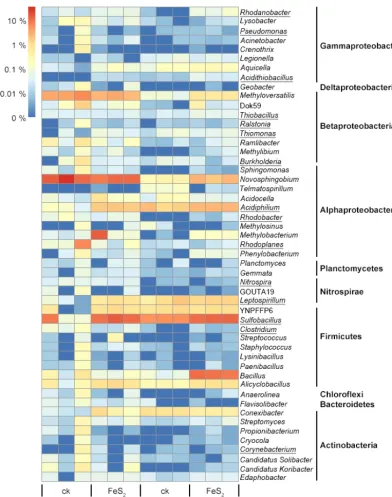
Rho-Figure 4. Heat map of the top genera with relative abundances above 0.02 % in mine tailings. Autotrophic bacteria were marked with underlining.
danobacter,Acidithiobacillus,Thiobacillus, and Sulfobacil-lus by 0.07 % (P =0.016), 0.03 % (P =0.034), 0.02 % (P =0.030), and 5.99 % (P <0.001), respectively.
3.3 DNA SIP identification of autotrophs in mine tailings
For quantitative analysis ofcbbLandcbbMgene abundances, the buoyant densities of the DNA in isopycnic centrifugation
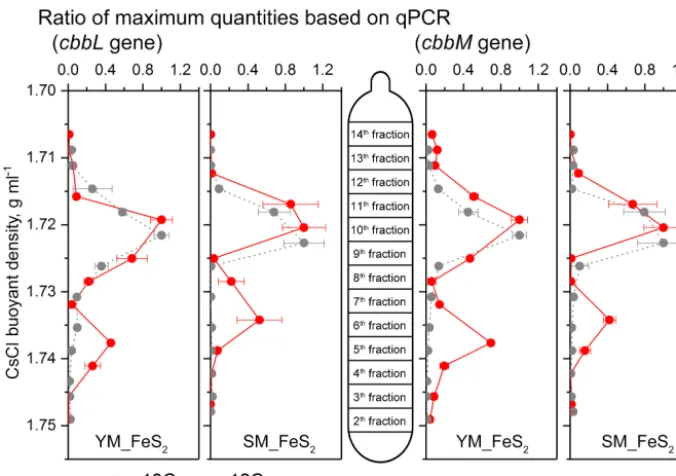
[image:6.612.102.494.62.559.2]Figure 5.Quantitative distribution ofcbbLandcbbMgene fragments across the entire buoyant density gradients of the DNA fractions from microcosms treated with FeS2and incubated with12C-CO2or13C-CO2. The normalized data consist of the ratio of the gene copy number for each DNA gradient to the maximum quantity for each treatment. The error bars represent the standard errors of triplicate microcosms, and each consisted of three technical replicates.cbbLandcbbMgene abundance qPCR data are presented in the Supplement.
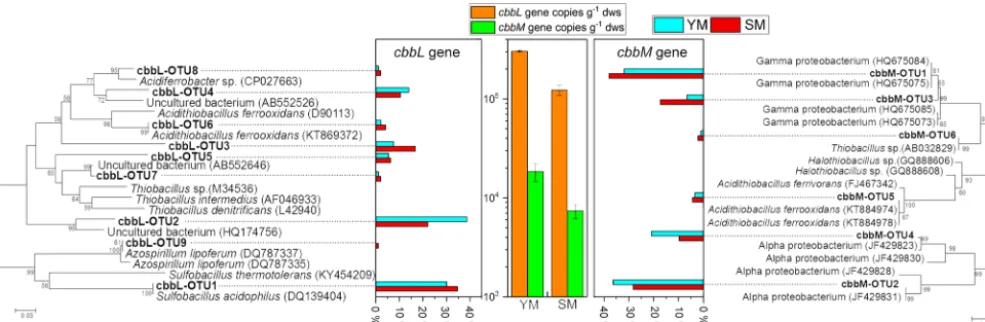
cbbM genes under the 12C-CO2 treatment appeared in the light fraction, with a buoyant density of 1.722–1.723 g mL−1. cbbLandcbbMsequences, encoding the large subunit of RuBisCO, from the clone libraries in the 13C-DNA heavy fraction treated with 13C-CO2 were used for phylogenetic analysis (Fig. 6). The gene copy numbers of cbbL were 16.50-fold and 8.20-fold greater than those of cbbMin the heavy fractions of YM_FeS2and SM_FeS2, respectively. In addition, a vast majority ofcbbLandcbbMgene sequences appear to be associated with unknown groups, with the ex-ception of cbbL-OTU1, cbbL-OTU6, cbbL-OTU9, cbbM-OTU5, and cbbM-OTU6. According to phylogenetic anal-ysis based on amino acid sequences, the cbbLgene OTUs are related toSulfobacillus,Acidithiobacillus, and Azospiril-lumand thecbbMgene OTUs are related toAcidithiobacillus andThiobacillus. TheSulfobacillus-likecbbLgene sequence cbbL-OTU1 accounted for 30.11 % and 34.74 % of the to-talcbbLgene sequences in the heavy fractions of YM_FeS2 and SM_ FeS2, respectively. Conversely, Acidithiobacillus-like cbbLand cbbM genes accounted for only 2.15 % and 4.21 % of the total cbbL gene sequences and 3.30 % and 4.35 % of the total cbbMgene sequences in the heavy frac-tions of YM_ FeS2and SM_FeS2, respectively. In addition, the genus Sulfobacillusexhibited the highest relative abun-dance based on 16S rRNA analysis (Table S2), accounting for 17.18 % and 18.24 % of the heavy fractions of YM_FeS2 and SM_FeS2, respectively. The Leptospirillum genus ac-counted for 1.32 % and 1.58 % of the heavy fractions of
YM_FeS2and SM_FeS2, respectively, andAcidithiobacillus accounted for 0.11 % and 0.06 % in the heavy fractions of YM_FeS2and SM_FeS2, respectively.
4 Discussion
4.1 The effect of FeS2on the entire bacterial community in mine tailings
Figure 6.Phylogenetic tree of translatedcbbLandcbbMsequences in the heavy fractions from YM and SM treated with FeS2. Relative frequencies (%) are marked in the bar graph. Bootstrap values of>50 % are indicated at branch points.cbbLandcbbMgene copy numbers in the heavy fractions from FeS2-treated YM and SM are shown in the middle of the figure. The cultured genera most related to OTUs from
cbbLandcbbMclone libraries are shown in Table S1.
process in mine tailings was accompanied by an increase in Firmicutes and a decrease in Actinobacteria as well as all classes of Proteobacteria except Gammaproteobacteria. In addition, Chen et al. (2013) and Liu et al. (2014) reported relative abundances of Euryarchaeota belonging to archaea significantly increased with decreasing pH, which indicates that this taxon is an indicator of metal contamination (Hur et al., 2011). Euryarchaeota compete with Betaproteobacte-ria for ecological niches under such acidic conditions (Liu et al., 2014). However, in this study archaea have been ignored, which will require further study.
The growth of microorganisms in bare mine tailings is usu-ally limited by the availability of organic carbon (Schimel and Weintraub, 2003). In our study, pyrite oxidization in mine tailings further increased the acidity of the mine tailings (pH decreased to 2.77 and 2.57 in YM_FeS2and SM_FeS2, respectively). As a result, only microorganisms that were able to overcome resistance to infertility and/or acidophilic conditions maintained high activities. The level of some spe-cific taxa, including the autotrophic genera Acidithiobacil-lus andSulfobacillus, increased in both of the tested mine tailings under pyrite addition (Fig. 4), indicating high con-sistency of dominant autotrophic bacterial genera in dif-ferent mine tailings. It is possible that acidophilic and/or autotrophic bacteria might be stimulated under conditions of pyrite oxidization and the availability of organic carbon (Deng et al., 2016; Antonelli et al., 2018); moreover, the main carbon fixers in these two mine tailings may be derived from the same groups. In addition, levels of major ferrous and sulfur-oxidizing genera, autotrophicLeptospirillumand Acidiphilium in YM_ FeS2 and autotrophicThiobacillusin SM_FeS2, were enhanced, suggesting the synchronization of pyrite oxidization and carbon sequestration in mine tailings.
4.2 The effect of FeS2on bacterial carbon sequestration in mine tailings
car-bonate mineral precipitation and further induces mineraliza-tion (McCutcheon et al., 2014, 2016). In the present study, however, the microcosms were not cultured in the presence of illumination, and as a result, chemoautotrophic microor-ganisms, particularly iron and/or sulfide oxidizers (such as Sulfobacillus), were the dominant carbon fixers. These re-sults indicate that bacterial carbon sequestration is mainly at-tributable to chemoautotrophic bacteria in mine tailings dur-ing pyrite oxidization. Nonetheless, archaea may have higher activities in RuBisCO-mediated carbon metabolic pathways (Kono et al., 2017), which will require further study.
During pyrite oxidization in mine tailings, some aci-dophilic autotrophic microorganisms showed very high ac-tivity levels; for example, levels of Sulfobacillus and Lep-tospirillum, both of which are vital ferrous and sulfur ox-idizers, increased significantly. Zhang et al. (2016) identi-fied genes for the CBB pathway and rTCA, but no other CO2 fixation pathways, in a copper bioleaching microbial community. Regarding the present study, the Sulfobacillus-likecbbLgene was the major carbon-fixing-associated gene found. ˇNancucheo and Johnson (2012) reported that among acidophilic prokaryotes isolated from mine-impacted envi-ronments, the ability to metabolize glycerate-3-phosphate appeared to be restricted to Firmicutes (e.g., Sulfobacillus) and that the glycerate-3-phosphate present in all of these acidophiles might be due to the activity of RuBisCO ( ˇ Nan-cucheo and Johnson, 2012). Previous studies have confirmed the existence ofSulfobacillusin mine tailings (Coral et al., 2018; Yu et al., 2018), and members of this genus have the ability to oxidize or reduce Fe(III) and oxidize sulfur (Dold et al., 2005). This ability is important because by adhering to mineral surfaces and further enhancing sulfide mineral ox-idation, Sulfobacillus likely leads to a high mineral disso-lution rate (Becker et al., 2011; Li et al., 2016). Although none of the cbbL or cbbM genes identified in our study were highly homologous to genes in Leptospirillum, Marín et al. (2017) reported that rTCA carbon fixation pathway genes were mainly found in Leptospirillum spp. RuBisCO is the most prominent enzyme, and the genes encoding the large subunit of RuBisCO serve as a marker for the anal-ysis of autotrophic organisms, including bacteria, using the CBB cycle (Berg, 2011). The Sulfobacillus-likecbbL gene dominated the13C-labeled DNA among carbon-fixing taxa, and the higher relative abundance ofSulfobacillusthan Lep-tospirillum, according to 16S rRNA analysis, demonstrates the contribution of the Sulfobacillus-like cbbLgene to car-bon sequestration. Regardless, although the number (or rel-ative abundance) of autotrophs demonstrated their ability to sequester carbon, it did not reflect their ability to perform or their importance to ferrous and sulfur oxidation. For ex-ample, the limited percentage ofAcidithiobacillusin the two mine tailings did not reflect the contribution of this genus to the oxidation of iron and sulfur. Falagán et al. (2017) high-lighted the importance of thermotolerant acidophiles, such as AcidithiobacillusandSulfobacillus, in extracting and
re-covering metals from mine tailings. Furthermore, it has been known for many years thatAcidithiobacilluscan obtain en-ergy by catalyzing oxidation of Fe2+to Fe3+ from sulfites
(Dold, 2014), which may significantly accelerate the rate of ferrous oxidization. The decreased level of total carbon, including low-molecular-weight carboxylic acids, may also limit the activity of this taxon (Dold et al., 2005).
In conclusion, this study is the first to elucidate carbon se-questration by autotrophic groups in the mine tailing acidi-fication process based on isotope tracers and DNA SIP. Our results reveal higher13C atom % values with the addition of pyrite than in controls after a 14-day incubation. The Sul-fobacillusgenus was dominant in the pyrite-treated bacterial communities and was also the primary carbon fixer carrying thecbbLgene. Overall, thecbbLgene may play a vital role in carbon sequestration in the sulfide mineral oxidation of mine tailings.
Data availability. The data are available from the first author and corresponding author upon request.
Supplement. The supplement related to this article is available online at: https://doi.org/10.5194/bg-16-573-2019-supplement.
Author contributions. YL, XD, and ZJ led the design of the study, assisted by QS. All sample collection and analyses were performed by YL, ZW, ZX, QZ, and HS. YL wrote the paper with contributions from ZW.
Competing interests. The authors declare that they have no conflict of interest.
Acknowledgements. This study was funded by the National Natural Science Foundation of China (31800456), the National Key Basic Research Program of China (2015CB150506), the Strategic Pri-ority Research Program of the CAS (XDB15040000), the Natural Science Foundation of the Anhui Provincial Education Department (KJ2018A0032), and the PhD Research Startup Foundation of Anhui University (J01003269).
Edited by: Luo Yu
Reviewed by: Weidong Kong and one anonymous referee
References
Antonelli, P. M., Fraser, L. H., Gardner, W. C., Broersma, K., Karakatsoulis, J., and Phillips, M. E.: Long term carbon seques-tration potential of biosolids-amended copper and molybdenum mine tailings following mine site reclamation, Ecol. Eng., 117, 38–49, https://doi.org/10.1016/j.ecoleng.2018.04.001, 2018. Becker, T., Gorham, N., Shiers, D. W., and Watling, H. R.:
In situ imaging of Sulfobacillus thermosulfidooxidans on pyrite under conditions of variable pH using tapping mode atomic force microscopy, Process. Biochem., 46, 966–976, https://doi.org/10.1016/j.procbio.2011.01.014, 2011.
Berg, I. A.: Ecological aspects of the distribution of different au-totrophic CO2fixation pathways, Appl. Environ. Microbiol., 77, 1925–1936, https://doi.org/10.1128/aem.02473-10, 2011. Campbell, B. J. and Cary, S. C.: Abundance of reverse tricarboxylic
acid cycle genes in free-living microorganisms at deep-sea hy-drothermal vents, Appl. Environ. Microbiol., 70, 6282–6289, https://doi.org/10.1128/AEM.70.10.6282-6289.2004, 2004. Chen, L., Li, J., Chen, Y., Huang, L., Hua, Z., Hu, M., and Shu, W.:
Shifts in microbial community composition and function in the acidification of a lead/zinc mine tailings, Environ. Microbiol., 15, 2431–2444, https://doi.org/10.1111/1462-2920.12114, 2013. Coral, T., Descostes, M., De Boissezon, H., Bernier-Latmani, R., de
Alencastro, L. F., and Rossi, P.: Microbial communities associ-ated with uranium in-situ recovery mining process are relassoci-ated to acid mine drainage assemblages, Sci. Total Environ., 628–629, 26–35, https://doi.org/10.1016/j.scitotenv.2018.01.321, 2018. Deng, X., Zhan, Y., Wang, F., Ma, W., Ren, Z., Chen, X., Qin,
F., Long, W., Zhu, Z., and Lv, X.: Soil organic carbon of an intensively reclaimed region in China: Current status and car-bon sequestration potential, Sci. Total Environ., 565, 539–546, https://doi.org/10.1016/j.scitotenv.2016.05.042, 2016.
Dold, B.: Evolution of acid mine drainage formation in sulphidic mine tailings, Minerals, 4, 621–641, 2014.
Dold, B., Blowes, D. W., Dickhout, R., Spangenberg, J. E., and Pfeifer, H.-R.: Low molecular weight carboxylic acids in oxidiz-ing porphyry copper tailoxidiz-ings, Environ. Sci. Technol., 39, 2515– 2521, https://doi.org/10.1021/es040082h, 2005.
Falagán, C., Grail, B. M., and Johnson, D. B.: New approaches for extracting and recovering metals from mine tailings, Miner. Eng., 106, 71–78, https://doi.org/10.1016/j.mineng.2016.10.008, 2017.
Harrison, A. L., Power, I. M., and Dipple, G. M.: Ac-celerated carbonation of brucite in mine tailings for car-bon sequestration, Environ. Sci. Technol., 47, 126–134, https://doi.org/10.1021/es3012854, 2013.
Heron, G., Crouzet, C., Bourg, A. C. M., and Christensen, T. H.: Speciation of Fe(II) and Fe(III) in contaminated aquifer sedi-ments using chemical extraction techniques, Environ. Sci. Tech-nol., 28, 1698–1705, https://doi.org/10.1021/es00058a023, 1994. Hu, Y., Mgelwa Abubakari, S., Singh Anand, N., and Zeng, D.: Dif-ferential responses of the soil nutrient status, biomass production, and nutrient uptake for three plant species to organic amend-ments of placer gold mine-tailing soils, Land Degrad. Dev., 29, 2836–2845, https://doi.org/10.1002/ldr.3002, 2018.
Hur, M., Kim, Y., Song, H.-R., Kim, J. M., Choi, Y. I., and Yi, H.: Effect of genetically modified poplars on soil mi-crobial communities during the phytoremediation of waste mine tailings, Appl. Environ. Microbiol., 77, 7611–7619, https://doi.org/10.1128/aem.06102-11, 2011.
Kono, T., Mehrotra, S., Endo, C., Kizu, N., Matusda, M., Kimura, H., Mizohata, E., Inoue, T., Hasunuma, T., Yokota, A., Mat-sumura, H., and Ashida, H.: A RuBisCO-mediated carbon metabolic pathway in methanogenic archaea, Nat. Comm., 8, 14007, https://doi.org/10.1038/ncomms14007, 2017.
Korehi, H., Blöthe, M., and Schippers, A.: Microbial diversity at the moderate acidic stage in three different sulfidic mine tail-ings dumps generating acid mine drainage, Res. Microbiol., 165, 713–718, https://doi.org/10.1016/j.resmic.2014.08.007, 2014. Li, Q., Sand, W., and Zhang, R.: Enhancement of biofilm
forma-tion on pyrite bySulfobacillus thermosulfidooxidans, Minerals, 6, e71, https://doi.org/10.3390/min6030071, 2016.
Li, X., Bond, P. L., Van Nostrand, J. D., Zhou, J., and Huang, L.: From lithotroph- to organotroph-dominant: Directional shift of microbial community in sulphidic tailings during phytostabi-lization, Sci. Rep., 5, 12978, https://doi.org/10.1038/srep12978, 2015.
Li, Y., Sun, Q., Zhan, J., Yang, Y., and Wang, D.: Soil-covered strategy for ecological restoration alters the bacterial commu-nity structure and predictive energy metabolic functions in mine tailings profiles, Appl. Microbiol. Biot., 101, 2549–2561, https://doi.org/10.1007/s00253-016-7969-7, 2017.
Liu, J., Hua, Z., Chen, L., Kuang, J., Li, S., Shu, W., and Huang, L.: Correlating microbial diversity patterns with geo-chemistry in an extreme and heterogeneous environment of mine tailings, Appl. Environ. Microbiol., 80, 3677–3686, https://doi.org/10.1128/aem.00294-14, 2014.
Lottermoser, B. G.: Mine wastes: characterization, treatment and environmental impacts, Springer, New York, 2010.
Marín, S., Acosta, M., Galleguillos, P., Chibwana, C., Strauss, H., and Demergasso, C.: Is the growth of mi-croorganisms limited by carbon availability during chal-copyrite bioleaching?, Hydrometallurgy, 168, 13–20, https://doi.org/10.1016/j.hydromet.2016.10.003, 2017.
McCutcheon, J., Power, I. M., Harrison, A. L., Dipple, G. M., and Southam, G.: A greenhouse-scale photosynthetic mi-crobial bioreactor for carbon sequestration in magnesium carbonate minerals, Environ. Sci. Technol., 48, 9142–9151, https://doi.org/10.1021/es500344s, 2014.
McCutcheon, J., Wilson, S. A., and Southam, G.: Micro-bially accelerated carbonate mineral precipitation as a strat-egy for in situ carbon sequestration and rehabilitation of as-bestos mine sites, Environ. Sci. Technol., 50, 1419–1427, https://doi.org/10.1021/acs.est.5b04293, 2016.
Meyer, N. A., Vögeli, J. U., Becker, M., Broadhurst, J. L., Reid, D. L., and Franzidis, J. P.: Mineral carbonation of PGM mine tailings for CO2storage in South Africa: A case study, Miner. Eng., 59, 45–51, https://doi.org/10.1016/j.mineng.2013.10.014, 2014.
Nanba, K., King, G. M., and Dunfield, K.: Analysis of faculta-tive lithotroph distribution and diversity on volcanic deposits by use of the large subunit of ribulose 1,5-bisphosphate car-boxylase/oxygenase, Appl. Environ. Microbiol., 70, 2245–2253, https://doi.org/10.1128/aem.70.4.2245-2253.2004, 2004. ˇ
Raven, J. A.: Rubisco: still the most abundant protein of Earth?, New Phytol., 198, 1–3, 2013.
Schimel, J. P. and Weintraub, M. N.: The implications of exoen-zyme activity on microbial carbon and nitrogen limitation in soil: a theoretical model, Soil Biol. Biochem., 35, 549–563, https://doi.org/10.1016/s0038-0717(03)00015-4, 2003.
Tabita, F. R.: Microbial ribulose 1,5-bisphosphate carboxy-lase/oxygenase: A different perspective, Photosynth. Res., 60, 1– 28, https://doi.org/10.1023/a:1006211417981, 1999.
Tabita, R. S., Sriram, Hanson, T. E., Kreel, N. E., and Scott, S. S.: Distinct form I, II, III, and IV Rubisco proteins from the three kingdoms of life provide clues about Rubisco evolution and structure/function relationships, J. Exp. Bot., 59, 1515–1524, 2008.
Wang, G., Welham, C., Feng, C., Chen, L., and Cao, F.: Enhanced soil carbon storage under agroforestry and afforestation in sub-tropical China, Forests, 6, 2307–2323, 2015.
White, A., Cannell, M. G. R., and Friend, A. D.: CO2 sta-bilization, climate change and the terrestrial carbon sink, Global change biology, Glob. Change Biol., 6, 817–833, https://doi.org/10.1046/j.1365-2486.2000.00358.x, 2000. Wilson, S. A., Dipple, G. M., Power, I. M., Thom, J. M., Anderson,
R. G., Raudsepp, M., Gabites, J. E., and Southam, G.: Carbon dioxide fixation within mine wastes of ultramafic-hosted ore de-posits: Examples from the Clinton Creek and Cassiar chrysotile deposits, Canada, Econ. Geol., 104, 95–112, 2009.
Yin, G., and Catalan, L. J.: Use of alkaline extraction to quantify sulfate concentration in oxidized mine tailings, J. Environ. Qual., 32, 2410–2413, 2003.
Young, I., Renault, S., and Markham, J.: Low levels or-ganic amendments improve fertility and plant cover on non-acid generating gold mine tailings, Ecol. Eng., 74, 250–257, https://doi.org/10.1016/j.ecoleng.2014.10.026, 2015.
Yu, R., Hou, C., Liu, A., Peng, T., Xia, M., Wu, X., Shen, L., Liu, Y., Li, J., Yang, F., Qiu, G., Chen, M., and Zeng, W.: Extracellular DNA enhances the adsorption ofSulfobacillus thermosulfidoox-idansstrain ST on chalcopyrite surface, Hydrometallurgy, 176, 97–103, https://doi.org/10.1016/j.hydromet.2018.01.018, 2018. Zhang, X., Niu, J., Liang, Y., Liu, X., and Yin, H.:
Metagenome-scale analysis yields insights into the structure and function of microbial communities in a copper bioleaching heap, BMC Ge-netics, 17, 21 pp., https://doi.org/10.1186/s12863-016-0330-4, 2016.
Zheng, Y., Huang, R., Wang, B. Z., Bodelier, P. L. E., and Jia, Z. J.: Competitive interactions between methane-and ammonia-oxidizing bacteria modulate carbon methane-and nitro-gen cycling in paddy soil, Biogeosciences, 11, 3353–3368, https://doi.org/10.5194/bg-11-3353-2014, 2014.