TOWARDS HPC AND BIG DATA CONVERGENCE IN A
COMPONENT BASED APPROACH
Supun Kamburugamuve
Submitted to the faculty of the University Graduate School
in partial fulfillment of the requirements
for the degree
Doctor of Philosophy
in the School of Informatics and Computing & Engineering
Indiana University
Accepted by the Graduate Faculty, Indiana University, in partial fulfillment of the
require-ments for the degree of Doctor of Philosophy.
Geoffrey Fox, Ph.D.
Martin Swany, Ph.D.
Judy Qiu, Ph.D.
Minje Kim, Ph.D.
Ryan Newton, Ph.D.
Copyright 2018
Supun Kamburugamuve
Acknowledgements
I have been blessed to be among many who have been guiding me and supporting me
throughout the years dedicated to this research.
I would like to thank my advisor Prof. Geoffrey Fox who gave invaluable and brilliant
research advice and directions. His remarkable insights and deep understanding of parallel
and distributed computing made possible this research. I’m privileged to be able to conduct
this research with his guidance.
I would like to thank Prof. Judy Qiu, whom I have worked with on different areas
including research, teaching and different software projects for her guidance and support.
Prof. Martin Swany gave great insights for communication improvements. I’m grateful to
Prof. David Crandall for his inputs on robotics algorithms we worked together. I would
like to thank Prof. Minje Kim and Prof. Ryan Newton for their valuable inputs.
I owe a lot to Dr. Sanjiva Weerawarana who encouraged me to pursue a graduate
degree. Without his encouragement, I would not have enrolled in a PhD program. Special
thanks go to Saliya Ekanayake whom I had the privilege to work with while he was an PhD
candidate under the same advisor. We shared ideas and worked on projects together and it
was a pleasure working with him. I would like to thank Henjing He who was a visiting
student from Dept. of Electrical Engineering, Tsinghua University in developing robotics
Further, I would like to thank team members of Twister2 project who are contributing to
making the Twister2 project a reality. Especially I would like to thank Pulasthi
Wickramas-inghe whom I worked on many research projects prior to Twister2. Kannan Govindarajan,
Ahmet Uyar, Gurhan Gunduz and Vibhatha Abeykoon are major contributors to the Twister2
project. I would like to thank systems administrators, especially Allan Streib, of our lab
who provided an excellent service to make this research a success.
Words cannot explain the love, support, and encouragement of my parents. They have
taught me to be ambitious and do things otherwise I would not have done.
None of this research would have been possible if not for my wife Chathuri who has
been with me throughout highs and lows of graduate life. Her love and support guided me
through the graduate life. My son Seth is too little to understand what his daddy is doing
Supun Kamburugamuve
TOWARDS HPC AND BIG DATA CONVERGENCE IN A COMPONENT BASED
APPROACH
Data-driven applications are essential to handle the ever-increasing volume, velocity, and
veracity of data generated by Web and Internet of things devices. Event-driven
computa-tional paradigm is emerging as the core of modern systems designed for database queries,
data analytics, and on-demand applications. Modern big data processing runtimes and
asynchronous many task (AMT) systems from high-performance computing (HPC)
commu-nity have adopted dataflow event-driven model. An event-driven distributed computing
platform consists of well-understood components such as communication, task
manage-ment, data management and fault tolerance. Different design choices adopted by these
components determine the type of applications a system can support efficiently.
Stream and batch data analytics applications are dominant with systems such as Hadoop,
Spark, and Heron are designed to execute them. This thesis investigates modern Apache
big data systems with different applications and compares their designs and performance
with classic HPC techniques. It shows that by using HPC features such as high performance
interconnects one can improve the performance of big data systems. Further, it recognizes
that these systems are mostly developed as single projects with fixed design choices at
To overcome design limitations of modern big data systems, a loosely coupled
component-based big data toolkit is proposed and its design and implementation are discussed. This
approach allows components to have different implementations to support different
appli-cations. Further, the thesis recognizes the requirements of both dataflow used in Apache
Systems and the Bulk Synchronous Processing style in HPC for different applications.
Mes-sage passing interface(MPI) implementations are dominant in HPC, but there are no such
standard libraries available for data processing. The thesis presents a novel stand-alone,
highly optimized dataflow style parallel communication library that can be used by big data
Geoffrey Fox, Ph.D.
Martin Swany, Ph.D.
Judy Qiu, Ph.D.
Minje Kim, Ph.D.
Contents
Abstract i
List of Figures xiv
Chapter 1. Introduction 1
1.1. Overview 1
1.2. Research Challenges 4
1.3. Outline 6
Chapter 2. Related Work 7
2.1. Batch Systems 7
2.2. Streaming Systems 8
2.3. HPC Frameworks 9
2.4. HPC Intergration to big data 10
2.5. Messaging for Big Data 12
2.6. Workflow Systems 14
Chapter 3. Big data landscape 15
3.1. Big Data Applications 15
3.2. Data flow and MPI 21
3.4. Algorithms on MPI, Spark and Flink 28
3.5. Performance of MPI, Spark and Flink 39
3.6. Discussion 43
3.7. Summary 45
Chapter 4. Batch Applications 46
4.1. Time series data visualization 46
4.2. Data Processing Workflow 48
4.3. WebPlotViz Visualization Software 52
4.4. Stock Data Analysis 56
4.5. Discussion 65
4.6. Summary 68
Chapter 5. Streaming applications 70
5.1. Cloud-based Parallel Implementation of SLAM for Mobile Robots 70
5.2. Background 72
5.3. Streaming parallel algorithm 76
5.4. Results & Discussion 79
5.5. Summary 85
Chapter 6. HPC integration to Big Data 87
6.1. HPC techniques with Apache Storm 87
6.2. Broadcast 91
6.4. Experiment Setup 96
6.5. Results & Discussion 97
6.6. Infiniband & Omni-Path for Apache Heron 101
6.7. Background 103
6.8. Apache Heron 107
6.9. Implementation 110
6.10. Experiments 114
6.11. Results & Discussion 117
Chapter 7. Next generation distributed and parallel frameworks 122
7.1. Choice of tools 123
7.2. Multiple abstractions 124
7.3. Dataflow vs Workflow 125
7.4. Next generation frameworks 126
Chapter 8. Twister2: Big data toolkit 128
8.1. Introduction 128
8.2. Toolkit Components 129
8.3. Communication 132
8.4. Task System 137
8.5. Distributed Data 144
8.6. Fault Tolerance 146
Chapter 9. Twister:Net 153
9.1. Introduction 153
9.2. Dataflow for Big Data 155
9.3. Dataflow Communication Requirements 157
9.4. Twister2:Net 158
9.5. Communication Model 160
9.6. Communication Spilling to Disk 163
9.7. Evaluation 165
9.8. SLAM Algorithm with Twister:Net 170
9.9. Summary 173
Chapter 10. Resource Scheduling and Task System 174
10.1. Resource Allocation 174
10.2. Task System 176
Chapter 11. Conclusion 178
11.1. Future Work 179
Bibliography 182
List of Figures
3.1 Load imbalance and velocity of data 17
3.2 Hierarchical data partitioning of a big data application 17
3.3 MPI applications arranged in a workflow 19
3.4 Microservices using FaaS, Left: Functions using a workflow, Right: Functions in a
dataflow 19
3.5 Dataflow application execution, Left: Streaming execution, Middle: Data
pipelines executing in stages, Right: Iterative execution 19
3.6 Logical graph of a data flow 22
3.7 Execution graph of a data flow 22
3.8 Execution flow of MPI program with compute and communication regions 23
3.9 A sample stream processing user defined graph 27
3.10 A sample stream processing execution graph 27
3.11 Storm task distribution in multiple nodes 28
3.12 Multidimensional Scaling algorithm with Deterministic Annealing control flow 30
3.14 Parallel sorting flow. Large boxes show the processes/tasks and small boxes are
input files and output files. 37
3.15 MPI’s data shuffling algorithm. Processes send and receive in a ring topology. 38
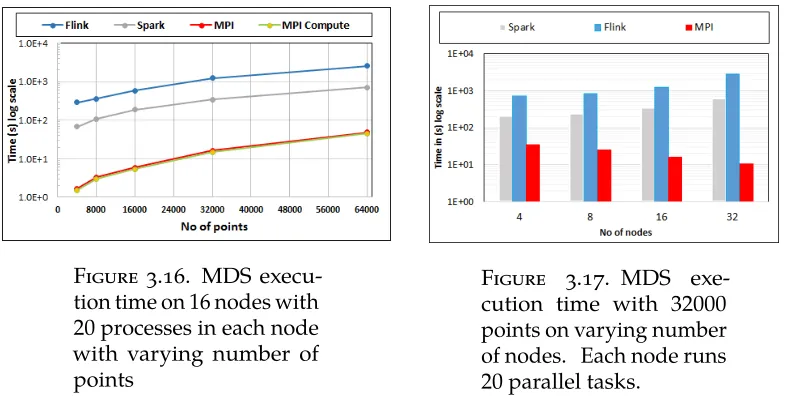
3.16 MDS execution time on 16 nodes with 20 processes in each node with varying
number of points 39
3.17 MDS execution time with 32000 points on varying number of nodes. Each node
runs 20 parallel tasks. 39
3.18 K-Means execution time on 16 nodes with 20 parallel tasks in each node with 10
million points and varying number of centroids. Each point has 100 attributes. 40
3.19 K-Means execution time on varying number of nodes with 20 processes in each
node with 10 million points and 16000 centroids. Each point has 100 attributes. 40
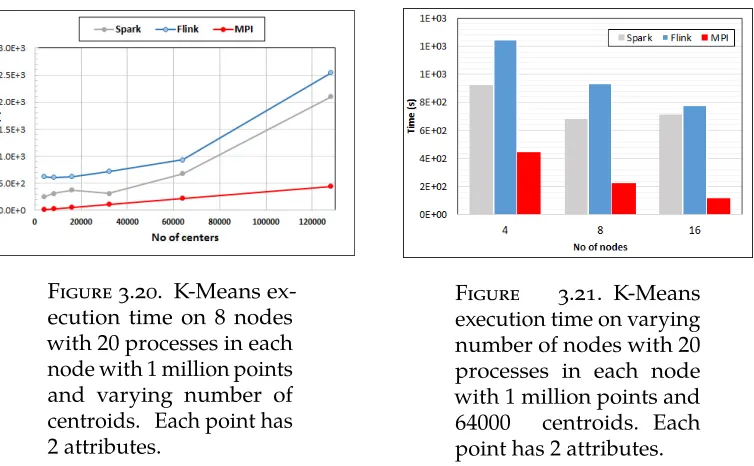
3.20 K-Means execution time on 8 nodes with 20 processes in each node with 1 million
points and varying number of centroids. Each point has 2 attributes. 41
3.21 K-Means execution time on varying number of nodes with 20 processes in each
node with 1 million points and 64000 centroids. Each point has 2 attributes. 41
3.22 Terasort execution time in 64 and 32 nodes. Only MPI shows the sorting time and
communication time as other two frameworks doesn’t provide a viable method to
accurately measure them. Sorting time includes data save time. MPI-IB - MPI
with Infiniband 42
3.23 Reduce operation time with 640 parallel tasks in 32 nodes. Integer array with
4.1 Data processing workflow 49
4.2 WebPlotViz view area with various options 54
4.3 Cluster of points and a tree visualized with WebPlotViz 55
4.4 Four Consecutive Plots of L given by Eq. 4 55
4.5 Two sample plots from Stock velocities 59
4.6 Four Consecutive Plots of L given by Eq. 4 59
4.7 Two views of leading finance stocks final position trajectories for L given by Eq. 4
with accumulating data segments 60
4.8 Heatmap(right) of original distance to projected distance and original distance
distribution(left) 63
4.9 MDS performance on 4, 8 and 16 nodes with points ranging from 1000 to 64000.
Each node has 24 MPI processes. Different lines shows the different parallelisms
used. 64
4.10 MDS final Stress and alignment fit when applying independent MDS for
consecutive plots, x axis shows the time series 65
4.11 MDS final Stress and alignment fit when initializing MDS with the previous data
segment’s solution, x axis shows the time series 65
4.12 MDS alignment fit for 1 Day shift with Accumulating segmentation and Log
distances 66
5.2 GMapping Robotics application 74
5.3 Storm streaming workflow for parallel RBPF SLAM. 77
5.4 Parallel behavior of the algorithm for the Simbad dataset with 640 laser readings (left) and
the ACES dataset with 180 readings (right). For each dataset, the top graph shows mean
times with standard deviations and the bottom graph shows the speedup. 80
5.5 Overhead on the Simbad dataset: (a) I/O, garbage collection, and Compute time.
(b) Overhead of imbalanced parallel computation. 81
5.6 Computation time across individual readings, for Simbad and 60 particles. (a)
Serial time, (b) Parallel without cutoff, (c, d) Two trials of parallel with cutoff at 140
steps 82
5.7 Average time and speedup for Simbad with cutoff at 140 83
5.8 Resampling overhead with Simbad 84
5.9 Parallel overhead with cutoff at 140 84
5.10 Map of ACES 84
6.1 Example broadcasting communications for each algorithm in a 4 node cluster with
each machine having 4 workers. The outer green boxes show cluster machines and
inner small boxes show workers. The top box displays the broadcasting worker
and arrows illustrate the communication among the workers 92
6.2 The structure of the shared memory file 94
6.5 Relative Importance of Shared Memory Communication compared to TCP in a
broadcasting ring, (a) The time for TCP communications. (b) Y-axis shows the
difference in latency for TCP implementation and shared memory implementation
(TCP - SHM) 97
6.6 Latency of serial, binary tree, flat tree and bi-directional ring implementations.
Different lines show varying parallel tasks with TCP communications and shared
memory communications(SHM). 98
6.7 Throughput of serial, binary tree, flat tree and ring implementations. Different
lines show varying parallel tasks with TCP communications and shared memory
communications (SHM) 99
6.8 The distribution of message latencies for 100K messages with 60 tasks. The X-axis
shows normalized latencies and Y-axis shows the percentage of messages observed
for a latency 99
6.9 High level architecture of Heron. Each outer box shows a resource container
allocated by a resource scheduler like Mesos or Slurm. The arrows show the
communication links between different components. 107
6.10 Heron high performance interconnects are between the stream managers 111
6.11 Topology A: Deep topology with a spout and multiple bolts arranged in a chain.
The spout and bolt run multiple parallel instances. 115
6.12 Topology B: Shallow topology with a spout and bolt connected in a shuffle
6.13 Yahoo Streaming benchmark with 7 stages. The join bolts and sink bolts
communicate with a Redis server. 116
6.14 Latency of the Topology A with 1 spout and 7 bolt instances arranged in a chain
with varying parallelism and message sizes. a) and b) are with 2 parallelism and
c) and d) are with 128k and 128bytes messages. The results are on Haswell cluster
with IB. 117
6.15 Latency of the Topology B with 32 parallel bolt instances and varying number of
spouts and message sizes. a) and b) are with 16 spouts and c) and d) are with 128k
and 128bytes messages. The results are on Haswell cluster with IB. 118
6.16 Latency of the Topology A with 1 spout and 7 bolt instances arranged in a chain
with varying parallelism and message sizes. a) and b) are with 2 parallelism and
c) and d) are with 128k and 128bytes messages. The results are on KNL cluster. 118
6.17 Throughput of the Topology B with 32 bolt instances and varying message sizes
and spout instances. The message size varies from 16K to 512K bytes. The spouts
are changed from 8 to 32. 118
6.18 Percent of messages completed within a given latency for the Topology A with
in-flight messages at 100 and 10 with 128K messages and 8 parallelism 119
6.19 Percent of messages completed within a given latency for the Yahoo! streaming
benchmark with InfiniBand network. The experiment was conducted in Haswell
6.20 The total time to finish the messages vs the total time to serialize the messages
using protobuf and Kryo. Top. B with 8 parallelism for bolts and spouts used.
Times are for 20000 large messages and 200000 small messages. The experiment is
conducted on Haswell cluster. 119
7.1 HPC workflow for application orchestration 125
7.2 Coarse grain dataflow graph with fine grain graphs as in streaming and BSP
application 126
7.3 Overall system view of future systems, each layer will have different API’s 127
8.1 Runtime architecture of Twister2 130
8.2 Default implementation of a dataflow reduce 136
8.3 Optimized dataflow reduce operation with sub-tasks arranged in a tree 136
8.4 Left: User graph, Right: execution graph of a data flow 137
8.5 RR Task Scheduling (Homogeneous Containers and Heterogeneous Task Instances) 141
8.6 FF Task Scheduling (Heterogeneous Containers and Heterogeneous Task Instances) 141
8.7 DLA Task Scheduling (Execution on the Data Nodes) 141
8.8 DLA Task Scheduling (Execution Closer to the Data Nodes) 141
8.9 Example execution graph forlogFile.map(...).f ilter(...).reduceByKey(...).f orEach(...)146
8.10 Twister2 Big Data Toolkit API levels 150
9.1 Dataflow vs. BSP graph structure 155
9.3 Twister:Net Architecture 159
9.4 Reduce Operation as a Graph Extension,left: Optimized graphright: Default
graph 159
9.5 Latency of MPI and Twister:Net with different message sizes on a two-node setup 165
9.6 Bandwidth utilization of Flink, Twister2 and OpenMPI over 1Gbps, 10Gbps and IB 165
9.7 Latency of Heron and Twister:Net for Reduce, Broadcast and Partition operations
in 16 nodes with 256-way parallelism 169
9.8 Total time for Flink and Twister:Net for Reduce and Partition operations in 32
nodes with 640-way parallelism. The time is for 1 million messages in each parallel
unit, with the given message size 170
9.9 Latency for OpenMPI and Twister:Net for Reduce and Gather operations in 32
nodes with 256-way parallelism. The time is for 1 million messages in each parallel
unit, with the given message size. Infiniband network is used. 170
9.10 Left: K-means job execution time on 16 nodes with varying centers, 2 million
points with 320-way parallelism. Right: K-Means wth 4,8 and 16 nodes where
each node having 20 tasks. 2 million points with 16000 centers used. 171
9.11 Left: Terasort time on a 16 node cluster with 384 parallelism. BSP and DFW
shows the communication time. Right: Terasort on 32 nodes with .5 TB and 1TB
9.12 SLAM Algorithm implemented with Twister2. The parallel computing happens
using BSP style communications. The stream of events are handled by the
dispatcher and broadcast to the BSP tasks using dataflow communications. 172
9.13 SLAM speedup with Twister:Net for 180 laser readings and 100 particles. 172
9.14 SLAM speedup with Twister:Net for 640 laser readings and 100 particles. 173
10.1 Runtime architecture of Twister2 175
CHAPTER 1
Introduction
1.1. Overview
Big data has been characterized by the ever-increasing velocity, volume, and veracity
of the data generated from various sources, ranging from web users to Internet of Things
devices to large scientific equipment. The data have to be processed as individual streams
and analyzed collectively, either in streaming or batch settings for knowledge discovery
with both database queries and sophisticated machine learning. These applications need
to run as services in cloud environments as well as traditional high performance clusters.
With the proliferation of cloud-based systems and Internet of Things, edge computing [32]
is adding another dimension to these applications where part of the processing has to occur
near the devices.
Parallel and distributed computing are essential to process big data owing to the data
being naturally distributed and processing often requiring high performance in compute,
communicate and I/O arenas. Over the years, the High Performance Computing
commu-nity has developed frameworks such as message passing interface to execute computationally
intensive parallel applications efficiently. HPC applications target high performance
hard-ware, including low latency networks due to the scale of the applications and the required
tight synchronous parallel operations. Big data applications have been developed for
more suitable for executing asynchronous parallel applications with high computation to
communication ratios. Recently, we have observed that more capable hardware comparable
to HPC clusters is being added to modern clouds due to increasing demand for cloud
applications in deep learning and machine learning. These trends suggest that HPC and
cloud are merging, and we need frameworks that combine the capabilities of both big data
and HPC frameworks.
There are many properties of data applications that influence the design of those
frame-works developed to process them. Numerous application classes exist, including database
queries, management, and data analytics, from complex machine learning to pleasingly
par-allel event processing. A common issue is that the data can be too big to fit into the memory
of even a large cluster. In another aspect, it is impractical to always expect a balanced data
set from the processing standpoint across the nodes. This follows from the fact that initial
data in the raw form is usually not load balanced and often require too much time and disk
space to balance the data. Also, the batch data processing is often insufficient, as much
data is streamed and needs to be processed online with reasonable time constraints before
being stored to disk. Finally, the data may be varied and have processing time that varies
between data points and across iterations of algorithms.
Even though MPI is designed as a generic messaging API, a developer has to focus on file
access, with disks in case of insufficient memory and relying mostly on send/receive
opera-tions to develop higher level communication operaopera-tions in order to express communication
in a big data application. Adding to this mix is the increasing complexity of hardware, with
It is becoming burdensome to develop efficient applications on these new architectures
using the low-level capabilities provided by MPI. Meanwhile, the success of Harp [153] has
highlighted the importance of the Map-Collective computing paradigm.
The dataflow [75] computation model has been presented as a way to hide some of the
system-level details from the user in developing parallel applications. With dataflow, an
application is represented as a graph with nodes doing computations and edges indicating
communications between the nodes. A computation at a node is activated when it receives
events through its inputs. A well-designed dataflow framework hides the low-level details
such as communications, concurrency, and disk I/O, allowing the developer to focus on the
application itself. Every major big data processing system has been developed according
to the dataflow model, and the HPC community has also developed asynchronous many
tasks systems (AMT) according to the same model. AMT systems mostly focus on
compu-tationally intensive applications, and there is ongoing research to make them more efficient
and productive. We find that big data systems developed according to a dataflow model
are inefficient in computationally intensive applications with tightly synchronized parallel
operations [95], while AMT systems are not optimized for data processing.
At the core of the dataflow model is an event-driven architecture where tasks act upon
incoming events (messages) and produce output events. In general, a task can be viewed
as a function activated by an event. The cloud-based services architecture is moving to an
increasingly event-driven model for composing services in the form of Function as a Service
its natural form. Coupled with microservices and server-less computing, FaaS is driving
next-generation services in the cloud and can be extended to the edge.
1.2. Research Challenges
Because of the underlying event-driven nature of both data analytics and message-driven
services architecture, we can find many common aspects among the frameworks designed to
process data and services. Such architectures can be decomposed into components such as
resource provisioning, communication, task scheduling, task execution, data management,
fault tolerance mechanisms, and user APIs. High-level design choices are available at each
of these layers that will determine the type of applications a framework composed of these
layers can support efficiently. We observe that modern systems are designed with fixed sets
of design choices at each layer, rendering them only suitable for a narrow set of applications.
The thesis shows the results of Machine learning algorithms and data processing
work-loads on Spark, Flink, and MPI. Also, it describes the contributions to integrate high
per-formance interconnects to Heron and how the perper-formance of Storm was improved using
algorithmic techniques. The thesis also describes an end-to-end batch application and
a streaming application developed using MPI and a streaming engine. With this work,
following conclusions were made regarding current Big data frameworks.
(1) Major big data systems are developed according to the dataflow model
(2) There are many decisions to be taken at different aspects of a framework that
determine the type of applications it can support
(3) Every system rely on the same components, but they have different implementations
(4) One cannot use these components independently or improve them easily because
of the tight integration
This thesis recognizes the need to clearly define the architecture of next generation
systems that will take advantage of both HPC and Cloud environments. Because of the
common underlying event-driven model, it is possible to build each component separately
with clear abstractions supporting different design choices. We present a design and
imple-mentation of a polymorphic system using these components to produce a system according
to the requirements of the applications, which we term the toolkit approach. We believe
such an approach will allow the system to be configured to support different types of
appli-cations efficiently. The project is called Twister2, encompassing the concept of the toolkit.
Twister2 will be a cloud native framework [4, 64] including Server-less FaaS.
Further, the thesis addresses the core question of what is the difference between HPC
and Big data processing. It is fair to say that HPC mostly revolves around Message Passing
Interface standard which is a Bulk Synchronous Processing model. Consequently, we
rec-ognize the requirements of both dataflow used in popular Apache Systems and the BSP
communication style common in High-Performance Computing(HPC) for different
applica-tions. Message passing interface implementations are dominant in HPC but there are no
such standard libraries available for big data. Twister:Net is the communication component
of Twister2, which has been developed as a stand-alone library for big data applications
supporting dataflow communications. Bulk synchronous parallel(BSP) communication as
implemented by MPI or Harp [154] can be used in Twister2 as well. The dataflow
it to be deployed in both HPC and cloud environments. In this thesis we present, dataflow
communications of Twister:Net and compare it to the existing big data frameworks in order
to show it can achieve equivalent performance or better with existing frameworks. Also, we
look at MPI communications and big data requirements and compare different applications
in those settings.
1.3. Outline
Rest of the thesis is organized as chapters. Chapter 6 discusses related work in the area
of HPC and big data computing for streaming and batch big data processing. Chapter 3
presents different application areas, frameworks, and three applications developed using
HPC and big data tools. It compares the performance of these applications and showcases
the differences between HPC and big data frameworks. This chapter forms the basis of the
thesis by discussing the strengths and weaknesses of existing systems.
Chapter 4 describes an end-to-end machine learning algorithm developed using HPC
technologies and big data. Chapter 5 describes an end-to-end streaming application for
an-alyzing robotics data. These two chapters discuss the requirements of batch and streaming
applications. Chapter 7 introduces the requirements and expectations of next generation
parallel and distributed systems.
Chapter 8 introduces the Twister2 framework with different requirements and
com-ponents. Chapter 9 introduces a novel communication library of Twister2 for big data
processing. Chapter 10 briefly introduces the Twister2 task system and resource scheduler
CHAPTER 2
Related Work
2.1. Batch Systems
Hadoop [144] was the first major open-source platform developed to process large
amounts of data in parallel. The map-reduce [47] functional model introduced by Hadoop
is well understood and adapted for writing distributed pleasingly parallel and one-pass
applications. Coupled with Java, it provides a great tool for average programmers to process
data in parallel. Soon enough, though, the shortcomings of HadoopâĂŹs simple API and its
disk-based communications [52] became apparent, and systems such as Apache Spark [151]
and Apache Flink [38] were developed to overcome them. These systems are designed
according to the dataflow model and their execution models and APIs closely follow dataflow
semantics. Some other examples of batch processing systems include Microsoft Naiad [118],
Apache Apex [13] and Google Dataflow [19]. It is interesting to note that even with all its
well-known inefficiencies, Hadoop is still being used by many people for data processing.
Note that some of the systems process both streaming and batch data in a unified way such
as Apache Apex, Google Dataflow, Naiad, and Apache Flink. Apache Beam [19] is a project
developed to provide a unified API for both batch and streaming pipelines. It acts as a
compiler and can translate a program written in its API to a supported batch or streaming
runtime. Prior to modern distributed streaming systems, research was done on shared
In task execution management and scheduling to acquire a fault tolerant system, Akka
framework has provided a pluggable implementation to manage task execution in other
systems. The actor-based model in Akka offers a versatile implementation in obtaining
a fault-tolerant and scalable solution. With the actor model, various topologies can be
designed to meet the requirements in a system.
2.2. Streaming Systems
There are several other DSPFs available, each solving specific problems with their
own strengths. Such open source DSPFs includeApache Storm [140], Apache Heron [100],
Apache Samza [125], Apache S4 [122], Apache Flink [1] and Apache Spark Streaming [152],
with commercial solutions including Google Millwheel [18], Azure Stream Analytics and
Amazon Kinesis. Early research in DSPFs include Aurora [15], Boreiles [11] and Spade [66].
Apache Spark Streaming uses micro-batch jobs on top of its batch engine to achieve
stream-ing computations while Samza is a storage-first processstream-ing framework; both target high
throughput applications rather than low latency applications. Apache Flink is comparable
to Storm in its underlying execution and supports low latency message processing.
Neptune [36] and Heron [100] improve some of the inefficiencies of Apache Storm.
Heron addresses issues in the task scheduling, enhance flow control by handling back
pressure and improves connection management for large applications and task isolation
for better performance in Storm. Neptune streamlines the throughput of applications by
using multiple threads for processing and efficient memory management. Apache Flink
employs efficient fault tolerance and message processing guarantee algorithms [38] that
compared to the upstream backup [85] mechanisms utilized by DSPFs such as Apache Storm.
Further, Nasir et al. [120] utilize a probabilistic algorithm in Storm’s load balancing message
distribution operator to avoid imbalance workloads in tasks. Adaptive scheduling [24]
improves the scheduling of Storm by taking into account the communication patterns
among the tasks and Cardellini et al. [39] has improved scheduling to take QoS into account.
All these systems follow the data flow model with comparable features to each other.
Stream bench [104] is a benchmark developed to evaluate the performance of these systems
in detail. These systems are primarily optimized for commodity hardware and clouds.
There has been much research done around Apache Storm and Apache Heron to improve its
capabilities. [61] described architectural and design improvements to Heron that improved
its performance much further.
2.3. HPC Frameworks
There is an ongoing effort in the HPC community to develop AMT systems for realizing
the full potential of multicore and many-core machines, as well as handling irregular parallel
applications in a more robust fashion. It is widely accepted that writing efficient programs
with the existing capabilities of MPI is difficult due to the bare minimum capabilities it
provides. AMT systems model computations as dataflow graphs and use shared memory
and threading to achieve the best performance out of many-core machines. Such systems
include OCR [115], DADuE [33], Charm++ [88], COMPS [44] and HPX [135], all of which
focus on dynamic scheduling of the computation graph. A portability API is developed
while reducing the burden of the user having to write such programs using MPI. Prior to
this, there was much focus in the HPC community on developing programs that could bring
automatic parallelism to users such as Parallel Fortran [35]. Research has been done with
MPI to understand the effect of computer noise on collective communication operations [17,
79, 80]. For large computations, computer noise coming from an operating system can play
a major role in reducing performance. Asynchronous collective operations can be used
to reduce the noise in such situations, but it is not guaranteed to completely eliminate the
burden.
2.4. HPC Intergration to big data
In large part, HPC and Big Data systems have evolved independently over the years.
Despite this, there are common requirements that raise similar issues in both types of
systems. Some of these issues are solved in HPC and some in Big Data frameworks. As
such, there have been efforts to converge both HPC and Big Data technologies to create better
systems that can work in different environments efficiently. SPIDAL [60] and HiBD are two
such efforts to enhance the Big Data frameworks with ideas and tools from HPC. This work
is part of an ongoing effort by the authors to improve stream engine performance using
HPC techniques. Previously we showed [89] how to leverage shared memory and collective
communication algorithms to increase the performance of Apache Storm. Also, the authors
have looked at various available network protocols for Big Data applications [139].
There are synergies between HPC and big data systems, and authors [58, 60] among
others [86] have expressed the need to enhance these systems by taking ideas from each
and processes, cache, memory management in NUMA [31], as well as multi-core settings
for machine learning algorithms with MPI. DataMPI [102] uses MPI to build Hadoop-like
systems while [22] uses MPI communications in Spark for better performance. Our toolkit
approach as proposed in Twister2 makes interoperability easier at the usage level, as one
can change lower level components to fit different environments without changing the
programmatic or user interface.
In recent years there have been multiple efforts to integrate high performance
inter-connects with machine learning and big data frameworks. InfiniBand has been integrated
into Spark [110] where the focus is on the Spark batch processing aspects rather than the
streaming aspects. Spark is not considered a native stream processing engine and only
implements streaming as an extension to its batch engine, making its latency inadequate
for low latency applications. Recently InfiniBand has been integrated into Hadoop [108],
along with HDFS [86] as well. Hadoop, HDFS, and Spark all use Java runtime for their
implementations, hence the RDMA was integrated using JNI wrappers to C/C++ codes that
invoke the underlying RDMA implementations. Recent work has added RDMA support
for the Tensorflow [16] machine learning framework.
High performance interconnects have been widely used by the HPC community, and
most MPI(Message Passing Interface) implementations have support for a large number of
interconnects that are available today. Some early work that describes in detail about RDMA
for MPI can be found in [103]. There has even been some work to build Hadoop-like systems
using the existing MPI capabilities [109]. Photon [96] is a higher level RDMA library that can
use RDMA over Ethernet to increase the maximum packets per second processed at a node
while decreasing latency. Heron doesn’t take into account the network when scheduling
tasks into available nodes and it would be interesting to consider network latencies as
described in [87, 97] for task scheduling.
2.5. Messaging for Big Data
Message Passing Interface (MPI) [12] is primarily responsible for addressing messaging
in parallel computing. It mainly supports two types of communications, point-to-point,
and collective communication. The traditional reduce/aggregate communication pattern
in Spark [8] sends all the partitions reduced data values into the driver program. However,
the driver program occupies a linear amount of time in those partitions that can lead to a
performance bottleneck if there are multiple data partitions and the data partition size is large.
To reduce the bottleneck, Apache Spark 1.1 [9] has introduced new communication patterns
named TreeReduce and TreeAggregate which are based on the multi-level aggregation tree
technique. In this technique, the data partitions are combined into a small set of executors
in a partial manner before they are sent to the driver program, which reduces the load of
the driver program and improves the performance.
Apache Flink [37] follows the data-streaming paradigm, thereby providing a unified
architecture for both batch and streaming processing in the programming model and
execu-tion engine. In Flink, the streams distribute the data based on the various communicaexecu-tion
patterns, namely point-to-point, broadcast, re-partition, fan-out and merge. In Storm and
Heron [10], a spout is a source of input data streams for the topology and a bolt is a
which defines the method to partition the data stream into bolt tasks. It consists of eight
built-in custom stream grouping concepts, namely shuffle grouping, field grouping, partial
key grouping, all grouping, global grouping, none grouping (similar to shuffle grouping),
direct grouping, and local or shuffle grouping. Harp [154] is a framework which is mainly
designed to run big data analytic algorithms on High Performance Computing architectures.
It is comprised of two main layers, computation and communication. The
communica-tion library is implemented similar to MPI collective communicacommunica-tion operacommunica-tions which are
highly optimized for big data analytics and machine learning algorithms. COMPS [44] is a
task-based environment for Spark-like applications in HPC.
MRNet [130] is a software-based reduction network specifically designed for scalable
tools to achieve scalable performance and multicast support. It uses a communicator for
representing groups of network points. Similar to MPI, MRNet provides the support for
point-to-point and multicast or broadcast communications. DataMPI [106] communication
library is an extended MPI specification to achieve Hadoop-like communications.
Cur-rently, it only supports single program and multiple data (Common), but they intended
to support MapReduce, Streaming, and Iterations in the future. There are many ongoing
efforts to incorporate HPC features into existing big data frameworks, including RDMA
support for frameworks such as Spark [107], Hadoop [105], and Apache Heron [94]. The
authors previously worked on improving Apache Storm’s performance using collective
2.6. Workflow Systems
In practice, multiple algorithms and data processing applications are combined together
in workflows to create complete applications. Systems such as Apache NiFi [2], Kepler [112],
and Pegasus [48] were developed for this purpose. The lambda architecture [114] is a
dataflow solution for designing such applications in a more tightly coupled way. Amazon
Step functions [3] are bringing the workflow to the FaaS and microservices.
There are many tools to develop large-scale workflows from both the HPC and Big Data
communities. Some noteworthy examples of HPC workflows include Tavarna [148],
Ke-pler [111] and Airavata [113]. Technologies such as Hadoop [144], Spark [151] and Flink [1]
are also available for developing dataflows. Developing workflows on top of such
frame-works provides other capabilities including fault tolerance and automatic parallelization for
analyzing large data sets. To develop big data workflows, tools such as Apache Beam [19]
and Crunch, which work as a layer on top of big data frameworks described above, can be
used. A generic dataflow language such as Apache Beam can avoid locking into a single
big data platform. The workflow described in this paper is implemented using Hadoop
and Crunch and later will be implemented in Apache Beam (open source Google Cloud
CHAPTER 3
Big data landscape
3.1. Big Data Applications
Here we highlight four types of applications with different processing requirements: 1)
Streaming, 2) Data pipelines, 3) Machine learning, and 4) Services. With the explosion of IoT
devices and the cloud as a computation platform, fog computing is adding a new dimension
to these applications, where part of the processing has to be done near the devices.
Streaming applications work on partial data while batch applications process data
stored in disks as a complete set. By definition, streaming data is unlimited in size and hard
(to say nothing of unnecessary) to process as a complete set due to time requirements. Only
temporal data set observed in data windows can be processed at a given time. In order to
handle a continuous stream of data, it is necessary to create summaries of the temporal data
windows and use them in subsequent processing of the stream. There can be many ways to
define data windows, including time-based windows and data count-based windows. In
the most extreme case, a single data tuple can be considered as the processing granularity.
Data pipelinesare primarily used to extract, transform and load (ETL) operations even
though they can include steps such as running a complex algorithm. They mostly deal with
unstructured data stored in raw form or semi-structured data stored in NoSQL [76] databases.
Data pipelines work on arguably the largest data sets possible out of the three types of
and we are required to process data partition by partition. Because the data is unstructured
or semi-structured, the processing has to assume unbalanced data for parallel processing.
The processing requirements are coarse-grained and pleasingly parallel. Generally, we can
consider a data pipeline as an extreme case of a streaming application, where there is no
order of data and the streaming windows contain partitions of data.
Machine learning applicationsexecute complex algebraic operations and can be made
to run in parallel using synchronized parallel operations. In most cases, the data can be
load balanced across the workers as curated data is being used. The algorithms can be
regular or irregular and may need dynamic load balancing of computations and data.
Servicesare moving towards an event-driven model for scalability, efficiency, and cost
effectiveness in the cloud. The old monolithic services are being replaced by leaner
mi-croservices. These microservices are envisioned to be composed of small functions arranged
in a workflow [3] or dataflow to achieve the required functionality.
3.1.1. Data Processing Requirements. Data processing requirements are different
com-pared to traditional parallel computing applications due to the characteristics of data. For
example, some data are unstructured and hard to load balance for data processing. Data
can be in heterogeneous sources including NoSQL databases and distributed file systems.
Also, it can arrive at varying velocities in streaming use cases. Compared to general data
processing, machine learning applications can expect curated data in a more homogeneous
environment.
Data Partitioning: A big data application requires the data to be partitioned in a
Figure 3.1. Load imbalance and velocity of data
Figure 3.2. Hierarchical data partitioning of a big data ap-plication
of a large file containing records of data points. The data is first partitioned according to
the number of parallel tasks and then each partition is again split into smaller partitions.
At every stage of the execution, such smaller examples are loaded into the memory of each
worker. This hierarchical partitioning is implicit in streaming applications, as only a small
portion of the data is available at a given time.
Hiding Latency: It is widely recognized that computer noise can play a huge role in
large-scale parallel jobs that require collective operations. Many researchers have
experi-mented with MPI to reduce performance degradation caused by noise in HPC environments.
Such noise is much less compared to what typical cloud environments observe with
mul-tiple VMs sharing the same hardware, I/O subsystems, and networks. Added to this is
the Java JVM noise which most notably comes from garbage collection. The computations
in the dataflow model are somewhat insulated from the effects of such noise due to the
asynchronous nature of the parallel execution. For streaming settings, the data arrives at
the parallel nodes with different speeds and processing time requirements. Because of
these characteristics, asynchronous operations are the most suitable for such environments.
Load balancing [119] is a much harder problem in streaming settings where data skew is
Overlapping I/O and Computations: Because of the large data transfers required by
data applications, it is important to overlap I/O time with computing as much as possible
to hide the I/O latencies.
3.1.2. MPI for Big Data. MPI is the de facto standard in HPC for developing parallel
applications. An example HPC application is shown in Fig. 3.3 where a workflow system
such as Kepler [112] is used to invoke individual MPI applications. A parallel worker of
an MPI program does computations and communications within the same process scope,
allowing the program to keep state throughout the execution. An MPI programmer has to
consider low-level details such as I/O, memory hierarchy and efficient execution of threads
to write a parallel application that scales to large numbers of nodes. With the increasing
availability of multi-core and many-core systems, the burden on the programmer to get the
best available performance has increased dramatically [53, 54]. Because of the inherent load
imbalance and velocity of the data applications, an MPI programmer has to go into great
detail to program efficient data applications in such environments. Another important
point is that MPI is a message level protocol with low-level message abstractions. Data
applications such as pipelines, streaming, and FaaS require higher level abstractions than
low level message abstractions. When data is in a more curated form as in machine learning,
the authors have shown that MPI outperforms other technologies by a wide margin [95].
3.1.3. Dataflow for Big Data. Data-driven computing is becoming dominant for big
data applications. Dataflow has been recognized and accepted as the preferred mechanism
for processing large data sets. A dataflow program can hide details such as communication,
Figure 3.3. MPI applications arranged in a workflow
Figure 3.4. Microservices ing FaaS, Left: Functions us-ing a workflow, Right: Func-tions in a dataflow
including task APIs or data transformation APIs. One can make different design choices
at these core components to tune a dataflow framework for supporting different types of
applications.
Figure 3.5. Dataflow application execution, Left: Streaming execution, Mid-dle: Data pipelines executing in stages, Right: Iterative execution
3.1.3.1. Streaming Applications. Streaming applications deal with load imbalanced data
coming at varying rates to parallel workers at any given moment. Unless very carefully
designed using asynchronous operations, an MPI application processing this data will
increase the latency of the individual events. Fig. 3.1 shows this point with an example
where three parallel workers process messages arriving at different speeds, sizes, and
processing times. If an MPI collective operation is invoked, it is clear that the collective has
to wait until the slowest task finishes, which can vary widely. Also, to handle streams of data
CPUs arranged in pipelines. The dataflow model is a natural fit for such asynchronous
processing of chained tasks.
3.1.3.2. Data Pipelines. Data pipelines can be viewed as a special case of streaming
application. They work on hierarchically partitioned data as shown in Fig 3.2. This is
similar to streaming where a stream is partitioned among multiple parallel workers and a
parallel worker only processes a small portion of the assigned partition at a given time. Data
pipelines deal with the same load imbalance as streaming applications, but the scheduling
of tasks is not equal between them. Usually, every task in a data pipeline is executed in each
CPU sequentially, so only a subset of tasks is active at a given time in contrast to all the tasks
being active in streaming applications. Streaming communication operations only need
to work on data that can be stored in memory, while data pipelines do communications
that require a disk because of the large size of data. It is necessary to support iterative
computations in data pipelines in case they execute complex data analytics applications.
3.1.3.3. Machine Learning. Complex machine learning applications work mostly with
curated data that are load balanced. This means tight synchronizations required by the
MPI-style parallel operations are possible because the data is available around the time the
communication is invoked. It is not practical to run complex machine learning algorithms
(>O(n2)) on very large data sets as they have polymorphic time requirements. In those
cases, it is required to find heuristic approaches with lower time complexities. There are
machine learning algorithms which can be run in a pleasingly parallel manner as well.
Because of the expressivity required by the machine learning applications, the dataflow
as threads and I/O from users. Task-based APIs as used by AMT systems are suitable for
such applications. We note that large numbers of machine learning algorithms fall into the
map-collective model of computation as described in [42, 67].
3.1.3.4. Services. The services are composed of event-driven functions which can be
provisioned and scaled without the user having to know the underlying details of the
infrastructure. The functions can be directly exposed to the user for event-driven
applica-tions or by proxy through microservices for request/response applicaapplica-tions. Fig. 3.4 shows
microservices using functions arranged in a workflow and in a dataflow.
3.2. Data flow and MPI
3.2.1. Execution models. Data flow frameworks model computation as a graph where
nodes represent the operators that are applied to data and edges represent the
commu-nication channels between the operators. The input and output of an operator are sent
through the edges. Operators are user defined code that executes on the data and produces
other data. The graph is created using data flow functions provided by the framework.
These data flow functions act upon the data to create the graph. An example function is
a partition function, often called a map in data flow engines. A map function works on
partitions of a data set and presents the partitioned data to the user defined operators at the
nodes. The output of a user defined operator is connected to another user defined operator
using a data flow function. Map and reduce are such two widely used data flow functions.
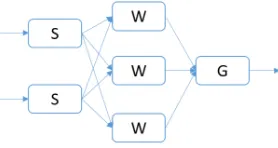
The data flow model consists of a logical graph and an execution graph. The logical
Figure 3.6. Logical graph of a data flow
Figure 3.7. Execution graph of a data flow
some user functions may run in larger numbers of nodes depending on the user defined
parallelism and size of input. Also when creating the execution graph the framework can
apply optimizations to make some data flow operations more efficient. An example logical
graph is shown in Fig. 8.4 where it displays a map and reduce data flow functions. Fig. 3.8
shows an execution graph for this logical graph where it runs multiple map operations and
reduce operations in parallel. It is worth noting that each user defined function runs on
its own program scope without access to any state about previous tasks. The only way to
communicate between tasks is using messaging, as tasks can run in different places.
For task execution, frameworks use a thread model with fewer task managers executing
the parallel tasks for a node. This leads to a smaller number of TCP connections between
the nodes, but the individual tasks are subjected to interference by other task executions.
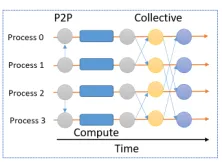
Message passing interface (MPI) is a generic model for doing parallel computations. It
Figure 3.8. Execution flow of MPI program with compute and communica-tion regions
The parallel processes can employ MPI functions for both message passing and
synchro-nization between the processes. Fig. 3.8 shows the execution model of MPI. Unlike in data
flow, the same process does the communion and computations throughout the execution.
The processes are normal Unix versions spawned by MPI.
3.2.2. Programming APIs. Popular data flow engines such as Spark, Flink and Google
Data Flow all enable a functional programming API. The data is abstracted as high level
language objects. A large distributed data set is represented as a programming construct.
For example, in Flink, the data structure is called a DataSet, while in Spark it is an RDD.
These data sets are considered immutable, meaning they cannot be changed once created.
The user defined operators are implemented according to the functional programming
paradigm with no side effects, meaning a user defined code cannot modify out-of-scope
data sets or passed-in data sets. The only way an operator can produce a new data set
is by outputting it, thus creating a different version every time. This clean programming
paradigm makes it easier for an average programmer to write data-flow programs faster
and error-free. But it comes with the cost of creating new structures every time a data set
has to be modified. In MPI style programs, we almost always modify the existing memory
data. The data flow functions are always applied to these data objects. Usually, a data flow
function implements a user defined function to act upon the data it receives, although there
are functions that don’t accept user defined programs.
The data loading and data saving are abstracted out in terms of data sources and sinks.
Data source and sinks are responsible for reading and writing the data while hiding the
details of different file systems such as local file systems and distributed file systems like
HDFS. The default data sources are sufficient for large sets of applications but for more
advanced use cases users often end up writing their own readers and writers.
3.3. Big data frameworks
3.3.1. Apache Flink. Apache Flink is a batch and stream processing engine that models
every computation as a data flow graph which is then submitted to the Flink cluster. The
nodes in this graph are the computations and the edges are the communication links.
Flink closely resembles both the data flow execution model and API. The user graph is
transformed into an execution graph by Flink before it is executed on the distributed nodes.
While undergoing this transformation, Flink optimizes the user graph, taking into account
the data locality. Flink uses thread based worker model for executing the data flow graphs.
It can chain consecutive tasks in the work flow in a single node to make the run more efficient
by reducing data serializations and communications.
Even though Flink has a nice theoretically sound data flow abstraction for programming,
we found that it is difficult to program in a strictly data-flow fashion for complex programs.
This primarily due to the fact that control flow operations such as if conditions and iterations
3.3.2. Apache Spark. Apache Spark is a distributed in-memory data processing engine.
The data model in Spark is based on RDDs [150], and the execution model is based on RDDs
and lineage graphs. The lineage graph captures dependencies between RDDs and their
transformations. The logical execution model is expressed through a chain of
transforma-tions on RDDs by the user. This lineage graph is also essential in supporting fault tolerance
in Apache Spark.
RDD’s can be read in from a file system such as HDFS, and transformations are applied
to the RDDs. Spark transformations are lazy operations and actual work is only done when
an action operation such as count, reduce are invoked. By default, intermediate RDDs
created through transformations are not cached and will be recomputed when needed. The
user has the ability to cache or persist intermediate RDDs by specifying this explicitly. This
is very important for iterative computation where same data sets are being used over and
over again.
Spark primarily uses a thread based worker model for executing the tasks. Unlike
in Flink where the user submits the execution graph to the engine, Spark programs are
controlled by a driver program. This driver program usually runs in a separate master node
and the parallel regions in this driver program are shipped to the cluster to be executed.
With this model complex control flow operations that needs to run serially such as iterations
and if conditions run in master while data flow operators are executed in worker nodes.
While this model makes it easier to write complex programs, it is harder to do complex
3.3.3. Apache Storm. Every DSPF consists of two logical layers identified as the
appli-cation layer and the execution layer. The appliappli-cation layer provides the API for the user to
define a stream processing application as a graph. The execution layer converts this user
defined graph into an execution graph and executes it on a distributed set of nodes in a
cluster.
3.3.3.1. Storm Application Layer. A Storm application called a topology determines the
data flow graph, with streams defining the edges and processing elements defining the
nodes. A stream is an unbounded sequence of events flowing through the edges of the
graph, and each such event consists of a chunk of data. A node in the graph is a stream
operator implemented by the user. The entry nodes in the graph acting as event sources to
the rest of the topology are termed Spouts while the rest of the data processing nodes are
called Bolts. The spouts generate event streams to the topology by connecting to external
event sources such as message brokers. From here onwards we refer to both spouts and bolts
as processing elements (PEs) or operators. Bolts consume input streams and produce output
streams. The user code inside a bolt executes when an event is delivered to it on incoming
links. The topology defines the logical flow of data among the PEs in the graph by using
streams to connect PEs. A user can also define the parameters necessary to convert this
user defined graph into an execution graph. The physical layout of the data flow is mainly
defined by the parallelism of each processing element and the communication strategies
defined among them. This graph is defined by the user who deploys it to the Storm cluster
to be executed. Once deployed, the topology runs continuously, processing incoming events
has a spout connected to a bolt by a stream and a second bolt connected to the first bolt by
[image:49.612.253.392.202.276.2]another stream.
Figure 3.9. A sample stream processing user defined graph
Figure 3.10. A sample stream processing execution graph
3.3.3.2. Storm Execution layer. Storm master (known as Nimbus) converts logical graph
of processing elements to an execution graph by taking the number of parallel tasks for each
logical PE and the stream grouping 6.1.1 into account. For example, Figure 3.10 displays
an execution graph of the user graph shown in Figure 3.9 where two instances ofS, three
instances ofW and one instance ofGare running. The stream grouping betweenSand
W is a load balancing grouping where each instance ofSdistributes its output to the 3W
instances in a round-robin fashion. A runtime instance of a node in the execution graph is
called a task.
After converting logical graph to execution graph, master node takes care of scheduling
of the execution graph and also manages the stream processing applications running in
the cluster. Each slave node runs a daemon called a supervisor, which is responsible for
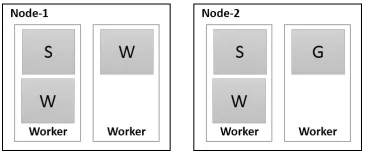
executing a set of worker processes which in turn execute the tasks of the execution graph.
running two workers. Each worker can host multiple tasks of the same graph, and the
worker assigned a thread of execution to every task. If multiple tasks run in the same
[image:50.612.233.417.175.251.2]worker, multiple threads execute the user codes in the same worker process.
Figure 3.11. Storm task distribution in multiple nodes
3.4. Algorithms on MPI, Spark and Flink
In this section we will look at three algorithms with MPI, Spark and Flink to compare
their performance. These algorithms are Multidimensional Scaling, K-Means and Terasort.
3.4.1. Multidimensional Scaling. Multidimensional scaling is a popular, well
estab-lished machine learning technique for projecting high dimensional data into a lower
dimen-sion so that they can be analyzed. It has been extensively used to visualize high dimendimen-sional
data by projecting into 3D or 2D models. MDS is a computationally expensive algorithm.
The best algorithms are in the range ofO(N2), where N is the number of data points. When
applied to a larger data set, the computation time increases exponentially. The algorithm
can be made to run efficiently in parallel to reduce the computation time requirements.
Parallel version of MDS requires multiple parallel regions and nested iterations for its
computations. We will not go through the details of the algorithm as it is already described
in several previous works. The initial work [131] illustrates how the original MDS algorithms
techniques for improving the implementation efficiency using Java and MPI. For the purpose
of this study, we only investigate the algorithm in terms of parallel operations it requires,
their complexity and how they can be run in parallel as we try to analyze this algorithm on
three execution platforms.
Given a high dimensional distance matrix, the goal of MDS algorithm is to produce a
point file with the target dimension. Optionally the algorithm can take a weight matrix.
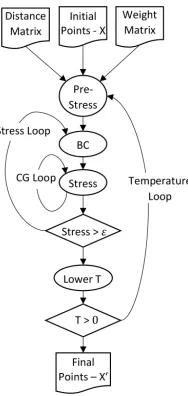
The flow of the algorithm is shown in flow diagram 3.12. MDS algorithm begins by reading
two files which contain the pair of matrices. If the data set hasNhigh dimensional data
points, the size of these matrices will beN×Nwith each cell containing 2 bytes of data in the
form of a Short Integer. One matrix file contains the distances and the other contains the
weights. Each worker in the computation only reads part of theN×Nmatrix. Aside from
these two matrices, the algorithm requires aN×Mmatrix whereMis the target projection
dimension. In most casesMwill be 3 or 2.
The pseudo code of the algorithm is shown in 1 emphasizing on the important parallel
operations. Since this particular implementation of MDS uses deterministic annealing(DA)
as an optimization technique, the algorithm has an outer loop involving temperature. The
temperature is lowered after each loop until it reaches a configured low value. For each
degree reading, the solution to the MDS equation is found as an optimization. For each
iteration, the stress is lowered until the difference between consecutive stresses are minimal
enough. This involves the last two loops, where the middle loop is over stress and the inner
Figure 3.12. Multidimensional Scaling algorithm with Deterministic Anneal-ing control flow
The core of the computation involves several matrix multiplications. The remaining
computations are mainly serial in nature. These matrix multiplications are present in the
two inner loops and largely involveN×N intoN×M matrices. The algorithm is made
parallel around these matrix multiplications.
Apart from the 3 matrices already described, three other matrix of sizeN×Mare required,
calledBC,MMrandMMaand one arrayV of sizeN. For this algorithm we can achieve a
balanced load across the parallel workers. The twoNNmatrices read are partitioned
row-wise. TheN×Mmatrix, which contains the projected points, is maintained as a whole in
all the workers along with along withBC,MMrandMMa.
3.4.1.1. MPI Implementation. The MPI implementation1is a BSP style program written in Java using the OpenMPI Java bindings. Computations in DA-MDS growO(N2) and
communicationsO(N). The algorithm involves gather/reduce of large matrices. Because
1
1: d,wi,P,n,m .Where d - partition of D, w - partition of W, p - Initial points, N - number of points, M - target dimension, K - number of parallel tasks
2: P= [N,M]point matrix 3: b=N
K
4: d= [b,N]partition of D matrix 5: w= [b,N]partition of W matrix 6: BC= [N,M]NxM matrix 7:V= [b]Array
8: T DA temperature
whileT>0do
9: end
preStress=calculateStress(d,w,P,T)whilestressDi f f>deltado 10:
end
BC=calculateBC(d,w,P,T) 11:P=con jugateGradient(d,w,P,T,BC) 12:stress=calculateStress(d,w,P,T) 13:stressDi f f=preStress−stress
14: preStress=stress
15: 16:T=αT
17:
18:functionconjugateGradient(d,w,P,T,BC)
19: MMr= [N,M]NxM matrix 20: MMr=calculateMM(w,V,P) 21: BC=BC−MMr
22: MMr=BC
23: rTr=innerProduct(MMr,MMr)
24: testEnd=rTr∗cgT hresholdwhileitr<cgCountdo 25:
end
MMAp=calculateMM(w,V,BC) 26: α=rTr/innerProduct(BC,MMAp) 27: P=P+α∗BCifrTr<testEndthen
28: end break 29:
30: MMr=MMr−α∗MMAp
31: temp=innerProduct(MMr,MMr) 32: β=temp/rTr
33: rTr=temp
34: BC=MMr+β∗BC
35:
36: returnP
37:end function
38:functioncalculateStress(d,w,P,T) .parallel operation
39: calculate partial value of Stress (Double value) 40: All Reduce partial stress (sum)
41: returnstress
42:end function
43:functioncalculateBC(d,w,P,T) .parallel operation
44: calculate partial value of BC for[b,M]matrix 45: gather the other parts from peers (AllGather) 46: returnBC
47:end function
48:functioncalculateMM(w,V,A) .parallel operation
49: calculatewAusingVfor diagnol values ofw
50: AllGather[b,M]parts from peers 51: return the collected[N,M]matrix
52:end function
53:functioninnerProduct(A,B)
54: return sum of vector dot products
55:end function