International Journal of Innovative Technology and Exploring Engineering (IJITEE) ISSN: 2278-3075, Volume-8 Issue-12, October 2019
3109
Published By:
Blue Eyes Intelligence Engineering & Sciences Publication
Retrieval Number: K15830981119/2019©BEIESP DOI: 10.35940/ijitee.K1583.1081219
Abstract: AA6064 is the most used nickel based super alloy. It is having high material strength, hardness and resistance to corrosion with good creep resistance. These properties in AA6064 is an attractive material and it is most commonly used in aerospace, gas turbine, marine and oil industries In this project machining of AA6064 is considered for the study. In these works three factors, cutting Speed (N), DOC (d), feed rate (f) are considered as parameters and their effect on metal removal rate (MRR) and surface roughness (SR) is studied through experimental investigation. The search for the optimal limited number of experimental runs, Taguchi’s orthogonal array L9 is
used. In this three factors with three levels are considered to conduct the experiments and these experiments are conducted with three different conditions of coolant. Totally 27 experiments are conducted. Grey relational analysis employed to identify optimal combinational of process parameter values that minimize the surface roughness and maximize the metal removal rate..
Keywords: CNC Turning, MRR, SR, Coolant Flow Rate, Grey Relational Approach
I. INTRODUCTION
Today’s scenario, aluminium alloys has expanded its attention to industrialists, researchers, engineers and designers as important structural materials in aerospace applications and in automotive industry. Particularly, aluminium (6000 series) alloys have been used widely due to it’s medium strength, workability, corrosion resistance and lower cost compared to other aluminium alloys. It requires more input power. To improve the turning operation, it is important to determine optimum parameters for this turning operation. It is an important task in selecting the cutting parameters in turning operation of material in CNC machining process. surface quality is the most important factor in performance measure and is mostly used in engineering
Revised Manuscript Received on October 05, 2019.
K.Srinivas, Asst. Professor, Department of Mechanical Engineering JB Institute of Engineering & Technology, Hyderabad Telangana, India, [email protected]
G.Gopinath*, Asst. Professor, Department of Mechanical Engineering JB Institute of Engineering & Technology, Hyderabad Telangana, India, [email protected]
A. Saikumar, Asst. Professor, Department of Mechanical Engineering JB Institute of Engineering & Technology, Hyderabad Telangana, India, [email protected]
Md. Rafeeq Ur Rahman, Asst. Professor, Department of Mechanical Engineering
JB Institute of Engineering & Technology, Hyderabad Telangana, India, [email protected]
T.Venkateshwar Rao, M. Tech Scholar, Department of Mechanical Engineering, JB Institute of Engineering & Technology, Hyderabad, Telangana, India, [email protected]
process in product quality at the same time metal removal rate(MRR) also directly affects the surface quality production cost and machine hour rate. These two performance measures are important to improve the machining performance operation. Hence multiple objective optimization technique such as Grey relational analysis (GRA) is used to optimize process parameters
II. LITERATUREREVIEW
Md. Tayab Ali, et. al have studied the turning of AA6063 with Taguchi’s technique[1]. It is easy to use for process optimization and it may be extended to other aluminium alloys considering of growing importance such alloys. They analyzed the surface roughness and MRR with input parameters.
Mohana Selva kumar et al has investigated the turning of AA6063 [2]. They found that feed rate has the most influencing effect on the quality classification of surface roughness followed by spindle speed and DOC. They have predicted Optimum parameter set for surface roughness in turning AA6063 through CNC turning machining
B. Ramreddy et al have analyzed the effect of input parameters (cutting velocity, feed rate and DOC) on surface roughness (SR) and MRR, by using tungsten carbide tools [3]. Yogendar singh et al have studied the optimize cutting parameters while turning operation of aluminium alloy AA6063-T6 by using tungsten carbide insert [4]. The cutting parameters include nose radius, spindle speed, feed rate, and DOC.
S. Saktivelu et al studied experimental design on Taguchi method[5]. It have been studied for optimizing mult process parameters for CNC Milling and turning machining of Al Alloys.
Swaraj Samanta, et al have studied turning of aluminium, cutting fluid performs cooling action more at different conditional stages on higher productivity and hence proves that coolant acts vital role in the machining process of CNC Turning[6].
P. Jayaraman et al have studied the optimization for the surface roughness, roundness, MRR etc by grey relational analysis[7]. They conducted different experiments under different condition for diverse combination of machining parameter.
The objective of present work to determine optimum process parameters in minimizing surface roughness and maximizing metal removal rate for machining of Al6064 by multi objective optimized technique i.e. Grey Relational Analysis.
Multi objective Optimization of Turning Process
Parameters at Different Conditions of Coolant
Flow Rate
III. METHODOLOGY 3.1. GREY RELATIONAL ANALYSIS
GRA is a multi-objective optimization technique, it uses Taguchi’s orthogonal array to conduct the experiments. In GRA No. of experimentations to be conducted depends on number of process parameters chosen for the study and their levels. Based on number input process parameters and levels orthogonal array has to be selected.
In this study, a data processing method for MRR, the higher is the better and it is expressed as
Xi (k) =
Surface roughness, which should be lower and it can be expressed as
Xi (k)
=
Where xi(k)=Normalized values,
minyi(k)=the smallest value of yi(k) for the kth response max yi(k)=the largest value of yi(k) for the kth response.
After getting normalized to values, grey relational coefficients can be find out by using following formula
ri(k)=
Where ∆0i =llX0(k)=Xi(k)ll = difference of values between X0(k) and Xi(k);
Ψ = Distinguish Coefficient (0.0 to1.0) generally Ψ =0.5 ∆min is least value of ∆0i
∆max is highest value of ∆0i
After getting grey relational coefficients, Grey Relational Grade (GRG) (γi) can be expressed as
γi
Where n is the number of responses. The highest value of the GRG means that the corresponding input parameter is near to optimal. High GRG gives the optimal conditions
IV. EXPERIMENTATION AND RESULTS
[image:2.595.308.545.100.267.2]Experiments are conducted on CNC Turning machine to optimize output performances.
Table 4.1 Levels of Parameters S No Parameter
s
Level 1 Level 2 Level 3
1 Speed (rpm) 700 1200 1700
2 Feed mm/min)
0.1 0.15 0.2
3 DOC (mm) 0.3 0.6 0.9
These experiments are conducted at different conditions and these are given below
Without coolant Max flow of coolant
Minimum Quantity of Coolant (MQC)
Selection of Orthogonal Array
Depending upon number of process parameters and their levels, a suitable orthogonal array is selected. In this work three process parameters with three levels are consider. For
this setup, suitable orthogonal array is L9 and it is shown in the table 4.2
Table 4.2 L09 orthogonal array Ex.
No
Parameter-1 Parameter -2 Parameter -3
1 Level-1 Level-1 Level-1
2 Level-1 Level-2 Level-2
3 Level-1 Level-3 Level-3
4 Level-2 Level-1 Level-2
5 Level-2 Level-2 Level-3
6 Level-2 Level-3 Level-1
7 Level-3 Level-1 Level-3
8 Level-3 Level-2 Level-1
9 Level-3 Level-3 Level-2
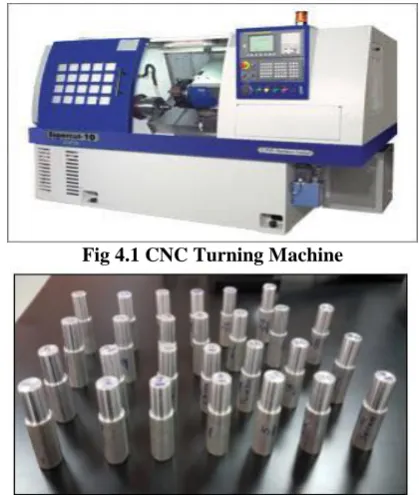
[image:2.595.320.530.323.571.2]In this setup machining is performed on CNC Turning machine with three different conditions of coolant. CNC Turning Machine and workpieces after machining are shown in fig 4.1, fig 4.2 respectively
Fig 4.1 CNC Turning Machine
[image:2.595.46.282.582.659.2]International Journal of Innovative Technology and Exploring Engineering (IJITEE) ISSN: 2278-3075, Volume-8 Issue-12, October 2019
3111
Published By:
Blue Eyes Intelligence Engineering & Sciences Publication
Retrieval Number: K15830981119/2019©BEIESP DOI: 10.35940/ijitee.K1583.1081219
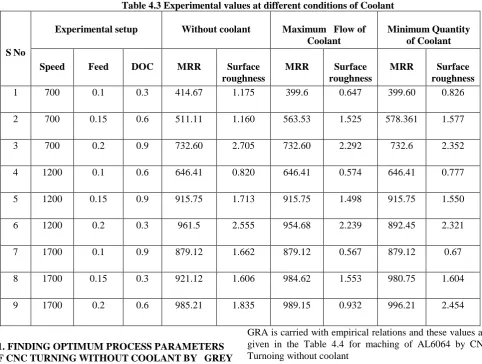
[image:3.595.57.540.63.427.2]Experimental values are shown in the Table 4.3
Table 4.3 Experimental values at different conditions of Coolant
S No
Experimental setup Without coolant Maximum Flow of Coolant
Minimum Quantity of Coolant
Speed Feed DOC MRR Surface
roughness
MRR Surface
roughness
MRR Surface roughness
1 700 0.1 0.3 414.67 1.175 399.6 0.647 399.60 0.826
2 700 0.15 0.6 511.11 1.160 563.53 1.525 578.361 1.577
3 700 0.2 0.9 732.60 2.705 732.60 2.292 732.6 2.352
4 1200 0.1 0.6 646.41 0.820 646.41 0.574 646.41 0.777
5 1200 0.15 0.9 915.75 1.713 915.75 1.498 915.75 1.550
6 1200 0.2 0.3 961.5 2.555 954.68 2.239 892.45 2.321
7 1700 0.1 0.9 879.12 1.662 879.12 0.567 879.12 0.67
8 1700 0.15 0.3 921.12 1.606 984.62 1.553 980.75 1.604
9 1700 0.2 0.6 985.21 1.835 989.15 0.932 996.21 2.454
4.1. FINDING OPTIMUM PROCESS PARAMETERS OF CNC TURNING WITHOUT COOLANT BY GREY RELATIONAL ANALYSIS(GRA)
GRA is carried with empirical relations and these values are given in the Table 4.4 for maching of AL6064 by CNC Turnoing without coolant
Table 4.4 Grey Relational Analysis values for turning without coolant
S.No
Normalized Values ∆0i values Grey relational coefficients
GRG
MRR Surface
roughness
MRR Surface
roughness
MRR Surface
roughness
1 0 0.811 1 0.189 0.333 0.725 0.529
2 0.169 0.819 0.831 0.181 0.375 0.734 0.554
3 0.557 0 0.443 1 0.530 0.333 0.431
4 0.406 1 0.594 0 0.457 1 0.728
5 0.878 0.526 0.122 0.474 0.803 0.513 0.658
6 0.958 0.079 0.042 0.921 0.922 0.351 0.636
7 0.814 0.553 0.186 0.447 0.728 0.527 0.627
8 0.887 0.583 0.113 0.417 0.815 0.545 0.68
9 1 0.461 0 0.539 1 0.481 0.740
After getting GRG, the experiment number which is having highest value of GRG represents optimum values of selected process parameters. In this highest values of GRG is occurring at the Ninth experiment and the value of GRG is given by 0.740. The predicted optimum values are given by cutting speed=1700rpm, Feed rate=0.2millimeter/minute and Depth of Cut=0.6millimeter.
4.2. FINDING OPTIMUM PROCESS PARAMETERS OF CNC TURNING WITH MAXIMUM FLOW OF COOLANT BY GREY RELATIONAL ANALYSIS(GRA)
Table.5 Grey Relational Analysis values for turning with Maximum Flow of Coolant
S.No
Normalized Values ∆0i values Grey relational
coefficients
GRG
MRR Surface
roughness
MRR Surface
roughness
MRR Surface
roughness
1 0 0.953 1 0.047 0.333 0.914 0.623
2 0.278 0.444 0.722 0.556 0.409 0.473 0.441
3 0.564 0 0.436 1 0.534 0.333 0.433
4 0.418 0.995 0.582 0.005 0.462 0.990 0.726
5 0.875 0.460 0.125 0.54 0.8 0.480 0.64
6 0.941 0.030 0.059 0.97 0.894 0.340 0.617
7 0.813 1 0.187 0 0.727 1 0.863
8 0.992 0.428 0.008 0.572 0.984 0.466 0.725
9 1 0.788 0 0.212 1 0.702 0.851
After getting GRG, the experiment number which is having highest value of GRG represents optimum values of selected process parameters. In this highest values of GRG is occurring at the seventh experiment and the value of GRG is given by 0.863. The predicted optimum values are given by cutting speed=1700rpm, Feed rate=0.1millimeter/minute and Depth of Cut=0.9millimeter
4.3. FINDING OPTIMUM PROCESS PARAMETERS OF CNC TURNING WITH MINIMUM QUANTITY OF COOLANT BY GREY RELATIONAL
ANALYSIS(GRA)
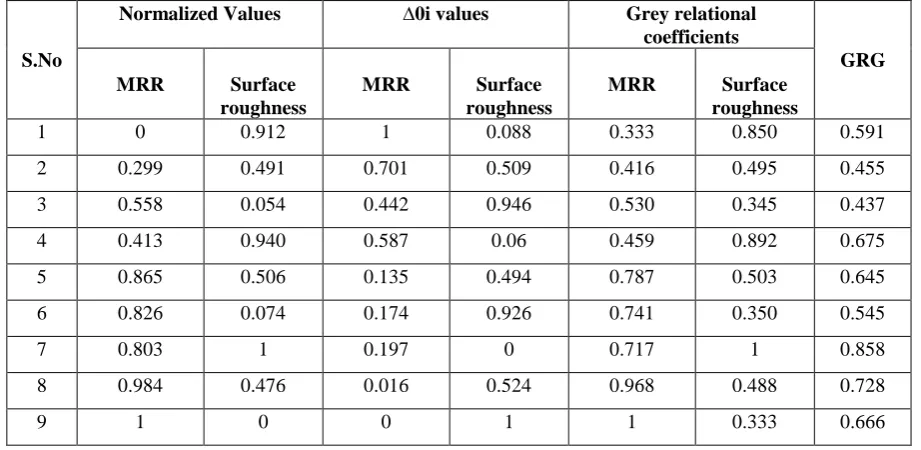
GRA is carried with empirical relations and these values are given in the Table 4.6 for maching of AL6064 by CNC Turnoing with minimum quantity of coolant
Table 4.6 Grey Relational Analysis values for turning with Minimum Quantity of Coolant
S.No
Normalized Values ∆0i values Grey relational
coefficients
GRG
MRR Surface
roughness
MRR Surface
roughness
MRR Surface
roughness
1 0 0.912 1 0.088 0.333 0.850 0.591
2 0.299 0.491 0.701 0.509 0.416 0.495 0.455
3 0.558 0.054 0.442 0.946 0.530 0.345 0.437
4 0.413 0.940 0.587 0.06 0.459 0.892 0.675
5 0.865 0.506 0.135 0.494 0.787 0.503 0.645
6 0.826 0.074 0.174 0.926 0.741 0.350 0.545
7 0.803 1 0.197 0 0.717 1 0.858
8 0.984 0.476 0.016 0.524 0.968 0.488 0.728
9 1 0 0 1 1 0.333 0.666
After getting GRG, the experiment number which is having highest value of GRG represents optimum values of selected process parameters. In this highest values of GRG is occurring at the seventh experiment and the value of GRG is given by 0.858. The predicted optimum values are given by cutting speed=1700rpm, Feed rate=0.1millimeter/minute and Depth of Cut=0.9millimeter
[image:4.595.68.529.414.639.2]International Journal of Innovative Technology and Exploring Engineering (IJITEE) ISSN: 2278-3075, Volume-8 Issue-12, October 2019
3113
Published By:
Blue Eyes Intelligence Engineering & Sciences Publication
[image:5.595.63.279.61.210.2]Retrieval Number: K15830981119/2019©BEIESP DOI: 10.35940/ijitee.K1583.1081219
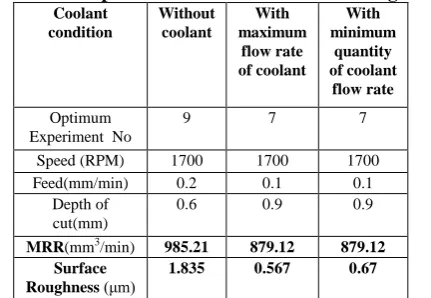
Table 4.7 Comparison of MRR and Surface Roughness Coolant condition Without coolant With maximum flow rate of coolant With minimum quantity of coolant flow rate Optimum Experiment No
9 7 7
Speed (RPM) 1700 1700 1700
Feed(mm/min) 0.2 0.1 0.1
Depth of cut(mm)
0.6 0.9 0.9
MRR(mm3/min) 985.21 879.12 879.12
Surface Roughness (μm)
1.835 0.567 0.67
From the experiments, it is observed that surface roughness is more in dry machining than in wet machining condition. Built up edge (BUE) forms in dry machining due to generation of heat and machine surface get damaged. In wet machining coolant avoids from the development of BUE and reduces heat generation at the junction of work and tool. So wet machining gives lower surface roughness than dry machining. If increasing coolant flow rate maximum of the generated heat taken by the coolant and it can reduces friction at work piece and tool interface leads to further increase in surface finish. So surface finish more at higher coolant flow rate.
Maximum metal removal rate is achieving at maximum cutting speed, maximum feed and maximum depth of cut but at these conditions surface roughness is maximum. Because of requirements of lower surface roughness it is not possible to get at higher MRR. The minimum value of surface roughness occurs at minimum speed and minimum feed and minimum depth of cut but at these conditions material removal rate is very low. So it increases production cost. If maximum metal removal rate is required at minimum surface roughness then increase the cutting speed and lower the feed rate.
V. CONCLUSION
This experimental approach is to study the effect of input process parameters on metal removal rate and surface roughness by applying different stages of coolant conditions through CNC turning process
1.
If the machining is done without coolant, the optimum values to get maximum MRR and minimum surface roughness are predicted and these values are given by cutting speed=1700rpm, Feed rate=0.2millimeter/minute and Depth of Cut=0.6mm2.
If the machining is done with maximum flow of coolant, the optimum values to get maximum MRR and minimum surface roughness are predicted and these values are givenby cutting speed=1700rpm, Feed rate=0.1
millimeter/minute and Depth of Cut=0.9mm
3.
If the machining is done with minimum flow of coolant, the optimum values to get maximum MRR and minimum surface roughness are predicted and these values are givenby cutting speed=1700rpm, Feed rate=0.1
millimeter/minute and Depth Of Cut=0.9mm By observing the above optimum values for maximum MRR
and minimum surface roughness concluded that Coolant flow rate is not showing very much impact on MRR. Surface roughness is more in dry machining condition than
wet machining condition. Built up edge (BUE) forms in dry
machining due to heat generation, machine surface get damaged. In wet machining the coolant prevents the formation of BUE and also reduces heat generation at the interface of tool and work piece so wet machining gives better surface finish than dry machining
.
REFERENCES
1 Md. Tayab Ali, Dr. Thuleswar Nath , “Cutting Parameters Optimization for Turning AA6063-T6 Alloy by Using Taguchi Method” International Journal of research In Mechanical engineering & technology (IJRMET ), Vol. 4, Issue 2, May – October 2014. 2 Mohana Selvakumar.V, Mohan Kumar.T, Ramanatha.R,
Dr.K.Chandrasekaram, Dr.P.Ranjith Kumar, “Experimental Analysiss of Turning Parameters Using Aluminium Alloy (AA6063)” International Journal for Modern Trends in Science and Technology, Vol-03, Issue No.4, April 2017.
3 B. Ramreddy and Gopal Varvatte, “Optimisation of Process Parameters in CNC Turning of Alluminium Alloy 7075 by Taguchi method using Regression Analysis” Proceeding of NCRIET-2015& Indian J.sci.Res12(1) 203-208,2015.
4 Yogendra singh Chauhan, Deepak Prashanth Singh,” Experimental investigation surface roughness by optimising the process parameter in turning operation of aluminium alloy” International Journal of Engineering Research & Technology (IJERT) Vol 5 Issue 11 November 2016.
5 S. Sakthivelu T. Ananda Raj, “Prediction of Optimum Machining Parameters on Surface Roughness and MRR in CNC Drilling of AA6063 Alloy Using Design of Experiments. “ International Journal Of Research & Technology (IJERT), ISSN: 2278-0181, 2017. 6 Swaraj Samanta, Sumit Kumar, Souram Guha, Sonal Kr. Singh4
“Process Parameters Optimization of CNC Turning on AA-6061 using Multiple Cutting Fluids” International Research Journal of Engineering and Technology (IRJET) Vol 5 Issue 07 July 2018. 7 P.Jayaraman, L. Mahesh kumar “Multi response optimisation of
machining parameters of turning AA6063 T6 Alluminium alloy using Grey relational analysis in taguchi method”, Science Direct, Procedia engineering 97 (2014) 197-204.
AUTHORSPROFILE
K. Srinivas working as Asst. Professor of Mechanical Engineering, JB Institute of Engineering and Technology(UGC Autonomous), Hyderabad, Telangana India
G. Gopinath workingas Asst. Professor of Mechanical Engineering, JB Institute of Engineering and Technology(UGC Autonomous), Hyderabad, Telangana India
.
A. Saikumar working as Asst. Professor of
Mechanical Engineering, JB Institute of Engineering and Technology(UGC Autonomous), Hyderabad, Telangana India
Md Rafeeq Ur Rahman working as Asst. Professor of Mechanical Engineering, JB Institute of Engineering and Technology(UGC Autonomous), Hyderabad, Telangana India