Abstract::A survey of ongoing research on bottom ash appears to demonstrate it has the ability to improve asphalt pavement performance when used to supplant a segment of the aggregate in asphalt mixes. Bottom ash can be utilized as an aggregate substitution, giving a considerable reserve funds to both highway organizations and service organizations. Bottom ash has been utilized as fine aggregates in flexible pavements since the mid 1970's. The American Coal Ash Association detailed that, more than 17,200 metric huge amounts of bottom ash was utilized in flexible pavements clearing during 2006.
The research is centered around examination of properties of bottom ash, which is the byproduct of Budgam coal power plant and attainability investigation of utilization of bottom ash in flexible pavements of indian roads. As indicated by the outcomes got, the best blends are delivered by mixing bottom ash with well-graded, angular, rough textured aggregate and restricting the level of bottom ash to 25% for wearing and 16% for binder course. Marshall Stability and flow values have been found to diminish as the level of Wet bottom ash is increased in the blend.
Further, high level of bottom ash substitution increases ideal bitumen content, which primarily influences to high production cost. In spite of the fact that the expense per 1 Mt of bottom ash mixed blend is higher than the conventional mix for both surface courses, its low density increases overlay zone. In light of that the expense per 1 m2 is lower than the conventional mix. The fruitful utilization of bottom ash in black topped pavements in Jammu and kashmir would give huge monetary investment funds as well as an ecological inviting solution for a waste material.
Keywords: Bottom ash, Binder coarse , wearing coarse
I. INTRODUCTION
Traditionally soil, stone, aggregates, sand, bitumen and cement are utilized for road development and construction. Natural materials utilized for road developments being expendable in nature, its amounts are declining continuously. Additionally, cost of extracting great quality of natural material is increasing. Worried about this, the researchers are searching for elective materials for highway construction and for approaches to improve the performance of bituminous paving mixtures. Bottom ash is one of the elective materials. The blend of bottom ash with limestone aggregate and natural sand
would appear to offer improvement to the overall performance of bituminous pavements as for skid resistance and basic stability. The asphalt mixes containing bottom ash from various power plants have essentially various attributes.
Revised Manuscript Received on November 05, 2019.
Amir Farooq,Civil Engineering Departement, RIMT University, Punjab, [email protected]
Punit verma,Civil Engineering Departement ,RIMT University,Punjab,[email protected] Sandeep singla,CivilEngineering Departement,RIMT University,punjab,india.[email protected]
As per the Sunday observer on 3 October 2004, coal fired electric power plant devours around 2640 tons of coal for each day in India. This utilization brings about the creation of 220 tons of coal ash, nearly180 huge amounts of fly ash and 40 tons of bottom ash as waste at Budgam coal power plant in the Jammu and Kashmir. Coal ash comprises fly ash and bottom ash. Bottom ash is the heavier ash that falls through the bottom of the furnace where it is gathered in a hopper. It is classified as wet or dry bottom ash contingent upon the kind of boiler used.
As the utilization of coal by power plants increments, so does the generation of coal ash. Transfer of unused coal ash is expensive and places an impressive burden on the power Industry. What's more, this would be a noteworthy natural issue in future.
Dumping of ash is a noteworthy action in this power plant where the land is exceptionally fruitful and the fresh water layer is next to no and just around 5 feet down. Dumping of bottom ash in the land fillings and the leakage to the water table will make serious hardships to agribusiness and to ground water. Along these lines, evacuation of bottom ash is a noteworthy issue. In the event that these wastes can be used in an effective way in highway construction, the contamination and disposal issues might be halfway decreased.
II. OBJECTIVES
The main objective of the study was finding an alternative economical material for hot mix asphalt concrete used in flexible pavements.
To access the properties of bottom ash
Feasibility of usage of bottom ash, Its characteristic in surface layers and
How it enhances the HMA properties.
The other objective was to find an environmental friendly solution for the waste product of coal power plant that may be a huge environmental problem in future, while providing economical savings to the country.
III. SAMPLECOLLECTION
The soil samples for the present study were taken from Budgam Power Plant. At each location disturbed Bottom ash samples were collected carefully. Required tests were done
IV. METHODOLOGY
To propose an economical mix proportion for flexible pavements dependent on bottom ash properties following approach was adopted.
Use of Bottom Ash as a Partial Replacement of
Fine Aggregates in Flexible Pavement
At first, literacies was done to discover the method for bottom ash produce, usage and application of bottom ash in different nations. Further study was done to recognize the characteristics of bottom ash contingent upon the boiler type, chemical composition, physical and mechanical properties, etc.
Also, bottom ash tests were collected from Budgam coal power plant and the experimental investigation of Bottom ash was done to decide, physical and chemical properties of Budgam bottom ash particles, on the grounds that relying on the source, bottom ashes can have distinctive physical and chemical properties.
Sieve analysis was done according to ASTM standard to determine the particle size distribution of bottom ash, quarry dust, 12.5mm and 19mm aggregates. At that point the specific gravities were determined for all aggregates. As indicated by ASTM standards, Loss Angeles Abrasion test was performed to check whether bottom ash is durable enough for pavement construction. Likewise, Bottom ash's weathering resistance characteristics was determined using the MgSO4 soundness test and after that water absorption test was done for absorption quality. At that point properties of bitumen (60/70) were determined by the ASTM norms. [American Society for Testing and Materials (ASTM), 1994]. AIV test and FI tests were accomplished for course aggregates as per British Standards.
Thirdly, suitable blend proportion for bottom ash was chosen considering combined gradation given in SSCM table 506-1 for both binder and wearing surface layers.
At that point, preliminary blends were set up with various blend proportions of bottom ash and Marshall tests were done to discover the variation of design characteristics, for example, stream esteem, VIM, VMA security and optimum bitumen content with bottom ash replacement. Subsequent to choosing appropriate bottom ash percentage for binder course and wearing course Mix designs were conveyed. At long last, economical comparison of bottom ash mixed hot blend asphalt concrete with conventional hot blend asphalt concrete was done to recognize the feasibility of usage of bottom ash in hot blend asphalt in Flexible pavements. Likewise, availability of material was considered to be feasible for the bottom ash supply.
Grading: The grading is significant in asphalt concrete properties, pavement skid resistance, binder content and production cost. ASTM D1073 defines a fine aggregate in asphalt paving mixtures as an aggregate that passes the 9.5 mm sieve [ASTM, 1994]. Particle size distribution for bottom ash is appeared in the Table 3.1 and Figure 3.1.
[image:2.595.308.526.51.227.2]Wet bottom ash, the by-product of Budgam coal power plant is uniformly sized, and consists of hard, durable, glassy particles.
Table 3.1 Particle size distribution for bottom ash.
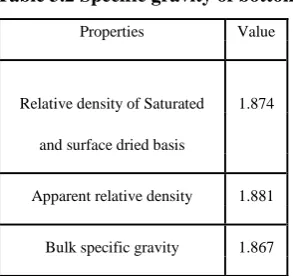
[image:2.595.355.502.357.495.2]Specific gravity: specific gravity is a good indicator to quantify the nature of a material. The specific gravity of bottom ash relies upon the mineralogical composition of the material and the porosity of the particles. The test results are recorded underneath for wet bottom ash, collected from Budgam coal power plant. Results are appeared in Table 3.2 and can be concluded that wet bottom ash has almost 35% lower specific gravity than conventional aggregates.
Table 3.2 Specific gravity of bottom ash
Properties Value
Relative density of Saturated 1.874
and surface dried basis
Apparent relative density 1.881
Bulk specific gravity 1.867
Durability: The aggregates used in surface course of the highway pavements are subjected to wearing because of movement of traffic. At the point when vehicles proceed onward the road, the particles present between the pneumatic levels and road surface cause abrasion of road aggregates. In this way, the road aggregates ought to be hard enough to resist abrasion. Resistance to abrasion of aggregate is determined in research center by Los Angeles test machine. The principle of LAA test is to produce abrasive action by use of standard steel balls which when blended with aggregates and rotated in a drum for specific number of revolutions likewise causes impact on aggregates.
The percentage wear of the aggregates because of scouring with steel balls is determined and is known as Los Angeles Abrasion Value and it ought not be more than 40% for pavement construction [ASTM, 1994].
As per the Table 1 (ASTM-131-C) Grading D was chosen for the sample and 5 kgs of sample dried in oven at 105° – 110°C. At that point, 6 number of balls used as abrasive charge according to Table 2 and the machine was rotated up to 500 number of revolutions. At long last the entire dust is sieved on 1.70 mm IS sieve and
Los Angeles Abrasion Value was determined.
Sieve Size Bottom Ash
in mm Passing %
28 100
20 100
10 100
5 100
2.36 98
1.18 89.7
0.600 81.7
0.300 72.4
0.150 50.5
LAAV for wet bottom ash sample was determined as 30%. MgSO4Soundness: Aggregates must be resistant to breakdown and deterioration from weathering or they may break apart and cause premature pavement distress. Soundness test was performed to measure the weathering resistance characteristic for bottom ash. Soundness values are generally found to be within ASTM D1073 weight loss specifications of not more than 15 % after five cycles when magnesium sulfate is used [ASTM, 1994].
MgSO4 Soundness for wet bottom ash sample was 10% Water absorption:Water absorption is also one of the key performance indicators for bottom ash. Water absorption of bottom ash as a percentage of dry mass is given below. Water absorption for wet bottom Ash -0.41 %
The absorption rates of bottom ash is lower than same of quarry dust (0.62%). Low water absorption rate is suitable for asphalt concrete. Aggregates used to produce HMA are dried before mixing with asphalt cement. Excessive moisture in the aggregates lessens the production rate of paving material because of the extra drying time required. Bottom ash is moderately simple to dewater, ought to be stockpiled and permitted to drain to a surface dry condition which is more efficient [Federal highway organization, 2012].
Selecting Suitable Mix Proportion for Bottom Ash Bottom ash quite often requires mixing with other aggregate sources to meet gradation specifications. Bottom ash may contain iron pyrites that causes to decrease the pavement strength. In view of this reason, close to 30 percent of the
aggregate in an asphalt pavement blend ought to be replaced with bottom ash [Federal highway organization, 2012]. The mix proportions of bottom ash and conventional aggregates was chosen fundamentally by the particle size distribution of the materials and the necessities of the gradation specifications as in Standard specifications for construction and maintenance of roads and extensions (SSCM), [2008] Table 506-1.
(i)Wearing course
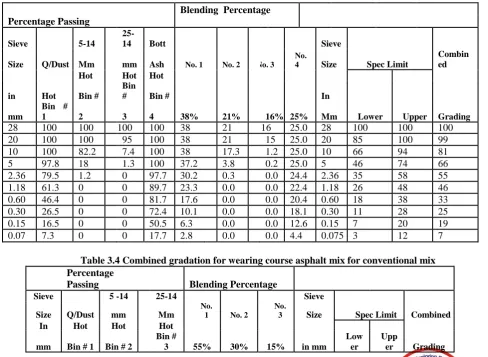
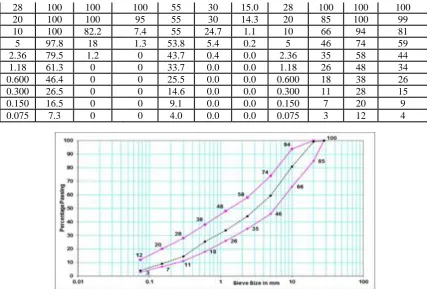
[image:3.595.308.542.227.354.2]Aggregate blending percentages for wearing course are shown in Table 3.3 and 3.4 for both 25% of bottom ash blended mix and conventional mix respectively. Figure 3.2 and 3.3 are shown the selected combined gradation is within the specification limits according to SSCM [2008] Standards.
Figure 3.2-Combined Gradation with 25 % bottom ash for Wearing Course (type 1) according to SSCM Table
[image:3.595.57.546.406.763.2]506-1
Table 3.3 Combined gradation for wearing course asphalt mix with 25% bottom ash
Table 3.4 Combined gradation for wearing course asphalt mix for conventional mix Percentage
Passing Blending Percentage
Sieve 5 -14 25-14 Sieve
Size Q/Dust mm Mm
No.
1 No. 2
No.
3 Size Spec Limit Combined
In Hot Hot Hot
mm Bin # 1 Bin # 2
Bin #
3 55% 30% 15% in mm
Low er
Upp
er Grading Percentage Passing
Blending Percentage
Sieve 5-14
25-14 Bott Sieve
Size Q/Dust Mm mm Ash No. 1 No. 2 No. 3 No.
4 Size Spec Limit
Combin ed Hot Hot Hot
in Hot Bin #
Bin
# Bin # In
mm
Bin #
1 2 3 4 38% 21% 16% 25% Mm Lower Upper Grading
28 100 100 100 100 38 21 16 25.0 28 100 100 100
20 100 100 95 100 38 21 15 25.0 20 85 100 99
10 100 82.2 7.4 100 38 17.3 1.2 25.0 10 66 94 81
5 97.8 18 1.3 100 37.2 3.8 0.2 25.0 5 46 74 66
2.36 79.5 1.2 0 97.7 30.2 0.3 0.0 24.4 2.36 35 58 55
1.18 61.3 0 0 89.7 23.3 0.0 0.0 22.4 1.18 26 48 46
0.60 46.4 0 0 81.7 17.6 0.0 0.0 20.4 0.60 18 38 33
0.30 26.5 0 0 72.4 10.1 0.0 0.0 18.1 0.30 11 28 25
0.15 16.5 0 0 50.5 6.3 0.0 0.0 12.6 0.15 7 20 19
[image:3.595.58.544.406.650.2]28 100 100 100 55 30 15.0 28 100 100 100
20 100 100 95 55 30 14.3 20 85 100 99
10 100 82.2 7.4 55 24.7 1.1 10 66 94 81
5 97.8 18 1.3 53.8 5.4 0.2 5 46 74 59
2.36 79.5 1.2 0 43.7 0.4 0.0 2.36 35 58 44
1.18 61.3 0 0 33.7 0.0 0.0 1.18 26 48 34
0.600 46.4 0 0 25.5 0.0 0.0 0.600 18 38 26
0.300 26.5 0 0 14.6 0.0 0.0 0.300 11 28 15
0.150 16.5 0 0 9.1 0.0 0.0 0.150 7 20 9
[image:4.595.83.511.48.337.2]0.075 7.3 0 0 4.0 0.0 0.0 0.075 3 12 4
Figure 3.3- Combined gradation for conventional wearing course (type 1) according to SSCM Table 506-1 (ii) Binder course
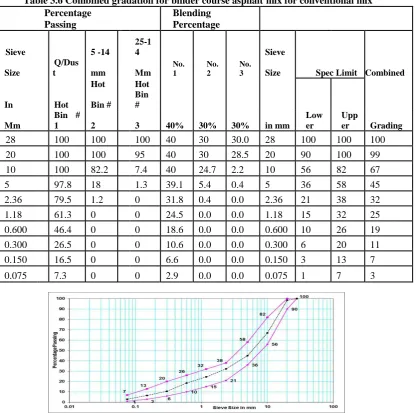
Aggregate mixing percentages for binder course are shown in Table 3.5 and 3.6 for both 16% of bottom ash blended mix and conventional mix respectively. Figure 3.4 and 3.5 are shown the combined gradation is within the specification limits for the same respectively.
Table 3.5 Combined gradation for binder course asphalt mix with 16% bottom ash Blending
Percentage Passing Percentage
Sieve Q/Dust 5-14 25-14 Bott Sieve
Size Hot mm mm Ash No. 1 No. 2 No. 3 No. 4 Size Spec Limit Combined in Bin # 1 Hot Hot Hot
mm Bin #
Bin
# Bin # In
2 3 4 27% 29% 28% 16% Mm Lower Upper Grading
28 100 100 100 100 27 29 28.0 16.0 28 100 100 100
20 100 100 95 100 27 29 26.6 16.0 20 90 100 99
10 100 82.2 7.4 100 27 23.84 2.1 16.0 10 56 82 69
5 97.8 18 1.3 100 26.4 5.22 0.4 16.0 5 36 58 48
2.36 79.5 1.2 0 97.7 21.5 0.35 0.0 15.6 2.36 21 38 36
1.18 61.3 0 0 89.7 16.6 0 0.0 14.4 1.18 15 32 31
0.600 46.4 0 0 81.7 12.5 0.0 0.0 13.1 0.60 10 26 24
0.300 26.5 0 0 72.4 7.2 0.0 0.0 11.6 0.30 6 20 19
0.150 16.5 0 0 50.5 4.5 0.0 0.0 8.1 0.15 3 13 12
[image:4.595.62.532.417.795.2]0.075 7.3 0 0 17.7 2.0 0.0 0.0 2.8 0.075 1 7 5
Table 3.6 Combined gradation for binder course asphalt mix for conventional mix Percentage
Passing
Blending Percentage
Sieve 5 -14
25-1
4 Sieve
Size
Q/Dus
t mm Mm
No. 1
No. 2
No.
3 Size Spec Limit Combined
Hot Hot
In Hot Bin #
Bin #
Mm
Bin #
1 2 3 40% 30% 30% in mm
Low er
Upp
er Grading
28 100 100 100 40 30 30.0 28 100 100 100
20 100 100 95 40 30 28.5 20 90 100 99
10 100 82.2 7.4 40 24.7 2.2 10 56 82 67
5 97.8 18 1.3 39.1 5.4 0.4 5 36 58 45
2.36 79.5 1.2 0 31.8 0.4 0.0 2.36 21 38 32
1.18 61.3 0 0 24.5 0.0 0.0 1.18 15 32 25
0.600 46.4 0 0 18.6 0.0 0.0 0.600 10 26 19
0.300 26.5 0 0 10.6 0.0 0.0 0.300 6 20 11
0.150 16.5 0 0 6.6 0.0 0.0 0.150 3 13 7
0.075 7.3 0 0 2.9 0.0 0.0 0.075 1 7 3
Figure 3.5- Combined gradation for conventional binder course according to SSCM Table 506-1 As per SSCM mixing standard the required affordable
bottom ash proportion was about 16% for binder course and 25% for wearing course.
Economical Comparison
Economical comparison was done for bottom ash blended hot mix asphalt concrete with conventional hot mix asphalt concrete for both binder and wearing surface layers. Current market costs and the Highway
Rate of Schedule (HSR) of Road Development Authority were utilized for cost figuring of mixtures. Table 5.1 demonstrates the rundown of cost subtleties utilized for the count. only material and transport expenses were considered.
Table 5.1 Cost details
Material
Price of 1m3 With
35km transport (Rs.)
Quarry dust
2900 5-14 mm Agg.
3190 10-25 mm Agg.
3247
If economical utilization or usage of the bottom ash was to be achieved, it was believed to be essential to have a source of the waste material close to the asphalt plant. As Budgam coal Power plant authorities prepared to supply the bottom ash materials to asphalt plants at no expense, the cost acquired for the mixture included just mixing and placing costs which is same to the conventional mixing method.
Material weights for one Mt of wearing course with 20% bottom ash and binder course with 8% bottom ash were calculated as shown in table 5.2 and 5.3 individually. At that point expenses were determined and analyzed.
Table 5.2 Material weights for one Mt of wearing course for 20% bottom ash blended mix
Table 5.3 Material weights for one Mt of binder course for 8% bottom ash Blended mix
Type of Bin
HOT BIN # 1 HOT BIN # 2 HOT BIN # 3 HOT BIN # 4 Bitumen
( 5 - 0 mm Agg.) (14 - 5 mm Agg,) ( 25- 10 mm Agg,) ( Bottom Ash,) (60-70)
Mix Proportion
28.4% 29.4% 29.4% 7.6% 5.2%
(By Weight of Mix
Weight for 1 Mt 284 294 294 76 52
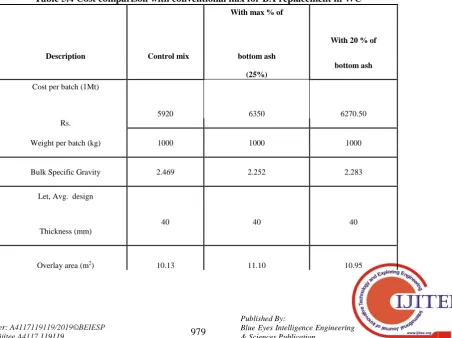
[image:6.595.99.552.493.831.2]The costs and the saving percentages of usage of bottom ash are compared as shown in Table 5.4 and 5.5. Table 5.4 Cost comparison with conventional mix for BA replacement in WC
With max % of
With 20 % of
Description Control mix bottom ash
bottom ash (25%)
Cost per batch (1Mt)
5920 6350 6270.50
Rs.
Weight per batch (kg) 1000 1000 1000
Bulk Specific Gravity 2.469 2.252 2.283
Let, Avg. design
40 40 40
Thickness (mm)
Overlay area (m2) 10.13 11.10 10.95
Type of Bin
HOT BIN # 1 HOT BIN # 2 HOT BIN # 3 HOT BIN # 4 Bitumen
( 5 - 0 mm Agg.)
(14 - 5 mm Agg,)
( 25- 10 mm
Agg,) ( Bottom Ash) (60-70)
Mix Proportion
37.8% 18.9% 18.9% 18.9% 5.4%
(By Weight of Mix ) Weight for 1 Mt
378 189 189 189 54
Cost per m2 (Rs.) 574.04 563.99 567.29
Saving percentage
1.90 1.43
per 1 m2
[image:7.595.90.509.48.134.2]Wearing course mixes with 25% of bottom ash shows considerable savings, while less amount of ash replacement reduces the saving percentage per unit surface area.
Table 5.5 Cost comparison with conventional mix for BA replacement in BC
Control
with max % of
with 8 % of
Description bottom ash
mix Bottom ash
(16%)
Cost per batch (1Mt) Rs. 5820 6315 6205
Weight per batch (kg) 1000 1000 1000
Bulk Spesific Gravity 2.581 2.342 2.423
Let, Avg. design
60 60 60
Thickness (mm)
Overlay area (m2) 6.46 7.12 6.88
Cost per m2 (Rs.) 910.46 892.16 903.52
Saving percentage per
0.90 -0.74 1 m2
Binder course mixes with 16% of bottom ash shows some saving compared to the control mix. However, some bottom ash replacement percentages may not be economically viable.
V. CONCLUSIONS
The performance of this project has shown that bottom ash aggregate can be effectively substituted for a portion of the aggregates in a bituminous surface mixture. In view of perceptions and testing performed in this study, the following conclusions were drawn:
1. The Marshall Mix design results demonstrate that asphalt mixes containing bottom ash have higher optimum asphalt contents than standard asphalt blends.
2. The optimum wet bottom ash replacement is 16 % for binder course and 25% for wearing course by weight of the mixture.
3. Marshall Stability and flow values have been found to decrease as the percentage of Wet bottom ash is increased.
4. Although the bottom ash increases the bitumen requirement in the mix, cost per unit surface area decreases, as its low density of bottom ash asphalt mx. In
this way the bottom ash replacement is economically feasible
5. Production rate of bottom ash is at the satisfactory level for overlaying of almost 180 km surface layer for every day.
The properties of HMA containing bottom ash are reliant on ash content. As the ash content was increased, the optimum asphalt content, the air voids and the voids in mineral aggregate were likewise increased, while the mixture density and the stability of HMA blend were decreased.
In any case, the blend is exceedingly resistant to moisture induced damage (stripping) due to low water retention rate of bottom ash particles.
As a matter of fact, the addition of bottom ash required an increase in asphalt content which isn't economically suitable. Because of the porous nature of bottom ash particles, the absorption of asphalt binder is higher than conventional fine aggregate. Subsequently, from a pure economic standpoint, bottom ash may not be a cost effective choice. Be that as it may, the bulk specific gravity of
conventional blend for the both layers. This is because of the low density of bottom ash particles. Therefore, despite the fact that the bottom ash increased the binder requirement and cost per 1 Mt of the blend, the overlay area per unit weight is higher than the conventional blend. In this way, an impressive savings can be seen.
It was discovered that, the wet bottom ash could be utilized as an elective material for fine aggregate in flexible pavement construction. Asphalt blends with bottom ash can be designed similarly likewise with conventional aggregates. From the obtained outcomes, the bottom ash replacement ought not be more than 25% for wearing course and 16% for binder course because of the way that high bottom ash substance causes higher binder requirement and the low stability in the mixture.
At last, it was concluded that the properties of bottom ash collected from Budgam coal power plant can meet the specifications for conventional aggregates and can be effectively used in hot mix asphalt concrete in Jammu and Kashmir while improving the mixture properties as well as skid resistance and resistance to striping. What's more it provides economical savings to the highway agencies and environmental friendly cost effective solution for the waste issue of the power plant.
REFERENCES
1. Ahmed, Imtiaz, and C.W. Lovell, “Use of waste materials in highway construction” in Transportation Research Rec.1345, Washington DC: Nat. Academy Press 1992, pp19 -54.American Coal Ash Association. (1983).Ash at work. Vol. XV [Online]. Available:http://www.acaa-usa.org.
2. American Society for Testing and Materials (ASTM), Annual book of ASTMstandards, Volume 04.03, West Conshohocken, Pennsylvania, 1994.
3. Hot-mix asphalt paving handbook, American Association of State Highway and Transportation Officials (AASHTO), Washington, D.C., 1991.
4. D.A. Anderson, M. D. Usmen, and L.K. Moulton,“Use of power plant aggregate in bituminous construction” in 55th Annu., Transportation Research Board,Washington, 1976, pp 151-169.
5. Asphalt Institute, “Performance graded asphalt binder specifications and testing”,Superpave Ser. 1, Lexington, Kentucky, 1995.
6. Asphalt Institute,“Superpave level 1 mix design”,Superpave ser. 2, Lexington, Kentucky, 1995.
7. Federal highway administration, Dept. of transportation. (2012 Apr.). “User guidelines for waste and byproduct materials in pavementconstruction”.
[Online].Available:http://www.fhwa.dot.gov/publications/research/infr astructure /structures/97148/cbabs2.cfm.
8. Q.D. Hunsucker, Design and performance of a bituminous surface mixturecontaining bottom ash aggregate, Research Report KTC 92-14, Lexington,Kentucky: Kentucky Transportation Center, 1992, pp 1-25. 9. K. Ksaibati and J. Stephen, Utilization of bottom ash in asphalt mixes.
Dept. of Civil and Architectural Eng., Uni.Wyoming, Laramie, WY. 1999, pp1-87.
AUTHORSPROFILE
Raja Adnan Khan, Masters of Technology RIMT University
Bachelor of Technology Punjab Technical University
Punit verma,Masters of technology HCTM College,kurukshetra university Bachelors of technology MIET College,kurukshetra university Presently he is
working as professor in Civil engineering Department of RIMT University Punjab India.