Abstract:Introduction. The period of studying in a professional educational organization is the most important in the life of a future specialist, as it is the time when a person becomes a participant of industrial relations, forms views on the profession, changes the system of values, develops motivation for professional activity. The strengthening of social and professional responsibility of a person should be accompanied by the strengthening of an educational institution’s responsibility for the quality of training of a specialist. Researchmethodology. Professional self-determination is considered by researches both as a process, and as the result of the development of a professional, each phase (stage) of which is characterized by different content. The age of adolescence plays here an important role, as the problem of choice of a profession becomes “an affective centre of the living situation” at that exact time. Researchresults. Competitiveness of a specialist becomes one of the priorities of improving the system of professional education in Russia and the most important criterion of its quality. This competitiveness includes not only the intimate knowledge of a profession, understanding of related areas of activity, readiness to practice the chosen profession effectively on a level with the highest world standards but also a high level of social and professional self-determination of graduates, developed self-concept of an individual. Discussion. The main characteristics of self-determination as a psychological and pedagogic phenomenon are belonging to a subject, procedurality, consciousness, self-sufficiency.Conclusion. Professional self-determination is an activity of a person (a component of personal self-determination) which is carried out during social development and maturity and, if necessary, adjusted with the help of a specially organized interference – career-guidance, teaching and educational process, theoretical and practical work.
Index Terms: choice of profession,competitive specialist, professional self-determination, research activity.
I. INTRODUCTION
The competence approach that federal state educational standards of the third-generation rest upon is based on the culture of self-determination. According to this approach, when developing professionally, a specialist should be able to create something new in the profession, even on a small scale
Revised Manuscript Received on July 05, 2019
TamaraAndreevnaBahor, Lesosibirsk School of Education – branch of Siberian Federal University, Lesosibirsk, Russia.
Zul'fijaUl'fatovnaKolokol'nikova, Lesosibirsk School of Education – branch of Siberian Federal University, Lesosibirsk, Russia.
Svetlana Vasil'evna Mitrosenko, Lesosibirsk School of Education – branch of Siberian Federal University, Lesosibirsk, Russia.
Tat'janaVjacheslavovnaZaharova, Leso sibirsk School of Education – branch of Siberian Federal University, Lesosibirsk, Russia.
Tat'janaViktorovnaKazakova, Lesosibirsk School of Education – branch of Siberian Federal University, Lesosibirsk, Russia.
VeranikaUladzimirawnaPakhirka, MinskInnovation University, Minsk, Belarus.
(new technique, method, etc.), bear individual responsibility for the taken decisions, determine goals taking into account a personal value basis [1]. The period of studying in a professional educational organization is the most important in the life of a future specialist, as it is the time when a person becomes a participant of industrial relations, forms views on the profession, changes the system of values, develops motivation for professional activity. The strengthening of social and professional responsibility of a person should be accompanied by the strengthening of an educational institution’s responsibility for the quality of training of a specialist. The increasing role of an individual in forming personal “educational routes” requires educational technologies allowing to “wake up” a person, give a student an opportunity to show interest in the professional life, provide freedom and the possibility of choice. However, according to the specialists’ estimation, professional educational organizations stick to the traditional knowledge paradigm of educational activity where an individual is an affected object, which results in the lack of initiative, irresponsibility, and infantilism. Providing conditions for the success in self-expression and self-realization of student’s personality, detection and realization of students’ potential abilities have not become a general practice yet.In the opinion of some scientists and practicing educators (Sharonin, Protas, and others), it is possible to solve the set problems from a position of self-developing pedagogic systems that determine the main areas of activity of educational institutions, employers, the whole professional community in the quality assurance of professional environment in general, and professional education in particular [2].In this,the most important distinguished theses include the strengthening of the role of professional self-determination, active position of students in showing their interests and orientation toward professional and creative achievements; forming of adequate self-evaluation of a graduate as the most important personal characteristic of the quality of professional training; increased activity of pedagogic staff, as well as of all social partners, who ensure the development of professional environment and purposeful formation and development of a future specialist.
II. PROPOSED METHODOLOGY
Some researchers (Andreev, Bim-Bad, Kagan, Petrovskij, and others) consider the value of self-realization to be the priority one, correlating and
integrating many different values of an individual in modern education [3]-[6]. It
Students’ Research Activity in the Context of
Professional Self-Determination
Tamara AndreevnaBahor, Zul'fija Ul'fatovnaKolokol'nikova, Svetlana
is based on the understanding of a person as an intrinsic value of the highest order, which in its turn is the necessary basis for the existence of all other values. The value of self-realization is existential in its nature and has crucial significance in the life of an individual. Experimental and theoretical works, written both abroad (Burns, Maslow, Super, and others), and in Russia (Golovaha, Klimov, Markova, Chistjakova, and others), convincingly showed that different parameters of living self-determination of an individual carry out an essential function in regulating professional self-determination [6]-[8]. Professional self-determination is considered by researches both as a process, and as the result of the development of a professional, each phase (stage) of which is characterized by different content. The age of adolescence plays here an important role, as the problem of the choice of a profession becomes “an affective centre of the living situation” at that exact time [9],[10].
Today the problem of professional self-determination of an individual is solved in two dimensions: theory-oriented and practice-oriented. In theory, scientists try to answer the
questions about the essence of professional
self-determination, its structural components, principles and approaches to studying this phenomenon. “Practitioners” create conditions, select means, develop and approve models of the most effective professional self-determination of an individual at different levels of education. However, they all agree that a high level of professional self-determination is observed in a small number of graduates of schools and professional educational institutions. It results in difficulties when choosing a profession, a low percentage of graduates’ retaining in their profession, socio-economic losses of the state. The necessity to search and create a complex of conditions for professional self-determination of the youth, as well as the necessity to develop appropriate methods of its realization, has become obvious [11], [12]. Today this search is carried out in different directions, including the study into the pedagogic potential of students’ research activity as a factor of professional self-determination of future specialists.
III. RESEARCH RESULTS
As a result of an analysis of the scientific and pedagogic literature on the studied problem, the following contradictions were discovered:
Between the requirements of the socio-economic situation in Russia for the standard of professional and research training of mid-level specialists and unreadiness of the graduates of specialized secondary educational institutions to fulfil their creative and professional potential in the social and working environment due to the low level of personal and professional self-determination;
Between personality-oriented and activity- and practice-oriented centration of the process of reforming the system of professional education and inadequate elaboration of ideas of individualization of personal and professional self-determination strategies and development of future specialists in the models of research training of mid-level specialists;
Between the necessity to take into consideration a specific character, stages and conditions of students’
professional self-determination in the educational process of a college and lack of a pedagogic system of their diagnostics, realization and control in the system of students’ research activity (SRA);
Between the need for well-grounded recommendations on managing the process of professional self-determination and inadequate scientific and theoretic comprehension of organizational and pedagogic conditions of its realization with the research activity means [13].
The quality of education in a broad sense is viewed as “balanced compliance of education (as a result, as a process, as an educational system) with various needs, aims, requirements, norms (standards), conditions” [14]. Competitiveness of a specialist becomes one of the priorities of improving the system of professional education in Russia and the most important criterion of its quality. This competitiveness includes not only the intimate knowledge of a profession, understanding of related areas of activity, readiness to practice the profession effectively on a level with the highest world standards but also a high level of social and professional self-determination of graduates, developed self-concept of an individual,which is why the interest of professional educational institutions to the problem of students’ self-determination has recently been increasing, and the statement that well-timed and well-grounded choice of profession, studied specialization is the assurance of both personal success of future specialists, and sustainable development of the society has already become an axiom [15]. It is known that in order to describe the sustainability of a society the UN recommends to apply the notion of sustainability capital consisting of three interrelated components: SC = Cp + Cn + Ch, where Cp – capital generated by a person (anthropogenic, technogenic); Cn – natural capital; Ch – human capital [16]. Moreover, the significance of the human capital (knowledge, skills, health, traditions, culture of people) for generating technogenic capital dramatically increases in the modern conditions of informational technologies domination. Nevertheless, a considerable part of the human capital proves to be unclaimed due to a simple lack of consideration for it or inability of a person to realize and develop personal potential, to self-determine in life and profession.
A great deal of attention to this problem of professional education in general and secondary professional education in particular is explained by the following circumstances.
Firstly, in-depth study of professional self-determination of
students meets the urgent needs of development, modernization and restructuring of the system of professional
education. Secondly, students of specialized
secondary-education institutions are predominantly older teens and adolescents, and self-determination (social, personal, professional, moral, etc.) is the main task for the representatives of these age groups. Thirdly, the problem of professional self-determination is a key one in psychology and pedagogy of professional education, it is considered there as a “core”, the most significant component of a person’s professional development on the one hand, and as a criterion of one of the stages of this
process on the other.
Fourthly, the functional
specialists providing the absoluteness of professionals’ powers has led to the forming of an adaptive strategy of students’ personalities, decrease of the level of creativity, personal responsibility, and deviation from the social and moral values. Fifthly, in modern conditions, each of the subjects of the educational process should carry out certain functions of self-development, self-realization and hold for this a set of certain means and methods. G.M. Kodzhaspirova notes that “subjectivity is an ability of a person to be a strategist of personal activity, set and adjust goals, recognize motives, independently make life plans” [17].
IV. DISCUSSION
A welding.The main characteristics of self-determination as a psychological and pedagogic phenomenon are belonging to a subject, procedurality, consciousness, self-sufficiency. Based on these characteristics, it is possible to define the concept of “self-determination” as a conscious independent
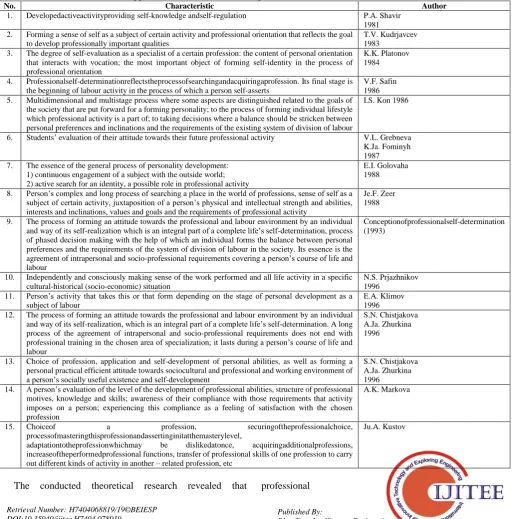
[image:3.595.43.557.296.816.2]purposeful process of determining and unleashing the essential strength of a person, ways of development and realization of personal potential and abilities carried out in partnership with other people [18]. The authors’ approach to the solution of the problem of professional self-determination of the students of specialized secondary-education institutions is determined by the L.M. Mitina’s viewpoint that “professional development is inseparable from personal one, both of them are based on the principle of self-development determining the ability of a person to transform personal life activity into the item of practical reorganization that leads to the highest form of life activity – creative self-realization” [19]. Despite the high significance of the concept of “professional self-determination” for the theory and practice of professional education, it is interpreted differently (Table I). In this regard, it does not have a universally recognized definition yet.
Table I.Scientific approaches to the definition of “professional self-determination of an individual”
No. Characteristic Author
1. Developedactiveactivityproviding self-knowledge andself-regulation P.A. Shavir
1981
2. Forming a sense of self as a subject of certain activity and professional orientation that reflects the goal
to develop professionally important qualities
T.V. Kudrjavcev 1983
3. The degree of self-evaluation as a specialist of a certain profession: the content of personal orientation
that interacts with vocation; the most important object of forming self-identity in the process of professional orientation
K.K. Platonov 1984
4. Professionalself-determinationreflectstheprocessofsearchingandacquiringaprofession. Its final stage is
the beginning of labour activity in the process of which a person self-asserts
V.F. Safin 1986
5. Multidimensional and multistage process where some aspects are distinguished related to the goals of
the society that are put forward for a forming personality; to the process of forming individual lifestyle which professional activity is a part of; to taking decisions where a balance should be stricken between personal preferences and inclinations and the requirements of the existing system of division of labour
I.S. Kon 1986
6. Students’ evaluation of their attitude towards their future professional activity V.L. Grebneva
K.Ja. Fominyh 1987
7. The essence of the general process of personality development:
1) continuous engagement of a subject with the outside world; 2) active search for an identity, a possible role in professional activity
E.I. Golovaha 1988
8. Person’s complex and long process of searching a place in the world of professions, sense of self as a
subject of certain activity, juxtaposition of a person’s physical and intellectual strength and abilities, interests and inclinations, values and goals and the requirements of professional activity
Je.F. Zeer 1988
9. The process of forming an attitude towards the professional and labour environment by an individual
and way of its self-realization which is an integral part of a complete life’s self-determination, process of phased decision making with the help of which an individual forms the balance between personal preferences and the requirements of the system of division of labour in the society. Its essence is the agreement of intrapersonal and socio-professional requirements covering a person’s course of life and labour
Conceptionofprofessionalself-determination (1993)
10. Independently and consciously making sense of the work performed and all life activity in a specific
cultural-historical (socio-economic) situation
N.S. Prjazhnikov 1996
11. Person’s activity that takes this or that form depending on the stage of personal development as a subject of labour
E.A. Klimov 1996
12. The process of forming an attitude towards the professional and labour environment by an individual
and way of its self-realization, which is an integral part of a complete life’s self-determination. A long process of the agreement of intrapersonal and socio-professional requirements does not end with professional training in the chosen area of specialization; it lasts during a person’s course of life and labour
S.N. Chistjakova A.Ja. Zhurkina 1996
13. Choice of profession, application and self-development of personal abilities, as well as forming a personal practical efficient attitude towards sociocultural and professional and working environment of a person’s socially useful existence and self-development
S.N. Chistjakova A.Ja. Zhurkina 1996
14. A person’s evaluation of the level of the development of professional abilities, structure of professional
motives, knowledge and skills; awareness of their compliance with those requirements that activity imposes on a person; experiencing this compliance as a feeling of satisfaction with the chosen profession
A.K. Markova
15. Choiceof a profession, securingoftheprofessionalchoice,
processofmasteringthisprofessionandassertinginitatthemasterylevel,
adaptationtotheprofessionwhichmay be dislikedatonce, acquiringadditionalprofessions,
increaseoftheperformedprofessional functions, transfer of professional skills of one profession to carry out different kinds of activity in another – related profession, etc
Ju.A. Kustov
self-determination as a psychological and pedagogic notion involves the use of the categories of profession, personality, activity and society.In the authors’ opinion, the most complete and successful approach to understanding the notion of “self-determination” was introduced by E.JuPrjazhnikova and N.S. Prjazhnikov. They consider self-determination as a readiness of a person to consciously and independently plan and fulfil the prospects of personal development. This statement raises the problem of interosculation of a person and world, mechanisms of this interosculation where a person is a sovereign subject of activity independently choosing the ways of communicating with the world in which one lives. Hence, this understanding of the term “self-determination” reflects the degree of a person’s participation in life activity. The way of personal self-determination is the ability to choose independently. When choosing a goal, predicting future activity in every moment of time, a person aspires to correspond not only to personal preferences but also to the world. In the last two decades, many reporting documents of the UNESCO Institute for Education, scientific reports of international conferences participants, works of Russian theorists and practitioners of education emphasized the importance and necessity of strengthening the students’ research activity. Thus, Jacques Delors, director of the UNESCO Institute for Education, noted in his 1989 report that the development of research skills, ability to independently set and solve research tasks is one of the priorities of modern professional education. The importance of learning and research activities in the process of training specialists is stressed by the developers of the new generation of the state educational standards of secondary professional education. Many Russian works (Ginecinskij, Zhuravljov, Jaroshevskij, and others; Nigmatullina et al.) emphasize that research activity of a student is an efficient tool of personal development directly reflecting the global goal of modern Russian education as it is proclaimed in the Law of the Russian Federation “About education in the Russian Federation”. According to this common goal of education, strengthening of research activity thereby realizes the principle of humanization under which the task of intellectual and, in fact, personal (in such manifestations as art, independence, responsibility, etc.) development of an individual, spiritual growth is a leading one in education. It is observed especially distinctly in professional education preparing specialists to an independent productive work that requires activity, rationality, initiative, self-dependence, responsibility, creative and exploratory attitude to work. Students' researches as a stand-alone kind of their educational, learning activity are carried out at different levels of education to varying degrees, in different time combinations with other kinds of their theoretical and practical learning activity. However, research activity in any form has a certain invariant of content, phasing of its realization, peculiarities of its organization and execution.
V. CONCLUSION
Thus, professional self-determination is an activity of a person (a component of personal self-determination) which is carried out during social development and maturity and, if
necessary, adjusted with the help of a specially organized interference – career-guidance, teaching and educational process, theoretical and practical work. Furthermore,
according to the Conception of professional
self-determination (Institute of professional
self-determination of the youth of the Russian Academy of Education (1993), this interference provides for equal interaction of an individual and the society, which optimally complies with the personal traits and demands of the labour market in competitive specialists. Professional self-determination is a multidimensional and multistage process, one of the main components of a person’s maturity, socialization, in which I.S. Kon distinguishes four stages: child’s play, teen fantasy, preliminary choice of a profession, and making the decision about the choice of a profession, preceded by a wider social orientation: aspiration to apply to a university, get specialized professional education or begin working. Based on D. Super’s conception of “professional maturity”, the authors think that such factor as research activity will be of significance for the effectiveness of the process of students’ professional self-determination. That is primarily because the age of 14-25 years corresponds with the research stage of professional path of a person related to testing personal strengths. This factor can be referred in the context of the grounds discussed above to the category of common ones. However, students’ research activity as a pedagogic system can be considered as a particular system, as it will have a specific character due to regional peculiarities of educational activity of a specific educational institution. At the same time, SRA can also act as an internal factor, since the capacity for research is greatly attributable to individual and personal traits of a student.
The analysis of scientific and theoretical aspects of the problem of professional self-determination showed that one of the main essential characteristics of this phenomenon is the willingness of a person to research – oneself, the society, profession, activity. Therefore, students’ research activity should become one of the decisive factors of their personal and professional formation and development.
REFERENCES
1. A.M.Tatarinceva, M.G.Sergeeva, S.V.Dmitrichenkova,
V.A.Chauzova, I.S. Andryushchenko, and E.F. Shaleeva, Lifelong learning of gifted and talented students. Espacios, vol. 39(2),2018, pp. 29.
2. M.G.Sergeeva, I.Yu. Sinelnikov, and A.P. Sukhodimtseva,
Metasubject abilities development in upper secondary school students
as a pedagogical problem. The European Proceedings of Social
&Behavioural Sciences EpSBS, 2017, pp. 531–539.
3. M.G.Sergeeva, N.G.Bondarenko, T.A.Shebzuhova, A.A.Vartumyan,
and S.L. Lesnikova, Scientific substantiation of the conception of
continuous economic education development. The Turkish Online
Journal of Design, Art and Communication (TOJDAC), Special Edition, 2018, pp. 178–185.
4. I.S.Samokhin, M.G.Sergeeva, E.V.Tabuyeva, T.G. Stanchulyakand
E.G. Kolesina, Assessment of student’s poten-tial based on the data concerning productivity and psychological comfort of education. Espacios, vol. 39(2), 2018, pp. 22.
5. M.G.Sergeeva, N.L.Sokolova, N.V.Ippolitova, E.V.Tabueva,
6. A.M.Tatarinceva, N.L.Sokolova, E.A.Mrachenko, M.G. Sergeeva, and I.S. Samokhin, Factors determining indi-vidual success in Life-long learning. Espacios, vol. 39(2), 2018, pp. 28.
7. S.D.Neverkovich, I.S.Bubnova, N.N.Kosarenko, R.G.Sakhieva,
Zh.M.Sizova, V.L. Zakharova, and M.G. Sergeyeva, Students’ Internet
Addiction: Study and Prevention. Eurasia Journal of Mathematics,
Science and Technology Education, vol. 14(4), 2018, pp. 1483–1495.
8. M.G.Sergeeva, V.Yu.Flyagina, I.V.Taranenko, E.V. Krasnova, and
A.V. Vilkova, The interaction of labor market and educational services market considering social partnership mechanism and specificity of the regional educational policy. Ponte, vol. 73(12), 2017, pp. 2.
9. N.F.Micheeva, E.A. Popova, and Z.N. Ignashina“Teaching
Latin-American Spanish in Russia: communication difficulties
approach”. 11th International Technology, Education and
Development Conference. Valencia, Spain, 6th-8th March. INTED Proceedings, 2017, pp. 3526-3534
10. M.G.Sergeeva, E.P.Komarovskaya, L.B.Bakhtigulova, E.V.Tabuyeva,
P.F. Kalashnikov, and A.D. Galyuk, Educational company: Peculiarities of the technology’s implementation at different educational levels when forming the eco-nomic competencies of future specialists. Espacios, vol. 39(2), 2018, pp. 25.
11. N.F. Mikheeva, II Firsova’s readings: On the international conference
“Contemporary Philology and Methodology of Foreign Language Teaching: Basic Tendencies and Development Prospects”. Moscow,
April 26–27, 2016. Proceedings of Peoples’ Friendship University of
Russia, Section “Linguistics” – Russian Journal of Linguistics, vol. 20(2), 2016, pp. 149–151.
12. M.G. Sergeeva, and E.E. Nikitina, Criteria indicators of formation of
economic competence of system of the general education. International Conference “Education Environment for the Information Age” (EEIA-2016). Moscow, Russia, June 6–7, 2016.
13. M.I.Mukhin, M.V. Mishatkina, and N.L. Sokolova, On the issue of
institutional and methodological foundations of teacher’s training. International conference “Education environment for the Information Age (EEIA 2017). European Proceedings of Social and Behavioural Sciences, vol. 28, 2017, pp. 457– 465.
14. K.Yu.Milovanov, E.Ye.Nikitina, N.L. Sokolova, and M.G. Sergeyeva,
The creative potential of museum pedagogy within the modern society. Espacios, vol. 38(40),2017, pp. 27–37.
15. S.Wang, N.V.Gorbunova, A.R.Masalimova, J.Bírová and M.G.
Sergeeva, Formation of Academic Mobility of Future Foreign Language Teachers by Means of Media Education Technologies. Eurasia Journal of Mathematics, Science and Technology Education, vol. 14(3),2017, pp. 959–976.
16. M.G. Sergeeva,N.N.Bedenko,L.Zh.Karavanova, T.Yu.Tsibizova, I.S.
Samokhin, and M.S.M. Anwar, Educational company (Technology): Peculiarities of its implementation in the system of professional education. Espacios, vol. 39(2), 2018, pp. 24.
17. M.G.Sergeeva, N.V.Ippolitova, A.V.Solovyeva, L.A.Petrova, M.L.
Kunytsina, and I.S. Andryushchenko, Verification of management support of the professional and educational trajectory of students in the
sociocultural educational environment of the University. Espacios, vol.
39(2), 2018, pp. 23.
18. A.M.Tatarinceva, N.L.Sokolova, M.G.Sergeeva, N.N. Bedenko, and
I.S. Samokhin, The influence of a psychologi-cal and a cognitive component of a student's thinking style on his/her success in lifelong learning. Espacios, vol. 39(2),2018, pp. 30.
19. A.P.Sukhodimtseva, M.G.Sergeeva, M.V.Donskaya, M.E.
Kupriyanova and S.B. Tomashevich, Metadisciplinari-ty in education: Solving actual problems. Espacios, vol. 39(2), 2018, pp. 27.
20. Yu.G.Nigmatullina, A.N. Pashkurov, A.I.Razzhivin, and
I.Yu.Dulalaeva. Binary and Trinitarian thought Dialogue in the Focus
of pre-romantic Melancholy Problem.European Journal of Science and