Abstract: Cloud computing allows users to use resources pay per use model by the help of internet. Users are able to do computation dynamically from different location by using internet resources. The major challenging task in cloud computing is efficient selection of resources for the tasks submitted by users. A number of heuristics and meta-heuristics algorithms are designed by different researchers. The most critical phase is the selection of appropriate resource and its management. The selection of resource include to identify list of authenticated available resources in the cloud for job submission and to choose the best resource. The best resource selection is done by the analysis of several factors like expected time to execute a task by user, access restriction to resources, and expected cost to use resources. In this paper, cloud architecture for resource selection is proposed which combines these factors and make the effective resource selection. In this paper a modified flower pollination algorithm is proposed to migrate the task on efficient virtual machine. The selection of the efficient virtual machine is calculated by the fitness function. By calculating the fitness function, the modified FPA algorithm is used to take the decision regarding VM migration is required to improve the resource efficiency or not. In this paper Virtual machine mapper maps the task as per knowledge base i.e. past history of the virtual machine, task type whether computational or communicational based. The results are compared with the existing meta-heuristic algorithms.
Keywords:- Cloud computing, Virtual machine, Meta-heuristics, Task Scheduling.
I. INTRODUCTION
High performance Distributed computing systems are the trending approaches for scientific and computational based intensive applications. Cloud computing is one of the high performance computing paradigm in which a shared pool of resources like storage, computation etc. are used as a service through internet access. The key challenges of cloud computing is scheduling of tasks to proper resources as well as efficiently utilization of the resources also. Task scheduling is based on the Quality of service parameters which can be cost, time, deadline, energy etc. Different users have different parameters for Quality of service. Some users want cost effective scheduling others required deadline based task execution. In cloud computing, cloud broker has all the information about the availability of resources. It uses the
Revised Manuscript Received on July 05, 2019.
Savita Khurana, Department of Computer Science and Engineering, I.K. Gujral Punjab Technical University, Jalandhar,Punjab, India.
Dr. Rajesh Kumar Singh, Department of Computer Science & Application, SUS Institute of Computer, Tangori, Mohali,Punjab,India.
concept of virtualization. A number of virtual machines are available to allocate the tasks. Some VMs are underutilized and some VMs are over utilized. It is the duty of cloud scheduler to allocate the tasks to the VMs so that VMs are efficiently utilized. Cloud scheduler schedules the tasks to the proper resource by considering the need of users. It is the duty of the cloud scheduler to keep track of the resources for how much time the resource is allocated to a particular task. Another duty of scheduler is that if the task is not executed on time then task is migrated to another VM. Cloud scheduler should allocate the resources efficiently so that user is satisfied as well as resources are well utilized. A number of task scheduling based algorithms [11] has been proposed by different researchers like ant colony optimization (ACO), Genetic algorithm (GS), Particle swarm optimization etc to solve the problem of task scheduling and task utilization. Task- resource mapping and management of the execution of inter-dependent tasks on the available resources in distributed manner. The motive of scheduling is to achieve high performance computing with a suitable allocation [12] of resources for each task to satisfy the QoS parameters [14] imposed by user. In order to improve the cloud performance, resources must be mapped to the resources with minimum overhead of migration of the tasks and increase the overall utilization of the resources with less makespan and cost [7].
II. RELATEDWORK
Gupta et.al, proposed FPA based task scheduling algorithm to minimize the makespan of the tasks. In this paper only static tasks are taken into consideration. For this purpose, the author proposed a FPA algorithm and compares the results with the other meta-heuristics algorithm [1].
Anbazhagi et.al,proposed a dynamic scheduling algorithm which scheduled the task not taking only priority but also monitor the idle time of resources. Using QoS-TS algorithm the task scheduling of the proposed system is implemented. The QoS-TS algorithms achieve good performance by QoS parameters priority, completion time.
Pandey et. al., proposed a scheduling heuristic that is based on the Particle Swarm Optimization (PSO). On cloud computing environments to minimize the total loss of execution of application workflow is minimized by this heuristic algorithm. In the future work they to schedule workflows of real applications such as brain imaging analysis, EMO, and others they can
integrate PSO based
heuristic[13] into their
Modified Flower Pollination Based Task
Scheduling in Cloud Environment using
Virtual Machine Migration
workflow management system [3].
Jang et. al., presented scheduling problems in Cloud computing and to solve this they proposed a task scheduling model. The proposed model is based on the Genetic algorithm. Every task scheduling cycle the task scheduler calls the GA scheduling function in the proposed model. The genetic algorithm-based task scheduling model show the effectiveness and efficiency in experimental results as round-robin task scheduling model [4].
Liu et. al., proposed workflow architecture for Smart City based upon cloud technology and reviewed variety of workflow scheduling algorithms. The objective of the proposed work is to develop taxonomy for workflow management and scheduling in a cloud environment. The proposed algorithm implemented cloud-based workflow architecture to Smart City environments [5].
Shukla et. al., study importance and challenges of quality of services which affects the cloud computing services. If the resources in cloud environment are properly scheduled, it reduced the response time, total cost of cloud resources, energy consumption and enhance the performance of overall
cloud environment. Proposed work comparative review of multi-objective workflow scheduling algorithms [6].
III. PROPOSEDAPPROACH
Cloud computing is the one of the eminent technology. It uses the concept of virtualization [8].In cloud data center a number of VMs are available for execution of the tasks [9]. The major challenge is for data centers is to proper utilization of the resources, task execution with minimum makespan, minimum cost and Virtual machine mapping to the particular task [10]. In proposed approach, a frame work cloud computing model is proposed which uses Flower Pollination Algorithm for Virtual Machine Migration to utilize all the virtual machines effectively and reduce the idle time to ensure the proper load balancing of virtual machines. The framework of the proposed approach is shown in Fig. 1.
VM Migration
Fig1: Proposed Cloud Framework
A. Components of Proposed Framework:-
I)Preprocessing Phase:- the components of the preprocessing phase are following:-
Task type:- to process the tasks firstly tasks are categorized according to the task types. The parameters of the tasks are defined by the users. Tasks are classified according to the parameters. Some tasks need high computation and some need high processing power. So, tasks are submitted according to the available virtual machine. Once tasks are categorized, task provisioner processes the suitable resource for execution of the task.
Task Knowledge Base:- This component is responsible for providing proper information related to a particular VM like its execution time, CPU power, storage based on the previous historical execution of the tasks. Tasks with similar configuration are executed on a particular VM, based upon these historical record VMs are decided by the task mapping engine.
VM Provisioner:- the information about the available VM like its memory, CPU speed, RAM etc are available in this component. According to the
its execution proceeds. If there is not availability of any such VM then that particular task is transferred to waiting queue.
II) Execution Phase:-
The following is the components for execution phase:- Task mapping:- after the task categorization, tasks are forwarded to the task mapper. Task mapper searches the available virtual machines from task provisioner according to the task type. The task scheduler finds the best VM from the available virtual machines and submits for execution. If no one VM is available then task is send to the waiting queue. Newly arrived tasks and waiting queue tasks are prioritized to avoid the starvation of the waiting queue tasks.
VM Provisioner:- this component keep track of the availability of the VMs in the data center and then availability of the VMs to the task mapper.
Data Center:- it is the collection of VMs having different types of configuration in respect to memory, CPU speed, storage etc. Some VMs are under- utilization and some VMs are over-utilized. According to the tasks execution, some tasks are migrated from over-utilized VMs to underutilized VMs. This process is called VMs migration. According to the tasks dependencies, VMs migration is done. Analysis of makespan, cost, reliability, utilization of the data center is calculated and analysis is done with the existing approaches.
Task Provisioner:- Once the task category is identified, appropriate availability of the VMs are shown to the task mapper. Appropriate task is provisioned for execution of the task. If task provisioner is unable to find a particular VM for execution then that task is send to the waiting queue component and task is considered again for execution with new list of tasks.
Task Execution Time:- It is the total execution time of virtual machine to complete execution of the task which is the sum of task processing time(Tpt) and task waiting time(Twt).
Task waiting time(Twt)= max_input(T)/BW (1)
Task processing time(Tpt)= task size/MIPS(VM) (2)
TET=∑(Tpt + Twt) (3)
Min_Makespan=Sd.M_VM(TET1,TET2,…………TETm) (4)
If tasks have no dependency in that case Twt will be 0, otherwise it is to be calculated. Cost:- Cost of the VM for execution of the task is sum of the cost of task execution per instruction and cost of task migration from mth VM to nth VM and cost of the storage for execution . Cp= TET*Cost per task (5)
Csto= (Tet+Twt) * Costperstorage (6)
Ctrans= (7)
CTC= Csto+ Ctrans) (8)
Ctotal=∑ CTCi (9)
CTC is the total cost of VM for execution of tasks. Ctotal is the total cost of all virtual machines running on a data center. Throughput:- It is denoted as Ttotal i.e. number of millions of instructions by the no. of VM. Total throughput of data center is the average throughput of all virtual machines. T= (10)
Ttotal= (11)
Fitness function:- Ctotal * Min_Makespan+ Ttotal (12)
B. Proposed algorithm for VM migration using Modified Flower Pollination Algorithm
INPUT: VMs from the data center;
Expected Result : VM migration with efficiency; 1. For all VMs {VM1, Vm2,…,VMn} ;
2. Find the minimum makespan time of available VM using eqs(1-4)
3. Find the cost of available VMs using eqs(5-9); 4. Find the throughput of the available VMs using eqs(10-11);
5. Find the fitness function by eq. 12. 6. IF( Fitness_value<THRESHOLD value)
7. Implement flower pollination algorithm[1][15] for VM migration ;
8. IF (THRESHOLD value > Fitness_value) then 9. Break;
10. Process continues until it reaches NULL. 11. Break;
11. End;
The proposed algorithm use Flower pollination used to sole the optimized resource allocation using VM migration [1]. The proposed algorithm is used to find the best VM among all available VMs.
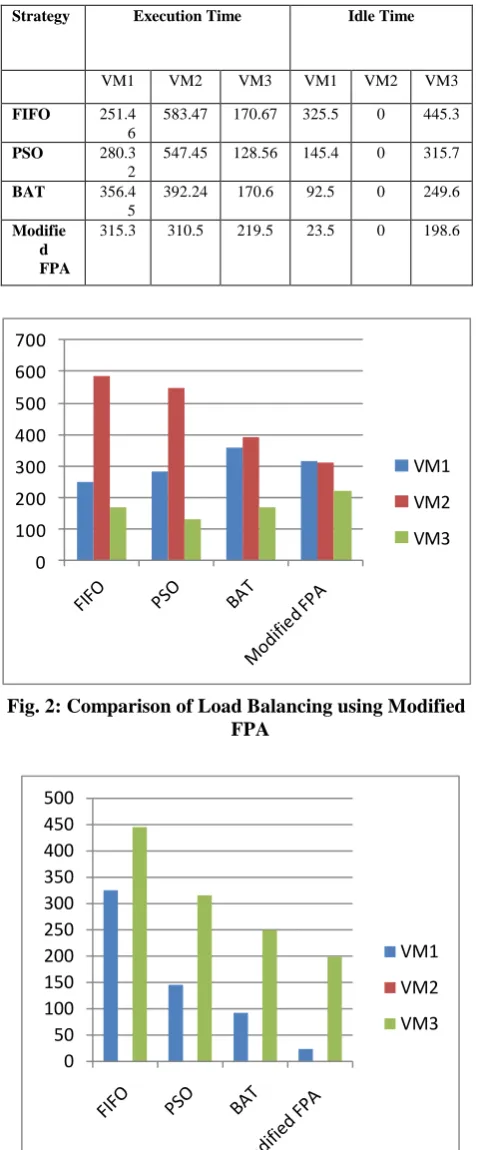
IV. RESULTS AND DISCUSSIONS
Table I: Comparison of various scheduling algorithms
Strategy Execution Time Idle Time
VM1 VM2 VM3 VM1 VM2 VM3
FIFO 251.4 6
583.47 170.67 325.5 0 445.3
PSO 280.3
2
547.45 128.56 145.4 0 315.7
BAT 356.4
5
392.24 170.6 92.5 0 249.6
Modifie d FPA
315.3 310.5 219.5 23.5 0 198.6
[image:4.595.50.291.72.648.2]0 100 200 300 400 500 600 700 VM1 VM2 VM3
[image:4.595.54.286.346.660.2]Fig. 2: Comparison of Load Balancing using Modified FPA 0 50 100 150 200 250 300 350 400 450 500 VM1 VM2 VM3
Fig. 3: Comparison of Idle time for Virtual Machines
V. CONCLUSION
Cloud computing is the one of the eminent technology which uses the concept of virtualization. Virtualization is the technology in which tasks uses the same physical machine having different processors cores. Virtual machine mapping to the particular task is the major challenge of cloud
computing. Virtual machine migration is one of the most important features provided by modern VM technologies which allow system administrators to move an OS instance to another physical node without interrupting any hosted services on the migrating OS so that users experience high availability of applications at all times. A modified Flower pollination based algorithm is proposed to migrate the VM to find the best VM among all available VMs by using the fitness function. It provides the best optimization as compare to the existing algorithm FIFO, PSO and BAT optimization algorithms.
REFERENCES
1. Gupta, I., et. al, “A Flower Pollination Algorithm Based Task
Scheduling in Cloud Computing”, International Conference on
Computational Intelligence, Communications, and Business
Analytics,2017, DOI: 10.1007/978-981-10-6430-2_9, pp-97-107
2. Anbazhagi, L. Tamilselvan and Shakkeera, "QoS based dynamic task
scheduling in IaaS cloud," 2014 International Conference on Recent
Trends in Information Technology, Chennai, 2014, pp. 1-8. doi: 10.1109/ICRTIT.2014.6996176.
3. Pandey, Suraj, et al. "A particle swarm optimization-based heuristic
for scheduling workflow applications in cloud computing
environments." Advanced information networking and applications
(AINA), 2010 24th IEEE international conference on. IEEE, 2010. 4. Jang, Sung Ho, et al. "The study of genetic algorithm-based task
scheduling for cloud computing." International Journal of Control and Automation 5.4 (2012): 157-162.
5. L. Liu, M. Zhang, R. Buyya. "Deadline‐constrained co evolutionary genetic algorithm for scientific workflow scheduling in cloud
computing." Concurrency and Computation: Practice and Experience
(2016).
6. S. Shukla, A. K. Gupta, S. Saxena and S. Kumar "An Evolutionary Study of Multi-Objective Workflow Scheduling in Cloud Computing." International Journal of Computer Applications (0975–8887), Volume (2016).
7. P.Kumar, M.Jaeyalakshmi, “Task scheduling using meta-heuristic
optimization techniques in cloud environment” ,International Journal of Pure and Applied Mathematics, Volume 118 No. 18 2018, ISSN: 1314-3395.
8. Barham, P. et al. (2003), “Xen and the Art of Virtualization”, Proc.
19th ACM Symp. Operating Systems Principles (SOSP’03),Bolton Landing, USA, October 19–22, pp. 164–177. ACM, New York, USA.
9. Zhang, Q., Cheng, L. and Boutaba, R. (2010), “Cloud computing :
state-of-the-art and research challenges”. Internet Serv. Appl., Vol 1, pp.7–18.
10. Fang, Y.,Wang, F. and Ge, J. (2010), “A task scheduling algorithm
based on load balancing in cloud computing”, Web Information
Systems and Mining, Lecture Notes in Computer Science 6318, Springer, Heidelberg, Germany. pp. 271–277.
11. Bawa R.K.,Sharma G., “Modified Min –Min Heuristic for Job
Scheduling based on QoS in Grid Environment”. IEEE Conference on
International Management in the Knowledge Economy, 19-20 December 2013.
12. Bawa R.K.,Sharma G.,"Reliable resource selection in grid
environment”. International Journal of Grid Computing &
Applications, March 2012, Volume 3, Number 1, pp. 1-10.
13. Miglani N., Sharma G., “ Modified Particle Swarm Optimization
based upon Task categorization in Cloud Environment” International Journal of Engineering and Advanced Technology (IJEAT) ISSN: 2249-8958, Volume-8 Issue-4C, April 2019 pp 67-72.
14. Khurana S., Singh R. K., “QoS based Modified Bat Algorithm for Task
Scheduling in Cloud” International Journal of Engineering and Advanced Technology (IJEAT) ISSN: 2249-8958, Volume-8 Issue-4C, April 2019 pp 163-168.
15. Khurana S., Singh R. K., “An Approach of Workflow Scheduling by
Convex Swarm Intelligence Optimization With Peft Base Task Ranking in Cloud Computing”, Journal of Advanced Research in
Dynamical & Control
oto
AUTHORSPROFILE
Savita Khurana completed Bachelor of Technology in Computer Science & Engineering from Kurukshetra University in 2005 and Master of Technology in Computer Engineering from Kurukshetra University in 2008. She is currently pursuing part-time Ph.D. from I.K. Gujral Punjab Technical University, Kapurthala, Jalandhar, punjab and also currently working as Assistant Professor in Department of Information Technology, Seth Jai Parkash Mukand Lal Institute of Engineering & Technology, Radaur, Yamunanagar, since 2008. She has published various research papers in reputed international journals and conferences.