Abstract: Pyrolysis of sludge is the thermo chemical technology, which is alternative for sludge disposal technique. Co-pyrolysis is used to enhance the quality of liquid product from Pyrolysis. Effective quantity of bio char (solid product) produced in this process. In this work, pyrolysis and co-pyrolysis of MSS, Waste Biomass blends (1:1) was performed in a fixed bed reactor to recover bio-char, combustible gases and oil/wax. It is established that yield and composition of the products recovered, depends on the temperature. The residue bio-char derived from pyrolysis and co-pyrolysis of MSS and bio-mass waste were studied. The bio-char was characterized by Fourier Transform Infrared spectroscopy (FTIR), elemental analysis (CHN), BET surface area, WD-XRF analysis. Adsorption experiments were carried out to investigate the effects of various parameters on adsorption capacity and utilization of bio-char as an adsorbent. High adsorption capacity is observed for bio char from co-pyrolysis of MSS and waste bio mass. Almost 90% COD removal is observed by using this bio char.
*MSS-Municipal Sewage Sludge
Index Terms: Adsorption, Bio-char, Co-pyrolysis, Municipal Sewage Sludge
I. INTRODUCTION
Large quantity of Municipal sewage sludge (MSS) and
Biomass waste are generated every year. Pyrolysis is one of the technology by which the volume of this waste can be reduced and it also helps for disposal of MSS and Biomass waste. Pyrolysis and co pyrolysis has been proved to be good feed stock material for the production of bio char with the bio oil and gas. It is simple and inexpensive technology for processing of variety of feed stocks. It anyhow decreases the amount of waste going into the open landfills and thereby reduces the land pollution and greenhouse gas emission.[1]Furthermore, it reduces water pollution risk andhas the potential to decrease its dependence on imported energy resources by generating energy from domestic waste. Waste management uses various pyrolysis techniques to reduces the risk of mismanagement of open lands and some of these techniques are cheaper compared to open dumping and
Revised Manuscript Received on December 22, 2018. Dharmesh Kapatel, Associate Professor, G. H. Patel College of
Engineering and Technology (GCET), Vallabh Vidhyanagar, Gujrat, India Meet Chavda, G. H. Patel College of Engineering and Technology (GCET), Vallabh Vidhyanagar, Gujrat, India
Yash Kothari, G. H. Patel College of Engineering and Technology (GCET), Vallabh Vidhyanagar, Gujrat, India
Harsh Modi, G. H. Patel College of Engineering and Technology (GCET), Vallabh Vidhyanagar, Gujrat, India
Aasit Movalia G. H. Patel College of Engineering and Technology (GCET), Vallabh Vidhyanagar, Gujrat, India
landfilling. Moreover, pyrolysis is widely used in various industries to produce activated carbon, charcoal and other substances from biomass waste and wood. [1]Gas produced
during pyrolysis of wastes can be used in steam and gas turbines for producing electricity. In addition to this, pyrolysis plays a vital role in carbon-14 dating and mass spectroscopy. Biochar obtained from pyrolysis are also used as fertilizers and are used to increase the fertility of barren Landfills so that it can help to boost the agricultural production of the farmers and the country thereby reducing one’s dependence on other allies.[2]
Pyrolysis is a chemical process of decomposition of organic materials at high temperature in anaerobic and a controlled condition under pressure. It is commonly used to convert organic materials into solid residue containing as and carbon along with small quantity of oil and gases. [2]Pyrolysis using
extreme conditions or extreme pyrolysis yields carbon as product and is also called as carbonization. Pyrolysis carried out using various feed materials contains different amount of yield and amount of residues also depends upon the initials carbon contents, organic and inorganic material content and heavy metal content of the feed materials.[3] The carbon
composition in bio char and oil obtained are in direct proportion to the initial carbon content of the feed/raw materials used in the initials stages. Unlike other processes pyrolysis doesn’t involve reaction with water, other reagents or oxygen. [4]
While co-pyrolysis is a process which involves two or more materials as feedstock. Many studies have indicated that the use of these process have enabled to improve the characteristics of the oil as it increases the oil yield, reduce the water content and increase the calorific value of oil.[5] Besides
the use of these technique it has also reduced the production cost and is also enabled to tackle some waste management and pollution issues that are being created due to the disposal of waste to open areas. It is the process which does not involves solvents, catalysts, additional pressure, waste from process and no complicated equipment.[5]It is the process which saves
cost for waste treatment, solves various environmental problems, significantly reduces the waste, enhances energy security and its feedstock is available worldwide.[6]
II. MATERIALSANDMETHODS A. Pyrolysis feed stocks
Municipal sewage sludge (MSS): Municipal Sewage Sludge was collected from
Characterization and Utilization of Biochar
Derived from Pyrolysis and Co-pyrolysis of
MSS and Waste Biomass as an Adsorbent
122 Retrieval Number: F22210486S219/19©BEIESP
Published By:
Blue Eyes Intelligence Engineering & Sciences Publication
the Municipal Sewage Treatment plant located at Vallabh Vidhyanagar, small town in Gujarat. Initially it was in semi-solid (slurry) form. [6] MSS consists of various elements
such as waste, organic and inorganic compounds that are disposed into atmosphere which are harmful to the environment. Sludge contains various pollutants and solid waste such as heavy metals, large organic solids, calcium and magnesium, metal sulphides, heavy metals organic complexes, precipitated soaps and detergents, biomass and precipitated phosphates. The method or treatment of sludge involves stabilization and dewater residue. [6]
Biomass waste are the aggregates obtained from agricultural land such as crop left over, animal fodder, organic industrial, human and animal waste. It is the materials obtained from plants which requires sunlight to flourish.[7] Biomass are
derived from various other general and special purpose sources such as woods from forest, forest leftover, sugarcane bagasse, rice husk, kitchen waste. Biomass waste contains various useful material which ignored till now. Mostly the waste obtained from above enlisted sources is simply dumped into landfill or burnt in open areas which create various pollution issues in the surrounding humiliation. Energy obtained from biomass is generally due to the carbon dioxide of the material. Sunlight trapped in the biomass due to the photosynthesis process. At longer period to time the waste biomass decomposed, thereby releasing energy stored and the carbon dioxide contained in the waste. These energies if released in a quick, directed and regulated way can get used in various useful way. [7]
B. Preparation of Biochar
The feedstocks were dried under the sun light for 7 days as well as dried in the oven for 90 minutes at 110°C in order to get dewatered sample with most of its moisture content evaporated.[7] Pyrolysis and co-pyrolysis experiments of the
waste biomass and dried MSS powder were performed using reactor in inert atmosphere.The waste biomass used for the experiment were agricultural waste, animal fodder leftovers, crop waste and other forestry waste. The MSS used was collected from the municipal sewage treatment plant. [8] The
feedstock material was crushed and converted it in small particle size powder of about approximately 5 mm. 200 gm of feedstock is taken in the reactor. The reactor was heated on open burner until the feed materials were completely pyrolyzed. The temperature is about 400-450 ⁰C. The oil is obtained by condensation of the gas. The bio-char obtained after the completion of pyrolysis was collected for usage. [9]
III. CHEMICALANALYSIS
A. Elemental Analysis (CHN)
The bio-char obtained from pyrolysis of MSS was analyzed. The pyrolysis was carried out at around 400-450°C. The results were listed in Table 1 showing that the Carbon (1.41%) whereas Hydrogen and Nitrogen were not found.
B. WD-XRF Analysis
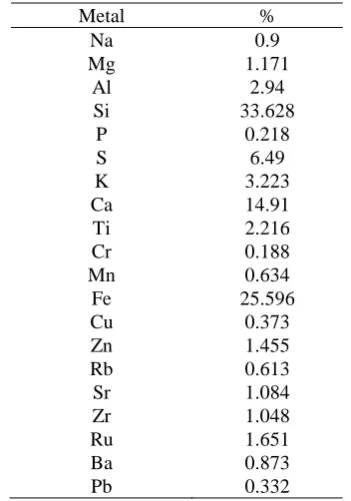
The bio-char obtained from pyrolysis of MSS was analyzed. XRF was performed to confirm the content of inorganic metal oxide of the MSS Biochar. The results were listed in Table 2
[image:2.595.311.554.102.171.2]showing that the MSS Biochar mainly contained Silicon (si) 33.62% and Iron (Fe) 25.59%.
Table. 1 Elemental analysis (CHN) result table
Test parameter Instruments Results
Carbon (%) CHN/S/O
Analyzer, Perkin Elmer, Series II, 2400
1.41
Hydrogen(%) Not Detected
Nitrogen (%) Not Detected
Table. 2 WD-XRF analysis of MSS Biochar sample
Metal %
Na 0.9
Mg 1.171
Al 2.94
Si 33.628
P 0.218
S 6.49
K 3.223
Ca 14.91
Ti 2.216
Cr 0.188
Mn 0.634
Fe 25.596
Cu 0.373
Zn 1.455
Rb 0.613
Sr 1.084
Zr 1.048
Ru 1.651
Ba 0.873
Pb 0.332
C. Fourier Transform Infrared Spectroscopy (FTIR)
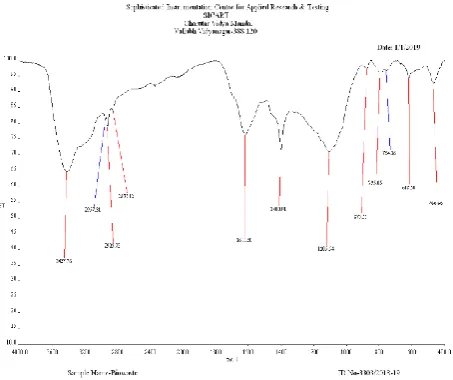
Fourier Transform Infrared Spectroscopy (FTIR) analysis was applied on the Biomass Biochar, MSS Biochar and MSS+Biowaste Biochar to determine the surface functional groups, and the spectrum were recorded in the wave number range of 400-4000 cm-1. FTIR micrograph of bio-mass, MSS
[image:2.595.338.514.209.460.2]Fig. 1 FTIR isotherm of bio char obtained from pyrolysis of Bio mass waste
Fig. 2 FTIR isotherm of bio char obtained from pyrolysis of Municipal Sewage Sludge (MSS)
Fig. 3 FTIR isotherm of bio char obtained from co pyrolysis of Bio mass waste and Municipal Sewage Sludge (MSS)
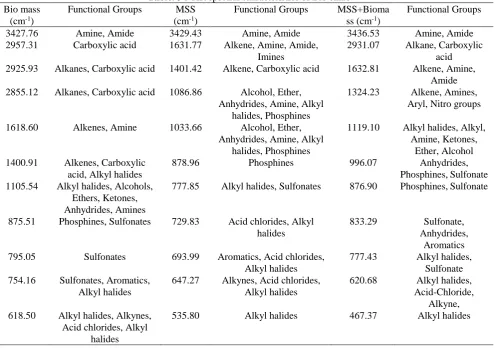
The obtained results of FTIR Spectroscopy of bio-char obtained from of Bio-mass states 3427.76 cm-1amide
(N-H Stretch) and amine (1 per N-H bond), 2957.31 cm-1 carboxylic acid (O-H Stretch), 2925.93 cm-1and 2855.12 cm-1indicates alkane (C-H Stretch) and carboxylic acid (O-H Stretch), 1618.60 cm-1alkene (C=C Stretch conjugated) and amines (N-H bend), 1400.91cm-1 alkene (C-H in plane bend) along with carboxylic acid (O-H bend) and alkyl halides (C-F Stretch), 1105.54cm-1(alcohols and anhydrides C-O Stretch), ethers (C-O Stretch dialkyl), ketones (C-C Stretch), amines (C-N Stretch alkyl/aryl) and alkyl halides (C-F Stretch), 878.51cm-1phosphines (PH bend) and sulfonates (S-O Stretch), 795.05cm-1sulfonates (S-O Stretch), 754.16cm-1 indicates sulfonates (S-O Stretch), aromatics (C-H bend mono and ortho), alkyl halides (C-Cl Stretch), 618.50cm-1 alkynes(C-H bend acetylenic), alkyl halides (C-Cl Stretch), alkyl chlorides (C-Cl Stretch) and alkyl halides (C-Br Stretch).
The MSS contains abundant functional groups, includes 3429.43 cm-1amide (N-H Stretch) and amine (1 per N-H bond), 1631.77 cm-1indicates presence of alkene (C=C Stretch conjugated and isolated), amines (N-H bend), amides (C=O Stretch) and imines (R2C=N-R Stretch),
1401.42cm-1alkene (C-H in plane bend) along with
carboxylic acid (O-H bend), 1086.86cm-1and
1033.66cm-1indicates (alcohols and anhydrides C-O Stretch), ethers (C-O Stretch dialkyl), amines (C-N Stretch alkyl), alkyl halides (C-F Stretch) and phosphines (PH bend), 878.96cm-1phosphines (PH bend), 777.85cm-1alkyl halides (C-Cl Stretch) and sulfonates (S-O Stretch), 729.83cm-1(alkyl halides and alkyl chlorides C-Cl Stretch), 693.99cm-1 indicates aromatics (C-H bend mono), (alkyl halides and alkyl chlorides C-Cl Stretch), 647.27cm-1alkynes (C-H bend acetylenic), (alkyl halides and alkyl chlorides C-Cl Stretch), 535.80cm-1alkyl halides (C-Br Stretch) and alkyl halides (C-I Stretch).
The main functional groups of MSS and Bio-mass waste contains 3436.63 cm-1(amide N-H Stretch) and (amine 1 per N-H bond), 2931.07 cm-1(alkane C-H Stretch), 1632.81cm-1(alkene C=C Stretch conjugated) along with (amine N-H bend) and amides, 1401.57cm-1(carboxylic acid O-H bend), 1324.23cm-1(alkene C-H in plane bend), (amine C-N stretch / aryl) and nitro group (aliphatic / aromatic NO2), 1119.10cm-1(alkyl halides C-F Stretch), (alkyl C-N Stretch / amines), (ketones C-C Stretch), (dialkyl C-O-C Stretch / ether) and (alcohol C-O Stretch), 996.07cm-1(anhydrides C-O Stretch), (phosphines P-H Stretch) and (sulfonate S-O
Stretch), 876.90cm-1(phosphines P-H bend),
833.29cm-1(sulfonate S-O Stretch), (anhydrides C-O Stretch) and (meta-aromatics C-H bend), 777.43cm-1(alkyl halides C-Cl stretch) and (sulfonate S-O Stretch), 620.68cm-1(alkyl halides C-Br Stretch), (acid chloride C-Cl Stretch) and (alkyne C-H bend / acetylenic).
D. Brunauer-Emmet-Teller (BET) Surface area
Total pore volume and average Pore Diameter of bio-char derived from pyrolysis and co-pyrolysis of biomass and MSS are as shown in Table 4. The table highlights that the surface area of bio-char of Biomass, MSS and MSS+Biomass are 0.1839(m²/g), 0.9165(m²/g)
[image:3.595.60.287.53.243.2] [image:3.595.61.286.531.719.2]
124 Retrieval Number: F22210486S219/19©BEIESP
Published By:
Blue Eyes Intelligence Engineering & Sciences Publication
[image:4.595.315.553.70.149.2]bio-char obtained from pyrolysis of Biomass has lower surface area to its counterparts and thus it can be stated that the other two bio-char presents better textural properties. Total pore volume of bio-chars of Biomass, MSS, and MSS+Biomass are 0.004014(cm³/g), 0.007039(cm³/g) and 0.004538cm³/g), respectively. Hence the analysis leads us to the conclusion that higher the surface area, higher will be the total pore volume. While there is no conclusive evidence for correlation of average pore volume with surface area and total pore volume.
[image:4.595.50.546.209.557.2]Table. 4 BET Surface area Result
Table. 3 FTIR spectral characteristics of Bio chars Bio mass
(cm-1)
Functional Groups MSS
(cm-1)
Functional Groups MSS+Bioma
ss (cm-1)
Functional Groups
3427.76 Amine, Amide 3429.43 Amine, Amide 3436.53 Amine, Amide
2957.31 Carboxylic acid 1631.77 Alkene, Amine, Amide,
Imines
2931.07 Alkane, Carboxylic acid
2925.93 Alkanes, Carboxylic acid 1401.42 Alkene, Carboxylic acid 1632.81 Alkene, Amine,
Amide 2855.12 Alkanes, Carboxylic acid 1086.86 Alcohol, Ether,
Anhydrides, Amine, Alkyl halides, Phosphines
1324.23 Alkene, Amines,
Aryl, Nitro groups
1618.60 Alkenes, Amine 1033.66 Alcohol, Ether,
Anhydrides, Amine, Alkyl halides, Phosphines
1119.10 Alkyl halides, Alkyl, Amine, Ketones,
Ether, Alcohol 1400.91 Alkenes, Carboxylic
acid, Alkyl halides
878.96 Phosphines 996.07 Anhydrides,
Phosphines, Sulfonate 1105.54 Alkyl halides, Alcohols,
Ethers, Ketones, Anhydrides, Amines
777.85 Alkyl halides, Sulfonates 876.90 Phosphines, Sulfonate
875.51 Phosphines, Sulfonates 729.83 Acid chlorides, Alkyl halides
833.29 Sulfonate,
Anhydrides, Aromatics
795.05 Sulfonates 693.99 Aromatics, Acid chlorides,
Alkyl halides
777.43 Alkyl halides,
Sulfonate 754.16 Sulfonates, Aromatics,
Alkyl halides
647.27 Alkynes, Acid chlorides, Alkyl halides
620.68 Alkyl halides,
Acid-Chloride, Alkyne, 618.50 Alkyl halides, Alkynes,
Acid chlorides, Alkyl halides
535.80 Alkyl halides 467.37 Alkyl halides
IV.ADSORPTIONSTUDIES
Adsorption experiments were performed in batch mode to evaluate the effects of various parameters on adsorption of Methyl Orange dye. In each experiment 100 mg/L of methyl orange dye solution was prepared and 2 gm/L of adsorbent was added in a 250 ml conical flask. The sample was shaken at 120 rpm for 100 min at 23°C temperature. Three sets were performed using different bio-char samples (Bio-mass, MSS, MSS+Biomass). The results of the so performed experiments are displayed below. [10]
Adsorption capacity ×V (mg/g) [10]
Where; V = Volume (L) m = mass of adsorbent (g)
A. Removal of color from dye solution
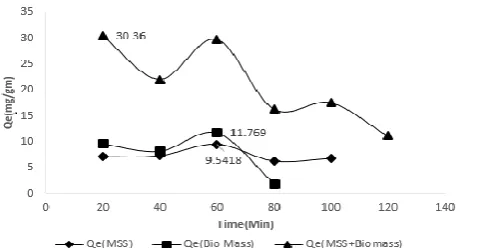
Figure 4 depicts the adsorption capacity of bio char samples prepared from pyrolysis of MSS and Biomass waste and co pyrolysis of both. From Table 5 it is observed that maximum adsorption capacity in bio char of bio mass is 11.77 mg/g. It is due to the organics available in bio mass. In comparison of that the adsorption capacity of MSS bio char is 9.54 mg/g and that of MSS+Bio-mass bio-char is 30.36 mg/g, which shows that the bio char from MSS is very effective adsorbent. More research is required to study the removal of specific impurities. While the bio char prepared from MSS and Biomass mixture is found of
very high adsorption capacity. There might be chances of enhancement in bio char for Sample Surface
Area (m²/g)
Pore Volume
(cm³/g)
Pore Diameter
(Å)
Biomass 0.1839 0.004014 873.237
MSS 0.9165 0.007039 307.193
adsorption. It shows synergetic effect of waste biomass on MSS.
[image:5.595.310.553.136.201.2]Table. 5 Maximum Adsorption capacity for each sample
Fig. 4 Adsorption capacity vs. Time plot for adsorption on bio char
B. COD Removal
Waste water from Fertilizer Industry was treated with bio-char obtained from Co-pyrolysis of MSS and Bio-mass waste. The mixture was stirred for 180 minutes at 120 rpm at room temperature and then was allowed to settle for 1440 minutes. The COD is measured by instrument HACH-DR 3900. The COD is reduced from 2612 mg/L to 260 mg/L. 90% COD is removed by using the bio char. Table 6 shows the COD values.
Table. 6 COD Value
Initial COD COD after
treatment
% Reduction COD
2612 mg/L 260 mg/L 90
*DM water used as blank
IV. CONCLUSION
To conclude, the work shows that the co-pyrolysis of municipal sewage sludge and bio-mass waste carried out in a vertical batch reactor under the temperature range of 400-450°C producing Bio-oil, Bio-char, and gaseous products. The biochar obtained contains almost 80% product is solid residue and 20% are Bio-oil and gases. The results show that there is no Hydrogen and Nitrogen present in the obtained bio-char sample of MSS. While 1.41% Carbon is found to be in the sample. The WD-XRF analysis shows that the MSS bio-char sample contains a maximum amount of Silicon.The results of BET shows he surface area of Biomass, MSS and Biomass+MSS are 0.1839(m2/g) and 0.9165(m2/g)
and 0.7866(m2/g) respectively. The highest Total pore
volume and average pore diameter is 0.007039 cm³/g and 873.237 Å respectively. A gradual reduction in the concentration of dye solution was seen during the experiment. A decrease of 90.04% of COD was observed after the treatment of effluent water with bio-char of MSS and Bio-mass
ACKNOWLEDGEMENT
This study was supported by Department of Chemical Engineering, G H Patel College of Engineering and Technology, Vallabh Vidhyanagar, Anand. The research and analysis of samples was supported by Sophisticated Instrumentation Centre for Applied Research and Testing,
Anand.
REFERENCES
1. Li-jian Leng, Xing-zhong Yuan, Hua-jun Huang, HouWang, Zhi-binWua, Li-huanFu, Xin Peng, Xiao-hong Chen, Guang-ming Zeng. Characterization and applications bio-chars from liquefaction of microalgae, lignocellulosic biomass and sewage sludge. Fuel processing Technology 129(2015) 8-14.
2. Gong Cheng, Lei Sun, Li Jiao, Li-xin Peng, Zhi-hong Lei, Yong-xiu Wang & JingLin. Adsorption of methylene blue by residue bio-char from co-pyrolysis of dewatered sewage sludge and pine sawdust. Desalination and Water Treatment 51 (2013) 7081–7087. 3. S.Maiti, S.Dey, S.Purakayastha, B.Ghosh. Physical and
thermochemical characterization of rice husk char as a potential biomass energy source. Bioresource Technology 97 (2006) 2065–2070.
4. Bernardoa, N. Lapaa, M. Gonc¸ alvesa, Mendesa, F. Pintob, I. FonsecM. Bernardoa, N. Lapaa,M. Gonc¸ alvesa, B. Mendesa, F. Pintob, I. Fonsecac, H. Lopesbac, H. Lopesb. Physico-chemical properties of chars obtained in the co-pyrolysis of waste mixtures. Journal of Hazardous Materials 219– 220 (2012) 196–202 199. 5. MejdiJeguirim, Lionel Limousy, Energies- Biomass Chars:
Elaboration, Characterization and Applications. Open access journal Energies (1996-1073).
6. W. K. Buah, A. M. Cunliffe, P.T. Williams, Characterization of Products from The Pyrolysis of Municipal Solid Waste, Journal of Analytical and Applied Pyrolysis,70:315.
7. Kris Walker, what is pyrolysis, AZO CleanTech 101(17th Jan 2013). 8. Faisal Abnisa, Wan Mohd Ashri Wan Daud, Review on co-pyrolysis of biomass: an optional technique to obtain a high grade pyrolysis oil (21 July, 2014).
9. Dezhen Chen, LijieYin,Huan Wang, Pinjing He, Pyrolysis Technologies for municipal solid waste(1 Aug 2014).
10. Huajun Huang, Co-pyrolysis of Sewage sludge and sawdust/rice straw for the production of biochar, Journal of Analytical and applied pyrolysis (April 2017).
AUTHORSPROFILE
Prof Dharmesh V Kapatel, Associate Professor of the Department, did his B.E in chemical Engineering from D D University (Formerly DDIT), Nadiad and M.E (Chemical Engineering) also from same institute. At Present, he is pursuing PhD from Gujarat Technological University, Gandhinagar. He has more than 16 years of experience in teaching and approximately 2 years in research and industry. He teaches Process Calculation, Thermodynamics, Process Control, Process Design, and Transport Phenomena at various levels of undergraduate and postgraduate programmes. His area of research is thermo chemical technology like Pyrolysis, gasification etc. He published several research papers at various national and international conference proceedings, including one international journal. He has guided many research project at undergraduate level and also
guiding one
research project at post graduate level. He is
Sample Adsorption
capacity(mg/gram)
Time(Min)
Biomass 11.76 80
MSS 9.54 60
[image:5.595.58.303.144.268.2]as an Adsorbent
126 Retrieval Number: F22210486S219/19©BEIESP
Published By:
Blue Eyes Intelligence Engineering & Sciences Publication
lifetime member of ISTE.
Mr. Meet Chavda, student of the chemical department from the 4th year, is pursuing his bachelor's degree in Chemical engineering from G. H. Patel College of Engineering and Technology (Formerly GCET), Vallabh Vidhyanagar. He has presented Posters in various national symposium. He is a member of IICHE.
Mr. Yash Kothari, student of the chemical department from the 4th year, is pursuing his bachelor's degree in Chemical engineering from G. H. Patel College of Engineering and Technology (Formerly GCET), Vallabh Vidhyanagar. He has presented Posters in various national symposium. He is a member of IICHE.
Mr. Harsh Modi, student of the chemical department from the 4th year, is pursuing his bachelor's degree in Chemical engineering from G. H. Patel College of Engineering and Technology (Formerly GCET), Vallabh Vidhyanagar. He has presented Posters in various national symposium. He is a member of IICHE.