Abstract: In the present scenario, Flexible Alternating Current Transmission (FACT) devices are broadly utilized as a part of the various power system. Because the application of FACTS technologies will increase attainable interferences in operational tasks of controllers. This paper describes the single machine infinite bus (SMIB) system, and to enhance the damping oscillation a new generation of FACT device such as Static Synchronous Series Compensator (SSSC) unit have been employed. The primary point of concern of the suggested method is better damping and overshoot reduction oscillation and by that enhancing the power oscillation damping. To tune the controller parameter effectively, Firefly Algorithm (FA) is applied. Both remote and local signals with related time delay are reflected in the model. MATLAB/SIMULINK software is used to analyses the SMIB with SSSC controller. The performance of the system is confirmed with changing parameter and diverse loading environments with delay.
Index Terms: FA, FACT, MATLAB, SSSC, SMIB
I. INTRODUCTION
In a bulk power system networks, the frequency of inter-area oscillation is increasing because of large alternate in load which gives rise to the instability of the machine. So these oscillations need to be stabilized as quickly as possible. With the employment of FACTs devices in the transmission line, the inter-area oscillations may be easily steadied accurately by employing damped controller[1]. SSSC, a prime FACT controller that executes in series with the power carrier to enrich the voltage profile. The fundamental target of the present work is an investigation of the cooperation between the SSSC and the SMIB. The distinct parameters of the lead-lag controller of SSSC i.e. KS, T1S, T2S, T3S, and T4S are discovered out with the aid of using primarily firefly (FA) optimization method for local and remote signals in which objective function is to minimize the speed deviation. An estimation is made among the behavior of system response at different loading situations by taking local and remote signals as the input signal. Now a day’s modern advance high-frequency switching devices presents the utilization of FACTs controller in the power system. Along these lines, in the operation of the FACTS control, it’s been verified that adjustable series compensation is very impressive instability
Revised Manuscript Received on May 28, 2019. Tapas K Panigrahi, PMEC, Berhampur, India Dillip Kumar Mishra, IIIT, Bhubaneswar, India Subhranshu S. Pati, IIIT, Bhubaneswar, India Asit Mohanty, CET, Bhubaneswar, India
and guiding line flow in the system. The Voltage Source Converter centered FACT compensator, referred to as static synchronous series compensator (SSSC) [1, 2]. SSSC give in essence reparation of line reactance by infusing the variable voltage in power transmission carrier. The potential of SSSC to perform in capacitive in addition to inductive type generalize it a very powerful in guiding the energy drift on the overall scheme. To die out the system oscillation, SSSC can be used with an extra stabilizing signal for controlling the power flow. SSSC can be used in various application likewise damp out the system oscillation, improve the system stability and frequency adjustment as found in few references. In this study, a different mode of operation and level of compensation is discussed. Recently, many researchers have been proposed and also implemented an unrealistic approach to construct FACTS oriented auxiliary damping compensating controller like PSO based algorithm, genetic algorithm, differential evolution, etc. Now the important things are to design a successful damping control to determine the input signal. When a power system is depending on disruption, the input signal must have the ability to take corrective measure actions. A considerable amount of literature has been published on the design of the damping controller which is based on remote or local signals, however, to the best of the author's knowledge, no report has been found so far using probable time delays because of the time constant and signal transmission delays[2].
Prior power system stabilizer (PSS) on the generator excitation system has been utilized to enhance the damping. However, PSS is a must effective only for local modes of operation thus utilization of PSS for managing the damping of inert area oscillation is a major issue. Hence FACTS controllers are acquainted with enhancing the stability execution of the system structure. FACTS devices are fundamentally high power semiconductor advances and were instrumental in giving a quick response, better reliability and effective operation of the power system. It has numerous points of interest over the traditional strategies like more prominent control of power, secure stacking of transmission lines, aversion of falling blackouts and damping of power system oscillations. There are predominantly two sorts of
.
Tapas K Panigrahi, Dillip K Mishra, Subhranshu S. Pati , Asit Mohanty
FACT controllers, such as series and shunt connection FACTs controllers. SSSC is a series connected FACTs device, whereas Static Var Compensator (SVC) referred to as a shunt connected device. An arrangement FACT device could be variable impedance, for example, passive compensating device or a high-speed switching founded flexible source of fundamental frequency, synchronous or harmonic frequency. An arrangement of FACT devices inject voltage to the line which is connected in series and the voltage and current are in phase quadrature, which will supply the variable reactive power. SSSC is a series compensation FACTS device which gives controllable voltage to the transmission line and it can work both capacitive and inductive regions. By increasing population, load demand also increases proportionally, different FACTS devices are designed to operate within a stability region of a system. To maintain the balance voltage by SSSC, FA optimizes damping controller is designed in this literature.
In recent decades, the damping controller has been one of the major interesting research subjects due to the enhancement of the new generation of FACTs device, low-value communication device and different correspondence network creates it conceivable to furnish the governing station through the actual time signals from distant stations. Although, the utilization of incorporated controller encompasses of inputs that might come later with a specific time stay. Time delays have the ability of less damping highlights in the control system [3]. To fulfill details for the wide-zone control system, the outline of a controller ought to check this time delay with a specific end goal to give a controller that is strong, not just for the scope of working situations sought, additionally for the instability in delay. Nowadays there is a developing enthusiasm for planning the controllers within the sight of indeterminate time intervals. In perspective of the over, this literature examines the configuration of an SSSC oriented damping controller taking care of possible time delays. In this study, active power and speed deviation have been denoted as local and remote signal respectively. Further, the firefly algorithm is employed to tune the control parameter. In this design different disturbance and fault are addressed in the Simulink model to validate the strength of the proposed methodology. Additionally, a two control signal namely remote and local, has been applied to check the performance of the system with and without compensator.
This article begins by introduction. Then, section II describes in detail the system under study. Subsequently in Section III pronounces the problem statement and proposed approach. Finally, Section IV analyses the results followed by the conclusion.
II.
S
YSTEM UNDERS
TUDYThis section provides a glimpse of the optimized SMIB model with SSSC drove damping controller as presented as Fig.1. This model comprises of a synchronous generator coupled to an infinite bus via boosting transformer and SSSC with a power carrier consist of two feeders [4]. The generator is well functions with mechanical devices like hydraulic turbine and generator (HTG), electrical control such as exciter, and power system stabilizer (PSS). The HTG involves a non-linear
hydraulic turbine, PID controller based governing system and a servomotor. Similarly, the exciter comprises the voltage-regulator with a regulated DC voltage which is not a function of exciter saturation. T/F symbolizes the transformer; the generator end and infinite bus supply are expressed as VS and VR; V1 and V2 are the bus voltages;
𝑉
𝐷𝐶 denoted the DC voltage source,𝑉
𝑐𝑛𝑣 represents the voltage across SSSC; the line current is I; the total real power flow is numbered as𝑃
𝐿 and𝑃
𝐿1 is the power flow in one of the transmission line. SSSC is referred to a compensating FACT device which is attached with the line in series which contains a high-frequency voltage source inverter offers a controllable voltage (Vq) of adjustable magnitude to the transmission line. The voltage which is injected should be phase quadrature with respect to the current. In addition to this, the inverter loss is due to the fact that the voltage is in-phase with the line and is a small fraction of injected voltage. The angle between the voltage and current can change the reactive power either is inductive or capacitive, or generally called as lagging and leading. Hence, by varying the magnitude as well as polarity, reactive power compensation can be done. The VSC which deliver ac voltage taken since DC voltage providing device utilizes the force commutated high-frequency electronics devices. A DC coupled capacitor connected to the VSC worked as a DC voltage source. A fraction of active power compensate the VSC losses and charging the capacitor. In this proposed approach, IGBT based PWM inverter is taken.Fig.1. Single-line diagram of SSSC based SMIB
III.
T
HEP
ROPOSEDA
PPROACHA. SSSC MODELLING
The block diagram of the SSSC is shown in Fig.2. It comprises the two-stage lead-lag compensator, washout with delay. This device is particularly used for mitigating the power system oscillation. It is very simple construction and can be easily optimized [4]. As the time gap block is present in the L-L controller input signal, the time delay is offered. For two input signals such Local and Remote input, for local input signal sensor constant is associated with it and for remote input signals, both signal transmission delay and sensor time constant is associated. In this design, washout block can be introduced by way of a high-pass filter and provide sufficiently large to permit signals with oscillations in input signals to permit unaltered. Practically the transient Free State power flow move very steadily and therefore Vref is
thought to be constant irrespective of disturbance event. By changing the value of injected voltage in SSSC compensation can be made, that is delivered
Fig.2. SSSC block diagram
The washout time constants TW is pre-defined in Lag-Lead
controller and taken as 10s for our study[7].The primary point of interest is to find out the controller gain KS and the time constants T1S, T2S, T3S and T4S.in dynamic condition, the
effective Vq can be represented by
∆Vq =Vqref +Vq (1)
∆Vq and Vqref are constant in steady state condition. During
the design of controller, more emphasis should be given to the suitable input signal as it provides appropriate control action when disturbances follow the power system. Local, as well as the remote signal, can be used as control. To make the system robust and reduction of cost in communication, it is recommended that the input the signal must be locally measurable. Although, the local control signal is easily available and may not contain expected system oscillation mode these signals are not greatly controllable and observable compared to wide area signals. As far as communication is concerned, global positioning and an optical fibre based system, the wide-area measurement approach can easily accommodate for phasor measurement with time stamping data which make it a favourable control input. Nowadays due to the advancement of technology time delays are restricted to 50 ms even in the worst case scenario in dedicated communication. To choose the input signals for the power system fluctuation to attenuate SSSC based compensate block, all parameters of SMIB such as active power, reactive power, current and voltage magnitudes must be considered. However, the active power, and magnitude of current has taken as local signal. Whereas, rotor angle, and speed deviation has taken as remote signal. SVC controller based SMIB system with local and remote signal has been demonstrated in [8]. In this study, the SSSC based SMIB system has been studied. The objective function: Integral time absolute error has been taken in this article. Further observation, time-constant of the sensor as 15ms and signal transmission delay of 50ms considered. The objective function J is given by
0
. .
sim t tt
J
t dt
=
=
=
(2)Where,
andt
sim denote as speed deviation and simulation time respectively.Time domain simulation period of the power structure is chosen [9] for the objective function calculation. The primary aim is to minimalize the objective function with certain restrictions to improve the system performances with respect to the settling time and overshoot. The constraints of the objective formulation are the controller time bound.
So the optimizing problem looks like as:
min max
s s
min max
1s 1s 1s
min max
2s 2s 2s
min max
3s 3s 3s
min max
4s 1s 4s
Minimize
Subject to K K K
T T T
T T T
T T T
T T T
s J
Fig.3. Detailed Simulink Model
Optimizing a control variable can be regarded as multimodal space optimization a number of sites of the controller can give rise to enhanced performances [10]. Traditional optimization algorithm has limited ability to tune the parameter effectively and efficiently. The recent advancement of modern heuristics optimizing approach, the tuning method is well followed by the distinct objective function with a time response analysis. However, the above method gives optimal value of controller parameter which brings the system from unstable to stable manner.
IV.
F
IREFLYA
LGORITHM(FA)
Enhanced metaheuristic based adaptive Firefly algorithm (FA) is prescribed for the optimization of the proposed controller parameter. The firefly algorithm is a partial searched populationbased optimization proposed by Xin -She Yang and influenced by the shining nature of fireflies [11]. They are recognized by their shining light portrayed by their biochemical reaction called bioluminescence. The shining light is represented as a primary signal to attract other flies for coupling. It depends on the three distinct assumed attributes present in the algorithm.
(a) All fireflies are cross sexual. Hence every unique firefly will be fascinated towards all other fireflies
(b) The engaging quality proportional to the light intensity. The lesser intensity one will be pulled by (and thus moves towards) the more intensity emitted firefly but the shines (virtual brightness) will reduce as the mutual separation increases.
(c) If there are no other bright fireflies than the present one, it will spin arbitrarily and the objective function which is linked with brightness should be
Before going to further, two important characteristics should be addressed, that is the variety of light intensity (I0) and the
detailing of attractiveness (β0).
-γ r 0
I(r)=I e
(3) Where I0 and r are the original light intensity and light
absorption coefficient.
However, the light intensity is directly linked with the attractiveness of adjoining fireflies. So the attractiveness of fireflies is formulated as:
2
-γ r 0
β=β e
(4) Here, β0 is denoted as initial attractiveness when r = 0.
The mutual separation among two fireflies and is characterized as Euclidian separation of the base firefly and calculated as:
k=n
2
ij i j ik jk
k=1
r = s -s =
(s -s )
(5) Here, n deals with the length of the algorithm.
The generation of ith firefly is attracted another brighter firefly and the production of new generation consists of three characteristics parameter namely: the current location of ith firefly, order of seduces in another brighter firefly and a random distance packaged by randomization number α and abnormal formulation quantity εi ranges [0; 1].
2 ij
-γ r
i i 0 i j i
s =s +β e
(s -s )+αε
(6) FA can be varied by three characters: the randomization parameter, the attractiveness and the absorption coefficient. The expected values of these parameter are in the range of 0 to 1. The quality and quantity of super function multidirectional firefly can be designed by well-planned execution with less computational complexities[12].
V.
S
IMULATIONR
ESULTSThe model of SSSC based SMIB has been designed through MATLAB/ Simulink environment. Further, FA is employed to tune the optimal parameter of the SSSC, to enhance the system performances. The Fig.4 portrays the speed deviation of the proposed system with no loading and heavy loading. Additionally, the comparison has been made with SSSC and FA-C SSSC controller. It is noted that using FA-SSSC gives better performance such as low settling time.
Fig .4(a). Speed variation with different optimizing method (No loading)
Fig .4(b). Speed variation with different optimizing method (Heavy loading)
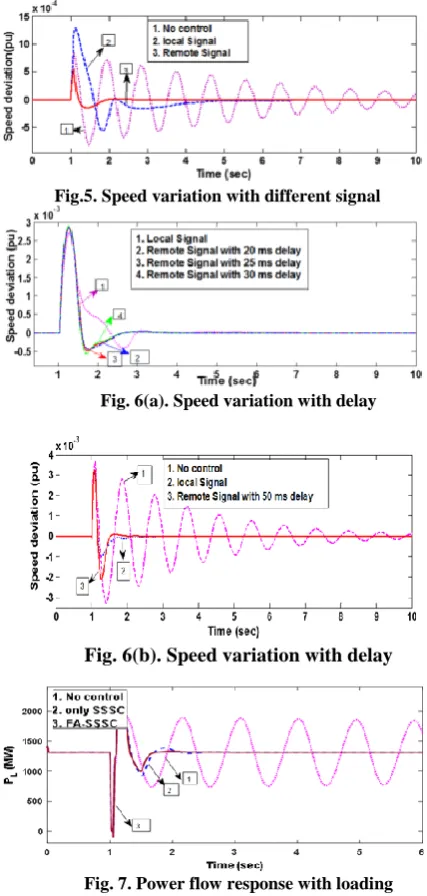
Fig.5 demonstrations the speed deviation with local signal and remote signal. It reveals that using a remote signal, the performance of the system has been improved dramatically. Furthermore, a remote signal with a delay has been tested and verified in Fig.6.
Fig.5. Speed variation with different signal
Fig. 6(a). Speed variation with delay
[image:4.595.321.535.52.140.2]Fig. 6(b). Speed variation with delay
Fig. 7. Power flow response with loading
[image:4.595.307.521.214.663.2] [image:4.595.65.278.597.670.2]VI.
C
ONCLUSIONThis study set out to determine the enhancement of power system oscillation with the employment of SSSC controller in SMIB system. The contribution of this study has been to confirm the improved performance layout with different signal input and delay as well. Additionally, firefly algorithm is applied to further enhancement of performance indexes such as speed deviation, and power flow. Taken together, these findings suggest a role for SSSC in promoting SMIB with a better response.
VII.
REFERENCE1. Messina (2009), A.R, Inter-area Oscillations in Power Systems - A Nonlinear and Nonstationary Perspective, Series: Power Electronics and Power Systems, eBook
2. Hingorani, N.H., Gyugyi, L (2000), Understanding FACTS: Concepts and Technology of Flexible AC Transmission Systems, IEEE Press, New York.
3. Rabiah, B. Shair, J. (2017) ,S Transient Stability Enhancement Using Sliding Mode Based NeuroFuzzy Control for SSSC, Intelligent Systems and Applications, Springer, 751, 39-58.
4. Khuntia, S.R. Panda, S. (2013),ANFIS approach for SSSC controller design for the improvement of transient stability performance, Math Comput Model, 57 , 289-300
5. Al Jowder, F.A.R. et.al. (2005), Series compensation of radial power system by a combination of SSSC and dielectric capacitors, IEEE Trans. Power Delv. 458–465.
6. Ali, E.S. Abd-Elazim, S.M. (2014), Optimal SSSC design for power systems via hybrid approach, International Journal Electrical Eng, 14, 138-147
7. Pillay Carpanen R, Rigby BS (2007) A FACTS-based power flow controller model for the IEEE SSR first benchmark model. In: Proceedings of the IEEE PES Power Africa conference, Johannesburg. 1478-84
8. Change, Y. et.al. (2007), A novel SVC supplementary controller based on wide area signals, Electr. Power Syst. Res. 77, 1569–1574.
9. Chatterjee A , Ghoshal, S.P. et.al(2012), Transient performance improvement of grid connected hydro system using distributed generation and capacitive energy storage unit, Electrical Power and Energy Systems, 43,210-221
10. Mohanty, A., Mishra, D.K., Mohan, K., Ray, P.K., (2016) “Optimised Fractional Order PID Controller in Automatic Generation Control”, Taylor & Francis Group, 215-219. 11. Yang.X.S(2009), Firefly algorithms for multimodal
optimization, in: Stochastic Algorithms: Foundations and Applications, SAGA 2009, Vol. 5792, pp. 169-178.
12. Mishra, D.K., Mohanty, A, Mohan, K., Ray, P.K,(2017) Optimization of TCSC with Multi Objective Firefly Algorithm for Enhancing SMIB System, IEEE PIERS Conference, pp. 1215-1222
AUTHORSPROFILE
Mr.Tapas K.Panigrahi currently working at PMEC, India as an associate professor. His research area includes AGC, Power-System Stability.
Mr. Dillip K. Mishra is the former Sr. Lecturer in EAST, Bhubaneswar, India. His fields of study are AGC, Hybrid power system.
Mr.Subrasnhu S.Pati is perusing M.Tech in Power System Engineering at IIIT, and Bhubaneswar. His research areas include automatic generation control and power system stability.