Abstract: Despite being known to the public ever since it had been introduced by human resources consulting firms, the concept of employee involvement is fairly new among academic research community. It is agreed by both groups of human resource management academics and practitioners that employees' behavior at work can be explained by the fundamental concept. However, there are various concepts and meanings of employee involvement being applied nowadays. The interesting employee involvement concept, however, is still vaguely defined. Its definition introduced by western academics has to be modified before being applied in Malaysia, to suit the local religion and culture. The purpose of this literature review is to come up with an employee involvement concept that is suitable for local engineers with diverse cultural background, by studying and examining the empirical and conceptual differences in defining employee involvement concept.
Index Terms: Employee involvement, Job involvement, Religiosity, Spirituality
I. INTRODUCTION
As the essential asset of an organization, the shortage of highly skilled and talented employees caused by global economic and many other issues, has resulted in organizations having to restructure their employees, causing the occurrence of a talent gap involving Generation Y and "baby boomers" (Gordon, 2009). To prevent that from happening, there is a need for new measures to keep the existing employees while recruiting high potential new employees.
Employees not having an interest in the duties and jobs at the workplace is the reason why organizations may find it hard to maintain employees. As mentioned by (Cartwright & Holmes, 2006), among the hardest challenges that business leaders and human resource management have to deal with was making sure that employees come to work. Apart from physical works, employees' mental and emotional states also play a role in implementing duties. For that reason, it is important for organizations to be aware of their employees' involvement in order to keep them encouraged in realizing the goals of the organization.
Revised Manuscript Received on May 05, 2019.
Mohd Farhan, Faculty of Engineering & Built, Universiti Kebangsaan Malaysia
Muhamad Azry, Faculty of Engineering & Built, Universiti Kebangsaan Malaysia
Azlina, Faculty of Social Sciences & Humanities, Universiti Kebangsaan Malaysia
Eizah, Academy of Malay Studies, Universiti Malaya
In the management of an organization, it is important for employees to be aware of employee involvement in order to make sure that the organization performs better as an active employee involvement can become the key in creating a good atmosphere at the workplace through their attitudes by working ethically, diligently and responsibly.
According to (Harter, Schmidt, & Hayes, 2002), employees' achievement, attitude and attendance can be influenced by their involvement. This has been proven by a number of studies, showing that employee involvement level is positively related to productivity as well as the performance of an individual, group or organization. These were based on the feedback of the employees' and the loyalty of the customers (Harter et al., 2002; Macey & Schneider, 2008; Salanova Agut, S., & Peiro, J. M., 2005). Organizations that practice employee involvement were found to be successful in lowering the rate of retrenchment and increasing the level of productivity, financial performance and shareholders' returns (Baumruk, 2006). In addition, this practice also turned out to be effective in gaining public interest, employees liked it better and managed to maintain highly skilled employees (Hetrick & Martin, 2006).
Various articles and known management magazines have discussed on this concept, but until today, researchers still have yet to come to a mutual agreement on defining the employee involvement concept. As stated by (Soldati, 2007; Wefald & Downey, 2009), this concept is new to the world of academic research despite it has been around and largely known by the public after it had been introduced by human resource consulting firms. Soldati (2007) states that, in spite of the difference in defining the concept of employee involvement, the majority of practitioners and academics agree that employees' behavior at the workplace may be influenced by its fundamental concept.
Even though employee involvement is a great concept for discussion, its meaning is still vaguely defined. The meaning of this concept as defined by researchers in the western part of the world has to go through an adaptation process to meet with the local Malaysian culture. To put a stop to this confusion, this study has been carried out, aiming to come up with evidence and results synthesized from previous research on this very concept. For that reason, this concept will be examined in terms of its definition with regard to academic area, as well as the overlapping in definition that occurs. This study will also come up with a conclusion and summary on
Engineer’s Work Engagement: Development
of Conceptual Framework through Religious
Dimension
this concept with regard to the theory of social sciences practiced by researchers in the academic field. Secondly, this study will also touch on the religious aspect pertaining to human resource management. At the end of this study, an employee involvement theoretical model that is suitable for engineers in Malaysia will be developed.
II. LITERATUREREVIEW
A. Concepts of Employee Engagement
(Sharmila, 2013) defines employee involvement as employees' good attitude or engagement and commitment in an organization. While (Kahn, 1990) defines it as the attachment that members of an organization have towards their responsibilities at work, and their involvement, which includes being engaged physically as well as keeping themselves emotionally and cognitively present while at work. Engaging physically can be defined as using physical efforts to carry out tasks. While engaging cognitively can be regarded as the perception and knowledge that an employee has about his job surroundings, and engaging emotionally means the attitudes and feelings that an employee has for his employers as well as working state. Based on Kahn's assumptions, employee involvement can be divided into two: absorption and attention.
To quote (Rothbard, 2001), "cognitive availability and the amount of time allocated by a person to thinking about their roles and functions" is what attention means, while absorption is "to function in their respective roles and referring to one's concentration in their roles". Rothbard also describes attention as "invisible, material resources which one can allocate", while absorption is "intrinsic motivation in a role or task".
According to (Richman, 2006), the motivation that an employee has in serving, making efforts, devoting discretion and experience as well as energy towards generating great results, which is in favor of the employer with no guarantee on personal return. Employee involvement is also defined by (Gibbons, 2006) as "a high level of emotional attachment that can be felt by an employee towards their organization that influences him to give more effort to the work he does".
Kahn's definition of employee involvement concept: "the harnessing of organization members' selves to their roles at work; in the engagement, employees take on a job and engage themselves physically, present cognitively and emotionally during work", is used as a fundamental argument in the discussion of this concept. Initially, it explained that employee involvement only happened personally, and not at work.
This way of defining the involvement concept revolves around the idea of how employees manifest "present at work" as "present in the work" in which that their mental state has to be in a specific condition while at work. They have to feel, think and act accordingly in order to get involved. In a nutshell, employees' mental state plays a significant role that needs to be supported by emotional, cognitive and physical ability sources.
According to Kahn, these motivating sources can be intensified psychologically by the sense of significance, the kind of emotion that an individual feels as the result of their
sacrifice towards their jobs; the sense of safety, which is the feeling a person gets when he is not worried about people's bad assumptions regarding his personal status or image while at work; and the sense of availability, which is the emotional, mental and physical strengths that are needed to be involved. These psychological aspects are the methods that can be applied by a person in order to improve his performance at work. On the other hand, job disengagement can be defined as "the discharge of an individual or employee's function from their respective job roles". Kahn's biggest contribution is in the identification of the conditions where employee involvement can be found.
However, there is a downside to the concept developed by Kahn (1990). While exploring the psychological aspect, Kahn failed to factor in the social science aspect of the employee involvement theory. This might have been resulted from the inadequate number of library research on the subject in the 1990s, as well as the reliance on workplace commitment, job engagement and other psychological constructs. Even though Kahn's discovery on the problems pertaining to employee involvement and commitment does help in explaining engagement and non-engagement on the personal level, the personal engagement here only highlights the roles of individuals at work.
Kahn believes that involvement refers to the role employees play at work, and that several conditions can affect how employees behave at work. The concept that Kahn developed does not possess an all-rounded perspective on the definition of employee involvement and the other different dimensions of contributing factors. For a while, Kahn was the only academician ever worked on the employee involvement concept. Then, research on burnout was carried out and contributed by reintroducing ideas on the employee involvement concept.
Another definition of the concept of employee involvement is introduced by (Maslach, 1997), stating that employee involvement is a state of energetic engagement, which happens to be the opposite of the burnout state. An engaged employee is described as being energetic and considers his role at work as something challenging. This contradicts the state in which employees are under a lot of pressure as they carry out their tasks unwillingly, which results in them perceiving it as a burden (Bakker et al. 2008).
Maslach (1997) also added that employees are more likely to experience fatigue and burnout if they are not involved. Maslach describes the engagement state as feeling energized with increased efficacy levels (instead of decreased efficacy) as well as effectiveness (instead of decreased effectiveness).
This detailed addition to the concept developed by Maslach had helped to enhance Kahn's (1990) 'present in the work' theory.
Maslach's (1997) view supports the idea that an employee who does not involved is more likely to suffer from fatigue and burnout. The major weakness of Maslach's idea is describing that employee engagement is contradictory to burnout.
Employee involvement does not always contradict with burnout. As stated by (Schaufeli, Salanova, González-Romá, & Bakker, 2002), employees who are not engaged or do not manifest engagement, are not necessarily bound to experiencing burnout or exhaustion. For instance, employees who show no interest towards their jobs may not enjoy their works and only carry out and complete a task for the sake of getting it done. However, that does not indicate that they are exhausted or experiencing fatigue.
Even though Gonzalez-Roma et al.'s (2006) study managed to produce evidence that supported the idea where involvement and burnout contradicted one another, only two dimensions were supported: energy contradicts emotional exhaustion, and dedication contradicts cynical behavior. 'Absorption' was not included, and the two dimensions covered were not enough to produce an all-rounded definition of job engagement. Therefore, Maslach's view does not accurately describe employee involvement.
(Britt, 1999) was an academician who had added in a sense of commitment and responsibility to the performance domain of the employee involvement concept, aiming to highlight the importance of performance. This approach did a better job at defining workplace engagement with the use of the Triangle Model of Responsibility, where involvement is considered as a sense of responsibility at work. Unfortunately, the commitment construct happened to be overlapped, making this definition inadequate.
Then, (Britt, Castro, & Adler, 2005) made an argument about psychology being one of the aspects involved in employee engagement, where people put much effort and commitment to accomplish their work. An association of ideas highlighting on the Triangle Model of Responsibility concept was established by (Schlenker, Britt, Pennington, Murphy, & Doherty, 1994). Britt also added that employees develop engagement naturally from the sense of responsibility that they have towards their duties. The elements that influence this include identity images, task instructions and events.
Similar to that of Kahn's, Britt's view focuses more on the elements that contain engagement trait, without much thought on the fundamental theory of engagement. This research paper, on the other hand, believes that work commitment is not similar to engagement because these are clearly two different constructs. This is contradictory to Britt's idea, as the meanings of commitment and engagement are overlapping in perceiving self-engagement.
Involvement and commitment are focused on workplace behavioral impact on the long and short-run, respectively. The downside of Britt's view also includes the fact that it only connects engagement with a sense of responsibility. The job engagement concept cannot simply be described by
connecting it with a sense of responsibility of the task accomplished.
There is no guarantee that a person who carry out his job responsibly is passionate about or behave positively towards his job. Similarly, a negative attitude and lack of motivations at work do not demonstrate involvement trait. Therefore, Britt's association of ideas cannot be used for this research as it failed to explain the involvement concept.
Other definitions of employee involvement also include individual engagement, individual satisfaction as well as work enthusiasm (Harter et al., 2002), as stated in the Gallup Workplace Audit, GWA (Buckingham & Coffman, 1999) which was developed by the Gallup organization on how employees perceive job characteristics. This perception then resulted in the concepts of the definition to be overlapped between job satisfaction and job engagement.
Firstly, the concept of employee involvement highlights the way job influences the identity of a person (Lawler & Hall, 1970). A person who is engaged in his job: has good work motivation, committed towards the job and organization and communicate professionally with colleagues (Brown, 1996). Therefore, in line with (Hallberg & Schaufeli, 2006) the statement that claims involvement is an individual function and needs to be considered as an antecedent in the research model while on the other hand, employee involvement needs to be considered as a variable in the research model.
The definition provided by (Harter et al., 2002) is also overlapped with the term 'employment satisfaction'. Employment satisfaction describes the state of a person's psychological aspect regarding his job, an emotional state of 'satisfied and fun', resulting from the employees' job evaluation (Locke, 1976). From thirteen details in the GWA, twelve of them describe job satisfaction variants. The concept of engagement in the GWA is derived from literature research in the field of employment satisfaction and is used to explain the concept of engagement. Clearly, in describing the actual employee engagement, the concepts between these two constructs overlap.
According to (Harter et al., 2002), the concept of involvement gives attention on only one area of employee involvement: being enthusiastic about work. A person needs a sense of enthusiasm and meaning in the workplace to achieve work involvement.
Perception of job characteristics, job involvement and job satisfaction may be the points that affect employee involvement rather than the concept itself. Clearly, the constructs used by (Harter et al., 2002) in describing the concept of involvement are conceptually overlapping. However, since the definition of involvement is not theoretically developed and depends on too many perceptions of job characteristics, the definition of this association of ideas is not enough to explain the involvement concept.
studies on the related field. Some studies define involvement as "to be present at work," while some others define it as the opposite of the burnout situation, and there are some whose definitions overlap with other constructs, such as job satisfaction and job involvement.
In this study, after exploring each argument of previous literature research, stresses that employee involvement is not inversely proportional nor is it connected to the burnout concept. In a nutshell, if a person does not experience a burnout, it does not mean that he is involved.
The differences between employee involvement concepts that have been discussed in the previous subtopics may provide the reason why (Schaufeli et al., 2002) explains the employee involvement concept most accurately and comprehensively. This is because the focus regarding employee involvement should be given to the positive aspects and lead to job satisfaction. A person has to be dedicated, strong and 'absorbed' in his work to enable him to demonstrate a high level of involvement. This positive feedback is consistent with the organization's positive attitude in attempting to comprehend employees' performance at work.
Schaufeli et al. (2002) describe employee involvement concept as a mental state, positive feeling and mind that requires a person to be preoccupied in accomplishing his tasks. In order to gain a full concentration on the task and completely preoccupied with his job, he needs to be positive and enthusiast about it.
That is why the idea of involvement by Schaufeli et al. (2002) is considered as more dominant and all-rounded than the others. Based on Schaufeli et al.'s (2002) view, it can be concluded in this study, that the employee involvement concept can be defined as a state of mind with regard to a positive and satisfactory job that can be identified by dedication, enthusiasm and absorption or 'preoccupation'. These three dimensions are able to produce the most accurate, genuine and all-rounded concept of involvement to date (Karatepe & Olugbade, 2009; Kim, Shin, & Swanger, 2009; Schaufeli & Bakker, 2004, 2010; Taris, Schaufeli, & Shimazu, 2010).
According to Schaufeli et al. (2002), enthusiasm, which is the first employee involvement element, is a positive feedback on how employees interact with the work elements and work environment. The enthusiasm concept is derived from the opinion that people share a basic determination for gaining, retaining and protecting what is valuable to them, such as 'resources' for their work (in this particular case, the encouraging motivator) (Hobfoll, 1989). Resources of enthusiasm include emotional energy, cognitive happiness and physical strength. Schaufeli et al. (2002) mentions that, the element of enthusiasm contains the features of energy and mental strength when carrying out work, and willing to work diligently even in difficulties. Passion is linked with the psychological ability to apply willpower and creativity, and subsequently find different ways to accomplish job goals, confidently predicting success and develop resilience in achieving goals. A passionate employee clearly demonstrates an involved employee.
Dedication, the second element of employee involvement, is defined as a state in which employees go through a sense of enthusiasm, interest, inspiration, challenge and pride
(Schaufeli et al., 2002). One's dedication towards his job is shown in his motivated actions which include hard work and giving his best efforts. A person's self-behaviour is also required at work, such as trying to solve problems at the workplace and avoiding individual goals and aims (Van Scotter & Motowidlo, 1996). A person with a dedication can be interpreted as a person who is involved in his job.
Finally, absorption, the third element of employee involvement. Absorption can be considered as a person's job satisfaction. It indicates a condition where a person is completely focused on the enjoyment and happiness of working to the extent that he becomes unaware of how quickly time passes, and having a hard time to stop working. The construct of employee involvement involves the hedonistic side of work. A person with a trait of involvement is more likely to have fun working and seek for enjoyment in his work. Hence, an involved employee will demonstrate a high level of concentration and happiness at work. A study involving 30 in-depth interviews has discovered and proven that absorption was connected to involvement (Demerouti, Nachreiner, Baker, & Schaufeli, 2001). A study by Demerutti et al. explains that absorption has a relationship with a person's effectiveness, continuously absorbed through confidence and endurance in the job.
Theoretical Framework of Employee Engagement From the literature review, it was shown that there was no clear theoretical framework for describing job involvement. On the other hand, past researchers have presented and proposed various theoretical perspectives, where different aspect was highlighted by each theory presented. Below are three types of approaches of theoretical framework suggested by employee involvement researchers.
Social Exchange Theory (SET)
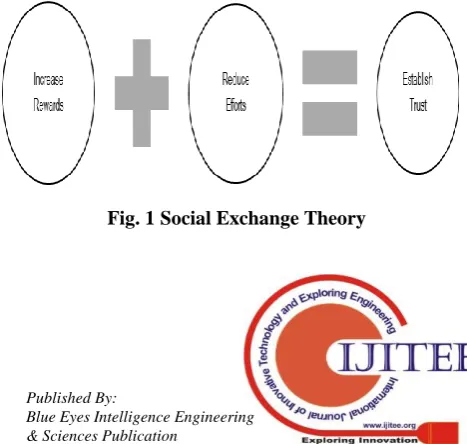
[image:4.595.308.542.610.832.2]As can be seen in Figure 1, Social Exchange Theory (SET) is one of the most influential conceptual paradigms in understanding workplace behavior. The initial development of the SET was reflected in the following studies of anthropology (Firth, 1967; Malinowski, 2002; Mauss, 1967; Sahlins & Economics, 1972), sociology (Blau, 1964) and social psychology (Gouldner, 1960; Homans, 1958; Thibault, n.d.). The previous SET study was developed with a focus on a rational assessment of individual interests with regard to social relationships of human.
According to (Emerson, 1976), even though there are different ideas on SET, theorists agree that SET includes a set of interactions responsible for relationships accountability. The interactions are commonly considered as interdependent and relies on others' actions (Blau, 1964). SET also stressed that these interdependencies can form a good relationship and can only arise under certain situations.
The basic principle of SET is human interactions develop within a certain length of time to reach loyalty, mutual commitment and trust, for as long as all parties in the relationship correspond to the communication sharing methods (Cropanzano & Mitchell, 2005). In these methods, the actions of one party is reciprocated or repaid, leading to reasonable response by the other party. Cropanzano and Mitchell also explained based on the SET theory, people who know about and value reciprocal methods in their social relationships are more pleased with their relationships and retain them.
According to (Robinson, Perryman, & Hayday, 2004), employee involvement is a reciprocal relationship. An organization develops an employee involvement method in which employees can react by the level of involvement that they prefer, as a feedback to the organization. Since SET is a two-way connection that rely on one another, employee involvement can be described by SET. (Schaufeli, 2013) also mentions that in the case where an employee is rewarded by the organization, such as being given good wages, opportunities for development or recognition, he is likely to respond in such as way that he performs more productively, innovatively and creatively at work.
In this context, (Saks, 2006) states that organizations can increase employees' productivity, creativity and innovation by implementing the employee involvement practice. Employees' level of engagement relies on the rewards that the organization provides. Schaffeli stresses that if an organization are not generous enough to provide such benefits, the tendency of employees or people in the organization to demonstrate dis-involvement is higher, and ultimately may result in employees experiencing burnout or exhaustion. Self Determination Theory
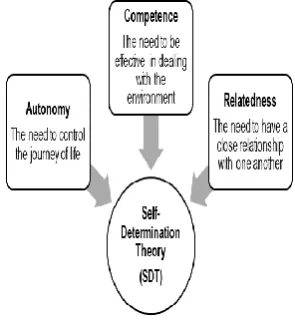
[image:5.595.358.506.52.215.2]The Self-Determination Theory (SDT) as shown in Figure 2, was developed by academic researchers, Edward L. Deci and Richard M. Ryan in 1985 (Deci & Ryan, 1985)). SDT lists down two types of motivation: intrinsic motivation and extrinsic motivation. Intrinsic motivation is the pursuit of personal interests, which is the result of enthusiasm and interest, whereby extrinsic motivation refers to activities carried out for important reasons (Meyer and Gagne 2008). The SDT describes that extrinsic motivation may demonstrate the wish to be rewarded or avoid being penalized (external rules), increase self-esteem or avoid feeling guilty (guilty), accomplish personal goals (recognition) or exhibit a sense of self (integration).
Fig. 2 Self Determination Theory
Both integration and recognition, along with intrinsic motivation, are considered as an autonomous rule. While external regulations and guilt are regarded as regulated rules. Deci and Ryan (1985) describe that autonomous rule has the ability to encourage people to take their performance, creativity, persistence and initiative to the next level. Meyer and Gagne (2008) states that the concept of autonomous rule intersects with the concept of 'involvement condition' introduced by (Macey & Schneider, 2008) which includes empowerment, satisfaction and involvement. They also added that the results of actions related to autonomous rule are consistent with what Macey and Schneider described as behavioral engagement, which includes additional behavioral roles, active behavior and development of roles.
The SDT also explains that the key to autonomous rule is to meet the basic psychological needs, such as autonomy and competence as well as other relevant issues. The requirement for satisfaction is the key mediator among environmental influences which include autonomous rule, job and leadership characteristics (Gagné & Deci, 2005). Meyer and the Ganges stated that, in addition to explaining engagement, the SDT also helps to describe an individual's psychological state and feedback that could lead to the lack of engagement trait. The reason for this is people tend to react to the loss of autonomy by going against the authorities or leaders (Koestner & Losier, 1996).
Meyer and Gagne (2008) found that SDT has long been used as a guide for variable measuring of involvement traits, which include motivational, psychological, behavioral outcomes and satisfaction needs. Meyer and Gagne also stressed that the SDT may readily be applied in developing measurements of various involvement aspects discovered by Macey and Schneider.
Job Dem ands
Health Strain
Organi zation Outco
mes Mental
Job Reso urces
Enga geme nt Emotion
al Physical
Support
Autono my Develop
ment
Etc.
+
+
+
-
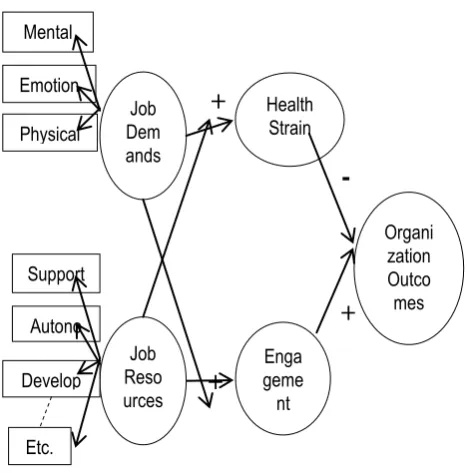
Job Demands-Resources ModelAccording to Shauffeli (2013), the Job Demand-Resources Model (Model JD-R) have been used as a framework by many research. The JD-R model, which was built by Demerouti et al. (2001), believes that job involvement is taken from an internal motivational source, which includes 'job resources' and 'job demands'. 'Job resources' refers to the functional aspects that
promotes goal achievement, lowers job demands or encourages job control, social support among co-workers, feedback on performance and other personal development.
[image:6.595.178.412.142.379.2]Schaufeli (2013) defined 'job demands' as a self-respect and the power to control and influence one's good behavior, such as self-confidence, self-efficacy and emotional stability.
Fig. 3 JD-R Model, Demerouti et al. (2001) According to the JD-R Model paradigm shown in Figure 3,
'job resources' has the ability to encourage workers and boost their resilience as well as keeping them focused at work. These encouragements are the resources that can increase the absorption, effort (energy) and dedication (efficiency) (Schaufeli 2013).
The JD-R model also describes that employee involvement will ultimately have positive implications for the organization, such as improving job performance. According to Shaufeli (2013), the JD-R model indicates that job involvement appears to be the result of 'job resources' and 'job demands' relationship, as well as the mediator of the relationship between organizational accomplishments and 'job demands' and 'job resources'.
The JD-R model also considers that low motivational resources can cause depression and burnout. For that reason, it is important for organizations to provide employees with the necessary resources in order to prevent burnout. The JD-R model also suggests that high workloads and demands can also cause burnout.
The JD-R model also demonstrates that workload burden may improve job involvement. But, according to Shaufeli (2013), this applies only to people with job demands that are potentially able to develop skills, grow career, learning as well as goal accomplishment.
The Role of Religious Element In Human Resource Management In Malaysia
Culture refers to how humans live their lives in a country and becomes a pattern product for the country which is shaped by the language, formal education, geography and religion (Derr & Laurent, 1989). (Ali, Camp, & Gibbs, 2000)
discovered that religious teachings have a basis in organizational human resource management issues.
A study by (Hofstede, 1993) states that it is necessary to understand the local culture and history to gain understanding regarding the processes, principles and issues of the model of national human resource management. According to the institutional theory, social institutions can influence the economic activity of a nation (Rowley & Jackson, 2010). This theory acknowledges the role of culture and religion as being relevant to be considered in institutional or organizational management. There are some researchers who stress that the cultural and institutional aspects of a place are key elements as they have influence over the practices in the management of human resources (Cooke & Saini, 2010; Hashim, 2008, 2009; Hofstede, 1993; Lee Cooke, 2008; Rowley & Benson, 2003). According to a study conducted by (Yousef, 2000), there is a positive relationship between Islamic work ethics and employee behaviors, such as organizational satisfaction, loyalty and commitment.
Fig. 4 Proposed theoretical model of employee engagement in the context of employees in Malaysia (Source: Author’s Note)
In order to gain a complete understanding regarding the human resource management practices in Malaysia, it has to be approached from the multiracial point of view as Malaysian society is a blending of Islamic, Western and Confucian values (Mansor & Ali, 1998). As most Malaysians are Muslims, these values are mostly backed by Quranic- based Islamic prescriptions (Ghazali, 1994) and the Prophet Muhammad's teachings (Ali, 2010). Despite being a multiracial, symbolic and ritualistic society, Malaysians share common values such as parental respect, living in harmony, concern for dignity, religious orientation and collective orientation (Selvarajah & Meyer, 2008). Similar to China, Malaysian culture is generally featured by traditional values such as collectivism which emphasizes on hierarchy, harmony, loyalty, reciprocity, as well as the importance of honour and guanxi (Abdullah, 2001; Kaur & Metcalfe, 1999; Sloane-White, 2008) .
According to (Branine & Pollard, 2010), the principles of religion are instilled in work values by different means throughout the world, and the local context holds a significant impact on the application of religious approaches in the management of human resources. In fact, people in different countries practice and interpret religious beliefs differently, thus, in some cases, the management practiced by the nation appears to contradict the actual religious teachings. Islamic teachings are practiced in Malaysia, along with other teachings such as the Confucian principle as well as the European powers' religious residuals. It is necessary for the multinational companies operating in Malaysia to be aware of the blending of Islamic teachings and cultural heritage since this obviously can influence the system practiced, especially in the human resource management.
The Role of Religious Element In Human Resource Management In Malaysia
In response to the need for adapting the involvement concept and practice with the human resource management condition in Malaysia, this research paper comes up with a new theoretical model or framework which is developed from the Demerouti et al.'s (2001) JD-R model. The author is under the opinion that the JD-R model is incomplete because as a moderator variable of one dimension; 'religiosity', and needs to be modified to meet the context of engineers in Malaysia.
Therefore, new variables have been added to the JD-R model, and a new theoretical involvement model is formed. It also involved the role of spirituality as a variable 'moderator', and existing variables that contribute to the 'job resources' and 'job demands' constructs.
As can bee seen in Figure 4, the dimension of 'religiosity' is included as a 'moderator' variable in the JD-R model. The function of 'religious' dimension is as a catalyst for 'job resources' and 'job demands' constructs, and subsequently plays a role in the change of employee involvement level. This is in accordance with the adaptation of human resource management in Malaysia in which most of Malaysia's employees believe in religions, such as Muslims, Confucians, Buddhists, Hindus, Christians and others (Mansor and Ali 1998). As mentioned by Rowley and Jackson (2010), one of the key elements in an organization or local institution or state structure, is the society's practices or religious beliefs.
These religion 'moderator' variables need to be taken into account as these variables are considered as important since the findings of previous study show that religious aspect had Job
Demands Health Strain
Organization Outcomes Mental
Resources Engagement
Emotional
Physical
Support
Autonomy
Development
Etc.
+
+
+
-
been underrated and ignored by human resource management and organizational practices in understanding human attitudes. (Zuckerman, 2007) stated that, even though at least 85 percent of the world's population believe in religion, and 82 percent of them say that religion has a major role in their lives (Crabtree, 2012), the potential connection between management practices, religious beliefs and revenue of the organizations have been obviously ignored in the research of mainstream management (Mellahi & Budhwar, 2010).
The spiritual aspect of a workplace is known to affect employee involvement (Gruman & Saks, 2011; Devendhiran & Wesley, 2017), which is supported by a study conducted in Thailand which found that the spiritual aspect of a workplace and job engagement were significantly related to one another (Petchsawang & McLean, 2017). Based on a study conducted by (Bickerton, Miner, Dowson, & Griffin, 2014) this hypothesis was further strengthened as it discovered that the levels of job engagement of 835 religious workers in Australia were increased as the result of spiritual aspect, while lowering the levels of fatigue. It was hoped that these effects would be good for the organization.
Religion is seen as an essential factor that encourages job commitments of engineers (Farrukh, Wei Ying, & Abdallah Ahmed, 2016), improving their work ethics (Spiekermann- Hoff, Korunovska, & Langheinrich, 2018), and as a result, socially responsible and social responsibility with the concepts of engineering are produced. (Bielefeldt & Canney, 2016).
III. CONCLUSION
It has been discovered from the study findings that, the focus of a research conducted plays a significant role in determining the different concepts of employee involvement. It is important to have the right concept in order to intervene accordingly and simultaneously improve employee involvement of an organization.
As employee involvement of different organizations and countries may be influenced by different factors, each organization needs to be studied within its own surrounding for the best results. Employee involvement may be directly or indirectly influenced by several factors, which makes it important for studies on employee involvement to be focused on determining both the direct and indirect impacts. This will make sure that appropriate interventions can be implemented. In order to understand the behavioral and attitudinal aspect of the employees in an organization, studying the spiritual and local beliefs that they practice may help. Understanding the history and culture the way they do is important in order to have an idea on the human resource management model of the nation which includes its philosophy and process as well as the problem. Since Malaysia comprises different religions and races, the employee involvement study conducted has to take into account the local cultures in order to get an accurate view on the employee involvement concept that is being practiced in this country.
In addition, it is necessary to understand how organizational involvement affects performance by conducting a longitudinal study, as well as to determine the
results and effects of practicing employee involvement in the long run, which has not been covered in previous researches. Even though there have been overlapping concepts on employee involvement discovered in this research, it is possible for future research to focus on exploring involvement, overlapped with for example, corporate social responsibility, or other constructs or concepts of human resource management.
ACKNOWLEDGEMENT
This material is based upon work supported by the Universiti Kebangsaan Malaysia under Grant No. KK-2018-013 and RCRP-2016-006, and we thank 2 “anonymous” reviewers for their so-called insights.
REFERENCES
1. Abdullah, A. (2001). Influence of ethnic values at the Malaysian workplace. Understanding the Malaysian Workforce: Guidelines for Managers, 1–24.
2. Ali, A. J. (2010). Islamic challenges to HR in modern organizations. Personnel Review, 39(6), 692–711.
3. Ali, A. J., Camp, R. C., & Gibbs, M. (2000). The ten commandments perspective on power and authority in organizations. Journal of Business Ethics, 26(4), 351–361.
4. Baker, J. O. (2008). An investigation of the sociological patterns of prayer frequency and content. Sociology of Religion, 69(2), 169–185. 5. Baumruk, R. (2006). Why managers are crucial to increasing
engagement: Identifying steps managers can take to engage their workforce. Strategic HR Review, 5(2), 24–27.
https://doi.org/10.1108/14754390680000863
6. Bickerton, G. R., Miner, M. H., Dowson, M., & Griffin, B. (2014). Spiritual resources in the job demands-resources model. Journal of Management, Spirituality & Religion, 11(3), 245–268.
7. Bielefeldt, A. R., & Canney, N. E. (2016). Relationships between religion, spirituality, and socially responsible engineering. Engineering Studies, 8(1), 66–90.
8. Blau, P. M. (1964). 1964 Exchange and Power in Social Life. New York: John Wiley.
9. Branine, M., & Pollard, D. (2010). Human resource management with Islamic management principles: A dialectic for a reverse diffusion in management. Personnel Review, 39(6), 712–727.
10. Britt, T. W. (1999). Engaging the self in the field: Testing the triangle model of responsibility. Personality and Social Psychology Bulletin, 25(6), 698–708.
11. Britt, T. W., Castro, C. A., & Adler, A. B. (2005). Self-engagement, stressors, and health: A longitudinal study. Personality and Social Psychology Bulletin, 31(11), 1475–1486.
12. Brown, S. P. (1996). A meta-analysis and review of organizational research on job involvement. Psychological Bulletin, 120(2), 235. 13. Buckingham, M., & Coffman, C. (1999). Break all the rules. London:
Simon & Shuster.
14. Cartwright, S., & Holmes, N. (2006). The meaning of work: The challenge of regaining employee engagement and reducing cynicism. Human Resource Management Review, 16(2), 199–208.
15. Cooke, F. L., & Saini, D. S. (2010). (How) Does the HR strategy support an innovation oriented business strategy? An investigation of institutional context and organizational practices in Indian firms. Human Resource Management: Published in Cooperation with the School of Business Administration, The University of Michigan and in Alliance with the Society of Human Resources Management, 49(3), 377–400.
16. Crabtree, A. (2012). Religion and pedagogy in the age of the remix. Journal of Religion and Culture.
18. Deci, E., & Ryan, R. M. (1985). Intrinsic motivation and self-determination in human behavior. Springer Science & Business Media.
19. Demerouti, E., Nachreiner, F., Baker, A. B., & Schaufeli, W. B. (2001). The Job Demand-Resources Model of Burnout. Journal of Applied Psychology. https://doi.org/10.1108/02683940710733115
20. Derr, C. B., & Laurent, A. (1989). theoretical and cross-cultural perspective. Handbook of Career Theory, 454.
21. Devendhiran, S., & Wesley, J. R. (2017). Spirituality at work: enhancing levels of employee engagement. Development and Learning in Organizations: An International Journal, 31(5), 9–13.
22. Emerson, R. M. (1976). Social exchange theory. Annual Review of Sociology, 2(1), 335–362.
23. Farrukh, M., Wei Ying, C., & Abdallah Ahmed, N. O. (2016). Organizational commitment: Does religiosity matter? Cogent Business & Management, 3(1), 1239300.
24. Firth, R. (1967). Themes in economic anthropology: A general comment. Themes in Economic Anthropology, 6, 1–28.
25. Fredrickson, B. L., Cohn, M. A., Coffey, K. A., Pek, J., & Finkel, S. M. (2008). Open hearts build lives: positive emotions, induced through loving-kindness meditation, build consequential personal resources. Journal of Personality and Social Psychology, 95(5), 1045.
26. Gagné, M., & Deci, E. L. (2005). Self‐determination theory and work motivation. Journal of Organizational Behavior, 26(4), 331–362. 27. Ghazali, A. H. (1994). Islamic values and management. Institute of
Islamic Understanding Malaysia (IKIM).
28. Gibbons, J. M. (2006). Employee engagement: A review of current research and its implications. Conference Board.
29. González-Romá, V., Schaufeli, W. B., Bakker, A. B., & Lloret, S. (2006). Burnout and work engagement: Independent factors or opposite poles? Journal of Vocational Behavior, 68(1), 165–174.
30. Gordon, E. (2009). The global talent crisis. Futurist. https://doi.org/10.1111/j.1467-8616.2010.00651.x
31. Gouldner, A. W. (1960). The norm of reciprocity: A preliminary statement. American Sociological Review, 161–178.
32. Gruman, J. A., & Saks, A. M. (2011). Performance management and employee engagement. Human Resource Management Review, 21(2), 123–136.
33. Hallberg, U. E., & Schaufeli, W. B. (2006). “Same same” but different? Can work engagement be discriminated from job involvement and organizational commitment? European Psychologist, 11(2), 119–127. 34. Harter, J. K., Schmidt, F. L., & Hayes, T. L. (2002). Business-unit-level
relationship between employee satisfaction, employee engagement, and business outcomes: A meta-analysis. Journal of Applied Psychology, 87(2), 268–279. Retrieved from
https://www.researchgate.net/publication/11367971_Business-Unit-Le vel_Relationship_Between_Employee_Satisfaction_Employee_Engage ment_and_Business_Outcomes_A_Meta-Analysis
35. Hashim, J. (2008). The Quran-based human resource management and its effects on organisational justice, job satisfaction and turnover intention. The Journal of International Management Studies, 3(148), 2. 36. Hashim, J. (2009). Islamic revival in human resource management
practices among selected Islamic organisations in Malaysia. International Journal of Islamic and Middle Eastern Finance and Management, 2(3), 251–267.
37. Hetrick, S., & Martin, G. (2006). Corporate Reputations, Branding and People Management. Routledge.
https://doi.org/10.4324/9780080462448
38. Hobfoll, S. E. (1989). Conservation of resources: A new attempt at conceptualizing stress. American Psychologist, 44(3), 513.
39. Hofstede, G. (1993). Cultural constraints in management theories. Academy of Management Perspectives, 7(1), 81–94.
40. Homans, G. C. (1958). Social behavior as exchange. American Journal of Sociology, 63(6), 597–606.
41. Kahn, W. A. (1990). Psychological conditions of personal engagement and disengagement at work. Academy of Management Journal, 33(4), 692–724.
42. Karatepe, O. M., & Olugbade, O. A. (2009). The effects of job and personal resources on hotel employees’ work engagement. International Journal of Hospitality Management, 28(4), 504–512.
43. Kaur, A., & Metcalfe, I. (1999). The shaping of Malaysia. Springer. 44. Kim, H. J., Shin, K. H., & Swanger, N. (2009). Burnout and engagement:
A comparative analysis using the Big Five personality dimensions. International Journal of Hospitality Management, 28(1), 96–104.
45. Koestner, R., & Losier, G. F. (1996). Distinguishing reactive versus reflective autonomy. Journal of Personality, 64(2), 465–494.
46. Lawler, E. E., & Hall, D. T. (1970). Relationship of job characteristics to job involvement, satisfaction, and intrinsic motivation. Journal of Applied Psychology, 54(4), 305.
47. Lee Cooke, F. (2008). Competition and strategy of Chinese firms: an analysis of top performing Chinese private enterprises. Competitiveness Review: An International Business Journal, 18(1/2), 29–56.
48. Locke, E. A. (1976). The nature and causes of job satisfaction. Handbook of Industrial and Organizational Psychology.
49. Macey, W. H., & Schneider, B. (2008). The Meaning of Employee Engagement. Industrial and Organizational Psychology, 1(January), 3–30. https://doi.org/10.1111/j.1754-9434.2007.0002.x
50. Malinowski, B. (2002). Argonauts of the Western Pacific: An account of native enterprise and adventure in the archipelagoes of Melanesian New Guinea. Routledge.
51. Mansor, N., & Ali, M. A. M. (1998). An exploratory study of organizational flexibility in Malaysia: A research note. International Journal of Human Resource Management, 9(3), 506–515.
52. Maslach, C. (1997). The truth about burnout. Jossey-Bass.
53. Mauss, M. (1967). The Gift: Forms and Functions of Exchange in Arachaic Societies. WW Norton.
54. Mellahi, K., & Budhwar, P. S. (2010). Introduction: Islam and human resource management. Personnel Review, 39(6), 685–691.
55. Petchsawang, P., & McLean, G. N. (2017). Workplace spirituality, mindfulness meditation, and work engagement. Journal of Management, Spirituality & Religion, 14(3), 216–244.
56. Richman, A. (2006). Everyone wants an engaged workforce how can you create it. Workspan, 49(1), 36–39.
57. Robinson, D., Perryman, S., & Hayday, S. (2004). The drivers of employee engagement. Report-Institute for Employment Studies. 58. Rothbard, N. P. (2001). Enriching or depleting? The dynamics of
engagement in work and family roles. Administrative Science Quarterly, 46(4), 655–684.
59. Rowley, C., & Benson, J. (2003). Introduction: Changes and continuities in Asian HRM. Asia Pacific Business Review, 9(4), 1–14. 60. Rowley, C., & Jackson, K. (2010). Human resource management: The
key concepts. Routledge.
61. Sahlins, M. D., & Economics, S. A. (1972). Aldine-Atherton. Inc., Chicago–New York.
62. Saks, A. M. (2006). Antecedents and consequences of employee engagement. Journal of Managerial Psychology.
https://doi.org/10.1108/02683940610690169
63. Salanova Agut, S., & Peiro, J. M., M. (2005). Customer Loyalty Scale. Journal of Applied Psychology. https://doi.org/10.1037/t09266-000 64. Schaufeli, W. B. (2013). What is engagement? In Employee engagement
in theory and practice (pp. 29–49). Routledge.
65. Schaufeli, W. B., & Bakker, A. B. (2004). Job demands, job resources, and their relationship with burnout and engagement: A multi‐sample study. Journal of Organizational Behavior: The International Journal of Industrial, Occupational and Organizational Psychology and Behavior, 25(3), 293–315.
66. Schaufeli, W. B., & Bakker, A. B. (2010). Defining and measuring work engagement: Bringing clarity to the concept. Work Engagement: A Handbook of Essential Theory and Research, 10–24.
67. Schaufeli, W. B., Salanova, M., González-Romá, V., & Bakker, A. B. (2002). The measurement of engagement and burnout: A two sample confirmatory factor analytic approach. Journal of Happiness Studies, 3(1), 71–92.
68. Schlenker, B. R., Britt, T. W., Pennington, J., Murphy, R., & Doherty, K. (1994). The triangle model of responsibility. Psychological Review, 101(4), 632.
69. Selvarajah, C., & Meyer, D. (2008). One nation, three cultures: exploring dimensions that relate to leadership in Malaysia. Leadership & Organization Development Journal, 29(8), 693–712.
71. Sloane-White, P. (2008). The Ethnography of failure: Middle-class Malays producing capitalism in an ‘Asian miracle’economy. Journal of Southeast Asian Studies, 39(3), 455–482.
72. Soldati, P. (2007). Employee engagement: What exactly is it. Management Issues.
73. Spiekermann-Hoff, S., Korunovska, J., & Langheinrich, M. (2018). Understanding Engineers’ Drivers and Impediments for Ethical System Development: The Case of Privacy and Security Engineering. 74. Taris, T. W., Schaufeli, W. B., & Shimazu, A. (2010). The push and pull
of work: About the difference between workaholism and work engagement. Work Engagement: A Handbook of Essential Theory and Research, 39–53.
75. Thibault, J. W. (n.d.). Et Kelley HH (1959). The Social Psychology of Groups.
76. Van Scotter, J. R., & Motowidlo, S. J. (1996). Interpersonal facilitation and job dedication as separate facets of contextual performance. Journal of Applied Psychology, 81(5), 525.
77. Wefald, A. J., & Downey, R. G. (2009). Job engagement in organizations: fad, fashion, or folderol? Journal of Organizational Behavior: The International Journal of Industrial, Occupational and Organizational Psychology and Behavior, 30(1), 141–145.
78. Yousef, D. A. (2000). Organizational commitment: A mediator of the relationships of leadership behavior with job satisfaction and performance in a non-western country. Journal of Managerial Psychology, 15(1), 6–24.
79. Zuckerman, P. (2007). Atheism: Contemporary Rates and Patterns. In Michael Martin (Ed.), Cambridge Companion to Atheism. University of Cambridge Press,. Retrieved from