*
Ancient and Medieval Eastern Texts as the Hypertext
Diloro Iskandarova1*, Sabohat Allamurodova2,
1Faculty of Philology, Russian-Tajik Slavonic University, 30 M. Tursunzoda St., Dushanbe, 734025, Tajikistan 2Faculty of the Russian Philology, Tajik National University, 17 Rudaki St., Dushanbe, 734025, Tajikistan
Abstract. Being the object of study within various sciences including linguistics, the hypertext represents a complex phenomenon of modern human communication. The earlier concept of hypertext became widely used with the development of computer technologies. However, despite a relatively new term, it is possible to acknowledge the ancient origin of hypertext represented by a variety of famous manuscripts, such as the Panini’s eight books of grammar or eastern fairy tales. The hypertext represents the fourth stage in cognitive revolution of humankind leading to the shift in human thinking thus changing it from linear, typical for the Gutenberg era, to lateral thinking, which most likely was dominating during the ‘preliterate’ period. Oral, written and electronic communication are considered as development stages of a discourse consistently replacing each other. Reflections on the relation of hypertext to lateral thinking lead to the idea of unconventional thinking of geniuses, which found it hard to study at a standard school. The paper analyzes the structure of the One Thousand and One Nights fairy tales from the point of view of its hypertextuality.
1 Introduction
A hypertext as a term appeared quite recently and in the consciousness of many people is generally associated with Internet documents. However, now scientists more often talk about hypertext with regard to ancient texts. The hypertext as a means of communication has a number of features, such as multilinear structure and interactivity, as well as immanence. These features made it possible for some researchers to describe the ‘postmodern’ nature of the hypertext.
It should be emphasized that textual and linguistic features of hypertext differ to some extent from typical features of a traditional text. It provides an opportunity for linguistic study in this field in general.
1.1 Importance of the Problem
The hypertext in general is understood as a text with references to other texts. “Hypertext is a multilevel system of informational (verbal or any other) blocks (or nests), in which the recipient is free to lay the way of … reading the information in a non-linear way. The structure of hypertext based on multilevel branching and abundance of cross references pre-programs a possibility of free entry into the text in any place and random search in its fragments, as well as blurring of the author’s function, plurality of authors, thus reaching a recipient (or a reader) to the level of a full-fledged author” [1]. On the one hand, it is believed that the hypertext is the latest
invention of the Internet and virtual reality. On the other hand, modern scientists trace its elements in the entire history of literature, including the ancient Bible, Boccaccio, L. Carroll and modern hyper novels-hypertexts of Italo Calvino, Milorad Paviç, etc. [2]. “During the preliterate period people communicated by transferring direct information at the level of individual communication, where the human brain serves as the guardian of information involving all memory mechanisms. This type of information storage also predetermines the form of information transfer, use of rhythmic duplications, which ensures its better storage. The literary forms reflecting preliterate culture are well-known to people: myths, national fairy tales, parables, etc. Such texts are not intended for written recording, and the variety of duplications ensures their better storage ” [3].
1.2 Problem Statement
distorting writing and reading aspects [4]. Oral, written and electronic means of communication (according to M. McLuhan) are considered as the development stages of a discourse consistently replacing each other inspired by the Kant’s law of three stages. All this is bound to the theories of ‘cognitive revolutions’. Different authors describe from three to five ‘cognitive revolutions’ in the history of mankind, which led to high-quality changes of human thinking and to the formation of new cognitive structures.
Let us highlight four of them: 1. development of speech; 2. invention of writing; 3. invention of printing;
4. invention of electronic interactive means of communication, i.e. hypertext.
As Jean-Claude Carriere and Umberto Eco wrote, “cumulative production of all written and then printing texts is an ‘ant hill of minds’, a ‘beehive’ where the golden bees of imagination bring honey”, which at the end of the Middle Ages has suddenly reduced them to a lower rank. In the same way, if the e-book eventually gains recognition at the expense of the printing book, the first one will hardly manage to exclude the second one from human houses and habits. So, the e-book will never ‘kill’ the book. Similar to Gutenberg with his ingenious invention, the written books were not abandoned at once like it was done with papyrus rolls or volumina trading [5].
1.3 Purpose of the Study
The study was the result of reflections over the thesis, which is usually suggested to students without thinking: “Many researchers consider the creation of hypertext as the beginning of a new information era opposed to the era of publishing. The linearity of writing, which externally reflects the linearity of speech, turns to be the fundamental category limiting the human thinking and understanding of a text. The world of meaning is non-linear... The theorists believe that the refusal from linearity of a text and in the course of its representation to the reader (i.e. during reading and understanding) and in the course of synthesis would contribute to the ‘release’ of thinking and even the appearance of its new forms” [6].
Trying to explain the fact that young people refer to a book less often as to the source of knowledge, information, the authors quite often think of the specified thesis thus realizing that for those who got used to operate with the hypertext, multimedia technologies, it is quite difficult to go back to the ‘boredom’ of a linear text. Further conversanse with the literature on linear and lateral thinking, as well as properties of hypertext also resulted in quite interesting conclusions, which formed the basis of this study.
1.4 Literature review
Various research works cover the study of hypertext. The concept of hypertext was the focus of various
scientific fields in the early 1990s. Many sciences, including geolinguistics, ethnolinguistics, sociolinguistics, psycholinguistics, philosophy, etc. were revealing its aspects.
The term hypertext was introduced by Ted Nelson in 1963. In his book Literary Machines, he gives a clear definition of hypertext through nonlinearity: “I understand the hypertext as inconsistent composition (non-sequential writing) – a text, which is diverging and making it possible for the reader to choose. In other words, it is a series of text chunks connected by links suggesting various ways of readings to the reader” [7].
The Internet laid the basis for the creation of a technical base to adapt a linear structure of text to nonlinear one based on the association of ideas in human brain. Vannevar Bush (adviser to the president E. Roosevelt, designer of the Memex program) wrote about the lateral thinking of a person: “... human brain ... operates following the associative principle. Having caught one thought, it immediately passes to another generated by associations of thoughts according to some combination of traces in brain cells” [8].
The computer terminology defines the hypertext as the text created by means of a markup language potentially containing hyperlinks.
The hypertext ensures functioning of a large volume of information in the electronic space. Communication is performed in the conditions of a multiple and fragmentary discourse, which constantly expands and masters new formats (a text is no longer the text, but video and sound now make its integral parts).
The dictionary of culture of the 20th century gives the following definition of hypertext: the hypertext is the text arranged in such a way that it becomes a system, a hierarchy of texts thus making the unity and variety of texts.
The simplest example of hypertext is any dictionary or encyclopedia where each article has references to other articles of the same dictionary. As a result such text may be read differently: from one article to another, if necessary ignoring hypertext references; reading all articles in a row thus coping with references; and finally, embarking on an unchartered sea of hypertext, i.e. from one reference to another [9].
To specify the concepts let us refer to the definition of hypertext in the Encyclopedia of Culturology:
2 Results and Discussion
2.1. Hypertextuality of ancient eastern texts: Panini’s grammar
Further study of the matter led to even more interesting results. The parallel study in the field of the most formalized description of the Tajik language and hence the acquaintance with various grammars, starting with the Panini’s grammar, turned out a real discovery since the Panini’s grammar Ashtadhyayi also represents the hypertext: “The entire grammar represents the hypertext based on cross references. Any rule implies simultaneous consideration of others. In the same way, if to remove any sutra from aṣtādhyāyī, the entire ‘network’ will be scattered, namely, all other sutras will lead to wrong outcomes, and the result of all these will not present the Sanskrit any more” [11].
The Panini’s grammar is often compared to the Periodic table of D. Mendeleyev, who did not invent new elements, but discovered a new way of their presentation, which turned to be remarkable and fostered the discovery of new chemical elements. The Panini’s grammar fully describes all existing forms of words and grammatical structures of the Sanskrit. Ashtadhyayi contains approximately 4,000 compressed rules – sutras. “The sequence of these rules forms an algorithm, a computer program. There are no explanations, examples, exercises. Only sequence of actions: “if the past tense is meant, then a prefix a” is added before a verbal root and so forth. The purpose of the algorithm is to explain the formation of all words and constructions used by distinguished authors speaking this language” [12].
It turns out that “for a person getting acquainted with a text of aṣtādhyāyī (even if he speaks Sanskrit as a native language), this text is presented as closed and absolutely unclear since the ‘keys’ for interpretation of sutras are codified similarly to sutra itself. It is possible that the text perceived by the volume consciousness turns into ‘self-unpacked archive’ and would be clear, but it is only possible to check in practice, for standard logical thinking it is impossible. Anyway, even dealing with already ‘deciphered’ sutras, it is possible to use them only by ‘keeping’ them in mind – all 4,000 rules with accompanying texts” [11].
Let us address to the personality of a famous grammatist. The sources mainly tell that Panini did not know reading and writing and did not compiled his grammar but composed it in the oral form: “The oral character of grammar caused its structure. Verses are remembered easier than prose. Therefore, the Panini’s grammar consists of short poetic pieces – sutras containing a huge volume of information” [13].
Besides, Brockhaus and Efron Encyclopedic Dictionary states that Panini was expelled from school because he was stupid: “In childhood Panini was so stupid that he was expelled from school, but the Shiva’s favor to him put him ahead of all” [14].
This imaginary ‘stupidity’ demonstrates Panini’s genius, his non-standard (lateral or volume) thinking as well as the genius of many other ingenious scientists and
great people that found it difficult to study at school (Napoleon Bonaparte, Ludwig van Beethoven, Isaac Newton, Albert Einstein, Thomas Edison, Winston Churchill, Bill Gates, etc.).
2.2 Eastern texts as hypertext
2.2.1 Structure of some eastern manuscripts
Despite the fact that the idea of hypertextuality is not new, the modern (computer) hypertext essentially differs from hypertexts of pre-network era by the fact that the specified set of reference texts, i.e. texts connected with main (perceived) texts by references, resides in the zone of immediate reach of a recipient (it is obvious that the connection of texts and instant access to various works are technically possible on the computer only).
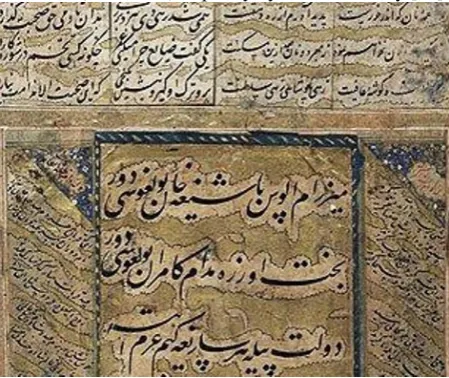
Ancient manuscripts represent examples of a nonlinear text. Different works in one or many languages can be presented on one page.
Figure 1 shows the manuscript illustrating this example. The distinguishing feature of such manuscripts is that several texts may be present on one page and the reader can choose the entry point into the text and lay trail of transitions from one text to another.
The text of the manuscript (Fig. 1) shows the ghazal written above and below the horizontal rectangular bands. In right and left vertical columns another poem is written diagonally. Both ghazals belong to Saadi Shirazi and are written in Farsi. The central text band contains verses in Chagatay language most likely coming from the Divan (Collection) of poetry by Alisher Navoiy [15].
Fig. 1. Manuscript sample. Verses in Persian and Chagatay languages
2.2.2 Hypertextuality of eastern fairy tales
[image:3.595.311.536.446.635.2]The principles of their composition are quite clear: either a set of episodes concentrated around one plot – ‘frame’ (the so-called ‘framed story’), or broad application of ‘a fairy tale within a fairy tale’.
The most striking example is TheOne Thousand and One Nights, which ‘frame’ is made by the stories of Shakherezada with numerous inserted fairy tales – a fairy tale within a fairy tale. At the same time the ‘framed structure’ provides great opportunities for imagination, involvement of a reader in the creation of a fiction story [16].
The principle of a framed story forming the basis for TheOne Thousand and One Nights allows including new and independent texts in the collection. Thus, one hero begins the story: “something happened to someone”, and his listeners ask: “And how did it happen?”, then a new story begins.
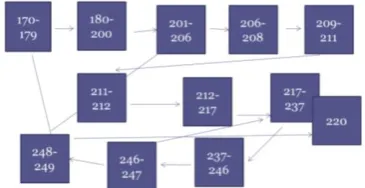
The authors analyzed the structure of fairy tale texts, however, this paper only presents the analysis of one fairy tale. Thus, for example, The Story of the King Shahraman, his Son Kamar az-Zaman and Princess Budur, which were told by Shakherezada from 170th to 249th night, the narration always includes new fairy tales where one passes into another with the general framed structure. Thus, the narration represents the hypertext having the following structure (Fig. 2).
Fig. 2. Structure of narration in The Story of the King Shahraman, his Son Kamar az-Zaman and Princess Budur.
[image:4.595.79.262.417.511.2]The texts connected among themselves leave a ‘mark’ or a footpath for reading. The text thus acquires the branched structure. In simplified form this may be presented as follows (Fig. 3):
Fig. 3. The scheme of references in the hypertext of The Story of the King Shahraman, his Son Kamar az-Zaman and Princess Budur.
The Internet project Fairy Tales of 1001 Nights (Arabian Nights), which used the technology of hypertext markup for simplicity of work with a text, allows accessing any part of this work and provides an opportunity for cross or nonlinear reading of a large hypertext, which is not possible with paper editions [17]. The online version of The Arabian Nights proves that initially this is a pure and simple hypertext, which after its written recording acquired a certain linear structure, which a little interferes with the perception of fairy tales in a way told by storytellers and narrators on eastern markets, which traditionally served the place of people gathering and the center of culture and trade.
The eastern market (bazar) is not only the place of trade, but also the place of active communication. This is the place where people learn news, conclude bargains, broadcast gossips, invent mysterious stories subsequently living under the laws of folklore reality, in a bazar people rest in tearooms, eat, and have meetings. The bazar is the place where myths and beliefs are created. It is also the place where the famous kissa khos (storytellers) tell fairy tales and other stories.
As remembered by the famous researcher of the Tajik-Persian literature Braginsky I.S., S. Ayni told his students about traditional events that he attended in the late 19th – early 20th century in Bukhara where qissakhons (storytellers) read various works in their huge hand-written books. Braginsky I.S. notes that he found one of such manuscripts in the written funds of the Firdousi State Republican Library in Dushanbe. The book represented a giant meter volume “in a flowery hard cardboard cover”, written “by a tiny graceful Arab ligature in Farsi and equal (in terms of modern printer’s measures) to at least hundred twenty or hundred fifty printed pages in petit font. The hand-written book contained seven multiple-reel ‘novels’ and over forty fantastic stories. Besides, the margins of the manuscript were speckled with hundreds of jokes, short parables, and other humorous catchphrases written in smaller handwriting, etc.” [18].
It seems like the representative of the French structuralism Rolan Bart wrote about these eastern works defining the hypertext: “... the text is filled with numerous cross-referencing internal moves, which do not dominate one another; it represents the galaxy of signifiers but not the structure of signified; it has no beginning, it is reversible; it is possible to enter through a set of entrances, none of which is recognized as the main; the chain of mobilized codes is lost somewhere in infinite distance, they ‘are not solvable’ (their meaning is subject to the principle of resolvability in a way that any decision will be random similar to the throw of dice); various semantic systems are capable to take control over this purely manifold text, however their circle is not closed since the measure of such systems forms the infinity of the language” [19].
3 Conclusion
[image:4.595.81.232.603.716.2]a need to further study various subject domains. In summary, the following conclusions may be made:
One of the most ancient ways of transferring the information and communication was the hypertext representing precedent, scientific and literary texts. The creation of such hypertext compositions during preliterate or even ‘pre-Gutenberg’ era was not random, which is proved by several examples. Many famous eastern works having ‘framed’ structure, the most striking example of which is The Arabian Nights, are also examples of hypertext, which served as some ‘mass media’ revealing the world order, customs and traditions, tenor of life of other cities and countries. A special role in the transfer of information was given to easter markets functioning as another mass media, which until now remains relevant in some places in the conditions of information hunger.
It should be emphasized that textual and linguistic features of hypertext differ to some extent from typical features of a traditional text. It provides an opportunity for linguistic study in this field in general.
Acknowledgment
The authors express their gratitude to the Russian-Tajik (Slavonic) University for financing the research under the University Development Program for 2018.
References
1. Encyclopedia of culturologist, Retrieved from: http://dic.academic.ru/dic.nsf/enc_culture/830/ %D0%93%D0%98%D0%9F%D0%95%D0%A0%D 0%A2%D0%95%D0%9A%D0%A1%D0%A2 2. S.A. Stroykov, The study of hypertext and
hypertextuality in modern linguistics Retrieved from: https://cyberleninka.ru/article/n/izuchenie-
giperteksta-i-gipertekstualnosti-v-kontekste-sovremennoy-lingvistiki
3. N.Yu. Klyueva, Marshall McLuhan About Culture and Communication. 100 anniversary since the birth of M. McLuhan, Theory of media and mass communication, 4, (2011) Retrieved from: http://www.mediascope.ru/node/917
4. J.D. Bolter, The idea of literature in the electronic medium, Topic. 36 (1985)
5. Jean-Claude Carriere and Umberto Eco, This is not the end of the book, Retrieved from: http://www.e-
reading.ws/bookreader.php/1005645/Karer_-_Ne_nadeytes_izbavitsya_ot_knig..html.
6. A.N. Baranov, Introduction to applied linguistics: atudy manual (M.: URSS Editorial, 2001)
7. T. Nelson, Literary machines. Sausalito, (CA: Mindful Press, 1993).
8. V. Bush, As we may think, Atlantic Monthly, 176 (1), 101-108 (1945)
9. V.P. Rudnev, Dictionary of culture of the XX century: Key concepts and texts (Moscow: Agraf, 1999)
10.Hypertext. Retrieved from: http://enc-dic.com/enc_culture/Gipertekst-1709.html
11.Panini’s grammar as a product of volumetric consciousness, Retrieved from: http://alfa.psyhonetika.org/blog/ratri/10-04-25--814?page=43
12.Panini’s grammar, Retrieved from: URL:http://russkiyjazik.ru/687/
13.E. Samoylov, Mathematical Panini’s grammar
Retrieved from:
https://forum.daode.ru/f616/matematicheskaya-grammatika-panini-8602-print/
14.Panini, Indian grammarian, Brockhaus and Efron Encyclopedic Dictionary, Retrieved from: https://slovar.cc/enc/brokhauz-efron2/1925157.html. 15.A manuscript sample, Retrieved from:
https://www.wdl.org/ru/item/221/
16.I.S. Braginsky, Encyclopedia of the Persian-Tajik prose: Kabusname. Sindbadname. Fairy tales. (Dushanbe, 1990)
17.One thousand and one nights - http://skazka1001noch.ru/
18.I.S. Braginsky, Encyclopedia of the Persian-Tajik prose: Kabusname. Sindbadname. Fairy tales. (Dushanbe, 1990)