1 INTRODUCTION
In recent decade, due to the in-depth development of globalization, Chinese enterprises actively devote to cross-border mergers & acquisitions boom. According to World Economic Beige Book published by Chinese Academy of Social Sciences in 2011, Chinese enter-prises are converted from the acquirees into the asset acquirers. China’s mergers & acquisitions turnover in 2010 ranks the second in the world, only behind the United States. Even in the post-crisis era with deceler-ated global economic growth and exacerbdeceler-ated compe-tition in international trade, the cross-border mergers and acquisitions of Chinese enterprises are still con-stantly accelerated. In 2011, China ranked the world’s top three merger transaction countries (Economist, 2011); in 2014, there are even 272 cases of overseas mergers and acquisitions by Chinese mainland enter-prises with turnover of $56.9 billion dollars, which is just next to the peak $66.9 billion dollars in 2012 at record. Moreover, currently, China vigorously pro-motes the Belt and Road Initiative and the open eco-nomic system construction, so the trend of the enter-prise’s cross-border mergers & acquisitions is bound to steadily push forward and create a new high. How-ever, can the rapidly expanding cross-border mergers
& acquisitions bring a good performance to the enter-prise? What factors affect the performance of cross-border mergers and acquisitions? This paper intends to do research for “exploration” and “exploit a-tion” types of cross-border mergers & acquisitions, and respectively discusses the performance of two types of cross-border mergers and acquisitions and factors affecting the performance, so as to provide a reference for the practical enterprise’s mergers & a c-quisitions.
2 LITERATURE REVIEW
For a long time, the research on the cross-border mer-gers and acquisitions are focused on three aspects: motivation, performance and performance influencing factors. And different schools reveal the motivation of cross-border mergers and acquisitions from different theoretical levels. However, the scholars have differ-ent opinions on the value creation of the cross-border mergers and acquisitions. Some scholars believe that the cross-border mergers and acquisitions create value for the acquirer’s enterprises (Harris & Rravenscraft, 1991; Markides & Ittner, 1994; Rossitza, 2006; Gu Lulu & Reed, 2011). Some scholars believe that the
Differences between “exploration” and “exploitation” of cross
-border
mergers & acquisitions and its value creation effect
Xingrui Yang1,2 1
Business School, Huanggang Normal University, Huanggang, Hubei, China
2Hubei Collaborative Innovation Center for the Characteristic Resources Exploitation of Dabie Mountains,
Huanggang, Hubei, China
ABSTRACT: This paper adopts the case study method to respectively research the value creation in the explo-ration and exploitation type of China’s four cross-border mergers & acquisitions, and discusses the similarities and differences between the value creation in the utilization and exploration type of mergers & acquisitions, and finds that the former type of mergers and acquisitions is suitable for a medium or higher level of integration in the aspect of the organization structure, culture, human resources and supply chain, so as to realize the value creation through the improvement of synergies and market forces; the latter type of mergers and acquisitions is suitable for higher level of integration in the aspect of the supply chain, research & development, brand and channel, so as to create value by broadening the marketing channel and enhancing innovation capability. Keywords: exploration; exploitation; cross-border mergers & acquisitions; value creation
DOI: 10.1051/
C
Owned by the authors, published by EDP Sciences, 201
/2 01
shsconf 62 0 01
6
value creation is not obvious (Cybo-Ottone & Murgia, 2000; Wu Song &Li Mei, 2010), and even bring value losses (Bülent & Aysun, 2009). Some scholars (Gug-ler, 2003; Gu Lulu & Reed, 2011) believe that, the enterprise obtains non-negative income in a medium and long term in the cross-border mergers and acquisi-tions. However, Ravenscraft & Scherer (1987), Dick-erson (1997), Chen Zhenbo (2012) point out that, the cross-border mergers & acquisitions fail to improve the performance of the mergers & acquisitions enter-prises. For the influencing factors of the value creation in the ross-border mergers & acquisitions, the scholars believe that they are intangible assets (Harris & Ra-venscraft, 1991; Mork & Yeung, 1992), growth rate (Gleason et al. 1999), mergers & acquisitions experi-ence (Haspeslagh & Jemison, 1991), corporate gov-ernance structure (Jensen & Mecking, 1976), industry (Hitt et al. ,2001), mode of mergers and acquisitions (Husayn Shahrur, 2005), host country (Markides & Ittner, 1994; Kiymaz & Mukherjee, 2000), enterprise scale, integration manner, organizational learning and so on. However, the research rarely considers the type of assets acquired by the enterprise, and its way to use assets.
3 RESEARCH FRAMEWORK
The concepts “exploration” and “exploitation” were first proposed by March (1991). According to the World Bank Investment Report, the cross-border mergers & acquisitions are divided into traditional type (that is, natural resource acquisition type) and strategic asset acquisition type. For the traditional type of the cross-border mergers and acquisitions, regard-less of its specific motivation that is to obtain natural resources, market or efficiency, it is based on the en-terprise’s unique and proprietary advantages formed in former overseas investment in the parent country. Even if there is debugging for the special environment of the host country, it also basically belongs to a “paradigm copy” type of investment behavior by the use of existing resources and capabilities of the enter-prise (Cantwell & Janne, 1999); for the strategic asset acquisition type of the cross-border mergers and ac-quisitions, the enterprise obtains complementary stra-tegic assets through foreign investment, so as to build new proprietary advantages of the enterprise or hance the existing proprietary advantages of the en-terprise. Therefore, it belongs to creative resources and capabilities type of investment behavior with more exploration color. Their fundamental difference is that the former is the cross-border application of the proprietary advantages of the enterprise by the cross-border enterprises, while the latter is the cross-border creation of the proprietary advantages of the enterprise by the cross-border enterprises. In a sense, to distinguish the cross-border mergers and acquisitions from the perspective of organizational
learning behavior, that is, to divide into “exploration” and “exploitation” types of cross-border mergers & acquisitions is the development and deepening of pre-vious classification from the perspective of the in-vestment motivation. Thus, in the previous research, as the antecedent variables, the traditional type and strategic asset acquisition type of the cross-border mergers and acquisitions can be converted into the behavioral variables with path, mechanism analysis and operability.
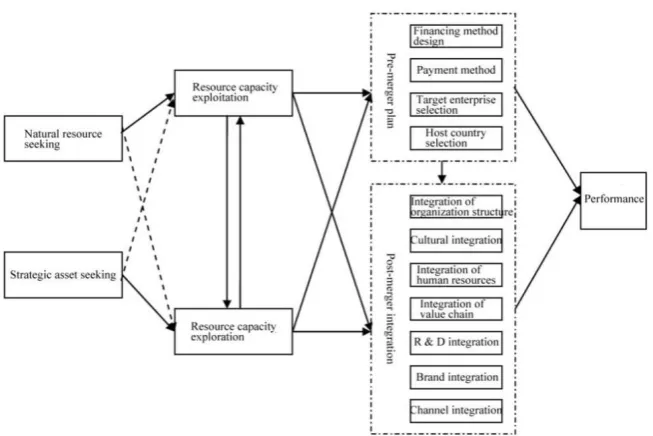
For Chinese enterprises, the natural resources ac-quired from the “exploitation” type of cross-border mergers & acquisitions are primarily used to ease China’s bottleneck of resource limitations, and seek for the pricing and control right of the key resources; meanwhile, the enterprises seeking for such resources are mostly large-scale domestic monopoly enterprises with more advanced technology; therefore, the cross-border mergers and acquisitions largely adopt their own resources and capabilities to achieve econ-omies of scale and increase the market power. The purpose of the strategic asset acquisition type of the cross-border mergers and acquisitions is mainly to obtain the technology, brands, channels and other assets to enhance innovation capability and influence of the mergers and acquisitions enterprises, and occu-py a favorable position in the global value chain; the purpose of the cross-border mergers and acquisitions of these enterprises is to explore more resources ca-pacity. The value creation in the cross-border mergers & acquisitions is mainly realized by the pre-merger plan and post-merger integration; the difference be-tween exploration and exploitation of the resources and capabilities by the cross-border enterprises lies in the pre-merger plan and post-merger integration. Therefore, this paper proposes the following research framework, as shown in Figure 1.
4 RESEARCH METHODS 4.1 Method selection
According to the viewpoint of Yin (2004), the case study is suitable for exploring the research on the type of the process mechanism. Multiple case studies are more reliable than a single case study, and the conclu-sion is more universal and general (Eisenhardt, 1989). Therefore, this paper adopts multiple case studies to discuss the similarities and differences between the value creation effect in the exploration and the exploi-tation types of cross-border mergers & acquisitions of the Chinese enterprises.
4.2 Data collection
researchers for “triangulation” of different data, thereby improving the reliability and validity of the research (Eisenhardt, 1989; Yin, 2003). Therefore, this paper collects the interview data, questionnaire data, observation data and secondary data and so on. In the aspect of measuring the value creation, this paper adopts eleven major financial indicators used by most scholars, such as the corporate profitability, opera-tional capacity, development capacity and so on (Venkatraman & Rananujam, 1986; Sabhewaland & Chan, 2001), and then constructs a composite score function by a sum of the weight of each factor’s var i-ance contribution ratio and the factor score
ij ij i i i i i i
i a f a f a f a f
F 1 1 2 2 3 3 . Finally, this paper measures long-term value creation in the cross-border mergers and acquisitions of the enterprise and analyze the relationship between the value creation effect and the differentiation and integration path through the composite factor score and its difference value, there-by discussing the long-term value creation mechanism of the cross-border mergers and acquisitions.
5 ANALYSIS OF VALUE CREATION EFFECT OF CROSS-BORDER MERGERS & ACQUISI-TIONS
[image:3.595.134.461.107.325.2]PetroChina Co., Ltd, Yongzhou Coal Mining Co., Ltd, Shenzhen Zhongjin Lingnan Non-ferrous metal Co., Ltd and Aluminum Corporation of China have an abundant technical strength and important impacts in their industries. However, major enterprises in devel-oped countries rely on energy consumption to main-tain rapid economic development and energy control. In order to break the competition pattern of global resources monopoly, get rid of the international trade controlled by others due to deficiency in the pricing right of the minerals and other resources, and break through the development bottleneck formed by inade-quate resource reserves, the cross-border merger & acquisition is an inevitable strategic choice of China’s resource-based enterprise. After mergers & acquisi-tions, these enterprises adjust the organization struc-ture, and integrate the research and development.
Figure 1.Differentiation and integration framework of Chinese enterprises’ cross-border mergers & acquisitions
Table 1. Basic situation of the sample enterprise
Founded in Total asset (RMB) Time Target enterprise /area Equity ratio PetroChina 1955 638.45 billion 2005 PK/ Kazakhstan 100% Yongzhou Coal 1997 32.12 billion 2009 Felix/ Australia 100% Zhongjin Lingnan 1984 7.93 billion 2009 PEM/ Australia 50.1% China Aluminum 2001 105.85 billion 2008 Rio Tinto / Australia 12% TCL Group 1997 15.97 billion 2004 Thomson 67% Lenovo Group 1984 6.76 billion 2004 IBM PC Division/ United States 100% Zoomlion Heavy Industry 1992 5.37 billion 2007 CIFA/ Italy 60% Geely Group 1986 18.80 billion 2010 Volvo / Sweden 100%
[image:3.595.95.500.370.470.2]What’s more, they optimize the supply chain (except for China Aluminum) to improve the resource exploi-tation efficiency and promote multicultural policy, implement localization management to improve the enthusiasm and initiative of the target enterprise and reduce the integration contradiction. TCL, Lenovo, Zoomlion and Geely are manufacturing enterprises with short history. They have a strong influence and market share in the domestic market by virtue of low-cost advantage, but also have a wide gap in as-pects such as technology, brands and channels com-pared with similar enterprises in developed countries; if they want to break through the trade barriers in de-veloped countries and quickly develop in the interna-tional market, the cross-border merger & acquisition is the best choice for them. Therefore, the purpose of their mergers and acquisitions is mostly the enterprises with strong technology in the developed countries. In order to reduce risks, they hire consultants or ask consulting or public relations firms for help in evalu-ating target enterprises and planning the financing and integration solutions. After mergers and acquisitions, they usually adjust the organization structure (fine adjustment for Geely), optimize the supply chain, adopt dual-brand strategy and introduce their own products through other channels (except for TCL); at the same time, they maintain the sustained innovation of the target enterprise, implement multicultural policy and
promote localization management (except for TCL). In the year of cross-border mergers and acquisitions, PetroChina Co., Ltd and Shenzhen Zhongjin Lingnan Non-ferrous metal Co., Ltd achieve the value creation. The performance of these two enterprises declines, but they achieve the value creation in the third year after mergers and acquisitions; Yongzhou Coal Mining Co., Ltd fails to achieve the value creation from the year of mergers and acquisitions to the third year after mer-gers and acquisitions, but its performance starts to gradually improve every year in the second year after mergers and acquisitions; the condition of Aluminum Corporation of China is the same as that of Yongzhou Coal Mining Co., Ltd. However, Lenovo achieves the value creation in the year of mergers and acquisitions. Although its performance slightly declines in the sec-ond year after mergers and acquisitions, it always achieves a positive value creation after mergers and acquisitions; Zoomlion Heavy Industry and Geely Group fail to achieve the value creation in the year of mergers and acquisitions. However, their performance gradually improves, and they respectively achieve the value creation in the second year and the third year after mergers and acquisitions; TCL fails to achieve the value creation in the third year after mergers and acquisitions, but its performance starts to be gradually improved in the first year after mergers and acquisi-tions.
Table 2. Integration amplitude of cross-border mergers & acquisitions of China’s enterprises
Note: “5” represents a very high amplitude; “4” represents a high amplitude; “3” represents a higher amplitude; [image:4.595.93.502.301.387.2]“2” represents a moderate amplitude; “1” represents a slight amplitude.
Table 3. Factor score of value creation in cross-border mergers and acquisitions of Chinese enterprises
F0-F-1 F1-F0 F1-F-1 F2-F1 F2-F-1 F3-F2 F3-F-1 PetroChina 0.62094 1.01439 1.63533 −0.37018 1.26515 1.36149 2.62664 Yongzhou Coal −2.58649 1.55119 −1.0353 0.31009 −0.72521 0.2629 −0.46231 Zhongjin Lingnan 0.30203 0.35316 0.65519 1.78358 2.43877 −0.86945 1.56932 China Aluminum −1.61408 −0.9728 −2.58688 0.40312 −2.18376 0.35026 −1.8335 TCL Group −1.46798 −0.50278 −1.97076 −0.18774 −2.1585 0.76653 −1.39197 Lenovo Group 0.41921 0.37526 0.79447 −0.73017 0.0643 2.37399 2.43829 Zoomlion Heavy Industry −1.64975 0.35354 −1.29621 1.63857 0.34236 0.21899 0.56135 Geely Group −2.04803 0.24644 −1.80159 1.18612 −0.61547 0.70611 0.09064
Note: F-1, F0, F1, F2 and F3 respectively represent the composite score of sample enterprises in the previous year, the same year, the next year, the next two years and the next three years of mergers & acquisitions.
6 CONCLUSION AND RESEARCH PROSPECT This paper adopts the multiple case study method, selects eight events of the exploration and exploitation types of cross-border mergers & acquisitions with different economic cycles, industries, sizes and life cycles, compares the value creation effect of two types of mergers & acquisitions and explores the value crea-tion mechanism of cross-border mergers & acquisi-tions of Chinese enterprises on this basis. This paper points out that the purpose of the exploitation type of cross-border mergers & acquisitions is to use re-sources through mergers & acquisitions. After mergers & acquisitions, a medium or higher level of integra-tion in the aspect of the organizaintegra-tion structure, culture, human resources and supply chain is necessary, so as to improve resource exploitation efficiency and achieve value creation. Without necessary integration, the value creation will be missed; the purpose of the exploration type of cross-border mergers & acquisi-tions is to explore new resources and capabilities through mergers & acquisitions. After mergers & acquisitions, a higher level of integration in the aspect of the supply chain, research & development, brand and channel is beneficial to value creation. A medium or lower level of integration shall be given to the or-ganization, human resources and culture based on the respect of the target enterprise, because the autonomy maintenance of the target enterprise is beneficial to achieve sustained innovation and conducive to the value creation after mergers & acquisition. Cross- border merger & acquisition is a complex project. The integration of mergers and acquisitions starts from developing the mergers and acquisitions plan by the acquirer’s enterprise rather than after the mergers and acquisitions. As a Chinese transnational corporation in the developing country, mergers and acquisitions not only make them face cultural distance between differ-ent countries, sometimes even face the interference of government mergers and acquisitions of the host country. Therefore, before mergers and acquisitions, there is a need to hire related consulting and invest-
ment firms or public relations firms to assist, so as to improve the probability of successful mergers and acquisitions, reduce risks of mergers and acquisitions, and promote the value creation after mergers and ac-quisitions.
ACKNOWLEDGEMENT
This paper is financially supported by Doctoral Fund Project of Huanggang Normal University“Research on the Mechanism of Value Creation in the Cross-border Mergers and Acquisitions of China’s Enterprises” (GN:2015002403) and Talent Pool Project of Huang-gang Normal University --“Innovation-driven Devel-opment Strategy -- A Study based on Enterprises in Huanggang City from the perspective of OFDI” (GN:2015011903)
REFERENCES
[1] Amiryany N, et al. 2012. Acquisition reconfiguration capability, European Journal of Innovation Manage-ment, 15(2): 177-191.
[2] Eisenhardt K.M. & Martin J.A.2000, Dynamic capabili-ties: what are they? Strategic Management Journal, 21(10/11): 991-995.
[3] Giovanni V., 2012. Measuring the effect of M&A on patenting quantity and quality. Strategic Management Journal, 33: 336–346.
[4] G. J. Michael, G. W. Sidney & M. K. Stefan. 2012. The dynamics of wealth, profit, and sustainable advantage.
Strategic Management Journal, 33: 1384–1410.
[5] J.G.March.1991. Exploration and exploitation in organi-zation learning. Organization Science, 2(1): 71-87. [6] Raisch S., B. Julian, P. Gilbert & L.T. Michael, 2009.
Organization ambidexterity: Balancing exploitation and exploration for sustained performance. Organization Science, 20(4): 685-695.