International Journal of Innovative Technology and Exploring Engineering (IJITEE) ISSN: 2278-3075, Volume-8 Issue-10, August 2019
Optimized Multi-layer Machine Learning
Technique for Movement Detection and Tracking
in Video Data Stream
Manisha Devi, Nidhi Bhatla, Harinder Kaur
Abstract: With the advent in technology, security and authentication has become the main aspect in computer vision approach. Moving object detection is an efficient system with the goal of preserving the perceptible and principal source in a group. Surveillance is one of the most crucial requirements and carried out to monitor various kinds of activities. The detection and tracking of moving objects are the fundamental concept that comes under the surveillance systems. Moving object recognition is challenging approach in the field of digital image processing. Moving object detection relies on few of the applications which are Human Machine Interaction (HMI), Safety and video Surveillance, Augmented Realism, Transportation Monitoring on Roads, Medical Imaging etc. The main goal of this research is the detection and tracking moving object. In proposed approach, based on the pre-processing method in which there is extraction of the frames with reduction of dimension. It applies the morphological methods to clean the foreground image in the moving objects and texture based feature extract using component analysis method. After that, design a novel method which is optimized multilayer perceptron neural network. It used the optimized layers based on the Pbest and Gbest particle position in the objects. It finds the fitness values which is binary values (x_update, y_update) of swarm or object positions. Method and output achieved final frame creation of the moving objects in the video using BLOB ANALYSER In this research , an application is designed using MATLAB VERSION 2016a In activation function to re-filter the given input and final output calculated with the help of pre-defined sigmoid. In proposed methods to find the clear detection and tracking in the given dataset MOT, FOOTBALL, INDOOR and OUTDOOR datasets. To improve the detection accuracy rate, recall rate and reduce the error rates, False Positive and Negative rate and compare with the various classifiers such as KNN, MLPNN and J48 decision Tree.
Index Terms: Digital image processing, Human Machine Interaction, Moving object recognition, Authentication.
I. INTRODUCTION
With the advent of medical and technical field, there has been huge advancement in recognising vision methodology of moving objects. Its related innovations have been broadly utilized in open transportation, government sector, banking and different scenes [1][2]. Moving object detection is the method of the detection of the bodily motion of the object in desired location. Moving object detection is an issue in the analysis of the series of the image. Some applications areas of MOD are the reconnaissance applications, for direction of independent vehicles, for productive video pressure, for brilliant following of moving articles,
Revised Manuscript Received on August 05, 2019.
Manisha Devi is an M.tech student at Department of CSE, Sachdeva Engineering College for girls , Gharuan(Mohali), Punjab,India.
Er. Nidhi Bhatla is HOD (CSE) at Sachdeva Engineering College for Girls, Gharuan(Mohali), Punjab, India.
Er. Harinder Kaur is an assistant professor at Sachdeva Engineering College for Girls, Gharuan(Mohali), Punjab, India.
and numerous different applications [3]. The 2D movement demonstrate in a picture arrangement is brought about by 3D camera movement, by the progressions in inward camera parameters (e.g., camera zoom), and by 3D movements of freely moving articles. The main aim for moving object detection is the motion of the convinced picture motion [4][5]. The division between moving items and stationary region or district, the moving articles movement could be followed and along these lines could be broke down later [6]. To accomplish this, consider a video is a structure based upon single casings, moving article identification is to discover the frontal area moving target, either in every video outline or video frame or just when the moving target demonstrates the primary appearance in the video [7]. The moving object detection techniques are categorised as background subtraction, frame differencing, temporal differencing and optical flow. In frame differencing an operator is used as picture subtraction operator for deducting the image frame [8]. Temporal differencing is used for the spreading over pixel transformation technique using two successive frames. Presently, there are usually utilized calculations in moving article location, includes the distinction strategy which are background difference method, time difference method and optical stream strategy [9][10]. The differencing technique depended on the present picture and the reference picture subtraction to finish the identification [11]. The diverse reference picture is the main distinction between background differencing and time difference technique. The main application of background difference is the most comprehensive element information; The upside of time differencing technique is that it has solid versatility for dynamic condition [12][13]. While moving article was divided by optical flow strategy, it isn't reasonable for item with just a couple of pixels, on the grounds that the blunder of optical stream estimation is inclined to false alert. Optical stream strategy is appropriate when the interval of picture procurement is exceptionally short, however the optical stream technique can be utilized for moving item identification under the state of camera movement [14].
Although, fuzzy morphological channel model was executed for expelling the noise presents in the frontal area sectioned digital frame. For characterization they utilized J48 i.e, choice tree based classifier.
Figure 1. Block diagram of Moving Object Detection [15] The presentation of the proposed technique was evaluated using k-NN and MLP regarding accuracy, review, f-measure and ROC. In the proposed approach, based on the pre-processing method in which there is extraction of the frames with reduction of dimension. The feature extraction takes place using particle component analysis algorithm and tracking was done by analysing BLOB ANALYSER. The detection and classification were based on PSO-multilayer perceptron neural network.
The sections are described as follows: Section 1 describes the overview of the detection and tracking of moving objects. Section 2 explained the literature survey of moving object detection. Section 3 contains the criteria used in research methodology. Section 4 contains the experimental results and comparison with existing techniques. Section 5 explained the conclusion and future scope.
II. LITERATURESURVEY
ElTantawy. et al.,2015 [16] presented research on a novel calculation for moving items recognition from dynamic cameras. The proposed technique breaks down a video from a functioning camera into three segments: foundation, moving articles, and change grid between continuous edges. The proposed strategy plans the issue as a powerful guideline part examination (PCA) issue (low position framework improvement issue) and explains it utilizing vague increased Lagrange multiplier (IALM). In the proposed strategy, the foundation speaks to the low rank grid, and the moving items and change framework are treated as included debasement. The vigour of the proposed strategy is exhibited utilizing a difficult dataset caught by camera mounted on unmanned air vehicle. The acquired outcomes demonstrate that the proposed strategy accomplishes best outcomes contrasted with other current state of- the-workmanship applicable techniques. Hashmi et al., 2016[17] proposed a method for distinguishing the
moving articles superbly in the recordings utilizing versatile foundation making, movement recognition and article estimation. The pre-handling part incorporates a versatile square foundation making model and a progressively versatile thresholding method to evaluate the moving articles. The post preparing incorporates a skilful parallel associated part marking calculation to gauge flawlessly the objects of intrigue. New parallel preparing techniques are created on each phase of the calculation to diminish the time-multifaceted nature of the framework. This calculation has accomplished a normal speedup of 12.26 occasions for lower goals video outlines (320×240, 720×480, 1024×768) and 7.30 occasions for higher goals video outlines (1360×768, 1920×1080, 2560×1440) on GPU, which is better than CPU preparing. Likewise, this calculation was tried by changing the quantity of strings in a string square and the base execution time has been accomplished for 16×16 string square. Also, this calculation was tried on a night succession where the measure of light in the scene is exceptionally less and still the calculation has given a huge speedup and precision in deciding the item. Heo et al.,2017 [18] proposed a research on novel moving object identification approach utilizing profound figuring out how to accomplish a hearty presentation even in a dynamic foundation. The proposed approach considers appearance includes just as movement highlights. To this end, we plan a profound learning engineering made out of two systems: an appearance arrange what's more, a movement organize. The two systems are consolidated to recognize moving article powerfully to the foundation movement by using the presence of the objective item notwithstanding the movement distinction. In the trial, it is demonstrated that the proposed strategy accomplishes 50 fps speed in GPU and outflanks cutting edge techniques for different moving camera recordings. Yang Y et al., 2017[19] proposed a research on another pixel wise and non-parametric moving object recognition technique is proposed. Foundation model is worked by the first 1 edges and testing times in 3 × 3 neighbourhood area randomly. On the one hand, spatial temporal model speaks to dynamic foundation scenes well. On the other hand, another update procedure makes the foundation model fit the dynamic foundation. What's more, the proposed strategy can manage apparition well. Test results appear that the proposed strategy can productively and accurately identify the moving items from the dynamic foundation. Kim et al., 2018 [20] studied new technique that describe neighbourhood position estimation from four camera utilizing by location and our combination server. Moreover, we execute the technique to comprehend the issue brought about by soak slant and bend street condition while driving. To get increasingly precise data, the article recognition and order ought to be at the same time prepared. Also, this article location results must have fast preparing time execution in limit HW stage condition for self-ruling vehicle. To take care of this issue, we use DARKNET based profound learning strategy and adjusted identifier to acquire neighbourhood position estimation Also, we use UDACITY self-driving and our extra street condition dataset to learn organize. Our fundamental reason for existing is to get moving article neighbourhood position data from multi cameras combination. In this
International Journal of Innovative Technology and Exploring Engineering (IJITEE) ISSN: 2278-3075, Volume-8 Issue-10, August 2019
multi objects data from four cameras on our self-ruling vehicle. Zhu et al.,2017 [21] studied an improved edge distinction strategy is proposed, which can rapidly identify the moving items by the video taken by a moving camera. The calculation is first picked by selecting the conceivable "moving articles" set through the connection between the nearby edge, at that point superimpose moving articles" set, which could decrease the range to be identified, at last evacuate the light obstruction brought about by the real location of the circumstance. In this paper, the moving UAV is taken for instance to distinguish the moving item. Through countless test thinks about, including the indoor and outside condition and light change condition, it demonstrates that the precision rate can increment by 8%, identification speed can increment by 21.06 occasions. Contrasted and the exploratory outcomes, we have arrived at resolution that the calculation can improve the location exactness and accelerate the identification speed altogether. This paper is isolated into five sections: the initial segment, we present the foundation of the moving articles discovery; the second part demonstrates the consequences of residential and remote researchers on the discovery of moving items explore, and presents some essential calculations; the third part clarifies the improved casing distinction technique; the fourth part appears the exploratory framework with the improved calculation and test the adequacy of the calculation. At long last, the fifth part gives an outline of the examination. Liu et al., (2014) [22] described the detection process of moving objects in the dynamic background. Mostly in every computer vision application, the detection of moving object was highly demanded. Basically, the most preferable approach was the optimal flow and the motion compensation. In the research, few techniques were introduced. The first one was the adaptive threshold harris method significantly for gathering feature points and after that, SIFT (Scale Invariant Feature Transformation) was utilized for the explanation of feature points. Along with this, the similarity function was accessed to match the same and different features. Finally, RAMSAC (Random Sample Consensus) technique was used to determine the perfect matches and later it associated with the affine transformation to compensate the moving directions and to modify the background. The performance parameter was accuracy and it achieved better scores rather than others. Various papers has been studied it has been concluded that segmentation technique through detection of moving objects. The distinguishing the moving articles superbly in the recordings are utilizing versatile foundation making, movement recognition and article estimation. The novel moving object identification approach is utilizing profound figuring out how to accomplish a hearty presentation even in a dynamic foundation. Along with that, studied new technique that describe neighbourhood position estimation from four camera utilizing by location and our combination server.
III. PROPOSEDMETHODOLOGY
In this research work, PSO-MLPNN algorithm along with Mixture of adaptive Gaussian Model Blob Detection, PCA model has been implemented for moving object detection, tracking and classification. The proposed method determines the segmentation of image in three stages such as
recognition phase, tracking and computation. It contains three stages which are:-
1. Image Foreground Segmentation 2. Distortion optimization and 3. MO tracking
3.1 Discovery Phase
The tracking of the non stationary object and object detection is the technique of acquiring non stationary object through video series.
Problem Statement
The main problem is maximum time consumption and detecting velocity of the moving objects is a difficult task. In existing research, background subtraction method performs slower than other present method. The main issue of the existing object tracking technique is that it is maximum time consuming method where moving consist high volume data. The main problem is the selection of the optimal tracking method for high volume of the information.
Object Tracking is a difficult process (i) Illumination Problem.
(ii) Dynamic background (iii) Shadow Presence (iv) Motion of the camera (v) Video Interference
3.1.2 Foreground Image Segmentation
Foreground object segmentation is the basic processing step in many automated video surveillance systems. The term foreground objects refers to all objects in the scene, which are interesting for a certain application. Good examples are: people, cars, animals etc. Other elements of the scene are called background. It is worth noting, that this is not a simple moving/static object division. First, a person can remain motionless for some time (e.g. waiting for a bus). Secondly, many background elements can move. Examples are: flowing water, fountains and leaves moved by the wind. Foreground object segmentation is used in several surveillance systems: abandoned luggage detection, violation of forbidden zone detection, as well as object tracking and classification, human-computer interaction and content based video coding. It is worth noting that the quality of the object mask influences the subsequent processing steps i.e. analysis and recognition.
3.2 Discovery Phase
The tracking of the non stationary object and object detection is the technique of acquiring non stationary object through video series.
Problem Statement
The main problem is maximum time consumption and detecting velocity of the moving objects is a difficult task. In existing research, background subtraction method performs slower than other present method. The main issue of the existing object tracking technique is that it is maximum time consuming method where moving consist high volume data. The main problem is the selection of the optimal tracking method for high volume of the information. Object
background (iii) Shadow Presence
(iv) Motion of the camera and (v)Video Interference 3.1.2 Foreground Image Segmentation
Foreground object segmentation is the basic processing step in many automated video surveillance systems. The term foreground objects refers to all objects in the scene, which are interesting for a certain application. Good examples are: people, cars, animals etc. Other elements of the scene are called background. It is worth noting, that this is not a simple moving/static object division. First, a person can remain motionless for some time (e.g. waiting for a bus). Secondly, many background elements can move. Examples are: flowing water, fountains and leaves moved by the wind. Foreground object segmentation is used in several surveillance systems: abandoned luggage detection, violation of forbidden zone detection, as well as object tracking and classification, human-computer interaction and content based video coding. It is worth noting that the quality of the object mask influences the subsequent processing steps i.e. analysis and recognition.
3.1.3 Mixture of adaptive Gaussian Model
MoAG is an estimation model that has the advantages of learning background easily. It has the tendency to adopt easily the modified environment through the creation of a powerful background approach and managed the challenges occurred by blinking light and dark light atmosphere. The initial step is to create a detection area where the detection is required for the object after that, it applied and updates after few times. Further, the selection of object is completed on the basis of Gaussian distribution and estimated the distance of the background. Eventually, the foreground and background distances are evaluated and if it is searched out it go further otherwise repeat the process to create the model again.
In the mixture of Adaptive Gaussian each pixel is considered in the dynamic procedure as shown below- {Y1, Y2, Y3……. Yn} = {R (xi, yi, j); 1<j<n}
………. (i)
Equation (i), R is a sequence of image and every pixel has the weight (W) which utilized as the function of Gaussian distribution to create a model. The value of W is considered between 3- 5 as per the researches and the probability distribution of pixel Yn is as below-
Probability (Yn) = G (
……….. (ii)
Equation (ii), where G is the Gaussian function and is the estimation of weight assigned to each pixel in the model [23].
3.2 Tracking and Classification Methods
The detection and tracking are the terms that are used to identify the presence of objects and the observation of objects at which frequency and distance it moves. Blob detection and analysis are the procedure to detect the objects in a video.
3.2.1 Blob Detection
For moving objects, Gaussian is used for the subtraction of backgrounds of a specific object by detecting blob. After using the mixture of Gaussian subtraction process, the image is represented on the each phase to perform a certain kind of filtrations. The most of the phases is used for the tracking of the blob and compared with the centroids of different blobs.
When the two blobs come near to each other, they are combined and formed a new blob.
3.2.2 Blob Analysis
The blob analysis is tracking and searching approach that achieved on the pixels of a particular image. It simply recognized the pixels of an object image and referred it as blob. It performed a number of important tasks as
- The marker and statistic of blobs. - Collect the information about every blob. - Assign border lines and centre.
- Declined the pixels that are not required in the tracking process.
- Access the information that is not possible to acquire by the edge detectors.
[image:4.595.383.467.249.331.2]- Applicable for ridge detection and to describe the elongated objects [24] [25].
Figure 2. Blob Information Collection Process [25]
3.2.3 Feature Extraction using PCA:
PCA (Principal Component Analysis) is the analysis of the multi variation data, PCA is considered as projection method which projects p-dimensional space with p variables to a k-dimensional space (where k < p)in order to conserve the large amount of information. The mathematical procedure that transforms a number of related variables in to number of unrelated variables called as Principal components. The first principal component determines the variability in the information with each component.
3.2.4 Classification using PSO and MLPNN algorithm : Particle Swarm Optimization is an evolutionary technique determine about the behaviour of the nature of strategies, programming, evolutionary algorithms and genetic programming.
Multilayer Perceptron Neural Network is used for structure of input layer, hidden layer and output layer in neural network.The Multilayer networks characterized by the constrained and cover all set of possible nodes. A graph in single-layer networks where tuple G=(V,E) v is set of nodes and E is a set of edges connects the pair of nodes, if the edge is between pair of nodes then nodes are adjacent to each other .
Figure 3. Proposed Architecture In this research, we have
worked on the following steps:
[image:4.595.307.543.626.837.2]International Journal of Innovative Technology and Exploring Engineering (IJITEE) ISSN: 2278-3075, Volume-8 Issue-10, August 2019
(ii) Pre-processing Phase (Frame Extraction and dimensional reduction).
(iii) Feature Extraction using PCA algorithm (Texture Based Features) and Track Object based on BLOB ANALYSER.
Moving Objects Detection, Tracking and Classification (PSO-MLPNN) Algorithm and Performance Evaluation.
IV. RESULTANALYSIS
The efficiency of the proposed method is computed through recognition and tracking method that is designed in MATLAB. It contains three stages which are Foreground distribution, tracking and particle swarm optimisation technique. The detection and tracking of moving objects is done.
Dataset
The series of 8 videos are acquired in which consists the issues in features of moving objects such as dissimilarity, posture and fast movement. The moving object recognition is acquired through various datasets like as MOT17, PET2009, video of football and so on. The moving object contains complex picture detection and consists certain and thickness validation, tracing of single person enclosed by complex structure and recognition done through different movements. Moving object as football describes the shot of the player and resistance of goal keeper. LASIESTA contains different actual internal and external series enclosed in various types where every image consist unique issue in moving object recognition technique. On the other hand, data set is completely marked at definite pixels and objective levels (marked through equipment). Hence, it is inappropriate for every scheme externally maintained on recognition of videos and also for integrating tracing approach in recognition method. In addition, series in saved with stable and moved cameras and that presents the data in moved objects that may stable for some time.
(i)
[image:5.595.311.552.75.404.2](ii)
Figure 4. LASIESTA Dataset Performance Analysis
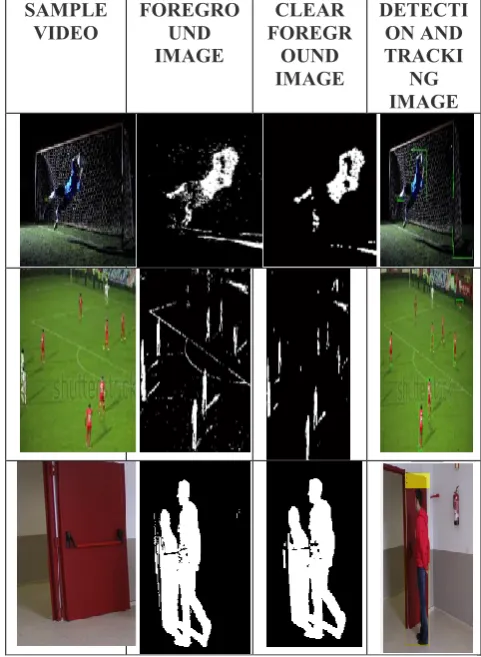
In this section, performance metrices are described using novel approach to improve the accuracy rate, False Rejection Rate and False Acceptance Rate and compared with the existing one. Experimental section is defined in Figure 5 which has 4 col and 8 rows. Initial col contains a video frame and in 2nd col foreground feature extracted images are shown. 3rd col has clean foreground image that is
the foreground feature extraction image contain some distortions using morphological filter method. 4th section col
includes of detect and track the object which is moveable. Fig 5 defines the segmentation phase, background division
object detection and tracking image consequences which are defined in each col and row-wise data.
SAMPLE VIDEO
FOREGRO UND IMAGE
CLEAR FOREGR OUND IMAGE
DETECTI ON AND TRACKI
NG IMAGE
Figure 5. Moving object Detection and Tracking Outputs
Below Figure 6 defines that the optimized multi-layer Neural Network Architecture. In this architecture shown the three layers (i) Input layer (ii) Hidden Layer and (iii) Output layer.
Input given = 100 Hidden neuron = 10 Output Data = 1 Output = 1
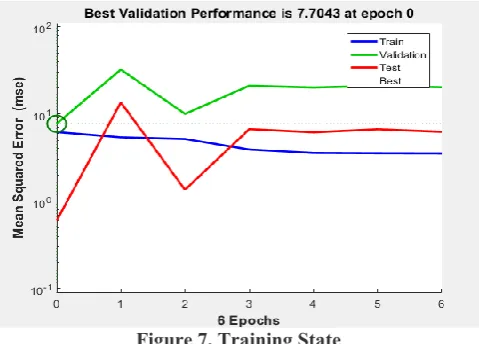
[image:5.595.60.274.470.648.2]Figure 7. Training State
[image:6.595.315.540.50.238.2]Above figure shows that the training state calculated MSE (Mean Square Error Rate) based on best validation performance is 7.7 at 0 epochs. It calculates the train, test, validation and Best Solution.
Table 1: Proposed Parameters Metrics
Parameters Values
TPR 0.932
TNR 0.8
FNR 0.1166
FPR 0.0676
FAR 0.03
Precision 0.116
Recall 0.88
Error Rate 0.0324
F-measure 0.1254
Accuracy Rate 93.24
Table 1 shows the performance metric using optimized Multilayer Neural Network and then improves the accuracy rate and recall value.
Table 2. Comparison Analysis with various classifiers
Class ifiers
T P R
F N R
F P R
F A R
Pre cisi on
Re cal l
F-meas
ure
Accuracy Rate (%)
PSO-MLPN
N
0. 93 2
0. 1 1
0. 06 7
0. 03
0.11 6
0.8 8
0.125 4
0.93 ~ 93.24
J48 0. 8
0. 5
0. 2
0. 29
0.61 0.6 5
0.69 0.65 ~65
KNN 0. 6
0. 3
0. 4
0. 36
0.66 7
0.6 5
0.63 0.65~65
MLP 0.
45 0.1 1 53 0. 0.234 0.45 0 0.45~45
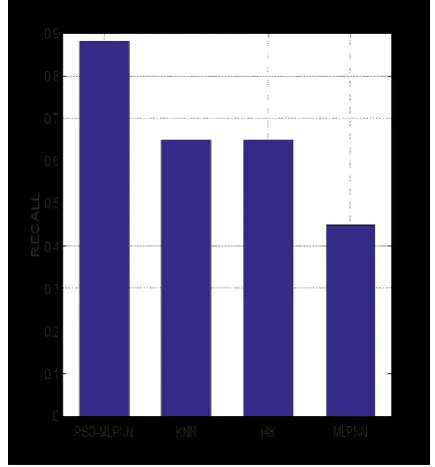
Table 2 define about the comparative analysis with various parameters and classifier in machine learning and artificial intelligence method. In proposed PSO-MLPNN algorithm is used to the video sequencing to improve the detection and track the accuracy rate and recall rate as compared to existing classifiers. It defines that the comparison between proposed method and existing methods with accuracy rate, Recall Rate and FNR (False Negative Rate).
Comparison Analysis
Figure 8 Comparative analysis with FAR
[image:6.595.72.248.304.455.2]The above table describes the results of the PSO-MPNN, KNN, J48 and MLPNN classifiers consequently. The performance is evaluated on the basis of the false acceptance rate, by comparing all the classifiers it is determined that FAR of the MLPNN have better performance.
Figure 9 Comparative analysis with accuracy
[image:6.595.316.538.331.505.2]International Journal of Innovative Technology and Exploring Engineering (IJITEE) ISSN: 2278-3075, Volume-8 Issue-10, August 2019
Figure 10 Comparative analysis with Precision The above table describes the results of the PSO-MPNN, KNN, J48 and MLPNN classifiers consequently. The performance is evaluated on the basis of the Precision rate, By comparing all the classifiers it is determined that Precision rate of the PSO-MLPNN have better performance.
[image:7.595.317.535.50.256.2]Figure 11 Comparative analysis with False positive rate The above table describes the results of the PSO-MPNN, KNN, J48 and MLPNN classifiers consequently. The performance is evaluated on the basis of the false positive rate, By comparing all the classifiers it is determined that FPR of the MLPNN have better performance.
Figure 12 Comparative analysis with False Negative rate
The above table describes the results of the PSO-MPNN, KNN, J48 and MLPNN classifiers consequently. The performance is evaluated on the basis of the False negative rate, By comparing all the classifiers it is determined that false negative rate of the J48 have better performance.
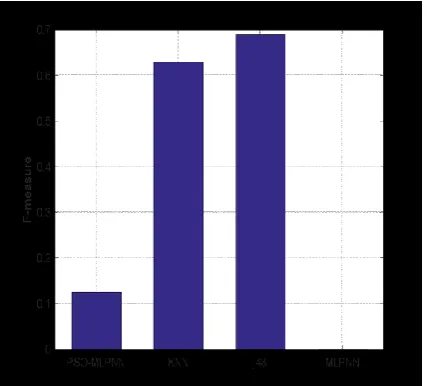
[image:7.595.317.535.371.605.2] [image:7.595.45.297.374.629.2]Figure 14 Comparative analysis with F-measure The above table describes the results of the PSO-MPNN, KNN, J48 and MLPNN classifiers consequently. The performance is evaluated on the basis of the F-measure, by comparing all the classifiers it is determined that F-MEASURE of the PSO- MLPNN have better performance.
V. CONCLUSIONANDFUTURESCOPE
In conclusion, moving object detection and tracking is one of the challenging issues of research because of the alteration in the movement of objects, change in the scene image, occlusions, change in appearance and change in illumination of image. Mainly, selecting features plays a crucial role in detection of moving objects. It is identified with numerous continuous applications like vehicle recognition, video reconnaissance and so forth. Some issues faced due to appearance and motion of objects to overcome the issue of detection and tracking. So, some of the algorithm has been found in research to detect the moving for smoothing the video structure. In proposed approach, in light of the pre-preparing technique in which there is extraction of the edges with decrease of measurement. The extraction of features and tracking of moving object acquired using BLOB ANALYSER. The morphological technique is interference of the foreground image in moving objects and extraction of texture features through component analysis. Along with that, new technique is used namely multilayer perceptron neural network. The optimised layers are on the basis of the Pbest and Gbest particle position in the objects. Then, searching the binary fitness values of swarm locations and acquiring frames of videos utilising BLOB ANALYSER. An application designed with activation function for filtration of the internal and external results considered with the help of pre-defined sigmoid. The detection and tracking of moving objects is done using MOT, FOOTBALL, INDOOR and OUTDOOR datasets. In moving objection technique detection accuracy rate, recall rate ,error rates, False Positive and Negative rate is improved and compared with the various classifiers such as KNN, MLPNN and J48 decision Tree.
In future Scope, for an automation detection and tracking of the moving objects, different tracking techniques can be designed using different view locations at wider ranges of distance.
REFERENCES
1. Jadhav, M. J. J., & Jyoti, J. (2014). Moving Object Detection and Tracking for Video Survelliance. International Journal of Engineering Research and General Science, 2(4), 372-378. 2. Piccardi, M. (2004, October). Background subtraction techniques: a
review. In 2004 IEEE International Conference on Systems, Man and Cybernetics (IEEE Cat. No. 04CH37583) (Vol. 4, pp. 3099-3104). IEEE.
3. Zhang, D., & Lu, G. (2001). Segmentation of moving objects in image sequence: A review. Circuits, Systems and Signal Processing, 20(2), 143-183.
4. Benezeth, Y., Jodoin, P. M., Emile, B., Laurent, H., & Rosenberger, C. (2008, December). Review and evaluation of commonly-implemented background subtraction algorithms. In 2008 19th International Conference on Pattern Recognition(pp. 1-4). IEEE. 5. Joshi, K. A., & Thakore, D. G. (2012). A survey on moving object
detection and tracking in video surveillance system. International Journal of Soft Computing and Engineering, 2(3), 44-48.
6. Karasulu, B. (2010). Review and evaluation of well-known methods for moving object detection and tracking in videos. Journal of aeronautics and space technologies, 4(4), 11-22.
7. Yuan, G., Sun, P., Zhao, J., Li, D., & Wang, C. (2017). A review of moving object trajectory clustering algorithms. Artificial Intelligence Review, 47(1), 123-144.
8. Idris, F., & Panchanathan, S. (1997). Review of image and video indexing techniques. Journal of visual communication and image representation, 8(2), 146-166.
9. Irani, M., & Anandan, P. (1998). A unified approach to moving object detection in 2D and 3D scenes. IEEE transactions on pattern analysis and machine intelligence, 20(6), 577-589.
10. Cucchiara, R., Grana, C., Piccardi, M., Prati, A., & Sirotti, S. (2001). Improving shadow suppression in moving object detection with HSV color information. In ITSC 2001. 2001 IEEE Intelligent Transportation Systems. Proceedings (Cat. No. 01TH8585) (pp. 334-339). IEEE.
11. Shih, M. Y., & Chao, Y. Y. (2011). U.S. Patent No. 8,000,498. Washington, DC: U.S. Patent and Trademark Office.
12. Oreifej, O., Li, X., & Shah, M. (2012). Simultaneous video stabilization and moving object detection in turbulence. IEEE transactions on pattern analysis and machine intelligence, 35(2), 450-462.
13. Wu, Y., & Wang, H. (2018, June). The Behavior Understanding of Moving Objects Based on Vision. In 2018 IEEE 3rd International Conference on Image, Vision and Computing (ICIVC) (pp. 982-989). IEEE.
14. Yokoyama, M., & Poggio, T. (2005, October). A contour-based moving object detection and tracking. In 2005 IEEE International Workshop on Visual Surveillance and Performance Evaluation of Tracking and Surveillance (pp. 271-276). IEEE.
15. Khosla, D., Chen, Y., & Kim, K. (2014). A neuromorphic system for video object recognition. Frontiers in computational neuroscience, 8, 147.
16. ElTantawy, A., & Shehata, M. S. (2015, September). Moving object detection from moving platforms using Lagrange multiplier. In 2015 IEEE International Conference on Image Processing (ICIP) (pp. 2586-2590). IEEE.
17. Hashmi, M. F., Pal, R., Saxena, R., & Keskar, A. G. (2016). A new approach for real time object detection and tracking on high resolution and multi-camera surveillance videos using GPU. Journal of Central South University, 23(1), 130-144.
18. Heo, B., Yun, K., & Choi, J. Y. (2017, September). Appearance and motion based deep learning architecture for moving object detection in moving camera. In 2017 IEEE International Conference on Image Processing (ICIP) (pp. 1827-1831). IEEE.
19. Yang, Y., Zhang, Q., Wang, P., Hu, X., & Wu, N. (2017). Moving object detection for dynamic background scenes based on spatiotemporal model. Advances in Multimedia, 2017.
20. Kim, J., Koo, Y., & Kim, S. (2018, January). MOD: Multi-camera Based Local Position Estimation for Moving Objects Detection. In 2018 IEEE International Conference on Big Data and Smart Computing (BigComp) (pp. 642-643). IEEE.
21. Zhu, M., & Wang, H. (2017, October). Fast detection of moving object based on improved frame-difference method. In 2017 6th International Conference on Computer Science and Network Technology (ICCSNT) (pp.
International Journal of Innovative Technology and Exploring Engineering (IJITEE) ISSN: 2278-3075, Volume-8 Issue-10, August 2019
22. Liu, T., Chi, H. H., Hong, C., and Zhao, M. S. (2014, July). Moving object detection in dynamic background. In Control Conference (CCC), 2014 33rd Chinese (pp. 4914-4919). IEEE.
23. Luo, J., and Zhu, J. (2010, June). Adaptive gaussian mixture model based on feedback mechanism. In Computer Design and Applications (ICCDA), 2010 International Conference on(Vol. 2, pp. V2-177). IEEE.
24. Mahalingam, T., and Subramoniam, M. (2018). A robust single and multiple moving object detection, tracking and classification. Applied Computing and Informatics.
25. Jia, T., Sun, N. L., and Cao, M. Y. (2008, September). Moving object detection based on blob analysis. In Automation and Logistics, 2008. ICAL 2008. IEEE International Conference on (pp. 322-325). IEEE.
AUTHORSPROFILE
Manisha Devi is a M.tech student at Department of CSE, Sachdeva Engineering College for girls , Gharuan(Mohali), Punjab,India. She has received her B.tech degree in computer science and engineering from Sachdeva Engineering College for girls, Gharuan(Mohali), Punjab, India in the year 2017. She is doing her research in the field of digital image processing and artificial intelligence titled as “Multi-layer Machine Learning Technique for Movement Detection and Tracking in Video Data Stream”. Besides this her other interests include Web Development, Web Designing, Data Management .
Er. Nidhi Bhatla is HOD (CSE) at Sachdeva Engineering College for Girls, Gharuan (Mohali), Punjab, India. She has completed her B.Tech from
Institute of Engineering and Technology, Bhaddal, Ropar (IKGPTU), Punjab and M.Tech from Guru Nanak Dev Engineering College, Ludhiana (IKGPTU), Punjab, India. Her specialization is in Data Mining and Digital Image Processing. She has various research publications in National and International journals.
![Figure 1. Block diagram of Moving Object Detection [15] The presentation of the proposed technique was evaluated using k-NN and MLP regarding accuracy, review, f-measure and ROC](https://thumb-us.123doks.com/thumbv2/123dok_us/8183603.255673/2.595.63.276.105.349/figure-detection-presentation-proposed-technique-evaluated-regarding-accuracy.webp)
![Figure 2. Blob Information Collection Process [25]](https://thumb-us.123doks.com/thumbv2/123dok_us/8183603.255673/4.595.307.543.626.837/figure-blob-information-collection-process.webp)