by
Kay ,Cuellar BA (Hons.)
School of Psychology University of Tasmania
PART 2
Submitted in fulfillment of the requirements for the degree of
CHAPTER 9
Study 5: Self-Reported Interaction Behaviours, Perfectionistic Motivations and Interpersonal Distress in Unpleasant Interpersonal Interactions
9.1 Rationale
Pursuing the fourth aim of this thesis, the current investigation examined whether high trait perfectionists self-reported different patterns of interaction behaviour, perfectionistic motivation and interpersonal distress in relation to unpleasant interpersonal interactions. The results of the investigations reported in the previous chapters of this thesis suggest that individuals high in specific negative evaluation concerns dimensions of perfectionism such as negative perfectionism, concern over mistakes, doubts about actions, socially prescribed perfectionism and the PCI are implicated in estimates of more frequent unpleasant interpersonal interactions and greater levels of interpersonal rejection sensitivity relative to low perfectionists. In addition these dimensions are differentially involved in attributions of less friendly behaviour and greater emotional distress relating to vignette descriptions of characters in dyadic interactions.
respect or affection of others resulting in increased levels of distress (Frost et al., 1990). These individuals are also suggested to engage in an increased level of self-critical evaluation of their behaviour that renders them unable to gain satisfaction from their efforts in a range of domains (Alden et al., 1994; Hewitt & Flett, 1991b). It is also suggested this increased self-focused attention and appraisal may subsequently exacerbate other maladaptive cognitions (Flett, Hewitt, Blankstein et al., 1996).
Terry-Short et al. (1995) have proposed that individuals high in negative perfectionism are motivated in their behaviour by a desire to avoid the disapproval of others. Thus their behaviours and cognitions are directed towards avoidance or escape from potentially negative consequences such as criticism or failure. In an interpersonal context individuals high in negative perfectionism are therefore likely to engage in increased levels of avoidance behaviour in order to avoid the disapproval of others (Slade & Owens, 1998). Other dimensions of perfectionism such as socially prescribed perfectionism, parental criticism and parental expectations have been found to be associated with a salient motivational component in that individuals high in these dimensions showed increased commitment towards having perfect relationships (Flett, Sawatzky et al., 1995).
literature in Chapter 3 reported that dimensions of perfectionism such as socially prescribed perfectionism are associated with a wide range of less adaptive behaviours and coping strategies in interpersonal situations, with a tendency towards avoidance and an increased tendency to perceive themselves as having less control over events, and experience high levels of emotional distress (Dunkley et al., 2000; Flett, Hewitt, Blankstein & O'Brien, 1991; Flett, Hewitt & DeRosa, 1996; Haring et al., 2003; Hill, Zrull & Turlington, 1997).
Similarly, although doubts about actions has been associated with specific disorders and psychopathology, there is little information available as to how this dimension of perfectionism may impact on interpersonal functioning. The dimension of doubts about actions is suggested to reflect a perfectionists' global doubts about the quality of their own actions or beliefs (Frost et al., 1990). Thus it is plausible that pervasive beliefs about the quality one's actions may result in differences in interpersonal functioning relative to low perfectionists. Individuals who perceive greater levels of parental criticism and parental expectations may also engage in increased levels of avoidance behaviour and experience greater levels of distress in interpersonal contexts although the results of the current investigations did not show associations between these dimensions and estimates of more frequent unpleasant interactions with others.
Individuals high in standards and achievement dimensions of perfectionism such as personal standards and self-oriented perfectionism have been characterised as engaging in stringent self-evaluation that results in increased distress. However, it is proposed that these individuals have a problem-solving orientation and will work until a solution is reached. This tendency to engage in more active strategies (and less avoidance) is thus thought to reduce the frequency and duration of negative experiences (Dunldey et al. 2000)
Slade and Owens (1998) have proposed that individuals high in positive perfectionism will engage in approach or pursuit behaviours in order to pursue success, perfection and
-
interpersonal context it is suggested that these individuals will engage in increased levels of approach behaviours in order to gain the approval of others (Slade & Owens, 1998).
It is therefore implicit in these characterisations of individuals high in specific standards and achievement dimensions as having positive and adaptive characteristics that result in better outcomes (or at least less distress) in a range of contexts including the interpersonal domain. However, there is mixed evidence to support the idea that there are benefits for the individual from high levels of standards and achievement dimensions of perfectionism.
Research regarding the perfectionism dimension of self-oriented perfectionism suggests that although individuals high in this dimension may engage in an increased level of conflict and other maladaptive behaviours, they do not always experience increased levels of interpersonal distress. In fact their high perfectionism may increase perceptions of social self-efficacy and lead to increases in adaptive interpersonal behaviours such as assertiveness (Fl tt, Hewitt & DeRosa, 1996; Habke et al., 1997 as cited in Habke & Flynn, 2002; Hill, Zrull & Turlington, 1997). However, other research has identified that high expectations for one-self within a relationship can increase levels of psychological distress (Wiebe & McCabe, 2002).
McCabe (2002) found that within a relationship, other-oriented perfectionism was not only associated with increased depression but that it mediated the relationship between symptoms of depression and hostile interpersonal behaviours.
Results of the current investigations conducted in this thesis have also provide mixed results in regard to the benefits of high levels of standards and achievement dimensions. The findings of Study 1 showed that no standards and achievement dimension was inversely associated with measures of psychological distress. In fact many of these dimensions showed a positive and significant relationship with distress. Furthermore no standards and achievement dimension of perfectionism showed a positive association with subjective well-being.
The results of Study 2 revealed that all of the standards and achievement dimensions investigated showed a positive relationship with the experience of more frequent negative interpersonal experiences although these associations did not reach significance. Individuals high in other-oriented perfectionism also showed increased levels of low self-esteem. However, individuals high in standards and achievement dimensions of perfectionism appear to be less likely to behave unassertively or to perceive the ambiguous or friendly behaviour of others as more negative relative to low perfectionists and their high negative evaluation concerns counterparts (See Study 4 reported in Chapter 8).
of research in regard to perfectionism and interpersonal behaviour has focused on the MPS-H measure with little literature available to examine the ways in which other dimensions of perfectionism impact on interpersonal behaviour and perceptions of distress.
In addition, although investigators have drawn links between dimensions of perfectionism and levels of distress in relation to interpersonal interactions, these investigations have not directly examined the behaviours and emotional responses of individuals within the context of a range of "real life" daily interpersonal experiences. Nor is there research examining the extent to which perfectionists perceive they are influenced or motivated by different perfectionistic reasons in relation to specific interactions. On these bases Study 5 investigates self-reported interaction behaviour, perfectionistic motivations and levels of interpersonal distress in relation to the experience of unpleasant interpersonal interactions. The findings of the studies already described within this thesis suggest that a range of negative evaluation concerns dimensions of perfectionism may be implicated in maladaptive behaviours and perceptions related to interpersonal functioning.
than their low perfectionism counterparts. It is also expected that individuals high in negative evaluation concerns dimensions of perfectionism will be more strongly influenced or motivated in their behaviour by perfectionistic concerns relating to doubts about the quality of ones actions (doubts about actions), fears about the consequences of making mistakes (concern over mistakes), beliefs of increased parental criticism and expectations (parental criticism/expectations), perceptions of unrealistic expectations imposed by others (socially prescribed perfectionism) and the desire to avoid the potential disapproval of others (negative perfectionism) relative to low perfectionists.
9.2 Method Participants.
The 165 male and female participants are those drawn from Study 1 as described in Chapter 6 and used in Studies 2 to 4.
Procedure.
Participants were requested to complete five diary entries relating to interactions they perceived as unpleasant in some way. The word 'conflict' was deliberately omitted from the description of interactions participants were asked to report, in order to capture daily interactions across a range of individuals and situations rather than possibly more extreme and unusual situations that might limit the type of interactions reported.
Materials.
Participants were provided with prepared diary pages and an example sheet to assist accurate completion of diary material. They were asked to report the time and date of the interaction, time and date of the diary entry, a brief description of the interaction including who was involved in the interaction, where and when the interaction occurred, and briefly what the interaction was about. Three aspects of these unpleasant interactions were then examined; interaction behaviours, perfectionistic motivations for behaviour and interpersonal distress.
To examine interaction behaviours, participants were requested to indicate the extent to which they engaged in the use of each of twelve specific behaviours during the interaction by circling the appropriate answer from the choices provided for each interaction behaviour. Response choices were "Not At All" (score of 1), "A Little Bit" (score of 2), "Some" (score of 3), "Quite A Bit" (score of 4) and "Very Much" (score of 5). The behaviours described are adapted from Sternberg and Dobson's (1987) investigation of resolution styles in interpersonal conflict. The behaviours provide a sufficiently brief response set for use in reporting of multiple interactions and are based on those already researched with a university student sample.
reduce the number of behaviour choices that could be characterised as negative in nature and provide a balance of negative and positive behaviour choices. Interactions reported in which the participant did not actually speak to or interact directly with the described interaction partner were excluded from analysis (e.g., someone I did not know sat near me and stared at me during a lecture so I tried to ignore him).
The twelve interaction behaviour items were:
1. I attempted to get my way by using some sort of force, coercion, pressure or manipulation directed at the other person (force/coercion).
2. I decided to wait things out and do nothing for the time being (wait)
3. I accepted the situation as it was and attempted to make the best of it (accept). 4. I attempted to diffuse the situation by reducing or negating my demands on the
other person (diffuse).
5. I attempted to have a third party outside the situation mediate and help arrive at a solution (mediate).
6. I attempted to get my way by undermining the esteem in which the other person was held by people outside the situation (undermine).
7. I tried to resolve the situation through bargain and compromise (bargain/compromise)
8. I tried to avoid unpleasantness altogether, especially any conversation or open confrontation with this person (avoid).
9. I tried to make the situation better by apologising to the other person or giving in to their demands (apologise).
11. I decided to talk to the other person about the problem, and both of us were able to exchange our views and mutually give consideration to the problem (talk). 12. I established a permanent separation from this person by avoiding them or not
speaking to them (separation).
From this set of interaction behaviours, behaviours can be characterised as approach strategies (mediate, bargain/compromise, and talk); accommodating, behaviours intended to reduce the intensity or demands of the situation (apologise, diffuse, accept); avoid, to describe passive behaviours intended to avoid or wait out any unpleasantness (avoid, wait, separate) and finally contending behaviours that can be characterised as actively negative behaviours (force/coercion, argue, and undermine). Higher scores for each interaction behaviour item indicate increased use of the behaviour.
should have done. Response choices were "Not At All" (score of 1), "A Little Bit" (score of 2), "Some" (score of 3), "Quite A Bit" (score of 4) and "Very Much" (score of 5).
The nine items for perfectionistic concerns were: I responded this way because:
1...the other person/s didn't do something as well as I think they should have (other-oriented perfectionism)
2...1 felt that I had failed by making a mistake and that the other person/s would not respect me because of this (concern over mistakes)
3 ...I prefer to confront challenging things and do them well and be recognised for my achievement (positive perfectionism)
4...it was very important for me to live up to the standards I had set for myself (personal standards/self-oriented perfectionism)
5...the other person/s expected too much from me (socially prescribed perfectionism) 6...1 wasn't sure if I had done the right thing (doubts about actions)
7...I usually try to avoid situations where others might disapprove of me or something I have done in case it is not as good as it should be (negative perfectionism)
8...my parents would have expected better of me and would not understand (parental expectations and criticism)
9...it was important to keep things well organised (organisation).
Finally, participants were asked to answer six questions relating to aspects of interpersonal distress. Two questions related to satisfaction with the interaction, 1) How satisfied were you with the way you handled the interaction? and, 2) How satisfied were you with the outcome of the interaction? Participants were asked to circle the appropriate point on a five point scale (a score of 1 reflecting a "Not at All" satisfied response and a score of 5 reflecting a "Very Much" satisfied response). The final four questions related to perceptions of positive and negative mood before and after the interaction and perceptions of control before and after the interaction. These questions were rated on an 11-point likert scale with a "neutral" mid-point and five points on either side reflecting perceptions of either negative or positive mood or perceptions of being out of control or in control of the interaction. The questions are set out below.
3. Please register the extent to which your mood was negative or positive just before the interaction began.
4. Please register the extent to which your mood was negative or positive after the interaction.
5. Please register the extent to which you felt in control of the situation when it began. 6. Please register the extent to which you felt in control of the situation when it was finished.
of least positive mood and being least in control and a score of 11 indicated perceptions of most positive mood or of being most in control. Lower scores on these items indicate increased levels of interpersonal distress in terms of decreased perceptions of control and lower mood.
9.3 Results
Only interactions categorised as occurring with specific interaction partners parent, sibling, friend, and partner (identified as boyfriend or girlfriend) were included in analysis. Other interaction partners were excluded from analysis (e.g., bus drivers, university lecturers, sales persons, sports coaches) as they were relatively few and represented a diverse range of people that did not fit neatly into additional categories. Analyses were conducted from overall mean scores for the aggregated score of the four main interaction partner categories. Each interaction behaviour item was treated as a separate variable rather than in clusters of related behaviours so as not to obscure the specific behaviours participants engaged in during interactions.
Means and Standard Deviations Interaction behaviours.
Table 19
Means and Standard Deviations for Ratings of Use of Interaction Behaviours
Interaction Mean Rating
behaviour M (SD)
Force/coercion 2.35 (0.80)
Wait 2.45 (0.92)
Accept 2.50 (0.84)
Diffuse 2.26 (0.74)
Mediate 1.84 (0.72)
Undermine 1.80 (0.75)
Bargain/compromise 2.42 (0.94)
Avoid 2.62 (0.87)
Apologise 2.06 (0.75)
Arguing 1.97 (0.81)
Talk 2.40 (0.90)
Separation 1.94 (0.85)
Note. Based on the responses of 165 participants, Males N=32, Females N=133
reliorted above show that this did not occur, indicating that participants did not attempt to positively bias their self-reported behaviours. Mediate was given the lowest overall rating of use and avoid the highest. No behaviour reached a mean rating of use above the "some" midpoint for overall mean scores.
Perfectionistic motivations
Table 20
Means and Standard Deviations for Ratings of Perfectionistic Motivations Perfectionistic
motivations
Mean Rating M (SD) NEC
NegP 2.51 (1.02)
CM 1.76 (0.78)
DA 2.29 (0.84)
PE/PC 1.96 (0.91)
SPP 2.56 (1.00)
SA
PosP 2.50 (1.05)
PS/SOP 2.94 (1.05)
OR 2.80 (0.97)
00P 2.80 (0.96)
Note. Based on the responses of 165 participants (Males N=32, Females N=133)
Domains/dimensions: NEC = negative evaluation concerns; SA = standards and achievement; NegP = negative perfectionism, CM = concern over mistakes; DA = doubts about actions; PE/PC = parental expectations/parental criticism; SPP = socially prescribed perfectionism; PosP = positive perfectionism; PS/SOP = personal standards/self-oriented perfectionism; OR = organisation; 00P = other-oriented perfectionism
oriented perfectionism. Concern over mistakes was rated as the least influential. Most perfectionistic reasons were rated as influencing behaviour in the "a little bit — some" range and none reached an overall mean score above the "some" midpoint.
Interpersonal distress
Means and standard deviations were calculated for ratings of interpersonal distress as shown in Table 21.
Table 21
Means and Standard Deviations for Ratings of Interpersonal Distress Interpersonal Mean Rating
Distress M (SD)
Satisfaction-H 2.94 (0.77) Satisfaction-0 2.76 (0.80) Mood before 6.59 (1.94)
Mood after 4.24 (1.76)
Control at beginning 6.18 (1.67) Control at end 6.17 (1.81)
Mean ratings for satisfaction with handling and satisfaction with outcome were in the "a little bit-neutral" range. Mean ratings of mood before the interaction all fell towards the neutral end of the positive mood range. Ratings of mood after the interaction fell towards the neutral end of the negative mood range for all groups. Mean ratings of control before and control after interactions fell close to the neutral midpoint, just within the "in control" range.
Univariate Analysis for High and Low Perfectionism Group Comparisons
Univariate analysis was undertaken to examine differences between mean scores for high and low groups in each dimension of perfectionism for differences in ratings of interaction behaviours, perfectionistic motivations and interpersonal distress. Results for negative evaluation concerns dimensions are discussed first followed by standards and achievement dimensions. Means and standard deviations for all' comparisons are shown in Tables B26 — B34 in Appendix B5.
Negative evaluation concerns dimensions PANPS: Negative perfectionism.
control and a more negative mood after interactions relative to low perfectionists. These
NEC
(dfe) 1122
NegP Group perfectionistic
motivations
oFfe)
(SD) Ili2 2 712 Interaction NegP
Behaviour Group (SD)
Low Satisfaction outcome High Low High Mood after 4.56 (1.62) 6.20* (155) 3.87 .04 (1.84) 2.38 (0.95) 6.72** (155) 2.79 .04 (1.04)
Interpersonal Interpersonal
distress distress
2.92 6.49
Low
(0.77) 7.78** Control (1.67) 5.83*
(155) (155)
end
2.57 .05 5.80 .04
High
(0.80) (1.90)
2.44
(0.78) 6.52*
(156) NegP
2.79 .04 (0.94)
2.13 Low
(0.97) 23.51** (155) .13 .08 Low SPP High 2.87 High (0.94)
3.08 Low 6.56
Low Control
Satisfaction beginning handling High High Low Avoid High (1.52) 9.73** (155) 5.78 .06 (1.71) (0.71) 5.31*
[image:23.568.63.482.230.743.2](155) 2.80 .03 (0.82) Table 22
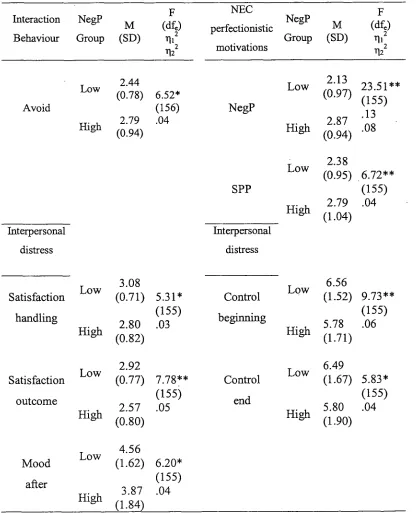
Descriptive and Inferential Statistics for Unadjusted Means and Effect Sizes Before
Covari ate Adjustment (n) and Where Applicable After Adjustment for Anxiety and
Note. All comparisons shown were statistically significant before covariance adjustment and also after adjustment in cases where anxiety and depression made a significant contribution when entered as covariates
No 1122 is shown when anxiety and depression were both non-significant as covariates In all F tests, dfi =1 as there are two perfectionism groups
Perfectionism domain/dimensions: NEC = negative evaluation concerns; NegP = negative perfectionism; SPP = socially prescribed perfectionism
Group n: low n = 80, high n =78 *p < .05. **p < .01
MPS-F: Concern over mistakes.
206 Table 23
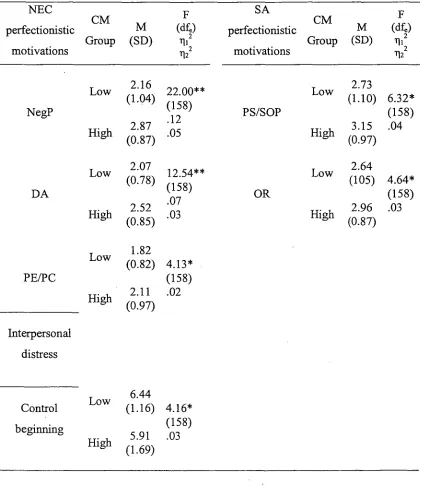
Descriptive and Inferential Statistics for Unadjusted Means and Effect Sizes Before Covariate Adjustment (,2) and Where Applicable After Adjustment for Anxiety and Depression (7722) for Trends and Statistically Significant Comparisons Between High and Low Concern Over Mistakes Group Ratings of Unpleasant Interactions
NEC perfectionistic
motivations
CM
(dy Group (SD) III
2 SA perfectionistic motivations CM Group (SD) NegP 2.16
Low (1.04) 22.00** (158) .12 2.87 High .05
(0.87) PS/SOP Low High 2.73 (1.10) 6.32* (158) 3.15 .04 (0.97)
DA
2.07
Low (0.78) 12.54** (158) .07 2.52 High (08 .03
.5) OR Low High 2.64 (105) 4.64* (158) 2.96 .03 (0.87) PE/PC Low High 1.82 (0.82) 4.13* (158) 2.11 .02 (0.97) Interpersonal distress Control beginning 6.44 Low (1.16) 4.16* (158)
High 5.91 .03
Note. All comparisons shown were statistically significant before covariance adjustment and also after adjustment in cases where anxiety and depression made a significant contribution when entered as covariates
No ii22 is shown when anxiety and depression were both non-significant as covariates In all F tests, dfi =1 as there are two perfectionism groups
Group low n= 86, high n= 74
Perfectionism domain/dimension: NEC = negative evaluation concerns; SA = standards and achievement; OR = organisation; PS/SOP =-- personal standards/self-oriented perfectionism; NegP = negative
perfectionism; DA = doubts about actions; PE/PC = parental expectations/criticism *p < .05. ** p < .01
MPS-F: Doubts about actions.
Individuals high in doubts about actions did not show any significant differences in
ratings of use of interaction behaviours relative to low perfectionists. However, they did
rate themselves as more influenced or motivated in their interaction behaviours by
perfectionistic reasons relating to negative evaluation concerns dimensions including the
desire to avoid the potential disapproval of others (negative perfectionism)and beliefs that
others expected too much of them (socially prescribed perfectionism). Individuals high in doubts about actions also perceived increased levels of interpersonal distress including
perceptions of lower satisfaction with their handling and the outcome of interactions and
a more negative mood after interactions relative to low perfectionists. These results are
(dfe) 2 111 2 112 Interpersonal distress DA Group (SD) perfectionistic motivations
DA M (dfe) Group (SD) 1112
2 112
2.20 Low
Low
NegP
High High
(0.95) (0.98) 2.87 19.27** (158) .11 Satisfaction with handling 3.07 (0.67) 5.57* (158) 2.78 .03 (0.86)
Low Low
SPP
High High
Satisfaction with outcome 2.43 (0.88) 4.96* (158) 2.78 .03 (1.11)
2.92
(0.74) 8.08** (158) 2.56 .05 (0.83) Low High Mood after interactions 4.58 (1.56) 7.51** (158) 3.83 .04 (1.90) NEC
'Table 24
Descriptive and Inferential Statistics for Unadjusted Means and Effect Sizes Before
Covariate Adjustment (q2 ) and Where Applicable After Adjustment for Anxiety and
Depression (m)for Trends and Statistically Significant Comparisons Between High and
Low Doubts About Actions Group Ratings of Unpleasant Interactions
Note. All comparisons shown were statistically significant before covariance adjustment and also after adjustment in cases where anxiety and depression made a significant contribution when entered as covariates
No 122 values are shown as anxiety and depression were both non-significant as covariates in all analyses In all F tests, dfi =1 as there are two perfectionism groups
Group n: low n= 87, high n = 73
MPS-F: Parental expectations.
Individuals high in parental expectations showed no significant differences in ratings of interaction behaviours or interpersonal distress relative to low perfectionists. Results revealed that the high parental expectations group were more influenced in their interpersonal behaviour by the perfectionistic reason relating to beliefs of increased parental expectations and lack of understanding (parental expectations/criticism) for the F (1,158) = 4.48,p < (i72 = .03; M10 = 1.81, SD low = 0.83; M high = 2.11, SD high =
0.96) relative to low perfectionists. The absence of any results relating to differences in interpersonal behaviour or interpersonal distress for individuals high and low in this dimensions suggests that having beliefs of increased parental expectations is not involved deficits in interpersonal functioning through the use of maladaptive behaviours or increased interpersonal distress.
MPS-F: Parental criticism.
MPS-H: Socially prescribed perfectionism.
(dfe) (SD) 1112
2 112 NEC SPP
perfectionistic
motivations Group Interaction SPP
M (dfe) behaviour Group (SD) 1112 2
112 Low Low High High NegP Avoid 2.46 (0.80) 4.51* (155) 2.74 .03 (0.89)
2.14
(1.01) 20.89** (154) 2.84 .12 (0.91) Low PE/PC High 1.80 (0.82) 4.97* (154) 2.12 .03 (0.99) SA perfectionistic motivations PS/SOP 2.58 (1.04) 6.57* (154) 2.97 .04 (0.84) OR ■■■ Low High Low High
2.71 2.41
Low SPP
High
(0.96) 5.24* (154) 2.77 .03 (0.99) (1.07) 6.56*
[image:30.569.70.480.232.657.2](154) 3.13 .04 (0.98) Table 25
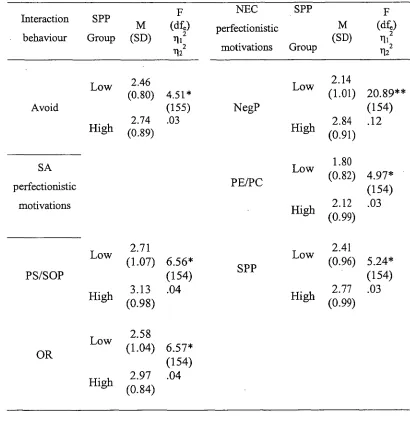
Descriptive and Inferential Statistics for Unadjusted Means and Effect Sizes Before Covariate Adjustment (j721) and Where Applicable After Adjustment ()for Trends and Statistically Significant Comparisons Between High and Low Socially Prescribed Perfectionism Group Ratings of Unpleasant Interactions
Note. All comparisons shown were statistically significant before covariance adjustment and also after adjustment in cases where anxiety and depression made a significant contribution when entered as ccivariates
Group n: low n= 78, high n= 78
Perfectionism dimensions/domains: NEC = negative evaluation concerns; SA = standards and
achievements; OR = organisation; NegP = negative perfectionism; PE/PC = parental expectations/criticism; SPP = socially prescribed perfectionism
*p <.05. **p < .01
Perfectionism Cognitions Inventory (PCI).
The results showed no significant differences in interaction behaviours between high and low PCI groups. However, individuals with high PCI scores showed increased perfectionistic motivations relating to reasons including the desire to avoid the potential disapproval of others (negative perfectionism), concerns about the consequences of making mistakes (concern over mistakes) and beliefs that others expected too much of them including parents (socially prescribed perfectionism, parental criticism/expectations) as well as the desire to maintain high personal standards (personal standards/self-oriented perfectionism) relative to low perfectionists. The high PCI group also showed some significantly increased interpersonal distress relating to reduced
perceptions of satisfaction and control. These results are shown in Table 26.
UNI
VE
RS
ITY
OF
TA
S
LIB
RA
(dfe)
1112 2 92 PCI Group (SD) NEC Perfectionistic motivations NEC Perfectionistic motivations PCI
M (dfe) Group (SD) 1112
2 712
(0.91) 5.91* (158) 2.77 04
(1.04) 11.90** (158) 3.21 .07 Table 26
Descriptive and Inferential Statistics for Unadjusted Means and Effect Sizes Before Covariate Adjustment 072d and Where Applicable After Adjustment for Anxiety and Depression (i722) for Trends and Statistically Significant Comparisons Between High and Low PCI Group Ratings of Unpleasant Interactions
2.20
(1.03) 14.69** (158) 2.80 .08 (0.94) 1.51 18.33** (0.60) (158) . 2.01 10
(0.85) .03
2.39 (1.06) SA Perfectionistic motivations PE/PC Interpersonal distress Satisfaction handling 1.81 (0.81) 4.54* (158) 2.11 .03 (0.98)
3.07
(0.72) 4.74** (158) 2.81 .03 (0.89) PS/SOP Interpersonal distress Control before 2.65 (1.00) 6.58 (1.46) 9.20** (158) 5.80 .05 (1.77) High
High
Low
Low Low
Note. All comparisons shown were statistically significant before covariance adjustment and also after adjustment in cases where anxiety and depression made a significant contribution when entered as covariates
No 122 is shown when anxiety and depression were both non-significant as covariates In all F tests, dfi =1 as there are two perfectionism groups
Group n: low n = 77, high n = 83
Perfectionism dimensions/domains: NEC = negative evaluation concerns; SA = standards and achievement; PS/SOP = personal standards/self-oriented perfectionism; NegP = negative perfectionism; CM = concern over mistakes; DA = doubts about actions; PE/PC = parental expectations/criticism; SPP = socially prescribed perfectionism
*p <.05. **p < .01
Standards and achievement dimensions PANPS.. Positive perfectionism.
Table 27
Descriptive and Inferential Statistics for Unadjusted Means and Effect Sizes Before Covariate Adjustment (n) and Where Applicable After Adjustment for Anxiety and Depression ()for Trends and Statistically Significant Comparisons Between High and Low Positive Perfectionism Group Ratings of Unpleasant Interactions
Interaction Behaviour
PosP
Group (SD) (df)
2 112 SA perfectionistic motivations PosP
Group (SD) M (dFf
e)
1112
1122 Wait Arguing Low High Low High 2.59 (0.99) 2.29 (0.81) 1.82 (0.71) 2.08 (0.86) 4.39* (156) .03 4.01* (156) .02 PosP PS/SOP OR Low High Low High Low High 2.26
(1.'08)
2.75 (1.00) 2.67 (1.06) 3.19 (0.99) 2.63 (1.03) 2.95 (0.86) 8.87** (155) .05 10.25** (155) .06 4.27* (155) .03
Note. All comparisons shown were statistically significant before covariance adjustment and also after adjustment in cases where anxiety and depression made a significant contribution when entered as covariates
Nore2values are shown as anxiety and depression were both non-significant as covariates in all analyses
In all F tests, dfi =1 as there are two perfectionism groups Group n: low n = 79, high n = 78
*p <.05. **p < .01
MPS-F: Personal standards.
NEC PosP (dfe) 2 111 2 112
Group (SD) Group (SD) PS perfectionistic motivations SA perfectionistic motivations Low High
NegP PS/SOP
2.70
(1.05) 9.91** (158) 3.21 .06 (1.00) 28
2.
Low 10.27** (1.06)
(158)
'05 06 High 2'78 .
(0.91) Low OR SPP High 2.62 (1.02) 6.39* (158) 3.00 .04 (0.88) Low 2.44
4.03* (0.99)
2.75 (158) High (1.00) '02
Low High Mood after 4.50 (1.77) 4.38* (158) 3.93 .03 (1.71) Interpersonal
[image:36.568.75.499.222.637.2]distress Table 28
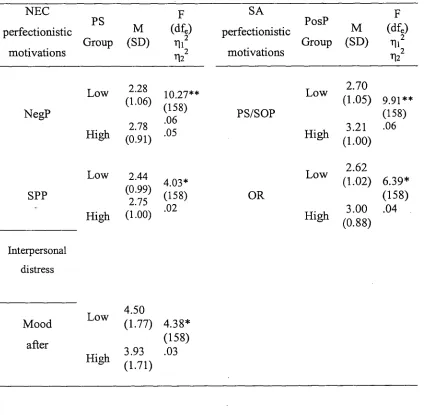
Descriptive and Inferential Statistics for Unadjusted Means and Effect Sizes Before
Covariate Adjustment (re d and Where Applicable After Adjustment for Anxiety and
Depression ()for Trends and Statistically Significant Comparisons Between High and
Low Personal Standards Group Ratings of Unpleasant Interactions
Note. All comparisons shown were statistically significant before covariance adjustment and also after adjustment in cases where anxiety and depression made a significant contribution when entered as covariates
No 1.'22 is shown when anxiety and depression were both non-significant as covariates In all F tests, dfi =1 as there are two perfectionism groups
Perfectionism domains/dimensions: SA = standards and achievement; NEC = negative evaluation concerns; PS/SOP = personal standards/self-oriented perfectionism; OR = organisation; NegP = negative perfectionism; SPP = socially prescribed perfectionism
*p <.05. **p < .01
MPS-F: Organisation.
The results showed no significant differences between high and low organisation groups for ratings of use of interaction behaviours. However, the high organisation group rated perfectionistic motivations relating to the desire to maintain organisation F (1,158) = 9.56, p <.01 (re = .06; M 10,, = 2.57, SD low = 1.00; M high = 3.04, SD high = 0.88) as
influencing their behaviour to a greater extent to low perfectionists. The high organisation group also showed a trend towards significantly reduced interpersonal distress in relation to ratings of increased control after interactions F (1,158) = 5.41, p <.05
(re
= .03; M low = 5.85, SD low = 1.81; M high = 6.51, SD high = 1.75) relative to lowperfectionists.
MPS-H Self-oriented perfectionism.
The results showed no differences between high and low self-oriented perfectionism groups for ratings of use of interaction behaviours or interpersonal distress. However, the high self-oriented perfectionism group showed significantly increased perfectionistic motivations relating to reasons including the desire to maintain personal standards (personal standards/self-oriented perfectionism) F (1,154) = 7.11, p <.01 (re = .04; M low = 2.69, SD low = 1.07; M high = 3.13, SD high = 0.98); as well as the desire to avoid the
actions (doubts about actions) F(1,154) = 14.34, p <.01 (re = .09; M10 = 2.02, SD low =
0.72; M high = 2.51, SD high = 0.88) relative to low perfectionists.
MPS-H: Other-oriented perfectionism.
Individuals high in other-oriented perfectionism showed a trend towards the significantly increased use of undermining behaviour F (1,155) = 5.44, p <.05 (re = .03; M low = 1.66,
SD low = 10.65; M high = 1.93, SD high = 0.79) relative to low perfectionists. However, it
should be noted that both the high and low groups rated their use of undermining in the
'not at all — a little bit' range suggesting there was not a high level of use of this behaviour in interactions in either group. The high other-oriented perfectionism group showed a trend towards significantly increased perfectionistic motivations relating to beliefs that others did not do something to the perfectionists own expectations of them
(other-oriented perfectionism) F (1,154) = 4.81,p < (re = .03; M low = 2.67, SD low =
0.92; M high = 3.00, SD high = 0.95) relative to low perfectionists. The high other-
oriented perfectionism group also showed a trend towards a significantly reduced interpersonal distress relating to a more positive mood before interactions F (1,154) = 5.92, p < .05 (e=.04; M10 = 6.23, SD low = 2.02; M high = 6.98, SD high -= 1.82) relative to
the low other-oriented perfectionism group.
9.4 Discussion
perfectionism self-reported that they have an increased tendency to engage in avoidance behaviours in unpleasant interpersonal situations. However, increased avoidance behaviour only occurred for the high socially prescribed and negative perfectionism groups and no other negative evaluation concerns group.
The findings of the current investigation are consistent with the findings of others that socially prescribed perfectionism is associated with increased avoidance and unassertive interpersonal behaviour (Flett, Hewitt, Blankstein et al., 1996; Hewitt & Flett, 1991b ; Hill, McIntyre & Bacharach, 1997; Hill, Zrull & Turlington, 1997). However, contrary to expectations, the current investigation failed to find evidence that individuals high in socially prescribed perfectionism experienced increased interpersonal distress following negative interactions (Flett, Hewitt, Blankstein & Mosher, 1991; Hewitt & Flett, 1991b; Hill, Zrull & Turlington, 1997).
One explanation for this latter result may be as individuals high in socially prescribed perfectionism engaged in avoidance behaviour in unpleasant interpersonal situations they
increased avoidance. However, this did not occur. In fact individuals high in negative perfectionism reported increased interpersonal distress on a number of variables. An alternative explanation may be found in the ratings of perfectionistic motivations for behaviour. These perfectionistic motivations in relation to negative perfectionism are discussed later in the chapter.
The dimensions of parental expectations and parental criticism have previously been described as more interpersonal than intrapersonal in that they are concerned with the opinions and behaviours of others, specifically parents (Habke & Flynn, 2002). Although individuals high in parental criticism engaged in less coercive behaviour than their low perfectionist counterparts, the pattern of results of the current study suggest that on their own these dimensions of perfectionism do not strongly influence interpersonal behaviour or levels of interpersonal distress.
The dimension of doubts about actions, a more intrapersonally directed dimension, does not appear to be implicated in differences in interpersonal behaviour between high and low perfectionists. However, high levels of doubts about actions do appear to be involved in increased interpersonal distress. In common with individuals high in
negative perfectionism, individuals high in doubts about actions reported increased perfectionistic motivations for behaviour relating only to negative evaluation concerns
dimensions. Although individuals high in parental expectations and parental criticism
were also motivated in their behaviour only by negative evaluation concerns reasons, these reasons were only those directly relating to parental expectations and understanding. In contrast, individuals high in doubts about actions and negative perfectionism were motivated by more global perfectionistic concerns about others.
maintaining high standards and organisation or the desire to be meet challenges and be rewarded for effort. This increased motivation relating only to global negatively oriented perfectionistic reasons may provide some explanation for the findings of the current study that the high groups for these dimensions were the only negative evaluations concerns groups to report a more negative mood following unpleasant interactions.
Individuals high in negative perfectionism self-reported an increased use of avoidance behaviours as well as a broad range of increased interpersonal distress relating to negative interpersonal interactions including decreased satisfaction with handling and decreased satisfaction with outcome of interactions as well as more negative mood after interactions. High negative perfectionists also experienced a reduced perception of control before and after interactions relative to their low perfectionism counterparts. As noted above, high negative perfectionists were motivated in their behaviour only by perfectionistic reasons relating to negative evaluation concerns. These results suggest that negative reinforcement in regard to perfectionistic behaviours may be highly implicated in the generation of increased interpersonal distress that may subsequently render the individual more vulnerable to symptoms of anxiety and depression.
perfectionism engage in avoidance behaviours in order to escape from their increased perceptions of potential negative evaluation of them and their actions by others and subsequently are more vulnerable to distress. Such beliefs may render them more vulnerable to distress than individuals high in dimensions such as socially prescribed perfectionism whose focus of concern relates to beliefs that others impose unrealistic
expectations on them. It may be as suggested by Campbell and Di Paula (2002), that although socially prescribed perfectionists are concerned about the perceived unrealistic expectations imposed upon them by others, they do not necessarily accept these imposed standards as reasonable thus reducing their vulnerability to distress. Alternatively it may be that as speculated by Flett, Hewitt, Blankstein et al. (1996), socially prescribed perfectionists do not persist in problem solving perhaps as a result of fears that others
may further increase standards imposed on them if problems are successfully solved.
exception of individuals high in negative perfectionism, doubts about actions, parental criticism and parental expectations as already discussed. It is possible that this dual motivation for behaviour may mitigate some of the more distressing effects of negative interpersonal interactions.
Some support for this idea is provided by an examination of differences between high and low perfectionism groups in regard to perfectionistic motivations for behaviour and outcomes in relation to levels of interpersonal distress. As noted above individuals high in negative perfectionism, doubts about actions, parental expectations and parental criticism do not report any increased influence of standards and achievement perfectionistic reasons on their interpersonal behaviour. The high groups for the dimensions of negative perfectionism and doubts about actions also report the greatest number of negative perceptions in relation to interpersonal interactions including a more negative mood. Individuals high in socially prescribed perfectionism reported an increased influence of perfectionistic reasons relating to maintaining personal standards but reported no increase in interpersonal distress following unpleasant interactions. Individuals high in concern over mistakes and the PCI reported differing levels of the increased influence of the desire to maintain personal standards and organisation and showed only limited interpersonal distress around negative interactions relative to low perfectionists.
concerns dimensions experience the greatest levels of interpersonal distress. In contrast, individuals high in negative evaluation concerns dimensions of perfectionism who are motivated to some extent by perfectionistic reasons relating to standards and achievement dimensions are somewhat less vulnerable to this type of distress.
An alternative explanation for the findings that individuals high in negative perfectionism and doubts about actions are solely motivated in their interpersonal behaviour by perfectionistic concerns relating to negative evaluation concerns dimensions and experience more negative perceptions and distress in regard to interpersonal interactions, is that these dimensions most closely capture the negative aspects of high trait perfectionism. It is possible that these dimensions are those that are most highly implicated in deficits in interpersonal functioning and subsequent vulnerability to distress.
The results for comparisons between individuals with high and low scores for standards and achievement dimensions of perfectionism showed only partial support for predictions. Overall, the results of this investigation suggested that high levels of standards and achievement perfectionism provides few benefits in regard to interpersonal functioning.
solution. This tendency to engage in more active strategies (and less avoidance) is suggested to reduce the frequency and duration of negative experiences (Thinkley et al., 2000).
The pattern of results for the conceptually related perfectionism dimensions of personal standards and self-oriented perfectionism did not show any consistent use of more active approach behaviours. In fact there were no significant differences between these high and low perfectionism groups for any interaction behaviour. Nor was there any evidence on the basis of the current investigation that individuals high in these dimensions of perfectionism engage in less avoidance behaviour relative to low perfectionists. Although they do not engage in increased levels of avoidance, there is no evidence on the basis of the current investigation to show that individuals high in dimensions of perfectionism such as personal standards and self-oriented perfectionism engage in more active and constructive behaviours at least in relation to unpleasant interpersonal situations (Dunldey et al., 2000). Nor is there any evidence to suggest that individuals high in these dimensions engage in increased conflict behaviour (Flett, Hewitt & DeRosa,
1996; Hill, Zrull & Turlington, 1997)
active approach strategies and less avoidant strategies relative to low perfectionists, it is possible that they will not gain the full benefits of persisting until a problem is solved that is proposed to reduce the experience of the frequency and intensity of daily stressors (Dunkley et al. 2000).
Slade and Owens (1998) have proposed that individuals high in positive perfectionism engage in pursuit behaviours in order to pursue success, perfection and excellence and are motivated by the desire to gain the approval of others. Individuals high in positive perfectionism were the only high standards and achievement perfectionism group that showed a pattern of both the decreased use of an avoiding behaviours (wait) and an increased use of the active but contending behaviour of arguing.
When the results relating to self-oriented perfectionism, personal standards and positive perfectionism and interpersonal behaviours are placed within the context of the perfectionistic concerns that influence or motivate behaviour, one possible explanation is evident. Individuals high in these dimensions of perfectionism all rated perfectionistic concerns relating to the desire to maintain personal standards (personal standards/self-oriented perfectionism) as having an increased influence on their behaviour relative to individuals low in these dimensions as expected.
standards and achievement and negative evaluative concerns dimensions explains the failure of the current investigation to find a pattern of differences in behaviour for the dimensions of personal standards and self-oriented perfectionism relating to increased active and problem solving behaviour. These findings could be considered consistent with the conclusions of Habke and Flynn (2002) that although individuals high in dimensions of perfectionism such as self-oriented perfectionism (and by extension personal standards and positive perfectionism) may focus on goal achievement, in an interpersonal context the behaviours used to achieve these goals may be maladaptive. It is possible that high stringent self evaluation in interpersonal contexts activates a range of negative evaluative concerns cognitions that overwhelm the problem solving orientation suggested by Dunkley et al (2000).
The results regarding perfectionistic motivations for behaviour also suggest that dimensions such as personal standards and self-oriented perfectionism are not entirely self-focused or intrapersonal in nature. The increased influence of perfectionistic reasons such as the desire to avoid the potential disapproval of others suggests that individuals high in these dimensions of perfectionism have increased interpersonally focused perfectionistic concerns in addition to their self-focused perfectionistic beliefs.
positive adjustment. Although the facet of the importance of being perfect was associated with some aspects of positive adjustment (albeit to a lesser extent) it was also negatively associated with levels of self-esteem and the ability to change goal directed behaviour when failing in an achievement context. Campbell and Di Paula concluded that it was active striving for perfectionism that may be a core factor associated with the positive consequences of perfectionism.
It is possible that the results of the current study relating to the dimensions of personal standards, and self-oriented perfectionism are a reflection of the fact that both perfectionistic striving and the importance of being perfect are represented to a greater or lesser extent within these dimensions of perfectionism. Therefore results have been mixed with regard to positive behaviours, affective responses and the relative influence of perfectionistic reasons on interpersonal behaviour.
The increased use of more maladaptive behavioural strategies such as arguing by high positive perfectionists is not inconsistent with the dual reinforcement theory proposed by Slade and Owens (1998). Slade and Owens suggested that similar behaviours may be associated with different emotional states dependent on whether the behaviour was a function of positive or negative reinforcement.
The results of the current investigation suggest that consistent with the theory put forward by Slade and Owens (1998), individuals high in positive perfectionism were motivated in their behaviour by positive reinforcement associated with recognition for achievement as well as the desire to maintain high personal standards. High positive perfectionists were the only perfectionism group of all the dimensions examined who reported an increased influence of perfectionistic reasons relating to the desire to do things well and to be recognised for achievement (positive perfectionism). High positive perfectionists were also among the high standards and achievement perfectionism groups that did not report any increased influence of perfectionistic reasons relating to negative evaluation concerns dimensions. Perhaps this desire to meet challenges and be recognised for achievement drives these perfectionists to engage in more confrontational behaviour such as arguing, and renders them less willing to wait out an unpleasant situation.
of Slade and Owens (1998) that individuals high in positive perfectionism are positively reinforced by the approval of others and will not experience increased interpersonal distress regardless of their actual behaviour because of this type of positive reinforcement.
It was expected that individuals high in other-oriented perfectionism would engage in an increased level of conflict behaviour but experience less distress than their low perfectionism counterparts in relation to unpleasant interpersonal interactions (Flett et al.,
1996; Hill, McIntyre & Bacharach, 1997). There was mixed evidence for the increased use of conflict behaviour as high other-oriented perfectionists showed an increased use of undermining others which can be viewed as a more indirect form of conflict behaviour.
Consistent with expectations, individuals high in other-oriented perfectionism did not report any increased distress in unpleasant interpersonal interactions and indeed reported perceptions of a more positive mood than their low perfectionism counterparts before the interaction began. These results are partially consistent with the conclusions of Hewitt and Flett (2002) in that high levels of other-oriented perfectionism may not be directly involved in the generation of stress. It is possible that high levels of other-oriented perfectionism contribute indirectly to stress interpersonal conflict. Although this may be
the case, the results of the current investigation do not suggest that high other-oriented perfectionists experience distress in relation to unpleasant interpersonal interactions.
interpersonal interactions with the exception of individuals high in personal standards. The majority of results for standards and achievement dimensions showed either no differences between high and low groups in levels of interpersonal distress (positive perfectionism and self-oriented perfectionism) or increased perceptions of control after interactions in some contexts (organisation). However, individuals high in personal standards reported an overall perception of more negative mood following interactions. An examination of the influence of perfectionistic reasons on interpersonal behaviour may offer some explanation for this finding.
Individuals high in personal standards were the only high standards and achievement group to rate the perfectionistic reason of the unrealistic expectations of others (socially prescribed perfectionism) as having an increased influence on behaviour. It is possible
that this increase in perception that others are imposing unrealistic standards for the self contributed to a more negative mood after interactions that was not evident for other standards and achievement dimensions of perfectionism. However, this explanation is somewhat problematic given that individuals high in socially prescribed perfectionism (who would presumably be highly vulnerable to distress in relation to the perceived expectations of others) did not report a more negative mood following unpleasant interactions despite their increased concerns about the expectations of others.
Although there is not extensive evidence regarding personal standards and interpersonal behaviour, researchers have reported mixed findings in relation to self-oriented perfectionism. Wiebe and McCabe (2002) reported that self-directed relationship
speculated that this association between high self-directed perfectionism in a relationship context may be the result of the individuals fears of acting below ones own standards, however, if this was the case for personal standards perfectionists a similar result would be expected for self-oriented perfectionists. Thus the difference in results may be due to findings that self-oriented perfectionism is associated with positive perceptions of problem solving ability that may not be the case for personal standards perfectionists. An alternative explanation may be that self-oriented perfectionism more directly captures the construct of perfectionistic striving suggested by Campbell and Di Paula (2002) to be associated with positive adjustment. Personal standards on the other hand may more directly capture the concept of the importance of being perfect which was not associated with positive adjustment.
CHAPTER 10
Summary of Findings, Concluding Comments and Implications for Further Research
10.1 Review of Results of the Investigations Conducted in This Thesis
The purpose of this chapter is to review the major findings of the investigations within this thesis and draw conclusions about perfectionism and interpersonal behaviour with reference to existing theories of perfectionism. Following the literature review in Chapter 1, it was concluded that there was a growing convergence of opinion that dimensions of perfectionism could be categorised according to whether the dimension was characterised as primarily negative or more positive or neutral in nature (Dunldey et al., 2000; Frost et al., 1993; Slade & Owens, 1998; Terry-Short et al., 1995). Therefore all dimensions of perfectionism have been discussed within this thesis under the umbrella of two domains of perfectionism labeled negative evaluation concerns and standards and achievement.
perfectionism, an overview of findings is provided for each study with reference to the aims of the investigation set out in Chapter 4.
The first aim guiding this thesis was to identify characteristics that distinguish individuals high in different dimensions of perfectionism and the extent to which perfectionism dimensions predicted scores on measures of psychological distress and subjective well-being. This was achieved in Study 1 by examining associations between a range of dimensions of perfectionism and sample characteristics such as sex and age, the presence of mental or medical illness, behaviours such as absenteeism and a history of suicide attempts and self-mutilation. Investigations were then conducted to establish associations between sample characteristics and measures of psychological distress and well-being followed by an examination of the extent to which different dimensions of perfectionism predicted scores on these measures.
also decreased significantly in the mature age group, whereas subjective well-being scores increased with age but did not reach significance. These findings are consistent with the conclusions of Chang (2000) who found that that while the nature of associations between perfectionism and psychological distress are similar in older and younger adults, there are differences in how strongly these variables are represented across age groups.
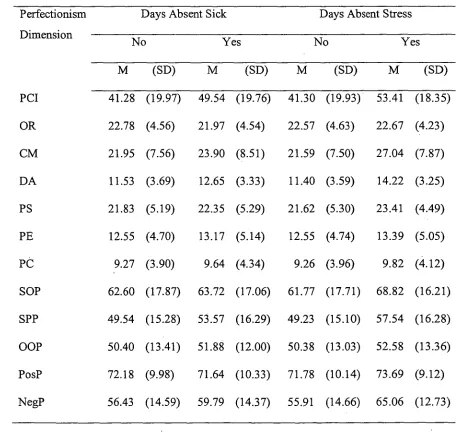
In regard to other participant characteristics, specific negative evaluation concerns dimensions of perfectionism showed positive associations with the reported presence of a mental illness, absenteeism due to stress and a history of suicide attempts and self-mutilation (Alden et al., 1994; Antony et al., 1998; Chang, 1998; Dean et a., 1996; Enns & Cox, 1998; Flett, Hewitt et al.; 1995; Hewitt et al., 1997; Hewitt et al.,1994; Hunter & O'Connor, 2003; Juster et al., 1996; Mitchelson & Burns, 1994; Rheaume et al., 1995).
1994, 1997). It is possible that individuals high in parental criticism also experience these same feelings of hopelessness and inability to control the expectations of important others that increase vulnerability to suicide attempts.
However, the results of the current investigation showed only relatively weak associations between socially prescribed perfectionism and suicide attempt. These results could be interpreted as suggesting that perceptions of an inability to meet or control the expectations of important others, particularly parents, are involved in increased vulnerability to suicide attempts rather than global beliefs that others have unrealistic expectations of one-self
Finally, as previous findings in relation to associations between measures of anxiety and depression have shown some inconsistent results, investigations were undertaken to establish how well dimensions of perfectionism predicted scores on these variables and a measure of subjective well-being. The results revealed that all dimensions of perfectionism were positively associated with symptoms of anxiety and depression and negatively with subjective well-being. However, not all of these associations were significant. Negative evaluation concerns dimensions showed the strongest significant associations with anxiety, depression and subjective well-being, particularly negative perfectionism, concern over mistakes, doubts about actions and the PCI. Standards and achievement dimensions showed associations of lower magnitude but in the same direction.
Regression analysis revealed that negative perfectionism most strongly positively predicted depression scores in both younger and older adults, whereas doubts about actions and PCI scores positively predicted anxiety scores in younger and older adults respectively. Subjective well-being in younger adults was negatively predicted by negative perfectionism and by PCI scores in older adults. It was concluded that increased levels of negative evaluation concerns dimensions of perfectionism are most implicated in increased psychological distress in both age groups. It was also concluded that it is a decrease in levels of these negative evaluation concerns dimensions that is involved in greater perceptions of subjective well-being and not increases in levels of standards and achievement dimensions.
The results of Study 1 add to current understandings of the role of a range of dimensions of perfectionism in relation to symptoms of anxiety, depression and subjective well-being. The findings of Study 1 highlight the role of a range of dimensions of perfectionism in relation to vulnerability to depression and anxiety that have received less attention in perfectionism research, particularly negative perfectionism, doubts about actions and the PCI. This investigation also contributes to understandings of the ways in which associations between perfectionism and participant characteristics may change with age and provides some additional findings in relation to associations between perfectionism and self-mutilation.
unpleasant interpersonal interactions and interpersonal rejection sensitivity. This aim was achieved through Study 2. Consistent with expectations, most negative evaluation concerns dimensions of perfectionism showed trends or significant positive associations with estimates of the frequency of negative interpersonal interactions with the exception of parental criticism and parental expectations. Standards and achievement dimensions were also positively associated with estimates of more frequent negative interpersonal interactions, however, none of these associations reached significance.
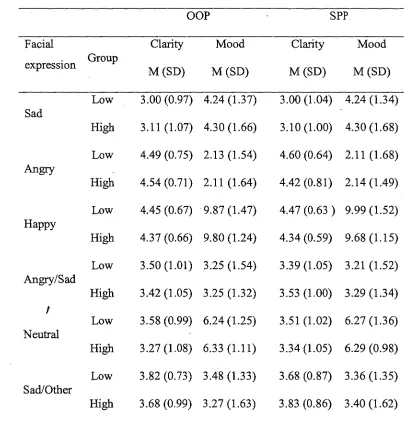
In pursuit of the third aim of the investigations in this thesis, Studies 3 and 4 examined differences in the ways that high trait perfectionists perceive social information such as facial expression and make attributions about the interpersonal behaviour and responses of others relative to non-perfectionists. In Study 3 photographs of facial expression were used to examine attributions about social information. Results from Study 3 revealed that there were few differences between individuals high and low in perfectionism in the categorisation of facial expression or the level of confidence about the categorisations made.
Contrary to expectations there were no differences between any high and low group for negative evaluation concerns dimensions of perfectionism for any measure. Small effects were found for standards and achievement dimensions which showed an increased tendency of individuals high in organisation to categorise a neutral facial expression as happy relative to low perfectionists and individuals high in personal standards and self-oriented perfectionism to be less confident in their categorisations of neutral or ambiguous expressions. There were no differences between and high or low perfectionism groups in perceptions of the negative or positive mood shown in facial expressions.
messages in facial expressions but decrease confidence about the categorisation made. The results of this investigation assist our understanding of the role of social information such as facial expression in relation to the ways in which high trait perfectionists may interpret information in interpersonal contexts.
In Study 4, brief vignettes describing friendly, neutral and unfriendly dyadic interactions were used to further examine differences in attributions of social information between high and low perfectionists. Consistent with expectations, the results of Study 4 revealed that individuals high in specific negative evaluation concerns dimensions (particularly negative perfectionism, concern over mistakes, socially prescribed perfectionism and the PCI) made more negative attributions about the behaviour and feelings of others in the context of a neutral interaction. However, these differences between high and low groups in relation to the neutral vignette were relatively few. The most prominent pattern found was for individuals high in negative evaluation concerns dimensions to rate the feelings of the person who was the object of the neutral behaviour as more anxious relative to low perfectionists. There were no differences found between high and low groups for any standards and achievement dimension.
in relation to friendly interactions relative to those low in perfectionism. More specifically, those high in the dimensions of socially prescribed perfectionism, and concern over mistakes showed a very similar pattern of responses in which friendly behaviour was rated as less warm, and the feelings of the person who was the object of the friendly behaviour as less happy, less pleased and less calm relative to low perfectionists. However, only individuals high in negative perfectionism and the standards and achievement dimension of self-oriented perfectionism made attributions of less friendly behaviour relative to low perfectionists.
On the bases of these results, it was concluded that there was support for the idea that individuals with high levels of specific negative evaluation concerns dimensions of perfectionism interpret neutral or ambiguous behaviour more negatively (Hewitt & Flett, 2002). The findings of the current study also show that individuals high in negative evaluation concerns dimensions interpret friendly behaviour and the emotional responses of the person who is the object of the friendly behaviour as more negative than those low in perfectionism.