Soft-Bit Assisted Iterative AMR-WB Source-Decoding and Turbo-Detection of Channel-Coded
Differential Space-Time Spreading Using Sphere Packing Modulation
N. S. Othman, M. El-Hajjar, O. Alamri and L. Hanzo*
School of ECS, University of Southampton, SO17 1BJ, UK.
Tel: +44-23-8059 3125, Fax: +44-23-8059 4508
Email:
{lh}@ecs.soton.ac.uk, http://www-mobile.ecs.soton.ac.uk
Abstract– Jointly optimised iterative source- and channel-de-coding is used for enhancing the error resilience of the Adaptive Multi Rate WideBand (AMR-WB) speech codec. The resultant AMR-WB coded speech signal is protected by Recursive System-atic Convolutional (RSC) codes and transmitted using a Sphere Packing (SP) aided Differential Space-Time Spreading (DSTS) assisted transceiver. The performance of the proposed scheme is evaluated when communicating over correlated non-dispersive Rayleigh fading channels. The proposed system exhibits anEb/N0 gain of about 1 dB in comparison to the benchmark scheme carry-ing out joint channel decodcarry-ing and DSTS aided SP-demodulation, but separate AMR-WB decoding, when usingI= 4external iter-ations.
1. MOTIVATION AND BACKGROUND
The classic Shannonian source and channel coding separation theo-rem [1] has limited applicability in the context of finite-complexity, finite-delay lossy speech [2] and video [3] codecs, where the dif-ferent encoded bits exhibit difdif-ferent error sensitivity. These argu-ments are particularly valid, when the complexity, limited-delay source encoders fail to remove all the redundancy from the correlated speech or video source signal. Fortunately, this residual redundancy may be beneficially exploited for error protection by in-telligently exchanging soft information amongst the various receiver components. More explicitly, it was explicitly demonstrated in [4] that the video performance of a twin-class protected MPEG4 video transceiver substantially benefitted from a multi-stage turbo detection process, which exchanged soft-information across three Soft-In-Soft-Out (SISO) blocks.
These powerful turbo principles may be further enchanced by ex-ploiting the innovative concept of soft speech bits, which was devel-oped by Vary and his team [5, 6], culminating in the formulation of iterative source and channel decoding (ISCD) [7]. More explicitly, in ISCD the source- and channel-decoder iteratively exchangea pri-oriandextrinsic information for the sake of improving the overall system performance. As a further development, in [8] the employ-ment of the turbo principle [9] for iterative soft demapping in multi-level modulation [10] schemes combined with channel coding demon-strated an enhanced bit error rate performance. Thus, ISCD combined with iterative soft demapping in the context of multilevel modula-tion and amalgamated with a number of other sophisticated wireless transceiver components may beneficially exploited. In the resultant
The financial support of the Universiti Tenaga Nasional Malaysia, of Vodafone under the auspices of the Dorothy Hodgkin Postgraduate Award, of the Ministry of Higher Education of Saudi Arabia and that of the EPSRC, UK as well as that of the European Union in the framework of the Pheonix and Newcom projects is gratefully acknowledged.
multi-stage schemeextrinsicinformation is exchanged amongst three receiver components, namely the demodulator, the channel decoder and the soft-input source decoder in the spirit of [11].
Explicitly, we proposed and investigate a jointly optimised ISCD scheme invoking the Adaptive Multirate-Wideband (AMR-WB) speech codec [12], which is protected by a Recursive Systematic Convolu-tional (RSC) code. The resultant bitstream is transmitted using Differ-ential Space-Time Spreading (DSTS) and Sphere Packing (SP) modu-lation [13] over a correlated, non-dispersive Rayleigh fading channel. An efficient iterative turbo-detection scheme is utilised for exchang-ingextrinsicanda prioriinformation between the constituent codes. In an effort to mitigate the effects of the hostile Rayleigh fading chan-nel, DSTS employing two transmit and one receive antennas was in-voked for sake of providing a spatial diversity gain. This powerful wireless transceiver is advocated, since it was demonstrated that the employment of SP modulation combined with the orthogonal transmit diversity designs of [14], outperformed the conventional orthogonal design based Space-Time Block Coding (STBC) schemes of [15, 16]. The paper is structured as follows. In Section 2, the AMR-WB speech codec is described briefly and the residual redundancy inherent in its parameters is quantified. In Section 3, the overall system model is described, while our simulation results are presented in Section 4. Our conclusions are offered in Section 5.
2. RESIDUAL REDUNDANCY IN THE AMR-WB SPEECH CODEC
code-Encoder Channels Sphere
Packing
DSTS Fading
Mapper Speech
Encoder Encoder
RSC Iterative
Decoder DSTS
Decoder
s
. .
. . .
.
zNr
y1
yNt
z1
x
c ˜c
˜ u
πin
πout
[image:2.595.59.562.71.139.2]u ˆx ˆs
Figure 1: Block diagram of the DSTS-SP-RSC-AMRWB scheme. The notationss,ˆs,u,c,x,yj,zk,πoutandπinrepresent the frame of the
speech source samples, the estimate of the speech source samples, the bit-representation of the encoded speech parameters, the encoded bits of the RSC encoder, the SP-coded symbols, the DSTS coded symbols of transmitterj, the received symbols at receiverk, the outer bit interleaver, and the inner bit interleaver, respectively. Furthermore,NtandNrdenote the number of transmitters and receivers, respectively. The iterative
decoder seen at the right is detailed in Figure 2.
Parameter 1st 2nd 3rd 4th Total
subfr subfr subfr subfr per frame
VAD-flag 1
ISPs 46
LTP Lag 9 6 9 6 30
LTP-filt.-flag 1 1 1 1 4
Fixed Index 52 52 52 52 208
CB Gains 7 7 7 7 28
[image:2.595.66.297.210.314.2]Total 317
Table 1: Bit allocation of the AMR-WB speech codec at 15.85 kbit/s [17].
book gains are jointly vector quantized using 7 bits per subframe, whilst the fixed excitation codebook parameters of each 5 ms sub-frame are encoded using 13 bits. [17]. A large training sequence of 2,133,035 20 ms frames was applied to the AMR-WB encoder in or-der to estimate the residual redundancy of each individual quantised AMR-WB parameter. In general, the residual redundancy inherent in the encoded bit-stream representing the speech signal at the out-put of the speech encoder reflects the residual redundancy manifest-ing itself in terms of the residual correlation (or memory). Another sign of substantial residual redundancy is the non-uniform probabil-ity of occurance for the various encoded speech parameters. Let us assume that each of the encoded codec parameters can be sufficiently accurately modelled by a stationary stochastic process and each of the encoded parameters is modelled by azero-order- or afirst-order Markov chain, when quantifying the residual redundancy manifesting itself in terms of the nonuniform relative frequency of the legitimate encoded speech parameters. Let us now consider the estimation of the residual redundancy inherent in the AMR-WB encoded parame-ters which is quantified by estimating the entropyH(U)of the en-coded parameters, whereUrepresents the random process modelling the AMR-WB encoded parameters. The entropyH(U) of the en-coded parameters, represents the minimum number of bits required for describing the parameter. Thus, if each parameter is encoded by
Bbits/symbol, the total residual redundancy inherent in the parame-ter is given byRT =B −H(U). The residual redundancy reflects
the residual correlation (or memory),RM and nonuniformity,RD.
Specifically, we can write RT = RD +RM where for variable
U1, the redundancy due to the nonuniformityRD = B −H(U1), whilst,RM = H(U1)−H(U)denotes the redundancy due to the memory [20]. Let us provide an example for quantifying the en-tropy H(U) of the ISP parameters. Assuming the ISP parameters can be approximated by a stationary stochastic process, let the ran-dom process,Ui:i= 1,2, ...,7, represent theith vector quantized
ISP in each AMR-WB frame, which are encoded using 8, 8, 6, 7,
7, 5 and 5 bits, respectively. Additionally, we assume that the ISPs corresponding to the same ISP index i=1,...,7 in the other AMR-WB encoded frames are independent and each of the ISPs within a frame exhibitsfirst-orderMarkov chain, so,
P(Un=un|U1=u1, ..., Un−1=un−1)
= P(Un=un|Un−1=un−1) (1) Following the derivation in [21],H(U)can be expressed as:
H(U) = limn→∞H(Un|U1, U2, ..., Un−1)
= limn→∞H(Un|Un−1)
= H(Un|Un−1)
= Ep(un,un−1)
×log2[P(Un=un|Un−1=un−1)] (2) Thus, the total residual redundancy,RTofU2is given by:
RT = 8−H(U) (3)
since,RT =RD+RM, thus, giving:
RD = 8−H(U2) (4)
RM = H(U2)−H(U2|U1) (5) whereH(U2)is the entropy of parameterU2, given by:
H(U2) = − X
u1
P(U2=u2) ˙log2[P(U2=u2)] (6)
Packing
Demapper Decoder
RSC
Utilization
Parameter
Estimation
Knowledge Inner
Iter. Outer
Softbit AMR−WB Decoding
a priori of Sphere
Iter.
π−1 in
ˆ x
LM,p LM,a
LD,e=LD,p−LD,c,a
LM,e=LM,p−LM,a
LD,c,a LD,i,e=LD,i,p−LD,a
LD,i,p
LD,a LS,e
LS,a ˆu
πout
π−1 out
πin
[image:3.595.82.537.70.251.2]LD,p
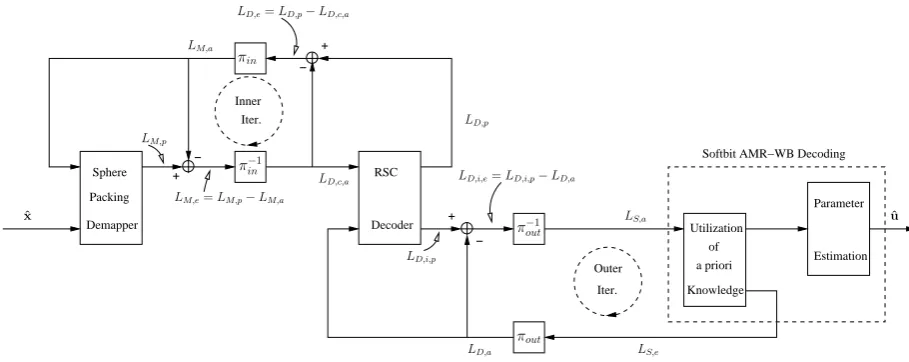
Figure 2: Block diagram of the jointly optimised DSTS-SP-RSC-AMRWB turbo detection scheme seen at the right of Figure 1. The notations
πinandπ−in1represent theinnerinterleaver and deinterleaver,πoutandπout−1 denote the outer interleaver and deinterleaver.
Parameter Encoded Bits RD RM RT
ISP No. 1 8 0.57 0.00 0.57
2 8 0.45 0.96 1.41
3 6 0.10 0.10 0.20
4 7 0.06 0.06 0.12
5 7 0.14 0.05 0.19
6 5 0.03 0.03 0.06
7 5 0.07 0.04 0.11
LTP Lag subfr 1 9 0.23 0.00 0.23
subfr 2 6 0.40 0.21 0.61
subfr 3 9 0.20 0.14 0.34
subfr 4 6 0.39 0.21 0.60
CB Gain subfr 1 7 0.10 0.00 0.10
subfr 2 7 0.10 1.10 1.20
subfr 3 7 0.10 1.12 1.22
[image:3.595.67.295.303.482.2]subfr 4 7 0.12 1.12 1.24
Table 2: Residual Redundancy in the AMR-WB codec’s Parameters Modelled by a First-Order Markov Chain
Parameter Encoded Bits RD RT
Fixed Ind. subfr1 1 13 0.33 0.33
2 13 0.31 0.31
3 13 0.31 0.31
4 13 0.31 0.31
Table 3: Residual Redundancy in the Fixed Codebook Index Mod-elled by a Zero-Order Markov Chain
3. SYSTEM OVERVIEW
Figure 1 shows the schematic of the proposed scheme. The itera-tive decoder structure of the DSTS-SP-RSC-AMRWB scheme is il-lustrated in Figure 2, where theextrinsicinformation is exchanged amongst all three constituent decoders. Theinneriterative loop cor-responds to the iterative soft SP demapping and RSC channel decod-ing [13], while theouteriterative loop corresponds to theextrinsic/a
prioriinformation exchange between the AMR-WB speech decoder and the RSC decoder.
3.1. Transmitter
The AMR-WB speech encoder produces a frame of speech codec pa-rameters, namely{v1,τ,v2,τ,. . . ,vκ,τ,. . . ,v36,τ}, wherevκ,τ denotes
an encoded parameter, withκ = 1, ..., Kκdenoting the position of
each parameter in the encoded speech frame, whilst, τ denotes the time index referring to the current encoded frame index. Then,vκ,τ
is quantised and mapped to the bit sequence,uκ,τ= [u(1)κ,τu(2)κ,τ
. . . u(M)κ,τ], whereM is the total number of bits assigned to the
κth parameter. Then, the outer interleaver,πoutpermutes the bits of
the sequenceu, yieldingu˜of Figure 1.
The interleaved RSC encoded source bit sequenceu˜of Figure 1 is generated by a rateR = 12 code having a constraint length of
K = 7and octally represented generator polynomials of(Gr, G) =
(217,110). The DSTS-SP modulator of Figure 1 first mapsBnumber of channel-coded bits˜c=[˜c0c˜1. . . ˜cB−1]∈0,1 to a sphere packing
symbolx∈X, so that we havex=mapsp(˜c), where the function ofmapsp(˜c)represents the mapping ofB bits to a SP symbol, x.
Furthermore, we haveB = log2L =log216 = 4, whereL repre-sents the set of legitimate SP constellation points, as outlined in [14]. Subsequently, we have a set of SP symbols that can be transmitted us-ing DSTS and two transmit antennas as detailed in [14]. Space-Time Spreading (STS) was first proposed by Marzettaet. al[22] for the sake of providing space-time-coding-style spatial transmit diversity gain for CDMA systems, as detailed in Section 8.2 of [23]. However, the channel impulse response (CIR) of all transmit-receive antenna links has to be estimated in coherently detected STS-CDMA systems which is a challenging task. Hence, in [13] the philosophy of differen-tially detected DSTS was developed, which dispenses with the need of estimating the CIR.
In this study, we considered transmissions over a correlated nar-rowband Rayleigh fading channel, associated with a normalised Dopp-ler frequency offD= 0.01.
3.2. Receiver
[image:3.595.73.287.525.584.2]de-mapped to their Log-likelihood Ratio (LLR) [9] representation for each of theBRSC-encoded bits per DSTS-SP symbol. As seen in Figure 2, thea prioriLLR values,LM,aprovided by the RSC decoder
are subtracted from thea posterioriLLR values,LM,pat the output of
the SP-demapper for the sake of generating theextrinsicLLR values
LM,eand then the LLRsLM,eare deinterleaved by a soft-bit
deinter-leaver. Next, the deinterleaved soft-bitsLD,c,aof Figure 2 are passed
to the RSC decoder in order to compute thea posterioriLLR values
LD,pprovided by the Max-log MAP algorithm [24] not only for the
systematic bits, but for all the RSC-encoded bits. Theextrinsic infor-mationLD,eseen in Figure 2 is generated by subtracting thea priori
information,LD,c,afrom thea posterioriinformationLD,p
accord-ing toLD,p−LD,c,a, which is then fed back to the SP demapper
as thea prioriinformationLM,aafter appropriately reordering them
using the inner soft-value interleaver. The SP-demapper of Figure 2 exploits thea prioriinformationLM,afor the sake of providing
im-proveda posterioriLLR values,LM,pwhich are then passed to the
RSC decoder and in task, back to the SP-demapper for further itera-tions.
Outer Iterations:As seen in Figure 2, theextrinsicLLR values
LD,i,eof the original uncoded systematic information bits are
gener-ated by subtracting thea prioriLLR values,LD,aof the RSC decoder
from the LLR valuesLD,i,pof the original uncoded systematic
infor-mation bits. Then, the LLRsLD,i,e are deinterleaved by the outer
soft-bit deinterleaver. The resultant soft-bitsLS,aare passed to the
AMR-WB decoder that was further developed for handling soft input bits in order to compute theextrinsicLLR values,LS,ewith the aid
of soft-bit source decoding (SBSD). TheseextrinsicLLR values are then fed back to the RSC decoder after appropriately reordering them in the order required by the RSC decoder for the sake of completing an outer iteration. We define this as havingI = 1iteration, namely, one external iteration. The residual redundancy quantified in Sec-tion 2 is exploited asa prioriinformation in computing theextrinsic LLR values, and estimating the parameters.
The details of the algorithm used for computing theextrinsicLLR values,LS,ecan be found in [7].
4. PERFORMANCE RESULTS
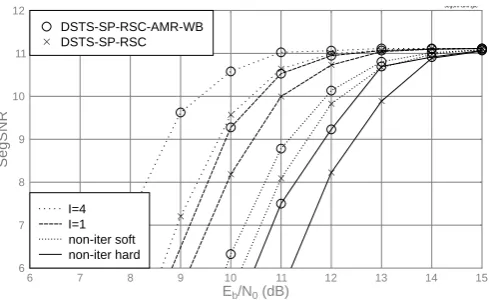
In this section we evaluate the attainable performance of the proposed scheme using both the Bit Error Ratio (BER) and the Segmental Sig-nal to Noise Ratio (SegSNR) [2] evaluated at the speech decoder’s output as a function of the channel SNR.
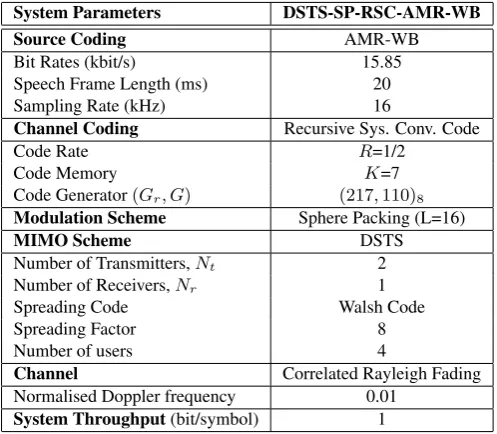
All simulation parameters are listed in Table 4. In our simulations each inner iteration was followed by an outer iteration.
Figure 3 depicts the BER versus Signal to Noise Ratio (SNR) per bit, namelyEb/N0performance of the non-coherent DSTS-SP-RSC-AMRWB scheme and that of its corresponding DSTS-SP-RSC benchmarker scheme, when communicating over uncorrelated Ray-leigh fading channels. It can be seen from Figure 3 that the DSTS-SP-RSC-AMRWB scheme outperforms the DSTS-SP-RSC benchmarker scheme by about 1 dB at BER=1.5×10⁻⁴
afterI = 4iterations where, we define a complete decoding iteration cycle, as having an inner iteration followed by a single outer-iteration, as mentioned in Section 3, which is referred to as havingI = 1iteration. The AMR-WB-decoded scheme has a low BER at its speech decoded output than its benchmarker dispensing with speech decoding, because the extrinsicinformation exchange between the AMR-WB decoder and the RSC decoder has the potential of improving the BER.
Let us now study the speech SegSNR performance of the
pro-System Parameters DSTS-SP-RSC-AMR-WB
Source Coding AMR-WB
Bit Rates (kbit/s) 15.85
Speech Frame Length (ms) 20
Sampling Rate (kHz) 16
Channel Coding Recursive Sys. Conv. Code
Code Rate R=1/2
Code Memory K=7
Code Generator(Gr, G) (217,110)8
Modulation Scheme Sphere Packing (L=16)
MIMO Scheme DSTS
Number of Transmitters,Nt 2
Number of Receivers,Nr 1
Spreading Code Walsh Code
Spreading Factor 8
Number of users 4
Channel Correlated Rayleigh Fading
Normalised Doppler frequency 0.01
[image:4.595.319.568.71.288.2]System Throughput(bit/symbol) 1
Table 4: System Parameters
ber-decodulation.gle
8 9 10 11 12 13 14 15
Eb/N0(dB) 5
10-4 2 5 10-3 2 5 10-2 2 5 10-1
BER
DSTS-SP-RSC-AMRWB DSTS-SP-RSC
[image:4.595.323.565.322.492.2]non-iter I=1 I=4
Figure 3: BER versusEb/N0performance of the jointly optimised DSTS-SP-RSC-AMRWB scheme of Figure 1 and Table 4, when com-municating over correlated non-dispersive Rayleigh fading channels.
segsnr-amr.gle
6 7 8 9 10 11 12 13 14 15
Eb/N0(dB)
6 7 8 9 10 11 12
SegSNR
DSTS-SP-RSC-AMR-WB DSTS-SP-RSC
[image:5.595.59.304.69.219.2]I=4 I=1 non-iter soft non-iter hard
Figure 4: Average SegSNR versusEb/N0performance of the jointly optimised DSTS-SP-RSC-AMRWB scheme of Figure 1 and Table 4 in comparison to the DSTS-SP-RSC benchmarker scheme, when communicating over correlated non-dispersive Rayleigh fading chan-nels.
5. CONCLUSIONS
In this contribution the three-stage turbo detection DSTS-SP-RSC-AMRWB scheme of Figure 1, 2 and Table 4 was proposed for trans-mission over a correlated non-dispersive Rayleigh fading channel. The employment of the soft-output AMR-WB speech codec, which exploits the residual redundancy inherent in the encoded bitstream demonstrates a significant improvement in terms of the average SegSNR versus channelEb/N0 performance compared to its corresponding hard decoding based benchmarker. The performance of the three-component turbo receiver is about 1 dB better in terms of theEb/N0 in comparison to the benchmarker scheme carrying out joint iterative channel decoding and DSTS aided SP-demodulation, but using sepa-rate AMR-WB decoding. The employment of the DSTS scheme that requires no channel state information, whilst providing a substantial diversity gain by invoking two transmit antennas.
6. REFERENCES
[1] C. E. Shannon, “A Mathematical Theory of Communication,”The Bell System Technical Journal, vol. 27, pp. 379–423,623–656, July, October 1948.
[2] L. Hanzo, F.C.A. Somerville, and J.P. Woodard,Voice Compression and Communications: Principles and Applications for Fixed and Wireless Channels. Chichester, UK: John Wiley-IEEE Press, 2001.
[3] L. Hanzo, P.J. Cherriman and J. Street,Wireless Video Communications: Second to Third Generation Systems and Beyond. NJ, USA : IEEE Press., 2001.
[4] S. X. Ng, J. Y. Chung and L. Hanzo, “Turbo-Detected Unequal Pro-tection MPEG-4 Wireless Video Telephony Using Multi-Level Coding, Trellis Coded Modulation and Space-Time Trellis Coding,” inIEE Com-munications Proceeding, vol. 152, pp. 1116–1124, 9 December 2005. [5] T. Fingscheidt and P. Vary, “Speech Decoding with Error Concealment
using Residual Source Redundancy,”IEEE Workshop on Speech Coding for Telecommunication, pp. 91–92, 7-10 Sept 1997.
[6] T. Fingscheidt and P. Vary, “Softbit Speech Decoding: A New Approach to Error Concealment,”IEEE Transactions on Speech and Audio Pro-cessing, vol. 9, pp. 240–251, March 2001.
[7] M. Adrat, P. Vary, and J.Spittka, “Iterative Source-Channel Decoder Using Extrinsic Information from Softbit-Source Decoding,”IEEE In-ternational Conference on Acoustics, Speech and Signal Processing, pp. 2653–2656, 7-11 May 2001.
[8] S. ten Brink, J. Speidel and R.-H. Yan, “Iterative Demapping and De-coding for Multilevel Modulation,” IEEE Global Telecommunications Conference, vol. 1, pp. 579–584, November 1998.
[9] L. Hanzo, T. H. Liew and B. L. Yeap,Turbo Coding, Turbo Equalisation and Space Time Coding for Transmission over Wireless channels. New York, USA: John Wiley IEEE Press, 2002.
[10] L. Hanzo, Ng S. X, T.Keller and W. Webb,Quadrature Amplitude Mod-ulation: From Basics to Adaptive Trellis-Coded, Turbo-Equalised and Space-Time Coded OFDM, CDMA and MC-CDMA Systems. New York, USA : John Wiley IEEE Press, 2004.
[11] T. Clevorn, J. Brauers, M. Adrat and P. Vary, “Turbo DeCodulation: It-erative Combined Demodulation and Source-Channel Decoding,”IEEE Communications Letters, vol. 9, pp. 820–822, September 2005. [12] B. Bessette, R. Salami, R. Lefebvre, M. Jelinek, J. Rotola-Pukkila, J.
Vainio, H. Mikkola and K. Jarvinen, “The Adaptive Multirate Wideband Speech Codec (AMR-WB),”IEEE Transactions on Speech and Audio Processing, vol. 10, pp. 620–636, November 2002.
[13] M. El-Hajjar, O. Alamri, and L. Hanzo, “Differential Space-Time Spreading Using Iteratively Detected Sphere Packing Modulation and Two Transmit Antennas,” inIEEE Wireless Communications and Net-working Conference, vol. 3, pp. 1664–1668, April 2006.
[14] W.Su, Z.Safar and K.J.R. Liu, “Space-Time Signal Design for Time-Correlated Rayleigh Fading Channels,”IEEE International Conference on Communications, vol. 5, pp. 3175–3179, May 2003.
[15] S. Alamouti, “A Simple Transmit Diversity Technique for Wireless Communications,”IEEE Journal on Selected Areas in Communications, vol. 16, pp. 1451–1458, October 1998.
[16] V. Tarokh, H. Jafarkhani, and A.R. Calderbank, “Space-Time Block Codes From Orthogonal Designs,”IEEE Transactions on Information Theory, vol. 45, pp. 1456–1467, July 1999.
[17] 3GPP TS 26.190 V5, “AMR Wideband Speech Codec: Transcoding Functions,” December 2001.
[18] L. Hanzo, C. H. Wong and M. S. Yee,Adaptive Wireless Transceivers: Turbo-Coded, Turbo-Equalized and Space-Time Coded TDMA, CDMA, and OFDM Systems. New York, USA : John Wiley and Sons, 2002. [19] Y. Bistritz and S. Pellerm, “Immitance Spectral Pairs (ISP) for Speech
Encoding,”IEEE International Conference on Acoustics, Speech, and Signal Processing (ICASSP), vol. 2, pp. 9–12, 27-30 April 1993. [20] F. Alajaji, N. Phamdo, N. Farvardin, and T. E. Fuja, “Detection of
Bi-nary Markov Sources Over Channels with Additive Markov Noise,” IEEE Transactions on Information Theory, vol. 42, pp. 230–239, Jan-uary 1996.
[21] F. Alajaji, N. Phamdo, and T. E. Fuja, “Channel Codes that Exploit the Residual Redundancy in CELP-Encoded Speech,”IEEE Transactions on Speech and Audio Processing, vol. 4, pp. 325–336, September 1996. [22] B. Hochwald, T.L. Marzetta and C.B. Papadias, “A Transmitter Diversity
Scheme for Wideband CDMA Systems Based on Space-Time Spread-ing,” IEEE Journal on Selected Areas in Communications, vol. 19, pp. 48–60, September 2001.
[23] L. Hanzo, L-L. Yang, E-L. Kuan and K. Yen,Single and Multi-Carrier DS-CDMA: Multi-User Detection, Space-Time Spreading, Synchronisa-tion, Networking and Standards. New York, USA : John Wiley and Sons, 2003.
[24] P. Robertson, E. Villebrun and P. Hoeher, “A Comparison of Optimal and Sub-Optimal MAP Decoding Algorithms Operating in the Log Domain,” IEEE International Conference on Communications, vol. 2, pp. 1009– 1013, 18-22 June 1995.