Review
Complexes Tickling the $ubject
Matthew Gildersleeve
School of Social and Behavioural Sciences, The University of Queensland, St Lucia QLD 4072, Australia; [email protected]
Academic Editor: Albrecht Classen
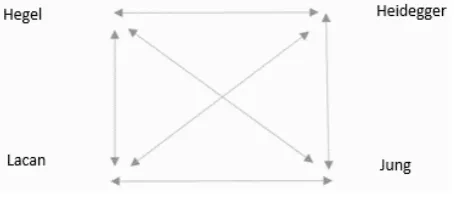
Received: 19 September 2016; Accepted: 11 November 2016; Published: 16 November 2016
Abstract:This article continues my earlier work of reading Jung with Lacan. This article will develop Zizek’s work on Lacan’s concept ofobjet petit aby relating it to a phenomenological interpretation of Jung. I use a number of different examples, including Zizek’s interpretation of Francis Bacon, Edvard Munch, Hans Holbein and Johann Gottlieb Fichte, to describe theobjet petit aand its relationship to a phenomenological interpretation of complexes. By integrating other Lacanian concepts, such as subject, drive, fantasy,jouissance, gaze, desire, and ego as well as the imaginary, symbolic and Real, this work also highlights how Hegel and Heidegger can elucidate the relationship betweenobjet petit a
and complexes. Jung’s transcendent function and the Rosarium Philosophorum also elucidate the relationship between Jung and Lacan.
Keywords:Jung; Lacan; Zizek; Heidegger; Nietzsche; Hegel
1. Complex as Foreign Body
This article continues my earlier work of reading Jung with Lacan [1]. Penot says “And it is indeed an intimate and continuous frequentation of the stranger in oneself that should be required of anyone who intends to become a psychoanalyst for others” ([2], p. 6). I will describe how to engage in a “continuous frequentation of the stranger in oneself” by reading Zizek’s interpretation of Lacan’s
objet petit awith a Heideggerian interpretation of Jung’s writing on complexes. Zizek explains the
objet petit asuch that “even if the psychic apparatus is entirely left to itself, it will not attain the balance for which the ‘pleasure principle’ strives, but will continue to circulate around a traumatic intruder in its interior—the limit upon which the ‘pleasure principle’ stumbles is internal to it. The Lacanian mathem for this foreign body, for this ‘internal limit’, is of course objet petit a: objet a is the reef, the obstacle which interrupts the closed circuit of the ‘pleasure principle’ and derails its balanced movement—or, to refer to Lacan’s elementary scheme” ([3], p. 48).
The relationship ofobjet petit a, to Jungian psychoanalysis can be identified by comparing it to a phenomenological interpretation of complexes [4]. My earlier work shows that a complex is phenomenologically disclosed “when Dasein’s world is conspicuously experienced as unready to hand and “not-being-at-home” ([4], p. 967).” In the event of a complex, angst, conscience and guilt are experienced in a moment of conspicuous obstructiveness and obstinacy, which results in the ready-to-hand losing its readiness-to-hand in a certain way. In other words, the experience of a complex is an experience ofobjet petit a: a complex disrupts the “pleasure principle” because of “a traumatic intruder”. When this “foreign body” is encountered “Dasein’s world is conspicuously experienced as unready to hand and “not-being-at-home”([4]. p. 967)”1. This initially highlights the compatibility of complexes withobjet petit a. This relationship can be further elucidated by reading
1 See my article “The Phenomenology and Ontology of Complexes” [4] for more detail about my Heideggerian interpretation of complexes.
a phenomenological interpretation of complexes into Lacan’s schema (Figure1). Theobjet petit a, which derails the balanced movement of the pleasure principle, also depicts a “conspicuous obstructiveness and obstinacy, which results in the ready to-hand losing its readiness-to-hand in a certain way” ([4], p. 967). When Lacan and Jung are read alongside Zizek and Heidegger, we can see that this derailment of the pleasure principle byobjet petit a(Lacan) or a complex (Jung) also results in the experience of angst, conscience and guilt (Heidegger).
phenomenological interpretation of complexes into Lacan’s schema (Figure 1). The objet petit a, which derails the balanced movement of the pleasure principle, also depicts a “conspicuous obstructiveness and obstinacy, which results in the ready to-hand losing its readiness-to-hand in a certain way” ([4], p. 967). When Lacan and Jung are read alongside Zizek and Heidegger, we can see that this derailment of the pleasure principle by objet petit a (Lacan) or a complex (Jung) also results in the experience of angst, conscience and guilt (Heidegger).
Figure 1. Hoop net ([3], p. 48).
Complexes arise when an analysand’s understanding of existence is inauthentically narrow and dogmatically averse to the authentic meaning of the call of conscience which discloses the truth of Being [4]. By reading this Heideggerian interpretation of Jung with Lacan and Zizek, Lacan’s schema can be understood in more detail. Zizek says “The resemblance of the depicted Lacanian scheme to a cross section of an eye is by no means accidental: objet a effectively functions as a rift in the closed circle of the psychic apparatus governed by the ‘pleasure principle,’ a rift which ‘derails’ it and forces it to ‘cast a look on the world,’ to take into account reality” ([3], p. 49). In other words, the analysand’s inauthentic understanding of the experience of a complex/objet petit a leads to a rift which “derails” “the analysand and this forces the analysand to” “cast a look on the world”: to discover the truth of Being. The experience of a complex/objet petit a consists of anxiety, conscience and guilt which is understood as a call of care from Dasein to itself [4]. This reveals another new meaning embedded in Lacan’s schema. This schema (Figure 1) resembles an eye and indicates that the analysand needs to “cast a look on the world” to remove the conspicuous obstructiveness and obstinance of complex/objet petit a to care for their being in the world. In other words, when the analysand experiences a “derailment” from a complex/objet petit a, “the world makes itself known in a new way as the Being of that which still lies before us and calls for our attending to it” ([5], p. 104). This is another way to understand the meaning of the eye in Lacan’s schema.
Zizek argues that “we should conceive Lacan’s thesis that objet a serves as a support to reality: access to what we call ‘reality’ is open to the subject via the rift in the closed circuit of the ‘pleasure principle,’ via the embarrassing intruder in its midst” ([3], p. 49). The objet a provides access to Dasein’s authenticity via the rift of a complex’s “pleasure principle”. However what should be added here is that although the objet a “serves as a support to reality” for Dasein to be authentic, Dasein needs to resolve to authentically listen to the call of conscience to exist in the truth of Being [4]. By being resolute, the analysand can authentically confront the objet petit a/complex and develop an interpreted understanding of new possibilities to expand the meaning of their being in the world. What Zizek calls “reality” can therefore be translated as “the unconscious” or the truth of Being. The “unconscious”, the truth of Being or “reality” is “an ‘excess,’ of a surplus which disturbs and blocks from within the autarky of the self-contained balance of the psychic apparatus” ([3], p. 49). The analysand experiences this excess when falling prey, which occurs when the analysand has inauthentically fled from the ontological truth of existence disclosed in the experience of angst, guilt and conscience [4]. Zizek argues this excess of “reality” is “the external necessity which forces the psychic apparatus to renounce the exclusive rule of the ‘pleasure principle’ is correlative to this inner stumbling block”([3], p. 49). This again shows that the objet petit a is identical to my phenomenological description of a complex. Through this experience of the objet petit a/complex, the analysand is forced to renounce the exclusive rule of the “pleasure principle” so that the transcendent function/individuation can take place by removing the “inner stumbling block” from being in the world [6]. Renouncing the “pleasure principle” means to go “through the wearisome” ([7], p. 223) by
Figure 1.Hoop net ([3], p. 48).
Complexes arise when an analysand’s understanding of existence is inauthentically narrow and dogmatically averse to the authentic meaning of the call of conscience which discloses the truth of Being [4]. By reading this Heideggerian interpretation of Jung with Lacan and Zizek, Lacan’s schema can be understood in more detail. Zizek says “The resemblance of the depicted Lacanian scheme to a cross section of an eye is by no means accidental: objet a effectively functions as a rift in the closed circle of the psychic apparatus governed by the ‘pleasure principle,’ a rift which ‘derails’ it and forces it to ‘cast a look on the world,’ to take into account reality” ([3], p. 49). In other words, the analysand’s inauthentic understanding of the experience of a complex/objet petit aleads to a rift which “derails” “the analysand and this forces the analysand to” “cast a look on the world”: to discover the truth of Being. The experience of a complex/objet petit aconsists of anxiety, conscience and guilt which is understood as a call of care from Dasein to itself [4]. This reveals another new meaning embedded in Lacan’s schema. This schema (Figure1) resembles an eye and indicates that the analysand needs to “cast a look on the world” to remove the conspicuous obstructiveness and obstinance of complex/objet petit ato care for their being in the world. In other words, when the analysand experiences a “derailment” from a complex/objet petit a, “the world makes itself known in a new way as the Being of that which still lies before us and calls for our attending to it” ([5], p. 104). This is another way to understand the meaning of the eye in Lacan’s schema.
place by removing the “inner stumbling block” from being in the world [6]. Renouncing the “pleasure principle” means to go “through the wearisome” ([7], p. 223) by resolving to confront angst, guilt and conscience. An authentic understanding of theobjet petit a/complex means to be resolute in the face of the experience of guilt, angst and conscience when “not being in the world” [4] has been disclosed by an obstinately obstructive world. By being authentically resolute, “the inner stumbling block” of the
objet petit a/complex can be removed when the analysand does not become absorbed in only one of its possibilities and has instead interpreted new possibilities for being in the world. What this also reveals is that not renouncing the “pleasure principle” “can be described as inauthentically absorbing an entire human existence in only one of its human possibilities, which is perpetuated through an inauthentic turning away from angst, guilt and conscience through a being perfect projection” ([4], p. 973). This is the work of the narcissistic ego/I and this will be examined in more detail in my future research. I will now relate Jung’s transcendent function to Lacanian psychoanalysis.
2. Zizek and Jung’s Transcendent Function
The aim of Jung’s transcendent function is not to obtain what the analysand desires. The aim of the transcendent function is equivalent to “the pass” of Lacanian psychoanalysis [8]. Zizek says “Saying that the pass is the final moment of the analytical process in no way means that the impasse has finally been resolved (that the transfer has closed off the unconscious, for example), that its obstacles have been overcome. Rather, the pass is just the retroactive experience that the impasse itself was already its own “resolution”. In other words, the pass is exactly the same thing as the impasse (the impossibility of the sexual rapport), in the same way that as I said earlier—the synthesis is exactly the same thing as the antithesis. The only thing that changes is the subject’s position, his ‘perspective’”([8], p. 122). Jung’s transcendent function is successful when the analysand discovers the impasse as a ‘resolution’. In other words, the transcendent function or pass takes places when the analysand changes perspective to discover the impossibility of removing an impasse.
In the section “Subject as an answer of the Real’” ofThe Sublime Object of Ideology[9], Zizek says “the subject is not a question, it is as an answer, the answer of the Real to the question asked by the big Other, the symbolic order. It is not the subject which is asking the question; the subject is the void of the impossibility of answering the question of the Other”([9], p. 178). His statement links Jung’s transcendent function to a process of questioning that leads to the “Subject as an answer of the Real’” and highlights a convergence between Jung and Hegel since the “Subject as an answer of the Real’” is “The reversal operated by AK comes about when we realize that the field of the Other is already ‘closed’ in its very discord. In other words, because the subject is barred it must be posited as the correlate of the inert remainder that blocks its full symbolic realization, its full subjectivization: $♦a. This is why, in the matheme for Absolute Knowledge [SA], both terms must be barred, because it is the conjunction of $ and A”([8], p. 123). Jung’s transcendent function needs to lead to an experience of the barred subject ($) to be successful and this occurs when the analysand questions theobjet petit a/complex. Zizek explains that “The real object of the question is what Plato, in the Symposium, called—through the mouth of Akibiades—agalma, the hidden treasure, the essential object in me which cannot be objectivated, dominated. (Lacan develops this concept in his unpublished Seminar VIII on Transference.)” ([9], p. 180)2.
3. Desire to Drive
Another way to explain this is to say the aim of Jung’s transcendent function is for the analysand to shift from desire to drive. Zizek explains this shift by claiming that “the Thing is first constructed as the inaccessible X around which my desire circulates, as the blind spot I want to see but simultaneously dread and avoid seeing, too strong for my eyes; then, in the shift towards drive, I (the subject) ‘make
myself seen’ as the Thing—in a reflexive turn, I see myself as It, the traumatic object-Thing I didn’t want to see” ([10], p. 301). Jung’s transcendent function involves “making myself seen” as the Thing. Desire leads the analysand to the Thing but the Thing can only be experienced as an answer of the Real when desire shifts to drive. Theobjet petit aof desire is a sublime object or “’an object elevated to the dignity of the Thing’: the void of the Thing is not a void in reality, but, primarily, a void in the symbolic, and the sublime object is an object at the place of the failed word” ([11], p. 696). This highlights an important relationship between desire and drive, where desire is a way of relating to the Thing (void in the symbolic) through the imaginary object, whereas drive is a way of relating to the Thing through the Real.
Desire is a path to the barred subject $ as an answer of the Real when the analysand questions this desire (objet petit a) as a question of the Other. For Zizek “the subject is an answer of the Real (of the object, of the traumatic kernel) to the question of the Other” ([9], p. 180). Zizek also highlights that this questioning of the sublime object of desire hystericizes the analysand: “The question as such produces in its addressee an effect of shame and guilt, it divides, it hystericizes him, and this hystericization is the constitution of the subject: the status of the subject as such is hysterical” ([9], p. 204). In other words, the analysand becomes hysterical by questioning the sublime object of desire and this sublimity comes from the subject which is an answer of the Real. The subject is hysterical because questioning is necessary for the void of the Thing to be experienced ‘as the place of the failed word’ as an answer to the analysand’s questioning [12] and highlights that “The subject is constituted through his own division, splitting, as to the object in him; this object, this traumatic kernel, is the dimension that we have already named as that of a ‘death drive’, of a traumatic imbalance, a rooting out. Man as such is ‘nature sick unto death’, derailed, run off the rails through a fascination with a lethal Thing”([9], p. 181). The analysand needs to confront this traumatic kernel through the death drive for the analysand to remove the obstructiveness of a complex by discovering the possibilities missing from the readiness to hand [6]. When the analysand discovers the possibilities missing from the readiness-to-hand the analysand shifts from desire to drive through an experience of the barred subject as an answer of the Real. In other words, removing the obstructiveness of a complex/objet petit aresults from reaching absolute knowledge ($A) where the analysand is barred from the imaginaryobjet petit a(a) and ‘makes myself seen’ as the Thing as a void in the symbolic (barred subject $ as an answer of the Real). This also elucidates why Heidegger emphasizes the importance of questioning when he says “the wonder of questioning must be experienced in carrying it out and must be made effective as an awakening and strengthening of the power to question” ([13], p. 10) and “in questioning reside the tempestuous advance that says ‘yes’ to what has not been mastered and the broadening out into ponderable, yet unexplored, realms. What reigns here is a selfsurpassing into something above ourselves. To question is to be liberated for what, while remaining concealed, is compelling” ([13], p. 10).
where the analysand experiences the aura that “envelops an object when it occupies a void (hole) within the symbolic order” ([11], p. 696). The analysand can experience the aura of theobjet petit a
as obstructive, unready to hand and “not-being-at-home” because “what Lacan calls the objet a, the subject’s impossible-Real objectal counterpart, is precisely such an ‘imagined’ (fantasmatic, virtual) object which never positively existed in reality” ([11], p. 645). The aura of theobjet petit acomes from the void in the symbolic order and the analysand will experience this void as obstructive, unready to hand and “not-being-at-home” if this void has not been discovered, or as Zizek has it, “Man as such is ‘nature sick unto death’, derailed, run off the rails through a fascination with a lethal Thing” ([9], p. 181). The analysand is fascinated with the aura of theobjet petit abut the analysand will be “derailed, run off the rails” by the Thing until desire shifts to drive to discover the barred subject $ as an answer of the Real. This occurs when the analysand discovers the meaning of the unconscious complex and the missing possibilities from the ready-to-hand [4,6]. To discover the meaning of an unconscious complex is to change perspective to see howthe objet petit aoccupied a void within the symbolic order. This occurs when the analysand can remove the obstructive complex/objet petit aby discovering the void of the symbolic order where the subject is as an answer of the Real. This happens because the analysand has hysterically questioned the aura of a complex/objet petit a, to discover the missing possibilities from the readiness-to-hand until reaching “the place of the failed word”. The analysand discovers the meaning of an unconscious complex by changing “the error in perspective” which “consists in thinking that the end of the dialectical process consists in the subject finally obtaining what he was looking for. This is an error in perspective because the Hegelian solution is not that the subject will never be able to possess the thing that he was searching for, but that he already had it, in the form of its loss” ([8], p. 122). As a result, the analysand needs to move beyond the error in perspective of the aura of theobjet petit a/complex, to the perspective of loss which is revealed through the void of the symbolic order or “the place of the failed word”. Just as Wiener ([15], p. 82) says the first woodcut is “a symbolic representation of the theory and practice of analysis and, metaphorically, the beginning of an analysis”, so too the aura of theobjet petit acan also be seen to be represented in the first woodcut of theRosarium Philosophorum[16], as the fluid substance in the mercurial fountain.
4. Objet Petit aand Jung’s Transcendent Function
This situates desire and theobjet petit aas fundamental to the first stage of Jung’s transcendent function because it provides a path to the end of analysis where the analysand uncovers a loss which is the barred subject ($). Theobjet petit ais a fantasy “so that all its fantasmatic incarnations, from breast to voice and gaze, are metonymic figurations of the void, of nothing” ([11], p. 639). Zizek says “the true object-cause of desire is the void filled in by its fantasmatic incarnations”([11], p. 639) and so the aim of analysis and Jung’s transcendent function is to “traverse the fantasy” of desire andobjet petit a. Traversing the fantasy removes the obstructiveness of a complex by discovering the missing possibilities from the readiness to hand to reveal the barred subject $ through loss or as an answer of the Real.
an “ontological” shift in the object itself”([17], p. 17). This is another way of elucidating the shift involved in Jung’s transcendent function. The transcendent function allows a transition to takes place from being ‘tickled’ by theobjet petit a/complex to removing the obstructiveobjet petit a/complex. This is a shift in perspective which occurs by discovering the void in the symbolic order which is the place of the analysand’s barred subjectivity ($). This is an experience of the Real which “is purely parallactic and, as such, nonsubstantial: is has no substantial density in itself, it is just a gap between two points of perspective, perceptible only in the shift from the one to the other”([17], p. 26). In other words the analysand needs to discover how the tickling “object embodies, gives material existence to the lack in the Other, to the constitutive inconsistency of the symbolic order” ([3], p. 22).
The analysand experiences the obstructiveness of a complex/objet petit abecause “phantasy is the unique way each of us tries to finish with the Thing, to settle our score with impossible jouissance, which is to say, the way in which we use an imaginary construct in our attempt to escape the primordial impasse of the being of language, the impasse of the inconsistent Other, the hole at the heart of the Other” ([8], p. 153). This highlights that fantasy involves an imaginary understanding of the other instead of a Real understanding. Removing the obstructiveness of a complex equates to traversing the fantasy (of the imaginary I or ego) as the analysand discovers “the hole at the heart of the Other” where the word fails. A complex is “formed in the specular relation, and of being fundamentally in the service of the pleasure principle—that led Freud to the theoretical necessity of envisioning abeyond the pleasure principle” ([2], p. 10). Going beyond the pleasure principle of an imaginary relationship to other is necessary to remove the obstructiveness of a complex/objet petit aand “it is precisely in this that the subject function can be distinguished as not simply reducible to narcissism” ([2], p. 10).
5. Reading Jung with Heidegger, Reading Lacan with Hegel
My interpretation of Jung is assisted by Heidegger whereas Zizek’s interpretation of Lacan is assisted by Hegel. As a result, through my integration of Jung with Lacan my work can also integrate Hegel and Heidegger. For example, when clarifying the way the fantasy ofobjet petit afills the hole in the symbolic order, Zizek explains why he uses Hegel to read Lacan by saying “What is concealed in the fascinating presence of this phantasmic construction? A hole, an empty space. It is possible to define this hole by undertaking the reading of Hegel with Lacan, which is to say against the background of the Lacanian problematic of the lack in the Other, the traumatic emptiness around which the signifying process articulates itself”([8], p. 2). Zizek adds to this by saying “From this perspective, Absolute Knowledge reveals itself to be the Hegelian name for what Lacan attempted to pin down with the term “the pass” [la passe], the final moment of the analytical process, the experience of the Lack in the Other. If, according to Lacan’s famous formulation, Sade gives us the truth of Kant, then Lacan himself could give us access to the fundamental matrix that gives the movement of the Hegelian dialectic its structure” ([8], p. 2). This highlights that Zizek equates absolute knowledge with the final moment of psychoanalytic treatment where the analysand experiences the lack in the Other. This is also what is required for Jung’s transcendent function to remove the obstructiveness of a complex [6]. When Jung is read with Lacan, the transcendent function can be understood to involve the retrieval of the fascinating presence of theobjet petit a, and to discover the meaning of an unconscious complex by shifting the analysand’s perspective from desire to drive. This takes place by reaching Zizek’s interpretation of absolute knowledge which involves shifting the analysand’s perspective to see that the fantasyobjet petit a, conceals a hole, an empty space which is the barred subject ($). The empty space comes from an experience of the lack in the Other and equates the lack in the Other with the place of the barred subject of the analysand. Penot, too, says the “subjectivating function implies the participation of at least two subjects. I would say that it is fundamentally and from the beginning an intersubjective experience” ([2], p. 18).
interpretation of Lacan. Just as Zizek says “To my eyes, Lacan was fundamentally Hegelian, but did not know It” ([8], p. 3), my work shows that Jung and Heidegger were fundamentally Lacanian ‘but did not know it’. Zizek explains Lacan’s “Hegelianism is not to be found where we might expect it to be, in his overt references to Hegel, but rather in the final stage of his teachings, in the logic of the pas—tout, in the importance he placed on the Real, on the Lack in the Other” ([8], p. 3). Likewise, although Jung and Heidegger do not make overt references to Lacan, their writing is compatible.
6. Zizek and Nietzsche
Zizek also links Francis Bacon’s art to theobjet petit a, noting that in his drawings “we find a (naked, usually) body accompanied by a weirddark stain-like formless form that seems to grow out of it, barely attached to it, as a kind ofuncanny protuberancethat the body can never fully recuperate or reintegrate, and which therebydestabilizesbeyond repair the organic Whole of the body—this is what Lacan was aiming at with his notion of thelamella” ([18], p. 10; my emphasis). The key words in this segment of Zizek’s writing are dark stain, uncanny protuberance and destabilizes. There are a number of ways to link this to my Heideggerian interpretation of Jung but now I will relate it to my earlier work on Jung’s transcendent function as Nietzsche’s Will to Power [19]. Specifically Zizek’s description of theobjet petit a, in Bacon’s art, is equivalent to Heidegger’s description of chaos in his interpretation of Nietzsche’s Will to Power. Heidegger says chaos “means the jumbled, the tangled, the pell-mell. Chaos means not only what is unordered but also entanglement in confusion, the jumble of something in shambles” ([19], p. 55). In my earlier work I related this to my Heideggerian interpretation of Jung’s writing on complexes. This led me to argue that the chaos of a complex urges, streams, and is dynamic, and the order of the chaos of a complex is covered, “whose law we do not descry straightaway” ([19], p. 55). I then argued that Jung’s transcendent function allows Dasein to resolutely schematize the law of the chaos to remove the obstructiveness of a complex from being in the world to preserve and enhance the life of Dasein. This can be seen to be describing the same phenomena in Francis Bacon’s drawing. The chaos of a complex is a dark stain which is an uncanny protuberance that destabilizes the analysand. As a result, this again highlights that my work on Jung’s transcendent function can be applied to Zizek’s writing on theobjet petit a. If the analysand is inauthentic, they will misunderstand and encounter the obstructive chaos of theobjet petit a/complex. The aim of psychoanalytic treatment is then to remove this impasse of theobjet petit a/complex by retrieving the meaning of a guilty mood and possibilities missing from the readiness to hand [6]. This means the analysand is required to shift from desire to drive so theobjet petit adoes not tickle the subject as obstructive chaos (This is symbolically depicted on the cover ofReturning to Jung with Heideggeras the sunlight of the drive allows the analysand to traverse their way through the obstructive chaos of the trees of desire [fantasy]).
The relation between theobjet petit aand Nietzsche’s writing of the Will to Power is evident again when Zizek says “This forever lost excess of pure indestructible life is—in its guise as the
7. Fantasy and the Desire of the Other
Zizek then elaborates by saying “What we encounter in the very core of fantasy is the relationship to the desire of the Other, to the latter’s opacity: the desire staged in fantasy is not mine but the desire of the Other. Fantasy is a way for the subject to answer the question of what object he is in the eyes of the Other, in the Other’s desire—that is, what does the Other see in him, what role does he play in the Other’s desire? A child, for example, endeavours to dissolve, by means of his fantasy, the enigma of the role he plays as the medium of the interactions between his mother and his father, the enigma of how mother and father fight their battles and settle their accounts through him. In short, fantasy is the highest proof of the fact that the subject’s desire is the desire of the Other” ([21], p. 177). This explains and reiterates a number of things I have said. Zizek declares “Fantasy is a way for the subject to answer the question of what object he is in the eyes of the Other”
and Lacan writes the formula for fantasy as ($♦a). This formula shows how “Fantasy is a way for the subject to answer the question of what object he is in the eyes of the Other”. In fantasy, the barred subject $ is covered by the imaginaryobjet petit a/complex. Fantasy covers the lack/desire of the Other through the imaginary “fullness” ofobjet petit a. When fantasy covers the lack/desire of the Other with theobjet petit a/complex in this way, the analysand misrecognises his or her place within the symbolic order because theobjet petit a/complex covers the place barred subject ($). This is what Lacan means when he says there is a “function of misrecognitionthat characterizes the ego in all the defensive structures so forcefully articulated by Anna Freud” ([22], p. 80). This imaginary relationship of a complex/objet petit ato the other through fantasy also involves “aggressiveness linked to the narcissistic relationship and to the structures of systematic misrecognition and objectification that characterize ego formation” ([22], p. 94).
To remove the obstructiveness of a complex/objet petit a, the analysand needs to go beyond an imaginary relationship to the other to discover the lack/desire of the Other or in Lacan’s words, beyond this imaginary relationship of the ego “language restores to it, in the universal, its function as subject” ([22], p. 76). This is achieved clinically with “speech to bring about change in the structure of the subject” ([23], p. 4). If the analysand does not go beyond an imaginary relationship to the other, they will experience the obstructiveness of a complex/objet petit abecause fantasy conceals the Real of the lack/desire of the Other. Through Jung’s transcendent function as Will to Power and eternal recurrence of the same, the analysand can traverse the fantasy through a shift in perspective in relation to the complex/objet petit a. This happens when the analysand no longer desires theobjet petit a, because the analysand’s new perspective sees that it is a fantasy. The analysand sees theobjet petit a/complex as a fantasy by discovering the desire/lack of the Other and that is why “Objet a is simultaneously the pure lack, the void around which the desire turns and which, as such, causes the desire, and the imaginary element which conceals this void, renders it invisible by filling it out” ([21], p. 178).
8. Obsessional Neurosis
lead to the obsessional’s obstructive being in the world because the obsessional has not discovered the missing possibilities [4] of the desire of the Other. Because these possibilities are undiscovered, the obsessional neurotic will experience the desire of the Other as an obstruction to their imaginary fantasy when the desire of the Other is encountered. When considered in this way, the obsessional has only an imaginary relationship to the other which does not engage with any of the meaning of the others subjectivity (symbolic and Real). The aim of psychoanalytic treatment in this case is for the analysand to engage with the other beyond the imaginary so the obsessional’s fantasy can be broken and the obstructiveness of a complex removed from being in the world.
Zizek summarises the pathology or inauthenticity of obsessional neurosis by saying “The key ingredient of obsessional neurosis is the conviction that the knot of reality is held together only through the subject’s compulsive activity: if the obsessive ritual is not properly performed, reality will disintegrate” ([21], p. 177). This shows that obsessional neurosis is a complex because of an inability to discover the missing possibilities from the readiness to hand. The obsessional must perform a compulsive ritual to ensure that the possibilities of the desire of the Other do not enter their “knot” of reality because if it does, the obsessional’s reality will “disintegrate”. “Disintegrate” is another way of saying “obstructiveness”. The obsessional’s reality/fantasy disintegrates when the obstructiveness of their complex is encountered through the desire of the Other.
9. Munch’s Scream
Zizek also refers to Lacan’s seminar on anxiety to elucidate theobjet petit a. In this seminar “Lacan referred to Munch’sScreamin order to exemplify the status of the voicequaobject. That is to say, the crucial feature of the painting is the fact thatthe scream is not heard” ([3], p. 116).Zizek argues “one could say that the scream ‘got stuck in the throat’: the voicequaobject is precisely what is “stuck in the throat,” what cannot burst out, unchain itself and thus enter the dimension of subjectivity” ([3], p. 117). In this section I use the example of Munch’sScreamto relate a phenomenological interpretation of complexes to theobjet petit a. First what I will say is that a complex obstructs the voice and throat in Munch’sScream. Theobjet petit a/complex gets “stuck in the throat” because the analysand experiences the un-ready-to-hand, where the world of entities ready-to-hand becomes obstructive, which means the world “cannot be budged without the thing that is missing” ([5], p. 103). As a result, what should now be apparent from the introduction of Heidegger’s writing is that the experience of a disturbing complex is an important moment to the analysand. This experience not only indicates that the current way of existing is unsuitable because of the conspicuous obstructiveness of the world but it also indicates its obstinacy and need for attention (care) to remove this obstructiveness from being in the world for the analysand to find their voice and “unchain itself and thus enter the dimension of subjectivity”. The scream is not heard because the experience of the obstructiveness of a complex/objet petit ablocks speech because the analysand has not discovered an entity (possibilities) to be assigned or referred to being in the world. Possibilities are undiscovered and missing from the analysand’s world and therefore the world falls into unreadiness to hand which is experienced as a complex/objet petit a. Zizek says “Lacan determines theobject small aas the bone which got stuck in the subject’s throat” ([3], p. 117) and this experience highlights that the analysand has discovered some regions of Being but has left others undiscovered. Heidegger says the readiness-to-hand of the world belongs to any region that has been discovered and “has the character of inconspicuous familiarity” ([5], p. 137). The conspicuous experience of the bone of theobjet petit a/complex highlights that the analysand has encountered something unfamiliar and “The region itself becomes visible in a conspicuous manner only when one discovers the ready-to-hand circumspectively and does so in the deficient modes of concern.” ([5], p. 138). This ‘derailment’ or ‘inner stumbling block’ occurs because ‘one fails to find something in its place’ ([5], p. 138)”. The analysand has not gone beyond an imaginary relationship to the other or unchained themselves from the complex/objet petit aby discovering the missing possibilities from the readiness to hand and therefore the bone/voice is “stuck in the throat”. Munch’sScream
a complex/objet petit a. This is because the region where the complex/objet petit ais experienced is left undiscovered (imaginary) and thus remains conspicuously obstructive to being in the world.
Alternatively, when the analysand has an authentic/Real understanding of the meaning of a complex/objet petit a, the analysand can discover the unconscious involvements required for them to unconceal the barred subject/truth of Being and find their authentic home in the world. This is how we should understand Zizek when he says “To this silent scream which bears out the horror-stricken encounter with the real of enjoyment, one has to oppose the scream of release, of decision, ofchoice, the scream by means of which the unbearable tension finds an outlet: we so to speak ‘spit out the bone’ in the relief of vocalization”([3], p. 117). This is what happens when the analysand retrieves and understands the meaning of the complex/objet petit athrough an interpretation of possibilities to remove its obstructiveness from being in the world [6]. This “spitting out the bone” can be explained in more detail when Heidegger’s work on truth is integrated. Heidegger says Being-true “means to-be-discovering” ([24], p. 201) and the being true means to let beings be seen in their unconcealment (discoveredness), taking them out of their concealment. As a result, the process of spitting out the bone (complex/objet petit a) can be understood in Heideggerian terms as taking Being/the subject out of concealment, which results in a new understanding of possibilities for being in the world when the truth of Being/the barred subject is authentically discovered. The analysand “finds an outlet” for “the scream of release” when the authentic/Real truth has been “wrested from beings. Beings are torn from concealment” ([24], p. 204)” and this allows the obstructiveness of a complex/objet petit a
to be removed from being in the world. The analysand “spits out the bone” and finds their voice by retrieving “missing possibilities from the readiness to hand to remove the obstructiveness of a complex from being in the world” ([6], p. 91). Zizek elucidates this further when he says “the opposition of silent and vocalized screams coincides with that of enjoyment and Other: the silent scream attests to the subject’s clinging to enjoyment, to his/her unreadiness to exchange enjoyment (i.e., the object which gives body to it) for the Other, for the Law, for the paternal metaphor, whereas the vocalization as such corroborates that the choice is already made and that the subject finds himself/herself within the community” ([3], p. 118).
10. Particularity and Community
This can be examined in more detail by noting that “the opposition of silent and vocalized screams coincides” with the opposition of being authentic (Other) and inauthentic (enjoyment). The silent scream from theobjet petit a/complex “stuck in the throat” coincides with the analysand’s imaginary/inauthentic understanding of the meaning of this experience which involves a projection of Being-perfect [4]. Being perfect is the analysand’s inauthentic understanding that understands themselves to have developed to the very apex of their potential and is coupled with closedness to other possibilities (e.g., imperfection, failure and guilt.) As a result, instead of authentically understanding the experience of a complex/objet petit aas the call of guilt from conscience which discloses the truth of the analysand’s “not being at home”, a Being-perfect projection resolutely flees facing the truth of guilt from falling prey and therefore lacks the discovery of new possibilities for being in the world.
a complex/objet petit a, to identify with an inauthentic familiar (imaginary) everyday being in the world. Identifying with the imaginary relationship to the other through the ego and the inability to adapt to life’s challenges can be phenomenologically described as fleeing into the average everyday familiarity with the world to tranquillize the angst, guilt and conscience of a complex/objet petit a. The analysand clings to enjoyment by fleeing into the familiarity of the “at-home” and avoids the truth of facing the “not-at home” ([5], p. 234) which is disclosed by the experience of a complex/objet petit a. By inauthentically understanding the experience of the complex/objet petit a, the analysand “does so by turning away from it in falling; in this turning-away, the ‘notat-home’ gets ‘dimmed down’” ([5], p. 234). By identifying with the imaginary ego and the “at home” of familiar enjoyment, the analysand flees to the “relief which comes with the supposed freedom of everydayness” ([5], p. 321).
Alternatively, if the analysand understands themselves authentically in the experience of a complex/objet petit a, the analysand can critically interpret their being-in-the-world to determine those unfamiliar and obstructive elements that have been neglected and so threaten the analysand’s care for being in the world. This is how the analysand exchanges enjoyment “for the Other, for the Law, for the paternal metaphor”. By falling prey to a complex/objet petit awhich discloses an unfamiliar, absurd and meaningless world, the analysand encounters an obstinate and obstructive existence which calls the analysand forth to individuate “to its ownmost being-in-the-world, which as understanding, projects itself essentially upon possibilities” ([24], p. 176). Importantly, the positive nature of the experience of a complex/objet petit acan bring the analysand face to face with concealed authentic/Real possibilities which have the potential to appropriate the unready to hand and obstructive world which allows the subject to find “himself/herself within the community”. In other words, discovering possibilities involves using language through a symbolic relationship to the Other and “Using language, on the one hand it attempts to lead people to perception of the general structure that conditions all their reactions and decisions in life; on the other hand, it tries to lead them to perceive what makes them unique, their own particularity” ([23], p. 4). The obstructiveness of a complex/objet petit a, is a symptom. This obstructiveness indicates the analysand misrecognises “their own particularity” because of an imaginary relationship to the other through the ego.
To discover “their own particularity” “within the community” the analysand must understand the authentic/Real meaning of the experience of a complex/objet petit a as being the basis for not discovering possibilities to be assigned or referred to the analysand’s world. Possibilities are undiscovered and missing from the analysand’s world and thus the world falls into unreadiness to hand which is experienced as the ‘bone in the throat’ of a complex/objet petit a. When the analysand has an authentic/Real understanding of the meaning of a complex/objet petit a, they have the possibility of discovering the unconscious involvements required to unconceal the truth of Being (the Other, Law, paternal metaphor) to find their authentic/Real home in the world. For the analysand to exchange enjoyment for the Other, the Law, or the paternal metaphor, the analysand must free other beings for their own authentic possibilities. This occurs by letting these possibilities be involved by making room for them to be part of the analysand’s world in the region of the experience of the obstructive complex/objet petit a.
“The ‘world’ which is ready-to-hand does not become another one ‘in its content’, nor does the circle of Others get exchanged for a new one ; but both one’s Being towards the ready-to-hand understandingly and concernfully, and one’s solicitous Being with Others, are now given a definite character in terms of their ownmost potentiality-for-Beingtheir-Selves.” ([5], p. 344).
This explains how the analysand “finds himself/herself within the community” by exchanging enjoyment for the Other, the Law or the paternal metaphor. The analysand “finds himself/herself within the community” by authentically retrieving and letting the Other, the Law or the paternal metaphor be free for its involvement in the ready to hand which removes obstructiveness from being in the world by understanding the authentic/Real meaning of the complex/objet petit a. By understanding the authentic/Real meaning of a complex/objet petit a, the analysand “makes it possible to let the Others who are with it ‘be’ through solicitude which leaps forth and liberates.” ([5], p. 344). The analysand finds themselves with the community because they have “let others be” by discovering and vocalizing the meaning of the Other, the Law or the paternal metaphor through an interpretation of possibilities. This is also consistent with Jungian individuation. Jung says “I note that the individuation process is confused with the coming of the ego into consciousness and that the ego is in consequence identified with the self, Individuation is then nothing but ego-centredness, the self comprises infinitely more than a mere ego. It is as much one’s self, and all other selves, as the ego. Individuation does not shut one out from the world, but gathers the world to oneself.” ([7], p. 226). In other words, ego-centredness is what Zizek would equate with the “silent scream” from “the subject’s clinging to enjoyment”. On the other hand, individuation can be equated with “spitting out the bone” because enjoyment has been exchanged “for the Other, for the Law, for the paternal metaphor” which “does not shut one out from the world, but gathers the world to oneself” which allows the subject to find “himself/herself within the community”.
11. Fichte
Zizek also makes the most of Fichte’s philosophy to examine theobjet petit a in more detail. Zizek argues that “Fichte was the first philosopher to focus on the uncanny contingency at the very heart of subjectivity” ([11], p. 149). Zizek explains that Fichte’s word for theobjet petit aisAnstoss
which “functions as the challenge (Aufforderung) compelling me to limit/ specify my freedom, that is, to accomplish the passage from the abstract egotistic freedom to concrete freedom within the rational ethical universe” ([11], p. 150). TheAnstossis clearly equivalent to the phenomena of a complex and
objet petit awhen Zizek says “It is important to bear in mind the two primary meanings of Anstoss in German: check, obstacle, hindrance, something that resists the boundless expansion of our striving; and an impetus or stimulus, something that incites our activity” ([11], p. 150). This is confirmed when Zizek says “If the Kantian Ding an sich corresponds to the Freudian-Lacanian Thing, Anstoss is closer to the objet petit a, to the primordial foreign body that ‘sticks in the throat’ of the subject, to the object-cause of desire that splits it up” ([11], p. 150). Therefore, a complex (Jung) andobjet petit a
(Lacan) are the same phenomena as Fichte’s “Anstoss as the non-assimilable foreign body that causes the subject’s division into the empty absolute subject and the finite determinate subject, limited by the non-I” ([11], p. 150). This also means that the experience of a complex/objet petit aas Anstoss thus designates the moment of the “run-in;” the hazardous knock, the encounter with the Real in the midst of the ideality of the absolute I: there is no subject without Anstoss, without the collision with an element of irreducible facticity and contingency—“the I is supposed to encounter within itself something foreign”: The point is thus to acknowledge “the presence, within the I itself, of a realm of irreducible otherness, of absolute contingency and incomprehensibility” ([11], p. 150).
This explains why the analysand inauthentically understands the experience of a complex/
of irreducible otherness, of absolute contingency and incomprehensibility”. Zizek explains this further: “In clear contrast to the Kantian noumenal Ding that affects our senses, Anstoss does not come from outside, it is stricto sensu ex-timate: a non-assimilable foreign body in the very core of the subject” ([11], p. 150). This means that the experience of a complex/objet petit a, is the “very core of the subject” and explains why the analysand who turns away from understanding this experience also flees the truth of its authentic self (the barred subject). Dasein is entrusted with and concerned about its being-in-the-world but can cover over its authentic/Real possibilities for care which remain unconscious or undiscovered. Dasein’s essence as being-in-the-world is care, but if an inauthentic/imaginary understanding of its Being is present, Dasein can be said to be “fleeing from it and of forgetting” ([24], p. 41) its authentic/Real Being which is disclosed in the experience of the obstructiveAnstoss/complex/objet petit a.
The obstructive experience of a complex/objet petit ais important because “The Anstoss which awakens (what will have been) the subject out of its pre-subjective status is an Other, but not the Other of (reciprocal) intersubjectiity as Lacan put it much later: ethics is the dimension of the Real, the dimension in which imaginary and symbolic balances are disturbed” ([11], p. 163). The experience of the Real of theAnstoss/objet petit adisturbs and hinders daily life just in the same way Heidegger phenomenologically describes the world as unready to hand and when Jung says the ego is “frequently disturbed by strong feeling tones” ([4], p. 968) and “A situation threatening danger pushes aside the tranquil play of ideas and places in its stead a complex of other ideas of the strongest feeling-tone” ([4], p. 968). These examples all highlight the experience of the Real where “imaginary and symbolic balances are disturbed”. This experience is important because the aim of psychoanalytic treatment is for the analysand to become authentic through an encounter with the Real to awaken “the subject out of its pre-subjective status”.
Complexes and the objet petit a can be better understood when Zizek says the Anstoss is “an appearance without anything that appears, a nothing which appears as something’ This is what brings the Fichtean Anstoss uncannily close to the Lacanian objet petit a, the object-cause of desire, which is also a positivization of a lack, a stand-in for a void” ([11], p. 168). There are two important things to extract from this. First, because a complex andobjet petit aare the same thing said differently and Zizek says theobjet petit ais the “object-cause of desire”, it is important to understand that the experience of the obstructiveness of a complex comes from the analysand’s “object-cause of desire”. What this means is that desire is always involved whenever a complex is experienced. The second important thing to note from this extract is that the obstructiveness of a complex/objet petit aactually comes from a void. This is because, as Zizek says, theobjet petit a, is “also a positivization of a lack, a stand-in for a void”. This void is not without significance because “here we come to the crucial point: the otherness, the ‘stranger in my very heart;’ which Fichte endeavored to discern under the name of Anstoss, is this ‘bone in the throat’ which prevents the direct expression of the subject (and which-since the “subject” is the failure of its own direct expression-is strictly correlative to the subject)” ([11], p. 175). With this, Zizek ties together a number of things. What this highlights is that the experience of a complex takes place when the analysand’s desire leads it to be obstructed by a void which is the barred subject ($). In other words, a complex is experienced when the analysand’s desire leads to a void which is a “’bone in the throat’ which prevents the direct expression of the subject”. Ultimately, the aim of psychoanalytic treatment is “to grasp this inherent impediment in itspositivedimension: true, theobjet aprevents the circle of pleasure from closing, it introduces an irreducible displeasure, but the psychic apparatus finds a sort of perverse pleasurein this displeasure itself, in the neverending, repeated circulation around the unattainable, always missed object” ([3], p. 48).
12. Death, Drive
“a sort of perverse pleasurein this displeasure itself, in the neverending, repeated circulation around the unattainable, always missed object” because this removes the analysand’s guilty mood from having-been and the obstructiveness of a complex/objet petit afrom being in the world [6]. Zizek says “The Lacanian name for this “pleasure in pain” is of course enjoyment(jouissance), and the circular movement which finds satisfaction in failing again and again to attain the object, the movement whose true aim coincides therefore with its very path toward the goal, is the Freudiandrive” ([3], p. 48). With this, Lacan’s concepts ofjouissanceand drive find their connection to Jung and Heidegger. What this adds to my earlier work on Jung’s transcendent function [6] is the observation that the obstructiveness of a complex is removed from being in the world through the drive. The drive is necessary because the analysand’s desire leads to a void which is a “’bone in the throat’ which prevents the direct expression/symbolization of the subject ($). In other words, Jung’s transcendent function involves the analysand retrieving the obstruction of a complex/objet petit aso the analysand can discover the missing possibility of the impossibility of the readiness to hand which is the impossibility of their desire [26].
When this occurs, the analysand “spits out the bone” because enjoyment has been exchanged “for the Other, for the Law, for the paternal metaphor” which “does not shut one out from the world, but gathers the world to oneself” which allows the subject to find “himself/herself within the community”. This is possible because the analysand discovers it’s authentic/Real ‘being at home in the world’ when an impossible desire has been removed through the death drive. Heidegger highlights this by saying “Death does not just ‘belong’ to one’s own Dasein in an undifferentiated way; death lays claim to it as an individual Dasein. The non-relational character of death, as understood in anticipation, individualizes Dasein down to itself. This individualizing is a way in which the ‘there’ is disclosed for existence” ([24], p. 243). The analysand’s individual “there” is disclosed through the death drive of an impossible desire when enjoyment has been exchanged “for the Other, for the Law, for the paternal metaphor”. The analysand understands themselves and others authentically when the impossibility of the possibility of a desire has been discovered and this explains why the obstructiveness of a complex/objet petit ais no longer experienced and this is why “Care is Being-towards-death”.
This can be understood better when Zizek says our understanding of the world “is by definition always inconsistent, full of lacunae, which the subject must somehow fill in to create a minimally consistent Whole of a world-and the function of imagination is precisely to fill in these gaps” ([11], p. 176). Zizek says, in imagination “the subject’s void is present[ifi]ed as an [imagined] object)” ([11], p. 176). This highlights that the analysand’s impossible desire fills the void of the place of the barred subject $ with the objet petit a/complex through imagination. This also explains that the analysand’s desire is impossible when the void of the barred subject $ is filled withobjet petit a/complex through imagination. This desire constitutes the analysand’s inauthenticity and that is why psychoanalytic treatment needs to bring the analysand “face to face with the absolute impossibility of existence” ([5], p. 299). The analysand needs to discover “The nullity by which Dasein’s Being is dominated primordially through and through” which “is revealed to Dasein itself in authentic Being-towards-death” ([5], p. 299). This is how the obstructiveness of a complex/objet petit a is removed from being in the world through the death drive when the analysand discovers “a certain
curvature of the space itself which causes us to make a bend precisely when we want to get directly at the object” ([3], p. 48). The analysand needs to discover that “theobjet ais not a positive entity existing in space, it is ultimately nothing but” ([3], p. 48) the analysand’s imagination of the possibility of a desire. Psychoanalysis involves moving the analysand away from filling in the void with the
objet petit a/complex to discover the “possibility of the impossibility of existence, that is, as the absolute nothingness of Da-sein” ([24], p. 283).
Heidegger also says “that proximally and for the most part Dasein covers up its ownmost Being-towards-death, fleeing in the face of it” ([5], p. 295). The analysand experiences the obstructiveness of a complex/objet petit awhen the analysand does not exist as “Being-towards-death” of an impossible desire. The analysand experiences this obstructiveness because the analysand has not freed “one from one’s lostness in chance possibilities urging themselves upon us” or discovered “the nullity of what can be taken care of, that is, the impossibility of projecting oneself upon a potentiality-of-being primarily based upon what is taken care of” ([24], p. 315). Successful psychoanalytic treatment requires the analysand to stop “fleeing in the face of one’s own most Being-towards-death” which is “a constant tranquillisation about death” ([24], p. 235). This allows the analysand to discover the impossibility of the possibility of a desire [26] and to find “a sort of perverse pleasurein this displeasure itself, to renounce the exclusive rule of the ‘pleasure principle’” ([3], p. 49). Although the death of the analysand’s impossible desire “introduces an irreducible displeasure”, “The revealing of this impossibility, however, signifies that one is letting the possibility of an authentic potentiality-for Being be lit up” ([5], p. 393).
Zizek explains “The Lacanian name for this “pleasure in pain” is of course enjoyment (jouissance)” ([3], p. 48) and this highlights its important role for the obstructiveness of the
impossibility” ([5], p. 378). In other words, removing the obstructiveness of a complex/objet petit a
through the death drive “means that the minimal emptying of subject, the reduction of its reality (of its ‘thingness’), is constitutive of subjectivity: the subject is caught in its loop because it is not-All, finite, lacking, because a loss of-reality is co-substantial with it, and Anstoss is the positivization of this gap” ([11], p. 175). In other words, the aim of psychoanalytic treatment is for the analysand to emptyAnstossfrom the place of the void of the subject and when this happens the analysand removes or traverses the obstructiveness of this “bone in the throat”. The bone in the throat of the
objet petit a/complex “is an object which is a direct counterpoint to the subject and, as such, gives body to a lack” ([27], p. 180). The experience of the obstructiveness of a complex/objet petit aindicates the impossibility of a desire has not been discovered because the analysand covers the truth of the void of the barred subject $ and “this paradoxical conjunction is designated by Lacan’s matheme of fantasy: $♦a” ([27], p. 180).
Zizek again reveals the compatibility of his work with my work when he says “The difference between subject and object can also be expressed as the difference between the two corresponding verbs, to subject (submit) oneself and to object (protest, oppose, create an obstacle)” ([17], p. 17). Psychoanalytic treatment helps the subject, submit to the object instead of being opposed/obstructed by it. Zizek explains this aim of psychoanalysis by saying “The subject’s elementary, founding, gesture isto subject itself—voluntarily, of course: as both Wagner and Nietzsche, those two great opponents, were well aware, the highest act of freedom is the display ofamor fati, the act of freely assuming what is necessary anyway”([17], p. 17). Psychoanalysis helps the analysand reachamor fatiby “submitting oneself to the inevitable” and this is achieved by traversing the complex/objet petit a“which moves, annoys, disturbs, traumatizes us (subjects)”([17], p. 17). In other words, psychoanalysis uses Jung’s transcendent function to guide the analysand to remove the obstructiveness of a complex/objet petit a
which “at its most radical the object isthat which objects, that which disturbs the smooth running of things” ([17], p. 17). This is why Jung also says “It is the man withoutamor fatiwho is the neurotic; he, truly, has missed his vocation” ([28], p. 308).
13. Holbein
“Objet a is the strange object that is nothing but the inscription of the subject itself in the field of objects, in the guise of a blotch that takes shape only when part of this field is anamorphically distorted by the subject’s desire” ([29], p. 69). Zizek uses Holbein’sAmbassadorspainting (Figure2) to add a visual layer/perspective to his description ofobjet petit aby saying “the most famous anamorphosis in the history of painting, Holbein’s Ambassadors, concerns death: when we look from the proper lateral angle at the anamorphically extended blotch in the lower part of the painting, set amongst objects of human vanity, it reveals itself as a skull” ([29], p. 69). Zizek importantly notes the death symbolism of this painting and this is important because the analysand needs to pass through the death drive to remove the obstructiveness of a complex/objet petit a(symbolised by the skull). Holbein’s painting is another way of highlighting that discovering the meaning of a guilty mood from an unconscious obstructive complex [6] is to shift perspectives from desire to drive. This involves the death of the fantasy ofobjet petit aby discovering the missing possibilities from the readiness to hand to reveal the void of the barred subject.
Humanities 2016, 5, 85 17 of 27
[image:17.595.213.382.275.449.2]meaning of a guilty mood from an unconscious obstructive complex [6] is to shift perspectives from desire to drive. This involves the death of the fantasy of objet petit a by discovering the missing possibilities from the readiness to hand to reveal the void of the barred subject.
Figure 2. Holbein’s Ambassadors [30].
The objet petit a is fascinating and desired because it covers the place of the barred subject (Dasein) and because it can lead the analysand to ground the barred subject (Dasein) through “the knowledge of the event, by way of the grounding (as Da-sein) of the essence of truth” ([13], p. 13). The barred subject is discovered at the place of “the void in the Other (the symbolic order), the void designated, in Lacan, by the German word das Ding, the Thing, the pure substance of enjoyment resisting symbolization” ([3], p. 8). The objet petit a/complex covers the Thing when the analysand has not gone beyond an imaginary relationship to the objet petit a/complex. An imaginary relationship to the objet petit a results in a complex disrupting the analysand’s being in the world and the experience of anxiety, guilt and the call of conscience. This phenomena is described by Zizek when he articulates the experience of the objet petit a “as the spot disturbing the picture, as a kind of blot on the white marble surface of the statue” ([3], p. 8). This experience is important for the analysand because “in the Lacanian perspective, the subject is strictly correlative to this stain on the picture. The only proof we have that the picture we are looking at is subjectified is not meaningful signs in it but rather the presence of some meaningless stain disturbing its harmony” ([3], p. 8). The analysand will continue to experience “not being at home in the world” as long as the analysand does not go beyond an imaginary relationship to this “meaningless stain disturbing its harmony”.
Zizek not only highlights the connection between Hegel and Lacan but also anticipates the connection to my phenomenological interpretation of complexes when he says “Does not the proposition ‘the Spirit is a bone’—this equation of two absolutely incompatible terms, pure negative movement of the subject and the total inertia of a rigid object—offer us something like a Hegelian version of the Lacanian formula of fantasy: $◊a?” ([9], p. 208). When Hegel says “the spirit is a bone” and Lacan writes his formula of fantasy as $◊a, they are describing the same experience as the obstructiveness of a complex. By aligning Zizek with my work in this way, I can show how a Heideggerian interpretation of Jung can develop the projects and understanding of both Hegel and Lacan. Zizek says “The bone, the skull, is thus an object which, by means of its presence, fills out the void, the impossibility of the signifying representation of the subject. In Lacanian terms it is the objectification of a certain lack: a Thing occupies the place where the signifier is lacking; the fantasy-object fills out the lack in the Other (the signifier’s order). The inert fantasy-object of phrenology (the skullbone) is nothing but a positive form of certain failure: it embodies, literally ‘gives body’ to, the ultimate failure of the signifying representation of the subject” ([9], p. 208). When Hegel says “the spirit is a bone”, he is describing the phenomena of the obstructiveness of a complex as a path to the spirit. Spirit is experienced as a bone when the analysand has an imaginary relationship to the lack in the Other. In other words, a complex which can be described as a “bone”, is experienced when the
Figure 2.Holbein’sAmbassadors[30].
Theobjet petit ais fascinating and desired because it covers the place of the barred subject (Dasein) and because it can lead the analysand to ground the barred subject (Dasein) through “the knowledge of the event, by way of the grounding (as Da-sein) of the essence of truth” ([13], p. 13). The barred subject is discovered at the place of “the void in the Other (the symbolic order), the void designated, in Lacan, by the German worddas Ding, the Thing, the pure substance of enjoyment resisting symbolization” ([3], p. 8).The objet petit a/complex covers the Thing when the analysand has not gone beyond an imaginary relationship to theobjet petit a/complex. An imaginary relationship to theobjet petit a results in a complex disrupting the analysand’s being in the world and the experience of anxiety, guilt and the call of conscience. This phenomena is described by Zizek when he articulates the experience of the
objet petit a“as the spot disturbing the picture, as a kind of blot on the white marble surface of the statue” ([3], p. 8). This experience is important for the analysand because “in the Lacanian perspective, the subject is strictly correlative to this stain on the picture. The only proof we have that the picture we are looking at is subjectified is not meaningful signs in it but rather the presence of some meaningless stain disturbing its harmony” ([3], p. 8). The analysand will continue to experience “not being at home in the world” as long as the analysand does not go beyond an imaginary relationship to this “meaningless stain disturbing its harmony”.
a bone” and Lacan writes his formula of fantasy as $♦a, they are describing the same experience as the obstructiveness of a complex. By aligning Zizek with my work in this way, I can show how a Heideggerian interpretation of Jung can develop the projects and understanding of both Hegel and Lacan. Zizek says “The bone, the skull, is thus an object which, by means of its presence, fills out the void, the impossibility of the signifying representation of the subject. In Lacanian terms it is the objectification of a certain lack: a Thing occupies the place where the signifier is lacking; the fantasy-object fills out the lack in the Other (the signifier’s order). The inert object of phrenology (the skullbone) is nothing but a positive form of certain failure: it embodies, literally ‘gives body’ to, the ultimate failure of the signifying representation of the subject” ([9], p. 208). When Hegel says “the spirit is a bone”, he is describing the phenomena of the obstructiveness of a complex as a path to the spirit. Spirit is experienced as a bone when the analysand has an imaginary relationship to the lack in the Other. In other words, a complex which can be described as a “bone”, is experienced when the analysand has not discovered the lack in the Other because the fantasy ofobjet petit acovers the “ultimate failure of the signifying representation of the subject”. Desire is desire for something negative/lacking (the Thing) but is misrecognised asobjet petit aas something positive. This clarifies that Jung’s transcendent function aims to convert “this lack of the signifier into the signifier of the lack; from Lacanian theory we know that the signifier of this conversion, by means of which lack as such is symbolized, is the phallus” ([9], p. 209). In other words, the analysand desires to discover the signifier for theobjet petit abut theobjet petit ais an imaginary positivity of a void (fantasy). As a result, the analysand needs to shift perspectives to convert the lack of a signifier into the signifier of lack, and this space of the phallus (lack in the Other) is the barred subject $.
14. Jouissanceand Gaze
This can now be linked to “Kant’s Critique of Judgement, where Beauty and Sublimity are opposed along the semantic axes quality-quantity, shaped-shapeless, bounded-boundless: Beauty calms and comforts; Sublimity excites and agitates. ‘Beauty’ is the sentiment provoked when the suprasensible Idea appears in the material, sensuous medium, in its harmonious formation—a sentiment of immediate harmony between Idea and the sensuous material of its expression; while the sentiment of Sublimity is attached to chaotic, terrifying limitless phenomena (rough sea, rocky mountains)” ([9], p. 202). Jung’s transcendent function involves a shift in perspective to theobjet petit awhich can be explained through the difference of beauty and sublimity. Zizek says “Beauty and Sublimity are opposed along the axis pleasure-displeasure: a view of Beauty offers us pleasure, while ‘the object is received as sublime with a pleasure that is only possible through the mediation of displeasure’! In short, the Sublime is ‘beyond the pleasure principle’, it is a paradoxical pleasure procured by displeasure itself (the exact definition—one of the Lacanian definitions—of enjoyment [jouissance])” ([9], p. 202). This describes that the experience of the shift from an imaginary relationship toobjet petit ato the void of the Thing involves a shift from the pleasure principle to “beyond the pleasure principle”. This shift is necessary for the analysand to traverse the fantasy of the pleasure ofobjet petit aand remove the obstructiveness of a complex through an experience of pleasure procured by displeasure (jouissance). This pleasure procured by displeasure comes from the pleasure of removing the obstructiveness of a complex/objet petit aeven though this means the displeasure of the loss of the possibility of a desire.
![Figure 2.Figure 2. Holbein’s Holbein’s AmbassadorsAmbassadors [[30]. 30].](https://thumb-us.123doks.com/thumbv2/123dok_us/146967.24111/17.595.213.382.275.449/figure-figure-holbein-s-holbein-s-ambassadorsambassadors.webp)