UNIVERSITI TEKNIKAL MALAYSIA MELAKA
DESIGN AND DEVELOPMENT OF CUSTOMIZED DRINKING
BOTTLE FOR SME
This report submitted in accordance with requirement of the Universiti Teknikal Malaysia Melaka (UTeM) for the Bachelor’s Degree in Manufacturing Engineering
Technology (BETD) (Hons.)
by
NAS MUSTAQIM WALAD BIN AHMAD
B071210376
930110055151
DECLARATION
I hereby, declared this report entitled "Design and Development of Customized Drinking Bottle for SME" is the results of my own research except as cited in
references.
Signature : ……….
Author’s Name : Nas Mustaqim Walad Bin Ahmad
APPROVAL
This report is submitted to the Faculty of Engineering Technology of UTeM as a partial fulfillment of the requirements for the Bachelor's Degree in Manufacturing Engineering Technology (Product Design) With Honours. The member of the supervisory is as follow:
i
ABSTRAK
ii
ABSTRACT
iii
DEDICATION
Special dedication, To my beloved parents
Mr. Ahmad Bin Abu Mrs. Puziah Binti Tasi
To my beloved sibling Nadia Izwannie Binti Ahmad
Nor Fatir Atila Binti Ahmad Nuhizammil Fitri Bin Ahmad
Naufal Hazwan Bin Ahmad
iv
ACKNOWLEDGEMENT
v
TABLE OF CONTENT
Abstrak i
Abstract ii
Dedication iii
Acknowledgement iv
Table of Content v
List of Tables x
List of Figures xi
List Abbreviations, Symbols and Nomenclatures xv
CHAPTER 1: INTRODUCTION 1
1.1 Background 1
1.2 Scope of Project 2
1.3 Problem Statement 3
1.4 Objective of Project 3
CHAPTER 2: LITERTURE REVIEW 4
2.1 Introduction 4
2.2 Plastic Bottle 4
2.2.1 Material Used In Plastic Bottle 5
2.2.2 Patent Research 7
2.2.2.1 Bottle with Top Loading Resistance 8
2.2.2.2 Standard Bottle 8
2.3 Product Design and Development (PDD) 9
vi
2.3.2 Product Development Process 10 2.3.3 Application of Product Design and Development Process 12
2.4 Reverse Engineering (RE) 13
2.4.1 Process Chain of Reverse Engineering 14 2.4.2 Reverse Engineering Methods 15
2.4.2.1 Contact Method 16
2.4.2.2 Non-Contact Method 17
2.5 Rapid Prototyping (RP) 19
2.5.1 Rapid Prototyping Process Chain from CAD to Prototype 20 2.5.2 The Benefits of the Rapid Prototyping 21 2.5.3 Rapid Prototyping Techniques 22 2.5.4 The Application of Rapid Prototyping 25
2.6 Computer Aided Design (CAD) 27
2.6.1 Principles of CAD 27
2.6.2 The Uses and Benefit of CAD 29 2.6.3 CAD within Product Development 30
2.6.4 Application of CAD 32
2.6.5 CAD Software 32
2.7 High Density Polyethylene (HDPE) 33
2.7.1 Properties of HDPE 34
2.7.2 Application of HDPE 36
vii
2.7.2.2 HDPE Pipe 37
2.8 Blow Mold 37
2.8.1 Blow Molding Process 38
2.8.2 Types of Blow Molding 39
2.8.2.1 Extrusion Blow Molding 39 2.8.2.2 Injection Blow Molding 40
2.8.2.3 Stretch Blow Molding 41
2.8.3 Injection Blow Molding Versus Extrusion Blow Molding 43
2.8.4 Blow Mold Parts 43
2.9 Interview 46
2.9.1 Types of Interview 46
2.9.2 Advantages and Disadvantages of Interview 47
CHAPTER 3: METHODOLOGY 48
3.1 Introduction 48
3.2 Flow Chart 48
3.2.1 Product Planning 49
3.2.2 Reverse Engineering Methods 50
3.2.3 Meeting and Interview 53
3.2.4 Concept Development 55
3.2.5 Generate 3D CAD Drawing 57
viii
3.2.5.2 Bottle 3D CAD Drawing 59
3.2.6 Mold Design 64
3.2.6.1 Mold 3D CAD Drawing 65
3.2.7 Prototype (RP Machine) 70
3.2.7.1 Procedures Rapid Prototyping 70
CHAPTER 4: RESULT AND DISCUSSION 75
4.1 Introduction 75
4.2 Company Specification 75
4.3 Main Concept 76
4.4 3D CAD Design 79
4.4.1 Bottle Design 79
4.4.2 Mold Design 82
4.4.3 Final Design 88
4.5 Final Product 90
4.6 Discussion 94
4.6.1 Designing Stage 94
4.6.2 Fabrication Stage 94
CHAPTER 5: CONCLUSION AND RECOMMENDATION 96
5.1 Conclusion 96
ix
REFERENCES 98
APPENDICES
A Gantt chart 103
x
LIST OF TABLE
2.1 Comparison of Bottle Polymer Materials 7
1.2 Contact vs. Non-contact 16
2.3 Development of Rapid Prototyping 19
2.4 Rapid Prototyping Process 22
2.5 Properties of HDPE with Test Method 35
2.6 Properties of HDPE 35
2.7 Example of Data on Stretched Blow Molded 41 2.8 Extrusion Blow Molding Versus Injection Blow Molding 43 2.9 Advantages versus Disadvantages 47
3.1 Meeting Descriptions 54
3.2 Concept Briefing and Sketches 56
4.1 Company Specification 77
xi
LIST OF FIGURES
2.1 First Glass Bottle 5
2.2 Bottle with Top Loading Resistance 8
2.3 Standard Bottle 9
2.4 Generic Product Development Process 11
2.5 The Design Phase 12
2.6 Process Chain of Reverse Engineering 15
2.7 Contact method 16
2.8 Non-contact Method 18
2.9 The Problem in Non-Contact Method 18 2.10 The Rapid Prototype Chain Process 21
2.11 Stereo Lithography Apparatus 23
2.12 Laser Sintering 23
2.13 Fused Deposition Modelling 24
2.14 Rapid Prototyping Process 25
2.15 Medical Application 26
2.16 Rapid Prototyping Application 26
2.17 Part Requires For Surface Modelling 28
2.18 Example Of Solid Modelling 29
2.19 Analysis of the average product development time and of the product
useful time for various industrial products. 30 2.20 Example of the Development Product 31 2.21 Example Product (a) Pharmaceutical Bottle, (b) Oil Container, (c) Spray
Bottle 36
2.22 The HDPE Pipe Application 37
2.23 The blow molding Process 38
2.24 Process Flow of Extrusion Blow Molding 39 2.25 Injection Blow Molding Process 41
xii
2.27 Parts of Blow Mold (a) 45
2.28 Parts of Blow Mold (b) 45
3.1 Flow Chart of the Project 48
3.2 Example of Patent (a) Patent of standard bottle design (b) Patent
Of Bottle with Top Loading Resistance 49 3.3 Tools for the Reverse Engineering 50
3.4 Measure the Size of the Bottle 51
3.5 Measure the Diameter of the Bottle 51 3.6 Blow mold At Plastic Laboratory 52
3.7 Measure the Diameter 52
3.8 Meeting with Production Manager of Ramaju Sdn. Bhd.
Mr. Ng Thian Heng 54
3.9 Example bottle from Ramaju Sdn. Bhd. 54
3.10 Example of 3D CAD drawing 58
3.11 Display Panel 59
3.12 Create New Document 59
3.13 Sketch Hexagon Shape 60
3.14 Solid Body Using Extruded Boss Command 61
3.15 Sweep Boss Command 61
3.16 Fillet Command 62
3.17 Circular Pattern Command 62
3.18 Loft Command 63
3.19 Wrap Command 63
3.20 Revolved Boss Command 64
3.21 Planar Surface Command 66
3.22 Extruded Surface Command 66
3.23 Combine Feature 67
3.24 Split Feature 67
3.25 Sketch Round Shape 68
3.26 Make a Hole 68
3.27 Round Shape Sketching 68
xiii
3.29 Extruded Cut 69
3.30 Example of the Rapid Prototyping Process 71
3.31 Select Save As 71
3.33 STL File Format 72
3.33 Save the Data 72
3.34 Drag the Part 73
3.35 Scale Down and Rotate the Part 73
3.36 Print Preview 74
3.37 Weight and Time Appeared 74
4.1 The forth concept (Hexagon Bottle) 77
4.2 Hexagon Bottle Design 79
4.3 Command Use for the Bottle Design 80
4.4 Grip Feature 80
4.5 Company's Logo 81
4.6 Spilt the Mold Base 82
4.7 Command For The Mold Design 82
4.8 Right Mold Base 83
4.9 Command For Right Mold Base 83
4.10 Left Mold Base 84
4.11 Command for Left Mold Base 84
4.12 Right Bottom Insert 85
4.13 Left bottom Insert 85
4.14 Commands for Left and Right Bottom Insert 86
4.15 Right Top Insert 86
4.16 Left Top Insert 87
4.17 Commands for Right and Left Top Insert 87
4.18 Full Assembly Cad Data 88
4.19 Exploited View 89
4.20 Exploited view (Rendering) 89
4.21 Bottle Prototype Process 90
4.22 Bottle Prototype 91
xiv
4.24 Insert of Mold Prototype 92
4.25 Mold Base Prototype Process 92
xv
LIST OF ABBREVIATIONS, SYMBOLS AND
NOMENCLATURE
SME - Small-Medium Enterprises CAD - Computer Aided Design RP - Rapid Prototyping RE - Reverse Engineering HDPE - High Density Polyethylene PET - Polyethylene Terephthalate LDPE - Low Density Polyethylene PP - Polypropylene
PS - Polystyrene
PVC - Polyvinyl Chloride
STL - Standard Triangulation Language lbf/g - Pound mass per gram
mm - Millimetre L/g - Litre per gram BOM - Bills of Material CAM - Casio Camera
CMM - Coordinate Measuring Machine CCD - Charge-Coupled Device
CAI - Computer-Aided Inspection LS - Laser Sintering
SLA - Stereo Lithography Apparatus CT - computed tomography
CRT - Cathode Ray Tube
DFM - Design for Manufacturability DFA - Design for Assembly
xvi
NSF - National Science Foundation
USDA - United State Department of Agriculture
1
CHAPTER 1
INTRODUCTION
This project is about to design and develop customized drinking bottle for small-medium enterprises (SME). In this project, design and fabricated of the bottle used the CAD software and the manufacturing machines in our facilities. There are some methods that used to complete this project where it involves the research about the bottle design, study about the mechanism and structure of blow mold and the materials will be used and also this project used the Reverse Engineering technology to the existed mold in our facilities. Based on the existed mold, a new design bottle used CAD software based on the customer need are made and produce a prototype used the Rapid Prototyping to give customer or company to make a valuation. If there are no problems, the mold design and the mold prototype used the Rapid Prototyping are made. As conclusion, this project is used the machines in our facilities and the CAD software that provide in our facilities.
1.1 Background
2
moulding process has two fundamental phases. First, a parison (or a preform) of hot plastic resin in a tubular shape is created. Second, compressed air is used to expand the hot preform and press it against mould cavities. The pressure is held until the plastic cools. The material that suitable for this mold is aluminium, and alloys. But the aluminium is preferred to use because the durability and can conduct heat.
1.2 Scope of Project
In this project, the existed bottle and mold was used as a reference and make a new design of drinking bottle. By using reverse engineering process, a new design using CAD was created based on the existing bottle. The CAD data can also be used to make prototype using RP machine by converted the file to STL file. Then, the CAD software is use to make the mold of the bottle and the file was converted to the STL file where it was been used to the RP machine for make the prototype. The product from RP machine will produce same as actual product.
1.3 Problem Statement
Based on the project, the problem statements are:
1. The researched company do not have the appropriate design tools to make the bottle design.
3 1.4 Objective of Project
The objectives of this project are:
1. To reverse engineering to the existing bottle and mold, then make a new design of the bottle design for SME.
2. To design and develop the prototype of the drinking bottle.
3. To design and develop the prototype of the mold of the drinking bottle. 4. To design and develop prototype of the drinking bottle based on the costumer
4
CHAPTER 2
LITERATURE REVIEW
2.1 Introduction
In this chapter, the literature review of this project will be discussed. All the literature review such as the material, the machine, and the method that will be used in this project is described in this chapter. The research about the material, machine and method is been made and there are some important point that show in literature review. The research is making based on the books, article, journal and the internet source to complete the literature review.
2.2 Plastic Bottle
5
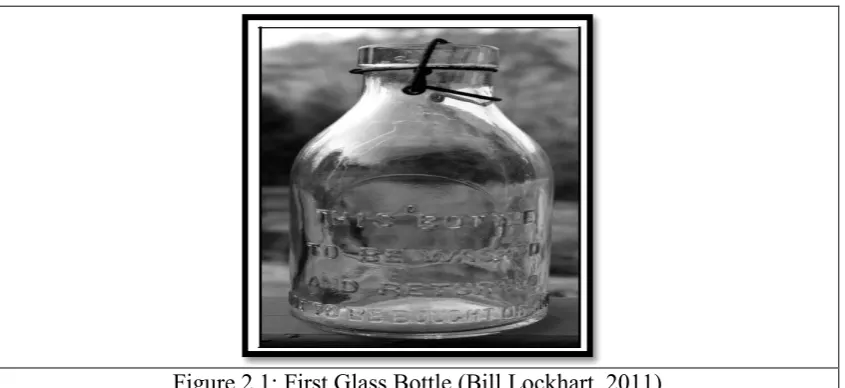
[image:24.595.110.533.223.417.2]2011). At that time, milk is one of the important businesses where everyone drinks milk at earlier morning. So, the company that runs milk business use the glass bottle to deliver to the people. In 1947, the plastic bottle is uses commercially but because of the cost is still expensive, plastic bottle is not popular among the people that time. After the high density polyethylene is introduced in 1953, people start to use the plastic to replaces the glass as container because to their lightweight nature and relatively low production and resistance to breakage compared with glass bottles.
Figure 2.1: First Glass Bottle (Bill Lockhart, 2011)
2.2.1 Material Used In Plastic Bottle
Plastic bottle is made using blow molding where plastic pallet from plastic factory is heated and blow by the air from the blow molding machine. The plastics pallet will follow shape of the mold after the blow and the plastic bottle is produced follow the shape of the mold. There are several material is used in plastic bottle production. Based on the American Chemical Council and ebottle.com, the materials are: