
Nectin-4 in Measles Virus Binding and Cell Entry, Nectin-4
Homodimerization, and Heterodimerization with Nectin-1
Mathieu Mateo,aChanakha K. Navaratnarajah,aRobin C. Willenbring,a,bJustin W. Maroun,a,bIanko Iankov,aMarc Lopez,c Patrick L. Sinn,dRoberto Cattaneoa,b
Department of Molecular Medicine, Mayo Clinic, Rochester, Minnesota, USAa
; Virology and Gene Therapy track, Mayo Graduate School, Rochester, Minnesota, USAb ; INSERM, UMR1068/CRCM, Institut Paoli-Calmettes and University of Aix-Marseille, Marseille, Francec
; Department of Pediatrics, University of Iowa, Iowa City, Iowa, USAd
ABSTRACT
Many viruses utilize cell adhesion molecules of the immunoglobulin superfamily as receptors. In particular, viruses of different
classes exploit nectins. The large DNA viruses, herpes simplex and pseudorabies viruses, use ubiquitous nectins 1 and 2. The
neg-ative-strand RNA virus measles virus (MeV) uses tissue-specific nectin-4, and the positive-strand RNA virus poliovirus uses
nectin-like 5 (necl-5), also known as poliovirus receptor. These viruses contact the BC, C
=
C
ⴖ
, and FG loops on the upper tip of
their receptor’s most membrane-distal domain. This location corresponds to the newly defined canonical adhesive interface of
nectins, but how viruses utilize this interface has remained unclear. Here we show that the same key residues in the BC and FG
loops of nectin-4 govern binding to the MeV attachment protein hemagglutinin (H) and cell entry, nectin-4 homodimerization,
and heterodimerization with nectin-1. On the other hand, residues in the C
=
C
ⴖ
loop necessary for homo- and heterotypic
inter-actions are dispensable for MeV-induced fusion and cell entry. Remarkably, the C
=
C
ⴖ
loop governs dissociation of the nectin-4
and H ectodomains. We provide formal proof that H can interfere with the formation of stable nectin-1/nectin-4 heterodimers.
Finally, while developing an alternative model to study MeV spread, we observed that polarized primary pig airway epithelial
sheets cannot be infected. We show that a single amino acid variant in the BC loop of pig nectin-4 fully accounts for restricted
MeV entry. Thus, the three loops forming the adhesive interface of nectin-4 have different roles in supporting MeV H association
and dissociation and MeV-induced fusion.
IMPORTANCE
Different viruses utilize nectins as receptors. Nectins are immunoglobulin superfamily glycoproteins that mediate cell-cell
adhe-sion in vertebrate tissues. They interact through an adhesive interface located at the top of their membrane-distal domain. How
viruses utilize the three loops forming this interface has remained unclear. We demonstrate that while nectin-nectin interactions
require residues in all three loops, the association of nectin-4 with the measles virus hemagglutinin requires only the BC and FG
loops. However, we discovered that residues in the C
=
C
ⴖ
loop modulate the dissociation of nectin-4 from the viral hemagglutinin.
Analogous mechanisms may support cell entry of other viruses that utilize nectins or other cell adhesion molecules of the
immu-noglobulin superfamily as receptors.
M
easles virus (MeV) is a highly contagious and
immunosup-pressive virus that still causes more than 120,000 deaths in
developing countries each year. Recently, the virus has been
re-sponsible for small epidemics throughout North America and
Eu-rope, where vaccination coverage has waned (
1
,
2
). After host
entry and dissemination in lymphatic cells through the receptor
signaling lymphocytic activation molecule (SLAM/CD150) (
3
,
4
),
rapid spread in respiratory epithelia depends on the adherens
junction protein nectin-4 (
5
,
6
). Vaccine strain MeV enters cells
also through the ubiquitous membrane cofactor protein (MCP/
CD46) (
7
,
8
). The tetrameric MeV attachment protein
hemagglu-tinin (H) binds these receptors and mediates virus entry in concert
with the fusion protein trimers (
3
,
9–12
). Structural analyses of H
in complex with either receptor have identified overlapping
sur-faces buried after complex formation (
13–15
). Functional studies
have further defined the individual residues governing the
recep-tor interactions, revealing remarkable differences (
16
).
Nectins are type I transmembrane proteins of the
immuno-globulin (Ig) superfamily that initiate cell-cell adhesion in
verte-brate tissues (
17
,
18
). Four family members, nectin-1 through
nectin-4 (also known as poliovirus receptor-like proteins 1 to 4 or
PVRL1-4), are well conserved among vertebrate species (
19
).
Nec-tins mediate calcium-independent cell-cell adhesion in many
tis-sues, including epithelia. They are localized to the subapical region
of lateral membranes in columnar epithelial cells and are one of
the main constituents of the adherens junction (
20
). Nectins are
characterized by an ectodomain composed of one
membrane-distal Ig variable-like domain (V), two Ig constant-like domains, a
transmembrane segment, and a cytosolic tail (
17
). The V domain
has the characteristic Ig fold, defined by two opposing antiparallel

sheets connected in a unique manner (
21
,
22
). The core of the Ig
Received15 August 2014 Accepted23 September 2014
Published ahead of print1 October 2014
Editor:T. S. Dermody
Address correspondence to Roberto Cattaneo, [email protected].
Copyright © 2014, American Society for Microbiology. All Rights Reserved.
doi:10.1128/JVI.02379-14
on November 7, 2019 by guest
http://jvi.asm.org/
fold is formed by four

-strands (B, C, E, and F) augmented with
additional

-strands (A, C
=
, C
⬙
, D, and G). Recent functional and
structural analyses have identified an adhesive interface involved
in the homophilic interaction of nectins, mapping to the B, C, C
=
,
C
⬙
, F, and G strands of the V domain (
20
,
23
,
24
).
Remarkably, viruses of different classes exploit nectins for cell
entry. Large DNA viruses like herpes simplex virus (HSV) and
pseudorabies virus use ubiquitous nectins 1 and 2 (
25–27
), and
the small RNA virus poliovirus uses nectin-like 5 (necl-5), also
known as PVR (poliovirus receptor) (
28
). Recently, the cocrystal
structure of the herpes simplex virus attachment protein gD in
complex with nectin-1 became available (
29
,
30
). Interestingly,
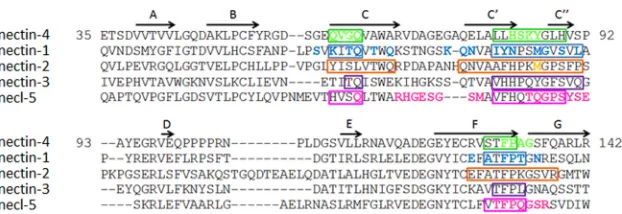
most of the nectin-1 residues involved in gD binding (
Fig. 1
, blue
residues) are part of the adhesive interface (
Fig. 1
, residues in
boxes) (
29
). In addition, early functional data (
31
,
32
) in
conjunc-tion with recent structural analyses of nectins 1 to 4 and necl-5
homodimers (
20
) suggest that targeting of the adhesive interface
could be the basis for the exploitation of nectins as viral receptors.
Taking advantage of the available structure of the nectin-4
ho-modimer (
20
) and the MeV H-nectin-4 complex (
15
), we assessed
how MeV H interacts with the nectin-4 adhesive interface. We
show that the three loops forming this interface have different
roles in supporting MeV association and dissociation and
MeV-induced membrane fusion and cell entry. We discovered that a
single residue variant in the nectin-4 BC loop restricts MeV entry
in pig airway epithelial (PAE) cells. We also address the question
of the heterophilic nectin interactions. All nectins can form
het-erodimers, and certain heterophilic interactions are much
stronger than the homophilic interactions. For example,
nec-tin-4/nectin-1 interactions are at least 1,000 times more stable
than the nectin-4 homodimers (
20
,
33
,
34
). We show that MeV
H can compete for the formation of nectin-4/nectin-1
trans-heterodimers.
MATERIALS AND METHODS
Cells. Vero, VerohSLAM (kindly provided by Y. Yanagi), VerohN4 (kindly provided by C. Richardson), 293, and Cos-7 cells were maintained in Dulbecco’s modified Eagle’s medium (DMEM; HyClone, South Logan, UT) supplemented with 10% fetal bovine serum (FBS). G418 at a concen-tration of 0.5 mg/ml was added to the medium of VerohSLAM and VerohN4 cells. Chinese hamster ovary (CHO) cells were maintained in RPMI medium (Corning, Manassas, VA) supplemented with 10% FBS and 0.5 mg/ml of nonessential amino acids. CHO-N1 and CHO-N4 cells were grown in RPMI medium complemented with 0.5 mg/ml of G418. Baby hamster kidney cells expressing stably the T7 polymerase (BHK-T7)
were maintained in DMEM supplemented with 10% FBS and 0.1 mg/ml G418. All the cell lines were kept at 37°C with 5% CO2.
Viruses and infections.To generate MV323LucII, the firefly luciferase open reading frame (ORF) was transferred into an infectious MV (i.e., recombinant MeV) genome in an additional transcription unit upstream of N, using the MluI and AatII restriction sites (35,36). MV323GFP ex-pressing green fluorescent protein (GFP) has already been described (37). Recombinant viruses were rescued as described previously (38). To pre-pare virus stocks, VerohSLAM cells were infected at a multiplicity of in-fection (MOI) of 0.01 and then incubated at 37°C for 36 to 48 h. To harvest virus, cells were scraped into Opti-MEM I reduced-serum me-dium (Life Technologies, Grand Island, NY) and freeze-thawed twice. Titers were determined by 50% tissue culture infective dose (TCID50) titration on VerohSLAM cells. For infections, cells were inoculated at the indicated MOIs for 1 h at 37°C in Opti-MEM I reduced-serum medium, washed, and incubated in 5% FBS medium at 37°C with 5% CO2for the
indicated times. For infections of N4-expressing cells in the presence of soluble N4 ectodomains, cells were infected with MV323LucII at an MOI of 0.2 in the presence of 10g/ml of the corresponding recombinant soluble nectin-4 ectodomain. Luciferase expression was determined at 16 h postinfection by using the Steady-Glo luciferase activity system (Pro-mega Corporation, Madison, WI) and a Topcount NXT luminometer (Packard Instrument Company, Meriden, CT).
Plasmids and mutagenesis.A codon-optimized ORF of human nectin-4 tagged by a carboxy-terminal (C-ter) FLAG epitope was cloned into a pCG vector. The plasmid coding for a C-ter FLAG-tagged nectin-1 was obtained by subcloning of the nectin-1 ORF from the pLX1.12 plasmid (39). Plasmids pCFR1 and pCFR4, encoding the full-length soluble ect-odomain of nectin-1 or nectin-4 fused to the human IgG1 Fc fragment, were described elsewhere (34). The H and F open reading frames of vac-cine MeV were cloned into a pCG vector (16). To clone the pig nectin-4 (pN4), RNA was extracted from cultures of pig airway epithelial cells using the RNeasy kit (Qiagen, Valencia, CA). A reverse transcription step using the Superscript II reverse transcriptase (Life Technologies, Grand Island, NY) followed by a PCR using specific primers (sense, 5=-ATGCC TCTGTCCCTGGGAGCC-3=; antisense, 5=-TCAGACCAGGTGCCCCC GC-3=; antisense FLAG, 5=-TTATCACTTGTCGTCATCGTCTTTGTA-ATCGACCAGGTGCCCCCGC-3=) allowed amplification of the pN4 cDNA and addition of the FLAG-epitope sequence. The pN4 cDNA en-coding a C-ter FLAG-tagged protein was cloned in the pCG vector. For all these plasmids, desired mutations were introduced by using the QuikChange site-directed mutagenesis (Stratagene, La Jolla, CA) proto-col. Introduction of the mutations was confirmed by sequencing.
Entry assay.To measure viral entry through mutated receptors, Vero cells were transfected with the pCG vectors expressing the indicated N4 mutants by using Lipofectamine 2000 (Life Technologies, Grand Island, NY). Forty-eight hours posttransfection, cells were infected with MV323LucII at an MOI of 0.2. Luciferase expression was determined FIG 1Sequences and interactions of the Ig V domain of nectins and necl-5. The protein sequences of human nectin-4 (Q96NY8), nectin-1 (Q15223), nectin-2 (Q92692), nectin-3 (Q9NQS3), and necl-5 (P15151) from the UniProt database (http://www.uniprot.org/) were aligned using ClustalW2 (http://www.ebi.ac .uk/Tools/msa/clustalw2/). Residues in boxes define the canonical nectin adhesive interface (20). Colored residues may interact with the viral attachment proteins of MeV (nectin-4, green), HSV (nectin-1 and nectin-2, blue and orange, respectively), or poliovirus (necl-5, pink) (29,32). The-strands A, B, C, C=, C⬙, D, E, F, and G (20) are indicated with arrows above the nectin-4 sequence.
on November 7, 2019 by guest
http://jvi.asm.org/
[image:2.585.137.448.63.170.2]at 16 h postinfection by using the Steady-Glo luciferase activity system (Promega Corporation, Madison, WI) and a Topcount NXT luminome-ter (Packard Instrument Company, Meriden, CT). In parallel, cell surface and total expression of the recombinant N4 were analyzed by flow cytom-etry and immunoblotting at 48 h posttransfection. For flow cytomcytom-etry, cells were detached using Versene (Life Technologies, Grand Island, NY) and then incubated in fluorescence-activated cell sorter (FACS) buffer (1⫻phosphate-buffered saline [PBS], 2% FBS, 0.1% NaN3) with primary
antibodies for 1 h at 4°C, followed by an incubation of 45 min at 4°C with phycoerythrin (PE)-conjugated secondary antibodies. The cells were fixed in 2% paraformaldehyde and read by FACSCalibur (BD Biosciences, San Jose, CA). The results were analyzed by FlowJo software (Tree Star Inc., Ashland, OR). For immunoblotting, cells were lysed in coimmunopre-cipitation (co-IP) buffer (10 mM HEPES [pH 7.4], 50 mM Na-Pyro-PO4,
50 mM Na-F, 50 mM NaCl2, 5 mM EDTA, 5 mM EGTA, 100M sodium
vanadate, 1% Triton X-100) 48 h posttransfection. The protein samples were resolved on 4 to 15% gradient SDS-polyacrylamide gels, transferred to polyvinylidene difluoride membranes (PVDF; Millipore, Billerica, MA), and then probed with horseradish peroxidase (HRP)-conjugated monoclonal antibodies FLAG-M2-HRP and -actin-HRP (Sigma-Al-drich, St. Louis, MO). Membranes were visualized using Supersignal West Dura chemiluminescent substrate (Thermo Scientific, Rockford, IL) and autoradiography (Denville Scientific, Metuchen, NJ).
Production and purification of recombinant soluble proteins.Cos-7 cells were transfected with pCFR1 and pCFR4 encoding the full-length nectin-1 and nectin-4 ectodomains (wild type or mutants) using X-tremeGENE 9 DNA transfection reagent (Roche). Supernatants were harvested at days 5 and 7 posttransfection, from which proteins were purified through their Fc tag using protein A chromatography (Pierce). Purification was monitored by Coomassie Easy Blue (Life Technologies) SDS-PAGE and immunoblotting using human IgG Fc HRP-conjugated antibodies (Bethyl Laboratories, Montgomery, TX). Protein concentra-tions were determined by enzyme-linked immunosorbent assay (ELISA) and spectrophotometry. The soluble H protein ectodomain was expressed and purified as described previously (11).
Surface plasmon resonance.The receptor binding kinetics of the mu-tant nectin-4 ectodomains to the MeV H protein were determined essen-tially as described previously (11). Briefly, the interactions of the soluble nectin-4 ectodomains with the soluble H protein ectodomain were mon-itored by using a BIAcore T200 instrument (GE Healthcare, Pittsburgh, PA). HBS-EP⫹(GE Healthcare, Pittsburgh, PA) buffer (0.01 M HEPES [pH 7.4], 0.15 M NaCl, 3 mM EDTA, 0.05% [vol/vol] surfactant P20) was used for all protein dilutions and as the running buffer. The FLAG-tagged H protein was captured onto the CM5 sensor chip surface by an immobi-lized anti-FLAG antibody (Sigma, St. Louis, MO). To monitor receptor binding, different concentrations of soluble receptors (0.05M to 0.8
M) were injected over the captured MeV H proteins as indicated. The soluble receptors were injected over the CM5 sensor chip surfaces either exhibiting or lacking captured H protein. The surfaces lacking captured H served as control surfaces for nonspecific receptor binding. The antibody surface was regenerated by injection of 50 mM citric acid (pH 3.0) for 60 s followed by 10 mM glycine (pH 3.0) for 60 s, with little change in the activity of the monoclonal antibody surface monitored. The curve-fitting function of Biacore T200 Evaluation software (version 1.0) was used to fit rate equations derived from the 1:1 Langmuir binding model to the ex-perimental data. The equilibrium dissociation constant (KD) was
deter-mined from the kinetic rate constantskon(association) andkoff
(dissoci-ation).
Coimmunoprecipitation.Cells were transfected with plasmids en-coding the corresponding FLAG-tagged nectin-4 (wild type or mutant, as indicated) or nectin-1. Forty-eight hours posttransfection, cells were lysed in co-IP buffer and cleared lysates were incubated with an anti-FLAG M2 affinity gel (Sigma-Aldrich, St. Louis, MO). Immunoprecipitates were then incubated with the corresponding soluble nectin ectodomains. Co-immunoprecipitates were eluted and analyzed by SDS-PAGE followed by
immunoblotting using monoclonal antibodies FLAG-M2-HRP (Sigma-Aldrich, St. Louis, MO) and human IgG Fc HRP-conjugated antibodies (Bethyl).
Competition binding assay.CHO-N1 cells expressing human nectin-1 were incubated with nectin-1g of soluble nectin-4 ectodomain in the presence of 10g/l of an antibody directed to the V domain of nectin-1 (R1.302), or an antibody directed to the V domain of nectin-4 (N4.61), or an anti-body directed to a C domain of nectin-4 (N4.40). Additional competition experiments included a soluble H ectodomain (sH) or 10g/l of an sH in the presence of 100g/l of H-neutralizing antibody 20H6 (40). An-tibodies R1.302, N4.61, and N4.40 were described previously (33). The binding of the soluble nectin-4 ectodomain was then assessed by flow cytometry using anti-human Fc goat PE antibodies (Abcam, Cam-bridge, MA).
Pig airway epithelial cells.Primary cultures of pig airway epithelial cells were prepared from trachea and bronchi by enzymatic dispersion and seeded onto collagen-coated, semipermeable membranes with a 0.4-m pore size (Millicell-HA; surface area, 0.6 cm2; Millipore
Corpo-ration, Billerica, MA) as previously described for human airway epithelia (41). Only well-differentiated cultures (⬎3 weeks old; resistance,⬎1,000
⍀ ⫻cm2) were used. Transepithelial resistance was measured with a
volt-ohm meter (World Precision Instruments, Sarasota, FL). Values were corrected for the blank filter resistance and further standardized against baseline readings and uninfected cultures. Neither corrected nor raw numbers resulted in a statistically significant variation from measure-ments in uninfected epithelia as determined by analysis of variance (ANOVA). For transductions, adenovirus type 5 (Ad5) vectors expressing mCherry or the human nectin-4 were diluted in sterile PBS to an MOI of 50, and 100l of the solution was applied for 4 h to the basolateral surface by inverting the culture insert. For infections, MeV preparations were diluted in sterile PBS to an MOI of 0.1 (as determined on Vero-SLAM cells), and 100l of the solution was applied to the basolateral surface.
RESULTS
Cross-linking the nectin-4 adhesive interface prevents
infec-tion.
While it was long thought that
cis
and
trans
nectin-nectin
interactions are governed by different V domain surfaces (
19
,
24
),
recent structural analyses strongly suggest that all these
interac-tions depend on one single adhesive interface (
20
). We reasoned
that if MeV uses the dimerization interface, cross-linking it by
covalent bridges should prevent MeV entry. To test this
hypothe-sis, we introduced disulfide bonds at the homodimer interface. We
identified suitable locations for introduction of cysteine residues
on a model of the nectin-4 homodimer based on the nectin-1
homodimer structure (
23
). Paired residues F132 and Y86 as well
as P133 and L81 were chosen for cysteine substitution because
they face each other across the antiparallel dimer interface and are
located at an appropriate distance.
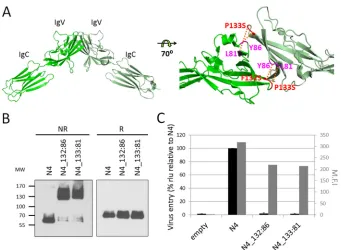
Figure 2A
shows the crystal
structure of the nectin-4 homodimer (
20
) and the location of the
disulfide bridges that may prevent access to the adhesive interface.
Figure 2B
(left panel, nonreducing conditions [NR])
docu-ments that while a FLAG-tagged human nectin-4 (N4) migrates as
monomer, both N4_132:86 and N4_133:81 mutant proteins
mi-grate almost exclusively as dimers. Thus, these proteins did fold
correctly and the SH groups of the new cysteine residues formed
disulfide bonds stabilizing the dimers. To assess whether these
stabilized dimers are functional MeV receptors, we transiently
ex-pressed nectin-4 mutants in Vero cells, which do not express
en-dogenous nectin-4, and then infected these cells with a
luciferase-expressing wild-type MeV (MV323-LucII) (
Fig. 2C
). While
standard nectin-4 supported MeV entry and production of
lucif-erase, only background levels of luciferase were detected in the
N4_132:86- and N4_133:81-expressing cells. We verified that
on November 7, 2019 by guest
http://jvi.asm.org/
N4_132:86 and N4_133:81 proteins are expressed at the cell
sur-face (about 69% and 67% of nectin-4, respectively) (
Fig. 2C
, gray
bars). Thus, MeV needs to access the nectin adhesive interface to
enter cells.
The nectin-4 adhesive interface loops BC and FG are critical
for MeV entry.
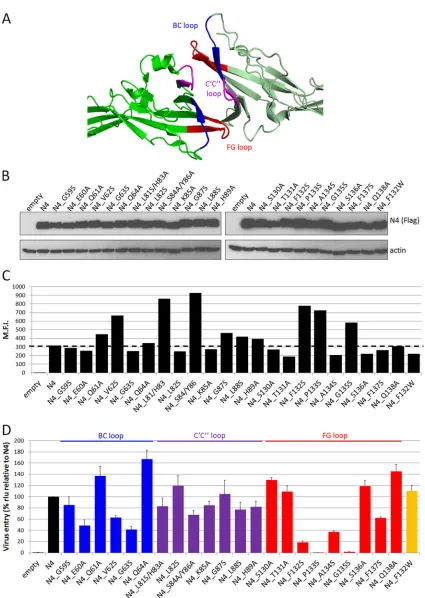
To assess whether all three loops forming the
nectin-4 adhesive interface are functionally important for MeV entry, we
performed an alanine/serine scan. Charged polar residues in the
BC, C
=
C
⬙
, and FG loops (
Fig. 3A
; blue, purple, and red,
respec-tively) were mutated to alanine, and uncharged apolar residues
were replaced by serine. Total protein expression and cell surface
protein expression were measured for all the mutants (
Fig. 3B
and
C
). Nectin-4 or its mutants were expressed in Vero cells for 48 h
before infection with MV323-LucII. Luciferase levels were
mea-sured at 16 h postinfection to assess cell entry.
Figure 3D
documents that mutations of the FG loop had the
strongest effect on MeV entry: mutations of the highly conserved
131-TFP-X-G-135 motif had strong effects, with substitutions
P133S and G135S abrogating entry and substitution F132S
reduc-ing entry by more than 80%. Importantly, the conservative
muta-tion F132W had no impact on entry efficiency (
Fig. 3D
, orange
bar). Substitutions A134S and F137S reduced entry by 60% and
40%, respectively. Other mutations of the FG loop slightly
in-creased MeV entry. In the BC loop, mutations of residues E60,
V62, and G63 reduced entry by 40 to 60% while substitutions of
residues Q61 and Q64 enhanced entry. Mutations of C
=
C
⬙
loop
residues had little to no effect on MeV entry. Accordingly,
muta-tions of the MeV H residues facing the C
=
C
⬙
loop of nectin-4 (PDB
4GJT
) did not affect the ability of H to support fusion of cells
expressing nectin-4 (data not shown). Thus, the integrity of the
BC and FG loops in the nectin-4 adhesive interface is required for
nectin-4-dependent entry of MeV.
The nectin-4 BC and FG loops support MeV H binding.
Hav-ing observed differential effects of mutations in the BC, C
=
C
⬙
, and
FG loops of nectin-4 on entry of viral particles, we sought to
de-termine the role of each loop in supporting binding of the viral
attachment protein. To this purpose, we engineered soluble
re-combinant nectin-4 ectodomains with individual loops mutated
to either alanine or serine residues. Based on the interactions
ob-served in the nectin-4/H cocrystal, we generated as previously
de-scribed (
33
) three mutant proteins, namely, 61-QVGQ-64 (BC
loop, QVGQ
¡
ASSA), 83-HSKY-86 (C
=
C
⬙
loop, HSKY
¡
AAAA),
and 132-FPAG-135 (FG loop, FPAG
¡
SSSS) (
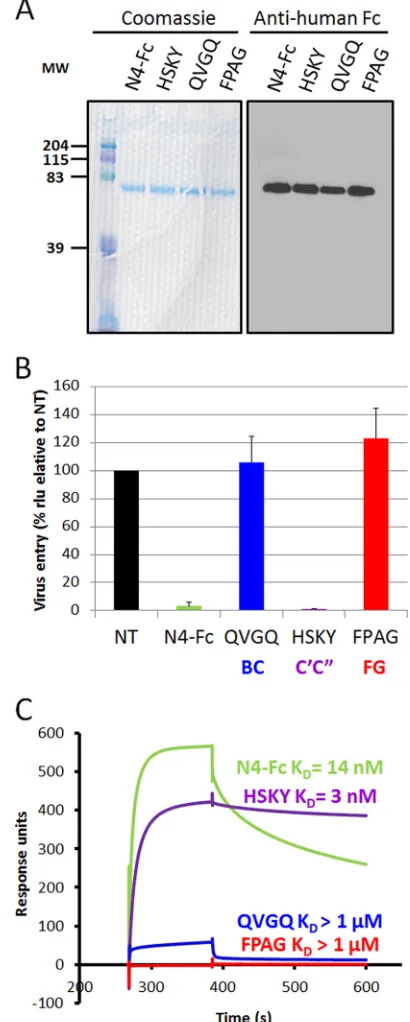
Fig. 4A
). These
sol-uble ectodomains were added to the medium of
nectin-4-express-ing CHO cells with MV323-LucII (
Fig. 4B
). As expected, the
sol-uble N4-Fc ectodomain blocked infection by more than 95%. The
soluble 83-HSKY-86 mutant also blocked infection, suggesting
that the C
=
C
⬙
loop residues are not critical for MeV binding. On
the other hand, both soluble 61-QVGQ-64 and 132-FPAG-135
mutant ectodomains failed to block infection, implying the
im-portance of the BC and FG loops for MeV H binding.
We further determined the binding kinetics and affinities of
the mutant soluble nectin-4 ectodomains for MeV H using surface
plasmon resonance. As expected, the equilibrium dissociation
constant (
K
D) of N4-Fc for MeV H was about 14 nM (
Fig. 4C
). In
contrast, the ectodomains with mutations in the BC and FG loops,
FIG 2Blocking access to the nectin-4 adhesive interface prevents infection. (A) Nectin-4 homodimer (PDB4FRW) with cross-linking disulfide bridges. Structural coordinates were processed using PyMOL. The left panel shows the two membrane-distal domains of the dimer. The right panel shows the dimer interface with the residues mutated to Cys and the expected disulfide bonds (red dotted lines). (B) Immunoblot analysis of the dimerization capacity and protein expression levels of the nectin-4 cysteine substitution mutants. Protein extracts from transfected cells were separated by 4 to 15% SDS-PAGE under nonreducing (NR) or reducing (R) conditions. MW, molecular weight (in thousands). (C) Entry of MeV through the nectin-4 cysteine substitution mutants. Forty-eight hours posttransfection, cells were infected with MV323LucII at an MOI of 0.2. At 16 h postinfection, cells were analyzed for luciferase expression levels. Averages and standard deviations relative to the standard nectin-4 (N4) are indicated (black bars). rlu, relative luciferase units. Cell surface expression of the different nectin-4 constructs is also shown as mean fluorescence intensity (M.F.I., gray bars).
on November 7, 2019 by guest
http://jvi.asm.org/
[image:4.585.122.463.62.312.2]FIG 3Residues of the nectin-4 adhesive interface supporting MeV entry. (A) Nectin-4 homodimer (PDB4GJT) showing the adhesive interface and the localization of the BC (blue), C=C⬙(purple), and FG (red) loops. The molecules are oriented as inFig. 2A, right panel. (B) Immunoblots of cell extracts of cells expressing the mutant proteins harvested 48 h posttransfection. Top panels, nectin-4 expression; bottom panels, actin expression. (C) Cell surface expression of the nectin-4 mutant proteins analyzed 48 h posttransfection by flow cytometry. M.F.I., mean fluorescence intensity. The dashed line indicates standard nectin-4 expression levels. (D) MeV entry efficiency through the nectin-4 mutants. Forty-eight hours posttransfection, cells were infected with MV323LucII at an MOI of 0.2. At 16 h postinfection, cells were analyzed for luciferase expression levels. Averages and standard deviations relative to the standard nectin-4 (N4) are indicated. rlu, relative luciferase units.
on November 7, 2019 by guest
http://jvi.asm.org/
[image:5.585.79.504.57.655.2]61-QVGQ-64 and 132-FPAG-135, respectively, had on rates (
k
on)
reduced 38- and 67-fold, and their affinities were in the
micromo-lar range (
Fig. 4C
and
Table 1
). In contrast, the ectodomain with
mutations in the C
=
C
⬙
loop (83-HSKY-86) had a 2-fold-reduced
k
on. Interestingly, the off rate (
k
off) was also reduced, resulting in a
4- to 5-fold-higher affinity than standard nectin-4.
One variant residue in the BC loop of pig nectin-4 disallows
MeV entry.
While developing an alternative model to study MeV
spread in epithelia, we observed that polarized primary pig airway
epithelia cannot be infected with MeV (
Fig. 5A
, left panel,
mCherry) despite efficient pig nectin-4 transcription (data not
shown). Expression of human nectin-4 through an adenovirus
vector rendered these epithelial sheets susceptible to basolateral
MeV infection (
Fig. 5A
, left panel [hNectin-4] and right panels).
These observations prompted us to compare the protein
se-quences of human and pig nectin-4.
In the alignment (
Fig. 5B
), we noted two differences mapping
in the BC loop (positions 58 and 63) and one mapping in the C
=
C
⬙
loop (position 83). We replaced the corresponding residues in
human nectin-4 by the pig counterpart (S58P, G63E, and H83N).
Residue serine 58 was also replaced by an alanine (S58A), as this
mutant was not in our previous screen. All these mutants were
expressed at levels similar to that of wild-type nectin-4 (
Fig. 5C
,
right panel). When tested for their ability to support entry and
replication of MV323-LucII in Vero cells, all the mutants except
G63E were susceptible (
Fig. 5C
, left panel).
To assess whether G63E is the sole difference accounting for
MeV restrictions in PAE cells, we cloned the pig nectin-4 cDNA
and assessed its ability to support MeV infection in human cells
not expressing endogenous nectin-4 (
Fig. 5D
). As expected, the
standard pig nectin-4 did not support entry of MeV in transfected
cells. However, substitution of glutamic acid with glycine at
posi-tion 62 (N4_E62G), which is found in the human homologue,
reestablished MeV receptor activity to pig nectin-4. Altogether,
these results highlight the importance of the BC loop for the
H/nectin-4 interaction.
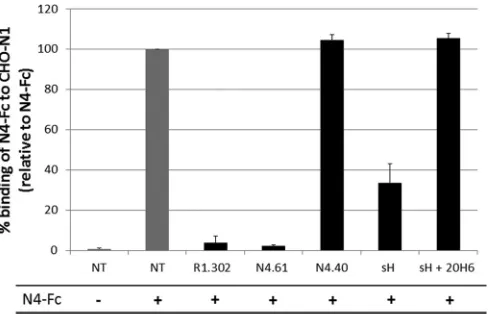
MeV H prevents nectin-4/nectin-1 heterodimer formation.
Since heterophilic interactions of nectin-4 with nectin-1 are much
stronger than both types of homophilic interactions (
33
), nectin-4
molecules are likely to be present on the cell surface as nectin-4/
nectin-1 heterodimers. Therefore, we assessed whether MeV H
can prevent the nectin-4 to nectin-1 interaction. We developed a
flow cytometry-based competition assay.
Figure 6
demonstrates
that binding of the nectin-4 ectodomain (N4-Fc) to CHO cells
expressing nectin-1 (CHO-N1) is abrogated in the presence of
antibodies against the V domain of nectin-1 (R1.302) or against
the V domain of nectin-4 (N4.61). In contrast, an antibody against
one of the C domains (N4.40) did not prevent N4-Fc binding to
the CHO-N1 cells. In addition, neither N4.61 nor N4.40
cross-reacted with CHO-N1 cells (data not shown). In the presence of a
FIG 4The BC and FG loops of nectin-4 are required for infection and for binding of the MeV attachment protein. (A) The soluble ectodomain of wild-type nectin-4 (N4-Fc), a mutant of the BC loop (61-QVGQ-64¡61-ASSA-64), a mutant of the C=C⬙loop (83-HSKY-86¡83-AAAA-86), and a mutant of the FG loop (132-FPAG-135¡132-SSSS-135) were expressed in Cos-7 cells. Eluted soluble nectin-4 ectodomains were separated by SDS-PAGE and visualized by Coomassie blue staining (left panel) or immunoblotting (right panel). MW, molecular weight (in thousands). (B) CHO cells expressing nectin-4 were infected with MV323LucII at an MOI of 0.2 in the absence (NT, not treated) or presence of soluble nectin-4 ectodomain (N4-Fc, green), or soluble mutants of nectin-4 with substitutions in the BC (QVGQ, blue), C=C⬙(HSKY, purple) or FG loop (FPAG, red). At 16 h postinfection, cells were analyzed for luciferase expression levels. (C) Kinetics of binding of soluble H to the corresponding soluble nectin-4 ectodomains, as deter-mined by surface plasmon resonance.KD, equilibrium dissociation constant.
[image:6.585.58.263.70.581.2]Color coding is as described for panel B.
TABLE 1Binding kinetics of soluble H ectodomains to soluble nectin-4 ectodomains
Ligand kon(105M⫺1s⫺1) koff(10⫺3s⫺1) K
D(koff/kon)
N4-Fc 2.71 3.83 14 nM
QVGQ 0.07 136 ⬎1M
HSKY 1.21 0.37 3 nM
FPAG 0.04 19.3 ⬎1M
on November 7, 2019 by guest
http://jvi.asm.org/
[image:6.585.298.546.87.144.2]soluble MeV H (sH), N4-Fc binding to CHO-N1 cells was reduced
by more than 65%. However, sH did not prevent the N4-Fc
inter-action in the presence of the anti-H antibody 20H6 (
40
).
There-fore, the MeV attachment protein can prevent nectin-4/nectin-1
heterodimer formation.
Nectin-4 uses a single interface to interact with itself and
with nectin-1.
Structural analyses of all four nectins and the necl-5
homodimers identified a canonical adhesive interface (
20
). It was
also suggested that the heterodimer’s stability may be controlled
by a few charged residues (
20
), but no heterodimer structure has
FIG 5A single amino acid variant in pig nectin-4 accounts for defective MeV entry in PAE cells. (A) PAE cells were transduced with a control Ad5 vector expressing mCherry (mCherry) or a vector expressing human nectin-4 (hNectin-4) and then infected apically or basolaterally with a GFP-expressing MeV. At 72 h postinfection, infectious centers were counted. The left panel shows the number of infectious centers per well (averages and standard deviations). The right panel shows GFP-positive infectious centers following apical or basolateral infection of PAE transduced with Ad5-nectin-4. Scale bars, 100m. (B) Sequence alignment of the IgV domains of pig and human nectin-4. Key residues in the BC, C=C⬙, and FG loops are underlined. The variant amino acids tested functionally are boxed. (C and D) MeV entry in cells expressing recombinant nectin-4 proteins. Forty-eight hours posttransfection, cells were infected with MV323LucII at an MOI of 0.2. At 16 h postinfection, cells were analyzed for luciferase expression levels. Right panels show immunoblots documenting expression of different recombinant nectin-4 proteins.
on November 7, 2019 by guest
http://jvi.asm.org/
[image:7.585.132.446.67.573.2]been obtained yet. While our observation that MeV H can prevent
the nectin-4
trans
-interaction with nectin-1 is consistent with a
model in which the adhesive interface also governs heterophilic
dimer interactions, formal proof is missing.
To characterize directly the nectin-4/nectin-1 dimer
interac-tions, we developed a coimmunoprecipitation assay based on
FLAG-tagged nectin-4 proteins (
Fig. 7
). We first assessed whether
the disulfide bridge-stabilized recombinant N4_132:86 and
N4_133:81 homodimers can interact with nectin-1. As expected
by the single-interface model, the stabilized homodimer did not
coimmunoprecipitate soluble nectin-1 while the wild-type
con-trol nectin-4 (N4) did (
Fig. 7
, left panel). We then used the whole
set of alanine/serine mutants of the nectin-4 adhesive interface to
identify those residues involved in nectin-1 binding. Mutations of
residues V62 and Q64 in the BC loop interfered with the ability to
coimmunoprecipitate nectin-1 (
Fig. 7
, center panels, left half). In
the C
=
C
⬙
loop, mutants L81S/H83A, NS84A/Y86A, G87S, and
H89A lost their ability to interact with nectin-1 (
Fig. 7
, center
panels, right half). The FG loop mutants T131A, F132S, P133S,
G135S, and F137S also lost binding to nectin-1 (
Fig. 7
, right
panel). Similarly, the soluble recombinant nectin-4 ectodomains
61-QVGQ-64, 83-HSKY-86, and 132-FPAG-135 did not
coim-munoprecipitate with a FLAG-tagged nectin-1 (data not shown).
Altogether, these results demonstrate that nectin-4 uses the same
key residues in the BC and FG loops to bind H and to make
het-erotypic and homotypic interactions. For the nectin interactions,
unlike for H binding, nectin-4 also requires the participation of
amino acids in the C
=
C
⬙
loop.
DISCUSSION
Viruses depend on cell surface molecules to enter cells and begin
their replicative cycle. Many viruses utilize cell adhesion
mole-cules of the Ig superfamily as receptors (
42
). In particular, HIV
uses CD4 (
43
), adenovirus uses the coxsackie virus and
adenovi-rus receptor (
44
), reovirus uses the junctional adhesion molecule
A (
45
), and coronaviruses use members of the carcinoembryonic
antigen glycoprotein family (
46
,
47
). MeV uses two cell adhesion
molecules of the Ig superfamily as receptors, SLAM and nectin-4
(
3–5
). Other viruses also exploit nectin-like proteins: herpes
sim-plex viruses use nectins 1 and 2 (
25–27
), and poliovirus uses necl-5
(
28
). Since all these viruses belong to different families, these viral
attachment protein-Ig superfamily receptor interactions may
have evolved independently. It has been proposed that early
vi-ruses may have shaped the evolution of the primordial Ig fold
prior to the existence of the vertebrate immune system (
42
).
Viruses contact these receptors through the upper “tip” of their
most membrane-distal domain (
42
), which includes the BC, C
=
C
⬙
,
and FG loops. This location corresponds to the newly defined
canonical adhesive interface of nectins (
20
). Here we characterize
how MeV appropriates this interface of nectin-4, preventing
dimerization. Based on proximity in the cocrystal structure, it was
suggested that contacts of MeV H with all three loops are necessary
for efficient virus entry (
15
). We show here that only the contacts
with the C

-sheet and the FG loop are critical for MeV H binding
and cell entry.
Figure 8A
illustrates how the nectin-4 FG loop (red backbone)
protrudes into an H-protein hydrophobic groove (orange
sur-face). The BC loop (blue backbone) covers the groove and helps
stabilize the complex. In agreement with the costructure (
15
), our
functional screen identifies E60, V62, and G63 as the main
resi-dues supporting contacts in the BC loop: mutations of the
61-QVGQ-64 stretch abrogated binding of nectin-4 to MeV H. The
nature of the amino acid at position 63 in human nectin-4 is
par-ticularly important. While substitution G63S reduces nectin-4
re-ceptor activity, substitution G63E completely abrogates it. In
ad-dition, this residue can determine species specificity: pig nectin-4
FIG 6MeV H prevents nectin-4/nectin-1 heterodimer formation. Binding of soluble nectin-4 (N4-Fc) to CHO-N1 cells expressing nectin-1 in the absence (NT, not treated) or presence of IgV nectin-1 antibodies (R1.302), anti-IgV nectin-4 antibodies (N4.61), anti-IgC nectin-4 antibodies (N4.40), soluble hemagglutinin ectodomain (sH), or sH- and H-neutralizing antibodies (sH⫹ 20H6). The negative control (first column) consisted of nontreated cells not incubated with N4-Fc. Binding was assessed by flow cytometry using an anti-human IgG1 Fc antibody directed to the Fc fragment of anti-human IgG1 fused to the soluble nectin-4 ectodomain (N4-Fc).
FIG 7Residues involved in nectin-4/nectin-1 heterodimerization. Immunoblot analysis of soluble nectin-1 binding to nectin-4 proteins with mutations in the adhesive interface. At 48 h posttransfection, nectin-4 proteins were immunoprecipitated through their C-terminal FLAG tag. The immunoprecipitates were incubated with soluble nectin-1 ectodomain. Eluates were separated by 4 to 15% SDS-PAGE. Proteins were detected using antibodies to the human Fc fragment of IgG1 (huFc) for soluble nectin-1 or the FLAG epitope for the FLAG-tagged nectin-4.
on November 7, 2019 by guest
http://jvi.asm.org/
[image:8.585.42.287.66.223.2] [image:8.585.140.450.584.682.2]presents a glutamic acid instead of a glycine at the corresponding
position and cannot function as a receptor for MeV. We show here
that pig nectin-4 with a glycine at the critical position has full MeV
receptor activity. The longer side chain and the negative charge of
glutamic acid are likely to induce a steric clash preventing complex
stabilization.
Residues in the highly conserved 131-TFP-X-G-135 motif of
the nectin-4 FG loop are also critical for binding MeV H. These
residues protrude deep in the groove and participate in
hydropho-bic interactions with residues L482, Y483, Y541, and Y543 on Mev
H (
16
). Indeed, Zhang et al. demonstrated that a 132-SSSS-135
mutant of the FG loop does not bind the surface of MeV
H-ex-pressing cells (
15
). We show here that the same mutant does not
bind MeV H in a surface plasmon resonance assay. Recently,
Delpeut et al. showed that the attachment protein of canine
dis-temper virus binds the V domain of canine nectin-4 through the
TFP-X-G motif (
48
). Remarkably, the same motif in the FG loop
of nectin-1 is also targeted by HSV (
29
). Moreover, poliovirus
targets the corresponding motif on necl-5 (
32
). As the
phenylala-nine in this motif is critical for nectin dimerization and the
estab-lishment of the adherens junction (
20
), all viruses using nectins
target the same key motif in the adhesive interface for cell entry.
We show here formally that the conserved F132 in the nectin-4
FG loop is critical not only for homodimer formation (
20
) but also
for heterodimer formation. Our studies also document that all
three loops forming the adhesive surface are functionally
impor-tant for nectin-nectin heterophilic interactions. Indeed, the
struc-ture of the nectin-4 homodimer shows that the symmetric
inter-face is stabilized mainly by interactions of the BC and FG loops
(
Fig. 8B
, blue and red backbone) with the C
=
C
⬙
loop of the facing
nectin-4 monomer (
Fig. 8B
, purple surface). Although integrity of
the BC loop is required for the interaction, the contacts between
the FG and C
=
C
⬙
loops are the strongest, with residue F132 fitting
in a hydrophobic pocket formed by H83, G87, Y86, and H89 of the
C
=
C
⬙
loop (
20
). Strikingly, the recently published structure of
necl-5 in complex with the TIGIT Ig superfamily protein
docu-ments an analogous binding mode (
49
).
All these observations highlight the relevance of the
interac-tions of viral attachment proteins with the tip of the V domain of
cell adhesion molecules of the Ig superfamily. Interactions
be-tween soluble forms of viral attachment proteins and their
recep-tors can be much stronger than homophilic interactions between
receptor subunits: HSV gD can interfere with the binding of
nec-tin-3 and nectin-4 to nectin-1 (
33
). We present here the first
de-tailed analysis of how a viral attachment protein prevents
het-erodimerization of its Ig superfamily receptor. Displacement of
receptor dimers forming in
trans
between infected and
nonin-fected cells is of central importance for MeV spread: since this
virus remains strongly cell associated (
50–52
), H protein
ex-pressed on infected cells must disrupt nectin-4/nectin-1
trans
-cellular dimers to allow spread.
In conclusion, the C
=
C
⬙
loop is the principal discriminator of
the functional interactions of the nectin-4 adhesive interface with
its viral and cellular partners. This has implications for antiviral
strategies. We also discovered that different contact surfaces
doc-umented in the H-nectin-4 cocrystals are critical for different
phases of the MeV-elicited membrane fusion process: while the
BC and FG loops govern binding, the C
=
C
⬙
loop must support a
successive phase. It will be interesting to assess whether the same
adhesive interface loops similarly govern the association and the
dissociation of attachment proteins of other viruses.
ACKNOWLEDGMENTS
We thank Patricia Devaux, Marie Frenzke, Swapna Apte-Sengupta, Chris-tian Pfaller, Tanner Miest, and Vladimir Gainullin for helpful discussions. This work was supported by U.S. National Institutes of Health grants R01 AI063476 to Roberto Cattaneo and R01 HL-105821 to Patrick L. Sinn.
Mathieu Mateo is a Merck fellow of the Life Sciences Research Foun-dation.
REFERENCES
1.Griffin DE.2013. Measles virus, p 1042–1069. Fields virology, 6th ed, vol 1. Wolters Kluwer, Lippincott Williams & Wilkins, Philadelphia, PA. 2.Kupferschmidt K.2012. Public health. Europe’s embarrassing problem.
Science336:406 – 407.http://dx.doi.org/10.1126/science.336.6080.406. 3.Mateo M, Navaratnarajah CK, Cattaneo R.2014. Structural basis of
efficient contagion: measles variations on a theme by parainfluenza vi-ruses. Curr. Opin. Virol.5:16 –23.http://dx.doi.org/10.1016/j.coviro.2014 .01.004.
4.Tatsuo H, Ono N, Tanaka K, Yanagi Y.2000. SLAM (CDw150) is a cellular receptor for measles virus. Nature406:893– 897.http://dx.doi.org /10.1038/35022579.
5.Muhlebach MD, Mateo M, Sinn PL, Prufer S, Uhlig KM, Leonard VH, Navaratnarajah CK, Frenzke M, Wong XX, Sawatsky B, Ram-achandran S, McCray PB, Jr, Cichutek K, von Messling V, Lopez M, Cattaneo R.2011. Adherens junction protein nectin-4 is the epithelial receptor for measles virus. Nature480:530 –533.http://dx.doi.org/10 .1038/nature10639.
6.Noyce RS, Bondre DG, Ha MN, Lin LT, Sisson G, Tsao MS, Richardson CD.2011. Tumor cell marker PVRL4 (nectin 4) is an epithelial cell recep-tor for measles virus. PLoS Pathog.7:e1002240.http://dx.doi.org/10.1371 /journal.ppat.1002240.
7.Dorig RE, Marcil A, Chopra A, Richardson CD.1993. The human CD46 molecule is a receptor for measles virus (Edmonston strain). Cell75:295– 305.
8.Naniche D, Varior-Krishnan G, Cervoni F, Wild TF, Rossi B, Rabour-din-Combe C, Gerlier D. 1993. Human membrane cofactor protein (CD46) acts as a cellular receptor for measles virus. J. Virol.67:6025– 6032. 9.Hashiguchi T, Kajikawa M, Maita N, Takeda M, Kuroki K, Sasaki K, Kohda D, Yanagi Y, Maenaka K.2007. Crystal structure of measles virus hemagglutinin provides insight into effective vaccines. Proc. FIG 8Nectin-4 binding to the MeV hemagglutinin or to itself. (A) Nectin-4
(backbone representation) in complex with the MeV hemagglutinin (surface representation [PDB4GJT]). The nectin-4 FG loop (red) protrudes in the MeV H hydrophobic groove (orange). The BC loop (dark blue) crosses over the FG loop in the hydrophobic pocket. The C=C⬙loop (purple) contacts H residues in the4 blade (light blue). (B) Structure of the nectin-4 homodi-meric adhesive interface (4FRW). Color coding is as described for panel A. Note that the C=C⬙loop contacts the BC and FG loops of the opposite monomer.
on November 7, 2019 by guest
http://jvi.asm.org/
[image:9.585.41.286.66.214.2]Natl. Acad. Sci. U. S. A.104:19535–19540.http://dx.doi.org/10.1073 /pnas.0707830104.
10. Navaratnarajah CK, Oezguen N, Rupp L, Kay L, Leonard VH, Braun W, Cattaneo R.2011. The heads of the measles virus attachment protein move to transmit the fusion-triggering signal. Nat. Struct. Mol. Biol.18: 128 –134.http://dx.doi.org/10.1038/nsmb.1967.
11. Navaratnarajah CK, Vongpunsawad S, Oezguen N, Stehle T, Braun W, Hashiguchi T, Maenaka K, Yanagi Y, Cattaneo R. 2008. Dynamic interaction of the measles virus hemagglutinin with its receptor signaling lymphocytic activation molecule (SLAM, CD150). J. Biol. Chem.283: 11763–11771.http://dx.doi.org/10.1074/jbc.M800896200.
12. Plattet P, Plemper RK. 2013. Envelope protein dynamics in paramyxovirus entry. mBio4(4):e00413-13.http://dx.doi.org/10.1128 /mBio.00413-13.
13. Hashiguchi T, Ose T, Kubota M, Maita N, Kamishikiryo J, Maenaka K, Yanagi Y.2011. Structure of the measles virus hemagglutinin bound to its cellular receptor SLAM. Nat. Struct. Mol. Biol.18:135–141.http://dx.doi .org/10.1038/nsmb.1969.
14. Santiago C, Celma ML, Stehle T, Casasnovas JM.2010. Structure of the measles virus hemagglutinin bound to the CD46 receptor. Nat. Struct. Mol. Biol.17:124 –129.http://dx.doi.org/10.1038/nsmb.1726.
15. Zhang X, Lu G, Qi J, Li Y, He Y, Xu X, Shi J, Zhang CW, Yan J, Gao GF.2013. Structure of measles virus hemagglutinin bound to its epithelial receptor nectin-4. Nat. Struct. Mol. Biol.20:67–72.http://dx.doi.org/10 .1038/nsmb.2432.
16. Mateo M, Navaratnarajah CK, Syed S, Cattaneo R.2013. The measles virus hemagglutinin beta-propeller head beta4-beta5 hydrophobic groove governs functional interactions with nectin-4 and CD46 but not those with the signaling lymphocytic activation molecule. J. Virol.87:9208 – 9216.http://dx.doi.org/10.1128/JVI.01210-13.
17. Takai Y, Ikeda W, Ogita H, Rikitake Y.2008. The immunoglobulin-like cell adhesion molecule nectin and its associated protein afadin. Annu. Rev. Cell Dev. Biol.24:309 –342.http://dx.doi.org/10.1146/annurev.cellbio.24 .110707.175339.
18. Takai Y, Nakanishi H.2003. Nectin and afadin: novel organizers of intercellular junctions. J. Cell Sci.116:17–27.http://dx.doi.org/10.1242 /jcs.00167.
19. Rikitake Y, Mandai K, Takai Y.2012. The role of nectins in different types of cell-cell adhesion. J. Cell Sci.125:3713–3722.http://dx.doi.org/10.1242 /jcs.099572.
20. Harrison OJ, Vendome J, Brasch J, Jin X, Hong S, Katsamba PS, Ahlsen G, Troyanovsky RB, Troyanovsky SM, Honig B, Shapiro L.2012. Nectin ectodomain structures reveal a canonical adhesive interface. Nat. Struct. Mol. Biol.19:906 –915.http://dx.doi.org/10.1038/nsmb.2366.
21. Bork P, Holm L, Sander C.1994. The immunoglobulin fold. Structural classification, sequence patterns and common core. J. Mol. Biol.242:309 – 320.
22. Harpaz Y, Chothia C.1994. Many of the immunoglobulin superfamily domains in cell adhesion molecules and surface receptors belong to a new structural set which is close to that containing variable domains. J. Mol. Biol.238:528 –539.
23. Narita H, Yamamoto Y, Suzuki M, Miyazaki N, Yoshida A, Kawai K, Iwasaki K, Nakagawa A, Takai Y, Sakisaka T.2011. Crystal structure of the cis-dimer of nectin-1: implications for the architecture of cell-cell junctions. J. Biol. Chem.286:12659 –12669.http://dx.doi.org/10.1074/jbc .M110.197368.
24. Samanta D, Ramagopal UA, Rubinstein R, Vigdorovich V, Nathenson SG, Almo SC.2012. Structure of Nectin-2 reveals determinants of homo-philic and heterohomo-philic interactions that control cell-cell adhesion. Proc. Natl. Acad. Sci. U. S. A.109:14836 –14840.http://dx.doi.org/10.1073/pnas .1212912109.
25. Eisenberg RJ, Atanasiu D, Cairns TM, Gallagher JR, Krummenacher C, Cohen GH.2012. Herpes virus fusion and entry: a story with many char-acters. Viruses4:800 – 832.http://dx.doi.org/10.3390/v4050800. 26. Geraghty RJ, Krummenacher C, Cohen GH, Eisenberg RJ, Spear PG.
1998. Entry of alphaherpesviruses mediated by poliovirus receptor-related protein 1 and poliovirus receptor. Science280:1618 –1620.
27. Krummenacher C, Nicola AV, Whitbeck JC, Lou H, Hou W, Lambris JD, Geraghty RJ, Spear PG, Cohen GH, Eisenberg RJ.1998. Herpes simplex virus glycoprotein D can bind to poliovirus receptor-related pro-tein 1 or herpesvirus entry mediator, two structurally unrelated mediators of virus entry. J. Virol.72:7064 –7074.
28. Mendelsohn CL, Wimmer E, Racaniello VR.1989. Cellular receptor for
poliovirus: molecular cloning, nucleotide sequence, and expression of a new member of the immunoglobulin superfamily. Cell56:855– 865. 29. Di Giovine P, Settembre EC, Bhargava AK, Luftig MA, Lou H, Cohen
GH, Eisenberg RJ, Krummenacher C, Carfi A.2011. Structure of herpes simplex virus glycoprotein D bound to the human receptor nectin-1. PLoS Pathog.7:e1002277.http://dx.doi.org/10.1371/journal.ppat.1002277. 30. Zhang N, Yan J, Lu G, Guo Z, Fan Z, Wang J, Shi Y, Qi J, Gao GF.
2011. Binding of herpes simplex virus glycoprotein D to nectin-1 ex-ploits host cell adhesion. Nat. Commun.2:577.http://dx.doi.org/10 .1038/ncomms1571.
31. Struyf F, Martinez WM, Spear PG.2002. Mutations in the N-terminal domains of nectin-1 and nectin-2 reveal differences in requirements for entry of various alphaherpesviruses and for nectin-nectin interac-tions. J. Virol. 76:12940 –12950.http://dx.doi.org/10.1128/JVI.76.24 .12940-12950.2002.
32. Zhang P, Mueller S, Morais MC, Bator CM, Bowman VD, Hafenstein S, Wimmer E, Rossmann MG.2008. Crystal structure of CD155 and electron microscopic studies of its complexes with polioviruses. Proc. Natl. Acad. Sci. U. S. A.105:18284 –18289.http://dx.doi.org/10.1073/pnas .0807848105.
33. Fabre S, Reymond N, Cocchi F, Menotti L, Dubreuil P, Campadelli-Fiume G, Lopez M.2002. Prominent role of the Ig-like V domain in trans-interactions of nectins. Nectin3 and nectin4 bind to the predicted C-C’-C”-D beta-strands of the nectin1 V domain. J. Biol. Chem.277: 27006 –27013.http://dx.doi.org/10.1074/jbc.M203228200.
34. Reymond N, Fabre S, Lecocq E, Adelaide J, Dubreuil P, Lopez M.2001. Nectin4/PRR4, a new afadin-associated member of the nectin family that trans-interacts with nectin1/PRR1 through V domain interaction. J. Biol. Chem.276:43205– 43215.http://dx.doi.org/10.1074/jbc.M103810200. 35. Msaouel P, Iankov ID, Allen C, Morris JC, von Messling V, Cattaneo R,
Koutsilieris M, Russell SJ, Galanis E.2009. Engineered measles virus as a novel oncolytic therapy against prostate cancer. Prostate69:82–91.http: //dx.doi.org/10.1002/pros.20857.
36. Takeda M, Takeuchi K, Miyajima N, Kobune F, Ami Y, Nagata N, Suzaki Y, Nagai Y, Tashiro M.2000. Recovery of pathogenic measles virus from cloned cDNA. J. Virol.74:6643– 6647.http://dx.doi.org/10 .1128/JVI.74.14.6643-6647.2000.
37. Leonard VH, Sinn PL, Hodge G, Miest T, Devaux P, Oezguen N, Braun W, McCray PB, Jr, McChesney MB, Cattaneo R.2008. Measles virus blind to its epithelial cell receptor remains virulent in rhesus monkeys but cannot cross the airway epithelium and is not shed. J. Clin. Invest.118: 2448 –2458.http://dx.doi.org/10.1172/JCI35454.
38. Radecke F, Spielhofer P, Schneider H, Kaelin K, Huber M, Dotsch C, Christiansen G, Billeter MA.1995. Rescue of measles viruses from cloned DNA. EMBO J.14:5773–5784.
39. Cocchi F, Menotti L, Mirandola P, Lopez M, Campadelli-Fiume G. 1998. The ectodomain of a novel member of the immunoglobulin sub-family related to the poliovirus receptor has the attributes of a bona fide receptor for herpes simplex virus types 1 and 2 in human cells. J. Virol. 72:9992–10002.
40. Iankov ID, Penheiter AR, Griesmann GE, Carlson SK, Federspiel MJ, Galanis E.2013. Neutralization capacity of measles virus H protein spe-cific IgG determines the balance between antibody-enhanced infectivity and protection in microglial cells. Virus Res.172:15–23.http://dx.doi.org /10.1016/j.virusres.2012.12.002.
41. Karp PH, Moninger TO, Weber SP, Nesselhauf TS, Launspach JL, Zabner J, Welsh MJ.2002. An in vitro model of differentiated human airway epithelia. Methods for establishing primary cultures. Methods Mol. Biol.188:115–137.http://dx.doi.org/10.1385/1-59259-185-X:115. 42. Dermody TS, Kirchner E, Guglielmi KM, Stehle T.2009. Immunoglobulin
superfamily virus receptors and the evolution of adaptive immunity. PLoS Pathog.5:e1000481.http://dx.doi.org/10.1371/journal.ppat.1000481. 43. Klatzmann D, Champagne E, Chamaret S, Gruest J, Guetard D,
Her-cend T, Gluckman JC, Montagnier L.1984. T-lymphocyte T4 molecule behaves as the receptor for human retrovirus LAV. Nature312:767–768. 44. Bergelson JM, Cunningham JA, Droguett G, Kurt-Jones EA, Krithivas
A, Hong JS, Horwitz MS, Crowell RL, Finberg RW.1997. Isolation of a common receptor for Coxsackie B viruses and adenoviruses 2 and 5. Sci-ence275:1320 –1323.
45. Barton ES, Forrest JC, Connolly JL, Chappell JD, Liu Y, Schnell FJ, Nusrat A, Parkos CA, Dermody TS.2001. Junction adhesion molecule is a receptor for reovirus. Cell 104:441– 451. http://dx.doi.org/10.1016 /S0092-8674(01)00231-8.
on November 7, 2019 by guest
http://jvi.asm.org/
46. Dveksler GS, Dieffenbach CW, Cardellichio CB, McCuaig K, Pensiero MN, Jiang GS, Beauchemin N, Holmes KV.1993. Several members of the mouse carcinoembryonic antigen-related glycoprotein family are functional receptors for the coronavirus mouse hepatitis virus-A59. J. Vi-rol.67:1– 8.
47. Williams RK, Jiang GS, Holmes KV.1991. Receptor for mouse hepatitis virus is a member of the carcinoembryonic antigen family of glycopro-teins. Proc. Natl. Acad. Sci. U. S. A.88:5533–5536.
48. Delpeut S, Noyce RS, Richardson CD. 2014. The V domain of dog PVRL4 (nectin-4) mediates canine distemper virus entry and virus cell-to-cell spread. Virology454 – 455:109 –117.http://dx.doi.org/10.1016/j .virol.2014.02.014.
49. Stengel KF, Harden-Bowles K, Yu X, Rouge L, Yin J, Comps-Agrar L,
Wiesmann C, Bazan JF, Eaton DL, Grogan JL.2012. Structure of TIGIT immunoreceptor bound to poliovirus receptor reveals a cell-cell adhesion and signaling mechanism that requires cis-trans receptor clustering. Proc. Natl. Acad. Sci. U. S. A.109:5399 –5404.http://dx.doi.org/10.1073/pnas .1120606109.
50. Bohn W, Rutter G, Hohenberg H, Mannweiler K.1983. Inhibition of measles virus budding by phenothiazines. Virology130:44 –55. 51. Cathomen T, Naim HY, Cattaneo R.1998. Measles viruses with altered
envelope protein cytoplasmic tails gain cell fusion competence. J. Virol. 72:1224 –1234.
52. Rentier B, Hooghe-Peters EL, Dubois-Dalcq M.1978. Electron micro-scopic study of measles virus infection: cell fusion and hemadsorption. J. Virol.28:567–577.
on November 7, 2019 by guest
http://jvi.asm.org/

![FIG 8 Nectin-4 binding to the MeV hemagglutinin or to itself. (A) Nectin-4(backbone representation) in complex with the MeV hemagglutinin (surfacerepresentation [PDB 4GJT])](https://thumb-us.123doks.com/thumbv2/123dok_us/144016.21160/9.585.41.286.66.214/nectin-binding-hemagglutinin-nectin-backbone-representation-hemagglutinin-surfacerepresentation.webp)