NUMERICAL SOLUTION OF TWO-POINT
BOUNDARY-VALUE PROBLEMS
Thesis By
Andrew Benjamin White, Jr.
In Partial Fulfillment of the Requirements
For the Degree of
Doctor of Philosophy
California Institute of Technology
Pasadena, California 91109
1974
Acknowledgements
The a u t h o r w i s h e s t o t h a n k P r o f e s s o r H e r b e r t B , K e l l e r f o r h i s p a t i e n t guidence and i n v a l u a b l e a s s i s t a n c e i n t h e p r e p a r a t i o n of t h i s t h e s i s . H i s encouragement and e n t h u s i a s m were e s s e n t i a l t o t h e completion of t h i s work.
The o p p o r t u n i t y t o c a r r y o u t t h i s r e s e a r c h was p r o v i d e d by C a l i f o r n i a I n s t i t u t e of Technology Graduate Teaching A s s i s t a n t s h i p s f o r which t h e a u t h o r i s g r a t e f u l . H e a l s o w i s h e s t o e x p r e s s h i s a p p r e c i a t i o n t o t h e e n t i r e Department of Applied Mathematics, b o t h f a c u l t y and s t u d e n t s , f o r p r o v i d i n g a n i n v i g o r a t i n g c l i m a t e i n which t o p u r s u e t h i s work.
ABSTRACT
The a p p r o x i m a t i o n of two-point boundary-value problenls by g e n e r a l f i n i t e d i f f e r e n c e schemes i s t r e a t e d . A n e c e s s a r y and s u f f i c i e n t c o n d i t i o n f o r t h e s t a b i l i t y of t h e l i n e a r d i s c r e t e boundary-value problem i s d e r i v e d i n terms of t h e a s s o c i a t e d d i s c r e t e i n i t i a l - v a l u e problem. P a r a l l e l s h o o t i n g methods a r e shown t o b e e q u i v a l e n t t o t h e d i s c r e t e boundary-value problem. One-step d i f f e r e n c e schemes a r e c o n s i d e r e d i n d e t a i l and a c l a s s of c o m p u t a t i o n a l l y e f f i c i e n t schemes o f a r b i t r a r i l y h i g h o r d e r of a c c u r a c y i s e x h i b i t e d . S u f f i c i e n t c o n d i t i o n s a r e found t o i n s u r e t h e convergence of d i s c r e t e f i n i t e d i f f e r e n c e a p p r o x i m a t i o n s t o
n o n l i n e a r boundary-value problems w i t h i s o l a t e d s o l u t i o n s . ~ e w t o n ' s method
i s c o n s i d e r e d a s a p r o c e d u r e f o r s o l v i n g t h e r e s u l t i n g
Table of Contents
TITLE
PAGE
Introduction
Chapter 1. Linear Two-Point Boundary-Value
Problems
1. Existence Theory
2. Numerical Methods
3. Convergence for Linear Boundary-
Value Problems
Chapter 2. Difference Schemes
1. Taylor Series
2. Quadrature
3. Gap Schemes
4.
Other Schemes
5.
Stability of Triangular Schemes
6. Asymptotic Error Expansions
7. Increased Accuracy
Chapter 3. Parallel Shooting
1. Parallel Shooting
2. Method of Complementary Functions
3. Method of Adjoints
Chapter
4.
Nonlinear Two-Point Boundary-Value
Problems
1. Finite Difference Schemes
2. Existence of Solutions
3.
Newton's Method
4.
Equivalence of Shooting and Implicit
Schemes
Chapter 6 . A Numerical Example: P l a n e C o u e t t e Flow
1. I s o l a t e d S o l u t i o n
2 . Numerical P r o c e d u r e
3 . Numerical R e s u l t s Appendix A
I n t r o d u c t i o n
T h i s t h e s i s d e a l s w i t h t h e a p p l i c a t i o n of f i n i t e d i f f e r e n c e schemes t o two-point boundary-value problems. The assumption i s made throughout t h a t t h e s e boundary-value problems have i s o l a t e d s o l u t i o n s ; t h a t i s , t h e homogeneous, l i n e a r i z e d problem h a s o n l y t h e t r i v i a l s o l u t i o n , The g e n e r a l t h e o r y developed p l a c e s no r e s t r i c t i o n s on t h e form of t h e d i f f e r e n c e e q u a t i o n s ,
I n
Chapter 1, t h e a p p l i c a t i o n of a n a r b i t r a r y , c o n s i s t e n t d i f f e r e n c e scheme t o a l i n e a r boundary-value problem i s t r e a t e d . I n t h e main theorem of t h i s c h a p t e r , Theorem 1.16, t h e s t a b i l i t y of t h e d i s c r e t e boundary-value problem i s shown t o be e q u i v a l e n t t o t h e s t a b i l i t y of t h e a s s o c i a t e d d i s c r e t e i n i t i a l - v a l u e problem. T h i s a s s o c i a t e d i n i t i a l - v a l u e problem employs t h e same d i f f e r e n c e e q u a t i o n s t o approximate t h e d i f f e r e n t i a l e q u a t i o n , b u t i n i t i a l c o n d i t i o n sr e p l a c e t h e boundary c o n d i t i o n s . From t h i s r e s u l t , i t i s c l e a r t h a t a s i m p l e s h o o t i n g method i s , i n f a c t ,
a
s p e c i f i c p r o c e d u r e f o r s o l v i n g t h e d i s c r e t e boundary-value problem.schemes.
In Chapter 3 , t h e e q u i v a l e n c e r e s u l t of Theorem 1.16 i s g e n e r a l - i z e d t o i n c l u d e a l l p a r a l l e l s h o o t i n g methods. Theorem 3 . 2 2 shows
t h a t t h e s e methods a r e e a c h a p a r t i c u l a r p r o c e d u r e f o r s o l v i n g t h e e q u a t i o n s d e r i v e d from approximating l i n e a r boundary-value problems. The Method of Complementary F u n c t i o n s i s examined i n d e t a i l a s a n example of methods f o r s o l v i n g problems w i t h s e p a r a t e d boundary
c o n d i t i o n s . The Method of A d j o i n t s i s a l s o c o n s i d e r e d and i t i s shown t h a t t h i s method i s n o t i n g e n e r a l e q u i v a l e n t t o t h e d i s c r e t e
boundary-value problem,
Nonlinear boundary-value problems a r e d e a l t w i t h i n Chapter 4. The d i f f e r e n c e schemes examined i n Chapter 2 a r e g e n e r a l i z e d t o be a p p l i c a b l e t o n o n l i n e a r d i f f e r e n t i a l e q u a t i o n s . Following Keller [
6
1,
e x i s t e n c e and u n i q u e n e s s of t h e s e d i s c r e t e a p p r o x i m a t i o n s i s shown. W e n o t e t h a t ~ e w t o n ' s method converges q u a d r a t i c a l l y .Chapter 5 i s concerned w i t h t h e p r a c t i c a l problem of s o l v i n g t h e systems of a l g e b r a i c e q u a t i o n s a r i s i n g from t h e a p p r o x i m a t i o n of boundary-value problems w i t h s e p a r a t e d boundary c o n d i t i o n s . These e q u a t i o n s a r e w r i t t e n i n b l o c k t r i d i a g o n a l form, Mx = b. The s p e c i a l z e r o s t r u c t u r e of t h i s system i s e x p l o i t e d t o show t h a t , w i t h a n a p p r o p r i a t e row s w i t c h i n g s t r a t e g y , such a m a t r i x p o s s e s s e s a s i m p l e b l o c k LU decomposition i f and o n l y i f
M
i s n o n s i n g u l a r .A n u m e r i c a l example i s p r e s e n t e d i n Chapter 6. The e q u a t i o n s c o n s i d e r e d model p l a n e C o u e t t e flow. The Gap4 scheme, a s d e r i v e d i n Chapter
4 ,
i s used t o d i s c r e t i z e t h e n o n l i n e a r boundary-valuen o n l i n e a r e q u a t i o n s .
Chapter I
L i n e a r Two-Point Boundary-Value Problems
1. E x i s t e n c e Theory
W e c o n s i d e r t h e system of n f i r s t - o r d e r , l i n e a r o r d i n a r y d i f f e r e n t i a l e q u a t i o n s :
where u ,
f,
6
a r e n - v e c t o r s and A,B , B a r e n x n m a t r i c e s . B e f o r e0 1
p r o c e e d i n g t o t h e n u m e r i c a l approximation of ( l . l a , b ) , we p r e s e n t a n e x i s t e n c e and uniqueness r e s u l t c o n v e n i e n t f o r o u r p u r p o s e s .
Theorem 1 . 2 . L e t A ( t ) E c m [ o , l ] f o r some m 5 o. D e f i n e t h e fundamental m a t r i x ~ ( t ) a s t h e s o l u t i o n of
X' ( t )
-
A ( t ) X ( t ) = o X(O) = I.Then f o r e a c h f ( t ) E c m [ o , l ] and
6
E E", problem ( l . l a , b ) h a s aunique s o l u t i o n y ( t ) E
cm+l
[0,
l] i f f [BO+BIX (1) ] i s n o n s i n g u l a r.
P r o o f : The s o l u t i o n t o t h e i n i t i a l - v a l u e problem
Uniqueness f o r t h e i n i t i a l - v a l u e problem i n s u r e s t h a t X(t) i s n o n s i n g u l a r on [ o , l ] . The boundary-value problem ( l . l a , b ) h a s a s o l u t i o n i f and o n l y i f we c a n d e f i n e a n n-vector r such t h a t y ( t ) s a t i s f i e s t h e boundary c o n d i t i o n
T h i s r e q u i r e s
Thus, ( l . l a , b ) h a s a unique s o l u t i o n i f and o n l y i f [B
+
B X(1)1
i s0 1
n o n s i n g u l a r . That y ( t ) E cm+'[o,l] i s an o b s e r v a t i o n from t h e form
of d i f f e r e n t i a l e q u a t i o n ( 1 . l a ) .
2 . Numerical Methods
Here w e d i s c u s s some s t a n d a r d c o n c e p t s of n u m e r i c a l a n a l y s i s and develop some n o t a t i o n . I n approximating t h e s o l u t i o n of
i = J
( l . l a , b ) , w e w i l l e m p l o y a n e t o f p o i n t s I t , } on [ o , l ] a n d a n e t i = J
f u n c t i o n {v,
1
d e f i n e d on t h i s n e t .Each v
i s a n n-vector and
w e d e f i n e V such t h a twhere V i s a n n ( J + l ) - v e c t o r , W e d e f i n e t h e mesh w i d t h s max
hi = ti
-
t i = l , , . . , J , a n d h = l l i l J h \Je f u r t h e r r e q u i r ei-1' o i'
t h a t f o r e a c h hi t h e r e e x i s t s a
A
E [ E , ~ ] , E>
0 , such t h a ti
T h i s c o n d i t i o n merely s t i p u l a t e s t h a t
E s min h./max hi 5 1
1
and t h u s t h e mesh becomes d e n s e i n [ o , l ] a s ho + o.
The norm we w i l l employ i s
1
I V
1 1
max0 S i l J I l v i l l and f o r
b l o c k m a t r i c e s , t h e u s u a l induced norm max
l l ~ l l
=I l v l l
= 1I
IwI
1
I n t h e n = l c a s e , t h i s induced norm e q u a l s t h e maximum a b s o l u t e row sum, however t h i s r e s u l t does n o t g e n e r a l i z e t o n
>
1. We may e a s i l y produce t h e upper boundmax J
I I"I
I
'
osi<J
j =owhere M i s a n n x n m a t r i x element of t h e b l o c k m a t r i x M. i j
The boundary c o n d i t i o n s ( l . l b ) a r e approximated by
We d e f i n e t h e t r u n c a t i o n e r r o r T t o b e i
where y ( t ) i s any s o l u t i o n of t h e d i f f e r e n t i a l e q u a t i o n ( l o l a ) . S i m i l a r l y , we d e f i n e a t r u n c a t i o n e r r o r T a s s o c i a t e d w i t h t h e
0
boundary c o n d i t i o n s
where
y
( t ) i s any s o l u t i o n of (1. l b ).
Note t h a tro w i l l always b e
z e r o . I n c o n s i d e r i n gthe
a c c u r a c y of a p p r o x i m a t i o n s ( 1 . 5 a ) , ( 1 . 5 b ) , w e a r e concerned w i t h y ( t ) a s o l u t i o n of ( l . l a , b ) and we d e f i n eMore briefly, we will write
where
B
is an n(J+l)
xn(J+l) matrix and r is an n(J+l)-vector
h
with ro =
f3.Employing Euler's method to approximate the differential
equation (lala), this formulation of the discrete problem becomes
This example will be used throughout to illustrate various points of
interest.
Consistency. The difference approximation (1.5a) is said
to be consistent with the differential equation (l.la) iff
Thus, ~ u l e r ' s method i s c o n s i s t e n t and we s a y t h a t i t i s f i r s t - o r d e r a c c u r a t e because t h e l e a d i n g term i n t h e t r u n c a t i o n e r r o r expansion i s l i n e a r i n h
.
i
Order of a c c u r a c y . A n u m e r i c a l scheme h a s a n o r d e r of a c c u r a c y p
>
o i f p i s t h e l a r g e s t i n t e g e r such t h a tf o r a l l n e t s w i t h h o 5 H.
S t a b i l i t y . L e t V b e a s o l u t i o n t o (1.8). The d i f f e r e n c e scheme (1.8) i s s a i d t o b e s t a b l e i f f t h e r e e x i s t c o n s t a n t s
K 2 o, and H
>
o, s u c h t h a t0
f o r a l l n e t s w i t h
ho
5 H. For t h e l i n e a r c a s e , t h i s c o n d i t i o n i s e q u i v a l e n t t o showing t h a t a KO 2 0 and H>
o e x i s t s u c h t h a tf o r a l l n e t s w i t h ho 5 H.
Convergence. The n u m e r i c a l scheme (1.8) i s c o v e r g e n t iff max
o S i < J I l y ( t i )
-
v i l l 4 0 a sh
0 4 0.
A s t a n d a r d r e s u l t may now b e s t a t e d ,
Lemma 1.10 L e t t h e boundary-value problem ( l . l a , b ) have t h e e x a c t s o l u t i o n y ( t ) . L e t t h e d i s c r e t e boundary-value problem
b e c o n s i s t e n t w i t h ( l . l a , b ) and s t a b l e . Then t h e method i s c o n v e r g e n t , t h a t i s ,
P r o o f : The d e f i n i t i o n of t h e t r u n c a t i o n e r r o r ~ [ y ( t ) ] combined w i t h (1.5a, b ) g i v e s
By h y p o t h e s i s , t h e d i f f e r e n c e scheme i s s t a b l e , t h u s t h e r e e x i s t c o n s t a n t s KO 2 0 , H
>
o s u c h t h a tHence,
max
l
l y
-
'I l
= .,i<JI
ly(ti)-
vil1
+ 0 a s ho + 0For any p a r t i c u l a r scheme, we would l i k e t o be a b l e t o show t h a t t h e n e t f u n c t i o n approximates t h e e x a c t s o l u t i o n a t t h e n e t p o i n t s : t h a t t h e method i s c o n v e r g e n t . The t r u n c a t i o n e r r o r and o r d e r of a c c u r a c y a r e g e n e r a l l y d e r i v e d v i a T a y l o r ' s Theorem, a s was done i n t h e example of ~ u l e r ' s method. I n o r d e r t o show t h a t ~ u l e r ' s method i s convergent f o r t h e d i s c r e t e boundary-value problem, we need t o prove t h a t t h e m a t r i x
Bh
i n (1.9) h a s a n i n v e r s e w i t h u n i f o r m l y bounded norm a s h -+ o. Then by Lemma 1.10, t h i s n u m e r i c a l0
scheme would b e c o n v e r g e n t . However, even i n t h i s s i m p l e c a s e , t h e n o n s i n g u l a r i t y of
Bh
i s n o t obvious.I n Theorem 1 . 2 t h e i n i t i a l - v a l u e problem i s used t o prove well-posedness of t h e boundary-value problem. A s K e l l e r
[ 5 ]
h a s shown f o r t h e c a s e of t h e c e n t e r e d - E u l e r scheme, t h i s approach i s a l s o u s e f u l i n t h e n u m e r i c a l problem. I f w e approximate t h e s o l u t i o n of t h e i n i t i a l - v a l u e problem~ ( 0 ) =
B
b )S i m i l a r l y , we d e f i n e t h e d i s c r e t e i n i t i a l - v a l u e m a t r i x
Th
a s s o c i a t e d w i t h any%
(1.7) t o beTo form
I
w e r e p l a c e Bo, B i n t h e f i r s t b l o c k row ofi3
w i t hh'
1 h1 , 0 r e s p e c t i v e l y .
3 . Convergence f o r l i n e a r boundary-value problems --
T h e main r e s u l t of t h i s c h a p t e r i s t h a t a n u m e r i c a l scheme a p p l i e d t o a boundary-value problem w i t h a unique s o l u t i o n i s s t a b l e and c o n s i s t e n t i f and o n l y i f t h e a s s o c i a t e d i n i t i a l - v a l u e problem i s s t a b l e and c o n s i s t e n t . I t w i l l be u s e f u l t o prove s e v e r a l lemmas f i r s t .
Lemma 1.12 ( F a c t o r i z a t i o n ) Let
7
b e t h e i n i t i a l - v a l u e m a t r i x hwhere L is a (J+l)n
xn+l matrix
N is an (n+l)
x(J+l)n matrix
and
6
is an (n+l)-vector
Proof: We take (1.7) to be the most general form of the boundary-value
matrix
Bh.
It may b e d i r e c t l y v e r i f i e d t h a t L,N,C a r e t h e p r o p e r f a c t o r s , b u t t h e sequence of o p e r a t i o n s below may c l a r i f y t h e d e r i v a t i o n .
The i d e n t i t y ro =
6
i s used h e r e .'
Lemma 1.13 (Reducing) L e t L,N be pxq and qxp m a t r i c e s r e s p e c t i v e l y . Let x and b be a p-vector and a q-vector r e s p e c t i v e l y . F u r t h e r , l e t L have r a n k q 5 p. Then t h e m a t r i x e q u a t i o n
h a s a s o l u t i o n
i f and o n l y i f
a r e l i n e a r l y i n d e p e n d e n t . T h e r e f o r e , t h e r e e x i s t s a p x ( P - ~ ) m a t r i x
L
s u c h t h a tW e may write any v e c t o r x E EP u n i q u e l y a s
Using t h i s r e p r e s e n t a t i o n i n (1.14),
The v e c t o r x i s a s o l u t i o n of (1.14) i f and o n l y i f
and
The n e c e s s i t y f o l l o w s .
m
Note t h a t t h i s lemma r e d u c e s t h e s o l u t i o n of p s i m u l t a n e o u s e q u a t i o n s
t o s o l u t i o n of q e q u a t i o n s , q 5 p ,
Theorem 1.16 L e t t h e boundary-value problem ( l , l a , b ) have a 1
unique s o l u t i o n y ( t ) E
c
[ 0 , 1 ] . Then t h e f o l l o w i n g a r e e q u i v a l e n t :a ) The d i s c r e t e boundary-value problem i s s t a b l e , c o n s i s t e n t (and c o n v e r g e n t ) .
b ) The a s s o c i a t e d i n i t i a l - v a l u e problem i s s t a b l e , c o n s i s t e n t (and c o n v e r g e n t ) .
P r o o f : (b
=>
a ) The F a c t o r i z a t i o n Lemma (1.12) s t a t e s t h a t f o r t h e boundary-value problem (1.8)The i n i t i a l - v a l u e problem i s s t a b l e by h y p o t h e s i s , t h e r e f o r e
Ih
i s n o n s i n g u l a r f o r a l lho
5 H , s a y . L e f t m u l t i p l y i n g (1.17) by-1
Ih
w e o b t a i nD e f i n e Z and z by
where Z i s a n n ( J + l ) x n m a t r i x and z i s a n n ( ~ + l ) - v e c t o r , From ( 1 . 1 8 ) , we n o t e t h a t Z s a t i s f i e s
max
o r i l J
IIzi
-
x ( t i ) I I +- o a s h -+ o0
and i n p a r t i c u l a r
I
IzJ
-
x ( ~ ) I I -+ o a s ho -+ o.
By v i r t u e of ( 1 , 1 8 ) , we may w r i t e (1.17) a s
v
+
[ z : , z ] € r w-
51
= 0.
1
The odumns of t h e n ( J + l ) x n + l m a t r i x [Z , z ] a r e l i n e a r l y independent s t
provided t h a t
r,
#
o , 1 5 i 5 J. I f t h e ( n + l ) - - column of L i s t h eI
z e r o v e c t o r w e remove i t , r e p l a c e =
k ]
by €J =[e]
and t h e degeneracy i s removed, We complete t h e proof assuming r#
o , f o rj
some j .
By t h e Reducing Lemma, (1.20) h a s a s o l u t i o n i f and o n l y i f
- 1
s a t i s f i e s ,and t h e s o l u t i o n must be of t h e form
W e r e c a l l t h a t Zo = I and t a k e A = 1, s o t h a t (1.21) i s e q u i v a l e n t t o
s o l u t i o n of t h e boundary-value problem ( l . l a , b ) . E x i s t e n c e and u n i q u e n e s s of t h e s o l u t i o n , V, of t h e d i s c r e t e boundary-value
problem now h i n g e on t h e n o n - s i n g u l a r i t y of (B
+
BIZJ). We w r i t e0
By h y p o t h e s i s y ( t ) i s u n i q u e , and Theorem 1 . 2 s t a t e s t h a t
[Bo
+
BIX(l)] must b e n o n - s i n g u l a r . It h a s a l r e a d y been shown t h a tt h u s , by t h e Banach Lemma, B
+
B Z i s n o n - s i n g u l a r f o r a l l n e t s0 1 J
w i t h ho 5 H, provided H i s s o s m a l l t h a t f o r some
p
E ( o , l )It i s c l e a r t h a t t h e d i s c r e t e boundary-value problem i s s t a b l e s i n c e
and Z and z a r e s o l u t i o n s of d i s c r e t e i n i t i a l - v a l u e problems, which were assumed s t a b l e .
( a
=>
b) The proof of t h i s p a r t i s e s s e n t i a l l y t h e same. Consider t h e d i s c r e t e i n i t i a l - v a l u e problemI h V - r = o .
Following t h e F a c t o r i z a t i o n Lermna ( 1 . 1 2 ) , w e may w r i t e
Th
v
-
r
=Bhv
-
L{NV
+
6 1 .
A
8 i s non-singular and we may d e f i n e [ Z
!
21
byh
The Reducing Lemma (1.13) now i m p l i e s t h a t t h e s o l u t i o n V of (1.23) must be of t h e form
and e x i s t s i f and o n l y i f
A
T h e r e f o r e , w e wish t o show t h a t Z i s non-singular f o r a l l n e t s w i t h
0
h 5 H, f o r H s u f f i c i e n t l y s m a l l . Theorem 1 . 2 d e r i v e s t h e s o l u t i o n 0
of t h e boundary-value problem t o be
where r must s a t i s f y
Thus, t h e s o l u t i o n t o t h e boundary-value problem
A
2'
( t )-
A ( t ) ~ ( t ) = o BoX(o)+
BIX(l)-
I = 0where R i s a n n x n m a t r i x and must s a t i s f y
By h y p o t h e s i s y ( t ) i s u n i q u e , t h u s t h e m a t r i x R i s n o n - s i n g u l a r ,
A A
t h a t i s , X(o) i s n o n - s i n g u l a r . W e n o t e t h a t Z a s d e f i n e d i n (1.24) i s a c o n v e r g e n t a p p r o x i m a t i o n t o t h e e q u a t i o n s ( 1 . 2 6 ) , hence
A
a n d , a s b e f o r e , Z i s n o n - s i n g u l a r f o r a l l n e t s w i t h h 5 H , where
0 0
H i s s u f f i c i e n t l y s m a l l . Now,
and t h e d i s c r e t e i n i t i a l - v a l u e problem h a s a s t a b l e s o l u t i o n .
m
W e r e c a l l t h a t t h e o r d e r of a c c u r a c y of a scheme i s d e t e r m i n e d by t h e l a r g e s t i n t e g e r p s u c h t h a t
I
l ~ [ ~ ( t ) ]1 1
5 K h: f o r a l l h 5 H.0
C o r o l l a r y 1.27. L e t t h e boundary-value problem ( l . l a , b ) have a u n i q u e s o l u t i o n y ( t ) E C P + ~ [ O , ~ ] , f o r some i n t e g e r p 2 1. L e t t h e d i s c r e t e a p p r o x i m a t i o n s ( 1 . 5 a , b ) b e p-order a c c u r a t e , F u r t h e r , l e t t h e d i s c r e t e i n i t i a l - v a l u e problem a s s o c i a t e d w i t h ( 1 . 5 a , b ) b e s t a b l e . Then f o r a l l n e t s w i t h ho 5 H ,
i n d e p e n d e n t of h o e
P r o o f . The proof f o l l o w s t h a t of Theorem 1 . 1 6 .
These r e s u l t s and t h e m a n i p u l a t i o n s l e a d i n g t o them. s u g g e s t s e v e r a l f u r t h e r t o p i c s , Chapter 11 w i l l b e concerned w i t h t h e o p e r a t i o n a l c h a r a c t e r i s t i c s of v a r i o u s s p e c i f i c n u m e r i c a l schemes, Theorem 1.16 w i l l b e e x p l o i t e d t o d e t e r m i n e t h e s t a b i l i t y p r o p e r t i e s of a p a r t i c u l a r c l a s s of schemes. W e w i l l examine a s y m p t o t i c
e r r o r e x p a n s i o n s and d i s c u s s methods of i n c r e a s i n g t h e a c c u r a c y of d i s c r e t e a p p r o x i m a t i o n s . I n Chapter 111, we w i l l e n l a r g e upon Theorem 1.16 and t h e e q u i v a l e n c e of d i s c r e t e i n i t i a l - v a l u e and boundary-value problems.
D r . H , 0 , Kreiss h a s r e c e n t l y p u b l i s h e d a p a p e r
[ 7 ]
d e a l i n g w i t h t h e s t a b i l i t y of d i s c r e t e a p p r o x i m a t i o n s t o a r b i t r a r y o r d e r s y s t e m s of l i n e a r o r d i n a r y d i f f e r e n t i a l e q u a t i o n s . Thus, i t
Chapter I1
D i f f e r e n c e Schemes
I n t h i s c h a p t e r , w e w i l l examine some s p e c i f i c d i f f e r e n c e schemes; of p a r t i c u l a r i n t e r e s t a r e one-step (two-point) methods. One-step methods f o r l i n e a r problems have t h e c h a r a c t e r i s t i c form
These methods a r e of s p e c i a l i n t e r e s t f o r s e v e r a l r e a s o n s . They admit nonuniform n e t s and, a s K e l l e r
1 5 1
h a s shown, p i e c e w i s e smooths o l u t i o n s . I n a d d i t i o n , t h e c a l c u l a t i o n s i n v o l v e d i n s o l v i n g t h e m a t r i x e q u a t i o n
f o r s e p a r a t e d boundary c o n d i t i o n s a r e p a r t i c u l a r l y s i m p l e . I n t h i s c a s e , t h e m a t r i x
8
may b e p u t i n t o a b l o c k t r i d i a g o n a l form whichh
p o s s e s s e s a s i m p l e LU-decomposition.
One of two methods i s u s u a l l y employed t o g e n e r a t e d i f f e r e n c e approximations t o ( l o l a ) and e v a l u a t e t h e i r o r d e r of a c c u r a c y . The f i r s t approach i s v i a T a y l o r s e r i e s and n e c e s s i t a t e s e v a l u a t i n g t h e t r u n c a t i o n e r r o r f u n c t i o n s a t some r e f e r e n c e p o i n t t ( t ) where
R i
t h e a p p l i c a t i o n of q u a d r a t u r e i s immediately obvious.
1. T a v l o r S e r i e s
The c e n t e r e d - E u l e r o r Box-scheme ( K e l l e r 1 : 5 ] ) i l l u s t r a t e s t h e u s e of T a y l o r s e r i e s . Applied t o ( l o l a ) t h e c e n t e r e d E u l e r scheme
where t
-
- -
hii-112
-
ti 2I f we assume t h a t y ( t ) E C 2nrfl [ o , l ] and l e t t R ( t i ) = ti-1l2,
t h e t r u n c a t i o n e r r o r i s shown t o b e
2
and the l e a d i n g term, 0 (hi)
,
i sHere t h e c h o i c e of tR
-
-
must b e i n v a r i a n t t o t h e r e f e r e n c e p o i n t t I f we were t o u s e R.
-
t R
-
ti-l' the t r u n c a t i o n e r r o r i s shown t o b eand t h e l e a d i n g term i s
However, r e c a l l i n g t h a t y ( t ) i s an e x a c t s o l u t i o n of (1. l a )
,
t h i s e x p r e s s i o n i s shown t o b e e q u i v a l e n t t o t h e f o l l o w i n gThus, t h e l e a d i n g term of (2.3a) i s e x a c t l y t h e same a s (2.4a) w i t h = t
t~ i-1/2 and t R =
5-1
r e s p e c t i v e l y . Note t h a t t h e n e x t terms i n each e x p a n s i o n a r e n o t t h e same.The c e n t e r e d - E u l e r scheme may b e g e n e r a l i z e d t o an a r b i t r a r i l y h i g h o r d e r by employing t h e e x a c t form of t h e t r u n c a t i o n e r r o r . In-
2
Act) and f ( t )
,
we must a l s o e v a l u a t e A") ( t ),
A(') ( t ),
)'(f ( t ),
f ( l ) ( t ) and v a r i o u s p r o d u c t s of t h e s e f u n c t i o n s .S i n c e t h e f u n c t i o n s C(t) and g ( t ) w i l l c o n t i n u e t o a p p e a r , we need t o d e f i n e t h e s e q u a n t i t i e s i n more g e n e r a l i t y . The u s u a l procedure w i l l b e t o e v a l u a t e y ( p ) ( t ) i n terms of d e r i v a t i v e s and combinations of A ( t ) , f ( t ) and y ( t ) . For s i m p l i c i t y , w e d e f i n e
where C ( t ) i s a n n x n m a t r i x and g ( t ) i s an n-vector.
v
VThus,
Y ( 0 ) ( t ) = y ( t ) => Co = I, go = 0
.
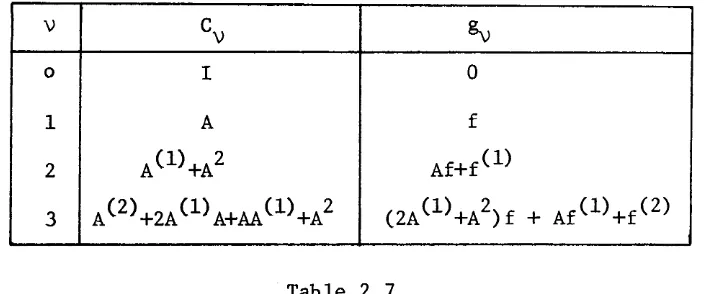
The terms of p a r t i c u l a r i n t e r e s t a r e c o n t a i n e d i n t h e f o l l o w i n g t a b l e .
Table 2.7
[image:31.619.131.484.400.547.2]I n t h e n e x t s e c t i o n , t h i s method w i l l b e improved upon i n t h e s e n s e t h a t t h e f u n c t i o n s Co, C1, C 2 , and C w i l l b e used t o d e f i n e a s i x t h -
3
order-method.
2. Q u a d r a t u r e Employing (2.1) we g e t
where y ( t ) i s t h e e x a c t s o l u t i o n t o ( l . l a , b ) . I f we a p p l y t h e t r a p e z o i d a l r u l e t o ( 2 . 9 ) , t h e r e s u l t i s
T h i s may b e e q u i v a l e n t l y w r i t t e n a s
u s i n g t h e f u n c t i o n s i n T a b l e 2.7. T h i s one-step method and o t h e r s of a r b i t r a r i l y h i g h o r d e r may b e d e r i v e d i n a more g e n e r a l s e t t i n g by means of (2.9)
.
Lemma 2.11. L e t b ( t ) E cdl[a,b]. Also l e t polynomials p i ( t ) b e
d e f i n e d by
wh.e r e
5,
E [ a r b ] . Then+
( - l ) & l (s) b(&') ( s ) d s,
(2.12a) and, f o r m a l l y , i s
v-1
IP,-,(t)l5
Ib-alThus,
Innumerable schemes p r e s e n t themselves by way of t h i s
Lemma. The Euler-Maclarin sum formula may b e d e r i v e d u s i n g polynomials which l o o k l i k e
of a r b i t r a r i l y high o r d e r . A f i f t h - o r d e r method d e f i n e d i n t h i s manner i s
One u n d e s i r a b l e a s p e c t of (2.13) i s e v a l u a t i n g c 4 ( t ) and g ( t ) . I n 4
o r d e r t o employ (2.13) w e must e v a l u a t e ( t )
,
( t ),
A(') ( t ),
A(t),
f (3) ( t ),
f C 2 ) ( t ),
f ( I ) ( t ),
f ( t ) and a s s o r t e d p r o d u c t s and sums oft h e s e f u n c t i o n s .
3. Gap schemes Thus f a r , w e have c o n s i d e r e d s e v e r a l one-step schemes. The c e n t e r e d - E u l e r scheme w a s g e n e r a l i z e d i n S e c t i o n 1 t o a f o u r t h - o r d e r a c c u r a t e scheme. T h i s i n c r e a s e i n a c c u r a c y i s bought a t t h e p r i c e of e v a l u a t i n g AC2) ( t )
,
A(') ( t ),
f (2) ( t ),
and f ( I ) ( t ) i n a d d i t i o nt o A(t) and f ( t )
.
I n S e c t i o n 2, t h e Euler-Maclarin Sum Formula was used t o d e f i n e a f i f t h - o r d e r method, b u t t h i s d i f f e r e n c e schemer e q u i r e d e v a l u a t i o n of ( t )
,
f (3) ( t ) and a l l lower o r d e r d e r i v a t i v e s . S i n c e each new f u n c t i o n t o b e e v a l u a t e d i n c r e a s e s b o t h programmingcomplexity and computation time, we want t o examine h i g h - o r d e r , one- s t e p methods w i t h a minimum of d e r i v a t i v e s r e q u i r e d .
The c e n t e r e d - E u l e r scheme and t h e T r a p e z o i d a l Rule (2.10) p o s s e s s a n o t h e r u s e f u l p r o p e r t y . Each of t h e s e d i f f e r e n c e schemes h a s a t r u n c a t i o n e r r o r expansion which c o n t a i n s o n l y even powers of 11
For r e a s o n s t h a t w i l l become c l e a r , s e e S e c t i o n 6 on a s y m p t o t i c e r r o r e x p a n s i o n s , w e want t o p r e s e r v e this p r o p e r t y i n c o n s i d e r i n g high- o r d e r methods.
R e c a l l i n g Lemma 2.11, we have the r e s u l t
b
+
( - l ) & lf
P&l (s) b(&') ( s ) ds. aV=m
I f t h e sequence of polynomials ( p V ( t )
lvmo
-
c o u l d be d e f i n e d i n such a way t h a t13y(a) = pV(b) = 0 v=n+l,. ,
.
,2nt h e n a d i f f e r e n c e method of o r d e r 2n can b e d e f i n e d which r e q u i r e s t h e e v a l u a t i o n of A - )
( 1 ,
f("-') ( t ),
and a l l lower-order d e r i v a t i v e s . For i n s t a n c e , a f o u r t h - o r d e r method s o d e f i n e d r e q u i r e s e v a l u a t i n g ~ ( " ( t ) and f(') ( t ) where a s t h e g e n e r a l i z e d c e n t e r e d - E u l e r scheme needs ~ ( " ( t ) , f ( 2 ) ( t ) , e t c .1 n n
Then
a ) ( p v ( t ) ) s a t i s f y conclusion a ) of Lemma 2.11.
Proof: We can r e p l a c e (.2.15a) w i t h
and t h e sequence s a t i s f i e s c o n c l u s i o n a ) of Lemma 2.11.
b.
5
Ib-alZn and t h e r e s u l t i s immediate by i n d u c t i o n .c. Immediate from (2.15a).
d. To prove t h i s p a r t of t h e Lemma, i t i s s u f f i c i e n t t o show t h a t p 2 r ( t ) , r
2
n , i s an even f u n c t i o n about t =-
b+a Without2 - b+a
l o s s of g e n e r a l i t y , we assume t h a t
-
-
2
-
0 , t h u stZr
= 0 .BY
h y p o t h e s i s ,
p
2n ( t ) i s even aboutF,
hence we assume t h a tp
2 (v-1) ( t > i s an even f u n c t i o n .3
n
t-l
I
-
(L)
R e c a l l i n g t h e d e f i n i t i o n of P ( t )
,
f o r L < n, P-
( t i ) = 0 .Thus,
-
-
m!2n! (m-n) ! (2n-m) n! ! ( h i ) 2 n - m *
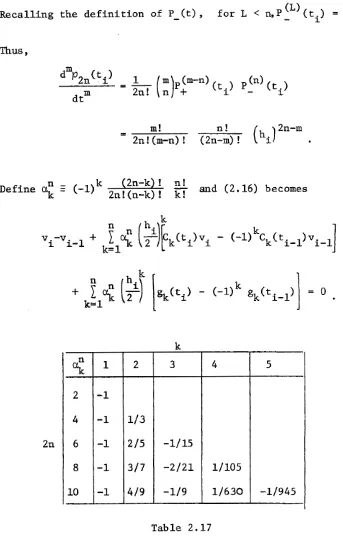
Define
8
-
(-1) k(2n-k) !
"I
and (2.16) becomes2n!(n-k)! k!
Table 2.17
[image:39.619.102.445.75.615.2]Fourth-order scheme:
S i x t h - o r d e r scheme :
The m a t r i c e s C and t h e v e c t o r s gv a r e d e f i n e d i n Table 2.7.
V
D r . K e l l e r n o t e d t h a t t h e s e gap schemes might b e d e r i v e d u s i n g Hermite i n t e r p o l a t i o n t o e s t i m a t e t h e f u n c t i o n
b ( t ) = A ( t ) y ( t )
+
f ( t ).
For
the
f o u r t h - o r d e r gap scheme ( 2 . 1 8 ) , we w r i t eb ( t ) = H(t)
+
( b ( t )-
H ( t ) )R e c a l l i n g t h e i n t e g r a l e q u a t i o n (2.1)
,
we havef f ( t ) may be i n t e g r a t e d e x a c t l y t o g e t
4.
Other Schemes We a r e p a r t i c u l a r l y i n t e r e s t e d i n one-stepd i f f e r e n c e schemes of t h e form (2.2)
,
(2.5),
and (2.18),
t h u s o n l y a b r i e f mention w i l l b e made of o t h e r methods. The i n t e g r a l e q u a t i o n(2.1) s u g g e s t s k - s t e p methods of t h e form
Note t h a t (2.20) r e p r e s e n t s (J-k+l)n e q u a t i o n s i n ( J + l ) n unknowns, and
kn
more e q u a t i o n must b e found t o d e t e r m i n e V u n i q u e l y . These e x t r a e q u a t i o n s are g i v e n by t h e u s u a l boundary c o n d i t i o n s (1.5b) and byI1
s t a r t i n g " m-step d i f f e r e n c e schemes, m
<
k , u s u a l l y of lower o r d e r t h a n (2.20). I n many c a s e s t h e " s t a r t i n g " scheme i s a one-s t e p scheme. Combining a l l of t h e s e e q u a t i o n s i n t o t h e formt h e i n i t i a l - v a l u e matrix,
Ih,
i s lower t r i a n g u l a r . I f t h e one-stepI1
s t a r t i n g " scheme i s of lower o r d e r t h a n t h e k - s t e p method, t h e mesh s i z e , h ( l ) , a s s o c i a t e d w i t h t h e one-step method s h o u l d b e s m a l l e r t h a n t h a t of t h e k-s t e p method, h(k)
.
I f t h e methods a r e of o r d e r p and q r e s p e c t i v e l y (p<
q),
t h e n C o r o l l a r y 1.27 i n d i c a t e s t h a t h ( 1 ) and h(k) s h o u l d b e r e l a t e d by5. S t a b i l i t y of T r i a n g u l a r D i f f e r e n c e Schemes A l l of t h e methods mentioned h e r e and most of t h o s e commonly used g i v e r i s e t o b l o c k
i n the form
The f a c t o r of J appearing w i t h a l l M ' s i s a n o r m a l i z a t i o n of t h e
i
ji n v e r s e of t h e mesh s i z e . We would l i k e t o examine t h e s t a b i l i t y of f a m i l i e s of m a t r i c e s
1
of t h i s form. The s t a b i l i t y theory f o r d i s c r e t eh
i n i t i a l - v a l u e problems i s well-developed provided t h a t a k-s t e p d i f f e r e n c e scheme i s used and a l l Mij can be w r i t t e n a s
M.
. I ,M
a1 J i j
s c a l a r . We a r e i n t e r e s t e d i n a r e s u l t which does n o t r e q u i r e t h e s e two r e s t r i c t i o n s on
I
h e
Lemma ( 2 . 2 2 ) . L e t
Ih
be a m a t r i x of t h e form of (2.21).
Define-1 1
L e t Do b e n o n s i n g u l a r and l e t
I
IDoI I
=d ,
I I D ~ I
I=
dl,1 1 ~ ~ 1
I
= n o ,0
0
and
I
IN1/1
= nl, independent of J. F u r t h e r , l e t-
d-
<
1. Then0
Proof : T h e matrix
1
i s w r i t t e n a s-
h
o r , e q u i v a l e n t l y
where
and
-1
By h y p o t h e s i s and the Banach Lemma, D
+
J D i s n o n s i n g u l a r f o r0
I
I
Since (Do
+
J-'D~)-' i s block d i a g o n a l and (N o+
J - h l ) i s block n i l p o t e n t , t h e product (Do+
J - ~ D ~ ) - ~ (N o+
J m b l ) i s block n i l p o t e n t . Thus,Combining C o r o l l a r y 1.27 and Lemma (2.22)
,
we s t a t e t h e following Theorem without proof,Theorem 2.24. L e t t h e l i n e a r boundary-value problem ( l . l a , b ) have a 1
unique s o l u t i o n y ( t ) E C [O,l]. Also, l e t t h e d i f f e r e n c e scheme be pth-order a c c u r a t e . L e t
Bh
be of t h e form-1 1 where M
is
nonsingular f o r everyi=O
,
.
.
.
,
J andI
1
M1 1
5
2
,
ii
vv
0
-
I
I M ~ ~ ~
I
5
dl, independent of J. F u r t h e r , l e tn
0
and
- 5
1.
Then f o r h<
H, H s u f f i c i e n t l y s m a l l ,d 0
-
0
This
Theorem g i v e sa
p r e c i s e e s t i m a t e on t h e convergence of finite6. Asymptotic E r r o r Expansions
I n S e c t i o n 3, t h e gap schemes were d e r i v e d s o t h a t t h e t r u n c a t i o n e r r o r expansion would have only even powers of h The
i * advantage of t h i s arrangement w i l l b e e v i d e n t i n t h i s d i s c u s s i o n . The g e n e r a l d i f f e r e n c e scheme i s d e f i n e d a s
The t r u n c a t i o n e r r o r i s h e r e d e f i n e d t o b e
where
z(t)
e c ~ + ~ [ 0 , 1 ] .For example, E u l e r ' s method has t h e t r u n c a t i o n e r r o r , l e t t i n g
-
tR
-
timl'I n g e n e r a l , t h e t r u n c a t i o n e r r o r w i l l be assumed t o b e of t h e form
where e a c h
f
(A,f) i s a l i n e a r d i f f e r e n t i a l o p e r a t o r of a t most o r d e rk
k + l which depends, in g e n e r a l n o n l i n e a r l y , upon A ( ~ ) ( t R )
,
f ( k ) ( t R ) and a l l lower o r d e r d e r i v a t i v e s . For E u l e r ' s method,Theorem 2.27. Let t h e d i f f e r e n t i a l e q u a t i o n ( l . l a , b ) have a unique s o l u t i o n y ( t ) E
c
q + l ~ ~ , l ] where A(t) E cq[O,l] and f ( t ) E c q ~ 0 , 1 ~ .Let
b e a s t a b l e , c o n s i s t e n t d i f f e r e n c e approximation t o (1. l a , b )
.
F u r t h e r , let t h e t r u n c a t i o n e r r o r be given bywhere z ( t ) E C P+l[O,l] and tR = ti
+
O(hi).
Also l e tF k ( ~ ( t )
,
f ( t ) ) z ( t ) Ecv
[ 0 , l ] wherev
=midp-k,q-k} .
Then f o r a l l n e t s w i t h h<
H,
H s u f f i c i e n t l y s m a l l ,where y o ( t ) = y ( t ) and y k ( t ) , k 1, i s d e f i n e d by
Proof: By i n d u c t i o n and t h e c o n t i n u i t y of
F
(A,£), A(t),
and f ( t ),
-
ki t can b e shown t h a t
Immediately upon s u b s t i t u t i n g
i n t o t h e t r u n c a t i o n e r r o r expansion (2.28b), we g e t
S i n c e yk(t) s a t i s f y (2.30a), we have immediately
and hence
By h y p o t h e s i s , t h e d i f f e r e n c e scheme i s s t a b l e , t h u s
O r e q u i v a l e n t l y ,
The e x p r e s s i o n (2.29) f o r vi
-
y ( t .) i s termed t h e asymptotic1
e r r o r expansion. I n t h e f o l l o w i n g d i s c u s s i o n we assume t h a t
y ( t ) E
cm[O,l],
A(t) E cm[O,l], and f ( t ) E cm[O,l]. Suppose t h a t t h et r u n c a t i o n e r r o r -ri[z(t)] h a s only even powers of h t h a t i s , i'
F2k+l = 0 , k=O,l,
.
.
.
.
The f u n c t i o n y l ( t ) is d e f i n e d byS i n c e t h e d i f f e r e n t i a l e q u a t i o n ( l . l a , b ) h a s a unique s o l u t i o n ,
Assume
t h a t y2k-l(t) Z 0 , k=1,2,...,
v,
then y2vtl(t) i sn
B
r-l+
d h) V U h* r-l
b?
"
g
,
4 &" 3 :
a z r t
3
. " ! g
& rl h U 0 k i
k
r l m
+
It
a
$ 8
kh *rl 0
U k
a &
8 a a
5
5
"
k 4
- U L )
(I]
*I4
d
3
a (I]
a, * -rl
2 4
because the h. and h
terms
a r e nonvanishing i n (2.32). However,1
i
c l o s e r examination of
F2
andF4
y i e l d s t h e f o l l o w i n g i d e n t i t i e s :d
-
~ ( A ' ~ ) - ~ A A ( ~ ' - ~ A ( ~ ) A-
d t[Lz
( t R ) -f ( t R ) ]+
~(A(~)A+A~(~)+~A(~)A(~))
[Lz
( t R ) -£( tR) ]1-
Thus,
y 2 ( t ) i s d e f i n e d byHowever, from (2.33) i t can b e s e e n t h a t
Theorem (2.27) and the i d e n t i t i e s ( 2 . 3 3 ) and ( 2 . 3 4 ) show that for t h e Gap6 d i f f e r e n c e scheme
where y 6 ( t ) i s d e f i n e d by
7.
I n c r e a s e d Accuracy W ew i l l c o n s i d e r two methods of i n c r e a s i n g
t h e accuracy of numerical s o l u t i o n s t o t h e d i f f e r e n t i a l e q u a t i o n (1. a , ) . These methods a r e , by name, Richardson h -t o e x t r a p o l a t i o nand FOX'S method of Deferred C o r r e c t i o n s (Fox [
2
1,
P e r e y r a [9
1)
.
Both methods r e l y
on
t h e e n t i r e t r u n c a t i o n e r r o r s e r i e s rather than t h e o r d e r of accuracy. Richardson e x t r a p o l a t i o n employs a s o l u t i o n of the d i s c r e t e problem on two d i f f e r e n t n e t s t o e l i m i n a t e s u c c e s s i v e e r r o r terms; t h e method of Deferred C o r r e c t i o n s u s e s a s o l u t i o n t o t h e d i s c r e t e problem t o approximate t h e f i r s t t r u n c a t i o n e r r o r term.U
[I]
k rl
'44 Q)
k 3 a Q) 0 0 k a [I] rl
6
U cd5
Q) U 0 E: n .9, cd d I-l u 0 Ug
d U 3 rl 0 rn Q) U cd k5
0 cd k Q) a k 0 rl a k Q) 3 a [I]3
C2
0 d U C) a k k 0 U a a, k k Q) w8
w 0 a 05
8
8
h ur CV w3
2
rnhl \ d I =rl w I n rl I
dfd
rl *rl 3 U N 1 rl I I n rl I r l d?
f-1 -rl3 U
disadvantages. At the boundary t=O, the quantity vo must be defined
-1
and thus we have to examine the solution outside the domain of interest.
Also, the solution procedure for
V O issignificantly different than
(2.38) where the approximation to the first truncation error term is
included. Evaluation of higher-order derivatives of y(t)
is at best a
delicate procedure and must be done with the utmost care.
Richardson extrapolation avoids these particular problems.
Once two aolutions are calculated, each on a different net, the power
structure of the asymptotic error expansion is used to eliminate the
leading error term at those points common to both nets. For example,
the sixth-order gap scheme has an asymptotic error expansion of the
form
If we solve the discrete problem twice for {vi (1)
3
and {vi(2)
1 ,
then
Let ti(l)
=t.
(2), where t
(1)
is the ith point of the first net and
J
i
t
.
(2) is
the
jth
point of the second net.
Jthen
This
elimination procedure may, of course, be carried on as long asi s practical, tkat i s , u n t i l the continuity of y ( t ) or round-off
Chapter I11
P a r a l l e l Shooting
T h i s c h a p t e r examines t h e r e l a t i o n s h i p between i m p l i c i t f i n i t e d i f f e r e n c e p r o c e d u r e s and d i s c r e t e i n i t i a l - v a l u e t e c h n i q u e s . The proof of Theorem 1.16 y i e l d s t h e f o l l o w i n g r e s u l t : I f b o t h t h e boundary-value p r o c e d u r e
and t h e i n i t i a l - v a l u e p r o c e d u r e
BV
have un'ique s o l u t i o n s , t h e n
vIV
= Vi,
i = o , .. .
,J. That i s , t h e1
p r o c e d u r e ( 3 . 2 a , b , c ) i s a c t u a l l y a method of s o l v i n g t h e e q u a t i o n s ( 3 1 ) The main r e s u l t of t h i s c h a p t e r s t a t e s t h a t any p a r a l l e l s h o o t i n g t e c h n i q u e i s a l s o e q u i v a l e n t t o (3.1) and, t h u s , t o
( 3 . 2 a , b , c ) .
o r t h o g o n a l i z a t i o n p r o c e d u r e ( f o r example, see S e c t i o n 2 on t h e
Method of Complementary F u n c t i o n s ) . W e i n c l u d e a s e p a r a t e t r e a t m e n t of t h e Method of Complementary F u n c t i o n s i n o r d e r t o i l l u s t r a t e
t h e i m p o r t a n t c a s e of s e p a r a t e d boundary c o n d i t i o n s . For completeness t h e Method of A d j o i n t s w i l l b e d i s c u s s e d even though i t h a s no s i m p l e r e l a t i o n s h i p t o (3.1)
.
1. P a r a l l e l Shooting
The boundary-value problem of i n t e r e s t i s
du
- -
d t A ( t ) u
-
f ( t ) = o t E [0,11 a )(3. 3 )
The s i m p l e s h o o t i n g method (Theorem 1 . 2 ) u s e s t h e s o l u t i o n of (n+l) i n i t i a l - v a l u e problems t o g e n e r a t e t h e s o l u t i o n of ( 3 . 3 a , b ) . I n
p a r a l l e l s h o o t i n g , t h e i n t e r v a l [ o , l ] i s d i v i d e d i n t o K n o n o v e r l a p p i n ~ s u b i n t e r v a l s , [Ty, Tv+l], and s e p a r a t e i n i t i a l - v a l u e problems a r e
s o l v e d on each s u b i n t e r v a l .
he
s o l u t i o n of (3.3a,b) i s c o n s t r u c t e d by r e q u i r i n g c o n t i n u i t y a t Tv,v
= 1,...,
K-1, and s a t i s f a c t i o n of t h e boundary c o n d i t i o n s (3.3b).D i s c r e t e p a r a l l e l s h o o t i n g methods mimic t h i s p r o c e d u r e . we p l a c e a n e t ( t y ~ f : ~ on each s u b i n t e r v a l [ T
v-l,
'fV]. On t h i s n e t , a d i s c r e t e i n i t i a l - v a l u e problem i s s o l v e d w i t h i n i t i a l c o n d i t i o n sV V
Zo, zo. These n + l i n i t i a l c o n d i t i o n s a r e a r b i t r a r y e x c e p t t h a t
V
we r e q u i r e t h e n x n m a t r i x
Z
b e n o n s i n g u l a r . T h i s i n i t i a l - v a l u e0
o r , e q u i v a l e n t l y we w r i t e
V ' V
z
1
z
1
= j r v ] .I I
I n p a r a l l e l s h o o t i n g , i t i s sometimes n e c e s s a r y t o s t a t e a n i n i t i a l - v a l u e problem on some i n t e r v a l [T
V '
Tvcl]
backward byf o r m a l l y g i v i n g n + l "boundary" c o n d i t i o n s a t T r a t h e r t h a n v + l
" i n i t i a l " c o n d i t i o n s a t T However, Theoren 1.16 s t a t e s t h a t f o r
v *
a l l n e t s w i t h ho 5 H,
H
s u f f i c i e n t l y s m a l l , t h e s o l u t i o n t o t h i s backward problem i s e q u a l t o t h e s o l u t i o n of (3.4) w i t hzV
and z V0 0
a p p r o p r i a t e l y chosen. Thus, i n o r d e r t o exaniine t h e most g e n e r a l p a r a l l e l s h o o t i n g methods, i t i s s u f f i c i e n t t o c o n s i d e r d i s c r e t e i n i t i a l - v a l u e problems of t h e form (3.4).
V
D e f i n i n g Z
,
zv by ( 3 . 4 ) , t h e s o l u t i o n of any i n i t ia l - v a l u ev
Jproblem on t h e n e t { t i j i i 0 i s g i v e n by
Thus, t h e c o n t i n u i t y r e q u i r e m e n t s f o r p a r a l l e l s h o o t i n g a r e
Combining ( 3 . 5 ) , ( 3 . 6 ) , (3.,7), and (3.8), t h e p a r a l l e l s h o o t i n g s o l u t i o n ,
vPS,
i s g i v e n byS t a b i l i t y . For t h e p u r p o s e s of t h i s d i s c u s s i o n , t h e d i s c r e t e p a r a l l e l initial
value
problem is saidto
be stable ifI n t h e p r o o f s t o f o l l o w , d e f i n e t h e nJv x n ( J +1) m a t r i x
v
V
The i n i t i a l - v a l u e m a t r i x
I
a s s o c i a t e d w i t h a p a r a l l e lshoot in^
hprocedure i s
For convenience, we w i l l w r i t e t h i s m a t r i x a s (K = 3 )
where t h e (1,o) block element of M' i s t h e (SV+2, Sv+l) block element of
1
h'1
Theorem 3.13. Let (3.3a,b) have a unique s o l u t i o n y ( t ) Ec
[ o , l ] .Let t h e d i f f e r e n c e scheme be c o n s i s t e n t w i t h (3.3a). Then t h e following a r e e q u i v a l e n t :
a)
The d i s c r e t e i n i t i a l - v a l u e problem is stable.v
-1-
By h y p o t h e s i s
I
I(lh)I
I
5 K,v
= l , . , . , ~ , then -K1
1
1
1
5 maxIK
,
11-
a)
=>
b ) Without l o s s of g e n e r a l i t y , w e w i l l c o n s i d e r t h e c a s e i n which t h e i n t e r v a l [ o , l ] i s d i v i d e d i n t o 3 s u b i n t e r v a l s , K = 3. The f i r s t s t e p i s t o show t h a t t h e m a t r i xrh,
d e f i n e d below, i s n o n s i n g u l a r ,M
2By u s i n g t h e F a c t o r i z a t i o n Lemma (1.12), t h e Reducing Lemma ( 1 . 1 3 ) , and t h e convergence of t h e i n i t i a l - v a l u e problem, i t c a n b e shown t h a t
where K i s independent of ho.
1
1 2 3
L e t V , V , V b e nJ1, n ( J + I ) , n J v e c t o r s r e s p e c t i v e l y .
2 3-
Consider t h e n ( J + l ) e q u a t i o n s
where g2 i s any n ( J 2 + 1 ) - v e c t o r . S i n c e
7
i s n o n s i n g u l a r,
f o r each h2
g2 t h e r e i s a V s u c h t h a t
R e c a l l i n g ( 3 . 1 4 ) , we f i n d t h a t
Thus,
T h i s argument i s v a l i d f o r any
v
= 1,...,
K, t h u s we havev
-1B e f o r e p r o c e e d i n g w i t h t h e theorem which w i l l t i e a l l t h r e e of t h e s e d i s c r e t e methods t o g e t h e r , i t i s c o n v e n i e n t t o p r e s e n t two lemmas.
Lemma 3.17. L e t C1, C b e n o n s i n g u l a r m x m m a t r i c e s . L e t C1 and
-
2C2 b e r e l a t e d by
where L, N a r e m x q , q x m m a t r i c e s r e s p e c t i v e l y . F u r t h e r , l e t L have r a n k q I m. Then t h e q x q m a t r i x [ I
+
NL] i s n o n s i n g u l a r .P r o o f . By h y p o t h e s i s C1 i s n o n s i n g u l a r , t h e r e f o r e f o r e a c h b E E?,
t h e r e e x i s t s a unique m-vector, x, s u c h t h a t
R e c a l l i n g ( 3 . 1 8 ) , t h i s e q u a t i o n c a n b e r e w r i t t e n a s
o r e q u i v a l e n t l y a s
The Reducing Lemma (1.13) s t a t e s t h a t (3.19) o n l y h a s s o l u t i o n s of t h e form
S i n c e a u n i q u e x, s o l u t i o n of (3.19), e x i s t s f o r e v e r y b , t h e m a t r i x ( I
+
hZ) must b e n o n s i n g u l a r .Lemma 3.20. L e t t h e ~ ( J + K ) x ~ ( J + K ) expanded boundary-value m a t r i x
-
8'
b e d e f i n e d by hL e t t h e boundary-value mat r i x
Bh
b e n o n s i n g u l a r.
Then n o n s i n g u l a r .P r o o f . Suppose t h a t
B~
i s s i n g u l a r , t h e n t h e r e i s a ~ ( J + K ) - v e c t o rh
E
V such t h a t
E
However, i f we d e l e t e t h e K-1 e l e m e n t s
v
i = SV+v,v
= 1,...,
K-1, i'E
By h y p o t h e s i s
Rh
i s n o n s i n g u l a r , t h u s1
[ v [
1
= O . Note t h a t f o rE
each element
vE
d e l e t e d from V t o form V iand vE a p p e a r s a s a n element of V. Thus, i-1
E
and by c o n t r a d i c t i o n , w e have 8 n o n s i n g u l a r . h
m
Now, w e s t a t e and prove t h e main theorem o f t h i s C h a p t e r , which w i l l i n c l u d e Theorem 1.16.
1
Theorem 3.22. L e t ( 3 . 3 a , b ) have a unique s o l u t i o n y ( t ) E
c
[ o , l ].
L e t t h e d i f f e r e n c e scheme employed b e c o n s i s t e n t w i t h (3.3a). Denote by B V ,
IV,
and P S the following methods:BV. D i s c r e t e boundary-value p r o c e d u r e , (3.1)
,
I V . D i s c r e t e i n i t i a l - v a l u e p r o c e d u r e , (3.2a,b,c), PS. D i s c r e t e p a r a l l e l s h o o t i n g p r o c e d u r e , ( 3 . 9 a , b , c ) . L e t one of the d i s c r e t e p r o b l e m s (3. I ) , ( 3 . 2 a ) , and ( 3 . 9 a ) be stable.Then, f o r a l l n e t s w i t h ho 5 11, H s u f f i c i e n t l y s m a l l ,
i) Each method u n i q u e l y d e f i n e s a n n ( J + l ) v e c t o r as an approximation t o y ( t ) on t h a t n e t , and
Proof: Note that stability
of (3.1) is equivalent to (3.2a)
or (3.9a).
Re
i).
Theorem 1.16 proves that methods
SVand
IV
uniquely
define approximations to y(t).
To show that method PS uniquely
defines an approximation it is sufficient to show that
thenK
xnK
matrix in (3.9b) is nonsingular. Without loss of generality, we
consider the case where
K =3. Thus, we want to show that the
3n
x3n matrix
P,
defined by
is nonsingular. From conclusion i),
Bh
is nonsingular, hence by
E
Lemma 3.20,
8
is nonsingular. Recall the n(J+l)-vector
rin
hE
(3.la), and define the ~(J+K)-vector r by
Consider the matrix equation
R e c a l l i n g t h e p a r a l l e l s h o o t i n 3 method [ 3 , 9 a , b , c ) , eq-uation (3.23) can b e w r i t t e n a s
where
and
-
I n z e n e r a l , L i s a n(J+K)x nK 1 n a t r i x ,
<
i s a n ( n ~+
1 ) - v e c t o r , and N i s a nK+
1 x n(J+K) m a t r i x . R e c a l l i n g Lemma 3.17, w e n o t e t h a ti s n o n s i n g u l a r , where
When t h e p r o p e r s u b s t i t u t i o n s a r e made, i t i s c l e a r t h a t (I
-
NL)
i s n o n s i n g u l a r i f and o n l y i f P i s n o n s i n g u l a r .vBV
=vIV*
Recalling (3.23), t h e Reducing Lemma 0 . 1 3 ) s t a t e s t h a twhere t h e n-vectors, wi, must s a t i s f y
Now, we have t h e r e l a t i o n s h i p
and thus
itis clear that
IV
vps
=vBv =
v
,Unfortunately, Theorem (3.22) contains no information on
the numerical stability of any parallel shooting technique. To
say that a unique solution to the difference equations (3.9a,b,c)
exists is not to say that it can be accurately approximated
numerically. It is well-known that a simple shooting method may
produce disastrous numerical solutions if the linearly independent
solutions of (3.3a) grow at different rates. For example, consider
the problem
This problem has a unique solution for all f(t)
Ec[o,l] and
2
f3 E
E
,
because the matrix
1
+
e
6o1
[Bo
+
BIX(l)
1
=1
60-..]
l + e
l + e
is nonsingular. However, if we try to invert this matrix numerically,
on a machine with less than 85-bit accuracy, the computer will
be numerically singular due to round-off error. For this reason,
methods which are equivalent
inthe sense of Theorem 3.22 may yield
greatly different numerical solutions.
2. Method of Complementary Functions
The Method of Complementary Functions (Goodman and Lance
[ 3 ] )
is used to approximate the solution of (3.3a,b) when the boundary
conditions are separated. That is, the boundary conditions (3.3b)
can be written as
where Bo is a
p xn matrix of rank
p, Bis a
q xn matrix of rank
1
q y p
+
q
=n, and Bo,
B1
are a p-vector, q-vector respectively. In
this section, we use the convention that a single matrix in parentheses,
(B,),
has p rows and a single matrix in brackets,
[B
1, has
qrows.
1The original equations (3.3a9b) can now be rewritten as
In what follows, we assume that the boundary-value problem (3.27ayb)
has a unique solution y(t).
If the boundary-value problem has
a
unique solution, then there exists
avector
qsuch that
0
(Do)qo
=(Bo)
where q o
is orthogonal to the null space of
(E ) .Let the orthonormal
s e t { ~ ~ } z = ~ span t h e n u l l s p a c e of (Bo), t h e n
(qi, ?'lo) = 0 1 s i S q .
With t h e s e n o t i o n s i n hand, t h e s o l u t i o n of (3,27a,b) c a n b e c h a r a c t e r i z e d i n t h e f o l l o w i n g way. S o l v e t h e q homogeneous i n i t i a l - v a l u e problems
and t h e inhomogeneous problem
The unique s o l u t i o n of (3.27a9b) i s g i v e n by
where t h e c o n s t a n t s
cii,
i = . . q , a r e determined fromI n t h e i n t r o d u c t i o n t o t h i s c h a p t e r , i t was s t a t e d t h a t t h e Method of Complementary F u n c t i o n s i s a s p e c i a l c a s e of p a r a l l e l s h o o t i n g . T h i s i s t h e b e s t p o i n t a t which t o make t h i s r e l a t i o n s h i p c l e a r . P a r a l l e l s h o o t i n g n a t u r a l l y c o n t a i n s t h e c a s e of s i m p l e
and t h e inhomogeneous problem
--
dx(t)-
A ( t ) x ( t )+
f ( t ) d twhere C i s a n o n s i n g u l a r n x n n a t r i x and c i s an n - v e c t o r . Now,
where t h e n - v e c t o r i s d e t e r m i n e d by
The r e s u l t of s p e c i a l i z i n g t h e s i m p l e s h o o t i n g p r o c e d u r e ( 3 , 3 2 a , b ) , ( 3 . 3 3 a , b ) , ( 3 . 3 4 ) , (3.35) by t a k i n g
i s t h e Method of Complementary F u n c t i o n s .
(3.29a,b), (3.30), and (3.31) numerically. Solve the
qhomogeneous
discrete initial-value problems
and the inhomogeneous discrete initial-value problem
-
-
For convenience, we write (3.32), (3.33) as
c.
-
'li
0
0 L r
i
where Z is
a(J+l)n
x qmatrix with its ith column being
z.
Thediscrete approximation to
y ( t )is given
byThe i n i t i a l - v a l u e e q u a t i o n (3.34) may b e f o r m a l l y w r i t t e n