This is the Accepted Version of a paper published in the
Journal: Rural Society
McCarthy, Breda, Eagle, Lynne, and Lesbirel, Hayden (2017) Barriers to the diffusion of renewable energy in Queensland. Rural Society. pp. 1-15. (In Press)
http://dx.doi.org/10.1080/10371656.2017.1364480
© 2015. This manuscript version is made available under
the CC-BY-NC-ND 4.0 license
http://creativecommons.org/licenses/by-nc-nd/4.0/
BARRIERS TO THE DIFFUSION OF RENEWABLE ENERGY IN QUEENSLAND
ABSTRACT
Renewable energy (RE) is needed for the low-carbon future envisioned in the 2015 Paris climate change agreement. This article comparatively evaluates the RE performance of two states in Australia to show how government policies affect energy transitions. The ‘complex systems’ perspective is used as a theoretical lens and it elucidates the constraints to RE transitions. Ambitious targets at state level and sustained political support are required to overcome the multi-dimensional barriers to RE transitions. However, given the complexity of the energy system, governments should pursue collaborative efforts across states and with various stakeholders to avoid conflicts. They need to address concerns about rising electricity prices and energy security if the much needed decarbonisation of the electricity sector is to take place.
Key words: renewable energy targets, climate change.
INTRODUCTION
Mitigating human-induced climate change is one of the greatest challenges facing society today. There is a general recognition that deep cuts in greenhouse gas emissions (GHG) are required in order to limit global warming over the 21st century to below 2°C relative to pre-industrial levels (IPCC, 2014). Today’s energy supply is largely responsible for climate change, acid rain and other negative impacts on health and the environment (Quaschning, 2016). Climate change can be mitigated by embracing renewable energy (RE) technologies, using carbon dioxide capture and storage (CCS) technologies and reducing energy demand (IPCC, 2014). The need for a global response to the threat of climate change was emphasised by the United Nations’ 21st Conference of the Parties (COP21) at the end of 2015 (the Paris Agreement), although it failed to reach any legally binding agreement by any participating country to reduce carbon emissions (UNFCCC, 2016). 2015 was a record year for renewable energy and total capacity has now overtaken coal. The share of renewables in electricity is expected to rise from 23% to 28% over 2015 to 2021 and most growth will be in four key markets, China, the USA, EU and India (International Energy Agency, 2016). In contrast to global trends, RE sources account for only 7% of electricity generation in Australia, although its use has been increasing strongly in recent years (GeoScience Australia, 2017). Australia has one of the most coal-and-gas dependent electricity supplies in the world and one of the highest per capital rates of GHG emissions from the consumption of energy (Heard, Bradshaw & Brook, 2015).
New RE sources (solar, wind, small hydropower, geothermal and bio-energy) have great potential to contribute to global energy supplies and reduce global emissions. A transition to renewable-based energy systems is looking increasingly likely as the costs of solar and wind power systems have dropped dramatically in the past 30 years, and furthermore, policy mechanisms to support the diffusion of renewables have evolved (Akella, Saini & Sharma, 2009). The social benefits of RE include improved health, work opportunities, greater self-reliance, consumer choice and taking advantage of technological advances. The
environmental benefits include reduced air pollution, lower GHG emissions and maintaining natural resources for the long term. Economic benefits include job creation in the
weather conditions are favourable. However, it is argued that having a diversity of solar and wind sites, using energy storage options, gas turbine plants and reducing demand peaks, will protect the current reliability standard (Elliston, Diesendorf & MacGill, 2017).
This article addresses the challenges that a transition to RE poses for regional Australia. A comparative case study of two states in Australia is outlined and recommendations for improving RE planning are given. Given that much of Australia’s solar and wind resources exist in rural areas of Australia with low population and marginal agricultural land (Climate Council of Australia, 2016), there may be opportunities for rural communities to exploit clean energy and avoid the externalities associated with coal. The social, environmental and health impacts of coal mining on local communities have been well documented in the literature (Morrice & Colagiuri, 2013).
The article is structured as follows. First, we provide a literature review on theoretical explanations for energy transitions and we elaborate on barriers to energy transitions. We introduce the complex systems perspective as a theoretical lens with which to explore energy transitions. Next, the research methods section contains an account for the methodology, including the case study selection and data analysis. This is followed by a presentation of the data findings and a discussion. We end this paper with conclusions and a reflection on the prospects for RE development in Australia and in other countries.
LITERATURE REVIEW AND THEORY
Energy transitions and barriers to renewable energy
Australia has considerable natural advantages in RE, but its electricity sector is one of the most carbon-intensive in the world (Clean Energy Council, 2015). The topic of RE has generated a considerable body of academic work, but this is divided between several disciplines such as engineering, economics, political science and sociology. Economic historians have played a key role in understanding the drivers of past energy transitions (such as the rise of coal). Theoretical concepts such as technology life cycles have been useful in explaining energy transitions (Grubler, 2012). There is a growing body of literature on energy transitions (Araújo, 2014), where a transition is defined as a shift in socio-technical systems (Geels, 2004), which unfolds over a long time-span and requires far-reaching changes along different dimensions including technological, organisational, political, economic and socio-cultural (Markard, Raven & Truffer, 2012). Government policies and regulation play a
significant role in stimulating, or obstructing, the development of new energy markets (Biggs, 2016). As Jacobsson & Bergek (2004) note, institutional change lies at the heart of energy transitions and it is a multi-faceted process, including market regulations, tax policies, value systems and R&D policy. Germany, which is Europe's largest economy, is seen as a leader in supporting RE. Its energy transition has had a positive net effect on its economy (Blazejczak, Braun, Edler & Schill, 2014). However, the transition was not an easy one. According to Jacobsson & Lauber (2006), a ‘battle over institutions’, including alterations in research and development (R&D) policy, was needed to overcome opposition from nuclear and coal interests, along with reluctant governments.
sub-optimal outcomes. Incumbent technologies enjoy huge advantages…and since economic strength (investment, income, exports, employment) can be converted into political influence, they can place substantial hurdles in the path of nascent rivals”. Market barriers are largely the domain of the economist and a market barrier is defined by Owen (2006, p. 633) as “anything that slows the rate at which the market for a technology expands.” Market barriers include uncompetitive market price, high cost of finance, poor information, buyer’s risk, regulation and technology-specific barriers (Owen, 2006; Painuly, 2001). The AKTESP framework (Trudgill, 1990) is useful in explaining barriers to solving environmental problems and the acronym stands for agreement; knowledge; technology; economic, social and political factors. Several reports have highlighted the technical challenges that need to be overcome in the Australian market (Belz & Owen, 2010; Deloitte, 2015), but the Australian Energy Market Operator has identified no fundamental barriers to securely operating with high renewables (AEMO, 2016). Regulatory and financialbarriers exist, such as
inconsistencies between states on issues such as network connection costs; licensing and approval processes (Jones, 2009); administrative hurdles; delays in project approvals; high capital costs and insufficient financial incentives (Martin & Rice, 2012).
There are a wide range of policy options for tackling market barriers (Byrnes, Brown, Foster & Wagner, 2013; Beck & Martinot, 2004; Pittock, Hussey & McGlennon, 2013; Queensland Renewable Energy Expert Panel, 2016) and they can be assessed on their effectiveness in reducing energy-related emissions and cost efficiency (MacGill, Outhred & Nolles, 2004). For instance, subsidies such as the feed-in-tariff scheme (FiT) and RE targets have been used to drive RE developments in Australia, just as they have been used elsewhere, such as
Germany (Jacobsson & Lauber, 2006). A FiT is a direct incentive increasing RE and it
typically provides individuals a payment based on volume of electricity exported into the grid (Queensland Renewable Energy Panel, 2016). This subsidy supported the rapid growth of small-scale, roof-top solar in Australia. Large scale solar and geothermal energy, however, struggle to obtain capital funding due to the high upfront capital costs (Byrnes et al., 2013), hence direct support is likely to be required (Clifton & Boruff, 2010). In the Energy White Paper, the federal government favours energy productivity and ‘clean coal’ technologies (i.e., high efficiency, low emission technology) in the future prosperity of the country’s energy market (Australian Government, 2015). The challenge is advancing these technologies to a cost that is commercially competitive (The Minerals Council of Australia, 2017), but such technologies are politically attractive since it justifies continued use of the nation’s extensive fossil fuel resources (Pittock, Hussey & McGlennon, 2013).
There is growing scholarship that discusses transitions to RE in Australia. Scholars have explored levels of social activism in influencing energy transitions (Pearse, 2016). In the literature, citizens are often seen as a bottleneck to social acceptance of energy infrastructure projects (Batel, Devine-Wright & Tangeland, 2013). Community opposition to wind farms in Australia has been explored (Jessup, 2010; Hindmarsh & Matthews, 2008), along with the impact of the coal lobby in the anti-wind farm movement (Muenstermann, 2012).
Furthermore, research has examined the framing of mass media communication on RE. In Australia, reporting on RE has been largely negative with a heavy emphasis on how RE implies economic burdens for both households and industry (Djerf-Pierre, Cokley & Kuchel, 2016).
Predictably, climate change concerns have not been a priority in a carbon-dependent
significant economic benefit to the nation (Department of Industry, Innovation and Science, 2016; GeoScience Australia, 2017). In Australia, it has been argued that the bias towards fossil fuels in political circles has hampered the development of large-scale RE (Clifton & Boruff, 2010). The mandatory renewable energy target (MRET) was introduced in 2001 in the context of Australia’s Kyoto negotiations (Kent & Mercer, 2006) but it became embroiled in debates and was the subject of complex and costly reviews. Kent & Mercer (2006, p. 1046) described the federal government at the time as a “reluctant participant in programs and strategies aimed at emissions’ reduction”. The MRET scheme is compatible with a permit-based emission trading scheme (MacGill, Outhred & Nolles, 2004), but it does not exist in Australia. Australian climate change politics are seen as “tumultuous”, with a national
emissions trading scheme (ETS) being “proposed, shelved, revived, legislated and replaced in the space of six years” (Pearse, 2016, p.1079). Opposition from incumbent groups to new policies underpinning energy transitions is to be expected (Wüstenhagen & Bilharz, 2006). In Australia, a proposal to tax the super-profits of the mining sector was strongly resisted by the mining lobby; the repeal of the mining tax in 2010 led Bell & Hindmoor (2014, p. 474) to conclude that “large industries like mining do indeed occupy a ‘privileged’ position within capitalist systems”. Federal opposition to an economy-wide emissions reduction scheme is said to exist due to economic concerns (Oam, 2006). Furthermore, there are members of the conservative government who are sceptical of climate change and who doubt that it is human induced (Crowley, 2013).
This study examines the transition from fossil fuels to renewables in Australia. It is located in the discipline of strategic management, which is attuned to strategy formation and
implementation processes. According to Sovacool (2014), social science related disciplines remain underutilised in contemporary energy studies research; he has called for a broadening of energy research, a focus on real-world problems and the bridging of the gap between academic researchers and practitioners, such as business people, policy makers and those managing utility programs. This article is case-based and does not address a conceptual gap in the literature; however, the study draws on a complex systems appraisal framework. This article subscribes to the view that using a ‘complex systems’ approach (Kauffman, 1995) is critical to understanding energy transitions. According to Geels (2004), socio-technical systems can consist of knowledge, social groups, organisations, capital and labour. The notion of complex systems is open to a variety of interpretations. They have a number of characteristics, including being made up of a large number of elements interacting richly, unknown variables, complex feedback loops, non-linearity and evolution to the edge of chaos (Anderson, 1999).
Previous studies on barriers to RE in an Australian context are rather scarce (e.g. Martin & Rice, 2012; Byrnes et al., 2013). One Australian study adopted a STEEP (social,
technological, environmental, economic, political) framework, and applied it to community RE (Hicks & Ison, 2014). Studies with a comparative approach are virtually absent except for a study comparing Victoria’s environmental energy transition with that of New South Wales (Jessup & Mercer, 2001). In the energy literature, most comparative studies conduct inter-country comparisons of institutional and social structures (Laird & Stefes, 2009;
(Australian Government, 2015). Hence, states play a significant role in influencing carbon emissions from the energy sector. The states of Queensland and South Australia provide a suitable case for a comparative study, since the two states display very different histories with regard to RE transitions. South Australia is typically proactive in progressing environmental actions and has delivered meaningful reductions in GHG emissions in just over 10 years (Heard et al., 2015). In South Australia, RE is supplying, at times, all of the state’s energy needs (Nelson, 2016). Queensland, whilst rich in natural renewable resources, lags behind South Australia in terms of RE performance (Clean Energy Council, 2015). South Australia has embraced an energy transition, which may serve either as a role model or cautionary tale for other states in Australia.
METHODS
Research questions
The research questions are as follows:
(1) How much attention do state policy makers give to RE? (2) Which types of RE are in focus (hydro, solar, wind, etc.)?
(3) To what extent are barriers present in transitions to RE at state level?
Case study location
This research uses a qualitative, comparative methodology to investigate the RE trajectory in two Australian states, South Australia and Queensland. Queensland is known as a 'mining state' due to the large contribution mining investment makes to the state’s economy (ABS, 2016a). It is a large state, with a population of 4.8 million people compared to 1.7 million in South Australia (ABS, 2016b) and its gross state product is almost triple that of South Australia (ABS, 2016c).
Content analysis
A qualitative case-based approach was employed in this study to achieve the research aim of gaining insights into RE transitions (Eisenhardt, 1989; Yin, 1994). This study employs content analysis, which is “a research technique for making replicable and valid inferences from texts (or other meaningful matter) to the contexts of their use” (Krippendorff, 2004, p. 18). This methodology has been used previously to analyse the opportunities and barriers to achieving RE targets (Martin & Rice, 2012). Content analysis is particularly applicable to qualitative case studies, which are rich descriptions of a single phenomenon, event,
organisation or program (Yin, 1994). According to Bowen (2009), the researcher is expected to demonstrate objectivity (seeking to represent the research material fairly) and sensitivity (responding to even subtle cues to meaning) in the selection and analysis of data from documents.
Sample and Data Analysis
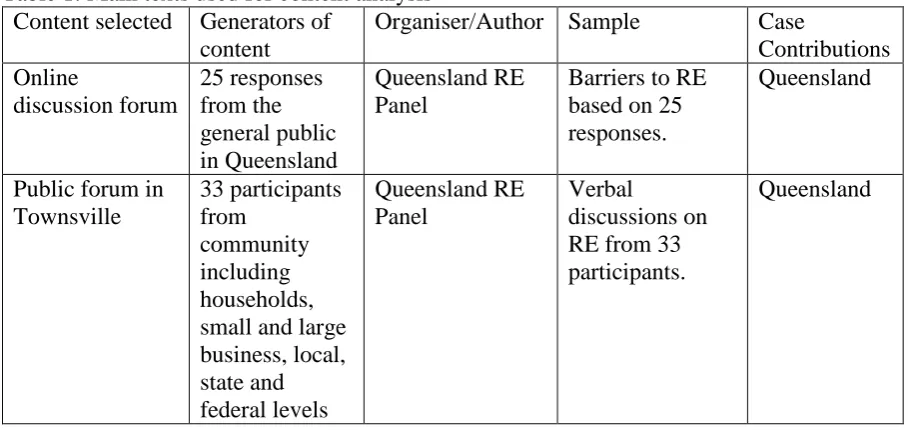
Queensland RE Panel produced several texts and they were chosen for content analysis. Table 1 summarises the texts. Reports, discussions at one public forum and submissions to the website, the Engagement Hub, (http://www.qldrepanel.com.au/engagement-hub) were analysed. There are both theoretical and practical reasons for choosing these texts for the content analysis. Firstly, this was a rich source of data - it covered community opinions on RE. Secondly, the RET panel’s agenda was aligned with this study’s objective of exploring barriers to RE transitions (Queensland RE Panel, 2016). Thirdly, the texts were easy to obtain. One limitation of relying on the panel’s report is the partial representation of lengthy verbal arguments presented at the eight public forums.
Obtaining a current, comparable sample for South Australia was not possible. For insights on South Australia, participation at one public event: the Energy Week Conference (2016) in Melbourne, was used to obtain data. This data source was current and relevant to the study’s purpose, given the focus on South Australia. This data was selective, in that the panel dealt with the negative aspects of transitioning to RE in South Australia. The unit of analysis was public speech; obtained from five speakers at a panel discussion. Using a different data source is a limitation, but this data set gives us a good (although still imperfect) indication of industry views and policy makers’ acceptance of RE targets in SA. Secondary data from government websites, reports and newspapers were used to provide historical data on the development of RE and track change and development.
[image:7.595.71.529.538.753.2]Making inferences from the data is important as it moves an analysis outside the data and “bridges the gap between descriptive accounts of texts and what they mean, refer to, entail, provoke or cause” (Krippendorff, 2004, p. 85). Identifying barriers depended on human intelligence. In the actual coding, we mostly focused on the arguments put forward, what people thought, what the speakers talked about, how an argument was sustained by the individual’s choice of words and use of metaphors. There are two main types of inferences: inductive inferences (proceed from generalizations to particulars) and deductive inferences (proceed from particulars to generalisations). We opted for a deductive approach, where pre-defined codes were identified (such as political barriers). This allowed us to draw on barriers identified in particular studies and to define potential themes before the analysis of the selected texts.
Table 1: Main texts used for content analysis Content selected Generators of
content
Organiser/Author Sample Case
Contributions Online
discussion forum
25 responses from the general public in Queensland
Queensland RE Panel
Barriers to RE based on 25 responses.
Queensland
Public forum in Townsville
33 participants from
community including households, small and large business, local, state and federal levels
Queensland RE Panel
Verbal
discussions on RE from 33 participants.
of government, University. Report on public
engagement
190 people attended public and industry forums.
Queensland RE Panel
Report summarising community consultation on RE in
Queensland
Queensland
Draft report Queensland RE
Panel
Report summarising policy options to achieve 50% RE target.
Queensland
Australian Energy Week Conference (2016)
341 delegates, primarily from industry. 39 speakers.
Quest Events Panel discussion, five speakers on the challenges posed by high-level renewable penetration in South Australia.
South Australia
Limitations
We acknowledge some specific limitations to the study. Firstly, the article was written before the Expert Panel had completed its work. Secondly, the article draws on submissions and public forums, with no control over participating organisations or the type of questions posed. Finally, the submissions may not be representative of the most powerful or hidden players in the energy industry.
DATA FINDINGS AND CASE STUDIES
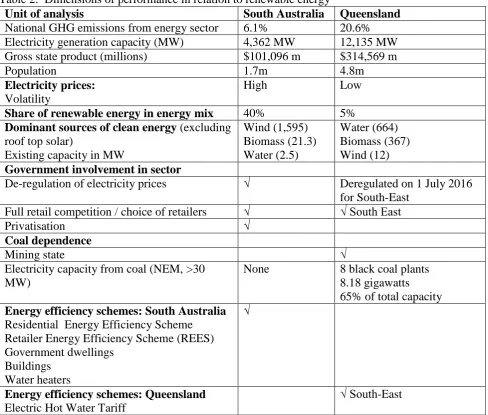
The following section reports the data findings and Table 2 compares Queensland and South Australia.
Competing energy technologies: an historical perspective
In 2014, the contribution to Australia’s total emissions by the energy sector were 20.6% from Queensland and just 6.1% from South Australia (Australian Government, 2014). Queensland relies heavily on coal-fired electricity generation. In 2013-14, Queensland’s electricity generation mix was 73% black coal; 22% gas and 5% renewable energy (Queensland Productivity Commission, 2016). Historically, hydro and biomass are important sources of large-scale renewable energy. The diffusion of biomass is linked to the state’s strong sugar cane industry. Queensland has not traditionally been viewed as a having a significant wind resource, but potential to develop wind farms does exist (Queensland RE Expert Panel, 2016). Australia’s only operating geothermal (hot rock) power plant is in Queensland. It was built as an experimental plant, funded by state and federal governments (
Up until recently, South Australia’s energy mix was diverse, consisting of gas, wind energy, coal-fired generation and rooftop PV systems (Pearson, 2015). The last coal-fired electricity plant was closed in 2016 (Brissenden, 2016). Wind meets 37% of electricity requirements, and at times, wind is the dominant form of regional generation (AER, 2015). It must be noted that South Australia is connected to the east coast National Electricity Market (which relies heavily on coal) through ‘interconnectors’, and can use supply from other jurisdictions when the need arises (Heard et al., 2015).
Barriers to RE development
Queensland has the lowest installed capacity of large-scale renewables across Australia. The need for an attractive investment and regulatory environment to support its diffusion was outlined in the panel’s draft report. The panel recommended reverse actions as a means to incentivise the development of new RE projects (Queensland RE Panel, 2016). The rapid diffusion of rooftop solar was due to feed-in-tariff schemes (AER, 2015), which paid small energy consumers to feed their electricity to the grid.
According to the Clean Energy Council, South Australia is the best-performing state on RE with a 41.3% share in 2015. It has the highest large-scale RE capacity installed in Australia. It was the first state to introduce a Solar Feed-in Scheme and has high rates of solar PV installation per capita. A supportive policy environment, the declining cost of the technology (Clean Energy Council, 2015), the underling wind resource, land-use and proximity to
transmission (Queensland RE Panel, 2016) helps explain the rapid diffusion of wind energy. According to Jones (2009), the key reason for South Australia’s top position in wind is strong policy support. Policies include government subsidies; funding of R&D; support for
vocational and tertiary education; providing investors with access to government owned land; establishing a requirement for installation of solar panels on all new and refurbished
government buildings; tax relief; tailoring regulatory frameworks and providing investment clarity and certainty (Government of South Australia, 2011). The government recently announced a state target to achieve ‘zero net emissions’ by 2025 (Climate Council of Australia, 2016). In Queensland, the perceived barriers to the development of RE (which were revealed through content analysis) are multi-dimensional. They are listed as follows: lack of federal policy on climate change; lack of long-term power purchase agreements; regulatory hurdles; compliance costs; lack of workforce training; lack of consumer awareness of the benefits of RE; potential conflict between the government acting as policy maker and shareholder and concern over rising electricity prices.
Government involvement in the energy sector, energy efficiency and electricity prices
The Queensland government is the owner of the electricity transmission and distribution networks (AER, 2015) and owns about 65% of the generation capacity (Queensland Government, 2016a). Historically, the state’s privatisation agenda has been contested by unions and environmentalists (Cahill & Beder, 2005). It appears, for the time being at least, that the Queensland labour government will continue with a policy of state ownership and regulatory control of energy utilities. Despite the fact that full retail competition was
introduced in 2007 (Queensland Government, 2016b), competition in regional Queensland is still immature (Queensland Productivity Commission, 2016). In South Australia, the
In Queensland, energy efficiency is promoted via rebates offered by Energex, a retailer that operates in South East Queensland (Department of Energy and Water Supply, n.d). In South Australia, energy efficiency is stressed in the Government’s Strategic Plan (2011) and a wide range of rebates are offered to energy consumers. Customers are free to choose their
electricity provider and electricity prices are not regulated (Government of South Australia, 2015).
[image:10.595.73.562.342.757.2]In Queensland, electricity prices have risen in the state over the last decade, due to over-capitalisation of the network, but this trend is not expected to continue (Queensland Productivity Commission, 2016). Wholesale prices have been consistently higher in South Australia compared with most NEM regions. Price volatility in the wholesale market is due to a variety of factors, such as the closure of gas and coal stations, dependency on a single interconnector and reliance on expensive gas for power when wind generation is low (Biggs, 2016; Queensland RE Panel, 2016). Panel speakers stressed that intermittent generation in South Australia was adding risks and costs to the energy system. There has been extensive media coverage and reports on the ‘energy crisis’ in South Australia, following a significant weather event which led to a blackout in the state (AEMO, 2016c).
Table 2: Dimensions of performance in relation to renewable energy
Unit of analysis South Australia Queensland
National GHG emissions from energy sector 6.1% 20.6% Electricity generation capacity (MW) 4,362 MW 12,135 MW Gross state product (millions) $101,096 m $314,569 m
Population 1.7m 4.8m
Electricity prices: Volatility
High Low
Share of renewable energy in energy mix 40% 5%
Dominant sources of clean energy (excluding roof top solar)
Existing capacity in MW
Wind (1,595) Biomass (21.3) Water (2.5)
Water (664) Biomass (367) Wind (12)
Government involvement in sector
De-regulation of electricity prices √ Deregulated on 1 July 2016 for South-East
Full retail competition / choice of retailers √ √ South East
Privatisation √
Coal dependence
Mining state √
Electricity capacity from coal (NEM, >30 MW)
None 8 black coal plants 8.18 gigawatts 65% of total capacity
Energy efficiency schemes: South Australia
Residential Energy Efficiency Scheme Retailer Energy Efficiency Scheme (REES) Government dwellings
Buildings Water heaters
√
Energy efficiency schemes: Queensland
Electric Hot Water Tariff
Energy Efficient Air Conditioning Incentive
Policy instruments – state level
Feed-in tariff (FiT) for roof-top solar PV Supportive policies and regulatory changes
√
√ √
Gas market
Rising prices, fall in domestic supply
√ √
Data sources: AEMO (2016b). Clean Energy Council (2015). GeoScience Australia (2012). Commonwealth of Australia (2014); Australian Government (n.d); Government of South Australia (2016); Queensland’s RE Panel (2016). ABS (2016b; 2016c).
DISCUSSION
Queensland and South Australia have exhibited markedly different trajectories in terms of RE transitions. If the state RE policies were analysed purely on the basis of sustainability criteria, such as penetration of RE; energy efficiency programs; the stated intention of a government to address the issue of climate change and reduce GHG emissions from the energy sector, then any judgement would have to conclude that South Australia was far superior to Queensland. The findings support the literature on the importance of institutional
arrangements, government intervention and effective policy tools in energy transitions (Laird & Stefes, 2009; Oteman et al., 2014; Wüstenhagen & Bilharz, 2006).
Meadowcroft (2009, p. 328) that energy transitions are likely to be “a very messy and open-ended process”.
Despite having strong RE potential, Queensland did not have a strong supply side focus to increasing RE. Like the state of Victoria, its dependence on coal created a clear self-interest not to shift away from coal to more expensive, less GHG intensive sources (Jessup & Mercer, 2001). As Bell & Hindmoor (2014, p. 480) note, culturally, mining is perceived to be a “dominant and essential part of the economy”. Despite the fact that Queensland’s economic fortunes are tied to the mining industry, the 50% RE target received support from the public and responses to large-scale solar developments were very positive.
Queensland lags behind South Australia in terms of privatisation. Data from the texts suggests there is some concern that the state-owned utility sector was perhaps discouraged from promoting solar power since that might endanger profit. From a systems point of view, this may pose a problem and shows the need to resolve conflicts between inter-dependent parts of a complex system. It is unclear whether privatisation can lead to positive
environmental effects or better policies that seek to manage demand (Jessup & Mercer, 2001). Jones (2009) asserts that when energy businesses remain in government hands, there will be political influence over pricing decisions and investment.
The case study in Queensland suggests that RE did not go far enough and in South Australia it went too far, too quickly. Whether RE development in Queensland will take a similar path is unlikely, given the many challenges identified in this article. As research shows, many factors can explain differences between state environmental policies, including socio-economic structures, political structures and personality of premiers (Kellow & Niemeyer, 1999).
CONCLUSIONS AND IMPLICATIONS FOR OTHER COUNTRIES
Addressing climate change will require the electricity system to transition towards RE. Ambitious RE policies at state level and sustained political commitment are required to overcome barriers to transitions. However, given the complexity of the energy system, governments should pursue collaborative efforts across states and with various stakeholders to avoid conflicts. Furthermore, they should address concerns about rising electricity prices and energy security if the much needed decarbonisation of the electricity sector is to take place. Future research should pay more attention to regional contexts when analysing the dynamics of energy transitions. The notion of complex systems holds promise in furthering an understanding of energy transitions and addressing the three pillars of sustainability, the social, economic and environmental dimensions.
REFERENCES
ABS (2016a). 8415.0 - Mining Operations, Australia, 2014-15. Retrieved from
http://www.abs.gov.au/AUSSTATS/[email protected]/Latestproducts/8415.0Main%20Feature s82014-15?opendocument&tabname=Summary&prodno=8415.0&issue=2014-15&num=&view=
ABS (2016c). 5220.0 - Australian National Accounts: State Accounts, 2015-16. Retrieved from http://www.abs.gov.au/AUSSTATS/[email protected]/DetailsPage/5220.02015-16?OpenDocument
AEMO. (2016a). Update to Renewable Energy Integration in South Australia; Joint AEMO and ElectraNet Study. Retrieved from
http://www.aemo.com.au/Electricity/Planning/Integrating-Renewable-Energy AEMO. (2016b). Generation Information Page. Retrieved from
https://www.aemo.com.au/Electricity/National-Electricity-Market-NEM/Planning-and-forecasting/Generation-information
AEMO (2016c). Preliminary Report – Black System Event in South Australia on 28 September 2016. Retrieved from
https://www.aemo.com.au/Media-Centre/-/media/BE174B1732CB4B3ABB74BD507664B270.ashx AEMO (2017). Gas Statement of Opportunities. Retrieved from
http://www.aemo.com.au/Media-Centre/2017-Gas-Statement-of-Opportunities-released
AER. (2015). State of the Energy Market 2015. Retrieved from
https://www.aer.gov.au/publications/state-of-the-energy-market-reports/state-of-the-energy-market-2015
Akella, A. K., Saini, R. P., & Sharma, M. P. (2009). Social, economical and environmental impacts of renewable energy systems. Renewable Energy, 34(2), 390-396.
Anderson, P. (1999). Perspective: complexity theory and organization science. Organization Science, 10(3), 216-232.
Araújo, K. (2014). The emerging field of energy transitions: progress, challenges, and opportunities. Energy Research & Social Science, 1, 112-121.
Australian Government. (n.d). Your Energy Savings. Retrieved from
http://www.yourenergysavings.gov.au/rebates?live_in[]=62&ownership[]=66&proper ty[]=69&interested[]=82
Australian Government (2014). State and Territory Greenhouse Gas Inventories 2014. Retrieved from http://www.environment.gov.au/climate-change/greenhouse-gas-measurement/publications/state-and-territory-greenhouse-gas-inventories-2014 Australian Government. (2015). Energy White Paper. Retrieved from
http://ewp.industry.gov.au/
Batel, S., Devine-Wright, P., & Tangeland, T. (2013). Social acceptance of low carbon energy and associated infrastructures: A critical discussion. Energy Policy, 58, 1-5.
Beck, F., & Martinot, E. (2004). Renewable energy policies and barriers. Encyclopedia of energy, 5(7), 365-383.
Bell, S., & Hindmoor, A. (2014). The structural power of business and the power of ideas: the strange case of the Australian mining tax, New Political Economy, 19(3), 470-486, Betz, R., & Owen, A. D. (2010). The implications of Australia’s carbon pollution reduction
scheme for its National Electricity Market. Energy Policy, 38(9), 4966-4977.
Biggs, C. (2016). A resource-based view of opportunities to transform Australia's electricity sector. Journal of Cleaner Production, 123, 203-217.
Blazejczak, J., Braun, F. G., Edler, D., & Schill, W. P. (2014). Economic effects of renewable energy expansion: A model-based analysis for Germany. Renewable and sustainable energy reviews, 40, 1070-1080.
Bowen, G. A. (2009). Document analysis as a qualitative research method. Qualitative Research Journal, 9(2), 27-40.
http://www.industry.gov.au/Office-of-the-Chief-Economist/Publications/Documents/req/REQ-2014-09.pdf
Brissenden, M (2016, May 9). The end of coal power energy generation in South Australia. ABC. Retrieved from http://www.abc.net.au/news/2016-05-09/the-end-of-coal-power-energy-generation-in-south/7394836
Byrnes, L., Brown, C., Foster, J., & Wagner, L. D. (2013). Australian renewable energy policy: barriers and challenges. Renewable Energy, 60, 711-721.
Cahill, D. & Beder, S. (2005). Regulating the power shift: the state, capital and electricity privatisation in Australia. Journal of Australian Political Economy, 55, 5–22. Clean Energy Council. (2015). Clean Energy Australia Report. Retrieved from
https://www.cleanenergycouncil.org.au/policy-advocacy/reports/clean-energy-australia-report.html
Clifton, J., & Boruff, B. J. (2010). Assessing the potential for concentrated solar power development in rural Australia. Energy Policy, 38(9), 5272-5280.
Climate Council of Australia. (2016). Game On: The Australian Renewable Energy Race Heats Up. Retrieved from
http://www.climatecouncil.org.au/uploads/2acac0b824742ec83f99676255ae5a81.pdf
Commonwealth of Australia. (2014). Renewable Energy Target Scheme – Report of the
Expert Panel. Retrieved from
http://apo.org.au/files/Resource/ret_review_report_2014.pdf
Crowley, K. (2013). Pricing carbon: The politics of climate policy in Australia. Wiley Interdisciplinary Reviews: Climate Change, 4, 603–613.
Deloitte (2015). Energy Markets and the Implications of Renewables: South Australian Case
Study. Retrieved from
http://www2.deloitte.com/au/en/pages/economics/articles/energy-markets-implications-renewables-sa-case-study.html
Department of Energy and Water Supply. (n.d). Electricity and Renewables Retrieved from https://www.dews.qld.gov.au/electricity
Department of Industry, Innovation and Science. (2016). Energy in Australia 2015, Canberra. Retrieved from
https://industry.gov.au/Office-of-the-Chief-Economist/Publications/Documents/energy-in-aust/Energy-in-Australia-2015.pdf Djerf-Pierre, M., Cokley, J., & Kuchel, L. (2016) Framing Renewable Energy: A
Comparative Study of Newspapers in Australia and Sweden. Environmental Communication, 10(5), 634-655.
Eisenhardt, K.M (1989). Building theories from case study research. Academy of Management Review, 14(4), 532–550.
Elliston, B., Diesendorf, M., & MacGill, I. (2017). Reliability of 100% Renewable Electricity Supply in the Australian National Electricity Market. In Towards 100% Renewable Energy (pp. 297-303). Springer, Cham.
Geels, F. W. (2004). From sectoral systems of innovation to socio-technical systems: insights about dynamics and change from sociology and institutional theory. Research Policy, 33(6), 897-920.
Geoscience Australia. (2012). Black Coal. Retrieved from http://www.ga.gov.au/data-pubs/data-and-publications-search/publications/aimr/black-coal
GeoScience Australia (2017). Basics. Retrieved from http://www.ga.gov.au/scientific-topics/energy/basics
http://www.renewablessa.sa.gov.au/files/111019-renewable-energy-plan-for-south-australia.pdf
Government of South Australia. (2015). First Year Review and Economic Statement 2015. Retrieved from
http://www.economic.priorities.sa.gov.au/first_year_review
Government of South Australia. (2016). Retailer Energy Efficiency Scheme. Retrieved from
http://www.sa.gov.au/topics/water-energy-and-environment/energy/rebates-concessions-and-incentives/retailer-energy-efficiency-scheme-rees
Grubler, A. (2012). Energy transitions research: insights and cautionary tales. Energy Policy, 50, 8-16.
Heard, B., Corey J. A. Bradshaw & Barry W. Brook (2015). Beyond wind: furthering
development of clean energy in South Australia. Transactions of the Royal Society of South Australia, 139(1), 57-82
Hicks, J., & Ison, N. (2011). Community-owned renewable energy (CRE): opportunities for rural Australia. Rural Society, 20(3), 244-255.
Hindmarsh, R., and Matthews, C. (2008). Deliberative speak at the turbine face: community engagement, wind farms, and renewable energy transitions in Australia. Journal of Environmental Policy & Planning, 10(3), 217-232.
Huddlestone-Holmes, C. (2014). Geothermal energy in Australia. CSIRO, Canberra. Retrieved from
http://arena.gov.au/files/2014/07/Geothermal-Energy-in-Australia.pdf
International Energy Agency. (2016). Renewable Energy Medium-Term Market Report 2016
International Energy Agency, Paris. Retrieved from
http://www.iea.org/newsroom/speeches/MTRMR_2016_Launch_Presentation_FINA L_for_web.pdf
IPCC (Intergovernmental Panel on Climate Change) (2014). Climate Change 2014 Synthesis Report Summary for Policy. IPCC, Geneva. Retrieved from
http://www.ipcc.ch/pdf/assessment-report/ar5/syr/AR5_SYR_FINAL_SPM.pdf Jacobsson, S., & Bergek, A. (2004). Transforming the energy sector: the evolution of
technological systems in renewable energy technology. Industrial and corporate change, 13(5), 815-849.
Jacobsson, S., & Lauber, V. (2006). The politics and policy of energy system
transformation—explaining the German diffusion of renewable energy technology. Energy policy, 34(3), 256-276.
Jessup, B. (2010). Plural and hybrid environmental values: a discourse analysis of the wind energy conflict in Australia and the United Kingdom. Environmental Politics, 19(1), 21-44.
Jessup, B., & Mercer, D. (2001). Energy policy in Australia: a comparison of environmental considerations in New South Wales and Victoria. Australian Geographer, 32(1), 7-28.
Jones, S. (2009). The future of renewable energy in Australia: a test for cooperative federalism? Australian Journal of Public Administration, 68(1), 1-20.
Kauffman, S. (1996). At home in the universe: The search for the laws of self-organisation and complexity. Oxford university press.
Kellow, A., & Niemeyer, S. (1999). The development of environmental administration in Queensland and Western Australia: why are they different? Australian Journal of Political Science, 34(2), 205-222.
Kent, A., & Mercer, D. (2006). Australia's mandatory renewable energy target (MRET): an assessment. Energy Policy, 34(9), 1046-1062.
Laird, F. N., & Stefes, C. (2009). The diverging paths of German and United States policies for renewable energy: Sources of difference. Energy Policy, 37(7), 2619-2629.
MacGill, I., Outhred, H., & Nolles, K. (2004). National Emissions Trading
for Australia: Key Design Issues and Complementary Policies for Promoting Energy Efficiency, Infrastructure Investment and Innovation. Australasian Journal of
Environmental Management, 11(1), 78-87.
Martin, N. J., & Rice, J. L. (2012). Developing renewable energy supply in Queensland, Australia: a study of the barriers, targets, policies and actions. Renewable Energy, 44, 119-127.
Markard, J. (2011). Transformation of infrastructures: sector characteristics and implications for fundamental change. Journal of Infrastructure Systems, 17(3), 107-117.
Markard, J., Raven, R., & Truffer, B. (2012). Sustainability transitions: An emerging field of research and its prospects. Research Policy, 41(6), 955-967.
Meadowcroft, J. (2009). What about the politics? Sustainable development, transition management, and long term energy transitions. Policy Sciences,42(4), 323-340.
Minerals Council of Australia (2017). High Efficiency Low Emissions Technologies.
Retrieved from
http://www.minerals.org.au/resources/coal21/low_emissions_coal_technologies/high_ efficiency_low_emissions_technologies
Morrice, E., & Colagiuri, R. (2013). Coal mining, social injustice and health: A universal conflict of power and priorities. Health & Place 19, 74-79.
Muenstermann, I. (2012). Australia’s climate change, wind farming, coal industry and the ‘big carbon plan’: Mine coal, sell coal, repeat until rich. Rural Society, 21(3), 231-249
Nelson, T. (2016). Redesigning a 20th century regulatory framework to deliver 21st century energy technology. Journal of Bioeconomics, 1-18.
Oam, R. J. S. (2006). A critique of present Australian energy policy. International Journal of Environmental Studies, 63(6), 719-729.
Oteman, M., Wiering, M., & Helderman, J. K. (2014). The institutional space of community initiatives for renewable energy: a comparative case study of the Netherlands, Germany and Denmark. Energy, sustainability and society, 4(1), 11.
Owen, A. D. (2006). Renewable energy: externality costs as market barriers. Energy Policy, 34(5), 632-642.
Painuly, J. P. (2001). Barriers to renewable energy penetration; a framework for analysis. Renewable Energy, 24(1), 73-89.
Pearse, R. (2016). Moving targets: carbon pricing, energy markets, and social movements in Australia. Environmental Politics, 25(6), 1079-1101.
Pearson, B (2015, June 18). Even if users agreed to pay much higher electricity bills, SA could not be 100% renewable. Minerals Council of Australia. Retrieved from
http://www.minerals.org.au/news/even_if_users_agreed_to_pay_much_higher_electri city_bills_sa_could_not_be_1
Pittock, J., Hussey, K., & McGlennon, S. (2013). Australian climate, energy and water policies: conflicts and synergies. Australian Geographer, 44(1), 3-22.
Trudgill, S. (1990). Barriers to a better environment: what stops us from solving environmental problems? Belhaven Press, London.
Quaschning, V. (2016). Understanding renewable energy systems. Routledge. Queensland Government. (2016a). Electricity Generation. Retrieved from
https://www.business.qld.gov.au/industry/energy/electricity-industry/electricity-queensland/electricity-generation
Queensland Renewable Energy Panel (2016). Credible pathways to a 50% renewable energy target for Queensland. Draft report, October 2016. Retrieved from
http://www.qldrepanel.com.au/draft-report
Queensland Productivity Commission. (2016). Draft Report – Electricity Pricing Inquiry Retrieved from
http://www.qpc.qld.gov.au/files/uploads/2016/02/EPI-DRAFT-REPORT-Final.pdf Sharaz, D. (2017, March 14). South Australia steps up in the ‘absence of national leadership’
on energy crisis. SBS. Retrieved from
http://www.sbs.com.au/news/article/2017/03/14/south-australia-steps-absence-national-leadership-energy-crisis
Sovacool, B. K. (2014). What are we doing here? Analyzing fifteen years of energy scholarship and proposing a social science research agenda. Energy Research & Social Science, 1, 1-29.
United Nations Framework Convention on Climate Change (UNFCCC) (2016). The Paris Agreement. UNFCCC, Bonn. Retrieved from
http://unfccc.int/paris_agreement/items/9485.php http://www.un.org/sustainabledevelopment/cop21/
Unruh, G. C. (2000). Understanding carbon lock-in. Energy policy, 28(12), 817-830. Wear, A., & Harrington, P. (2002). Australian federalism's impact on energy efficiency
policy. Australian Journal of Environmental Management, 9(1), 37-44.
Wüstenhagen, R., & Bilharz, M. (2006). Green energy market development in Germany: effective public policy and emerging customer demand. Energy policy, 34(13), 1681-1696.