Is it possible to improve the analytical approach to the evaluation of cluster-randomised trials where the complexity of the intervention demands a small number of clusters?
The case of the Triage plus Integrated TB-HIV Community Intervention Project in Lilongwe Rural, Malawi
Thesis submitted in accordance with the requirements of the University of Liverpool for the degree of Doctor in Philosophy
By
George Anubi Faki Bello
ii Abstract
Introduction
In this thesis, analytical approaches for the design and evaluation of cluster randomised trials are presented and reviewed. In particular, statistical power/ sample size issues relating to the design of cluster randomised trials for which only a limited number of clusters are available are assessed using a series of simulation studies. The use of computer simulation methods made it possible to investigate how well cluster randomised trials with limited numbers of clusters available can be optimised both in terms of statistical power and also the accuracy of parameter estimates. The study design conditions performing best in the simulation studies were then applied to a community intervention study involving informal healthcare providers: the 'Triage Plus integrated tuberculosis (TB) and human immuno-deficiency virus (HIV) community intervention project in Lilongwe rural, Malawi'.
Aims and objectives
The general aims of this dissertation were to:
1. investigate if it is possible to improve the analytical approach to the evaluation of cluster-randomised trials where the complexity of the intervention demands a small number of clusters and in which the primary outcome measure is a count of events occurring in a specified time interval;
2. investigate the effectiveness of engaging informal healthcare providers in integrated
TB and HIV community intervention in treatment initiation rates and testing access rates, a cluster randomised trial was conducted in Malawi for which only a limited number of clusters were available to the researchers.
The specific objectives were:
1. to review cluster randomised trials and the statistical methods used in the assessment
of the effectiveness of the intervention in this type of trial when the primary outcome measure is a count of events occurring in a specified time interval;
3. to identify the circumstances under which each of the statistical methods would be most robust in detecting significant intervention effects or providing accurate estimates of intervention effects;
4. to apply these statistical approaches to the data collected in the cluster randomised
clinical trial of community based interventions for TB and HIV (the 'Triage Plus' study);
5. to assess the effect of involving non-paid informal healthcare providers in integrated
TB and HIV community interventions aimed at improving testing and treatment initiation rates for these two diseases.
Methods
Two research approaches were used in this dissertation:
1. Simulation studies were used to investigate statistical efficiencies in terms of statistical power and accuracy in parameter estimation under different study design conditions for cluster randomised trials in which the primary outcome measure is a count of the number of events occurring during a specified period of time.
2. These statistical approaches were then applied to obtain robust estimates of the effect
of the test intervention using the data collected during the “Triage Plus” study. The Triage Plus intervention, implemented in rural areas of Lilongwe, involved informal healthcare providers in an integrated TB and HIV community intervention. This intervention specifically involved empowering the informal healthcare providers in disease recognition, sputum specimen collection, referral of presumptive TB cases, and conducting community TB and HIV awareness meetings.
Results
iv
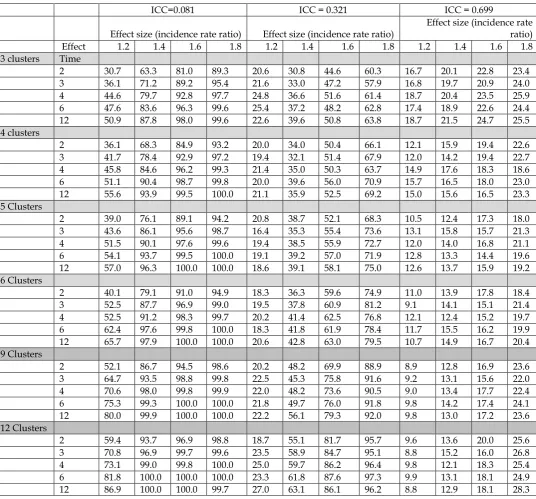
at least 9 clusters were needed to achieve adequate statistical power of ≥80% with an effect size of 20% with 6 and 12 measurement time points respectively for high and low incidence disease conditions. For an effect size of 40%, at least 3 clusters per arm were needed to achieve adequate power with 4 repeated measurement times in low incidence diseases and 3 measurement times for high incidence diseases. For ICCs of 0.321 and above, no adequate statistical power was achieved with an effect size of ≤40% in both high and low disease incidence conditions.
In the analysis of the TB services access data from the Triage plus study, the intervention significantly increased the number of presumptive TB cases accessing testing sites by 15.2% (p=0.003) in the first 12 months of the intervention; however, this was followed by a statistically non-significant reduction of 18.3% (p=0.224) when the intervention was rolled-out into the control clusters. Overall, the intervention was associated with a non-significant increase in TB treatment initiation rates of 18% (p=0.112).
In the analysis of HIV services access rates, antiretroviral therapy (ART) initiation rates increased significantly by 34.7% (p=0.048) in the intervention clusters in the first 12 months of intervention, and the ART initiation rates were similar after rolling-out the intervention to the control clusters. Overall, the intervention was associated with a 61% increase in HIV testing uptake rates (p<0.001).
Conclusion:
To achieve adequate statistical power and improved precision in parameter estimation in cluster randomised trials with a count outcome measure, with the ICC of 0.00154 the simulation results suggested that a minimum of 3 clusters per arm is required with at least 12 measurement times for the estimation of an effect size of 20% (or higher) in low incidence disease situations. However, for high incidence outcomes, a minimum of 3 clusters per arm with 3 or more measurement times may be adequate to achieve a statistical power of at least 80%. For an ICC of 0.081, at least 3 clusters per arm were needed to achieve adequate power if the effect size was 40% after 4 repeated measurement times in low incidence diseases and 3 measurement times for high incidence diseases. With ICCs of 0.321 and above, no adequate statistical power was achieved with an effect size of ≤40% in both high and low disease incidence conditions.
vi ACKNOWLEDGEMENTS
A number of individuals and organisations were involved in the implementation of the Triage plus study and are too numerous to mention. In particular, I am highly indebted to theinformal health care providers for their dedication despite not receiving any incentives in the implementation of the project. To them saving lives was their priority. The project could not have progressed well without the support from community leaders (traditional authorities, group village headmenand village headmen) and the national or district level stakeholders (the National TB Programme, HIV Department, the Lilongwe District Health Office, the Lilongwe District Assembly) for their support throughout the project. Their efforts are greatly appreciated. As the project was implemented in rural Lilongwe involving members within the same communities, it is my sincere hope that the knowledge and experience gained by the various individuals will continue toflourish, thereby benefitting the whole community.
Special thanks are due to the Triage plus study team: Lifah Sanudi, Patnice Nkhonjera, Mtisunge Chobambo-Mphande, Mafayo Phiri, Chifundo Chisesa, Linda Chisi, Helecks Mtengo, and Phonex Mkuliwa for their critical roles in the implementation of the project. For the research assistants, Chifundo Chisesa, Linda Chisi, Helecks Mtengo, and Phonex John, I hope the expertise they have aquired through the project will be put into full use in future community randomised interventions. It was not easy for them to fully understand and excecute the intervention using the laid down procedures. Further thanks go to the Lilongwe District Health Office facilitators for supporting the facilitation of informal healthcare providers, health surveillance assistants and supervision of informal healthcare providers during their project implementation. Special recognition goes to Janet Chikonda for her critical role in coordinating the facilitators and ensuring the facilitators were available when needed.
this thesis, may I individually acknowledge the services of Professor Stephen Bertel Squire, Rachael Thompson, and Dr. Brian Faragher from the Liverpool School of Tropical Medicine, and Rasmus Malmborg of the Norwegian Heart and Lung Patient Organisation. These individuals played critical roles in ensuring proper execution of the research project.
In ensuring proper execution of the study, my key role was in designing a proper cluster randomised trial with more than one cluster per arm (i.e. changing the original study design with one cluster assigned per study arm to a design with multiple clusters (although only a limited number of clusters could be used due to a fear of contamination challenges, in fact just 3 clusters per arm). In addition, implementation of the study design, interventions and quality data management procedures was supervised in order to align to standard cluster randomised trial processes (e.g. blinding patient allocation to clusters). Simulation studies that informed the design conditions that were considered during the evaluation of the actual Triage Plus intervention were also conducted.
My big heart-felt appreciation and thanks go to my supervisors Dr Brian Faragher and Professor Bertel Squire for their words of encouragement, inspiration and technical guidance throughout the preparation of this thesis. They accorded me ample time, despite their busy schedules, in shaping the direction of the research, an experience which will be hard to forget. May I also thank Dr Bertha Simwaka, Professor Cam Bowie, Dr. Liz Corbett for their offsite supervision and encouragement. Further thanks go to Rachael Thompson and Helen Rigby for arranging all logistic support for all my annual visits and short courses attended as part of the PhD studentship.
viii Table of Contents
CHAPTER 1 ... 1
GENERAL INTRODUCTION AND CONTEXT ... 1
1.1 Overview of the Triage Plus study and its objectives ... 1
1.1.1 Introduction ... 1
1.1.2 Access to TB and HIV services ... 1
1.1.3 The relationship between poverty and TB or HIV/AIDS ... 3
1.1.4 The need for community participation in integrated TB and HIV interventions ... 4
1.1.5 The Triage Plus study and the previous studies implemented by the REACH Trust ... 6
1.2 Statistical power in cluster randomised studies ... 6
1.3 Estimation of prevalence and incidence rate ratios in cluster randomised trials ... 7
1.4 Aim of the study ... 9
1.5 Structure of the thesis ... 10
CHAPTER 2 ... 11
THE TRIAGE PLUS STUDY ... 11
2.1 Introduction ... 11
2.2TB and HIV Case detection, treatment and the need for community interventions ... 11
2.2.1 Tuberculosis case detection and treatment ... 11
2.2.2 HIV and AIDS diagnosis and the need for timely ART treatment initiation ... 13
2.2.3 The need for an integrated approach to TB and HIV/AIDS... 14
2.2.4 The need for community participation in integrated TB and HIV interventions .... 14
2.3 The Triage Plus Study design ... 15
2.3.1 The study areas ... 15
2.3.2 Study design ... 16
2.3.3 The phased intervention design ... 17
2.3.3.1 Number of clusters for randomisation ... 17
2.3.3.2 Matching of clusters ... 19
2.3.3.3 The randomisation process ... 19
2.3.3.4 Blinding of the intervention ... 20
2.3.3.5 The Triage Plus study implementation phases ... 20
2.4 Study intervention ... 23
2.4.2 Inclusion and exclusion criteria for the informal health care providers ... 25
2.4.3 Conceptual basis of the intervention Framework ... 25
2.5 The Triage Plus study outcome measures and sample size ... 29
2.6 Data collection for impact evaluation ... 32
2.6.1 HIV and TB treatment initiation and testing data ... 32
2.6.2 Contextual factors (Health system and population characteristics data) ... 34
2.7 Study limitations ... 34
2.8 Conclusion ... 35
CHAPTER 3 ... 36
CLUSTER RANDOMISED TRIALS ... 36
3.1 Introduction ... 36
3.2 Cluster randomisation trials and their challenges ... 37
3.2.1 Cluster randomisation designs ... 37
3.2.2 Challenges of cluster randomised trials ... 38
3.2.2.1 Number of clusters available for randomisation ... 39
3.2.2.2 Reduced statistical power due to within cluster correlation of outcomes ... 40
3.3 Approaches to address the limited number of clusters ... 44
3.4 Implications of the limited number of clusters in the Triage Plus study ... 45
3.5 The repeated cross-sectional design for impact evaluation ... 47
3.6 Measures of effect: Odds ratios, prevalence ratios and incidence rate ratios ... 49
3.6.1 Appropriate measures for the effectiveness of the intervention ... 49
3.6.2 Estimation of prevalence ratios and incidence rate ratios ... 51
3.6.2.1 Cox regression model ... 52
3.6.2.2 Poisson regression model ... 53
3.6.2.3 Log-binomial models ... 55
3.7 Analysis of clustered data using single level modelling approaches ... 59
3.8 Conclusion ... 60
CHAPTER 4 ... 62
GENERALISED LINEAR MIXED MODELS... 62
4.1 Introduction ... 62
4.2 Generalised linear mixed model framework ... 63
x
4.2.2 Generalised linear mixed model representation in a repeated measurements design
... 66
4.2.3 Poisson and negative binomial models... 67
4.2.3.1 The Poisson models ... 67
4.2.3.2 The Negative Binomial Model ... 71
4.2.3.3 Marginal effects Poisson model ... 72
4.3 Likelihood based estimation methods for incidence rate ratios ... 73
4.3.1 Numerical integration ... 73
4.3.1.1 Maximum Likelihood Estimation of GLMM using adaptive and spherical quadrature ... 74
4.3.1.2 Estimation of random effects and regression coefficients ... 76
4.3.2 Penalised quasi-likelihood ... 76
4.3.2.1 Estimation of generalised linear mixed models using PQL ... 76
4.3.2.2 Estimation of variance components: ... 78
4.4 Likelihood based model selection ... 80
4.4.1 Likelihood ratio tests ... 80
4.4.2 Akaike Information Criterion and Bayesian Information Criterion ... 81
4.5 Conclusion ... 82
CHAPTER 5: ... 83
STATISTICAL POWER ISSUES WITH CLUSTER RANDOMISED TRIALS ... 83
5.1 Introduction ... 83
5.2 Number of clusters and numbers of participants per cluster: a literature review ... 83
5.3 Simulation study ... 85
5.3.1 Rationale and objectives ... 86
5.3.2 Simulation procedures ... 86
5.3.3 The Simulation Algorithm ... 94
5.3.4 Assessment of statistical power estimation for different design conditions ... 96
5.3.5 Diagnostics and sensitivity analysis of simulation procedures ... 96
5.3.6 Assessing performance of the different statistical methods ... 97
5.4 Results ... 99
5.4.1 Convergence ... 99
5.4.2 Power estimation ... 104
5.4.2.2 Power estimates when incidence of the outcome is high and ICC is 0.00154 . 106
5.4.2.3 Effect of varying ICC on power estimation ... 108
5.4.3 Assessment of accuracy of parameter estimates ... 112
5.4.3.1 Parameter estimates and precision when the ICC was 0.00154 ... 112
5.4.3.2 Effect of varying ICC on the accuracy of parameter estimates ... 120
5.4.3.3 Coverage rates of Standard errors when ICC was 0.00154 ... 123
5.5 Conclusions ... 125
CHAPTER 6 ... 129
STATISTICAL ANALYSIS OF THE TRIAGE PLUS STUDY ... 129
6.1 Introduction ... 129
6.2 Analytical approach ... 129
6.2.1 Unit of analysis and the need for repeated measurements ... 129
6.2.2 The matched-pair design analysis ... 131
6.3 Statistical methods ... 132
6.3.1 Analysis plan ... 132
6.3.2 Adjustment for baseline outcome data and cluster-level covariates ... 134
6.3.3 Statistical modelling... 134
6.4 Summary of characteristics of clusters ... 137
6.4.1 Baseline demographic and distribution of health facilities ... 137
6.4.2 Baseline measurement of outcome measures between intervention arms ... 143
6.4.3 Assessment of the effectiveness of the intervention in the first 12 months using unadjusted incidence rate ratios ... 144
6.5 Impact evaluation based on the generalised linear mixed modelling ... 146
6.5.1 Impact on TB and ART treatment initiation rates in the first 12 months of the intervention ... 147
6.5.1.1 Impact on TB treatment initiation rates ... 147
6.5.1.2 Impact on smear- positive TB treatment initiation rates ... 150
6.5.1.3 Impact on ART treatment initiation rates ... 152
6.5.2 Impact on secondary outcome measures in the first 12 months ... 156
6.5.2.1 Impact on TB and HIV testing access rates in the first 12 months of intervention ... 156
xii
6.6 Impact on TB and ART treatment initiation and testing uptake rates in the second
phase (11 months) of the intervention ... 164
6.6.1 Impact on TB and ART treatment initiation rates in the second phase (11 months) of the intervention ... 164
6.6.1.1 Impact on TB treatment initiation rates in the second phase (11 months) of the intervention ... 164
6.6.1.2 Impact on smear- positive TB treatment initiation rates in the second phase (11 months) of the intervention ... 167
6.6.1.3 Impact on ART treatment initiation rates in second phase (11 months) of the intervention period ... 171
6.6.2 Impact on TB testing uptake rates in the second phase (11 months) of the intervention ... 175
6.7 Summary and conclusion ... 178
6.8 Statistical implications of the findings of the Triage Plus study ... 179
CHAPTER 7 ... 181
GENERAL DISCUSSION, POLICY IMPLICATIONS AND CONCLUSIONS ... 181
7.1 Introduction ... 181
7.2 Statistical power and parameter estimation in a cluster randomised trial with a limited number of clusters but adopting a repeat observation design ... 181
7.3 Statistical power of the Triage Plus study ... 183
7.4 How the Triage Plus study was conducted and its limitations ... 185
7.4.1 Research design ... 185
7.4.2 Study limitations ... 186
7.5 Effectiveness of the Triage Plus study ... 188
7.5.1 Intervention effect on ART treatment initiation rates and HIV testing uptake rates ... 188
7.5.2 Intervention effect on TB treatment initiation rates and testing uptake rates ... 188
7.5.3 Flexibility of the intervention ... 192
7.6 Policy implications ... 193
7.6.1 Policy implications on TB control ... 193
7.6.2 Policy implications on HIV transmission prevention ... 193
7.7 Conclusions ... 194
7.8 Future work ... 197
7.8.1 Introduction ... 197
7.8.3 Bayesian estimation of incidence rate ratios ... 200
7.8.3.1 Introduction: ... 200
7.8.3.2 The Bayesian paradigm ... 200
7.8.3.3 Computation of posterior distributions ... 201
7.8.3.4 Diagnosing the convergence of posterior distributions ... 203
7.8.3.5 Prior distributions ... 205
7.8.3.6 Bayesian model selection ... 208
7.8.4 Future simulation work... 216
8.0 Appendix ... 217
Appendix 8.1: A statement of declaration of the contributions made by me and other people in the whole study ... 217
Appendix 8.2: Data recording/collection forms ... 218
Appendix 8.2.1: TB treatment registration form-sample ... 218
Appendix 8.2.2: Anti-retroviral treatment registration form ... 219
Appendix 8.2.3: Presumptive TB testing registration form... 220
Appendix 8.2.4: HIV testing registration form ... 221
Appendix 8.3 Cluster level population sizes... 222
Appendix 8.4: Sample of dataset layout for TB treatment initiations (similar layout used for ART initiations, HIV testing and TB testing) ... 223
Appendix 8.5: Stata simulation programme ... 224
Appendix 8.6: Stata data processing and analysis programme ... 229
Appendix 8.7: Abstract presented at the 2013 Union Conference ... 234
xiv LIST OF TABLES
Table 1: Poverty incidence in Lilongwe rural areas ... 21
Table 2: Intervention effectiveness outcome measures used in Triage Plus trial ... 29
Table 3: The effect of number of groups, effect size and number of time points on the
convergence rate (%) based on 1000 simulated data sets ... 101
Table 4: The effect of the ICC, number of groups, effect size and repeated
measurements on convergence rate, based on 1000 simulated data sets when the
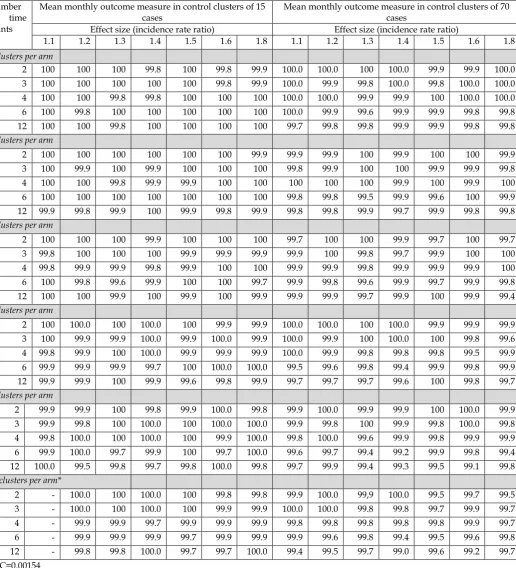
disease incidence is low: Mean outcome measure in control clusters of 15 cases
per month ... 102
Table 5: The effect of the ICC, number of groups, effect size and repeated
measurements on convergence rate, based on 1000 simulated data sets when the
disease incidence is high: Mean outcome measure in control clusters of 70 cases
per month ... 103
Table 6:The effect of the number of clusters, repeated measurement times and effect
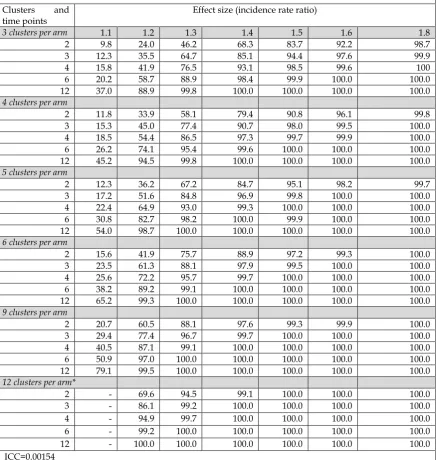
size on the statistical power of the study design (% p value<0.05) based on 1000
simulated data sets under low disease incidence – The mean outcome measure
in control clusters is 15 cases per month. ... 105
Table 7:The effect of the number of clusters, repeated measurement times and effect
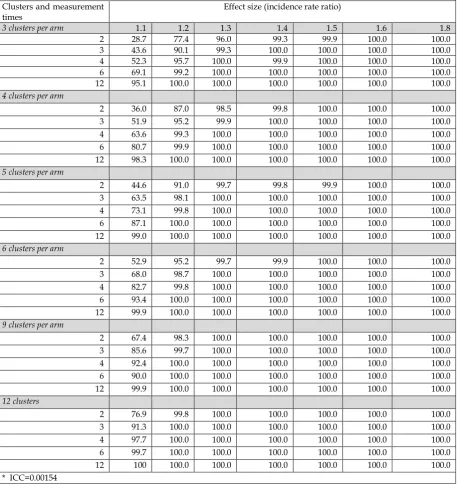
size on the statistical power of the study design based on 1000 simulated data
sets under high disease incidence. The mean outcome measure in control
clusters is 70 cases per month. ... 107
Table 8: The effect of the ICC, number of groups, effect size and repeated
measurements on the statistical power, based on 1000 simulated data sets when
the disease incidence is low: Mean outcome measure in control clusters of 15
cases per month ... 110
Table 9: The effect of the ICC, number of groups, effect size and repeated
measurements on the statistical power, based on 1000 simulated data sets when
the disease incidence is high: Mean outcome measure in control clusters of 70
cases per month ... 111
Table 10: The effect of the number of groups, time points and the effect size on how
accurately the estimated effect size is close to the fixed estimate size and how
the precision of the estimated effect size improves based on the 95% confidence
interval after 1000 simulated data sets (using ICC=0.00154) ... 114
Table 11: The effect of the number of groups, time points and the effect size on how
accurately the effect sizes were estimated based on 5% and 95% percentiles of
the estimated effect size after 1000 simulated data sets. ... 116
Table 12: The effect of the number of groups and repeated measurements on the
accuracy of the estimated effect size based on the mean length of 95%
confidence interval, based on 1000 simulated data sets ... 118
Table 13:The effect of the number of clusters, time points and the effect size on the
Table 14: The effect of the ICC, number of groups, effect size and repeated
measurements on the accuracy of the estimated effect size based the mean
length of 95% confidence interval, based on 1000 simulated data sets ... 121
Table 15: The effect of number of clusters, time points and the effect size on the
non-coverage of the 95% confidence intervals of parameter estimates (regression
coefficients) based on 1000 simulated data sets. ... 124
Table 16: Comparison of the baseline demographic characteristics between Early
intervention and Delayed intervention arms ... 138
Table 17: Comparison of baseline crude mean counts and incidence rate ratios for TB
and ART treatment initiation rates between intervention arms ... 143
Table 18: Comparison of baseline cluster-pair TB and ART treatment initiation rates
between intervention arms ... 144
Table 19: Comparison of crude mean counts and incidence rate ratios in TB and
ART treatment initiation rates between interventions arms in the first 12
months of intervention ... 145
Table 20: Comparison of cluster-pair incidence rate ratios for TB and ART treatment
initiation between intervention arms in the first 12 months of the intervention
... 145
Table 21: Adjusted incidence rate ratios for intervention effects using the marginal
effects, random intercepts, and random coefficients models for measuring TB
treatment initiation rates in the first 12 months of the intervention ... 151
Table 22: Adjusted incidence rate ratios for intervention effects using the marginal
effects, random intercepts, and random coefficients models for measuring access
rates to TB treatment services among smear positive patients in the first 12
months of the intervention ... 153
Table 23: Adjusted incidence rate ratios for intervention effects using the marginal
effects, random intercepts, and random coefficients models for measuring access
rates to ART services in the first 12 months ... 155
Table 24: Adjusted incidence rate ratios for intervention effects using the marginal
effects, random intercepts, and random coefficients models for measuring access
rates to testing services for presumptive TB cases in the first 12 months ... 158
Table 25: Adjusted incidence rate ratios for intervention effects using the marginal
effects, random intercepts, and random coefficients models for smear -positive
TB cases identified at testing sites during the first 12 months... 159
Table 26: Maximum likelihood estimates for intervention effects using the marginal
effects, random intercepts, and random coefficients models for measuring access
rates to HIV testing in the first 12 months ... 161
Table 27: Adjusted incidence rate ratios for intervention effects using the marginal
effects, random intercepts, and random coefficients models for measuring
overall access rates to TB treatment initiation rates using the data from the
second phase of the intervention (11 months) ... 166
Table 28: Adjusted incidence rate ratios for intervention effects using the marginal
xvi
Table 29: Adjusted incidence rate ratios for intervention effects using the marginal
effects, random intercepts, and random coefficients models for measuring
overall ART initiation rates using the second phase (11 months) of the
intervention ... 173
Table 30: Adjusted incidence rate ratios for intervention effects using the marginal
LIST OF FIGURES
Figure 1: Flow diagram for the intervention
design...
18
Figure 2: Map of Lilongwe showing the distribution of the Triage Plus study clusters
between intervention arms
...
22
Figure 3: Triage Plus study design
...
23
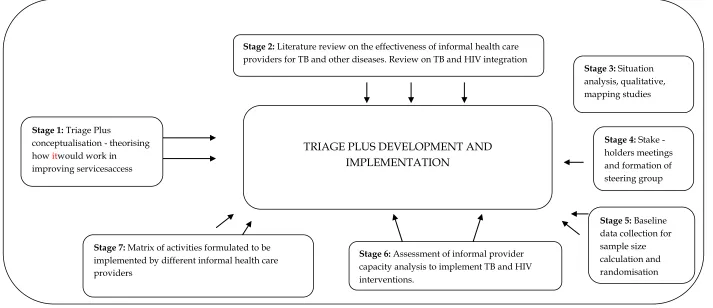
Figure 4: The Triage Plus study implementation framework ... 28
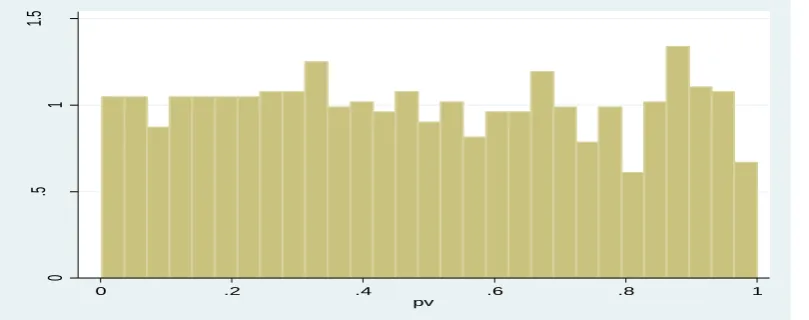
Figure 5: Distribution of p-values after running 1000 simulations when the effect of the intervention was set to a Null case
...
98
Figure 6 Power curves when the disease incidence is low...
109
Figure 7 Power curves when the disease incidence is high...
109
Figure 8: Flow
diagram...
140
Figure 9: Map showing the distribution of TB and ART treatment initiation sites in the first 12
months... 142
Figure 10: Map showing the distribution of new ART initiation sites... 143
Figure 11: Monthly and cumulative HIV testing uptake rates per 1,000 adults...
164
Figure 12: Monthly and cumulative TB treatment initiations rates per 10,000 adults... 169
Figure 13: Monthly and cumulative ART treatment initiations rates per 10,000 adults...
xviii
Figure 14: Monthly and cumulative TB testing uptake rates per 10,000 adults...
178
Figure 15: History plots for the converged chains...
206
CHAPTER 1
GENERAL INTRODUCTION AND CONTEXT
1.1 Overview of the Triage Plus study and its objectives 1.1.1 Introduction
Tuberculosis (TB) and human immuno-deficiency virus (HIV) remain the major determinants of morbidity and mortality in Sub-Saharan Africa. The region includes most of the countries with the highest burden of the tuberculosis epidemic (WHO, 2009). The TB epidemic in Sub-Saharan Africa has worsened because of its interaction with HIV and AIDS (Corbett et al. 2002; Corbett et al., 2003; WHO, 2009). Of the 9.27 million TB cases in 2007 globally, 15% (1.37 million) cases were HIV-related tuberculosis, of which 79% were from the African region (WHO, 2009). Because of this interaction, these two diseases form a vicious cycle: TB is the main cause of morbidity and mortality in people with HIV; a quarter of HIV-related deaths are due to TB, and HIV enhances the progression of latent tuberculosis infection to active disease thereby driving the TB epidemic (WHO, 2009; Naidoo and Taylor, 2007;Mukadi, Maher and Harries, 2001).
Although interventions to address the two disease conditions exist, patient and health system barriers affect service utilisation. Barriers such as cost, distance, delays and repeated visits to multiple health facilities increase patient drop-out rates in the course of care seeking especially in Sub Saharan Africa (Lawn et al., 1998; Squire et al., 2005; Xu et al., 2007; Storla et al. 2008). This is particularly so among the poor who face challenges in getting a definitive diagnosis, starting on treatment and adhering to treatment regimens. To address these access challenges, the Triage plus study - a cluster randomised intervention study involving informal health care providers - was implemented in rural Malawi. Primarily, the intervention aimed at evaluating the effectiveness of engaging informal health care providers in TB and HIV testing and treatment services.
1.1.2 Access to TB and HIV services
2
cohort. TB treatment success rates surpassed the 85% target in the WHO eastern Mediterranean region (88%), the south eastern Asian region (88%), and the western Pacific region (92%) (WHO, 2009). However, treatment success rates in the African Region remain below the 85% target, and case detection rates of smear-positive TB remain below the 2005 target of 70% in many countries (WHO, 2009).
Achieving high treatment success rates and timely case detection for smear positive TB cases have long been considered key factors for controlling TB because they cut transmission rates and avert TB related deaths. However, achieving high TB case detection rates is the greatest challenge to controlling TB in many countries. In Malawi, despite the increase in TB case notifications reported at the National TB Programme from 19,496 in 1994 to 28,234 in 2003, WHO estimated that the country was only notifying 41% of the TB cases (Nyirenda, 2006; WHO, 2007a). Thus, improving TB case detection and timely initiation of TB treatment, especially for smear-positive TB cases, is the focus of most TB intervention initiatives because it is the most effective way to reduce TB transmission in the general community.
Although swift and accurate TB case detection is essential, the most commonly used approach for case detection is based on screening patients with a chronic cough at health facilities, a method which is less efficient in detecting a large proportion of smear positive TB cases (Ayles et al., 2009; Hoa et al., 2010), than the active case finding strategies that screen all at risk populations (WHO, 2011). The difficulty is to ensure sustainability of such active case finding strategies. Debate continues on the effectiveness of the active case finding strategies considering the cost and logistics involved in implementing such interventions in low-income countries (Golub et al., 2005; Uplekar and Raviglione, 2007).
The recently completed 'Demographic and Health Surveys in the Sub Saharan Africa' revealed that the percentages of men and women who know their sero-status ranged from 14% to 51% in men and 15% to 72% in women (see National Population Commission (Nigeria) and ICF Macro, 2009; National Statistical Office [Malawi] and ICF Macro, 2011; Central Statistical Agency [Ethiopia] and ICF International, 2012).This suggests that many of those who are infected do not know their HIV status, and, therefore, are at risk of spreading the infection or being re-infected with ART resistant strains. If such populations are not reached with preventive interventions such as HIV testing services they may end up spreading the infection or being re-infected with resistant strains. Thus, to combat the HIV pandemic, there has been an increased emphasis on prevention of new HIV infections through early HIV detection by promoting voluntary HIV testing.
Given that early ART treatment has the potential of reducing the risk of HIV transmission to an uninfected partner (Cohen and Gay, 2010; Anglemyer et al., 2011; Cohen et at, 2011), reaching all eligible patients with ART services, coupled with improved HIV testing uptake, is likely to reduce HIV transmission. With the HIV burden in Sub-Saharan Africa worsening the tuberculosis epidemic: HIV enhances the progression of latent tuberculosis infection to active disease and therefore drives the TB epidemic(Corbett et al. 2002; Corbett et al., 2003; WHO, 2009), interventions targeting both TB and HIV are essential to reduce TB and HIV transmission.
1.1.3 The relationship between poverty and TB or HIV/AIDS
Recognition of the relationship between poverty and timely access to diagnostic and treatment services from health facilities is well documented (Squire et al., 2005; Storla et al., 2008). In particular, the poor are most likely to contract TB, progress to disease, and have poor treatment outcomes but have the most difficulty accessing formal public health services. This creates the potential problem of continued TB transmission, which, in turn, maintains the risk of TB transmission among the general population (Squire et al., 2005;Lönnroth et al., 2009).
4
delaying seeking health care from formal sources. These individuals, in turn, resort to informal health care sources, such as traditional healers and store-keepers. Detrimental behaviour patterns, such as delaying health care or seeking alternatives, are compounded by health system barriers, including the incorrect diagnosis of TB and HIV and, errors in referring TB and HIV symptomatic patients to the appropriate departments within the facility, both of which results in extending the time before a correct diagnosis is made (Storla et al., 2008). These factors contribute to long care-seeking pathways and high direct and indirect costs; further depleting a household's already strained financial status (Kemp et al., 2007).
TB and HIV/AIDS are chronic conditions leading to prolonged care and support and which create a vicious cycle of poverty within affected households. Poor households with TB or HIV/AIDS affected members may be caught in a damaging cycle of poverty and ill-health. By strengthening health systems (especially at the community level) and improving the awareness of TB, and general health among communities, early TB diagnosis and treatment of the most infectious forms, can occur (WHO, 2011).
1.1.4 The need for community participation in integrated TB and HIV interventions
Given the structural barriers (e.g. transportation costs) faced by the poor and the vulnerable in accessing TB and HIV/AIDS services, and the need to prevent TB and HIV in order to reduce transmission, community-based strategies involving informal healthcare providers such as store-keepers are essential for ensuring access to health services (WHO, 2011; Simwaka et al., 2012). WHO (1989, page 6) described informal healthcare providers as 'members of the communities where they work, selected by the communities, answerable to the communities for their activities, supported by the health system but not necessarily a part of its organization, and have shorter training than professional workers'. Informal healthcare providers have been used in community interventions to improve access to services for various diseases and conditions including treatment of uncomplicated malaria in Kenya and nutrition education intervention that has resulted in improved case detection for diarrhoea, respiratory infections and malnutrition in Nepal (Curtale et al., 1995;Datiko and Lindtjørn, 2009; Marsh et al., 1999 & 2004; Simwaka et al., 2012).
and Lindtjorn, 2009). This resulted in improved case detection: 122.2% in intervention areas compared to 69.4% in control areas, with women showing the highest rise in case detection (Datiko and Lindtjorn, 2009). In China, village doctors increased TB case detection from 36.2 to 49.9/100,000 following a similar community intervention (Xiong et al., 2007). In Malawi, storekeepers engaged in the referral of presumptive TB cases to the nearest health facility, significantly increased the smear positive TB case notification from 0.6 per 1000 people in the control areas to 1.2 per 1000 in the intervention areas (Simwaka et al., 2012).
Informal health care providers play a critical role in reaching out to individuals who might otherwise not access TB and HIV services due to factors such as inadequate knowledge of TB and HIV (Storla et al., 2008). The use of community structures, such as informal health care providers, in promoting health information at the community level does not only promote the dissemination of culturally appropriate health information, it also reduces the stigma associated with TB and HIV (Norris et al., 2006; Corkery et al., 2007; Farid et al., 2007; Mock et al., 2007; O’Donnell et al., 2012).
By equipping these informal health care providers with the necessary skills to conduct community interventions and improve access to TB and HIV services, diagnostic and treatment delays that would lead to unnecessary deaths or transmission, can be reduced (Storla et al., 2008). Working with informal healthcare providers, in improving disease recognition, health communication, treatment, and referral at the first point of access in the community, is in line with WHO recommendations (WHO, 2011).
However, engaging informal health care providers in vertical programs may lead to a duplication of efforts as the same informal healthcare providers are usually engaged to provide information on a range of diseases. In contrast, the engagement of informal health care providers to assist with multiple conditions such as TB and HIV in an integrated manner is likely to be more efficient. Studies of the clinic based integration of TB and HIV in service provision for co-infected individuals have shown promising results in improving TB and HIV health outcomes (Hermans et al., 2012).
6
there is limited evidence that the involvement of non-paid informal health care providers in the provision of integrated TB and HIV services at the community level might lead to an improvement in access to TB and HIV services. A randomised, controlled health system intervention trial involving informal health care providers called 'Triage plus' was therefore set up to investigate their impact on access to TB and HIV services in rural Lilongwe, Malawi. Primarily, the intervention aimed to investigate whether the engagement of informal health care providers in integrated TB and HIV community interventions would be effective in improving services access rates for the two diseases, thereby guiding evidence based policy formulation on using informal providers in TB and HIV interventions at the community level. Specifically, the Triage Plus study aimed to determine the overall effect on a) TB and Anti-Retroviral Therapy (ART) treatment initiation and b) testing uptake of TB and HIV services.
1.1.5 The Triage Plus study and the previous studies implemented by the REACH Trust
This study continues the work of previous studies conducted by the Research for Equity and Community Health (REACH) Trust which focused on health issues for the poor and the vulnerable in Malawi (e.g. Simwaka et al., 2012). Previous research by the REACH Trust was conducted primarily in semi-urban areas where the effectiveness and acceptability of engaging community based structures in single disease conditions was assessed (e.g. Simwaka et al., 2012).
Due to the interaction between TB and HIV (Corbett et al. 2002; Corbett et al., 2003; WHO, 2009), this current study assessed the effectiveness of community engagement, utilising a variety of informal health care providers, to improve access to both TB and HIV services among the poor. A detailed description of the project is provided in Chapter 2.
1.2 Statistical power in cluster randomised studies
The use of a small number of clusters for this study had its own statistical implications. First, there would be statistical challenges in achieving statistical power and obtaining robust estimates when assessing effectiveness of the intervention. These challenges stem from the need for conducting statistical analysis using clusters as units of analysis, which reduces the number of degrees of freedom for adequate statistical power (Murray, Hannan and Baker, 1996; Donner and Klar, 2000). Second, the randomisation process of clusters to different study arms may not be efficient in ensuring the even distribution of confounding factors between study arms (Murray, 1998a). To achieve adequate power and robust estimates in cluster randomised studies, previous simulation studies have recommended a minimum of 30 clusters per arm (Maas and Hox, 2005; Moineddin et al., 2007).
With only 3 clusters per arm in the Triage Plus intervention, it is likely that the statistical power to detect significant intervention effects is reduced because there is a limited number of degrees of freedom for the between-cluster residual errors (Cornifield 1978; Koespell et al., 1991; Feldman, McKinlay and Niknian, 1996; Murray, 1998a, Donner and Klar, 2000).
To improve statistical power in studies with a limited number of clusters, the use of external intracluster correlation coefficients and the subdivision of the clusters into small sub-clusters have been proposed (Feldman, McKinlay and Niknian, 1996; Murray, Hannan and Baker 1996). Hayes and Moulton (2009) caution against using external intracluster correlations of outcome measures from a different setting. Although use of sub-clusters improves power and type I error rates, Feng et al (2001) recommended the use of the original analysis clusters for valid estimates. To achieve robust estimates and adequate statistical power in the Triage plus study, alternative statistical approaches were needed.
1.3 Estimation of prevalence and incidence rate ratios in cluster randomised trials
8
log-binomial models fail (Deddens et al., 2003). These models are based on the generalised linear model (GLM) theory- a class of fixed effects models (McCullagh and Nelder, 1989). The GLM framework involves specification of a link function 𝑔(. ) that relates the expected response to the linear predictor 𝜂𝑖 = 𝑥𝑖𝛽 (where 𝑖 represents the individual observations, 𝑥𝑖
is a vector of explanatory variables with fixed effects𝛽), and variance structure for the response variable that is assumed to follow a distribution from the exponential family (McCullagh and Nelder, 1989). A brief description of the GLM is provided in section 3.7 in Chapter 3.
The statistical approaches based on the generalised linear model theory are typically applied to data derived from clinical trials or cohort studies whose observations are independent. However, in cluster randomised trials, where clusters of individuals or communities (such as villages, schools) are assigned randomly to different intervention arms, the study observations or responses are usually correlated, so standard models can no longer be used to analyse such data (Breslow and Clayton, 1993, Murray et al., 1998a, Hayes and Moulton, 2009). Therefore, the analysis of data from cluster randomised trials needs to take into account the non-independence of the observations within the clusters, usually referred to as intracluster correlation (ICC).To account for the inherent dependency or correlation of data derived from community randomised interventions, a generalised linear mixed model (GLMM)framework, an extension of the generalised linear model theory, is usually used (Breslow and Clayton, 1993).
Markov chain Monte Carlo methods have been considered (Zhao et al., 2006). A detailed description of the GLMM framework and modelling approaches are presented in Chapter 4.
1.4 Aim of the study
There have been many studies like the Triage Plus intervention employing a limited number of clusters, a factor which is likely to have had profound consequences on both the statistical power and the statistical precision of the parameter estimates. Most empirical research has investigated power and parameter estimation issues in cluster randomised designs with at least 30 clusters per arm for valid estimates (e.g. Moineddin et al., 2007). The main aim of the present study was to investigate if it is possible to improve the analytical approach to the evaluation of cluster-randomised trials where the complexity of the intervention demands a small number of clusters and to investigate the effectiveness of engaging informal healthcare providers in integrated TB and HIV community intervention in treatment initiation rates and testing access rates.
The specific objectives of the study are:
1. To review cluster randomised trials and the statistical methods for assessing
effectiveness of the intervention in cluster randomised trials.
2. To assess the statistical efficiencies of different design conditions in terms of statistical power and accuracy in parameter estimates when determining the effectiveness of complex interventions with a limited number of clusters, and to identify the circumstances under which each of the statistical methods would be more robust in detecting significant intervention effects or providing accurate estimates of intervention effects.
3. To apply these statistical approaches to the actual data from the current community
based intervention on TB and HIV called 'Triage Plus'.
4. To assess the effect of involving non-paid informal healthcare providers in integrated
10 1.5 Structure of the thesis
CHAPTER 2
THE TRIAGE PLUS STUDY
2.1 Introduction
This Chapter provides an overview of the study design for the Triage Plus study, a TB and HIV community-based intervention implemented in rural Malawi. The intervention was participatory, involving informal healthcare providers delivering elements of the intervention in rural communities with technical support from health surveillance assistants (front line public health workers). This Chapter first extends the discussion of TB and HIV services access issues presented in Chapter 1 and the need for timely treatment initiation for the two diseases. The Chapter then explains the need for an integrated approach to TB and HIV in community interventions. A description of the study design and intervention package as well as the outcome measures and data collection methods used during the implementation of the Triage Plus study is given. Study design limitations, in terms of the number of clusters used for randomisation and the possible statistical implications, are provided. This Chapter concludes with the suggestion that there is a need for further evaluation of the statistical implications of limited cluster numbers as in the Triage Plus study design.
2.2TB and HIV Case detection, treatment and the need for community interventions 2.2.1 Tuberculosis case detection and treatment
Despite global adoption of the STOP-TB strategy to improve case detection rates and reduce TB incidence, tuberculosis case detection rates are far from reaching the global target of at least 70%. Moreover, the halving of TB prevalence and death rates by 2015 are less likely to be met in the Africa region (WHO, 2009).
12
Improved TB case detection and timely diagnosis and treatment are essential for effective tuberculosis control in order to reduce the period of infectivity in the community (Golub et al., 2005). Delayed or incorrect diagnosis and treatment of tuberculosis results in severe disease and more complications that lead to increased mortality (Glynn et al., 1998). However, despite the popularity of active case finding which has remained an integral part of tuberculosis control in high risk settings, its effectiveness still remain uncertain (Golub et al., 2005). It is discouraged because of the associated high costs and weaknesses in treatment programmes (Golub et al., 2005; Uplekar and Raviglione, 2007). Given that recent TB prevalence surveys have shown that a large proportion of smear positive TB cases do not report any TB symptoms early in the disease course (Ayles et al., 2009;Hoa et al., 2010), active case finding strategies need to be reconsidered (especially in high prevalent settings for TB and HIV).
Active case finding studies recently conducted in Harare, Zimbabwe, demonstrated that the use of community based case finding approaches in high TB and HIV prevalence settings could improve TB case detection rates (Corbett et al., 2010). In Uganda, using a model based analysis of the effectiveness of active case finding strategies in tuberculosis control found an additional 1,594 TB cases over one year, and 675 deaths were averted over a 5 year period (Mupere et al., 2013). Nevertheless, the costs and logistics of implementing such strategies in resource-limited settings are unlikely to be sustainable. These approaches are more suited for select risk groups such as prisoners. New, innovative approaches for improving TB case detection in the general population are thus required, with active case finding strategies being adopted as complementary approaches.
2.2.2 HIV and AIDS diagnosis and the need for timely ART treatment initiation
Although HIV infection is incurable, recent advances in medical technology, such as the introduction of Highly Active Anti-Retroviral Therapy (HAART) in 1996 have generally improved the quality of life (Cohen et al., 1998; Brechtl et al., 2001) and survival rates of HIV infected individuals (Hogg et al., 1998; Palella et al. 1998). In particular, standardised clinical practice and improved availability of HIV medication have contributed to a decline in HIV related mortality rates in most affected countries (Malawi National AIDS Commission, 2007 & 2010, Ray et al., 2010).
Because of the reduced viral load in genital secretions following ART treatment (Vernazza et al., 2000; Graham et al., 2007), ART reduces HIV transmission rates (Cohen et al., 2011). HIV transmission probabilities are increased when ART initiation is delayed(Cohen et al., 2011); therefore, the early diagnosis of HIV infection followed by the timely initiation of antiretroviral treatment would most likely reduce transmission rates, the progression of HIV to AIDS and early mortality (Castilla et al., 2002, Cohen et al., 2011). Castilla and colleagues found that a late diagnosis of HIV was associated with the early onset of AIDS because those with a late diagnosis cannot benefit from antiretroviral therapy.
Effective HAART for HIV-infected persons has been inaccessible in most developing countries. Recently, free antiretroviral treatment has been scaled up following the "3 by 5" initiatives to ensure universal access to HIV services (Kim and Ammann, 2004).The increased availability of effective antiretroviral treatment has led to new insights into HIV prevention strategies, such as voluntary HIV counselling and testing. Instead of promoting only HIV infection prevention (through abstinence, being faithful among partners or the consistent use of condoms), focus is now given to the early detection of HIV by promoting HIV counselling and testing (Campbell et al., 1997; Creek et al., 2007; Preidis et al., 2013).
14
promoted to prevent the spread of HIV but also as an essential component for one’s entry into the antiretroviral treatment programme. Furthermore, as described below, the STOP-TB strategy has been unable to sufficiently contain TB incidence in the face of rising HIV prevalence. Improving early HIV detection and timely ART initiation by involving community structures such as informal healthcare providers will, in turn, help contain TB incidence (De Cock and Chaisson, 1999).
2.2.3 The need for an integrated approach to TB and HIV/AIDS
In Sub-Saharan Africa the TB epidemic has worsened because of its interaction with HIV and AIDS (Corbett et al. 2002; Corbett et al., 2003; WHO, 2009). This interaction of TB and HIV has created a need to confront the dual pandemic with an integrated approach using models that range from offering TB and HIV services at the same facility to a complete TB/HIV package that is delivered by one health care team (Harries et al., 2002, WHO, 2004; Legido-Quigley, 2013). According to the interim policy on collaborative TB and HIV activities (WHO, 2004), TB and HIV services can be integrated in two ways. First, tuberculosis services may be integrated into HIV health-care settings in order to reduce the TB burden among HIV. Second, HIV services may be integrated into tuberculosis control programmes with a view to reducing the HIV burden in patients with TB.
The integration of TB and HIV services in TB or HIV clinics is meant to improve diagnosis and treatment outcomes among co-infected patients as well as overcome challenges such as losing patients when they are referred between TB and HIV services, increased patient travel costs due to multiple visits and increased time spent in clinics (Kerschberger et al., 2012; Legido-Quigley, 2013; Hermans et al., 2012). This integration not only offers benefits for patients, health providers and the health system, but also benefits from shared resources, as the complete integration of TB and HIV services uses the same health system resources, including the drug procurement supply chain and human resources (Maher, 2010).
2.2.4 The need for community participation in integrated TB and HIV interventions
exist such as inadequate laboratory infrastructure and skilled staff with required expertise and experience to manage TB and HIV co-infected patients(Howard and El-Sadr, 2010).
Furthermore, given the structural barriers faced by the poor and the vulnerable in accessing TB and HIV services in health facilities, the use of community based strategies involving informal healthcare providers would ensure equitable access to the health services. As described in Chapter 1 section 1.1.4, the use of informal healthcare providers in community interventions is well documented (Datiko and Lindtjørn, 2009; Marsh et al., 1999; Simwaka et al., 2012). However, there is little research involving informal healthcare providers in the provision of integrated TB and HIV services at the community level. To address this research gap, a cluster randomised intervention study involving informal health care providers called ‘Triage Plus’ was implemented in rural Malawi.
2.3 The Triage Plus Study design
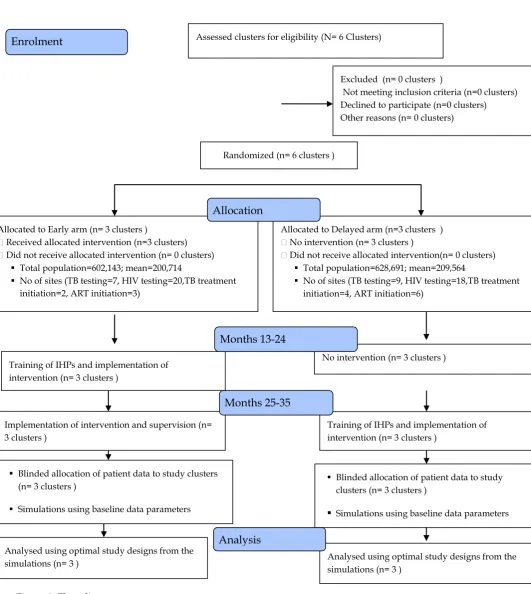
The overall design of the study is illustrated in a flow diagram shown in Figure 1 (Campbell, Elbourne, and Altman, 2004). A detailed description of the study design follows.
2.3.1 The study areas
As indicated in Chapter 1 section 1.1.5, earlier research by the REACH Trust focused on health issues for the poor and the vulnerable in semi-urban areas (see Simwaka et al., 2012). This study continued these efforts in rural areas where different challenges exist. Thus, the Triage Plus study was implemented in rural areas of Lilongwe District.
Lilongwe is the capital city of Malawi. It is in the centre of Lilongwe District, an administrative demarcation. The city is therefore surrounded by a large rural district. Lilongwe rural is served by 18 traditional authorities with a total population of 1,230,834 (NSO, 2010).There are 4 mission hospitals, 2 community hospitals, 32 health centres, and 68 health posts in Lilongwe rural. In addition, the district is served by a referral hospital and private clinics located in the urban areas. All the mission and community hospitals located in the rural areas offer TB and HIV services (e.g. TB and ART treatment initiations). All health centres offer HIV testing while TB testing is done in 16 health facilities in the rural areas.
16
Policy Research Institute (IFPRI), Washington, DC, USA and the National Statistical Office (NSO), Malawi, respectively in 1998, 64.3% of the Malawian population live in poor households of which 76.6% are situated in rural Lilongwe (Benson et al., 2002).
2.3.2 Study design
As the intervention was meant to alter general health seeking behaviour in the intervention areas, an individually randomised clinical trial was considered inappropriate, and a cluster randomisation approach was, therefore, adopted in this study. In cluster randomised trials, distinct and identifiable groups, such as communities or schools, are randomly assigned to study conditions, and data for impact evaluation is collected from the members of those groups (Murray et al., 1998a; Hayes and Moulton, 2009). However, because the effects of the intervention were likely to persist for some time, stepped wedged (De Allegri et al., 2008) and crossover designs (Sjögren et al., 2005) were considered to be inappropriate. A parallel cluster randomised trial design was therefore used. Such parallel designs have previously been used in cluster randomised trials in the evaluation of different health intervention strategies (see Corbett et al., 2010).
Unlike parallel designs, crossover designs allow each cluster to receive both the intervention and control treatment at equal time intervals (Palmer et al., 1985; Chavasse et al., 1999; Sjogren et al., 2005). The within-cluster evaluation design allows a more precise intervention evaluation and requires fewer clusters than parallel designs (Hussey and Hughes, 2007).
In the stepped wedge design, a type of crossover design, different clusters switch interventions at different times, and the crossover is in one direction from control to intervention (Hussey and Hughes, 2007; Brown and Lilford, 2006, The Gambia Hepatitis Study Group, 1987; De Allegri et al., 2008). This design approach not only removes the ethical concern of withholding the intervention from some communities (Hussey and Hughes, 2007), but it is also more efficient as clusters act as their own control.
wedged design, a formal stepped wedged design randomisation was not implemented because of the limited number of clusters.
Cluster randomization has practical advantages: all subjects in the cluster are treated in the same way thereby reducing costs and ethical concerns (Donner et al., 1990). However, cluster randomisation may not permit the direct determination of the extent to which individual subjects were exposed to the intervention.
2.3.3 The phased intervention design
2.3.3.1 Number of clusters for randomisation
The Triage Plus study was implemented in rural areas of Lilongwe where the level of infection with mycobacterium tuberculosis is generally low compared to the urban areas. For instance, in a TB prevalence survey conducted by Ayles et al (2009), two areas (one urban and the other rural) in Zambia showed that the adjusted TB prevalence in urban areas was approximately two times higher than that of rural areas (650/100,000 (95% CI 360–940) in the rural areas vs 1200/100,000 (95% CI 750–1640 in urban areas). However, it is acknowledged that in other settings different patterns exist. A TB prevalence study conducted in India found higher TB prevalence in rural areas than in urban areas (Rao et al., 2012). To obtain an adequate number of TB cases for the primary outcome measures, such as TB treatment initiation rates, large cluster sizes were used for randomisation to different study arms. In total, 6 clusters were formed by subdividing the Lilongwe rural communities. The cluster boundaries were based on existing boundaries drawn by traditional authorities. Approximately three traditional authorities were grouped to form a cluster. This not only permitted obtaining adequate numbers of TB and HIV cases but also minimised the risk of potential contamination of the intervention between intervention arms due to reduced interactions of people between clusters due to the large size of the clusters. When small clusters with no corresponding buffer zones are used, there is a high likelihood of people between clusters interacting thereby affecting the effectiveness of the intervention (Hayes et al., 2000; Torgerson, 2001; Borm et al., 2005).Thus, the Triage Plus study had three clusters in each of the two arms.
18
Excluded (n= 0 clusters )
Not meeting inclusion criteria (n=0 clusters) Declined to participate (n=0 clusters) Other reasons (n= 0 clusters)
Analysed using optimal study designs from the simulations (n= 3 )
Training of IHPs and implementation of intervention (n= 3 clusters )
Allocated to Early arm (n= 3 clusters )
Received allocated intervention (n=3 clusters) Did not receive allocated intervention (n= 0 clusters)
Total population=602,143; mean=200,714
No of sites (TB testing=7, HIV testing=20,TB treatment initiation=2, ART initiation=3)
No intervention (n= 3 clusters ) Allocated to Delayed arm (n=3 clusters )
No intervention (n= 3 clusters )
Did not receive allocated intervention(n= 0 clusters)
Total population=628,691; mean=209,564
No of sites (TB testing=9, HIV testing=18,TB treatment initiation=4, ART initiation=6)
Analysed using optimal study designs from the simulations (n= 3 )
Allocation
Analysis Months 13-24
Randomized (n= 6 clusters )
Enrolment Assessed clusters for eligibility (N= 6 Clusters)
Implementation of intervention and supervision (n= 3 clusters )
Training of IHPs and implementation of intervention (n= 3 clusters )
Blinded allocation of patient data to study clusters (n= 3 clusters )
Simulations using baseline data parameters
Months 25-35
Blinded allocation of patient data to study clusters (n= 3 clusters )
Simulations using baseline data parameters
[image:36.595.40.572.100.695.2]
2.3.3.2 Matching of clusters
Although randomising clusters to the interventions arms without stratification or matching improves statistical power, this approach is actually ideal when there are many clusters available for randomisation (Klar and Donner, 1997). However, with the 6 clusters available for randomisation in the Triage Plus study, obtaining balanced distribution of potential risk factors between intervention arms was difficult. Thus, before the 6 clusters were randomised to different intervention arms (an Early arm and a Delayed arm) as described below in section 2.3.3.3 and 2.3.3.5, the 6 clusters were pair-matched according to population sizes and whether or not the clusters bordered urban areas. The pair-matching was done when all the available clusters (i.e. the 6 clusters) had been enrolled in the study. Similar clusters based on population sizes and proximity to urban areas were pair-matched. One of the pair-matched pairs was then randomly assigned to the intervention arm as described in 2.3.3.3.This was done to minimise the imbalance between the two intervention arms as well as to control for the effects of urbanisation (Mc Clatchey et al., 1992; Hayes et al., 2000).
2.3.3.3 The randomisation process
20 2.3.3.4 Blinding of the intervention
Because of the nature of the intervention implemented at community level, it was not possible to conceal either the allocation of the intervention from the communities or from the research team involved in the study. However, patient allocation to specific clusters was blindly done by an independent person who had no knowledge of the intervention.
2.3.3.5 The Triage Plus study implementation phases
In the Early intervention clusters, the schedule of the project implementation was decided randomly and each selected cluster received the full intervention before moving to the subsequent clusters. All 3 clusters in the Early intervention arm received the full intervention package within 3 months. The intervention package was implemented in the Early intervention clusters for a period of 12 months. During this time, the Delayed intervention arm continued receiving standard care. In both Early and Delayed arms, data collection continued throughout the 12 months called ‘Phase I’.
Due to time constraints (inadequate time to conduct data entry, cleaning, analysis and final write up of the thesis), the Delayed intervention arm received a full intervention package for only the 11 months immediately following the initial 12 months of Phase I. The Early arm clusters continued to receive the intervention during this time. In both arms, data collection continued in the 11 month period called ‘Phase II’.
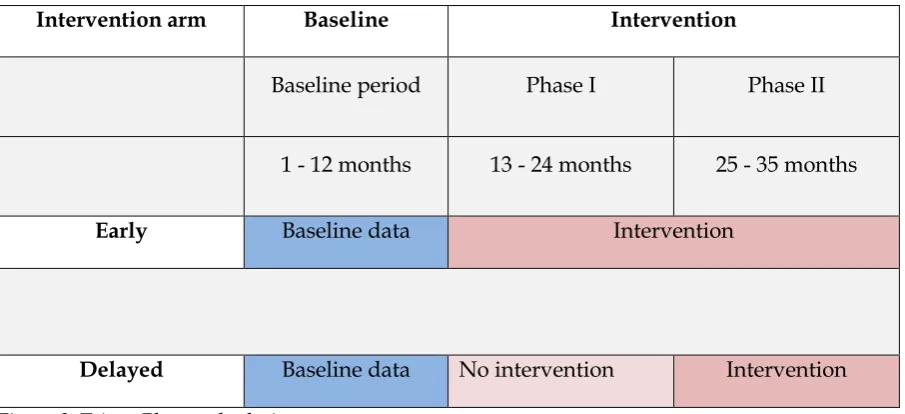
Before cluster randomisation was done, baseline data for the study outcome measures and contextual factors (see section 2.6) was collected over the 12 month period before the initiation of the intervention in all clusters (called ‘Baseline period’). Figure 3 summarises the phased, pair-matched, parallel cluster design used in the Triage Plus study.
were similar (see Table 1). Cluster characteristics are compared in section 6.4 of the statistical analysis (Chapter 6).
Table 1: Poverty incidence in Lilongwe rural areas
Early arm* Delayed arm**
Traditional authority
Total house-holds
Poverty Headcount (%)
Ultra poverty headcount (%)
Traditional authority
Total house-holds
Poverty Head-count (%)
Ultra Poverty Headcount (%)
Chadza 19,173 80.6 52.7 Kalolo 23,457 96.1 39.7 Kabudula 17,435 80.3 50.0 Chiseka 40,371 66.3 39.8 Mazengera 18,358 82.8 56.6 Chimutu 15,403 87.9 64.8 Chitekwere 6,632 75.0 42.0 Chitukula 4,824 83.9 54.7 Khongoni 15,954 75.9 45.1 Mtema 7,648 82.9 53.4 Kalumbu 11,321 89.0 66.9 Malili 14,895 74.2 44.0 Tsabango 4,885 87.1 63.3
Kalumba 4,289 76.7 50.1 Njewa 4,891 75.3 47.1
*Early arm = clusters that received the intervention early;
**Delayed arm = clusters that received the intervention in the second half (next 11 months) of the study period.
22
Figure 2: Map of Lilongwe showing the distribution of the Triage Plus study clusters between intervention arms.
The pink background represents clusters in the Early intervention arm and the green background represents clusters in the Delayed intervention arm. Each cluster is formed by grouping 2 to 3 traditional authorities which have purple boundary lines. The names of the traditional authorities are indicated inside the clusters. The centre of the map is the urban area which was not part of the study.
Masula Kalolo
Malili
Mazengera Kabudula
Khongoni
Chadza
Chim utu Chitukula
Chiseka Mtema
Masum bankhunda Kalumbu
Njewa
Mbang'ombe
Tsabango
Kalumba City
S N
E W
Lilongwe district Early intervention Delayed intervention Road network
Main Road Secondary R oad
Traditional Authority Boundaries
Intervention arm Baseline Intervention
Baseline period Phase I Phase II
1 - 12 months 13 - 24 months 25 - 35 months
Early Baseline data Intervention
[image:41.595.73.526.90.297.2]Delayed Baseline data No intervention Intervention
Figure 3: Triage Plus study design.
The figure shows the phased, pair-matched, parallel cluster design which was used to randomise study clusters to Early and Delayed arms. The blue colour represents the baseline period and the dark purple represents when the intervention package was implemented in the respective arms and the light purple under the Delayed intervention arm represents study period when no intervention was implemented in the Delayed arm.
2.4 Study intervention
2.4.1 The Intervention package
Informal healthcare providers are known to be the first point of call along the health-seeking pathway for the most poor and vulnerable (e.g., see Simwaka et al., 2012).The Triage Plus study, therefore, aimed to assess the potential of involving a variety of informal health care providers such as storekeepers, traditional healers and village health committees in assisting in the diagnostic and treatment process for TB and HIV at the community level.
Thus, the intervention package entailed:
a) Training informal health care providers to effectively implement the components of
the intervention.