arXiv:math/0402153v3 [math.DG] 21 Jun 2004
ANNA PRATOUSSEVITCH
Abstract. We present several formulas for the traces of elements in complex hyperbolic triangle groups generated by complex reflections.
The space of such groups of fixed signature is of real dimension one. We parameterise this space by a real invariantαof triangles in the complex
hy-perbolic plane. The main result of the paper is a formula, which expresses the trace of an element of the group as a Laurent polynomial ineiα with
coeffi-cients independent ofαand computable using a certain combinatorial winding
number. We also give a recursion formula for these Laurent polynomials and generalise the trace formulas for the groups generated by complexµ-reflections.
We apply these formulas to prove some discreteness and some non-discre-teness results for complex hyperbolic triangle groups.
1. Introduction
We study representations of real hyperbolic triangle groups, i.e. groups generated by reflections in the sides of triangles in HR, in the holomorphic isometry group2 PU(2,1) of the complex hyperbolic planeHC.2
We use the following terminology: A complex hyperbolic triangle is a triple (C1, C2, C3) of complex geodesics inHC. If the complex geodesics2 Ck−1 andCk+1 meet at the angleπ/pkwe call the triangle (C1, C2, C3) a (p1, p2, p3)-triangle. If the complex geodesicsCk−1andCk+1are ultra-parallel (i.e. their closures inHC2∪∂HC2 do not intersect) with distance ℓk we call the triangle (C1, C2, C3) a [ℓ1, ℓ2, ℓ3]
-triangle. A complex geodesic (or complex slice) in H2
C is the fixed point set of a complex reflection. Acomplex reflection is an element of PU(2,1) conjugate to the map
[z1:z2:z3]7→[z1:−z2:−z3].
For more details on complex reflections and complex and real slices see section 2.
We call a subgroup of PU(2,1) generated by complex reflectionsιkin the sidesCk of a complex hyperbolic (p1, p2, p3)-triangle (C1, C2, C3) a (p1, p2, p3)-triangle group. We call a representation of the group
Γ(p1, p2, p3) =hγ1, γ2, γ3 γk2= (γk−1γk+1)pk= 1 for allk∈ {1,2,3}i, whereγk+3=γk, and the relation (γk−1γk+1)pk = 1 is to omit forpk=∞, into the group PU(2,1) given by taking the generatorsγk of Γ(p1, p2, p3) to the generators
ιk of a (p1, p2, p3)-triangle group a (p1, p2, p3)-representation. In the ultra-parallel case we define similarly [ℓ1, ℓ2, ℓ3]-triangle groups and [ℓ1, ℓ2, ℓ3]-representations.
Date: February 1, 2008.
2000Mathematics Subject Classification. Primary 51M10; Secondary 32M15, 53C55, 53C35.
Key words and phrases. complex hyperbolic geometry, triangle groups.
For fixed (p1, p2, p3) resp. (ℓ1, ℓ2, ℓ3) the space of complex hyperbolic triangle groups is of real dimension one. There is a canonical path ρt of representations. The starting pointρ0 for the path is the case when the triangle lies in a real slice. Real slices are the second type of totally geodesic subspaces inHC.2
For (p1, p2, p3)-triangle groups, according to Richard Schwartz [Sch02], the con-jectural picture is as follows:
Conjecture. We assumep16p26p3. DefinewA=ι3ι2ι3ι1 andwB=ι1ι2ι3.
A(p1, p2, p3)-representation is a discrete embedding if and only if neitherwAnor
wB is elliptic. The set of the corresponding parameter values is a closed symmetric
interval.
If the element wA becomes elliptic before wB, we say that the triple (p1, p2, p3)
is of type A, else we say that the triple is of type B.
The triple(p1, p2, p3)is of type A if p1<10and of type B ifp1>13.
If the triple (p1, p2, p3) is of type A then there is a countable collection of
pa-rameters, for which the (p1, p2, p3)-representation is infinite and discrete but not
injective. If the triple (p1, p2, p3) is of type B then there are no such discrete but
not injective (p1, p2, p3)-representations.
R. Schwartz proved this conjecture for (∞,∞,∞)-groups in [Sch01b], and for (p1, p2, p3)-groups with p1, p2, p3 sufficiently large in [Sch03b]. For sufficiently largep1,p2,p3the triple (p1, p2, p3) is of type B.
The case of (p, p,∞)-triangle groups was studied in [WG00] by Justin Wyss-Gallifent. It turns out that the triple (p, p,∞) is of type A forp613 and of type B for p > 14. He also described some of the discrete but not injective (4,4,∞ )-representations.
In general, to prove that a certain (p1, p2, p3)-representation is discrete and injec-tive, it is necessary and sufficient to show that the images of elements of Γ(p1, p2, p3) of infinite order are not regular elliptic. Here the traces come in, namely, an ele-ment of SU(2,1) is not regular elliptic if and only if the value of certain discriminant function (introduced by W. Goldman) on the trace of the element is not negative. The main results of this paper are formulas for traces of elements in complex hy-perbolic triangle groups, a combinatorial trace formula (theorem 4) and a recursive trace formula (theorem 7) as well as their applications. These formulas generalise the results of Hanna Sandler [San95] on ideal triangle groups.
We parameterise the one-dimensional space of (p1, p2, p3)-triangle groups by an invariantαof triangles in the complex hyperbolic plane. The combinatorial trace formula express the trace of an element of the group as a Laurent polynomial ineiα with coefficients independent of α and computable using a certain combinatorial winding number. Then we give a recursion formula for these Laurent polynomi-als. We also generalise the trace formulas for the groups generated by complex
µ-reflections.
We apply the formulas to prove some discreteness and some non-discreteness results for complex hyperbolic triangle groups.
element wA is regular elliptic (proposition 12 and corollary 13). Furthermore, for a certain subfamily of triangle groups we can partially confirm the conjecture of Schwartz about type A and B. We find a sufficient condition for a triple (p1, p2, p3) to be of type B. This condition implies for example that triples (p, p,∞) withp>14 and triples (p,2p,2p) withp>12 are of type B (proposition 16). We also obtain similar results for ultra-parallel triangle groups.
The paper is organised as follows: In section 2 we recall the basic notions of complex hyperbolic geometry, specially for the complex hyperbolic plane H2
C. In sections 3 and 4 we define angular invariantα, which classifies complex hyperbolic triangles with fixed angles up to isometry, and we compare this invariant with invariants defined for some special cases by U. Brehm, J. Hakim and H. Sandler. Section 5 contains the description of certain combinatorial functions of words, first of all the winding number.
After that we are prepared to state and to prove in sections 6 and 7 our main results, the combinatorial trace formula (thm. 4) and the recursive trace formula (thm. 7). In section 8 we discuss as the first application of the recursive trace formula the resulting formulas for the traces of short words in triangle groups. We prove in section 9 some properties of the traces of elements in a triangle group, which are also used later in section 13. In section 10 we describe the generalisations of our trace formulas for groups generated by µ-reflections (for the definition see section 2).
Sections 11–13 contain applications of the trace formulas. In section 11 we discuss necessary conditions for a triangle group representation to be a discrete embedding. Section 12 deals with a subfamily of (p1, p2, p3)-triangle groups with the property
π p1 =
π p2 +
π
p3 resp. of [ℓ1, ℓ2, ℓ3]-triangle groups with the propertyℓ3=ℓ1+ℓ2. The
triangle groups in this subfamily seem to share a lot of properties of the ideal triangle groups. For this subfamily we can prove more precise statements about type A and B. In section 13 we discuss some arithmetic properties of the traces for certain (finite) family of signatures and parameter values of triangle groups. Finally, in section 14 we summarise some of the known results on complex hyperbolic triangle groups and describe them in terms of our parameterr1, r2, r3, and α(for notation compare section 3).
Part of this work was done during an enjoyable stay at the University of Mary-land. I am grateful to William Goldman and Richard Schwartz for their kind invitation and for helpful discussions and to the University of Maryland for its hospitality. I would like to thank Werner Ballmann, Egbert Brieskorn, Martin Der-aux, Ilya Dogolazky, Tadeusz Januszkiewicz, John Parker, Blake Pelzer, and Gregor Weingart for useful conversations related to this work.
2. Complex Hyperbolic Plane
In this section we recall some basic notions of complex hyperbolic geometry. The general references on complex hyperbolic geometry are [Gol99], [Par], and [BH99].
Complex Hyperbolic Plane: LetC2,1 denote the vector spaceC3 equipped with the Hermitian form
of signature (2,1). We call a vectorz ∈C2,1 negative, null, or positive, according as hz, zi is negative, zero, or positive. Let P(C2,1) denote the projectivisation ofC2,1−{0}. We denote the image ofz∈C2,1under the projectivisation map by [z]. We also write [z] = [z1:z2:z3] forz = (z1, z2, z3)∈C2,1. Thecomplex hyperbolic
plane H2
C is the projectivisation of the set of negative vectors in C
2,1. Its ideal
boundary ∂H2
C is defined as the projectivisation of the set of null vectors in C 2,1. The complex hyperbolic plane H2
C is a K¨ahler manifold of constant holomorphic sectional curvature. The holomorphic isometry group ofH2
C is the projectivisation PU(2,1) of the group SU(2,1) of complex linear transformations, which preserve the Hermitian form.
TheHermitian cross product: ⊠:C2,1×C2,1→C2,1is defined by
z⊠w=
−1 0 0
0 −1 0
0 0 1
(¯z×w¯) =
z3w2−z2w3
z1w3−z3w1
z1w2−z2w1
.
The Hermitian cross product of two vectors yields a vector perpendicular to both of them
hz⊠w, zi=hz⊠w, wi= 0.
Furthermore we have
ha⊠c, b⊠ci=ha, cihc, bi − ha, bihc, ci,
in particular
ha⊠b, a⊠bi=|ha, bi|2− ha, aihb, bi.
Totally Geodesic Submanifolds: There are two kinds of totally geodesic submanifolds of dimension 2 inHC,2 complex slices(or complex geodesics) and real
slices (or totally real totally geodesics subspaces). Complex geodesics are obtained by projectivisation of 2-dimensional complex subspaces of C2,1. Given any two points in H2
C, there is a unique complex geodesic containing them. Any positive vectorc∈C2,1determines a 2-dimensional complex subspace
{z∈C2,1hc, zi= 0}
and a complex geodesic, which is the projectivisation of this subspace. The vector
cis called apolar vectorof the complex geodesic. A polar vector can be normalised to hc, ci= 1. Conversely, any complex geodesic is represented by a polar vector. A typical example is the complex slice {[z : 0 : 1] ∈ H2
C} with polar vector c = (0,1,0)T. Any complex slice is isometric to this one.
We now describe possible configurations of two complex geodesics (compare proposition 6.8 in [Par]). For two complex geodesics one of the following situa-tions occur:
• they coincide,
• they intersect in a single point inHC,2
• their closures inH2
C∪∂HC2 intersect in a single point in∂HC,2
• their closures inH2
C∪∂HC2 are disjoint.
LetC1 and C2 be two complex geodesics with normalised polar vectors c1 and
c2 respectively. The complex geodesics C1 and C2 intersect in HC2 if and only if
of intersection betweenC1andC2, andc1⊠c2is a negative vector, corresponding to the intersection point. The angle of intersection can be defined as
∠(C1, C2) = min{∠(λ1c1, λ2c2)
λ1, λ2∈R},
where the angles on the right hand side are measured in the underlying real vector space of C2,1. The angle satisfies∠(C1, C2)∈[0, π/2]. The complex geodesics C1 andC2intersect in∂HC2if and only if|hc1, c2i|= 1, in this casec1⊠c2is a null vector, corresponding to the intersection point. The closures of the complex geodesics C1 andC2are disjoint if and only if |hc1, c2i|>1, in which case|hc1, c2i|= cosh(ℓ/2), whereℓis the distance betweenC1 andC2.
Any real slice is isometric to{[z:w: 1]∈HC2
z, w∈R}. Real slices are fixed point sets ofreal reflections,i.e. antiholomorphic isometries conjugate to the map
[z:w: 1]7→[¯z: ¯w: 1].
Complex Reflections: Given a complex geodesicC, there is a unique isome-tryιC in PU(2,1) of order 2, whose fixed point set equalsC. We call this isometry thecomplex reflection inC (or the inversion onC). The complex reflection inC
is represented by an elementιC ∈SU(2,1) that is given by
ιC(z) =−z+ 2hz, ci
hc, cic,
wherec is a polar vector ofC.
Complexµ-Reflections: For a unit complex numberµa complexµ-reflection is an element of PU(2,1) conjugate to the map
[z1:z2:z3]7→[µz1:z2:z3].
Its fixed point set is a complex geodesic and the µ-reflection rotates around this complex geodesic by the angle arg(µ). For µ = −1 we get the usual complex reflections described above. The complexµ-reflection in a complex geodesicCwith a polar vectorcis given by
ιµC(z) =z+ (µ−1)·hz, ci
hc, ci·c.
Classification of isometries: An isometry ϕofH2
C is called ellipticif it has a fixed point in HC. It is called2 hyperbolic (or loxodromic) if its displacement
dϕ = inf{d(x, ϕ(x)) x ∈ HC2} is positive. Here d is the inner metric on HC.2 A hyperbolic isometry has two fixed points that lie in ∂HC. An isometry, which2 is neither elliptic nor hyperbolic, is called parabolic. It has one fixed point that lies in ∂H2
C. So far this was the usual classification of isometries of non-positive curved spaces. In the case of the complex hyperbolic space we can refine this classification. An elliptic element is calledregular elliptic if all its eigenvalues are distinct. A parabolic element, which can be written as an element of U(2,1) with only eigenvalue 1, is called unipotent, otherwise the parabolic element is called
ellipto-parabolic (orskew-parabolic).
Using the discriminant function
we can classify isometries of the complex hyperbolic plane by the traces of the corresponding matrices: An isometryA∈SU(2,1) is regular elliptic iffρ(traceA)<
0 and hyperbolic iff ρ(traceA) > 0. If ρ(traceA) = 0 there are three cases. If (traceA)3= 27 thenAis unipotent. Otherwise,Ais either a complex reflection in a complex geodesic or a complex reflection about a point, orAis ellipto-parabolic. The proof can be found in [Gol99], Theorem 6.2.4. Note that for realzthe functionρ
factors intoρ(z) = (z+ 1)(z−3)3. This means forA∈SU(2,1) whose trace is real, thatA is regular elliptic iff traceA∈(−1,3) and hyperbolic iff traceA6∈[−1,3].
3. Complex Hyperbolic Triangles and α-Invariant
In this section we describe a parameterisation of the space of (complex hyper-bolic) triangles inHC, i.e. of triples (2 C
1, C2, C3) of complex geodesics, by means of an invariantα. Letck be the normalised polar vector of the complex geodesicCk. Letrk =|hck−1, ck+1i|. If the complex geodesicsCk−1andCk+1 meet at the angle
ϕk, then rk = cosϕk. If the complex geodesicsCk−1 and Ck+1 are ultra-parallel with distance ℓk, thenrk = cosh(ℓk/2). We define theangular invariantα of the triangle (C1, C2, C3) by
α= arg 3 Y k=1
hck−1, ck+1i !
.
The angular invariant is obviously invariant under isometries ofHC. The complex2 reflectionιk =ιCk in the complex geodesicCk is defined by
ιk(z) =−z+ 2hz, cki ·ck.
(Note that because of the propertyhck, cki= 1 we can simplify the formula for the reflection.)
Remark. If the complex geodesicsCk−1 andCk+1 or their closures intersect, then the vectorvk =ck−1⊠ck+1is a negative resp. null vector, which corresponds to the intersection point, i.e. to a vertex of the complex hyperbolic triangle. The points [vk] can be also meaningfully interpreted in the case of ultra-parallel geodesicsCk−1 andCk+1.
We call a complex hyperbolic triangle (C1, C2, C3) a (ϕ1, ϕ2, ϕ3)-triangle if the complex geodesicsCk−1 andCk+1 meet at the angleϕk.
Proposition 1. A (ϕ1, ϕ2, ϕ3)-triangle in HC2 is determined uniquely up to
isom-etry by the triple (ϕ1, ϕ2, ϕ3)and the angular invariant
α= arg 3 Y k=1
hck−1, ck+1i !
.
For any α∈ [0,2π] there exists a (ϕ1, ϕ2, ϕ3)-triangle inHC2 with angular
invari-antαif and only if
cosα < r
2
1+r22+r23−1 2r1r2r3
,
Proof. We can normalise so that
c1=
z ξ β
, c2=
γ δ
0
, and c3= 0 1 0
withz∈C,ξ, β, γ, δ∈Rand ξ, γ, δ >0. We compute
hc1, c3i=ξ, hc2, c1i=γz¯+δξ, hc3, c2i=δ.
The conditions|hck−1, ck+1i|=rk andhck, cki= 1 imply
δ=r1, γ=s1,
ξ=r2, |z|> s2, β= (|z|2+r22−1)1/2,
z= (r3e−iα−r1r2)s−11,
where rk = cos(ϕk) and sk = sin(ϕk). The inequality |z| > s2 finally implies
|r3eiα−r1r2| > s1s2. Computation shows that this inequality is equivalent to
cosα <(r2
1+r22+r23−1)(2r1r2r3)−1.
Remark. In the case of angular invariantα=πall the vertices [v1], [v2], and [v3] of the triangle lie in one real slice. The corresponding triangle group representation stabilises this real slice. The angular invariantαwith
cosα= r 2
1+r22+r23−1 2r1r2r3
corresponds to the case that all vertices [v1], [v2], and [v3] of the triangle coin-cide. The groups with angular invariant αand 2π−αare conjugate via an anti-holomorphic isometry ofHC. For this reason we can restrict ourselves to the cases2 of angular invariantα∈(0, π].
Similar statements can be proved also in the cases when some of the complex geodesics are ultra-parallel. For example, for an ultra-parallel [ℓ1, ℓ2, ℓ3]-triangle (C1, C2, C3), i.e. in the case that the complex geodesicsCk−1 andCk+1 are ultra-parallel with distanceℓk, we obtain by similar reasoning the following result:
Proposition 2. An ultra-parallel [ℓ1, ℓ2, ℓ3]-triangle inHC2 is determined uniquely
up to isometry by the triple(ℓ1, ℓ2, ℓ3)and the angular invariant
α= arg 3 Y k=1
hck−1, ck+1i !
.
For any α ∈ [0,2π] there exists an ultra-parallel [ℓ1, ℓ2, ℓ3]-triangle in HC2 with
angular invariant αif and only if
cosα < r
2
1+r22+r23−1 2r1r2r3
,
Examples of explicit parameterisations: In the casep3 =∞ we consider forα∈[−π, π] the complex geodesics with normalised polar vectors
c1=
1
z2
−z2
, c2=
1
z1
−z1
, and c3= 0 1 0
,
wherez1= cos(π/p1)e−iα/2 andz2= cos(π/p2)eiα/2. Computing
hc1, c3i=r2eiα/2, hc2, c1i= 1, hc3, c2i=r1eiα/2
we see thatγk7→ιCk defines a (p1, p2,∞)-representation withα-invariant equal to
α. For the sake of completeness we also compute the vertices of the triangle
[v1] = [−r1eiα/2: 0 : 1], [v2] = [−r2e−iα/2: 0 : 1], [v3] = [0 : 1 :−1].
A special case of this parameterisation is the parameterisation of (p, p,∞)-groups in [WG00]. Another example of explicit parameterisation is the parameterisation of (4,4,4)-groups in [Sch03a].
4. Connection of the Angular Invariantα and Other Invariants
In this section we compare our parameterisation of the space of complex hyper-bolic triangles with other parameterisations by Ulrich Brehm [Bre90] and Jeffrey Hakim and Hanna Sandler [HS00].
Let (C1, C2, C3) be a complex hyperbolic triangle. Let ck be the normalised polar vector of the complex geodesic Ck. Assume that for k= 1,2,3 the complex geodesicsCk−1 andCk+1 or their closures intersect. Letvk =ck−1⊠ck+1.
The Cartan angular invariant of three points [v1], [v2], and [v3] in ∂H2 C was defined by ´E. Cartan in [Car32] as follows:
A([v1],[v2],[v3]) = arg(−hv1, v2ihv2, v3ihv3, v1i).
To compare the Cartan angular invariant and our invariantαwe need the following proposition:
Proposition 3. Let hck−1, ck+1i = rkeiθk. Then we have hvk, vki = r2k −1,
hvk−1, vk+1i=eiθk(rk−rk−1rk+1e−iα), and 3
Y k=1
hvk, vk+1i= 3 Y k=1
hvk−1, vk+1i=e−iα· 3 Y k=1
(rk−rk−1rk+1eiα).
Proof. The proof of this proposition, based on the fact that [vk] = [ck−1⊠ck+1] and the formula forha⊠c, b⊠ci, is straightforward.
Using the last proposition we obtain the following formula for the Cartan angular invariant
A= arg(−e−iα(1−eiα)3) =α−π
2 mod 2π because of arg(1−eiα) = (α−π)/2.
Ulrich Brehm defined in [Bre90] the shape invariant of three points [v1], [v2], and [v3] in H2
C as
σ([v1],[v2],[v3]) = Re
hv1, v2ihv2, v3ihv3, v1i
hv1, v1ihv2, v2ihv3, v3i
The shape invariant σis invariant under PU(2,1), and the triangle [v1], [v2], [v3] is determined uniquely up to isometry by its three angles together with the shape invariant. Using proposition 3 we obtain the following formula that describes the relation between the Brehm’s shape invariantσand our invariantα:
σ=r
2
1r22r23cos 2α−r1r2r3(r12+r22+r32+ 1) cosα+ (r12r22+r22r32+r32r12) (1−r2
1)(1−r22)(1−r32)
.
In [HS00] Jeffrey Hakim and Hanna Sandler defined such angular invariants also in the cases of triangles with one or two ideal vertices:
η([v1],[v2],[v3]) = hv3, v1ihv1, v2i
hv3, v2ihv1, v1i
.
Using proposition 3 we compute
η=e−iα· (r2−r1e
iα)(1−r 1r2eiα) (r1−r2eiα)(r21−1)
.
5. Winding Numbers and Other Combinatorial Functions
In this section we introduce some combinatorial functions of words, which will appear in the combinatorial trace formula.
We first fix some notation. Elements of the (p1, p2, p3)-triangle group, or the abstract group Γ(p1, p2, p3), may be naturally identified with finite sequences of numbers 1, 2, and 3. We refer to such sequences as words. The sequence a =
(a1, . . . , an) corresponds to the elementιa:=ιa1· · ·ιan. We shall simplify notation
where it is convenient, for example we write (123) instead of (1,2,3) andι123instead
ι(123) orι(1,2,3). The empty sequence corresponds to the identity element denoted byι∅. There is a natural definition of the powers (a1, . . . , an)w for w∈Z, which is consistent with taking powers of the corresponding elements in the group, for example (123)2= (123123) and (123)−1= (321). We denote byτ
a the trace of the elementιa.
We now introduce the winding number. Let χ denote the unique nontrivial character modulo 3, i.e. if ais any integer thenχ(a) is the unique element of the set of integers{−1,0,1}, which is congruent to amodulo 3. Define
w(a1, . . . , an) =1
3 · n X m=1
χ(am+1−am),
wherean+1:=a1.
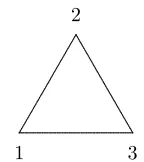
Remark. The integer w(a1, . . . , an) can be interpreted as the winding number of the loopa1 →a2→ · · · →an →a1 along the vertices of the (1,2,3)-triangle (see figure 1).
We are interested in traces of elements. ForA1, . . . , Am∈SU(2,1) we have
trace(A1· · ·Am) = trace(Am·A1· · ·Am−1).
... ... ... ... ... ... ... ... ... ...... ...... ...... ... ............ .. .. .. .. .. .. .. .. .. .. .. .. .. .. .. .. .. .. .. .. .. .. .. .. .. .. .. .. .. .. .. .. .. .. .. .. .. .. .. .. .. .. .. .. .. .. .. .. .. .. .. .. .. .. .. .. .. .. .. .. .. .. .. .. .. . 1 2 3
Figure 1: Winding Number and (1,2,3)-Triangle
Dealing with winding numbers we often use the following consideration: We start with the following operations on cyclic words: reduction
(· · · , k, k,· · ·)→(· · ·, k,· · ·)
and straightening
(· · · , k, l, k,· · ·)→(· · · , k,· · ·).
These operations do not change the winding number, and any cyclic wordacan be transformed into the cyclic word (123)w(a)using these operations.
We now introduce combinatorial functionsuk that will be used in the combina-torial trace formula.
Let
uk(a1, . . . , an) =|{m∈ {1, . . . , n} {am, am+1}={k−1, k+ 1}}|,
wherean+1=a1. Using the functionψk given byψk(a, b) = 1 iff
{a, b}={k−1, k+ 1}
andψk(a, b) = 0 otherwise we can describeuk as
uk(a1, . . . , an) =
n X m=1
ψk(am, am+1),
where againan+1=a1.
6. Combinatorial Trace Formula
The first main result of this paper is the following combinatorial formula for traces of elements in complex hyperbolic triangle group.
We first fix some notation. For a word a = (a1, . . . , an) and a subset S of the set [n] :={1, . . . , n} we denote byuk(S) resp. w(S) the values ofuk resp. w for the corresponding subsequences ofa, for example uk(S) =uk(ai1, . . . , aim) for
S={i1, . . . , im}with 16i1<· · ·< im6n.
Theorem 4. Let a= (a1, . . . , an)be a cyclic word,ιa=ιa1· · ·ιan the correspond-ing element of the(p1, p2, p3)-group andτa the trace ofιa. Then
τa= (−1)n·
2 + X S⊂[n]
(−2)|S|·ru1(S)
1 r u2(S)
2 r u3(S)
Equivalently, τa = (−1)n·(2 +pa(eiα)), where pa(z) = Pwqwzw is the Fourier
polynomial with coefficients
qw=
X
S⊂[n]
w(S)=w
(−2)|S|·ru1(S)
1 r u2(S)
2 r u3(S)
3 .
Proof. We write the complex reflections asιk =−id +2ckc∗k, where c∗ is the dual vector to a vector c ∈ C2,1, i.e. c∗(z) = hz, ci. To get a formula for traces we
expand
ιa=ιa1· · ·ιan
= (−id +2ca1c
∗
a1)· · ·(−id +2canc
∗
an)
= X
S={i1,...,im}⊂[n]
(−1)n−|S|·2|S|·(c
ai1c
∗
ai1· · ·caimc
∗
aim).
Let S = {i1, . . . , im} be a subset of [n]. For ease of notation let bj = aij and
b= (b1, . . . , bm). We have
cb1c
∗
b1cb2c
∗
b2· · ·cbm−1c
∗
bm−1cbmc
∗
bm =c
∗
b1(cb2)· · ·c
∗
bm−1(cbm)·(cb1c
∗
bm)
and trace(cb1c
∗
bm) =c
∗
bm(cb1) implies
trace(cb1c
∗
b1· · ·cbmc
∗
bm) =c
∗
b1(cb2)· · ·c
∗
bm−1(cbm)·c
∗
bm(cb1)
=hcb2, cb1i · · · hcbm, cbm−1i · hcb1, cbmi.
We claim that
hcb2, cb1i · · · hcbm, cbm−1i · hcb1, cbmi=r
u1(b)
1 r u2(b)
2 r u3(b)
3 ·eiαw(b).
It is clear that the absolute value of the complex number on the left hand side of the equation is equal to ru1(b)
1 r u2(b)
2 r u3(b)
3 . The statement about the argument of this complex number is clear for the words of the form (123)wfor somew∈Z. Any other cyclic wordbcan be transformed into the word (123)w(b)using the winding number preserving operations of reduction and straightening as described in section 5. It remains to note that this operations do not change the argument of the complex number on the left hand side of the equation. So we have proven the formula
hcai2, cai1i · · · hcaim, caim−1i · hcai1, caimi=r
u1(S)
1 r u2(S)
2 r u3(S)
3 ·eiαw(S)
forS={i1, . . . , im} ⊂[n]. (Note that this formula does not hold forS=∅, so we
have to handle this case separately.) Using this formula we finally obtain
τa = (−1)n·
2 + X S⊂[n]
(−2)|S|·ru1(S)
1 r u2(S)
2 r u3(S)
3 ·eiαw(S) .
Remark. In the ideal triangle group case, i.e. forp1=p2=p3=∞, it follows from the Binomial Theorem
X k
qk =
X S⊂[n]
7. Recursive Trace Formula
In explicit computations we rather use the following recursive trace formula, which can be derived from the combinatorial trace formula of the last section. We first state some properties of the winding number and of the combinatorial function
uk. They follow from routine induction arguments.
Proposition 5. We note that
w(a1, . . . , an) =w(a1, . . . , am) +w(am, . . . , an) +w(a1, am, am+1, an)
for m= 2, . . . , n−1. Especially
w(a1, . . . , an, an+1) =w(a1, . . . , an) +w(a1, an, an+1),
and
w(b1, . . . , bm, an−2, an−1, an) =w(b1, . . . , bm, an−2, an) +w(an−2, an−1, an).
Proposition 6. We note that
uk(a1, . . . , an, an+1) =uk(a1, . . . , an) +vk(an, an+1, a1)
and
uk(b1, . . . , bk, an−2, an−1, an) =uk(b1, . . . , bk, an−2, an) +vk(an−2, an−1, an),
where
vk(a, b, c) =ψk(a, b) +ψk(b, c)−ψk(a, c).
Definedeletion operators δ,δ′, andδ′′: For a worda= (a
1, . . . , an) let
δ(a) = (a1, . . . , an−3, an−2, an−1), δ′(a) = (a1, . . . , an−3, an−2, an),
δ′′(a) = (a
1, . . . , an−3, an−1, an).
Theorem 7. Leta= (a1, . . . , an)be a word of lengthn>3andτa the trace of the
corresponding element ιa. Then
τa=−(τδa+τδ′′a+τδδ′′a) +β(τδ′a+τδδ′a+τδ′δ′′a+τδδ′δ′′a),
where
β= 2rv1(T)
1 r v2(T)
2 r v3(T)
3 ·e iαw(T)
−1
Proof. The proof is along the lines of the proof of Theorem 3 in [San95]. We consider
ta: = (−1)nτa−2
= X
S⊂[n]
(−2)|S|·ru1(S)
1 r u2(S)
2 r u3(S)
3 e iαw(S),
t′a: =ta−tδa= (−1)n(τa+τδa)
= X
n∈S⊂[n]
(−2)|S|·ru1(S)
1 r u2(S)
2 r u3(S)
3 eiαw(S),
t′′
a: =t′a−t′δ′a= (−1)n(τa+τδa+τδ′a+τδδ′a)
= X
n−1,n∈S⊂[n]
(−2)|S|·ru1(S)
1 r u2(S)
2 r u3(S)
3 eiαw(S),
t′′′a : =t′′a−t′′δ′′a
= (−1)n(τa+τδa+τδ′a+τδδ′a+τδ′′a+τδδ′′a+τδ′δ′′a+τδδ′δ′′a)
= X
n−2,n−1,n∈S⊂[n]
(−2)|S|·ru1(S)
1 r u2(S)
2 r u3(S)
3 eiαw(S).
For S ⊂ [n−3] let ˆS := S ∪ {n−2, n−1, n} and S′ := S∪ {n−2, n}. By
propositions 5 and 6 it holds forS ⊂[n−3]
w( ˆS) =w(S′) +w(T) and uk( ˆS) =uk(S′) +vk(T).
This implies
t′′′a =
X n−2,n−1,n∈S⊂[n]
(−2)|S|·ru1(S)
1 r u2(S)
2 r u3(S)
3 eiαw(S)
= X
S⊂[n−3]
(−2)|S|+3·ru1( ˆS)
1 r u2( ˆS)
2 r u3( ˆS)
3 e iαw( ˆS)
=−2·rv1(T)
1 r v2(T)
2 r v3(T)
3 e iαw(T)
· X
S⊂[n−3]
(−2)|S|+2·ru1(S′)
1 r
u2(S′)
2 r
u3(S′)
3 e
iαw(S′)
=−(β+ 1)·t′′δ′a.
From this equation and the definition oft′′′
a we obtain
t′′a =t′′δ′′a+t′′′a =t′′δ′′a−(β+ 1)·t′′δ′a.
On the other handt′′can be expressed in terms of the traces as
(−1)n(τa+τδa+τδ′a+τδδ′a)
= (−1)n−1(τδ′′a+τδδ′′a+τδ′δ′′a+τδδ′δ′′a)
This implies usingδ′δ′=δ′δ′′
τa =−(τδ′′a+τδδ′′a+τδ′δ′′a+τδδ′δ′′a+τδa+τδ′a+τδδ′a)
+ (β+ 1)·(τδ′a+τδδ′a+τδ′δ′′a+τδδ′δ′′a)
=−(τδ′′a+τδδ′′a+τδa) +β·(τδ′a+τδδ′a+τδ′δ′′a+τδδ′δ′′a).
In order to use this formula to compute traces recursively, it is necessary to know the traces of all elements associated to words of length 0, 1, and 2:
τ∅ = 3, τk=−1,
τk−1,k+1=τk+1,k−1= 4r2k−1.
8. Examples
We compute the traces for some special elements of complex hyperbolic triangle groups, in particular forwA=ι1323 andwB=ι123.
We have
τ123=−(τ12+τ23+τ2) +β·(τ13+τ1+τ3+τ∅),
where
β= 2rv1(1,2,3)
1 r
v2(1,2,3)
2 r
v3(1,2,3)
3 eiαw(1,2,3)−1 = 2r1r2−1r3eiα−1.
Hence
τ123=−((4r32−1) + (4r21−1) + (−1)) + (2r1r2−1r3eiα−1)·((4r22−1) + 1)
= 8r1r2r3eiα−(4(r12+r22+r32)−3).
Furthermore we have
τ2321=−(τ232+τ221+τ22) +β·(τ231+τ23+τ21+τ2),
where
β= 2rv1(3,2,1)
1 r
v2(3,2,1)
2 r
v3(3,2,1)
3 eiαw(3,2,1)−1 = 2r1r2−1r3e−iα−1.
It holdsι231=ι1(ι123)ι−11and thereforeτ231=τ123. Because ofτ232+τ221+τ22=
τ3+τ1+τ∅= 1 and
τ231+τ23+τ21+τ2
= (8r1r2r3eiα−(4r12+ 4r22+ 4r23−3)) + (4r12−1) + (4r32−1) + (−1)
we obtain
τ2321=−1 + (2r1r−21r3e−iα−1)·4r2(2r1r3eiα−r2)
= 4(2r1r3e−iα−r2)(2r1r3eiα−r2)−1
= 4· |2r1r3eiα−r2|2−1
= (16r21r23+ 4r22−1)−16r1r2r3cosα.
Similarly, for anykwe get
σk :=τk,k−1,k,k+1=τk,k+1,k,k−1
= 4· |2rk−1rk+1eiα−rk|2−1
= (16r2k−1r2k+1+ 4rk2−1)−16r1r2r3cosα.
9. Some Properties of the Traces
In this section we study some properties of our trace formulas. Lemma 8 will be also used later in section 13.
Lemma 8. The coefficients qw in the combinatorial trace formula satisfy
qw∈(8r1r2r3)|w|·Z[4r21,4r22,4r23].
Proof. The coefficientqw is a sum of the terms of the form
±2|b|·ru1(b)
1 ·r u2(b)
2 ·r u3(b)
3
for some word b of length |b| and winding number w(b) = w. For the words
b= (123)wwithw∈Zwe have
2|b|·ru1(b)
1 ·r u2(b)
2 ·r u3(b)
3 = 23|w|·r
|w|
1 ·r
|w|
2 ·r
|w|
3 = (8r1r2r3)|w|.
Any other wordb can be transformed into the word (123)w(b) using the winding number preserving operations described in section 5. But the number
±2|b|·ru1(b)
1 ·r u2(b)
2 ·r u3(b)
3
is divided by 2 under reduction and by 4r2
k for somek∈ {1,2,3}under straighten-ing. Altogether this implies
±2|b|·ru1(b)
1 ·r u2(b)
2 ·r u3(b)
3 ∈(8r1r2r3)|w(b)|·Z[4r12,4r22,4r32]
and henceqw∈(8r1r2r3)|w|·Z[4r12,4r22,4r32].
Theorem 9. For any cyclic word a of length n there is a polynomial sa(z) in
Z[4r2
1,4r22,4r23][z,z¯] of degree at most n/2 in 4r2k and at most n/3 in z and z¯,
independent of the angular invariant α, such thatτa=sa(τ), whereτ=τ123.
Proof. LetR:=Z[4r2
1,4r22,4r23]. The traceτ =τ123is equal toτ= (8r1r2r3)·eiα−c, wherec= 4r2
1+ 4r22+ 4r23−3∈R. Therefore
eiαw= (8r1r2r3)−|w|·([τ or ¯τ] +c)w∈(8r1r2r3)−|w|·R[τ,τ¯].
On the other hand the coefficients qw in the combinatorial trace formula satisfy
qw∈(8r1r2r3)|w|·Rby lemma 8, henceqw·eiαw∈R[τ,τ¯].
10. Groups Generated by Complex µ-Reflections
In this section we generalise the trace formulas for the case of groups generated by complexµ-reflections.
Let (C1, C2, C3) be a complex hyperbolic triangle. Let ck be the normalised polar vector of the complex geodesicCk, and let rk =|hck−1, ck+1i|. The angular invariantαof the triangle (C1, C2, C3) is
α= arg 3 Y k=1
hck−1, ck+1i !
.
Letµ1,µ2, andµ3 be unit complex numbers. The complex µk-reflectionιk =ιµCkk
in the complex geodesicCk is given by
ιk(z) =z+ (µk−1)· hz, cki ·ck.
We consider the subgroup generated by the reflectionsι1,ι2, andι3. The formulas for traces can be generalised for this case.
Let
nk(a1, . . . , an) =|{m∈ {1, . . . , n}
am=k}|.
For a worda= (a1, . . . , an) and a subsetSof the set [n] :={1, . . . , n}we denote by nk(S), uk(S), resp. w(S) the values of nk, uk, resp. w for the corresponding subsequences ofa, for exampleuk(S) =uk(ai1, . . . , aim) forS ={i1, . . . , im} with
16i1<· · ·< im6n.
Theorem 10. Let a = (a1, . . . , an) be a word, ιa = ιa1· · ·ιan the corresponding element of the group generated by the three reflections ιk = ιµCkk and τa the trace
of ιa. Then
τa = 2 + X S⊂[n]
3 Y k=1
(µk−1)nk(S) !
·
3 Y k=1
ruk(S)
k !
·eiαw(S).
Proof. We write the complexµk-reflection asιk = id +(µk−1)ckc∗k, wherec∗is the dual vector to a vector c∈ C2,1, i.e. c∗(z) =hz, ci. In order to get a formula for
traces we expand
ιa=ιa1· · ·ιan
= (id +(µa1−1)ca1c
∗
a1)· · ·(id +(µan−1)canc
∗
an)
= X
S={i1,...,im}⊂[n]
3 Y k=1
(µk−1)nk(S) !
·(cai1c
∗
ai1· · ·caimc
∗
aim).
The generalisations of other statements based on the combinatorial trace formula for the case of the groups generated byµ-reflections are straightforward, for instance the generalisation of the recursive trace formula and of lemma 8.
As an example, we consider Mostow’s non-arithmetic complex hyperbolic lat-tices [Mos80]. Let us denote by Γ(p, ρ) a complex hyperbolic triangle groups gen-erated by complexµ-reflections of the same finite orderp∈ {3,4,5}
µ:=µ1=µ2=µ3=e
2πi
p
in the sides of an equiangular triangle with
r:=r1=r2=r3=
1 2 sinπ
p
and the value of the angular invariantαof the form
α= 2π
ρ +
π
p−
π
2.
Proposition 11. The traces of elements in the group Γ(p, ρ)satisfy
τa∈Q[e
2πi
p , e
2πi
ρ ].
Proof. Generalising lemma 8 we obtain that the coefficients
qw=
X
S⊂[n]
w(S)=w
3 Y k=1
(µk−1)nk(S) !
·
3 Y k=1
ruk(S)
k !
in the combinatorial trace formula satisfy
qw∈((µ−1)r)3|w|·Z[µ,(µ−1)2r2].
Forµ=e2πip andr= 1
2 sinπ
p it holds
(µ−1)r=i·eπip,
hence we obtain
qw∈(ie
πi
p)3|w|·Z[e
2πi
p ]
and therefore
τa ∈Q[e
2πi
p , ie πi
peα].
Finally
i·e−πip ·eiα=e
2πi
ρ
implies, that the traces of elements in the group Γ(p, ρ) satisfy
τa∈Q[e
2πi
p , e
2πi
ρ ].
11. Applications: Non-Discreteness of Triangle Groups
In this section we describe some necessary conditions for a triangle group repre-sentation to be a discrete embedding. For the computations in this and the next section the parameterisation of complex hyperbolic (p1, p2, p3)-triangle groups by
t= ctanα 2 =
r
1 + cosα
1−cosα
is more suitable than the parameterisation by the angular invariantαitself. Recall that a (p1, p2, p3)-triangle group exists fort∈(−t∞, t∞), where
t∞=
r 1 +c∞
1−c∞ and c∞=
r2
1+r22+r23−1 2r1r2r3
.
(Forc∞>1 resp.c∞<−1 we sett∞= +∞resp.t∞=−∞.)
Let φ: Γ(p1, p2, p3)→ PU(2,1) be a complex hyperbolic triangle group repre-sentation andG:=φ(Γ(p1, p2, p3)) the corresponding complex hyperbolic triangle group. Assume thatγ is an element of infinite order in Γ(p1, p2, p3) and that its imageφ(γ) inGis regular elliptic. Then there are two cases, eitherφ(γ) is of finite order then φis not injective, orφ(γ) is of infinite order and thenφis not discrete because the subgroup of G generated by φ(γ) is not discrete. In particular, if a (p1, p2, p3)-representation φ is a discrete embedding, then the elements ι123 and
ιk,k−1,k,k+1 are not regular elliptic.
We have shown that the trace of the elementwA =ι3231is the real number
σ3= (16r21r22+ 4r32−1)−16r1r2r3cosα.
To check if the element wA is regular elliptic we use the discriminant function ρ described in section 2. As explained there, an elementA∈SU(2,1) whose trace is real is regular elliptic iff traceA∈(−1,3). The inequalityσk >−1 holds for any
k= 1,2,3 andα∈Rexcept in the case 2r1r2=r3 andα∈2π·Z since
σk = (16r2k−1rk+12 + 4rk2−1)−16r1r2r3cosα
>16rk2−1r2k+1+ 4rk2−1−16r1r2r3
= 4(2rk−1rk+1−rk)2−1>−1.
It remains to resolve the inequality σ3 <3 with respect to cosα. We obtain the following proposition
Proposition 12. The elementwA=ι3231 in a(p1, p2, p3)-triangle group is regular
elliptic iff|t|> tA, where
tA=
r 1 +cA 1−cA
and cA= 4r2
1r22+r32−1 4r1r2r3
.
(ForcA>1 resp.cA<−1 we settA= +∞resp.tA=−∞.)
This proposition implies
Corollary 13. The(p1, p2, p3)-triangle group representation with|t|> tA is not a
discrete embedding, because the element wA is regular elliptic.
Proof. We obtain
4r1r2r3·(c∞−cA) =r23−(2r12−1)(2r22−1)
= cos2 π
p3
−cos
2π
p1
cos
2π
p2
.
Forp3>p1, p2>4 this impliesc∞>cAbecause of
cos π
p3
>cos
2π
p1
,cos
2π
p2
>0.
In the casep1= 3 the computations are straightforward.
Remark. Because ofσk −σk+1 = 4(rk2−rk+12 )(1−4rk2−1) it holds σ1 >σ2 >σ3. This means that among the elements ιk,k−1,k,k+1 the element wA = ι3231 is the first one to become elliptic as t >0 tends tot∞ and therefore there is no need to control the ellipticity of the elementsι1312andι2123.
To check the ellipticity of the elementwB=ι123is computationally a much more involved task. A tedious but straightforward computation shows thatρ(trace(wB)) is of the form
ρ(trace(wB)) = fB(t) (t2+ 1)3,
where fB is an even polynomial of degree 6. Moreover, it holds fB(0) > 0 for
r1, r2, r3 >1/2, and the coefficient by t6 vanishes if c∞ = 1. The polynomialfB can be computed explicitly, but we shall not use these formulas, so we omit them.
12. Triangle Groups with r2
1+r22+r23= 1 + 2r1r2r3
In this section we study triangle groups corresponding to triples (r1, r2, r3) with
r21+r22+r23= 1 + 2r1r2r3. (∗)
These triangle groups seem to share a lot of properties with the ideal triangle groups. Possibly some of the methods used for ideal case can be used in this case too.
The equation (∗) is equivalent toc∞= 1 and t∞ = +∞. This implies that all real numbers occur as values of parametert for some (ϕ1, ϕ2, ϕ3)-triangle inHC.2
We first consider the case of triangle group corresponding to a complex hyperbolic triangle with all three vertices in H2
C∪∂HC. In this case2 rk = cosϕk, where ϕ1,
ϕ2, and ϕ3 are the angles of the triangle. We assume r1 6 r2 6 r3 and hence
ϕ1>ϕ2>ϕ3>0. The equation (∗) is then equivalent to
ϕ1=ϕ2+ϕ3.
The signature of a non-ideal triangle group which belongs to the family (∗) is of the form
(p1, p2, p3) = (abp, a(a+b)p, b(a+b)p)
for some positive integer numbers a, b, and pwith a6b. Some special cases are (p,2p,2p)-groups, (2p,3p,6p)-groups etc. If we allow also ideal vertices, we obtain
(p, p,∞)-groups studied by J. Wyss-Gallifent (compare (4) in section 14) and among
them the ideal triangle groups. A computation shows that
cA= 1−
In the case of an ultra-parallel complex hyperbolic [ℓ1, ℓ2, ℓ3]-triangle group we similarly obtainℓ3=ℓ1+ℓ2 and
cA= 1 + sinh 2(ℓ
1−ℓ2) 4R >1.
Some special cases are [ℓ, ℓ,2ℓ]-groups studied by J. Wyss-Gallifent (compare (5) in section 14), [ℓ,2ℓ,3ℓ]-groups etc.
The computation of
ρ(trace(wB)) =
fB(t)
(t2+ 1)3
for the triples (r1, r2, r3) satisfying the equation (∗) is simpler. We obtain
fB(t)
1024R = (1−R)t
4+ (64R3
−80R2+ 11R+ 2)t2+ (64R3+ 48R2+ 12R+ 1),
where R=r1r2r3. The polynomialfB has no roots if R <7/8. For R>7/8 the roots of the polynomialfB can be computed explicitly as±t±B, where
t±B=
s
2 + 11R−80R2+ 64R3±Rp
(8R−7)3(8R+ 1)
2(R−1) .
More precisely,
(1) for R <7/8 we havefB(t)>0 for allt∈R, (2) for R= 7/8 we havefB(t)>0 for allt∈R\{±t±B},
(3) for 7/8< R < 1 we havefB(t)>0 for|t|< t−B or |t| > t+B and fB(t)<0
fort−B <|t|< t+B,
(4) for R >1 we havefB(t)>0 for|t|< t+B andfB(t)<0 for|t|> t + B. In the ideal triangle group case we haveR= 1 and hence (compare [GP92])
ρ(τ123)·(t2+ 1)3= 1024·(125−3t2).
In the ultra-parallel case the elementwA remains hyperbolic for all t∈ R and the elementwB goes elliptic fort=t+B, hence
Proposition 15. Any ultra-parallel[ℓ1, ℓ2, ℓ3]-triangle group such that
r21+r22+r23= 1 + 2r1r2r3,
i.e. any ultra-parallel [ℓ1, ℓ2, ℓ1+ℓ2]-triangle group is of type B.
In the non-ideal case we obtain the following result
Proposition 16. A (p1, p2, p3)-triangle group such that
r21+r22+r23= 1 + 2r1r2r3
and
r1r2r3>
13 +√297
32 ≈0,9448
is of type B. For instance, the triples(p, p,∞)withp>14and the triples(p,2p,2p)
Proof. The elementwA goes elliptic for t =tA. The elementwB goes elliptic for
t=t−B since 7/8< R <1. We are going to prove thattA> t−B. We have
cA−R=(4r
2
1r22−1)(1−r23) 4R >0
and hencecA>R. This impliestA>t◦A, where
t◦A=
r 1 +R
1−R.
(t◦
A is the value oftAforr1=r2=
√
Randr3= 1.) We obtain
fB(t◦A) =−
2048R
1−R ·(16R
2
−13R−2).
ForR>(13 +√297)/32 it holds 16R2−13R−2>0. This impliesfB(t◦
A)<0 and hencet◦
A>t
−
B. The inequalitiestA>t◦A> t
−
B implytA> t−B.
13. Applications: Arithmetic Properties of Traces
LetG(p1, p2, p3;n) be the (p1, p2, p3)-triangle group such thatι3132 is a rotation by 2π/n. Then τ3132 = 1 + 2 cos(2π/n) (compare Lemma 3.18 in [Par]). On the other hand
τ3132=σ3= (16r21r22+ 4r32−1)−16r1r2r3cosα and hence
cosα= (8r1r2r3)−1·
(8r2
1r22+ 2r23−1)−cos 2π
n
.
Heren=∞is allowed and meansτ3132= 3.
Proposition 17. Let τ be the trace of the element inG(p1, p2, p3;n), then 2 Re(τ), |τ|2∈Z
2 cos
2π
p1
,2 cos 2π
p2
,2 cos 2π
p3
,2 cos 2π
n
.
Proof. Because of 2 cos(2π/pk) = 4r2k−2 we have
Z[2 cos(2π/p1),2 cos(2π/p2),2 cos(2π/p3),2 cos(2π/n)] =R[2 cos(2π/n)],
whereR=Z[4r2
1,4r22,4r32]. For the traceτ of an element ofG(p1, p2, p3;n) it holds according to the combinatorial trace formulaτ= (−1)|a|·(2 +ξ), where |a|is the
length ofaand
ξ= X
w∈Z
qw·eiαw.
We have 2 Re(τ) = (−1)|a|·(4 + 2 Re(ξ)) and|τ|2 = 4 + 4 Re(ξ) +|ξ|2, hence is is sufficient to prove that 2 Re(ξ) and|ξ|2belong to the ringR[2 cos(2π/n)]. We have
2 Re(ξ) = X w∈Z
qw·(2 cos(αw))
and
|ξ|2=ξ·ξ¯= X w∈Z
q2
w+ X
w,w′∈Z w6=w′
But 2 cos(αw) is a polynomial of degree |w| in 2 cosα with integer coefficients, even for even|w|and odd for odd|w|(Chebyshev polynomials, compare for exam-ple [San95]). This implies
2 cos(αw)∈(8r1r2r3)−|w|·R[2 cos(2π/n)]
because of
2 cosα∈(8r1r2r3)−1·R[2 cos(2π/n)] and hence
(2 cosα)|w|−2j∈(8r1r2r3)−|w|·(4r21·4r22·4r23)j·R[2 cos(2π/n)]
⊂(8r1r2r3)−|w|·R[2 cos(2π/n)].
On the other hand the coefficientsqwsatisfyqw∈(8r1r2r3)|w|·Rby lemma 8. This
finishes the proof.
Corollary 18. Let τ be the trace of an element inG(p1, p2, p3;n)with
{p1, p2, p3, n} ⊂ {3,4,6,∞, q},
where q is any natural number, then 2 Re(τ) and |τ|2 both belong to the ring
Z[2 cos(2π/q)].
Proof. Fora∈ {3,4,6,∞}we have 2 cos(2π/a)∈Z.
14. History and Geography
In this section we describe some of the results in the area of complex hyperbolic triangle groups and specify there position in the space of triples (r1, r2, r3). (1) ideal triangle case: r1=r2=r3= 1, (pk=∞,ϕk= 0), type B.
Ideal triangle group representations were first studied in [GP92] by William Goldman and John Parker. They proved that an ideal triangle group represen-tation is a discrete embedding for cosα < 17
18 and is not a discrete embedding for
cosα > 61
64, and they conjectured that an ideal triangle group representation is a discrete embedding for cosα6 61
64. This conjecture was confirmed by Richard E. Schwartz in [Sch01b]. He proved that an ideal triangle group representation is a discrete embedding if and only if cosα6 61
64. In [Sch01a] he also used the so called last ideal triangle group, i.e. the group withι123 parabolic, i.e. with cosα= 61
64, to construct the first example of a complete hyperbolic 3-manifold with a spherical CR-structure. Hanna Sandler suggested in [San95] to study formulas for the traces of elements in an ideal triangle group in order to prove the Goldman-Parker conjecture.
(2) (4,4,4)-groups: r1=r2=r3= 2−1/2, (pk = 4,ϕk=π/4), type A.
(3) (4,4,∞)-groups:r1=r2= 2−1/2,r3= 1, type A.
Justin Wyss-Gallifent studied (4,4,∞)-groups in [WG00]. He proved that a (4,4,∞)-group is not discrete for cosα >1/2 and that the groupsG(4,4,∞;n) are discrete forn= 3,4,∞.
(4) (p, p,∞)-groups:r1=r2,r3= 1.
The (p, p,∞)-groups were studied also by Justin Wyss-Gallifent in [WG00]. He proved that a triple (p, p,∞) is of type A forp613 and of type B forp>14. (5) ultra-parallel [ℓ, ℓ,2ℓ]-groups: r1=r2=r,r3= 2r2−1.
Justin Wyss-Gallifent studied in [WG00] ultra-parallel [ℓ, ℓ,2ℓ]-groups and ob-tained partial results similar to the results in [GP92] on ideal triangle groups.
(6) Mostow’s non-arithmetic complex hyperbolic lattices: µ1 =µ2 = µ3 = e
2πi
p ,
p∈ {3,4,5},r1=r2=r3= 2 sin1 π p,α=
2π ρ +
π p −
π
2,ρ∈Z.
G. D. Mostow studied in [Mos80] some triangle groups generated by threeµ -reflections of the same orderp∈ {3,4,5}in the sides of a equiangular triangle with angles related to the orderpand with special values of the angular invari-ant α and obtained the first examples of non-arithmetic complex hyperbolic lattices.
References
[BH99] Martin R. Bridson and Andr´e Haefliger, Metric spaces of non-positive curvature, Springer, 1999.
[Bre90] Ulrich Brehm,The shape invariant of triangles and trigonometry in two-point homoge-neous spaces, Geom. Dedicata33(1990), no. 1, 59–76.
[Car32] Elie Cartan,´ Sur le groupe de la g´eom´etrie hyperspherique, Comm. Math. Helv.4(1932),
158–171.
[Gol99] William M. Goldman,Complex Hyperbolic Geometry, Oxford University Press, 1999. [GP92] William M. Goldman and John R. Parker, Complex hyperbolic ideal triangle groups,
Journal f¨ur reine und angew. Math.425(1992), 71–86.
[HS00] Jeffrey Hakim and Hanna Sandler, Applications of Bruhat decompositions to complex hyperbolic geometry, J. Geom. Anal.10(2000), no. 3, 435–453.
[Mos80] G. D. Mostow,On a remarkable class of polyhedra in complex hyperbolic space, Pacific Journal of Math.86(1980), 171–276.
[Par] John R. Parker,Notes on Complex Hyperbolic Geometry, preliminary version (July 11, 2003).
[San95] Hanna Sandler,Traces inSU(2,1)and complex hyperbolic ideal triangle groups,
Alge-bras, Groups and Geom.12(1995), 139–156.
[Sch01a] Richard E. Schwartz, Degenerating the complex hyperbolic ideal triangle groups, Acta Math.186(2001), 105–154.
[Sch01b] ,Ideal triangle groups, dented tori and numerical analysis, Annals of Math.153
(2001), 533–598.
[Sch02] ,Complex hyperbolic triangle groups, Proceedings of the International Congress of Mathematicians, Vol. II (Beijing, 2002) (Beijing), Higher Ed. Press, 2002, pp. 339–349. [Sch03a] , Real Hyperbolic on the Outside, Complex Hyperbolic on the Inside, Invent.
Math.151(2003), 221–295.
[Sch03b] ,Spherical CR Geometry and Dehn Surgery, research monograph, 2003. [WG00] Justin Wyss-Gallifent,Complex Hyperbolic Triangle Groups, Ph.D. thesis, University of
Maryland, 2000.