Chapter 2
K-Means
Joydeep Ghosh and Alexander Liu
Contents
2.1 Introduction . . . . 21
2.2 The k-means Algorithm . . . . 22
2.3 Available Software . . . . 26
2.4 Examples . . . . 27
2.5 Advanced Topics. . . . 30
2.6 Summary . . . . 32
2.7 Exercises . . . . 33
References . . . . 34
2.1
Introduction
In this chapter, we describe thek-meansalgorithm, a straightforward and widely
Thek-meansalgorithm is a simple iterative clustering algorithm that partitions a given dataset into a user-specified number of clusters, k. The algorithm is simple to implement and run, relatively fast, easy to adapt, and common in practice. It is historically one of the most important algorithms in data mining.
Historically, k-meansin its essential form has been discovered by several
re-searchers across different disciplines, most notably by Lloyd (1957, 1982)[16],1
Forgey (1965) [9], Friedman and Rubin (1967) [10], and McQueen (1967) [17]. A
detailed history ofk-meansalong with descriptions of several variations are given
in Jain and Dubes [13]. Gray and Neuhoff [11] provide a nice historical background fork-meansplaced in the larger context of hill-climbing algorithms.
In the rest of this chapter, we will describe howk-meansworks, discuss the
limi-tations ofk-means, give some examples ofk-meanson artificial and real datasets,
and briefly discuss some extensions to thek-meansalgorithm. We should note that
our list of extensions tok-meansis far from exhaustive, and the reader is encouraged
to continue their own research on the aspect ofk-meansof most interest to them.
2.2
The k-means Algorithm
The k-means algorithm applies to objects that are represented by points in a d-dimensional vector space. Thus, it clusters a set of d-dimensional vectors, D =
{xi|i =1, . . . ,N}, where xi∈ ddenotes the i th object or “data point.” As discussed
in the introduction,k-meansis a clustering algorithm that partitions D into k
clus-ters of points. That is, thek-meansalgorithm clusters all of the data points in D
such that each point xifalls in one and only one of the k partitions. One can keep
track of which point is in which cluster by assigning each point a cluster ID. Points with the same cluster ID are in the same cluster, while points with different cluster IDs are in different clusters. One can denote this with a cluster membership vector m
of length N , where mi is the cluster ID of xi.
The value of k is an input to the base algorithm. Typically, the value for k is based on criteria such as prior knowledge of how many clusters actually appear in D, how many clusters are desired for the current application, or the types of clusters found by exploring/experimenting with different values of k. How k is chosen is not necessary
for understanding howk-meanspartitions the dataset D, and we will discuss how
to choose k when it is not prespecified in a later section.
Ink-means, each of the k clusters is represented by a single point ind. Let us
denote this set of cluster representatives as the set C = {cj|j =1, . . . ,k}. These k
cluster representatives are also called the cluster means or cluster centroids; we will
discuss the reason for this after describing thek-meansobjective function.
1Lloyd first described the algorithm in a 1957 Bell Labs technical report, which was finally published in
2.2 The k-means Algorithm 23
In clustering algorithms, points are grouped by some notion of “closeness” or
“similarity.” Ink-means, the default measure of closeness is the Euclidean distance.
In particular, one can readily show thatk-meansattempts to minimize the following
nonnegative cost function:
Cost=
N
i=1
(argminj||xi−cj||22) (2.1)
In other words,k-meansattempts to minimize the total squared Euclidean distance
between each point xiand its closest cluster representative cj. Equation 2.1 is often
referred to as thek-meansobjective function.
The k-meansalgorithm, depicted in Algorithm 2.1, clusters D in an iterative fashion, alternating between two steps: (1) reassigning the cluster ID of all points in D and (2) updating the cluster representatives based on the data points in each cluster. The algorithm works as follows. First, the cluster representatives are initialized by
picking k points ind. Techniques for selecting these initial seeds include sampling
at random from the dataset, setting them as the solution of clustering a small subset of the data, or perturbing the global mean of the data k times. In Algorithm 2.1, we initialize by randomly picking k points. The algorithm then iterates between two steps until convergence.
Step 1: Data assignment. Each data point is assigned to its closest centroid, with ties broken arbitrarily. This results in a partitioning of the data.
Step 2: Relocation of “means.” Each cluster representative is relocated to the center (i.e., arithmetic mean) of all data points assigned to it. The rationale of this step is based on the observation that, given a set of points, the single best representative for this set (in the sense of minimizing the sum of the squared Euclidean distances between each point and the representative) is nothing but the mean of the data points. This is also why the cluster representative is often interchangeably referred to as the cluster mean or cluster centroid, and where the algorithm gets its name from.
The algorithm converges when the assignments (and hence the cj values) no longer
change. One can show that thek-meansobjective function defined in Equation 2.1
will decrease whenever there is a change in the assignment or the relocation steps, and convergence is guaranteed in a finite number of iterations.
Note that each iteration needs N ×k comparisons, which determines the time
complexity of one iteration. The number of iterations required for convergence varies
and may depend on N , but as a first cut,k-meanscan be considered linear in the
dataset size. Moreover, since the comparison operation is linear in d, the algorithm is also linear in the dimensionality of the data.
Algorithm 2.1 Thek-meansalgorithm
Input: Dataset D, number clusters k
Output: Set of cluster representatives C, cluster membership vector m
/* Initialize cluster representatives C */ Randomly choose k data points from D
5: Use these k points as initial set of cluster representatives C
repeat
/* Data Assignment */
Reassign points in D to closest cluster mean Update m such that miis cluster ID of i th point in D 10: /* Relocation of means */
Update C such that cjis mean of points in j th cluster
until convergence of objective functioniN=1(ar gmi nj||xi−cj||22)
initializing the set of cluster representatives C differently can lead to very different clusters, even on the same dataset D. A poor initialization can lead to very poor clusters. We will see an example of this in the next section when
we look at examples ofk-meansapplied to artificial and real data. The local
minima problem can be countered to some extent by running the algorithm multiple times with different initial centroids and then selecting the best result, or by doing limited local search about the converged solution. Other approaches
include methods such as those described in [14] that attempt to keepk-means
from converging to local minima. [8] also contains a list of different methods
of initialization, as well as a discussion of other limitations ofk-means.
As mentioned, choosing the optimal value of k may be difficult. If one has knowledge about the dataset, such as the number of partitions that naturally comprise the dataset, then that knowledge can be used to choose k. Otherwise, one must use some other criteria to choose k, thus solving the model selection problem. One naive solution is to try several different values of k and choose the clustering which minimizes the k-meansobjective function (Equation 2.1). Unfortunately, the value of the objective function is not as informative as one would hope in this case. For example, the cost of the optimal solution decreases with increasing k till it hits zero when the number of clusters equals the number of distinct data points. This makes it more difficult to use the objective function to (a) directly compare solutions with different numbers of clusters and (b) find the optimum value of k. Thus, if the desired k is not known
in advance, one will typically runk-meanswith different values of k, and then use
2.2 The k-means Algorithm 25
celebrated LBG algorithm [11] used for vector quantization doubles the number of clusters till a suitable code-book size is obtained. Both these approaches thus alleviate the need to know k beforehand. Many other researchers have studied this problem, such as [18] and [12].
In addition to the above limitations,k-meanssuffers from several other problems
that can be understood by first noting that the problem of fitting data using a mixture
of k Gaussians with identical, isotropic covariance matrices ( =σ2I), where I is
the identity matrix, results in a “soft” version ofk-means. More precisely, if the soft
assignments of data points to the mixture components of such a model are instead hardened so that each data point is solely allocated to the most likely component
[3], then one obtains thek-meansalgorithm. From this connection it is evident that
k-meansinherently assumes that the dataset is composed of a mixture of k balls or hyperspheres of data, and each of the k clusters corresponds to one of the mixture
components. Because of this implicit assumption, k-meanswill falter whenever
the data is not well described by a superposition of reasonably separated spherical
Gaussian distributions. For example,k-meanswill have trouble if there are
non-convex-shaped clusters in the data. This problem may be alleviated by rescaling the data to “whiten” it before clustering, or by using a different distance measure that is more appropriate for the dataset. For example, information-theoretic clustering uses the KL-divergence to measure the distance between two data points representing two discrete probability distributions. It has been recently shown that if one measures distance by selecting any member of a very large class of divergences called Bregman divergences during the assignment step and makes no other changes, the essential
properties ofk-means, including guaranteed convergence, linear separation
bound-aries, and scalability, are retained [1]. This result makesk-meanseffective for a
much larger class of datasets so long as an appropriate divergence is used.
Another method of dealing with nonconvex clusters is by pairingk-meanswith
another algorithm. For example, one can first cluster the data into a large number of
groups usingk-means. These groups are then agglomerated into larger clusters using
single link hierarchical clustering, which can detect complex shapes. This approach also makes the solution less sensitive to initialization, and since the hierarchical method provides results at multiple resolutions, one does not need to worry about choosing an exact value for k either; instead, one can simply use a large value for k when creating the initial clusters.
The algorithm is also sensitive to the presence of outliers, since “mean” is not a robust statistic. A preprocessing step to remove outliers can be helpful. Postprocessing the results, for example, to eliminate small clusters, or to merge close clusters into a large cluster, is also desirable. Ball and Hall’s ISODATA algorithm from 1967
effectively used both pre- and postprocessing onk-means.
Another potential issue is the problem of “empty” clusters [4]. When running
k-means, particularly with large values of k and/or when data resides in very high dimensional space, it is possible that at some point of execution, there exists a cluster
representative cj such that all points xi in D are closer to some other cluster
repre-sentative that is not cj. When points in D are assigned to their closest cluster, the j th
The standard algorithm does not guard against empty clusters, but simple extensions (such as reinitializing the cluster representative of the empty cluster or “stealing” some points from the largest cluster) are possible.
2.3
Available Software
Because of thek-meansalgorithm’s simplicity, effectiveness, and historical
impor-tance, software to run the k-means algorithm is readily available in several forms. It is a standard feature in many popular data mining software packages. For example, it can be found in Weka or in SAS under the FASTCLUS procedure. It is also commonly included as add-ons to existing software. For example, several implementations of k-meansare available as parts of various toolboxes in MATLAB.k-meansis also available in Microsoft Excel after adding XLMiner. Finally, several stand-alone
versions ofk-meansexist and can be easily found on the Internet.
The algorithm is also straightforward to code, and the reader is encouraged to create
their own implementation ofk-meansas an exercise.
−6
−4
−2
0
2
4
6
8
[image:6.612.58.393.306.577.2]−6
−4
−2
0
2
4
6
2.4 Examples 27
2.4
Examples
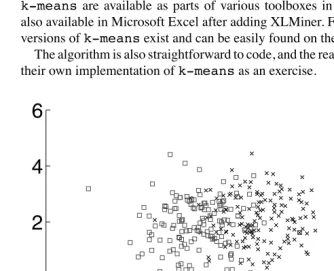
Let us first show an example ofk-meanson an artificial dataset to illustrate how
k-meansworks. We will use artificial data drawn from four 2-D Gaussians and
use a value of k = 4; the dataset is illustrated in Figure 2.1. Data drawn from a
particular Gaussian is plotted in the same color in Figure 2.1. The blue data consists
of 200 points drawn from a Gaussian with mean at (−3,−3) and covariance
ma-trix.0625×I, where I is the identity matrix. The green data consists of 200 points
drawn from a Gaussian with mean at (3,−3) and covariance matrix I. Finally, we
have overlapping yellow and red data drawn from two nearby Gaussians. The yellow
data consists of 150 points drawn from a Gaussian with mean (−1,2) and covariance
matrix I, while the red data consists of 150 points drawn from a Gaussian with mean (1,2) and covariance matrix I. Despite the overlap between the red and yellow points,
one would expectk-meansto do well since we do have the right value of k and the
data is generated by a mixture of spherical Gaussians, thus matching nicely with the underlying assumptions of the algorithm.
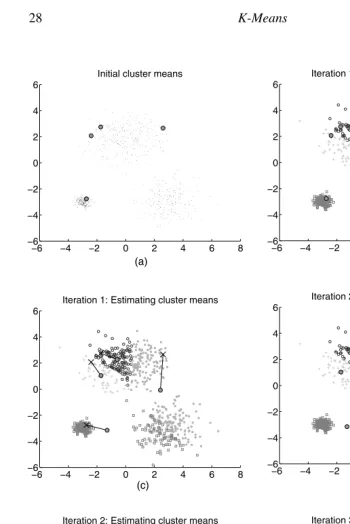
The first step ink-meansis to initialize the cluster representatives. This is
illus-trated in Figure 2.2a, where k points in the dataset have been picked randomly. In this figure and the following figures, the cluster means C will be represented by a large colored circle with a black outline. The color corresponds to the cluster ID of that particular cluster, and all points assigned to that cluster are represented as points of the same color. These colors have no definite connection with the colors in Figure 2.1 (see Exercise 7). Since points have not been assigned cluster IDs in Figure 2.2a, they are plotted in black.
The next step is to assign all points to their closest cluster representative; this is illustrated in Figure 2.2b, where each point has been plotted to match the color of its
closest cluster representative. The third step ink-meansis to update the k cluster
representatives to correspond to the mean of all points currently assigned to that clus-ter. This step is illustrated in Figure 2.2c. In particular, we have plotted the old cluster representatives with a black “X” symbol and the new, updated cluster representatives as a large colored circle with a black outline. There is also a line connecting the old cluster mean with the new, updated cluster mean. One can observe that the cluster representatives have moved to reflect the current centroids of each cluster.
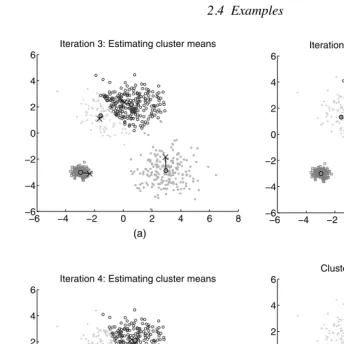
Thek-meansalgorithm now iterates between two steps until convergence: reas-signing points in D to their closest cluster representative and updating the k cluster
representatives. We have illustrated the first four iterations ofk-meansin Figures
2.2 and 2.3. The final clusters after convergence are shown in Figure 2.3d. Note that this example took eight iterations to converge. Visually, however, there is little change in the diagrams between iterations 4 and 8, and these pictures are omitted for space reasons. As one can see by comparing Figure 2.3d with Figure 2.1, the clusters found byk-meansmatch well with the true, underlying distribution.
In the previous section, we mentioned thatk-meansis sensitive to the initial points
−6 −4 −2 0 (a)
2 4 6 8
−6 −4 −2 0 2 4 6
Initial cluster means
−6 −4 −2 0
(b)
2 4 6 8
−6 −4 −2 0 2 4 6
Iteration 1: Assigning cluster IDs
−6 −4 −2 0
(c)
2 4 6 8
−6 −4 −2 0 2 4 6
Iteration 1: Estimating cluster means
−6 −4 −2 0 2 4 6 8
−6 −4 −2 0 2 4 6
Iteration 2: Assigning cluster IDs
(d)
−6 −4 −2 0 2 4 6 8
−6 −4 −2 0 2 4 6
Iteration 2: Estimating cluster means
(e)
−6 −4 −2 0 2 4 6 8
−6 −4 −2 0 2 4 6
Iteration 3: Assigning cluster IDs
[image:8.612.50.401.47.572.2](f)
2.4 Examples 29
−6 −4 −2 0 2 4 6 8
−6 −4 −2 0 2 4 6
Iteration 3: Estimating cluster means
(a)
−6 −4 −2 0 2 4 6 8
−6 −4 −2 0 2 4 6
Iteration 4: Assigning cluster IDs
(b)
−6 −4 −2 0 2 4 6 8
−6 −4 −2 0 2 4 6
Iteration 4: Estimating cluster means
(c)
−6 −4 −2 0
(d)
2 4 6 8
−6 −4 −2 0 2 4 6
[image:9.612.53.397.55.399.2]Clusters after convergence
Figure 2.3 k-meanson artificial data. (Continued from Figure 2.2.)
initialized poorly on the same artificial dataset used in Figures 2.2 and 2.3. Figures 2.4a and c show two initializations that lead to poor clusters in Figures 2.4b and d. These results are considered poor since they do not correspond well to the true underlying distribution.
Finally, let us examine the performance ofk-meanson a simple, classic
bench-mark dataset. In our example, we use the Iris dataset (available from the UCI data mining repository), which contains 150 data points from three classes. Each class rep-resents a different species of the Iris flower, and there are 50 points from each class. While there are four dimensions (representing sepal width, sepal length, petal width, and petal length), only two dimensions (petal width and petal length) are necessary to discriminate the three classes. The Iris dataset is plotted in Figure 2.5a along the dimensions of petal width and petal length.
In Figure 2.5b, we show an example of thek-meansalgorithm run on the Iris
−6 −4 −2 0 (a)
2 4 6 8
−6 −4 −2 0 2 4 6
Initial cluster means
−6 −4 −2 0 2 4 6 8
−6 −4 −2 0 2 4 6
Clusters after convergence
(b)
−6 −4 −2 0 2 4 6 8
−6 −4 −2 0 2 4 6
Initial cluster means
(c)
−6 −4 −2 0 2 4 6 8
−6 −4 −2 0 2 4 6
Clusters after convergence
[image:10.612.54.397.47.387.2](d)
Figure 2.4 Examples of poor clustering after poor initialization; these resultant clusters are considered “poor” in the sense that they do not match well with the true, underlying distribution.
k-meansalgorithm is able to cluster the data points such that each cluster is com-posed mostly of flowers from the same species.
2.5
Advanced Topics
In this section, we discuss some generalizations, connections, and extensions that have
been made to thek-meansalgorithm. However, we should note that this section is
far from exhaustive. Research onk-meanshas been extensive and is still active.
Instead, the goal of this section is to complement some of the previously discussed
2.5 Advanced Topics 31
1 2 3 4 5 6 7
0 0.5 1 1.5 2 2.5
Petal Length
Petal Width
Iris Dataset
1 2 3 4 5 6 7
0 0.5 1 1.5 2 2.5
Petal Length
Petal Width
Iris dataset: clusters after convergence
[image:11.612.60.394.62.213.2](a) (b)
Figure 2.5 (a) Iris dataset; each color is a different species of Iris; (b) Result of k-means on Iris dataset; each color is a different cluster; note that there is not necessarily a correspondence between colors in (a) and (b) (see Exercise 7).
As mentioned earlier,k-meansis closely related to fitting a mixture of k isotropic
Gaussians to the data. Moreover, the generalization of the distance measure to all Bregman divergences is related to fitting the data with a mixture of k components from the exponential family of distributions. Another broad generalization is to view
the “means” as probabilistic models instead of points in Rd. Here, in the assignment
step, each data point is assigned to the model most likely to have generated it. In the “relocation” step, the model parameters are updated to best fit the assigned datasets.
Such model-based k-means [23] allow one to cater to more complex data, for
example, sequences described by Hidden Markov models.
One can also “kernelize”k-means[5]. Though boundaries between clusters are
still linear in the implicit high-dimensional space, they can become nonlinear when
projected back to the original space, thus allowing kernelk-meansto deal with
more complex clusters. Dhillon et al. [5] have shown a close connection between
kernelk-meansand spectral clustering. The K-medoid [15] algorithm is similar to
k-means, except that the centroids have to belong to the dataset being clustered. Fuzzy c-means [6] is also similar, except that it computes fuzzy membership functions for each cluster rather than a hard one.
To deal with very large datasets, substantial effort has also gone into further
speed-ing upk-means, most notably by using kd-trees [19] or exploiting the triangular
inequality [7] to avoid comparing each data point with all the centroids during the assignment step.
Finally, we discuss two straightforward extensions of k-means. The first is a
variant ofk-meanscalledsoft k-means. In the standardk-meansalgorithm,
each point xibelongs to one and only one cluster. Insoft k-means, this constraint
is relaxed, and each point xican belong to each cluster with some unknown probability.
that describe the likelihood that xibelongs to each cluster. These weights are based
on the distance of xi to each of the cluster representatives C, where the probability
that xiis from cluster j is proportional to the similarity between xiand cj. The cluster
representatives in this case are found by taking the expected value of the cluster mean over all points in the dataset D.
The second extension ofk-meansdeals with semisupervised learning. In the
intro-duction, we made a distinction between supervised learning and unsupervised learn-ing. In brief, supervised learning makes use of class labels while unsupervised learning
does not. Thek-meansalgorithm is a purely unsupervised algorithm. There also
exists a category of learning algorithms called semisupervised algorithms. Semisu-pervised learning algorithms are capable of making use of both labeled and unlabeled data. Semisupervised learning is a useful compromise between purely supervised methods and purely unsupervised methods. Supervised learning methods typically require very large amounts of labeled data; semisupervised methods are useful when very few labeled examples are available. Unsupervised learning methods, which do not look at class labels, may learn models inappropriate for the application at hand.
When runningk-means, one has no control over the final clusters that are
discov-ered; these clusters may or may not correspond well to some underlying concept that one is interested in. For example, in Figure 2.5b, a poor initialization may have resulted in clusters which do not correspond well to the Iris species in the dataset. Semisupervised methods, which can take guidance in the form of labeled points, are more likely to create clusters which correspond to a given set of class labels.
Research into semisupervised variants ofk-meansinclude [22] and [2]. One of the
algorithms from [2] calledseeded k-meansis a simple extension tok-means
that uses labeled data to help initialize the value of k and the cluster representatives C. In this approach, k is chosen to be the same as the number of classes in the labeled
data, while cjis initialized as the mean of all labeled points in the j th class. Note that,
unlike unsupervisedk-means, there is now a known correspondence between the
j th cluster and the j th class. After initialization,seeded k-meansiterates over
the same two steps ask-means(updating cluster memberships and updating cluster
means) until convergence.
2.6
Summary
Thek-meansalgorithm is a simple iterative clustering algorithm that partitions a dataset into k clusters. At its core, the algorithm works by iterating over two steps: (1) clustering all points in the dataset based on the distance between each point and its closest cluster representative and (2) reestimating the cluster representatives.
Limita-tions of thek-meansalgorithm include the sensitivity ofk-meansto initialization
and determining the value of k.
Despite its drawbacks,k-meansremains the most widely used partitional
2.7 Exercises 33
reasonably scalable, and can be easily modified to deal with different scenarios such as semisupervised learning or streaming data. Continual improvements and general-izations of the basic algorithm have ensured its continued relevance and gradually increased its effectiveness as well.
2.7
Exercises
1. Using the standard benchmark Iris dataset (available online from the UCI
dataset repository), runk-meansto obtain results similar to Figure 2.5b. It is
sufficient to look at only the attributes of “petal width” and “petal length.” What happens when one uses a value for k other than three? How do different cluster initializations affect the final clusters? Why are these results potentially different than the results given in Figure 2.5b?
2. Prove that the value of thek-meansobjective function converges when
k-meansis run.
3. Describe three advantages and three disadvantages ofk-meanscompared to
other clustering methods (e.g., agglomerative clustering).
4. Describe or plot a two-dimensional example wherek-meanswould be
un-suitable for finding clusters.
5. Ink-means, after the cluster means have converged, what is the shape of the
cluster boundaries? How is this related to Voronoi tesselations?
6. Doesk-meansguarantee that points within the same cluster are more similar
than points from different clusters? That is, prove or disprove that, after
k-meanshas converged, the squared Euclidean distance between two points in the same cluster is always less than the squared Euclidean distance between two points from different clusters.
7. Assume one is given a hypothetical dataset D consisting of 10 points.k-means
is run twice on this dataset. Let us denote the cluster IDs of the 10 points in D
as a vector m, where mi, the i th entry in the vector, is the cluster ID of the i th
point in D.
The cluster IDs of the 10 points from the first timek-meansis run are
m1=[1,1,1,2,2,2,3,3,3,3], while the cluster IDs obtained from the second
run ofk-meansare m2=[3,3,3,1,1,1,2,2,2,2].
What is the difference between the two sets of cluster IDs? Do the actual cluster IDs of the points in D mean anything? What does this imply when comparing the results of different clustering algorithms? What does this imply when comparing the results of clustering algorithms with known class labels?
8. Create your own implementation ofk-meansand a method of creating
artifi-cial data drawn from k Gaussian distributions. Test your code on the artifiartifi-cial
9. Using the code generated in the previous exercise, plot the average distance of each point from its cluster mean versus the number of clusters k. Is the average distance of a point from its cluster mean a good method of automatically determining the number of clusters k? Why or why not? What can potentially happen when the number of clusters k is equal to the number of points in the dataset?
10. Research and describe an extension to the standard k-means algorithm.
Depending on individual interests, this could include recent work on mak-ingk-meansmore computationally efficient, work on extendingk-means to semisupervised learning, work on adapting other distance metrics into k-means, or many other possibilities.
References
[1] A. Banerjee, S. Merugu, I. Dhillon, and J. Ghosh. “Clustering with Bregman
divergences,” Journal of Machine Learning Research (JMLR), vol. 6, pp. 1705– 1749, 2005.
[2] S. Basu, A. Banerjee, and R. Mooney. “Semi-supervised clustering by seeding,”
International Conference on Machine Learning 2002, pp. 27–34, 2002.
[3] C. M. Bishop. Pattern Recognition and Machine Learning (Information Science
and Statistics). 2006.
[4] P. S. Bradley, K. P. Bennett, and A. Demiriz. “Constrained k-means clustering,”
Technical Report MSR-TR-2000-65, 2000.
[5] I. S. Dhillon, Y. Guan, and B. Kulis. “Kernel k-means: Spectral clustering and
normalized cuts,” KDD 2004, pp. 551–556, 2004.
[6] J. C. Dunn. “A fuzzy relative of the ISODATA process and its use in detecting
compact well-separated clusters,” Journal of Cybernetics, vol. 3, pp. 32–57, 1974.
[7] C. Elkan. “Using the triangle inequality to accelerate k-means,” International
Conference on Machine Learning 2003, pp. 147–153, 2003.
[8] C. Elkan. “Clustering with k-means: Faster, smarter, cheaper,” Keynote talk at
Workshop on Clustering High-Dimensional Data, SIAM International Confer-ence on Data Mining, 2004.
[9] E. Forgey. “Cluster analysis of multivariate data: Efficiency vs. interpretability
of classification,” Biometrics, 21, pp. 768, 1965.
[10] H. P. Friedman and J. Rubin. “On some invariant criteria for grouping data,”
References 35
[11] R. M. Gray and D. L. Neuhoff. “Quantization,” IEEE Transactions on
Infor-mation Theory, vol. 44, no. 6, pp. 2325–2384, 1998.
[12] G. Hamerly and C. Elkan. “Learning the k in k-means,” Neural Information
Processing Systems, 2003.
[13] A. K. Jain and R. C. Dubes. Algorithms for Clustering Data, Prentice Hall,
1988.
[14] T. Kanungo, D. M. Mount, N. Netanyahu, C. Piatko, R. Silverman, and A. Y.
Wu. “A local search approximation algorithm for k-means clustering,” Com-putational Geometry: Theory and Applications, 28 (2004), pp. 89–112, 2004.
[15] L. Kaufman and P. J. Rousseeuw. Finding Groups in Data: An Introduction to
Cluster Analysis, 1990.
[16] S. P. Lloyd. “Least squares quantization in PCM,” unpublished Bell Lab. Tech.
Note, portions presented at the Institute of Mathematical Statistics Meet., Atlantic City, NJ, Sept. 1957. Also, IEEE Trans. Inform. Theory (Special Issue on Quantization), vol. IT-28, pp. 129–137, Mar. 1982.
[17] J. McQueen. “Some methods for classification and analysis of mutivariate
observations,” Proc. 5th Berkeley Symp. Math., Statistics and Probability, 1, pp. 281–296, 1967.
[18] G. W. Milligan. “Clustering validation: Results and implications for applied
analyses,” Clustering and Classification, P. Arabie, L. J. Hubery, and G. De Soete, ed., pp. 341–375, 1996.
[19] D. Pelleg and A. Moore. “Accelerating exact k-means algorithms with
geomet-ric reasoning,” KDD 1999, pp. 227–281, 1999.
[20] D. Pelleg and A. Moore. “X-means: Extending k-means with efficient
estima-tion of the number of clusters,” Internaestima-tional Conference on Machine Learning 2000, pp. 727–734, 2000.
[21] M. Steinbach, G. Karypis, and V. Kumar. “A comparison of document clustering
techniques,” Proc. KDD Workshop on Text Mining, 2000.
[22] K. Wagstaff, C. Cardie, S. Rogers, S. Schr¨odl. “Constrained k-means clustering
with background knowledge,” International Conference on Machine Learning 2001, pp. 577–584, 2001.
[23] S. Zhong and J. Ghosh. “A unified framework for model-based clustering,”