Rochester Institute of Technology
RIT Scholar Works
Theses
Thesis/Dissertation Collections
5-12-1986
Diverse realities
Julia Dutton Peterson
Follow this and additional works at:
http://scholarworks.rit.edu/theses
This Thesis is brought to you for free and open access by the Thesis/Dissertation Collections at RIT Scholar Works. It has been accepted for inclusion
in Theses by an authorized administrator of RIT Scholar Works. For more information, please contact
.
Recommended Citation
ROCHESTER INSTITUTE OF TECHNOLOGY
A Thesis Submitted to the
Faculty
ofThe College of Fine and Applied Arts
in
Candidacy
for the Degree ofMASTER OF FINE ARTS
DIVERSE REALITIES
By
Julia Dutton Peterson
APPROVALS
Adviser:
Lawrence M. Williams
Date:
Associate Ad
v
iser'
Da
v
id C
.
Dic
k
inson
!
David C. Dickinson
Date:
~
/
,
;:{;
Associate Adviser:
/1&6
/ Philip W. Bornarth
Philip Bornarth
Date,
~?<J
LUft
Special
As~t
to
~he
Dean for Graduate Affairs:
Philip Bornarth
/
Philip W. Bornarth
Date:
Robert Johnston
/
Robert H. Johnston Ph.D.
Julia Dutton Peterson
I,
, hereby grant permission
to the Wallace Memorial Library of RIT, to reproduce my thesis
in whole or in part.
Any reproduction will not be for
TABLE OF CONTENTS
LIST OF ILLUSTRATIONS iii
PREFACE iv
I. IDEAS 1
II. DEVELOPMENT 5
III. ARTISTS 15
IV. DIVERSE REALITIES EO
ILLUSTRATIONS 26
SELECTED BIBLIOGRAPHY 37
-LIST OF ILLUSTRATIONS
1. Untitled #1 Graphite
Drawing
262. Untitled #2 Graphite
Drawing
263. Untitled #3 Graphite
Drawing
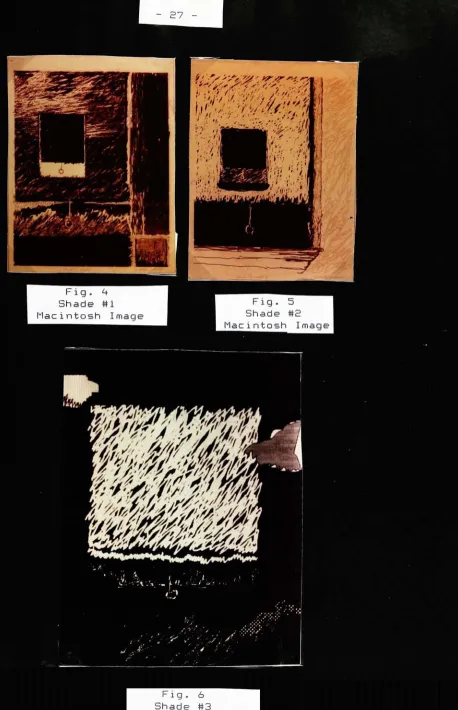
264. Shade #1 Macintosh Image 27
5. Shade #2 Macintosh Image 27
6. Shade #3 Macintosh Image 27
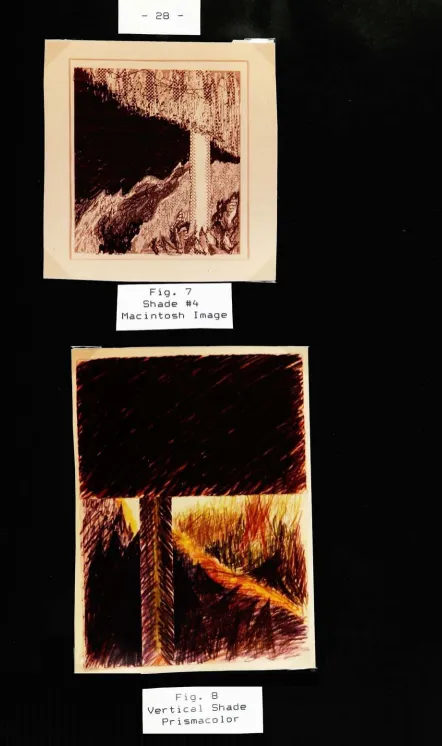
7. Shade #4 Macintosh Image 28
8. Vertical Shade Prismacolor 28
9. Untitled #4 Graphite
Drawing
2910. Untitled #5 Graphite
Drawing
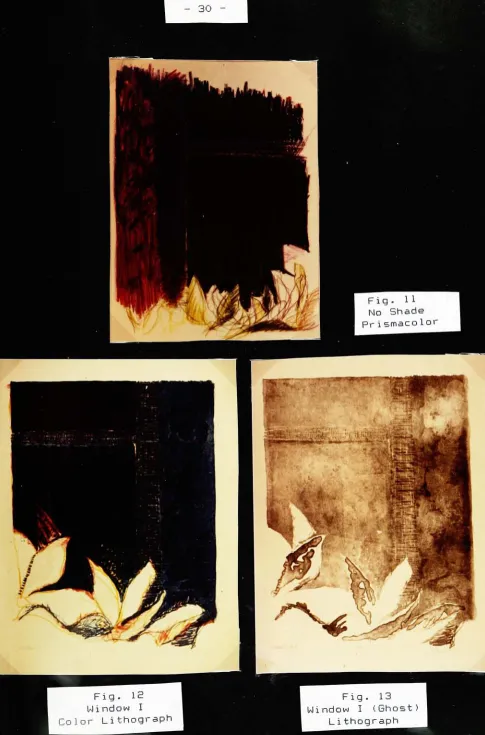
2911. No Shade Prismacolor 30
12. Window I Color Lithograph 30
13. Window I (Ghost) Lithograph 30
14. Window II
Etching
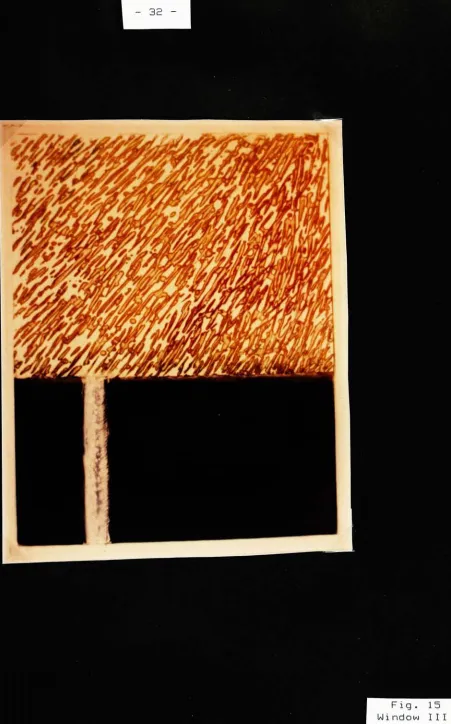
3115. Window III Color
Etching
3216. Window IV Woodcut 33
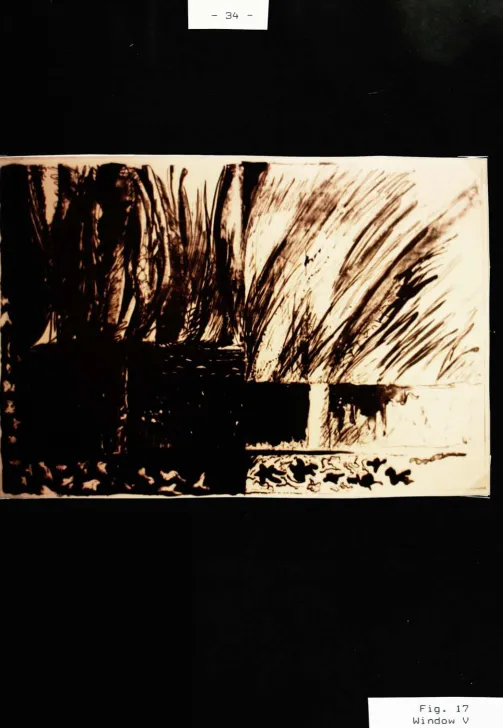
17. Window V Offset
Lithography
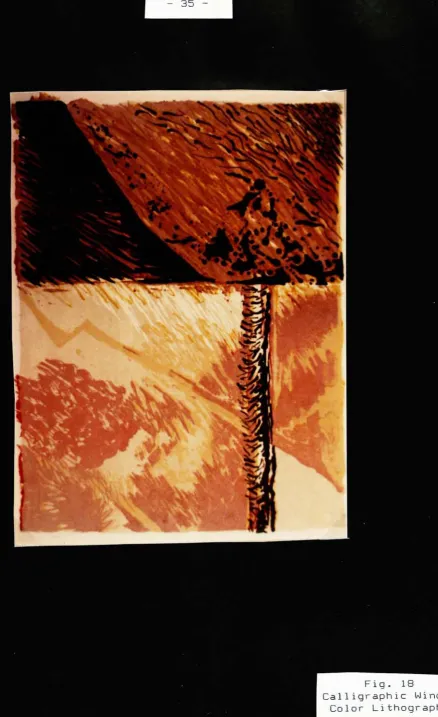
3418. Calligraphic Window Color
Lithography
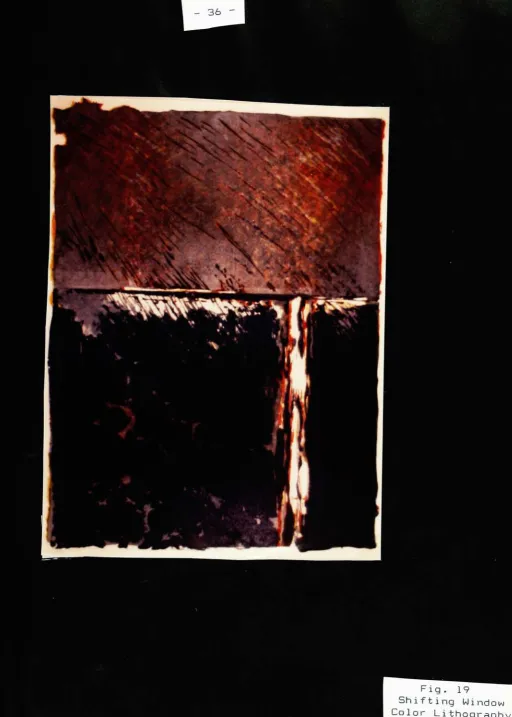
3519.
Shifting
Window ColorLithography
36
-PREFACE
In this thesis project, I employed printmaking media to
explore the evolution and extension of
drawing
style in mywork. I wanted to use a wide variety of drawn marks to evolve
a series of images which would extend reality into imagination
or abstraction. "Drawn mark"
was defined in the widest pos
sible sense.
Artists filter and define reality in visual statements.
The lanquage is visual, as the language of fiction is verbal
and the lanquage of music is auditory. What makes each art
ist's work unique is his use of visual lanquage his shaping of
it to his own ends.
As a sprinqboard for examininq the development of my
own visual lanquaqe, I researched the development of visual
lanquaqe in children.
I am thankful for the
help
and fineteaching
of PhilBornarth, David Dickinson and Judd Williams, the qenerous
support of my parents, and the love and cooperation of my
husband and children. Without these diverse realities, this
thesis project would not have been possible.
-IDEAS
Art has a tradition, but it is a visual heritage, The artist's language is the memory from sight. Art
is made from dreams and visions and things not known and least of all from things that can be said. It comes from the inside of who you are, when you face yourself. It is an inner declaration of purpose.
David Smith
I used to think that art was made
by
a direct transcription of an idea from the mind to the visible surface. I
was frustrated
by
myinability
to exactly transfer my idea topaper. At that point I was more closely tied to verbal images.
I could say how I wanted work to look, but the visual manifes
tation did not satisfy me.
Often students say "I didn't have a good idea for this
project, that's why it didn't work out."
Each new
drawing
orprint seems to need a new idea, when in fact all that is needed
is one idea which will support a series of experiments. The
idea is "no more than the motivation, then process takes
over."
It is the working process which tests the idea, magni
fies it, makes it visible and alters it. Eventually, the same
process leads to the next idea.
Process is defined as "a specific, continuous action,
3 operation, or series of
changes."
By
process, I mean the wayan idea changes as it is drawn and re-drawn and transformed
by
various media.
What is needed to engage in artistic process is to
re-learn visual language. This is a language of gestalts and
P
Comment from critique with Judd Williams,
January
1985.3
Jess Stein, ed. , The Random House College Dictionary (New York: Random House, 1975), p. 1055.
-ima
- 3
-ges, not one of words and phrases. "In childhood we have
been raped
by
word pictures. We must revolt against all wordauthority. Our only language is vision."
Word pictures are
"traps which lure laymen into cliche thinking."
The ease with which we accept verbal images over visual
ones is reinforced
by
schools, which emphasize verbal systems.The type of
thinking
required for visual language developmentis rarely taught.
Research into brain
functioning
suggests that verbal,analytical skills are controlled
by
the left hemisphere of thebrain while holistic, gestalt-invo 1ved tasks are handled
by
theright hemisphere. This would mean that visual language would
be a right-hemisphere function, separate from verbal language.
Although these ideas are still controversial, I find that for
me analytical, verbal
functioning
and visual, intuitive functioning
conflict.As I have strengthened my visual mode, my verbal mode
has changed. It is easier for me to visualize than to verbal
ize. When I am working, I find that I use both intuitive and
analytical modes of thinking, but not simultaneously. The im
portance of the intuitive to production seems greater. The
analytical function, criticism, is needed after production to
Smi th, p . 137.
5Ibid.
Linda Verlee Williams, Teaching for the Two Sided Mind
- 4
evaluate the work. If evaluation happens too soon in the
working process, it shuts off the flow of images and marks.
Seeing
is dynamic. To a visually attuned person, theworld appears constantly different. The search for ideas
begins in seeing and becomes a search for personal visual
preferences. "Idea"
needs to be something observed or
imag
ined, not a word picture, but a visual notion. A visual world
exists which can only be seen or envisioned, like the auditory
world of sound and music which can only be heard. The visual
experience can be described, discussed, reinterpreted or remem
bered through art.
You have experiences that are profound, but you don't
act in the right way, and
they
seem unresolved. Thegreat
thing
about art is that when you re-experiencesomething you have the chance to resolve it ... .
Douglas C. McGill, "Eric Fischl,"
New York Times,
II. DEVELOPMENT
Oh that I were where I would be, Then I would be where I am not,
But where I am there I must be,
And where I would be I can not.
Old rhyme
As children we were once all artists together.8
g
Miriam Lindstrom, Children's Art (Berkeley:
of California Press, 1957), p. 2.
Erik
Erikson,
in Childhood and Society, defines a progression of developmental tasks which apply throughout life.
For each task there is a positive and a negative resolution.
Erikson feels that emotional progress is possible only if a de
velopmental task is mastered, but if the negative state exists,
9 no further progress can be made.
Development in any area depends on previous experi
ence. This is how
learning
takes place. I wanted to becomefamiliar with the stages of
drawing
development to increase myunderstanding of the
drawing
process. Children'sdrawing
particularly
fascinates me, as I have watched my own childrenlearn to express their visual ideas.
Children do not draw because
they
are creating consciously.
They
aredrawing
to explore, to understand, tosymbolize. It is the excitement of exploration that makes
children's
drawing
interesting. The images are of secondaryimportance.
All children begin to draw
by
scribbling.They
thenuse their scribbled marks to form shapes. There is much debate
about why children draw, what purpose it serves for them, and
what their drawings mean. Nonetheless, most humans draw when
Erik H. Erikson, Childhood and
Society,
2nd ed. (NewYork: W. W. Norton, 1963), pp. 247-74.
-7
they
are young, creating drawings that are exciting and visually pleasing. Most cease
drawing
beforethey
are adult.The assurance, expressiveness and spontaneity of
children's
drawing
has often been compared to thedrawing
ofartists. Artists themselves have noted this link. Saul
Steinberg
called hisdrawing
"a way of writing from myilliterate days"
and Picasso commented "It has taken me a
whole lifetime to learn to draw like children."
The fact that children's drawings from all over the
world appear to use the same forms seems to support a
theory
ofuniversal
drawing
development. Even children who have neverdrawn, when given materials, tend to create similar shapes.
"What children do . .
take them where it will."
These universal stages of
drawing
development relate todevelopmental progress as a whole. Howard Gardner offers this
13
overall progression for
drawing
concerns in children.is play with form and let the process
12
Howard Gardner, Artful Scribbles: The Significance of
Children's Drawing (New York: Basic Books, 1980), p. 266.
1 1
Gardner, p. 8.
12
Alexander Alland, Jr., Playing with Form: Children
Draw in Six Cultures (New York: Columbia
University
Press, 1983), p. 1.13
- a
Age
scribb ler
todd ler
pre-schoo1
schoo1 chi Id
adolescent
Developmental Task
learning
tool uselearning
basic categories, objectc1asses
use of symbolic play, imagination
use of dogged realism
importance of peer pressure
rejection of deviation
interest in pure design
renderi ng
concentration on human figure
rejection of works that do not meet
standards
Lowenfeld describes the stages in a much more direct way:
14
Age
to 4 years
4-6 years
7-9 years
9-11 years
11-13 years
Stage of Drawing Development
scribbl i ng
pre
schemat ic
schematic
realistic
pseudo-real istic
Miriam Lindstrom gives a detailed account of children's
drawing
15 interests at various ages.
Rhoda Kellogg, Analyzing Children's Art (Palo Alto:
Mayfield Publishing, 1970), p. 148.
15
-9
-Age Characteristics of Drawing
2-5 years scribble and chance forms
controlled marks
basic forms
first schematic formula
4-6 years use of repertory for
developing
formula5-8 years whatever can be thought of can be
p ic tured
7-10 years development of possibilities within the
schematic mode
B
-12 years dissatisfaction with limitation of
schematic mode
drawing
from observationjuvenile idealism
boy/girl differences
perspective concerns
aesthetic interest at low ebb
drawing
from memory contrasts withdrawing
from observationThe above diagram shows most clearly how stages of
drawing
development are built on previous experience as well as
age-typical characteristics. The progression from stage to stage
is clear.
Rhoda Kellogg, who has worked extensively with young
children's drawings, has systematized the forms
they
containand has demonstrated how these basic forms become more complex
and varied. She, too, believes that
drawing
development in thepre-school child is a natural part of total development.
In Kellogg's system, the marks that children make are
categorized. There are
twenty
basic scribbles which lead tosix
"diagrams."
These are
~T
' / , w ,Z-A
, V_j7, andX
."Combines"
10
"aggregates"
are the
joining
of three or more. Thefollowing
chart demonstrates how these simple forms build up to form
more complex ones.
^W^fWyh
1110
&
\
t
f
TfTf
f
#
^%^TJlK1l^^flW.
<>f#@-f^
#^-*r#
O#O0@Ottl
^
@]
E@c%>^:0-hXmt2]D
^omxim
Going
from bottom to top, these Gestalts represent the probable evolution of Humans from earlier scribbling. The Basic Scribbles at the bottom lead to(2)
Diagrams andCombines;
(3)
Aggregates; (4)
Suns; (S)
Sun facesandfigures; (6)
Humanswithhead-top
markings and witharms attached tothehead;
(7)
Humans withouthead-top
markings;(8)
armlessHumans; (9)
Humans with varied torsos;(10)
Humans
witharms attachedto thetorso;and(11)
relatively complete Human images {author's sketches)Not all of these evolutionary steps may appear in the work of every child. Each
drawing
madeby
thechild over a three-year period wcnild be needed to determine the point.
However,
the stepsapply well to large quantities ofwork
by
many children. Similar steps apply to the evolution of other pictorial itemsSource: Kellogg, p. 109.
16
-11-This shows the way that a repertoire of marks is built
up and then used as graphic language.
Kellogg
feels thatchildren's art is aesthetically motivated and should not be
used to test children's ideas of reality or their emotional
state. "Art is and should be the free use of lines for
17
gestalt-mak i ng .
"
Children's
drawing
loses a lot of its spontaneity atthe same time as a whole new group of developmental concerns
are
becoming
important. Concern with peer group, conformityand rules, and realism cause the expressiveness and assurance
to be replaced
by
tentat iveness and adherence to perceivedrules.
As children arrive at adolescence,
they
reach an agewhen
they
cannot produce drawings that meet their own highstandards.
Many
cease drawing. For some, cartooning "represents a compromise between a desire to draw really well . . .
and the anxiety lest
they
fail to render something in acon-18 vincing
manner." ""'
This is a point when technical instruction
can facilitate the
drawing
process.Initially, people teach themselves to draw as
they
areinvolved in mark-making in the pre-school years. As
they
enterschool, their self-education is cut off
by
the needs of theschool and
by
their own developmental tasks which vary from theaesthetic needs of drawing.
17
18
Kellogg, p. 143.
-12
-I remember clearly the point at which I stopped draw
ing. I remember the frustration at my lack of technical
ability. I sought out other media, such as cut paper and col
lage,
which did not make such demands.By
constructing thisdevelopmental schema, I was able to see the point in the devel
opmental progression where I had stopped and I made a conscious
effort to go back and work through that stage.
When I was in elementary school, the "artists"
were the
ones who could draw things the way
they
looked, or the way theteacher wanted them to look. This left the rest of us
unconfi-dent in our own particular vision of the world. It would not
have occurred to us to challenge the commonly-held knowledge
that artists had to draw things the way
they
looked. We certainly
were not encouraged to continue our owndrawing
experiments.
Consequently, my view of
drawing
throughout my schoolyears was very narrow.
Drawing
is much more than the abilityto accurately represent reality with marks. In 1983, after two
years of study at RIT, I wrote the following:
Drawing - All
of the Definitions
Rendering
-photographic realism
attempt to reproduce image of object
exactly
tonal technique
Contour
-following
edges and contours with lineGesture suggestion of movement
-13
-Drawing
-All of the Definitions (con't.)
Automatic
-spontaneous arrangement of lines/tones into pleasing composition
Tonal suggests objects using shading
Drawing
-Uses and Purposes
-method of studying form
-recording process
-method of creating illusion of three
dimensionality
on a flat surface
-method of
training
the hand/eyeexpressive graphic language
-exploratory process of design
-rearrangement of ideas
-play, experimentation
-invention,
fantasy
Drawing
instruction books take each of these categoriesand deal with it in isolation, giving specific exercises to
improve each technique. An exception is The Art of Drawing,
by
Bernard Chaet, which attempts to synthesize these ideas. The
real task of
learning
to draw is combining techniques into apersonal graphic language.
Many
non-artists still definedrawing
as the making ofa realistic picture of something. The farther the person is
from the art-making process, the more realistic he will prefer
the picture to be. Drawings function as talismans: the person
likes horses, trees, barns, whatever, and wants to possess an
image of one. His judgment of the work is divorced from the
-14
Good
drawing
begins in accurate observation. This initiates the
drawing
process which is supportedby
imaginationand thought and memory. Once an artist steps from depiction of
an object to visual exploration of an idea, a step is taken
toward using
drawing
as a tool of personal expression. Just asa composer must
develop
a palette of sounds, or a poet a particular verbal style, an artist must put together a language of
marks.
The visual language must contain a wide repertoire of
marks. All possibilities must be tried and tested.
Nothing
should be prejudged. The artist must be secure enough to take
risks, and in the process must
develop
sensitivity and intui tive visual judgement. Then he must learn to trust his judgments and act on them with assurance.
Drawing
becomes an act of expression and interpretationrather than depiction. The personal nature of a
drawing
comes from the calligraphic language usedby
the artist, which is a combination of technique, instrumentation, medium andIll ARTISTS
Only
artists understand art, possibly because oneartist can go along with another artist the path
he followed in creating it.
David Smith
Few people recognize what artists happen to do for
others. The artist providesK a mental gardenM for
50
people to think, live, work and invent in.
James Rosenquist
19
Smith, p. 60.
PO
My
interest indrawing
originated in my dissatisfactionwith my own work. When I began to understand
drawing
as alanguage rather than an armamentarium of techniques, I could
begin to understand its potential for me. It wasn't until I
began to explore and re-explore the same image, combining ob
servation and imagination and thought, that I began to see the
possible dimensions of drawing.
I became intrigued with the work of Jennifer Bartlett
through her In the Garden series two hundred drawings in var
ious media of a single garden scene. What especially caught my
interest was the enormous variation in drawn language, style
and presentation.
Paging
through In the Garden allows a viewerto travel through a
drawing
process in its varied states. Theimage is not important here, the imagination is.
The idea has been proposed that Bartlett was
teaching
herself to draw in this series of work. She has said "I never
had the kind of talent that lets you draw portraits or horses
2 1
. . . She has also noted that at first writing was easier
than painting and that her own best ideas came out of the pro
cess of working
22
? 1
Calvin Tomkins,
"Drawing
and Painting," in JenniferBartlett (New York: Abbeville Press, 1985), p. 10.
22
Tomkins, p . 14
-17
-The process of
Bartlett's
work has at times involvedthe use of many techniques to achieve variation. An earlier
work, "Rhapsody," was an enormous, room-sized mosaic of 12"
by
12"
steel tiles painted in a number of styles. The
totality
of this work istightly
regulated and it occurs like a piece ofmusic, over time. The images appear and reappear like themes
in a sonata. The main ideas are linked to color and symbol.
It is too easy to generalize from a particular sequence
of an artist's work to her total oeuvre. When I saw Bartlett's
retrospective in Brooklyn in December, I realized how limited I
had been in my consideration of her work. Theme and variation
is certainly a strong element in her process, but there are
other concerns which are more central such as sequence, pro
gression and two-dimensional/three-dimensional interplay.
In the Garden was a springboard for my own experiments
in varying a single image. That is the value in
knowing
the work of other people indiscovering
those "resonances"that
add to your own motivation and thinking.
Working
artists serve as inspirational role models for students.Reading
biographies of other artists has increased my awareness of the enormous variety of concerns that differentartists address, and the variety of life patterns in which art
ists work. There is no one life pattern for artists, just as
there is no one definition for drawing. It is an easy
trap
to
-18
-When I began studying art, I did so with the perspec
tive of a musician and an elementary teacher. There have been
times when the role of artist has not seemed to fit with the
other things that I do. The wider question becomes one of
self-definition, because
identity
is crucial to an artist.It is
identity,
and not that overrated quality calledability, which determines the artist's finished work.
Ability
is but one of the attributes and acts only in degree.
Ability
may produce a work, butidentity
producesthe works before and after.
Ability
may make the successful work in the eyes of the connoisseur, but
identity
canmake the failures which are most important to the artist.
What the critics term the failures are apt to be unresolved
but of greatest projection.
They
had to be done,they
held the promise. The promise, the hint of new vista, the unresolved, the misty dream, the artist should love even more
than the resolved, for here is the fluid force, the promise
23
and the search.
When I began this study five years ago, I had been mak
ing
art for many years, but did not call myself an artist. Ihave come to an understanding of what it is that artists work
at. Because art is so closely identified with the artist, it
forces you to confront what you believe, what you are, and what
you can and cannot do.
I would liken artists to philosophers. The study of
art, like the study of philosophy, does not seem practical to
many people. The activities of the artist, like those of the
philosopher, are poorly understood except
by
other artists andpeople who are particularly interested.
23
19
To be an artist, a person must come to an increased
self-awareness and then must confront ideals and beliefs.
Studying
art, like studying philosophy, focuses these beliefs.It was very important for me to merit the role of
artist. I did not grow up labeled an artist. How I live with
that label and those concerns now depends solely on my determination to do so.
There are conflicts between the process of making art
and the process of
daily
life. It can be a struggle totransition from one reality to another.
Daily
life sometimesseems like an interruption to the inner dialogue necessary to
art production, an interruption to the compulsion to produce
that art process involves. At other times, routines are a relief and a chance to regain perspective. Life as an artist
IV. DIVERSE REALITIES
We are all probing the same mysteries.
Who am I?
Where am I?
What am I doinq?
24 Is it right?
Ellen Gilchrist, from her
dairy
National Public Radio,
Morning
Edition. . . And
immediately
Rather than words comes the thought of high windows:
The sun-comprehending glass
And beyond it, the
deep
blue air, that showsNothing, and is nowhere, and is endless.
Phi 1 1
ip
Larkin24
Interview with Ellen
Gilchrist,
NPRMorning
Edition,
November 1985.
25
Phillip
Larkin, High Windows (New York:Farrar,
This thesis work arose out of a concern to explore
drawn language in drawings and prints. I wanted to expand my
repertoire of marks and use contrasting print media to present
a single formal image.
I find windows
fascinating
as formal structures, aswell as openings from one reality to another.
They
were a particularly
powerful childhood memory, andthey
entered thedrawings (which were
initially
landscapes) almost unconsciously. I tried to recreate remembered "childhood land
scapes"
in a series of graphite stick drawings. At the same
time, I was exploring a set of imagined window images using the
Macintosh computer. I found the extreme freedom of both draw
ing
media allowed my ideas to flow freely. The graphite drawings were large <22"
x 30") and I used my whole arm to make the
marks. The computer drawings, on the other hand, were small.
There,
the freedom came from my ability to alter tone, line andshape so easily. Because the
drawing
did not exist until itwas printed out, there was no risk involved in experimenting
with a wide variety of ideas.
In the first graphite drawings are the New
Jersey
winter hills, tree tops like wheat stubble or shorn hair. The
windows I used to look through as a child had 200-year-old
glass in them that distorted the view and split the light. The
-22
-curtains were
translucent,
and there were two shades in eachwindow: a black-out shade and a white one. The windows of that
house are the same but the landscape is not. The visual idea
in memory seems powerful.
I attached emotional importance to using a landscape remembered from childhood. It is not crucial to the finished work, but to the initial motivation. The landscape that I
attempted to draw so often as an adolescent no longer exists.
It has been altered from rural to suburban.
Many
ideas were explored in this series of drawings,but the vertical window format with a shade and sill was the
format that became more and more important. It seemed more ambiguous and open, thus allowing for more imagination within
any
drawing
.Although the windows were
initially
very important psychologically to me, formal concerns were ultimately more
impor tant.
The form of a work of art has meaning of its own and
the contemplation of the form . . . gives rise in some
people to a special emotion which does not depend upon
the association of the form with anything else whatever.
When I would redraw the vertical space, it would alter and new visual elements would become important within it. In
some cases the shade became flames, or human forms. In other cases the window frame and the shade became tree-like. In one
26,
-23
-case, the window opening became a landscape with a straight
road, and the shade became sky.
I tried to
keep
thedrawing
process very open throughout the series of prints. I did not attempt to reproduce draw
ings as prints, but rather use the drawn ideas to initiate the
drawing
process on the plates and stones.Of the work produced, six prints were shown. The two
etchings, one woodcut and three lithographs have an interaction
with each other that is strengthened
by
the fact thatthey
contain a single image. The various print media allowed me to ex
periment with many kinds of drawn marks. If I had continued
the process, I would have begun to overlap the images from the
different print media, because that yielded an even richer sur
face characteristic.
Layering
has been a visual concern of mine, especiallyin color printing. I like the richness and ambiguity of over
printed color. Another visual element that is possible with
many layers of color is the
highlighting
that occurs when asmall remnant of color survives at the edge of an overprinted
area.
Of the works shown, the black and white works deal most
closely with the proposition of the thesis. A drawn language
which is both expressive and personal evolved from the process
of working.
In the drawings and prints I tried to employ a wide
-24
-processes, the repertoire of marks expanded even more.
Print-making techniques allow
build-up
of layers of drawing. A sequence of drawings is thus built into one print because of the
changes that are made on the plate or stone. Even the simplest
print transforms a
drawing
and gives it other qualities. Theseare lost if the printmaker has an inflexible attitude about the
print in process.
Etching
the stone,biting
the plate, altering
the original image each of these changes the outcome.Most education is a personal
Odyssey
of some sort. Thisdocument traces my
journey
towardbeing
an artist. I have hadto examine previous experiences, change my attitudes about my
self and my work. I have learned to be more intuitive and less
intellectual. I have gained technical skill and aesthetic in
sight.
Creative expression occurs first in childhood. Artists
channel the same creative energy in adulthood but with a much
more conscious process. A knowledge of the development of
drawing
in children serves to deepen understanding of the process all artists pass through and remember, but most other
adults forget. For me, this developmental knowledge was a
key
to better understanding of my own art-making process.
I now think of
drawing
as a visual language of its own.Drawing
technique can be taught and mastered, but thedrawing
process must be self-taught and self-explored. The artist must
- 25
Art is a synthesis of
thinking
andfeeling
they
cannotbe separated out. It is thought and response that give fine art direction and vitality.
The process of art-making engages me. The works in the
thesis show already seem a little detached from my reality.
What seems important now is to learn what is beyond those
works.
They
are beginnings rather than ends. "The journey is 27the destination."
27
F
Unt ig.
1tl 1
ed #1
J
Graphi te
Drawing
A
,F
ig
. 2Untitled #2
raphite Drawing
ig
. 3Untitled
#327
Fig
. 4Shade #1
Macintosh Image
^Sm
yflFXm
WA
ym
Ik
/ *
'
<MKV-'/ . v
Fig. 6
Shade #3
[image:33.515.52.510.18.728.2]Fig. 8
|
Vertical Shade
[image:34.515.56.498.15.761.2]
-Fig. 11
|
No Shade
Prismacolor
Fig. 12
Window I
Color
[image:36.515.15.500.14.749.2]Lithograpl-Fig. 15
Window III
[image:38.515.39.490.13.737.2]Fig. 16
Window IV
[image:39.515.42.475.10.728.2]Fig. 17
Window V
[image:40.534.12.516.8.736.2]Fig. 18
Calligraphic Window
[image:41.538.67.506.17.735.2]Fig. 19
Shifting
Window [image:42.559.39.552.18.735.2]SELECTED BIBLIOGRAPHY
Alland, Alexander Jr.
Playing
with Form: Children Draw in SixCul tures. New York: Columbia
University
Press, 1983.Bartlett,
Jennifer. In the Garden. Introductionby
John Russell. New York:Harry
N. Abrams, 1982.Chaet,
Bernard. The Art of Drawing. New York: Holt, Rinehartand Winston, 1978.
Edwards, Betty. Drawing on the Right Side of the Brain. Los
Angeles: J. P. Tarcher, 1979.
Erikson,
Erik H. Childhood and Society. 2nd ed. New York: W. W.Norton Co., 1963.
Gardner, Howard. Artful Scribbles: The Significance of
Children's Drawings. New York: Basic Books, 1980.
Goldwater, Marge; Smith, Roberta; and Tomkins, Calvin. Jenni fer
Bartlett. New York: Abbeville Press, 1985.
Goodnow, Jacqueline. Children Drawing. Cambridge: Harvard
University
Press, 1977.Kellogg, Rhoda. Analyzing Children's Art. Palo Alto: Mayfield
Publishing, 1970.
Larkin, Phillip. High Windows. New York: Farrar, Straus and
Giroux, 1974.
Lindstrom, Miriam. Children's Art. Berkeley:
University
ofCalifornia Press, 1957.
Munro, Eleanor. Originals: American Women Artists. New York:
Simon and Schuster, 1979.
Smith, David. David Smith by David Smith. Edited
by
Cleve Gray.New York: Holt, Rinehart and Winston, 1968.
Stein, Jess, ed . The Random House College
Dictionary. New York:
Random House, 1975.
Williams, Linda Verlee. Teaching for the Two Sided Mind.
Englewood Cliffs: Prentice-Hall, 1985.