A Practical Guide to
James Hannan, Editor
•
Contributors To This Volume
Steven F. Blanding EDP Audit Manager, Tandy Corporation
Fort Worth TX
Robert J. Coyle
CISA, EDP Audit Manager, Consolidated Rail Corporation Philadelphia PA
William A. Emory, Jr.
Data Processing, Planning, and Security Consultant RoanoakeVA
Thomas H. Fitzgerald Director of Data Processing Auditing
Merrill Lynch, New York NY
Ian Gilhooley EDP Auditor, Toronto, Canada
Ben G. Matley COP, Ventura College, Ventura CA
Jack B. Mullen
CPA, Wilmington Trust Company, Wilmington DE
William E. Perry
CPA, CIA, CISA, President, William E. Perry Enterprises Incorporated OrlandoFL
Michael I. Sobol
CISA, President, MIS Associates, Framingham MA
David W. Syfritt COP, D.W. Syfritt AssOCiates, Ojai CA
Bryan Wilkinson
A Practical Guide to
A
AUERBACH
.
~
EDP Auditing
Edited by James Hannan
AUERBACH Publishers Inc Pennsauken NJ
Library of Congress Catalog Card Number 82-11607
ISBN 0-442-20909-6
All rights reserved. No part of this work covered by the copyright hereon
may be reproduced or used in any form or by any means-graphic,
electronic, or mechanical, including photocopying, recording, taping,
or information storage and retrieval systems-without written
permis-sion of the publisher.
Printed in the United States of America
Published in the United States in 1982
by Van Nostrand Reinhold Company Inc
135 West 50th Street
New York NY 10020 USA
16 15 14 13 12 11 10 9 8 7 6 5
Library of Congress Cataloging in Publication Data
Main entry under title:
A Practical guide to EDP aUditing.
(Auerbach data processing management library ; 7)
1. Electronic data processing departments-Auditing.
I.Hannan,
James, 1946-
. II. Title: Practical guide to E.D.P. aUditing.
ill. Series.
Contents
Preface
viiIntroduction
ixChapter
1
Defining EDP Audit Objectives
William A. Emory, Jr . • • • • • • • • 0 • • • • • • • • • • • • • • • • •
2
Defining the Scope of DP Controls
Ian Gilhooley ... 15
3
Writing EDP Audit Reports
William E. Perry . . . 0 • • • • • 0 • • • • • • • • • • • • • • 33
4
Auditing DP Standards
Ben G. Matley & David W. Syfritt ... 45
5
Test Design for Systems under Development
Jack B. Mullen ... 596
Applications Projects Cost/Benefit Review
Bryan Wilkinson • • • • • • • • • • • • • • • • • • • • • • • • • • • • 0 • • 83
7
Auditing Application Programs
Michael I. Sobol
...
998
Auditing an MVS Operating System
Robert J. Coyle • • • • • • • • • • • • • • • • • • • • • • • • • • • • • • • 0 107
9
The Auditor's Use and Control of Utility
Programs
Michael I. Sobol • • • • • • • • • • • • • • • • • • • • • • • • • • • • • '0 119
10
Auditing J CL Standards
Steven F. Blanding • • • • • • • • • 0 • • • • • • • • • • • • • • • • • • • 129
11
Auditing Minicomputer-Based Systems
Preface
In its relatively brief existence, the computer has emerged from the back rooms of most organizations to become an integral part of business life. Increasingly sophisticated data processing systems are being used today to solve increasingly complex business problems. As a result, the typical data processing function has become as intricate and specialized as the business enterprise it serves.
Such specialization places a strenuous burden on computer professionals. Not only must they possess specific technical expertise, they must understand how to apply their special knowledge in support of business objectives and goals. A computer professional's effectiveness and career hinge on how ably he or she manages this challenge.
To assist computer professionals in meeting this challenge, AUERBACH Publishers has developed the AUERBACH Data Processing
Management Library. The series comprises eight volumes, each addressing the
management of a specific DP function:
A Practical Guide to Data Processing Management A Practical Guide to Programming Management
A Practical Guide to Data Communications Management A Practical Guide to Data Base Management
A Practical Guide to Systems Development Management A Practical Guide to Data Center Operations Management A Practical Guide to EDP Auditing
A Practical Guide to Distributed Processing Management
Each volume contains well-tested, practical solutions to the most common and pressing set of problems facing the manager of that function. Supplying the solutions is a prominent group of DP practitioners-people who make their living in the areas they write about. The concise, focused chapters are designed to help the reader directly apply the solutions they contain to his or her environment.
AUERBACH has been serving the information needs of computer professionals for more than 25 years and knows how to help them increase their effectiveness and enhance their careers. The AUERBACH Data
Processing Management Library is just one of the company's many offerings in
this field.
James Hannan Assistant Vice President AUERBACH Publishers
Introduction
In less than two generations, the computer has profoundly altered the structure and functions of most organizations. In some cases, the computer has helped to create sleeker organizational structures and more efficient modes of operation; in others, it has served to buttress outmoded forms and to institutionalize cumbersome processes. In all cases, however, the computer has rendered obsolete traditional methods of verifying and control-ling the typical organization's data and procedures. Unfortunately, many entetprises have been slow to adopt the forms of control required in this new environment.
Although several factors have contributed to this lag, two are especially significant: the technical complexity of modem computer systems and the "mind set" of those who build and run them. The average medium to large system is an engineering marvel, with powerful high-speed hardware, sophisticated firmware and systems software, and complex and idiosyncratic application programs. The systems are designed, configured, and operated by technicians who, understandably, are more concerned with processing speed and technical "elegance" than with verification and control.
In response to this situation, many organizations have estab-lished an ED P auditing function and have attempted to staff it with people who know as much about computers as they do about principles of control. Finding such people, however, has not been easy: because the function is relatively new, experienced auditors are scarce. What is more, few educational institu-tions offer extensive EDP auditing curricula. Thus even the best-intentioned organizations have been unable to keep pace with computerization in their attempts to institute appropriate controls.
The critical need for EDP auditors together with the complex-ity and importance of their responsibilities presents auditors with difficult challenges. To perform effectively, auditors must understand their organiza-tions' structure and operations, as well as the role of the DP function within the organization. They must be knowledgeable about computers and keep abreast of the latest technological developments in equipment, communications, and software. They must be able to use the latest audit tools and methodologies. And they must establish and maintain effective working relationships with upper management, users, and DP personnel. This volume of the AUERBACH
Data Processing Management Library is designed to help EDP auditors meet these challenges.
We have commissioned an outstanding group of EDP auditing practitioners to share the benefits of their diverse experience. Our authors have written on a carefully chosen range of topics and have provided proven, practical advice for managing the auditing function more productively.
In Chapter One, William A. Emory, Jr., presents a method of defIning EDP audit objectives in terms of the organization's overall audit goals. He discusses the role of the ED P auditor, describes methods for developing and organizing a list of objectives, and offers suggestions for gaining management support for the objectives.
Although the introduction of data processing did not change the objectives of internal control, it did alter the methods for achieving those objectives. In his "Defining the Scope of DP Controls," Ian Gilbooley
de-scribes the controls that should be present in this new environment.
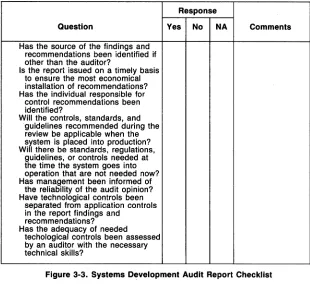
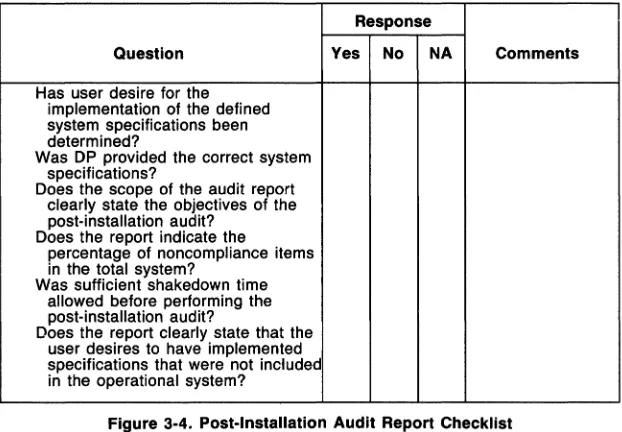
In addition to well-defined objectives, the effectiveness of an EDP audit depends on whether the recommendations included in the audit report are accepted. As a consequence, the auditor should design and write the report in a way that clearly demonstrates the merits of the recommendations. In Chapter Three, William E. Perry discusses the problems involved in writing effective EDP audit reports, describes the five types of reports, and provides tips on effective report writing.
Of all the areas with which the EDP auditor must be con-cerned, perhaps the most fundamental is that of DP standards. Such standards are crucial to maintaining control over DP applications. In addition, the absence or neglect of standards can hinder the effectiveness of traditional
control in non-DP areas. In Chapter Four, Ben G. Matley and David W. Syfritt
provide a step-by-step procedure for determining the existence and effective-ness ofDP standards.
An activity in which DP standards are particularly important is systems development. Although there is no general agreement on the extent of audit activities during the systems development life cycle, the auditor should take part in this process to ensure the adequacy of internal control systems. To do this, the auditor must examine two major areas: internal controls over the computer and manual systems and administrative controls over the systems
development process. In his' 'Test Design for Systems under Development,"
Jack B. Mullen presents a checklist for in-depth auditor involvement in the systems development process.
After major systems have been developed, the auditor should conduct post-implementation audits to determine the accuracy of cost/benefit estimates made before the start of the projects. These reviews are necessary because management bases decisions about applications projects on those estimates. In Chapter Six, Bryan Wilkinson describes how to conduct a cost! benefit review of applications projects.
The source code of application programs should also be audit-ed. Although source code analysis is time consuming and requires a great deal of technical skill, the potential benefits make it a productive and informative
activity. In Chapter Seven, Michael I. Sobol discusses various methods and
tools useful in auditing application programs.
Introduction
In addition to application programs, the EDP auditor must be familiar with operating systems, utility programs, and job control languages (JCLs). Operating systems are programs (or sets of programs) that direct the activities of computers; they are the "brain" of any computer system. Utility programs are powerful and convenient tools for performing redundant tasks in the data center. Their capabilities make them both useful and a security risk. JCL is a high-powered, flexible language used to define the tasks performed by the computer and thus should be subject to strict standards. In Chapter Eight, Robert J. Coyle presents a systematic approach to reviewing a particular operating system-the IBM Multiple Virtual Storage (MVS) operating system. This is followed by Michael!. Sobol's discussion of the auditor's use and control of utility programs in Chapter Nine. And in Chapter Ten, Steven F. Blanding describes how JCL standards are enforced and how the auditor can approach their review.
The proliferation of minicomputers has added a new level of complexity to the auditor's tasks. Because the degree of control inherent in large-scale systems is often absent in minis, the auditor must develop a workable audit plan that takes into account the unique nature of these devices; he or she must also find alternate methods to accomplish audit objectives. In Chapter Eleven, Thomas H. Fitzgerald presents control techniques that can minimize the risks posed by minicomputers.
Post-installation costibenefit review of hardware acquisitions may not be considered part of the EDP auditor's bailiwick in most organiza-tions. As one who monitors the use of company assets, however, the auditor should recommend a thorough and impartial follow-up of hardware acquisition projects. Bryan Wilkinson describes such a review in Chapter Twelve.
I I I I
,
I I I
I I I I I I I
I I I I I
I I I I
I I I I I I I I I
i I I I I
~
Defining EDP Audit
Objectives
by William A. Emory, Jr.INTRODUCTION
Many articles have been written concerning the EOP auditor's role-as viewed by the general auditor, the EOP manager, and by senior management. Although this type of article provides useful infonnation, it leaves unan-swered such questions as:
• What is the proper role of the EOP auditor? • What are the objectives of EOP auditing? • How can these objectives be defined?
Another problem in defining EOP audit objectives is illustrated by the following examples. At one large wholesale distributor, the internal audit procedures for accounts receivable include the following instruction: Verify the totals on the computer output to the departmental or general ledger con-trols. After this instruction, the financial auditors routinely placed the follow-ing comment: Perfonned by EOP auditors. A subsequent review of the EOP audit procedures revealed that the EOP auditor had no procedure for verifying computer output to user controls. Each had simply assumed that the other was responsible for this procedure.
In a banking institution, the financial auditors developed a program in which they used their calculators to verify interest calculations on consumer loans during their annual audit of the consumer loan department. In this same organization, the EOP auditor conducted periodic application reviews. One objective was to test the accuracy of program documentation. The method involved using the documented interest calculations in an audit software pro-gram to recalculate the loan interest and then comparing these figures with the
interest calculated by the production program. In this case, although the two
audit groups had different audit objectives, there was a clear duplication of effort.
To avoid these problems, the role of the EDP auditor must be defined in terms of the objectives of EDP auditing, and the objectives of EDP auditing must be dermed in terms of the· overall audit goals of the individual organiza-tion.
THE ROLE OF THE EDP AUDITOR
The proper role for an EDP auditor is the one that most effectively contrib-utes to the organization's total audit needs. Although no article, portfolio, or book on EDP auditing can define exactly what the auditor's role or specific objectives should be, published sources can provide excellent guidelines and useful ideas. When developing role definition and audit objectives, the EDP auditor should consider the following:
• The structure and goals of the organization in which he or she works • The characteristics of the DP department
• The needs and objectives of the financial auditors
• His or her own capabilities and those of the EDP audit staff
The Organization. The organizational structure, the levels at which DP and auditing report, the management philosophy, the corporate goals, and even the product lines all have some influence on defining the EDP audit objectives. For example, in the banking industry the computer applications are an integral part of the product line (financial services), and the computer operation, or at least the output, is highly visible to the customer. In this situation, application auditing receives high priority as an EDP audit objec-tive. A computer service bureau, however, may process many customer appli-cations, but the service contract may specify that the customer has responsi-bility for auditing the application. In this case, application auditing would not
be an appropriate objective for the EDP auditor.
The DP Department. The general makeup and relative sophistication of the data center must be considered when defining EDP audit objectives. For example, the EDP auditor responsible for a multisite data center that has online processing and an extensive data communications network has differ-ent objectives than does the auditor for a single-site cdiffer-enter with all batch processing. Ensuring that adequate controls are incorporated during systems design might be an excellent objective in a center that develops new systems but may be inappropriate for a turnkey operation that uses only vendor-supplied software.
Financial Audit Objectives. If the financial records of the organization are highly automated and the financial auditors have little DP background, the most efficient role for the EDP auditor may be to provide support for the financial auditors. Another important objective might be to provide basic DP training for the financial auditors.
DEFINING AUDIT OBJECTIVES 3
eliminate duplication and avoid oversights. For example, many EDP auditors review DP personnel policies and evaluate employee performance. Financial auditors may review general personnel policy for the entire company and may evaluate the performance of key personnel. Coordination of audit objectives between the two groups can eliminate duplication of effort in this area.
EDP Auditor Capabilities. Another factor that must be considered in set-ting EDP audit objectives is the capability-training and experience-of the
EDP auditors. It makes little sense to set objectives that the auditors are
incapable of attaining. Once the objectives are defined, the beneficiaries of the audit (e.g., senior management and the board of directors) have every
right to hold the auditors responsible for meeting those objectives. It is
there-fore more prudent to leave unspecified those objectives that the auditors cannot attain.
This course of action may create a dilemma for the EDP auditor. If he does
not meet defined objectives, he is held accountable; if he leaves important objectives undefined, he may be considered negligent. Although the profes-sional auditor should try to increase his knowledge so that he can perform additional required audit functions, the funds and time are often unavailable for needed training. A method of defining EDP audit objectives on a contin-gent basis, which takes auditor capability into account, is presented later in this chapter.
DEFINING EDP AUDIT OBJECTIVES
We have already stated that the objectives ofEDP auditing must be defined in terms of the overall audit goals for the organization. To do so, the EDP auditor must consider every possible EDP audit objective (or at least every one that he or she can think of or obtain from reference material) and decide which of these contribute to the organization's overall goals. In addition, the auditor must determine which objectives are proper functions of the EDP auditor and within his or her present capabilities and which objectives might be better performed by other persons within the organization. Determining this can be difficult. One way to proceed is to develop a "laundry list" of EDP audit objectives.
Developing a Laundry List
A laundry list of EDP audit objectives is simply a list of every conceivable audit objective associated with DP and automated applications. When devel-oping the list, the auditor should first write down every objective that comes to mind. Since no one person can possibly think of all of the objectives, the next step is to solicit the views of associates. The auditor should not worry at this point about whether the objectives are proper for EDP auditing; the
purpose of this exercise is to gather all possible DP-related audit objectives.
specifi-cally m.ention audit objectives, they should provide additional ideas. A simple review of the table of contents of this infonnation service should suggest many possible EOP audit objectives. In addition, the list in the Appendix contains 120 EOP audit objectives that can help the EOP auditor start his own list.
Anyone with some training in fonnal planning or management by objec-tives techniques might insist that some of the items on the list in the Appendix are not objectives at all but are, rather, perfonnance targets or work steps. Several goals and perfonnance measurements are also included in the list. In view of this, it might be helpful to think of an audit objective as anything an EOP auditor should try to accomplish. Note that although an EOP auditor must cope with the buzzwords of the computer industry, he cannot afford to let them prevent him from clearly defining his role.
The laundry list approach should help to define specifically the limits of EOP auditor responsibility and the points of interface between him and other audit or control groups. When developing the list, the EOP auditor should have in mind one or two possible audit procedures or questions to use to attain each objective. As the auditor approaches the limits of his self-defined re-sponsibility, the objectives should become more focused, perhaps to the point of becoming individual procedures. The idea is to detennine the exact point at which the EOP auditor's responsibility ends and that of another group begins. This prevents missed audit objectives and avoids costly duplications.
Systems Development Objectives. A few examples may clarify the
con-cept of defining responsibility limits. One controversy in EOP auditing has been between those who feel the need to participate in systems design efforts and those who believe that reviewing systems development projects will suffice. Items 31 through 41 in the list of objectives (see Appendix) address this area. Items 33,38, and 40 suggest active participation, while the remain-ing items suggest a review role. The idea is to include both roles and to let the organizational needs help define the proper choice. Those EOP auditors who feel strongly about active participation in systems development may wish to expand the number of objectives in that area to help derme the degree of participation.
Application Audit Objectives. Another point of possible contention be-tween EOP auditors and financial auditors involves application audits. Should the EOP auditor review the entire application system, or does his responsibil-ity end at the data center door? Who is responsible for user controls and work in transit? Objectives 95 through 101 address the application audit. Note that objectives 99, 100, and 101 are very specific; their purpose is to define the exact limit of the EOP auditor's responsibility and the point of interface between the EOP auditor and the financial auditor.
DEFINING AUDIT OBJECTIVES
5
in conducting financial audits? Objectives 112 through 120 cover the area of audit support. Objective 115, which relates to reconciling automated output, is always a disputed issue. While many EDP auditors think this task beneath their dignity, many financial auditors believe that reconciling output is the only valid reason for having EDP auditors. Although this chapter cannot resolve this conflict, it does recommend that this objective be specifically included in the list. The EDP auditor should also include any other items that he feels he should not be responsible for, even though the items are DP related. The purpose of the list is to define the auditor's role based on the needs of the organization; this may include accepting responsibility for some objectives that he feels belong to someone else.
Objectives beyond Present Capabilities. Mentioned earlier were the problems involved with defining objectives beyond the auditor's present capa-bilities. Items 76 and 80, which relate to telecommunications, are examples of objectives for which many EDP auditors feel unqualified. At this point in the development of the list, this type of objective should be included, regardless of the staffs ability to accomplish such objectives.
Organizing the List
The next step is to meaningfully organize the list, remembering that people outside the EDP audit staff who may lack a background in either DP or auditing will review it.
When organizing the list, the first step is to eliminate any objectives that do not apply to the DP operation in the organization. For example, if the organi-zation does not have a data communications network, items 76 through 81
should be omitted. If there is no systems development work done in the
organization, objectives 31 through 41 should be omitted. The idea is to keep the list as short as possible, while covering all bases. When editing the list and eliminating possible objectives, the auditor should note the reason he is omit-ting them.
Lists of audit objectives are generally organized in the same format as are the procedures used to conduct the audits (i.e., audit objectives and audit procedures should parallel each other). The audit procedures themselves are usually organized in order of control objectives (audit goals). Controlobjec-tives are broad audit objecControlobjec-tives, such as:
• Ensure the integrity of the data being processed. • Prevent unauthorized access to information.
• Ensure the continued availability of the computer resources.
Based on this type of organization, most EDP auditors conduct audits of such items as data integrity, physical security, logical access security, and emer-gency preparedness.
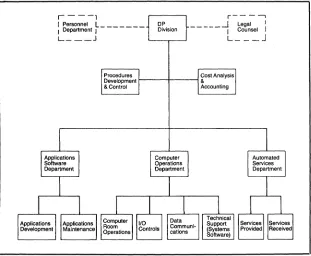
goals, but none totally covers any of them. As an alternative, the audit objectives should be arranged into OP functional areas based on the organiza-tion of the OP operaorganiza-tions within the company.
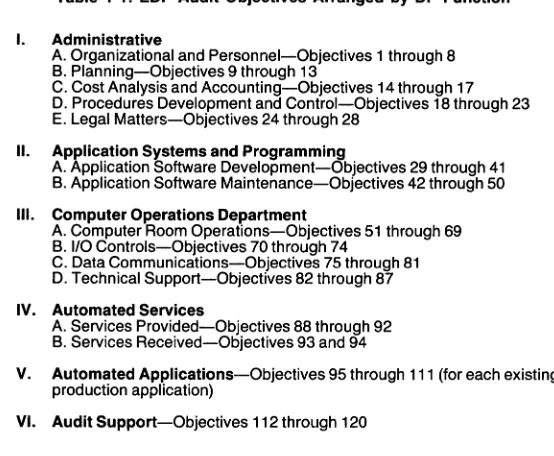
Figure 1-1 shows an organizational chart for a typical medium-sized OP operation. Based on this chart, Table 1-1 gives a laundry list of objectives broken down into OP functional areas.
Organizing the list of objectives by OP functional area has several
advan-tages. An EOP auditor should be aware of the work that is performed in each
area and how it relates to the overall OP effort; this type of organization may thus help him think of additional objectives or audit procedures. Management at all levels is more accustomed to thinking in terms of organizational struc-ture than in terms of control objectives; a functional approach should thus more clearly delineate the objectives to management. This arrangement also helps management to suggest additional objectives or to spot objectives that may have been included in the wrong functional area.
By arranging the objectives into functional areas, the auditor should be able to develop the audit procedures into functional audit units. This can help improve the control over EOP audit performance by creating smaller,
better-defined audit units. It should also help improve the auditor/auditee
relation-ship by limiting individual audits to specifically defmed functions and groups of employees.
r - - - , r - - - ,
,Personnel L ______ _ I Department I
L _ _ _ J
_____ -1 cLegal I,
, ounsel
[image:19.414.59.370.305.561.2]L _ _ _ J
DEFINING AUDIT OBJECTIVES
Table 1-1. EDP Audit Objectives Arranged by DP Function
I. Administrative
A. Organizational and Personnel-Objectives 1 through 8 B. Planning-Objectives 9 through 13
C. Cost Analysis and Accounting-Objectives 14 through 17 D. Procedures Development and Control-Objectives 18 through 23 E. Legal Matters-Objectives 24 through 28
II. Application Systems and Programming
A. Application Software Development-Objectives 29 through 41 B. Application Software Maintenance-Objectives 42 through 50
III. Computer Operations Department
A. Computer Room Operations-Objectives 51 through 69 B. 1/0 Controls-Objectives 70 through 74
C. Data Communications-Objectives 75 through 81 D. Technical Support-Objectives 82 through 87
IV. Automated Services
A. Services Provided-Objectives 88 through 92 B. Services Received-Objectives 93 and 94
V. Automated Applications-Objectives 95 through 111 (for each existing production application)
VI. Audit Support-Objectives 112 through 120
Distributing the List
7
After the list is trinimed down and properly organized, it is ready for
distribution. It should be distributed to those persons directly responsible for,
or interested in, the EDP audit function. The distribution list should include the Corporate Auditor (Audit Manager), the Director of DP (Data Center Manager), the Senior Operations Officer (the person to whom the Director of DP reports), and the Audit Committee of the Board of Directors (if such a committee exists).
The audit objectives cannot be distributed without some instructions to the recipients. These instructions should be written and should include a brief statement of purpose. In addition, they should request the recipient to review the list and to indicate whether he thinks each item is a proper objective for the
EDP auditor. If the recipient disagrees with an objective, he should give a
reason. He should also include any additional objectives that he feels would be worthwhile. The instructions should include a time limit for returning the lists.
[image:20.414.61.338.78.306.2]Potential Problems
Three potential problems regarding those who review the lists of objectives should be anticipated. First, senior management often takes a rubber-stamp approach to such a review. They may not understand the list nor have time to find out more about it. Instead, they simply approve and return it. When this happens, nothing is really accomplished.
The second problem, usually associated with DP management and the financial audit staff, is the "that's a good idea-do it" approach. An objective may be considered worthwhile, but some question over where or by whom the objective should be done may remain. Since it entails procedures that no one really enjoys doing, the person reviewing the list takes the easy way out and simply lets the EDP auditor do it. This is only slightly better than the rubber-stamp review. In this situation, EDP audit objectives may have been thought-fully defined, but the auditor cannot depend on whether they have been coordinated with the overall audit and management control objectives of the organization.
The third potential problem involves EDP auditor capabilities or lack thereof. This chapter stated earlier that worthwhile objectives should be in-cluded, even if the EDP audit staff lacks the capability to perform the
proce-dures dictated by the objectives. If the reviewers of the list conclude that these
are worthwhile objectives and should be the responsibility of the EDP auditor, that auditor may be in a real bind. He has a clear mandate but is unable to
perform the required tasks. If the auditor asks management for more training
in order to meet the objectives, he may lose credibility or may even be accused of using underhanded methods to justify more training.
If the auditor feels that these or similar problems apply to his organization,
he should address them before distributing the list of objectives. One ap-proach would be to emphasize the potential problems in the written and oral instructions. Perhaps a better approach is to divide the list into three sections. The first part would include the objectives that the EDP auditor feels are worthwhile and that he should perform. The second part would list objectives that the auditor feels are worthwhile but that should be performed by someone other than EDP audit staff members. The third part of the list would contain objectives that the auditor considers worthwhile but beyond the present capa-bilities of the EDP audit staff (a brief explanation of the reason the objective is beyond current audit capabilities should probably be included).
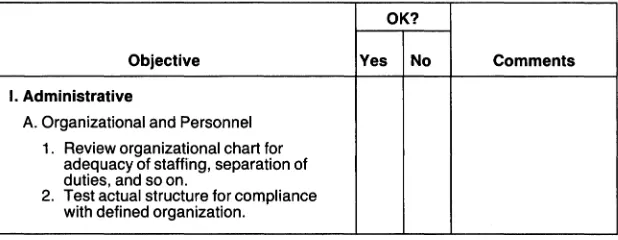
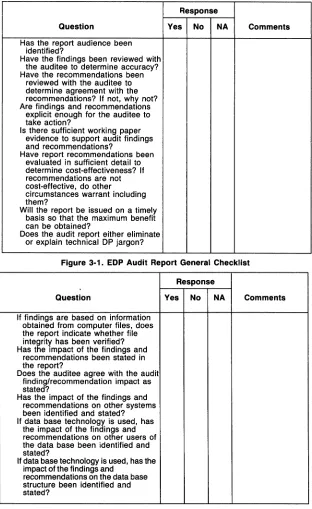
In addition to the three-part approach, the use of a form may help over-come some of the potential problems. A clearly organized form often helps accelerate the review process by immediately focusing the reviewer's atten-tion on the more important issues. Figure 1-2 shows such a form.
These methods should help overcome the potential problems. If the auditor gets a rubber-stamp response, at least he knows that the reviewer considered
his viewpoint. If he is mandated to perform beyond the present capabilities of
DEFINING AUDIT OBJECTIVES 9
OK?
Objective Yes No Comments
I. Administrative
A. Organizational and Personnel
1. Review organizational chart for adequacy of staffing, separation of duties, and so on.
[image:22.414.48.357.63.183.2]2. Test actual structure for compliance with defined organization.
Figure 1-2. Sample EDP Audit Objectives Form
The Final List
After performing the various exercises described in this chapter, the audi-tor should end up with several lists of objectives, each with the viewpoints and recommendations of different levels of management who are concerned with both audit and DP. The final task is to combine these lists into one working list that defines the specific objectives for EDP audit activities.
Combining the lists is relatively simple. If all agree with the objective, it
should be included in the final list; if all disagree, it should be omitted. If
there is split agreement, the auditor should use his own judgment or take the safe route and leave it in.
If the list contains objectives that belong to the financial audit group, the
EDP auditor must coordinate his activities with that group. It is his
responsi-bility to ensure that the financial auditors understand any DP-relatedobjec-tives that are assigned to them and that they develop procedures to fulfill these objectives. He must also ensure that the procedures that he develops, based on the list of objectives, dovetail with those of the financial audit group. Only with such attention to detail can he totally avoid missed audit objectives and needless duplication.
CONCLUSION
The first step in designing any system, whether an accounts receivable system or an EDP audit system, is to define the problem. The basic questions to ask are:
• Have the objectives of the EDP audit function been formally defined? • Is there a defined interface between the EDP auditors and the financial
auditors?
If the EDP auditor can answer yes to both questions, he is to be congratulated
because he is, unfortunately, probably in the minority. Much attention has
been devoted to audit objectives and professionalism in EDP auditing;
If EDP audit objectives are not clearly delineated, the EDP auditor should attempt the process described in this chapter. First, he must obtain prelimi-nary support. The project will take some time and will involve people whose approval and support are essential. The next step, of course, is to develop the list of objectives, distribute it, and consolidate the results. From the list, the EDP auditor must develop the audit procedures necessary to attain the audit objectives. He must then monitor the performance of the procedures to ensure
that the objectives are actually being met. If this sounds like a lot of work, it
is. It is necessary work, however, if the EDP auditor is to define his role
DEFINING AUDIT OBJECTIVES
APPENDIX
Possible EDP Audit Objectives
1. Review organizational chart for adequacy of staffing, separation of duties, and the like.
2. Test actual structure for compliance with defined organization.
11
3. Review personnel policies for adequacy of control features and compliance with laws or standards.
4. Test personnel procedures for compliance with policies. 5. Determine that employees understand personnel policies. 6. Evaluate performance of key personnel.
7. Review salary administration program. 8. Review employee training programs.
9. Determine that DP plans are coordinated with overall corporate plans. 10. Review DP plans for adequacy.
11. Test performance against plan.
12. Determine that senior management and users participate in planning efforts. 13. Participate in planning process to express audit concerns.
14. Review and test cost analysis procedures.
15. Determine that cost basis figures are uniformly applied. 16. Review budget and budgeting procedures.
17. Test performance against budget.
18. Determine that DP standards have been developed for all areas. 19. Review management procedures for enforcing standards. 20. Help to enforce standards.
21. Test performance against standards.
22. Determine adequacy of procedures for maintaining and updating standards. 23. Participate in the development of standards.
24. Review DP hardware/software contracts. 25. Review DP services contracts.
26. Test contract performance. 27. Participate in contract negotiations. 28. Review DP insurance coverages.
29. Review application software development plans. 30. Test plan performance.
31. Determine adequacy of standards for systems design or software purchase. 32. Review user involvement in systems development.
33. Participate in systems development. 34. Test feasibility determinations.
35. Review controls on new systems before implementation. 36. Review implementation plans.
37. Review selection and use of programming languages. 38. Participate in systems testing.
39. Review test results before implementation. 40. Conduct post-implementation reviews.
41. Determine that post-implementation reviews are conducted.
42. Determine adequacy of standards for application software maintenance. 43. Test maintenance procedures for compliance with standards.
47. Test documentation backup.
48. Review logical security over data and program mes. 49. Review programmer use of private or temporary libraries. 50. Test maintenance performance against requests for maintenance or
modifications.
51. Review standards for computer operations, and test for compliance. 52. Determine that hardware is being used efficiently.
53. Review management reports concerning hardware utilization. 54. Determine that equipment is used only for authorized jobs. 55. Review plans for equipment acquisition.
56. Test equipment acquisition feasibility studies. 57. Participate in hardware selection studies. 58. Review scheduling procedures.
59. Test performance against schedules. 60. Conduct inventory ofDP equipment. 61. Review hardware maintenance procedures. 62. Review environmental conditions. 63. Review physical security program. 64. Review physical access controls.
65. Review procedures for protection against and/or detection of possible disasters. 66. Review disaster recovery procedures.
67. Test disaster recovery procedures.
68. Review security over media containing data and program files. 69. Test file backup procedures.
70. Review data entry procedures. 71. Review input balancing procedures.
72. Review controls over rejected and unposted items. 73. Review output reconcilement procedures. 74. Review output distribution procedures.
75. Review standards for communications network design. 76. Participate in network planning.
77. Review network backup provisions.
78. Review physical security of network components. 79. Review communications network logical access security. 80. Test network operating efficiency.
81. Review management reports concerning network performance. 82. Review system software planning procedures.
83. Review controls over software modification. 84. Review documentation for systems software. 85. Review controls over utility programs. 86. Test utility program use.
87. Review and test production library maintenance procedures.
88. Test DP services provided to outside parties to determine compliance with contract provisions.
89. Test servicing income against billings and processing records. 90. Verify processing parameters to consumer documentation. 91. Verify contents of customer meso
92. Determine that customer processing is subject to adequate controls. 93. Determine nature and impact ofDP services received from outside sources. 94. Conduct audit reviews of outside servicers.
DEFINING AUDIT OBJECTIVES 13
97. Review user documentation.
98. Determine if users are satisfied with systems. 99. Test user data flow control procedures.
100. Review controls over data in transit between user and computer center. 101. Review application data work flow through DP.
102. Test data entry and reentry procedures. 103. Test 110 balancing procedures. 104. Review report distribution procedures.
105. Review application programming documentation for completeness. 106. Test program modifications for compliance with standards. 107. Review documentation for evidence of programmed controls. 108. Test functioning of programmed controls and edits.
109. Review documentation for evidence that key calculations are performed in accordance with policy or legal requirements.
110. Test critical calculations.
111. Verify contents of magnetic files via the documentation. 112. Develop computer programs to assist financial auditors. 113. Serve as liaison between financial auditors and DP department.
114. Assist financial auditors in interpreting and evaluating DP-generated reports. 115. Reconcile DP reports to user department controls.
116. Provide basic DP training to financial auditors.
Defining the Scope of
DP Controls
by Ian GilhooleyINTRODUCTION
Controls are individual standards and procedures that, when combined, comprise the system of internal control within an organization. The objectives of a system of internal control are to provide reasonable assurance that assets are safeguarded, that information is timely and reliable, and that errors and irregularities are discovered and corrected promptly. Such a system also should be designed to promote operational efficiency and to provide sufficient information for the auditor to evaluate the level of compliance within each organizational division.
The introduction of DP did not change the objectives of the system of internal control nor the available levels of control. Before the introduction of DP, however, functional responsibilities were defined along departmental lines, with each department manager held accountable for adherence to partic-ular controls within his operation. With the introduction of DP, the DP department assumed many of the functions previously shared among other departments, and the various computer application programs now make deci-sions (e.g., whether to allow an overdraft based on the presence of an autho-rized credit limit) that were previously handled by a department supervisor or manager. While controls could previously be seen and physically attested to (e.g., segregation of duties and supervisory checking), the introduction of computers has forced management and auditors to reevaluate many traditional controls and concepts.
FUNCTIONS OF DP
The DP department can be divided into two functional elements: the
cen-tral computing facility (CCF) and the systems development department (SDD). The CCF is responsible for providing and maintaining the computer environment (i.e., hardware, operating software, and telecommunications) necessary to execute the various application systems. The CCF is also respon-sible for executing these application systems so as to provide the user with accurate, timely output. In addition, it must provide data security to protect the integrity of application programs and the user data processed by these programs.
Like the CCF, the SDD is user oriented. Systems development personnel must develop and maintain application systems on schedule, within budget,
and in accordance with user needs.
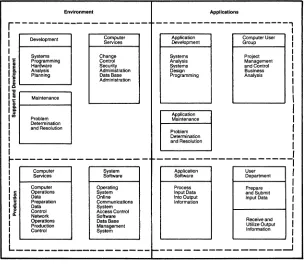
As shown in Figure 2-1, the scope of D P can be considered in terms of the environment and applications, with the elements of each paralleling the re-sponsibilities of the CCF and SDD, respectively. This figure illustrates the concept of the common processing environment and the multiple application systems that run in this environment. To serve the information needs of the user in a complete, accurate, and timely manner (and in a form that the user
Environment
r---I I 1 DevelopmentI c ~ro~~:~ming
I ; Hardware
I
f
L-_~_~a_nr:_i~~
_ _ _I'"..--
__
-
...Maintenance
Iii
I" 111---1
I"' I 1 I
I
Problem Determination and Resolution Change Control Security Administration DataBase Administration ~---Computer Services Computer Operations Data Preparation Data Control Network Operations Production Control System Software Operating System Online Communications System Access Control Software DataBase Management System Applications---,
Apptlcation Development Systems Analysis Systems Design Programming Problem Determination and Aesolution Computer User Group Project Management and Conlrol Business Analysis ---~ Process InputOsla IntoOutpul Information User Depanment ~~!:~mit Input Data Receive and Utilize Output Informationr
I I I I I I I IL ___________________________________ ...-J
[image:29.414.63.367.308.579.2]DEFINING THE SCOPE OF CONTROLS 17
can understand), the DP department must have a support and development as well as a production capability.
Support and Development
The support and development capability must develop and maintain the various application systems required to provide infonnation to users and must install, maintain, and administer the hardware and software environment in which the various application systems will run. The following support and development functions are found within this environment:
• Development-includes the systems programming function responsible for SYSGEN and for installing any other software that will be common to all application systems (e.g., access control software, data base management software). The development function also includes ana-lyzing the current perfonnance of the environment (hardware and soft-ware) and planning to ensure that the environment can continue to satisfy demands from the application systems.
• Maintenance-includes the activities of the vendor's hardware and soft-ware engineers, telecommunications engineers, and the organization's systems programmers. The maintenance function is primarily con-cerned with maintaining the environment's capacity to service the vari-ous application systems.
• Computer services-is the administrative interface between the envi-ronment and the application. This function is responsible for adminis-tering change control (e.g., promoting changes in the production envi-ronment); administering security; defining access levels to production data files; maintaining the password data set for online users; and, where appropriate, data base administration (e.g., maintaining the data dictionary and data base definition tables).
The following support and development functions are found within the applications:
• Application development-is responsible for analyzing, designing, and programming application systems that fulfill a business requirement of the organization as reflected in the needs of the user for whom the system is developed.
• Application maintenance-is responsible for problem detennination and resolution when an error is detected in the application system or when an enhancement that can improve the effectiveness and/or effi-ciency of the system is identified.
• Computer user group-provides the interface betwe~n the DP
re-sponsibility for project management and control (i.e., ensuring that the system is developed on schedule and within budget).
Production
Production is the actual running of the application system to provide timely and complete information to the user. A combination of people and software functions, production requires effective interfacing between the two to produce the desired output.
The following production functions are found within the environment: • Computer services-comprises the personnel functions necessary to
provide the interfaces among the hardware, telecommunications, and system and application software. Computer services also includes the following subfunctions:
-Computer operations is responsible for monitoring the execution of the various tasks operating in the computer; providing resources (e.g., tapes, disks, and special stationery) as requested by applica-tion systems; and taking the appropriate acapplica-tion for unexpected occur-rences during the execution of these application systems (e.g., pro-gram abends and unexpected halt messages).
-Data preparation is responsible for translating source documents onto computer-readable media (e.g., cards or tape files).
-Data control is responsible for gathering the data needed to run the various application systems and for ensuring that complete output information is received.
-Network operations is responsible for controlling the telecommunica-tions network, anticipating problems within the network, and cor-recting existing problems.
-Production control is responsible for job scheduling, job submission, and media management (e.g., allocating disk space, compressing scratched files, and deleting unused files).
• Systems software-refers to the software generic to all application sys-tems and includes the vendor-supplied operating system, online com-munications software, any access control software (e.g., software that restricts access to data or library files to authorized users), and a data base management system (e.g., IMS).
The following production elements exist within the sphere of applications: • Application software-refers to the computer programs designed and
developed to provide the information required by the user.
• User department-prepares and submits input data (whether online or in the form of source documents forwarded to data preparation) and uses the output information provided by the application software.
SCOPE OF DP CONTROLS
Physical Security
finan-DEFINING THE SCOPE OF CONTROLS 19
cial investment, adequate physical security measures must be adopted to protect the organization from the following four levels of loss:
• Temporary and partial loss-loss of a disk drive through mechanical failure
• Temporary but total loss-total break in the power supply
• Permanent but partial loss-accidental or intentional destruction of data ftles
• Permanent and total loss-destruction of the data center by fire
It is the intention of this chapter to state the importance of physical security
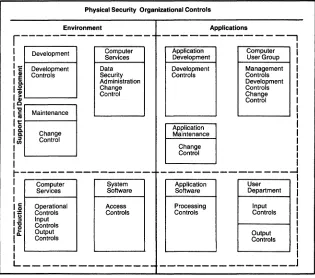
within the scope of OP controls and to show its relationship to other forms of control (see Figure 2-2).
Organizational Controls
As stated previously, the introduction of the OP department did not change the objective of the accounting control-the separation of duties. The control procedures and some duties in OP, however, differ from those found in manual processing environments. For example, with an intimate knowledge of the system and the availability of production data, a programmer can
Physical Security Organizational Controls
Environment Applications
r--- 1---,
I Development
I I
-I i g~~~~~fsment I [
I~
I ii 1..--_ _ _ ---1 I C r - - - ,
I
i
MaintenanceI~ 18: IJl I I Change Control Computer Services Data Security Administration Change Control Application Development Development Controls Application Maintenance Change Control Computer User Group Management Controls Development Controls Change Control I
r---
---~
I I I 15 lti Ii:P!
10..
I I Computer Services Operational Controls Input Controls Output Controls System Software Access Controls Application Software Processing Controls User Department Input Controls Output Controls [image:32.414.46.361.293.571.2]L ______________________________ _
manipulate data to perpetrate fraud. The organization of a DP department can be considered as split between groups responsible for the environment and groups responsible for applications. Figure 2-3 shows a functional diagram of the organization of a typical DP department, based on this division. Figure 2-2 shows the relationship of organizational controls to the other forms of control.
Application Support and Development Controls
The following controls pertain to the support and development of applica-tion systems:
• Management controls • Development controls • Change control
Management Controls. These controls apply primarily to the develop-ment of new application systems. Managedevelop-ment controls, which are the re-sponsibility of the computer user group, are designed to ensure that a develop-ment project meets the user requiredevelop-ments. The business analysts in the computer user group are responsible for providing an interface between the user department and the systems development department. The business ana-lyst must understand the needs of the user in business terms and translate these needs into system specifications that can be used in analyzing and designing a computerized system. He must then monitor the development of the system to ensure that user needs are being met.
The computer user group must also act as project managers for all system
development, coordinating all activities to ensure that the correct resources are available at the appropriate time. For example, the user group must ensure that a programming team with the necessary skills is available when program-ming begins or that the user department is fully trained when the system goes live.
The existence of an effective computer user group is in itself a manage-ment control. Additional managemanage-ment controls include project status and budget reviews to ensure that the system is being developed on schedule and within budget.
Environment
I
[ - - - 1
Support and Development ProductionI
-Software Programmers -Hardware Analysts -Communications Specialists
-Change Control Officers -Security Administrators
-Data Base Administrators -Media Analysts
-Computer Operators -Network Operators -Keypunch Operators
-Data Control Officers
Applications
I
I
l
Prodpction Support and Development
-Project Manager -Business Analysts -Systems Analysts
-Systems Designers -Programmers
Figure 2-3. DP Department Organizational Chart
o
m
"T1
Z
Z
(j)-I
;J:
m
rn
o
o
"tIm
o
"T1o
o
Z
-I :I1
o
r
rn
[image:34.414.63.608.65.308.2]I\)
Change Control. Regardless of how well a computer system has been designed, programmed, and tested, changes are usually required either be-cause an error is found in the system or bebe-cause an enhancement is required to meet user needs. Change control procedures ensure that only authorized changes are made to a production system and that the changes are fully tested and approved and are migrated into the production environment in a con-trolled manner (e.g., under the control of the computer services function for support and development). Documentation standards are also an essential part of change control because they provide an audit trail of all changes and ensure that the system can continue to be maintained.
Application Production Controls
The types of control pertaining to the production functions of application systems include:
• Input controls • Processing controls • Output controls
Input Controls. These controls can be considered in terms of manual and programmed controls. Manual input controls, which usually exist at the user department and the data center, include checking procedures to ensure that the data to be processed is recorded accurately and completely, authorization procedures to ensure that all data submitted for processing is legitimate, and filing procedures to ensure the existence of an audit trail. The types of input controls commonly implemented in the user department are batching input data and using prenumbered, preprinted forms and check digits.
To ensure that incorrect data is not allowed to complete the processing cycle, there should be stringent edit checks at the front end of the application system. Common types of edit checks include:
• Balancing to batch totals-Specific fields are accumulated separately and balanced to a batch total record.
• Anticipatory checks-Where specific data is expected in every run, the edit program should check that such data is actually present. • Validity checking-The edit program should check that each field
con-tains the expected type of information (e.g., numerical data or data within specific ranges or of specific values).
• Check digits-These digits can detect transposition of characters within a field and are commonly used for account number fields where trans-position errors, if undetected, could cause posting to the wrong ac-count.
• Reasonableness checks-Based on an analysis of what is normal, the edit program highlights or even rejects data that does not comply with the norm.
Processing Controls. Related to the update stage, processing controls are
ac-DEFINING THE SCOPE OF CONTROLS
23
counted for. Common types of processing controls include: • Labels-These ensure that the correct files are being used.
• Control records-These records contain a count of the number of records on the file and accumulations of specific fields from each record. By using the control record, the update program can check that the input file, updated by the day's transactions, matches the output file. The use of control records facilitates run-to-run balancing. • Date records-When the master file has a date record as its first record,
and the transaction file also has a date record, the update program can ensure that matching, as well as correct, files are used.
• Error handling-The update program must be able to handle the various processing combinations, including those that are invalid within the context of the application (e.g., an update transaction record for an account that does not exist).
• Restart/recovery procedures-When an update program runs for a long period of time (e.g., more than 30 minutes), or when files are updated in place, it should be possible to restart an interrupted run without starting from the beginning and recreating all files.
• Audit trails-The update program should indicate the disposition of all records processed in order to provide an audit trail.
• Vendor controls-These controls detect missing or incorrectly transmit-ted data (e.g., parity bit checking, block count reconciliation).
Output Controls. These controls are associated with the application sys-tem's reporting stage, which may be incorporated into the update program or may be a separate subsystem. Output controls are designed to ensure the completeness, accuracy, timeliness, and proper distribution of output, whether in the form of printed reports or magnetic media. Common types of output controls include:
• Labels-These ensure that the correct file is being created or updated. • Reconciliation-This process ensures that the correct amount of data has been processed and written out. Reconciliation reports can be produced to enable either the data control function or the user depart-ment to determine that all data has been received, processed, and output.
• Quantity reports-These detail the report types and number of pages per type printed by the report programs to allow the data control func-tion and user department to ascertain that all printed output is actually received.
• Distribution schedules-These aid the data center in ensuring that all reports are dispatched in time to meet user requirements.
• Dual custody-When negotiable instruments are to be printed, there may be a dual-custody arrangement between the data center and the user department to ensure that all instruments are correctly accounted for.
Environment Support and Development Controls
The types of control related to the support and development of the environ-ment include:
• Development controls • Change control
• Computer services function
Development Controls. Development controls within the application sys-tems are usually developed within the organization, while controls within environmental systems are virtually always packages purchased from either the computer vendor (e.g., operating system) or from independent software vendors (e.g., access control software packages). In addition, while control over the development of application systems has been subject to close scru-tiny, controls over environmental systems development have been left to the discretion of the technical services department responsible for development.
In many ways, the controls for environmental systems development are the same as those for application systems:
• The purchase of the particular software should have the approval of appropriate management.
• A feasibility study indicating costibenefits should be prepared. • The developed system should be tested fully, signed off by system
users, and migrated into the production environment under the control of the change control group within computer services.
The main barriers to a more thorough approach to the development and adoption of controls within this area have been the highly specialized and technical nature of the business and the limited experience or interest in the area of control of the technicians responsible for environmental systems de-velopment. In addition, the control specialists (i.e., the auditors) have little understanding of this area and find it difficult coming to terms with the more simplistic application systems development. This situation, however, is slowly changing, as both management and auditors realize that this uncon-trolled area warrants closer examination.
Change Control. Change control over application systems parallels change control over environmental systems. Changes to environmental sys-tems should be authorized, fully tested, fully documented, and migrated into the production environment under the control of the change control group within computer services. The comments on controlling the development of environmental systems likewise apply to controlling changes to these sys-tems. The topic of controlling changes to environmental systems is also coming under the close scrutiny of management and auditors.
DEFINING THE SCOPE OF CONTROLS
25
Computer services is also responsible for providing the manual interface between management and the automated data security measures existing within the installation. This function also must maintain the access control data base specifying who has access to which files, the password data set specifying who has access to computer resources and to what extent, and so on. While management is responsible for specifying the access criteria, this function must translate these criteria into the appropriate computer instruc-tions, monitor compliance, and report exceptions to management.
Environment Production Controls
The types of control related to the production functions within the environ-ment include:
• Input controls • Operational controls • Output controls • Access controls
Input Controls. These controls include the manual controls used within the computer services area of the data center by either the data preparation group or the data control group. The data preparation group may have key-punch machines capable of loading data programs that guide the operator in the types of data allowed within the various fields (e.g., will not allow alphabetic data in a numeric field, or will verify the accuracy of check digits) and that may even assist the keypunch operator in balancing to a batch totals record. The most common control within this area is keypunch verification, in which one operator checks another operator's work by rekeying the data.
The data control group collects the various inputs required by a particular application system and informs the production control group that the process-ing cycle can begin. An adequate, up-to-date data control manual, containprocess-ing the source of the various forms of input, the media involved, and the time frame in which input should be available, must exist for each application system.
Operational Controls. These controls are concerned with the interaction among production control, computer operations, and the computer processing environment. The controls ensure that each application system is processed in a complete, accurate, and timely manner and that computer resources are managed efficiently. Common operational controls include:
• Tape librarian-This function is responsible for inventory recording and issuing and storing of tape files.
• External labels-To complement the checking of internal labels by the software, tapes and disks should have external identification labels to assist the operators when they are required to mount them.