A multidomain integrated-radial-basis-function
collocation method for elliptic problems
N. Mai-Duy
∗and T. Tran-Cong
Faculty of Engineering and Surveying,
The University of Southern Queensland, Toowoomba, QLD 4350, Australia
Submitted to
Numerical Methods for Partial Differential Equations,
11-Jul-2007; revised, 11-Oct-2007
∗Corresponding author: Telephone +61 7 4631 1324, Fax +61 7 4631 2526, E-mail
Abstract This paper is concerned with the use of integrated radial-basis-function networks (IRBFNs) and non-overlapping domain decompositions (DDs) for
numer-ically solving one- and two-dimensional elliptic problems. A substructuring
tech-nique is adopted, where subproblems are discretized by means of one-dimensional
IRBFNs. A distinguishing feature of the present DD technique is that the
continu-ity of the RBF solution across the interfaces is enforced with one order higher than
with conventional DD techniques. Several test problems governed by second- and
fourth-order differential equations are considered to investigate the accuracy of the
proposed technique.
KEY WORDS: non-overlapping domain decomposition; radial basis function;
collo-cation technique; high-order differential equations
1
Introduction
The basic idea of a physical DD technique (cf. [1]) is to divide the problem domain
into a number of subdomains, on which the governing differential equations (DEs)
are solved with transmission conditions at the interfaces. The main advantage of
DD techniques lies in their ability to handle large-scale problems. Given a spatial
discretization, the size of matrices obtained with DD techniques is much smaller
than that with a one-domain technique. With the recent emergence of parallel
com-puters, DD techniques have become more attractive because they allow the parallel
computations of solutions to subdomains. The disadvantage of DD techniques is
that their solution is not as smooth as that on a single domain.
The basic part of any DD technique lies in the method of matching the computed
order are enforced across the subdomain interfaces. For second-order problems, the
enforcement is applied to the solution and its first-order normal derivative, while for
fourth-order problems, one imposes the continuity for the solution and its normal
derivatives of order up to three. The DD approach thus provides an approximate
solution that is aC1 function across the interfaces for second-order problems andC3
function for fourth-order problems. It is noted that there are relatively few papers
on DDs for the solution of fourth-order differential problems.
RBF collocation methods for solving DEs appeared in the early 1990s. Kansa [2] and
Fasshauer [3] were the first to suggest the so-called non-symmetric and symmetric
RBF collocation methods, respectively. The RBF methods are easy to implement
and have the capability to provide a very accurate solution using relatively low
numbers of points. When handling large-scale problems, like other discretization
techniques, the RBF methods need to be combined with DD techniques for an
efficient solution or one needs to construct the RBF approximations locally. A
number of RBF papers discussing these topics have been reported, see, e.g. [4-8] for
the use of DDs and [9-11] for the use of local approximations. A drawback of the
DD approach is that it requires a domain partition, i.e. some sort of meshing. For
these one- and multi-domain RBF collocation techniques, the construction of the
RBF approximations is based on differentiation (DRBFNs).
In this paper, we discuss a multidomain IRBFN collocation technique for the solution
of second- and fourth-order elliptic problems in one and two dimensions. The IRBFN
discretization scheme, which is applied on subdomains here, is based on the use
of a Cartesian grid and a one-dimensional (1D) IRBFN interpolation scheme that
has recently been reported in [12,13]. The incorporation of 1D-IRBFNs into the
substructuring technique leads to an approximate solution that is a Cp function,
instead of the usual Cp−1, across the subdomain interfaces, where p is the order
approximate solution alleviates the deterioration in accuracy caused by the domain
division.
An outline of the paper is as follows. Brief reviews of 1D-IRBFNs for the
approxima-tion of funcapproxima-tions and the soluapproxima-tion of DEs are given in Secapproxima-tions 2 and 3, respectively.
The proposed DD technique is described in Section 4. Numerical results are
pre-sented in Section 5. Section 6 concludes the paper.
2
A brief review of 1D-IRBFNs
Consider a univariate functionf(x). The basic idea of the integral RBF scheme [14]
is to decompose a pth-order derivative of the functionf into RBFs
dpf(x)
dxp = n
X
i=1
wiϕi(x) = n
X
i=1
wiIi(p)(x), (1)
where{wi}ni=1 is the set of network weights, and{ϕi(x)}ni=1 ≡
n
Ii(p)(x)on
i=1 is the set
of RBFs. Lower-order derivatives and the function itself are then obtained through
integration
dp−1f(x)
dxp−1 =
n
X
i=1
wiIi(p−1)(x) +c1, (2)
dp−2f(x)
dxp−2 =
n
X
i=1
wiIi(p−2)(x) +c1x+c2, (3)
· · · ·
df(x)
dx =
n
X
i=1
wiIi(1)(x) +c1
xp−2
(p−2)! +c2
xp−3
(p−3)! +· · ·+cp−2x+cp−1, (4)
f(x) =
n
X
i=1
wiIi(0)(x) +c1
xp−1
(p−1)! +c2
xp−2
where I(p−1)
i (x) =
R
Ii(p)(x)dx, I(p−2)
i (x) =
R
I(p−1)
i (x)dx,· · · , I
(0)
i (x) =
R
Ii(1)(x)dx, and c1, c2,· · · , cp are the constants of integration.
Unlike conventional differential schemes, the starting point of the integral scheme
can vary in use, depending on the particular application under consideration. The
scheme is said to be of order p, denoted by IRBFN-p, if the pth-order derivative is taken as the starting point.
The evaluation of (1)-(5) at a set of collocation points{xj}nj=1 leads to
d
dpf
dxp =Ib
(p)
[p]α,b (6)
d
dp−1f
dxp−1 =
b I(p−1)
[p] α,b (7)
· · · ·
cdf dx =Ib
(1)
[p]α,b (8)
b
f =Ib[(0)p]α,b (9)
where the subscript [.] and superscript (.) are used to denote the order of the
IRBFN scheme and the order of a derivative function, respectively;
b I[(pp]) =
I1(p)(x1), I2(p)(x1), · · · , In(p)(x1), 0, 0, · · · , 0, 0
I1(p)(x2), I2(p)(x2), · · · , In(p)(x2), 0, 0, · · · , 0, 0
· · · ·
I1(p)(xn), I2(p)(xn), · · · , In(p)(xn), 0, 0, · · · , 0, 0
, b I(p−1)
[p] =
I(p−1)
1 (x1), I2(p−1)(x1), · · · , In(p−1)(x1), 1, 0, · · · , 0, 0
I(p−1)
1 (x2), I2(p−1)(x2), · · · , In(p−1)(x2), 1, 0, · · · , 0, 0
· · · ·
I(p−1)
1 (xn), I2(p−1)(xn), · · · , In(p−1)(xn), 1, 0, · · · , 0, 0
· · · ·,
b I[(0)p] =
I1(0)(x1), I2(0)(x1), · · · , In(0)(x1), x
p−1
1
(p−1)!,
xp−2
1
(p−2)!, · · · , x1, 1
I1(0)(x2), I2(0)(x2), · · · , In(0)(x2), x
p−1
2
(p−1)!,
xp−2
2
(p−2)!, · · · , x2, 1
· · · ·
I1(0)(xn), I2(0)(xn), · · · , In(0)(xn), x
p−1
n
(p−1)!,
xp−2
n
(p−2)!, · · · , xn, 1
; b
α= (w1, w2,· · · , wn, c1, c2,· · · , cp)T ;
and
d
dkf
dxk =
dkf
1
dxk,
dkf
2
dxk,· · · ,
dkf n
dxk
T
, k = (1,2,· · · , p),
b
f = (f1, f2,· · · , fn)T ,
in whichdkf
j/dxk =dkf(xj)/dxk and fj =f(xj) with j = (1,2,· · · , n).
The use of integrated basis functions is expected to avoid the problem of reduction of
convergence rate caused by differentiation [15]. Numerical studies (e.g. [16,17]) have
shown that the integral collocation approach is more accurate than the differential
one. Recently, theoretical studies [18] have confirmed superior accuracy of IRBFNs
over DRBFNs. Moreover, there are additional weights (integration constants) in the
integral collocation formulation, and they have been found to be extremely useful
for handling the multiple boundary conditions [19-21]. This study further exploits
the constants of integration for the purpose of improving the order of continuity of
3
A brief review of 1D-IRBFNs for solving DEs
on a single domain
In the remainder of the paper, we will use
• the notation b[] for a vector/matrix [] that is associated with a grid line,
• the notation e[] for a vector/matrix [] that is associated with the whole set of
grid lines,
• the notation [] for a vector/matrix [] that is associated with the boundaries
of the domain,
• the notation [](η,θ) to denote selected rows η and columns θ of the matrix [],
• the notation [](η) to pick out selected components η of the vector [],
• the notation [](:,θ) to denote all rows of the matrix [], and
• the notation [](η,:) to denote all columns of the matrix [].
3.1
1D elliptic problems
Consider a 1D boundary-value problem governed by thepth-order ODE
F(u,du dx,
d2u
dx2,· · · ,
dpu
dxp) =b(x), r≤x≤s, (10)
where F and b are prescribed functions, together with boundary conditions for u,
du/dx, ..., and dp/2−1u/dxp/2−1 atx=r and x=s.
The continuous domain of interest is replaced by a set of discrete points{xj}nj=1with
to approximate the field variable and its derivatives in the ODE and the boundary
conditions. Owing to the presence ofp integration constants in the integral
formu-lation, one can addp extra equations to the discrete system. These extra equations
can be utilized to represent the ODE and the values of the derivative boundary
con-ditions at both ends of the domain. The governing equation (10) and the boundary
conditions can be transformed into the following discrete form
b
Aαb=f ,b (11)
whereAbis the system matrix of size (n+p)×(n+p) defined as
b A=
F Ib[(0)p](1,:),Ib[(1)p](1,:),Ib[(2)p](1,:),· · · ,Ib[(pp](1) ,:)
F Ib[(0)p](2,:),Ib[(1)p](2,:),Ib[(2)p](2,:),· · · ,Ib[(pp](2) ,:) · · ·
F Ib[(0)p](n,:),Ib[(1)p](n,:),Ib[(2)p](n,:),· · · ,Ib[(pp]()n,:) b
I[(0)p]([1,n],:)
b
I[(1)p]([1,n],:)
· · ·
b I(p/2−1)
[p]([1,n],:)
, b
α= (w1, w2,· · · , wn, c1, c2,· · · , cp)T, and
b
f = (b1, b2,· · · , bn, ur, us,
dur
dx , dus
dx,· · · ,
dp/2−1u
r
dxp/2−1 ,
dp/2−1u
s
dxp/2−1 )
T.
In (11), the ODE is collocated at the whole set of grid points including the two
boundary pointsx=r and x=s. Solving (11) yields
b
α=Ab−1f ,b (12)
3.2
2D elliptic problems
Consider a 2D boundary value problem governed by thepth-order PDE
F(u,∂u ∂x,
∂u ∂y,· · · ,
∂ku
∂xi∂yj,· · · ,
∂pu
∂xp,
∂pu
∂yp) = b(x, y), (x, y)∈Ω, (13)
where Ω is a rectangular domain, and subject to the prescribed conditions for u,
∂u/∂n, ..., and ∂p/2−1u/∂np/2−1 on the boundaries of Ω (n−the direction normal to
the boundary).
The 1D-IRBFN-based Cartesian-grid technique approximates the solution in terms
of nodal variable values rather than network weights. On a grid line, thepth-order
integral scheme (IRBFN-p) is employed. Along a horizontal grid line, the
relation-ships between the network-weight space and the physical space can be described
by
ub
b
v
=Cb[p] α,b (14)
whereCb[p] is the conversion matrix of dimension (nx+p)×(nx+p)
b C[p]=
b I[(0)p]
b
I[(1)p]([1,nx],:)
· · ·
b I(p/2−1)
[p]([1,nx],:)
b
I[(pp]([1) ,nx],:) , b
u= (u1, u2,· · · , unx)
T , b v = ∂u1 ∂x , ∂unx
∂x ,· · ·,
∂p/2−1u
1
∂xp/2−1 ,
∂p/2−1u
nx
∂xp/2−1 ,
∂pu
1
∂xp ,
∂pu nx
∂xp
T
,
b
α= (w1, w2,· · · , wnx, c1, c2,· · · , cp)
T
and nx is the number of grid points on the line. It can be seen that (14) takes into
account information about the values ofuat the grid points (the first nx equations),
the derivative boundary conditions (the next (p−2) equations) and the PDE at the
boundary points (the last two equations). Solving (14), one will obtain a map from
the physical space to the network-weight space
b
α=Cb−1
[p]
ub
b
v
. (15)
Substitution of (15) into (6)-(8) yields
d
∂ku
∂xk =Ib
(k) [p]Cb
−1
[p]
bu
b
v
, k= (1,2,· · · , p), (16)
where ∂∂xckuk =
∂ku
1
∂xk ,
∂ku
2
∂xk,· · · ,
∂ku nx
∂xk
T
. Approximate expressions for derivatives ofu
with respect to x over the whole domain can then be conveniently constructed by
means of Kronecker tensor products. The process of constructing the 1D-IRBFN
approximations for∂ku/∂yk is similar to that for ∂ku/∂xk.
Moreover, mixed derivatives ofu can be computed via the following relation
∂ku
∂xi∂yj =
1 2 ∂i ∂xi
∂ju
∂yj + ∂ j ∂yj
∂iu
∂xi
, with k =i+j, (17)
which reduces the computation of mixed derivatives to that of lower-order pure
derivatives for which IRBFNs involve integration with respect to x or y only. In
computing (17), lower-order integral schemes are employed, and hence one only
needs to take derivative boundary conditions (not information about the PDE at
Letn, nip and nbp be the total number of collocation points, the number of interior
points and the number of boundary points, respectively. Collocating (13) at the
interior points results in
e A e u ∂u ∂n · · ·
∂p/2−1
u ∂np/2−1
∂pu
∂np
=eb, (18)
where Aeis a known matrix of size nip×(n+ (p/2)nbp);eb represents the values of
b in (13) at the interior points; ue = (u1, u2,· · ·, un)T; and ∂n∂u,· · · ,∂
p/2−1u
∂np/2−1 and
∂pu
∂np
represent the values of ∂u∂n,· · · ,∂p/2−1u
∂np/2
−1 and
∂pu
∂np at the boundary points, respectively.
The equation set (18) can be rewritten as
e
A(:,ip) ue(ip)=eb− B0u− B1
∂u
∂n +· · · − Bp/2−1
∂p/2−1u
∂np/2−1 − Bp
∂pu
∂np, (19)
where
u=ue(bp), B0 =Ae(:,bp),
B1 =Ae(:,n+bp),· · · , Bp/2−1 =Ae(:,n+nbp(p/2−2)+bp), Bp =Ae(:,n+nbp(p/2−1)+bp),
and the notations ip and bp refer to the indices of the rows/columns that are
as-sociated with the interior and boundary points, respectively. Given the PDE and
the boundary conditions, the right-hand side of (19) can reduce to a known vector.
In forming (19), the IRBFN discretization does not involve the four corners of the
domain.
More details can be found in [12]. In the case of irregular domains, there are some
4
The proposed multidomain(MD) IRBFN method
The present DD method is based on the use of non-overlapping subdomains and
1D-IRBFNs. The substructuring technique is employed to construct a separated
problem that involves the unknowns relative to the subdomain interfaces only (the
Schur complement system). Subdomains are handled here with the
1D-IRBFN-based Cartesian-grid method.
4.1
1D elliptic equations
For simplicity, the present DD technique is described for the case of the biharmonic
equation and 2 non-overlapping subdomains, namelyI and II. The values of uand
du/dxat the interface ˇx are selected to be the interface unknowns
uI(ˇx) =uII(ˇx) = ˇu, (20)
duI
dx(ˇx) = duII
dx (ˇx) =
ˇ
du
dx, (21)
and these unknowns are then determined by solving the equations of continuity in
second- and third-order derivatives
d2u
I
dx2 (ˇx) =
d2u
II
dx2 (ˇx), (22)
d3u
I
dx3 (ˇx) =
d3u
II
Expressions for d2u/dx2 and d3u/dx3 in the Schur complement system, (22) and
(23), are constructed using the subdomain solver ((10)-(12))
d2u
dx2(ˇx) = Ib (2)
[4](n,:)αb=Ib (2) [4](n,:)Ab−
1f ,b (24)
d3u
dx3(ˇx) = Ib (3)
[4](n,:)αb=Ib (3) [4](n,:)Ab−
1f ,b (25)
in whichfb=b1, b2,· · · , bn, ur,u,ˇ dudxr,dudxˇ
T
for subdomain I, and
d2u
dx2(ˇx) =Ib (2)
[4](1,:)αb=Ib (2) [4](1,:)Ab
−1f ,b (26)
d3u
dx3(ˇx) =Ib (3)
[4](1,:)αb=Ib (3) [4](1,:)Ab−
1f ,b (27)
in which fb = b1, b2,· · · , bn,u, uˇ s,dudxˇ,dudxs
T
for subdomain II. In (24)-(27), the
subscripts I and II are dropped out for brevity.
Substitution of (24)-(27) into (22)-(23) leads to a set of two algebraic equations for
the two unknowns ˇuand ˇdudx. Once these unknowns are determined, the solutions to subdomains will be obtained through (12) and (6)-(9).
A distinguishing feature of the present DD scheme is that, in solving a subproblem,
the ODE is forced to be satisfied exactly at the interface (thenth and 1st rows in
(11) for subdomains I and II, respectively):
d4u
I
dx4 (ˇx) +
d2u
I
dx2 (ˇx) = b(ˇx) and (28)
d4u
II
dx4 (ˇx) +
d2u
II
dx2 (ˇx) = b(ˇx). (29)
Since the field variableuand its first three derivatives are enforced to be continuous at the interface ((20)-(23)), equations (28) and (29) lead to
d4u
I
dx4 (ˇx) =
d4u
II
The present MD-IRBFN technique thus achieves aC4 solution at the interface.
4.2
2D elliptic equations
The MD-IRBFN method in the previous section is extended to the case of
two-dimensional problems. The problem domain, which can be of regular and irregular
shape, is partitioned into a number of subdomains, for which the interfaces are
required to run parallel to the x and y axes and the grid points on the interface of
two adjoining subdomains are chosen to be the same. The MD-IRBFN method is
described in detail for the Poisson and biharmonic equations with Dirichlet boundary
conditions. Special attention is given to the treatment for the continuity of the
approximate solution at the interior corner points.
4.2.1 Poisson equation
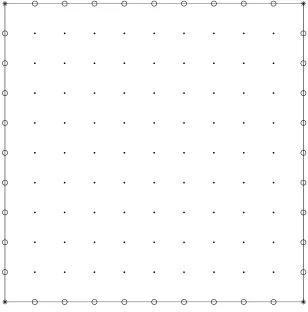
Consider a typical subdomain (i.e. all boundaries are the interfaces) (Figure 1). The
proposed DD technique gives different treatments for the interior corner points (the
intersection points) and the interior points on the interfaces (the interface points),
which achieves a C2 solution across the interfaces. The present Schur complement
system is constructed as follows. The unknown values on the interfaces are chosen to
be the values ofu at the interface points and the values ofu, ∂2u/∂x2 and ∂2u/∂y2
at the intersection points. The equations used for determining these unknowns are
based on the continuity of ∂u/∂n at the interface points, and the continuity of
∂u/∂x, ∂u/∂y together with the satisfaction of the PDE at the intersection points.
First, one needs to express the values ofu at the interior points of a subdomain in terms of the interface unknowns only. For the Poisson equation, the discrete system
(19) reduces to
e
A(:,ip) eu(ip) =eb− B0u− B2
∂2u
∂n2. (31)
The second-order normal derivative vector on the right-hand side of (31) can be
replaced by
∂2u
∂n2 =b−
∂2u
∂t2, (32)
wheret is the direction tangent to the boundary.
We employs the second-order integral scheme (IRBFN-2) to express tangent
deriva-tives in (32) in terms of the interface unknowns. For an interface of the subdomain,
one has
d
∂2u
∂t2 =Ib (2) [2]Cb−
1 [2]
ub
b
v
, (33)
where bu represents the values of u at the grid points on the interface, and bv the
values of ∂2u/∂t2 at the two extreme points of the interface (i.e. the intersection
points).
Second, by taking (31), (32) and (33) into account, one is able to derive the values
of ∂u/∂nat the interface points in terms of the interface unknowns only.
Intersection points: The values of ∂u/∂x and ∂u/∂y at these nodes are simply computed via function approximation.
obtains the values of ∂u/∂x at the intersection points ∂u1 ∂x ∂unx ∂x
=Ib[2]([1(1) ,nx],:)Cb−1
[2] b u ∂2 u1 ∂x2 ∂2 unx ∂x2
, (34)
whereubrepresents the values of u at the grid points on the interface.
Similarly, for the interfaces that run parallel to they axis, one has
∂u1 ∂y ∂uny ∂x
=Ib[2]([1(1) ,ny],:)Cb−1
[2] b u ∂2 u1 ∂y2 ∂2 uny ∂y2
. (35)
The computations here are relatively simple because the approximations used involve
information about the interfaces only.
The third equation in a set of three equations, which is employed at each intersection
point, is the PDE in its original form, i.e.
∂2u
∂x2 +
∂2u
∂y2 =b. (36)
Owing to the fact that the PDE is not collocated at the four corners of the domain in
the solution of subdomains, equation (36) is independent from continuity equations
for∂u/∂n.
Continuity order: The present DD technique enforces the continuity of the solu-tion across the interfaces with one order higher than convensolu-tional DD techniques
because (i) the PDE is forced to be satisfied at the interface points in the
4.2.2 Biharmonic equation
The MD-IRBFN method for the biharmonic equation is similar to that for the
Poisson equation. However, the Schur complement system is larger. The unknown
vector consists of the values ofuand∂u/∂nat the interface points, and the values of
u,∂u/∂x,∂u/∂y,∂4u/∂x4 and∂4u/∂y4 at the intersection points. The construction
of the interface system is based on the use of a set of two equations, namely∂2u/∂n2
and ∂3u/∂n3, at an interface point, and a set of 5 equations, ∂2u/∂x2, ∂2u/∂y2,
∂3u/∂x3, ∂3u/∂y3 and the PDE, at an intersection point.
The values of ∂2u/∂n2 and ∂3u/∂n3 at an interface point are computed using the
subdomain solver and the IRBFN-4 scheme. The equations that correspond to (31),
(32) and (33) are, respectively,
e
A(:,ip) eu(ip) =eb− B0u− B1
∂u ∂n− B4
∂4u
∂n4, (37)
∂4u
∂n4 =b−2
∂4u
∂x2∂y2 −
∂4u
∂t4, (38)
d
∂4u
∂t4 =Ib (4) [4] Cb
−1
[4]
ub
b
v
, (39)
wherebv consists of the values of∂u/∂tand∂4u/∂t4 at the intersection points. After
solving (37), any derivative functions of u, including the mixed fourth-order one,
can be expressed in terms of the interface unknowns only.
On the other hand, the computation of∂2u/∂x2, ∂2u/∂y2, ∂3u/∂x3 and ∂3u/∂y3 at
an intersection point is based on the use of the fourth-order 1D-IRBFN scheme only.
points of the interface are given below ∂2 u1 ∂x2 ∂2 unx ∂x2
=Ib[4]([1(2) ,nx],:)Cb−1
[4] b u ∂u1 ∂x ∂unx ∂x ∂4 u1 ∂x4 ∂4 unx ∂x4 and (40) ∂3 u1 ∂x3 ∂3 unx ∂x3
=Ib[4]([1(3) ,nx],:)Cb−1
[4] b u ∂u1 ∂x ∂unx ∂x ∂4 u1 ∂x4 ∂4 unx ∂x4 , (41)
whereubis the vector containing the values of uat the grid points on the interface.
Continuity order: Consider an interface (Γ) and its two associated subdomains
(Ω1 and Ω2). As shown earlier, the present DD technique imposes the
continu-ity for the solution u and its normal derivatives of order up to four (i.e. ∂u/∂n,
∂2u/∂n2, ∂3u/∂n3 and ∂4u/∂n4) at every point on the interface Γ. The 1D-IRBFN
approximations for derivatives of these interface values with respect to the tangent
direction (i.e. mixed derivatives) from subdomain Ω1 can be seen to be identical to
those taken from subdomain Ω2. In other words, one also has the continuity across
the interface Γ for mixed derivatives (e.g. ∂4u/∂t2∂n2). The present DD technique
5
Numerical examples
Several examples are presented here to demonstrate the attractiveness of the
pro-posed DD technique.
It has generally been accepted that, among RBFNs, the multiquadric (MQ)-based
interpolation scheme tends to result in the most accurate results. The present
1D-IRBFN schemes are implemented with the MQ function whose form is
ϕi(x) =
q
(x−ci)2 +a2i, (42)
where ci and ai are the centre and the width of the ith MQ function, respectively.
The centre points are selected to coincide with the collocation points. The MQ
widths are known to have a profound effect on the performance of MQ-RBFNs.
However, there is still a lack of mathematical theories for specifying their optimal
values. For all numerical examples taken here, the MQ widths are simply computed
by
ai =βdi, i= (1,2,· · · , n), (43)
in whichβ is a factor anddi is the distance between the theith centre and its closest
neighbour. The reader is referred to [16,19] for a discussion about the effect ofβ on accuracy of the RBFN solutions.
To assess the accuracy of the IRBFN method, the one-domain IRBFN and
MD-DRBFN methods are considered. It is noted that the present MD-MD-DRBFN method
is also based on the substructuring technique and the multiquadric functions. Both
5.1
1D second-order problem
Consider the following second-order ODE
d2u
dx2 +
du
dx+u=−exp(−5x) [9979 sin(100x) + 900 cos(100x)], 0≤x≤1, (44)
with Dirichlet boundary conditions u(0) = 0 and u(1) = sin(100) exp(−5). The
exact solution can be verified to be
ue(x) = sin(100x) exp(−5x), (45)
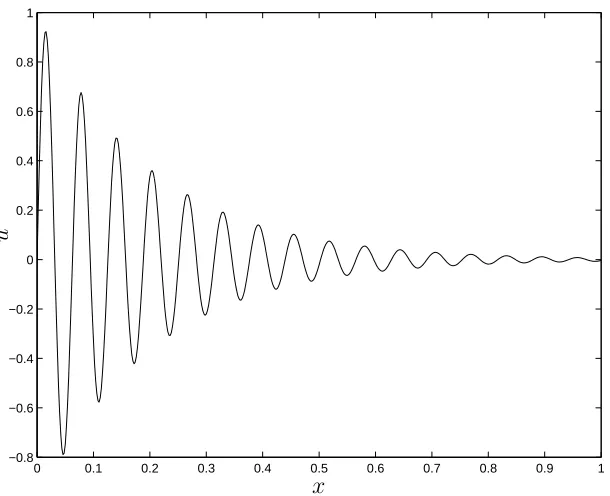
which is highly oscillatory as shown in Figure 2.
The domain is partitioned into two subdomains of the same size, and each subdomain
is discretized with uniformly distributed points. Twenty grids are considered with
their densities varying from 11 to 201 in increment of 10. The accuracy of a numerical
scheme is measured by means of the discrete relative L2 norm of the solution (Ne).
A test set of 201 uniform points is used to compute the error Ne.
The approximate solution is aC1 function across the interface for MD-DRBFNs and
C2 for MD-IRBFNs.
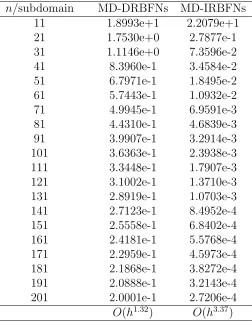
Table 1 presentsNes of MD-DRBFNs and MD-IRBFNs obtained with β = 1. The
performance of the latter is far superior to that of the former in both accuracy and
convergence rate. The MD-DRBFN results are relatively poor. As mentioned earlier,
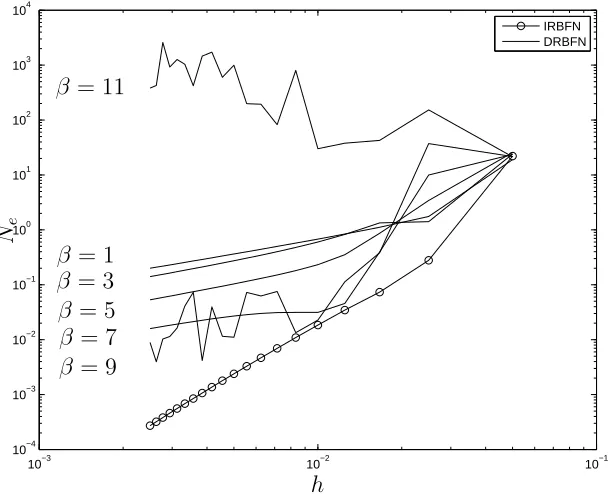
the RBF widths strongly affect the accuracy of RBFNs. Figure 3 shows a significant
improvement in accuracy for MD-DRBFNs with increasing RBF widths. However,
the MD-DRBFN results with higher values ofβ are still less accurate than the
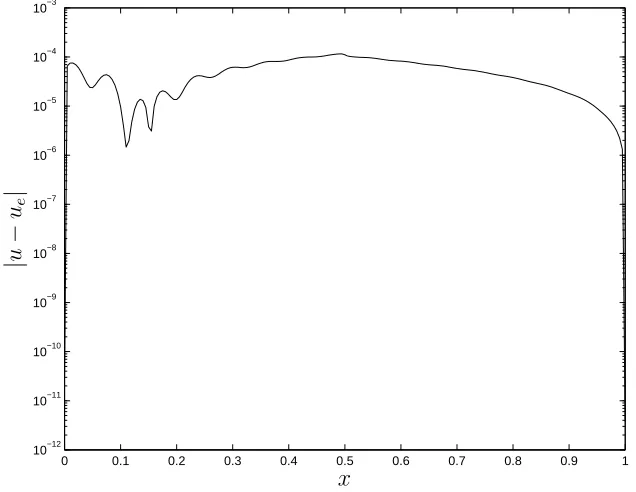
becomes unstable for β = 9 and there is no grid convergence observed for β = 11. We also investigate how the domain partition affects the local error. Figure 4 shows
the variation of the absolute error of the MD-IRBFN solution over the domain. It
can be seen that the distribution of the error is quite uniform.
5.2
1D fourth-order problem
This test problem is governed by
d4u
dx4 +
d2u
dx2 = exp(−5x) [98490650 sin(100x) + 19949000 cos(100x)], −1≤x≤1,
(46)
with Dirichlet boundary conditions
u(0) = 0, du
dx(0) = 100,
u(1) = sin(100) exp(−5), du
dx(1) = 100 cos(100) exp(−5)−5 sin(100) exp(−5),
for which the exact solution is also given in the form of (45). Four subdomains
are considered. Grid convergence is studied using various sets of collocation points,
namely (11,21,31,· · · ,701) points/subdomain. A test set of 201 uniformly
dis-tributed points is employed to compute the error Ne.
The continuity of the approximate solution at the interfaces is imposed up to
third-order derivative for MD-DRBFNs and fourth-third-order derivative for MD-IRBFNs.
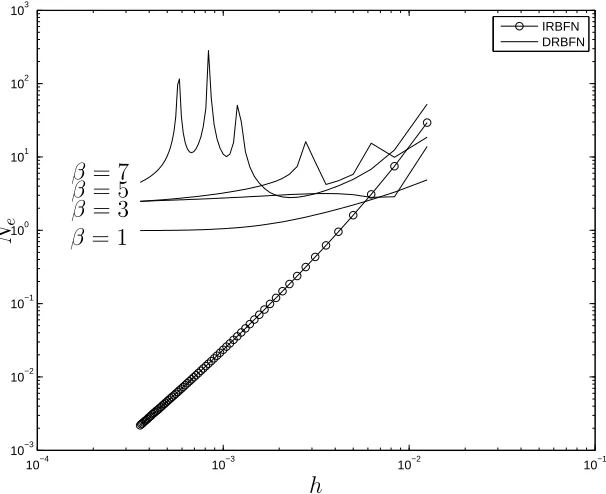
Fig-ure 5 shows accuracy against grid refinement by the two multidomain RBF
tech-niques, indicating a superior performance of MD-IRBFNs over MD-DRBFNs.
lead to better accuracy, probably due to the effect of implementing multiple
bound-ary conditions. The ODE on each subdomain is collocated at (n−4) grid points for
MD-DRBFNs and n points for MD-IRBFNs. To investigate this issue separately,
we solve the above problem by the one-domain DRBFN method. The same grid
sizes are used. Two boundary points and two adjacent interior points are set to
implement the double boundary conditions. Results obtained are shown in Figure
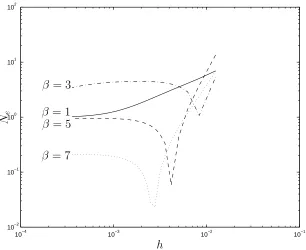
6. For β = 1, the convergence behaviour is smooth, but its rate is very slow. For
higher values ofβ, the technique gives a fast rate of convergence over coarse grids. However, the accuracy of the solution then deteriorates rapidly over fine grids. It
can be seen that the grid-convergence behaviour of the one-domain DRBFN method
is not stable, which may cause a poor performance of the MD-DRBFN technique
here.
5.3
2D second-order problem
Consider the Poisson equation
∂2u
∂x2 +
∂2u
∂y2 = (1−π
2) sin(πx) sinh(y) + 4(1−π2) cosh(2x) cos(2πy), (47)
on the domain −1≤x, y ≤1, subject to Dirichlet boundary conditions
u= cosh(±2) cos(2πy), x=±1, and
u= sin(πx) sinh(±1) + cosh(2x), y=±1.
The exact solution of this problem is given by
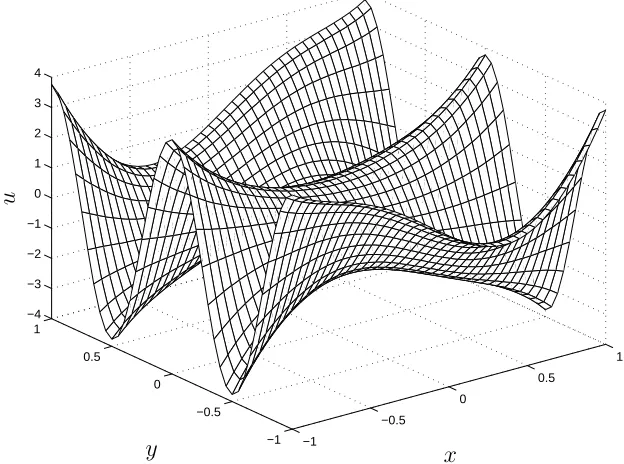
Figure 7 shows the variation of (48) over the domain of interest. Only IRBFNs
are applied here to solve this problem. The relative L2 norm of the approximate
solution (Ne) is computed at the grid points. Results concerning Ne for two cases,
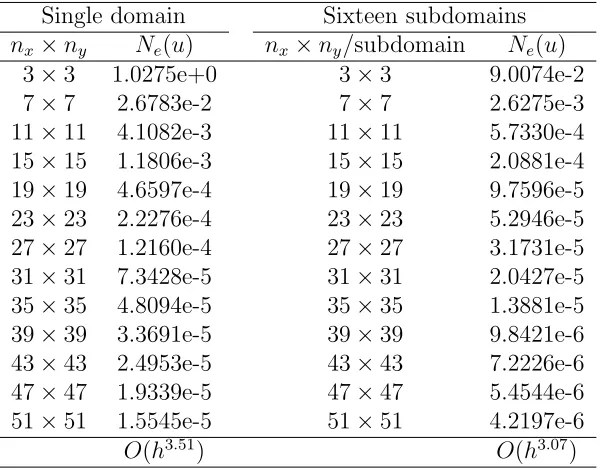
single domain and 16 subdomains, are presented in Table 2. Values of the condition
number of the IRBFN system matrix vary from 1.0e0 to 2.4e3 for grids of 3×3 to
51×51/subdomain, respectively. It can be seen that the MD-IRBFN technique is
able to employ much larger numbers of collocation points (e.g., up to 40,400 grid
points used here without suffering from the problem of ill-conditioned matrices).
The achievement of higher-order smoothness of the present DD solution across the
subdomain interfaces is expected to alleviate the deterioration in accuracy caused
by the domain division. Numerical results show that the convergence rate is reduced
fromO(h3.51) (single domain) toO(h3.07) (16 subdomains). This amount of reduction
appears to be relatively small. Owing to smaller grid sizes used, the MD-IRBFN
results are more accurate than the one-domain IRBFN results. Furthermore, the
MD-IRBFN method only needs to handle a set of smaller matrices (i.e. a matrix
for the unknowns on the interfaces and matrices for the interior values of the field
variable on subdomains), leading to an improvement in computational efficiency
over the one-domain IRBFN method.
5.4
2D fourth-order problem
This test problem is governed by the biharmonic equation with Dirichlet boundary
conditions (u and ∂u/∂n). The domain of interest is a square region of size 2×2
that is centered at the origin. The exact solution is chosen to be the same as that
of the previous problem, i.e. (48), from which one can easily derive expressions
for the forcing function b and the boundary conditions. The problem domain is
using a number of grids, namely 3×3, 5×5,· · · ,and 15×15. RelativeL2errors (Ne)
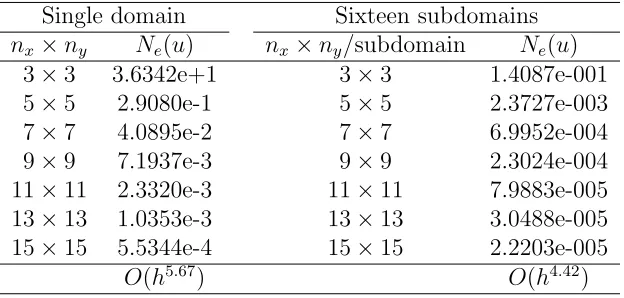
of the solutionuobtained by the one-domain and multidomain IRBFN methods are
presented in Table 3. Grid densities used for both methods are the same. The
size of MD-IRBFN matrices is thus comparable with that of one-domain IRBFN
matrices. However, the grid spacing of the former is 4 times smaller than that of
the latter. For grids employed here, the condition numbers of the IRBFN system
matrix are in the range of 1.0e0 to 4.5e4. As expected, the rate of convergence of
the MD-IRBFN solution is reduced relative to the case of single domain. However,
the DD method still yields a fast convergence rate up to O(h4.42), resulting in very
accurate solutions (e.g. Ne(u)=2.2e-5 is obtained with a density of 15×15). Given
the same exact solution and the same number of subdomains, Tables 2 and 3 show
that the MD-IRBFN technique performs better for the fourth-order PDE than for
the second-order PDE.
6
Concluding remarks
In this paper, one-dimensional IRBFN interpolation schemes are incorporated into
the substructuring technique for the solution of second- and fourth-order elliptic
problems. The constants of integration in IRBFNs are exploited to improve the
continuity order of the approximate solution across the subdomain interfaces.
Addi-tional enforcements are applied at the intersection points, which allows the solution
at these points to be continuous across the subdomain interface with the same
order as that at the interface points. Numerical results show that the proposed
domain-decomposition technique yields a high level of accuracy and a fast rate of
convergence. The multidomain IRBFN method thus appears to be more attractive
Acknowledgement
This work is supported by the Australian Research Council. We would like to thank
the referees for their helpful comments.
References
1. B.F. Smith, P.E. Bjorstad and W.D. Gropp, Domain Decomposition
Paral-lel Multilevel Methods for Elliptic Partial Differential Equations, New York,
Cambridge University Press, 1996.
2. E.J. Kansa, Multiquadrics- A scattered data approximation scheme with
appli-cations to computational fluid-dynamics-II. Solutions to parabolic, hyperbolic
and elliptic partial differential equations, Computers and Mathematics with
Applications 19(8/9) (1990), 147–161.
3. G.E. Fasshauer, “Solving partial differential equations by collocation with
ra-dial basis functions”, A. LeMhaut, C. Rabut and L.L. Schumaker, editors,
Surface Fitting and Multiresolution Methods, Vanderbilt University Press,
Nashville, TN, 1997, pp. 131–138.
4. M.R. Dubal, Domain decomposition and local refinement for multiquadric
ap-proximations. I: Second-order equations in one-dimension, Journal of Applied
Science and Computation 1(1) (1994), 146–171.
5. E.J. Kansa and Y.C. Hon, Circumventing the ill-conditioning problem with
multiquadric radial basis functions: applications to elliptic partial differential
equations, Computers and Mathematics with Applications 39 (2000), 123–137.
6. J. Li and Y.C. Hon, Domain decomposition for radial basis meshless methods,
7. M.S. Ingber, C.S. Chen and J.A. Tanski, A mesh free approach using radial
ba-sis functions and parallel domain decomposition for solving three-dimensional
diffusion equations, International Journal for Numerical Methods in
Engineer-ing 60(13) (2004), 2183-2201.
8. E. Divo and A. Kassab, Iterative domain decomposition meshless method
mod-eling of incompressible viscous flows and conjugate heat transfer, Engineering
Analysis with Boundary Elements 30(6) (2006), 465–478.
9. C.K. Lee, X. Liu and S.C. Fan, Local multiquadric approximation for solving
boundary value problems, Computational Mechanics 30(5–6) (2003), 396–409.
10. C. Shu, H. Ding and K.S. Yeo, Local radial basis function-based differential
quadrature method and its application to solve two-dimensional
incompress-ible Navier-Stokes equations, Computer Methods in Applied Mechanics and
Engineering 192 (2003), 941–954.
11. B. Sarler and R. Vertnik, Meshfree explicit local radial basis function
colloca-tion method for diffusion problems, Computers & Mathematics with
Applica-tions 51(8) (2006), 1269–1282.
12. N. Mai-Duy and R.I. Tanner, A collocation method based on one-dimensional
RBF interpolation scheme for solving PDEs, International Journal of
Numer-ical Methods for Heat & Fluid Flow 17(2) (2007), 165-186.
13. N. Mai-Duy and T. Tran-Cong, A Cartesian-grid collocation method based on
radial-basis-function networks for solving PDEs in irregular domains,
Numer-ical Methods for Partial Differential Equations 23 (2007), 1192–1210.
14. N. Mai-Duy and T. Tran-Cong, Approximation of function and its
15. E.J. Kansa, H. Power, G.E. Fasshauer and L. Ling, A volumetric integral radial
basis function method for time-dependent partial differential equations: I.
Formulation, Engineering Analysis with Boundary Elements 28 (2004), 1191–
1206.
16. N. Mai-Duy and T. Tran-Cong, Numerical solution of differential equations
us-ing multiquadric radial basis function networks, Neural Networks 14(2) (2001),
185–199.
17. L. Ling and M.R. Trummer, Multiquadric collocation method with integral
formulation for boundary layer problems, Computers & Mathematics with
Applications 48(5–6) (2004), 927–941.
18. S.A. Sarra, Integrated multiquadric radial basis function approximation
meth-ods, Computers & Mathematics with Applications 51(8) (2006), 1283–1296.
19. N. Mai-Duy, Solving high order ordinary differential equations with radial
basis function networks, International Journal for Numerical Methods in
En-gineering 62 (2005), 824–852.
20. N. Mai-Duy and R.I. Tanner, Solving high order partial differential equations
with indirect radial basis function networks, International Journal for
Numer-ical Methods in Engineering 63 (2005), 1636–1654.
21. N. Mai-Duy and T. Tran-Cong, Solving biharmonic problems with
scattered-point discretisation using indirect radial-basis-function networks, Engineering
Table 1: 1D second-order problem, 2 subdomains, β = 1: Relative L2 errors and
their orders by the MD-DRBFN and MD-IRBFN methods
n/subdomain MD-DRBFNs MD-IRBFNs
11 1.8993e+1 2.2079e+1
21 1.7530e+0 2.7877e-1
31 1.1146e+0 7.3596e-2
41 8.3960e-1 3.4584e-2
51 6.7971e-1 1.8495e-2
61 5.7443e-1 1.0932e-2
71 4.9945e-1 6.9591e-3
81 4.4310e-1 4.6839e-3
91 3.9907e-1 3.2914e-3
101 3.6363e-1 2.3938e-3
111 3.3448e-1 1.7907e-3
121 3.1002e-1 1.3710e-3
131 2.8919e-1 1.0703e-3
141 2.7123e-1 8.4952e-4
151 2.5558e-1 6.8402e-4
161 2.4181e-1 5.5768e-4
171 2.2959e-1 4.5973e-4
181 2.1868e-1 3.8272e-4
191 2.0888e-1 3.2143e-4
201 2.0001e-1 2.7206e-4
Table 2: 2D second-order problem: RelativeL2 errors and their orders by the
one-domain and multione-domain IRBFN methods
Single domain Sixteen subdomains
nx×ny Ne(u) nx×ny/subdomain Ne(u)
3×3 1.0275e+0 3×3 9.0074e-2
7×7 2.6783e-2 7×7 2.6275e-3
11×11 4.1082e-3 11×11 5.7330e-4
15×15 1.1806e-3 15×15 2.0881e-4
19×19 4.6597e-4 19×19 9.7596e-5
23×23 2.2276e-4 23×23 5.2946e-5
27×27 1.2160e-4 27×27 3.1731e-5
31×31 7.3428e-5 31×31 2.0427e-5
35×35 4.8094e-5 35×35 1.3881e-5
39×39 3.3691e-5 39×39 9.8421e-6
43×43 2.4953e-5 43×43 7.2226e-6
47×47 1.9339e-5 47×47 5.4544e-6
51×51 1.5545e-5 51×51 4.2197e-6
Table 3: 2D fourth-order problem: Relative L2 errors and their orders by the
one-domain and multione-domain IRBFN methods
Single domain Sixteen subdomains
nx×ny Ne(u) nx×ny/subdomain Ne(u)
3×3 3.6342e+1 3×3 1.4087e-001
5×5 2.9080e-1 5×5 2.3727e-003
7×7 4.0895e-2 7×7 6.9952e-004
9×9 7.1937e-3 9×9 2.3024e-004
11×11 2.3320e-3 11×11 7.9883e-005
13×13 1.0353e-3 13×13 3.0488e-005
15×15 5.5344e-4 15×15 2.2203e-005
0 0.1 0.2 0.3 0.4 0.5 0.6 0.7 0.8 0.9 1 −0.8
−0.6 −0.4 −0.2 0 0.2 0.4 0.6 0.8 1
x
[image:32.612.149.454.44.292.2]u
10−3 10−2 10−1
10−4
10−3
10−2
10−1
100
101
102
103
104
IRBFN DRBFN
h
Ne
β = 1
β = 3
β = 5
β = 7
β = 9
[image:33.612.147.451.45.292.2]β = 11
Figure 3: 1D second-order problem, 2 subdomains: ErrorNeversus the grid spacing
0 0.1 0.2 0.3 0.4 0.5 0.6 0.7 0.8 0.9 1
10−12
10−11
10−10
10−9
10−8
10−7
10−6
10−5
10−4
10−3
x
|
u
−
ue
[image:34.612.137.455.40.286.2]|
10−4 10−3 10−2 10−1
10−3
10−2
10−1
100
101
102
103
IRBFN DRBFN
h
Ne β = 1
β = 3
[image:35.612.148.451.45.292.2]ββ= 5= 7
Figure 5: 1D fourth-order problem, 4 subdomains: ErrorNe versus the grid spacing
10−4 10−3 10−2 10−1
10−2
10−1
100
101
102
h
Ne β = 1
β = 3
β = 5
[image:36.612.146.452.43.293.2]β = 7
Figure 6: 1D fourth-order problem: Error Ne versus the grid spacing h by the
−1
−0.5 0
0.5
1
−1 −0.5 0 0.5 1 −4 −3 −2 −1 0 1 2 3 4
x y
[image:37.612.140.452.42.274.2]u