Rochester Institute of Technology
RIT Scholar Works
Theses Thesis/Dissertation Collections
3-27-2017
Machine Learning Based Autism Detection Using
Brain Imaging
Gajendra Jung Katuwal [email protected]
Follow this and additional works at:http://scholarworks.rit.edu/theses
This Dissertation is brought to you for free and open access by the Thesis/Dissertation Collections at RIT Scholar Works. It has been accepted for inclusion in Theses by an authorized administrator of RIT Scholar Works. For more information, please [email protected]. Recommended Citation
Machine Learning
Based Autism Detection
Using Brain Imaging
A dissertation
by
Gajendra Jung Katuwal
Submitted in partial fulfilment
of
Doctor of Philosophy in Imaging Science
Chester F. Carlson Center for Imaging Science
Rochester Institute of Technology
Rochester, New York, USA
Chester F. Carlson Center for Imaging Science
Rochester Institute of Technology
Rochester, New York, USA
CERTIFICATE OF APPROVAL
PhD Degree Dissertation
The PhD Degree Dissertation of Gajendra Jung Katuwal has been examined and approved by the following dissertation committee as satisfactory for a PhD degree in Imaging Science.
Dr. Andrew Michael, Dissertation Advisor Date
Dr. Stefi Baum, Dissertation Advisor Date
Dr. Manuela Campanelli, Committee Chair Date
Dr. Nathan Cahill, Committee Member Date
ACKNOWLEDGMENTS
First of all, I would like to express my sincere gratitude to my advisors, Dr. Andrew Michael and
Dr. Stefi Baum for their guidance and training during this fulfilling journey of four years and some
months. Andrew believed in me despite of my zero experience in brain imaging and guided me to
this point. Stefi, despite being physically on the other side of the 49th parallel, always inspired me
to ask the right questions, which was pivotal for the evolution of my thought process and was
immensely helpful during the course of my research.
I would also like to thank the rest of the dissertation committee: Dr. Nathan Cahill, Dr. John
Kerekes, and Dr. Manuela Campanelli, for many insightful comments and questions. My sincere
gratitude also goes to my cool lab mates Chao, Chase, and Viraj. Without them, this journey would
have been difficult. My sincere gratitude goes to all the individuals behind the data, ideas,
publications, software, etc. used in my research and all helpful folks from stackexchange. Without
their contributions, I would not have made this far.
I would like to thank Ronnie and Rob for their help in grammatical debugging. Finally, I am
grateful to several baristas from the beautiful town of Lewisburg to the hip places in Cambridge
ABSTRACT
Autism Spectrum Disorder (ASD) is a group of heterogeneous developmental disabilities
that manifest in early childhood. Currently, ASD is primarily diagnosed by assessing the behavioral
and intellectual abilities of a child. This behavioral diagnosis can be subjective, time consuming,
inconclusive, does not provide insight on the underlying etiology, and is not suitable for early
detection. Diagnosis based on brain magnetic resonance imaging (MRI)—a widely used
non-invasive tool—can be objective, can help understand the brain alterations in ASD, and can be
suitable for early diagnosis. However, the brain morphological findings in ASD from MRI studies
have been inconsistent. Moreover, there has been limited success in machine learning based ASD
detection using MRI derived brain features. In this thesis, we begin by demonstrating that the low
success in ASD detection and the inconsistent findings are likely attributable to the heterogeneity
of brain alterations in ASD. We then show that ASD detection can be significantly improved by
mitigating the heterogeneity with the help of behavioral and demographics information. Here we
demonstrate that finding brain markers in well-defined sub-groups of ASD is easier and more
insightful than identifying markers across the whole spectrum. Finally, our study focused on brain
MRI of a pediatric cohort (3 to 4 years) and achieved a high classification success (AUC of 95%).
Results of this study indicate three main alterations in early ASD brains: 1) abnormally large
ventricles, 2) highly folded cortices, and 3) low image intensity in white matter regions suggesting
myelination deficits indicative of decreased structural connectivity. Results of this thesis
demonstrate that the meaningful brain markers of ASD can be extracted by applying machine
learning techniques on brain MRI data. This data-driven technique can be a powerful tool for
ABBREVIATIONS
ABIDE: Autism Brain Imaging Data Exchange
ADHD: Attention Deficit Hyperactivity Disorder
AS: Autism Severity
ASD: Autism Spectrum Disorder
AUC: Area Under the Receiver Operating Curve
CARS: Childhood Autism Rating Scale
CDC: Center for Disease Control and Prevention
CTR: Controls
CSF: Cerebrospinal Fluid
Curvind: Curvature Index
DB: Demographics and Behavioral Measures
DC: Diencephalon
FAST: FMRIB's Automated Segmentation Tool
Foldind: Folding Index
FS: FreeSurfer
FSL: FMRIB Software Library
Gauscurv: Gaussian Curvature
GM: Gray Matter
Meancurv: Mean Curvature
MRI: Magnetic Resonance Imaging
Std.: Standard Deviation
TDC: Typically Developing Controls
TIV: Total Intracranial Volume
VIQ: Verbal Intelligent Quotient
CONTENTS
ABSTRACT ... i
ABBREVIATIONS ... ii
FIGURES.. ... x
TABLES… ... xii
CHAPTER 1: INTRODUCTION ... 1
1.1 Autism Spectrum Disorder ... 1
1.2 Importance of early detection of ASD ... 2
1.3 Problem 1: Behavior based diagnosis of ASD is late and does not help to understand underpinnings of ASD ... 3
1.4 Problem 2: Inconsistent brain anatomical findings in ASD ... 4
1.5 Problem 3: Low Classification success in large multi-site data ... 4
1.6 Thesis Contributions ... 4
1.6.1 Demonstrating MRI as a potential tool for detection ...5
1.6.2 Relating inconsistent findings and low classification success to ASD heterogeneity and methodological differences ...5
1.6.3 Providing the evidence of brain image processing tool dependent findings and suggesting multi-variate techniques as a partial solution ...6
1.6.4 Divide and Conquer: we propose identifying brain biomarkers in sub-groups of ASD is easier and more meaningful than across the whole spectrum ...7
1.6.5 Brain biomarkers discovery for early detection of ASD ...7
1.7 Thesis Organization ... 8
1.7.2 Chapter 2: Background ...9
1.7.3 Chapter 3: Method Dependent Findings ...9
1.7.4 Chapter 4: Brain Morphology Based ASD Detection and Tackling ASD Heterogeneity ...10
1.7.5 Chapter 5: Early Detection of ASD ...10
1.7.6 Chapter 6: Conclusion ...10
1.7.7 Appendices ...10
2 CHAPTER 2: BACKGROUND ... 12
2.1 Brain Imaging ... 12
2.2 MRI……….14
2.2.1 MRI acquisition ...14
2.3 Brain Feature extraction from MRI ... 16
2.3.1 SPM……….. ...16
2.3.2 FSL…….. ...18
2.3.3 FS………… ...19
2.4 Analysis of neuroimaging data ... 23
2.4.1 Voxel-based ...23
2.4.2 Vertex-based or Surface-based ...24
2.4.3 Feature-based ...24
2.5 Machine Learning ... 25
2.5.1 Random Forest (RF) ...27
2.5.2 Gradient Boosting Machine (GBM) ...29
3 CHAPTER 3: DEPENDENCY OF BRAIN FINDINGS ON IMAGE PROCESSING TOOLS AND POTENTIAL SOLUTIONS ... 31
3.1 Introduction ... 31
3.2.1 Data……. ...35
3.2.2 Tissue Segmentation and Brain Volumes Estimation ...36
3.2.3 Statistical Analysis ...38
3.3 Results……. ... 40
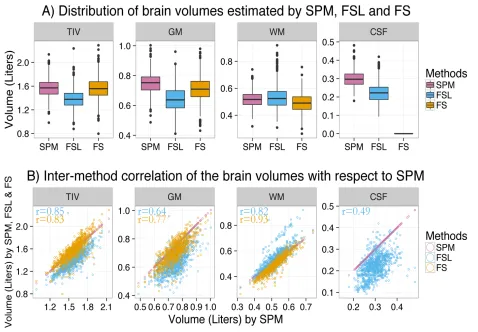
3.3.1 Estimated brain volumes and inter-method differences ...40
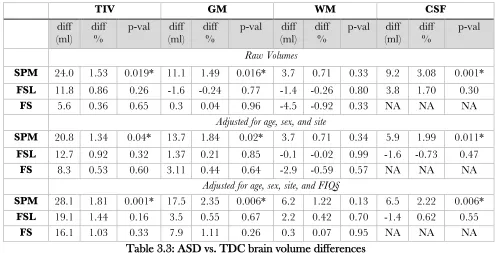
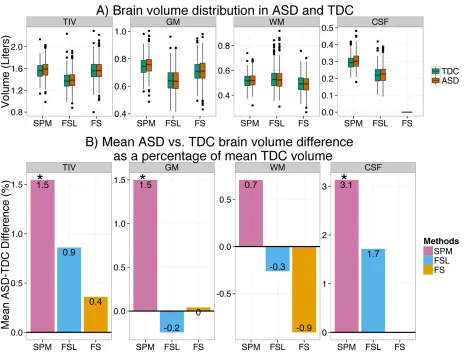
3.3.2 ASD vs. TDC inter-group differences is dependent on the method used ...42
3.3.3 Differential bias of methods to the diagnostic group ...45
3.4 Discussion. ... 46
3.4.1 ASD vs. TDC inter-group differences dependent on the method used ...47
3.4.2 Comparison of ASD vs. TDC brain volume differences with previous studies ...48
3.4.3 Methods have different biases for diagnostic group, and many of them are larger than inter-group differences ...50
3.4.4 Locations of the inter-method segmentation discrepancies ...50
3.4.5 Sources of the inter-method discrepancies in tissue segmentation ...55
3.4.6 Implications to future neuroimaging studies ...56
3.5 Conclusion ... 60
4 CHAPTER 4: UTILIZING NON-BRAIN INFORMATION TO IMPROVE ASD DETECTION BASED ON BRAIN MORPHOLOGY ... 62
4.1 Introduction ... 62
4.2 Methods……….. ... 65
4.2.1 MRI Data ...65
4.2.2 Reasons for using male subjects only ...66
4.2.3 MRI Data processing ...67
4.2.4 Classification Algorithms ...67
4.2.6 Adding AS, VIQ, and age information to the brain morphometric features ...69
4.3 Results……. ... 70
4.3.1 Classification using only brain morphometric properties ...70
4.3.2 Age and VIQ used as training features in conjunction with brain morphometric features ...70
4.3.3 Sub-grouping subjects by AS, VIQ, and age ...71
4.3.4 Multivariate analysis: Important features for classification and their variability across sub-groups ……….….75
4.4 Discussion ………81
4.4.1 Classification becomes difficult with increase in AS ...82
4.4.2 Folding index and curvature features may be important markers for early detection of ASD 84 4.4.3 ASD heterogeneity in brain morphometry ...86
4.4.4 Low classification success in large multi-site data due to ASD heterogeneity ...87
4.4.5 Future direction for neuroimaging studies ... 88
4.5 Conclusion ... 93
5 CHAPTER 5: EARLY DETECTION OF AUTISM USING BRAIN MORPHOLOGY .... 94
5.1 Introduction ... 95
5.2 Material and Methods ... 96
5.2.1 Subjects…… ...96
5.2.2 Brain Features Extraction ...98
5.2.3 Univariate Analysis ...99
5.2.4 Multivariate Analysis: ASD vs. CTR Classification ...99
5.3 Results……. ... 100
5.3.1 ASD vs. CTR Brain Differences ...100
5.3.2 ASD vs. CTR Classification ...104
5.4 Discussion ……….110
5.4.1 Amygdala in ASD ...111
5.4.2 Early brain overgrowth in ASD ...111
5.4.3 Overgrowth is related to increase in cortical surface area but not thickness ...111
5.4.4 Higher cortical folding in ASD brains and its relation to early brain overgrowth and cortical expansion…….. ...112
5.4.5 Larger Ventricles and extra-axial volume in ASD may cause additional cortical folding ...114
5.4.6 WM in frontal and temporal regions less myelinated in ASD ...115
5.4.7 Brain overgrowth in ASD is followed by arrested growth and even degeneration ...116
5.5 Conclusion ... 118
CHAPTER 6: CONCLUSION AND FUTURE WORK ... 120
5.6 Contributions ... 121
5.6.1 We demonstrated MRI as a potential tool for ASD detection ...121
5.6.2 We showed that the methodological differences are a cause of inconsistent brain imaging findings………. ...121
5.6.3 We showed that identifying brain biomarkers in sub-groups of ASD is easier and more meaningful than across the whole spectrum ...122
5.6.4 We identified potential brain markers for early detection of ASD ...123
5.7 Future Work ... 123
5.7.1 Critical need for large longitudinal studies ...123
5.7.2 Data-driven brain features ...124
BIBLIOGRAPHY ... 126
Appendix A ... 151
FIGURES
Figure 1.1 Thesis Organization ... 9
Figure 2.1: Sagittal view of a T1 weighted brain MRI. ... 13
Figure 2.2: MRI acquisition process. ... 15
Figure 2.3: SPM Tissue Segmentation. ... 18
Figure 2.4: Freesurfer (FS) recon-all processing workflow ... 20
Figure 2.5: Sub-cortical segmentation & cortical parcellation in Freesurfer (FS). ... 22
Figure 2.6: Random Forest is an ensemble of decision trees. ... 28
Figure 3.1: Distribution of estimated brain volumes and inter-method differences. ... 42
Figure 3.2: ASD – TDC brain volume differences are method dependent ... 44
Figure 3.3: Inter-method segmentation comparison ... 52
Figure 3.4: Multi-variate pattern is more robust across methods ... 59
Figure 4.1: Improvement in classification by sub-grouping ... 72
Figure 4.2: Important features for classification are different across sub-groups. ... 77
Figure 4.3: Variability of the important features. ... 78
Figure 4.4: Folding index and curvature features are important for classification in young subjects ... 85
Figure 4.5: ASD vs. TDC group difference in ventricular volumes decreases with verbal IQ (VIQ) ... 91
Figure 5.1: Subject Selection Flowchart ... 97
Figure 5.2: Classification Flowchart. ... 100
Figure 5.4: Global Volume Features ... 104
Figure 5.5: ASD vs. CTR Classification Scores. ... 105
Figure 5.6: Important brain feature for ASD vs. CTR classification ... 107
Figure 5.7: Important morphology features for ASD vs. CTR classification. ... 108
Figure 5.8: Important intensity features for ASD vs. CTR classification. ... 109
Figure 5.9: Cortical expansion theory on cortical gyrification ... 113
Figure 5.10: Higher cortical folding in ASD brain. ... 115
Figure 5.11: Inefficient communication in ASD brain. ... 116
Figure 5.12: Arrested brain growth in ASD ... 118
Figure 8.1: Gradient Boosting Machine: Improvement in classification by sub-grouping based on autism severity (AS), age and Verbal IQ (VIQ). ... 154
Figure 8.2. Gradient Boosting Machine (GBM): Important features for classification are variable across sub-groups. ... 155
Figure 8.3: Inter and intra sub-groups classification AUC scores ... 156
Figure 8.4: Random Forest: Important features for classification in sub-groups (10% threshold). ... 157
Figure 8.5: Random Forest: Important features for classification by in sub-groups (25% threshold). ... 158
Figure 8.6: Classification performance degrades with Autism Severity (AS). ... 159
TABLES
Table 3.1: Subject demographics and behavioral (DB) measures ... 35
Table 3.2: Estimated brain volumes and inter-method differences ... 41
Table 3.3: ASD vs. TDC brain volume differences ... 43
Table 3.4: Differential bias for diagnostic group (ASD) ... 46
Table 4.1: Previous ASD vs. TDC Classification studies ... 64
Table 4.2: Subject demographics and behavioral (DB) measures ... 66
Table 4.3: Sub-groups definition ... 70
Table 4.4: Classification AUC in sub-groups created by AS, VIQ and age ... 73
Table 7.1: Estimated brain volumes and inter-method differences in NYU ... 151
Table 7.2: ASD vs. TDC brain volume differences in NYU ... 152
Table 7.3: Differential bias for diagnostic group (ASD) in NYU ... 153
1
CHAPTER 1: INTRODUCTION
1.1
Autism Spectrum Disorder
Autism Spectrum Disorder (ASD) is a group of lifelong developmental disabilities that
manifest in early childhood. According to DSM 5 (American Psychiatric Association, 2013), ASD
is characterized by impairment in social-communication and behavior domains, including
repetitive behaviors and restrictive interests. According to a recent Center for Disease Control and
Prevention (CDC) survey (CDC, 2014), 1 in 68 children (1 in 42 boys and 1 in 189 girls) have ASD.
A more recent CDC survey of parents indicated that this number can be as high as 1 in 45
(Zablotsky et al., 2015). In addition to the substantial difficulties faced by ASD individuals and their
parents, the economic burden of ASD is high. A recent study by Leigh and Du (2015) has estimated
ASD’s economic cost for 2015 to be $268 billion in the United States alone. The study projects
annual costs rising to $461 billion in 2025 if ASD’s prevalence remains constant and more than $1
trillion by 2025 if ASD’s prevalence continues the steep rise seen over the last decade.
ASD is highly heterogeneous in its etiology, comorbidity, pathogenesis, genetics, and
severity (Betancur, 2011; Happé et al., 2006; Jeste & Geschwind, 2014; Ronald et al., 2006). It has
a strong genetic basis and is highly heritable (Ronald et al., 2006). It has been reported that 10%–
20% of individuals with ASD have an identified genetic etiology. The genetic architecture of ASD
is highly heterogeneous (Geschwind & Levitt, 2007; Jeste & Geschwind, 2014); ASD has been
linked to more than 100 different genes affecting different aspects of neurodevelopment and
disorders (Dougherty et al., 2016b; Matson et al., 2013). For example, it has been estimated that
14 to 78% of children with ASD also meet the criteria for Attention Deficit and Hyperactivity
Disorder (ADHD) (Gargaro et al., 2011), up to 42% meet the criteria for anxiety disorders (Matson
et al., 2013), and 25 to 70% have some level of intellectual disability (Fombonne, 2009). Similarly,
brain alterations in ASD have been found to be highly heterogeneous which is discussed in Section
1.6.2
1.2
Importance of early detection of ASD
Early detection of ASD is important because it allows for the application of early
intervention methods. It has been shown that early intervention is effective in decreasing
impairments (Dawson et al., 2010) and may result in more positive long-term outcomes for the
child (Pickles et al., 2016; Rogers & Vismara, 2010). The annual economic cost of ASD has been
significant—and the largest factors contributing to the cost are lost productivity and adult care
(Ganz, 2007). With successful application of early intervention methods, in addition to improving
the quality of life of ASD individuals, the economic cost related to ASD can also be significantly
reduced. And, for successful application of early intervention methods, early detection of ASD is
required.
Early detection of ASD may help to disentangle the effects of genetic and environmental
risk factors of ASD and may improve our knowledge of its underlying etiology. A large study by
Sandin et al. (2014) including 2 million children (~14500 ASD) have reported that the risk of ASD
is influenced equally by genetic and environmental factors. Environmental factors include a wide
range of influences such as parental age (Sandin et al., 2015), obstetric conditions (Kolevzon et al.,
2007), medication used (Boukhris et al., 2015), maternal nutrition (Lyall et al., 2013; Schmidt et
The environmental factors related to the risk of ASD can interact with each other making the
etiology of ASD more complex. If detection can be achieved at the neonatal stage, it can help in
separating out the effects of post-natal environmental risk factors of ASD—thus, improving our
knowledge of ASD etiology.
In addition, it may be the case that ASD is closer to normal development in its presentation
at a younger age, before environmental factors have influenced its postnatal development. That
is, when a child is tested for ASD as early as possible, fewer environmental factors will have
contributed to the development of ASD after birth—which means that the underlying etiology and
perhaps its manifestation may be more homogenous—which in turn, would make it easier to detect
and understand the underlying etiology of ASD in children through the application of biomarkers
at very young age.
Below we briefly discuss the major challenges faced by current techniques for ASD
detection and studies investigating brain morphology of ASD.
1.3
Problem 1: Behavior based diagnosis of ASD is late and does not help
to understand underpinnings of ASD
Currently ASD diagnosis is based on clinical assessments based on observations of the
individual's behavior and intellectual abilities. This diagnosis procedure can be subjective, time
consuming, and inconclusive due to factors such as comorbidity (Close et al., 2012). An objective
diagnostic tool is highly valuable and its importance further increases from the fact that currently
existing behavioral diagnosis has been found to be highly subjective especially at a young age where
there is so little to observe. In addition, since the present diagnosis procedure is based only on
behavioral symptoms, it does not provide insight on the brain anatomical underpinnings and
intervention. According to a recent report by CDC (CDC, 2014), the median age of ASD diagnosis
is 53 months. Similarly, it has been reported that more than half of school-aged kids were age 5 or
older when they were first diagnosed with ASD and less than 20% were diagnosed by age 2 years
(Pringle et al., 2012).
1.4
Problem 2: Inconsistent brain anatomical findings in ASD
A number of studies utilizing structural Magnetic Resonance Imaging (MRI) data to
investigate the brain morphology of ASD have reported alterations in brain regions involved in
language and social behavior, particularly fronto-temporal regions (Bigler et al., 2007; Ha et al.,
2015), and the amygdala-hippocampus complex (Groen et al., 2010; Nordahl et al., 2012). Early
brain overgrowth (Campbell et al., 2014), alterations in corpus callosum (Wolff et al., 2015),
cerebellum (D’Mello et al., 2015), and fusiform (Dougherty et al., 2016a; van Kooten et al., 2008)
have also been reported by studies. However, these findings have been somewhat inconsistent
(Amaral et al., 2008; Chen et al., 2011; Katuwal et al., 2015a).
1.5
Problem 3: Low Classification success in large multi-site data
In recent years, several studies have applied machine learning on MRI derived brain
features, targeted at ASD detection. These studies have been successful with high classification
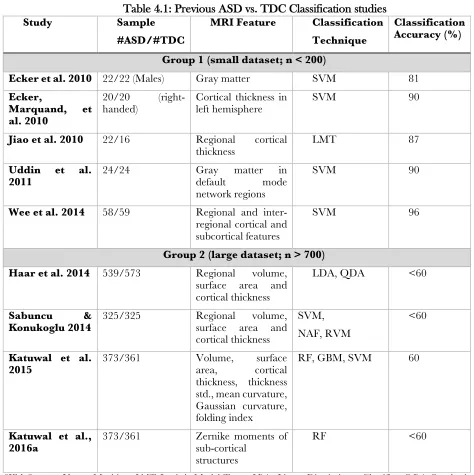
accuracies (80%) for well-matched small datasets (n < 200). However, the studies using the large
multi-site ABIDE dataset (n > 700) (Haar et al., 2014; Katuwal et al., 2015b; Sabuncu &
Konukoglu, 2014) have reported low classification accuracies (~60%).
1.6.1
Demonstrating MRI as a potential tool for detection
As a solution to the Problem 1 i.e. “Behavior based diagnosis of ASD is late and does not help to
understand the underpinnings of ASD”, we demonstrate that ASD can be successfully detected using
machine learning on MRI data. Using brain images of both children and adult subjects,
data-driven potential brain biomarkers that are consistent with the current biological understanding of
ASD were found. In addition, we could successfully classify ASD subjects from non-ASD subjects
in many cases. From the results of this thesis, we can safely argue that the application of machine
learning on MRI data can be a useful technique for early detection of ASD and for understanding
its brain anatomical underpinnings. This analysis and results are presented in Chapter 4 and
Chapter 5.
1.6.2
Relating inconsistent findings and low classification success to ASD
heterogeneity and methodological differences
In this thesis, we have attempted to identify the causes of Problem 2: “Inconsistent brain
anatomical findings in ASD” and Problem 3: “Low Classification success in large multi-site data”. We
attribute methodological differences and heterogeneity of ASD, or a combination of both, as the
likely underlying causes of these discrepancies.
The methodological differences can arise from the differences in image preprocessing tools,
analytical models, covariates, etc. In this thesis, we focus on methodological differences due to the
choice of image preprocessing tool. This analysis and results are presented in Chapter 3.
The heterogeneity of ASD brain morphology can be mainly attributed to the significant
dependence of brain alterations on demographics and behavioral (DB) measures such as age, sex,
IQ, handedness, etc. Previous studies have reported variability in brain alterations with factors
thesis, we focus on the variability ASD brain alterations with respect to three DB measures: age,
verbal IQ (VIQ), and autism severity (AS). This analysis and results are presented in Chapter 4.
1.6.3
Providing the evidence of brain image processing tool dependent findings and
suggesting multi-variate techniques as a partial solution
We investigate differences in image preprocessing tools as a possible cause behind the
inconsistent anatomical findings in ASD and in neuroimaging in general. In particular, we focus
on the estimation of the following brain volumes: gray matter (GM), white matter (WM),
cerebrospinal fluid (CSF), and total intracranial volume (TIV) from T1-weighted MRIs using three
popular preprocessing methods: SPM, FSL, and FreeSurfer (FS). We found that the estimated
brain volumes did not agree across methods and the methods showed differential biases for ASD,
and many of the biases were larger than ASD versus TDC differences. In summary, we
demonstrated that the differences in the choice of image preprocessing tool is a reason behind the
inconsistent neuroimaging findings in ASD.
Improving the current brain image preprocessing tools to make them more accurate and
standardizing them is the best possible solution to remove the effects of methodological differences
in the end findings. However, when the existing popular tools have to be used, we suggest
investigating multi-variate relationships (in addition to univariate relationships) in brain alterations
because multi-variate relationships are more robust across methods and scanners. In this thesis, we
provide few examples to corroborate this view. This analysis and results are presented in Chapter
1.6.4
Divide and Conquer: we propose identifying brain biomarkers in sub-groups of
ASD is easier and more meaningful than across the whole spectrum
We first propose and then demonstrate that the heterogeneity in ASD brain morphometry
can be mitigated by augmenting the information from demographics and behavioral measures
(DB) of the subjects. We demonstrate that identifying ASD brain alterations in relatively
homogenous sub-groups is easier and more insightful than across the whole heterogeneous ASD
spectrum. We use automatically extracted multiple brain morphological features and multiple
classification techniques for this investigation. We explore if DB measures of the subjects can be
utilized to mitigate the ASD heterogeneity and hence facilitating a better understanding of the
brain alterations associated with ASD and aiding in its detection. First, we investigate the
incremental predictive power that can be gained by adding DB measures such as age, VIQ, and
AS to the brain morphological features derived from MRI. Second, we probe if sub-grouping the
subjects by the above-mentioned DB measures helps to improve ASD vs. TDC classification and
provides better insight into the brain morphometric alterations in ASD. This analysis and results
are presented in Chapter 4.
1.6.5
Brain biomarkers discovery for early detection of ASD
We apply machine learning on automatically extracted multiple brain morphometric and
intensity features to classify young ASD subjects (3 to 4 years) from the controls of the same age
group. We achieved very high success rate (> 90% AUC) for ASD vs. control classification. We
also identified three potential brain markers for early detection of ASD: larger ventricles, larger
TIV, higher amount of cortical folding, and myelination deficits particularly in frontal and
temporal regions. We also noticed that larger TIV of ASD brain is related to larger cortical surface
amount of cortical folding in ASD brains may be an aftereffect of the early brain overgrowth in
ASD. We also hypothesize that the higher amount of cortical folding in ASD is due to the greater
compressive stress in the cortex induced by both hyper-expansion of the cortex and abnormally
large ventricles. To our knowledge this is the first study to leverage clinical imaging archives to
investigate early brain markers in ASD. The high degree of success in classification and the
biologically relevant potential brain markers indicate that application of advanced analytic
methods on brain features holds promise for aiding early identification of ASD.
1.7
Thesis Organization
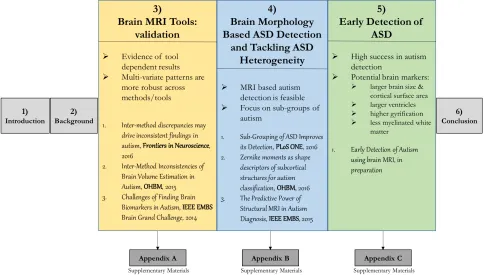
This thesis is divided into six chapters and three appendices; see Figure 1.1.
1.7.1
Chapter 1: Introduction
This Chapter contains a brief introduction to ASD and studies investigating brain
alterations in ASD using MRI. It starts with the shortcomings of behavioral based ASD diagnosis
and then provides motivation for brain morphology based ASD detection using machine learning.
This chapter makes an effort to educate the reader about the importance of early detection of ASD
and then presents MRI based ASD detection as a potential technique for it. Finally, this chapter
briefly discusses the challenges to characterize the ASD brain morphology using MRI and then
Figure 1.1 Thesis Organization
1.7.2
Chapter 2: Background
This Chapter contains the basic elements required to get acquainted with brain imaging in
general and brain MRI data processing and analysis in particular. It includes a brief introduction
to MRI, extraction of brain features from MRI, and univariate and multi-variate analysis
techniques used to identify meaningful patterns from these brain features.
1.7.3
Chapter 3: Method Dependent Findings
This Chapter is based on the Frontiers in Neuroscience research article “Inter-Method
Discrepancies in Brain Volume Estimation May Drive Inconsistent Findings in Autism” (Katuwal
et al., 2016b). Using the case study of brain volumes estimation from three popular brain image
processing tools, this Chapter provides the evidence that the differences in the choice of processing
1.7.4
Chapter 4: Brain Morphology Based ASD Detection and Tackling ASD
Heterogeneity
This Chapter is based on the PLOS ONE journal research article “Divide and Conquer:
Sub-Grouping of ASD Improves ASD Detection Based on Brain Morphometry” (Katuwal et al.,
2016c). Using the brain images of adult subjects (6 to 40 years) from the ABIDE dataset, this
Chapter shows how information from DB measures such as age, VIQ, and AS can help to mitigate
the heterogeneity in ASD brain morphology. This Chapter demonstrates that searching for the
brain biomarkers in meaningful sub-groups of ASD is easier and more meaningful than searching
them across the whole ASD spectrum.
1.7.5
Chapter 5: Early Detection of ASD
Utilizing the brain images of subjects 3 to 4 years of age from a clinical imaging archive at
Geisinger Health System, this Chapter demonstrates that applying machine learning on
MRI-derived brain morphology features, early brain markers of ASD can be identified in a data-driven
fashion and be used for early detection of ASD.
1.7.6
Chapter 6: Conclusion
This Chapter summarizes the methodology and the results of this thesis and provides a
discussion on the implications of the findings of this thesis. Finally, it concludes by discussing the
future work.
1.7.7
Appendices
Appendix A, B, and C contain the supplementary materials form Chapter 3, 4, and 5
2
CHAPTER 2: BACKGROUND
2.1
Brain Imaging
Brain imaging includes the use of diverse techniques to image the structure, function, and
biochemical processes of the brain. Imaging technologies of various modalities now provide the
visualization of the structure and function of the brain with high resolution. Brain imaging is
becoming an important technique in both research and clinical care. It is being successfully used
to facilitate the understanding of the structure and the functions of the brain and also has been a
vital diagnostic tool for many neurological disorders (O’Brien, 2007). Brain imaging can be broadly
categorized into three categories: structural, functional, and molecular imaging (Asbury, 2011).
Structural imaging techniques can capture the anatomical structure of the brain and
include X-ray, Computer Assisted Tomography (CT), MRI, Diffusion Tensor Imaging (DTI) etc.
MRI is based on the principle of nuclear magnetic resonance and uses radiofrequency waves to
probe tissue structure. DTI is a special form of MRI technique that measures the diffusion of water
as a function of spatial location and is used to characterize the microstructural changes in the tissues
(Le Bihan et al., 2001). It is widely used to estimate the WM connectivity patterns in neurological
disorders such as ASD and ADHD (Assaf & Pasternak, 2008).
Functional imaging techniques capture the function or physiology of the brain or measure
the brain metabolism (Raichle, 1998). Most of the techniques such as functional Magnetic
Resonance Imaging (fMRI) and Positron Emission Tomography (PET), measure the amount of
cerebral blood flow as a proxy to the brain metabolism rate assuming that there is more blood flow
Molecular and cellular imaging techniques probe the biochemical activities of cells and
their molecules (Massoud & Gambhir, 2003). They generally use different kinds of light
microscopes on light-emitting probes. The light-emitting probes are the molecules emitting radio
frequencies of various wavelengths to contrast the target cells.
In addition to the unimodal studies based on brain images of a single modality, there are
several other studies utilizing the joint information from the brain images of multiple modalities
(Michael, 2009; Michael et al., 2010, 2011; Pichler et al., 2010; Townsend & Cherry, 2001).
This thesis makes an effort to identify brain markers for ASD detection using the brain
morphology captured by MRI. So, we will limit our scope to MRI from here on. To be more
particular, MRI refers to structural MRI in this thesis. All the brain MRI images used in this thesis
were T1-weighted. In T1-weighted images, tissues with high fat content (e.g. WM) appear bright
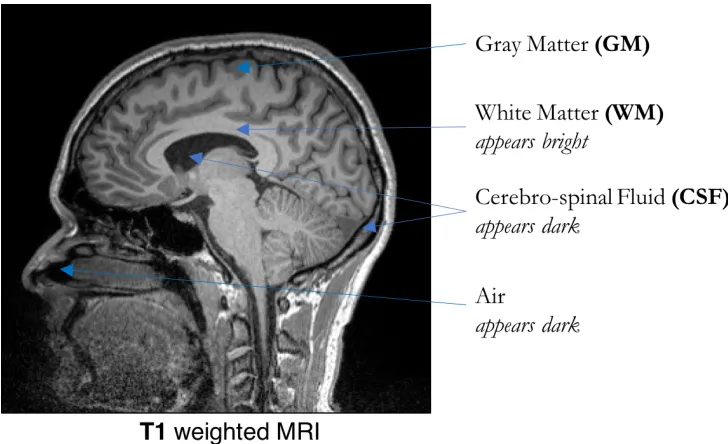
whereas fluids (e.g. CSF) and air appear dark (Hornak, 1996). Figure 2.1 shows the sagittal view
[image:30.612.130.494.427.649.2]of a typical T1-weighted brain MRI.
2.2
MRI
MRI is a non-invasive tool for examining the anatomy of the human body. It is based on
the principle of magnetic resonance imaging and it utilizes the magnetic properties of the proton
of the hydrogen atom which is abundant in our body.
2.2.1
MRI acquisition
Here we briefly explain the MRI acquisition process. For detailed information, please refer
to https://radiopaedia.org/articles/mri-introduction, Pooley (2005), Hornak (1996) and Section
2.1 of Michael (2009). A typical MRI machine consists of three major components: a very strong
main magnet, gradient magnets, and a radio frequency emitter. A typical MRI process includes
four major components: slice selection, phase encoding, frequency encoding, and signal
reconstruction (see Figure 2.2).
Slice selection: The protons spin around their axes effectively acting as small magnetic
dipoles. Initially, the magnetic dipoles (protons) are randomly aligned. When a strong external
magnetic field of the MRI machine is applied, in addition to the spinning motion, the dipoles start
to precess along the direction of the external field at the Larmor frequency, which is proportional
to the external magnetic field. After that, a combination of gradient magnets is turned on, by effect
of which, the net magnetic field varies linearly along the axis perpendicular to the 2D slice of
interest—i.e. the net magnetic field is uniform in each slice but is different across the slices—which
means the protons at each slice are precessing with unique frequency and hence can only absorb
electromagnetic waves of particular frequencies to resonate, echo or excite. In other words, varying
Figure 2.2: MRI acquisition process.
Phase encoding. A suitable radio frequency pulse is emitted for a brief time so that the
hydrogen atoms only in the slice of interest are excited. Then the radio frequency is turned off and
the excited hydrogen atoms are allowed to return to the low energy state through a gradual decay.
During relaxation, electromagnetic waves are emitted at the precessing frequency of the Hydrogen
atoms. Then another set of gradient magnets is turned on for a short interval, by effect of which,
the net magnetic field along one axis of the slice of interest varies. Since the precession frequency
is dependent on the external magnetic field, protons at different locations precess with different
frequencies creating location dependent phase lag relative to their initial state. This location
dependent phase lag effectively encodes the spatial information in the slice of interest. In practice,
several phase encoding steps are repeated so that the captured signal has enough information to
reconstruct the anatomical image.
Frequency encoding. After phase encoding, another gradient is applied along the axis
perpendicular to the phase encoding axis so that the hydrogen atoms at different columns precess
Signal reconstruction. The excited hydrogen atoms return to the low energy state
releasing electromagnetic waves. These waves have frequency and phase dependent on their spatial
location and are picked up by receiver coils and the collected 2D signal is called the k-space. A
Fourier Transform is applied on the k-space image to reconstruct the 2D anatomical image of the
slice. Multiple 2D slices are collected and combined to form the 3D MRI volume.
2.3
Brain Feature extraction from MRI
MRI data have to be processed to extract brain features before performing further analyses
on them. There are a number of automatic software tools available from different labs and research
universities for MRI data processing. Among them, the most popular are SPM (Ashburner &
Friston, 2005), FS (Dale et al., 1999a; Fischl et al., 1999b), FSL (Jenkinson & Smith, 2001), AFNI
(Cox, 1996), and LONI (Dinov et al., 2010). MRI data processing can be roughly divided into two
steps. The first step includes preprocessing tasks such as motion correction, non-uniform intensity
normalization, skull stripping, etc. These tasks ensure that the final image is suitable for further
processing. In other words, these preprocessing tasks are image processing operations performed
on raw brain images so that they have desirable properties that are consistent with the assumptions
made by the subsequent registration and segmentation steps. The second step includes tasks such
as registration of a brain image to a standard brain template and segmentation of cortical and
sub-cortical brain regions.
Below we briefly discuss the brain feature extraction steps of three popular neuroimaging
preprocessing tools that were used in this thesis.
2.3.1
SPM
SPM (http://www.fil.ion.ucl.ac.uk/spm/) is a brain imaging software tool mainly designed
& collaborators of the Wellcome Trust Centre for Neuroimaging at University College London.
In Chapter 3 of this thesis, SPM was utilized for the segmentation of following brain tissues: GM,
WM, and CSF.
Tissue segmentation in SPM is performed using the New Segment tool (Ashburner et al.,
2013). New Segment utilizes a Gaussian Mixture Model (GMM) with components for GM, WM,
CSF, bone, soft tissue, and air/background where each component is modeled as one or more
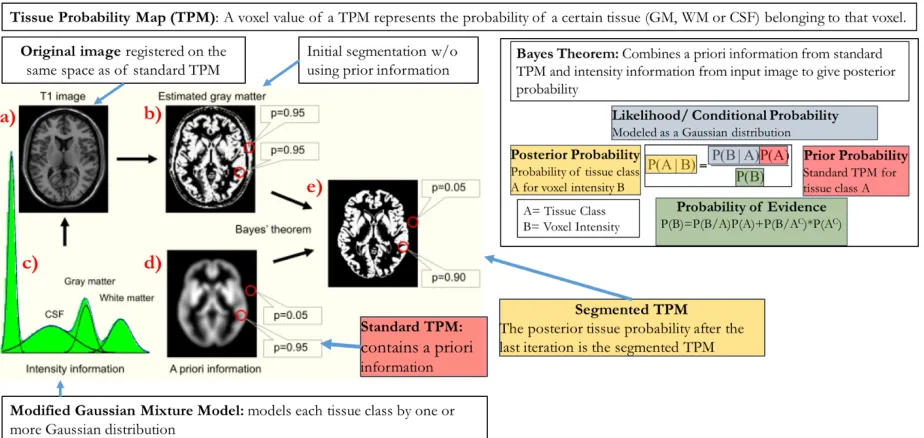
Gaussians. The distribution or histogram of image intensities in a T1 weighted brain image (Figure
2.1A) are modeled by a GMM (Figure 2.3c) where the different peaks correspond to the different
image intensities of the tissue classes. The mixture model is updated by combining the spatial
information from a standard tissue probability map (TPM) and the intensity information of the
input MRI (Ashburner & Friston, 2005). The standard TPM (Figure 2.3d) of a tissue contains
information about the spatial location of the tissue in a probabilistic sense. The value at a certain
voxel of a TPM represents the probability of a certain tissue (GM, WM or CSF) belonging to that
voxel. In this example, a voxel value of the TPM in Figure 2.3d represents the probability that the
voxel contains GM. New Segment uses ICBM-452 T1 brain atlases (Mazziotta et al., 2001a) as
standard TPMs.
At first the T1 image is registered in the same space as the standard TPM. After the
registration, the registered T1 image is segmented roughly based on intensity thresholds to get an
initial segmentation map (Figure 2.3b) to create an initial TPM. Then, the segmented tissue map
is refined using Bayes’ theorem with the standard TPM as a priori. The maximum likelihood
estimate of the parameters of the mixture model are estimated using the Expectation Maximization
(EM) algorithm (Do & Batzoglou, 2008). At each iteration of EM, model parameters and the TPM
are updated. The iteration continues until the final parameters of the mixture model are estimated.
particular tissue. Further details on SPM tissue segmentation can be found at (Ashburner et al.,
[image:35.612.74.536.126.345.2]2013).
Figure 2.3: SPM Tissue Segmentation.
The distribution (histogram) of image intensities of the T1 image (upper left) are modeled by a Gaussian Mixture Model (bottom left) where the different peaks correspond to the different image intensities of the tissue classes. First, the T1 image is registered in same space as standard Tissue Probability Map (TPM) which contains the anatomical information of a particular tissue in probabilistic sense. Second, the T1 image is segmented roughly based on intensity thresholds. Third, the segmented tissue map is refined using Bayes theorem with the standard TPM as a priori. This process is repeated until there is no significant change in the segmented tissue map. A voxel in the final tissue map represents the probability of that voxel containing a particular tissue type. Note: A part of this figure was borrowed from Mietchen and Gaser (2009).
2.3.2
FSL
FSL (https://fsl.fmrib.ox.ac.uk/fsl/fslwiki) is a brain imaging software tool designed for the
analysis of both structural and functional brain images. It was developed and is maintained by the
Analysis Group at the Oxford Centre for Functional MRI of the Brain, at the Oxford University.
In Chapter 3 of this thesis, FSL was utilized to for the segmentation of following brain tissues: GM,
WM, and CSF.
Tissue classification in FSL is performed by FMRIB's Automated Segmentation Tool
Rabiner, 1989) which is a generalized version of the finite mixture model. In the HMRF model
utilized by FAST, each tissue class in the mixture model is represented by a Gaussian. In addition
to a basic mixture model, HMRF model incorporates a Markov random field (MRF) to utilize the
neighborhood information of the voxels. The hidden variables specifying the identity of the
mixture component (parametric distribution or Gaussian in this case) of each observation (voxel
intensity) are related by a Markov process in the HMRF model unlike a finite mixture model where
they are independent of each other. The HMRF model in FAST does not use a standard TPM as
a priori; instead it uses K-means segmentation (Kanungo et al., 2002) to estimate the initial
parameters of the tissue classes. It uses the EM algorithm to find the maximum likelihood estimate
of the model parameters. Before tissue segmentation using FAST, the brain region is extracted
using the brain extraction tool (Smith, 2002).
2.3.3
FS
FS (https://surfer.nmr.mgh.harvard.edu/) is a brain imaging software tool designed for the
analysis of both structural and functional brain images, and was originally developed for the
construction of cortical surface models. It was developed and is maintained by the Laboratory for
Computational Neuroimaging at the Athinoula A. Martinos Center for Biomedical Imaging. In
Chapter 4 and 5 of this thesis, FS was utilized to compute various morphometric properties of a
number of cortical and sub-cortical structures of the brain. In this thesis, the recon-all workflow of
FS v. 5.3.0 (Dale et al., 1999a; Fischl et al., 1999a, 2002; Ségonne et al., 2004) was used to extract
brain morphometric features.
Recon-all is a fully automated workflow (see Figure 2.4) that performs all the FS cortical
reconstruction and sub-cortical segmentation steps in a unified pipeline. It includes several
(Talairach & Tournoux, 1988) transform computation, intensity normalization, skull stripping,
sub-cortical segmentation, and cortical parcellation steps. Detailed steps of recon-all workflow can
be found at https://surfer.nmr.mgh.harvard.edu/fswiki/recon-all. Cortical parcellation and
sub-cortical segmentation steps are briefly explained below.
Figure 2.4: Freesurfer (FS) recon-all processing workflow
Recon-all is a fully automated workflow for cortical reconstruction and sub-cortical segmentation steps. Detailed steps of recon-all workflow can be found at https://surfer.nmr.mgh.harvard.edu/fswiki/recon-all
2.3.3.1 Sub-cortical Segmentation
FS utilizes the Bayesian approach for the segmentation of sub-cortical structures (Fischl et
al., 2002). At first, a brain image is affine registered to a standard probabilistic atlas called Aseg atlas
(Fischl et al., 2002) which contains the information regarding statistical properties of 37 anatomical
structures. At each voxel of the standard atlas, one of the 37 anatomical labels including left and
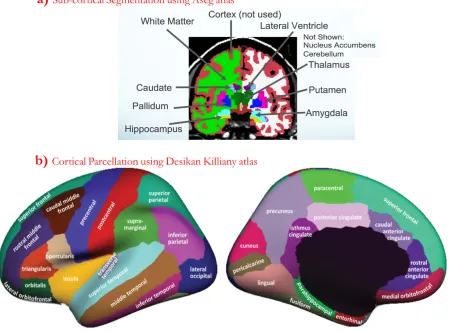
right caudate, putamen, pallidum, thalamus, lateral ventricles, hippocampus, and amygdala (see
Figure 2.5a), can belong to a voxel. The intensity distribution of each label is modeled as a
Gaussian. Local spatial relationships between the labeled brain structures are encoded by an
anisotropic non-stationary MRF. After registration to the atlas, the maximum posteriori estimate
of the segmentation or the probability of an anatomical label belonging to each voxel is calculated.
information or the probability that an anatomical label can be present at a particular voxel. This
information is derived from the atlas and the affine transformation of the input image to the atlas.
The second is the local spatial information or the local spatial relationship between anatomical
labels such as “posterior amygdala is frequently superior to anterior hippocampus, but never
inferior to it” (Fischl et al., 2002). This spatial relationship is encoded by an anisotropic
non-stationary MRF.
2.3.3.2 Cortical parcellation
FS subdivides the cerebral cortex on a brain MRI into a number of gyral based regions of
interest or parcellations (Fischl et al., 2004; Desikan et al., 2006). It utilizes the prior information
from a standard atlas such as the Desikan-Killiany atlas (Desikan et al., 2006) which was created
using a dataset of 40 MRI scans, where in each scan, 35 cortical regions were manually identified
in each of the individual hemispheres (see Figure 2.5b). The local surface geometry of a location in
the cortex and the prior information derived from the atlas are combined in a Bayesian framework
to calculate the maximum posteriori estimate of a brain parcellation belonging to that location.
Similar to sub-cortical segmentation, the prior information has two sources. The first source is the
global spatial information; it is the probability that a given parcellation occurs at a particular
location in the atlas, independent of the local surface geometry. This information is provided by
the atlas and the registration of the input image to the atlas. The second source is the local spatial
information or the local spatial relationship between parcellation labels such as “precentral gyrus
can be anterior, superior or inferior to central sulcus but never posterior to it” (Fischl et al., 2004).
Figure 2.5: Sub-cortical segmentation & cortical parcellation in Freesurfer (FS).
Figure a) was borrowed from http://slideplayer.com/slide/5222876 and figure b) was borrowed from Klein and Tourville (2012).
2.3.3.3 FS Features
After the segmentation of cortical and sub-cortical brain regions, different morphometric
and intensity properties or features of these regions can be calculated. Volume, intensity mean,
intensity standard deviation (std.) of 40 sub-cortical brain structures are automatically estimated by
the recon-all workflow. Similarly, recon-all automatically estimates the volume, surface area,
Gaussian curvature, mean curvature, curvature index, folding index, thickness mean, thickness
standard deviation, intensity mean, and intensity std. for the 34 cortical brain regions of each
Mean curvature is the arithmetic mean of principal curvatures !"#$%!"&'
( where K*+, and
K*-. are maximum and minimum principal curvatures respectively. Mean curvature measures the
extrinsic curvature. Extrinsic curvature refers to the amount of folding created with no distortion.
Gaussian curvature is the square of the geometric mean of principal curvatures K*-.K*+,.
Gaussian curvature measures the intrinsic curvature and its sign can be used to characterize the
surface. Intrinsic curvature refers to the folding created with distortion or shearing i.e. it is
excess/deficit in the surface area compared to a plane at the point (Schaer et al., 2008).
Folding index is defined as 01/ K*+, K*+, − K*-. 𝑑𝐴 (VanEssen & Drury, 1997).
Folding index is an overall measure of the folding of a surface. For any sulci having the shape of a
half-cylinder, its folding index is proportional to its length.
2.4
Analysis of neuroimaging data
Neuroimaging data analysis can be mainly categorized in three groups: voxel-based,
vertex-based, and feature-based.
2.4.1
Voxel-based
In voxel-based studies, the voxel intensities are compared between the images. The analysis
is usually preceded by the registration of the brain images to a standard space to ensure
voxel-to-voxel correspondence across images by adjusting the 3D coordinates of a voxel-to-voxel to best match the
MRI intensities across subjects at that particular voxel (Greve, 2011). Image registration is
generally followed by image smoothing and the amount of smoothing or the size of the low pass
filter used for smoothing is proportional to the size of the region of interest. The intensity of a voxel
in a final smoothed image may represent intensity, volume, or concentration of a tissue class at that
Representative voxel-based neuroimaging studies include: Nishida et al. (2011) reporting larger
anterior insular volume in patients with obsessive–compulsive disorder, May (2011) demonstrating
experience-dependent structural plasticity in the adult human brain, Matsuda et al. (2012)
detecting Alzheimer’s, Walther et al. (2009) relating brain structural differences to body mass index
in older females, Demirakca et al. (2011) reporting diminished GM in the hippocampus of cannabis
users, Kühn, Schubert, and Gallinat (2010) reporting reduced thickness of medial orbitofrontal
cortex in smokers, etc.
2.4.2
Vertex-based or Surface-based
In vertex-based or surface-based studies, the surface area of a brain structure is explicitly
represented by a mesh of triangles. The point where the vertices of the neighboring triangles meet
is called a vertex. A vertex can be localized by two spherical coordinates (longitude and latitude)
on a surface. After a brain surface such as the pial surface is represented by a mesh of triangles,
several geometric features such as area, curvature, thickness, etc. can be computed. For group
analysis, the surface based registration is performed where the 2D spherical coordinate of a vertex
is adjusted to match the curvature across subjects so that the folding patterns are aligned as
described by Greve (2011). Representative vertex-based neuroimaging studies include: Tondelli et
al. (2012) reporting atrophy in the right medial temporal lobe and the right hippocampus in
Alzheimer’s patients 10 years before clinical diagnosis, Im et al. (2006) reporting cortical thickening
in women in localized anatomical regions, Zarei et al. (2010) reporting significant bilateral regional
atrophy in the dorsal-medial part of the thalamus in Alzheimer’s patients.
2.4.3
Feature-based
In feature-based studies, the different features or properties of the brain regions are
based such as the mean intensity of a brain region. The feature-based analysis is usually preceded
by the segmentation of various cortical and sub-cortical brain regions and the calculation of
different features of these regions. The feature extraction may involve many vertex and voxel based
techniques. In this thesis, all analyses are feature-based and the scope is limited to feature-based
analysis from here on.
Usually in feature-based studies, the group differences in a feature or a group of features
are investigated. When a study involves only one feature or treats each feature in a group to be
independent of each other, it is called a univariate study. A typical univariate study utilizes a
statistical model such as General Linear Model (Nelder et al., 2006) to investigate the group
differences in brain features. In contrast, when a study treats the individual features to be
dependent of each other and tries to identify a multi-variate pattern between two groups, it is called
a multi-variate study. A typical multi-variate study utilizes machine learning techniques to identify
multi-variate differences in a data-driven fashion.
2.5
Machine Learning
Machine learning is the process of learning the underlying structure of a dataset and using
that knowledge to make predictions on unseen data (Alpaydin, 2010). An algorithm or a collection
of algorithms are applied on samples of a population to learn underlying structure or study the
probability distribution of the population. Machine learning techniques capture the multi-variate
relationships in data and hence are well-suited to detect subtle and distributed differences in the
data. So, compared to univariate techniques, machine learning techniques can perform better in
capturing the brain morphology of heterogeneous conditions like ASD. Thus, they hold promise
for improving our knowledge of ASD brain morphology and identifying brain biomarkers helpful
Machine learning techniques cover three major areas: supervised learning, unsupervised
learning, and reinforcement learning.
In supervised learning a training dataset with class labels are given and the algorithm learns
the input to output mapping function or a pattern in the training data. The learned mapping
function is then used to predict the labels of an unseen test data. The inherent assumption here is
that the training and testing data are similar. In other words, the same probability function
generates both training and test data. Supervised learning can be a classification problem when
the target label is categorical, or a regression problem when the target label is continuous. Some
applications of supervised learning are stock prediction (Rather et al., 2017), mortality prediction
(Katuwal & Chen, 2016), spam detection (Chakraborty et al., 2016), cancer detection (Bazazeh &
Shubair, 2016), ASD detection (Kim et al., 2016) etc. Some examples of supervised learning
algorithms are regression models, naïve Bayes, decision trees, Random Forest (RF), Gradient
Boosting Machine (GBM), neural networks, etc.
In unsupervised learning, class label information is absent and the algorithm has to learn
the underlying structure of the data by itself. Unsupervised learning can be a goal in itself, such as
finding sub-groups or clusters in the data or can be an intermediate step such as dimensionality
reduction for subsequent machine learning steps. Some applications of unsupervised learning are
human action categorization (Niebles et al., 2008), extracting hierarchical features for object
recognition (Ranzato et al., 2007), discovery of human neural-behavioral maps (Vogelstein et al.,
2014), identifying sub-groups of ASD (Gupta, 2015), etc. Some examples of unsupervised learning
algorithms are K-means, mixture models, principal component analysis, autoencoder, and
generative adversarial networks.
In reinforcement learning, an agent or a group of agents is trained in an environment to
process (Puterman & L., 1994) with its inputs as the actions of the agent and outputs as the
observations and rewards sent to the agent. Reinforcement learning is particularly well-suited to
problems where trade-off between long-term and short-term reward is important. Some
applications of reinforcement learning are robot control (Kober et al., 2013), playing Go (Silver et
al., 2016) , and playing poker (Brown & Sandholm, 2017).
In this thesis, we applied supervised learning techniques namely RF (Breiman, 2001) and
GBM (Friedman, 2000). These two algorithms are briefly explained below.
2.5.1
Random Forest (RF)
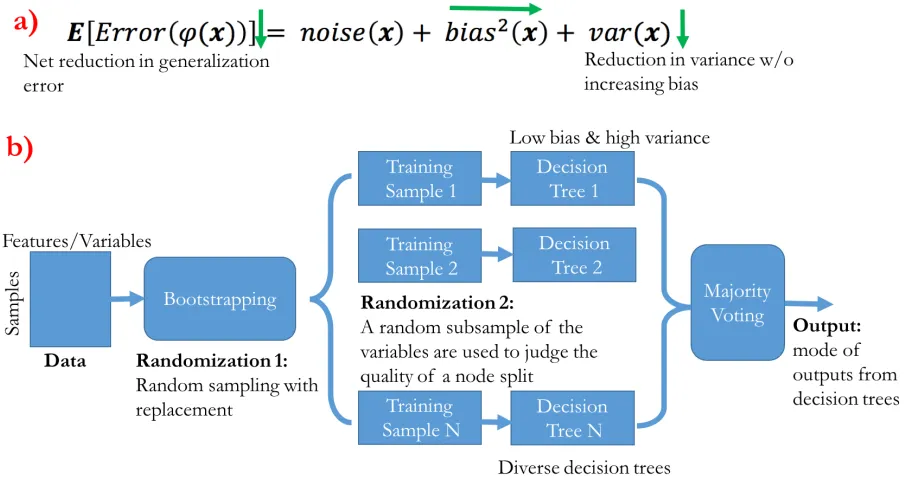
RF (Breiman, 2001) is an ensemble of decision trees and its output class is the mode value
of the output classes of the individual decision trees (see Figure 2.6). It is an ensemble technique
that relies on the reduction of the variance of the general error term. For the squared error loss,
the expected generalization error of a model φ at a given point 𝐱 can be decomposed into three
components (Gelman & Hill, 2006) as in Equation 2.1.
E Error φ(x) = noise 𝐱 + bias( 𝐱 + var(𝐱) (2.1)
In Equation 2.1, the first term noise 𝐱 is the irreducible error or Bayes error. It is the
theoretical lower bound on the generalization error and is independent of both learning algorithm
and data. The second term bias( 𝐱 is the difference between the average prediction of the model
and the prediction of the Bayes model. The third term var(𝐱) is the variability of the predictions
at point 𝐱 over the models learned from all possible subsets of population.
The main idea of RF is to decrease the variance term by keeping the bias constant, thereby
decreasing the overall error of the ensemble. It achieves this variance reduction by averaging the
high variance classifiers or decision tree classifiers. The more diverse or uncorrelated the decision
each other, RF introduces randomness while constructing the trees, hence the name ‘random
forest’. The randomization is introduced at first during data sampling and then while constructing
the decision trees. Each tree learns from a bootstrap replica of the data obtained by random
sampling with replacement in the original data. This introduces a degree of randomness in the
decision trees because they are trained with different bootstrap replicas. While growing decision
trees, the quality of a node split is based only on a random subsample of the variables instead of all
[image:45.612.90.545.269.511.2]of them. Most of the randomization comes from this step.
Figure 2.6: Random Forest is an ensemble of decision trees.
a) Generalized error broken down into three terms: noise, bias, and variance. Random Forest (RF) relies on the reduction of variance without increasing bias, thus reducing the overall error. The directions of the green arrows correspond to the direction of change of the error terms due to ensembling. b) General block diagram of RF as an ensemble of diverse decision trees.
A decision tree is a simple classifier which iteratively partitions the data space into more
homogenous partitions using simple decision rules. The quality of the data partitions or the child
nodes after a node splitting in a decision tree is measured by their homogeneity. The homogeneity
(Breiman, 1996), entropy (Gray & M., 1990), etc. and the quality of the node split is quantified by
change in these metrics.
In a RF, the importance of a variable is the sum of the weighted impurity decreases in all
node splits by the variable, averaged over all trees in the forest (Breiman, 2001; Louppe, 2015). It
is calculated as in Equation 2.2.
Imp XK = 1
M 1(jO= j) p(t)Δi(sO, t)
S"
T
*U/
(2. 2)
Where,
Imp XK = the importance of variable XK
jO = the identifier of the variable used for splitting node t
sO = a split at node t due to variable XK
p t = the proportion XY
X of samples at node t where NOis the number of samples at node t and N is the total number of samples
Δi sO, t = decrease in node impurity by split sO
φ* = mth decisiontree
M = the number of decision trees in the forest
In this thesis, RF was used as the first choice classifier since it is inherently suitable for
parallel processing, has very few hyper parameters to tune, does not require data scaling, is
theoretically resistant to overfitting, provides variable importance, and has been found to be very
good for a variety of datasets (Breiman, 2001; Caruana & Niculescu-Mizil, 2006).
2.5.2
Gradient Boosting Machine (GBM)
Boosting is an ensemble technique that relies on bias reduction to reduce the generalized
several weak or base learners with high bias and low variance such as decision tree stumps into one
strong learner. The base learners are combined so that the ensemble bias decreases while variance
remains the same, thereby reducing the net ensemble error. At each iteration or boosting step,
GBM constructs a new base learner to be the most parallel to the negative gradient of a loss
function along the observed data so that the new base learner focuses on the weakness of the model
(Natekin & Knoll, 2013). In other words, it performs functional approximation of a model by
consecutively improving along the negative direction of a loss function. In this thesis, a binomial
3
CHAPTER
3:
DEPENDENCY
OF
BRAIN
FINDINGS ON IMAGE PROCESSING TOOLS
AND POTENTIAL SOLUTIONS
Some material from (Katuwal et al., 2016b) has been reused in this chapter under Creative Commons Attribution
(CC BY) license.
Previous studies applying automatic brain image processing methods on MRI report
inconsistent neuroanatomical alterations in ASD. In this study, we investigate methodological
differences as a possible cause behind these inconsistent findings. In particular, we focus on the
estimation of the following brain volumes: GM, WM, CSF, and TIV. T1-weighted MRIs of 417
ASD subjects and 459 TDC from the ABIDE dataset were estimated using three popular
preprocessing methods: SPM, FSL, and FS. The estimated brain volumes were correlated but had
significant inter-method biases. ASD vs. TDC differences in all brain volume estimates were highly
dependent on the method used. When methods were compared with each other, they showed
differential biases for ASD, and several biases were larger than ASD vs. TDC differences of the
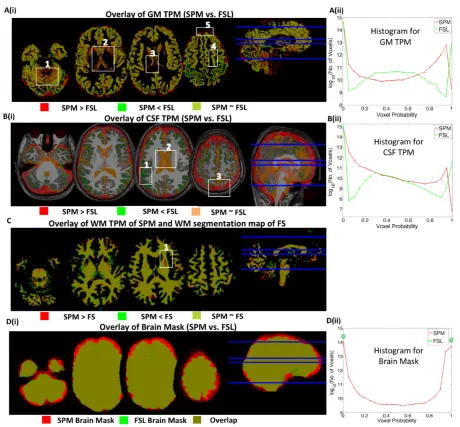
respective methods. After manual inspection, we found inter-method segmentation mismatches in
the cerebellum, sub-cortical structures, and inter-sulcal CSF. In summary, method dependent ASD
vs. TDC differences indicate that the inter-method discrepancy can contribute to inconsistent
neuroimaging findings in ASD. We suggest cross-validation across methods and emphasize the
need to develop better methods to increase the robustness of neuroimaging findings.
MRI is a powerful tool used to investigate the human brain in vivo and to find associations
between brain morphometry and brain disorders. Although a large number of MRI studies have
been conducted, consistent MRI markers for brain disorders are yet to be found (Chen et al. 2011).
This can mainly be attributed to low statistical power of neuroimaging and neuroscience studies
(Button et al., 2013). Inconsistent results may be due to differences in the demographics of data
(Stanfield et al., 2008), image acquisition settings (Auzias et al., 2014a; Styner et al., 2002),
assumptions made on data and algorithms used (Eggert et al., 2012; Fellhauer et al., 2015;
Nordenskjöld et al., 2013), and even machines used to process the data (Gronenschild et al., 2012).
With the increasing use of automated preprocessing methods in neuroimaging studies, the
effect of inter-method variations in neuroimaging findings merit an investigation. Although
automatic methods are more objective than manual methods, they possess method-specific bias
and variance (Eggert et al., 2012; Nordenskjöld et al., 2013). The bias and variance across methods
arise mainly due to method specific assumptions made on data, varying definition of brain
structures, different image processing algorithms, varying sensitivity to imaging artifacts such as
motion, and use of inconsistent a priori information such as brain templates. A number of previous
studies have reported significant inter-method inconsistencies (Eggert et al., 2012; Fellhauer et al.,
2015; Hansen et al., 2015; Ren et al., 2005; Tsang et al., 2008). Eggert et al. (2012) reported
pronounced differences (11%) in mean segmented GM volumes from four standard segmentation
algorithms: SPM8 New Segment, SPM8 VBM, FSL v. 4.1.6 and FS v. 4.5. According to Hansen et
al. (2015), compared to manual segmentation, FS 4.5 underestimated TIV by 7 %. Similarly,
differences in segmentation accuracies between FSL and SPM5 were reported by Tsang et al.
(2008).
One important concern is that inconsistent results driven by inter-method variations can
Several previous studies have shown that the magnitude and even the direction of the effect size
can be dependent on the method used. Boekel et al. (2015) performed a replication study on 17
brain structure-behavior correlations from five neuroimaging studies and were not able to replicate
any of the correlations. A response paper by Muhlert and Ridgway (2015) pointed out that one of
the reason the correlations could not be replicated is the methodological differences between SPM
and FSL. Nordenskjöld et al. (2013), compared SPM8 and FS v. 5.1.0 TIV estimates to reference
TIV obtained from manual segmentation of proton density weighted images. They report that
both SPM8 and FS overestimated TIV. In addition, SPM showed systematic bias associated with
gender (systematic overestimation of TIV in females) and aging atrophy while FS showed bias for
reference TIV (systematic overestimation of TIV for larger skull size). Notably, hippocampal
volume showed different associations with education depending on which TIV measure (SPM or
FS) was used for hippocampal volume normalization. When normalized with SPM TIV, there was
no association between hippocampal volume and education, whereas when normalized with FS
TI