7-14-2017
Generation, validation, and application of
abundance map reference data for spectral
unmixing
McKay D. Williams
Follow this and additional works at:
https://scholarworks.rit.edu/theses
This Dissertation is brought to you for free and open access by the Thesis/Dissertation Collections at RIT Scholar Works. It has been accepted for inclusion in Theses by an authorized administrator of RIT Scholar Works. For more information, please [email protected].
Recommended Citation
Generation, validation, and application of abundance map reference
data for spectral unmixing
by
McKay D. Williams
B.S. Utah State University, 2009
M.S. Air Force Institute of Technology, 2011
A dissertation submitted in partial fulfillment of the
requirements for the degree of Doctor of Philosophy
in the Chester F. Carlson Center for Imaging Science
College of Science
Rochester Institute of Technology
July 14, 2017
Signature of the Author
Accepted by
CERTIFICATE OF APPROVAL
Ph.D. DEGREE DISSERTATION
The Ph.D. Degree Dissertation of McKay D. Williams has been examined and approved by the
dissertation committee as satisfactory for the dissertation required for the
Ph.D. degree in Imaging Science
Dr. Jan van Aardt, Dissertation Advisor
Dr. David Ross, External Chair
Dr. David Messinger
Dr. John Kerekes
Date
Generation, validation, and application of abundance map reference
data for spectral unmixing
by
McKay D. Williams
Submitted to the
Chester F. Carlson Center for Imaging Science in partial fulfillment of the requirements
for the Doctor of Philosophy Degree at the Rochester Institute of Technology
Abstract
Reference data (“ground truth”) maps traditionally have been used to assess the
accu-racy of imaging spectrometer classification algorithms. However, these reference data can
be prohibitively expensive to produce, often do not include sub-pixel abundance estimates
necessary to assess spectral unmixing algorithms, and lack published validation reports.
Our research proposes methodologies to efficiently generate, validate, and apply abundance
map reference data (AMRD) to airborne remote sensing scenes. We generated scene-wide
AMRD for three different remote sensing scenes using our remotely sensed reference data
(RSRD) technique, which spatially aggregates unmixing results from fine scale imagery
(e.g., 1-m Ground Sample Distance (GSD)) to co-located coarse scale imagery (e.g., 10-m
GSD or larger). We validated the accuracy of this methodology by estimating AMRD in 51
randomly-selected 10 m×10 m plots, using seven independent methods and observers,
in-cluding field surveys by two observers, imagery analysis by two observers, and RSRD using
three algorithms. Results indicated statistically-significant differences between all versions
of AMRD, suggesting that all forms of reference data need to be validated. Given these
significant differences between the independent versions of AMRD, we proposed that the
represent true abundances. We then compared each version of AMRD to MOA. Best case
accuracy was achieved by a version of imagery analysis, which had a mean coverage area
error of 2.0%, with a standard deviation of 5.6%. One of the RSRD algorithms was nearly
as accurate, achieving a mean error of 3.0%, with a standard deviation of 6.3%, showing the
potential of RSRD-based AMRD generation. Application of validated AMRD to specific
coarse scale imagery involved three main parts: 1) spatial alignment of coarse and fine scale
imagery, 2) aggregation of fine scale abundances to produce coarse scale imagery-specific
AMRD, and 3) demonstration of comparisons between coarse scale unmixing abundances
and AMRD. Spatial alignment was performed using our scene-wide spectral comparison
(SWSC) algorithm, which aligned imagery with accuracy approaching the distance of a
single fine scale pixel. We compared simple rectangular aggregation to coarse sensor
point-spread function (PSF) aggregation, and found that the PSF approach returned lower error,
but that rectangular aggregation more accurately estimated true abundances at ground
level. We demonstrated various metrics for comparing unmixing results to AMRD,
includ-ing mean absolute error (MAE) and linear regression (LR). We additionally introduced
reference data mean adjusted MAE (MA-MAE), and reference data confidence interval
adjusted MAE (CIA-MAE), which account for known error in the reference data itself.
MA-MAE analysis indicated that fully constrained linear unmixing of coarse scale imagery
across all three scenes returned an error of 10.83% per class and pixel, with regression
analy-sis yielding a slope = 0.85, intercept = 0.04, andR2 = 0.81. Our reference data research has
demonstrated a viable methodology to efficiently generate, validate, and apply AMRD to
specific examples of airborne remote sensing imagery, thereby enabling direct quantitative
Contents
1 Introduction 23
1.1 CONTEXT . . . 23
1.2 OBJECTIVES . . . 28
1.3 DISSERTATION LAYOUT . . . 29
1.3.1 Chapter 2: Background . . . 29
1.3.2 Chapter 3: Remotely Sensed Reference Data (Objective 1) . . . 29
1.3.3 Chapter 4: Validation of Abundance Map Reference Data (Objective 2) . . . 29
1.3.4 Chapter 5: Application of Abundance Map Reference Data (Objective 3) . . . 30
1.3.5 Chapter 6: Summary . . . 30
1.4 CONTRIBUTIONS . . . 30
2 Background 33 2.1 FOREWORD . . . 33
2.2 KEY ATTRIBUTES OF REFERENCE DATA . . . 33
2.2.1 Imaging Sensor . . . 34
2.2.2 Image Size . . . 34
2.2.3 GSD of Pixels . . . 34
2.2.4 Number of Classes . . . 34
2.2.5 Generation Method . . . 35
2.2.6 Spatial Detail . . . 35
2.2.7 Validation Availability . . . 35
2.2.8 Accuracy . . . 35
2.3 AN INTRODUCTION TO WELL-KNOWN REFERENCE DATA . . . 36
2.3.1 Cuprite (Nevada, USA) . . . 36
2.3.2 Indian Pines (Indiana, USA) . . . 37
2.3.3 Salinas (California, USA) . . . 38
2.3.4 Pavia (Italy) . . . 39
2.4 KEY ATTRIBUTE ANALYSIS OF WELL-KNOWN REFERENCE DATA 41 2.5 PREVIOUS SUB-PIXEL REFERENCE DATA . . . 42
2.6 COMPLEXITY OF REFERENCE DATA . . . 43
2.7 CONCLUSIONS . . . 46
3 Remotely Sensed Reference Data 47 3.1 FOREWORD . . . 47
3.2 ABSTRACT . . . 47
3.3 INTRODUCTION . . . 49
3.4 METHODOLOGY . . . 51
CONTENTS 7
3.4.2 Classification Scheme & NEON Endmember Determination . . . 56
3.4.3 Classification & Spectral Unmixing of NEON Data . . . 57
3.4.4 Generation of Abundance Map Reference Data for AVIRIS . . . 58
3.4.5 Direct Spectral Unmixing of AVIRIS Data . . . 58
3.5 RESULTS . . . 59
3.5.1 Comparison of Classification and Unmixing . . . 59
3.5.2 Abundance Map Reference Data . . . 61
3.5.3 Comparison of Abundance Map Reference Data and Directly Un-mixed AVIRIS Abundances . . . 63
3.6 CONCLUSIONS . . . 64
4 Validation of Abundance Map Reference Data 67 4.1 FOREWORD . . . 67
4.2 ABSTRACT . . . 67
4.3 INTRODUCTION . . . 69
4.4 METHODOLOGY . . . 72
4.4.1 Airborne Data and Cover Classes . . . 72
4.4.2 Reference Data Collection . . . 76
4.4.3 Data Aggregation . . . 82
4.4.4 Methods of Data Comparison . . . 83
4.5 RESULTS . . . 85
4.5.1 Comparison of Field Survey Data . . . 85
4.5.2 Pairwise Comparisons of Reference Data Versions . . . 87
4.5.4 Statistical Equivalence Tests . . . 91
4.6 DISCUSSION . . . 93
4.7 CONCLUSIONS . . . 98
5 Application of Abundance Map Reference Data 101 5.1 FOREWORD . . . 101
5.2 ABSTRACT . . . 101
5.3 INTRODUCTION . . . 103
5.3.1 Spatial Alignment . . . 105
5.3.2 Spatial Aggregation . . . 106
5.3.3 Comparison of Unmixing Results and AMRD . . . 107
5.4 METHODOLOGY . . . 108
5.4.1 Data . . . 108
5.4.2 Validated Abundance Map Reference Data . . . 111
5.4.3 Spatial Alignment . . . 115
5.4.4 Spatial Aggregation . . . 120
5.4.5 Spectral Unmixing . . . 120
5.4.6 Comparison of Spectral Unmixing Results and AMRD . . . 121
5.5 RESULTS . . . 123
5.5.1 Spatial Alignment Accuracy . . . 123
5.5.2 Assessing the Performance of Unmixing Using Mean Absolute Error 126 5.5.3 Assessing the Performance of Unmixing Using Regression . . . 129
5.6 DISCUSSION . . . 133
CONTENTS 9
6 Summary 139
6.1 CONCLUSIONS . . . 141
6.2 FUTURE WORK . . . 144
Appendices 159
A Available Data 161
A.1 San Joaquin Experimental Range - High School (SJERHS) . . . 162
A.2 San Joaquin Experimental Range - NEON Site 116 (SJER116) . . . 162
List of Figures
1.1 1689 World Map by van Schagen of Amsterdam [1]. . . 24
1.2 1904 Aerial photograph of the Giza Pyramids by Eduard Spelterini [2]. . . . 25
1.3 3-D cube representation of imaging spectrometer data taken by NEON Inc.
near Fresno, CA. . . 26
1.4 (a) RGB representation of Indian Pines imagery, (b) Indian Pines Reference
Data [3]. . . 27
2.1 (a) RGB representation of the Cuprite imaging spectrometer data, (b)
Min-eral map derived from the Tetracorder algorithm on VNIR bands, (c) MinMin-eral
map derived from Tetracorder algorithm on SWIR bands [4]. . . 37
2.2 (a) RGB representation of Indian Pines imagery, (b) Indian Pines Reference
Data [3]. . . 38
2.3 (a) RGB representation of Salinas imagery, (b) Salinas Reference Data [3]. . 39
2.4 (a) RGB representation of the Pavia Centre imagery, (b) Pavia Centre
Ref-erence data [3]. . . 40
2.5 (a) RGB representation of the Pavia University imagery, (b) Pavia University
Reference data [3]. . . 40
3.1 RGB representations of (a) NEON RGB, (b) NEON IS, and (c) AVIRIS IS
data for the study area. . . 51
3.2 A plot of the mean spectral angle between AVIRIS pixels and underlying
NEON pixels as NEON shifts across AVIRIS image. The optimum shift
location is determined by the shift location resulting in the lowest mean
spectral angle. . . 54
3.3 The spectral average of all pixels in the aligned AVIRIS and NEON images
are plotted to compare radiometric similarity of the two data sets. . . 55
3.4 Pixel-by-pixel classification of NEON imaging spectrometer data
correspond-ing to the followcorrespond-ing classes (left-to-right and top-to-bottom): Roof,
Photo-synthetic Vegetation, Non-PhotoPhoto-synthetic Vegetation, Bare Soil, Pavement. 59
3.5 Abundance maps from NNLS unmixing of NEON imaging spectrometer data
corresponding to the following classes (left-to-right and top-to-bottom): Roof,
Photosynthetic Vegetation, Non-Photosynthetic Vegetation, Bare Soil,
Pave-ment. . . 60
3.6 Estimated AMRD for AVIRIS imaging spectrometer data based on classified
NEON pixels corresponding to the following classes (left-to-right and
top-to-bottom): Roof, Photosynthetic Vegetation, Non-Photosynthetic Vegetation,
Bare Soil, Pavement. . . 61
3.7 Estimated AMRD for AVIRIS imaging spectrometer data based on unmixed
NEON pixels corresponding to the following classes (left-to-right and
top-to-bottom): Roof, Photosynthetic Vegetation, Non-Photosynthetic Vegetation,
LIST OF FIGURES 13
3.8 Abundance maps from direct NNLS unmixing of AVIRIS imaging
spectrom-eter data corresponding to the following classes (left-to-right and
top-to-bottom): Roof, Photosynthetic Vegetation, Non-Photosynthetic Vegetation,
Bare Soil, Pavement. . . 63
4.1 (a) RGB imagery of a remote sensing scene overlaid by a 10 m×10 m grid
rep-resenting generic imaging spectrometer pixels; (b) example abundance maps
for for the following classes (left-to-right and top-to-bottom): PV, NPV, BS,
rock, other (roof). . . 70
4.2 AVIRIS pixel grid pattern overlaid on a pseudo-RGB representation of NEON
IS data. . . 72
4.3 Overhead imagery of the three remote sensing scenes validated in this
pa-per: (a) SJER High School; (b) SJER 116; and (c) SOAP 299. A generic
10 m×10 m grid is overlaid on the RGB photographs, showing the size of
validation sampling plots. Randomly selected sampling plots are marked. . 73
4.4 (a) An illustration of the sampling grid setup for one of the 10 m×10 m
plots; (b) an example data collection sheet; one of these was filled out by
each observer for each of the 51 10 m×10 m plots. Note that abundances
were estimated by each observer for 25 2 m×2 m samples within each plot. 79
4.5 (a) An example 10 m×10 m NEON IS plot to be classified by imagery analysis
with the aid of NEON RGB; (b) a classified 10 m×10 m plot (PV, green;
NPV, yellow; BS, red; rock, blue). Note that 100 whole 1 m×1 m pixels were
4.6 Example fine-scale SJERHS scene-wide abundance map estimation of 1-m
GSD NEON IS data for classes (left-to-right and top-to-bottom): PV, NPV,
BS, rock and other (roof) via: (a) RSRD-ED (note that data are either 0 or
1, hence the binary color scale); and (b) RSRD-NNLS. . . 82
4.7 An illustration of how fine-scale samples were aggregated to produce coarse
scale samples (left-to-right): 100 unaggregated 1-m samples within a 10 m×10 m
plot, 1-m samples aggregated to the 2-m scale, 1-m and 2-m samples
aggre-gated to the 6-m scale, 1-m and 2-m samples aggreaggre-gated to the 10-m scale. 83
4.8 Histograms of differences between abundance estimates from Field-A and
Field-B observers for PV, NPV, BS and rock (Field-A 2 m samples −
Field-B 2 m samples). . . 86
4.9 (a) Mean and (b) standard deviation of differences between Field-A and
Field-B data for PV, NPV, BS and rock for 2-m, 6-m and 10-m aggregation
scales (Field-A data −Field-B data). . . 86
4.10 (a) NEON RGB view of plot SOAP299.39; (b) reference data estimates and
MOA for plot SOAP299.39. . . 89
4.11 (a) Mean and (b) standard deviation of absolute differences from MOA for
2-m, 6-m and 10-m aggregation scales. Note that spatial aggregation of data
do not affect the mean difference from MOA, but greatly reduce the standard
deviation. . . 91
4.12 Confidence intervals for the mean difference between individual versions of
reference data and a linear combination of all other versions of reference data
for: (a) photosynthetic vegetation (PV); (b) non-photosynthetic vegetation
LIST OF FIGURES 15
4.13 (a) RGB imagery SJERHS; (b) validated abundance map reference data
(AMRD) at the 10 m×10 m aggregation scale for SJERHS, with ground cover
classes (left-to-right and top-to-bottom): PV, NPV, BS, rock and other (roof). 97
4.14 (a) RGB imagery of SJER116; (b) validated abundance map reference data
(AMRD) at the 10 m×10 m aggregation scale for SJER116, with ground
cover classes (left-to-right and top-to-bottom): PV, NPV, BS, rock and other. 97
4.15 (a) RGB imagery of SOAP299; (b) validated abundance map reference data
(AMRD) at the 10 m×10 m aggregation scale for SOAP299, with ground
cover classes (left-to-right and top-to-bottom): PV, NPV, BS, rock and other. 98
5.1 RGB imagery of the three study scenes, (a) SJERHS; (b) SJER116; and (c)
SOAP299. . . 109
5.2 Grey scale values represent the number of identically equal adjacent pixels for
each pixel in SJERHS AVIRIS IS (a) Orthorectified and (b) Unorthorectified
data, indicating pixel reuse from nearest-neighbor spatial resampling. . . 110
5.3 (a) RGB imagery of SJERHS; (b) Validated abundance map reference data
(AMRD) at the 10 m ×10 m aggregation scale for SJERHS, with ground
cover classes (left-to-right and top-to-bottom): PV, NPV, BS, Rock, and
Other (Roof). . . 114
5.4 (a) RGB imagery of SJER116; (b) Validated abundance map reference data
(AMRD) at the 10 m ×10 m aggregation scale for SJER116, with ground
cover classes (left-to-right and top-to-bottom): PV, NPV, BS, Rock, and
5.5 (a) RGB imagery of SOAP299; (b) Validated abundance map reference data
(AMRD) at the 10 m ×10 m aggregation scale for SOAP299, with ground
cover classes (left-to-right and top-to-bottom): PV, NPV, BS, Rock, and
Other. . . 115
5.6 This figure is a visualization of a single rotation, scale, and translation
itera-tion within the SWSC algorithm. Blue stars represent coarse pixels centers,
red dots represent fine pixel centers, and black lines represent the nominal
divisions between coarse sensors for rectangular aggregation. . . 119
5.7 MeanrSAM values in these figures were generated by sweeping across
possi-ble (a) rotation; (b) scale; and (c) translation values. The minimum mean
rSAM locations for rotation, scale, and translation were selected as the
op-timal parameters for spatial alignment between NEON SI and AVIRIS
Un-orthorectified data for the SJERHS scene. . . 124
5.8 MeanrSAM values in these figures were generated by sweeping across possible
translation values. The meanrSAM minimums represent the optimal
transla-tion for spatial alignment between NEON SI and (a) AVIRIS Orthorectified;
(b) AVIRIS Unorthorectified; (c) NEON 15 m; (d) NEON 29 m, for the
SJERHS scene. . . 125
5.9 FCLS unmixing abundances versus rectangular aggregated AMRD for all
three scenes of AVIRIS Unorthorectified data combined, including regression
LIST OF FIGURES 17
5.10 Unmixing abundances versus rectangular aggregated AMRD for data from all
four classes and all three scenes combined, including the regression line and
R2, for (a) AVIRIS Unortho/LS unmixing, (b) NEON 15 m/LS unmixing,
(c) AVIRIS Unortho/NNLS unmixing, (d) NEON 15 m/NNLS unmixing,
List of Tables
2.1 Specific details of well-known reference data [3]. . . 41
3.1 NEON/AVIRIS Data Details . . . 51
3.2 Comparison of AMRD generated via classification and spectral unmixing
of NEON pixels. Data in the first two lines are the fraction of the total
study area covered by each class. Data in the last two lines are the mean and
standard deviation of the pixel-wise difference between the AMRD, respectively. 62
3.3 Comparison of AMRD and abundance maps from direct unmixing of AVIRIS
data. Data in the first two lines are the fraction of the total study area covered
by each class. Data in the last two lines are the mean and standard deviation
of the pixel-wise difference between AMRD and direct unmixing abundance
maps, respectively. . . 64
4.1 NEON data details. AtmCal and OrthoRect refer to proprietary atmospheric
calibration and orthorectification respectively. . . 74
4.2 t-test and standard deviation of differences between Field-A and Field-B
data. Results are bold when p < 0.05, representing rejection of the null
hypothesis, i.e., significant differences between reference data versions. . . . 87
4.3 t-test results (p) and standard deviation (σ) of the differences between all
versions of reference data at the 10-m aggregation scale. Results are bold
when p < 0.05, indicating rejection of the null hypothesis, i.e., significant
differences between reference data versions. . . 88
4.4 Confidence intervals and zone of equivalence for RSRD-NNLS, expressed in
terms of percent coverage area difference from MOA. Bold CIs defined the
limits of the zone of equivalence. . . 92
4.5 Accuracy validation data for scene-wide AMRD generated using
RSRD-NNLS. All data are expressed in terms of percent coverage area differences. 96
5.1 National Ecological Observatory Network (NEON)/Airborne Visible/Infrared
Imaging Spectrometer(AVIRIS) Data Details. . . 110
5.2 Accuracy assessment of RSRD-NNLS across 51 validation plots from all three
study scenes. Data are expressed in terms of percent coverage area difference
from MOA [5]. . . 113
5.3 The values in this table represent minimum mean rSAM values (radians) at
the location of optimal alignment between NEON SI and coarse scale imagery
for the SJERHS, SJER116, and SOAP299 scenes. Values are listed for the
PSF and rectangular aggregation methods. . . 125
5.4 Comparison of mean absolute error (%) between reference data and unmixing
LIST OF TABLES 21
5.5 Comparison of mean absolute error (%) between reference data and unmixing
abundances by image type and reference data type, when LS unmixing results
were excluded from analysis. . . 127
5.6 Comparison of mean absolute error (%) between reference data and unmixing
abundances by unmixing type and reference data type, when AVIRIS imagery
results were excluded from analysis. . . 128
5.7 Specific mean absolute error (%) results for the combination of AVIRIS
Un-orthorectified imagery, FCLS unmixing, and rectangular aggregation of AMRD.129
5.8 Regression Table. . . 133
A.1 SJERHS Data . . . 162
A.2 SJER116 Data . . . 162
Chapter 1
Introduction
1.1
CONTEXT
For centuries, humans have created maps to document and communicate information about
the surface of the earth. The 1689 World Map by van Schagen of Amsterdam, shown
in Fig. 1.1, is an example of what was known about our planet’s surface over 300 years
ago. This 1689 map represents far greater understanding than what was known only 200
years earlier, when Europeans knew little of the western hemisphere. Similarly, significant
advances have been made in the centuries since 1689, culminating in modern digital maps.
These modern maps are a technological marvel made possible through the integration of
numerous complex technologies [6]. They are accessible to billions of people across the
world via mobile devices [7]. Incredibly, a person in rural South America can sit in their
home and view detailed street maps, aerial imagery, terrain maps, photos, etc., of nearly
any place on earth.
Figure 1.1: 1689 World Map by van Schagen of Amsterdam [1].
Aerial photography is an enabling technology for modern digital maps and the two
technologies are highly interconnected. Humans have been collecting aerial imagery since
the invention of camera and flight technology. The 1904 aerial photograph of the Giza
Pyramids, shown in Fig. 1.2, is an example of early aerial photography taken from a hot
air balloon. Aerial imagery and reconnaissance technologies progressed quickly in the 20th
century [8]. Commercial availability of satellite imagery in the early 21st century, in turn,
supported the development of modern digital maps. Ideally, aerial imagery and
correspond-ing maps are aligned perfectly and the map is simply a summarization of the nearly infinite
1.1. CONTEXT 25
Figure 1.2: 1904 Aerial photograph of the Giza Pyramids by Eduard Spelterini [2].
In the late 20th century a new type of aerial imaging technology emerged, called imaging
spectroscopy or hyperspectral imagery [9]. Previously, each pixel in an image had contained
a single brightness intensity (black and white image), three brightness intensities for red,
green, and blue colors (color image), or multiple brightness intensities for red, green, blue,
short-wave infrared, long-wave infrared, etc. (multispectral image). With the advent of
imaging spectroscopy, however, each pixel may contain brightness information for hundreds
of contiguous color bands from the visual, near infrared, and short-wave infrared
spec-trum [10]. Such data can be visualized as a 3-D cube, shown in Fig. 1.3, where the x and
y coordinates represent spatial dimensions and the z coordinate represents spectral
dimen-sions. These imaging spectrometer data add little value in their raw format, but are well
suited to imagery analysis by computer algorithms, resulting in useful data products that
Figure 1.3: 3-D cube representation of imaging spectrometer data taken by NEON Inc. near Fresno, CA.
Reference data maps are a special type of map designed to assess the performance of
computer algorithms that automatically categorize overhead imagery into a finite number
of ground classes [12]. For example, a reference data map for a typical suburban area
would accurately categorize all areas of the map into several ground cover classes including:
roof top, sidewalk, road, vehicle, vegetation, soil, etc. The resulting reference data map
could then be used to quantitatively assess the accuracy of a new computer algorithm
that attempts to categorize the image into the same ground cover classes. Over the years,
several reference data maps have become well-known in the field of remote sensing imaging
spectroscopy, including maps known as Cuprite (Nevada, USA) [13, 14, 15, 16, 17], Indian
Pines (Indiana, USA) [18, 19, 20, 21, 22], and Pavia (Italy) [18, 21, 23, 24, 25]. Numerous
publications for new imaging spectrometer processing algorithms have been published based
on quantitative comparisons with these reference data. Example reference data for Indian
1.1. CONTEXT 27
[image:28.612.111.503.86.266.2](a) (b)
Figure 1.4: (a) RGB representation of Indian Pines imagery, (b) Indian Pines Reference Data [3].
In the field of remote sensing, these reference data or reference data maps are often
called “ground truth” maps, referring to the traditional method of creating reference data by
conducting field surveys. However, reference data terminology is preferred because ground
truth is an overused term in remote sensing that can mean any type of data collected
on the ground, including spectral reflectance of calibration panels, weather data, labeled
class maps, etc. [26]. Ground truth also implies that reference data maps are perfectly
accurate and that ground measurements are the best way to create the maps. Our research
has demonstrated that reference data maps are not perfectly accurate and that ground
measurements may not be the best way to create such maps [27, 5, 28].
Reference data maps are typically generated by field surveys and imagery analysis;
however, both these methods can be prohibitively labor intensive and are prone to various
sources of error, including human bias, mistakes, fatigue, view angle differences, and spatial
alignment differences [12]. In addition to the labor required to produce reference data maps,
reference data itself should be validated in order to characterize uncertainty and error.
maps.
A key attribute of reference data is the level of spatial detail in the map. Spatial detail
can be grouped into three categories: area, pixel, and abundance level detail. Area detail
means that multiple pixels are grouped together and labeled as belonging to a certain ground
cover class. Pixel detail means that each pixel is independently labeled as belonging to a
certain class. Abundance detail means that each pixel can be a fractional mix of multiple
classes. The well-known reference data maps mentioned previously are provided at area or
pixel detail, with no widespread use of reference data at abundance map detail. In summary,
the current state of reference data is deficient in the following respects:
Existing reference data products are limited in number because generating new
refer-ence data using traditional methods can be prohibitively expensive.
Existing reference data sets lack published validation reports that characterize error
and uncertainty.
Existing reference data sets do not include spatial detail at the abundance level.
This research demonstrates methods through which the deficiencies of existing reference
data can be improved and makes several examples of improved reference data publicly
avail-able. We have defined a set of research objectives to address these identified shortcomings
of current reference data maps.
1.2
OBJECTIVES
Objective 1: Demonstrate a new method of efficiently generating abundance map
1.3. DISSERTATION LAYOUT 29
Objective 2: Validate the new method of generating reference data to characterize
expected error and uncertainty
Objective 3: Assess the new method of generating and validating reference data using
several examples of real imagery
1.3
DISSERTATION LAYOUT
1.3.1 Chapter 2: Background
This chapter provides a summary of the history of reference data for imaging spectrometer
data. Key attributes of reference data are identified, well-known reference data sets are
analyzed in context of these key attributes, and previous sub-pixel reference data efforts
are summarized.
1.3.2 Chapter 3: Remotely Sensed Reference Data (Objective 1)
This chapter presents a paper that was presented and published at the SPIE Defense and
Security Conference, April 2016 [27]. The concept of Remotely Sensed Reference Data
(RSRD) is presented, which provides a methodology to produceAbundance Map Reference
Data (AMRD) at a fraction of traditional cost.
1.3.3 Chapter 4: Validation of Abundance Map Reference Data (Objec-tive 2)
This chapter presents a journal paper that was published inRemote Sensing, in May 2017 [5].
data are compared with other versions of AMRD collected through field work and imagery
analysis to characterize expected error and uncertainty.
1.3.4 Chapter 5: Application of Abundance Map Reference Data (Ob-jective 3)
This chapter presents a journal paper that was published in Remote Sensing in August
2017 [28]. It focuses on applying previously validated AMRD to several examples of aerial
imagery. It addresses several challenges related to using real imagery, including spatial
alignment, the point-spread function of a pixel, orthorectification and resampling to a
north-south oriented grid, etc. It also introduces several methods for comparing unmixing results
to AMRD.
1.3.5 Chapter 6: Summary
This chapter summarizes the work that has been performed, presents final conclusions, and
recommends future work.
1.4
CONTRIBUTIONS
The novel contributions of this research include the following items:
Generation, validation, and application of AMRD for three independent remote
sens-ing scenes, with data made available for use by the research community
1.4. CONTRIBUTIONS 31
Execution of an extensive data collection campaign in support of AMRD validation,
including field surveys and imagery analysis by two observers, and image processing
by three algorithms
Introduction of a methodology to validate the accuracy of reference data
Development of an image registration algorithm capable of aligning coarse and fine
scale imaging spectrometer data, with accuracy approaching that of a single fine scale
pixel
Introduction of methodologies to quantitatively compare spectral unmixing results
with AMRD, including accounting for known error in AMRD itself.
These contributions were presented in the following academic fora:
SPIE Defense + Security Conference, April 2016, Baltimore, MD, USA [27]
EARSeL SIG Imaging Spectroscopy Workshop, April 2017, Zurich, Switzerland
Remote Sensing, May 2017 [5]
IEEE IGARSS Conference, July 2017, Fort Worth, TX, USA [29]
Chapter 2
Background
2.1
FOREWORD
This dissertation is organized in the modern format, meaning that each of the primary
chapters is a complete paper, including the standard background section. This additional
background chapter is provided as a more in-depth examination of traditional imaging
spectrometer reference data. We also include a section discussing the complexity of remotely
sensed imaging spectrometer data and accompanying reference data.
2.2
KEY ATTRIBUTES OF REFERENCE DATA
Through the experience of generating reference data products for imaging spectrometer
data [27, 5, 28], we have identified a number of key attributes of reference data. The
following sections briefly describe these key attributes, which are used later to analyze the
past and present state of reference data products commonly implemented by the remote
sensing community.
2.2.1 Imaging Sensor
Reference data maps are generated for specific imaging spectrometer scenes. Details of
the imaging spectrometer, including its name, the number of spectral bands, calibration,
post processing, and any other pertinent information are important for the combined use
of imagery and accompanying reference data.
2.2.2 Image Size
The imagery and corresponding reference data have a total number of pixels, based on
the number of rows and columns in the data. The number of pixels can be important in
remote sensing, for purposes of having enough pixels from each class to both train and test
algorithms.
2.2.3 GSD of Pixels
Ground sample distance (GSD) refers to the size of the pixels at ground location. For
example, pixels with 15m GSD occupy approximately a square area of size (15m x 15m) on
the ground. Large GSD pixels are more likely to be made up of a mixture of ground cover
classes, when compared to small GSD imaging spectrometer data.
2.2.4 Number of Classes
A small number of ground cover classes provides a simple map, but generally results in more
pixels being significantly different from the closest class. Increasing the number of classes
2.2. KEY ATTRIBUTES OF REFERENCE DATA 35
2.2.5 Generation Method
Reference data have typically been generated using field surveys, human imagery analysis,
computer algorithms, or some mixture of these methods.
2.2.6 Spatial Detail
Spatial detail can be broken into three categories or scales: area, pixel, and abundance level
detail. Area detail implies that multiple pixels are grouped together and labeled as belonging
to a certain ground cover class. Pixel detail means that each pixel is independently labeled
as belonging to a certain class. Abundance detail means that each pixel can be a fractional
mix of multiple classes.
2.2.7 Validation Availability
Before using a reference data product to quantitatively assess the performance of a new
algorithm, a researcher should have an idea how much error or uncertainty is present in
the reference data. Ideally, a validation report or similar document should be available for
widely used reference data.
2.2.8 Accuracy
The accuracy of reference data maps should be known before they are used as the benchmark
2.3
AN INTRODUCTION TO WELL-KNOWN REFERENCE
DATA
The following sections provide an introduction to five of the most widely used reference data
sets in the remote sensing community. While they are not a comprehensive list of available
reference data, these data sets were chosen because of their widespread use and historical
importance.
2.3.1 Cuprite (Nevada, USA)
Cuprite is a mining district in Nevada, USA, that was studied extensively by geologists
in the 1990’s [3]. Perhaps the forerunner of all imaging spectrometer reference data, the
Cuprite scene and accompanying mineral maps are shown in Fig. 2.1. Swayze et al. [30, 31]
conducted field surveys in the area and tied field results to an algorithm called Tetracorder,
which generated scene wide mineral maps. Several versions of maps are available, with
separate maps and minerals for AVIRIS’ VNIR and SWIR bands. Cuprite map publication
coincided with the initiation of NASA’s AVIRIS program and attained notoriety along with
the sensor itself. Tetracorder outputs were continuous rather than binary, resulting in
mineral maps with semi-abundance qualities. In practice, researchers tended to use Cuprite
results in a quantitative fashion when assessing classification results and in a qualitative
2.3. AN INTRODUCTION TO WELL-KNOWN REFERENCE DATA 37
[image:38.612.105.509.88.267.2](a) (b) (c)
Figure 2.1: (a) RGB representation of the Cuprite imaging spectrometer data, (b) Mineral map derived from the Tetracorder algorithm on VNIR bands, (c) Mineral map derived from Tetracorder algorithm on SWIR bands [4].
2.3.2 Indian Pines (Indiana, USA)
Indian Pines is an agricultural area in Indiana, USA, that was imaged by AVIRIS in 1992
and studied by researchers at Purdue University in the early 1990’s [3]. The Indian Pines
scene and reference data are shown in Fig. 2.2. Similar to Cuprite, the publication of Indian
Pines reference data coincided with the rise of the AVIRIS sensor. Baumgardner et al. [32]
conducted field surveys and questionnaires in the area and created the reference data map
by classifying broad areas of pixels into the various classes. While use of Cuprite has faded
(a) (b)
Figure 2.2: (a) RGB representation of Indian Pines imagery, (b) Indian Pines Reference Data [3].
2.3.3 Salinas (California, USA)
Salinas Valley is an agricultural area in California, USA, that was imaged in 1998 by AVIRIS
flying at a low altitude [3]. The Salinas scene and reference data are shown in Fig. 2.3. This
scene is frequently used as reference data, including numerous recent publications [35, 36,
33, 37, 34] . Despite its widespread use, information regarding its creation and validation
is difficult to find; thus far we have not been able to locate any documentation other than
2.3. AN INTRODUCTION TO WELL-KNOWN REFERENCE DATA 39
[image:40.612.159.450.88.324.2](a) (b)
Figure 2.3: (a) RGB representation of Salinas imagery, (b) Salinas Reference Data [3].
2.3.4 Pavia (Italy)
Pavia is an urban area in northern Italy that was imaged by the ROSIS sensor in 2003 and
studied by researchers at Pavia University [3]. There are two Pavia scenes, known as Pavia
Centre and Pavia University. These scenes and reference data are shown in Fig. 2.4 and
Fig. 2.5, respectively. The white areas in the center and right of the images are a result of
technical issues during the aerial campaign that corrupted these portions of the data.
The Pavia scenes are used often in recent publications [18, 21, 23, 24, 25, 36, 33, 20, 37],
nevertheless, we have not been able to locate detailed information about how the reference
data were generated. Gamba [38] mentions that the reference data maps were created
from regional maps, ground surveys, and manual photo interpretation, implying a mixed
(a) (b)
Figure 2.4: (a) RGB representation of the Pavia Centre imagery, (b) Pavia Centre Reference data [3].
(a) (b)
2.4. KEY ATTRIBUTE ANALYSIS OF WELL-KNOWN REFERENCE DATA 41
2.4
KEY ATTRIBUTE ANALYSIS OF WELL-KNOWN
REF-ERENCE DATA
Table 2.1 provides specific information about the five reference data sets introduced in
Section 2.3. The unknown label means that after a reasonable amount of effort, we were
unable to locate the associated information. This suggests that even though the information
may be available somewhere, the standard researcher using these reference data likely does
not have access to the information. Explanation in the validation column means that
detailed information is available about how the reference data were created, but that this
information does not reach the level of validating accuracy. Analysis of this table reveals
several trends and weaknesses in commonly used reference data.
Table 2.1: Specific details of well-known reference data [3].
Scene Year Sensor Size GSD Classes Method Detail Validation Accuracy
Cuprite 1992 AVIRIS 614x972 18m 39 Mixed Pixel Explanation Unknown Indian Pines 1992 AVIRIS 145x145 18m 16 Mixed Area Explanation Unknown Salinas 1998 AVIRIS 512x217 3.7m 15 Unknown Area Unknown Unknown Pavia Centre 2003 ROSIS 1096x1096 1.3m 9 Mixed Pixel Unknown Unknown Pavia University 2003 ROSIS 610x610 1.3m 9 Mixed Pixel Unknown Unknown
The first notable trend is the decrease in both GSD and number of classes over time.
The Pavia and Salinas data sets, which are commonly used in recent research, boast higher
spatial resolution, but summarize the imagery into a smaller number of ground cover classes.
This trend is perhaps the opposite of what one would expect, given that higher resolution
imagery should reveal more detail on the ground. As such, this trend is probably driven by
considerations of practicality, rather than from a pure information content perspective.
The second trend is that these reference data provide information at the pixel or area
Cuprite does have some abundance like properties, as Tetracorder results for each pixel are
continuous, but the maps are not presented in a manner supporting quantitative abundance
analysis.
The third trend is that all these data appear to have been created through mixed
methodologies of field surveys, imagery analysis, existing map products, and in the case of
Cuprite, algorithms. Field surveys are often considered the gold standard, but practical
constraints make it difficult to produce comprehensive reference data through a pure field
survey methodology. Indian Pines is the data set that relies most heavily on field surveys
and questionnaires and not surprisingly, it is provided at the area level of detail where entire
fields are combined into the same class, rather than taking into account intra-field variation
as would be done for pixel level detail.
The fourth, and perhaps the most important trend, is the surprising lack of validation
reports and expected accuracy of reference data. Meaningful documentation is available
for Cuprite and Indian Pines and these reports speak to the dedication and professionalism
of the researchers who developed the reference data maps. But the focus of the reports
documents how the data were created rather than estimating accuracy, as would be done in
a validation report. Salinas and Pavia were also likely compiled by professional researchers
using careful methodology, but documentation is not readily available.
2.5
PREVIOUS SUB-PIXEL REFERENCE DATA
Prior to our introduction of the remotely sensed reference data (RSRD) methodology to
produce abundance map reference data (AMRD), several studies produced sub-pixel
2.6. COMPLEXITY OF REFERENCE DATA 43
products to generate AMRD for co-located coarse scale imagery. Specifically, sub-pixel
ref-erence data were created using high-resolution RGB videography [39], RGB imagery [40],
multi-spectral imagery [41] and imaging spectrometer data [42]. However, although several
of these studies alluded to the need for the validation of sub-pixel reference data, none
implemented an assessment approach of reference data, nor did they expand on which
ref-erence data development approach is best suited to this challenge. Our research therefore
further explores the topic of sub-pixel reference data generated via high-resolution imaging
spectrometer data, specifically in terms of a methodology to validate reference data, spatial
alignment of image data, and novel error metrics.
2.6
COMPLEXITY OF REFERENCE DATA
Remotely sensed imaging spectrometer data and accompanying reference data are complex
products that capture information from complex scenes. Producing these data requires
making assumptions which are often overlooked by end users. For example, in the creation
of imagery, each link in the imaging chain contributes non-zero error to the final data
prod-uct. This imaging chain includes key links such as the radiative transfer of electromagnetic
energy from ground level to the imaging sensor, camera optics and digital sensors, image
processing, etc. [43, 26]. Creation of reference data further contributes error, as producing
ground cover class maps requires the loss of much information while complex scenes are
simplified into a finite set of classes [44]. The selection of appropriate ground cover classes
and the eventual loss of intra-class variability have been shown to significantly affect image
processing accuracy [45]. Furthermore, numerous additional sources of error exist whether
methods [12, 5]. In addition to these standard sources of error in imagery and reference
data, the methodology described in this research uses high spatial resolution imaging
spec-trometer data to produce abundance level reference data for low spatial resolution imaging
spectrometer data. As a result, there are differences between the two imaging systems,
including collection altitude and angle, calibration and post-processing, etc. Even the basic
interpretation of an abundance is complex when it comes to assigning physical meaning to
the theoretical definition of an abundance being a scalar multiplier of an endmember
spec-trum. As such, the work contained in this dissertation comes with a number of assumptions
and limitations which are outlined below.
Assumptions:
Imagery data, image processing results, and reference data all contain error
Through validation, error in reference data can be accurately estimated
Through quantitative assessment of image processing results using validated reference
data, error from imagery data and image processing can be accurately estimated
The chosen classification schemes broadly characterize the major ground materials of
the scenes
The endmember spectra of ground cover classes approximate the mean of the spectra
they are intended to represent
The ground cover classes are distinct enough to be separable using only red, green,
2.6. COMPLEXITY OF REFERENCE DATA 45
Spatial alignment of high and low resolution imagery products is accurate enough so
that the accuracy of validated reference data is not significantly degraded
The physical interpretation of theoretical abundance scalars corresponds to sensor line
of sight surface area fractions on the ground
Limitations:
Validated reference data have both mean and standard deviation error, of which only
mean error can be removed from analysis, leaving standard deviation error as a
per-sistent form of error between image processing results and reference data
Utilizing reference data to assess image processing results requires using the same
clas-sification scheme for both image processing and reference data; ground cover classes
can’t be added or subtracted without re-generating and re-validating reference data
Reference data validation is accomplished using samples from multiple scenes together,
requiring image processing assessments to also be conducted together
Reference data validation is tied to ground level and high resolution imagery
abun-dances, meaning that we validate line of sight surface area fractions falling within
nominal low resolution imagery pixel squares; however, the point spread function of
low resolution sensors overemphasizes information from the center of pixels and
in-cludes contributions from outside the nominal pixel square on the ground, creating
2.7
CONCLUSIONS
We have introduced and analyzed five of the most widely used aerial imaging spectrometer
reference data maps. We commend the professionals who compiled these and other data sets,
which have supported several decades of remote sensing research. Despite the usefulness of
these well-known reference data, they also have weaknesses that are not often acknowledged.
Specifically, none of these data have been validated, and only two of the five have readily
accessible documentation describing how the data were generated. Furthermore, these
well-known scenes were all estimated at the area- or pixel-level of spatial detail, lacking
the abundance level detail needed to assess spectral unmixing algorithms. We identified
several lesser-known studies that used sub-pixel reference data, but these data sets lack
validation and have not been adopted widely. We therefore recommend that the remote
sensing community develop methodologies to efficiently generate validated abundance level
reference data. Finally, we acknowledged the complexity of remote sensing scenes, imagery,
image processing algorithms, and reference data, and we therefore encourage the responsible
Chapter 3
Remotely Sensed Reference Data
3.1
FOREWORD
This paper was presented and published in the SPIE Defense and Security 2016
proceed-ings [27]. It introduces and demonstrates remotely sensed reference data (RSRD), which is
a new method of efficiently generating abundance map reference data (AMRD). It fulfills
our first research objective, namely, “Demonstrate a new method of efficiently generating
abundance map reference data (AMRD).”
3.2
ABSTRACT
Exploitation of imaging spectrometer (IS) data (hyperspectral imagery) using classification
and spectral unmixing algorithms is a major research area in remote sensing, with reference
data required to assess algorithm performance. However, we are limited by our inability to
generate rapid, accurate, and consistent reference data, thus making quantitative algorithm
analysis difficult. As a result, many investigators present either limited quantitative results,
use synthetic imagery, or provide qualitative results using real imagery. Existing reference
data typically classify large swaths of imagery pixel-by-pixel, per cover type. While this
type of mapping provides a first order understanding of scene composition, it is not detailed
enough to include the complexity of mixed pixels. Accounting for mixed pixels requires
es-timation of the fractional composition or abundance of each pixel. The creation of more
detailed ground reference data based on field surveys or imagery analysis, on the other
hand, is complicated by the spatial scale of common IS data sets. This research presents
a solution to this challenge via classification of low altitude, high spatial resolution (1-m
GSD) National Ecological Observatory Network (NEON) IS imagery, on a pixel-by-pixel
basis. High resolution classification results are then aggregated to produceabundance map
reference data (AMRD) for high altitude, lower spatial resolution (15-m GSD) AVIRIS im-agery. Classification of high resolution imagery is performed using traditional algorithms.
This new methodology for generating large scale AMRD is called remotely sensed
refer-ence data (RSRD). This paper demonstrates the process of using a RSRD methodology to produce AMRD using NEON and AVIRIS imagery. It also addresses challenges related
to the fusion of multiple remote sensing modalities (e.g., different sensors, sensor look
an-gles, spatial registration, varying scene illumination, etc.). A new algorithm for spatial
registration of IS imagery with disparate resolutions also is presented. Several versions of
AMRD results were compared to each other, with total cover area differences of 0.7-6.4%,
depending on the ground cover class. Differences between individual pixels, on the other
hand, had means of 1.0-8.8%. These versions of AMRD differed less than when AMRD
were compared to directly unmixed AVIRIS data, which had total cover area differences
3.3. INTRODUCTION 49
promising, with future field survey and imagery analysis required to quantify the accuracy
of AMRD produced using the RSRD technique.
3.3
INTRODUCTION
Imaging spectrometers were conceived in the 1980’s [46] and imaging spectrometer (IS) data
(hyperspectral imagery) became widely available in the 1990’s when the Jet Propulsion
Lab-oratory (JPL) fielded the Airborne Visible / Infrared Imaging Spectrometer (AVIRIS) [47].
Since that time, researchers have spent considerable effort implementing algorithms to better
use the available data, with classification and spectral unmixing among the most common
research areas in the image processing community [13, 14, 15, 16, 17, 18, 19, 20, 21, 22, 33,
34, 35, 36, 37, 23, 24, 25].
Classification refers to algorithms that label each pixel as belonging to a certain ground
cover class of materials according to the chosen classification scheme [10]. For example, in
this paper the classification scheme consists of the following classes: roof, photosynthetic
vegetation (PV), non-photosynthetic vegetation (NPV), bare soil (BS), and pavement [48,
49]. The representative spectral signature for each class is often called an endmember if of
pure composition [50]. A classification algorithm would assign each pixel in the image to
one of these five ground cover classes based on which endmember most closely resembles
the spectrum of the given pixel.
Spectral unmixing, on the other hand, refers to a variety of algorithms wherein the
spectra of each pixel is assumed to come from a mixture of endmembers within the ground
footprint of the pixel. Spectral unmixing algorithms are designed to estimate the fraction
up of 50% PV, 25% NPV, and 25% BS. Spectral unmixing has been exhaustively studied
[50] and since the problem is challenging the effort continues into the present [51].
One of the challenges involved in assessing the performance of classification or unmixing
algorithms, is knowing the actual abundances per class for each pixel. Traditionally, a map
that provides the true composition of classes or abundances on the ground has been called
a “ground truth” map or a reference data map [26]. Unfortunately, there is a lack of quality
reference data for remotely collected imaging spectrometer data. Collection of reference
data is challenging for many reasons, not the least of which being the large spatial scale
of aerial imaging spectrometer data. Field survey derived reference data maps are time
consuming and costly; and while often considered the gold standard, they are still prone to
positional and thematic errors [12]. Existing reference data typically classify area-by-area,
or at best pixel-by-pixel, without accounting for the mixed pixel abundance information
necessary for assessing spectral unmixing.
Without quality reference data, it is not possible to quantitatively assess and compare
algorithm performance on imaging spectrometer data. This fact, along with the lack of
reference data maps, has forced researchers to present quantitative results using synthetic
imagery and qualitative results using a small number of well-known imaging spectrometer
scenes to show that their results visually approximate previous results. Large area, high
quality, abundance map reference data (AMRD) would enable quantitative assessment of
spectral umixing algorithms on real imaging spectrometer data. This paper introduces a
methodology for generating large area, high quality, AMRD, which we callremotely sensed
reference data (RSRD). Demonstration of this methodology, including initial results, are presented using the imagery shown in Figure 3.1. These data were acquired from AVIRIS
3.4. METHODOLOGY 51
(a) (b) (c)
Figure 3.1: RGB representations of (a) NEON RGB, (b) NEON IS, and (c) AVIRIS IS data for the study area.
NEON was established to study long-term ecological change across the major ecoclimate
domains of the United States. NEON’s AOP is a suite of remote sensing instruments
integrated in an airplane, nominally flying 1 km above ground. Onboard sensors include a
high resolution RGB camera, imaging spectrometer, and waveform lidar [52]. On 13 June
2013, NEON AOP and AVIRIS collected imagery over NEON’s San Joaquin Experimental
Range (SJER) near Fresno, CA. Details of these data are available in Table 3.1 [53]. The
main purpose of this paper is to demonstrate the use of low altitude, high spatial resolution
NEON data to generate AMRD for AVIRIS imagery.
Table 3.1: NEON/AVIRIS Data Details
Data GSD Altitude Scan Type Bands Processing Date/Time(PDT)
NEON RGB 0.25 m 1 km Framing 3 N/A 13Jun2013/1430 NEON IS 1 m 1 km Pushbroom 428 AtmCal/OrthRect 13Jun2013/1430 AVIRIS IS 15 m 20 km Whiskbroom 224 AtmCal/OrthRect 13Jun2013/1058
3.4
METHODOLOGY
The process of using NEON imaging spectrometer data to createabundance map reference
visual aid for increasing human understanding of the study area, designing the classification
scheme, and to help select corresponding NEON and AVIRIS pixels to serve as exemplar
endmembers. NEON data were calibrated such that 16 (4×4) NEON RGB pixels fit in each
NEON imaging spectrometer pixel. For the SJER collections, roughly 218 (14.76×14.76)
NEON imaging spectrometer pixels fit in each AVIRIS pixel. This allowed the opportunity
to create AMRD for AVIRIS via classification or spectral unmixing of NEON data. In either
case, initial results on NEON data were aggregated according to the overlapping AVIRIS
pixels to create AMRD.
3.4.1 Data Preparation
Since NEON and AVIRIS data were collected by different sensors at different altitudes and
times of day, data preparation attempts to align data spectrally, spatially, and
radiomet-rically. Both NEON and AVIRIS imaging spectrometer data were provided as
orthorec-tified reflectance imagery. NEON’s imaging spectrometer is designed by NASA JPL [54]
and is considered to be a next generation version of AVIRIS. NEON used a CIMEL sun
photometer for atmospheric characterization and verified atmospheric compensation using
tracor tarps [53]. AVIRIS used a proprietary variant of the Atmospheric Removal Program
(ATREM) for atmospheric compensation [55].
It is worth noting here that the digital elevation maps (DEM) used for orthorectification
by NEON and AVIRIS did not include small scale elevation deviations from ground surface,
such as buildings, trees, etc. Both NEON and AVIRIS sensors look side to side +/- 15
degrees, but AVIRIS flies at a higher altitude than NEON and its swath width is wide
compared to NEON (see Table 3.1). Therefore, the sensor look angle for AVIRIS remains
3.4. METHODOLOGY 53
significantly from the DEM, are imaged in slightly different ground locations by the two
sensors due to parallax effects. Since the flight patterns for these collections were oriented
north to south, parallax differences are amplified towards the east and west edges of the
NEON data. Accounting for parallax distortions is an area of future work.
NEON data contain 428 contiguous spectral bands from 380-2510 nm with the full-width
half max (FWHM) of spectral channels being roughly 5 nm [52]. AVIRIS data contain 224
contiguous spectral bands from 400-2500 nm with a FWHM of roughly 10 nm [9]. ENVI’s
spectral resampling tool was used to resample NEON data such that the new bands matched
AVIRIS bands. ENVI uses a Gaussian model with instrument-specific FWHM information
to accomplish resampling. NEON and AVIRIS data also contained noisy bands due to
atmospheric absorption and other factors and these bands (1-10, 104-114, 153-168,
215-224) were removed prior to further processing.
When the data sets were loaded into ENVI it was visually apparent that the
georefer-encing of data sets was off by roughly 1-2 AVIRIS pixels, or 15-30 meters. Since NEON data
were to be aggregated according to the corresponding AVIRIS pixel to produce AMRD, it
was important for the two data sets to be spatially aligned. A new algorithm was developed
for spatial alignment with the following steps:
Extract a spatial subset of NEON imaging spectrometer data corresponding to the
desired study area.
Extract a spatial subset of AVIRIS imaging spectrometer data that is larger than the
study area by enough margin (In this case, three AVIRIS pixels in all directions) that
the true NEON position certainly falls within the extracted AVIRIS image.
down and right, one NEON pixel at a time, until NEON reaches the bottom right of
the AVIRIS image.
At each position, compare the spectra of each AVIRIS pixel to the average of the
corre-sponding NEON pixels. This comparison is made using spectral angle mapper (SAM)
(Eq. 3.1). Results of the spatial alignment algorithm are displayed in Figure 3.2,
which shows a clear location of the minimum mean SAM.
The shift location with the lowest mean SAM is the position of optimal spatial
align-ment.
Aligned data are trimmed to the nearest whole AVIRIS and NEON pixels.
3.4. METHODOLOGY 55
rSAM(x) =cos−1
sTx
p
(sTs)(xTx)
(3.1)
At this point our data were atmospherically compensated, orthorectified, spectrally
resampled, and spatially aligned. The effectiveness of the data preparation process can
be assessed in at least two ways. The first is by taking the spectral average of all pixels
in the aligned images and plotting NEON compared to AVIRIS. This result is shown in
Figure 3.3, which shows good concurrence between the two data sets with exception of a
few noisy areas in AVIRIS data. The second is to look back at Figure 3.2. When optimally
aligned, the mean spectral angle between AVIRIS and integrated NEON pixels decreased
from 0.13 radians before alignment, to 0.085 radians after alignment.
3.4.2 Classification Scheme & NEON Endmember Determination
For any type of reference data map, a classification scheme must be developed, choosing
ground cover classes and representative endmembers that broadly summarize the ground
targets in the study area. The classification scheme for this study area was designed based
on studying the NEON RGB image in Figure 3.1. White roof, grey roof, grass vegetation,
tree vegetation, dry vegetation, dry grass, dirt road, dirt trail, concrete, and blacktop targets
were selected as classes to represent the study area. Following processing, results for similar
endmembers were combined to form the final classes which were: roof, PV, NPV, BS, and
pavement. Endmember spectra representing each of the original ten endmember classes were
determined by visually identifying a single pixel to represent each class. Then, every pixel
in the image was assigned to the nearest class using a weighted average of SAM (Eqn. 3.1)
and Euclidean Distance (ED) (Eqn. 3.2), shown in Eqn. 3.3. We found that a weighted
average of SAM and ED provided improved results over either individual method, based
on qualitative analysis of algorithm outputs. Best case results were achieved with α= 0.8
and β = 0.2. Endmember spectra were then updated based on a 50% contribution from
the original endmember pixels and 50% contribution from the average of all pixels assigned
to the classes. This process was repeated until the endmember spectra representing each
class remained stable. Through this method, the original intent/definition of classes was
preserved, while assuring that endmember spectra were representative of the entire class.
rED(x) =||x−s||=
p
(x1−s1)2+ (x2−s2)2+...+ (xn−sn)2 (3.2)
3.4. METHODOLOGY 57
3.4.3 Classification & Spectral Unmixing of NEON Data
Classification of NEON data was performed by assigning each pixel to the class whose
endmember minimizes Eqn. 3.3. Once each pixel was assigned to a class, similar classes
were combined, thus resulting in the final classes.
Spectral unmixing was performed using a non-negative least squares (NNLS)
algo-rithm [56]. When applied to spectral unmixing, this algoalgo-rithm performs linear unmixing,
while guarding against negative contributions from endmembers. The linear mixing model
(LMM) [10] is given by
xi = M
X
m=1
ai,mεm+n, (3.4)
wherexi is the spectrum of pixel i,ai,m is the abundance of endmember min pixeli,εm is
the spectrum of endmember m, andnis noise. Eqn. 3.4 can be represented in matrix form
as
X=EA+N (3.5)
whereXandNarek×nmatricies,Eisk×m, andAism×n. kis the number of spectral
bands, n is the number of pixels, and m is the number of endmembers. Unconstrained
unmixing can be performed using the standard normal equations, i.e., ai = (ETE)−1ETxi.
However, unconstrained unmixing allows ai < 0 and Pai 6= 1, which have no physical
meaning in the LMM. The NNLS algorithm used in this paper therefore ensured thatai ≥0
[56]. No sum-to-one requirement was enforced during initial unmixing, because we use class
means as endmembers rather than the most extreme pixels in the image, naturally resulting
in mixtures above and below the ideal sum-to-one constraint. Our solution was to perform
NNLS and scale abundances afterward, such thatP
abundance maps of similar endmembers were combined to form the final abundance maps.
Whether performing classification or unmixing, the objective of the algorithm is to
estimate A, the abundance matrix. Abundance maps are simply the slices ofA belonging
to each class. For example, the “roof” slice of A is a two dimensional matrix whose pixels
align with imagery pixels. Pixel values fell in the range 0 to 1, with 0 representing 0% roof
and 1 representing 100% roof.
3.4.4 Generation of Abundance Map Reference Data for AVIRIS
Once a classification scheme was selected for the study area and NEON pixels were either
classified or unmixed, the next step aggregated NEON pixels that fit within corresponding
AVIRIS pixels to produce AVIRIS scale abundance maps. Since the edges of NEON and
AVIRIS pixels do not align perfectly, partial NEON pixels were assigned to the AVIRIS
pixel in which the majority of their area resides. The result of this process is our desired
AMRD for AVIRIS imagery.
3.4.5 Direct Spectral Unmixing of AVIRIS Data
For purpose of comparison to RSRD, AVIRIS data were unmixed directly using NNLS
un-mixing. Endmember selection for AVIRIS was challenging, because relatively few AVIRIS
pixels cover the spatial extent of the study area and most pixels were highly mixed.
End-member determination is often the most difficult aspect of spectral unmixing, especially
as resolution decreases or ground complexity increases. Various endmember determination
strategies were attempted and we settled on a strategy to extract AVIRIS endmember
spec-tra directly from single AVIRIS pixels, using RGB imagery and NEON abundance maps
3.5. RESULTS 59
3.5
RESULTS
3.5.1 Comparison of Classification and Unmixing
Either classification or spectral unmixing can be used on NEON imaging spectrometer data
to ultimately generate AMRD for AVIRIS data using the RSRD process. Figure 3.4 shows
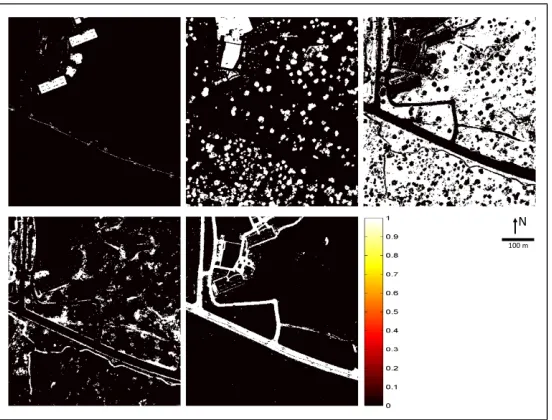
the result of classifying NEON pixels. Note that in the case of classification, each pixel
[image:60.612.170.446.332.542.2]is assigned to only one class and the resulting abundance maps appear black and white.
Figure 3.5 shows the result of spectral unmixing. In this case, each pixel is a mixture of
classes and resulting abundance map values range from 0 to 1.
Figure 3.5: Abundance maps from NNLS unmixing of NEON imaging spectrometer data corresponding to the following classes (left-to-right and top-to-bottom): Roof, Photosyn-thetic Vegetation, Non-PhotosynPhotosyn-thetic Vegetation, Bare Soil, Pavement.
Both classification and unmixing are appealing for different reasons. Classification is
straightforward, we simply assign each NEON pixel to the closest class. NEON pixels are
only 1 m2 and roughly 218 NEON pixels fit within each AVIRIS pixel. Classifying whole
NEON pixels provides good fractional quantization for AVIRIS pixels. Classification also
avoids the circular argument of creating reference data to assess unmixing performance
us-ing other unmixus-ing results. Unmixus-ing, on the other hand, improves fractional quantization
compared to classification. Even 1 m2 pixels are often mixed pixels and classification
ig-nores sub-pixel complexity. This is particularly interesting for the NPV and BS classes in
this study area, where senescent grass often is highly mixed with background soil spectral
response. In other words, a significant portion of the study area gets classified as NPV;
however, many of these NPV pixels also contain a small but significant portion of BS and
3.5. RESULTS 61
3.5.2 Abundance Map Reference Data
Generating the data in Figure 3.6 and Figure 3.7 is the primary objective of this paper.
These abundance maps constitute AMRD. These figures were generate
![Figure 1.1: 1689 World Map by van Schagen of Amsterdam [1].](https://thumb-us.123doks.com/thumbv2/123dok_us/35777.2820/25.612.181.431.88.304/figure-world-map-van-schagen-amsterdam.webp)
![Figure 1.2: 1904 Aerial photograph of the Giza Pyramids by Eduard Spelterini [2].](https://thumb-us.123doks.com/thumbv2/123dok_us/35777.2820/26.612.159.454.89.307/figure-aerial-photograph-giza-pyramids-eduard-spelterini.webp)

![Figure 1.4: (a) RGB representation of Indian Pines imagery, (b) Indian Pines ReferenceData [3].](https://thumb-us.123doks.com/thumbv2/123dok_us/35777.2820/28.612.111.503.86.266/figure-representation-indian-pines-imagery-indian-pines-referencedata.webp)
![Figure 2.1: (a) RGB representation of the Cuprite imaging spectrometer data, (b) Mineralmap derived from the Tetracorder algorithm on VNIR bands, (c) Mineral map derived fromTetracorder algorithm on SWIR bands [4].](https://thumb-us.123doks.com/thumbv2/123dok_us/35777.2820/38.612.105.509.88.267/representation-cuprite-spectrometer-mineralmap-tetracorder-algorithm-fromtetracorder-algorithm.webp)
![Figure 2.2: (a) RGB representation of Indian Pines imagery, (b) Indian Pines ReferenceData [3].](https://thumb-us.123doks.com/thumbv2/123dok_us/35777.2820/39.612.108.504.89.267/figure-representation-indian-pines-imagery-indian-pines-referencedata.webp)
![Figure 2.3: (a) RGB representation of Salinas imagery, (b) Salinas Reference Data [3].](https://thumb-us.123doks.com/thumbv2/123dok_us/35777.2820/40.612.159.450.88.324/figure-rgb-representation-salinas-imagery-salinas-reference-data.webp)