Rochester Institute of Technology
RIT Scholar Works
Theses
Thesis/Dissertation Collections
2017
Aligning Business Decision Making to Strategy
Donald J. Barnes
Katherine A. Dominguez
Whitney J. Vazquez
Follow this and additional works at:
http://scholarworks.rit.edu/theses
This Master's Project is brought to you for free and open access by the Thesis/Dissertation Collections at RIT Scholar Works. It has been accepted for inclusion in Theses by an authorized administrator of RIT Scholar Works. For more information, please [email protected].
Recommended Citation
Aligning Business Decision Making
to Strategy
Donald J. Barnes, Katherine A. Dominguez, Whitney J. Vázquez
Academic Advisor: Dr. Clyde Eiríkur Hull, Rochester Institute of Technology Industry Advisor: Lori Thompson
Rochester Institute of Technology Master of Science in Product Development
Capstone Research Project
2 | Page
Aligning Business Decision Making to Strategy
By Donald J. Barnes Katherine A. Dominguez
Whitney J. Vázquez
RIT 2016-2017
Approved by:
Academic Advisor Clyde Eiríkur Hull Ph.D. Date
Industry Advisor Lori Thompson Date
Author Donald J. Barnes Date
Author Katherine A. Dominguez Date
3 | Page
Acknowledgements
We would like to thank our advisors, Dr. Hull and Lori Thompson for the insights and gentle nudges that made this Capstone possible. We would also like to thank all of those that took time out of their busy schedules to take our surveys and provide the much-needed input for this project.
Donald Barnes
I would like to give my deepest thanks to my family for all the sacrifices they made while I was juggling work, school and the military. I couldn't have done it without your support. I would also like thank my supervisors, both past and present for supporting me through this program. Your flexibility has been a great help. Lastly, I’d like to thank my project team, Kate and Whitney, for all the hard work they put into this with me. Awesome job!
Katherine Dominguez
I would like to thank the Lord for all the grace and blessings in my life. Thank you to my family, especially my husband Miguel for his support; to the St. Irenaeus community for their love and prayers; and to my supervisors during this program, particularly Bill Eign, for their encouragement. Thank you to Don and Whitney for your work on this Capstone.
Whitney Vazquez
4 | Page
Abstract
"Hurry up and wait" is a recipe for inefficiency. Some product development projects start and stop and start again, with team members being added and removed throughout the process. The cost of this lurching does not appear to be well quantified. Moving technical talent from one project to another may assume 100% engineering efficiency, which is not case. Hidden effects of engineers being moved include having to "spin up" on the new project and learn where the last team members left off (which may not be well documented), repeating initial work, and lowered efficiency and morale on the part of the engineers if the reason behind the moves was not well communicated or understood.
5 | Page
Executive Summary
Chapter 1: Introduction
Strategy is an important part of any firm's new product development process. Without a well-formed strategy, projects without well-defined acceptance criteria are funded, greatly increasing the chance for product failure. When making decisions to move resources from one project to another, there are costs associated with those decisions, some obvious, others not. The information presented on strategy was gained through conducting literature reviews, personnel interviews, and online surveys.
Chapter 2: Literature Review
Secondary research was conducted in order to understand and identify what strategy and strategic characteristics are important to product development efforts. This was accomplished through a literature review focusing on product development strategic intent and entrepreneurial orientation. In addition, a search of the literature was conducted that focused on intellectual capital, knowledge management, and the six facets model. A summary of these literature reviews is contained in this chapter.
Chapter 3: New Product Development (NPD) Process
The chosen firm's NPD process is described from the strategic planning, through the annual plan to the gate process for an individual project.
Chapter 4: Methodology
Stakeholders of the product development process at the chosen firm were surveyed and interviewed to collect contextual data, experiences, and opinions on the strategy and decision communications processes being used within the organization.
Chapter 5: Results
Detailed information, along with summaries of the key information gleaned from these two sets of surveys, is documented in this chapter.
Chapter 6: Conclusions
6 | Page
Chapter 7: Future Work
7 | Page
Table of Contents
Abstract ... 4
Executive Summary ... 5
Chapter 1: Introduction ... 5
Chapter 2: Literature Review ... 5
Chapter 3: New Product Development (NPD) Process ... 5
Chapter 4: Methodology ... 5
Chapter 5: Results ... 5
Chapter 6: Conclusions ... 5
Chapter 7: Future Work ... 6
Table of Contents ... 7
Chapter 1 – Introduction ... 10
Background ... 10
Understanding Why ... 10
This Investigation... 12
Chapter 2 – Literature Review ... 13
Strategy ... 13
Strategic Intent ... 13
Strategy Execution ... 13
Costs of Shutting Down a Project ... 14
8 | Page
Open Innovation... 15
Creative Destruction ... 16
Organization and Management Control Systems (MCS) ... 17
Resource Changes ... 18
Training ... 19
Intellectual Capital and Knowledge Management ... 19
Employee Engagement ... 20
Six Facets Model... 21
Entrepreneurial Orientation ... 23
Chapter 3 – New Product Development Process ... 25
Chapter 4 – Methodology ... 27
Senior Leadership Questions (SLQ) ... 28
Engineering Questions (EQ) ... 33
In-Person Interviews ... 37
Origin of Survey Questions ... 37
Chapter 5 – Results ... 38
General Information ... 38
Entrepreneurial Orientation ... 38
Senior Leadership Results ... 55
Strategy ... 55
Resource Moves ... 56
9 | Page
Decision Making ... 69
Engineering Results ... 71
Strategy ... 71
Employee Engagement ... 74
Chapter 6 – Conclusions ... 81
Entrepreneurial Orientation ... 81
Strategy ... 82
Resource Moves ... 84
Knowledge Transfers ... 86
Organization and Management Control Systems (MCS) ... 86
Chapter 7 – Future Work ... 88
Urgency ... 88
Training ... 88
Entrepreneurial Orientation (EO)... 89
10 | Page
Chapter 1 – Introduction
Background
The perception amongst engineers is that there is a greater than industry average churn amongst projects, with people being constantly shifted from one to another. When resources are re-distributed between projects, the firm's management does not know the full effects of their decisions on strategic plans. Members of the leadership team have stated that when a manager pulls a string, they do not know everyone who is affected. If the manager does not know the effects of their decisions in the short term, they certainly can’t know what the long term effects their decision will have.
This lack of clarity leads to people or money being shifted between projects very frequently and inefficiently. In the case of a project being completely shut down due to the shift, the short term effects are fairly obvious: the old project is stopped and will not complete until it is started up again. The long term effects could include opportunity costs of missed sales and additional cost to pull the project out of mothballs. When a project is not completely shut down, the effects are more difficult to quantify. Were the resources moved subject matter experts? Is the increase in schedule a one for one match or something more substantial?
Understanding Why
In order to better understand why these inefficiencies happen, this study is taking a higher level view of the causes of these symptoms and on engineering efficiency. An initial effort to understand these causes led to a conversation with our industry advisor; she described her three reasons for why these symptoms happen in a firm:
1. No project management.
2. No concrete requirements (engineers creating their own requirements rather than Product Management creating requirements).
11 | Page
More discussion into why these inefficiencies are seen at the firm under study led to a list of the some of the common gross inefficiencies including:
● Moving people from project to project because of tactical decisions
● Possibly the number of layers of the engineering organization
● Lack of strategic thinking
● Product Line Management filling the funnel rather than leading Market-driven product development
● Innovation is not budgeted for (Strategic Growth Plan is not used for strategy)
If the firm were to move to Market-driven products from pursuit-driven products, changes would need to be made. The best use of engineering efficiency efforts would be to tackle these gross inefficiencies first.
Moving beyond the gross inefficiencies, another cause is rooted in the fact that most of the firm’s R&D is internally funded, which leads to a careful consciousness of costs in other areas. The division of the firm selected for this research "runs lean," so that there are only ever "the right" number of engineers on a project team and no more. When team members stay on a project for its entire duration, start to finish, this can mean well defined roles and fast-tracking schedule by parallelizing of tasks. However, when team members are moved from the project, this can push out the schedule- possibly delaying deliverables to a point where the rate of return is no longer attractive. This delay in schedule and its concomitant miss on revenue-bearing deliverables may not be understood by decision makers.
12 | Page
this turnover can also leave unanswered questions and knowledge gaps about product design or planning. Again, being a "lean" organization means that there is little time budgeted for succession planning for when resources are moved, quit, retire or become otherwise unavailable (unexpected serious illness, etc.). Senior leaders, who may be interested in making a staffing "trade," may not have visibility into the deliverables that the technical resource, who has been identified to be moved, is responsible for- and the revenue and schedule tied to those deliverables. In terms of strategy, senior leaders have visibility of the "hot new project" that has the potential for some dollar amount in revenue, but may not have in mind the expected revenue that is attached to the deliverables of this technical resource’s current project.
This Investigation
13 | Page
Chapter 2 – Literature Review
Strategy
The concept of corporate strategy has been reviewed from several alternative dimensions. Mintzberg defines strategy with five definitions – as a plan, ploy, pattern, position and perspective. (Mintzberg, 1987, p. 11) When acknowledged as a ‘plan,’ "strategy deals with how leaders try to establish direction for organizations, to set them on predetermined courses of action." (Mintzberg, 1987, p. 21) From his comparison of the five definitions of strategy, Mintzberg concluded that "strategy is not just a notion of how to deal with an enemy or a set of competitors or a market, as it is treated in so much of the literature and in its popular usage. It also draws us into some of the most fundamental issues about organizations as instruments for collective perception and action." (Mintzberg, 1987, p. 22) It is important for an organization to understand its strategic intent; "without strategy, an organization is a collection of individuals, each going his or her own way, or else looking for something to do." (Mintzberg, 1987 p. 26)
Strategic Intent
Strategic intent brings a unifying direction to an organization. "The strategically intent firm is aggressive, relentless, and incessant in the press for advantage through identification of opportunities, planning and execution, and garnering and building resources for leveraging and exploitation." (Mariadoss et al, 2014, p. 3) A clear and disseminated strategy can bridge the goals of the firm: "When you clarify competencies, your entire organization knows how to support your competitive advantage— and readily allocates resources to build cross-unit technological and production links." (Prahalad and Hamel, 1990, p.) The effects on resources, project costs, and competitive advantage due to the lack of strategic intent follow-through are difficult to quantify. While past literature hints that organizational slack may interplay with factors related to a firm's strategic intent, "the exact relationship between firm strategic intent and the level of slack held in the firm has not been addressed." (e.g., Bourgeois, 1981; Tan & Peng, 2003)
Strategy Execution
14 | Page
would think that implementation of strategy should be simple for these leading companies, but creating a strategy and executing on a strategy are two different tasks. "Nielson, Martin and Powers (2008) in their research discovered that 60% of the employees of different companies rated their companies being weak when it came to effective strategy execution." (Higgins, J. M., 2005, p. 1). There appears to be a disconnect in literature and industry between creating sustainable change and effective strategy execution. Many models have been researched and developed for implementing strategy, but the broader context of the effects on daily operations could be addressed further. "The view mentioned is also supported by Corboy and O’Corrbui (1999) who argue that it is equally imperative to understand that strategy being applied and executed along with daily operations." (Higgins, J. M., 2005, p. 1)
Kotter’s (2013) framework for effective strategy execution stresses that the key step missing between strategic planning and execution is the urgency process.
An urgency process is a quantifiable and repeatable way to generate alignment, urgency, and engagement in a majority of employees in a company, division, functional area, or large team. Some of the elements it contains are:
● Senior leadership team alignment around a market opportunity
● An urgency team
● Urgency initiatives to create alignment, urgency, and engagement
● A way to capture names of urgent employees that want to volunteer to help
● A means of measuring urgency to ensure at least 50% of the organization is urgent Additional research has shown that most executions fail with the presence of a poor communication plan. The research of Kaplan and Norton (2005:44) revealed that as much as 95% of the employees in a typical organization are unaware of or do not understand their company’s strategy.
Costs of Shutting Down a Project
15 | Page
unknown is if the costs associated with shutting down the other projects are taken into account prior to the decision to switch priorities. There are monetary costs associated with loss of learning, storage of incomplete development items, etc. There are also more soft costs as those involved face uncertainty and stress when placed on a new project. Fields such as real options, open innovation, and transaction cost economics (TCE) deal with decision making choices presented to management. At the same time, creative destruction can influence management decisions on what projects to pursue.
Real Options
Real options refer to "application of option pricing theory to the valuation of non-financial or ‘real’ investments with learning and flexibility." (Borison, 2005, p. 1; Myers, 1977) Generally speaking, real options refer to the decision around an opportunity to invest (or not) and when to best exercise that decision. Real options stress such principles as "it is optimal to wait longer before investment" (Dixit, 1992, p. 108) which is echoed by Mercier who highlights the "value of waiting and learning before investing." (Mercier, 2002, p. 77) Real options thinking also emphasizes the value of strategic investments "such as research and development, where additional options are created by investments." (Mercier, 2002, p. 77) A high technology firm will necessarily need to pursue R&D strategically, so as to generate new, real options effectively. Volatility of the business impacts the value of real options, where "volatile businesses derive the most value by having the flexibility to exercise a diverse portfolio." (Mercier, 2002, p. 78)
Open Innovation
16 | Page
(Kortelainen et al., 2012, p. 5) Amplification "by time compression diseconomies" (Dierickx & Cool, 1989) means "that the direction of the firm is hard or even impossible to change in short run, causing delays to strategic intent and action." (Kortelainen et al., 2012, p. 5) This means that extra care must be taken when deciding to forgo a strategic project in favor of a more tactical one because it will take even longer to reach the strategic goal.
Companies are using new and innovative methods to achieve strategic goals. Open source is a boundary-blurring approach to innovation that typically involves software development by volunteers. A more corporate-appropriate approach might be the more recently-developed community source model, in which companies, rather than individuals, cooperate to develop software for their mutual use (Liu, Wu, Zhao & Zhu, 2010). This parallel runs closer than standard open innovation to the scenario of multiple development projects within a single high-tech business. In community source, participants share resources, including personnel, as needed for the development project, but problems with allocating work across the participants may lead to conflict and potentially a need for outsourcing (Liu, et al., 2010). Similarly, what we call internal source –the sharing of development resources across multiple internal independent projects– may cause conflict and difficulty as personnel are shifted to new projects at the cost of the projects in which they were already enmeshed. However, just as community source can be a highly effective approach to cooperative innovation across organization boundaries (Liu, Hull & Hung, 2017), we suggest that internal sourcing has the potential to be a highly effective approach to internal innovation.
Creative Destruction
17 | Page
the investment is irreversible, (2) the uncertainty regarding the investment is being resolved gradually in time, and (3) the investment can be flexibly postponed." (Dixit, 1992, p. 108)
With the fast pace of technology, it is important to track strategic technology shifts in order to understand when an advance is likely to start eroding the current base. William E. Halal mentions four keys to working in a technology industry which is constantly living in an age of creative destruction. The first is to "Track Strategic Technologies" (Halal, 2015, p. 42): companies are influenced by a wide variety of technology, "so it is essential to identify those that are strategic for a specific organization and monitor their progress." (Halal, 2015, p. 42) Doing so allows one to keep track of potentially disruptive technologies to one’s existing base. It also leads to Halal’s second point, "Develop Creative Opportunities… Disruptive technologies that could change an industry are especially important and require creative thought to develop viable new business ventures." (Halal, 2015, p. 43) Sharing knowledge allows for more rapid development. "Cooperation is crucial in today’s knowledge economy because knowledge increases when shared." (Halal, 2015, p. 44) This cooperation is what Halal calls involving stakeholders. Stakeholders can be both internal (employees, management) and external (customers, industry experts). He goes so far as to recommend "cooperating even with competitors to produce better results for all." (Halal, 2015, p. 44) Halal’s next point is to "Plan for Both Failure and Success" (Halal, 2015, p. 44). There is always risk involved with new technology, so it is wise to hedge your bets. "Disruptive technologies involve great uncertainty, so failures should be anticipated and planned for." (Halal, 2015, p. 44) Halal quotes Steve Jobs: "Killing bad ideas is not hard—what is really hard is killing good ideas." While the context was filtering out ideas to make new products from, it is easily applied to the existing regime. Companies must decide when it is time to kill off yesterday’s good ideas to embrace new, better ones.
Organization and Management Control Systems (MCS)
18 | Page
1998, p. 156) "Consistent with Brickley, et al. (1997) and Rotch (1993) the system of management control [MCS] is comprised of three variables: performance measurement, organization structure, and incentives." (Hammermeister, 2005, p. 15) The decision to end a project in favor of another is therefore a combination of how performance is measured within the organization, the structure (hierarchy vs. polyarchy) and how management is incentivized. "Given an uncertain environment, TCE posits that the system of management controls should exhibit the following characteristics: (a) Financial measures must be complemented with appropriate nonfinancial measures to provide decision-makers with a complete picture of business unit performance; (b) the organization should be structured so that decision rights are placed further down the organizational hierarchy, providing decision-makers with the flexibility to respond quickly; and (c) incentive compensation should be subjectively based, allowing latitude to adjust rewards for the vagaries of cause and effect present in a dynamic environment." (Hammermeister, 2005, p. 20) Hammermeister further advocates the Balanced Scorecard Concept (BSC) developed by (Kaplan & Norton, 1992) because it provides "managers with an integrated set of financial and nonfinancial performance measures." (Hammermeister, 2005, p. 156) Not only did he find "BSC usage had a more positive impact on effectiveness for those business units following a product differentiation strategy," he found that "the evidence was consistent… that the method of determining incentive compensation interacts with strategy in impacting effectiveness." (Hammermeister, 2005, p. iv) Followers of open innovation would agree with the assessment of MCS, with (Remneland-Wikhamn & Knights, 2012, p. 285) quoting (Teece, 2000) that "flexible boundaries, high powered incentives, non-bureaucratic decision making, shallow hierarchies and an innovative and entrepreneurial culture" are required attributes.
Resource Changes
19 | Page
be a way to evaluate the strategic weights of each project and calmly evaluate the decision to move resources. Much of this work could be done in early discussions about risk and contingency planning. Then, later changes in the market or environment would lead to an already thought-out response from the firm, like following a premeditated contingency plan, rather than a hasty reaction.
Most new product development projects require multi-disciplinary teams, which means different functional leads coordinating on resource planning with different targets in mind. Kaplan and Norton (2005:47) pointed out that the problem with a lack of resources lies in the alignment with the strategy between the various corporate functions. There will be various goals and plans within a business unit, but they should be aligned as best as possible.
Training
Training is essential for making a system work. For success in plan execution, it is recommended "to budget significant time and money, to provide documentation, to choose the most appropriate approach to training, and to bring in power users" (Liao et al., 2013, p. 15). Training on technical or project management subjects is useful and needed in general, but there is also specific project training that is often undertaken informally and learned by team members as the project initially ramps up. As this training happens naturally and informally, it is rarely fully documented and becomes difficult to transfer to a new team member if there is a sudden resource change. The more sudden and permanent the resource change, the greater the difficulty in knowledge transfer. Rolling a resource off of a project while they ramp onto their next one is one way that some firms allow time for some natural answering of questions as they arise from the new team member.
Intellectual Capital and Knowledge Management
Intellectual capital (IC) and knowledge management (KM) have both been studied in relation to a firm’s innovation. "A firm’s KM capability may be defined as "the firm’s ability to create, transfer, integrate, and leverage knowledge" (Tanriverdi (2005) as cited in Hsu and Sabherwal, 2011, p. 629). When a team is formed, relevant project knowledge is stored in the people of that team and in their interactions and relationships. Informal networks and relational knowledge aid innovation efforts.
20 | Page
is likely to lead to more knowledge being stored in organizational systems, routines, and so on." (Walsh and Ungson (1991) as cited in Hsu and Sabherwal, 2011, p. 630). Strong bonds between project team members can allow knowledge to be shared and acted on more efficiently. "Conversely, weak ties (which reflect a lower level of social capital) impede transfer of knowledge, especially when knowledge is not codified" (Hansen (1999) as cited in Hsu and Sabherwal, 2011, p. 631). When a team member is moved regularly off of a project team after being "spun-up," the time and effort put into training that person now has a lower return on investment (ROI) and some of the knowledge built into the team structure and interactions is lost. When individuals are moved on short notice, there often is not time to transfer the knowledge well and great inefficiencies are accepted.
Hsu and Sabherwal’s 2011 study shows "support for the following overall causal path: IC → KM capability → innovation → firm performance." (Hsu and Sabherwal, 2011, p. 637-638). Human capital was the one dimension of IC that had a direct effect on innovation, social capital and organizational capital did not. New product development projects, creative designs, and process improvements all rely on the skills, knowledge, and experience of each team member to come to fruition. When a team of employees work on a project for a length of time, team synergies are found and leveraged in a way that is difficult to document and relies on the interactions of the team members. The importance of knowledge management in innovative pursuits, especially transfer of knowledge within the organization, should be stressed, but cannot take the place of the having the team remain generally intact.
Employee Engagement
21 | Page
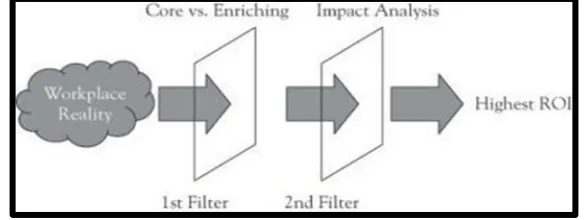
[image:22.612.159.452.150.260.2]One way to improve employee engagement is to "show that the company is committed to a long-term relationship, one that will survive short-long-term pressures" (LID, 1). The short-long-term pressures of multiple "hot" projects can be a good problem to have and can be better handled with improved up-front planning.
Figure 1. Filters for Employee Engagement. Source: PerformancePoint, LLC (Federman, 2009)
Six Facets Model
"Organizational fitness is often achieved by making changes in business operations, changes which frequently involve the use of a new technology" (Kearns, Taylor, and Hull, 2005, p. 77). Kearns, et al. (2005) list the six facets of technology management as Technology Evaluation, Product & Process Integration, Planning, Implementation, Training, and Change. Their six facets tool can be used to aid the process of technology management, from technology selection to implementation; it "summarizes elements which should not be overlooked when attempting to effectively implement change in an organization." (Kearns, et al., 2005, p.78)
22 | Page
reasoning behind a change, members of the organization may not accept it." (Kearns, et al., 2005, p. 80) If information critical to product design or project success is undocumented and kept solely or mostly in tribal knowledge, turnover can have a much more devastating effect on the success of the project. Not clearly communicating the reason behind a change, in staffing, direction, or strategic needs of the business leads to less buy-in from team members.
The "Planning" facet highlights the importance of scope definition. A clear definition of scope can help to keep the project on schedule and on budget. The scope helps to maintain the project’s purpose, which allows for clear alignment of projects to strategic goals.
Using the six facets model as a guide, the following questions are investigated: 1) Has the business been following its strategic plan?
2) Are projects being staffed correctly to achieve the stated strategy? 3) Are employees being affected by project staffing decisions? 4) Is the business losing knowledge based on resource transfers?
Strong leadership is needed for both authority and communication. "A strong central leader is necessary to keep a project on track. This is especially important if a change involves many functional groups, or even multiple brands. Having one leader to represent each group is often not enough to maintain authority and responsibility for a project." (Kearns, et al., 2005, p. 80). If leadership does not regularly and consistently communicate the vision to the team, the goals of the project may not be well understood throughout the levels of the project organization. If these goals are not understood, it becomes difficult to discuss product development process in a useful way.
23 | Page
Scope definition during the planning stages means expectations can, and should, be clearly set early in the project. This allows for improved accountability for teams and individuals. In the BBW case study, questions relating to the "Planning" facet "focused on team composition, member selection criteria, experience and involvement, scope, schedule and budget changes and challenges." (Kearns, et al., 2005, p. 87) Turnover was listed by BBW respondents as a major challenge in shakedown (the time period after roll-out until the return to normal operations) and communication was listed as a process weakness (Kearns, et al., 2005, p. 99). Questions could be written to find if these two elements are also seen as problems at the firm during recent product development efforts.
Cox et al. (2007) conducted survey research that validated Kearns et al.’s (2005) findings based on a semi-structured interview case study approach in a different setting. Hull, Baroody and Payne (2007) highlight a question they argue is overlooked in the original six facets model: Whether to make the change at all, or simply stay the current course. In a variation on this theme, Luxmore & Hull (2010) suggest that the model can be strengthened by considering potential negative consequences of the change being evaluated. In the current study, we are careful not to overlook these issues. Liao et al., (2013) offer insights into the six facets model based on a high-technology innovation setting that are also useful in the context of this study, including the importance of sticking to a plan rather than modifying it frequently over time. However, ours is the first study to use both semi-structured interviews and survey data to apply the six facets model to innovation in a high-technology setting.
The Cox, et al. (2007) study included both in-person interview and web-based survey response questions. This case study will focus on web-based survey response questions to collect enough data to be statistically relevant and use interviews to supplement the data collected in surveys.
Entrepreneurial Orientation
24 | Page
25 | Page
Chapter 3 – New Product Development Process
The new product development process at the firm under review starts with the Strategic Growth Plan (SGP). The annual SGP is developed by each segment of the business and projects planned out for the next three fiscal years. The SGP defines key areas for growth of existing products, adjacent markets to expand into, and potentially new markets to pursue.
Following the SGP, every year the segments develop an Annual Operating Plan (AOP) that defines the specific areas of the SGP that will be addressed in the upcoming fiscal year. Internally funded research and development (IRAD) is allocated to a number of projects based on their priority. Projects that will span multiple fiscal years will get an allocation for the current FY with projects made for remaining funding needed in following years.
During execution of a project, a gate process is used where five gates need to be passed with a yes/no decision prior to launch. While typically depicted as a linear process, activities can be performed sequentially, or in parallel.
Between the major phases, a CheckPoint Review Board (CRB) meets to make informed decisions on the future of the project. They make go/no-go or redirect decisions based on risks and additional resource requirements. The CRB will meet whenever all required deliverables for that CheckPoint have been delivered. The CRB will also meet if the project goes "out of bounds," meaning something large has changed that requires immediate feedback by the CRB. Reasons for going "out of bounds" vary from external influences (shift in customer focus), resources were not delivered, etc.
26 | Page
executives. Class C projects, on the other hand, are typically chaired by a product line leader and members are a Director or Senior Managers.
The division of the firm being surveyed is working through a change process to become a more strategically aligned organization. Using the Six Facets Model to grade the change management effort so far could help the firm highlight what’s been done well to date and where opportunities might lie for improvement as this change effort continues. The methodology of the Kearns, et al. Bath and Body Works (BBW) case study could be used as a model for this grading effort. (Kearns, et al., 2005, p. 79)
The division of the firm being surveyed is now in Year 1 of Executing to Strategy. There is now monthly status reporting in this division on how business decisions matches the stated strategy and quarterly reporting on this strategy-alignment to Headquarters. A case study of the change management process with regards to strategy could assist leadership and middle managers as the process continues.
Our industry advisor highlighted "Change" and "Planning" as two of the Six Factors that the firm could most work on improving. Her work in Strategy organizations also connects strongly with the "Technology Evaluation" facet. Investigations of these facets at the firm are further discussed in the case study sections in Chapters 5 and 6.
27 | Page
Chapter 4 – Methodology
28 | Page
Senior Leadership Questions (SLQ)
SLQ # Question Literature Link
Question Group 1
In the following scale items, the terms risk-taking,
innovativeness, and proactiveness are used. As employed in these items, risk-taking refers to a willingness to commit resources to projects, ideas, or processes whose outcomes are uncertain and for which the cost of failure would be high. Innovativeness refers to a the exhibition of experimentation, exploration, and creative acts as reflected in, for example, new products/services, new process technologies, new methods of operation, and new business strategies.
Proactiveness refers to engaging in forward-looking actions targeted at the exploitation of opportunity in anticipation of future circumstances, as would be typical of firms that lead and/or pre-empt the actions of others (e.g., market pioneers, early adopters of new technologies).Given these definitions, please indicate the extent to which you agree with the following statements. (All items rated on 5-point, Likert-type scales ranging from "Strongly disagree" [=1] to "Strongly agree" [=5].)
1.1 If an entrepreneurial firm is operationally defined as "one that engages in product-market innovation, undertakes somewhat risky ventures, and is first to come up with ‘proactive’ innovations, beating competitors to the punch," then my firm is an entrepreneurial firm.
Creative Destruction (CD), Entrepreneurial Orientation (EO)
1.2 My firm characteristically exhibits high levels of risk taking, innovativeness, and proactiveness.
CD, EO
29 | Page
initiatives before potential rivals recognize the opportunities at which our initiatives are targeted.
1.4 Risk taking, innovativeness, and proactiveness are equally inherent to my firm’s overall business orientation.
CD, EO
1.5 The innovative initiatives pursued/funded by my firm are
often somewhat risky and industry leading (i.e., chosen in advance of other firms’ potentially similar initiatives).
CD, EO, Strategy (S), Strategic Intent (SI)
1.6 My firm concurrently manifests risk taking, innovativeness, and proactiveness.
CD, EO
1.7 My firm often pre-empts its rivals by being an early leader with innovations whose successful outcomes cannot be assured.
CD, EO
1.8 In general, my firm is on the cutting edge when it comes to exploiting entrepreneurial opportunities because of our desire and demonstrated ability to embrace novel (and often risky) innovative initiatives ahead of our rivals.
CD, EO, S
Question Group 2
2 How do you rate your firm on its ability to effectively
execute strategy? (1-5 scale, 1 weak, 5 strong)
SE
3 How often do you see the strategy being applied and
executed in daily operations? (1-5 scale, 1 never, 5 always)
30 | Page
4 Do you understand the firm's strategy? (Yes, No, Somewhat,
Don't care to know)
S
5 How many years have you worked at your division of the
firm?
6 During that time period, how many projects have you
overseen?
7 How many of these projects were cancelled to transfer
resources to a higher priority project?
Real Options (RO), Resource Change (RC)
8 How many of the cancelled projects were part of the strategic
plan?
Open Innovation (OI)Strategy (S),
Strategic Execution (SE)
9 How many of the cancelled projects were started up again at
a later date?
RO, S, SE
10 How many of these projects were not cancelled but had staff
moved off to a higher priority project?
RO, RC
11 How many of the downsized projects were part of the
strategic plan?
OI, RO, S, SE
12 How many of the downsized projects completed on time? RO
13 How many of the projects were increased by pulling in
resources from other projects?
31 | Page
14 How many of the increased projects were part of the strategic
plan?
OI, RO, S, SE
15 Of these increased projects, how many were completed on
time?
RO
16 Of these increased projects, how many met the financial
expectations (orders, revenue, etc.)?
Management Control Systems (MCS)
17 How many projects have had significant scope change (ex:
large design change after months of engineering effort)?
Six Facets Model(SFM)
18 When people moved off of a project, how much time passed
between their finding out they’d be changing positions and their starting the new one full-time? (enter time in days)
RC
19 How well do you feel the reason for these project changes are
communicated to employees? (1-5 scale, 1 Poor, 5 Outstanding)
Employee Engagement (EE)
20 How well do you think documentation and knowledge
capture (of requirements/design decisions/lessons learned) happened on these projects? (1-5 scale, 1 Poor, 5
Outstanding)
SFM
21 Was time allotted for clean handoff and/or documentation?
(Yes, No, Somewhat, Don't know)
RC
22 Does training/standard practice exist on knowledge
capture/hand offs? (Yes, No, Somewhat, Don't know)
32 | Page
23 Who planned training or team on-boarding/ramp up for new
members of the project team?
24 What were the main challenges in providing training to new
members of the project team?
25 Given the same set of resources (time, staff, budget), what would you do differently?
Question Group 3
26 What measures are used to track the performance of the
business unit? (financial, non-financial, both)
TCE, MCS
27 At what level are resource shifts typically made (CEO, Pres,
VP, Senior Manager, Manager) or are the decisions made in a cross-functional committee?
TCE, MCS
28 Is incentive compensation based on objective or subjective
criteria? (1-5, 1 = purely objective, 5 = purely subjective)
33 | Page
Engineering Questions (EQ)
EQ # Question Literature Link
Question Group 1
In the following scale items, the terms risk-taking,
innovativeness, and proactiveness are used. As employed in these items, risk-taking refers to a willingness to commit resources to projects, ideas, or processes whose outcomes are uncertain and for which the cost of failure would be high. Innovativeness refers to a the exhibition of experimentation, exploration, and creative acts as reflected in, for example, new products/services, new process technologies, new methods of operation, and new business strategies.
Proactiveness refers to engaging in forward-looking actions targeted at the exploitation of opportunity in anticipation of future circumstances, as would be typical of firms that lead and/or pre-empt the actions of others (e.g., market pioneers, early adopters of new technologies).Given these definitions, please indicate the extent to which you agree with the following statements. (All items rated on 5-point, Likert-type scales ranging from "Strongly disagree" [=1] to "Strongly agree" [=5].)
1.1 If an entrepreneurial firm is operationally defined as "one that engages in product-market innovation, undertakes somewhat risky ventures, and is first to come up with ‘proactive’ innovations, beating competitors to the punch," then my firm is an entrepreneurial firm.
Creative Destruction (CD), Entrepreneurial Orientation (EO)
1.2 My firm characteristically exhibits high levels of risk taking, innovativeness, and proactiveness.
34 | Page
1.3 My firm often takes calculated risks by pursuing innovative
initiatives before potential rivals recognize the opportunities at which our initiatives are targeted.
CD, EO
1.4 Risk taking, innovativeness, and proactiveness are equally
inherent to my firm’s overall business orientation.
CD, EO
1.5 The innovative initiatives pursued/funded by my firm are
often somewhat risky and industry leading (i.e., chosen in advance of other firms’ potentially similar initiatives).
CD, EO, Strategy (S), Strategic Intent (SI)
1.6 My firm concurrently manifests risk taking, innovativeness,
and proactiveness.
CD, EO
1.7 My firm often pre-empts its rivals by being an early leader with innovations whose successful outcomes cannot be assured.
CD, EO
1.8 In general, my firm is on the cutting edge when it comes to exploiting entrepreneurial opportunities because of our desire and demonstrated ability to embrace novel (and often risky) innovative initiatives ahead of our rivals.
CD, EO, S, Strategic Intent (SI)
Question Group 2
2 How many years have you worked at your division of the
firm?
3 Do you know the five pillars of the firm's strategy? (Or
easily know where to find them?)
35 | Page
4 Do you understand the firm's strategy? S
5 Do you know our core competencies? (Or easily know where
to find them?)
SI, SE
6 Do you know how the work you are doing connects to the
firms' strategy or core competencies?
SI, SE
7 Of the projects you’ve been involved with, how many were
part of the strategic plan for the company?
RO, OI, S, SE
8 How would you rate your firm on its ability to effectively
execute strategy?
SE
9 How often do you see the strategy being applied and
executed in daily operations?
36 | Page
Question Group 3
10 How many of the projects you have been involved on were
cancelled to transfer resources to a higher priority project?
Real Options (RO)
11 How many projects were not cancelled but you were
transferred to a higher priority project?
RO, SE
12 If you have been moved off a project, do you feel your career
was helped or hurt by these moves?
TCE, EE
13 If you have been moved off a project, do you feel the firm
(and overall completion of priority projects) was helped or hurt by these moves?
TCE, EE
14 How well do you feel the reason for these project changes
were communicated to you? (1-5 scale, 1 Poor, 5 Excellent) EE
15 How many projects have you been on that have had
significant scope change (ex: large design change after months of engineering effort)?
TCE, SFM
16 How well do you think documentation and knowledge
capture (of requirements/design decisions/lessons learned) happened on these projects? (1-5 scale, 1 poor, 5 excellent)
SFM
37 | Page
17 I feel loyal to my… (Project Team, Discipline Team,
Neither, Other)
EE
18 How many people do you know who left the company due to
(or you believe due to) being shifted on projects?
EE
19 Relating to the question above about people you know (or
believe) left the company due to being
shifted on projects: Please provide names so we can provide an accurate count (names will not be
provided in the results):
EE
20 Optional: Please share any thoughts you may have on how
the firm can better align decisions to strategy, and how best to communicate these ideas to decision makers. Your honest feedback is extremely helpful.
EE
In-Person Interviews
In addition to the online surveys, in-person interviews will be conducted to collect any additional feedback that may not come from the online survey. At a minimum, the survey questions can be asked. If the interviewee had not already completed the online survey, the inputs can be added to those results. If they had, then the inputs will not be added but can be used to correlate to the overall results.
Origin of Survey Questions
38 | Page
Chapter 5 – Results
General Information
The senior leadership survey was sent to 72 managers and above within the engineering organization. An email request was sent with the option to take the online survey or opt for an in person interview. A total of 34 managers took the online survey and two opted for in-person interviews. Of those taking the online survey, only 20 completed the full survey. It is unclear the reason for not finishing, though one person did report a technical error that closed the session out early.
The employee survey was online only and was sent out to 939 engineers within the division, with 208 respondents and 193 of them completing the full survey.
Eight of the respondents failed to provide a valid response to the years of service question, the remainder are broken up into the following categories:
Years of Service Employee Total Employee %
>16 years 41 19.71%
11-16 years 54 25.96%
6-10 years 59 28.37%
1-5 years 36 17.31%
<1 year 10 4.81%
Entrepreneurial Orientation
39 | Page
Agree. Each of the questions below is broken up by raw count for each of the response categories along with a percentage response rate for both the leadership and the employees. An overall average is provided for the two groups as well as a standard deviation. The data was further correlated against years within the company.
NOTE: The leadership portion is left as one group. Only 26 of the 36 respondents completed that portion of the survey and 65% of those were in the > 16 year category and 23% were in the 11 - 16 year group, making it difficult to gather much meaning from further breakdowns of the data.
Q1: If an entrepreneurial firm is defined as "one that engages in product-market innovation, undertakes somewhat risky ventures, and is first to come up with ‘proactive’ innovations, beating competitors," then my firm is an entrepreneurial firm.
Strongly Disagree
Disagree Neutral Agree Strongly
Agree
total
engineer raw count
18 49 35 72 24 198
engineer % 9.09% 24.75% 17.68% 36.36% 12.12% 100%
leader raw count
3 12 10 7 4 36
leader % 8.3% 33.3% 27.8% 19.4% 11.1% 100%
40 | Page
41 | Page Q2: My firm characteristically exhibits high levels of risk taking, innovativeness, and proactiveness.
Strongly Disagree
Disagree Neutral Agree Strongly
Agree
total
engineer raw count
29 68 50 43 9 199
engineer % 14.57% 34.17% 25.13% 21.61% 4.52% 100%
leader raw count
5 16 6 8 1 36
leader % 13.9% 44.4% 16.7% 22.2% 2.8% 100%
42 | Page
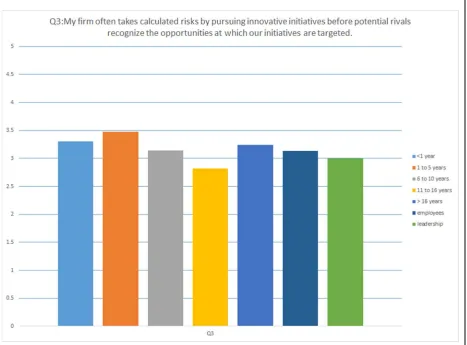
43 | Page Q3: My firm often takes calculated risks by pursuing innovative initiatives before potential rivals recognize the opportunities at which our initiatives are targeted.
Strongly Disagree
Disagree Neutral Agree Strongly
Agree
total
engineer raw count
15 46 48 71 16 196
engineer % 7.65% 23.47% 24.49% 36.22% 8.16% 100%
leader raw count
1 12 9 14 0 36
leader % 2.8% 33.3% 25% 38.9% 0% 100%
44 | Page
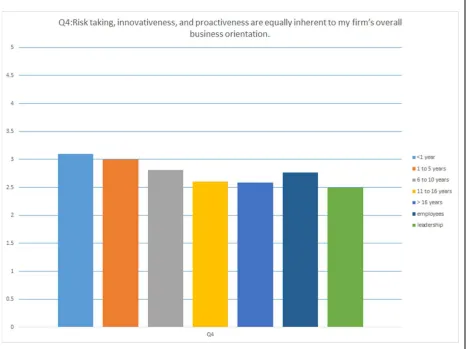
45 | Page Q4: Risk taking, innovativeness, and proactiveness are equally inherent to my firm’s overall business orientation.
Strongly Disagree
Disagree Neutral Agree Strongly
Agree
total
engineer raw count
16 77 53 43 9 198
engineer % 8.08% 38.89% 26.77% 21.72% 4.55% 100%
engineer raw count
6 15 7 7 1 36
leader % 16.7% 41.7% 19.4% 19.4% 2.8% 100%
46 | Page
47 | Page Q5: The innovative initiatives pursued/funded by my firm are often somewhat risky and industry leading (i.e., chosen in advance of other firms’ potentially similar initiatives).
Strongly Disagree
Disagree Neutral Agree Strongly
Agree
total
engineer raw count
19 52 58 63 6 198
engineer % 9.60% 26.26% 29.29% 31.82% 3.03% 100%
leader raw count
2 12 8 13 1 36
leader % 5.6% 33.3% 22.2% 36.1% 2.8% 100%
48 | Page
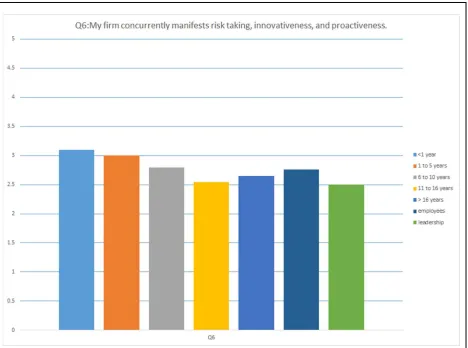
49 | Page Q6: My firm concurrently manifests risk taking, innovativeness, and proactiveness.
Strongly Disagree
Disagree Neutral Agree Strongly
Agree
total
engineer raw count
18 71 55 50 4 198
engineer % 9.09% 35.86% 27.78% 25.25% 2.02% 100%
engineer raw count
3 19 7 7 0 36
leader % 8.3% 52.8% 19.4% 19.4% 0 100%
50 | Page
51 | Page Q7: My firm often pre-empts its rivals by being an early leader with innovations whose successful outcomes cannot be assured.
Strongly Disagree
Disagree Neutral Agree Strongly
Agree
total
engineer raw count
20 36 61 68 12 197
engineer % 10.15% 18.27% 30.96% 34.52% 6.09% 100%
leader raw count
2 10 13 11 0 36
leader % 5.6% 27.8% 36.1% 30.6% 0% 100%
52 | Page
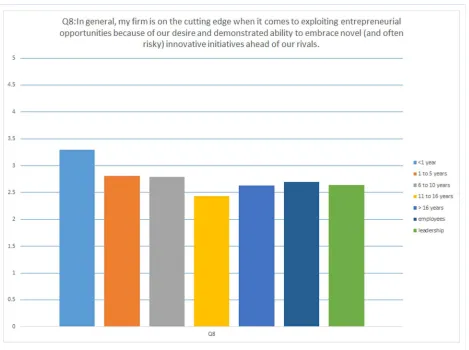
53 | Page Q8: In general, my firm is on the cutting edge when it comes to exploiting entrepreneurial opportunities because of our desire and demonstrated ability to embrace novel (and often risky) innovative initiatives ahead of our rivals.
Strongly Disagree
Disagree Neutral Agree Strongly
Agree
total
engineer raw count
32 63 48 44 11 198
engineer % 16.16% 31.82% 24.24% 22.22% 5.56% 100%
leader raw count
4 15 8 8 1 36
leader % 11.1% 41.7% 22.2% 22.2% 2.8% 100%
54 | Page
55 | Page
Senior Leadership Results
The following topic areas are the results of the Senior Leadership Questions (SLQs).
Strategy
SLQ9: How do you rate the firm on its ability to effectively execute strategy? (1-5 scale, 1 weak, 5 strong)
Poor (1) Below
Average (2)
Average (3) Above
Average (4)
Outstanding (5)
Total
raw count 2 13 17 3 1 36
% 5.56% 36.11% 47.22% 8.33% 2.78% 100%
Average: 2.67
Standard Deviation: 0.83
SLQ10: How often do you see the strategy being applied and executed in daily operations? (1-5 scale, 1 never, 5 always)
Never (1) (2) (3) (4) Always (5) Total
raw count 2 13 15 6 0 36
% 5.56% 36.11% 41.67% 16.67% 0% 100%
Average: 2.69
56 | Page SLQ11: Do you understand the firm's strategy?
Yes No Somewhat Don’t Care Total
raw count 18 2 16 0 36
% 50% 5.56% 44.44% 0% 100%
Resource Moves
Senior Leadership questions (SLQ) 13 to 24 dealt with the movement of people between projects and how that relates to the strategic goals set forth in the Strategic Growth Plan. Of the 37 leaders, 24 completed this portion of the survey. Further, two were thrown out for reporting overseeing 100 and 250 projects with the mean without those respondents being 16 projects. Another respondent's data point was thrown out for reporting more projects affected by moves than total projects overseen, leaving 21 respondents.
SLQ13: During that time period, how many projects have you overseen?
# of Respondents # of Projects
57 | Page SLQ14: How many of these projects were cancelled to transfer resources to a higher priority project?
# of Cancelled Projects % of Total Projects # of "Don’t Know" Responses
43 34.9% 0
SLQ15: How many of the cancelled projects were part of the strategic plan?
Four of the respondents responded "Don’t Know." Excluding their reported cancelled projects yields:
# of Cancelled Projects (strategic)
% of Cancelled Projects % of Total Projects
12 44.4% 3.6%
Using the above percentage as an assumption about the projects for those reporting "Don’t Know" yields an additional 7 cancelled projects which were part of the strategic plan. Those values are then used with the result above to yield:
# of Cancelled Projects (strategic, assuming don’t know)
% of Cancelled Projects % of Total Projects
19 44.2% 5.6%
SLQ16: How many of the cancelled projects were started up again at a later date?
58 | Page
the total yields:
# of Restarted Projects % of Cancelled Projects
15 40.5%
Assuming the same percentage listed above applies to the "Don’t Know" projects yields:
# of Restarted Projects % of Cancelled Projects
17 39.5%
SLQ17: How many of these projects were not cancelled but had staff moved off to a higher priority project?
Four of the respondents selected "Don’t Know." Excluding their projects from the total yields:
# of Downsized Projects % of Total Projects
54 24%
Assuming the same percentage applies to those responding "Don’t Know" yields:
# of Downsized Projects % of Total Projects
59 | Page SLQ18: How many of the downsized projects were part of the strategic plan?
Seven respondents replied "Don’t Know" (includes those that replied don’t know to SLQ17). Excluding their projects yields:
# of Downsized Projects (strategic)
% of Downsized Projects % of Total Projects
23 60.5% 6.8%
Assuming the same percentage applies to those responding "Don’t Know" yields (includes assumption from SLQ17 results):
# of Downsized Projects (strategic)
% of Downsized Projects % of Total Projects
43 53.1% 12.8%
SLQ19: How many of the downsized projects completed on time?
# of Downsized Projects Completed On Time % of Downsized Projects
60 | Page SLQ20: How many of the projects were increased by pulling in resources from other projects?
# of Upsized Projects % of Total Projects
60 17.8%
SLQ21: How many of the increased projects were part of the strategic plan?
Six respondents replied "Don’t Know." Excluding their projects yields:
# of Upsized Projects (strategic) % of Upsized Projects % of Total Projects
35 97.2% 10.1%
Assuming the same percentage, including the estimates for the "Don’t Know" answers yields:
# of Upsized Projects (strategic) % of Upsized Projects % of Total Projects
58 96.7% 17.2%
SLQ22: Of these increased projects, how many were completed on time?
Five respondents replied "Don’t Know." Excluding their projects yields:
# of Upsized Projects (on time) % of Upsized Projects
61 | Page
Assuming the same percentage applies to those responding "Don’t Know" yields:
# of Upsized Projects (on time) % of Upsized Projects
12 20%
SLQ23: Of these increased projects, how many met the financial expectations (orders, revenue, etc.)?
# of Upsized Projects (met expectations) % of Upsized Projects
28 46.7%
SLQ24: How many projects have had significant scope change (ex: large design change after months of engineering effort)?
# of Significant Scope Change % of Total Projects
62 | Page
Knowledge Transfers
SLQ25: When people moved off of a project, how much time passed between their finding out they’d be changing positions and their starting the new one full-time?
# of Respondents Average (days)
25 8.4
SLQ26: How well do you feel the reason for these project changes are communicated to employees?
Poor (1) Below
Average (2)
Average (3) Above
Average (4)
Outstanding (5)
Total
raw count 4 10 11 1 0 26
% 15.38% 36.46% 42.31% 3.85% 0% 100%
Average: 2.35
Standard Deviation: .78
SLQ27: How well do you think documentation and knowledge capture (of requirements/design decisions/lessons learned) happened on these projects?
63 | Page
Average (2) Average (4) (5)
raw count 8 12 5 1 0 26
% 30.77% 46.15% 19.23% 3.85% 0% 100%
Average: 1.96
Standard Deviation: .81
SLQ28: Was time allotted for clean handoff and/or documentation?
Yes No Somewhat Don’t Know Total
raw count 2 14 6 0 22
% 9.09% 63.64% 27.27% 0% 100%
63.64% of respondents thought that sufficient time was not allotted for handoff and documentation when they were transferred from one project to another.
SLQ29: Does training/standard practice exist on knowledge capture/hand offs?
Yes No Somewhat Don’t Know Total
64 | Page
% 0% 63.64% 36.36% 0% 100%
SLQ28 and SLQ29 are related. 63.64% of respondents thought that sufficient time was not allotted for handoff and documentation when they were transferred from one project to another. Zero percent of respondents said that training/standard practice exists on knowledge capture/handoffs and only 2 respondents out of 22 (9.09%) said that they had sufficient time to document and hand off when they were transferred. There are multiple responses to this data.
Perhaps if a standard practice existed for how to capture the results of decisions throughout the project and was regularly used, then it would be less of the case that project knowledge exists only as undocumented tribal knowledge. It may help if a template existed for what an employee should capture before moving off of a project -or a list of questions that should be filled out by the exiting employee documenting the point they are at in their current efforts, basic rationale behind recent important decisions, and drive locations where important project documents are saved.
SLQ30: Who planned training or team on-boarding/ramp up for new members of the project team?
Role Count % Response
Manager 6 27.3%
Lead 8 36.4%
Manager and Lead 5 22.7%
65 | Page
shadowing
Engineers 1 4.5%
Nobody 1 4.5%
SLQ31: What were the main challenges in providing training to new members of the project team?
There were 22 responses to this open question. Highlighted categories of responses are in the table below.
Category # Responses % Response
Insufficient Time/Schedule 12 54.5%
Not Budgeted 6 27.3%
Distraction to senior engineers 4 18.2%
66 | Page
Adding people can be a help, but it must either be early enough in the project’s schedule that the benefit of the new employees output outweighs the loss of time and money needed to train them and bring them up to speed or the new employees who are added must be enough of subject matter experts that they require very little direction to create real gains for the project. The decision to add people to a project that is slipping schedule should be carefully considered and the input of the members of the project team should be included in the discussion. The quotes below shine a light on the thoughts of respondents.
Quotes:
"The new people that are given to our team when we need people are the bottom of the barrel people from other teams. So not only do you have to deal with a normal learning curve you are having to work with lower quality engineers."
"[Training of new team members is] Unfunded by both the program/project and not funded by [overhead budget]. Not recognized as a ‘value added’ cost."
"Learning curve for people new to our team is several months. Throwing new people on a project to save it late in the game (which is what the company does) makes it worse. It does not help get the project done on time and creates a negative atmosphere on the team for the current and new team members."
SLQ32: Given the same set of resources (time, staff, budget), what would you do differently?
Highlighted quotes in the following table:
Estimate more time for training and fight to keep that $ in the budget
67 | Page
winds of change. We too frequently initiate projects based on the whims of product management.
Get better communication between managers. Matrix seems to filter before it gets to the engineer. "Guarantee it doesn't"
Need to get people excited about how they tie into the company strategy
Create more realistic schedules that do not always over task the engineering team.
View a methodical onboarding and periodic refresher training to pay off in the long run
Make sure scope and budget are clearly aligned, with buy-in at all levels. Then communicate the frequent scope changes in terms of budget/schedule/performance/cost, and again get buy-in at all levels.
Better planning and estimating, limit scope creep, give time for onboarding and ensure handoff/release is in the plan and executed properly.
plan time for cross-training on complex features
Lock requirements down early
train staff in groups while more senior engineers flush out design
Slow ramp up time to allow senior personnel to design and plan, dedicate staff to execute and do not start / stop or otherwise throttle the project beyond original project constraints.
reduce scope so that a realistic schedule and project plan can be put in place
68 | Page
I think the Team would have been happier if some of this work could have been done as part of the project. We worked a lot of OT as it was, adding the training was appreciated but was quite a burden for people with outside interests or families.
69 | Page
Decision Making
SLQ33: What measures are used to track the performance of the business unit?
Financial Non-Financial Both Total
raw count 11 1 10 22
% 50% 4.55% 45.45% 100%
SLQ34: At what level are resource shifts typically made (Executive, Senior Manager, Manager) or are the decisions made in a cross-functional committee?
Executive Senior
Management
Middle Management
Cross- Functional Committee
Total
raw count 11 10 1 0 22
% 50% 45.45% 4.55% 0% 100%
70 | Page SLQ35: Is incentive compensation based on objective or subjective criteria?
Purely Objective
(1)
Slightly More Objective (2)
50/50 (3) Slightly
More Subjective
(4)
Purely Subjective
(5)
Total
raw count 2 5 6 4 5 22
% 9.09% 22.73% 27.27% 18.18% 22.73% 100%
Average: 3.23
Standard Deviation: 1.28
71 | Page
Engineering Results
The following topic areas are the results of the Engineering Questions (EQs).
Strategy
EQ3-EQ9 focused on strategy and how it is understood and applied throughout the engineering organization.
EQ3: Do you know the five pillars of the firm's strategy? (Or easily know where to find them?)
Yes No Somewhat Don’t care to
know
Total
raw count 68 64 55 12 199
% 34.2% 32.2% 27.6% 6.0% 100%
EQ4: Do you understand the firm's strategy?
Yes No Somewhat Don’t care to
know
Total
raw count 48 40 108 3 199
72 | Page EQ5: Do you know our core competencies? (Or easily know where to find them?)
Yes No Somewhat Don’t care to
know
Total
raw count 68 64 55 12 199
% 34.2% 32.2% 27.6% 6.0% 100%
EQ6: Do you know how the work you are doing connects to the firm's strategy or core competencies?
Yes No Somewhat Other (please
specify)
Total
raw count 101 27 69 2 199
% 50.8% 13.6% 34.7% 1.0% 100%
EQ7: Of the projects you’ve been involved with, how many were part of the strategic plan for the company?
None (1)
Less than half
<