
APAL with Memory is Better
Alexandru Baltag1, Ayb¨uke ¨Ozg¨un1,2, and Ana Lucia Vargas Sandoval1 ILLC, University of Amsterdam, The Netherlands
Arch´e, University of St. Andrews, United Kingdom
Abstract. We introduce Arbitrary Public Announcement Logic with Memory (APALM), obtained by adding to the models a ‘memory’ of the initial states, representing the information before any communica-tion took place (“the prior”), and adding to the syntax operators that can access this memory. We show that APALM is recursively axiomatizable (in contrast to the original Arbitrary Public Announcement Logic, for which the corresponding question is still open). We present a complete recursive axiomatization, that uses a natural finitary rule, and study this logic’s expressivity and the appropriate notion of bisimula-tion. We then examine Group Announcement Logic with Memory, the extension of APALM obtained by adding to its syntax group announcement operators, and provide a complete finitary axiomatization (again in contrast to the original Group Announcement Logic, for which the only known axiomatization is infinitary).
1
Introduction
Arbitrary Public Announcement Logic (APAL) and its relatives are natural extensions of Public Announce-ments Logic (PAL), involving the addition of operatorsϕand^ϕ, quantifying over public announcements [θ]ϕof some given type. These logics are of great interest both philosophically and from the point of view of applications. Motivations range from supporting an analysis of Fitch’s paradox [19] by modeling notions of ‘knowability’ (expressible as^Kϕ), to determining the existence of communication protocols that achieve certain goals (cf. the famous Russian Card problem, given at a mathematical Olympiad [20]), and more gen-erally to epistemic planning [12], and to inductive learnability in empirical science [6]. Many such extensions have been investigated, starting with the original APAL [2], and continuing with its variants GAL (Group An-nouncement Logic) [1], Future Event Logic [23], FAPAL (Fully Arbitrary Public AnAn-nouncement Logic) [27], APAL+(Positive Arbitrary Announcement Logic) [22], BAPAL (Boolean Arbitrary Public Announcement Logic) [21], etc.
One problem with the above formalisms, with the exception of BAPAL1, is that they all useinfinitary
axiomatizations. It is therefore not guaranteed that the validities of these logics are recursively enumerable.2 The seminal paper on APAL [2] proved completeness using an infinitary rule, and then went on to claim that in theorem-proving3this rule can be replaced by the following finitary rule: fromχ→[θ][p]ϕ, inferχ→[θ]ϕ, as long as the propositional variablepis “fresh”. A similar method is adopted in the completeness proof of GAL in [1] and it was claimed that the infinitary rule used in the completeness proof could be replaced by the finitary rule ‘fromχ→[θ][V
i∈GKipi]ψinferχ→[θ][G]ψ’, wherepi’s are “fresh” and [G] is the group
1BAPAL is a very weak version, allowingϕto quantify over only purely propositional announcements - no epistemic
formulas.
2APAL+is known to be decidable, hence its validities must be r.e., but no recursive axiomatization is known. Also,
note that APAL+is still very weak, in that it quantifies only over positive epistemic announcements, thus not allowing public announcements of ignorance, which are precisely the ones driving the solution process in puzzles such as the Muddy Children.
3This means that from any proof of a theorem from the axioms that uses the infinitary rule we can obtain a finitary proof
announcement operator. These are naturaland [G]-introduction rules, similar to the introduction rule for universal quantifier in First Order Logic (FOL), and they are based on the intuition that variables that do not occur in a formula are irrelevant for its truth value, and thus can be taken to stand for any “arbitrary” formula (via some appropriate change of valuation). However, the soundness of the-introduction rule was later disproved via a counterexample by Kuijer [14]. Thus, a long-standing open question concernsfinding a ‘strong’ version of APAL for which there exists a recursive axiomatization.4Moreover, as we have observed, a slightly modified version of Kuijer’s counterexample also proves that the aforementioned [G]-introduction rule is unsound, which renders the same question for GAL open.
In this paper, we solve these open questions and focus primarily on the problem concerning APAL. The framework for the ‘strong’ version of GAL will be developed analogously, as an extension of the one for APAL. Due to the similar syntactic and semantic behaviours of the group announcement ([G]) and arbitrary announcement () operators, most of our analysis of the latter also applies to the former.
Our diagnosis of Kuijer’s counterexample is that it makes an essential use of a known undesirable fea-ture of PAL and APAL, namely theirlack of memory: the updated models “forget” the initial states. As a consequence, the expressivity of the APAL-modality reduces after any update. This is what invalidates the above rule. We fix this problem by adding to the models a memory of theinitialepistemic situation W0, representing the informationbefore any non-trivial communication took place(“the prior”). Since communi-cation – gaining more information – deletes possibilities, the setW of currently possible states is a (possibly proper) subset of the setW0of initial states. On the syntactic side, we add an operatorϕ0saying that “ϕwas initially the case” (before all communication). To mark the initial states, we also need a constant 0, stating that “no non-trivial communication has taken place yet”. Therefore, 0 will be true only in the initial epistemic situation. It is convenient, though maybe not absolutely necessary, to add a universal modalityUϕthat quan-tifies over all currently possible states.5In the resulting Arbitrary Public Announcement Logic with Memory (APALM), the arbitrary announcement operatorquantifies over updates (not only of epistemic formulas but) of arbitrary formulas that do not contain the operatoritself.6As a result, the range ofis wider than in standard APAL, covering announcements that may refer to the initial situation (by the use of the operators 0 andϕ0) or to all currently possible states (by the use ofUϕ).
We show that the original finitary rule proposed in [2]issound for APALM and, moreover, it forms the basis of acomplete recursive axiomatization.7 Besides its technical advantages, APALM is valuable in its own respect. Maintaining a record of the initial situation in our models helps us to formalize updates that refer to the ‘epistemic past’ such as “what you said, I knew already” [18]. This may be useful in treating certain epistemic puzzles involving reference to past information states, e.g. “What you said did not surprise me” [15]. The more recentCheryl’s Birthdayproblem also contains an announcement of the form “At first I didn’t know when Cheryl’s birthday is, but now I know” (although in this particular puzzle the past-tense announcement is redundant and plays no role in the solution).8See [18] for more examples.
4Here, by ‘strong’ version we mean one that allows quantification over a sufficiently wide range of announcements
(sufficiently wide to avoid Liar-like circles) as intended by a similar restriction in the original APAL.
5From an epistemic point of view, it would be more natural to replaceUby an operatorCkthat describes current
common knowledge and quantifies only over currently possible states that are accessible by epistemic chains from the actual state. We chose to stick withUfor simplicity and leave the addition ofCkto APAL for future work.
6This restriction is necessary to produce a well-defined semantics that avoids Liar-like vicious circles. In standard
APAL, the restriction is with respect to inductive construct^ϕ. Thus, formulas of the formh^piϕare allowed in original APAL. APAL and APALM expressivities seem to be incomparable, and that would still be the case if we dropped the above restriction.
7We use a slightly different version of this rule, which is easily seen to be equivalent to the original version in the
presence of the usual PAL reduction axioms.
8Cheryl’s Birthday problem was part of the 2015 Singapore and Asian Schools Math Olympiad, and became viral after
Note though that the ‘memory’ of APALM isvery limited: our models do not remember the whole history of communication, but only the initial epistemic situation (before any communication). Correspondingly, in the syntax we do not have a ‘yesterday’ operator Yϕ, referring to the previous state just before the last announcement as in [17], but only the operatorϕ0referring to the initial state. We think of this ‘economy’ of memory asa (positive) “feature, not a bug”of our logic: a detailed record ofallhistory is simply not necessary for solving the problem at hand. In fact, keeping all the history and adding aYϕoperator would greatly complicate our task by invalidating some of the standard nice properties of PAL and APAL.9
So we opt for simplicity, enriching the models and language with just enough memory to recover the full expressivity ofafter updates, and thus establish the soundness of the-introduction rule. Such a limited-memory semantics is sufficient for our purposes, but it also has an intrinsic naturality and simplicity, similar to the one encountered in some Bayesian models, with their distinction between ‘prior’ and ‘posterior’ (aka current) probabilities.10
Having established the desired results for APALM, we also study a version of GAL with the same memory mechanism – Group Announcement Logic with Memory (GALM) – obtained by extending APALM with group announcement operators. In this logic, the group announcement operators [G]ϕquantify over updates with formulas of the formV
i∈GKiϕi, thus, representswhat a group of agents can bring about via simultaneous
public announcements. These updates can have occurrences of every component of the language butand [G] for the same reason explained in footnote 6. We then show, following the same steps as for APALM, that the original finitary [G]-introduction rule proposed in [1] is sound for GALM.11 By using this rule, we provide a completefinitaryaxiomatization for GALM, thus, prove that it is recursively axiomatizable.
On the technical side, our completeness proof involves an essential detour into an alternative semantics for APALM and GALM (‘pseudo-models’), in the style of Subset Space Logics (SSL) [16,13]. This reveals deep connections between apparently very different formalisms. Moreover, this alternative semantics is of independent interest, giving us a more general setting for modeling knowability and learnability (see, e.g., [9,10,6]). Various combinations of PAL or APAL with subset space semantics have been investigated in the literature [5,29,28,24,25,9,7,6], including a version of SSL with backward looking public announcement operators that refer to what was truebeforea public announcement [4]. Following the SSL-style, our pseudo-models come with a given family of admissible sets of worlds, which in our context represent “publicly announceable” (or communicable) propositions.12We interpretin pseudo-models as the so-called ‘effort’ modality of SSL, which quantifies over updates with announceable propositions (regardless of whether they are syntactically definable or not). The modality [G] on the other hand quantifies over updates with those announceable propositions that are known by some agents inG. The operator [G] is thus modelled as a restricted version of the effort modality. The finitary -introduction rule is obviouslysound for the effort modality, because of its more ‘semantic’ character. Similarly, the finitary [G]-introduction rule is also sound
9E.g. the standard Composition Axiom (stating that any sequence of announcements is equivalent to a single
announce-ment) fails in the presence of theY operator. As a consequence, a logic with full memory of all history would lose some of the appealing features of the APAL operator (e.g. itsS4 character:ϕ→ϕ). Moreover, this would force us to distinguish between “knowability via one communication step”^Kversus “knowability via a finite communication sequence”^∗K, leading to an unnecessarily complex logic.
10In such models, only the ‘prior’ and the ‘posterior’ information states are taken to be relevant, while all the intermediary
steps are forgotten. As a consequence, all the evidence gathered in between the initial and the current state can be compressed into one setE, called “the evidence” (rather than keeping a growing tail-sequence of all past evidence sets). Similarly, in our logic, all the past communication is compressed in its end-result, namely in the setWof current possibilities, which plays the same role as the evidence setEin Bayesian models.
11We again use a slightly different version of this rule, which can easily be proven to be equivalent to the original
version in the presence of the PAL reduction axioms. This choice is clearly cosmetic and made in order to simplify the soundness and completeness proofs.
12In SSL, the set of admissible sets is sometimes, but not always, taken to be a topology. Here, it will be a Boolean
for this effort-like group announcement operator. These observations, together with the important fact that our models for APALM and GALM (unlike original APAL models) can be seen as a special case of pseudo-models, lie at the core of our soundness and completeness proofs.
The paper is organized as follows. In Section 2, we introduce the syntax and semantics of APALM (Sec-tion 2.1); then discuss Kuijer’s counterexample for the soundness of the finitary-introduction rule of the original APAL (Section 2.2); prove expressivity results comparing fragments of the language of APALM (Section 2.3); and present a complete finitary axiomatization (Section 2.4). Section 3 presents the syntax, semantics, and axiomatization of our group announcement logic with memory GALM. In Section 4 we prove soundness, and in Section 5 we prove completeness, for both APALM and GALM. Section 6 contains some concluding comments and ideas for future work.
For readability, most of the rather technical proofs are omitted from the main text and presented in the appendix.
2
Arbitrary Public Announcement Logic with Memory
We start by introducing APALM, obtained by enriching the models of APAL with a record of the initial information states (representing the informational situation before any communication took place) and the language of APAL with operators that can refer to this memory.
2.1 Syntax and Semantics of APALM
LetProp be a countable set of propositional variables andAG = {1,. . .,n}be a finite set of agents. The languageLof APALM (Arbitrary Public Announcement Logic with Memory) is recursively defined by the grammar:
ϕ ::= > |p|0|ϕ0| ¬ϕ|ϕ∧ϕ|Kiϕ|Uϕ| hθiϕ|^ϕ,
wherep∈ Prop,i ∈ AG, andθ∈ L−^is a formula in the sublanguageL−^obtained fromLby removing the^operator. Given a formulaϕ∈ L, we denote byPϕthe set of all propositional variables occurring inϕ. We employ the usual abbreviations for⊥and the propositional connectives∨,→,↔. The dual modalities are defined as ˆKiϕ:=¬Ki¬ϕ,Eϕ:=¬U¬ϕ,ϕ:=¬^¬ϕ, and [θ]ϕ:=¬hθi¬ϕ.13
We read Kiϕas “ϕisknownby agenti”;hθiϕas “θcan betruthfully announced, and afterthis public
announcementϕis true”.UandEare, respectively, the universal and existential modalities quantifying over allcurrentpossibilities:Uϕsays that “ϕis true inall current alternativesof the actual state”.^ϕandϕare the (existential and universal) arbitrary announcement operators, quantifying over updates with formulas in
L−^. We can readϕas “ϕisstably true(under public announcements)”, i.e.,ϕstays true no matter what (true) announcements are made. The constant 0, meaning that “no (non-trivial) announcementstook place yet”, holds only at theinitial time. Similarly, the formulaϕ0means that “initially(prior to all communication),
ϕwastrue”.
Definition 1 (Model, Initial Model, and Relativized Model).
– Amodelis a tupleM=(W0,W,∼1,. . .,∼n,k · k), where W⊆W0are non-empty sets of states,∼i⊆W0×
W0are equivalence relations labeled by ‘agents’ i∈ AG, andk·k:Prop→ P(W0)is a valuation function that maps every propositional variable p ∈ Prop to a set of stateskpk ⊆ W0. W0is theinitial domain, representing the initial informational situation before any communication took place; its elements are calledinitial states. In contrast, W is thecurrent domain, representing the current informational situation, and its elements are calledcurrent states.
13The update operatorhθiϕis often denoted byh!θiϕin Public Announcement Logic literature; we skip the
– For every modelM=(W0,W,∼
1,. . .,∼n,k·k), we define itsinitial modelM0=(W0,W0,∼1,. . .,∼n,k·k),
whose both current and initial domains are the initial domain of the original modelM.
– Given a modelM=(W0,W,∼1,. . .,∼n,k · k)and a set A⊆W, we define therelativized modelM|A=
(W0,A,∼1,. . .,∼n,k · k).
For statesw∈Wand agentsi, we will use the notationwi := {s∈W :w∼is}to denote the restriction toW
ofw’s equivalence class modulo∼i.
Definition 2 (Semantics).Given a modelM =(W0,W,∼1,. . .,∼n,k · k), we recursively define atruth set [[ϕ]]Mfor every formulaϕ∈ Las follows (we skip the subscript and simply write[[ϕ]]when the current model
Mis understood):
[[>]]=W
[[p]]=kpk ∩W
[[0]]=
W0 if W =W0
∅ otherwise
[[ϕ0]]=[[ϕ]]M0∩W
[[¬ϕ]]=W−[[ϕ]]
[[ϕ∧ψ]]=[[ϕ]]∩[[ψ]]
[[Kiϕ]]={w∈W :wi⊆[[ϕ]]}
[[Uϕ]]=
W if[[ϕ]]=W
∅ otherwise
[[hθiϕ]]=[[ϕ]]M|[[θ]]
[[^ϕ]]=[{[[hθiϕ]] : θ∈ L−^}
Observation 1 Note that we have
w∈[[ϕ]] iff w∈[[[θ]ϕ]]for everyθ∈ L−^.
What we study in this paper is information update via public announcements. But the models given in Definition 1 are too general for this purpose: their current domainW can beanysubset of the initial domain
W0. Our intended models (which we call “announcement models”) will thus be a subclass of these models, in which the current domain comes from updating the initial domain with some public announcement. Definition 3 (Announcement Models and Validity).Anannouncement model(or a-model, for short) is a modelM =(W0,W,∼1,. . .,∼n,k · k)such that W = [[θ]]M0for someθ∈ L−^; i.e.,Mcan be obtained by updating its initial modelM0with some formula inL
−^. A formulaϕisAPALM valid(orvalid, for short) if it is true in every current state s ∈ W (i.e.[[ϕ]]M =W) of every announcement modelM = (W0,W,∼1 ,. . .,∼n,k · k).
w p
p
r
a b
b a
[image:5.595.215.347.519.605.2]a
Example 1. Consider the a-model M = (W0,W,∼
a,∼b,k · k)given in Figure 1, where the initial states
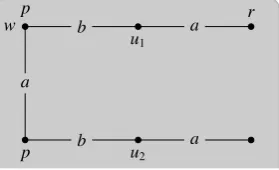
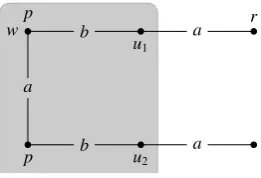
include all the nodes of the graph and the current states are the nodes in the shaded area. It is easy to see that the current domain W is obtained by updating the initial domain byKˆbp: the shaded area corresponds
to[[ ˆKbp]]M0. The representation in Figure 1 makes it clear that the a-model does not lose the initial domain and specifies the current domain as a subset of the initial one. Since W0
,W (the shaded area does not cover
the whole initial domain),0is false everywhere in the model, that is,[[0]]=∅. Moreover, whileKˆbKˆaKbr was
initially true at w, it currently is not: w∈[[( ˆKbKˆaKbr)0]]but w<[[ ˆKbKˆaKbr]](as[[r]]=∅).
2.2 An Analysis of Kuijer’s counterexample
To understand Kuijer’s counterexample [14] to the soundness of the finitary-introduction rule for the origi-nal APAL, recall that, in APAL,quantifies only over updates withepistemicformulas. More precisely, the APAL semantics ofis given by
w∈[[ϕ]] iff w∈[[[θ]ϕ]] for everyθ∈ Lepi,
whereLepiis the sublanguage generated from propositional atomsp∈Propusing only the Boolean
connec-tives¬and∧, and the epistemic operatorsKi.
Kuijer takes the formulaγ:=p∧Kˆb¬p∧KˆaKbp, and shows that
[ ˆKbp]¬γ→[q]¬γ.
is valid in APAL models, i.e., in multi-agent epistemic models with equivalence relations. (In fact, it is also valid in oura-models.) But then, by the [!]-intro rule (or rather, by its weaker consequence in Proposition 5.5), the formula
[ ˆKbp]¬γ→¬γ
should also be valid. But this is contradicted by the modelMin Figure 2. The premise [ ˆKbp]¬γis true at
winM, since¬γholds atwin the updated modelM|[[ ˆKbp]] in Figure 3a: indeed, the only way to falsify
¬γwould be by deletingu2from Figure 3a while keeping (all other nodes, and in particular) nodeu1. But inM|[[ ˆKbp]],u1andu2can not be separated by epistemic sentences: they are bisimilar.
w p
p
u1
u2
r
a b
b a
[image:6.595.252.381.490.571.2]a
Fig. 2: An epistemic modelM. Worlds are nodes in the graph, valuation is given by labeling the nodes with the true atoms, and epistemic relations are given by labeled arrows.
In contrast, the conclusion ¬γ is false at w inM, since in that original model u1 andu2 could be
separated. Indeed, we could perform an alternative update with the formulap∨Kˆar, yielding the epistemic modelM|[[p∨Kˆar]] shown in Figure 3b, in whichγis trueatw(contrary to the assertion that¬γwas true
w p
p
u1
u2 a
b
b
(a)M|[[ ˆKbp]]
w p
p
u1
r
a
b a
[image:7.595.212.352.377.462.2](b)M|[[p∨Karˆ ]]
Fig. 3: Two updates ofM.
To see that the counterexample does not apply to APALM, notice thata-models keep track of the initial states. When we takeM as ana-model as drawn in Figure 4 - where the initial states and current states collapse - the updated modelM|[[ ˆKbp]] consists now of the initial structure together with current set of
worldsWin Figure 3a. This structure is given in Figure 5a, where the nodes in the shaded area are the current states. But in this model,¬γisno longer trueatw(and so the premise [ ˆKbp]¬γwasnottrue inMwhen
considered as ana-model!). Indeed, wecanperform a new update of thea-modelM|[[ ˆKbp]] with the formula
(p∨Kˆar)0, which yields the updated model given in Figure 5b:
wp
p
u1
u2
r
a b
b a
a
Fig. 4:Mas an a-model. Initial states are nodes in the graphs and current states are represented by the nodes in shaded areas.
Note that, in this new model,γisthe case atw(- thus showing that¬γwasnottrue atwinM|[[ ˆKbp]]).
So the counterexample simply does not work for APALM.
Moreover, we can see that the unsoundness of [!]-intro rule for APAL has to do with its lack of memory, which leads to information loss after updates: while initially (inM) there were epistemic sentences (e.g.
p∨Kˆar) that could separateu1andu2, there are no such sentences after the update.
APALM solves this by keeping track of the initial states, and referring back to them, as in (p∨Kˆar)0.
2.3 Expressivity
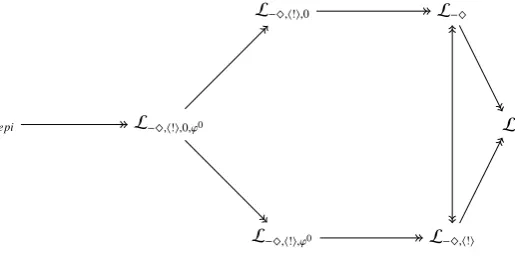
To compare APALM and its fragments with basic epistemic logic (and its extension with the universal modal-ity), consider thestatic fragment L−^,h!i, obtained fromL by removing both the^operator and the dy-namic modalityhϕiψ; as well as thepresent-only fragmentL−^,h!i,0,ϕ0, obtained by removing the operators
0 andϕ0 fromL
w p
p
u1
u2
r
a b
b a
a
(a)M|[[ ˆKbp]], whenMis ana-model
w p
p
u1
u2
r
a b
b
a
a a
(b) (M|[[ ˆKbp]])|[[(p∨Karˆ )0)]]
[image:8.595.137.268.115.204.2]M|[[ ˆKbp]]
Fig. 5: Two updates ofM, whenMis ana-model. Initial states are nodes in the graphs and current states are represented by the nodes in shaded areas.
modalityUfromL−^,h!i,0,ϕ0. For everya-modelM=(W0,W,∼1,. . .,∼n,k · k), consider itsinitial epistemic
modelMinitial =(W0,∼
1,. . .,∼n,k · k) and itscurrent epistemic modelMcurrent =(W,∼1 ∩W×W,. . .,∼n ∩W×W,k · k ∩W).
We need the following auxiliary lemma for some of our expressivity results. Lemma 1. There exists a well-founded strict partial order<onLsuch that:
1. ifϕis a subformula ofψ, thenϕ < ψ, 2. (θ→ p)<[θ]p,
3. (θ→ ¬[θ]ψ)<[θ]¬ψ,
4. (θ→Ki[θ]ψ)<[θ]Kiψ,
5. [hθiρ]χ <[θ][ρ]χ,
6. (θ→ϕ0)<[θ]ϕ0,
7. (θ→U[θ]ϕ)<[θ]Uϕ,
8. (θ→(Uθ∧0))<[θ]0, 9. hθiϕ <^ϕ, for allθ∈ L−^.
Proof. The proof is via easy arithmetic calculations following the definitions in Appendix A.1, restricted to languageL. Note that, Definition 14 is redundant for the cases restricted to languageL−^.
Proposition 1. The fragmentL−^ is co-expressive with the static fragmentL−^,h!i. In fact, every formula ϕ ∈ L−^ is provably equivalent to some formulaψ ∈ L−^,h!i (by usingAPALMreduction laws, given in
Table 1) to eliminate dynamic modalities, as in standard PAL).
Proof. Use step-by-step the reduction axioms (given in Table 1, Section 2.4), as a rewriting process, and prove termination by<-induction onϕby using Lemma 1.
Proposition 2. The static fragmentL−^,h!i(and hence, alsoL−^) is strictly more expressive than the
present-only fragmentL−^,h!i,0,ϕ0, which in turn is more expressive than the epistemic fragmentLepi. In fact, each of
the operators0andϕ0independently increase the expressivity ofL
−^,h!i,0,ϕ0.
Proof. Consider thea-model in Figure 5a: whileu1andu2are indistinguishable forL−^,h!i,0,ϕ0, the sentence
(p∨Kˆar)0 distinguishes the two. This shows that L−^,h!i,0 is strictly more expressive than L−^,h!i,0,ϕ0. To
see thatL−^,h!i,ϕ0 is strictly more expressive thanL−^,h!i,0,ϕ0, we just need to consider twoa-modelsM1 = (W0,W,∼1,. . .,∼n,k · k) andM2 =(W,W,∼1 ∩W×W,. . .,∼n ∩W×W,k · k) such thatW ⊂W0. As both
models have the same underlying current models, they make the same formulas ofL−
^,h!i,0,ϕ0true at the same
L−^,h!i,0,ϕ0
L−^,h!i,ϕ0
L−^,h!i,0
L−^,h!i L−^
[image:9.595.156.414.108.236.2]L Lepi
Fig. 6: Expressivity diagram (Arrows point to the more expressive languages, and reflexive and transitive arrows are omitted.)
The expressivity diagram in Figure 6 summarizes Propositions 1 and 2.
Kuijer’s counterexample shows that the standard epistemic bisimulation is not appropriate for APALM, so we now define a new such notion:
Definition 4 (APALM Bisimulation).AnAPALM bisimulationbetween a-modelsM1=(W10,W1,∼1,. . .,∼n
,k · k1)andM2=(W20,W2,∼01,. . .,∼0n,k · k2)is a total bisimulation B (in the usual sense)14between the
cor-responding initial epistemic modelsMinitial
1 and M
initial
2 , with the property that:if s1Bs2, then s1 ∈ W1 iff
s2∈W2. Two current states s1∈W1and s2∈W2areAPALM-bisimilarif there exists an APALM
bisimula-tion B between the underlying a-models such that s1Bs2.
Since a-models are always of the form M = M0|[[θ]] for some θ ∈ L
−^, we have a characterization of APALM-bisimulation only in terms of the initial models as stated in Proposition 3. To prove Propositions 3 and 4, we need the following auxiliary Lemmas 2 and 3.
Lemma 2. Let B be a total epistemic bisimulation between initial epistemic modelsMinitial
1 andM
initial
2 (or
equivalently, an APALM-bisimulation between initial a-modelsM0 1andM
0
2), and let s1 ∈ W10, s2 ∈ W20 be
two initial states such that s1Bs2. Then we have
s1∈[[α]]M0
1iffs2∈[[α]]M02 for all formulasα∈ L−^.
Proof. See Appendix A.2.
Lemma 3. Let B be a total epistemic bisimulation between initial epistemic modelsMinitial
1 andM
initial
2 (or
equivalently, an APALM-bisimulation between initial a-modelsM0 1andM
0
2), and let s1 ∈ W 0
1, s2 ∈ W 0 2 be
two initial states such that s1Bs2. Then, for allϕ∈ L, we have
s1∈[[hαiϕ]]M0
1iffs2∈[[hαiϕ]]M02 for all formulasα∈ L−^.
14Atotal bisimulationbetween epistemic models (W,∼
1,. . .,∼n,k · k) and (W0,∼01,. . .,∼
0
n,k · k
0
) is an epistemic bisim-ulation relation (satisfying the usual valuation and back-and-forth conditions from Modal Logic)B⊆W×W0
, such that: for everys∈Wthere exists somes0∈
W0
withsBs0
; and dually, for everys0∈
W0
there exists somes∈Wwith
Proof. Let B be an APALM bisimulation between initial a-models M0
1 and M 0
2. The proof goes by < -induction onϕ, using Lemma 1). We assume the following induction hypothesis: for allψ < ϕinLand all statess1∈W10,s2∈W20withs1Bs2, we have:s1∈[[hαiψ]]M0
1iffs2∈[[hαiψ]]M02, for allα∈ L−^.
Base casesϕ:=>,ϕ:=p, andϕ:=0 follow directly from Lemma 2 and the fact that the formulashαi>,
hαip, andhαi0 are inL−^.
In the following sequence of equivalencies, we make repeated use of the semantic clauses in Defn. 2. Caseϕ:=ψ0
s1 ∈[[hαiψ0]]M0 1iffs1
∈[[ψ0]] M0
1|[[α]]M0
1
iffs1 ∈[[ψ]]M0 1
∩[[α]]M0 1 (since
M0
1|[[α]]M0 1 =(W
0 1, [[α]]M0
1,
∼1,. . .,∼n
,k · k1)) iffs2 ∈ [[ψ]]M0
2∩[[α]]M02 (by IH, Lemma 2:α ∈ L−^) iffs2 ∈ [[ψ
0]] M0
2|[[α]]M0 2
(sinceM02|[[α]]M0 2 =
(W0 2, [[α]]M0
2, ∼0
1,. . .,∼ 0
n,k · k2)) iffs2∈[[hαiψ0]]M0 2.
Casesϕ:=Kiψandϕ:=Uψfollow similarly as in Lemma 2. We spell out here only the caseϕ:=Uψ.
First observe that,
s1∈[[hαiUψ]]M0 1iffs1
∈[[Uψ]]M0 1|[[α]]M0
1
iff∀s∈[[α]]M0 1,s
∈[[ψ]]M0 1|[[α]]M0
1
iff∀s∈[[α]]M0 1,s
∈[[hαiψ]]M0 1.
Supposes1∈[[hαiUψ]]M0
1and lets
0∈[[α]] M0
2. SinceBis a total bisimulation, there iss
0 1∈W
0
1such thats 0 1Bs
0. Sinceα∈ L−^, by Lemma 2, we haves01∈[[α]]M0
1. Then, by the above observation, we haves
0
1∈[[hαiψ]]M0 1.
Thus, by IH, we obtain thats0∈[[hαiψ]] M0
2. Ass2 ∈W
0
2, we then conclude, via similar steps as in the above observation, thats2∈[[hαiUψ]]M0
2. The other direction is similar. For the caseϕ:=Kiψ, we also use the back
and forth conditions ofB.
Caseϕ:=hθiψuses the validity of the formulahαihθiψ↔ hhαiθiψwhich can be easily verified.
s1 ∈ [[hαihθiψ]]M0 1iffs1
∈ [[hhαiθiψ]]M0 1 (by
|=hαihθiψ ↔ hhαiθiψ) iffs2 ∈ [[hhαiθiψ]]M0
2 (IH, usingψ < hθiψ) iffs2∈[[hαihθiψ]]M0
2.
Caseϕ:=^ψ
s1 ∈[[hαi^ψ]]M0 1iffs1
∈[[^ψ]]M0 1|[[α]]M0
1
iffs1 ∈Sθ∈L−^[[hθiψ]]M01|[[α]]M0
1
iffs1 ∈Sθ∈L−^[[hαihθiψ]]M01 iffs2 ∈
S
θ∈L−^[[hαihθiψ]]M20(IH,hθiψ <^ψ) iffs2∈ S
θ∈L−^[[hθiψ]]M02|[[α]]M0 2
iffs2∈[[^ψ]]M0 2|[[α]]M0
2
iffs2∈[[hαi^ψ]]M0 2.
Proposition 3. LetM1=(W10,W1,∼1,. . .,∼n,k · k1)andM2=(W20,W2,∼10,. . .,∼0n,k · k2)be a-models, and
let B⊆W10×W20. The following are equivalent:
1. B is an APALM bisimulation betweenM1andM2;
2. B is a total epistemic bisimulation betweenMinitial
1 andM
initial
2 (or equivalently, an APALM bisimulation
betweenM0 1andM
0
2), andM1=M 0 1|[[θ]]M0
1,M2=M
0 2|[[θ]]M0
2for some common formulaθ∈ L−^.
Proof. (1)→(2): LetBbe an APALM bisimulation betweenM1andM2. Then it is obvious (from the defi-nition) thatBis also a total bisimulation betweenMinitial
1 andM
initial
2 . SinceM1andM2area-models, there must existθ1,θ2 ∈ L−^s.t.M1 =M01|[[θ1]]M0
1,
M2 =M0
2|[[θ2]]M0
2. Hence,W1 =[[θ1]]M 0
1andW2 =[[θ2]]M 0 2.
To show that [[θ1]]M0
1 = [[θ2]]M 0
1, let first s1
∈ [[θ1]]M0
1 = W1. By the definition of APALM bisimulation,
there must exists2 ∈W20such thats1Bs2. Again by the definition, s1 ∈W1implies thats2 ∈W2 =[[θ2]]M0 2.
This, together with s1Bs2, gives us by Lemma 2 thats1 ∈ [[θ2]]M0
1. For the converse, let s1
∈ [[θ2]]M0 1; by
the definition of APALM bisimulation, there must exist s2 ∈ W20 such that s1Bs2. By Lemma 2, we have
s2∈[[θ2]]M0
2=W2, and again by the definition of APALM bisimulation (and the fact thats1Bs2), this implies
thats1∈W1=[[θ1]]M0
1. Given that
M1=M0
1|[[θ1]]M0 1and
M2=M0
2|[[θ2]]M0
2such that [[θ1]]M 0
1=[[θ2]]M 0 1, we
can takeθ:=θ2. ThenM1=M01|[[θ1]]M0 1=
M0
(2)→ (1): Suppose thatBis a total bisimulation betweenMinitial
1 andM
initial
2 , andM1 =M01|[[θ]]M0 1,
M2=
M0
2|[[θ]]M0
2for some common formulaθ
∈ L−^. Hence,W1=[[θ]]M0
1andW2=[[θ]]M 0
2. We need to verify that M1 andM2are APALM-bisimilar. For this we just need to verify the property that if s1Bs2, then s1 ∈ W1 holds iffs2 ∈W2holds. Supposes1Bs2and lets1 ∈ W1 =[[θ]]M0
1
⊆W0
1. By the totality of the bisimulation
B, there must exist some s2 ∈W20withs1Bs2. By Lemma 2,s1 ∈[[θ]]M0
1implies thats2
∈[[θ]]M0
2 =W2. The
converse is analogous.
So, to check for APALM-bisimilarity, it is enough to check for total bisimilarity between the initial models and for both models being updates with the same formula.
Next, we verify that this is indeed the appropriate notion of bisimulation.
Corollary 1. APALM formulas are invariant under APALM-bisimulation: if s1Bs2for some APALM-bisimulation
relation B between a-modelsM1 =(W10,W1,∼1,. . .,∼n,k · k1)andM2 =(W20,W2,∼10,. . .,∼0n,k · k2), then:
s1∈[[ϕ]]M1iffs2∈[[ϕ]]M2for allϕ∈ L.
Proof. LetBbe some APALM-bisimulation relation betweena-modelsM1=(W10,W1,∼1,. . .,∼n,k · k1) and
M2 = (W20,W2,∼01,. . .,∼0n,k · k2). By Proposition 3, there exists some formula θ ∈ L−^such that M1 =
M01|[[θ]]M0
1,M2=M
0 2|[[θ]]M0
2. By the same proposition,Bis a total epistemic bisimulation between the initial
epistemic models Minitial
1 andM
initial
2 . Thus, for every formula ϕ, we have the sequence of equivalences:
s1∈[[ϕ]]M1iffs1∈[[hθiϕ]]M01iff(by Lemma 3)s2∈[[hθiϕ]]M20iffs2∈[[ϕ]]M2.
Proposition 4 (Hennessy-Milner).LetM1 = (W0
1,W1,∼1,. . .,∼n,k · k1) andM2 = (W20,W2,∼01,. . .,∼ 0
n
,k · k2)be a-models with W0 1 and W
0
2 finite. Then, s1 ∈W1and s2 ∈W2satisfy the same APALM formulas iff
they are APALM-bisimilar.
Proof. We only need to prove the left-to-right direction. Lets1 ∈W1ands2 ∈ W2 such that for allϕ∈ L,
M1,s1|=ϕiffM2,s2 |=ϕ. This implies that for allϕ∈ L,M01,s1|=ϕiffM02,s2 |=ϕ. To see this, letϕ∈ L such thatM0
1,s1 |=ϕ. This means, by the semantics, thatM1,s1|=ϕ 0. AsM
1,s1andM2,s2satisfy the same APALM formulas, we obtain thatM2,s2 |=ϕ0, thus,M02,s2 |=ϕ. The opposite direction is analogous. We then show that the modal equivalence relation inW0
1 ×W 0
2 between the modelsM 0 1andM
0
2 is an APALM bisimulation. We thus need to show the following:
– (Totality) for all s ∈ W10, there exists s0 ∈ W20 such that M01,sandM02,s0 satisfy the same APALM formulas, and for all s0∈W20, there existss∈W10such thatM0
1,sandM 0 2,s
0satisfy the same APALM formulas:
Lets ∈W0
1 and suppose, toward contradiction, that for no elements 0ofW0
2 we haveM 0
1,sandM 0 2,s
0
satisfy the same APALM formulas. SinceW0
2 is finite, we can list its elementsW 0
2 ={w1,w2,. . .,wn}. The first assumption then implies that for allwi ∈ W20, there existsψi ∈ Lsuch thatM01,s |= ψi but
M0
2,wi6|=ψi. Thus,M 0
1,s1|=E(ψ1∧· · ·∧ψn) butM 0
2,s26|=E(ψ1∧· · ·∧ψn), contradicting the assumption thatM0
1,s1andM 0
2,s2satisfy the same APALM formulas. The second clause follows similarly. – (Valuation) This follows immediately from modal equivalence.
– (Forth for∼i) Letw1,w01 ∈ W10 andw2 ∈ W20 such thatM01,w1 andM02,w2 satisfy the same APALM formulas andw1 ∼i w01. Suppose, toward contradiction, that for no elementw02 ∈ W20 withw2 ∼0i w02,
M0
1,w 0 1andM
0 2,w
0
2satisfy the same APALM formulas. SinceW 0
2 is finite, the set∼ 0
i(w2) ={t ∈W
0 2 :
w2 ∼0i t}is finite, thus, we can write∼0i(w2) ={t1,. . .,tk}. As in the proof of (Totality), the assumption
implies that for alltjwithw2∼0itj, there existsψj∈ Lsuch thatM01,w01|=ψjbutM02,tj6|=ψj. Therefore,
M0
1,w1 |=Kˆi(ψ1∧ · · · ∧ψk) butM 0
2,w2 6|=Kˆi(ψ1∧ · · · ∧ψk), contradicting the assumption thatM 0 1,w1 andM0
We have therefore proven that the modal equivalence relation inW0 1 ×W
0
2 between the modelsM 0 1and
M0
2 is an APALM bisimulation betweenM 0 1 andM
0
2. By Proposition 3, it suffices to further prove that
M1 = M0
1|[[θ]]M0
1,M2 = M
0 2|[[θ]]M0
2 for some common formulaθ ∈ L−^. It then suffices to show that
[[θ1]]M0
2=[[θ2]]M02, whereW1=[[θ1]]M01andW2=[[θ2]]M02.
[[θ2]]M0
2 ⊆[[θ1]]M02: Observe thatM1,s1 |=U(θ
0
1), sinceW1 =[[θ1]]M0
1. Moreover, asM1,s1andM2,s2
satisfy the same APALM formulas, we obtain thatM2,s2 |=U(θ01). Therefore, for ally ∈ [[θ2]]M0 2, we
haveM2,y|=θ0
1, implying thatM 0
2,y|=θ1. Hence, [[θ2]]M0 2
⊆[[θ1]]M0 2.
[[θ1]]M0
2 ⊆[[θ2]]M02: Observe thatM2,s2 |=U(θ
0
2), sinceW2 =[[θ2]]M0
2. Moreover, asM1,s1andM2,s2
satisfy the same APALM formulas, we obtain thatM1,s1|=U(θ02). Now suppose, toward contradiction, that [[θ1]]M0
2
6⊆ [[θ2]]M0
2, i.e., there isy
∈ W0
2 such thatM 0
2,y |= θ1 butM02,y 6|= θ2. By the totality of the modal equivalence relation, there exists x ∈W0
1 such that M 0
1,x|=θ1butM01,x6|= θ2. The former implies that x∈ W1. Therefore, by the latter, we have thatM1,x 6|=θ02. This implies, since s1,x∈ W1, thatM1,s1 6|=U(θ20), contradictingM1,s1andM2,s2satisfying the same APALM formulas.
Therefore, we obtain that [[θ1]]M0
2 =[[θ2]]M02. Given thatM1 =M
0 1|[[θ1]]M0
1andM2 =M
0 2|[[θ2]]M0
2such that
[[θ1]]M0
2=[[θ2]]M02, we can takeθ:=θ1. ThenM2=M
0 2|[[θ2]]M0
2 =M
0 2|[[θ1]]M0
2.
[image:12.595.100.499.603.670.2]2.4 Axiomatization
Table 1 presents a complete proof systemAPALMfor our logic APALM (where recall thatPϕis the set of propositional variables inϕ).
Intuitive Reading of the Axioms.Parts (I) and (II) should be obvious. The axiom R[>] says thatupdating with tautologies is redundant. The reduction laws that do not contain0,Uor 0 are well-known PAL axioms. RU is the natural reduction law for the universal modality. The axiom R0 says that the truth value ofϕ0
formulas stays the same in time (because the superscript0 serves as a time stamp), so they can be treated similarly to atoms. Ax0 says that 0 was initially the case, and R0 says that at any later stage (after any update) 0 can only be true if it was already true before the update and the update was trivial (universally true). Together, these two say that the constant 0 characterizes states where no non-trivial communication has occurred. Axiom 0-Uis a synchronicity constraint:if no non-trivial communication has taken place yet, then this is the case in all the currently possible states. Axiom 0-eqsays thatinitially,ϕis equivalent to its initial correspondentϕ0. The Equivalences with0 express that 0 distributes over negation and over conjunction. Imp0
says thatif initiallyϕwas stably true (under any further announcements), thenϕis the case now. Taken
together, the elimination axiom [!]-elim and introduction rule [!]-intro say thatϕis a stable truth after an announcementθiffϕstays true after any more informative announcement(of the formθ∧ρ).15
Proposition 5. The following schemas and inference rules are derivable inAPALM, whereϕ,ψ,χ∈ Land θ∈ L−^:
1. from`ϕ↔ψ, infer`[θ]ϕ↔[θ]ψ
2. ` hθi0↔(0∧Uθ)
3. ` hθiψ↔(θ∧[θ]ψ)
4. `ϕ→[θ]ϕ
5. from`χ→[p]ϕ, infer`χ→ϕ (p<Pχ∪Pϕ) 6. `(ϕ→ψ)0↔(ϕ0→ψ0)
7. `ϕ00 ↔ϕ0
8. `ϕ0↔ϕ0, and`^ϕ0↔ϕ0
9. `(ϕ)0→ϕ0
10. `(0∧^ϕ0)→ϕ
11. `ϕ→(0∧^ϕ)0
12. `ϕ→ψ0if and only if`(0∧
^ϕ)→ψ
(I) Basic Axioms of system APALM:
(CPL) all classical propositional tautologies and Modus Ponens (S5Ki) allS5 axioms and rules for knowledge operatorKi
(S5U) allS5 axioms and rules forUoperator
(U-Ki) Uϕ→Kiϕ
(II) Axioms and rules for dynamic modalities[!]: (K!) Kripke’s axiom for[!]: [θ](ψ→ϕ)→([θ]ψ→[θ]ϕ)
(Nec!) Necessitation for[!]: fromϕ, infer [θ]ϕ.
(RE) Replacement of Equivalents[!]: fromθ↔ρ, infer [θ]ϕ↔[ρ]ϕ.
Reduction laws:
(R[>]) [>]ϕ↔ϕ (Rp) [θ]p↔(θ→p)
(R¬) [θ]¬ψ↔(θ→ ¬[θ]ψ) (RKi) [θ]Kiψ↔(θ→Ki[θ]ψ)
(R[!]) [θ][ρ]χ↔[hθiρ]χ
(R0) [θ]ϕ0↔(θ→ϕ0)
(RU) [θ]Uϕ↔(θ→U[θ]ϕ)
(R0) [θ]0↔(θ→(Uθ∧0))
(III) Axioms and rules for 0 andinitialoperator0:
(Ax0) 00
(0-U) 0→U0
(0-eq) 0→(ϕ↔ϕ0)
(Nec0) Necessitation for0: fromϕ, inferϕ0 Equivalences with0:
(Eq0
p) p
0↔p
(Eq0
¬) (¬ϕ)0↔ ¬ϕ0
(Eq0
∧) (ϕ∧ψ)0↔(ϕ0∧ψ0)
Implications with0:
(Imp0
U) (Uϕ)
0→Uϕ0
(Imp0
i) (Kiϕ)
0→Kiϕ0
(Imp0
) (ϕ)0→ϕ
(III) Elim-axiom and Intro-rule for: ([!]-elim) [θ]ϕ→[θ∧ρ]ϕ
([!]-intro) fromχ→[θ∧p]ϕ, inferχ→[θ]ϕ (forp<Pχ∪Pθ∪Pϕ).
Table 1: The axiomatizationAPALM. (Here,ϕ,ψ,χ∈ L, whileθ,ρ∈ L−^.)
13. `[θ](ψ∧ϕ)↔([θ]ψ∧[θ]ϕ)
14. `[θ][p]ψ↔[θ∧p]ψ
15. `[θ]⊥ ↔ ¬θ
Proof. See Appendix A.3.
Proposition 6. All S4axioms and inference rules forare derivable inAPALM. Proof. See Appendix A.3.
We arrive now at one of the main results of our paper.
Both soundness and completeness proofs are rather involved, thus, given in separate Sections 4 and 5, respectively.
3
Group Announcement Logic with Memory: GALM
In this section we turn our focus on the Group Announcement Logic (GAL) introduced in [1]. As briefly mentioned in Introduction, GAL is also an extension of PAL, involving group announcement operators [G]ϕ andhGiϕ(instead of the arbitrary announcement operatorsϕand^ψ). The group announcement operator can be seen as a restricted version of the arbitrary public announcement operator in the sense that it quantifies only over updates with formulas of the formV
i∈GKiθi, whereθi∈ Lepiandi∈G⊆ AG. More precisely, [1]
interprets the operator [G]ϕon epistemic modelsM=(W,∼1,. . .,∼n,k · k) as
w∈[[[G]ϕ]] iff for every set{ψi:i∈G} ⊆ Lepi,w∈[[[^
i∈G
Kiψi]ϕ]]. (1)
This operator intends to capture communication among a group of agents and what a coalition can bring about via public announcements. While GAL seems to provide more adequate tools than APAL to treat puzzles involving epistemic dialogues, the axiomatization of GAL presented in [1] has a similar shape as the one for APAL in [2]. To recall, [1] proves completeness of GAL also by using an infinitary rule and claims that it is replaceable in theorem-proving by the finitary rule
fromϕ→[θ][^
i∈G
Kipi]ψinferϕ→[θ][G]ψ, (R[G])
wherepi<Pϕ∪Pψ∪Pθ. However, Kuijer’s counterexample presented in Section 2.2 constitutes a
counterex-ample also for the soundness of this rule. Consider again the formulaγ:=p∧Kˆb¬p∧KˆaKbpand letG={a}.
We show that while
[ ˆKbp][G]¬γ→[Kaq]¬γ
is valid on epistemic models, itsR[G]-conclusion
[ ˆKbp][G]¬γ→[G]¬γ
is not. For the former, suppose that [ ˆKbp][G]¬γ→[Kaq]¬γis not valid on epistemic models, i.e., that there
is an epistemic modelN=(W,∼1,. . .,∼n,k · k) andw∈Wsuch thatw∈[[[ ˆKbp][G]¬γ]] butw<[[[Kaq]¬γ]].
The latter means thatw ∈ [[hKaqiγ]]. Therefore,w ∈ [[Kaq]] and w ∈ [[γ]]N |[[Kaq]]. The latter implies that
w∈ kpkand there are two statesw1,w2inN |[[Kaq]] such that (1)w1is∼b-connected towandw1 <kpk, and (2)w2is∼a-connected towandw2∈[[Kbp]]N |[[Kaq]]. In other words, the model in Figure 7 is guaranteed to be
a submodel ofN |[[Kaq]].
Moreover, sincew∈[[[ ˆKbp][G]¬γ]] andw∈[[ ˆKbp]], we also have thatw∈[[[G]¬γ]]N |[[ ˆKbp]]. Recall that
w ∈ [[Kaq]]. Therefore, neitherwnorw2 have∼a-access to a states inN that makesq false. Furthermore,
sinceKaq is a positive knowledge formula, we havew ∈ [[Kaq]]N |θfor anyθ. Then, w ∈ [[[G]¬γ]]N |[[ ˆKbp]]
implies that w ∈ [[¬γ]](N |[[ ˆK
bp]])|[[Kaq]]N |[[ ˆKb p]] = [[¬γ]](N |[[hKˆbpiKaq]]). It is not difficult to see that the model in
Figure 7 is also a submodel ofN |[[hKˆbpiKaq]] (recall thatw1 is inN |[[Kaq]]), thus, w ∈ [[γ]](N |[[hKˆbpiKaq]]).
This contradicts the assumption thatw ∈ [[[ ˆKbp][G]¬γ]]. Therefore, [ ˆKbp][G]¬γ → [Kaq]¬γis valid on
epistemic models. However, modelMin Figure 2 constitutes a counterexample for [ ˆKbp][G]¬γ→ [G]¬γ,
asw∈[[[ ˆKbp][G]¬γ]]Mandw∈[[hKaKˆa(p∨r)iγ]]M, thus,w<[[[G]¬γ]].
w p,q
p,q w2
qw1
[image:15.595.236.323.105.191.2]a b
Fig. 7: Submodel ofN |[[Kaq]]
Memory (GALM), obtained by extending the syntax of APALM with group announcement operators inter-preted ona-models.16 The languageLGof GALM is defined recursively, for each group of agentsG⊆ AG, as:
ϕ ::= > |p|0|ϕ0| ¬ϕ|ϕ∧ϕ|Kiϕ|Uϕ| hθiϕ|^ϕ| hGiϕ,
wherep∈Prop,i∈ AG, andθ∈ L−^. The dual modality for this new operator is defined as [G]ϕ:=¬hGi¬ϕ. hGiϕand [G]ϕare the (existential and universal) group announcement operators, quantifying over updates with formulas of the formV
i∈GKiθi, whereθi ∈ L−^ andi ∈ G. This restricted quantification over L−^
captures the assumption that each agent can announce only the (^andG-free) propositions she knows and nothing else. Analogous to the reading of , we read [G]ϕ as “ϕis stably true under group G’s public announcements”, i.e., “ϕstays true no matter what groupGtruthfully announces”.
We introduce the following abbreviation ofrelativized knowledgefor notational convenience:
Kiϕψ:=Ki(ϕ→ψ),
whereϕ,ψ∈ LGandi∈ AG. The languageLGis also interpreted on models introduced in Definition 1.
Definition 5. Given a modelM=(W0,W,∼1,. . .,∼n,k · k), the semantics forLGis defined recursively as in Definition 2 with the following additional clause forhGi:
[[hGiϕ]]=[{[[h^ i∈G
Kiθiiϕ]] : {θi:i∈G} ⊆ L−^}.
Lemma 4. There exists a well-founded strict partial order<onLG, such that:
1. ifϕis a subformula ofψ, thenϕ < ψ,
2. hθiϕ <^ϕ, for allθ∈ L−^,
3. hθiϕ <hGiϕ, for allθ∈ L−^.
Proof. Similar to Lemma 1. Observation 2 Note that we have
w∈[[[G]ϕ]] iff w∈[[[^
i∈G
Kiθi]ϕ]] for every{θi:i∈G} ⊆ L−^.
Proposition 7. We have[[ϕ]]⊆W, for all formulasϕ∈ LG.
16We note that the language of the original GAL in [1] does not include the arbitrary announcement operator
Proof. See Appendix A.4.
Our a-models given in Definition 3 are also theintended models for GALM, so GALM validities are defined with respect toa-models as in Definition 3. We can now state the main result of this section. Theorem 2 (Soundness and Completeness of GALM).GALM validities are recursively enumerable. In fact, the sound and complete axiomatizationGALMwrt a-models is obtained by extendingAPALMwith the axiom and rule given in Table 2.
Elim-axiom and Intro-rule for[G]: ([!][G]-elim) [θ][G]ϕ→[θ∧V
i∈GKiθρi]ϕ
([!][G]-intro) fromχ→[θ∧V
i∈GKiθpi]ϕ, inferχ→[θ][G]ϕ (forpi<Pχ∪Pθ∪Pϕ).
Table 2: The additional axioms ofGALM
The axiom and rule in Table 2 are very similar in spirit (and in what they express) to the [!]-elim axiom and [!]-intro rule, respectively. Together, the elimination axiom [!][G]-elim and rule [!][G]-intro say that
ϕis a stable truth under group G’s announcements after an announcementθiffϕstays true after any more informative announcement from the group G(of the formθ∧V
i∈GKθiρi).
4
Soundness via Pseudo-model Semantics
As GALM is an extension of APALM, we present the soundness and completeness proofs directly for the former. The same results for APALM are obtained following similar steps.
To start with, note that even the soundness of our axiomatic systems is not a trivial matter. As we saw from Kuijer’s counterexample, the analogues of our finitaryand [G]-introduction rules werenotsound for APAL and GAL, respectively. To prove their soundness ona-models, we need a detour into an equivalent semantics, in the style of Subset Space Logics (SSL) [16,13]:pseudo-models.17
We first introduce an auxiliary notion: ‘pre-models’ are just SSL models, coming with a given familyA
of “admissible sets” of worlds (which can be thought of as thecommunicablepropositions). We interpret
in these structures as the so-called “effort modality” of SSL, which quantifies over updates with admissible propositions inA. Analogously,hGiquantifies over updates with conjunctions of those admissible proposi-tions in the scope of an epistemic operator labeled by an agent inG. Our ‘pseudo-models’ are pre-models with additional closure conditions (saying that the family of admissible sets includes the valuations and is closed under complement, intersection, and epistemic operators). These conditions imply thatevery set defin-able by a^,hGi-free formula18is admissible, and this ensures the soundness of our-elimination and [G ]-elimination axioms on pseudo-models. As for the soundness of the long-problematicand [G]-introduction
17A more direct soundness proof ona-models is in principle possible, but would require at least as much work as our
detour. Unlike in standard EL, PAL or DEL, the meaning of an APALM formula (and therefore of a GALM formula) depends, not only on the valuation of the atoms occurring in it, but also on the familyAof all sets definable by L−^-formulas. The move from models to pseudo-models makes explicit this dependence on the familyA, while also relaxing the demands onA(which is no longer required to be exactly the family ofL−^-definable sets), and thus makes the soundness proof both simpler and more transparent. Since we will need pseudo-models for our completeness proof anyway, we see no added value in trying to give a more direct soundness proof.
18
rules on (both pre- and) pseudo-models, this is due to the fact that both the effort modality and [G] operator interpreted on pseudo-models have a more ‘robust’ range than the arbitrary announcement versions of them: they quantify over admissible sets, regardless of whether these sets are syntactically definable or not. Sound-ness with respect to oura-models then follows from the observation that they (in contrast to the original APAL models) are in fact equivalent to aspecial case of pseudo-models: the “standard” ones (in which the admissible sets inAareexactlythe sets definable by^,hGi-free formulas).
Definition 6 (Pre-model).Apre-model is a tupleM = (W0,A,∼
1,. . .,∼n,k · k), where W0 is the initial
domain,∼i are equivalence relations on W0,k · k : Prop → P(W0)is a valuation map, and A ⊆ P(W0)
is a family of subsets of the initial domain, calledadmissible sets(representing the propositions that can be publicly announced).
Given a setA⊆W0and a statew∈A, we use the notationwA
i := {s∈A:w∼i s}to denote the restriction
to A of w’s equivalence class modulo ∼i. We also introduce the following abbreviation for the semantic
counterpart of relativized knowledge:KA
i B={w∈W
0:w
i∩A⊆B}.
Definition 7 (Pre-model Semantics forLG).Given a pre-modelM =(W0,A,∼1,. . .,∼n,k · k), we
recur-sively define atruth set [[ϕ]]Afor every formulaϕand subset A⊆W0:
[[>]]A =A
[[p]]A =kpk ∩A
[[0]]A =
A if A=W0
∅ otherwise
[[ϕ0]]A =[[ϕ]]W0∩A
[[¬ϕ]]A =A−[[ϕ]]A
[[ϕ∧ψ]]A =[[ϕ]]A∩[[ψ]]A
[[Kiϕ]]A={w∈A:wAi ⊆[[ϕ]]A}
[[Uϕ]]A=
A if[[ϕ]]A=A ∅ otherwise
[[hθiϕ]]A=[[ϕ]][[θ]]A
[[^ϕ]]A=
[
{[[ϕ]]B : B∈ A,B⊆A}
[[hGiψ]]A=
[
{[[ψ]]A∩T
i∈GKiABi :{Bi:i∈G} ⊆ A}
Observation 3 Note that, for all w∈A, we have
1. w∈[[ϕ]]A iff ∀B∈ A(w∈B⊆A⇒w∈[[ϕ]]B);
2. w∈[[[G]ϕ]]Aiffw∈[[ϕ]]A∩T
i∈GKiABifor every{Bi:i∈G} ⊆ A;
3. [[ϕ]]A⊆A for all A∈ Aandϕ∈ LG.
Observation 3.1 shows that our proposed semantics ofon pre-models fits with the semantics of the effort modality in SSL [16,13]. The proof of Observation 3.3 is similar to that of Proposition 7.
Definition 8 (Pseudo-models and Validity).Apseudo-modelis a pre-modelM=(W0,A,∼
1,. . .,∼n,k · k),
satisfying the following closure conditions:
1. kpk ∈ A, for all p∈Prop, 2. W0∈ A,
3. if A∈ Athen(W0−A)∈ A,
4. if A,B∈ Athen(A∩B)∈ A,
5. if A∈ Athen KiA∈ A, where KiA:={w∈W0 : ∀s∈W0(w∼is⇒s∈A)}.
A formulaϕ∈ LGisvalid in pseudo-modelsif it is true in all admissible sets A∈ Aof every pseudo-model
M, i.e,[[ϕ]]A=A for all A∈ Aand allM.
Proof. See Appendix A.5.
Proposition 8. Given a pseudo-model(W0,A,∼1,. . .,∼n,k · k), A∈ A, andθ∈ L−^, we have[[θ]]A∈ A.
Proof. See Appendix A.5.
To prove the soundness of our axioms, we need the following lemmas: Lemma 6. Given a pseudo-modelM=(W0,A,∼
1,. . .,∼n,k · k), A ∈ Aandθ∈ L−^such that w∈[[θ]]A,
w∈[[Kiθρ]]A iff w∈Ki[[θ]]A[[ρ]]Afor allρ∈ L−^.
Proof. See Appendix A.5. Lemma 7. LetM = (W0,A,∼
1,. . .,∼n,k · k)andM0 = (W0,A,∼1,. . .,∼n,k · k0)be two pseudo-models
andϕ∈ LGsuch thatMandM0differ only in the valuation of some p<Pϕ. Then, for all A∈ A, we have
[[ϕ]]MA =[[ϕ]]MA0.
Proof. The proof follows by subformula induction on ϕ. Let M = (W0,A,∼
1,. . .,∼n,k · k) and M0 =
(W0,A,∼
1,. . .,∼n,k · k0) be two pseudo-models such thatMandM0 differ only in the valuation of some
p <Pϕand letA∈ A. We want to show that [[ϕ]]MA =[[ϕ]]AM0. The base casesϕ:=q(, p),ϕ:=>,ϕ:=0, and the inductive cases for Booleans are standard.
Case ϕ := ψ0. Note thatP
ψ0 = Pψ. Then, by IH, we have that [[ψ]]M
0
A = [[ψ]]
M
A for every A ∈ A, in
particular forW0∈ A. Thus [[ψ]]M0
W0 =[[ψ]]
M
W0. Then, [[ψ]]
M0
W0∩A=[[ψ]]
M
W0∩Afor allA∈ A. By the semantics
of the initial operator on pseudo-models, we obtain [[ψ0]]MA0=[[ψ0]]MA . Caseϕ:=Kiψ. Note thatPKiψ=Pψ. Then, by IH, we have that [[ψ]]
M
A =[[ψ]]
M0
A . Observe that [[Kiψ]]
M
A =
{w∈ A: wAi ⊆[[ψ]]M
A }and, similarly, [[Kiψ]]
M0
A ={w ∈ A:w
A i ⊆[[ψ]]
M0
A }. Then, since [[ψ]]
M
A =[[ψ]]
M0
A , we
obtain [[Kiψ]]MA =[[Kiψ]]M
0
A .
Caseϕ :=Uψ. Note thatPUψ = Pψ. Then, by IH, we have that [[ψ]]M
0
A =[[ψ]]
M
A for everyA ∈ A. We
have two case: (1) If [[ψ]]MA0 =[[ψ]]MA =A, then [[Uψ]]MA0 =A =[[Uψ]]MA . (2) If [[ψ]]AM0 =[[ψ]]MA ,A, then [[Uψ]]MA0=[[Uψ]]MA =∅.
Case ϕ := hθiψ. Note that Phθiψ = Pθ∪Pψ. By IH, we have [[θ]]M
0
A = [[θ]]
M
A and [[ψ]]
M0
A = [[ψ]]
M
A
for everyA ∈ A. By Proposition 8, we know that [[θ]]MA = [[θ]]MA0 ∈ A. Therefore, in particular, we have [[ψ]]M0
[[θ]]M0
A
=[[ψ]]M [[θ]]M
A
. Therefore, by the semantics ofh!ion pseudo-models, we obtain [[hθiψ]]M0
A =[[hθiψ]]
M
A.
Caseϕ:=^ψ. Note thatP^ψ = Pψ. Sincethe samefamily of setsAis carried by both modelsMand M0and since (by IH) [[ψ]]M0
A =[[ψ]]
M
A for allA∈ A, we get:
[[^ψ]]M 0
A =
[
{[[ψ]]MB0:B∈ A,B⊆A}=[{[[ψ]]MB :B∈ A,B⊆A}=[[^ψ]]MA .
Caseϕ:=[G]ψ. Note thatP[G]ψ =Pψ. Then, by (IH), we have that [[ψ]]M 0
B =[[ψ]]
M
B for everyB∈ A. In
particular, [[ψ]]MB0 = [[ψ]]MB for theB’s of the formA∩KA
iCwithA,C ∈ A(recall that pseudo-models are
closed underKA
i operation and conjunction, see Definition 8 and Lemma 5). Since the same family of setsA
is carried by both modelsMandM0, we obtain: [[[G]ψ]]MA0 =[{[[ψ]]MA∩0T
i∈GKAiBi :
{Bi:i∈G} ⊆ A}=
[
{[[ψ]]MA∩T
i∈GKiABi :
{Bi:i∈G} ⊆ A}=[[[G]ψ]]MA .
Proof. The soundness of most of the axioms follows simply by spelling out the semantics. We present here only the soundness of the axioms [!]-elim, [!][G]-elim and rules [!]-intro, [!][G]-intro:
For the elimination axioms, let M = (W0,A,∼
1,. . .,∼n,k · k) be a pseudo-model,A ∈ A, andw ∈ A
arbitrarily chosen:
([!]-elim): Letρ ∈ L−^and suppose (1)w ∈ [[[θ]ϕ]]A and (2)w ∈ [[θ∧ρ]]A. We need to show that
w ∈ [[ϕ]][[θ∧ρ]]A. Assumption (1) means that ifw ∈ [[θ]]A thenw ∈ [[ϕ]][[θ]]A. By assumption (2) and since
w ∈ [[θ∧ρ]]A ⊆ [[θ]]A, we havew ∈ [[ϕ]][[θ]]A. Thus, by the semantics of, we havew ∈ {u ∈ [[θ]]A :
for allB∈ A(u ∈B⊆[[θ]]A ⇒u ∈[[ϕ]]B}. Therefore, forB:=[[θ∧ρ]]A ⊆[[θ]]A (since by Proposition 8,
[[θ∧ρ]]A∈ A) we havew∈[[ϕ]][[θ∧ρ]]A.
([!][G]-elim): Let{ρi : i ∈G} ⊆ L−^and suppose (1)w ∈ [[[θ][G]ϕ]]A and (2)w ∈[[θ∧Vi∈GKiθρi]]A.
Assumption (1) means that ifw ∈[[θ]]A thenw ∈[[[G]ϕ]][[θ]]A. I.e., by the semantic clause for [G], we have
that ifw∈ [[θ]]Athen for all{Bi :i ∈G} ⊆ A, w ∈[[ϕ]][[θ]]
A∩Ti∈GK
[[θ]]A
i Bi. By (2) we have thatw∈ [[θ]]Aand
w∈[[V
i∈GKiθρi]]A. Thus, by (1), we obtainw∈[[ϕ]][[θ]]A∩Ti∈GK
[[θ]]A
i [[ρi]]A=[[ϕ]][[θ]]A∩Ti∈G[[Kiθρi]]A =[[ϕ]][[θ∧Vi∈GKθiρi]]A
(by Proposition 8 and Lemma 6). Thus if w ∈ [[θ∧V
i∈GKθiρi]]A then w ∈ [[ϕ]][[θ∧V
i∈GKiθρi]]A, i.e., w ∈
[[[θ∧V
i∈GKiθρi]ϕ]]A.
([!]-intro): Suppose|= χ → [θ∧p]ϕand6|= χ → [θ]ϕ, where p < Pχ∪Pθ∪Pϕ. The latter means that there exists a pseudo modelM=(W0,A,∼
1,. . .,∼n,k · k) such that for someA ∈ Aand somew∈A,
w<[[χ→[θ]ϕ]]AM. Thereforew∈[[χ∧ ¬[θ]ϕ]]
M
A . Thus we have (1)w∈[[χ]]
M
A and (2)w∈[[¬[θ]ϕ]]
M
A .
Because of (2),w∈[[hθi^¬ϕ]]M
A , and, by the semantics,w∈[[^¬ϕ]]
M [[θ]]M
A
. Therefore, applying the semantics of, we obtain (3) there existsB∈ As.t.w∈B⊆[[θ]]MA ⊆Aandw∈[[¬ϕ]]MB.
Now consider the pre-modelM0=(W0,A,∼1,. . .,∼n,k · k0) such thatkpk0:=Bandkqk0=kqkfor any
q , p ∈ Prop. In order to use Lemma 7 we must show thatM0is a pseudo-model. For this we only need to verify thatM0satisfies the closure conditions given in Definition 8. First note thatkpk0 :=B∈ Aby the construction ofM0, sokpk0∈ A. For everyq
,p, sincekqk0=kqkandkqk ∈ Awe havekqk0∈ A. SinceAis the same for bothMandM0, andMis a pseudo-model, the rest of the closure conditions are already satisfied forM0. ThereforeM0is a pseudo-model. Now continuing with our soundness proof, sincep
<Pχ∪Pθ∪Pϕ,
by Lemma 7, we obtain [[χ]]MA0=[[χ]]MA , [[θ]]MA0=[[θ]]MA and [[¬ϕ]]MA0=[[¬ϕ]]MA . Sincekpk0=B⊆[[θ]]M0
A ⊆A
we havekpk0=[[p]]AM0. Because of (3) we have thatw∈[[θ]]MA0andw∈[[¬ϕ]]BM0 =[[¬ϕ]]M0 [[p]]M0
A
=[[hpi¬ϕ]]MA0. Thus,w ∈ [[p]]MA0, sow ∈ [[θ∧p]]MA0 = [[θ]]MA0∩[[p]]MA0 = [[p]]MA0 simply because [[p]]MA0 ⊆ [[θ]]MA0. Since
w∈[[¬ϕ]]M0 [[p]]M0
A
we obtainw∈[[¬ϕ]]M0 [[θ∧p]]M0
A
. Putting everything together,w∈[[θ∧p]]MA0andw∈[[¬ϕ]]M0 [[θ∧p]]M0
A
, we obtain thatw∈[[hθ∧pi¬ϕ]]MA0andw∈[[χ]]MA0. ThereforeM0,w=| χ∧ hθ∧pi¬ϕ, which contradicts the validity ofχ→[θ∧p]ϕ.
([!][G]-intro): Suppose|= χ → [θ∧V
i∈GKiθpi]ϕand6|= χ → [θ][G]ϕwherepi < Pχ∪Pθ∪Pϕ. The
latter means that there exists a pseudo modelM = (W0,A,∼1,. . .,∼n,k · k) such that for some A ∈ A
and somew ∈ A,w < [[χ → [θ][G]ϕ]]MA . Thereforew ∈ [[χ∧ ¬[θ][G]ϕ]]
M
A . Thus we have (1)w ∈ [[χ]]
M
A ,
and (2)w ∈ [[¬[θ][G]ϕ]]MA . Item (2) meansw ∈ [[hθihGi¬ϕ]]MA. Then, by the semantics of h!i, we have
w ∈ [[hGi¬ϕ]]M [[θ]]M
A
. Therefore by the semantics of hGi we obtain: (3) there exists {Bi : i ∈ G} ⊆ A s.t.
w∈[[¬ϕ]]M [[θ]]M
A∩
T
i∈GK
[[θ]]MA
i Bi
.
Now consider the pre-model M0 = (W0,A,∼
1,. . .,∼n,k · k0) such that kpik0 = Biandkqk0 = kqk for
that K[[θ]]A
i (A∩Bi) = Ki[[θ]]ABi. In order to use Lemma 7 we must show that M0 is a pseudo-model as in
the soundness proof of [!]-intro. First note that for everyq , pi, sincekqk0 =kqkandkqk ∈ A, we have kqk0∈ A. Moreover, since for everyi∈G,kp
ik0=Bi∈ A, we conclude thatM0satisfies Definition 8.1. Since Ais the same for bothMandM0, andMis a pseudo model, the rest of the closure conditions are satisfied already. ThereforeM0is a pseudo model. Now continuing with our soundness proof, givenp
i<Pχ∪Pθ∪Pϕ
for alli∈G, by Lemma 7, we obtain [[χ]]MA0 =[[χ]]MA and [[θ]]MA 0=[[θ]]MA . We moreover have that [[¬ϕ]]M
[[θ]]M
A∩
T
i∈GK
[[θ]]MA
i Bi
=[[¬ϕ]]M0 [[θ]]M0
A ∩
T
i∈GK
[[θ]]M0A
i Bi
=[[¬ϕ]]M0 [[θ]]M0
A ∩
T
i∈GK
[[θ]]M0A
i kpik0
=[[¬ϕ]]M0 [[θ]]M0
A ∩
T
i∈GK
[[θ]]M0A
i (A∩kpik0)
by the above observation. And by Lemma 6, we obtain [[¬ϕ]]M0
[[θ]]M0
A ∩
T
i∈GK
[[θ]]M0A
i (A∩kpik0)
=[[¬ϕ]]M0 [[θ]]M0
A ∩
T
i∈GK
[[θ]]M0A
i ([[pi]]M0A )
=[[¬ϕ]]M0 [[θ∧V
i∈GKiθpi]]M0A
.
Therefore,w∈[[¬ϕ]]M0 [[θ∧V
i∈GKiθpi]]M0A
. I.e.,w∈[[hθ∧V
i∈GKθipii¬ϕ]]
M0
A . Since we also have thatw∈[[χ]]
M0
A , we
conclude thatw∈[[χ∧ hθ∧V
i∈GKiθpii¬ϕ]]
M0
A , contradicting the validity ofχ→[θ∧
V
i∈GKiθpi]ϕ. Therefore, |=χ→[θ][G]ϕ.
Definition 9 (Standard Pre-model).A pre-modelM = (W0,A,∼1,. . .,∼n,k · k)isstandardif and only if
A={[[θ]]W0:θ∈ L−^}.
Proposition 10. Every standard pre-model is a pseudo-model.
Proof. LetM=(W0,A,∼1,. . .,∼n,k · k) be a standard pre-model. This implies thatA={[[θ]]W0 :θ∈ L−^}.
We need to show thatM satisfies the closure conditions given in Definition 8. Conditions (1) and (2) are immediate.
For (3): letA∈ A. SinceMis a standard pre-model, we know thatA=[[θ]]W0for someθ∈ L−^. Since θ ∈ L−^, we have¬θ ∈ L−^, thus, [[¬θ]]W0 ∈ A. Observe that [[¬θ]]W0 = W0−[[θ]]W0, thus, we obtain W0−A∈ A.
For (4): letA,B∈ A. SinceMis a standard pre-model,A=[[θ1]]W0 andB =[[θ2]]W0for someθ1,θ2 ∈ L−^. Since θ1,θ2 ∈ L−^, we haveθ1 ∧θ2 ∈ L−^, thus, [[θ1∧θ2]]W0 ∈ A. Observe that [[θ1 ∧θ2]]W0 =
[[θ1]]W0∩[[θ2]]W0 =A∩B, thus, we obtainA∩B∈ A.
For (5): letA ∈ A. SinceMis a standard pre-model,A=[[θ]]W0 for someθ∈ L−^. Sinceθ∈ L−^, we
haveKiθ∈ L−^, thus, [[Kiθ]]W0 ∈ A. Observe that [[Kiθ]]W0 ={w∈W0 :∀s∈W0(w∼i s⇒ s∈[[θ]]W0)}= Ki[[θ]]W0, thus, we obtainKiA∈ A.
Equivalence between the standard pseudo-models and announcement models.For Proposition 11 only, we use the notation [[ϕ]]PS
A to refer to pseudo-model semantics (as in Definition 7) and use [[ϕ]]Mto refer to the semantics ona-models (as in Definition 5).
Proposition 11.
1. For every standard pseudo-modelM=(W0,A,∼
1,. . .,∼n,k · k)and every set A∈ A, we denote byMA
the modelMA=(W0,A,∼1,. . .,∼n,k · k). Then:
(a) For everyϕ∈ LG, we have[[ϕ]]MA=[[ϕ]]
PS
A for all A∈ A.
(b) MAis an a-model, for all A∈ A.



![Fig. 7: Submodel of N|[[Kaq]]](https://thumb-us.123doks.com/thumbv2/123dok_us/8382044.320860/15.595.236.323.105.191/fig-submodel-of-n-kaq.webp)
