Abstract
Universal Grammar (UG) is characterized by the assumption that all hu-man languages share a common structure with respect to their linguistic well-formedness conditions. In Optimality Theory (OT) this structure is represented by a set of linguistic candidate forms, a set of constraints and the definition of being optimal. The nativist view of OT assumes that such a structure is encoded in a Language Acquisition Device (LAD) provided to a learner of a language genetically.
Acknowledgments
I gratefully acknowledge the Consejo Nacional de Ciencia y Tecnolog´ıa (CONACYT) in Mexico for the scholarship this institution granted me and thereby made it possible that I studied at the ILLC.1 In particular, I want to express my gratitute to the staff of scholarschips abroad, not only for their efficiency but also for the gentle treatment that they always gave me. Many thanks to my advisor, Dr. Reinhard Blutner for his guidance and support through all the thesis work. His academical comments and his patience made easier the way and helped me significantly in improving the work. ‘Thanksprofessor, it has been a pleasure to work with you!’.
I would like to express also my gratitute to my mentor, Professor Dick de Jongh for all the help that I received from him before and during the master. Here I only make the remark that I was fortunate in having him as mentor.
Thanks also to Professor van Emde Boas and Dr. Zeevat for their kind disposition of forming part of my Thesis Committee.
My gratitute also to Atocha Aliseda. Her advice and her unconditional academical support before I started the master were quite helpful for finish-ing the program.
I would like to say ‘thank you’ also to Ariel Campir´an and Maricarmen Mart´ınez for their comments about the thesis. I appreciate a lot that they have accepted to read my work and give me helpul insights to continue my research in a near future.
Many thanks also to my friends Sophia Katrenko, Fenrong Liu and Ka-sia Pilch. Their talks sometimes about the thesis, sometimes about other topics, made me enjoy the life in Amsterdam. In particular, I want to thank Sophijka for her technical advice aboutLATEX.
Finally, my eternal gratitude to my family and my boyfriend. ‘How can I ever express my thanks to you for all you have done for me? At least, permit me to dedicate this thesis to you’.
1
Contents
1 Introduction 6
1.1 This is the best . . . 6
1.2 The naturevs. nurture debate . . . 7
1.3 Other traditional debate . . . 8
1.4 What is innate? . . . 10
1.5 The proposal . . . 11
1.6 About the other chapters . . . 12
2 Optimality Theory 13 2.1 The nativist hypothesis in OT . . . 13
2.2 The OT framework . . . 16
2.3 The Basic Architecture . . . 17
2.4 Two readings of an OT architecture . . . 19
2.5 The optimal candidate . . . 20
2.6 Speakers and Hearers . . . 20
2.7 Structural Descriptions . . . 21
2.8 The constraint hierarchy . . . 22
2.9 The Basic CV Syllable Theory . . . 23
2.10 Appendix: The set of universal constraints Con . . . 27
3 CVnet: A network embodying OT 29 3.1 The ‘abstract genome’ project . . . 29
3.2 In which sense are the net-constraints universal? . . . 30
3.3 CVnet architecture . . . 31
3.4 The constraints of CVnet . . . 33
3.4.1 The net-Con constraints . . . 33
3.4.2 The net-Gen and net-Structural constraints . . . 34
3.5 Candidate Activations . . . 40
3.6 The energy function E ofnet-constraints . . . 42
4 Penalty Logic 52
4.1 Penalty Logic as an abstract genome . . . 52
4.2 The Penalty Logic System . . . 52
4.3 Translation of symmetric networks into penalty logic . . . 59
5 Translation of CVnet into Penalty Logic 63 5.1 Formulae . . . 63
5.2 Translation of CVnet . . . 64
5.2.1 Formulae of cv . . . 64
5.2.2 Penalties of cv . . . 69
5.3 The preferred models . . . 71
5.4 Exponential penalties . . . 75
6 Conclusions 79
List of Figures
2.1 Basic OT Architecture . . . 19
3.1 Abstract Genome . . . 30
3.2 CVnet . . . 32
3.3 net-Onset . . . 35
3.4 net-NoCoda . . . 35
3.5 net-Parse . . . 36
3.6 net-FillV and net-FillC . . . 36
3.7 net-Identity . . . 38
3.8 net-Linearity . . . 38
3.9 net-OutputIdentity . . . 39
3.10 net-Correspondence . . . 39
3.11 Network activity for c1 . . . 40
3.12 Network activity for c2 . . . 41
3.13 Network activity for c3 . . . 41
3.14 Network activity for c4 . . . 42
3.15 micro-Onset . . . 43
3.16 micro-NoCoda . . . 44
3.17 micro-Parse . . . 45
3.18 micro-F illV . . . . 45
3.19 micro-F illC . . . . 47
3.20 Another representation of CVnet . . . 48
3.21 net-Onset and net-Parse . . . 50
3.22 CVnet and candidate c1 activation . . . 51
4.1 A symmetric network . . . 60
5.1 p-Onset andp-NoCoda . . . 65
5.2 p-Parse . . . 66
5.3 p-FillV and p-FillC . . . 67
5.4 p-Identity . . . 68
5.5 p-OutputIdentity . . . 69
List of Tables
2.1 Candidate comparison in OT . . . 26
2.2 Candidate comparison in H’ . . . 27
3.1 Energymicro-Onset . . . 43
3.2 Energymicro-NoCoda . . . 44
3.3 Energy micro-Parse . . . 46
4.1 Models of the PKBex . . . 57
4.2 E for activated states s1 . . . 61
4.3 Some models M . . . 61
5.1 The PKBcv . . . 72
5.2 p-Onset models . . . 73
5.3 p-NoCoda models . . . 73
5.4 p-Parse models . . . 74
5.5 OT table . . . 76
5.6 Exponential penalties of an OT table . . . 77
Chapter 1
Introduction
1.1
This is the best
According to Leibniz ‘this is the best of all possible worlds’. Do you believe it? Why not? Being the best does not mean being perfect. It means that among a set of competitors, the candidate that is chosen as the best one is the candidate that fulfills to a degree certain constraints. But notice that the best candidate is always the best with respect to a certain group of candidates and with respect to the fulfillment of a certain set of constraints. Optimality theory is based on this general idea. It always looks for the optimal orbest linguistic form, not for the perfect one.
Optimality Theory (OT) is a framework for generating linguistic theo-ries. It was officially presented to the intellectual community in the decade of the 1990s. From this time it has brought new and interesting insights in different areas of linguistics, especially in the area of phonology. A cen-tral idea in OT is that the knowledge of linguistic well-formedness that is attributed to speakers is universal. That does not mean that the speaker always performs linguistic forms in a well-formed manner. What it means is that the knowledge of certain structures is shared by all humans. This assumption of a core of universals in human languages identifies OT as a Universal Grammar (UG).
It is important to note that there is no consensus among UG frameworks, about which elements form the core of universals assumed for all possible human languages. Their common link is just the general assumption of the existence of such ‘universals’. Furthermore, what ‘universal’ means in each of the UG proposals is not homogeneous. OT for example, introduces a break with the notion of ‘universal’ in Generative Grammar. In OT inviolability is not necessary for universality while in traditional generative frameworks it is.
el-ements of human languages, why they differ with respect to each other. With respect to this, OT says that language variation is a question of con-straint ranking variation. In other words, certain sets of concon-straints are the same in all languages, but languages differ just in that each language or-ders such constraints in different ways. To learn a grammar is not to learn new constraints, it is only to learn another ordering of the same universal constraints.
As we have said, OT shares with other UG approaches the belief that humans share some linguistic knowledge. That this knowledge is innate is not a necessary assumption in OT. But in this thesis we want to focus on the nativist position of OT. We think that this exploration can bring us new ideas for a possible encoding of a linguistic framework.
1.2
The nature
vs
. nurture debate
The “naturevs. nurture” debate is one of the most traditional and lively de-bates concerning the origin of human knowledge. Unfortunately this debate has arrived at a stalemate, where the arguments given for supporting one of the positions do not seem better than those proposed for defending the other position. Here we are going to draw a general picture of the nature vs. nurture debate, in terms of the nativism-no nativism debate.
It is difficult to present a clear view of the debate of nativism against no nativism, mainly for two reasons. First, there are a lot of issues mixed when this debate is presented. The link nativism-no nativism is successor of the discussion rationalim-empiricism. In such a tradition many elements enter in the discussion and usually they are not cleary distinguished. Second, the mixture of issues has lead to several misunderstandings between the defenders of nativism and those who reject it.
How can we explain the nativism-no nativism debate? Traditionally nativism has been related to rationalism and no-nativism to empiricism. Nonetheless, these links can be dissolved. The point of discussion among learning theorists is not whether there is something innate or not, in the sense of something being possessed at birth before sensory experience or not. Innateness in this sense of something possessed at birth is quite ac-cepted. The disagreement arises in the opinion aboutwhat is considered to be native. Following [2], we could say that the nativist controversy should be constructed in terms ofwhat is native or innate not in terms of whether anything is innate.
The nativism in grammatical knowledge compatible with OT is based on three elements: language, typology and a language acquisition device. Below the general definition:
The nativist hypothesis (general formulation)
a. Language. A language L is a rich combinatorial system gov-erned by complex structural well-formedness conditions,GL. b. Typology. The well-formedness conditions GL for all human languages L share a great deal of common (‘universal’) struc-ture U. The space of possible human languages, T, is intrin-sically structured, the boundary separating possible from im-possible languages being subtly determined by the universals of well-formednessU.
c. LAD. The genome equips the learner with a Language Ac-quisition Device (LAD) which encodes knowledge of U in the following sense: the LAD is incapable of learning an impossible human language —one that violates U— but it is capable of ef-fectively and efficiently homing in on any target possible human languageLinT, given examples of well-formed items inL([25]: 971-2). 1
In OT the structureU shared by all possible human languages is defined by the set of output candidates produced by Gen, the set of well-formedness constraintsConand the definition ofbeing optimal.2 The learner is equipped with a Language Acquisition Device (LAD) that encodes the knowledge of the structure U. According to the definition above, such LAD is provided by nature, is something that humans would have thanks to their genome.
1.3
Other traditional debate
The traditional polemic of rationalism vs. empirism clearly alive in the seventeenth century is in some sense revived in the twentieth century under the name of the nativist-no nativist polemic.
The point at issue in the rationalism vs. empiricism debate was raised in the context of epistemology. The discussion focused on the origin of human knowledge. The debate can be seen as answering the question Which is the main source of our knowledge? Empiricists thought that our sensory experience was the main source of our knowledge while rationalists disagreed
1
A no nativist position will tend to postulate the least number of innate elements. For example, those who support a no nativist position could accepta andb of the definition above but it would rejectc. That is, they could agree with the idea of a common structure Ubut disagree with the idea that such a structure has been encoded genetically.
2
about it and thought that ‘true knowledge’ was based on the principles of reasoning.
Empiricists drew the distinction between simple and complex ideas. Sim-ple ideas were those ideas directly produced from sensory experience. Com-plex ideas were composed from simple ideas. The empiricist tradition in-cludes an account for psychological processes called associationism. In this view complex ideas are thought of as associations of simple ideas. The as-sociation can be made for example by spatial contiguity, or by temporal contiguity. The point that we want to stress here is that for empiricists, ideas were grounded in experience in the sense that every idea is related directly or indirectly to it. Rationalists do not think so. For them ideas are innate, inborn, not acquired through sensory experience. True beliefs arrive by reasoning according to these ideas.
The rationalist-empiricist debate can be brought into the context of lan-guage acquisition. The debate was revived in the middle of the 20thcentury by Chomsky. In his polemic argument about the poverty of stimulus he stated the impossibility of an organism of learning everything from experi-ence. The debate was nativism-no nativism, exemplified under the names Chomsky against Skinner.
Behaviorism, mainly represented by Skinner, is a kind of association-ism. Universal Grammar ocurring as generative grammar in Chomsky, is innatism. The routes seem to be empiricism-associationism-behaviorism-Skinner and rationalism-Universal Grammar-generative grammar-Chomsky. The context in which connectionism3 appears it assumes these links. Con-nectionism ‘is an elaboration of associationism’ (Cfr. [2]). So, it is not strange that the first reaction of those who supported nativism was rejec-tion. Even when connectionism has incorporated ideas of associationism, it has added new ideas that places it far from previous forms of associa-tionism. It is important to note that connectionism can be seen as neither supporting nativism nor supporting no nativism. It can be seen as a theory integrating both positions. In this tone in [24] it is said that Parallel Dis-tributed Processing models can bring us a new perspective to think about the nativism-empiricism debate.
[With respect to an organism that consists of highly intercon-nected units]
Like good nativists, we have given the organism a starting point that has been selected by its evolutionary history. We have not, however, strapped the organism with the rigid predeterminism that traditionally goes along with the nativist view (...) At the same time, we have the best of the empiricist view, namely, we place noa priori limitations on how the organism may adapt to 3
its enviroment. We do, however, throw out the weakest aspect of the empiricist dogma, namely, the idea oftabula rasa (or totally random net) as starting point ([24]: 140-1).
We close this section with an idea that other authors have mentioned before in [2],[11], [24]: Connectionism may be an option for closing the gap in the nativism-no nativism debate.
1.4
What is innate?
The answer is not Nature or Nurture; it’s Nature and Nurture. But to say that is to trade one platitude for another; what is nec-essary is to understand the nature of that interaction ([11]:357). The concept of innateness has a quite wide use in different areas. Here we are interested in a neural sense of the term. This does not mean a homogeneous definition of the term. Innateness as connected with biology, brings us the general idea of genes and different characterizations of innateness that in many cases are not clear. For example, being innate from the biological perspective can refer to our complete genetic endowment, or only to a single setg of genes that produces a specific behavior, and so on.
In [11], the authors argue that for a precise characterization of innateness it is important to distinguish between the mechanism and the content of innateness. We focus only on the mechanism, given its relevance for our topic.
With respect to themechanism, we can identify three kind of constraints: representational, architectural and timing constraints.
Representational constraints in a network level constitute patterns of activation that spread across the processing units. Activation patterns are determined considering connections between units. Innateness may be ex-plained in terms ofprespecified weights on the connections.
Architectural constraints operate in three levels: unit, local and global level. But it is important to stress that in all levels, such constraints operate considering the architecture of a network.
Timing constraints arise from the timing of developmental events. Here, innateness is understood in terms of adaptative learning rates, incremental presentation of data, and so on.
It is worthwhile to mention that only in the representational level a neural mechanism is capable of dealing with the idea that knowledge of grammar can be innately specified. UG and, specifically OT, will be related to the representational level. So, innate knowledge in the OT framework will take the form of prespecified weights on the unit connections.
Universal Grammar assumes that certain grammatical knowledge is in-nate. However, as Elman has pointed out in [11], representational con-straints even when theoretically plausible seem to be biologically implausi-ble. This point reminds us of the topic of competence and performance. A grammar is oriented to explain the competence of language not its perfor-mance. That is, a grammar is focused on explaining theuse of the language by a speaker as well as the judgment of grammaticality. Nonetheless, it does not deal with the issue of how a speaker processes the language. This is an important issue to be noted in order to understand why for a pro-posal in linguistics, as OT for example, to use the representational level on constraints is relevant even when such constraints are far from being a biologically plausible model of biological networks.
A last remark with respect to the translation invariance problem. 4 For solvingthe translation invariance problem, OT proposes to bound weights. This proposal is in tone with the proposal of [12]. Proposals that suggest as solution of the translation invariance problem to make the weights iden-tical, usually assume representational constraints. According to what we have mentioned before, this would mean that networks built under the as-sumption of such proposals cannot be seen as plausible biological models, as explanation ofhow speakers process language. Nevertheless, such networks perhaps are not far from explaining how speakersuse the language. 5
1.5
The proposal
In this thesis we propose to translate the constraints of the symmetric net-workCVnetinto formulae of penalty logic. The novelty of this proposal is in the link penalty logic-optimality theory-connectionist networks, expressed specifically in the link penalty logic-CVnet. The proposal is located in an interdisciplinary environment. Some areas in which it could generate new issues of research would be logic, linguistics, computation and philosophy.
4
For an introduction to the translation invariance problem,Cfr. [12].
5
1.6
About the other chapters
2 Optimality Theory
OT assumes that there are three things that all human languages share: (i)A set of linguistic forms, from which thebest oroptimal form is selected; (ii) a set of constraints and (iii) the definition ofbeing optimal. These three elements constitute the common structure U. The genome brings to the learner a Language Acquisition Device (LAD) in whichU is encoded.
In this chapter we introduce the elements of U. We present a concrete example that implements such a structure, the CV Syllable Theory.
3 CVnet: A network embodying OT
In this chapter we treat the encoding of U into LAD. In particular, we look at the encoding of the CV theory into a network called CVnet. This network is part of the LAD.
4 Penalty Logic
The genomic encoding of U into the connectionist networkCVnet can be simplified and enriched if we encodeU in Penalty Logic.
In this chapter we introduce the main definitions of Penalty Logic and we exemplify how a symmetric network can be translated into Penalty Logic.
5 Translation of CVnet into Penalty Logic
Chapter 2
Optimality Theory
In this chapter we present some elements of the framework of Optimality Theory (OT). As we have pointed out in the introduction, we assume a na-tivist reading of OT. The reason for such assumption is only methodological. We think that the exploration of the nativist path might bring us new ideas for a more critical view of the naturevs. nurture debate1.
We start this chapter, defining a ‘nativist’ OT. The definition will permit us to present a rough introduction of some elements of OT as well as some clarifications about the set of universals in an OT Theory. After the nativist OT’s definition, we present more extensively some elements of OT. We close this chapter with the presentation of the CV Syllable Theory. The CV Theory will be the base for the examples developed in later chapters.
2.1
The nativist hypothesis in OT
According to [25], the nativism in OT can be defined as follows: Definition 2.1 The nativist hypothesis in OT
a. Language. A language L is a subset of a combinatorially-structured candidate set of linguistic formsS;Lconsists of those forms which best satisfy a set of violable well-formedness con-straintsConL, as ranked in a strict domination hierarchy, GL. b.Typology. The set of candidate forms S, the set of well
formedness conditionsCon, and the formal definition of ‘best sat-isfying a hierarchy of violable constraints’ are exactly the same for all possible human languages: they defineU. The typological space of possible human languagesT is the space of all languages
L comprised of the optimal forms relative to some rankingsGL 1
of the constraintsCon.
c. LAD. The genome g equips the learner with a Language Ac-quisition Device (LAD) encoding knowledge ofU in the following sense.
i. During development, g drives the construction of a neural networkN that maximizes Harmony.
ii. The activation patterns inN can realize any candidate lin-guistic structure inS.
iii. The connections in N encode the constraints Con: maxi-mizing Harmony constructs the realization of the structure that best-satisfies the constraintsCon, with each constraint
Ci inCon having a numerical strengthsi .
iv. During language acquisition,N adjusts the constraint strengthssi while processing example linguistic forms inS. The learning algorithm finds a set of strengthssi such that each constraint in Con strictly dominates all weaker con-straints —i.e., it finds the grammar of a possible language inT.
v. If the learning data derive from a language L in T, the learning algorithm efficiently converges to a set of strenghts si realizing a ranking of Con that correctly generates L. ([25]: 972).
OT deals with linguistic forms. From the set of linguistic forms, some forms arise asoptimal. The selection of anoptimal form is not absolute, but rela-tive to a certain hierarchy of the constraintsCon. The set ofoptimal forms that emerge from a candidate evaluation in a hierarchy, say H, constitute a language.
In OT, a grammatical form is an optimal form. In order to select such a form, there is a candidate comparison, in which, the constraint hierarchy is the most important tool for deciding which form is the optimal. It is important to note, that for OT a grammatical formis not a form that does not violate any constraint. On the contrary, optimal forms usually violate some constraints. An important point for selecting theoptimal form is the position of the violated constraint(s) in a certain hierarchy. Constraints at the top of the hierarchy have a higher value. As the hierarchy goes down, the value of constraints decrease. Violations on the bottom constraints are preferable given their lower cost in comparison with the top constraints. However, the position of the violated constraint(s) is not sufficient for se-lecting the winner candidate. For sese-lecting the best form it should be also taken in account which constraints the other competitors have violated.
to constitute the common structure for all possible human languages, that is, the structure U. This common base that all human languages share is formed by the set of linguistic forms,2 the set of violable constraints Con and the definition of ‘being optimal’. That means that human languages do not differ neither in the candidate forms to be consider in the selection of optimal forms, nor in the constraints that regulate the selection, nor in what they consider as an ‘optimal’ form. According to OT, languages only differ in the ranking of constraints. Second. “Typology is the study of the range of systems that re-ranking permits” ([20]:7). According to the definition above, the typological space of possible human languages is constituted by the space of all languages L. That is, by all the optimal forms that arise through different re-rankings of the constraints in Con.
Definition 2.1 also tells us that the structureU is encoded in a Language Acquisition Device(LAD). This LAD is a harmonic network call it CVnet. The point that I want to stress here is that the genome provides such LAD. The genomic origin of the LAD has led people to see CVnet as an inborn device. Such assumption about CVnet makes it plausible to think that the definition of ‘being optimal’, the linguistic forms and the set of constraints Con, due to their encoding in CVnet, are inborn too.
A more complete characterization of the inborn character of U, specifi-cally inCVnet, should consider not only the violable constraints but also the inviolable. In the CV Syllable Theory as formulated in ([25]: 980-1), the distinction between violable and inviolable constraints is explicitly drawn. Violable constraints are theCon constraints. Inviolable constraints are the Gen and the Structural constraints. As the authors state in [25], theGen and the Structural constraints are beyond any constraint hierarchy, they are assumed fulfilled in every candidate competition. As you can see in the definition 2.1, such constraints are not mentioned. This suggests us the alternative that such inviolable constraints may be excluded from the CV Theory. However, independently whether a set ofGen and Structural con-straints belong or not to the general OT, what we want to stress here is that we are going to consider such constraints as part of the structure U that is encoded in CVnet. We think that we are allowed to do this, first, because such constraints as presented in [25] seem to be more fundamental than any violable constraint; second, they are part ofCVnet.
2
2.2
The OT framework
Optimality Theory arises to the public light at the end of the 20th century. Alan Prince and Paul Smolensky introduced this framework extensively in [20]. Initially, OT was focused on phonology, but since its birth has been promptly extended to other areas of linguistics like syntax and semantics.
OT emerges in a context in which linguistic research is mainly based on the framework of generative grammar.3 However, it differs from the traditional approach in important points:
• In OT, linguistic forms are compared to each other for the selection of an optimal. The status of a form always depends on other forms. In generative grammar, this is not the case. Forms are singly evaluated according to certain rules.
• OT’s constraints are universal and violable. Generative grammar’s principles are universal and inviolable. 4
• OT recuperates markedness as a key element of a grammar where in generative grammar the central role was played only by faithfulness. This recuperation is related to the conflicting relation that the con-straints will hold in OT.
• In OT, neither is violability a synomyn of inactivity, nor does satisfac-tion (inviolability) mean activasatisfac-tion. The OT outputs are not thought in terms of duality, e.g. on/off, right/wrong, and so on, but in terms of optimization. In generative grammar violability is inactivation, sat-isfaction means activation.
• OT explains language variation in terms of re-ranking of constraints, while generative grammar justifies that aspect appealing to other tools like different rules/parameters and the lexicon.
• In generative grammar the lexicon plays an important role imposing structure on the linguistic primitives. In OT, linguistic primitives and 3
In the early 80’s Chomsky presents the Principles and Parameters Theory (P& P) (Cfr.
[7] and [8]). In P & P, it is postulated that languages do not have rules but principles which are universal. Language variation is explained through parameters.“The reliance on principles rather than rules has consequences also for the interpretation of the term
generative grammarthat has been been associated with the Chomskyan approach since it first appeared. ‘Generative’ means that the description is rigorous and explicit; ‘when we speak of the linguistic’s grammar as a ‘generative grammar’ we mean only that it is sufficiently explicit to determine how sentences of the language are in fact characterized by the grammar ([6]:220)’”. ([10]:35).
4
Acording to the CV Syllable Theory as exposed in ([25]: 980-1), some constraints are universal and violable, these are theCon constraints. The Gen and the Structural
inputs are the same (Richness of the Base Hypothesis). From this point of view, two positions about the lexicon arise in OT:a)If a lexicon is recognized, the role of the lexicon is quite different and almost null; or b) There is no lexicon, only vocabulary.
• In OT and generative grammar, Universal Grammar (UG) plays a central role. But the conception of UG that underlies these frameworks is quite different. In OT, UG consists mainly of a set of universal and violable constraints, while in generative grammar UG is a set of (inviolable) principles and rule schemata.
It will be helpful for the clarity of the next sections, to mention something about the relationship between OT and OT grammars. OT constitutes a theory of human language capacity while an OT grammar is a part of that language capacity. OT is a framework for positing linguistic theories, its instantiations are particular OT grammars or OT linguistic theories. OT deals with the structure of UG, while the grammars are concerned with its content. In other words, OT works with the typology, with all possible re-rankings of the set of universal constraints Con; OT grammars are the particular rankings in that space of possible re-rankings.
2.3
The Basic Architecture
An OT grammar can be seen as an input-output mechanism5. The grammar must assign to each input or underlying form, an output or surface form. This input-output pairing is such that to each input there corresponds only one output, and this output is always the optimal form among a set of competitors.
The input-output association is accomplished by two functions: the Gen-erator (hereafterGen) and the Evaluator (henceforth Eval). Gen associates with each input a set of possible analyses or output candidates. This set is submitted to Eval. Eval will evaluate the candidate output forms us-ing a rankus-ing of the constraints inCon. From this evaluation, the optimal candidate will be selected as the output.
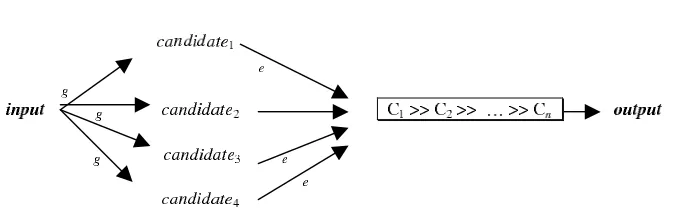
The process described above can be schematically represented like: Gen(Ik)→ { c1,c2,...,cn }
H-Eval (ci, 1≤i ≤ ∞) → Out6. 5
In this section, the description of the mechanism for generating an optimal form is based on [20]. In the section ‘Structural Descriptions’ we complete this exposition mentioning some elements of the contemporary OT as exposed in [25].
6
where Ik is the input for which a set of candidates c1, c2,..., cn will be generated. As we have said Eval selects from that set of candidates, a candidate ci that becomes the output (Out) assigned to the input Ik. In such selection a ranking or constraint hierarchy H is assumed.
The number of candidates that Gen can assign to a certain input I can be infinite. Besides, Gen is free to generate any conceivable candidate for a certain input I, even when such output candidate may be a quite unfaithful analysis of that input. The unique requirement is thatGen uses licit elements for building the candidates, that is, elements from the universal vocabulary or lexicon.
Gen’s characteristic of postulating any amount of analyses or output candidates for a certain input I, is known as Freedom of Analysis. This freedom of Gen could raise the question whether the system can at some point finish the evaluation and state an output. This question leads us to the distinction, usually accepted among formal linguists, between the grammar and its cognitive implementation. That is, the distinction between competenceandperformance. A grammar model is satisfactory if it explains grammatical judments of speakers and regularities in natural language. Its aim is not to explain how human minds process linguistic knowledge but how they use them. In other words, a grammar’s goal is oriented to the competence of a language not to its performance.7 The problematic issue of whether a system can finish the process of evaluation and to select an output is a problem related to the performance of language not to its competence. So, it seems to be a problem that goes beyond a grammar’s goal.8
The candidates generated by Gen are compared to each other. From this comparison, Eval will choose an optimal candidate, that is, the candi-date that best satisfies the ranking of the constraints. Independently of the number of output candidates, Eval always selects one, the most harmonic candidate that becomes the output. There are two cases that may seem problematic with respect to the unicity of the output. First, when there are two or more candidates that have the same number of violation marks with respect to the same constraint. In this case OT will consider such candidates as forms equally correct. Second, when there is no optimal candidate. OT always assumes that the candidates generated by Gen can be compared in terms of violation marks. The candidates have thesame number of marks9
7
It leaves to disciplines like psycholinguistics, neurolinguistics and computational lin-guistics, the task to deal with the cognitive implementation or performance. In Chomsky, the distinction between competence and performance can be drawn in terms of the dis-tinction between I-language and E-language ([5]).
8
It should be observed that the gap between competence and performance is been closed. Perhaps this explains why more people from ‘theoretical’ linguistics, computational linguistics and neurolinguistics are nowadays working together.
9
or not. If they do not, there is always a candidate with the minimum number of marks.
Summing up. The basic architecture of an OT grammar includes a universal candidate generator Gen, a universal evaluation function Eval, and a universal set of constraints Con, whose constraints are ranked in a hierarchy H. Assumming that a grammar deals with competence not with performance, Eval is always able to find an output for a given input.
2.4
Two readings of an OT architecture
[image:23.595.130.470.322.428.2]The basic architecture of an OT grammar introduced in the previous section can be depicted as in figure 2.1. This architecture can be read in terms of
Figure 2.1: Basic OT Architecture
harmonic serialism or in terms of parallelism. In harmonic serialism the production of an optimal form is explained as follows: A set of candidates generated byGen is advanced to evaluation, where Eval assuming a hierar-chy of the constraints selects the mostharmonic. Theoptimal candidate is fed back into Gen. Gen generates another set of candidates, which again is evaluated, and again theoptimal candidate is returned toGen. This process continues until no improvement in optimization is possible [20].
2.5
The optimal candidate
Intuitively, theoptimal candidate that constitutes the output of an evalua-tion, it is the winner among other candidates. In the selection of anoptimal candidate, the number of violations on the constraints is not as important as the position of the constraint(s) in a certain hierarchy. To violate a higher constraint is more costly than to violate a lower one. An optimal candidate is always optimal with respect to other candidates. The best or optimal form will be that candidate that violates lower ranked constraints than those constraints that the other candidates violate. That is,
Definition 2.2
A candidate w is considered to be optimal iff for each competitor w’, the constraints that are violated by w must be ranked lower than at least one constraint violated by w’.(Cfr.,[3]:20).
2.6
Speakers and Hearers
As you can see in figure 2.1, we have depicted a forward relation between input and output, but the relation can be backward. What we have called input and output are respectively the underlying form and theoptimal form. Figure 2.1 shows us the relation from the underlying form to the optimal form, this relation is a function that we call, following [25], ‘the production function’. This function denoted byfprod, can be identified with thespeaker perspective.
Additionally, in [25] a backward function is introduced. This function maps from the optimal candidate10 to the underlying form, called it ‘the comprehension function’, denoted byfcomp, and it is commonly matched to thehearer perspective.
In this thesis we focus on the speaker perspective. We will use the terms ‘input’ and ‘output’ as in earlier sections, as denoting the underlying and the optimal forms respectively. A more precise characterization of the functions just exposed is given in the next section, with the help of the concept of structural description.
10
2.7
Structural Descriptions
11 Structural descriptions play an important role in theories that assumes the principle of compositionality of meaning. This principle states that the meaning of a complex expression is formed from the meaning of its parts plus rules for combining such parts. OT grammars assume the principle of compositionality. Structural descriptions will be the parts from which compound structures will be formed.
A structural description in OT has three primitive elements: an pretation, an expression and a correspondence relation between the inter-pretation and the expression. In the speaker’s perspective, input elements are interpretations while outputs elements are expressions. 12 For example, in the Basic CV Syllable Theory of OT, interpretations are strings of conso-nants and vowels and expressions are such strings parsed into syllables. 13
Definition 2.3
A structural descriptionS in an OT grammar is a tuple (I,E,R), where 1. I is an interpretation
2. E is an expression.
3. Ris a correspondence relation between I and E.
For every expressionE, there is a substructureO, called theovert part. 14 The universe of structural descriptions is denoted by US. The universe of interpretations, expressions, correspondence relations and overt forms by UI,UE,UR and UO respectively.15
The set of candidate expressions of a particular interpretation I0 is the set of all structural descriptionsS = (I0,E,R) in US. Such a set is called Gen(I0). That is,
11
The content of this section is based on [25]:472-495.
12
In the hearer’s perspective is in the opposite way. Input elements are expressions while outputs are interpretations.
13
We can take the string /V1 C2
V3 C4
/ as interpretation. Its correspondinggrammatical
oroptimal expression with respect to the hierarchyFillC ≫ Parse ≫FillV ≫NoCoda
≫Onset would be .V1
.C2
V3
C4
. Cfr. section 2.9
14
Theovert part or surface form is ‘the portion ofE that is directly available to the hearer’([25]: 472).
15
Definition 2.4
Gen(I0) ={ S ∈ US| ∃E ∈ UE, R ∈UR s.t. S= (I0,E,R)}
The so-called functionGenis the correspondence relation that maps from the interpretation I0 to the Es ∈ UE. The production function assigns to each interpretation a subset of the set assigned byGen. That is,fprod(I0)⊂ Gen(I0). If a structureS= (I0,E,R)∈fprod,S is a grammatical expression of the interpretation I0.
The set of candidate interpretations of a particular expressionE0 is the set of all structural descriptions S = (I,E0, R) in US. This set is called Int(E0).
Definition 2.5
Int(E0) ={ S ∈ US| ∃I ∈UI,R ∈ URs.t. S= (I,E0,R)}
The functionInt maps from the expressionE0to theIs ∈UI. The com-prehension function assigns to each expression a subset of the set assigned byInt. That is,fcomp(E0)⊂Int(E0). If a structureS= (I,E0,R)∈fcomp,
S is a grammatical interpretation of the expression E0.
As we have mentioned, we will focus on the speaker’s perspective. We consider the hearer’s perspective also interesting , but it goes beyond our main goal in this thesis.
2.8
The constraint hierarchy
The function of evaluation, that is, Eval, carries the responsability of select-ing the grammatical well-formed structures in a certain language. Assumselect-ing a strict order on the constraints, Eval looks for the output in the space of candidates produced by Gen. But for such an evaluation gets help from the following devices: a constraints hierarchy, marking of violations and harmony evaluation ([15]). In this section we only comment the first device. In OT, the universal constraints grouped in Con, are not mutually con-sistent. In order to resolve their conflict and to choose the most harmonic candidate, all the constraints in Con are ordered in a strict domination hierarchy. We will represent this domination as: C1 ≫ C2 ≫... Cn where ‘Ca ≫ Cb’ is read as ‘constraint a dominates constraintb’.
The absolute priority of C1 over C2 consists in that independently of the number of violations of C2, large, small or nil, the violations of C2 does not compensate a single violation of C1. “The penalty for violating C1 is infinitely greater than the penalty for violating C2” ([20]:236).
The strict domination hierarchy can be seen as a strict partial order (SPO). An SPO is a pair (W,R), where the relation R is irreflexive (∀x
¬Rxx) and transitive (∀xyz(Rxy∧Ryz → Rxz)). In the case that concerns us,W =Con, andR is the relation ≫. The properties of irreflexivity and transitivity of the ranking of constraints can be expressed as:
Irreflexivity: ¬(C1≫C1)
Transitivity: If C1≫C2 and C2 ≫ C3 then C1 ≫ C3.
Another property related to the ranking of constraints is calledeconomy. Economy Property: Banned options are available only to avoid violations on higher-ranked constraints and can only be used minimally ([20]:32).
This property is quite important, it tell us about the purpose of violating a constraint: a constraint may be violated only to avoid the violation of higher ranked constraints. And only to avoid such violations, that is, that violations even when permitted should be kept to a minimum.
For example, take the case in which markedness constraints dominate faithfulness constraints (markedness ≫ faithfulness). Assuming the econ-omy property, those output candidates that violate faithfulness without reduction of markedness will never become optimal. This is in tone with the economy property, violation of a constraint (faithfulness in this case) is permitted in order to avoid violation of a higher ranked constraint (here, markedness). If the reverse ranking is the case, that is, faithfulness≫
markedness, violations of markedness are justifiable in order to avoid vi-olations of faithfulness.
2.9
The Basic CV Syllable Theory
For the presentation of the Basic Syllable Theory in OT, we follow [25]. This version of the CV theory assumes elements of the correspondence theory of McCarthy and Prince [18].
a) The universe US
In the Basic CV Syllable Theory, the universe of structural descriptions US, is formed by strings of consonants and vowels, that is, C’s and V’s. Interpretations are strings of C’s and V’s like /VCVC/, /CVCVC/, and so on. Expressions are strings of C’s and V’s but parsed into syllables. For example, from the interpretation /VCVC/ = /V1C2 V3C4/ the following candidates (i)-(iv) can be generated:16
/VCVC/ /V1C2 V3C4/
(i) .2V.CV.hCi [σCV1][σC2V3] (ii) hVi.CV.hCi [σC2V3]
(iii) hVi.CV.C2. [σC2V3][σC4V]
(iv) .V.CVC. [σV1][σC2V3C4]
From the speaker’s perspective, interpretations are always the inputs of theGen function, and expressions the output of such function.
b) Constraints
The Basic CV Syllable Theory has the following constraints ([25]:980-1): Con constraints
(i)Onset. Every syllable nucleus has a preceding onset. (ii)NoCoda. Codas are not permitted.
(iii)Parse. For every element in the input there is a corresponding element in the output.
(iv) FillV. Every syllable nucleus in the output has a corresponding V in the input.
(v)FillC. Every syllable onset or coda in the output has a corresponding C in the input. 17
16
The example is shown in two notations. The notation used in the left expressions can be read as follows: .X. as ‘the string X is a syllable’,hxias ‘the element x is unparsed’,2
as ‘a nodeOnset,Nucleus orCoda is empty’, ´x as ‘the element x is a nucleus’ ([20]:110). In the right expressions, all of the elements of the underlying form are numerated. This strategy makes the2andhisymbols unnecessary. A syllable is indicated byσ. In what follows we add to the left notation upper numbers just as to the right one. Numbers make clearer which elements are mapped. But we still preserving boxes and angles because they will help us in the next chapter to clarify which elements are parsed and which ones not.
17
Gen constraints
(vi)Identity. Each correspondence index i may label at most one pairing: either Ci↔ Ci or Vi↔Vi, but not both.
(vii)Linearity. Output segments mantain the order of their corresponding input segments.
(viii)Integrity. Each segment in the input corresponds to at most one seg-ment in the output.
(ix)Uniformity. Each segment in the output corresponds to at most one segment in the input.
Structural constraints
(x) Outputidentity. Every output segment is either an onset, a coda or a nucleus, but no more than one of these.
(xi)NoOutputgaps. There are no gaps between consecutive segments in an output string.
(xii) Correspondence. No correspondence relation exists without both an input and an output element.
(xiii)Nucleus. There must be a nucleus, after every onset and before every coda.
The structureU in CV Theory is constituted by:
UCV ={ US,constraints, definition of ‘being optimal’ }
In the following chapters we will focus on the encoding of the structure
UCV. First, we will present the encoding in the connectionist level (chapter 3) and then in penalty logic (chapter 5).
c) The OT Table
In the Basic CV Theory the function Gen produces candidate expressions. These candidates are compared taking in account a specific hierarchy H of the constraints in Con. From such comparison, Eval will select the optimal expression in the hierarchy H.
Suppose that for the input /V1C2 V3C4/Gen has generated the follow-ing candidates:
And assume that the constraints in Con show the ranking: FillC ≫
Parse ≫ FillV ≫ NoCoda ≫ Onset. 18
The OT table that shows the candidate comparison can depicted as in table 2.1.
input: /V1C2V3C4/ → F illC ≫P arse≫F illV ≫N oCoda≫Onset c1: .2V1.C2V3.hCi * *
c2: hVi.C2V3.hCi **
c3: hVi.C2V3.C42. * *
c4: .V1.C2V3C4. * *
Table 2.1: Candidate comparison in OT
Asterisks indicate violations on constraints. For example, candidate c1 has violated the constraints FillC and Parse. If you observe the table, all candidates have violated a constraint. The optimal candidate is c4 because from each competitor c’, the constraints that are violated by c4, that is, NoCoda and Onset, are ranked lower than at least one constraint lost by any c’ (definition 2.1).
Now, suppose that we have the same input and output candidates as above, but the order that the constraint in Con show is different. Take the hierarchy H’ being: Onset ≫ NoCoda ≫ FillV ≫ Parse ≫ FillC. The corresponding OT table is table 2.2.
With respect to the constraint hierarchy H’, candidate c1 arises as the optimal form.
Different rankings on the constraints in Con can support different lin-guistic forms asoptimal. This means that grammatical forms will be relative to the contraint hierarchy assumed. As we have mentioned, in a nativist OT, human languages will share the structure U but they will differ in the way they order their Con constraints. To learn a language is just to learn the ranking of constraints. The rest is inborn.
18
input: /V1C2V3C4/ → Onset≫N oCoda≫F illV ≫P arse≫F illC
c1: .2V1.C2V3.hCi * *
c2: hVi.C2V3.hCi **
c3: hVi.C2V3.C42. * *
c4: .V1.C2V3C4. * *
Table 2.2: Candidate comparison in H’
2.10
Appendix: The set of universal constraints
Con
OT recognizes two fundamental classes ofCon constraints: markedness con-straints and faithfulness concon-straints. Faithfulness concon-straints evaluate the preservation of underlying forms in the output candidates, that is, in the output of the Gen function. Markedness constraints assess only to such outputs. These two types of universal constraints are always present in the setCon.
OT requires that every OT grammar has markedness and faithfulness constraints. That does not mean that each OT grammar will have the same specific constraints of those types. Different OT theories can propose distinct faithfulness constraints and distinct markedness constraints. For example, in a theory for avoiding hiatus,19 the following Con constraints may be assumed.
For avoiding Hiatus
(i)Markedness constraints: *HIATUS: Hiatus are prohibited. (ii)Faithfulness constraints:
MAX(V): Vowels may not be deleted.
DEP(C): Consonants epenthesis is prohibited.
While in a basic syllable theory as that exposed in [20], the following constraints could be postulated:
For a syllable theory in OT
(i)Markedness constraints:
ONSET: A syllable must have an onset.
−CODA: A syllable must not have a coda. (ii)Faithfulness
PARSE: Underlying segments must be parsed into syllable structure (Avoid deletion).
19
FILL: Underlying segments must be filled with underlying segments (Avoid epenthesis). 20
The relation between constraints is in principle conflictive. This aspect is related to its violability. Markedness and faithfulness are two antago-nistic classes. While faithfulness asks for preservation in the expression of the material given in the underlying form, markedness usually modifies the expression or output candidate, by deleting or aggregating material.
In OT violability does not mean ungrammaticality. Given the conflictive character of markedness and faithfulness, an output is in most situations forced to violate one class. This conflict will be resolved in the interaction of constraints in a particular ranking. In this interaction Eval will select the candidate with the least serious violations, that is, the optimal candidate. The optimal candidate is not the candidate with null violations, but that candidate that compared with other candidates is the best in satisfying the set of constraints. Grammaticality in OT meansoptimality not inviolability.
20
In the syllable theory we have presented in 2.9,OnsetandNoCodaare themarkedness
Chapter 3
CV
net
: A network
embodying OT
3.1
The ‘abstract genome’ project
It seems that we can distinguish between two categories. On the one side, the group of devices related with material of genome. In the other, the group of devices concerning nets. In [25] is assumed that each level of the genomic side encodes a level of the net’s side. In each side three levels are distinguished.
The genomic side is constituted by the levels: biological genome, abstract genome, innate constraints. Each of these ones will encode respectively the following levels in the net’s side: biological neural net, connectionist net, symbolic system. We will call this way of relation among the levels the ‘horizontal’ relation (see figure 3.1).
In [25] the necessity of introducing an intermediate level between the biological genome’s level and the innate constraints’ level is suggested . This intermediate level is called ‘abstract genome’.
The levels mentioned will indicate a ‘vertical’ relation. In the genomic side, is assumed that the biological genome’s level instantiates the abstract genome’s level, and this one, the innate constraints level. In the nets’ level, the biological neural net’s level instantiates the connectionist net level and this one, the symbolic system level.
In terms of what we treat in this thesis the scheme explained above means the following: U is in the innate constraint level. To OT corresponds the symbolic system level. That means, U encodes OT. However, also means in the ‘vertical’ relation, that U is instantied in an abstract genome, and this one, in a biological genome. In the nets’ side, it means that OT is instantiated inCVnet, and this network in a biological network.
Figure 3.1: Abstract Genome
Their suggestion has been an abstract genome. We agree with the necessity of an intermediate level, but instead of the abstract genome, we introduce penalty logic. For us, penalty logic in the ’horizontal’ relation will encode CVnet . In the ‘vertical’ path it instanties the innate constraints’ level, in particular, the structureU; and it is instantiated in a biological genome.
3.2
In which sense are the
net
-constraints
univer-sal?
In OT, constraints are universal as they form part of the structure U. In the connectionist level, constraints are usually characterized as universal when their weights are bound. In this thesis, we assume such a notion of universality in the connectionist level.
In order to avoid confusion, we will use the following names for the ‘con-straints’: Constraints in the level of OT will be called ‘OT-constraints’, while constraints in the connectionist level will be denominated ‘net-constraints’. This distinction will be extended to the particular constraints. For example, we use the name ‘OT-Onset’ for talking aboutOnset in the linguistic level, and net-Onset forOnset in the connectionist level.
3.3
CV
netarchitecture
In the CV Syllable Theory, the grammar defines a mapping from an under-lying string composed with C’s and V’s, to a surface form with C’s and V’s. This mapping is implemented inCVnet.
CVnet is a symmetric local connectionist network that can represent in-terpretations and expressions of C’s and V’s.
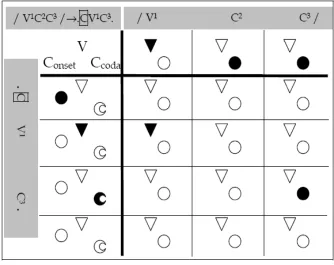
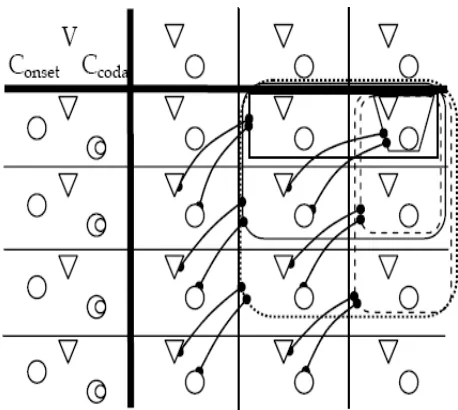
InCVnet we find three layers: an input, an output and a correspondence layer. 1 Take figure 3 as a matrix2. The input unit is represented by cells a12,a13, a14, the output layer by cells a21,a31,a41 and a51, while the correspondence layer is spread over the remaining cells, in the center of the CVnet picture.
In the input and correspondence layers, units are classified by being vowels or consonants. Vowels are denoted by ∇ and consonants by . In the output layer a more detailed distinction is introduced. Consonants are distinguished as onsets or codas. In the output layer we have three units: vowels, onset consonants and coda consonants. These are denoted respectively by∇, and a crescent.
It is important to note that as CVnet is a symmetric network, its con-nectivity pattern has a symmetic feedback. That is, for two unitsα,β the weight fromα to β is equal to the weight fromβ to α.
Let us explain in more detail the activity inCVnet. Suppose that we have the input string /V1C2C3/ (grey part of figure 3.2). This input is depicted in the network through activation or disactivation of units in the input layer. Black nodes represent activated nodes, white nodes disactivated nodes. The input /V1C2C3/ is depicted in figure 3.2 in the input layer, that is, cells a12,a13,a14. As we have pointed out, in the input layer we only find vowels and consonants. If we think in the OT framework, this may be intepreted as entering as inputs just CV syllables, that is, a syllable that has an onset consonant, a nucleus, but no coda. Graphically, this interpretation seems to be supported too, if you look at figure 3.2, a is found in the input and output layers, and in the last one is interpreted as onset consonant.
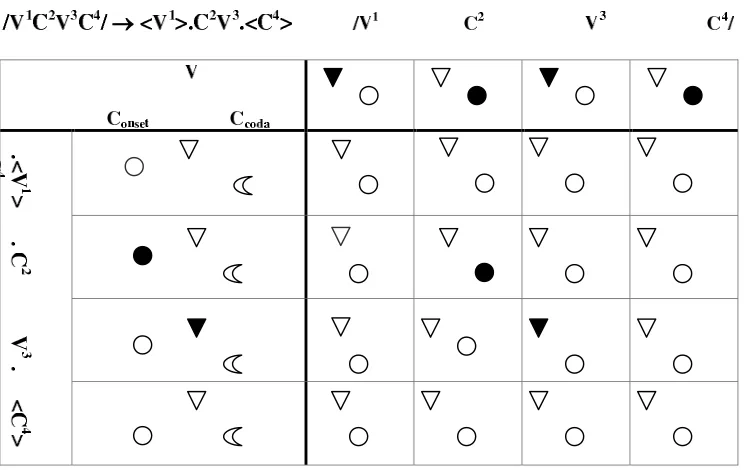
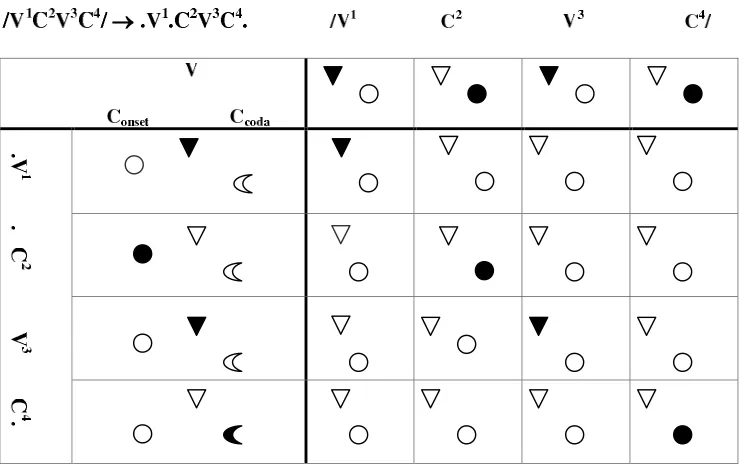
In the correspondence layer we still find the distinction of units into vow-els and consonants. But in this layer, consonants are not distinguished yet by onset or coda consonants. Let us see how the activity in the correspon-dence layer goes. The V1 in the input (cell a12) is in correspondence with the V in the cell a32. Notice that these two V’s are activated. Now, if you look at cell a31, there is also a V active. This means that the V1 in the input has been parsed, additionally it indicates in which output position the V1 has been parsed. In this case, it has been parsed in the second position of the output. The position of a vowel or consonant in the output will be
1
In the standard representation of networks, the input, correspondence and output layers will be the rows of input, hidden and output units respectively.
2
relevant for the intepretation if the syllable has onset, nucleus or coda. Now consider the C2 in cella13. This consonant is active but there is no unit beneath it that indicates to us a correspondence relation. The C in the output (cella21) cannot be interpreted as the consonant C2 in the input (cell a13) because in the cell a23 the consonant unit is not active. Furthermore, observe that no consonant in the cells to the right of the cell a21 is active (cells a22, a23, a24). This tell us that the consonant C in the output (cell a21) has been added (epenthesis).
Now, consider the last consonant in the input, the consonant C3 (cell a14). Beneath it, there is an active consonant (cell a44) and in the output layer, cell a41, there is a C-coda active. This means that the C3 has been parsed to a consonant coda in the output.
Notice that in the explanatin given above, we were always looking to relate the vowels in some layer only with vowels in other parts of the net. Similarly, we relate consonants in some layer only with consonants in other layers. This way of proceeding is justified by thenet-Identity constraint.3
3.4
The constraints of
C V
net3.4.1 The net-Con constraints
In order to describe properly the behavior of the net-Con constraints, we have to state that all optimal patterns of activations satisfy thenet-Gen and thenet-Structural constraints. The statement is plausible under the assump-tion that these last sets ofnet-constraints have higher strength than the set of net-Con constraints. Usually an exponentially higher weight is assigned to thenet-Gen and net-Structural constraints. This way of proceeding even though it is not adequate because such constraints are not rankeable, in practice guarantees the submission of the violable net-constraints.
Below we present the pictures of the net-constraints. In these pictures you will see some numbers assigned to each net-constraint. These numbers represent the bias values. Strengths are not determined. Connections co-efficients are only introduced in the description of each net-constraint, but not in the figures.
a)net-Onset and net-NoCoda
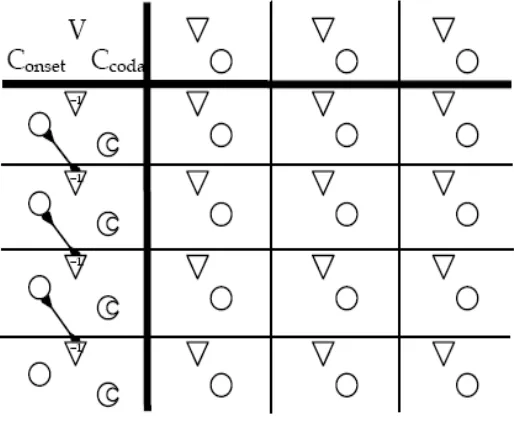
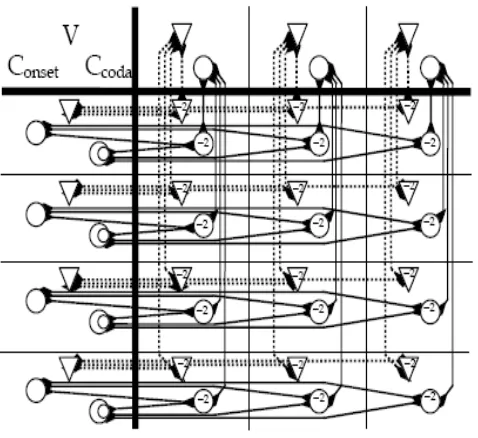
net-Onset is realized through a negative bias−1 on every V-unit in the out-put. In order to avoid this negative value, a positive connection coefficient +1 between every V-unit and C-onset unit in the output is required (see figure 3.3).
For net-NoCoda a bias −1 is related to each C-coda unit. Given that in a CV Syllable Theory codas should be avoided, for this negative bias
3
we do not require a positive connection coefficient +1, instead a connection coefficient−1 is introduced (see figure 3.4).
b) net-Parse
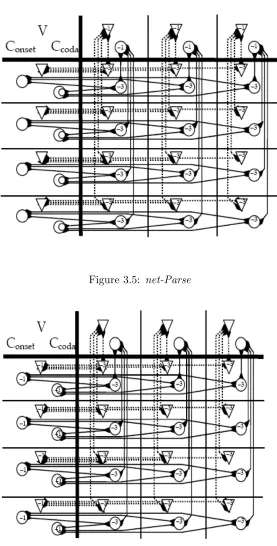
In OT faithfulness constraints, there is a correspondence between the ele-ments in the input and those in the output. In order to implement such a correspondence in the connectionist level, correspondence units are needed. In net-Parse, the values of correspondence units plus the values of the bias coefficients lead to a ‘zero net Harmony’. In other words, for anyParse net, a bias coefficient of−1 associated with each input unit, is assumed. A bias coefficient of −3 is assigned to each correspondence node and +2 for all connection coefficients. From the bias deficit plus a correspondence unit linked to it, we have (−1) + (−3) =−4. By the addition of the connection coefficients we have 2 + 2 = 4. Then 4 + (−4) = 0. In figure 3.5 only the bias coefficients are represented. Value of connection coefficients are not included.
c) net-FillV and net-FillC
Similarly tonet-Parse, for thesenet-constraints connection coefficients will take the value +2, and the bias coefficient in each correspondence unit will be equal to−3. Differently from net-Parse,net-FillV and net-FillC do not have bias coefficients in input units but in output units. The bias coefficient in each output unit will be −1. Similarly to net-Parse, these constraints lead to a ‘zero net Harmony’.
In figure 3.6 both constraints are depicted: net-FillV is constituted by all V-units (see dotted lines) whilenet-FillC is constituted by all the consonants being onset or coda (see solid lines).
3.4.2 The net-Gen and net-Structural constraints
The net-Gen and net-Structural constraints are the inviolable constraints of CVnet. More properly stated, these net-constraints have fixed strengths. Besides, such net-constraints do not change their strengths with respect to each other, so, we can consider them as a one complex constraint whose weight is exponentially larger than any net-Con constraint.
Figure 3.3: net-Onset
Figure 3.5: net-Parse
net-Gen constraints
a)net-Identity
For net-Identity there is a connection coefficient −1 between the C’s and V’s of the correspondence units. This connection coefficient will avoid the activation of a C and V at the same time supporting in this way the mapping C-C and V-V from input to output (see figure 3.7).
b) net-Linearity
In OT, linearity was the constraint that regulated that the order of the elements in the input was preserved in the output. In the connectionist level, this constraint is implemented through the assignment of a value -1 to each connection coefficient between the correspondence units. Observe that in figure 3.8 below, the correspondence units are linked in a way that preserves linear order. Consonants and vowels in a certain cell aij will be linked with a cell that is in a previous columnk and a posterior rowl.
net-Structural constraints
c) net-OutputIdentity
For this constraint there is a connection coefficient −1 between the triple formed in each output cell by the vowels, onset and coda consonants. This negative connection is given in order to avoid the effect that more than one unit of the triple is activated. The ranking of this constraint is required to be significantly higher than the othernet-Gen ornet-Structural constraints. This requirement is there because other fixednet-constraints will force more than one unit in the output’s triple to be actived ([25]:992-3). See figure 3.9.
d) net-Correspondence
Figure 3.7: net-Identity
Figure 3.9: net-OutputIdentity
[image:43.595.174.413.439.658.2]Figure 3.11: Network activity for c1
3.5
Candidate Activations
Figure 3.12: Network activity for c2
[image:45.595.124.492.414.689.2]Figure 3.14: Network activity for c4
3.6
The energy function E of
net
-constraints
Consider the function:
(F1) E(s) =−X
i<j
wijsisj
This function, called Ljapunov orenergyfunction will help us to calculate the value of E relatively to different activation states. Here, we will use for calculating the minimal energy of each of the net-constraints. Below we present pictures of net-constraints links. These links we will call them micro-constraints. Below we also introduce the corresponding tables of the energy E of themicro-constraints.
Microconstraints are important because they simplify the calculation of the energy function E of the net-constraints. The character of localist network ofCVnetpermits us to focus in the minimal significative part of the network (the microconstraints) and to spread the results to more complex networks build with these parts. If you observe the figures ofnet-constraints, you will see the repetition of the same relations (microconstraints) through all the network.
s s s
coj vj′ b0 E(s) coj vj′ b0 E(s) coj vj′ b0 E(s)
[1] 1 1 1 0 [10] −1 1 1 2 [19] 0 1 1 1
[2] 1 1 −1 −2 [11] −1 1 −1 0 [20] 0 1 −1 −1
[3] 1 1 0 −1 [12] −1 1 0 0 [21] 0 1 0 0
[4] 1 −1 1 0 [13] −1 −1 1 −2 [22] 0 −1 1 −1
[5] 1 −1 −1 2 [14] −1 −1 −1 0 [23] 0 −1 −1 1
[6] 1 −1 0 1 [15] −1 −1 0 −1 [24] 0 −1 0 0
[7] 1 0 1 0 [16] −1 0 1 0 [25] 0 0 1 0
[8] 1 0 −1 0 [17] −1 0 −1 0 [26] 0 0 −1 0
[9] 1 0 0 0 [18] −1 0 0 0 [27] 0 0 0 0
Table 3.1: Energy micro-Onset
co for a unit representing an onset consonant, cc for a coda consonant, v for a vowel and b for a bias. For an easier visual relation, we use circles for onset consonants, crescents for coda consonants, triangles for vowels and circles with a an internal cross for biases.
As we mentioned in 3.4.1, for the net-Onset constraint the connection coefficient is always positive between the corresponding onset consonant and the vowel. The bias for this constraint is always on the vowel and is negative. In the micro-Onset we take the connection coefficient value as the value of the link between the onset consonant and the vowel. The bias value is−1. We can depict the network of themicro-constraint Onset as follows:
Figure 3.15: micro-Onset
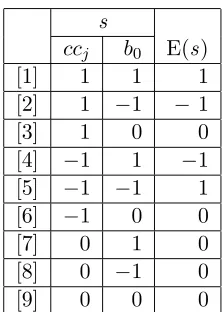
The energy function for this system is: E(s) = − cojvj′ +vj′b0. States
in rows [2] and [13] show theminimal energy E with−2 (see table 3.1). 4 For the net-NoCoda constraint each coda unit is affected by a negative bias. In the micro-Onset we take the value of such a bias (−1) for the
4
representation of the link between the coda consonant and bias unit. The micro-constraint NoCoda may be depicted as:
Figure 3.16: micro-NoCoda
The energy function E forNoCoda would be: E(s) =− ccjb0. States in [2] and [4] show the minimal energy E.
s
ccj b0 E(s)
[1] 1 1 1
[2] 1 −1 −1
[3] 1 0 0
[4] −1 1 −1 [5] −1 −1 1
[6] −1 0 0
[7] 0 1 0
[8] 0 −1 0
[image:48.595.241.352.355.511.2][9] 0 0 0
Table 3.2: Energy micro-NoCoda
Figure 3.17: micro-Parse
The energy function for this system is: E(s) =− 2vivij-2vijvj +vib0+ 3vijb1. States in rows [4] and [29] show the minimal energy E with − 8 (see table 3.3). For brevity, here we only show the cases corresponding to activated and inactivated states. These will be the relevant ones for the translation into penalty logic.
The micro-constraints F illV may be depicted as follows:
s
vi vij vj b0 b1 E(s)
[1] 1 1 1 1 1 0
[2] 1 1 1 1 −1 −6
[3] 1 1 1 −1 1 −2
[4] 1 1 1 −1 −1 −8
[5] 1 1 −1 1 1 0
[6] 1 1 −1 1 −1 −6
[7] 1 1 −1 −1 1 −2
[8] 1 1 −1 −1 −1 −4
[9] 1 −1 1 1 1 2
[10] 1 −1 1 1 −1 8
[11] 1 −1 1 −1 1 0
[12] 1 −1 1 −1 −1 6
[13] 1 −1 −1 1 1 −2
[14] 1 −1 −1 1 −1 0
[15] 1 −1 −1 −1 1 −4
[16] 1 −1 −1 −1 −1 2
[17] −1 1 1 1 1 2
[18] −1 1 1 1 −1 −4
[19] −1 1 1 −1 1 4
[20] −1 1 1 −1 −1 −2
[21] −1 1 −1 1 1 6
[22] −1 1 −1 1 −1 0
[23] −1 1 −1 −1 1 8
[24] −1 1 −1 −1 −1 2
[25] −1 −1 1 1 1 −4
[26] −1 −1 1 1 −1 2
[27] −1 −1 1 −1 1 −2
[28] −1 −1 1 −1 −1 4
[29] −1 −1 −1 1 1 −8
[image:50.595.201.392.172.644.2][30] −1 −1 −1 1 −1 −2 [31] −1 −1 −1 −1 1 −6 [32] −1 −1 −1 −1 −1 0
F illV may be depicted as:
Figure 3.19: micro-F illC
The energy calculation for these constraints is similar to those of micro-Parse.
3.7
Summary
In this chapter we have introduced the network CVnet. For doing that we have presented the net-constraints, the micro-constraints, the energy func-tion E and activafunc-tions for particular candidates. All these topics are related. For explaining such a relation, first, we will display CVnet in a more conventional way of representing networks, that is, a network in which we have rows of input units, of hidden units and of output units. In such a network, we introduce arrows whose direction is forward and backward due to the symmetry ofCVnet.
Look at figure 3.20. In this representation, the first row from bottom to top represents the input units ofCVnet. The row in the middle contains the hidden or correspondence units. The row at the top is constituted by the output units.