XML Query Evaluation via CTL Model Checking
Loredana Afanasiev
March 11, 2004
Abstract
Acknowledgements
This thesis is the result of work with several people which I will mention below. I was just being in the middle of the process, trying to catch and to learn as much as possible, about myself, about my interests, about my capacities. What I have learned actually is a great deal about the people that I got to know. I learned how people can be generous and patient, professional and loving. I had a school of life more then a school of logic.
I consider this thesis to be the work of Massimo Franceschet, Maarten Marx and Balder ten Cate, as much as mine. More of mine was the pleasure of learning from them.
Maarten Marx’s help cannot be described in words. He has many qualities which I respect. I will mention only one. He was able always to come up with just the right solution for my problems. He offered help firmly, quickly, the right one and in the right moment. I wish I could be the same in this respect.
Massimo Franceschet was very kind to me and brave, agreeing to be my adviser. He advised me wisely, caring more about my health than about deadlines.
Balder ten Cate didn’t leave my side during the whole period. He helped me in every existing possible way. Balder brings up the best of me.
Maarten de Rijke and Dick de Jongh are the rare cases of the good people in the important administrative positions. They decided the course of things for me. Their kindness and goodness are legendary in ILLC. They gave me an ocean of help spread with patience.
Arjen de Vries made me a great favor by being in my commitee. His enthusiasm about science and about this project energized me. He is a bright source of inspiration.
Deep respect and warm feelings I have for Paul Vitanyi, who gave me incredible support and the most interesting hours full with discussions. His smiling eyes and almost child like interest and curiosity I’ll never forget. I want to thank also Rudi Cilibrasi for his help.
I hope my road will cross the road of these people over and over again.
Humble admiration I have for Ineke ten Cate. She is an endless source of love and care. Big gratitude goes to Nuffic and NWO for their financial support. In particular, I would like to thank Neda Wimmers for her help and patience with me.
Contents
1 Aperitif 3
1.1 The Query Evaluation problem for XML . . . 3
1.2 The Model Checking problem for CTL . . . 3
1.3 Our proposal: Query Evaluation via Model Checking . . . 4
1.4 Previous work . . . 4
2 The ingredients 6 2.1 Extensible Markup Language (XML) . . . 6
2.2 XML Path Languages . . . 7
2.2.1 Core XPath . . . 8
2.2.2 XCPath . . . 9
2.3 Computation Tree Logic . . . 10
2.3.1 Many dimensionalCTL . . . 12
3 The recipe 13 3.1 EmbeddingXCPathintoCTL . . . 13
3.1.1 EmbeddingXCPathinto many dimensionalCTL . . . 13
3.1.2 Embedding many dimensionalCTLinto one dimensionalCTL . . . 16
4 Cooking and Tasting 19 4.1 NuSMV model checker . . . 19
4.1.1 Model specifications . . . 20
4.1.2 Global model checking . . . 22
4.2 XCheck . . . 22
4.2.1 Technical specifications . . . 22
4.3 Experimental results . . . 23
5 Digestives 32
Chapter 1
Aperitif
1.1
The Query Evaluation problem for XML
The Extensible Markup Language (XML) is a standard adopted by the World Wide Web Con-sortium (W3C) [16] that was designed to describe the content of a document, and its hierarchical structure. It is becoming a major standard for exchanging structured or semistructured data on the web [1].
XML query evaluation problem is the problem of selecting elements that meet particular re-quirements from an XML document. XML query evaluation is widely studied from the perspective of storing large databases as XML documents. As Buneman et al [8] observe, “whether we shall store large XML document as databases (as opposed to using conventional databases and employ-ing XML just for data exchange) depends on our ability to find specific XML storage models that support efficient querying of XML”.
XML path language (XPath) [17] is a language proposed by the World Wide Web Consortium (W3C) for querying XML documents. XPath is already widely used as XML query language, and it there are several implementations of XPath retrieval systems. The XPath query evaluation problem is known to be solvable in polynomial time (polynomial in the combined size of the query and the document) [20]. Surprisingly, it was observed by the same authors that the existing XPath query evaluation processors, both the commercial and the academic onces, implement a naive, exponential-time algorithm. Since then, several new algorithms have been proposed. At present there are academic implementations of polynomial time algorithms for XPath query evaluation and linear time algorithms for smaller fragments of XPath, in particularCore XPath[20, 21]. Core XPathis simply the navigational part of XPath language.
In this thesis we focus on the query evaluation problem for Core XPath. We introduce and test a new method for solving this problem. Our algorithm also works for XCPath, a recently introduced extension of Core XPaththat is expressively complete for first-order logic [25].
1.2
The Model Checking problem for CTL
Model checking is the algorithmic verification that a given logical formula holds in a given structure. This concept is meaningful for most logics and classes of models, but it has been investigated most extensively for the case of temporal logic. During the last two decades, an active research field has emerged that focuses around the use of temporal logic model checking for the verification of software specifications. One temporal logic that has received much attention in this area is Computation Tree Logic(CTL) [15]. There are several implementations of efficient model checking algorithms forCTL, among which NuSMV [12].
formulas are checked onvery large models, since the models essentially describe the entire state space of the program to be verified. It is therefore crucial to use an efficient representation of the model. Efficient in the sense that the representation is small, and in the sense that the model checking of temporal formulas can be performed efficiently given that the model is represented in this way. One technique that is often used to achieve this (and that is used among others by NuSMV) issymbolic model checking. Symbolic model checking algorithms avoid explicitly storing and manipulating the entire state space by using Ordered Binary Decision Diagrams (OBDDs). This model checking algorithm is called symbolicbecause it is based on manipulation of Boolean formulas.
1.3
Our proposal: Query Evaluation via Model Checking
The main idea that drives this thesis is to perform query evaluation via model checking: if we think of an XPath query as a modal formula, and of an XML document as a model, query evaluation is nothing more than checking which elements of the model satisfy the formula. This thesis is meant to test if this approach to query evaluation is feasible, both theoretically and in practice.
The idea of XML query evaluation via model checking is sensible for the following reason. One of the main concerns in the area of model checking is finding an efficient representation of models that admits efficient model checking. Various optimization techniques have been developed and implemented for exactly this purpose (in particularsymbolic model checking). We might expect that these techniques work well also in the case of XML.
In Chapter 3, we establish a linear time reduction from the query evaluation problem of Core XPath to the model checking problem forCTL. In Chapter 4, we discuss an implementation of this translation, i.e., aCore XPathquery evaluation system that works by translation toCTL. The system uses theCTLmodel checker NuSMV. Chapter 4 also contains a discussion of experimental results.
Our contributions can be summarized as follows.
• We present a linear time translation from the query evaluation problem of Core XPath to the model checking problem forCTL. This shows that query evaluation forCore XPathis in linear time. As a theoretical result, this was already known [20]. However, our translation can be used for practical implementation.
• We have implemented aCore XPathquery evaluation system, XCheck, based on our transla-tion. XCheck translates the XML query intoCTL, and runs theCTLmodel checker NuSMV to evaluate it.
• We have performed experiments to analyze the practical efficiency of our proposal. Our first experimental results are not very positive. They show that there is a clear bottleneck in our approach, namely in representing the XML document symbolically, as input for the model checker. A more efficient symbolic representation of the XML document is needed in order to take full advantage of the model checking techniques.
• Our translation not only work forCore XPath, but also for a recently introduced extension of it,XCPath.
XCPath has the property that it is expressively complete with respect to first-order logic. While our implementation only acceptsCore XPath input, it is very easily extended to full XCPath, thus leading to the first implementation of a query evaluation system forXCPath.
1.4
Previous work
uses simulations and morphisms, [2] concentrate on regular expressions, and [10] make the con-nection with description logic. Early work in the area was (necessarily) mostly concerned with proposals for data models and query languages for semistructured data. After the introduction of XML and XPath, this is where much of the research converged.
The relation between model checking and query processing has been extensively explored in the setting of structured data. We refer to [22] as a good entry-point to the area. The relation between model checking and query processing for semistructured data goes back at least to [3], where it was formulated in terms of suitable modal-like logics. Quintarelli [28] embeds a fragment of the graphical query language G-Log into CTL, and she sketches a mapping for subsets of other semistructured query languages, like Lorel, GraphLog and UnQL. De Alfaro [5] proposes the use of model checking for detecting errors in the structure and connectivity of web pages. Alechina et al. [4] discuss the use of Propositional Dynamic Logic (rather than CTL) to obtain decidability and complexity results for checking path constraints on semistructured data (rather than query evaluation). Calvanese et al. [10] use description logics for similar purposes. Finally, Miklau and Suciu [27] and Gottlob et al. [19] sketch an embedding of the forward looking fragment of XPath into CTL, but they do not test the practical effectiveness of this approach.
Chapter 2
The ingredients
2.1
Extensible Markup Language (XML)
The Extensible Markup Language (XML) is a standard adopted by the World Wide Web Con-sortium (W3C) [16] that was designed to describe the content of a document, and its hierarchical structure. It is becoming a major standard for exchanging structured or semistructured data on the web [1]. An example of XML document is shown in Figure 2.1.
The basic component in XML is theelement, that is, a piece of text bounded by matching tags such as<book> and</book>. Inside an element we may have raw text or other elements. There are composite and atomic elements. Each atomic element consists of (1) a tag, (2) a possibly empty list ofattributes of the form name=value, and (3) a possibly empty string of text called Parsed Character Data(PCDATA). Each composite element consists of a tag and an attribute list as above, and a list ofsubelements. For instance, consider the atomic element from Figure 2.1:
<title language="English"> Database Systems </title>
The tag of this element istitle, the attribute list contains only the pair language="English", and the PCDATA isDatabase Systems.
Next, consider the following composite element from Figure 2.1: <book>
<author> Cassio </author>
<title> Data Production </title> </book>
The tag is book, the attribute list is empty, and the list of subelements contains the two atomic elements with tagsauthorandtitlerespectively.
There exists always a main element, called theroot element, in an XML document. The root element of the XML document in Figure 2.1 is the element with tag biblio. The attribute list of an element may contain a special attribute calledobject identifier, that can be used to identify the object uniquely. The object identifier is a special attribute with nameid, the value of which must be uniquely identify the element.
An XML document may contain different elements with the same tag. However, attribute names have to be unique for the same element (i.e., the attribute list of an element cannot contain two different attributes with the same name). There is a document order between elements in an XML file, which is induced by the order in which the tags appear in the file. For instance, in Figure 2.1,<author> Roux </author>comes before<author> Combalusier </author>. We follow [8] in using the wordskeleton to refer to what remains when all PCDATA is stripped off from an XML document.
<biblio> <book>
<author> Roux </author>
<author> Combalusier </author>
<title language="English"> Database Systems </title> <date format = "YYYY"> 1999 </date>
</book> <book>
<author> Smith </author>
<title> Database Systems </title> <date> 1999 </date>
</book> <paper>
<author> Cassio </author>
<title> Data Production </title> </paper>
</biblio>
Figure 2.1: An XML document
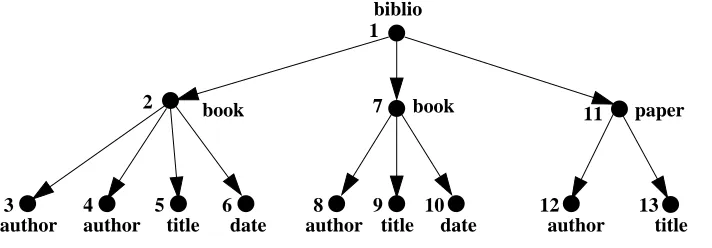
element is the root of the tree, composite elements correspond to internal nodes, and atomic ones correspond to leaf nodes. The tree is sibling ordered in the sense that the children of a node, if any, are ordered (first child, second child, and so on) according to the document order. Finally, each node is labeled with its element tag, as well as with its attributes. Figure 2.2 contains the tree representation of the skeleton of the XML document in Figure 2.1. For simplicity, in this picture, the attribute information of the elements is not represented, and each node is labeled with a number to indicate the document order.
Throughout this thesis, we will only considerskeletonsof XML documents. Moreover, we will ignore all attribute information, focusing only on the hierarchical structure of the document and the tags of the elements. The reason for this is that the XML query languages we will consider are not capable of describing more than just this part of the XML document.
We will now give a precise definition of the tree representation of XML documents that we will use in the next sections.
Definition 2.1.1 (XML Trees) Let Σbe a set of labels corresponding to XML tags. An XML tree is a finite sibling ordered node-labeled treeT = (N, R↓, R→, L), where N is the set of nodes, R↓ ⊆N ×N is the set of edges of the tree, R→ ⊆ N ×N is a functional relation associating each node with its immediate right sibling (if any) andL: Σ→℘(N)is a node-labeling function associating to each label a set of nodes.
This definition is arguably too liberal: it does not prohibit cases in which an element satisfies two XML tags. None of the results in the rest of this thesis depend in any way on this simplification.
2.2
XML Path Languages
XML path language (XPath) [17] is a language proposed by the World Wide Web Consortium (W3C) for querying XML documents. Using XML queries, one can select elements from an XML document that meet particular requirements. XPath is already widely used as XML query language, and it there are several implementations of XPath retrieval systems.
biblio
book
book 7 paper
9
8 13
author title date author title 12
6 2
11 1
3 author
10 5
title 4
[image:10.595.129.485.108.232.2]author date
Figure 2.2: An XML tree
step is of the formaxis::l, whereaxis is an axis such aschild, parent ordescendant, andl is an XML tag. For example, child::bookreturns all subelements that have the XML tag book. In addition, predicates can be used to put additional requirements on the elements. For instance, descendant::toy[attribute::color = "red"] returns all subelements that have tagtoy and that have attributecolor="red".
Being designed for practical use, XPath offers a range of numerical and string operations that can be used in formulating the queries. For example,
/child::biblio/child::book [attribute::date > 1998]
returns all books from the XML document in Figure 2.1 that have a date attribute with value higher than 1998. Similarly,
/child::biblio/child::book [string-length(child::title) > 3]/child::author
extracts form our example document the authors of all books that have a title consisting of more than three characters.
Rather than giving a formal definition of the full XPath language, we will proceed and consider two fragments of it, namelyCore XPathandXCPath.
2.2.1
Core XPath
Core XPath [20] is the clean logical core of XPath. The only objects that are manipulated by Core XPath are sets of nodes. No arithmetical or string operations are available. Hence, only the skeleton of the XML documents is considered in queries. The PCDATA and the attribute information of the elements is not manipulated.
The crucial notions of Core XPath language are axes, location steps and location paths. There are eleven axes: self, child, parent, descendant, ancestor, descendant or self, ancestor or self,following sibling, preceding sibling, following, and preceding. Each axis corresponds to a binary relation on the set of nodes of the tree. For instance, in the example of Figure 2.2, the axis following relates the node 7 with the nodes 11, 12, and 13, that is with the set of XML elements following the second book element in the XML document in Figure 2.1. A location path is an arbitrary long sequence of location steps separated by the symbol /, where a location step has the form axis :: l or axis :: l[pred], where axis is one of the eleven axes, l an XML tag and pred a predicate. The location stepaxis:: l is interpreted as a binary relation on the set of nodes of the tree that relates (n, m) ifmis reachable fromn throughaxis
and the label ofmisl. For example, the pair of nodes (7,13) belongs to the relation identified by following::title.
Finally, a location path locationpath/locationstep is interpreted as the concatenation of the relation for locationpath with the relation forlocationstep. For example, the pair (1,3) belongs tochild::book/child::author.
Location paths can be absolute or relative. Absolute location paths start with the symbol /
and are evaluated from the root of the tree. Relative location paths miss the symbol / in the beginning and are evaluated at any node of the tree. A Core XPath query q is an absolute or relative location path and the result of the evaluation ofqis the set of nodes that can be reached through the corresponding relation starting at the tree root or at any node of the tree, respectively.
We now we give the formal definition of the syntax of Core XPath[20].
Definition 2.2.1 (Core XPath Language) Let Σ be a set of labels corresponding to the XML element tags. An Core XPath query is a formula generated by the first clause of the following inductive definition.
cxp = locationpath| /locationpath locationpath = locationstep(/locationstep)∗
locationstep = χ :: l|χ :: l[pred]
pred = pred and pred|pred or pred|not pred|cxp
χ = child|parent|descendant|ancestor|
descendant or self |ancestor or self |following sibling | preceding sibling|following |preceding
wherel∈Σ∪ {∗}.
The label∗ acts as a wildcard (i.e., denotes any possible XML element tag). Instead of stating the semantics forCore XPathdirectly, we will first discuss a more expressive variant of it, namely XCPath[25], and we will show how Core XPathcan be embedded into XCPath. In this way, we implicitly give the semantics forCore XPath.
2.2.2
X
CPath
XCPathis a more expressive variant ofCore XPaththat was defined and proved to be expressively complete with respect to first-order logic on XML trees in [25]. In the same paper the author proves that model checking for this language can be performed in linear time on both query and model size, by means of a translation to Propositional Dynamic Logic.
The syntax of XCPathis as follows.
Definition 2.2.2 (XCPathLanguage) Let Σbe a set of labels corresponding to XML element tags. An XCPathquery is a formula generated by the first clause of the following inductive defi-nition.
locationpath ::= /locationstep |locationstep|locationpath/locationstep locationstep ::= axis::l|axis::l[pred]
pred ::= predandpred |pred orpred| notpred |locationpath axis ::= ²|d| d∗ |(d[pred])∗ |([pred]d)∗
wherel∈Σ∪ {∗}andd∈ {↑,↓,←,→}.
Core XPathis contained inXCPath, because the 11 axes of Core XPathcan be defined in terms of those of XCPath, cf. Table 2.1. On the other hand,XCPath is more expressive thenCore XPath [25].
For any binary relationR, letR−1 denote its inverse1and letR∗ denote its transitive reflexive closure2. The semantics of an XCPath query over an XML tree T is given by the following
1R−1={(m, n)|(n, m)∈R}.
Table 2.1: Traditional XPath axes vs. XCPathaxes self ::l[pred] ≡ ²::l[pred]
child ::l[pred] ≡ ↓::l[pred] parent ::l[pred] ≡ ↑::l[pred] descendant ::l[pred] ≡ ↓::∗/↓∗::l[pred]
ancestor ::l[pred] ≡ ↑::∗/↑∗::l[pred] descendant or self ::l[pred] ≡ ↓∗::l[pred]
ancestor or self ::l[pred] ≡ ↑∗::l[pred]
following sibling ::l[pred] ≡ →::∗/→∗::l[pred] preceding sibling ::l[pred] ≡ ←::∗/←∗::l[pred]
following ::l[pred] ≡ ↑∗::∗/→::∗/→∗::∗/↓∗::l[pred] preceding ::l[pred] ≡ ↑∗::∗/←::∗/←∗::∗/↓∗::l[pred]
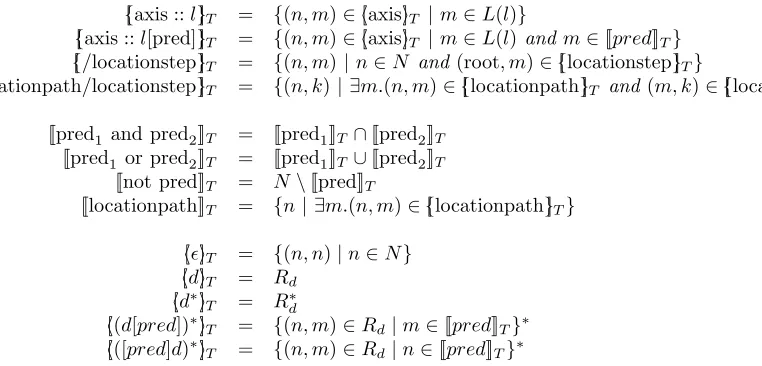
three simultaneously inductively defined functions: [{·}]T that, given anXCPathquery, returns the corresponding binary relation on the set of nodes ofT, [[·]]T that, given a predicate, returns a set of nodes of T that satisfy the predicate, and [h·i]T that, given an axis, returns the corresponding binary relation on the set of nodes ofT.
Definition 2.2.3 (Semantics of XCPath[25]) Let T = (N, R↓, R→, L) be an XML tree (cf. Definition 2.1.1). Let R↑ = (R↓)−1, R← = (R→)−1 and let L(∗) = N. Let root ∈ N be the root of the treeT. We define the semantics of XCPath as follows.
[
{axis ::l}]T = {(n, m)∈h[axisi]T |m∈L(l)} [
{axis ::l[pred]}]T = {(n, m)∈[haxisi]T |m∈L(l)andm∈[[pred]]T} [
{/locationstep}]T = {(n, m)|n∈N and(root, m)∈{[locationstep}]T} [
{locationpath/locationstep}]T = {(n, k)| ∃m.(n, m)∈{[locationpath}]T and(m, k)∈[{locationstep}]T} [[pred1 and pred2]]T = [[pred1]]T ∩[[pred2]]T
[[pred1 or pred2]]T = [[pred1]]T ∪[[pred2]]T [[not pred]]T = N\[[pred]]T
[[locationpath]]T = {n| ∃m.(n, m)∈{[locationpath}]T} [
h²i]T = {(n, n)|n∈N} [
hdi]T = Rd [
hd∗i]
T = R∗d [
h(d[pred])∗i]
T = {(n, m)∈Rd|m∈[[pred]]T}∗ [
h([pred]d)∗i]
T = {(n, m)∈Rd|n∈[[pred]]T}∗
Theresultof evaluation of anXCPathqueryqon a treeTis the set Result(T, q) ={m| ∃n.(n, m)∈ [
{q}]T}. Notice that, given a queryq=/q0, the result of the absolute queryqand that of the relative oneq0 may differ.
2.3
Computation Tree Logic
Computation Tree Logic, or CTL for short, is a very expressive temporal logic, often used for proving the correctness of the computer systems via model checking [15]
Let Σ be a set ofpropositional variables whose elements are usually denoted byl, a, b, c, . . .. Definition 2.3.1 (CTL Language) The formulasofCTLlanguage are inductively defined by:
Table 2.2: Intuitive readings of the temporal connectives of CTL EXα: on somEpath,αis true in the neXt state
AXα: onAll paths,αis true in the neXt state EFα: on somEpath, in someFuture stateαis true AFα: onAll paths, in someFuture state αis true
EGα: on somEpath, in all future states(Globally)αis true AGα: onAll paths, in all future states(Globally)αis true EU(α1, α2) : on somEpath,α1 is trueUntilα2 is true
AU(α1, α2) : onAll paths, α1 is trueUntilα2 is true
wherel∈Σ.
In Definition 2.3.1, ∧, ∨ and¬are standard logical connectives. The connectivesEX,EU,AU are called temporal connectives and using them we can obtain five other temporal connectives: AXα = ¬EX¬α, EFα = EU(true, α), AFα = AU(true, α), EGα = ¬AF¬α, and AGα = ¬EF¬α. The temporal connectives have the readings given in Table 2.2.
A CTL formula is interpreted over node-labeled, graphsG = (N, E, L), whereN is a set of nodes, E⊆N×N is a set of edges andL: Σ→℘(N) is a node-labeling function. Hence, only the nodes are labeled, and not the edges. Gmust is atotal with respect to E, meaning that for everym∈N there is ann∈N such that (m, n)∈E.
A successor of a node n ∈N is a node m ∈ E with (n, m)∈N. A path in Gis an infinite sequencen0, n1, . . ., such that (ni, ni+1)∈E, for allni, ni+1 in the sequence.
We specify the semantics of CTLby means of the inductively defined function [[·]]Gthat, given aCTL-formula, returns the set of nodes from a given modelGthat satisfy the formula.
Definition 2.3.2 (Semantics of CTL [15]) Let α be a CTL-formula and G = (N, E, L) be a model for CTL. We define the semantics ofCTLas follows:
[[true]]G = N
[[l]]G = L(l), l∈Σ [[α1 ∧ α2]]G = [[α1]]G∩[[α2]]G [[α1 ∨ α2]]G = [[α1]]G∪[[α2]]G
[[¬α]]G = N\[[α]]G
[[EXα]]G = {n∈N |(n, m)∈E for somem∈[[α]]G}
[[EU(α1, α2)]]G = {n∈N | there is a path π=n0, n1, . . . such thatn0=nand there is an nj ∈πwithnj ∈[[α2]]G andni∈[[α1]]G, for all0≤i < j} [[AU(α1, α2)]]G = {n∈N | for all paths π=n0, n1, . . . such thatn0=n,
there is an nj ∈πwithnj ∈[[α2]]G andni∈[[α1]]G, for all0≤i < j}
The following theorem by [14, 6] is discussed in [30].
Theorem 2.3.3 (CTL Model Checking) The model checking problem for CTL can be solved in timeO(|G| · |α|)
Throughout this thesis, we will not make use of theAUmodality. In particular, the translation
from XCPath toCTLwe present in the next chapter never producesCTL formulas in whichAU
However, to see thatCTLwithout theAUmodalities is a fragment of PDL it suffices to note that EXαandEU(α1, α2) can be written in PDL ashaiαandh(?α1;a)∗iα2respectively, for some fixed actiona.
2.3.1
Many dimensional
CTL
We will also use a many dimensional variant of Computation Tree Logic, which we will refer to as CTL∆.
Definition 2.3.4 (The language of many dimensional CTL) Let Σ be a set of node-labels, and let∆ be a finite set of edge-labels. The formulasofCTL∆ are inductively defined by:
α ::= true| l|α ∧ α|α ∨ α| ¬α|EXdα|EUd(α, α)|AUd(α, α)| EU0d(α, α) wherel∈Σ,d∈∆.
CTL∆ formulas are interpreted over ∆-labeled graphsG = (N,(Ed)d∈∆, L), where N is a set of nodes, each Ed ⊆ N×N is a set of edges, L : Σ→ ℘(N) is a node-labeling function. G must be total with respect to Sd∈∆Ed. The semantics is a straightforward generalization of that for one dimensionalCTL. TheEU0
dis added to the language for technical reasons: it will allow us to
formulate our translation fromXCPathto CTLmore smoothly.
Generalizing the uni-relational case, a path in Gis now an infinite sequence n0, n1, . . ., such that (ni, ni+1)∈Sd∈∆Ed, for allni, ni+1 in the sequence.
Definition 2.3.5 (Semantics of Many Dimensional CTL) Let α be a CTL∆ formula and G = (N,(Ed)d∈∆, L) be a CTL∆ model. We define the semantics of many dimensional CTL formulas as follows:
[[true]]G = N [[l]]G = L(l)
[[α1 ∧ α2]]G = [[α1]]G∩[[α2]]G [[α1 ∨ α2]]G = [[α1]]G∪[[α2]]G
[[¬α]]G = N\[[α]]G
[[EXdα]]G = {n∈N |(n, m)∈Ed for somem∈[[α]]G}
[[EUd(α1, α2)]]G = {n∈N | there is a path π=n0, n1, . . . such thatn0=nand there is annj ∈πwith nj∈[[α2]]G andni ∈[[α1]]G,(ni, ni+1)∈Ed for all0≤i < j}
[[EU0
d(α1, α2)]]G = {n∈N | there is a path π=n0, n1, . . .such that n0=nand there is annj ∈πwith nj∈[[α2]]G andni ∈[[α1]]G,(ni, ni+1)∈Ed for all0≤i < j}
[[AUd(α1, α2)]]G = {n∈N | for all paths π=n0, n1, . . . such thatn0=n,
there is annj ∈πwith nj∈[[α2]]G andni ∈[[α1]]G,(ni, ni+1)∈Ed for all0≤i < j}
Note that we used the same function [[·]]G for the semantics of plain and many dimensional CTL. We assume that it will always be clear from the context which language we mean.
Chapter 3
The recipe
3.1
Embedding
X
CPath
into
CTL
In this section, we give a linear time reduction fromXCPathquery evaluation (hence from Core XPath) toCTLmodel checking. Using Theorem 2.3.3, we conclude thatXCPathquery evaluation can be performed in linear time. As a theoretical result, this was already known [25]. However, our reduction toCTLis suitable for practical implementation.
The reduction proceeds in two steps. First, we linearly reduce XCPath query evaluation to model checking for many dimensional CTL with four dimensions. Next, we show that many dimensionalCTLcan be linearly reduced toCTL.
3.1.1
Embedding
X
CPath
into many dimensional
CTL
In this section, we translate the models and queries forXCPathinto models and formulas for many dimensional CTL. We reduceXCPathquery evaluation to model checking for many dimensional CTL. First, we convert an XML tree model into a many dimensionalCTLmodel.
Definition 3.1.1 (From XML trees toCTL{↑,↓,←,→} models) Let T = (N, R↓, R→, L), with L : Σ → ℘(N) be an XML tree (cf. Definition 2.1.1). We define the translation of T to be the labeled graph µ1(T) = (N,(Ed)d∈{↓,↑,←,→}, L), with E↓ = R↓, E→ = R→, E↑ = (R↓)−1, E←= (R→)−1
Remark 3.1.2 The obtained model µ1(T) is in almost all cases total with respect to
S
d∈{↓,↑,←,→}Ed, thus we are allowed to talk about paths in the model. The only exception is the modelµ1(T), whereT is an XML tree with a single node. In this thesis we will not consider this trivial case.
Notice that the size ofµ1(T) is linear in the size ofT, and thatµ1(T) can be obtained fromT in linear time.
Given an axisaxis, letaxis−1be its inverse, i.e. ²−1=², (←)−1=→,. . .and (d∗)−1= (d−1)∗. Finally, forl∈Σ∪ {∗}, letl0=truein casel=∗andl0=l otherwise.
Definition 3.1.3 (From XCPathqueries to CTL{↑,↓,←,→} formulas) Given aXCPathquery
q, we define its translation into many dimensional CTL formula τ1(q) as in Table 3.1, where root =¬EX↑true.
Table 3.1: Translation fromXCPathintoCTL{↑,↓,←,→} τ1(axis::l) = l0 ∧ haxis−1itrue
τ1(axis::l[pred]) = l0 ∧ haxis−1itrue ∧ ω1(pred) τ1(/axis::l) = l0 ∧ haxis−1iroot
τ1(/axis::l[pred]) = l0 ∧ haxis−1iroot ∧ ω1(pred) τ1(locationpath/axis::l) = l0 ∧ haxis−1iτ1(locationpath)
τ1(locationpath/axis::l[pred]) = l0 ∧ haxis−1iτ1(locationpath)∧ ω1(pred)
ω1(pred1 andpred2) = ω1(pred1) ∧ ω1(pred2) ω1(pred1 orpred2) = ω1(pred1) ∨ ω1(pred2)
ω1( notpred) = ¬ω1(pred) ω1(axis::l) = haxisil0
ω1(axis::l[pred]) = haxisi(l0 ∧ ω1(pred))
ω1(/locationpath) = EF↑(root ∧ ω1(locationpath)) ω1(axis::l/locationpath) = haxisi(l0 ∧ ω1(locationpath))
ω1(axis::l[pred]/locationpath) = haxisi(l0 ∧ ω1(locationpath) ∧ω1(pred))
h²iα = α
hdiα = EXdα
hd∗iα = EU
d(true, α) =EFdα h(d[pred])∗iα = EU0
Intuitively, one can view the axis in a location step of a query as a CTLmodality ”looking in opposite direction”, while the axis in a location step of a predicate can be seen as an ”identical direction”CTL modality. The reason behind this is that theCTLtranslation of a query charac-terizes the nodes that lie on theend of a path satisfying the query, whereas theCTLtranslation of a predicate characterizes the nodes that lie on thestart of such a path. The length of a query is nothing else then the depth of a the coresponding CTLformula.
Example 3.1.4 Consider the absolute XPath query:
q = /child::book [child::author [following sibling::author]]/child::title
Its equivalent in our notation is:
q = /↓::book [↓::author [→::∗ /→∗::author]]/↓::title
It selects the title node of all the books with at least two authors. In the tree in Figure 2.2, the queryqretrieves the node 2. Its translationτ1(q) is the following many dimensionalCTLformula:
title∧ EX↑(book ∧EX↑root ∧EX↓(author ∧ EX→(true ∧ EF→author)) which is equivalent to:
title∧ EX↑(book ∧EX↑root∧ EX↓(author ∧ EX→EF→author)
Theorem 3.1.5 (Correctness) Let T be a XML tree with more than one node, q an XCPath query,pred anXCPathpredicate and αa many dimensionalCTLformula. Then,
1. Result(T, q) = [[τ1(q)]]µ1(T)
2. [[pred]]T = [[ω1(pred)]]µ1(T)
3. [[haxisiα]]µ1(T)={m| there is ann∈[[α]]µ1(T) such that (m, n)∈Raxis}.
Proof. By simultaneous induction on the length ofq,pred andaxis. LetT = (N, R↓, R→, LT), whereLT :N →Σ, andµ1(T) = (N,(Ed)d∈{↓,↑,←,→}, L), whereL: Σ→℘(N). For convenience, letL(∗) =N.
Consider q of the form /axis :: l[pred]. The cases where q = axis :: l[pred], q = /axis :: l,
q=axis::l are similar.
m∈Result(T, q)
iff (root, m)∈Raxis andm∈L(l)andm∈[[pred]]T
iff(IHP) (root, m)∈Raxis andm∈[[l0]]µ1(T) andm∈[[ω1(pred)]]µ1(T)
iff (m, root)∈Raxis−1 andm∈[[l0]]µ
1(T) andm∈[[ω1(pred)]]µ1(T)
iff(IHP) m∈[[l0 ∧ haxis−1iroot ∧ ω1(pred)]]µ1(T)
iff m∈[[τ1(q)]]µ1(T)
Consider the case where q is of the form locationpath/axis :: l[pred]. The case where q =
locationpath/axis::l is similar.
m∈Result(T, q)
iff ∃n.n∈Result(T, locationpath)and(n, m)∈{[axis::l[pred]}]T iff ∃n.n∈Result(T, locationpath)and(n, m)∈Raxis andm∈L(l)
andm∈[[pred]]T
iff(IHP) ∃n.n∈[[τ1(locationpath)]]µ1(T)and(n, m)∈Raxis andm∈[[l 0]]
µ1(T) and m∈[[ω1(pred)]]µ1(T)
iff ∃n.n∈[[τ1(locationpath)]]µ1(T)and(m, n)∈Raxis−1 andm∈[[l 0]]
µ1(T) and m∈[[ω1(pred)]]µ1(T)
iff(IHP) m∈[[l0 andhaxis−1iτ1(locationpath)andω1(pred)]]µ1(T)
We now proceed with part 2. of the theorem. We will skip the Boolean cases, which are trivial. Consider the case wherepredis of the formaxis::l[pred0]. The proof for the casepred=axis::l is similar.
n∈[[pred]]T
iff ∃m.(n, m)∈{[axis::l[pred0]}] T
iff ∃m.(n, m)∈Raxis andm∈L(l)andm∈[[pred0]]T iff(IHP) ∃m.(n, m)∈Raxis andm∈[[l0]]µ1(T)andm∈[[ω1(pred
0)]] µ1(T)
iff(IHP) m∈[[haxisi(l0 andω1(pred))]]µ1(T)
iff m∈[[ω1(pred)]]µ1(T)
Let pred be of the form axis:: l[pred0]/locationpath. The pred=axis:: l/locationpath case is similar.
n∈[[pred]]T
iff ∃m.(n, m)∈{[axis::l[pred0]}]
T andm∈[[locationpath]]T
iff ∃m.(n, m)∈Raxis andm∈L(l)andm∈[[pred0]]T andm∈[[locationpath]]T iff(IHP) ∃m.(n, m)∈Raxis andm∈[[l0]]µ1(T)andm∈[[ω1(pred
0)]]
µ1(T) and m∈[[ω1(locationpath)]]µ1(T)
iff(IHP) n∈[[haxisi(l0 ∧ ω1(pred0) ∧ ω1(locationpath))]]µ1(T)
iff n∈[[ω1(pred))]]µ1(T)
Let predbe of the form /locationpath.
n∈[[pred]]T
iff root∈[[locationpath]]T
iff(IHP) root∈[[ω1(locationpath)]]µ1(T)
iff n∈[[EF↑(¬EX↑true ∧ ω1(locationpath))]]µ1(T)
iff n∈[[ω1(pred))]]µ1(T)
Finally, we proceed with part 3. of the theorem. Let axis be of the form ([pred]d)∗. The other cases are similar.
m∈[[haxisiα]]µ1(T)
iff m∈[[EUd(ω1(pred), α)]]
iff there is a path π=n0, n1, . . .such that n0=m, and there is annj ∈πwith nj ∈[[α]]µ1(T)andni∈[[ω1(pred)]]µ1(T),(ni, ni+1)∈Ed for all0≤i < j
iff(IHP) there is a path π=n0, n1, . . .such that n0=mand there is an nj∈π with nj ∈[[α]]µ1(T)andni∈[[pred]]T,(ni, ni+1)∈Ed for all0≤i < j
iff there is a node nj∈[[α]]µ1(T) such that(m, n)∈Raxis
qed
3.1.2
Embedding many dimensional
CTL
into one dimensional
CTL
We will encodeCTL∆into plain, one dimensionalCTL, for finite ∆. First, we transform a CTL∆ model into a simple, one dimensionalCTLmodel.
The idea of the translation is based on the following intuition. For every nodenand direction
d∈ ∆, we create a new node (n, d). Next, we replace every transition of the form n −→d m by (n, d)→(m, d). In this way, replace the edge-labels by node-labels.
Definition 3.1.6 (From CTL∆ models to CTLmodels) LetG= (N,(Ed)d∈∆, L)be aCTL∆ model, with L : Σ→ ℘(N). We rewrite G into a node-labeled graph µ2(G) = (N0, E0, L0), with L0 : Σ∪∆∪ {a} →℘(N0), wherea is a new label different from alld∈∆ andl∈Σ, such that:
• N0=N×∆;
• E0 ={((u, a),(u, d)),((u, d),(u, a))|u∈N, d∈∆} ∪ {((u, d),(v, d))|(u, v)∈E
d, d∈∆}; • L0(l) ={(u, a)|u∈L(l)}, for l∈Σ
Notice that, for a fixed, finite ∆, the size ofµ2(G) is linear in the size ofG, and thatµ2(G) can be obtained fromGin linear time.
Definition 3.1.7 (From CTL∆ formulas toCTL formulas) The translationτ2fromCTL∆to CTLis given as follows, whereα,α1 andα2 are CTL∆ formulas.
τ2(true) = true τ2(l) = l
τ2(α1 ∧ α2) = τ2(α1) ∧ τ2(α2) τ2(α1 ∨ α2) = τ2(α1) ∨ τ2(α2)
τ2(¬α1) = ¬τ2(α1)
τ2(EXdα1) = EX(d∧ EX(d ∧ EX(a∧ τ2(α1))))
τ2(EUd(α1, α2)) = EXEU(d ∧ EX(a ∧τ2(α1)), d ∧EX(a ∧ τ2(α2))) τ2(AUd(α1, α2)) = EXAU(d∧ EX(a ∧ τ2(α1)), d ∧ EX(a∧ τ2(α2))) τ2(EU0d(α1, α2)) = EX(d∧ EXEU(d∧ EX(a ∧ τ2(α1)), a∧ τ2(α2)))
Again, notice that the length ofτ2(α) is linear in the length ofα, and thatτ2(α) can be obtained from αin linear time and the operator depth can grow at most 4 times bigger. Given a set S of nodes ofµ2(G), we define⇓a(S) ={n|(n, a)∈S}.
Theorem 3.1.8 (Correctness) Let G = (N,(Ed)d∈∆, L) be a CTL∆ model and α be a CTL∆ formula. Then,
[[α]]G =⇓a[[τ2(α)]]µ2(G)
Proof. Letµ2(G) = (N0, E, L0). To prove the theorem, it suffices to prove the following equivalent statement:
n∈[[α]]G iff (n, a)∈[[τ2(α)]]µ2(G)
The proof goes by induction on the structure of α.
• The atomic cases: Let α=true. We have that n∈[[true]]G =N iff (n, a)∈[[true]]µ2(G)= N0. Let α = l. We have that n ∈ [[l]]
G = L(l) iff by the definition of µ2(G), (n, a) ∈ [[l]]µ2(G)=L
0(l).
• The Boolean casesare simple.
• Letα=EXdα0. We have thatn∈[[EXdα0]]Giffthere is anmsuch that(n, m)∈Edandm∈ [[α0]]
G. By IHP and by definition ofµ2(G), the latter holds iffthere is a node(m, a)inµ2(G) such that((n, a),(n, d)),((n, d),(m, d)),((m, d),(m, a))are inE and(m, a)∈[[τ2(α0)]]µ2(G),
which holds iff (n, a)∈[[EX(d ∧EX(d∧ EX(a ∧τ2(α0))))]]µ2(G)= [[τ2(α 0)]]
µ2(G).
• Let α = EUd(α1, α2). The case for α of the form AUd(α1, α2) is similar. We have that n ∈ [[α]]G iff for some path in G, n0, n1, n2, . . ., with n0 = n, there is some nj on the path, such that nj ∈ [[α2]]G and ni ∈ [[α1]]G, (ni, ni+1) ∈ Ed for all i < j. By definition of µ2(G) and by IHP, the latter holds iff there is a corresponding path (n0, a),(n0, d),(n1, d),(n1, d),(n2, d),· · · ,(nj, d),(nj, a)inµ2(G)withn0=n, such that we have (nj, a) ∈ [[τ2(α2)]]µ2(G) and (ni, a) ∈ [[ τ2(α1)]]µ2(G) for all 0 ≤ i < j. This holds iff
(n, a)∈[[EXEU(d ∧EX(a∧ τ2(α1)), d ∧ EX(a ∧ τ2(α2)))]]µ2(G)= [[τ2(α)]]µ2(G). • Let α be of the form EU0
d(α1, α2). We have that n ∈ [[α]]G iff for some path in G, n0, n1, n2, . . ., with n0 =n, there is some nj on the path, such that nj ∈ [[α2]]G and ni ∈ [[α1]]G,(ni, ni+1)∈Edfor all1≤i≤j. By definition ofµ2(G)and by IHP, the latter holds iff there is a corresponding path (n0, a),(n0, d),(n1, d),(n2, d),· · · ,(nj, d),(nj, a) in µ2(G) with n0 =n, such that we have(nj, a)∈ [[τ20(α2)]]µ2(G) and (ni, a)∈ [[τ
0
2(α1)]]µ2(G) for all
1≤i≤j. The latter holdsiffthere is a path(n0, a),(n0, d),(n1, d),(n2, d),· · ·,(nj, d),(nj, a) in µ2(G) with n0 = n, such that we have (nj, d) ∈ [[d ∧ EX(a ∧ τ20(α2))]]µ2(G) and
(ni, a)∈[[a ∧ τ20(α1)]]µ2(G) for all 1≤i≤j. This holds iff (n, a)∈[[EX(d ∧ EXEU(d ∧
EX(τ0
2(α1)), a ∧τ20(α2)))]]µ2(G)= [[τ 0
qed
Corollary 3.1.9 For finite∆, there is a linear time (both on query size and model size) reduction fromCTL∆ model checking toCTLmodel checking.
Theorem 3.1.10 (Main) Let T be a XML tree andq be aXCPathquery. Then, Result(T, q) =⇓a[[τ2(τ1(q))]]µ2(µ1(T))
Proof. Follows from Theorem 3.1.5 and Theorem 3.1.8 qed
Corollary 3.1.11 There is a linear time (both on query size and model size) reduction from XCPathquery evaluation toCTLmodel checking. Thus, by Theorem 2.3.3 it follows thatXCPath query evaluation problem is solved in linear time.
Chapter 4
Cooking and Tasting
One advantage of our approach to query evaluation is that it is easily implemented. By using an existing CTL model checker, we reduce our task to implementing the query and document translations presented in Chapter 3 and the translation from the model checker output back to the world of XML.
We have indeed followed this approach, and the resulting implementation is called XCheck. We performed several experiments to analyze the behavior of XCheck, and to compare it to two other Core XPathquery evaluation systems. The present chapter reports on XCheck, its implementation and on the obtained experimental results.
First, we will discuss the model checker that we used, NuSMV. We motivate our choice, discuss the features of NuSMV and describe its input requirements. We will also report on a small modification that we needed to make in order to use NuSMV for our purposes. Next, we provide a detailed description of our implementation, including the source code, which is written in Perl. Finally, we discuss the experiments that we performed and their outcome.
4.1
NuSMV model checker
NuSMV [13] is a state-of-the-art model checker for CTLand several other temporal logics. It is generally considered to be among the best model checkers currently available. It performssymbolic model checking [26]. Recall from Chapter 1 that symbolic model checkers cleverly avoid the need to represent the entire state space of the program by the use of ordered binary decision diagrams [15]. Moreover, NuSMV incorporates several model partitioning methods [9]. For programs with a large state space, this gives rise to a considerable improvement in the efficiency of the model checker.
Apart from this, NuSMV is open source, modularly structured and well documented, all of which make it attractive for our purposes. NUSMV is available athttp://nusmv.irst.itc.it/. Its documentation can be found on the same website [11].
In spite of all its virtues, NuSMV lacks one feature that is necessary in order for us to be able to use it. Being designed for the verification of computer software, NuSMV only allows for local model checking, i.e., given a formula, a model and a state in that model, test whether the formula is satisfied or not. For our purposes, we need to solve a slightly more general task: given a formula and a model, list the states that satisfy the formula. Luckily, this functionality is easily obtained by making a small modification to the source code of NuSMV.
A,a
B,a
B,a
0
[image:22.595.173.432.110.269.2]1
2
Figure 4.1: TheCTLmodel
4.1.1
Model specifications
Since NuSMV is a symbolic model checker, it takes as input not a model and a formula, but a program specification and a formula. By taking as input a program specification, NuSMV avoids representing the full state space (i.e., the full model). Rather, it uses the program to construct a symbolic representation of the model. For this reason, we are forced to present our model to NuSMV in the form of a program specification. The specification language NuSMV uses is called SMV [26].
We have chosen to specify our model in a way that allows us to take advantage of the model partitioning methods implemented in NuSMV. For example let us consider the following XML file:
<A>
<B> </B> <B> </B> </A>
Via our translation the skeleton of this XML document becomes the CTLmodel given in Figure 4.1. The specification of this model in the NuSMV input language is given in Figure 4.2. We will briefly explain the basic elements in this specification, in order to give the reader a sense of what is going on.
The model description that we feed to NuSMV is described using Boolean formulas. The set of states of the model is determined by the declaration of the state variable s. s is the scalar variable that takes a value from 0,1,2. These values are the node identifiers in our model. With the help of the variable labels we describe the set of labels A,B. The vari-able d runs over the symbols _a_,_up_,_down_,_left_,_right_ that represent the auxiliary labels a,↑,↓,←,→ in our CTL model. Each transition of the model is described by a pair consisting of a current state and a next state. Whether the pair is in the relation is again determined by a Boolean formula. For example the pair ((0, a)(0, d)) is in the relation if ( s = 0 & d = _a_ -> (next(s) = 0 & next(d) != _a_)) holds. The transition relation of the model is expressed by a conjunction of such formulas, one for each pair. Finally, the labeling function of the model is described by the variablel, which specifies for each value of the variable sa set of values oflabels.
MODULE main VAR s : 0..2;
d : {_up_, _down_, _left_, _right_, _a_}; labels : {A,B};
TRANS
( s = 1 & d = _a_ -> (next(s) = 1 & next(d) != _a_) ) & ( s = 1 & d = _up_ -> ( (next(s) = 1 & next(d) = _a_) |
(next(s) = 0 & next(d) = _up_) ) ) &
( s = 1 & d = _left_ -> (next(s) = 1 & next(d) = _a_) ) & ( s = 1 & d = _down_ -> (next(s) = 1 & next(d) = _a_) ) & ( s = 2 & d = _a_ -> (next(s) = 2 & next(d) != _a_) ) & ( s = 2 & d = _up_ -> ( (next(s) = 2 & next(d) = _a_) |
(next(s) = 0 & next(d) = _up_) ) ) &
( s = 2 & d = _left_ ->( (next(s) = 2 & next(d) = _a_) | ( next(s) = 1 & next(d) = _left_) ) ) &
( s = 1 & d = _right_ -> ( (next(s) = 1 & next(d) = _a_) | (next(s) = 2 & next(d) = _right_) ) )&
( s = 2 & d = _down_ -> (next(s) = 2 & next(d) = _a_) ) & ( s = 0 & d = _a_ -> (next(s) = 0 & next(d) != _a_) ) & ( s = 0 & d = _up_ -> (next(s) = 0 & next(d) = _a_) ) & ( s = 0 & d = _left_ -> (next(s) = 0 & next(d) = _a_) ) & ( s = 0 & d = _down_ -> ( (next(s) = 0 & next(d) = _a_) |
(next(s) = 1 & next(d) = _down_) | (next(s) = 2 & next(d) = _down_) ) ) &
( s = 2 & d = _right_ -> (next(s) = 2 & next(d) = _a_) ) & ( s = 0 & d = _right_ -> (next(s) = 0 & next(d) = _a_) );
DEFINE l := case
s = 0 : A; s in {1,2} : B; esac;
4.1.2
Global model checking
NuSMV processing takes several computational steps, which can be activated through various commands. For instance,read_modelinstructs NuSMV to read the model (specified in the SMV specification language). After reading the model, gotells NuSMV to compile the model into its internal OBDD based representation, after which NuSMV is ready to check the formulas, using the commandcheck_spec. For a detailed list of all NuSMV commands, see [11].
NuSMV was design to implement local model checking, i.e., given a formula, a model and a state of the model, check if the formula is satisfied at that particular state. We are interested in theglobal model checking problem, i.e., given a formula and a model, return the set of states that satisfy the formula. The latter is called the truth set of the formula. Internally, NuSMV has implemented global model checking. However, the interface does not provide the option for retrieving the truth set. Therefore, we had to extend the NuSMV interface with another command, global_check_spec, that gives us the truth set of CTL formulas. As will be clear to the reader, this command is a variant of the existingcheck_spec command. For reference, we give here the precise usage of the new command that we added.
usage: global_check_spec [-h] [-m | -o file] [-n number | -p "ctl-expr"]
-h Prints the command usage.
-m Pipes output through the program specified by the "PAGER" environment variable if defined, else through the UNIX command "more".
-o file Writes the generated output to "file".
-n number Checks only the SPEC with the given index number. -p "ctl-expr" Checks only the given CTL formula and prints
out the set of states that satisfies the formula.
4.2
XCheck
XCheck is our prototype implementation of XPath query evaluation viaCTLmodel checking. In implementing XCheck we aimed to achieve several goals:
• To check the practical feasibility of the translation provided in Chapter 3. We have a theoretical proof (cf. Theorem 3.1.10) that both translations, XML documents to CTL models and Core XPath queries to CTL formulas, are linear. However, whether they are suitable for practical use can only be tested experimentally.
• To evaluate to what extent Core XPath query evaluation gains from all the optimizations implemented in NuSMV.
• To compare the performance of model checking with that of two existing linear time query evaluation systems, namely MacMill[8] andXMLTaskForce XPath[20].
XCheck allowed us to perform the tests we were interested in.
4.2.1
Technical specifications
Implementation
sub translate model This subroutine implements the model translation. It takes as input an XML document and generates anCTLmodel conform translationµ1andµ2(Definition 3.1.1 and 3.1.6). The resulting model is described in the SMV language (cf. Section 4.1.1). The subroutine uses the perl module XML::Twig, designed and written be Michel Rodriguez [29]. We execute a depth first traversal of the XML tree to translate the relation between the nodes.
sub translate formula This subroutine executes the Core XPath query translation into CTL formula conform translations τ1, ω1, τ2 and ω2 (Definitions 3.1.3 and 3.1.7, respectively). Our implementation of the query translation rewrites a Core XPathquery directly to aCTL formula, thus avoiding the intermediate representation in many dimensional CTL. Besides this, the subroutine follows precisely the theoretical translation. The subroutine calls two additional ones,sub tau andsub mu, which have the subtasks of translating the location paths and predicates, respectively.
sub nusmv This subroutine calls NuSMV. It runs the model checker on the generated model and formula, and returns the truth set of the formula, i.e., the set of states satisfying the formula.
XCheck keeps track of the CPU time elapsed while running each translation and each NuSMV command. The source code of above mentioned subroutines is included in Appendix 1.
As it stands, XCheck is not suitable for interactive, real-time XPath query evaluation.
Usage
system_promt> ./XCheck [-tc] [-d doc.xml] [-q "query"]
Options:
-d doc.xml
extracts the skeleton of the XML document doc.xml, and translates it into doc.smv. doc.xmlis any XML document, conform the W3C specifications [16]. doc.smv is the NuSMV specification of the CTL model obtained by using the translations µ1and µ2(Definitions 3.1.1,3.1.6).
-q "query"
translates query into CTL formula conform translation τ1 and τ2 (Definitions 3.1.3,3.1.7).
queryis a Core XPathquery conform Definition 2.2.1. -t
reports the elapsed CPU time -c
must be used in combination with -d doc.xml -q "query". Invokes NuSMV to build an internal representation of (the translation of) doc.xml, and the to perform global model checking on the CTLtranslation of"query".
4.3
Experimental results
We performed four experiments.
A
B
0
1
2
B. . .
i
BA A
i
A
. . .
A root withi children A complete tree of depth i
Figure 4.3: The tests models
Experiment 2 We tested the time it takes NuSMV to read the model, and to convert it into its internal, OBDD based represenation. In practice, this preprocessing of the model (which also includes the translation mentioned above) can be done beforehand, rather than real-time. This means that the performance is of less importance than for instance that of the query translation. However, the efficiency of preprosessing is still of interest, and the experiment is meant to measure it. At the same time, the experiment also might give us more information about the behavior of NuSMV, when given as input XML documents according to our representation.
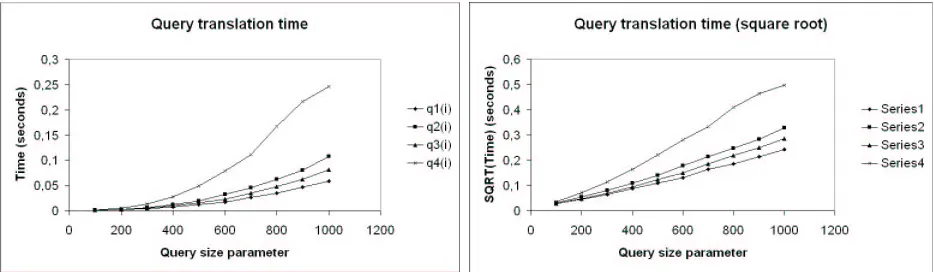
Experiment 3 We tested the time of translatingCore XPathqueries intoCTLformulas. Again, by Corollary 3.1.11, we know that the translation time should be linear in the size of the query. Then, the goals of the experiment are: to confirm that the implementation of the translation is indeed linear and to see how efficient it is.
Experiment 4 We tested the time it takes NuSMV to perform the actual model checking. This does not include the time of translating the document and the query, nor the time it takes NuSMV to compile the model. We tested the two other query evaluation systems (MacMill and XMLTaskForce XPath) with the same input, in order to compare the running times.
Experimental set-up
For our experiments we use artificially generated data. Our motivation is the following: first, real XML documents contain a lot of information, while we are interested only in the navigational part of the document. The skeleton of a typical XML document is about 10% of the size of the document. It is therefore hard to obtain enough real data to run the tests with preferred granularity. This is also because there are no benchmarks for testing Core XPath queries (as opposed to full XPath). By using generated data, we can also systematically test the influence of particular parameters on the performance (e.g., thebranching factor of the XML document).
The queries and document we use are similar to the ones that were used to evaluate XMLTask-Force XPath. In [20], the authors motivate the use of this type of generated data.
Leti≥0. We are going to use two different parametric documents:
1. Let doc1(i) =haihb/iih/ai, where, hb/i0 =² (the empty document) and, for i >0,hb/ii = hb/ihb/ii−1. Recall thathx/iis a shorthand forhxi h/xi. Hence,doc
1(i) is a tree withi+ 1 nodes: a root labeled with aandi children labeled withb. See Figure 4.3.
2. Letdoc2(i) be such thatdoc2(0) =ha/iand, fori >0,doc2(i) =haidoc2(i−1)doc2(i−1)h/ai. Hence,doc2(i) is a complete binary tree with 2i+1−1 nodes all labeled witha. See Figure 4.3.
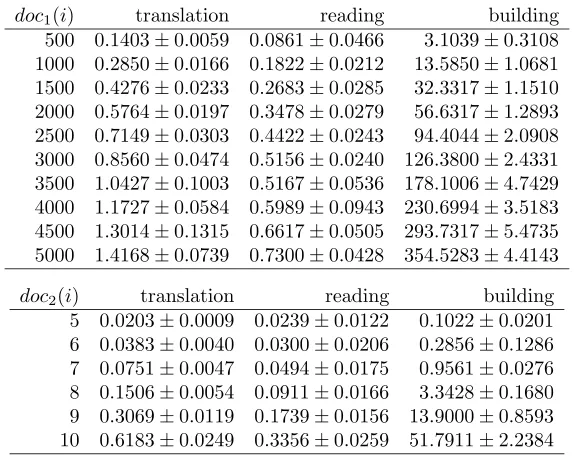
Table 4.1: Document translation and model compilation time (n=18)
doc1(i) translation reading building 500 0.1403±0.0059 0.0861±0.0466 3.1039±0.3108 1000 0.2850±0.0166 0.1822±0.0212 13.5850±1.0681 1500 0.4276±0.0233 0.2683±0.0285 32.3317±1.1510 2000 0.5764±0.0197 0.3478±0.0279 56.6317±1.2893 2500 0.7149±0.0303 0.4422±0.0243 94.4044±2.0908 3000 0.8560±0.0474 0.5156±0.0240 126.3800±2.4331 3500 1.0427±0.1003 0.5167±0.0536 178.1006±4.7429 4000 1.1727±0.0584 0.5989±0.0943 230.6994±3.5183 4500 1.3014±0.1315 0.6617±0.0505 293.7317±5.4735 5000 1.4168±0.0739 0.7300±0.0428 354.5283±4.4143
doc2(i) translation reading building 5 0.0203±0.0009 0.0239±0.0122 0.1022±0.0201 6 0.0383±0.0040 0.0300±0.0206 0.2856±0.1286 7 0.0751±0.0047 0.0494±0.0175 0.9561±0.0276 8 0.1506±0.0054 0.0911±0.0166 3.3428±0.1680 9 0.3069±0.0119 0.1739±0.0156 13.9000±0.8593 10 0.6183±0.0249 0.3356±0.0259 51.7911±2.2384
1. Letq1(i) =descendant_or_self::A/ path/ . . . /path
| {z }
itimes
, where
path=child::B/parent::Aandi≥0. We will call the number of path steps in a query the length of the query. The length of the queryq1(i) is 2i+ 1.
2. Letq2(i) =/descendant::A/ path/ . . . /path
| {z }
itimes
, where
path=following_sibling::B/preceding\_sibling::Bandi≥0. The length of the query
q2(i) is 2i+ 1.
3. Letq3(i) =/descendant_or_self::A/ path/ . . . /path
| {z }
itimes
, where
path=descendant::B/ancestor::Aandi≥0. Hence,q3(i) is a query of length 2i+ 1. 4. Letq4(i) =/descendant::A/ path/ . . . /path
| {z }
itimes
, where
path=/following::A/preceding::Aandi≥0. The query q4(i) has length 2i+ 1.
The experiments are run on a 1.50GHz Intel(R) Pentium(R) 4 machine, with 1,5GB RAM, running Linux version 2.4.21-ict1. All reported times are in seconds CPU time.
Results
A brief description of each test case follows including the results. In each case, the times are given in seconds. In the result tables we also included the standard deviation for each of the results, to indicate the reliability of the results, andnindicates the number of experiments ran.
Experiment 1 and 2 Testing the document translation and model compilation time.
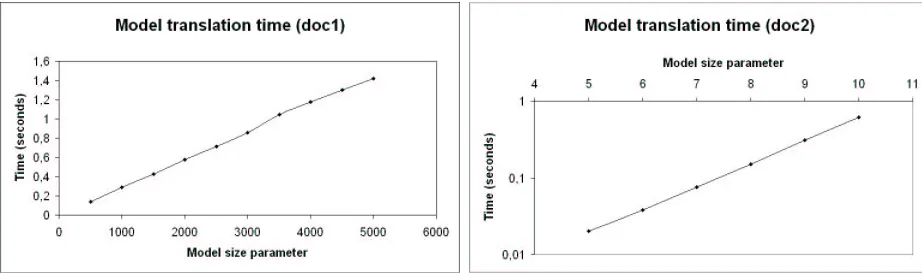
Figure 4.4: Document translation time
Table 4.2: Query translation times (n=10)
i q1(i) q2(i) q3(i) q4(i)
100 0.0008±0.0002 0.0010±0.0002 0.0008±0.0001 0.0012±0.0004 200 0.0020±0.0004 0.0029±0.0009 0.0023±0.0003 0.0052±0.0019 300 0.0041±0.0009 0.0065±0.0014 0.0049±0.0011 0.0131±0.0068 400 0.0077±0.0013 0.0120±0.0026 0.0091±0.0022 0.0272±0.0126 500 0.0122±0.0034 0.0196±0.0046 0.0152±0.0044 0.0492±0.0162 600 0.0169±0.0065 0.0317±0.0089 0.0228±0.0090 0.0789±0.0157 700 0.0267±0.0083 0.0457±0.0165 0.0349±0.0129 0.1107±0.0183 800 0.0348±0.0140 0.0617±0.0187 0.0478±0.0178 0.1675±0.0401 900 0.0461±0.0175 0.0805±0.0274 0.0625±0.0195 0.2166±0.0243 1000 0.0586±0.0222 0.1073±0.0362 0.0813±0.0266 0.2465±0.0376
based representation. On the Y-axis is indicated the parameter which determines the size of the generated models.
The translation times are as expected: in both cases, the translation time grows linearly with respect to the size of the document (cf. Figure 4.4). Note that the size of doc2(i) is exponential in i.
The time taken by NuSMV to build the internal OBDD-based representation of the model is high. As we mentioned before, this can be considered part of preprocessing the data. However, it might suggest that the OBDD-based representation is large. So far, we have not investigated the size of the OBDD-based representations, but we consider this necessary for further work on our approach.
During our experiments, we discovered that NuSMV has a limited processing capacity for large input files. It cannot cope with very large program specifications. In the case of our experiments, NuSMV could not read and process doc1(i) approximitely of sizei≥60000, or doc2(i) approximitely of sizei≥14.
Experiment 3 Testing the query translation time.
The results of our query translation experiment are reported in Table 4.2. On the X-axis, the different types of queries are given. On the Y-axis, the parameter in given that determines the size of the queries. Note that the size of the queries is linear with respect to the parameter. We would therefore expect that the values in the matrix are linear with respect to this parameter as well.
[image:28.595.128.471.298.441.2]Figure 4.5: Query translation time
cause might lie in the way Perl implements regular expression matching. The worst-case complexity of regular expression matching in Perl is exponential in the size of the input, due to its enriched syntax for regular expressions [18].
Experiment 4 Testing the query evaluation time.
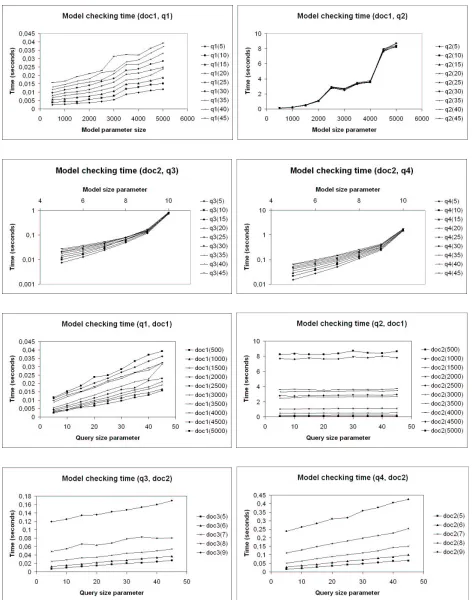
In Table 4.3, 4.4 and 4.5, every cell contains three lines. The first indicates the time NuSMV needed to check the translated query on the compiled, translated document. The second and third entries indicate the time needed byMacMillandXMLTaskForce XPath, respectively, to evaluate the query.
For optimal precision, we performed the model checking 100 times, divided in 10 jobs. Of every job, the total time was measured, and divided by 10. The average of the resulting 10 numbers is reported in the tables, as well as the standard deviation computed on these 10 numbers.
In the case of MacMillandXMLTaskForce XPath, each experiment was simply performed 10 times.
The model checking time is slightly higher than the time needed byMacMilland XMLTask-Force XPath to perform the query evaluation. Perhaps this could be explained by the fact that, while our translation is linear, the size of the translated model is high.
Figure 4.6 contains several graphs that represent the observed model checking times. As one can clearly see, NuSMV model checking is linear in the size of the query, and almost linear in the document size.
Incidentally, note the remarkable shape of the curve for model checking q2 queries ondoc1 document. Perhaps, some features of NuSMV play a role in this, but we could not tell.
Interpretation of the results and suggestions for improvements
• We noticed that there is a problem with our implementation of query translation. Our im-plementation runs in quadratic time in the size of the query, although our translation admits a linear implementation. We suspect that this problem is caused by Perl’s implementation of regular expression matching that we use in our implementation. We believe that a linear implementation of the translation is easy to achieve by being more careful in this respect. • What needs more attention is the setup of our experiments. It is always important to evaluate
theory in practice. So far all the experiments we performed involved artificially generated XML documents and queries. Testing on real data is essential to get a clear picture of the performance of XCheck. This remains future work.
Table 4.3: Model checking time forq1(i) queries ondoc1(j) documents
doc1(i)\q1(j) 5 10 15 20 25 30 35 40 45
500 0.0025±0.0014 0.0039±0.0011 0.0057±0.0016 0.0067±0.0021 0.0080±0.0023 0.0097±0.0025 0.0116±0.0023 0.0130±0.0027 0.0158±0.0023 0.0010±0.0001 0.0010±0.0001 0.0010±0.0001 0.0010±0.0001 0.0010±0.0001 0.0011±0.0001 0.0011±0.0001 0.0011±0.0001 0.0011±0.0001 0.0125±0.0006 0.0131±0.0002 0.0137±0.0001 0.0147±0.0006 0.0152±0.0001 0.0182±0.0091 0.0169±0.0001 0.0179±0.0016 0.0184±0.0006 1000 0.0028±0.0021 0.0044±0.0017 0.0061±0.0026 0.0081±0.0022 0.0097±0.0016 0.0115±0.0030 0.0132±0.0013 0.0146±0.0025 0.0166±0.0023 0.0009±0.0001 0.0009±0.0001 0.0009±0.0001 0.0009±0.0000 0.0010±0.0000 0.0010±0.0000 0.0010±0.0001 0.0010±0.0001 0.0010±0.0000 0.0145±0.0006 0.0158±0.0002 0.0170±0.0006 0.0185±0.0007 0.0198±0.0008 0.0213±0.0007 0.0225±0.0002 0.0238±0.0002 0.0255±0.0028 1500 0.0034±0.0034 0.0043±0.0039 0.0070±0.0041 0.0089±0.0038 0.0104±0.0040 0.0127±0.0028 0.0149±0.0036 0.0166±0.0030 0.0192±0.0023 0.0009±0.0001 0.0009±0.0000 0.0009±0.0001 0.0010±0.0000 0.0010±0.0000 0.0010±0.0000 0.0010±0.0000 0.0010±0.0000 0.0013±0.0016 0.0163±0.0001 0.0184±0.0002 0.0202±0.0007 0.0224±0.0008 0.0241±0.0007 0.0265±0.0006 0.0284±0.0008 0.0305±0.0010 0.0325±0.0011 2000 0.0038±0.0052 0.0057±0.0060 0.0077±0.0061 0.0098±0.0054 0.0116±0.0061 0.0141±0.0045 0.0161±0.0053 0.0180±0.0059 0.0211±0.0056 0.0009±0.0000 0.0009±0.0000 0.0010±0.0001 0.0012±0.0012 0.0010±0.0000 0.0010±0.0000 0.0011±0.0000 0.0011±0.0000 0.0011±0.0001 0.0182±0.0003 0.0210±0.0009 0.0250±0.0125 0.0258±0.0002 0.0283±0.0004 0.0315±0.0007 0.0363±0.0127 0.0364±0.0007 0.0389±0.0010 2500 0.0044±0.0083 0.0066±0.0074 0.0089±0.0064 0.0113±0.0076 0.0137±0.0073 0.0164±0.0077 0.0174±0.0078 0.0217±0.0087 0.0229±0.0079 0.0009±0.0000 0.0010±0.0002 0.0010±0.0000 0.0010±0.0000 0.0010±0.0000 0.0010±0.0000 0.0011±0.0001 0.0011±0.0000 0.0011±0.0000 0.0205±0.0001 0.0249±0.0036 0.0270±0.0009 0.0307±0.0009 0.0342±0.0007 0.0384±0.0007 0.0418±0.0013 0.0489±0.0034 0.0482±0.0010 3000 0.0056±0.0116 0.0079±0.0107 0.0107±0.0108 0.0130±0.0114 0.0160±0.0113 0.0182±0.0108 0.0210±0.0101 0.0227±0.0110 0.0315±0.0103 0.0010±0.0000 0.0010±0.0000 0.0010±0.0001 0.0010±0.0000 0.0010±0.0000 0.0011±0.0001 0.0011±0.0000 0.0011±0.0000 0.0011±0.0000 0.0223±0.0002 0.0267±0.0008 0.0300±0.0007 0.0349±0.0044 0.0378±0.0007 0.0429±0.0007 0.0470±0.0008 0.0554±0.0247 0.0548±0.0012 3500 0.0087±0.0290 0.0120±0.0290 0.0148±0.0277 0.0174±0.0295 0.0208±0.0292 0.0230±0.0305 0.0264±0.0288 0.0280±0.0277 0.0325±0.0279 0.0010±0.0000 0.0010±0.0000 0.0010±0.0000 0.0010±0.0000 0.0011±0.0000 0.0011±0.0001 0.0011±0.0000 0.0011±0.0000 0.0011±0.0000 0.0249±0.0003 0.0290±0.0003 0.0337±0.0002 0.0377±0.0008 0.0426±0.0009 0.0474±0.0008 0.0531±0.0010 0.0578±0.0011 0.0627±0.0054 4000 0.0099±0.0360 0.0130±0.0359 0.0153±0.0371 0.0181±0.0372 0.0215±0.0369 0.0240±0.0359 0.0266±0.0368 0.0292±0.0351 0.0322±0.0359 0.0014±0.0018 0.0015±0.0019 0.0014±0.0020 0.0011±0.0000 0.0013±0.0012 0.0011±0.0000 0.0011±0.0000 0.0011±0.0000 0.0011±0.0000 0.0268±0.0006 0.0316±0.0006 0.0369±0.0007 0.0414±0.0009 0.0467±0.0010 0.0526±0.0010 0.0589±0.0015 0.0643±0.0011 0.0685±0.0008 4500 0.0111±0.0400 0.0144±0.0426 0.0170±0.0387 0.0202±0.0378 0.0232±0.0385 0.0268±0.0381 0.0297±0.0396 0.0334±0.0405 0.0363±0.0357 0.0010±0.0000 0.0010±0.0000 0.0010±0.0000 0.0011±0.0001 0.0011±0.0000 0.0011±0.0000 0.0011±0.0000 0.0011±0.0000 0.0012±0.0000 0.0293±0.0001 0.0348±0.0003 0.0411±0.0010 0.0466±0.0036 0.0526±0.0012 0.0586±0.0010 0.0666±0.0030 0.0726±0.0008 0.0774±0.0009 5000 0.0117±0.0438 0.0152±0.0442 0.0187±0.0445 0.0239±0.0549 0.0249±0.0458 0.0285±0.0433 0.0333±0.0462 0.0372±0.0477 0.0393±0.0428 0.0010±0.0000 0.0010±0.0001 0.0011±0.0000 0.0011±0.0000 0.0012±0.0006 0.0011±0.0000 0.0011±0.0000 0.0012±0.0001 0.0012±0.0000 0.0312±0.0005 0.0376±0.0010 0.0442±0.0009 0.0495±0.0006 0.0568±0.0016 0.0637±0.0010 0.0719±0.0014 0.0788±0.0012 0.0843±0.0012