,
;
1
'lIl:
'.
" 'l! ~\,
1
)
-, " ,•.:a1II• . •,J .•...10~
SIMTECT 2009
:> SIMULATION :> CONCEPTS,CAPA81LITYS TECHNOLOGY
•
•
•
•
•
i<
•
.
l
f
'
-.
-~
.
.}
.'
.
,..~
•
'
<+1
.
~,
.
~
....•
~
~'
.
,i
.
'
.>
i,tf
:
_
.
,
,X.~•
a
•
~~.:'.' 1;, ;,
S
~
~
.~
South Australia,Abntlia nt blend MINING
INDUSTR Y
SirnfeeT2009isheldundertheauspices
oftheSimulationIndustry Associationof
Austra'ia (511'.1')LtdABN 13 087862 619
Editor
Dr Elyssebeth Leigh
University of Technology
,
Sydney
Published by the Simulation Industry AssociatIon of Australia
ABN13 087 862 619ISBN 0 9775257 6 7
©2009 Simulation Industry Association of Australia. Permission is hereby
granted to quote any of the mater
ial
here
in,
or to make copies thereof
,
for
non-commercial purposes, as long as proper attribution is made and this
copyr
ight
notice
i
s included.
All other uses are proh
ibited
without written
perm
ission
from the S
imulation
Industry Associat
ion
of Australia.
For further information
,
contact:
Simulation Industry Association of Australia
PO Box 226
Lindfield
,
NSW
,
2070
Austra
lia
www.siaa.asn.au
SimTecT 2009 Paper Review Committee
Dr Elyssebeth Leigh(Papers
Coordinator)
Ms Emily Andrew
Dr Jonathan Binns
Mr Anthony Cramp
Mr Alfred Devlvi
MrGary Eves
Mr Per Gustavsson
Mr Peter Hill Mr Nick Howden
Dr Heath James
Mr John Marychurch
Dr Michael McGarity(Paper Review
Coordinator)
Prof N K Mehta
Mr Roger Mulligan
Mr Daniel Munro Prof Saeid Nahavandi
Dr John Olsen
Dr Simon Parker
Mr Craig Pepper Mr Shane Rogers
Dr Peter Ryan
Dr David Stratton
Mr Philip Swadllng Dr Andreas Tolk
Mr Grant Tudor Mr Charles Tumltsa
Dr Susannah Whitney
SeniorLecturer,Universityof Technology, Sydney
Director,NCS Modeling & Simulation,Raytheon
Company
Researcher,MT&E,Australian Maritime College
DefenceScientist,Defence Scienceand
Technology Organisation
SeniorSoftware Engineer,Northrop Grumman
PracticeLead,QinetiQConsulting
Vice Manager,Ericsson Microwave Systems AB
Director,Simeon Services
BusinessDevelopment Manager,CAE
ProfessionalServices
Modelling and Simulation Discipline Lead,
DefenceScience and Technology Organisation
Solutions Architect,Thales Australia
Manager, DecisionSupport Services,CAE
Australia
Indian Institute of Technology Roorkee
Consultant
Associate,Booz & Company
Chair in Engineering,Deakin University
Lecturer,School ofMechanical and
Manufacturing Engineering,University of New
South Wales
Principal Research Scientist,Defence Science
and TechnologyOrganisation
Technical Lead,BoeingDefence Australia
Senior Manager, Systems AnalysisLaboratory,
Boeing Defence Australia
Principal Research Scientist,Defence Science
and TechnologyOrganisation
Leader,Distributed Simulation Laboratory,
Universityof Ballarat
Chief Engineer- Simulation,Thales Australia
Senior Research Scientist,Old Dominion
University, USA
Director,Army SimulationWing
Virginia ModelingAnalyses& SimulationCenter,
Old DominionUniversity,USA
CognitiveScientist,Defence Science and
Technology Organisation
iri1TecT 2009
Multiple Applications of Sailing Simulation
M
r
John
M
OONEY;
YirtualSailingPlyLtd
johnmooney@virtual. net.au
Prof. Norman R. SAUI'I'DERS
University ofMelbourn e& Yirtua lSailingPty Ltd
n.saunders teunimelb.edu.au
Dr. Mark HABGOOD
UniversityofMelbourne& YirtualSailingPtyLtd
mhabgoodseunimelb.ed u.au
Dr. Jonathan R
.
BINNS
Australian MaritimeCollege, Unive rsity a/Tasmania
&Vinual SailingPly Ltd
j.binns@amc.edu.au
Training
Abst r act. The world' sonlyride-onsailingsimulatorhasbeenproducedby the Australian company VirtualSailing
(VS) for 10 years. Over this period significant research and development has occurred. On-going R&D is
incorporatedintonewand retro-fittedto oldsimulators. During thistimeanumber of users haveowned and operated the VS·Laser, VSail-Trainer,VSail-Aeeessand VSail-Researehersimulators showing the wayfor avariety of uses.
The initial intention of the VSail-Trainerwas forfitnesstraining and physiological evaluation ofelite athletes. This
has shown promise with four sailors at the recentOlympicsusing and praisingthe simulator as a useful toolfor
fitness training and tactics and strategy development. The VSail-Researeher has been integrated into the undergraduat eengineering courseat the AMCto demonstra te thebasicprinciplesofsailing and simulation. As a
rehabilitationtooltheVSail-Access simulator has beenused tointroduce disabledpeople to sailing and reintroduce
sailors post accident(in Melbourne,Sydney,Miami and Auckland). A recent virtual regattawas organised by VS
with participants fromAustraliaand the USA.
The area showing thegreatestnumbers ofparticipantsis in team ing to sail. Programs have been started within
Australia forpre-teenagersthroughtouniversityage studentsto learn to sail forthefirsttime,adding simulationto
themoretraditiona llearningmethodologies. Theuse of simulation inthisareashows great promisefor increasing patticipationand retentionrates for the sailing industryas a whole.
Figure 1 The VSail-Researc her sailing simulation classroom
1.
INTRODUCTIONSailing simulation has been used for the analysis of
tacking (Masuyama, Fukasawa, & Sasagawa, (995),
handicap assessment (Keuni ng, Vermeulen, &
deRidder, 2005); design optimisation of engineering
and humansystems (Philpott & Mason,2002;Scarponi, Shcnoi, Tumock, & Conti, 2006); and prediction of starting manoeuvres (Binns, Hoehkire h, DeBord, &
Burns,2008). Simulationasalaboratorytool has been used in sailing for at least twenty years (Bursztyn,
Coleman,Hale, & Harrison, 1988; Walls & Saunders,
1995 ) continuing to the present day (Cunningham & Hale,2007)and more recentlygeneralisedsail training is making usc of simulation (Binns, Bethwaite, & Saun ders, 2002). Each of these applications requires varying degrees of accuracy in the predicted
parameters. Thispaper describes the applicationof the simulationdetailedin Binns,et a!.(2002) to the areasof
training, engineering education and novice learning exerci ses.
2. THEUNDERLYINGSI M ULATION
The physical simulation hasbeen achieved through an explicit Euler time stepping procedure. From a
numerical stabilitypointofview thisisa fairlyclumsy method, as time steps of greater than 0.1sresult in
serious instabilities. However, it does provide a
Figur e 2 Simplified free body diagram of a dingby
sailing to windward, showing the main componentsof
theheel momentbalance.
Figure 3 The hiking posture. Laserdinghies are well
known for producing back injuries in competitive
sailors. Top image is pre-remedial posture;bottom is
post-remedial following physiotherapy advice. The
abilityto takephotos suchas these forlater analysisis
unique to the sailing simulator (reproduced with
permission of theOlympicsailor,Krystal Weir).
3. OLYMPIC SAIL TRAINING
Through experience with the Victorian state youth
squad, it hasbecome apparentthat a sailingsimulator
will be a valuable tool for studying and correcting
hiking posture. A sailing dinghy creates forces to
counteract hydrodynamic drag with a complicatedforce and moment balance. The essential parts ofthe heel
moment balanceare shown inthcfree bodydiagramof
Figure2. Thereis alarge aerodynamicside force from
the sail, which is balanced by a hydrodynamic side
force from the centreboard and rudder. Since some distance offsets the aerodynamic and hydrodynamic
forces,amomentiscreated. Thismoment isbalanced
bythecentre of gravityofthe sailor' s mass beingoffset
from thebuoyancy force. The success of a competitive
dinghy sailoris greatlyinfluencedbythe consistency
andsizeofthcbalancing heelmomentthatthcy are able
to produce;that is the furtherthey are ableto sit (hike)
fromthe centrelineofthe boatand the longer they can hold this position. This meansthat asailor' s successis
highly influenced by theirability to hold a strenuous
positionfor long periods oftime. Asaconse quence of
the stressesinvolved, back pain appears to be quite common in competitive dinghy sailors. especially in
Lasers.
Training SimTec T 2009
power and advances in computing power are
immediately realised without the need for
re-programming. This method also explicitly ties the simulationtorealtime.
To maintaina smalltimestep the sailingsimulationhas
been simplified. Details of the simplified
characteristics of thethree dinghy classes usedin the
simulation can befoundin(Binnset al.,2(02). Sailing
a realdinghysafelyandefficiently is related more to
fecithan itisto thinkingabout thecomplex systemof
forces and moments required to move the dinghy
forward. Therefore the limiting factor insimplifying
the physicsof a sailing dinghy isthat the feelof the
simulation must remain sufficiently close to a real
dinghy,otherwise theillusion of sailing islosttothe
user, and the simulator is little more than a hiking
bench. Aquasi-dynamic measure of this feelcan be
made bothon-waterandon the simulator. Essentially,
this method of analysisinvolves settinga wind angle
relativeto thedinghy'sheadingand sailingthe dinghy
as fastas possible at that heading. Reasons forsome
discrepancies between the model and full scale are
discussed inBinns,et al.(2002);however,itshould be notedthat these discrepanciesdo not upsetthcfeel of
the simulator. Adynamic measure of the feel of a
sailing dinghy has beenmadeby consideringthetimeto
complete a tack. In the simplifiedsimulation model the
added mass and dampingof the hull was essentially
lumped into a fcw parameters. Realistic limits were
placedon theselumped termsand users were allowedto
varytheparameters within these realisticlimits. Based
on the variations suggested,theseparameters were
non-dimensionalised and hence applied to all dinghies
[image:5.547.314.482.65.301.2] [image:5.547.311.493.354.622.2]rnTecT 2009
It should be considered unacceptable for young people to injure themselves through sailing with inadequate
hiking posture. The top female Australian Junior Laser Radialsailorwasoutof sailing forseveralmonthsat the beginning of 2003, because ofstress fractures in her vertebrae. Figure 3 shows this sailor's hiking posture beforeher back injury (top) and after re-edueationby her coach and physiotherapist (bottom). The ability to
take pictures for analysis such astheseisuniqueto the
sailing simulator. To take these during on-water
training session s would be extrem ely expensive and
time consuming. Such data collection would be
imposs ibleif reproducibleconditions were required. It isnow planned tocarry out a studyof hiking posture in the Victorian Youth squad, using a Virtual Sailing simulator.
The sailor mentioned in the previous paragraph has goneonto compete in the openclassesofthe Olympics,
representing Australiain the Ynglingclass at the 2008 Olympics. Three additional athletes competedat these Olympics who have used the simulator, one Spanish
competitor has purchased a unit for her sail training
school .
4. ENGINEERINGEDUCATION
4.1 Introdu cti on
Sailing yacht design is taught at the Australian Maritime College (AMC) as an elective in the fourth
year of the Bachelorof Engineeringdegree. The design
of asailing yachtisnecessarilydominatedbyanumber ofenginee ringapproxim ations duetothecomplexity of the force balanceat the air/waterinterface(Claughton,
1998). Each of the appro ximations alluded to has
definite physical meaning, which must be understood
by an engineer engaged to designa sailing yacht. An example of such an approximation is the effective
aspeet ratio of the underwater appendages, which can be equated to the efficie ncyof theplan form(Houghton & Brock,1970).
The VSail-Researcher (see Figure I) was used to
demonstrate and actively involve the students in the
effectsof alteringthe underlying simulation parameters. Inadditio n the processdemonstrated to thestudents the difficultiesofperforming and analysingexperimentson
asailingyacht,
4.2 Participa nts
Seven final year BE students were divided into 3
groups.
4.3 Proloeol
Each group was requested to analyse the available simulation parameters and estimate changes to the parameters whic h would produ ce a simulation sailing quicker than the original set. Changes were only
Training
permitted on the boatside of the simulation,changesto environmentalconditions werenot permitted.
Each group wasthen required to nominateonemember tobethe sailor. The sailor wac;permittedtopracticeon the simulato r for 5 minutes. This allowed thesailor to
get accustomed to the simulator without overly tiring
him/her.
The sailor then performed a race using the original
simulation parameters. The length of the race typicall y
takestwo tothree minutes.
Finall y a second race wasperformed by the sailor of each group during which the simulation parameters werealtered to thoseselected by the group.
4.4 Resu lt s
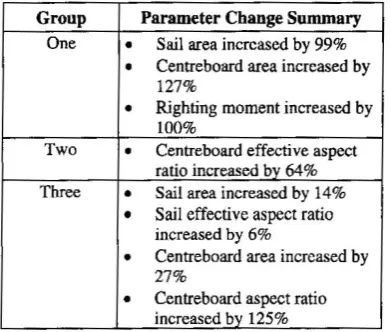
The design parameter changes selected by the three groups are listed in Table 1. To understand these changes a summary of theforce andmomentbalanceof a sailingyacht follows.
A sailing yacht is able to progress through the water
due to the lifting surface of the sail (aerodynamic forces) balancing with the lifting surfaces of the underwater appe ndages, or rudder and centerboard
(hydrodynami cforces). Asthese surfaces are actingas wings,the forces caobe easilyincreasedby increa sing
the surface area. However, the aerodynamic and
hydrodynamic forces are separated by some distance,
creatinganoverturningmoment. Thereforeto keep the
yacht sailing in a straight line, a significant righting momentis required. The speedof the yacht is therefore
highly dependent on the size of the sails,rudder and
centerboard and the available righting moment. The parametersselected by the students in Table I show an attempt byeach group to increase the aerodynamic and hydrodynamic forces.
Table 1 Design parametershifts selected by the three groups
Gro u p
Param
eter
ChangeSummaryOne
•
Sail areaincreasedby 99%•
Centreboard area increased by127%
•
Rightingmomentincreased by100%
Two
•
Centreboard effective aspeetratio increasedbv 64%
Three
•
Sailareaincreas ed by14%•
Sail effective aspectratio. increasedby 6%
•
Centreboardarea increasedby 27%•
Centreboardaspeet ratioincreasedbv 125%
[image:6.561.261.457.508.674.2]Training
of the simulation was assessed by calculating the
distance travelled into the wind and dividing by the
time taken (36 s). This provides an immediat e
assessment for a VelocityMade Good(VM G) intothe directionof thewind. The results ofthis analysis are
presented in Table 2, for which an increas e in VMG
shows an improvementin sailing performance.
Table 2 Velocity Made Good (VMG) for each design group
Group VMG before VMG after change change One 62.6rn/min N/A
Two 56.8 mlmin 72.8mlmi n Three 77 .7 mlmin 88.4 mlmin
4.5 Discussion
Within Table2 the first result of note was that Group Onewas unable to record a result after the suggested
design parametermodifications. Thiswasbecauseafter
the modificationsweremade the simulationwasfar too difficult to sail. Theinstabilities introd uced
i
n
theheel rotation were much too difficult eve n foran authorofthis paper, with some 6 years of sailing simulation
experience and over 20 years of competitive sailing experience to overcome. It is believed that this has occurred becausethe stiffness of the system
in
heel (the righting moment) has been substantially increasedalong with the excitation forces (aero and
hydrodynamic lifting surface forces), however the damping has not been significantly increased.
Therefore the damping ratio has been significantly
decreased. Inaddition tothistherewasno attempt by
Group One to increase the efficiency of the system,
instead the total power available has been increased
independent of efficienc y, These two lessons were
easily demonstratedinthesailing simulatorclassroom.
The results of Group Twoand Three showa significant increase in VMG when the design parameter
modificationsweremade. Anincreasein VMG canbe
directly correlated to improved sailing performance.
These two groups achieved the improvement in
performance
by
increasing the efficiency ofthe aeroand hydrodynamic lifting surfaces. Which group
succeededthe most is inconclusive based on these
results. as a statistical measure would need to
be
estimated. Thisisthe final lessnn to belearnt by the
students throughsimulation:even under the perfectl y
controlled environment of the sailing simulator, the
human influe nce can cloud design asses sment and
requireprobabilistically basedexperimental procedures.
The lessons of dynamic stability; aero and hydrodynamic efficiency; and probabilistic
requirements of experiments involvin g human
interaction are all lucidly and repeatable demonstrabl e
usingsimulation. If environmental factors were added , thenthese enginee ringelements could not beisolated,
SimTecT 2009
in addition to an explosion in cost of this teaching
exercise.
S. DISABLED SAIL TRAINING
Virtual Sailing invited threerehab ilitation centres,who use VSail-Aceess simulators in their rehabilitation
programs to participate in a "Virtual Regatta" as a tribute to the Paralympics. The "Virtual Regatta"
provided a means to bring the scattered VSail-Access
simulators together.
A set of Sailing Instructions was drawn up and the challenge issued to: Royal Talbot Rehabilitation
Hospital (Melbourne, Australia); Royal Rehabilitation
Hospital (Sydney, Australia); and SALM (Miami, Florida, USA).
Although it is possibleto run the regattalive by linking the VSail simulators together on-line,it was decidedto allowa twoweek window for eaeh institution to enter their best times. The regatta was sailed around a trapezoidcoursein Liberty Motor Sailorboats with 14
knots of wind. Each sailor was able tosail the course three times and register theirbesttime. The besttime overallwon the trophy for theirinstitution.
RoyalRehabilitation (Sydney) were the first to submit
theirracetimesbytheirsailorsDale Williams aSydney
Sailability sailor and Phil Thompson a well known Sydneyoffshore sailor. The times were competitive but
notgood enough tostave off RoyalTalbot represented byFrank Kleintz,whohad previouslysailed a Hobie 16 on the Gippsland Lakes before his accident 5 months ago. Frank had a faster time and he took the lead. At Virtual Sailing we nervously awaited the American
entryfrom SALM. Itdid notgo un· noticed that during the month of the regatta the 25th anniversary of the historic Austra lian victory in the America's Cup
occured. However. as
with
on water sailing, theweather played havoc with SALM and they battened down the hatches for a hurricane and were unable to
submit a race result within the timelimit. They have promised to mount an America'sCupstyle challengefor the next international challenge.
Figure 4 TheVSail-Accesssimulatorbeing used in the
il11TeeT 2009
6. ABLE-BODIED NOVICE SAIL LEARNING
A VS2 Laser (the predecessor to the VSail-Trainer
pictured in Figure 5) simulator was used in a 2 day
"Learn to sail" course for children at the Sandy Bay
Sailing Club in Tasmania in December 2002. Twenty one of about 30 children (age range 8-14) had
instructionon thesimulator beforegoing on the watcr
inOptimistdinghies. Thecoachesreported that of the
childrenwho had been on the simulator,all of thegirls and boys over 10years old were more confident and
learned on-water skillmorerapidlythan thosewho had notbeen on the simulator or boys 10and under. The
problemsexperienced with theseyounger boysboth o
n-waterand onthesimulator appearedtorelate toashort
attentionspan.
In 2008, a school based instructional program was
organized for12 students(Year8)from Laverton High
School, Victoriausing a VS-2 Laser simulator basedat Altona Yacht Club, Victoriaand a V-Sail Trainerat the
new Yachting Victoria sail training centre at the
Boatshed on Albert Park Lake, Melbourne. Lessons
were organised by one of theauthors assisted by two members of Altona YC. The students participated in half a dozen lessons ingroups of 3-4, after which their
simulatorperformanc ewas assessedby Olympian Sarah
Blanck (Figure 5) and thcy had theopportun ityto sail
on Albert Park Lake in a variety of sailing dinghies. Unpredicted side effects were that the students' self
esteem and attitude to school work were reported by
their teachers to have improved considerably and the
previoushighinci denc eof truancyfell tozero.
A trialwas completed in the Universityof Melbourne in
which30 novice sailors were assigned randomlyto two
programs: (1) A standard instructional program
involving an initial theoretical session followed by a
simpleintroduction to on-waterexperience in Lasersor
a Tasar under the supervision of coaches. (2) A
simulator cours e in which groups of 5-6 students
attended 6 evening classes involving instruction on a
simulator. After this the simulator students were
introduced to sailing on the water (in Lasers and a
Tasar). Aformalcomparisonofon-waterperformance
by both groups was not completed due to time
constraints ; however some clear differen ces between
the groups were apparent. In the simulator group 4
students were lost from one subgroup after the first
eveningclass,in favour ofother studentpursuits. The
other II completed thecourse and went sailing. They
persistedwith on-watersailing inspiteof some difficult
weather conditions, which involved several of the
students capsizing. The coaches reported that all 11
students could beat, tack and sit out (hike) without
difficulty. Incontrast 8 of the on-watergroupgave up
and thcresthad considerably more difficulty than the
simulator group in learning elementary boat handling skills. From this preliminarystudy a drop-out rate of
53% for the non-simula tor group was strikin gly
different to27% for the simulator group. Also, it has
been reported thattwoof thesimulatorgroupwere able
to sail unaccompanied; at thesame point in lessons
noneof the non-simulatorgroup wereable to do this.
Training
Figure 5 The VSail-Trainer being used to introduce school childrentosailing
7. CONCLUSIONS
The application of sailing simulation to solving prob lems has been growing through the work of a
numberofdifferent groups worldwide. Thispaper has
reportedon fourapplications ofasailingsimulator built in Australia.
Firstly the simulation has found application for elite
sailing athletes. This applicat ion has been for
physiolo gical based research and remedial
physiotherapyadvice aswcll as for training.
A second area of application is to engineering
education. For this application student educational
experienees are greatly enhanced through simulation.
Engineering education dictates that students are
required tounderstand the principles ofaerodynami cs,
hydrodynamics and dynamic systems as they apply
their engineering skills tothe design and construction of sailing vessels. As a repeatable and realisable
representation ofrealworld dynamicsin the class room,
simulation is unsurpassed. Asthe VS simulatorengin e
is based on ftrst principles engineering, students are able to gain immediate insight aboutdesignalteration s suchasfoil shape changes and stability increases. The third application described within this paper is to
disabled sail training. For this purpose simulation
offers a safe and comfortable introduction to sailing.
Therepeatable andrecordable nature ofsimulationhas
been used to invol ve disparateinstitutionsin the same
competition.
Finally, the applicationof simulationto beginner sail
traininghas been explored throughprogramsinvolving
pre-teenager children through to university aged
stude nts. Forthislastapplicationevidence isemerging
thatsimulatio n combined withactualon-water training
can increase retention rates of new participants for
sailing, as well as having some unexpected positive
personal consequences in socially disadvantaged
Training
REFERENCES
Binns, J.R., Bethwaite, F. W., &Saunders, N. R. (2002).
Developmentof a more realisticsailingsimulator,
The 1st High Performance Yacht Design
Conference(pp. 221-228).Auckland,NZ: RINA.
Binns, 1.R., Hochkirch, K., DeBord, F., & Bums, I. A.
(2008). The development and use of sailing
simulation forlACe starting manoeuvre training,
The 3rd High Performance Yacht Design
Conference.Auckland,NZ: RlNA.
Bursztyn, P.G.,Coleman,S.,Hale, T.,&Harrison, J.(1988). Laboratory simulationof the physiologicaldemands
of singlehanded dinghy racing. Journal of
Physiology .400(14) .
Claughton, A. (1998). Balance of air and water forces .InA.
Claughton,J.Wellicome&J. Sbenoi (Eds.),Sailing
.Yacht Design - Theory (pp.3-13).Edinburgh,UK:
Addison WesleyLongmanLimited.
Cunningham, P.,& Hale,T. (2007).Physiological responses
of elite Laser sailors to 30 minutes of simulated
upwind sailing.Journal ofSports Sciences,25(10),
1109-1116.
Houghton, E.L., &Brock, A.E.(1970).Aerodynam ics for
Engineering Students. London, UK: Edward
Amold.
Keuning, 1. A., Vermeulen,K.J.,&deRidder,E. J.(2005). A
generic mathematical model for the manoeuvring andtacking of a sailingyacht, TheJ7th Chesapeake
Soiling YachtSy mpos ium (pp.143-163). Annapolis, USA:SNA."ffi.
Masuyama, Y., Fukasawa, T., & Sasagawa, H. (1995).
Tacking simulation of sailing yachts - numerical
integration of equations of motion and application
of neural network technique,The 12th Chesapeake
Sailing Yocht Symposium (pp. 117-131).Annapolis,
USA:SNAME.
Philpott, A"&Mason,A.(2002).Advancesin optimization
in yacht performance analysis, The 1st High
Performance Yacht Design Conference (pp.
229-236).Auckland, NZ:RJNA.
Scarponi, M.,Shenoi, R. A.•Tumock, S. R.. &Conti, P.
(2006). Interactions between yacbt-crew systems and racing scenarioscombiningbehaviouralmodels
with VPPs, The 19th International HISWA
Symposium on Yacht Design and Yacht
Construction (pp. 109-120) . Amsterdam, The Netherlands:HISWA.
Walls,J.T.,& Saunders, N.R.(1995). Comparison of static
and dynamic dinghy biking using a sailing
ergometer. Can trained and untrainedsailors be
differentiated? Proceedings of the Australian Physiological and Pharmacological Society,
26(206P).