Modelling Multilateral Negotiation in Linear Logic
Daniele Porello
and
Ulle Endriss
1Abstract. We show how to embed a framework for multilateral ne-gotiation, in which a group of agents implement a sequence of deals concerning the exchange of a number of resources, into linear logic. In this model, multisets of goods, allocations of resources, prefer-ences of agents, and deals are all modelled as formulas of linear logic. Whether or not a proposed deal is rational, given the preferences of the agents concerned, reduces to a question of provability, as does the question of whether there exists a sequence of deals leading to an allocation with certain desirable properties, such as maximising so-cial welfare. Thus, linear logic provides a formal basis for modelling convergence properties in distributed resource allocation.
1
INTRODUCTION
AI applications often involve some form of multiagent resource al-location [1]: e.g., in cooperative problem solving, we need to find an allocation of resources to agents that will allow each agent to com-plete the tasks she has been assigned; in the context of electronic commerce applications, the system objectives will often be defined in terms of properties of the allocations of resources that are being negotiated. Studies of resource allocation in AI may range from the design of negotiation strategies, over the game-theoretical analysis of allocation problems, to the complexity-theoretic study of relevant optimisation problems. While some of the work in the field is very pragmatic in nature, and rightly so, at one end of the spectrum, fun-damental research in AI should (and does) develop frameworks for the precise representation and formal study of systems for multiagent resource allocation and negotiation. Logic suggests itself as a tool for this purpose, and there have been a number of contributions of this kind [4, 5, 8, 11, 12, 15, 16], some of which we shall review below.
In this paper, we show how to embed a framework fordistributed resource allocation[2, 3], in which a group of agents implement a sequence of multilateral deals concerning the exchange of a number of resources, intolinear logic[6]. In our model, multisets of goods, allocations of resources, preferences of agents, and deals are all mod-elled as formulas of linear logic. Whether or not a proposed deal is rational, given the preferences of the agents concerned, reduces to a question of provability, as does the question of whether there exists a sequence of deals leading to an allocation with certain desirable properties, such as maximising social welfare.
There have been a number of previous contributions that use dif-ferent kinds of logical frameworks to model a variety of aspects of negotiation in multiagent systems. In an early contribution to the field, Fisher [5] shows how to reduce the problem of constructing coherent negotiation dialogues to (distributed) theorem-proving. In-deed, most work on logic-based approaches to negotiation and re-source allocation deals with this domain of “symbolic negotiation”.
1Institute for Logic, Language and Computation, University of Amsterdam,
email: [email protected], [email protected]
Sadri et al. [16], for instance, do so in the framework of abductive logic programming. Several authors have recognised that, due to its resource-sensitive nature, linear logic is particularly suited to mod-elling resource allocation problems [8, 11, 15]. In particular, as far as modelling the complex preferences of agents over bundles of re-sources are concerned, we build directly on our recent work [15], in which we have developed bidding languages for multi-unit combina-torial auctions based on linear logic.
Two contributions on logic-based approaches to resource alloca-tion relate to the same kind of resource allocaalloca-tion framework we shall be working with here: Endriss and Pacuit [4] develop a modal logic to study the convergence problem in distributed resource allocation; and Leite et al. [12] show how to map the problem of finding an al-location that is socially optimal (for a wide variety of fairness and efficiency criteria) into the framework of answer-set programming.
The remainder of the paper is organised as follows. In Section 2, we briefly review the distributed resource allocation framework we shall adopt and Section 3 covers the necessary background on linear logic. In Section 4, we define classes of valuations on multisets of goods and in Section 5 we model social welfare of allocations. In Section 6, we present a language to express deals and in Section 7 we define the relevant notions of rationality and we prove the results connecting deals and social welfare. Section 8 concludes.
2
MULTIAGENT RESOURCE ALLOCATION
In this section, we briefly review the the framework of thedistributed approachto multiagent resource allocation [2, 3]. (There are two dif-ferences between the cited literature and our presentation here: we allow for resources to be available inmultiple unitsand we restrict utility values and prices tointegers.) In the body of the paper, we will then show how to model this framework in linear logic.
LetN = {1, . . . , n}be a finite set of agentsand letMbe a finite multiset ofresources. We denote the set oftypes of resources inMby A(as these will be the atomsof our logical language). Anallocationis a mappingα:M → N ∪ {∗}from resources to agents; indicating for each item who receives it or whether it does not get allocated at all (∗).Ai=α−1(i)is the multiset of resources
given to agenti∈ N. We will refer to allocations both in terms ofα
andA. Adealtakes us from one allocation to the next; i.e., we can think of it as a pair of allocations. Note that there are no restrictions as to the number of agents or resources involved in a single deal. Of special interest are structurally simple deals: for instance,1-dealsare deals involving the reassignment of a single resource only.
Each agenti ∈ N is equipped with avaluation function vi :
welfareof an allocationAis defined asswu(A) = Pi∈Nvi(Ai)
and we shall be interested in finding allocations that maximise so-cial welfare; (2) an allocation isPareto optimalif no other allocation gives higher valuation to some agents without giving less to any of the others (this is a considerably less demanding criterion).
What kinds of allocations can be reached from a given initial al-location depends on the range of deals we permit. A deal is called individually rationalif it is possible to arrange side payments for the agents involved such that for each agent her gain in valuation out-weighs her loss in money (or her gain in money outout-weighs her loss in valuation). The payments of all agents need to add up to 0.
It is possible to show, rather surprisingly, that any sequence of individually rational deals will always converge to an allocation with maximal social welfare [17]. The proof of this result crucially relies on the insight that increases in social welfare are in factequivalentto individual rationality [3]. For certain restricted classes of valuation functions it is furthermore possible to prove convergence by means of structurally simple deals [2].
To be precise, social welfare increase is equivalent to individual rationality in case valuation functions are real-valued. In this paper, we assume that valuation functions are integer-valued; we will adapt the definition of individual rationality accordingly and consequently obtain a slightly different (namely, stronger) convergence result.
3
LINEAR LOGIC
We briefly present some essential features of linear logic (LL); for full details, we refer to Girard [7] and Troelstra [18]. LL provides a resource-sensitive account of proofs by controlling the amount of formulas actually used. In classical logic, sequents are defined asΓ`
∆, whereΓand∆are sets. According to the structural rules of the Gentzen sequent calculus, we can for example delete a second copy of a formula. In LL, structural rules are dropped, soΓand∆are to be considered multisets of formulas. The absence structural rules has important consequences on the logical connectives we can define.
Given a set of positive atomsA, the language of LL is defined as follows (wherep∈ A): L ::=
p|1| ⊥ | > |0|L⊥|L⊗L|L L|L⊕L|L&L|!L|?L
Linear negation(·)⊥is involutive and each formula in LL can be transformed into an equivalent formula where negation occurs only at the atomic level. The conjunctionA⊗B (“tensor”) means that we have exactly one copy ofAand one copy ofB, no more no less. Thus, e.g.,A⊗B0A. We might say that in order to sellAandB, we need someone who buysAandB, not just a buyer forA. We will not directly use the disjunctionA B(“par”); rather we use linear implication:A ( B :=A⊥ B. Linear implication is a form of deal: “forA, I sell youB”. The additive conjunctionA&B(“with”) introduces a form of choice: we have one ofAandB and we can choose which one. For example,A&B ` A, but we do not have them both:A&B0A⊗B. The additive disjunctionA⊕B(“plus”) means that we have one ofAandB, but we cannot choose, e.g.,A` A⊕BbutA⊕B0A&B. The exponentials!Aand?Areintroduce structural rules in a local way: !-formulas licence contraction and weakening on the lefthand side of`;?-formulas licence structural rules on the right. Intuitively, exponential formulas can be copied and erased; they are relieved from their linear status and can be treated as elements of sets again.
We will use the intuitionistic version of LL (ILL), obtained by restricting the righthand side of the sequent to a single formula, so we
will not use?and . In fact, we will mostly use ILL augmented with the global weakening rule (W), also known asaffine logic[10, 18]:
Γ`∆
W
Γ, A`∆
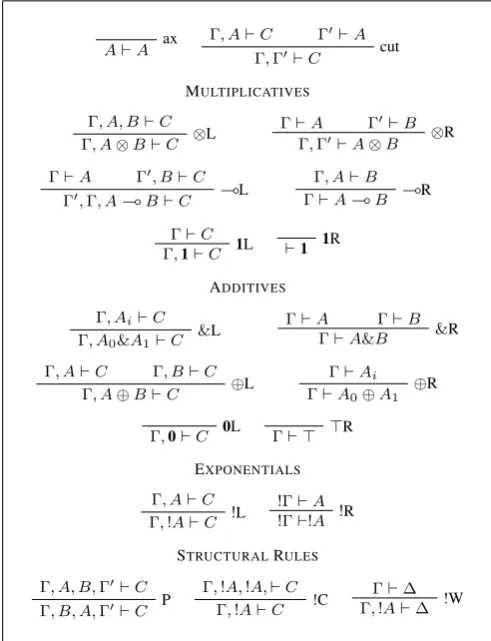
The rules of the sequent calculus for ILL are shown in Table 1 [18]. We can restrict attention to the following fragments:intuitionistic multiplicative linear logic(IMLL) using only⊗and(; intuition-istic multiplicative additive linear logic(IMALL) using only⊗,(,
&and⊕; andHorn linear logic(HLL). In the latter, sequents must be of the formX,Γ ` Y [9], whereX andY are tensors of pos-itive atoms, andΓis one of the following (withXi,Yi being
ten-sors of positive atoms):(i) (X1 (Y1)⊗ · · · ⊗(Xn (Yn),(ii)
(X1 (Y1) &· · ·& (Xn(Yn).
For these fragments, we have the following proof-search complex-ity results. MLL is NP-complete and so is MLL with full weakening (W) [13]. The same results apply for the intuitionistic versions. HLL is NP-complete, and so is HLL + W [9]. MALL and IMALL are PSPACE-complete [14].
ax
A`A
Γ, A`C Γ0`A
cut
Γ,Γ0`C
MULTIPLICATIVES
Γ, A, B`C
⊗L
Γ, A⊗B`C
Γ`A Γ0`B ⊗R
Γ,Γ0`A⊗B
Γ`A Γ0, B`C
(L
Γ0,Γ, A(B`C
Γ, A`B
(R
Γ`A(B
Γ`C
1L
Γ,1`C
1R `1
ADDITIVES
Γ, Ai`C
&L
Γ, A0&A1`C
Γ`A Γ`B
&R
Γ`A&B
Γ, A`C Γ, B`C
⊕L
Γ, A⊕B`C
Γ`Ai
⊕R
Γ`A0⊕A1 0L
Γ,0`C Γ` > >R EXPONENTIALS
Γ, A`C
!L
Γ,!A`C
!Γ`A
!R
!Γ`!A
STRUCTURALRULES
Γ, A, B,Γ0`C
P
Γ, B, A,Γ0`C
Γ,!A,!A,`C
!C
Γ,!A`C
Γ`∆
!W
[image:2.595.304.550.291.612.2]Γ,!A`∆
Table 1. Sequent Calculus for Intuitionistic LL
4
VALUATIONS
show how to represent different classes of valuation functions over the powerset ofMin LL.
There is an isomorphism between multisets and tensor formulas of atoms (up to associativity and commutativity):
{m1, . . . , mk} ∼= m1⊗ · · · ⊗mk
Thus, we can represent each subsetX ⊆ Mas a tensor product. Moreover, ifM ∼=AandN ∼=B, then the (disjoint) union ofM
andNis isomorphic toA⊗B.
We want to define languages to encodevaluation functions v :
P(M) → N(including 0), mapping subsets ofMto values. To model values, assume a finite set of distinct weight atomsW =
{w1, ..., wp}. In fact, we will use just one weight atomu. We write
ukfor the tensor productu⊗ · · · ⊗u(ktimes). To associate weights with numbers, we define a functionval:W →N, withval(u) = 1. Let W⊗ be the set of all finite tensor products of atoms in W, modulo commutativity (including the “empty” product1). That is, W⊗={1, w1, w2, w1⊗w2, . . .}. We extendvaltoW⊗by stipu-latingval(1) = 0andval(ϕ⊗ψ) =val(ϕ) +val(ψ). In particular, this means thatval(uk) =k.
We first defineatomic valuations, which specify which valuewis associated to a multisetM.
Definition 1. An atomic valuation is a formulaM (w, whereM
is a tensor product of atoms inAandw∈ W.
We will consider various languages to express valuations; they all share the same definition of generated function.
Definition 2. Every formulaϕin any of our languages generates a valuationvϕmapping multisetsX⊆ Mto their value:
vϕ(X) = max{val(w
0
)|w0∈ W⊗andX, ϕ`w0}
In the case of atomic valuationsϕ = (M ( w), this simply says thatvM(w(X) =wwheneverX is equal to (or a superset of) the
multiset isomorphic toM, andvM(w(X) = 0otherwise.
In case the only weight atom used isu, i.e., ifW = {u}, then Definition 2 can be restated as follows:2
vϕ(X) = max{k|X, ϕ`uk}
Now, consider the following classes of valuations.
Definition 3. Letv:P(M)→N; we say that:
• vis monotonic ifM1⊆M2impliesv(M1)≤v(M2). • vis additive ifv(M) =P
m∈Mv({m})for allM ⊆ M.
• vis dichotomous ifv(M) = 0orv(M) = 1for allM⊆ M • vis 0-1 if it is add. andv({r}) = 0orv({r}) = 1for allr∈ M.
We can define the following languages to encode valuations. They are obtained by restricting the language of LL.
VAL:=X(w|VAL&VAL ADD:=a(w|ADD⊗ADD DIC:=X(1|X(u|DIC&DIC 01:=a(1|a(u|01⊗01
The class of all valuations fromP(M)toNcan be generated by the formula&X⊆M(X ( w), which encodes the graph of the
func-tionv.
2If we defineu0=1, by weakening (which represents monotonicity), from
`1we getΓ`1, for anyΓ. So every valuation produces at leastu0, since it will always be satisfied by any allocation (also by allocating nothing), e.g.,p, p⊗q(uk`1will be provable.
Proposition 4. The following facts hold: • VALgenerates all valuationsv:P(M)→N.
• VAL under weakening generates all monotonic valuations and only those.
For a proof, we refer to [15]. The next result is immediate, and we omit its proof for lack of space.
Proposition 5. The following facts hold:
• DICgenerates all dichotomous valuations and only those. • 01generates all 0-1 valuations and only those.
Moreover, we have:
Proposition 6. ADD generates all additive valuations and only those.
Proof. Consider any formulaADD = (a1 (w1)⊗ · · · ⊗(ap (
wp). We prove that it generates an additive function. Let uk =
vADD(M). Since a singleton can satisfy at most one implication in
ADD, for anym∈ M, we havevADD({m}) =wiifm=ai,
oth-erwise we havevADD({m}) = 0. If we take all themi providing
non-zero utility, we can build the following proof (by⊗Rand⊗L):
m1, al1(wl1`wl1 . . . mk, alk(wlk`wlk
m1, . . . , mk,(al1(wl1)⊗ · · · ⊗(alk(wlk)`wl1⊗ · · · ⊗wlk
If(al1(wl1)⊗· · ·⊗(alk(wlk)is not equal toADD, then we can
use weakening and⊗Lto get the full formula. ThusM,ADDproves P
m∈M{v({m})|v({m})6= 0}. That the value actually equals the
maximum follows, since all the non-zero elements are there. Conversely, take an additive functionv, define the additive for-mula as follows. For all m ∈ M, consider v({m}) = hm. If
h6= 0, write(m(hm), otherwise write nothing. The expression
⊗m∈M(m(hm)generatesv.
5
ALLOCATIONS
In this section, we show how to represent allocations (and their properties) in LL. We will model an allocation producing a certain social welfare as a proof for a particular LL sequent. Recall that N = {1, ..., n}is the set of agents. We add to the set of atoms A={p1, . . . , pm}all atomspji, withi≤mandj≤n, to express
that the goodpiis allocated to the individualj. From now on, we
will assume that valuations are defined using these indexed names of resources; agents must express their preferences using the set of atomsAj
={pj1, . . . , p
j m}.
To express that each (copy of a) resource may be given to any of the agents (but not to more than one), we use the following formula:
MAP := O
p∈A
[&j∈N(p(pj)]M(p) (1)
Following [15], we now define the concept ofallocation sequent, which encodes a feasible allocation returning a particular social wel-fare. We takeMandN to be fixed, andMAPto be defined accord-ingly.
Definition 7. The allocation sequent for value k and valuations VAL1, . . . ,VALnis defined as the following LL sequent:
M,MAP,VAL1, . . . ,VALn`uk
Proposition 8. Givennformula in a given class of formulasVAL, every allocationAwith valuekprovides a proofπof an allocation sequent fork, and vice versa, every proofπof an allocation sequent forkprovides an allocationαwith valuek.
For the proof we refer to [15]. Given an allocation sequent, we can read the allocationAconsidering the atoms that have been actually used in the proof.
Example 9. Consider the following allocation sequent:
p, q, r,
MAP
z }| {
p(p1&p(p2, q(q1&q(q2, r(r1&r(r2,
p2⊗q2(w, r1(v`w⊗v
We can retrieveAfrom the proofπof the sequent, which contains the following steps:
p2, q2`p2⊗q2 w`w p2, q2, p2⊗q2
(w`w
r1`r1 v`v r1, r1(v`v
So the multiset of allocated goods,A ={p2, q2, r1}, can be read from the axioms inπ.
DefineAi ⊆ A to be the multiset of atoms allocated to agenti:
{pi|pi∈A}. We can state the definitions of social welfare within our framework as follows.
Definition 10(Utilitarian social welfare).
swu(A) = max{k|A,VAL1, . . . ,VALn`uk}
We can consider a particular proofπof an allocation sequent and define the value of the allocation in that proof asswπ
u(A) = uk,
whereA,VAL1, . . . ,VALn`ukis inπ. The value of the allocation
for a certain agentiis given by:uπ
i(A) = wi, whereA,VALi `
wiis inπ. So, for example, the utilitarian social welfare of a given
allocation sequent is given by the sum of the individual utilities:
uπ1(A)⊗ · · · ⊗u
π
n(A) =sw π u(A)
Slightly abusing the notation, we identify the valueswu(A0)with the
valuekof the tensor formulauk. Given two allocationsAandA0, since we are using LL with (W), we have thatswu(A)≤swu(A0)
iff swu(A0) ` swu(A). In order to define a strict order, we put
swu(A)< swu(A0)iffswu(A0)`swu(A)⊗u.
We can present now the definition of Pareto optimality.
Definition 11(Pareto optimality). An allocationAis Pareto optimal iff there is no allocationA0such thatsw(A0)`sw(A)⊗uand for alli,ui(A)`ui(A0).
6
DEALS
In this section, we define a general language to express deals, then in the next section we will see what it means for an agent to be willing to accept a deal. The language we define will be more general than one would expect, since we consider any kind of formula to be a deal. We will not put structural constraints on the formula expressing deals; rather, the condition we will put on the feasibility of the nego-tiation will provide the expected meaning of deals, namely that they transform an allocationAinto and allocationA0.
Definition 12. A deal is any formula of linear logic built over the indexed alphabetAj
.
So for example a single atompjmeans thatpgoes to agentj. The meaning of a deal of the formp1
(q3
is simply the agent 1 losesp
and the agent 3 getsq.
Definition 13. We say that an allocationA0is obtained fromAby a DEALiff
A,DEAL`A0
The fact that we use provability to model the passage from aAtoA0
amounts to assuming that the deals are feasible in the sense that they concern the resources inA. For example, takep1 (p2; if agent 1 does not ownpinA, then such a deal will not be used.
Remark 14. There are some situations we are excluding. The valua-tions we are considering are defined on multisets that are represented in our language by tensor formulas. We will not consider here valua-tions defined on other types of formulas, as opvalua-tions likea&b(agent has the choice) ora⊕b(agent doesn’t have the choice): it would require a rather different definition of valuation functions. We leave such extensions to future work.
We discuss some examples. Deals that simply move a single resource
pfrom one agent to another (1-deals) can be modelled as implica-tions of the formpi ( pj. Aswap deal [17] between individu-als is defined by the following formula(pi
( pj)⊗(qj
( qi)
, which means thatigivesptojandjgivesqtoi. For example, let
A={p1, q2, r3}
, we can getA0={p2, q1, r3}
by the swap:
p1, q2, r3,(p1(p2)⊗(q2(q1)`p2⊗q1⊗r3
Note that, according to this definition, there might be deals that change nothing, e.g.,pi(pi. Moreover, we can also consider deals that simply provide a resourcepto a certain agenti,pi. In this way, we can for example model, as a form of negotiation, the passage form a partial allocation, in which some goods were not allocated, to a total one:
p1, q2 | {z }
A
, p1(p2, q3
| {z }
DEAL
`p2⊗q2⊗q3
| {z }
A0
Cluster deals[17], where agents exchange more then one item, can be modelled using tensors:pi⊗qi⊗ri(pj⊗qj⊗rj, meaning thatigives onep, oneqand onertoj.
The language of LL allows for expressing deals that entail some forms of choice. Let us call themoptative deals. So, for example,
(p1
(p3) & (p2
(p3)
means that 3 would getpfrom 1 or from 3 (but not from both), or(p1(p2) & (p1(p2)means that 1 would givepto 2 or to 3 (but not to both).
Using the distributivity law of LL:
A (B&C)a`(A B) & (A C),
we can write optative deals in the following forms. We can express deals like “someone givesptoi” as follows:
(p1⊕ · · · ⊕pn)(pi
Symmetrically, we can express “igivespto someone”:
pi((p1&· · ·&pn)
In an analogous way, we can consider “igives something toj” and “igets something fromj”.
Taking the language of deals in its full generality, we can also definetransformationsof deals, for example(pi(pj)((rj (
ri), the intuitive meaning of which is thatjwould givertoiif the deal(pi
(pj)
Example 15. LetAbe{p1, r3, p1, q2}and the dealsp1(p2and
q2
(q3
, meaning that 1 gives onpto 2 and 2 gives oneqto 3. The following proof shows thatA0 ={p1, r3, p2, q3}is obtained fromA:
p1, r3`p1⊗r3
p1, p1(p2`p2 q2, q2(q3`q3
⊗L
p1, q2, p1(p2, q2(q3`p2⊗q3
⊗L
p1, r3, p1, q2, p1(p2, q2(q3`p1⊗r3⊗p2⊗q3
We can prove that the language of deals is sufficiently powerful to express every transformation of allocationsA,A0.
Proposition 16. LetAandA0be two allocations. Then there exists a formulaDEALin the deal language such that
A,DEAL`A0
The proof is obvious in the sense that it is enough to consider the formulaA(A0as a deal. We can define a general notion of nego-tiation as follows.
Definition 17. A negotiation is a sequentA,DEAL1, . . . ,DEALl `
A0whereDEAL1, . . . ,DEALlare accepted deals according to some
criterion.
We can also consider the feasibility of an allocation with respect a given multiset of resources as follows:
M,MAP`A (2)
Here, MAPis the formula defined as in (1). The provability of (2) entails that, given the actual multiset of resourcesM,Ais a feasible way to assign goods.
7
RATIONALITY OF DEALS
In this section, we present some conditions that specify when an agent would accept a deal. Basically, according to the relevant lit-erature [3], we distinguish two cases, one withside paymentsand one without. Apayment functionis a functionp:N →Zsuch that
X
i∈N
p(i) = 0
Using side payments, the notion of individual rationality can be de-fined as follows. A deal is individually rational iff wheneverA0 is obtained byAby means of that deal, then there exist a payment func-tionpsuch that for alli∈ N:
vi(A0)> p(i) +vi(A)
We rephrase the notion of payment function considering formulas in our language as side payments. The requirement that the prices actu-ally paid must sum up to zero is here interpreted as the provability of the sequent containing positive and negative payments. Intuitively, there should be a matching between who pays and who gets pay-ments.
Definition 18. A side payment is a sequentX a`Y, whereX and
Y are tensors ofu, that is provable in LL. We call the formulas on the left negative payments and those on the right positive payments.
We could also consider more general formulas as side payments. As an example of possible generalisation, we can consider an individual
iwho would accept to face a loss of three units of her utility for get-ting oneq; it can be modelled using the formulau3(qi. However, it is not clear how to define a notion of rationality for side payments consisting of general formulas.
Using payment sequents we can rephrase the notion of individual rationality as follows.
Definition 19. Given a dealDEALsuch thatA0 is obtained byA
by means ofDEALand a side paymentX a`Y, we say thatDEAL is individually rational iff for alli,ui(A0i), Xi ` ui(Ai)⊗Yiand
there exists ajsuch that:uj(A0), Xj ` uj(Aj)⊗u⊗Yj, where
X1⊗ · · · ⊗Xn∼=XandY1⊗ · · · ⊗Yn∼=Y.
Note that, since we are working with integers, we do not require all agents to experience a (possibly infinitesimally small) improvement, but rather ask that no agent suffers a loss, and at least one of them gains one full unitu. We can derive the case without side payments, by taking the payment sequent to be1` 1, yielding the following definition ofcooperative rationality[3]:
Definition 20. A deal formula DEALsuch thatA,DEAL ` A0 is cooperatively rational iff for alli,ui(A0)` ui(A)and there exists
ajsuch thatuj(A0)`uj(A)⊗u.
In what follows, w.l.o.g., we will consider payments in which, for eachi, (at least one of)XiorYiis the tensor unit1.
Example 21. Suppose we want to determine whether a deal taking us from allocationAto A0 is individually rational. Letu1(A0) =
u15,u2(A0) =u10,u3(A0) =u5andu1(A) =u2,u2(A) =u1,
u3(A) =u6. We can defineXiandYias follows:
u15`u2⊗u6 Y 1=u6
u10`u1⊗u2 Y2=u2
u5, u8`u6 X3=u8
We have that positive and negative payments match:u8a`u6⊗u2 .
We can now state the relationship between individual rationality and social welfare by means of the following theorems. The next result corresponds to [3, Lemma 1], except that we get a more precise char-acterisation in the context of integer valuations: a deal is individually rational if and only if it increases social welfare by at least one unit.
Theorem 22(Rational deals and social welfare). A deal formula DEALwithA,DEAL ` A0 is individually rational iffswu(A0) `
swu(A)⊗u.
Proof. (⇒) LetDEALbe individually rational. We have that for all
i, there are payments such thatui(A0), Xi`u(Ai)⊗Yi. Moreover,
there is an agenthsuch thatuh(A0), Xh ` u(Ah)⊗u⊗Yh. Let
i1, ...ikbe the set of agents which gets negative payments (those for
whichYiis1) andlk+1, . . . , lnthose with positive payments (those
for whichXiis1). From sequentsuij(A 0
), Xj`uij(A), by tensor
introduction, we get:
ui1(A 0
), . . . , uik(A 0
), Xi1, . . . , Xik`ui1(A)⊗· · ·⊗uik(A) (3)
Now consider the negative paymentsuli(A 0
) ` uli(A)⊗Yli. We
can splituli(A 0
) in two tensors, sayu0li and u 00
li, such thatu 0
li `
uli(A)andu 00
li ` Yli. In casehis in this group, then we have that
u0h`uh(A)⊗u. Ifhwas in the previous group, then his utility has
already been considered. So, taking all theu0li `uli(A), by tensor
introduction, we have:
ui1(A 0
), . . . , uik(A 0
), u0lk+1, . . . , u
0
ln, Xi1, . . . Xik` (4)
Where the formula on the right hand side amounts tosw(A)⊗u. From all theu00li`Xli, we build by introducing tensors:
u00lk+1, . . . , u 00
ln`Ylk+1⊗ · · · ⊗Yln (5)
SinceYlk+1⊗ · · · ⊗Yln`Xi1⊗ · · · ⊗Xik, we have by cut:
u00lk+1, . . . , u 00
ln`Xi1⊗ · · · ⊗Xik (6)
We can finally conclude again by cut on (6) and (4):
ui1(A 0
), . . . , uik(A0), u0lk+1, u 00
lk+1, . . . , uln, u 00
lnj`
sw(A)⊗u
Whereui1(A 0
), . . . , u0ln, u 00
lnissw(A 0
). Thus,sw(A0)`sw(A)⊗u
(⇐) Let A and A0 such that swu(A0) ` sw(A) ⊗ u, where
A,DEAL`A0. We prove that there exist a payment sequentX a` Y. We defineZi=up(i)wherep(i)is defined as follows:
p(i) =ui(A0)−ui(A)
Moreover, we chose an individual h and we allocate also
usw(A0)−sw(A)
. We have that if p(i) is positive, then ui(A0) `
ui(A)⊗Zi and ifp(i)is negativeui(A0)⊗Zi ` ui(A).
More-over the individualhwill have a strict improvement. The provability ofXa`Y follows then from the fact thatp(i)sum up to zero.
In a similar way we can prove a result linking cooperative rationality and Pareto improvements [3].
The following result shows that allocations with maximal utilitar-ian social welfare can be reached from any (suboptimal) allocation
Aby means of individually rational deals.
Theorem 23. LetA∗be an allocation with maximal social welfare. Then for any allocationAwith lower social welfare there exists an individually rational dealDEALsuch thatA,DEAL`A∗.
The proof relies on the fact that there always exists a deal to reach
A∗fromA, by Proposition 16. Since social welfare improves, by Theorem 22 such a deal is individually rational.
It is interesting to remark that, since we are dealing with integer valuations, if we consider any set of rational deals, each of them must make social welfare increase by at least one unit. Thus, ifkis the dif-ference between the maximal social welfare and the social welfare of the initial allocation, then we will always reach an optimal allocation by means of any sequence of at mostkindividually rational deals.
8
CONCLUSION
We saw how a framework for multilateral negotiation over multisets of goods can be embedded in linear logic. Moreover, we defined a general language to express deals as transformations of allocations, which have adequately been interpreted as proofs in LL. We also showed how to use our framework to exhibit some fundamental re-sults in multiagent resources allocation, and we pointed at some in-teresting differences with respect to the usual treatment (stemming from the use of integers for valuations).
Future work should include an investigation of the complexity of checking the relevant problems, such as feasibility of an allocation or existence of certain class of sufficient deals. Furthermore, it is interesting to further investigate the notion of side payments we pro-vided, since we would be able consider classes of formulas as pay-ments, which could be interesting for example for modelling agents with various rationality constraints, or even to investigate different notions of rationality .
REFERENCES
[1] Y. Chevaleyre, P. E. Dunne, U. Endriss, J. Lang, M. Lemaˆıtre, N. Maudet, J. Padget, S. Phelps, J. A. Rodr´ıguez Aguilar, and P. Sousa, ‘Issues in multiagent resource allocation’, Informatica, 30, 3–31, (2006).
[2] Y. Chevaleyre, U. Endriss, and N. Maudet, ‘Simple negotiation schemes for agents with simple preferences: Sufficiency, necessity and maxi-mality’,Journal of Autonomous Agents and Multiagent Systems,20(2), 234–259, (2010).
[3] U. Endriss, N. Maudet, F. Sadri, and F. Toni, ‘Negotiating socially op-timal allocations of resources’,Journal of Artificial Intelligence Re-search,25, 315–348, (2006).
[4] U. Endriss and E. Pacuit, ‘Modal logics of negotiation and preference’, inProc. 10th European Conference on Logics in Artificial Intelligence (JELIA-2006). Springer-Verlag, (2006).
[5] M. Fisher, ‘Characterizing simple negotiation as distributed agent-based theorem-proving: A preliminary report’, inProc. 4th Interna-tional Conference on Multi-Agent Systems (ICMAS-2000), (2000). [6] J.-Y. Girard, ‘Linear logic’,Theor. Comput. Sci.,50(1), 1–101, (1987). [7] J.-Y. Girard, ‘Linear logic: Its syntax and semantics’, inAdvances in
Linear Logic, Cambridge University Press, (1995).
[8] J. Harland and M. Winikoff, ‘Agent negotiation as proof search in lin-ear logic’, inProc. 1st International Joint Conference on Autonomous Agents and Multiagent Systems (AAMAS-2002), (2002).
[9] M. I. Kanovich, ‘The complexity of Horn fragments of linear logic’,
Ann. Pure Appl. Logic,69(2-3), 195–241, (1994).
[10] A. P. Kopylov, ‘Decidability of linear affine logic’, inProc. 10th Annual IEEE Symposium on Logic in Computer Science (LICS-1995). IEEE Computer Society, (1995).
[11] P. K¨ungas and M. Matskin, ‘Symbolic negotiation with linear logic’, in
Proc. 4th International Workshop on Computational Logic in Multia-gent Systems (CLIMA IV). Springer-Verlag, (2004).
[12] J. Leite, J. J. Alferes, and B. Mito, ‘Resource allocation with answer-set programming’, inProc. 8th International Joint Conference on Au-tonomous Agents and Multiagent Systems (AAMAS-2009), (2009). [13] P. Lincoln, ‘Deciding provability of linear logic formulas’, in Proc.
Workshop on Advances in Linear Logic. Cambridge University Press, (1995).
[14] P. Lincoln, J. C. Mitchell, A. Scedrov, and N. Shankar, ‘Decision prob-lems for propositional linear logic’,Ann. Pure Appl. Logic,56(1–3), 239–311, (1992).
[15] D. Porello and U. Endriss, ‘Modelling combinatorial auctions in lin-ear logic’, inProc. 12th International Conference on the Principles of Knowledge Representation and Reasoning (KR-2010), (2010). [16] F. Sadri, F. Toni, and P. Torroni, ‘An abductive logic programming
ar-chitecture for negotiating agents’, inProc. 8th European Conference on Logics in Artificial Intelligence (JELIA-2002). Springer-Verlag, (2002). [17] T. W. Sandholm, ‘Contract types for satisficing task allocation: I The-oretical results’, inProc. AAAI Spring Symposium: Satisficing Models, (1998).