Evaluation of the performance of dual-purpose cows
in European pasture-based systems
Name student: Gerdine Kaptijn
Period: January – July 2016
Farming Systems Ecology Group
Droevendaalsesteeg 1 – 6708 PB Wageningen - The Netherlands
2
Evaluation of the performance of dual-purpose cows
in European pasture-based systems
Name student: Gerdine Kaptijn
Registration number student: 911227422040 Credits: 36
Code number/
name course: FSE-80436 Period: July 2016
3
Abstract
The demand for organic products in Europe is growing, especially organic products of animal origin. Organic dairy milk production requires grazing of cows, which results in a feed ration that is pasture-based. The breed that is kept by far the most for dairy production in Europe is the Holstein Friesian cow, a high-yielding dairy cow. This cattle breed has been developed in North America and was selected for its high milk yield. The disadvantages of this one-sided selection for production manifest in the health, fertility and longevity of the cow. More important, the high milk yield of the Holstein Friesian is only achieved when the cows are fed a diet of high quality and especially concentrates, which is not always possible in a pasture-based system.
In this study the alternative for the Holstein Friesian breed is considered, namely the dual-purpose cow. Most countries feature indigenous cow breeds which were traditionally kept for both milk and meat. Because of the popularity of the Holstein Friesian breed these local breeds are less used in dairy production systems. An extensive literature study was carried out to compare the popular Holstein Friesian breed to the local dual-purpose cattle breeds. This showed that local dual-purpose breeds display in many traits such as health, fertility, meat quality and longevity an advantage over the Holstein Friesian. Additionally, dual-purpose cows are better able to cope with a harsh environment and a diet of low quality.
Furthermore, the grazing behaviour of one of the Dutch dual-purpose breeds, the Dutch Friesian, was compared in the current study to the Holstein Friesian. For this purpose the monitoring system SensOor (AGIS) was used. SensOor registers the four main conducts of the cows, namely eating, ruminating, resting and other activity (such as walking, standing, etc.). The system expresses the time the cows spend on these conducts in percentages per hour or per day. In this study the SensOor system was validated under grazing conditions for the first time. Before, the SensOor system was only validated indoors or in a dirt pen. The validation under grazing conditions was done by observing the behaviour of the cows on the pasture, and comparing these observations with the SensOor output. The observation of the activity ‘grazing’ corresponded very well with the detection of the activity ‘eating’ (R² = 0.97). As the validation of SensOor under grazing conditions was successful, the output of the system was used to compare the behaviour of the two cattle breeds. In the current study no significant differences in behaviour were found, which can be explained by the differences in size of the cows (HF: 650 kg, DF: 575 kg) which have therefore different energy requirements. Another explanation could be that the high quality of the grassland on the studied farm concealed the ability of dual-purpose cows to cope with low-quality roughages.
Besides the study of the behaviour of the cows, the herbage production on two farms was estimated. This was done by the placement of grass cages on the pastures. The herbage growth under the cages was mown, weighed and analysed.
4
Content
Abstract ... 3
1. Introduction ... 6
2. Materials & Methods ... 8
2.1. Literature study ... 8
2.2. Participating farmers ... 8
Mts. Lozeman, Achterveld, Utrecht ... 8
Mts. Bosma, De Wilgen, Friesland ... 10
2.3. Grazing management on the farms ... 12
2.4. Validation of SensOor under grazing conditions ... 12
How does SensOor work? ... 12
SensOor: Support and value for farmers ... 12
Validation ... 12
2.5. Differences in grazing behaviour among breeds ... 14
2.6. Measuring herbage production ... 15
2.7. Impact of environmental factors ... 17
2.8. Impact of grazing on herbage production ... 19
3. Results ... 20
3.1. Literature study: Dual-purpose cattle vs. Holstein Friesian cattle ... 20
Cows in Europe: From local breeds to Holstein Friesian cows ... 20
Milk production ... 21
Milk composition ... 22
Meat quality ... 22
Fertility ... 23
Health ... 23
Grazing behaviour ... 24
Genotype × Environment interactions ... 24
Environmental factors ... 25
Conclusions ... 25
3.2. Validation of SensOor ... 25
3.3. Dual-purpose cows & grazing ... 27
Grazing behaviour: differences between breeds ... 28
Behaviour study during daytime grazing hours ... 28
3.4. Herbage production ... 32
4. Discussion ... 34
4.1. Literature study: Milk-type vs. dual-purpose cow... 34
5
4.3. Comparison of Holstein Friesian and Dutch Friesian cattle ... 35
4.4. Herbage production ... 36
5. Conclusions ... 37
6
1.
Introduction
In Europe a growing demand for organic dairy products can be observed, which asks for an increase in organic production (Schaack et al., 2014). In the Netherlands the sales of organic food grew by 17% in 2011. Especially the demand for organic products from animal origin is growing in the Netherlands. 41% of all purchased organic products in the Netherland during 2011 were of animal origin (Bakker and Brouwer, 2012). Possible reasons for this increase in demand are that organic products are perceived as more healthy and are better for animal welfare and the environment (Bakker and Brouwer, 2012; Lairon and Huber, 2014). Furthermore, the image of organic agriculture is positive as consumers know that organic systems accommodate the animal’s expression of natural behaviour better, for example by grazing cows or free-range chickens.
While the market for organic products is growing at a high rate, the production of organic products in the Netherlands stays somewhat behind. Organic milk is imported from different European countries. This causes a much higher purchase price for organic milk (€52/100 kg milk) compared to the price of conventional milk (€30/100 kg milk) (Jacobsen, 2015). This price difference of €22/100 kg milk motivates conventional farmers to convert their farm into an organic system.
Organic dairy production is associated with pasture-based production, because one of the criteria for organic farming is to practice grazing (Isselstein et al., 2013). Therefore it is important that grazing cows utilize the grass as efficiently as possible. Nowadays 95% of the cows in Europe are of the breed Holstein Friesian (Van Arendonk and Liinamo, 2003), in the Netherlands this is even 98% (CRV, 2015). This commercial milk-typical cow breed is selected for its high milk yield. Selection for many years on high milk yield has led to an impressive high milk production and for this reason many farmers keep the Holstein Friesian breed on their dairy farm.
However, a high level of milk production is associated with a reduced fertility and health issues. Cows which are selected for their high milk yield tend to use the majority of their available energy for the lactation, which becomes evident after parturition (Dillon et al., 2006). After calving most cows experience a negative energy balance, because of the start of their lactation and its associated energy requirement. Holstein Friesian cows however are more susceptible to this negative energy balance. Because of this negative energy balance after parturition the fertility is low (Roche et al., 2006; Fulkerson et al., 2008; Delaby et al., 2009; Roche et al., 2009). Indications for a decreased fertility are a reduced appearance of oestrus and a longer calving interval.
When cows are kept in an organic (i.e. pasture-based) system, it is questionable whether the Holstein Friesian breed is the best option. To keep the milk production of the Holstein Friesian as high as possible in a grazing system, intensive supplemental concentrate feeding is necessary. In an extensive system such as a pasture-based system Holstein Friesians do no reach their production potential (McCarthy et al., 2007). Research shows that cattle breeds which have not been exclusively selected for a high milk yield keep a more stable production in a pasture-based system than the Holstein Friesian (Delaby et al., 2009). These cattle breeds are called dual-purpose cows, which means that they are kept for both meat and milk production (Peniche-González et al., 2014). The meat of dual-purpose cows is as profitable as their milk production, because the meat quality is high and farmers receive a better price for both calves and adult cows. Because dual-purpose breeds are not selected exclusively for milk production, dual-purpose cows have a more diverse genotype. In general they show better health, higher fertility and a better longevity than the Holstein Friesian (De Winter et al., 2010; Piccand et al., 2013).
7 dual-purpose cattle breeds in Europe, and the environment of the local production systems (Kristensen, 2015).
Nine European partners are involved in the project and conduct research on farms with their local dual-purpose breeds. In the Netherlands, two farmers participate who keep the Dutch Friesian cow, a black-pied dual-purpose breed which is in part the ancestor of the Holstein Friesian. On the participating research farms a monitoring system is installed, called SensOor. This system was developed by the Dutch company AGIS.
SensOor monitors the behaviour of cows and gives an indication of animal health, fertility and nutrition. The system consists of a three-dimensional accelerometer which is placed in the cow’s ear and detects the ear movements. Cows make specific head and ear movements when eating, resting or ruminating. The temperature of the individual cows and of the total herd are measured and sent to the receiver where the data is collected and stored. Most farmers use the SensOor system mainly to detect when their cows are more active (and thus might be in heat). The use of SensOor has decreased the calving interval on many farms considerably. Another important function is the early detection of ill cows by dropping temperatures or decreased eating or rumination time. The system has been tested comprehensively under indoors circumstances, but never in a grazing environment. Therefore in this thesis SensOor will be validated outdoors, and if reliable, be used as an indicator for the grazing behaviour of the dual-purpose cows on the two Dutch farms.
The hypotheses of the project 2-ORG-COWS are:
1. Dual-purpose cows are more robust than modern dairy cattle breeds, and therefore more suitable for varying harsh organic grassland systems.
2. Novel environmental descriptors combined with novel statistical methodology reveal G×E for ‘conventional’ and for novel functional traits.
3. Breeding goals and breeding strategies for dual-purpose cattle breeds need to be adapted for selection of suitable cattle for varying harsh organic grasslands systems, regarding to constitution, physiology, health, milk quality, greenhouse gas emissions, etc.
4. Economic evaluation criteria exhibit superiority of dual-purpose cattle over modern dairy cattle breeds in organic pasture-based production systems when using a systemic approach on the farm as well as on the population level.
5. Pasture-based production system need to be adapted (improved) to realize a better health status, less greenhouse gas emissions, and improved product quality of dual-purpose cows.
In this thesis hypothesis 1 shall be investigated. The performance of dual-purpose cows in a pasture-based system will be evaluated by answering the following questions:
- What similarities and differences exist between European dual-purpose breeds and milk-typical breeds such as the Holstein Friesian?
This question will be answered by carrying out a literature study in which the characteristics of the Holstein Friesian breed and the different dual-purpose breeds will be investigated.
- Is SensOor a reliable system to monitor the grazing behaviour of dual-purpose cows?
To answer this question the SensOor system has to be validated. In order to this cows will be observed during their daytime grazing hours and their behaviour will be noted. The observations will be compared with the output of the SensOor system.
- Does the grazing behaviour of dual-purpose cattle differ from the grazing behaviour of the Holstein Friesian?
The output of SensOor will be used to give an overview of the behaviour of the different cattle breeds. A comparison of their behaviour will show whether a difference exists in their grazing behaviour.
8
2.
Materials & Methods
2.1. Literature study
First the concept of a dual-purpose cow was defined and explained which dual-purpose cow breeds are most common in Europe. Using an explorative literature study dual-purpose cows were compared to the well-known commercial cow breed Holstein Friesian. Similarities and differences between the breeds were discussed. Many comparative studies about the characteristics and qualities of the breeds have been executed in the past. The results of these studies were shown and discussed. It was expected that dual-purpose breeds have certain advantages over the Holstein Friesian and that this will become apparent by a thorough literature study.
Literature was acquired by using Google Scholar and the online library of Wageningen University. Personal communication with experts and farmers was used as well. As less information exists on dual-purpose breeds, ‘grey’ literature such as non-scientific agricultural journals was consulted.
2.2. Participating farmers
Two Dutch farms participate in this research. They are situated in Utrecht and in Friesland. Both farmers have installed the monitoring system SensOor on their farm. The farmer in Friesland already uses SensOor since 2012. The farmer in Utrecht has the system since October 2015. Both farmers endorse the system as a positive asset for their management and observe an increased fertility and disease detection among their herds.
Mts. Lozeman, Achterveld, Utrecht
Farmer Lozeman in Utrecht runs an organic dairy farm of 30 ha with 56 dairy cows of the Dutch Friesian breed. During the grazing season (April-November) the cows have access to a grass-clover pasture throughout the whole day. They graze 200 days a year, 20 hours a day. In summer the cows also receive concentrates (on average 7 kg/cow/day) and in the barn there is additional grass silage available. In winter the cows are fed grass and triticale silage and some additional concentrates. The cows are milked at 5:45 and at 17:15. The milking takes approximately 1 hour.
The production of the cows is 6500 kg milk per cow per year, and 19,6 kg milk per cow per day.
In Appendix I a map of the farm can be found. The black line delineates the parcels of the farm, which add up to a total of 29.7 ha. This year (2016) the parcels 11-13 were not available to the farmer as the municipality diverts the stream north of the farm for cultural purposes. All parcels of the farmer are on sandy soil on which a grass-clover mixture is grown. Each year the farmer ploughs 1 parcel where he sows triticale (a cross of rye and wheat) to produce part of the concentrate feed of the cows. This year the triticale was sown on parcel 2. Triticale is suitable for sandy soils because it is a drought-resistant crop.
In Table 1 an overview of the parcels regarding their acreage, altitude, soil type and utilization for the last 6 years is given. The numbers of the parcels correspond with the numbers on the map in figure 1. Taking into account the parcels which are not available due to excavation around the stream (11-13) and the triticale parcel (2), the total grass acreage available on the farm is 29.7 – 1.8 – 1.46 – 0.66 – 2.49 – 3.8 = 19.49 ha.
9
Table 1. Overview of the parcels on the organic farm.
# Hectares Crop Soil type Average altitude (m)
1 0.44 2009-2015: grass-clover Sand 3.96
2 3.8 2009-2015: grass-clover Sand 4.17
3 1.36 2009-2015: grass-clover Sand 3.28 4 3.99 2009-2013: grass-clover
2014: triticale 2015: grass-clover
Sand 3.13
5 4.10 2009-2012: grass-clover 2013: triticale
2014-2015: grass-clover
Sand 3.33
6 2.13 2009-2015: grass-clover Sand 3.57 7 0.75 2009-2015: grass-clover Sand 4.08 8 1.36 2009-2015: grass-clover Sand 3.67 9a 0.71 2009-2014: grass-clover
2015: triticale
Sand 4.02
9b 3.30 2009-2014: grass-clover 2015: triticale
Sand 4.64
10 1.19 2009-2015: grass-clover Sand 3.98 11 1.80 2009-2013: maize
2014-2015: grass-clover
Sand 3.17
12a 1.46 2009-2013: maize 2014-2015: grass-clover
Sand 3.16
12b 0.66 2009-2015: grass-clover Sand 3.27 13 2.49 2009-2013: maize
2014-2015: grass-clover
Sand 3.26
The organic farmer has kept the Dutch Friesian dual-purpose cows for decades. The farmer is part of a national breeders association in which knowledge is exchanged and bulls and sperm is traded among farms. The farmer tries to keep the bloodlines of his cows pure but to avoid inbreeding he needs to crossbreed. Usually he uses sperm from British Friesian bulls to inseminate his cows. The British Friesians descend from the Netherlands as well and are similar to Dutch Friesians regarding their physique and milk production.
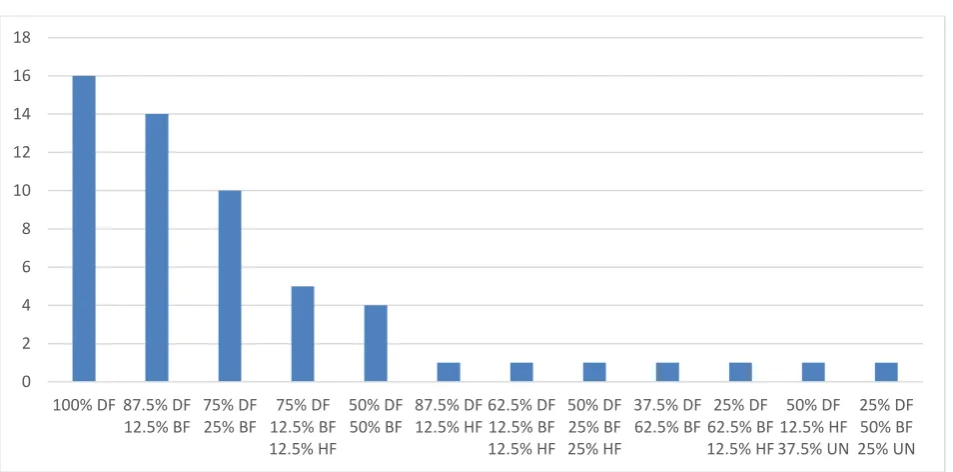
In Table 2 an overview is given of the herd and their bloodline composition. There are 16 pure-bred DF cows, and 29 cows are cross-bred DF and BF. The remaining cows have HF blood as well, and some blood of which the origin is unknown.
Table 2. Overview of bloodline composition (%) of the herd on the organic farm.
Dutch Friesian British Friesian Holstein Friesian Unknown Number of cows
100 - - - 16
87.5 12.5 - - 14
75 25 - - 10
75 12.5 12.5 - 5
50 50 - - 4
87.5 - 12.5 - 1
62.5 12.5 25 - 1
50 25 25 - 1
37.5 62.5 - - 1
25 62.5 12.5 - 1
50 - 12.5 37.5 1
25 50 - 25 1
56
10
Figure 1. Dispersion of the bloodlines of the organic herd.
Mts. Bosma, De Wilgen, Friesland
Farmer Bosma in Friesland has a conventional dairy farm and keeps 100 Dutch Friesian cows. They have 48 ha of grassland and 12 ha of maize, for the maize silage production. There has been some crossbreeding with Holstein Friesian. Approximately 15% of the herd is cross-bred with HF and 5% is purebred HF. In summer the cows spend on average 6 hours of grazing per day and are inside the barn overnight, where they are fed maize and some brewer’s grains. Additionally they receive on average 4 kg concentrates per cow per day. In winter the feed ration is grass and maize silage, brewer’s grains, some soy and minerals.
In Appendix II the conventional farm is shown with all grass and maize parcels. The total acreage is about 60 ha, of which 20% is used for production of maize. On 4 parcels maize is grown, on the remaining land grass is grown for grazing and silage. The parcels on the south-west side of the farm are mostly on peat soils (parcel 7-14), whereas the other parcels are on sandy soils.
The conventional farmer is situated in Friesland. The parcels of the farmer are shown in Table 3. Typical for Friesland peat soils can be found, which have in general a lower altitude than sandy soils. Besides this, peat soils have a lower water permeability compared to sandy soils (Bot, 2011). On half of the parcels the farmer is involved in nature conservation, such as protection of nesting birds and rest areas for meadow birds.
The pastures are fertilized with animal manure and artificial fertilizer. On average the pastures are fertilized with 22 m³ manure/ha. Additionally 40 kg nitrogen per ha is used.
0 2 4 6 8 10 12 14 16 18
100% DF 87.5% DF
12.5% BF 75% DF25% BF 12.5% BF75% DF 12.5% HF
50% DF
50% BF 87.5% DF12.5% HF62.5% DF12.5% BF 12.5% HF
50% DF 25% BF 25% HF
37.5% DF
62.5% BF62.5% BF25% DF 12.5% HF
50% DF 12.5% HF 37.5% UN
11
Table 3. Overview of the parcels on the conventional farm
# Hectares Crop Soil type Average altitude (m) Nature conservation
1 1,57 2009-2015: grass Sand 0.24
2 3,82 2009-2015: grass Sand 0.04
3 1,24 2009-2015: grass Sand -0.02
2+3 1,44 2009-2010: grass 2011-2015: maize
Sand -0.04
4 2,75 2009-2015: grass Sand + peat 0.19
5 4,63 2009-2015: grass Sand 0.01
6 3,41 2009-2015: grass Sand -0.56
7 4,08 2009-2015: grass Peat -0.93 Yes
8 3,67 2009-2015: grass Sand + peat -0.47 Yes
9 3,96 2009-2015: grass Sand + peat -0.73 Yes
10 2,75 2009-2015: grass Peat -0.91 Yes
11 4,76 2009-2015: maize Peat -0.77 Yes
12 1,26 2009-2013: maize 2014-2015: grass
Peat -0.72 Yes
13 0,97 2009-2015: maize Sand 0.18 Yes
14 5,76 2009-2015: grass Sand + peat -0.31 Yes
15 2,25 2009-2015: grass Sand -0.10
16 2,70 2010-2015: maize Sand + peat -0.51 Yes
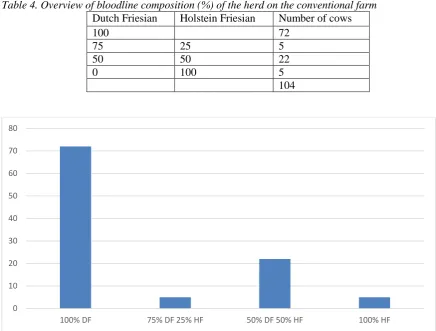
[image:11.595.69.506.413.744.2]The conventional farmer has a large herd of 104 dairy cows. The majority of the cows is pure-bred Dutch Friesian, but in 2010 the farmer bought 10 pure-bred Holstein Friesians to extend the herd. This resulted in cross-bred animals. Most of the bulls that are used to inseminate the cows are DF, but HF is used as well to avoid inbreeding and to increase the milk production. This resulted in a diversified herd which is shown in Table 4 and Figure 4.
Table 4. Overview of bloodline composition (%) of the herd on the conventional farm
Dutch Friesian Holstein Friesian Number of cows
100 72
75 25 5
50 50 22
0 100 5
104
Figure 4. Dispersion of the bloodlines of the conventional herd
0 10 20 30 40 50 60 70 80
12
2.3. Grazing management on the farms
On both farms the herds have access to grazing during summer. The grazing behaviour of the HF cows of the conventional farmer will be studied and compared to DF cows. To enable a fair comparison, DF cows will be selected which are comparable to the HF cows in their age and production stage. If possible, it will be determined whether there is a difference in grazing time between the breeds.
2.4. Validation of SensOor under grazing conditions
The performance of the SensOor system under indoor conditions with dairy cows was already evaluated in 2013 (Bikker et al., 2014). The behaviour of the cows was observed and these observations were compared to the SensOor output. The results proved that the output of SensOor has a very high reliability. The testing was done during winter time, when the cows are kept indoors. Another study evaluating the performance of SensOor was done in 2013, Canada (Wolfger et al., 2015). The animals that were studied were castrated bulls in an outdoor dirt pen, which were fed at a feeding bunk. This study also supports the reliability of SensOor, although attention must be paid to the difference between the activities eating and ruminating. The study showed that SensOor was not always correct in discerning these particular activities, especially in warm environments where due to insects the cows use their ears a lot, thus compromising the data.
At the time of writing this thesis no other validation studies concerning SensOor have been published. The reliability of SensOor data of cows grazing on a pasture has not been tested so far.
How does SensOor work?
SensOor consists of a three-dimensional accelerometer which is placed in the ear of the cow. It detects the temperature of the cow, ear movements and typical head movements. From these movements the system can derive the behaviour of the cow, whether she is eating, ruminating or resting. The chip in the ear of the cow collects the data every minute and can save the data for 48 hours. Then the data is sent via a router in the barn to the computer where the data is interpreted and saved.
The data from the ear chip is interpreted by a proprietary model developed by AGIS. The data is expressed in a behavioural category, either the cow is eating, ruminating, resting or active. The minute-to-minute data is converted into percentages of behaviours per hour and per day. Through an online web application the farmer can access the information about the herd.
SensOor: Support and value for farmers
SensOor can support the farmers management by providing information about the health, fertility and nutritional status of the herd. Health issues can be detected by comparing the ear temperature of a specific cow to the average temperature of the herd. When there is a large deviation SensOor notices the farmer about this by sending a notification (Zevenbergen, 2012).
The activity of the cows is also measured by SensOor. When there is a peak in the cows activity this might indicate that the cow is in heat and can be inseminated. The system even shows the LH (Luteinizing Hormone) peak, which enables the farmer to inseminate the cow on precisely the right time (Buning, 2012).
Fluctuations in eating and rumination activity can also indicate health problems or issues with the feed of the cows. The graphs created by SensOor in the web application can provide a helpful overview of the time the cow (or total herd) spends on eating, ruminating and resting.
Validation
In this study SensOor was validated under grazing conditions. To achieve this cows were studied during their time spent in the pasture. This observations were compared to the output from SensOor to validate the performance of the system under a grazing environment. There is no research done so far on the performance of SensOor on cows while grazing outside on pasture. However, the dual-purpose cows on the farms that were studied are often outside and spend time on grazing. Therefore it is interesting to see whether the activity that SensOor registers is viable for cows that graze outdoors.
13 The observations were done in the same time frames, from 11:00 to 15:00. The behaviour of the cows were noted every minute in an observation scheme. This scheme can be found in Appendix II. Later the observations were classified in one of the following categories: ‘eating, ruminating, resting or active’. The observation protocol as described by Bikker et al. (2014) was followed. Using the statistical program IBM SPSS Statistics 22 (from now referred to as SPSS) the observations were analysed.
In May 2016, on the 10th and 12th, cows were observed in Achterveld, Utrecht. The weather conditions during these days are displayed in Table 5.
Table 5. Weather conditions on observation days (KNMI, 2016b).
Date Temperature (°C) Sun hours Wind speed (m/s) Humidity (%)
May 10th 15.4-22.1 0.9 3.4 62
May 12th 14.4-25.1 13.7 5.5 50
[image:13.595.65.533.350.493.2]The cows that were observed are listed in Table 6. Their genetics, age and days in lactation on the day of observation are shown as well.
Table 6. Information on observed cows.
Observation date Cow number Genetics Birth date (age) Calving date (DIL)
May 10th 19 87.5% DF
12.5% BF
21-02-2008 (8.02) 4-5-2016 (6)
May 10th 33 50% DF
50% BF
20-12-2012 (3.04) 12-12-2015 (150)
May 10th and 12th 57 87.5% DF 12.5% BF
05-03-2011 (5.02) 06-01-2016 (125, 127)
May 12th 43 87.5% DF
12.5% BF
21-02-2007 (9.02) 27-09-2015 (228)
May 12th 56 62.5% BF
25% DF 12.5% HF
18-11-2013 (2.06) 24-11-2015 (170)
The observant was situated outside of the pasture which provided an overview of the cows without disturbing their natural behaviour. However due to the presence of trees and the possibility of the cows to go indoors, it was not easy to observe the selected cows for consecutive hours. For this reason the data of four of the observed cows covers 1 hour.
[image:13.595.126.453.639.743.2]SensOor shows five different activities in its output, namely eating, ruminating, resting, active and highly active. It is unknown where the difference in active and highly active is based on. Therefore the output of these two activities was combined. To accommodate a comparison between the observations and the output of SensOor, the behaviour of the cows was classified into the activities that SensOor uses (Table 7).
Table 7. Observed behaviour classified into four SensOor activities. Observed behaviour SensOor Activity
Grazing standing Eating
Grazing walking Eating
Ruminating lying down Ruminating Ruminating standing Ruminating
Standing Active
Lying down Resting
14 The minutes they spent on grazing, ruminating, resting or activity were recalculated into percentages. This was done to enable a comparison between the output of the SensOor web application and the observations.
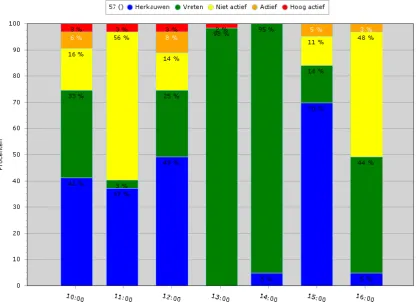
Figure 5. Output of SensOor for cow 57 on May 12th between 9:00 and 16:00. Blue stands for rumination, green for eating, yellow for resting and orange and red for active.
Figure 5 shows the output of SensOor. The time that the cow spends on different activities are shown in percentages per hour. It is also possible to compute the output in days or weeks.
2.5. Differences in grazing behaviour among breeds
As it was found that SensOor is indeed reliable under grazing circumstances (see Results), the data of SensOor was be used to examine whether dual-purpose cows (Dutch Friesian) spend more time on grazing than commercial, milk-typical breeds (Holstein Friesian). Within the cow herds of the farms variation exists in the bloodlines, which makes it possible to compare the grazing behaviour of the cows within the herds. Although the sample size is quite small, it will be examined whether the behaviour of a 100% DF cow is different from a 100% HF cow.
[image:14.595.76.494.124.426.2]15
Table 8. Information on 10 cows (5 Holstein Friesian, 5 Dutch Friesian) whose behaviour was studied.
100% HF 100% DF
Cow number: Birthdate: Age (years): Yield (kg/day): Lactation number: Calving date: Days in lactation: Concentrates (kg/day) Concentrates/kg milk 33 Unknown Unknown 39.6 5 20-01-2016 127 6 0.15 81 10-02-2011 5.03 31.8 4 19-01-2016 128 2 0.06 Cow number: Birthdate: Age (years): Yield (kg/day): Lactation number: Calving date: Days in lactation: Concentrates (kg/day) Concentrates/kg milk 63 Unknown Unknown 28.7 4 22-05-2015 370 8 0.28 42 23-02-2007 9.03 18.1 6 03-06-2015 358 0.5 0.03 Cow number: Birthdate: Age (years): Yield (kg/day): Lactation number: Calving date: Days in lactation: Concentrates (kg/day) Concentrates/kg milk 75 17-12-2013 2.05 38 1 09-02-2016 107 7 0.18 80 07-12-2013 2.05 20.3 1 12-02-2016 104 4 0.20 Cow number: Birthdate: Age (years): Yield (kg/day): Lactation number: Calving date: Days in lactation: Concentrates (kg/day) Concentrates/kg milk 94 02-08-2008 7.09 27.3 5 16-12-2015 162 3 0.11 36 09-11-2009 6.06 19.9 5 08-12-2015 170 4 0.20 Cow number: Birthdate: Age (years): Yield (kg/day): Lactation number: Calving date: Days in lactation: Concentrates (kg/day) Concentrates/kg milk 106 20-10-2008 7.07 19.3 5 27-09-2015 242 2 0.10 43 10-10-2010 5.07 24 4 30-09-2015 239 1 0.04
The behaviour of the breeds will be compared. If differences are observed, factors such as the weather conditions and the amount of fed concentrates will be considered as a possible explanation for deviations.
2.6. Measuring herbage production
[image:15.595.65.525.95.629.2]16 can be calculated. The cages were placed in Friesland on April 12th, and in Utrecht on April 13th. On each farm 6 parcels were measured by 2 cages. In total 12 cages were placed per farm.
In Figures 6a and 6b the locations of the grass cages are shown. The red dot indicates where a grass cage was placed. On every parcel the two cages are marked with A and B to differentiate between the cages. On the organic farm (Figure 6a) the cages were placed on parcel 3, 4, 5, 6, 9b and 10. Parcel 3, 6 and 10 are grass-clover parcels since 2009. On parcel 4, 5 and 9b triticale was grown in respectively 2014, 2013 and 2015.
On the conventional farm (Figure 6b) the cages were placed on parcel 2, 4, 5, 6, 8 and 9. The parcels which are more to the east (2, 5 and 6) are on sandy soils, parcel 4, 8 and 9 are partly on peat soils. All these parcels have been used for grass production since 2009.
Figure 6a. Figure 6b.
[image:16.595.72.546.211.589.2]17 Forage quality is influenced by many aspects. Palatability, animal uptake, digestibility and nutrient content are the main factors which determine forage quality. A good palatability is associated with high feed intake by the animal. The digestibility of the grass that is taken up is determined by the maturity of the grass. Young leaves can be digested for 80-90%, while older plant materials such as the stem are digested for less than 50% (Ball et al., 2001).
Neutral detergent fibers (NDF) comprise the parts of the grass which are difficult to digest, mainly the fibers (Oba and Allen, 1999). The poor digestible fibers such as cellulose and lignine are ranked under the acid detergent fibers (ADF). When the NDF content of forage grass is below 50%, this is considered good quality. When NDF exceeds 60% the forage quality is below average. ADF is an appropriate indicator for grassland quality as well because it contains the especially poor digestible fiber cellulose and lignine. For a good quality forage an ADF content below 35% is desired (Van Saun, 2006).
2.7. Impact of environmental factors
The netto primary production of grass can be influenced by adequate farm management. However, climatic factors are beyond the control of the farmer. The potential impacts of the climatic environment on grass growth are elaborated below.
Temperature can be a limiting factor for grass growth. In an experiment done by Kummerow and Ellis (1984) it was shown that arctic grasses will grow at 2 °C, but their biomass production is enhanced when temperature is increased to 12 °C. This indicates that although grass survives low temperatures, a higher air temperature increases grass growth and therefore the biomass production.
Thornley and Cannell (1997) discovered that the net primary production of a temperate grassland increases with rising temperatures, as long as the sward is ungrazed. Pastures that are grazed respond differently to an increased temperature, because the leaf area index decreases fast as the grass leaves are eaten by livestock. A high leaf area index is associated with a higher primary production.
The production of the grass in the grass cages will not be influenced by grazing, so it is expected that a higher air temperature will have a positive effect on grass growth in the cages. However, the grass outside the cages will be subject to grazing. The fact that grazing affects primary production should be taken into account when estimating total forage production of the farms.
The amount of precipitation and the water holding capacity of the soil influences the grass production as well (Sala et al., 1988). The authors state that in cases where the precipitation per year exceeds 370 mm, a high water holding capacity increases the production of the grassland. Below 370 mm per year the water holding capacity of the soil has a negative effect on primary production. As the average annual precipitation in the Netherlands is 792 mm (KNMI, 2016a), the water holding capacity of the soils of the pastures will have a positive effect on grass production. The soils of the farm in Utrecht are all sandy soils. In Friesland some of the parcels have partly peat soils. According to Bot (2011) peat soils are less water permeable than sand soils (0.001-0.1 m vs. 1-10 m in sand). The water holding capacity is therefore higher in Friesland than in Utrecht. It is expected that the parcels which have a partly peat soil have a higher grass production than the sandy soils. These parcels are 4, 8 and 9.
Climatic factors such as rainfall, temperature and sunshine hours have shown to influence grass growth. Therefore the meteorological information of the farms was collected. Using maps of the Dutch meteorological institute (KNMI) the rainfall, temperature and sunshine was noted during February, March, April, May and June of 2016. For the assessment of rainfall on the farm in Utrecht the data from the precipitation station in Barneveld was used. Concerning temperature and sunhours, the data from weather station ‘De Bilt’ was used. In Friesland the weather stations in Drachten (rainfall) and Leeuwarden (temperature and sunhours) were consulted.
18
Figure 7. Total rainfall in mm during February, March, April, May and June on research farms.
[image:18.595.70.528.85.292.2]During these five months the total rainfall in Friesland was 450 mm. In Utrecht this was slightly more, 494 mm. The difference in rainfall between the two locations was not significant. During the month April more rain fell in Friesland (105 mm, vs. 91 mm in Utrecht). In all other months the rainfall was higher in Utrecht. The month June was very wet, both in Friesland and in Utrecht 37% of the precipitation during February-June fell in June (165 and 182 mm, respectively).
Figure 8. Sunshine in hours on average per day during February, March, April, May and June on research farms.
During these five months the total sunhours in Friesland were 893. In Utrecht this was less: 817 hours. The difference in hours of sunshine over the five months between the two locations was not significant. Except for the month April, the sun shone more in Friesland than in Utrecht. This might be connected to the amount of rainfall, as it rained more in Utrecht than in Friesland. Usually in case of rainfall the sky is cloudy and there is less sunshine.
0 20 40 60 80 100 120 140 160 180 200
February March April May June
Rainfall (mm)
Total rainfall in mm per month
Friesland
Utrecht
0 1 2 3 4 5 6 7 8 9
February March April May June
Sunhours
Average sunhours per day
Friesland
19
Figure 9. Average daily temperature during February, March, April, May and June on research farms.
The graphs in Figure 9 look very similar. However, during the five months that were studied the temperature was significantly higher in Utrecht. During April and in the first half of June the higher temperature in Utrecht can be clearly observed. In Friesland the daily temperature during the five months was on average 9,2 °C, whereas in Utrecht this was 10 °C. This difference in temperature might partly explain the higher yield of grass on the pastures of Lozeman in Achterveld.
For the evaluation of the grazing behaviour of the Dutch Friesian and Holstein Friesian cows in Friesland, the weather conditions of 9-13 May were studied in more detail. Relative humidity data was collected from the KNMI website. Using the ambient temperature and relative humidity data the temperature humidity index (THI) was calculated. This was done with the same method used by Charlton et al. (2011):
THI = (1.8T + 32) – [(0.55 – 0.0055RH) × (1.8T – 26)] in which T is the ambient temperature and RH is the relative humidity.
2.8. Impact of grazing on herbage production
Grasses can cope with grazing very well, as their leaves are produced quickly and abundantly. However, leaves are necessary for photosynthesis which is crucial for plant growth and respiration. When due to grazing too much leafy material is removed, grass growth is substantially decreased (Trlica, 1992). Parsons et al. (1983) state that a sward under intensive grazing has lower photosynthesis. According to Milchunas et al. (1988) the impact of grazing on a grassland depends heavily on the type of grassland, the grass species and the grazing intensity. Some grasses are very resistant to trampling. Other grass species show increased tillering and formation of rhizomes and stolons under grazing circumstances. Without grazing species diversity is decreased because dominant species are allowed to flourish.
-5.00 0.00 5.00 10.00 15.00 20.00 25.00
1-2-2016 1-3-2016 1-4-2016 1-5-2016 1-6-2016
Temperature (°C)
20
3.
Results
3.1. Literature study: Dual-purpose cattle vs. Holstein Friesian cattle
In this chapter an overview will be provided of the main European dual-purpose breeds and how they compare to the production performances of the Holstein Friesian cow.
Cows in Europe: From local breeds to Holstein Friesian cows
For centuries cows have been kept as a husbandry multi-purpose animal. The cow provided milk, meat, draught and leather for the farmer and his family (Syrstad, 1993). After World War II the Netherlands faced the challenge of reconstruction of their society and economy. This induced Dutch farmers to modernize their farms and increase their production. This was achieved by upscaling and mechanization of the farms which lead to specialisation while focusing on milk production in cows. The authorities played an active role in this process by creating a steady milk price and investing in dairy advisors and research (Theunissen, 2012). Thus, dairy cows have been selected for their high milk yields, resulting in a shift from the original Friesian black-pied cow to the highly productive Holstein Friesian cow. These Holstein Friesians were imported from the United States or Canada and have an astonishing high milk production, up to 10,000 kg milk/cow/year. In Europe the Holstein Friesian is commonly kept in an intensive system. This means that the cows are kept indoors during winter and are fed supplemental feeds such as maize, brewers grains and concentrates. Furthermore they are almost all fertilized by artificial insemination and calve year round (Van Arendonk and Liinamo, 2003). The same development was observed in other western European countries. Due to the new possibility of artificial insemination many European farmers crossbred their local cattle breeds with the milk-typical Holstein Friesian, or with more beef-producing cattle breeds such as the Belgian Blue (Hiemstra et al., 2010). In this way the process of specialisation of farms progressed quickly. Nowadays, the majority of European dairy farmers keep the Holstein Friesian, as 95% of the European cows is predominantly Holstein Friesian (Van Arendonk and Liinamo, 2003).
Due to the unilateral selection for milk production, other important physiological aspects of the Holstein Friesian have been neglected or at least have been underexposed. Commercial dairy cows such as the Holstein Friesian are susceptible to claw and udder infections. The drop in their body reserves after calving (negative energy balance) is severe, resulting in a low fertility. Genetic research shows that selecting for high milk yields might be correlated with low fertility and an increased prevalence of mastitis, milk fever and claw problems (Pryce et al., 1997). Royal et al. (2002) showed that it is feasible to select for fertility traits as they are correlated to milk yield. Because of the wide-spread use of the Holstein Friesian, the genetic variation in the total dairy cattle population has become low. Medugorac et al. (2009) therefore emphasize the importance of the conservation of local cattle breeds, arguing that these breeds are well adapted to specific environmental conditions and have unique production features. These genetic traits could be used to diversify and improve the current European cattle population if needed.
21
Figure 10. The Dutch dual-purpose breeds from left to right: Dutch Friesian, Groninger Whitehead and MRY.
In this chapter the main differences between the high-yielding Holstein Friesian and the European dual-purpose breeds will be discussed.
Milk production
The main and most striking difference between the Holstein Friesian and the dual-purpose cow is their milk yield. In an Irish study by Dillon et al. (2003) the Holstein Friesian was compared to the dairy breed Irish Holstein and to the French dual-purpose breeds Normande and Montbeliarde. All cows were kept in a pasture-based system and were fed the same diet of concentrates and silage. The milk production of the HF was much higher (5994 kg/cow) than the Normande (4561 kg/cow) and Montbeliarde (5119 kg/cow).
Another study in which cow breeds in a pasture-based system were compared was executed in Austria by Horn et al. (2013). They compared the performance of the Austrian Brown Swiss (which has been selected for milk yield) and a Holstein strain which was bred for longevity and fitness under low-input conditions. This Holstein type (HFL) is used as a dual-purpose breed in Austria. The Brown Swiss had a higher milk yield of 6595 kg than the HFL breed which produced 5616 kg.
Haiger and Knaus (2010) compared conventional Holstein Friesians to the same HFL as mentioned above and to the dual-purpose Simmental breed. The Simmental had a production of 6027 kg and the HFL 6145 kg, whereas the Holstein Friesian produced 7567 kg.
It is clear that the breed Holstein Friesian excels in milk production compared to dual-purpose breeds. Even under low-input conditions in a mostly pasture-based system the milk production of the Holstein Friesian proves superior, although their full potential is not reached in that case. A comparative French study carried out by Delaby et al. (2009) reviewed the performances of Holstein Friesian cows and the dual-purpose breed Normande under different feeding strategies. The milk yield of the HF was again higher than those of the Normandes. However, it was shown that the milk production of HF is much more dependent on the quality of the feed than those of Normande. When the diet was changed from high to low supplementation of concentrates, the milk production and body condition score dropped dramatically for HF. This change was observed in the Normande cows as well, but not so strong. Reversed, when the amount of concentrates was increased, the milk production of the HF increased much faster than that of the Normande.
22
Milk composition
A high milk production is one of the most important aspects of a cow, in which the HF breed is superior over dual-purpose breeds. However, the quality of the milk is determined by the composition of the milk, for example the fat and protein content. It has been shown that protein and fat percentages in the milk are negatively correlated to milk yield (Syrstad, 1993; Fulkerson et al., 2008). Therefore dual-purpose breeds which have a lower milk yield produce milk of a higher quality. The breeds that on average have a higher protein content than the HF are the MRY breed (3.75%) (Hiemstra, 2015), Normande (3.60%) and Montbeliarde (3.49%) (Dillon et al., 2003).
The local Holstein strain of New Zealand is often used as a dual-purpose breed and was compared to the American Holstein Friesian by (Roche et al., 2006). They observed that the protein and fat content of the New Zealand Holstein is consistently higher throughout the lactation. Interestingly, by supplementing the diet of the cows with concentrates the fat content for both breeds was decreased. At the other hand, the protein content of the milk increased.
However, fat and protein contents are not necessarily higher in every dual-purpose breed. According to the research done by Renna et al. (2014) among the Italian red-pied Aosta breed the protein content ranged from 3.28-3.35%. This might be explained by the fact that the milk composition is not only genetically determined, but is also influenced by feed regimes (Roche et al., 2006), lactation stage, season (Palmquist et al., 1993) and health status of the cow (Auldist et al., 1995). So although the negative relationship between high milk yield and functional components in the milk is proven, it is still possible to influence the milk quality by managing the ration carefully and assure proper cow health.
Meat quality
Besides milk production the purpose cow is bred for meat production. Beef quality in dual-purpose breeds is determined by the daily weight gain of the animal, the SEUROP classification (European meat quality assessment system) and the meat percentage (Schild et al., 2003). In their study about the Dutch dual-purpose breed Groninger Whitehead De Winter et al. (2010) underline the superior carcass quality of dual-purpose cows when they are too old for milk production. Within the SEUROP classification the meat of dual-purpose cows fits on average in the U-class (‘very good’). In contrast, the HF carcasses score usually in the O (‘fair’) or P class (‘poor’).
This difference can be explained by the composition of the animals. Where HF cows for years have been selected for their high milk production, dual-purpose cows were bred for their meat production as well. The German dual-purpose breeds Fleckvieh and Gelbvieh proved to have much better carcass and meat quality than the dairy types Braunvieh and HF.
Besides getting a better price for old dairy cows, farmers receive also a higher price for the bull calves when sold to a fattener because they grow faster (Geuder et al., 2012). This is confirmed by the Dutch farmers involved in this research, as they name the better price they get for their bull calves as a benefit of their dual-purpose cows. In Norway two genetic lines of the dual-purpose breed Norwegian Red were compared. One line was selected for high milk production while the other served as a control line. There were no differences in carcass quality, although it became clear that it is very hard to improve carcass quality while selecting for milk production traits (Aass and Vangen, 1997).
23 meat of the Brown Swiss better than the Holstein. In comparison however, the other breeds (which were bred for meat production only) ranked better than the Brown Swiss.
Fertility
One of the most important aspects of dairy cows is their fertility. Reproduction is crucial for the cow’s milk production and the herd replacement. Optionally, the sale of young stock can be an additional form of income for the farmer. Economically, the fertility of the herd has a direct effect on the income of the farmer. A low pregnancy rate results in more inseminations and a longer calving interval, which gives higher costs and a lower yearly milk production. For example, the overall income difference between a farm with a conception rate of 45% and 60% can be 10% (Boichard, 1990)
It is well-known that there is a negative genetic correlation between high milk yield and fertility. When cows are intensively selected for milk yield, a decline in reproductive performance is to be expected. Although this correlation is strong, the cows diet has an important effect on fertility as well (Pryce et al., 2004). After parturition a reduced ability to resume cyclicity is observed in Holstein Friesians because of their high genetic merit for milk and functional components yield (Carthy et al., 2016). This ability to resume cyclicity is positively correlated with body condition score and carcass with better conformation.
In a comparative study of Piccand et al. (2013) of the HF with Fleckvieh in a seasonal calving system it was shown that the Fleckvieh cattle perform much better than the HF. Because it takes longer for the HF to get pregnant, the HF is unsuited for a seasonal calving system. (Piccand et al., 2013) suggests that the higher body condition score of the Fleckvieh cattle accounts for the increased fertility of the cows compared to the HF cows.
This is supported by Fulkerson et al. (2008) who state that the fertility of a cow is closely related to the animal’s energy balance. When the energy balance is negative (which happens often immediately after calving), the fertility of the cow is greatly reduced. This drop in energy balance happens in all cows after parturition, but is exacerbated in cows with a high genetic merit for milk yield (Pryce et al., 2004).
To improve the fertility of cows it is advised to avoid exclusive selection for milk yield. Because fertility traits do not have a high heritability, it is possible to improve fertility indirectly by selecting for health traits in cows. Berry et al. (2003b) suggest selection for body condition score, as this trait is associated with a good fertility. After all, when cows are in a good physical condition, the conception and calving interval are in general shorter (Jílek et al., 2008).
Health
Dual-purpose cows are perceived as more robust than HF cows due to their extra muscle development. Dual-purpose cows usually are ranked with a high body condition score (BCS). According to (Roche et al., 2009) the BCS can be used as a measure for health. Cows with a good BCS are less susceptible to infectious diseases and are more fertile. In addition, Rössler et al. (2013) examined the breeding goals of German cattle breeders who kept either Braunvieh or Hinterwälder. For both breeds the breeders underlined the robustness of the breed which prevents leg and claw problems and disease in general.
24 The good health and associated good fertility of dual-purpose cows are an incentive for farmers to crossbreed their HF herds with dual-purpose breeds (Van Ginneken, 2010).
Cows that are more robust live longer. Ray et al. (1992) showed that cows in their fourth and fifth lactation have their highest milk production. Many Holstein Friesian cows in the Netherlands never reach this number of lactations. According to CRV (2015) the average age of a Holstein Friesian in the Netherlands is 3.10 years, whereas the average age of the dual-purpose breeds MRY, Dutch Friesian and Groninger Whitehead is respectively 4.03, 4.04 and 4.02 years.
Grazing behaviour
Much studies have been executed concerning the diet and grazing behaviour of cows. The substitution rate plays an important role, which is defined as ‘the decrease in pasture intake per kilogram of
supplemental feed’ (Bargo et al., 2002). This substitution rate indicates to what extent cows acquire
their energy requirements from concentrate feed or from pasture. Several studies on cattle’s grazing behaviour show that when concentrates are increased in the diet, the grazing time and fresh grass intake decreases (O'Connell et al., 2000; Bargo et al., 2002; McCarthy et al., 2007). According to Gibb et al. (1999) the grazing time of cows increases when the sward surface height decreases. Furthermore lactating cows display a higher grass intake, which is explained by their higher energy requirements.
A comparative study in Ireland of 3 HF strains (highly productive, highly durable and New Zealand) in 3 different feeding systems showed that genetics are related to grazing behaviour (McCarthy et al., 2007). In all 3 feeding systems the New Zealand strain grazed longer than the other HF cows. This can be explained by the New Zealander breeding programs for their cows. NZ cows are selected for fat and protein concentrations in the milk, a good feed conversion and the potential to produce well on low quality pastures.
Holstein Friesians which have been selected for high milk production, show consistently the largest response to supplementation of their grass-based diet by concentrates. This suggests that milk-typical cows cannot achieve their full potential under exclusively grazing conditions (Kennedy et al., 2003; Dillon et al., 2006; McCarthy et al., 2007; Delaby et al., 2009). At the other hand, high milk yield is positively correlated to feed intake. Therefore, Holstein Friesian cows consume more grass or other roughages (Oldenbroek and Van Eldik, 1980).
In their report on the Groninger Whitehead De Winter et al. (2010) describe the ability of this dual-purpose breed to feed on nature grass (up to 40% of their diet) without excessive loss in milk production. This breed is particularly suitable for nature conservation or extensive dairy production systems. Other dual-purpose breeds are also known for their ability to cope with forage of low quality.
Genotype × Environment interactions
25 different diets, namely a grass-based diet and a total mixed ration (TMR), it was shown that American HF cows perform much better on a TMR diet than New Zealand HF cows. Conversely, the New Zealand HF cattle performed better on a grass diet than the American cows did (Kolver et al., 2002). Another study from New Zealand (Macdonald et al., 2008) showed that although the genetic merit for milk yield and milk solids has been increased in the American Holstein Friesian breed during the years, their production performance in a pasture-based system is not superior over the local New Zealand breed. Moreover, under pasture-based conditions their body condition score and fertility is lower which makes the local New Zealand breed more fit for a pasture-based system. Only when supplemented with concentrate feed the genetic merit of the Holstein Friesian cow became evident. Other factors than production system and diet that may affect G×E interaction are a hot or cold climate and herd size (Zwald et al., 2003).
Environmental factors
Environmental factors influence the cows performance and production as well. It is well known that cows are susceptible to heat stress. When the ambient temperature surpasses 26 degrees, cows experience heat stress because they cannot cool down themselves. Heat stress leads to a severe reduction in production (Kadzere et al., 2002). However, Sharma et al. (1983) found that Jersey cows are better resistant to heat stress compared to Holstein cows. This could be due to their difference in size. In general dual-purpose cows are smaller than HF cows, which suggests that dual-purpose breeds are less affected by heat stress.
The slope of the pasture increases the energy that the cow needs for maintenance (Knaus, 2016). This can take 50% of their energy. Coulon and Pradel (1997) discovered that an increased walking of cows decreases their milk production. It is suggested that when cows are on a steep or sloped pasture they walk more and spend more of their energy on walking than on production.
Another factor which influences cows to go outside on the pasture is the distance to the meadow. The closer the pasture, the more likely the cows will go graze outside. However, in general cows prefer to graze outside. When given the choice, cows were outdoors 57% of their time (Charlton et al., 2013). Cows on pasture experience less claw problems, but lose more weight and produce slightly less compared to cows which are housed indoors all day long (Hernandez-Mendo et al., 2007).
Conclusions
In this chapter the differences between European dual-purpose breeds and the milk-typical Holstein Friesian have been discussed. Although the Holstein Friesian breed has a very high milk production, it has also been shown that concentrate supplementation is needed to actually achieve their high production potential. The occurrence of G×E interaction might explain this dependence on an optimal diet. Therefore, in a pasture-based system where feed quality differs along the season, Holstein Friesians cannot perform to their full potential. Dual-purpose cows show a lower but stable milk production with high fat and protein content, while also being fertile, healthy and able to cope with fodder of low quality. These traits make them more fit for a low input dairy production system.
3.2. Validation of SensOor
26
Table 7. Observation of grazing behaviour vs. output SensOor.
May 10th Number of minutes Percentages
11:00-12:00 graz rum rest active Graz rum rest active
Cow 19 Observed 9 27 22 2 15% 45% 37% 3%
SensOor 22% 65% 6% 8%
Cow 33 Observed 43 16 0 1 72% 27% 0% 2%
SensOor 73% 27% 0% 0%
12:00-13:00
Cow 57 Observed 57 0 0 3 95% 0% 0% 5%
SensOor 94% 3% 0% 3%
May 12th
11:00-12:00 graz rum rest active Graz rum rest active
Cow 56 Observed 30 30 0 0 50% 50% 0% 0%
SensOor 63% 21% 0% 16%
Cow 43 Observed 0 8 52 0 0% 13% 87% 0%
SensOor 3% 11% 80% 7%
12:00-13:00
Cow 43 Observed 32 14 4 10 53% 23% 7% 17%
SensOor 55% 23% 5% 17%
13:00-14:00
Cow 57 Observed 60 0 0 0 100% 0% 0% 0%
SensOor 98% 0% 0% 2%
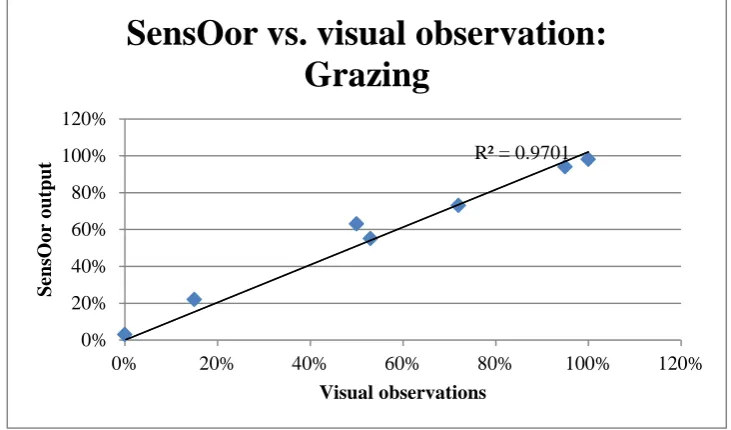
All observations were entered in Excel and linked with the corresponding output from SensOor. This generated a scatter plot which shows the similarities between the visual observations and the detected behaviour by SensOor. The scatter plot of the grazing behaviour is shown in Figure 11.
Figure 11. Scatter plot of SensOor output and visual observations of the grazing behaviour of 6 different cows.
The trendline and its R² (0.97) in Figure 11 indicate that the visual observations have a strong correspondence with the output from SensOor. When in the field the cows were observed as grazing,
R² = 0.9701
0% 20% 40% 60% 80% 100% 120%
0% 20% 40% 60% 80% 100% 120%
Se
ns
O
o
r o
ut
put
Visual observations
[image:26.595.114.480.471.686.2]27 SensOor detected this activity as eating. However, to assess whether there exists a significant resemblance between the observations and SensOor, statistical tests are necessary. Therefore a 2-sided paired t-test was performed using SPSS. The output is shown in Table 8 and 9.
Table 8. [Output SPSS - Paired Samples t-test: Correlation] Correlations between the observations and output SensOor.
Correlation (r) Sig. (p)
Pair 1 Grazing Observed Grazing SensOor
0.99 0.00
Pair 2 Ruminating Observed Ruminating SensOor
0.77 0.05
Pair 3 Resting Observed Resting SensOor
0.94 0.00
Pair 4 Active Observed Active SensOor
0.50 0.25
A positive correlation exists between the observed and detected activities of grazing, ruminating and resting (p ≤ 0.05, Table 8). For the behaviour ‘Active’ this positive correlation was not significant (p > 0.05). A significant positive correlation means that the two variables are associated with one another. When for example the variable ‘Grazing Observed’ has a high value, the variable ‘Grazing Observed’ will also have a high value.
Table 9. [Output SPSS - Paired Samples t-test] Comparison of observed behaviour to detected behaviour by SensOor.
Mean (%) Std. Error Mean t Df Sig. (2-tailed) Pair 1 Grazing Observed
Grazing SensOor
-3.3 2.0 -1.7 6 0.15
Pair 2 Ruminating Observed Ruminating SensOor
1.1 5.4 0.2 6 0.84
Pair 3 Resting Observed Resting SensOor
5.7 4.3 1.3 6 0.24
Pair 4 Active Observed Active SensOor
-3.7 2.4 -1.5 6 0.18
The paired samples t-test tests whether the difference between the paired variables is significantly different. For all 4 activities the differences between observation and SensOor output were not significantly different (p > 0.05, Table 9). Therefore the observations in the field and the detection output of SensOor are well comparable. From this we can conclude that the monitoring system SensOor presents a reliable image of the behaviour of cows under grazing conditions. Especially regarding the connection between eating and grazing: when SensOor detects the behaviour ‘eating’ when the cow is on pasture, it is certain that the cow is grazing.
3.3. Dual-purpose cows & grazing
It was confirmed that SensOor is reliable under grazing conditions. To assess a difference in behaviour between Holstein Friesian (HF) and Dutch Friesian (DF) cows their SensOor output was collected and compared.
[image:27.595.164.431.162.282.2] [image:27.595.66.515.403.512.2]28 need less concentrates per kg milk compared to the HF cows. This is shown by calculating the amount of concentrates that the cows need to produce 1 kg of milk.
Table 10. Average information on the 10 selected cows.
Holstein Friesian Dutch Friesian Difference
Lactation number 4 4 0
Milk yield (kg/day) 30,6 22,8 -7,8
Concentrates (kg/day) 5,2 2,3 -2,9
Concentrates per kg milk (kg) 0,17 0,10 -0,07
Grazing behaviour: differences between breeds
The behaviour in percentages of the cows during 7 days (May 9th – 15th) was gathered from the SensOor web application and entered in Excel. An average of these 7 days for each behaviour for each cow was obtained. For example, on average HF94 spent 23.9% on eating, 39.4% on ruminating, 30.9% on resting and 6% on activity during the 7 studied days. In the same way an average of the behaviour of the other cows was obtained using Excel.
Using SPSS, an independent samples t-test was executed. The 4 test variables were the 4 different behaviours in percentages and the grouping variable was the breed (HF or DF). The output is shown in Table 11.
Table 11. [Output SPSS - independent samples t-test] Comparison of the behaviour of 5 HF and DF cows during 1 week.
Breed Mean (%) Std. Error Mean t df Sig. (2-tailed) Eating HF
DF
24.1 23.5
2.2 2.9
0.17 8 0.87
Ruminating HF DF
38.6 36.7
1.6 1.9
0.79 8 0.45
Resting HF DF
29.0 31.4
2.3 1.9
-0.80 8 0.45
Active HF DF
8.4 8.8
1.8 1.4
-0.17 8 0.87
Equal variances were assumed. The output of the test shows that there are no significant differences between the eating, ruminating, resting and activity behaviour of the cows between breeds during 1 week.
Behaviour study during daytime grazing hours
[image:28.595.99.501.398.509.2]29
Table 12. [Output SPSS - independent samples t-test] Comparison of the grazing behaviour of 5 HF and DF cows during 7 hours of pasture on May 12th.
Breed Mean (%) Std. Error Mean t df Sig. (2-tailed) Grazing HF
DF
33.5 42.1
2.2 2.1
-2.80 8 0.02
Ruminating HF DF
32.2 26.1
1.3 2.0
2.51 8 0.04
Resting HF DF
24.5 23.1
3.3 3.4
0.29 8 0.78
Active HF DF
10.0 8.8
2.4 1.5
0.42 8 0.69
As a result, for May 9th, 10th and 11th, no significant difference in behaviour between the HF cows and the DF cows was found during their time on pasture. The mean differences between the behaviour percentages of the breeds were very small or not significant enough.
For the days May 12th and 13th the percentage of grazing behaviour of the DF cows was significantly increased (12th: 42.1%, 13th: 45.3%) compared to the HF cows (12th: 33.5%, 13th: 34.9%). Additionally, on May 12th the rumination behaviour of the DF cows was decreased (26.1%) compared to the HF cows (32.2%). On May 13th there was no difference in rumination between the breeds.
In Figure 12 the behaviour of the animals on pasture is shown in percentages. During the five days their behaviour demonstrates differences.
[image:29.595.100.495.109.218.2]
Figure 12: Average activities of the 5 HF cows and 5 DF cows during the week.
When grazing behaviour was increased, the cows spent less time on resting. This can be explained by the fact that when cows graze, they walk or stand and are not lying down, which would be registered as ‘resting’. The behaviour ‘active’ stays stable over the week.
The most striking difference in the behaviour of the cows during this week is that the grazing behaviour of the DF cows increased from May 10th, while the grazing behaviour of the HF cows
0.00 10.00 20.00 30.00 40.00 50.00 60.00
May 9th May 10th May 11th May 12th May 13th
Grazing behaviour
Grazing HF
Grazing DF
Ruminating HF
Ruminating DF
Resting HF
Resting DF
Active HF
[image:29.595.71.524.407.649.2]30 decreased after May 11th. An explanation for this increased grazing behaviour of the DF cows is difficult to find. The cows were on the same two parcels (2 and 4) for all five days, although they probably received access to new parts of pasture each 2 days.
[image:30.595.67.527.284.600.2]The weather conditions may have played a role, which is why the weather of these days are shown in Figure 13, together with the grazing behaviours of both breeds. Throughout the week the humidity of the air increased (from 50% to 72%), while there was a steady decrease in temperature (from 19.9 °C to 11.8 °C) . May 10th and 11th had less sunshine (6.5 and 9.2 hours) compared to the other days, which were extremely sunny (around 14 hours sunshine). To assess the effect of temperature and humidity on the grazing behaviour of cows, the temperature humidity index (THI) was calculated using the method of Charlton et al. (2011). According to Ehrenreich and Bjugstad (1966) the time spent on grazing by beef cattle decreases when the THI exceeds 60. When the THI is between 65 and 67, the average time less spent on grazing is 0.25 hours, between 73 and 75 this is 0.84 hours. According to Ravagnolo and Misztal (2000) heat stress in cattle occurs when THI exceeds 72.
Figure 13. Climatic conditions and the grazing behaviour of the studied cows.
During the week relative humidity increased, while temperature decreased. This resulted in a constant THI during the first 4 days, which was around 72 (range: 70 - 73). Therefore it is possible that during those days the cows suffered from heat stress which might have reduced their grazing time. The average grazing behaviour of the HF cows decreased during the week. In contrast, the grazing time of the DF did increase from May 10th. This suggests that the HF cows did suffer from heat stress whereas the DF cows are less susceptible to heat stress. This agrees with the findings of Sharma et al. (1983) who states that smaller cows are less affected by heat stress than larger breeds such as the Holstein Friesian. 0 10 20 30 40 50 60 70 80 0 10 20 30 40 50 60
9-5-2016 10-5-2016 11-5-2016 12-5-2016 13-5-2016
W ea the r c o ndi to ins P ercen ta g e o f t im e sp en t o n g ra zi n g
Grazing behaviour and climatic conditions
Grazing HF (%) Grazing DF (%) Sunshine (hours)