RIT Scholar Works
Theses Thesis/Dissertation Collections
2004
Process evaluation
Claudia V. Guerrero
Follow this and additional works at:http://scholarworks.rit.edu/theses
This Thesis is brought to you for free and open access by the Thesis/Dissertation Collections at RIT Scholar Works. It has been accepted for inclusion in Theses by an authorized administrator of RIT Scholar Works. For more information, please [email protected].
Recommended Citation
Graduate Studies
M.S. Service Management Presentation of ThesislProject Findings
Name: ClaudiaV.Guerrero SS# Date: 2/25/04
Title of Research: Process Evaluation
Specific Recommendations: (use other side if necessary)
Thesis Committee: (1) JamesW. Jacobs, Ph.D.
(2) Richard Morales, Ph.D.
OR (3)
Faculty Advisor:
Number of Credits Approved: _ _-..:4 _
~!';I
f/(}r
Date Committee Chairperson's Signature
£}:zS(,zCOi
Date Committee Signature
(Chairperson)
Note: This form will not be signed by the Department Chairperson until all corrections, as suggested in the specific recommendations (above) are completed.
cc. Department Student Record File - Original
Graduate Studies
M.S. Service Management
Statement Granting or Denying Permission to Reproduce Thesis/Graduate Project
The Author of a thesis or project should complete one of the following statements and include this statement as the page following the title page.
Title of Thesis/project: Process Evaluation
I, Claudia Guerrero e d e n y ) pennission to the Wallace
Memorial Library ofRI.T., to reproduce the document titled above in whole or part.
Any reproduction will not be for commercial use or profit.
OR
I, ,prefer to be contacted each time a request
for reproduction is made. I can be reached at the following address:
Date
#1
FORMK
ChapterI
Introduction
Theglobaleconomy has gonethroughverytoughtimes duringthelastthreeyears.
TheUSstock markethasexperienced greatdisappointments. Corporations thatwere
verysolid andstablehavereportedbiglossesandmanyhavegoneinto bankruptcy.
Dueto this situation,meeting quarterlymarket expectations andimproving
profitability havebecomethegreatest challengeformanycompanies.Inthiseffort, it
also becamecrucialtodefinea clearstrategytocompete in themarketplace,involving
actions toconfrontbudgetcutbacks.
One oftheindustriesmorewidelyaffectedis the UStelecommunicationindustry.
AccordingtotheTelecommunications Market Reviewand Forecast(2001),since1994,
everyyearbroughta milestone developmentfavoringtheexpansion ofthisindustry
whileurging serviceproviderstomake enormousinvestmentsin their technological
infrastructure. After experiencingsix years ofdrivingtop-linegrowth,thedefining
trend inU.S. telecommunicationsduringtheyears 2001and2002wasthesharpdropin
equipmentspending
-adecrease of24%.Even thoughit isencouragingtoknow that
theU.S. telecommunicationmarketisstartingtoreboundduringyear2003,it is still a
challengetokeepupwithrevenuetargets and cost reductionobjectives.
Thisresearch willfocusona specific scenario within acompanythathas suffered
from thetelecomindustry downturn,TECHCorporation (TECH).TECH isdedicatedto
thedesignanddelivery ofsolutionsthathelpbuild and maintainreliableand
beensuccessful atofferinggreat valuetocustomers in termsofqualityproducts and
expertise.
TECH has laid out arestructuringplan andhastakenimportantstepsforits
implementation. However, inthiscourseofaction, ithasalso establishedmany
bureaucraticmeasurestoassurepositive results out ofeverytransaction.Thisdirectly
affects everyprocessthatinvolvesfinancialdecision-making.TECH is very focusedon
financialresultswhileoverlookingother aspectsthatmay beof equalimportancetoits
mainobjective: generaterevenue quickly. Processeshave becomehighlycentralized
andtimeconsuming,sincecompanyrules stipulatethatseveralhierarchylevelsneedto
providefinancial approvalsforsimpleday-to-dayactivities.
AccordingtoWomakandJones(1996), leanthinkingprovides awaytodomore
withfewerresources,while stillprovidingcustomersexactlywhattheywantEvery
organization needstostudyindetaileach ofitsdifferentprocesses, frombeginningto
end, andthink"lean"aboutthese. TECHisnot an exceptionamongthesecompanies. It
isvitalfor TECHtoinvestthe timeand resources neededtoformallydefinekey
operationalactivities anddevelopmethodstoimprovetheway theseactivitiesare
carried outEquallyimportantis tofindwaysto operate moreefficiently,improve
qualityand reduce organizationalproblems.Oneprocess worthevaluatingatTECH,is
thepreparationof quotesforstandardhardwareand software.Manybureaucratic
controls generatedelaysinrespondingto thesecustomer'ssimplerequests, resulting
TECH's customersmayrequest eitheraquotethat involveshighcustomizationand
differentservices,likeinstallationandengineering,or a simple quotethatdoesnot
require servicesor customization ofanykind.Today, bothtypesof quotes are prepared
usingthesame process withtheonlydifferencethatwhen standardhardwareand
softwareisquoted,theServices Departmentisnotinvolved intheprocess.Some
non-valueaddedactions that takeplaceduringtheprocesstoquote standard hardwareand
software arethateventhough thesehavecustomaryprices anddiscounts, it is
mandatoryfortheProduct Managertoprovide price anddiscountsinorderto seek
approvalfrom Business ManagementandtheFinancialOrganization.Also, Terms &
Conditionsarestandard,but it is mandatory for aContract Managertosendthese to
theSalesExecutive everytimea quote needstobe delivered.
Animportantobservationisthat it iscommonforcommunication service providers
tocontractbigprojectstogrowtheirnetworkaccordingto themarket'sdemands. These
projectsare of significant size andusuallyrequire alotof customization.Ontheother
hand, requestsforstandard hardwareand software areusuallyneeded tocompletethe
bigprojectsbeingimplemented atthemoment ortosolve a problemthatisaffectingthe
performance oftheirnetworkWithfrequency, small quotes are much more urgentthan
theonesthatarehighlycustomized.
Problem Statement
Theprocess implementedtodaytoputtogethera quoteforstandardmaterial goes
throughvarious stepsthatdonot add valuetotheend result,
demanding
thedoesnotallowtheSales Teamstosubmitverysimple quotesto thecustomerinatimely
manner.
PurposeStatement
Themainpurposeofthisprojectistomake management aware of thebenefitsin
cost reduction andincreased customer satisfaction ofputtinginplace a new processto
preparequotes forstandardhardwareandsoftware. Amore specific objective ofthis
projectis toobtainmanagementsupporttodifferentiatequotepreparationprocessesfor
standard solutionsandcustomized solutions.Concurrently,other questionstobe
addressed are:
1. Whatarethedifferenttypesof proposals atTECH?
2. Whatisthecurrent process used atTECHCorporationtocreate quotesfor
standardhardwareandsoftware?
3. Who isinvolved in thisprocess?
4. Whatisthetimeframeto respondtocustomer's requestsforquotesforstandard
hardwareand software?
5. Whatpercentage oftheproposalsprocessed atTECHare quotesforstandard
hardwareand software?
6. What isthesystemused atTECH tocreateproposals, how isitused and who
usesit?
Methodology
Thisprojectwillreviewtheprocess used atTECHCorporationtoprepareallthe
intheLatinAmericanregion,fromJanuary2003tillOctober 2003. Thesequote
represent32% of allthequotessubmittedto thiscustomerduringthisperiod oftime.
Afterthisprocessis evaluated, are-engineered one willbesuggested.
Significance
Thisprojectwillfocusontheevaluation ofthecurrent processforthepreparationof
proposalsforstandardhardwareandsoftwareandtherecommendationof a new
processtoquotethesesolutions.Therecommended processisexpectedtohaveshort
range andlong-rangepositive consequencesfortheorganization.
Short Range Consequences
(a)Reducethecycletime toprepare quotesforstandard &customized solutions
(b)Eliminatenone-value addedtasks
(c) Reduceresources requirements
(d)IncreasetheefficiencyoftheBids & Proposals Team
LongRange Consequences
(a)Reduceoperationalcosts
(b)Increasecustomer satisfaction
(c) Delivera standardizeformatforproposals
(d)Acceleraterevenue recognition
(e) Increasetheaccuracyofhighlycustomizedproposals
Limitations
Anewprocesstoquote standard hardwareand software requires management
preparation system.Aswell,bureaucracy,whichisintended tocontroltheentire
business;itmay be difficulttoobtainFinancial Managementsupportfor thiseffort
Summary
Thisproject willevaluatetheprocessusedtodaytoputtogethera quotefor
none-customized materialatTECHCorporation.Inthe opinion ofDrake(2002), thereal
challengefacedbymanagementis todeterminewhere, andhow,theenterprisehascost
leaks andfindcreativewaystoendthesewithoutcompromisingtheperformance ofthe
basic operations. Guidedbythisstatement,a re-engineered process willbe suggestedto
increase theefficiencywhenpreparingthesequotes. Theresearch willdetailthe
methodologyused toanalyzethecurrent process and recommendations willbeshared
afterconsideringthe findings.
Thefollowingchapter willfocusonthepreparation of sales proposalsoffering
details regarding structure, metrics,technologyand proposalmanagement.Insights
fromrelevantarticles,white papers andbookson proposalpreparation,process
improvementandcostreductionefforts willbe includedtoprovide abetterexplanation
onthesubject.The literaturefound onthis topicmainlyrefersto the term"proposal".
Duringthecourse ofthisstudy,thewords"quote", "bid"
and"proposal"maybeused
interchangeablyand are all relatedto ihepurchase of aproduct.Inaddition,subsequent
chapters willidentifythecurrent proposalprocess, demonstrateissueswiththat
DefinitionofTerms
Inordertoassuretheunderstandingofthisresearch,adefinitionoftermsisshared
below:
(a) RFQ: Request forquote
(b)B&P: Bids&Proposal Team
(c) CaptureTeam: Allemployeesinvolved inthequote preparatcion process
(d)PM: ProposalManager
(e) PH:Product House
(f) CM: ContractManagement
(g)BM: Business Management
(h)FO: Finance Organization
(i) COR: Standsfor CustomerOpportunityRequest. It isan electronicformused to
registerthecustomer'srequest andtostarttheproposal production process.
(j) KOcall: Kick-Offcall.Conferencecall scheduledbythePMtoget the capture
team togetherand starttheprocess.
(k)ProposalPackage: Electronic foldercreated ontheCORtogather allthe
documentsthatwillbe deliveredwithintheproposal.
(1) StandardHardwareandSoftware: Nocustomizationisrequired.
(m) StandardPrices,Discounts andPayment Terms &Conditions: Prices,
DiscountsandPayment Terms&Conditions thathavebeenpreviouslyagreedtowith a
(n)Value Stream: Allactionsrequired tobringa good oraservicefromconceptto
design, fromordertakingto delivery, andfromraw materialsto afinishedproductto
thecustomer's hands.
ChapterII
LiteratureReview
Introduction
Salesquotesand/or proposals are a powerfulinstrumentused byvendors to
position their product and serviceofferings, attemptingtomeet customer needs and
win newbusiness. Fieldprofessionals agreethatthereis anever-increasing levelof
sophistication andqualityexpectedbycustomersincompetitive sales proposals.Even
thoughcompanies aremorethenever pressuredtopresenthighqualityproposals at
theleastexpense, this achievementdependsonhavingtheneeded resourcesinplace.
Thischapter examines thefollowing;
(a)Proposal Development
(b)ProposalManagement
(c) Proposal Structure
(d)RFQsVs.RFPs
(e) Proposal Metrics
(f) ProposalCostand TimeCycleReduction
(g)The RoleofTechnologyinProposalDevelopment
(h)Creatinga LeanProcess
ProposalDevelopment
There isno standardwaytoputtogethera salesproposal. Dependingonthe
customer's requestfora given project andthecomplexityoftheexpectedresponse, a
Per Kelman(2000),whois involvedinproposalpublishingmanagement andtechnical
communicationsdevelopment,"ona smallproposal,one skilled production person
may beenoughforthejob", (p.23)
Ontheotherhand,Kelman(2000)also points outthatalargeproposalwill most
likelyinvolve a completeteam of professionalsdedicatedto theeffort,whereproducing
a single component oftheoverallproposalmaybeafull-time job forone person.As an
example, Dickson(2001)sharesthefollowingdevelopmentcycle of a given proposal:
(a) RFPorRFQisreleased.
(b)Vendor decidestobid forthebusiness or notIf thevendordecidesnottobid,
thecycle ends. If it decides thatthebusiness shouldbepursued,thenext stagesmay
follow.
(c) KickoffMeeting- It ismeanttointroduce the
team,sharethe scope ofthe
proposal,setthescheduleand agree onthestrategytofollow.
(d)Draft ProductionoftheProposal
(e)Formal review ofthe entire proposaltoconfirm thatthesolution meetsthe
customer's requirement
(f) Reviewoftheproposaldocument for finalcorrections.
(g)Formattheproposal's presentationaccordingto thecustomer's guidelines.
(h) Delivery oftheproposal.
Proposal Management
Onceavendordecidestobidfora business,theProposalManagementteam takes
accuracy. The Proposal Managerisactivelyinvolved in thecreationofa proposal
strategy, pricingand teaming; makingsurethatalltheresources needed are alignedfor
thedevelopmentoftheproposal andthatatimelyresponseisgiventoRFPsand RFQs.
It isalsotheproposal manager'sresponsibilitytolayouta schedule oftheproposal
developmentprocess, assigningactionitems andduedatesto all ofthose involvedin
theprocess. A very importanttaskistomake surethatallinputs aredeliveredas
scheduled andthattheseareincompliance withthecustomer'srequest andin
accordanceto thesalestrategyoriginallydefined.
Oneofthetoolsused tomeasure proposalqualitybefore it issubmittedtothe
customeris theuse of red reviewteams.Thered reviewteamisagroup ofpeople,
usuallynotcompanyemployees, selectedtoproof readtheentire proposaltoassure
that thereare noinconsistencies. Itisrecommendedtoperformshortreviewsearlyin
theproposalwritingprocess toconfirm thattheinitialstructure and strategyare
properly designed. AssuggestedbyHerdon(2000), afinalredteam revision should
take placetovalidatetheproposal'scompliance, completeness, responsiveness,
presentationandsellingapproach.Eventhough thesmallest proposals canbenefit from
simplereviews,redteamsare mostlikelytoplaya role whendealingwithhigh
complex proposals.
ProposalStructure
Thepresentationand structure of a sales proposalplayavery importantroleinthe
customer'sdecision-makingprocess. Dueto thefactthataproposalisintendedto
wantThe formatandspecificsofaproposalistotallydependentonthecustomer's
requestAproposal canbeasbriefas amemo;othersmayextendtoseveralhundred
pages andhavenumerous sections. Sincethereis nostandardwaytopresent a proposal
itiscommontofinddifferentrecommendationsregardingtheproperstructure.
Market!(2001)suggeststhefollowingbasic structure whentheorganization
requestingtheproposaldoesnot provide a guideline:
(a)Summaryprovidingabriefstatement abouttheproposedsolution,company's
credentials, budgetand schedule.
(b)Introductionorientingthereader,providing adescriptionofthepurpose ofthe
proposal, background detailsand thescope ofthe solution proposed.
(c) Program describingwhatisproposed anditsdelivery,andwhy it isthebest
option forthe customer.Thissection should alsoincludeadetailed listof who willbe
providingwhatinformationor resources duringtheproject's process.
(d)Qualifications/Experience oftheproject staff andthecompany'shistoryand
experienceasitrelatesto theproject
(e)Budget,whichgreatlydependson the projectAgoods proposaltypically
providesjustthebottom linecostfor thecustomer.
(f) Appendicesincludingwork/ taskschedules,testimonials, references,
graphs/charts and evaluation methods.
Anotherrecommendedproposal structureaccordingtoHickey(2001),CEOofTIU,
abusinessandfinance-consultingfirm:
(b)Agendaincludingstructure,agreement of agenda and addition of newtopics
(c)
Company
profilewithabriefoutline ofhistory, skills and client references(d)Overviewofthebasicrequirements and adiscussionofobjectives
(e) Proposed solutionexplaininghowthevendorisplanningtomeetthoseneeds
and specificallywhat willbedone
(f) Benefits oftheproposed solution,overview ofthebenefits oftheproposed
solution andhow thiswill add valueto thecompany
(g)Costsassociated withtheproposed solution
(h)Summary ofthebenefitsofthesolution.
Theabove guidelines canbeusefultocreate a detailedproposal,butsmaller
proposalsmayrequire a simpler structure.Thefollowingsectionsmaybeenoughfor
thesestraightforward cases: (a)Cover letter
(b)Descriptionoftheoffer (c) Price Section
(d)Terms& Conditions
RFQs Vs.RFPs
Someprofessionalsinthefieldunderstandthatthereare cleardifferences betweena
requestforquote(RFQ)and arequestforproposal(RFP).InDickson's (2001)opinion, a RFQis usuallyusedtopurchase off-the-shelfproductsmeaningitemsthatarevery
standard andfrequentlyavailable throughmanysources. Theseproducts aremuch
These bids detailtheitemofferedalongwithitsprice.Ontheotherhand, aRPF
suggests thesubmission of alargeproposal,whichusuallyrequiresafulldescriptionof
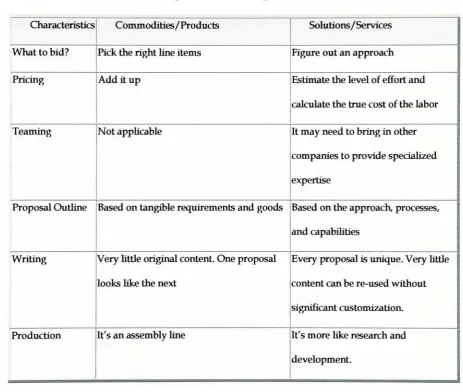
theproposed solution.Thefollowingisa templateprovidedbyDickson (2001)that
showsthedifferencesbetweencreatingabid tooffer acommodityproductandcreating
a proposalto offer a solution or specific services: (p. 1)
Characteristics Commodities/Products Solutions/Services
Whattobid? Picktherightlineitems Figureout an approach
Pricing Additup Estimatethelevelof effort and
calculatethetruecost ofthelabor
Teaming Notapplicable It mayneedtobringinother
companiestoprovide specialized
expertise
ProposalOutline Basedontangiblerequirements andgoods Basedonthe approachprocesses,
andcapabilities
Writing Verylittleoriginalcontent.Oneproposal
lookslikethenext
Everyproposalisunique.Verylittle
contentcanbere-usedwithout
significant customization
Production It'sanassembly line It'smorelikeresearchand
development.
RFQsarebasicallyfocused on price andRFPs involveamore complicated purchase
[image:17.555.45.509.191.583.2]AcustomermayissueanRFQwhenthere isa specificneed,have decidedtomakea
purchaseand havethebudgettodoso. Otherreasonsfora customertodo RFQsareto
discoverpricingwithoutthe intenttomake a purchase ortojustifyusinga preferred
vendor. Whenapurchasingdecisionisnot yetmade,a coverlettershallaccompanythe
price detailemphasizingthecommitmenttofulfill thecustomer's need.ARFQ
responseisalso anopportunitytodemonstratevalueforthecustomer.
RFPsareusuallyissuedwhenthecustomeris interested inalargerprojectanditis
frequently sent outtoseveral vendors. WhenrespondingaRFP,it isveryimportant to
includeallthedetailscalledforandtofollow thecustomer's guidelinesfor its
presentation and submission.
Proposal Metrics
Organizationsmakeeveryefforttoproducewinningproposals,while alsolooking
to trim downtheoperatingexpensesthatare requiredtoproducethem. Inorderto
achieve this,it isimportant toconstantlyobtain, maintain, and analyze accurate and
meaningfulmetrics.Ametricisa standardmeasuretoassesstheperformance of a
particulararea.AsexpressedbyWesner(1995), metrics shouldbe:
(a)Specific: Targetedto theareathat isbeingmeasured.
(b)Measurable:Able tocollect accurate and completedata.
(c) Actionable:Easyto understandinorderto takeaction whenneeded.
(d)Relevant Onlymeasure whatisuseful.
(e) Timely: Abletoobtainthedatawhen needed.
The definitionofmetricsvariesfromcompanytocompany.When referringto
measuringtheperformanceof a proposaldevelopmentprocess,theproper metrics
should be carefullyselected.Theproposal managementteamusuallykeepstrackof
proposal statisticstomeasuretheperformance oftheteamandtheoverall proposal
preparation process.Toillustrate thedifferentmetricsthatmay beusedtomeasurethis
process, an exampleissharedbelow:
NCR isacompanythatprovidesRelationship Technologysolutionsforretail,
financial, communications, travelandinsurancemarkets. Messin(2000) statesthat
Metrics atNCRare usedto measuretheProposal Center'sperformance andtolevel
workload.Thereareusually 20or30active proposals at atime. Thesemetrics are:
1. Proposalqualitybybusinessunit
2. Proposalqualitybysolution(product/service)
3. Duration
4. Start date
5. End date
6. Staffhours
7. WinRate
8. Sizeof effort(derived fromstaffhours)
9. Dollarvalue
10.Numberof copies
11. Pagecount
13. Customertimesaved
14.Customer propensitytoreturn
15.Customercomments
Regardingmetricstoevaluateproposals, FreemanandFreeman(2000),suggestthe
use ofthefollowingMetricsToolboxinordertoassurethata proposalislikelytowin
or atleastassurethatthemessageisclearlycommunicated. Theseguidelines are
probablymost appropriatefor very largeproposal effortsinvery largecompanies
involving manypeople on a proposalteam. But,whengettingto thebasics, it mayhelp
evaluatethepotential ofanyproposal,regardless ofitslengthor complexity.
This Metrics Toolboxconsists of a quantitativeratingsystemthatputstogethera
proposal evaluation process. Thissystemhelpssavetimeand moneysince subject
matter expertsfocus ontheirarea of expertise anditstreamlinesthereview process. It
evaluates a proposal on several categoriesbyusinga predefined score sheet and by
ratingeach category. Categoriessuggestedfora Metrics Toolboxsystem are:
(a) Basics: Grammar,Spelling&Punctuationreview
(b)Knowledgeabout whatthecustomer wants and needs
(c) WritingStyle
(d)Proposal Organization
(e) Visual Presentation/ Balance
(f) Language Tone/ Professional,Competent, Non-Arrogant
(g)CredibilityandCompleteness
(i) Cost(Reasonable, BasisandClarity)
(j) Risk/Canyoudeliverwhat you promise
Therearemanywaystoreview or rate a proposal. Proposalreviewers are often
focusedontechnicalaccuracyand one-on-one complianceitembutonlylooking at
these two thingswill notnecessarilyhelpimprove thereviewprocess or evenincrease
theprobabilitiesofwinningabid. Giventhateveryproposalisstructureddifferently
anditrespondstodifferentneeds, eachcompanyor proposal managementgroup
definesits ownstrategytoreview andimprove itsproposaldevelopmentprocess.
LockheedMartin FederalSystems(LMFS), Owego,isamanufacturingfacility (IBM
Electronic DefenseSystems)foundedin1956,where aqualityimprovementprogram
was implemented inearly1995.As describedbySalamida (2000), thiseffort was
extended toalldepartments, includingtheProposal Process Management(PPM). Prior
to 1995,thisteam poorly documented itsprocesses, proposal process control was
inconsistentand performed no measurementtracking.Inordertostartmeasuringthe
efficiencyoftheproposalprocess, LMFStook thefollowingsteps:
1) EstablishedaProductionProcessQualityImprovement Team (QIT)to
investigateproposal production process problems and recommendsolutions.
2) Keyissues &Responsibilitieswheredefined:
o Inconsistent textstylesand formats(Responsible: ProposalCoordination)
o Excessivepreparationtime(Responsible: ProposalCoordination)
o Lostofback levelgraphics(Responsible: ArtCoordination)
o Highamountof"throw-away"graphics(Responsible:ArtCoordination)
3)
Existing
processwasdocumented4) Measurementpoints and metrics goals wheredefined,mainly focusedon
reducing cycletimesandloweringcosts
5) Process improvementsweredefinedprimarilybased on clearerdefinitionof
responsibilities.Keyinitiatives:
o Developa teamapproachtoproduction management
o Defineandimplementtwonew positions ontheproductionteam
o Redefinetheexistingproposal coordination position
6) Process Improvement Tested:Testswhere made ona pilot proposal.
7) Datawas collected.Whentheproposal wasready forsubmission,thefollowing
datawas gathered:
o Feedbackfrom lessons learnedmeetings
o Arttrackingspreadsheets
o Word processingand graphics support vendorinvoiceswithdetailsof
hoursand dollarschargedforeach proposal task
o Logs, reports,orinvoicesrelatedto theproduction, likecolorcopies,
bindersand proposalteamlabor.
8) Dataanalysis anditerativeprocessimprovementtookplace. Datawas analyzed
and compared withthepredefined goals. Theteamdiscoveredthat themetrics could
9) Anongoingprocessimprovementeffort started out withtheimplementationof
severalqualityinitiatives:
o Internalcustomer satisfaction surveysthataddressedtheefficiencyof
processimplementation, issueresolution,innovationsolutions,training, general
processknowledgeand schedule management
o Lessons Learnedmeetingstogetinputsonprocesses,facilities andtools.
o Action Teamstofocuson specific areas of process concern orissues
identified through thesatisfaction surveys andthelessons learnedmeetings.
o Continuousmeasurements collectionfocusingonthethings that impact
proposal costslikecost perdeliveredpage againsttotalproductioncost, cost per
graphic generated, amongothers.
Anotherexample of the metricsthatmay beused toevaluatetheprocessto prepare
a sales proposalisprovided bySBCCommunications, atelecommunications service
providerin theUnitedStates. Per Green's(2000)article onthissubject, themetrics used
atSBCincluderevenuetoexpenseratios,customer satisfactionresults, thenumber of hours itsavesthesalesteamsandthewinrates.SBC'sproposal center uses adatabase
that trackseveryprojectincludingdataregardingtimespentbytheteam,revenue
impact to thecompany, thestatusofeach proposal(wonorlost)and otherdetails.
ProposalCostAndTime CycleReduction
Asstated above,proposalmetrics are often usedtomeasurethecostsincurredwhen
cycleoftheproposalpreparationprocess. Thesetipsarearesult oftheexperience of
several proposal managers andconsultants.
o Usepeoplethatare qualifiedforthejob.
o Keepthe teamsmall.
o Providetrainingforthestaff. o Reducerotation ofthestaff.
o
Keep
theschedulethroughdailyfollowupmeetings. o Be firmwith reviewdates.o Answerall questionsinanRFP, beforeanyreviewisdone.
o Keepfiles updatedanddocument anyperformance problem
o Establisha specificformatand tailorit tomeetthe RFPrequirements
o Keepthecompany's experience and profile updated.
o Definetheproposaltargets andbudget foreverythingneededtowin
o Activelyinvolvea proposal advisor
o UsethehelpofProposalCenters,whenneeded.
o Keepbackupsofallinputsand24-hourssecurityprograms.
o Follow thestrategy originallydefinedwiththe team.
Role OfTechnologyIn ProposalDevelopment
Ingeneralterms,thebasicideaofusingtechnologytoautomatethemanagementof
data istriggeredbytheinterest inreducingtimecycles andlaborcosts. Thesame
objecitves alsodrivetheuse oftechnologyintheproposaldevelopmentprocess.
today.As Wilson(2001) states, "specialized,computer-based proposal automation
products werefirstintroducedtothe marketplaceinthelate1980s" (p.67);thesehave
evolvedtovery sophisticatedtools thatareavailabletoday.
Companiesconsumehigh-valueresourcesrespondingtoRFPs. Somereasons are
thattheymightnothavetheadequatequalifications,efforts areduplicated, same
mistakes aremadefailingtoleveragebestpractices and no post-mortem win/loss
evaluationisfollowed. Theproper use oftechnologywould allowforthesecompanies
tohavea central warehouseforcontent and templates, haveaflexibleapplicationfor
qualifyingandexecutingRFPs,definea structured processtostreamline reviews and
approvals and even set alerts and notificationstoacceleratetheprocess.Theuse of
technologyallows proposal managementteams tocontinuouslymeasuretheir
performance and improvebestpractices.
Therearemany softwaretools in the market placethatareaimingto providethe
perfect solutionforcompanies orindividuals toeffectivelyandefficientlyprepare
proposals, regardless oftheindustrythesebelongto. Wilson(2001),who alsoisa
proposal professional atCACIInternationalInc, acompanythatprovidesITand
network solutionsforUS GovernmentAgencies, emphasizesthatproposalautomation
products are not a one sizefitsall solution.Thesetools areveryusefultorespondlarge
complexRFPs,tohelpmakebid-nobiddecisions,to trackandevaluatetheproposal
process,to managetheproposaltextandgraphics moreefficiently,among others.But,
inorderfor anyofthesesoftwareproductstohelpachievethespecific goals setbyan
Theseproducts are notintendedtoreplacetheproposalmanagementteam, butifused
properly,theycan savetime, moneyandthefrustrationassociated with adisorganized
proposaldevelopmenteffort
There aremanyvendors of proposal automationtools. Alotofthesetools arefully
network compatible and web-based solutionsthatcanhelpfacilitatethemanagement
and coordinationofteams,evenif thesearegeographicallyapartNearlyeveryone of
theproductsavailablehasaccess control andsecurityfeatures. Someare considered
mostfavorableinengineeringenvironments and others workbest forcommercial
product sales.
Followingisa shortlistof proposal automation products availablein the
marketplace:
o Virtual ProposalCenter(www.intravation.com)
o Proposal Master/RFPMaster/eProposalMaster (www.santcorp.com)
o Proposal Assembler(www.pragmatech.com)
o Slate(www.sdrc.com/slate)
o ProposalSmartz(www.proposalsmartz.com)
o WinAward(www.acibiz.com)
o Deltek Proposals (www.deltek.com)
o Wind2Award! (www.wind2.com)
Tobetterillustrate the impact that theproper use oftechnologymay haveinthe
proposal preparationprocess, thecase ofL. RobertKimball& Associates Inc isshared
L. RobertKimball& AssociatesInc (Kimball)isafull-service firmestablishedin
Pennsylvaniain1953. This firmoffers servicesin architectural/engineeringbuilding
systems, civil and environmentservices,mappingsciences, telecommunications and
technology, andtransportationservices.
Kimball has alargeproposal operation with a sales teamof10people and a
marketingteam of18. Thesetwogroups worktogether toprepare and submit
proposals. Beforeimplementinganautomated proposalsoftware, themarketingteam
would preparetheproposalusinga word processor andconsultingexistingfilestoget
informationsuch ascompanyhistory,resumes,related experiences,and so on. Someof
the disadvantagesofthisprocess werethattheexistingfilesgotquickly outdated anda
lotoftimewasinvested incompletinggovernmentdocuments liketheSF254andSF
255,whichindicateafirm'spast experiencein thearea relatedto theprojectinhand.
Kimball's Information System department decidedtolookintoproposal automation
softwareinorderto improvetheproposaloperation. They finallydecidedtopurchase
the AwardlCRM's familyof softwarefrom Wind2Software,Inc. Thissoftware offered
thecapabilitytopreparefocused, effective andexquisitely formattedsubmittalsforthe
private sector and evenincludedan optionalSF 254 andSF 255module,whichhad
templatesfora numberofdifferent formats.
Theprocess starts withtheAwardlCRM's Proposal Generatormodule. Theprogram
hasseveral tabsfortheusertoaccesskeysectionslikedcover page andletter,
introduction,projectapproach,schedule, projectorganization, projectexperience,
wordand the softwaredraws information froma databaseclassifiedbysubjectIn this
case, thesoftwarewillbringupa version ofthecompanyhistoryonthespecifiedtopic.
Installingand using AwardlCRMsoftware,hasallowedKimballto decreasethe
cycle timeoftheproposal operationfromthreeorfourdaysto twoorthreehours. The
sales andmarketingteamscan also prepare more comprehensive andfocused proposals
and are abletocarefullytrackeach proposal.Nonetheless,theproposals areuptodate
andhighlyaccuratebecausethemarketingteamis constantly updatingthefilesin
AwardlCRM. Ata rate of5,000proposals peryear,Kimballfoundthat thetimesaving
alonefromtheuse ofthissoftwarehasresulted inahugereductionoflabor hours. It
hasalso allowedthemtoattendmorebusinessopportunities.
Theautomation oftheproposal preparation process aims toincrease theefficiency
andaccuracyofproposals, reduce costs and save time.Companiesthatproperly
implementthesetoolscandelivermorequalityand consistent proposals and are most
likelyto gainimportantfinancial benefits fromthiseffort
Creating aLean Process
Management ismoretheneverchallengedtodelivervaluetoitscustomers. Thefirst
steptoovercomethis challengeis to evaluateits internalprocesses, whilerethinking
valuefromthe
customers'
point of view. In thiseffort, theattemptis toidentifythe
value stream of each process and eliminate wasteinordertoallow a smoothflowof
value-creatingactions with nointerruptions.Leanthinkinglooksintothe
butaddno value atall. AccordingtoWomakandJones (1996),actionsmayfallinto
threedifferentcategories:
1) Actionsthatcreate value perceived bythecustomer
2) Actionsthatdonot create valuebutthatcannotbe currentlyavoided
3) Actions thatdonot create valuebutcanbeavoidedimmediately
Creating
valueisdirectlylinkedto thestagesthatforma value chain. Fitzsmmons&Fitzsmmons (1998),define a value chain as"theactivities,frombeginningtoend,that
are needed toproduce a service,each of whichhasthepotentialtocreate valueforthe
customer"
(p.78). Thereisa physical and a virtual value chain. Thevirtual value chain
isknowntobethe information thatsupportsthephysical elements ofthevaluechain.
Inorderfora processtoflowsmoothlyandforthevirtualvalue chaintocreate real
valueforthecustomer,the informationmustbegathered,processed and made
availabletotherightpeople. Goingthroughthescequence ofthesestages allows
value-addingelements andleanactivitiesto takeplace.AsstatedbyWomakandJones (1996),
"The lean activityis toredefinethework offunctions, departments, andfirmssothey
can make a positive contributiontovaluecreation andto speakto thereal needs of
employees ateverypointalongthe
stream" (p.24).
Leanthinkingmay beapplied toanyprocess, includingtheprocessto prepare
competitive sales proposals.Theinicialapproachtoaleanerprocess startsby
evaluatingwhatis currentlytakingplace,frombeginningto completion,aimingto
identifyanyopportunity toeliminatebackflowsorstoppages,withthefinalobjective of
Summary
Asales proposalisstructured, prepared, reviewed and presenteddependingonthe
customers'
requirementsand purchasingdecision-makingprocess. Itisalsodependant
onthevendor'ssellingstrategy,its nature anditsown goals.Thischapterdiscussedat
lengththe stepsfortheDevelopmentofSalesProposals,structures forsalesproposals,
theperformancemeasurement oftheproposaldevelopmentprocess, theresources
neededtoputtogethera proposal (includingtechnology),thedifferencesbetweena
RFQand aRFP andhowtocreateleanprocesses.
Thenext chapterhasthe objective ofbringingtheconcepts discussedin thissection
toamore specificscenario,goingthroughthemethodologyusedtoevaluate a current
Chapter III
Methods & Procedures
Introduction
This Evaluation Research isadescriptive studythatfocusesontheproposal
preparation process used atTECH Corporationtoquote non-customizedhardwareand
software.Today,TECH Corporationmakes nodifferentiation betweenthepreparation
ofstandardquotes,whichareverysimple and straightforward,andthe preparation of
those thatarehighlycustomized.As sharedinChapterI,apurpose ofthis projectisto
recommend a newleanprocesstoputtogetherthesesimplequotes. Thischapter will
gothroughthemethods andprocedures usedtoevaluatetheprocesscurrentlyinplace,
which willleadto therecommendation of a new one.
Methodology
This studyisbasedontheprocess used toprepare standard quotes fora specific
customer in theLatin Americanregion,onlytakingintoconsiderationtheproposals
submitted fromJanuary2003throughAugust 2003. Itisafactthat the average cycle
timeofthequotesdelivered duringthespecified timeframeis ten(10) calendardays.
Thisaverage willbecompared withthecycletimeexpected afterputtinginplacethe
reengineered processthatwillberecommended in thelastchapter ofthis research.The
processfor preparingcustomized proposals willnotbetakenintoconsiderationduring
this review.
Themethodologyused inthis studyconsists ofthree sections,which aredescribed
DescriptionoftheValueChainoftheexistingprocessforproposalproduction,
detailingthePhysicalandVirtualstages, and thedepartmentsinvolvedalongwiththeir
responsibilitiesthroughoutthe process.
Identificationofthe actionsthatdonotaddvalue,pointingout which resources
arebeingconsumed.
Eliminationoftheactionspreviouslyidentified, offeringan explaination ofthe
reasoning behindtheelimination of each activity.
Inordertoobtainthedata neededtoevaluatethecurrentprocess, interviewswere
performedtoemployees ofthe differentdepartments involved in theprocess. The
participants of suchinterviewsaredetailedbelow:
SalesExecutive
ProposalManager
Product Manager
ContractManager
Business Manager
ChiefFinancialOfficer
i
Aflowchartofthecurrent process willbeevaluatedinordertoidentifytheactivities
thatconsume resourcesbutadd no value.Forthepurpose ofthisevaluation, anactivity
isconsidered toadd no valuetotheprocess,whenitisfeasibletoeliminateitby
properlyusinginformation. Mostlikely, theseactivitiesrequireaminimum ofdecision
makingand areliable forextendingthecycletimeoftheprocessduetowaitingtime in
value addingactions,whichare performedthrough and withinformation. Inaddition,
thefollowingassumptions shallbetakenintothoughtthroughoutthisevaluation:
(a) Prices are standard
(b)Discountsare standard
(c) Terms & Conditionsare standardaccordingtoa General Purchase Agreement
previouslysigned between thecustomer andTECH Corporation
(d)Hardwareand Softwareneed no customization or specific configuration.
(e) No services areincludedinthesequotes
(f) TheChiefFinancial Officerapproves all quotes with standard prices& discounts.
Bias InThisResearch
1. Theaveragetimecyclethatisprovided earlierin thischapter,may include
quotes thatexperienced delays duetoerrorsinpartnumber, containedhardwarenot
yetavailablein themarket,orhardware alreadydiscontinuedandthereforehardto
find in thedatabasesavailable.Thesedifficulties may havedemandedmoretimeand
effort thanusual,directlyimpactingtheaveragetimecycle.To avoidthisbias, the
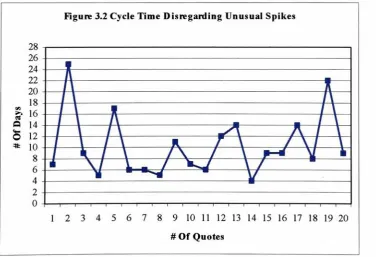
populationof quotesforstandardhardwareand software wasdrawn into agraph, to
clearlyviewtheunusual spikesincycle time.Thethreehighestspikeswere nottaken
intoconsiderationtocalculatetheaveragetimecycle ofthequotes preparedthrough
Figure3.1CycleTime ForStandard QuotePreparation
13%
1 2 3 4 5 6 7 8 9 10 11 12 13 14 15 16 17 18 19 20 21 22 23
#OfQuotes
87%
As shown onFigure3.1,thisevaluation considers87% ofthetotal of quotesfor
standardhardwareand softwarethatwere preparedduringthespecifiedtimeframe.
[image:34.555.40.518.49.299.2]Aftertakingouttheunusualspikes,a view oftheadjusted graphis sharedbelow:
Figure 3.2 Cycle Time DisregardingUnusual Spikes
28 26 24 22 20 18
I
16 P 14 <5 12* 10
8 6 4 2
0 i 1 1 1 1 1 1 1 1 1 1 1 1 1 1 1 1 1 1
1 2 3 4 5 6 7 8 9 10 11 12 13 14 15 16 17 18 19 20
[image:34.555.78.455.400.657.2]2. Datacollectionthroughinterviewsperformedbyphone mightleaveout
important details oftheprocess. Toavoidthisbias,interviewswhere performedto
everyemployeeinvolved inthequote preparationprocess, allowing for its description
tobeas accurate as possible.
Summary
Thischapterdetailedthestepstakentoproperlyassesstheprocessthatisfollowed
todaytoquote standardhardwareand software atTECHCorporation. Inaddition,this
section points outtwoprobablebiasesofthisproject as well astheactionstaken
towards itsavoidance.Thenext chapter will offer a clear explanation onthe
evaluation's outcome. Thefindingsresultedfromthemethodology previously
ChapterIV
Findings
Introduction
Thischapter will discuss atlengththeresultsobtained afterfollowingthe
methodology describedin theprevious section. Thefindingsarethoroughlyanalyzed
partingfrom flowchartsthatareintended toprovide a clear view oftheprocessinplace
toprepare standardquotes.
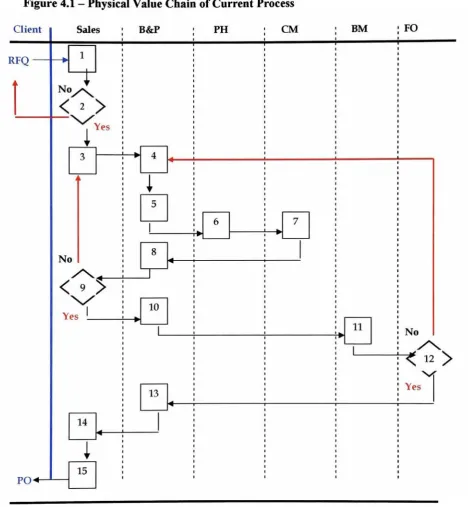
TheflowchartinFigure4.1describesthe PhysicalValue Chainoftheexisting
processforproposalproduction,detailingthedepartmentsinvolved alongwiththeir
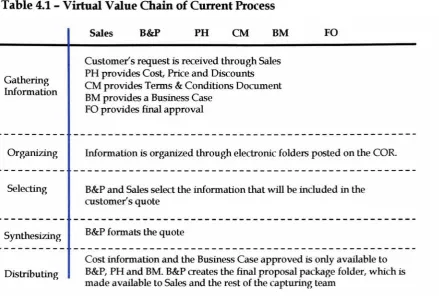
responsibihtiesthroughout the process.Inaddition,theVirtualValue Chainis
describedinTable 4.1.
Physical Value Chain
Thephysical value chainincludesthesequence of actions performedfromthe
momentthe Sales Teamreceives a requestforquote untilthequoteisdeliveredto the
Figure4.1- Physical ValueChain
ofCurrentProcess
Client Sales : B&P : PH : CM BM FO
RFQ
PO*-T
<
^>
-x^.
I
YesNo
Yes
14
I
15
I
10
13
11
No
X
12>
Yes
Inordertoprovide abetterunderstandingoftheflowchartillustratedabove,every
stepalongtheprocessis describedina chronologicalorder:
1. SalesExecutiveconfirmsreceipt ofRFQ.
[image:37.555.45.514.62.570.2]3. Sales Executive fillsout aCORonlineform.
4. Proposal Managerreceives automaticnotificationand schedules a KOCall.
5. Proposal ManagerleadsKOcall and assigns actionitems toeveryparticipant
and agrees onduedates.
6. ProductHousepoststheprice,discountand cost ontheCORonlineform.
7. ContractManagerpostsTerms & Conditions ontheCORonlineform
8. Proposal Managercreates adraftpricedocumentand emailsit toSales.
9. SalesExecutivereviewsthedraftprice and makes sureeverything isaligned
withthecustomer's request.
10. Proposal Managersends approveddrafttoBusiness Management
11. Business Managercreatesthebusinesscase and emailsit to theChiefFinancial
Officer forapproval.
12. The ChiefFinancialOfficerapprovesthebusinesscase and posts approval onthe
CORonlineform.
13. Proposal Managersendsdoes finalformattingto thequoteand creates a
proposalpackage,whichisposted ontheCORonlineform.
14. Sales Executivereceives automatic notificationthat theproposalpackageisready
fordeliveryand proceeds toprint outtheproposal
15. SalesExecutivedeliversthequoteto thecustomer
Thepreparationofa quoteforstandardhardwareandsoftware requiresthe
participationof sixdifferentdepartments,each withclearresponsibilities throughout
1) Sales: The SalesExecutiveisresponsiblefor registeringtheCOR, followingup
withthePM, reviewingthedraftprice anddeliveringto thefinalquotetothecustomer
2) B&P: TheProposal Manager isresponsiblefor scheduling the KOcallthatwill
bringtogetherthe capturingteam. Italso assigns actionitems,followsupwiththePH
and CMto assure ontimedeliveryofinputs, sendsdraftpricetosales and putstogether
thefinalproposal package.
3) PH: The ProductManagerisresponsibleforprovidingstandardprice, discounts
and costs
4) CM: The ContractManagerisresponsibleforprovidingstandardTerms&
Conditions tobeattachedtotheproposal.
5) BM: TheBusiness Managerisresponsiblefor puttingtogethertheBusiness Case
with all requiredfinancial information.
6) FO:The Chief Financial Officer is responsibleforprovidingfinalapprovalforthe
Business Case.
Virtual ValueChain
Thevirtualvalue chaindescribes howinformationisbeingusedtosupportthesteps
Table 4.1- Virtual Value ChainofCurrent Process
Gathering Information
Organizing
Selecting
Synthesizing
Distributing
Sales B&P PH CM BM FO
Customer'srequestisreceivedthroughSales PHprovidesCost,PriceandDiscounts CMprovidesTerms& ConditionsDocument BMprovides aBusinessCase
FOprovidesfinalapproval
Informationisorganizedthroughelectronicfoldersposted ontheCOR.
B&PandSalesselecttheinformationthatwillbeincluded inthe customer's quote
B&Pformatsthequote
CostinformationandtheBusinessCaseapprovedisonlyavailableto B&P, PHandBM.B&Pcreatesthefinalproposal packagefolder,whichis made availabletoSalesandtherest ofthecapturingteam
Thecurrent virtual chain ofthisprocess showsthatalltheinformationneededto
puttogethera responseforthecustomerisnot made availableto theSalesteam. Dueto
thislimited distribution,theowners oftheinformation,liketheProductHouse,
Contract ManagementandBusinessManagement, areforcedtogetinvolved inthe
process regardless oftheirworkloadand/or priorities.
Theactivitiesthatwerefound nottoadd valueto theprocesshave been identified
with boxesin theflowchart illustratedinFigure4.2,bearinginmindthecriteria
Figure4.2-Non-Value Added ActivitiesofCurrentProcess
Client Sales ; B&P PH CM ; BM
j FO
RFQ
<
2>
V,I
YesNo
9 9
Yes'
14
I
PO^-15
4 +
1
10
Q
No
-> 12
Yes
Eachoftheactivitiesidentified inFigure 4.2consume variousresources, whichare
showedbelow. Theselectionofnon-valueaddedactivitiesisbasedonthe
[image:41.555.42.512.104.594.2]neededtoprepareastandardquote, the involvementoffiveotherdepartmentswould
nolonger berequired. Keepingthis inmind, thethinkingbehindtheselection of each
activityisalsoincludedinthefollowingdetail.
Activity# 4& 5- PM
receivesan automatic notification and schedules aKOCall.
PM leadsKOcall and assigns actionitemsto everyparticipantand agrees ondue
dates.
Theobjective of aKick-off Callis toassign actionitems and establishdue dates
foreach teammember. IftheSalesTeamalone can prepare a quoteforstandard
hardware andsoftware, neither an automatic notification nor aKick-off Callisneeded.
Resource Consumed: Proposal Manager'stimeand effort andthe timeofthecapture
team thatisexpected toparticipateinthiscall.
Activity# 6- Product Houseposts
the price,discountand cost ontheCOR
The Product Houseuses adatabasetomake a search of thehardwareand/or
software requestedbythecustomerinorderto obtaincostand price of eachitem. Since
these itemsrequire nocustomization, thecost and priceisnot variable ordependenton
thecustomer'sspecific request.Regardingthediscount, thisisbasedon apercentage
previouslynegotiated withthe customerand approvedbythe ProductHouse. This
activity isnotaddingvaluetotheprocesssincetheinformationoncost,price and
discount ismade availablethroughafixed database, requiringnodecision making from
theProductHouse. Ifthis information ismadeavailableto theSalesTeam,theProduct
House isnolongerrequiredtoparticipatein theprocesstoquote standardhardware
concentratemore onthehighlycustomizedproposals,whichdo demand strategic
decision-making
sincetheseareusuallyverycompetitivebids.Resource Consumed:Product Manager'stimeand effort.
Activity# 7- ContractManager
postsTerms & Conditionsonthe COR
Terms &Conditions have alreadybeenagreedtowiththecustomer underaGeneral
Purchase Agreement(GPA). Itisrequiredthateveryquote or proposaldeliveredto the
customermustreiterate the paymenttermspreviouslyapprovedbybothparties.The
ContractManagerprovidesthe samedocumentevery time,withno changes exceptfor
thename or reference number ofthequote response. Paymenttermsarenotdependent
onthespecific customer request and theContractManagermakes noimmediate
decision regardingthose terms.This documentcaneasily bemade availabletotheSales
Teamwith no need toinvolve aContract Manager. Resource Consumed: Contract
Manager's time and effort
Activity# 8- PMcreates adraftpricedocumentand emailsitto Sales
Themain reasonwhy PMneedstocreate adraftpriceisbecausetheSalesteam has
no accesstopricinginformation. If theSalesTeam had accessto thisinformation,the
PMwould nothavetodedicatetimeand effortto thepreparation of apricefile.
ResourceConsumed: ProposalManager's timeand effort
Activity# 9- SalesExecutivereviewsthedraftprice and makes sure
eveiything is
aligned withthecustomer'srequest
Contraryto theactivitiespreviouslymentioned, thisactivitywasfoundtoadd value
accordancewithher/hisrequest.On theotherhand,ithas beenselectedbecause itonly
takesplacetomakeupfortheflawsofthisprocess. AssharedbytheSalesExecutive
thatwasinterviewedduringthecourseofthisstudy,it is commontoaskforchangesin
thepricedocument,oftenrequiringthePMtodo some re-workIftheneeded
informationweremade availableto theSalesTeam, a review at such an advanced stage
oftheprocesswould notberequired and rework wouldbereducedtoa minimum.
ResourceConsumed: Sales Executive'stimeand effort.
Activities #10,11&12-Proposal Managersends approveddraftto theBusiness
Managerwho will putinplace aBusiness Case. Business Manageremailsthe
Business Caseto theChiefFinancial OfficerforapprovalThe ChiefFinancial
Officerapprovesthe Business Caseand posts approval ontheCORonlineform.
Activities 10, 11&12sharethesame reasoning.The Business Managerand theChief
FinancialOfficerareinvolved toreach approvalforpricesthatare setinadatabaseand
for discountsthathave beenpreviouslyapproved and agreedtowiththecustomer. If
theSales Teamisabletoputtogetherthequotebasedon pre-approved prices and
discounts, there isno needforaBusiness Managertoelaborate aBusinessCaseforthe
ChiefFinancial Officer toapproveit. ResourcesConsumed: Timeandeffortofthe
ProposalManager,BusinessManagerand theChief FinancialOfficer.
Basedonthe reasoningpreviouslydiscussed,nineactivities are subjectto
elimination.Theseactivitiesareconsideredto addnoreal valueto theprocessbutcan
onlybeavoidedifanewprocessisputinplace. TheflowchartsinFigure4.4 aim to
Figure4.3- Process
View BeforeandAfter Elimination ofActivities
Currentprocess Aftereliminatingnon-value
addedActivities
Client Sales B&P PH CM BM FO
Client Sales jjpn 1 1 L\ No _ 2 RFQ T No t i
| Hes 1
x 1 3
iL 1
5
1 14
No
1 6
, 7 l5
PO"* 8 1 1 q (es in No 2 Yes 1 1 13 14 I
Figure4.3showsthatbyehminatingthenon-value addedactivities;theprocessmay
bereducedtoatotal offivesteps only requiringtheinvolvementofonedepartment
Conclusion
Resultsobtained throughthisstudyshowthat thecurrent process atTECH
Corporation toprepare a standard quoteisnotcarried out efficiently. Afterevaluating
[image:45.555.46.514.79.489.2]offifteenactivitieswerefoundtoaddno real valuetothefinal outcome. Inaddition,
thesenine activities are
consumingresources such asthetime and effort of sixdifferent
departments,whenthesalesteam alone can accomplishthis task.Thesenon-value
added activities arepart ofthecurrentprocess duetomismanagedpricinginformation,
whichisnotsharedproperlyamongstthe differentorganizations withinTECH, the
salesteamnotbeinganexception. Basedonthesefindings,recommendationsregarding
a new processtoquotestandardhardwareand software are sharedinthefollowing
ChapterV
Recommendations
Thenewprocesstoprepare standardquotesisexpectedtosignificantlyreducethe
current averagecycletimeof10calendardaysandtooperate at alowercostwithfewer
resources. Drivenbytheseobjectives,therecommended process suggestsonlyatotalof
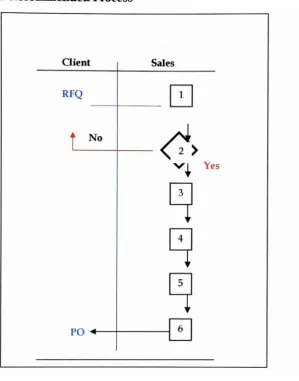
sixsteps, alltobeperformedbythesalesteam. Thesesteps aredescribedbelowand
illustratedinFigure 4.5.
1. Confirmreceipt ofRFQ.
2. Decidetobidor nottobid
3. Fillout a CORonlineform toformallyregisterthecustomer's request
4. SearchthedatabaseavailablethroughtheCORsystem and selectthe items
requested toobtainprice and discounts
5. Printout aformattedpricefile,whichdetailsterms&conditionspreviously
agreedtowiththecustomerthroughaGeneral Purchase Agreement. Bothdocuments
areautomaticallyprovidedbythesystem
6. Deliverythe quoteto thecustomer, electronicallyor ahardcopy, dependingon
Figure5.1Recommended Process
Client Sales
RFQ 1
t No
<^>
\ 2 ? Nri Yes
3
1
4
I
5
1
1 U *
In orderfortherecommendedprocess toflowsmoothlywith nointerruptions,the
followingfundamentalsare suggestedtotakeplace:
Allow the salesteam proper accesstopricinginformationonnon-customized
hardwareand software
Dedicateresourcesto constantlyupdatethedatabasesthatprovidepricing
information
Enhance thesoftwaretoolalreadyinuseto allowtheautomatic generationof
[image:48.555.113.413.66.448.2]softwaretoolsshouldbeabletoautomaticallyprovideaBusiness Case foreach quote
delivered,which wouldstayin therecordforfinancialcontrols andfuturereferences.
It isafactthat TECHCorporationisfacingachallengingeconomicsituation,which
forcesuppermanagementtobe verycautious withspendingand veryserious about
achieving andmaintainingprofitability.Thenew process recommendedisaimedto
helpTECHCorporationinitsefforttoachievethesegoals.The reasoning behindthe
new process isthatbyallowingthe salesteamtodeliversimple quotes through a much
leanerapproach,theotherfivedepartmentsthatarecurrentlyinvolved in this task
wouldbeabletofocusonhighlycustomized proposals and acceleratethese deliveries,
whichbringimportantrevenueto thebusiness. Inaddition,thenew process will mean
todeliverquotes and proposals inatimelyfashionregardless ofthecomplexityofthe
customer's request withthe intentionofmeetingorexceedingcustomer expectations.
Asa result ofthis study,it is alsostronglyrecommendedtopursue adeeper
evaluation ofthecurrent processtoquotestandardhardwareandsoftware,which
should gobeyond thequantityof activitiesthatcurrentlytakeplace. Furtheranalysis
shouldtake intoaccountdetails onwaitingtime, activityduration,specificfinancialson
cost/ timespent and even considerthecustomer'sfeedback concerningtheir
expectations ontimeof response andhowthismayimpacttheirdecisionmaking
References
Dickson,C. (2001). ANewWaytoLookatProcess [Electronicversion].
CapturePlanning.com. RetrievedSeptember25,2003
http://www.captureplanning.com/index.cfm/main/10841/2/article/view?cfid=35
67407&cftoken=32002403
Dickson, C. (2001).HowtoApproachaRequest for Quotation? [Electronicversion].
CapturePlanning.com. Retrieved September25,2003
http://www.captureplanning.eom/index.cfm/main/27062/2/article/view?cfid=35
67407&cftoken=32002403
Dickson, C. (2001). The Proposal Lifecycle [Electronicversion]. CapturePlanning.com.
Retrieved September25,2003
http://www.captureplanning.com/index.cfm/main/10843/2/article/view?cfid=35
67407&cftoken=32002403
Dickson, C. (2001). Whatarethedifferences between commodity/productand
service/solutionproposals? [Electronicversion].CapturePlanning.com. Retrieved
September25,2003
http://www.captureplaruning.com/index.cfm/main/13599/2/article/yiew?cfid=35
67407&cftoken=32002403
Dickson,C. (2001). What ShouldGointoaBusiness Proposal? [Electronicversion].
CapturePlanning.com. RetrievedSeptember25,2003
http://www.captureplanning.com/index.cfm/main/25326/2/article/view?cfid=35
Drake,K. (2002). Cost-Reduction StrategiestoKeep Enterprises Afloat [Electronic
version]. Brimingham Business Journal. Retrieved March14, 2003
http://www.bizjournals.com/birmingham/stories/2002/01/21/focus5.html
Fitzsimmons,J.A, &Fitzsimmons, M. J. (1998). ServiceManagement: Operations, Strategy,
andInformation Technology(2nded.). NewYork,NY: McGraw-Hill.
Freeman, R., &Freeman,J.S. (2000). A Metrics Toolbox- A
ScoringSystem ToHelp
You Evaluate Proposalsand Proposal Proceses [Electronicversion].Journalof
Association ofProposal ManagementProfessionals, 28-34.
Green,R. D. (2000). DivineIntervention,OneMan'sLeadershipinaNew Commercial
Proposal Paradigm[Electronicversion].JournalofAssociation ofProposal Management
Professionals,17-22.
Herdon, D. H. (2000). UsingRed TeamsEffectively [Electronicversion].Journalof
Association ofProposal ManagementProfessionals,58-65.
Hickey, G. (2001). Winningproposals- Howto
wincompetitivebusinessproposals
[Electronicversi6n].JournalofTIUTechwatch. Retrieved August5,2003
http://www.techwatch.ie/files/6 3/2000 520.htm
Kelman, S. (2002). Proposal Production[Electronicversion].Journal ofAssociation of
ProposalManagementProfessionals,22-29.
Marketl,M. (2000). TechnicalCommunication (6thed.). Boston: Bedford
Messin,P. (2000). MetricsatNCR's ProposalCenter [Electronicversion].Journal of
Salamida, M. (2000). Process ImprovementMethodology[Electronicversion].Journalof
Association ofProposalManagementProfessionals,23-27.
Software Shrinks ProposalPreparationfromDaystoHours,Helps Triple Revenues
(2001) [Electronicversion].DesignBiuldMagazine. RetrievedJuly10, 2003
http://www.designbuildmag.com/news/2001/wind2.asp
Trunball,D. (2001). TipstoCuttingProposalCosts [Electronicversion].Journalof
Association ofProposal ManagementProfessionals, 29-30.
Wesner,J.W., Hiatt,J.M., &Trimble, D. C(1995). WinningWithQuality:Applying
QualityPrinciples inProduct Development(EngineeringProcessImprovement) (1sted.).
Reading, MA:Adison-WesleyPubCo
Wilson,G. (2001).ProposalAutomationProducts [Electronicversion].Journalof
AssociationofProposal ManagementProfessionals,67-73.
WomakandJones(1996). Lean Thinking: Banish Waste AndCreateWealthIYour