‘A Model Among Towns?’: A Study of Progressivism
in Launceston During the Interwar Period
Ronald Alan Mallett, B. A. (Hons.)
Submitted in fulfilment of the requirements for the Degree of
Doctor of Philosophy
University of Tasmania
Declaration of Originality
This thesis contains no material which has been accepted for a degree or diploma by the University or any other institution, except by way of background information and duly acknowledged in the thesis, and to the best of my knowledge and belief no material previously published or written by another person except where due acknowledgement is made in the text of the thesis, nor does the thesis contain any material that infringes copyright.
Authority of Access
This thesis may be made available for loan and limited copying and communication in accordance with the Copyright Act 1968.
Statement of Ethical Conduct
The research associated with this thesis abides by the international and Australia codes on human and animal experimentation, the guidelines by the Australian Government’s Office of the Gene Technology Regulator and rulings of the Saftey, Ethics and Institutional Biosafety Committees of the University.
Abstract
Progressivism is a term describing an array of secular, transnational reform coalitions which emphasized government interventionism and reliance on expertise, when attempting to solve the largely urban problems presented by industrialisation. Progressivism emerged during the economic unrest of the last decade of the nineteenth century, reaching its peak by the end of the First World War and subsequently enjoying resurgence as a result of the sustained effects of the Great Depression during the mid-1930s. Following the armistice, popular attention across Australia began to turn away from a necessary focus on the demands of the war towards a determined consideration of the problems presented by the need for reconstruction and the continuing improvement of society.
suitable environment for an upsurge in Progressive resolve and activity, just as it did on the international stage.
Acknowledgements
Firstly I’d like to thank my family Kylie, James and Thomas for making sacrifices and sometimes having to put up with a grumpy hubby and Dad. My own parents have also been very understanding, if somewhat bewildered, by the whole process.
Secondly praise must go to my supervisor, Doctor Tom Dunning, for his patience, support and sage council through the last three and a half years.
Thirdly there are some other individuals who also require some special thanks. Thanks to Ross Smith at the Queen Victoria Museum and Art Gallery for his expert help in helping to identify pertinent records and the odd friendly chat over two years of research. Very special thanks to my fellow post grads, Jacqueline Fox, Jai Patterson and Katrina Ross, for reading the draft and offering suggestions.
Contents
LIST OF TABLES ... XII
ABBREVIATIONS ... XIII
CHAPTER 1: INTRODUCTION ... 1
1.1: Literature Review ... 1
1.1.1: Rationale for Research – Positioning the Thesis ... 1
1.1.2: Principal Secondary Texts – Key Influences on the Thesis ... 4
1.1.3: Primary Sources ... 16
1.2: Methodology ... 22
1.2.1: A Model of Progressivism in Launceston ... 22
1.2.2: Key Research Questions ... 23
1.2.3: A Thematic Approach ... 23
1.2.4: Approach to Primary Research ... 25
1.2.5: The Structure of the Thesis ... 26
CHAPTER 2: THE ROOTS OF INTERWAR PROGRESSIVISM IN LAUNCESTON, 1889-1918 ... 33
2.1: Introduction to Progressivism in Launceston... 33
2.1.1: A Brief Historical Summary of the Settlement of Launceston ... 33
2.1.2: A Self-Reliant City ... 35
2.1.3: Moral Reform Movements ... 35
2.1.4: Civic Pride, Engagement and Altruism in Launceston ... 44
2.1.5: Municipal Reformers ... 46
2.1.6: The Emergence of an Alternative Social Economy ... 49
2.1.7: The Role of the Examiner as a Catalyst for Progressivism ... 52
2.2: Case Study: The Four Themes of Progressivism in Launceston ... 55
2.2.1: The Focus on Infrastructure and Services ... 55
2.2.1.1: Funding the Municipalisation of Launceston ... 55
2.2.1.2: The Influence of the 1890s Depression ... 56
2.2.1.3: Expansion of Infrastructure and Services During the Municipalisation Phase ... 56
2.2.1.4: The Onset of Fiscal Conservatism... 62
2.2.1.5: The Launceston Marine Board and the Hunter Scheme ... 64
2.2.1.6: The Failure of the LCC to Adopt the New Social Agenda ... 65
2.2.1.7: The Town Planning Movement in Launceston ... 75
2.2.1.8: Recreation, Education and Entertainment in Launceston ... 77
2.2.2: The Efficiency Movement... 80
2.2.2.1: Applying Scientific Methodology to the Issue of Health Reform ... 81
2.2.2.2: The Professional Dynamic and Progressive Health Reform ... 83
2.2.2.3: Imposing Stricter Housing Standards and Unintended Consequences ... 84
2.2.3: Progressive Coalitions ... 86
2.2.3.1: A Classic Progressive Cause ... 86
2.2.3.2: The Professional Dynamic in Launceston ... 86
2.2.3.3: A Significant Failure? ... 88
2.2.3.4: The Importance of Educating the Masses ... 89
2.2.4: Social Justice Not Equality ... 90
2.2.4.2: Local Council Responses to Distress Caused by the 1890s Depression ... 92
2.2.4.3: The Prospect of a Council Funded Public Housing Scheme ... 93
2.2.4.4: The Reliance on the Private Model of Charity ... 94
2.3. Conclusions ... 96
CHAPTER 3: BUILDING AND MAINTAINING A PROGRESSIVE CITY, 1919-1939 ... 101
3.1: Introduction to the First Thematic Analysis ... 101
3.1.1: The Role of the Examiner in Promoting the Cause of Urban Improvement ... 103
3.1.2: The Increasing Fiscal Conservatism of the LCC ... 105
3.1.3: The Failure to Capitalize on the Brief Boom... 107
3.1.4: The London Loans ... 108
3.1.5: The Increasing Emphasis on Reproductive Projects ... 110
3.1.6: Failed Progressive Infrastructure Initiatives ... 113
3.1.6.1: A Municipal Housing Scheme ... 113
3.1.6.2: A Sewage Treatment Scheme ... 115
3.1.6.3: A Flood Protection Scheme ... 117
3.1.7: A Model Authority ... 124
3.2: Major Infrastructure Project Case Studies 1919-1939... 126
3.2.1: A Water Filtration Plant ... 126
3.2.2: A New City Abattoir ... 129
3.2.3: A City Crematorium ... 136
3.2.4: The State of the City Infrastructure by 1940 ... 142
3.3: Conclusions ... 145
CHAPTER 4: THE SEARCH FOR EFFICIENCY, 1919-1939 ... 147
4.1: Introduction to the Second Thematic Analysis... 147
4.1.1: The New Bureaucratic Orientation ... 147
4.1.2: The New International Outlook in Launceston... 150
4.1.3: The Influence on Town Planning in Launceston ... 151
4.1.4: The Influence on Health Policy in Launceston ... 152
4.1.5: The Influence on Local Government Reform in Launceston ... 157
4.2: Case Study: The City Manager Experiment, 1921-1922 ... 160
4.2.1: Calls for Reform ... 160
4.2.2: An American Influence ... 164
4.2.3: An Underrated Success? ... 170
4.2.4: Reasons for Termination and Abolishment of Position ... 177
4.3: Conclusions ... 186
CHAPTER 5: A CITY OF COALITIONS, 1919-1939 ... 188
5.1: Introduction to the Third Thematic Analysis ... 188
5.1.1: The Age of the Coalition ... 188
5.1.2: The Continuing Importance of the Professional Dynamic in Launceston ... 189
5.1.3: The Cult of the Expert in Launceston ... 192
5.1.4: Coalitions and the Alternative Social Economy ... 193
5.2: Progressive Coalition Case Studies ... 196
5.2.1: The Child Welfare Association of Launceston ... 196
5.2.1.2: The Launceston Child Welfare Association... 197
5.2.1.3: Dr. Truby King and the ‘Higher Ideal’ ... 199
5.2.1.4: Mixed Motives? ... 201
5.2.1.5: A Movement Without Heart? ... 202
5.2.1.6: A Qualified Success?... 204
5.2.2: Business Progressivism in Launceston ... 206
5.2.2.1: Open for Business ... 206
5.2.2.2: The Concept of Business Progressivism ... 207
5.2.2.3: More than Just a Booster Organisation ... 208
5.2.2.4: An Unwanted Social Conscience ... 216
5.3: Conclusions ... 219
CHAPTER 6: CALLS FOR A FAIR GO, 1919-1939 ... 222
6.1: Introduction to the Fourth Thematic Analysis ... 222
6.1.1: A Divided Social Elite ... 222
6.1.2: Reliance on Established Charity Networks ... 224
6.1.3: The New Deal and the Antipodean Roosevelt ... 228
6.1.4: The Changing Role of Local Government ... 234
6.1.5: The Emergence of the Welfare State ... 238
6.2: Case Study: Responses to Unemployment, 1919-1939 ... 244
6.2.1: The End of Laissez Faire Government... 244
6.2.2: State Responses to Unemployment ... 244
6.2.3: Local Government Responses to Unemployment ... 249
6.2.4: The Threat of Radicalism ... 256
6.2.5: Advocating for the Unemployed ... 259
6.2.6: The Work Relief Scheme in Launceston From 1933 ... 263
6.2.7: Community Responses to Unemployment ... 268
6.3: Conclusions ... 270
CHAPTER 7: AN INTERPRETATION OF PROGRESSIVISM IN LAUNCESTON DURING THE INTERWAR PERIOD ... 272
7.1: The Demise of Radical Conservatism in Launceston ... 272
7.2: The Characteristics of Progressivism in Launceston ... 276
7.2.1: The Focus on Improving the Urban Environment ... 276
7.2.2: The ‘New Bureaucratic Orientation’... 280
7.2.3: The Tendency to Alienate ... 283
7.2.4: The Importance of the Professional Dynamic ... 287
7.2.5: The Darker Side of Progressivism ... 288
7.2.6: Civic Altruism ... 293
7.2.7: Social Justice, Not Equality ... 294
7.3: Final Conclusions ... 296
APPENDIX A: A MAP OF INTERWAR LAUNCESTON, 1938 ... 301
Points of Interest Listed:... 302
APPENDIX B: A LAUNCESTON INTERWAR TIME-LINE ... 304
BIBLIOGRAPHY ... 315
PRIMARY SOURCES: ... 315
Documentary: ... 315
Government Publications: ... 316
Newspapers and Periodicals: ... 317
Books: ... 317
Annual Reports: ... 318
SECONDARY SOURCES:... 319
Books: ... 319
Prefaces, Entries and Chapters: ... 323
Journal Articles: ... 327
Theses and Other Unpublished Material: ... 331
List of Tables
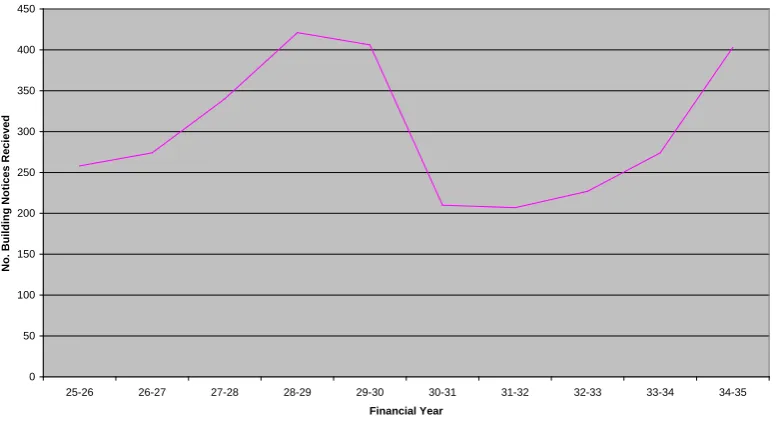
Table 1: Building Activity in Launceston 1925/6 to 1934/5 - Building Notices Received ... 107 Table 2: Rates for Remitting Funds to the London Market, August 1928 &
Abbreviations
AMIEU Australian Meat Industry’s Employee Union AOT Archives Office of Tasmania
BHA Baby Health Association
CHO Chief Health Officer
CMO City Medical Officer
CTA Commercial Travellers’ Association
CWA Child Welfare Association
ehp Electric Horse Power
HCC Hobart City Council
IIPA Invermay and Inveresk Progress Association
IMR Infant Mortality Rate
LCC Launceston City Council
LFTL Launceston Fifty Thousand League
LGH Launceston General Hospital
LHSPP Launceston Historical Society Papers and Proceedings
LTLC Launceston Trades and Labour Council
LTPA Launceston Town Planning Association
LTS Launceston Temperance Society
MHA Member of the House of Assembly
MLC Member of the Legislative Council
NTTPA Northern Tasmanian Town Planning Association
QVM Queen Victoria Museum and Art Gallery
SLIA South Launceston Improvement Association
SPCA Society for the Prevention of Cruelty to Animals
STTPA Southern Tasmanian Town Planning Association
tb Tuberculosis
TCS Tasmanian Cremation Society
THRAPP Tasmanian Historical Research Association Papers and Proceedings
THS Tasmanian Historical Studies
TSIA Tasmanian Suburbs Improvement Association
UCTA United Commercial Travellers’ Association
UNSW University of New South Wales
Chapter 1: Introduction
1.1: Literature Review
1.1.1: Rationale for Research – Positioning the Thesis
By the beginning of the twentieth century, the city of Launceston, Tasmania, had developed an international reputation as being unusually modern for a small, regional city.1 The city had also enjoyed a long history of reformism, providing the scene for important contributions to both the temperance and anti-transportation movements. 2
1
Henry Reynolds has commented that municipal services such as water and electricity were evident early by world standards and that the city was also culturally vibrant in relation to its diversity and strong institutions. See: Henry Reynolds, ‘Foreword’, in P. A. C. Richards, B. Valentine & T. P. Dunning, eds, Effecting a Cure: Aspects of Health and Medicine in Launceston
(Launceston, 2006), p. xxi. There are several references which evidence this view. In 1898, English trade unionist and Fabian Socialist Alderman of the London County Council while on a lecture tour, noted at a Mayoral reception in Launceston that he could suggest little improvement and that the city appeared to be a heaven to him. He contrasted it with the state of most other colonial cities, including Hobart. See: Examiner, 5 March 1898 no pagination (n. p.) as cited in Stefan Petrow, Sanatorium of the South?: Public Health and Politics in Hobart and Launceston 1875 -1914 (Hobart, 1995), p.30. On the occasion of the centenary of the settlement of Launceston in 1906, the Editor of the Hobart newspaper the Mercury offered the following tribute:
‘Launceston has numerous literary, social, charitable, religious and scientific societies, and altogether at the end of its first century possess all the equipment of an enlightened and
progressive city.’ See: Mercury, 17 March 1906, n. p. In 1910 the Editor of Adelaide newspaper, the Advertiser, in a discussion of progressive Australasian cities lists Launceston in the same breath as Melbourne, Sydney, Auckland, Christchurch, Dunedin and Wellington. See: Advertiser, 29 November 1910, p. 8. This acclaim was sustained as the Lord Mayor of Melbourne, Sir Harold Gengoult-Smith, on visiting the city for the first time in twenty years congratulated the Council on its progressive qualities. See: Mercury, 5 January 1934, p. 5. Please note that all primary and secondary references cited in other works have been personally viewed. Citing their original use has been practised as a courtesy and to ensure that proper credit is given to the previous
researcher/historian.
By 1900, Launceston provided potentially fertile ground for Progressivism, as it possessed a rich history of reformism, a decided culture of civic pride and engagement, and had also displayed a predilection for large-scale municipal interventionism. While some work has been done charting and analysing the history of the development of the city’s local government and its municipalisation phase, little attention has been given to its subsequent history of
2
Progressivism.3 The role that Progressivism played in the development of the city, and the nature and course of the wider movement in the interwar period, are issues that are far less acknowledged or understood.
Progressivism was a political reformist movement made up of smaller coalitions which championed diverse but often interconnected issues. It spread across the world between the years 1890 to 1920. It also arguably enjoyed resurgence during the Great Depression. On the whole, it left a tangible legacy in the form of a general acceptance of the need for an emphasis on expanded, interventionist state or federal government policy, as well as reliance on professional expertise to realise the ultimate goal of a harmonious society.4 Daniel T. Rodgers has insisted that Progressivism as a phenomenon, extended right up to the outbreak of the Second World War.5
This thesis is essentially a transnational study, which uses the history of Progressivism in the regional city of Launceston, Tasmania, during the interwar period as its case study. Traditionally, historical studies of Progressivism in the United States have demonstrated a national or state/regional emphasis.6
3
The most significant contributions have been provided by historians Michael Roe and Stefan Petrow. Their relevant works are detailed and discussed in section 1.1.2.
Focusing the lens of academic enquiry onto a specific city is arguably an underused approach in transnational history, although it often forms the basis for international
4
Linda Gordon, ‘If the Progressives Were Advising Us Today, Should We Listen?’, The Journal of the Gilded Age and Progressive Era, 1, 2 (April 2002), pp. 110-11.
5
Daniel T. Rodgers, Atlantic Crossings: Social Politics in a Progressive Age (London, 1998), p. 485. From an Atlantic perspective, Rodgers views First World War as an interruption, settlement schemes and the ‘New Deal’ phases as high points and the Second World War as a watershed in the seen that it was the ‘closing of the American’s Atlantic social-political era.’ David W. Gutzke also asserts that at least in Britain, the course of Progressivism ran its course between 1870 and 1939. This is qualified by the view that the pub reform movement was one of the last significant phases of ‘British Progressivism’ operating until approximately 1960. See also: David W. Gutzke, ‘Historians and Progressivism’, in David W. Gutzke, ed., Britain and Transnational Progressivism
(New York, 2008), p. 18 & David W. Gutzke, Pubs and Progressives: Reinventing the Public House in England, 1896-1960 (Dekalb, Illinois, 2006), p. 17. It is my contention that the Progressive experience in Launceston generally echoes the Rodgers interpretation of global Progressive trends.
6
comparative studies.7 However, several transnational historians have based aspects of their analyses of Progressivism around the basic city unit.8 Progressives themselves, assessed the success of reforms or made comparisons between similar initiatives, based on the concept. This was a natural reflection of the contemporary understanding of the interrelationship between Progressivism and the process of municipalisation.9
Previous historical analysis of the city of Launceston during the interwar period has been conducted through primarily state or national frameworks, effectively serving to obscure Progressivism as an issue.10 Transnational history has been defined as ‘the study of the ways in which past lives and events have been shaped by processes and relationships that have transcended the borders of nation states.’11 Admittedly the study reflects an exclusively one-way movement of ideas, but as a study of Progressivism on the periphery, the history of Launceston still attests to the power of such ideas to transcend national boundaries, specifically during the interwar period. This has been done in two ways: through comparison of reform ideas and initiatives between Launceston and other Progressive cities around the world, and alternatively through identifying direct influences.12
7
Ann Curthoys & Marilyn Lake, ‘Introduction’, in Ann Curthoys & Marilyn Lake, eds, Connected Worlds: History in Transnational Perspective (Canberra, 2005), p. 6.
By assessing the nature,
8
For instance, Daniel T. Rodgers makes the observation that ‘what Birmingham and Glasgow were to the UK. Frankfurt and Düsseldorf were to Germany.’ See: Atlantic Crossings, p. 123. Glasgow is Hamish Fraser’s primary case study among several other city units in ‘Municipal Socialism and Social Policy’, in R. J. Morris and Richard Rodger, eds, The Victorian City: A Reader in British Urban History, 1820-1914 (London, 1993) pp. 258-80.
9
In 1905, nominee for the position of Mayor of Chicago Edward Dunne, claimed that he wanted to make the city a ‘second Glasgow’. Similarly, Woodrow Wilson often referred to the same city as a Progressive model. See: Bernard Aspinwall, ‘The Civic Ideal: Glasgow and the United States, 1880-1920’, in David W. Gutzke, ed., Britain and Transnational Progressivism (New York, 2008), p. 78.
10
John Reynolds, Launceston: History of an Australian City (Melbourne, 1969). This book is constructed around a linear economic framework. The history of the city during the wider period of 1870-1940 has received some attention in the form of books and articles from such esteemed historians as Lloyd Robson, Richard P. Davis and Michael Roe. But even their academic work has been largely written within the state and national and state paradigms. Stefan Petrow’s work provides the best attempt at placing the history of the city in some kind of an international context, but in terms of his work on Launceston, it has been focused more on single issues such as health or housing and not specifically on analysing Progressivism in the city in a wider sense. Please refer to the bibliography for an exhaustive list of the most relevant articles and books by that core group of Tasmanian historians.
11
Curthoys & Lake, Connected Worlds, p. 5.
12
direction, fate and legacy of Progressivism in Launceston during the interwar period, the thesis will serve a dual purpose: improve understanding of the Progressive movement within the confines of the city, as well as attest to the power and global scope of Progressive ideas.
1.1.2: Principal Secondary Texts – Key Influences on the Thesis
What was Progressivism? David Thelen in his article ‘Social Tensions and the Origins of Progressivism’, published in 1969, called for a much more inclusive definition of the typical Progressive, and dismissed the use of behavioural theory in history in general. To Thelen it was a general ‘moral indignation’ against the behaviour of corporations and corrupt politicians that united American progressives to intervene on a plethora of issues of common concern rather than social tensions.13 Thelen’s vision of Progressivism then was a typically ‘neo-progressive’ one. David M. Kennedy has used this term to describe the paradigm shift from the focus on essence to context in the study of the phenomenon.14 Shelton Stromquist later described that approach as a shift in focus from the ‘sociological attributes of the Progressives themselves to the political processes that generated reform.’15 Martin J. Schiesl in his book The Politics of Efficiency also alerted scholars to the danger of utilising a bland definition of participants in Progressivism, noting that to some, reform was a ‘road to respectability.’16 But any considered analysis of Progressivism in Launceston could only conclude that it consisted of an array of ‘top-down’ coalitions.
‘Progressivism in Britain and Abroad’, in David W. Gutzke, ed., Britain and Transnational Progressivism, pp. 24-5.
13
David Thelen, ‘Social Tensions and the Origins of Progressivism’, Journal of American History, 56, 2 (September 1969), pp. 323-41. Thelen does appear to establish that at least in Wisconsin, there was no direct link between class and political orientation based on correlating occupational details with voting patterns in the state legislative assembly. He concludes: ‘The profiles from Wisconsin and elsewhere reveal empirically that the origins of progressivism cannot be found by studying the social backgrounds and tensions of progressive leaders.’
14
David M. Kennedy, ‘Overview: The Progressive Era’, Historian, 37, 3 (May 1975), p. 453, 465.
15
Shelton Stromquist, ‘The Crucible of Class: Cleveland Politics and the Origins of Municipal Reform in the Progressive Era’, Journal of Urban History, 23, 2 (January 1997), p. 193.
16
In his recent book on Progressivism, Pubs and Progressives, David W. Gutzke offered a more succinct and satisfying definition of the concept of Progressivism:
Progressivism is best understood as a series of local protest movements based on shifting, short lived coalitions that united individuals of dissimilar social backgrounds. Neither coordinated into a national movement nor united on an agreed agenda, Anglo-American Progressives nevertheless responded with common motivations – moral indignation, a desire for social justice; guilt; or fear of disorder, upheaval, or national deterioration. Characteristics of Progressivism were its cross-class alliances to achieve broader goals, reliance on scientific methodology, cult of efficiency, and eagerness to experiment. Pragmatists, not ideologues, Progressives saw the individual as the product of the environment, which they wanted changed to reshape behaviour. These condescending middle- and upper-class reformers fully expected to impose their values on working-class inferiors. Progressives offered moral uplift, order, discipline, and environmentalism as antidotes for urban problems, and social justice as a new standard of fairness for class reconciliation. 17
This is a very concise and perceptive definition of a mercurial phenomenon, and it applies just as accurately in an Australian context. It is also a definition that recognises the class component of Progressivism, although it was characterised by ‘cross-class alliances’. Gutkze’s interpretation recognises that Progressivism was a middle and upper-class movement which experienced qualified success but only occasional widespread support amongst the working classes. I will demonstrate that this definition fits the Launceston experience of Progressivism.
In attempting to define my own specific model of Progressivism and the typical Progressive in Launceston of the first half of the twentieth century, I have drawn strongly on the ideas of Michael Roe. Tim Rowse has argued that Michael Roe did not fully clarify the common themes associated with Australian Progressivism in his book Nine Australian Progressives: Vitalism in Bourgeois Social Thought 1890-1960. However a number of key issues did emerge.18
17
David W. Gutzke, Pubs and Progressives, p. 17.
Michael Roe himself
18
characterised the movement in Australia as an essentially bourgeois one, exhibiting a strong belief that the future could be molded by shaping the environment, and in pursuing that task, one that gave a prominent role to the state. According to Michael Roe, Progressivism differed from the traditional moral reform movements more in ‘mode’ than in content, as a sort of ‘radical conservatism’: the achievement of conservative ends by radical means. The Progressive ideal was efficiency, one they asserted in a highly aggressive fashion. It was also a movement with a darker side in that there was a decided element of racial paranoia inherent in it: the movement almost totally consisted of middle-class, white, male, Protestants, who while wearing a ‘veneer of altruism’ in their war to save capitalist society from itself, also sought to protect themselves from extreme elements, above and below.19
Throughout the thesis a distinction is made between progressives and Progressives. Sidney Pollard in his book The Idea of Progress: History and Society uses the idea of a ‘pyramid of the believers in progress’ in order to make several distinctions between those who subscribe to what became a core belief of the Western world between 1750 and 1900. At the base he categorises those who simply believe that the apparent technological advancement of civilisation will improve the wealth and general material conditions of human existence. In the middle of the pyramid lay those who have some faith that mankind will be able to refine its social and political organisations so as to guarantee greater equality and freedom. At the top of Pollard’s pyramid are those that believe progress will improve the very character of man. This thesis therefore makes a blatant distinction between ‘progressivism’ (a simple emphasis on material advancement which one would find at the base of Pollard’s pyramid) and ‘Progressivism’ (a political/cultural phenomenon which inherently expresses a faith in the possibility of improving the general human condition to be found nearer to the top of Pollard’s pyramid) and uses capitalisation to mark the difference to avoid confusion.20
endeavour, passion for nature and efficiency. While the Great War fragmented the movement, the result was an increase in state intervention into public health and family centred policies.
Progressives then shared the faith in the
19
Michael Roe, Nine Australian Progressives: Vitalism in Bourgeois Social Thought 1890-1960, (St. Lucia, 1984), pp. 1-15.
20
Sidney Pollard, The Idea of Progress History and Society (Ringwood, Victoria, 1968), pp. 11-2. While Pollard does not directly discuss the Progressives, it is significant that in his book he
material benefits of science and technology with everyday progressives, but on the whole rejected the progressive preoccupation with the virtues of the passive state. Progressives should then be commonly placed in the middle to the top of the Pollard’s conceptual pyramid as they displayed an inherent faith in the possibility of improving the human condition on several levels. Robert Nisbet in his work the History of the Idea of Progress, refers to a ‘New Liberalism’ apparent during the classic Progressive period which placed interventionism directed by social scientists at the frontline of the battle to improve social and economic progress. As a result, in an American context, both the Roosevelt and Wilson administrations encouraged progress through direct political interventionism.21
An appreciation of the key philosophical shifts during the nineteenth century is central to explaining the nature of Progressive thought as it developed before 1900. In Nine Australian Progressives Roe acknowledges the role of William James and his theory of Pragmatism in the development of this process. James’ rejection of absolute truths seemed to pave the way for a more organic approach to life in direct opposition to the mechanistic approach inherited from the enlightenment.22 Robert H. Wiebe notes in his book The Search for Order, the importance of the fluidity of such an approach in developing the bureaucratic approach that was so much a key element to the Progressives attempt to rationalise society. According to Robert H. Wiebe, John Dewey’s development of many of James’ ideas, blended with his natural emphasis on the importance of practice above theory (and indeed rejecting many traditional western philosophical dualisms), helped to provide Progressives with a philosophy that justified their push to make ‘individuals the plastic stuff of society’. I have incorporated this emphasis by Michael Roe on the importance of the pragmatic tendencies of the Progressives (‘treating truth as a process instead of an essence, and knowledge as the continual testing of hypotheses against life’s facts’) as a core component of my own model of Progressivism in Launceston.23
lose its appeal. However this thesis will show that it was not until the early/mid-1920s that Progressivism began to attract broad appeal and effect cultural changes in Launceston, Tasmania.
21
Robert Nisbet, History of the Idea of Progress (London, 1980), pp. 300-4.
22
Michael Roe, Nine Australian Progressives, pp. 4-5.
23
In order to develop a fully-rounded interpretation of Progressivism in Launceston, it has been necessary to acknowledge the darker aspects of the phenomenon. Again in Nine Australian Progressives, Michael Roe appears to have been very aware of the darker side of the Progressives: a preoccupation with the health and purity of the race often translated into an appreciation for the notion of eugenics. Michael Roe claims that this explained the emphasis on the health and welfare of mothers, babies and children; it was in fact an expression of their collective concern for the European race. This concern manifested itself as everything from a measured concern for vital health reform to castration of the unfit and selective breeding. Michael Roe acknowledges that Progressivism worked to both ‘liberate and constrain’. This ‘liberal-authoritarian duality’ is identified by Michael Roe and he explains that the movement simultaneously ‘invoked liberation and order, democracy and elitism, change and continuity, welfare and asceticism, worship of both technology and Nature’. While he notes that this has led some to deny the ‘validity of the concept’, it can be explained by its complex philosophical foundations in that it sought ‘to claim the virtues of rationality, but at heart to be emotive and mystical’. 24
Municipalisation was to be the first manifestation of the Progressive interventionist spirit to emerge in Launceston. It had begun in the middle of the nineteenth century and had taken deep root by its end. This impression is legitimised to some extent by the works of historians, Robert H. Wiebe and Daniel T. Rodgers. Robert H. Wiebe in his book The Search for Order argues that at least in relation to American urban Progressivism, it was the new focus on municipal reform in the late nineteenth century which laid the foundations for wider Progressive reform.25 The link between the origins of Progressivism and municipal reform is also a core concept explored in Daniel T. Rodgers’ book Atlantic Crossings: he insists that municipalisation was the first ‘Atlantic-wide progressive project’. 26
24
Michael Roe, Nine Australian Progressives, pp. 12-4.
The transformation of Launceston into a modern city was roughly concurrent with the increasing popularity of ideas relating to the achievement of efficiency through the adoption of professional and scientifically informed administrative techniques by
25
Robert H. Wiebe, The Search for Order, pp. 166-7.
26
the ‘state’, as embodied by the system of local government. From the outset though, this devotion to intervention and expertise was tempered by a well-ingrained strain of economic restraint, which often undermined the potential effectiveness of the measures introduced.27
Stefan Petrow has prepared the most directly relevant historical work on the unique municipal development of the city of Launceston. In his comparative work, Sanatorium of the South: Public Health and Politics in Hobart and Launceston 1875-1914, Stefan Petrow contrasts the commitment of its administration with that of Hobart, concluding that the former was more ambitious during the period in relation to municipal reformism.28 As a primarily administrative historian, his work on Launceston has been mainly concerned with assessing the effectiveness of local government, albeit within a wider historical context. An examination of the role of political Progressivism in Launceston’s development then has not formed a central part of Stefan Petrow’s overall historical analysis.29
27
Anne McLaughlin, ‘Launceston’, in Alison Alexander, ed., The Companion to Tasmanian History (Hobart, 2005), pp. 207-9. Within this very basic entry on Launceston, the classic
progressive era of roughly 1890-1920, is covered by the first two paragraphs of the second column on p. 208. That material, combined with other entries in the same edited work, does build up an impression of Launceston as a peculiarly Progressive city. See also: Marian Walker, ‘Launceston Fifty Thousand League’, p. 209; Peter Mercer, ‘The National Trust of Australia (Tasmania)’, p. 250; Stefan Petrow, ‘Progress Associations’, p. 291. Stefan Petrow, Sanatorium of the South?, pp. 25-88, (basically ‘Part 2: Launceston 1886-1914’) establishes Launceston’s credentials as a progressive City in relation to general public health policy up to 1914. John Reynolds, Launceston, pp. 126-9, details the glory of the Samuel Sutton led progressive era of the 1890s. This period saw the establishment of the QVM, the building of the Albert Hall and the holding of the 1891/2 International Exhibition, the institution of a deep drainage system and most importantly the
construction of the Cataract Hydro-electric scheme and the subsequent realisation of street lighting.
28
Stefan Petrow, Sanatorium of the South?, pp. 25-50.
29
In relation to Launceston, Petrow’s focus on assessing the quality of local governance is also evident in the following articles: ‘The Best Governed City in Australia: Launceston 1885-1914’,
Launceston Historical Society Papers and Proceedings (LHSPP), 2 (1995), pp. 49-70 &
While the Progressives themselves are understandably the focus of any academic analysis of Progressivism, the thesis will also attempt to acknowledge the importance of opposition to Progressive reform. Robert H. Wiebe’s The Search for Order dealt with the tendency of Progressives to alienate large sections of society.30 Michael Roe in Nine Australian Progressives also argues that the Progressive enthusiasm for the First World War, which inadvertently led to severe social, political and economic disruption, also resulted in the gradual rejection of their reformist ideas.31 David Thelen commented in his book on Progressivism in Wisconsin, The New Citizenship, that traditionally, in Progressive scholarship, there has been a focus on reform rather than reaction: the efforts of the anti-reform section of the community have arguably not received the attention they deserve.32 This thesis will argue that among the educated classes, it was both those possessing more radical ideologies and more hardline conservative ideologies that provided sustained resistance to the wider movement in Launceston. The true obstacle though, as in all the countries that enjoyed a Progressive phase, was of course, working-class apathy.
This thesis will follow the emerging tendency to emphasise the analysis of an integrated array of reform initiatives in a single study, as demonstrated most recently again by Daniel T. Rodgers’ Atlantic Crossings.33 In his review of Atlantic Crossings, Michael B. Katz noted that such issues as municipal infrastructure, town planning and unemployment relief have been traditionally analysed independently.34
30
Robert H. Wiebe, The Search for Order, pp. 212-3.
Australian historical studies of Progressivism in the main, with the exception of Michael Roe’s biographical approach, have focused on individual
31
Michael Roe, Nine Australian Progressives, p. 315.
32
David Thelen, The New Citizenship, p. 4.
33
The most pertinent example is Daniel T. Rodgers’ Atlantic Crossings which casts a wide net in terms of Progressive themes partly as a consequence of its transnational methodology. Issue discussed include: urban planning, labour legislation, public and private relief of poverty etc. It is much more common for an Australian analysis to focus on a single issue, such as education or health reform.
34
issues. This has served as a barrier to developing a more integrated conception of the nature of Australian Progressivism at both the local, state and national levels.35
The city is the fundamental unit of analysis of this thesis. Carl Abbott’s Boosters and Businessmen, published in 1981, demonstrated how effective the city orientated approach can be in historical studies: in that book he examined the nature of popular economic thought in four Midwestern cities between 1840 and 1860.36John Louis Recchiuti’s Civic Engagement Social Science and Progressive-Era Reform in New York City in turn examined New York’s role in the latter part of the nineteenth century and early part of the twentieth century, as an ‘incubator’ of ideas that contributed to the new social sciences that were to help fuel Progressivism.37 While Progressive ideas crossed international boundaries and influenced the cultural landscape of the city, they were often modified before being tested in their new environment. While in the case of Launceston, the transnational transmission of Progressive ideas was almost totally one-way, we find that individuals and coalitions did enjoy a direct role in filtering and synthesising them before championing their application.
In regards to examining business progressivism more specifically in Launceston, Simon Harris’ doctoral thesis, ‘Selling Tasmania’ completed in 1991 (although dealing mostly with boosterism’s influence on the Tasmania tourist trade) has been of substantial benefit to development of this thesis. One of the central premises of ‘Selling Tasmania’ is establishing the importance of considering the role of the lobbyist or the propagandist when examining the events and wider trends pertinent to political and economic history. His thesis also provides some examination of the tension between self-interest and civic voluntarism as a motivation for Progressive activity amongst the business community. The thesis has also provided a valuable
35
A prime example of such a (still essential) single focus history would be Grant. W. Rodwell’s
With Zealous Efficiency: Progressivism and Tasmanian State Primary Education, 1900-1920 (Darwin, 1992).
36
Carl Abbott, Boosters and Businessmen Popular Economic Thought and Urban Growth in the Antebellum Middle West (Westport, 1981), p. 6.
37
initial grounding in the, to date, much neglected history of the Launceston Fifty Thousand League (LFTL).38
At the core of Progressivism was an impulse to rationalise society, mostly through the institution of the newly developed bureaucratic orientation which emphasised such values as ‘continuity and regularity, functionality and rationality, administration and management’. 39 The implied goal was the creation of a universally efficient society. Michael Roe correctly draws attention to the difficulty in defining exactly what ‘efficiency’ meant. In fact he concisely explains the problem in the following way: ‘In effect, it becomes synonymous with whatever was virtuous in progressive eyes, and so to define it is to define progressivism – a game of peering into face-to-face mirrors’.40 Robert H. Wiebe provides some clarification. In his book The Search for Order, Robert H. Wiebe argued that while there were few exact definitions of ‘frictionless bureaucracy’ (characterised by order and efficiency) and little instruction on how it was to be achieved, he did identify two basic aspects: adjusting interactions according to the wishes and needs of the people involved (hence the influence of pragmatism) and regulating society’s movements to produce maximum returns for a minimum outlay of time and effort.41
The ideas of Frederick Winslow Taylor had as much a pervasive effect on Progressivism as it did on the organisation of labour within the capitalist economic system. Scientific management was devised as a means of improving labour efficiency by applying the methods of science to the workplace.42
38
Simon Harris, ‘Selling Tasmania Boosterism and the Creation of the Tourist State 1912-1928’, unpublished PhD thesis, University of Tasmania, 1993, pp. 322, 334. Discussion of the LFTL is scattered throughout the thesis but they feature most prominently in section 5.2.2
Harry Braverman in his work Labor and Monopoly Capital reflects the contemporary view that the
39
Robert H. Wiebe, The Search for Order, p. 295.
40
Michael Roe, Nine Australian Progressives, p. 11.
41
Robert H. Wiebe, The Search for Order, pp. 154-5.
42
approach was not in truth scientific but in reality a method for the ‘explicit verbalisation of the capitalistic mode of production’ disguised as science. 43 Regardless of the validity of its scientific credentials, it was regarded highly by Progressives and applied to a range of fields and disciplines in order to solve fundamental problems confronting society. Progressives appreciated Taylorism less in terms of its capacity to provide a rigid rule-book on how to maximise efficiency in the work place, but rather as an example that quantitative methods could properly facilitate a ‘scientific’ orientation to reform. This thesis will demonstrate that in the context of Launceston, a modified version of Taylorism influenced policy in several areas including health and administration.
Robert H. Wiebe makes another contribution by providing a historical explanation for the link between the emerging professions of the age and the new bureaucratic orientation. As many occupations were professionalised and new professions emerged, Weibe explains that there was a gradual realization that even across the various professional fields (including law, education, social work and medicine) there was a common language of rationality and mutual concerns. Bureaucracy was to be the instrument through which the new middle-class professionals were to fulfil their destiny and remodel society on scientific principles.44 In relation to Progressive Launceston, the thesis will show that organisational reform was led by same-minded professionals who shared ideas and were encouraged by reforms that were truly international. This principle of the ‘internal dynamics’ of professionals driving the Progressive engines of reform is an important concept upon which the thesis relies for its coherence.45
Organisational historians have identified two core problems with the Progressive pseudo-scientific approach to administrative reform. Robert H. Wiebe, once more in The Search for Order, argues that organisational Progressives often believed that
43
Harry Braverman, Labor and Monopoly Capital, pp. 85-7. According to Braverman’s critique, Taylor’s scientific management approach demonstrated some naive assumptions of human nature, antagonised labour and was eventually succeeded by more empathic theories as functional foremanship and incentive pay schemes. In his rather bleak analysis of the world of production, Braverman argues that Taylorism and its successors continue to dominate the capitalist system noting that its fundamental teachings have become ‘the bedrock of all work design’.
44
Robert H. Wiebe, The Search for Order, pp. 111-32.
45
once all citizens had surrendered to rationalism that there would be no disagreement over policy. This was a result of a false belief that politics and ambition could actually be separated from the development of policy and its institution.46 In his book The Politics of Efficiency published in 1977, Martin J. Schiesl drew attention to another naive assumption: the Progressives believed in the validity of a ‘rational, monocratic system of firmly arranged levels of hierarchical authority flowing from superior to inferior roles’, which unfortunately did not recognise that in a typical workplace there is always a degree of interdependency between experts and less skilled workers.47
The success of the organisational Progressives of Launceston was variable and obstructed in part by these assumptions. The downfall of Launceston’s City Manager, F. W. Nicholl was closely related to his failure to grasp two principles: no organisation could operate in an entirely top-down manner and no policy on any issue could enjoy universal acceptance, regardless of how scientifically it was conceived. This thesis will argue that the most successful organisational reformers, arguably Launceston’s two long serving City Medical Officers of the period – L. Grey Thompson and James Pardey – were more successful in securing reform, because they did not make the same assumptions. They were certainly more diplomatic than Nicholl. Their mutual qualified success and longevity reflected the fact that they were more peripheral than Nichol in relation to the power structure of local government. Their departments were also small and their overall direct influence over policy was minor. They were mostly informed advisors with little power. There is no evidence that there was any resentment held towards them on the part of the aldermen or general staff.48
There are several histories that have provided basic vital historical content and historiographical guidance for the development of the thesis. Lloyd Robson’s A History of Tasmania, Volume II: Colony and State from 1856 to the 1980s first published in 1987, has provided an authoritative touchstone, particularly in relation
46
Robert H. Wiebe, The Search for Order, pp. 161-2.
47
Martin J. Schiesl, The Politics of Efficiency, pp. 189-90.
48
to general political history when it has been necessary to relate the topic to wider historical issues.49 John Reynolds’ A History of Launceston published in 1969, was useful in the initial stages in providing a practical and general overview of the history of the city.50 In terms of helping me to better understand the field and afterwards position the thesis in relation to the broader American historiography on the topic of Progressivism, William G. Anderson’s article, ‘Progressivism: An Historiographical Essay’ published in 1973, and Daniel T. Rodger’s article ‘In Search of Progressivism’ published in 1982, have provided sound guidance.51
The identification of a suitable methodological approach and the selection of an optimum period for the study of Progressivism in Launceston were critical preliminary steps in the preparation of the thesis. John Rickard’s Australia: A Cultural History, provided an excellent example of how a thematic approach can facilitate a ‘freer’ study which seeks to extend understanding of the ‘evolving values, beliefs, rites and customs’ of a particular society, as opposed to a more linear, chronologically based one. His book concentrates on the cultural changes which took place in Australian society at a national level in the first half of the twentieth century.52 Australia became an increasingly urbanised and industrialised society during the interwar period and as a consequence, many of the core elements of its national culture and identity were being redefined. 53
49
Lloyd Robson, A History of Tasmania Volume II: Colony and State from 1856 to the 1980s, (Melbourne, 1987); Lloyd Robson, A Short History of Tasmania (Melbourne, 1985) and Lloyd Robson and Michael Roe, A Short History of Tasmania, 2nd ed. (Hobart, 2005) have all been convenient and trustworthy academic comforts.
It was logical then,
50
I would class John Reynolds’ Launceston, as a social-economic history and any reference to the link between political activity in the city and any wider cultural phenomena appear to be minimal. It is unreferenced but well written. It provides a good guide to important events relating to the city up to 1969.
51
William G. Anderson, ‘Progressivism: An Historiographical Essay’, The History Teacher, 6, 3 (May 1973), pp. 427-52 & Daniel T. Rodgers, ‘In Search of Progressivism’, Reviews in American History, 10, 4 (December 1982), pp. 113-32.
52
John Rickard, Australia: A Cultural History (Melbourne, 1988), pp. xi-xii.
53
Manning Clark notes that while approximately thirty five and a half per cent of the population resided in capital cities in 1906, by 1940 it was forty seven and a half per cent. Clark’s view of Australian society in the interwar period appears to have been a malleable one. Increased
given the previous attention devoted to various aspects of Progressivism in Launceston up to the First World War, that these two decades would be selected as providing the most fertile ground for analysis of this topic.
1.1.3: Primary Sources
The design of this thesis has been strongly influenced by the views of contemporary Progressive Australian intellectuals. C. E. W. Bean’s Progressive manifesto In Your Hands, Australians, was an attempt to incite Progressive passions following the First World War. In many ways an Australian exceptionalist, Bean attributed many of the emerging reformist ideas simply to the influence of the war, although many of the social and political trends he describes were firmly entrenched before the outbreak of the conflict. Still, his book is a pure, almost encyclopaedic, expression of popular Progressive thought translated into an Australian context at the outset of the interwar period.54
Meredith Atkinson’s The New Social Order: A Study of Post-War Reconstruction, voices the same sentiments as Bean’s book, albeit in a more academic framework. Like most mainstream Progressives, Atkinson advocated a gentle reformist approach aimed at ‘securing a state of greater liberty, enlightenment and happiness of every individual’. As a Progressive, Atkinson was typically ambivalent towards democracy, recognising that the qualified version that existed in his lifetime was
Russel Ward, The Australian Legend (Melbourne, 1966), p. 227. In turn, Richard White has argued that while the cultural baggage of its immigrants and the views of its intelligentsia/artists are influential in the formation of a country’s national identity. The period between the late nineteenth century and the middle of the twentieth century best illustrates the influence of the economic ruling class. White observed that the view of Australia as ‘young, white, happy and wholesome and needing protection’ which had formed before World War One, was intensified by the subsequent idealization of the ‘digger’. This view was reflected in much of the federal legislation of the period, which attempted to deal with collective fears of Asia and Communism. The depression though, damaged confidence in the idea of Australia as a young nation with unlimited potential. The battle over the design of the Australian national identity between pastoral and manufacturing interests then (the ideal of the bushman versus the tanned, masculine, urban lifesaver for the mantle of the real Australian) intensified during the interwar period. See: Richard White, Inventing Australia: Images and Identity 1680-1980 (Sydney, 1980), pp. ix-x, 140-57.
54
merely a device designed to prevent ‘mob-rule’ rather than facilitate it. Encouraging ‘efficient citizenship’ (wherein the mass of citizens were fit, functional and conformist) was the essential ingredient rather than universal franchise. 55 Importantly, stability and prosperity were achievable through the reformation of the economic system, not by its abolition. The ideal society according to Atkinson could be created through the achievement of an ‘industrial democracy’ (full employment and satisfactory pay being the main features) and typically the state had a pivotal role to play in its creation. Atkinson’s vision appears to have been an expression of a typically modernist teleological view which insisted that it was the ultimate destiny of humanity to evolve into a classless, ‘super-race’. The key to achieving that goal appears to have been to embrace a scientific approach in to human endeavours and to convert the masses into accepting that philosophy. To Atkinson, only New Zealand was more deserving of the title of ‘social laboratory of the world’, by virtue of gentle legislative reforms. This general rejection of individualism and acceptance of the central role of the state in creating the new social order suggested that Australia as a nation might lead the way towards a utopian future.56
In many ways the city manager form of government was an attempt to apply both bureaucratic and business principles to achieve a scientific form of local government. Harry Aubrey Toulmin Junior’s The City Manager a New Profession, provides a detailed international historical context for the experiment in Launceston.57
55
Peter Haeusler, ‘Progressives and the Janus Face of Efficient Citizenship, Meredith Atkinson and Australian Democracy’, Australian Journal of Politics and History, 42, 1 (1996), pp. 25-35. Haeusler argues that Atkinson’s vision of ‘efficient citizenship’ involved a ‘highly sanitised’ interpretation of democracy that did not incorporate the principle of mass participation. Leadership was not for amateurs but for those best equipped to serve in that capacity.
A specific contemporary example of an attempt to remodel local government on these principles is provided by Charles E. Rightor’s study of the institution of the city manager form of government in Dayton, Ohio entitled City Manager in Dayton and published in 1919. It is to be revealed in this thesis that the reforms there were to provide at least a partial model for a similar experiment in Launceston between 1921 and 1922, when there was an attempt to at least partly
56
Meredith Atkinson, The New Social Order: A Study of Post-War Reconstruction (New Town, 1919), pp. 2, 15, 28, 37-9, 273-5.
57
substitute it for the Mayor-Council system. Therefore that book (although hardly objective) provides the archetypical template for the city manager model and a good guide to the similarities and differences in the subsequent Launceston hybrid form. The typical reforms dictated by this trend involved: tightening the control of both the Commissioners and City Manager over fiscal policy, an emphasis on employing experts in key positions, having policy determined by scientific research, an overall general administration in order to eliminate waste by imposing such practices as central audited purchasing.58
The most significant archive of primary resources relating to this research project has proved to be the Launceston City Council (LCC) records held by the Queen Victoria Museum and Art Gallery (QVM), and to a lesser extent by the Archives Office of Tasmania (AOT). These include various administrative files and reports (including records of meetings, letters of correspondence, collected statistical data etc.), which have allowed me to trace and analyse the activities and beliefs of those who administered the city during the relevant period. Most crucial to the project have been the annual Mayor’s Valedictory Addresses and Other Reports dating from 1898 to 1945 (which include separate reports from the City Engineer, City Electrical Engineer, City Medical Officer and other departmental heads).59 These records have provided core administrative, demographic and general statistical data helping to map out a coherent trail through the voluminous correspondence records available for the period.
58
Charles E. Rightor, D. C. Sowers & W. Matscheck, City Manager in Dayton Four Years of Commission-Manager Government, 1914-1917; and Comparisons with Four Preceding Years Under the Mayor-Council Plan, 1910-1913 (New York, 1919), pp. 20-3, 171-2, 191. The book was written by Rightor based on collaborative work with Sowers and Matscheck. In the book Rightor remarks on the clear demarcation of responsibilities between the Commissioners and the City Manager, which although having to be fine tuned generally, intimated that the City Manager was subservient to the will of the Commissioners. Within the framework of that model, the City Manager had total autonomy in regard to his individual departments (an issue which was not to be transferred as clearly to the Launceston hybrid model). In contrast, the Launceston City Council chose to retain their won positions as elected, voluntary aldermen rather than opting for a smaller board of elected but professional commissioners. Rightor’s book is hardly an objective account however, as its first chapter is titled: ‘How Dayton Got Good Government’ (!).
59
As this is a thesis chiefly concerned with a significant cultural shift in relation to values and beliefs, and to some extent the influence of those on the development and institution of public policy in Launceston, the role of the LCC is central to the analysis. From 1853, public policy in the city has been largely determined by the LCC. By the time Launceston was declared a city in 1889, the authority and capacity of the local council was well established. To a lesser extent, the Launceston Marine Board (LMB) also determined policy - Progressive or not - and that too has been taken into consideration. During the period covered by this thesis, the LCC was lobbied and influenced in its determination of public policy by four basic groups: the State Government, the media, business/professional groups and the general population. Even private initiatives had to be approved by the LCC and so to some extent it was involved in all Progressive activity that occurred within the city. Particularly with regard to infrastructure investment, the LCC was often the only body with both the authority and resources to act on certain problems. In a legislative sense it was responsible for a greater range of issues than it is as a municipal authority today, including the prevention and care of infectious disease, roads and welfare relief. During the interwar period, the aldermen of the LCC acted increasingly as a filter for the transnational reform ideas being absorbed by its largely professional population of local Progressives. Some of the central Progressive voluntary organisations to emerge in Launceston during this period were the LFTL, the reformed Tasmanian Cremation Society (TCS) and the Launceston Town Planning Association (LTPA). To a large extent it is the debate rather than the execution of policy that is crucial to this thesis. A policy does not have to have been initiated to be relevant, only considered. In fact, often, what did not happen is just as relevant as what did.
organisation that preferred to present a united front on most issues. One of the exceptions of course is the divisive city manager experiment between 1921 and 1922 and some pencilled intimate exchanges between aldermen are extant. In the main there is little record of debate, only resolutions and this limits the potential to expand on differences of opinion amongst the various generations of city fathers. Also, while this thesis relies heavily on mayoral addresses and departmental reports, it has had to be considered that the LCC applied political spin to its public version of events to help place themselves in the most positive light. This re-emphasises the importance of consulting specific correspondence files which often help to uncover the ‘real story’ behind the official sanitised version. It will be seen that some policy decisions were flawed or failed in delivery, and if mentioned in an annual address, I believe were not referred to again in retrospect.60
In addition to the records of local government, local newspapers have provided a more community orientated window on events in the city of Launceston during the period and compliment the more administrative view provided by the records of the LCC. It is clear that the editorial views of the Examiner were very Progressive and encouraged discussion and action on relevant issues. Letters to the Editor also provide a rare a glimpse of community views on issues of concern to Progressives.
As this is primarily a history concerned with the nature and success of Progressive ideas as they manifested themselves in Launceston, there is a danger that what may have been created could be interpreted as an elitist account of the period. The types of records on which I have been most dependent are those made and maintained by local government, manned by the elite of society. Even the local press in Launceston during the period, was overwhelmingly conservative and less than sympathetic to the concerns or ideas of the working classes.61
60
The best example of this sanitization or blatant re-writing of history is the failure to mention the position of City Manger in the centenary special on Municipal government in Launceston
published in Examiner, 7 March 1953, n. p. Next to the article on past and present Town Clerks there is a suspiciously large advertisement suggesting that the article was edited or an
accompanying article on the position of City Manager (who in a legislative sense did enjoy all the powers of the Town Clerk) was possibly removed at the Council’s insistence.
Progressivism
61
in Launceston however was a movement dominated by the educated and wealthy. The main focus of the thesis has been on how such ideas were transplanted, cultivated and realised in practice. There are very few records which document the experiences and beliefs of the lower orders. My methodology has been highly empirical but I have still attempted to utilise any indication of working-class reaction to Progressive reforms. I have acknowledged in several instances that the working-class clearly did not always share the same values and beliefs as the higher orders and therefore have imbued them with some sense of agency.62
socialist in nature on the behalf of the LCC continued into the interwar period. Neil Batt mentions the peculiar antipathy of the Nationalist dominated LCC towards unemployment relief programs during the Great Depression. See: Neil Batt, ‘Unemployment in Tasmania 1928-33’, THRAPP, 25, 3 (September 1978), p. 51.
Aside from ideological resistance from both the right and the left spectrum of politics, working-class attitudes did provide one of the most important sources of resistance to Progressive reforms, even if it was just simple apathy.
62
One example of this may be the detrimental effects of the home visits conducted by the child health nurse on behalf of the LCC and the Child Welfare Association during the period. Please refer to section 5.2.1.3. As discussed, there is no direct evidence of any resentment towards the home visits of the Clinic Nurse but secondary reading has indicated that in some cases they may not have been welcomed and that they may have also contributed to the breaking of
1.2: Methodology
1.2.1: A Model of Progressivism in Launceston
As discussed, one of the key methodological necessities in the production of this thesis has been to develop a personal model of Progressivism in Launceston. My own model is an amalgam of previous work blended with some modest refinements of my own invention. Progressivism in Launceston in the first half of the twentieth century, was at any given time, a loose confederation of interests, sharing the core assumption that there was a need to create a more efficient and stable society through the means of sometimes elaborate intervention guided by reliance on scientific expertise. Essentially a bourgeois movement as defined by Michael Roe, occasionally it did enjoy mass working-class support which characterised its most successful phases. Still it was certainly led by the educated, or at least propertied, elite, which sought to exert a moulding influence over the masses. It must be stressed though, that they were not moralists, but rather pragmatists.63
Reflecting the course of the wider, transnational movement, Progressivism in Launceston between 1889 and 1939 experienced three distinct phases. The first wave consisted of a brand of social politics motivated by the 1890s depression and encouraged by the fruits of municipalisation. They focused on reforming the urban environment for the benefit of the lower orders and indirectly, society as a whole. These early Progressive valued university trained experts and scientific approaches to the emerging urban problems of modern industrial society. The second wave of Progressives in Launceston proved to be largely organisational reformists drawn from the professional and business classes after 1920. Their emphasis was encouraging greater efficiency and economy within the various levels of the administrative systems that allowed society to function. The horrors of the Great
63
Depression largely acted as an impetus for the third phase. The Progressivism that emerged after 1929 in Launceston, proved to be a synthesis of the first two phases: while organisational reform remained an important element, their success was once again measured by the degree of social stability and well-being that could be achieved.
1.2.2: Key Research Questions
This thesis then, will consider the following clustered research questions:
• Who were the Progressives in Launceston? Did their membership change over time? Was the local movement made up of a set of co-ordinated coalitions or disparate ones? Did their membership reflect the international trends? Who opposed the local Progressives and why?
• What were the central causes that Progressives in the city pursued? How closely did they reflect the concerns of the international movement? Did their agenda connect directly with that of the international movement?
• What course did Progressivism take in Launceston? Did it reflect the overall course of the international movement?
• What were the main achievements of the Progressives in Launceston? In what senses did they fail? Did they create a tangible legacy? Did Launceston actually become a ‘model among towns’?
1.2.3: A Thematic Approach
In pursuit to the answers to these key questions, I have decided on the adoption of a thematic approach.64
64
In regards to developing a thematic approach, and specifically in regards to identifying Progressive themes to apply to a study of the phenomenon in Launceston during the interwar period, the work of urban planning historians Pierre Clavel and Denise R. Nickel has proved useful. Although their focus had been in part on analyzing the nature and extent of municipal
progressivism in American cities (although they did incorporate wider Progressive themes such as alternative redistributive policies and mass political participation), they were able to provide me with a way of breaking typical Progressive activity within an urban unit, down into separate