Virtually Real: Being In Cyberspace
By
Morgan Leigh
A thesis submitted in fulfillment of the requirements for the degree of
Doctor of Philosophy
University of Tasmania
Statement of Originality
This thesis contains no material which has been accepted for a degree or diploma by the University or any other institution, except by way of background information and duly acknowledged in the thesis, and to the best of the my knowledge and belief no material previously published or written by another person except where due acknowledgement is made in the text of the thesis, nor does the thesis contain any material that infringes copyright.
Statement of Ethical Conduct
The research associated with this thesis abides by the international and Australian codes on human and animal experimentation, the guidelines by the Australian Government's Office of the Gene Technology Regulator and the rulings of the Safety, Ethics and Institutional Biosafety Committees of the University.
Morgan Leigh
7/11/2014
Authority of Access
This thesis is licensed under the Creative Commons Attribution-ShareAlike 4.0 International License. To view a copy of this license, visit http://creativecommons.org/licenses/by-sa/4.0/.
You are free to:
• Share — copy and redistribute the material in any medium or format
• Adapt — remix, transform, and build upon the material
• for any purpose, even commercially.
• The licensor cannot revoke these freedoms as long as you follow the license terms.
Under the following terms:
• Attribution — You must give appropriate credit, provide a link to the license,
and indicate if changes were made. You may do so in any reasonable manner, but not in any way that suggests the licensor endorses you or your use.
• ShareAlike — If you remix, transform, or build upon the material, you must distribute your contributions under the same license as the original.
Acknowledgements
This thesis would never have been started, let alone come to fruition, without the endless supply of hardware, support, debates, encouragement, arguments, sheer programming brilliance and the inconceivably amazing attention to detail I was fortunate to be the beneficiary of from my partner, Tim Serong. It is to him that I dedicate this thesis.
I am indebted to the members of the communities I studied for agreeing to take part in this project. I owe especial thanks to the Pharaoh for his permission to undertake this research in his sims, to the oracle for constantly keeping me up to date with the latest gossip, and to the tailor for his mediating skills.
Abstract
This thesis is an autoethnographic account of my search for the sacred in cyberspace. The research was conducted in the virtual world Second Life, and in particular in two role play communities set in Ancient Egypt. Virtual worlds are often criticised as unreal, as just games. Here I explore the ontological status of virtual worlds, recognising the priority for their inhabitants of lived experience over purely rational assessments. This research is unique and important as no monograph of role play communities in Second Life has yet been published, and yet tens of millions of people spend an increasing amount of time in virtual and game worlds, often preferring them to the meatspace world. I recount my experiences with ritual in cyberspace, describing sacred virtual space, and its relationship to sacred meatspace from a Pagan perspective. I compare two initiation rituals, and describe how one produced the perception of sacred space, in both meatspace and the virtual world, while the other remained only a role play. Finally I analyse an opening of the mouth ritual to reveal the way we make sense of our own realities by building on and remixing what came before us, and to argue that there are many truths and that objectivity is impossible in the human condition. This is the story of how I became one with my avatar, despite my best efforts not to do so.
Table of Contents
1. Introduction...9
Encountering A New World...19
Virtual Worlds: Definition And History...21
Games In The World...29
Representations Of The World...34
Ethics In The World...37
Being In The World...39
Free Culture: Libre And Gratis...46
Welcome...55
2. The Mechanics Of The World Of Second Life...57
How It Works...62
Prims...64
Textures...67
Inventory Loss...67
Avatars...70
Clothing...71
Land...72
Scripting...74
Examples Of What Is Possible...76
Doors...77
New Kingdom Chariot With Horses...78
Why Are Residents So Driven To Create?...80
3. My Life In Ancient Egypt...87
Dramatis Personae...87
Amon...87
Berenike...89
Horemheb...96
How I Came To Ancient Egypt...101
Notecard - Anachronistic Lands Ptolemaic Egypt Application...106
Ptolemaic Egypt Rules...106
Notecard - Sim Rules...107
Chat Excerpt - OOC usage ...113
Notecard - OOC Chat Guidelines...113
Meta Chatting...114
Chat Excerpt - Raw Local Chat...115
Role Playing...119
Metagaming...120
Animations, Gestures And Emoting...122
Notecard - Role Play Example: Capture...124
Notecard - Role Play Example: Greetings...126
4. Priestly Life...129
Notecard - My Petition To Join The Priesthood...129
Thutmose's Initiation...131
OOC v RL - The Demise Of Paiankh...135
Notecard - What Priests Do...136
I Settle In To The Priesthood...138
Priestly Attire...141
Residing In The World...155
Notecard - Egyptian Creation Story...157
Notecard - The Goddess Ma'at...158
Notecard - Egypt And The Natural World...159
The Hieroglyph Game...159
Chat Excerpt - The Hieroglyph Game...162
Chat Excerpt - The Pharaoh Visits The Temple...167
Separatists And Integralists...168
Chat Excerpt - Cleopatra Asks Me To Be Her Teacher...169
Chat Excerpt - Thutmose And The Oracle Consider Gor...172
Pepi's Initiation Ritual...178
5. The Opening of the Mouth...189
The Girl Temple Thing...190
Chat Excerpt - The Girl Temple Thing...191
A Ritual In The Isis Shrine...191
Chat Excerpt - The Opening Of The Mouth Ritual...192
Egyptian Remixing...199
A Remix Remixed...207
6. Virtual Reality...213
An Encounter With A Viking Reveals Discontent...213
Notecard - Proclamation Of The High Priestess of Isis...219
Notecard - Reply From The High Priest...220
Notecard - Proclamation By The High Priestess Of Isis...220
The Isis Shrine Is Ransacked...224
Chat Excerpt - The Oracle Chastises Cleopatra...225
Chat Excerpt - Thutmose Is Framed For Murder...228
Decline And Fall...232
Notecard - A New Beginning...232
Notecard - Prohibition Against Role Playing In Other Communities...233
7. Conclusion...237
Appendix...249
Information Sheet...249
Consent Notecard - Sim owner...250
Consent Notecard - Participant Observer...252
1. Introduction
I am writing this thesis in the first person. It is an autoethnography, the story of what became of me in Second Life, how I entered that world and was changed by it. I have to tell this in the first person as the only thing I can be sure of is what happened to me. I know what others told me about themselves, but that is not the same as knowing what happened to them. Many other humans and avatars intersected my journey. We shared space and place and time. We told each other stuff and shared experiences, but, as is likewise the case in the physical world, in cyberspace one never really knows the other. In Second Life one can not even know for sure the name of the human behind the avatar, even if they tell you. What they say may or may not be a complete fabrication. I can tell you what they told me, but that has just become hearsay. So I prefer to tell you about what happened to me, because I know that is real. I can speak to you about them, but not for them. Even when their own voices speak they are filtered through the lens of what Leary calls a reality tunnel1.
We each live in our own perceptual universe, no two sensoria are exactly alike, but, because we all live in the same physical universe, we imagine it is a shared whole, its entirety common to us all. But our perceptual worlds are as unique as we each are, each unique perceptual world adding to the creation of the whole of reality. This thesis is my own contribution to the creation of that reality in the spirit of the Jain concept of Anekantavada2 - the multiplicity of
viewpoints that make up truth and reality.
Each of these perceptual worlds, not just our sensoria, but the perceptions and understandings we develop as the result of the accumulation of our life's experiences, comprise our own unique reality tunnel. We usually only notice the differences when our tunnels don't intersect, when we suddenly discover that someone we think we know acts unexpectedly. Because I am not living in the same reality tunnel as any of the inhabitants of the communities I studied, I choose not to speak for them. I will tell you what they told me, and use that as a basis to frame my understanding of what their motivations and plans might have been. But please bear in mind when I do this that it is my perceptions of such motivations and plans, which, it is entirely possible, and indeed highly likely, are distinctly different to those intended by the people I was engaging with. This thesis is about my perceptions and the understandings I came to as a result of them. Even by the act of selecting which stories to tell you I am editing, re-framing, refocusing, and readjusting their words by removing them from the context in which they were spoken. It is not my intention to uncover The Truth, if such a thing even exists, about what went on in these communities. Rather I am here to tell you my story. The story of my lives in virtual worlds.
1 Leary, T. F., (2006), Neuropolitique, New Falcon Publications, Arizona, p. 93.
My theological framework is then an important part of my perspective. I am primarily a theologian and secondarily a sociologist. So this is not going to be a typical sociological thesis. I was raised a Catholic in a very Catholic family and was always interested in and connected to religion in a very visceral way, from quite an early age, but Catholicism never sat well with me. I found monotheism restricting as a theological framework, and honestly quite worrying, as a monotheistic conceptual world is contingent on the creation of an other that is rejected and excluded. I wanted to embrace and include. This, and my inability to conceive humans as non divine creations of a separate divine progenitor, but rather as divine beings who were a part of a panentheistic universe, soon led me to a theological understanding which is today generally labeled Pagan. Mine is a diverse Paganism. I do not belong to any particular tradition in the Pagan sphere, but see them all as expressions of the underlying panentheistic nature of being. An important difference between this study of Paganism and magic and some others is that the journey I was taking was of non resident to resident, not from non Pagan to Pagan. Unlike Stoller and Olkes3 and Luhrmann4 I was already quite firmly a Pagan
before I began this work.
Because of my panentheistic conceptions of being you will see me employ conceptions from diverse traditions in order to explain my understandings of being 'in the world', which is how residents of Second Life refer to being immersed in their virtual domain. Henceforth when I use this phrase it refers to the world inside Second Life. To refer to the physically manifest world we humans normally reside in I will use 'meatspace', a term with a long history in internet culture5 and which is used by some residents of Second Life6 to refer
to the physical world in which our consciousnesses inhabit meat bodies. Most residents of Second Life use 'RL', for real life. My resentment of the implication that the ontological status of virtual worlds was somehow inferior to that of the physical world caused me to reject that term. I preferred 'meatspace'. My experiences in the world ultimately revealed to me the relevance of meatspace as a descriptor. For virtual worlds disintermediate physical pain. The avatar has no meat, so it has no physical pain. The meatspace world is controlled by the application, or the fear of, pain. Both physical and emotional. Only one of these is possible in the virtual world. In virtual worlds we can be the people we could be if we never had to fear physical pain. We enter the world and create ourselves anew. This is not to say that avatars cannot be harmed. People are deeply affected when their avatars are perceived to have been harmed7.
3 Stoller, P., Olkes, C., (1987), In Sorcery's Shadow, University Of Chicago Press, Chicago. 4 Luhrmann, T. M., (1989), Persuasions of the Witch's Craft: Ritual Magic in Contemporary
England, Harvard University Press.
5 Ask MetaFilter, Origin of the term meatspace?, http://ask.metafilter.com/15851/Origin-of-the-term-meatspace, Accessed 02/04/2014.
6 Dodero, C., (2006), Does your life suck?, http://thephoenix.com/Boston/life/17440-does-your-life-suck/, Accessed 02/04/2014.
Like the gods, of whose divine essence I understand myself to partake, I have a drive to create. In my theology the divine totality created matter from energy, being from non being. Now humans can create form without matter in virtual worlds. This completes an oscillation, maintaining balance. By means of this creation I can put a piece of my soul into my avatar. Second Living is the Aaru of modern existence, the ideal world the ancient Egyptians spent their lives preparing for and expected to join in after mortal death. It is an idealized version of life. We are using virtual worlds to live, here on Earth, the perfected life Egyptians didn't get until they were dead.
When I first entered the world and began my journey from human to resident, it was a strange and amazing place to me. Now, after years of immersion in it, I am different. I grok8 it. Actually it is more true to say that I grok the part of it
I encountered, for Second Life is a rich and diverse set of places. It is thousands of worlds, tens of thousands; because not only are there as many worlds as sims9, but there are as many perceptual worlds as there are
residents. We delude ourselves into thinking that we all live in this same world, but we don't. We each look into the universe through our own distinct, individual eyes. Even those we are closest to don't have the exact same vision as us.
As I was sharing a particular ancient Egyptian flavoured corner of the virtual world with a variety of residents, none of whom I have met in meatspace, and who are from a wide variety of cultures, age groups, religions, educations and reality tunnels, the differences in our perceptions of the same virtual space are myriad. Some perceptions were shared in real and deep ways, and some weren't. Some were withheld. Some things shared were a tissue of lies. Some were lost in translation, either on account of a language or cultural barrier, or because of the inability we have to truly know the other. Even when we seek union in the most intimate of ways, we can not know as the other does until grokking is.
We are agnostic of the other's reality tunnel in our subjective lives. It is the presence of this absence, the space that can only be filled by grokking the other, that causes rational knowledge alone to be lacking. Yet, I am not advocating a rejection of the Platonic or Cartesian philosophies that conceptualization humans as thinking things in favour of a radical existentialist position. Perhaps my thinking is philosophically closest to the Heideggerian position, that we are Dasein10, a being engaged in the world
who reflects on that world. Although I don't think it possible to separate the being part from the thinking part, when I examine the actions of others and ponder on the meaning those actions might have for them, I am necessarily relying more on the thinking part of myself. Accordingly I caution the reader
8 This word was coined by Robert A. Heinlein in his book "Stranger in a Strange Land" and means to understand a thing so fully as to become one with it.
9 Short for simulation. A region of virtual land 256x256 metres that is supplied by Linden Lab.
that when I remark that a certain person's actions indicate that they are thinking a certain thing or forming meanings in a certain way this is an expression of my reflection on my experience of being in the world with those people. It is my understanding of how they might be understanding the world. It is my reality not theirs. As such it is not necessarily exactly how they might characterise what they are doing. This is a necessary process if one is to explore the cloud of unknowing that characterises relationships with other humans via the mediated experience of cyberspace. I am relating the process of my gnosis in cyberspace. It is because of my desire to share the real, the real that I know to be real, that I render my story in the first person. Trying to tell the stories of others involves such a great degree of uncertainty. I feel most honest when telling my own story. Yet part of my story is forming an understanding of how others understand the world. It is the difficulty of grokking the other that I seek to highlight.
I spent two and a half years as a participant researcher in order to gather data for this autoethnography. I usually spent about 60 hours a week in the world. During the course of this time I participated in two separate Second Life communities, Anachronistic Lands - Ptolemaic Egypt and Nubian Egypt, the latter being formed in January 2009 following the collapse of the former. It is unusual in Second Life for a role-playing community to exist for longer than a year. Internet time11 certainly exists in Second Life. The logistical,
interpersonal and financial skills necessary to manage and maintain a community are uncommon among Second Life residents. During the period of my research I saw a continuing stream of communities being founded and then failing, usually for the same reasons. These reasons are split between being caused by residents' actions and Linden Lab's (the company who produced Second Life) policy. But more on that later.
When we enter virtual worlds we take large pieces of our meatspace culture with us: virtual worlds are not tabulae rasae. They are, like the colonial world of my forebears, populated by dreamers, misfits and pioneers from the old world. The denizens of the virtual come from the old world, the physical world, meatspace. The place where the bounds and exigencies of the meat bind us, tie us, limit the possible. When we enter a virtual world we leave some of those bounds behind us, we can, for instance, fly as avatars in Second Life. But some bounds we must still abide by. Avatars don't need to eat: the humans driving them still do. We enter a world which has its own new kinds of limits; no smells, no touch and its own demands; high end computers, fast internet access. Malpas is correct when he states that the virtual is "always dependent, in a variety of ways, on the everyday world within which it is embedded"12. This obvious statement is objectively true. There is one world, in
11 Odlyzko, A., (2001), The Myth of "Internet Time",
http://www.technologyreview.com/review/400952/the-myth-of-internet-time/, Accessed 19/01/2013.
the sense Malpas means, but this is not what one means when one speaks of entering a virtual world. Perhaps this is why we call them virtual worlds and not other physical realities.
When entering a virtual world one does not imagine that one is leaving the one physical reality of which we are all aware and entering another world of the same type. At least no one I met does. Rather one imagines oneself entering another world in the same way that a god enters our world: as an avatar. When we enter a virtual world we are as beings who live in one world, where we have many abilities and capabilities, but who have chosen to enter another world as a phantasm, whereby our abilities are limited by the form we must take to enter it. Like the manifesting god, our meatspace self continues to exist in its native reality, but our avatar exists as the means by which we experience the new world.
The primary way that avatars express their being in these new worlds is by the stories they tell each other. Some of these stories are told visually, the avatar's attire, for instance, indicating their role, the place in the community they inhabit. But most of the avatars' stories in the communities I studied were conveyed by the creation that was their role play performance. This performance is communicated mostly in words. It is through these words that the avatars express their sociocultural, political and their personal lives. I chose autoethnography as it is the method which best enables me to communicate that world, as I experienced it, to you. But what really is an autoethnography?
In 2000 Ellis noted a trend towards authors who have made themselves and their personal experience a central feature of their research13. Ellis remarks
that, in many cases, whether a social science work is called an autoethnography or an ethnography depends on the claims made by authors and those who write about it"14. Moreover Ellis goes on to say that nowadays
things are labeled autoethnography which used to be called personal narratives, narratives of the self, personal experience narratives, self-stories, personal essays, ethnographic short stories, complete member research, opportunistic research, self-ethnography, critical autobiography, radical empiricism, ethnobiography, emotionalism, experiential texts, and many more terms besides15.
Looking back to the origins of the form, Ellis notes that Karl Heider used the term in 1975 to refer to the Dani's own account of what people do, but gives Hayano as the person usually considered to be the originator of the term, he using it only in the case of "cultural level studies by anthropologists of their
13 Denzin, D. (ed), Lincoln, Y. S. (ed), (2000), Handbook of Qualitative Research, Sage, Thousand Oaks, pp. 733-734.
14 Ellis, C., (2003), The Ethnographic I: A Methodological Novel about Autoethnography, AltaMira, Walnut Creek, p. 39.
'own people', in which the researcher is a full insider by virtue of being 'native', acquiring an intimate familiarity with the group, or achieving full membership in the group being studied"16. Hayano himself however states
that "I first heard the term auto ethnography used in Sir Raymond Firth's structuralism seminar in 1966 at the London School of Economics17. Hayano
identifies two major types of autoethnography, the first being those written by insiders, here, for example, he cites Roy's18 1975 study of Bengali women,
noting that Roy is both a Bengali and a woman19. The second type being those
written by "researchers who have acquired an intimate familiarity with certain subcultural, recreational, or occupational groups"20. Moreover he notes a
subcategory of this second type which "occurs when individuals become formally and informally socialized, after indoctrination, into a specific group or role-type with some specialized knowledge or way of life"21.
It is interesting to note though that Hayano was only conceiving these two types as variants of studies by indigenous insiders of ethic or subcultural groups. Indeed it was this conception of autoethnography which was its only meaning in the early years of the form. This conception was the cause of some rather insulting critiques, with argument centering on the question of whether "native" authors could be objective enough. Unsurprisingly some insiders, among them Chilungu22, took umbrage at arguments that insiders must
necessarily be biased when compared to outside observers. However some "native" authors early on were strong supports of the ideal of objectivity, notably Srinivas23, who argued that objective research procedures,
detachment and uninvolvement were more important than intense personal familiarity.
Michael Jackson argues in "Paths Towards a Clearing"24 that objective
detachment is a requirement of positivist social science, and he sees a problem in writing about people without distorting their thoughts and making them appear mechanical. His suggested solution is "radical empiricism" a process that includes the ethnographers’ experiences and interactions with other participants as vital parts of what is being studied. Hayano however criticises overobjectivity, writing that even Malinowski "misunderstood,
16 Ellis, C., (2003), The Ethnographic I: A Methodological Novel about Autoethnography, AltaMira, Walnut Creek, p. 38.
17 Hayano, D. M., (1979), "Auto Ethnography: Paradigms, Problems and Prospects", Human Organization, Vol. 38, No. 1, p. 99.
18 Roy, M., (1975), Bengali Women, University of Chicago Press, Chicago.
19 Hayano, D. M., (1979), "Auto Ethnography: Paradigms, Problems and Prospects", Human Organization, Vol. 38, No. 1, p. 100.
20 Hayano, D. M., (1979), "Auto Ethnography: Paradigms, Problems and Prospects", Human Organization, Vol. 38, No. 1, p. 100.
21 Hayano, D. M., (1979), "Auto Ethnography: Paradigms, Problems and Prospects", Human Organization, Vol. 38, No. 1, p. 100.
22 Chilungu, S. W., (1976) "Issues in the Ethics of Research Method: An Interpretation of the Anglo-American Perspective", Current Anthropology, Vol. 17, No. 3, pp. 457-481.
23 Srinivas, M. N., (1966) Social Change in Modern India, University of California Press, Berkeley.
misinterpreted, or inaccurately described important features of native life and culture"25. Ellis sees the academic pursuit of objectivity as a shortcoming,
arguing that the use of the third person passive voice removes personal accountability and thus gives more weight to abstract and categorical knowledge26. Another of the criticisms of subjective research is that "cultural
realities and interpretations of events among individuals in the same group are often highly variable, changing or contradictory"27 and that, as such, this
kind of research only presents a single interpretation of events rather than a single, objective truth. I shall argue that this is in fact the value of this method. Taking a subjective approach forces one to admit that there are many truths.
Jones28 was an early advocate for a more subjective approach, arguing for the
validity of an approach which seeks to present on behalf of and beneficial to one's own group. Adler and Adler called this kind of research complete member research and defined it as referring to "researchers who are fully committed to and immersed in the groups they study"29. For myself I most
identify with Megan and Wood's expression of "becoming the phenomenon"30.
It seems to me that anything less is like trying to explain what it is to be a fish by gazing into a fishbowl. In being troubled by this gaze I seem to be an incarnation of what Scheper-Hughes is describing when she says "Many younger anthropologists today, sensitized by the writing of Michel Foucault on power/knowledge, have come to think of anthropological fieldwork as a kind of invasive, disciplinary 'panopticon' and the anthropological interview as similar to the medieval inquisition confession though which church examiners extracted 'truth' from thier native and 'heretical' peasant practitioners"31.
Scheper-Hughes wrestled with the ethical conundrum of being an allegedly detached observer, at first telling the objects of her enquiry that according to the dictates of anthropology, "I cannot be an anthropologist and a
companheira at the same time"32 but later realising that "...there was little
virtue to false neutrality in the face of the broad political and moral dramas of life and death, good and evil, that were being played out..."33.
25 Hayano, D. M., (1979), "Auto Ethnography: Paradigms, Problems and Prospects", Human Organization, Vol. 38, No. 1, p. 102.
26 Denzin, D. (ed), Lincoln, Y. S. (ed), (2000), Handbook of Qualitative Research, Sage, Thousand Oaks, p. 734.
27 Hayano, D. M., (1979), "Auto Ethnography: Paradigms, Problems and Prospects", Human Organization, Vol. 38, No. 1, p. 102.
28 Jones, D. J., (1970), "Towards a Native Anthropology", Human Organization, Vol. 29, No. 4, pp. 251-259.
29 Adler, P. A., Adler, P., (1987), Membership Roles in Field Research, Sage, Newbury Park. 30 Megan, H., Wood, H., (1975), The Reality of Ethnomethodology, John Wiley, New York. 31 Scheper-Hughes, N., (1995), "The Primacy of the Ethical", Current Anthropology, Vol. 36,
No. 3, p. 417.
32 Scheper-Hughes, N., (1995), "The Primacy of the Ethical", Current Anthropology, Vol. 36, No. 3, p. 410.
For myself, I shall argue that objectivity is impossible in the human condition, that subjectivity is the only remaining option and that there is never a single truth. Once we can get past the Enlightenment conceit that there is a single, rational, true, way of knowing, and that European males are the only ones who can find it, true progress can be made. If I had in fact not been a committed member of the communities I studied the members would not have wished me to do this research. This response has been noted before in studying internet communities. Hudson and Bruckman conducted research in IRC chatrooms and found that 63% of the chatrooms they entered ejected them as soon as they indicated they were researchers who wished to study the chat34.
In the present day discussions about autoethnography have broadened to consider not only the value of a subjective approach but also of a narrative one, with Ellis defining autoethnography as "...an autobiographical genre of writing and research that displays multiple levels of consciousness, connecting the personal to the cultural"35. Ellis argues for a personal,
narrative approach on the basis that,
Stories are the way humans make sense of their worlds. Stories are essential to human understanding and are not unique to autoethnography. Stories are the focus of Homeric literature, oral traditions, narrative analysis, and fairy tales. Given their importance I argue that stories should be both a subject and a method of social science research36.
Critics of narrative approaches have argued that stories fictionalise life by giving life a structure it does not have37 or that they are in fact a "Romantic
construction of the self"38 and thus cannot be considered to be genuine social
science, rather, Atkinson claims, they are journeys of self discovery which cannot be the same thing as analysis. In reply to the first criticism I stand with Adrienne Rich, who argues that "The story of our lives becomes our lives"39,
that is, reality is constituted for us not in what objectively happened, which we can never know, but in what we tell ourselves happened. To the latter criticism I reply that analysis is an important tool in self discovery, a life unreflected on is no life, as Heinlein puts it in the words of his perennial hero Lazarus Long, "A generation that ignores history has no past and no future"40.
34 Hudson, J. M., Bruckman, A., (2004), "'Go Away': Participant Objections to Being Studied and the Ethics of Chatroom Research", The Information Society, No. 20, pp. 127-139. 35 Denzin, D. (ed), Lincoln, Y. S. (ed), (2000), Handbook of Qualitative Research, Sage,
Thousand Oaks, p. 739.
36 Ellis, C., (2003), The Ethnographic I: A Methodological Novel about Autoethnography, AltaMira, Walnut Creek, p. 32.
37 Mink, L., (1970), "History and Fiction as Modes of Comprehension", New Literary History, No. 1, pp. 541-558.
38 Atkinson, (1997), "Narrative Turn in a Blind Alley", Qualitative Health Research, No. 7, pp. 325-344.
39 Rich, A., (1978), On Lies, Secrets and Silence: Selected Prose 1966-1978, W. W. Norton, New York.
I say this because we are always living in the past, constructing reality in retrospect because of the way our perceptual system functions. Our perception continuously lags 80ms after events occur and our brain constructs our perceptual reality after the fact, even correcting for this lag by editing what we actually perceived41. In effect, we tell ourselves a story to frame our
perceptions. And the story is, "I perceive that thing to be red and I perceive that thing to be hot. And I can also perceive that a thermometer indicates that that thing is 100 degrees of this perception I call hot." First comes the trigger, then the perception. The 100 degrees, the science of the perception is tertiary. It's fantastically useful, but it is tertiary to the trigger and secondary to one's own perception of hot. Imagination is where we live. Everything is a remix and everything is a story. It is the performance of the story of the remix that constitutes what we know and are.
The aforementioned criticisms are ignoring this vital factor, our lives are not texts, they are performances. Blain, Ezzy et al. note that scholars have recently begun to embrace performance as a useful analytical category, especially in religious studies, sociology, anthropology, ritual studies and gender studies42. This study is of a performance of Ancient Egyptian Pagan
worlds being recreated in Second Life. Paganism is an inherently experiential religion, as Lynne Hume puts it "doing is knowing"43. Paganism is low on
dogma and high on experience. Tanya Luhrmann argued44 that people become
Pagans as a result of experiencing the practice and building from that the conceptualisation of the Pagan universe. The doing creates the knowing.
In the virtual world of Second Life one's doing is hampered, it is at one remove, filtered by the interface. Bonewits45 writes of the widely known
necessity of stimulating as many senses as possible in order to create effective ritual, but in Second Life there is no smell or touch, and one's other senses are limited. In my experience there is an awareness of the desirability of initiating a full range of sensory stimulation in order to produce efficacious rituals in present day Pagan communities. So knowing this, and yet continuing to participate in rituals in the virtual world practitioners of virtual rituals are knowingly accepting a limitation to their practice. However only some members of the Second Life communities revealed herein are Pagans in the meatspace world. Of those few who are some do realise the limitations the virtual space has in regards to ritual practice and work hard to find accommodations for virtual ritual. These are the residents most likely to participate in rituals in the virtual space. Those residents of these
41 Eagleman, D. M., Sejnowski, T. J., (2007), "Motion Signals Bias Localization Judgments: A Unified Explanation for the flash-lag, flash-drag, flash-jump, and Frohlich Illusions",
Journal of Vision, Vol. 7, No. 4.
42 Blain, J. (ed), Ezzy, D. (ed), Harvey, G. (ed), (2004), Researching Paganisms, AltaMira, Walnut Creek, p. 17.
43 Hume, L., (1997), Witchcraft and Paganism in Australia, Melbourne University Press, Melbourne, pp. 1-15.
44 Luhrmann, T. M., (1989), Persuasions of the Witch's Craft: Ritual Magic in Contemporary England, Harvard University Press.
communities who are not Pagans still have an awareness of the limitations of the virtual world they choose to inhabit. They too strive to find ways to make their virtual experiences more rich. But they too live with acknowledged limitations.
Why would one choose to experience a limiting reality? For the same reason divine avatars choose to come into our world, because one is required to do so in order to enter it. It is my experience that accepting a limitation is usually born of one of two things. The first is that utter gnawing, unbeatable, indefatigable frustration that accompanies chronic irremediable situations such as chronic pain or war. The second is because there is a trade-off, some other circumstance that makes it worthwhile for one to accept a seemingly crucial limitation. Some benefit to be gained from this acceptance. While some individuals in the virtual world are indubitably dealing with chronic pain, or other disabilities that limit their access to the normal social intercourse that most take for granted, they are a minority. They are probably represented in the virtual world in the same proportions as they are in the meatspace world. This means that for the vast majority of the population of virtual worlds the desperation driven acceptance of limitation is not the reason for their participation. This leaves only the trade-off. This thesis then is the record of my quest to find what that thing is, or those things are, that virtual worlds offer that causes their residents to accept the crucial limitations inherent in the experience and still attempt to know by doing.
Humans enter virtual worlds because they are, in a variety of ways, different, better, more desirable, more engaging than meatspace. One can do things in them one cannot do in meatspace. Yes, they are lacking in some ways in comparison to meatspace, deficient in satiating our full range of senses, but the balance of their benefits must be substantial or so many of the humans who visit them wouldn't prefer46 47 to spend time in virtual worlds rather than
in meatspace, wouldn't build lives, communities and religions there, wouldn't game until they die48, wouldn't stay immersed while their meatspace children
die for lack of attention49 50.
46 Castronova, E., Wagner, G. G., (2011), "Virtual Life Satisfaction", Kyklos, Vol. 64, Issue 3, pp. 313-328.
47 Castronova, E., (2001), "Virtual worlds: A first-hand account of market and society on the cyberian frontier", CESifo Working Paper Series, No. 618,
http://ssrn.com/abstract=294828, Accessed 02/04/2014.
48 Parkin, S., (2012), Death by gaming: an investigation into the Taiwan café fatalities,
http://www.eurogamer.net/articles/2012-09-19-death-by-gaming-why-taiwans-cafe-culture-is-killing-gamers, Accessed 26/01/2014
49 CBSNews, (2010), Gaming Addicts Guilty of Starving Baby to Death,
http://www.cbsnews.com/news/gaming-addicts-guilty-of-starving-baby-to-death-28-05-2010/, Accessed 26/01/2014.
50 Farberov, S., (2013), Parents 'were so immersed in fantasy video game world where their avatars married and had jobs they let real-life daughter, 2, nearly starve to death',
Marc Prensky51 introduced the term 'Digital Natives' in 2001, explaining that,
"Our students today are all 'native speakers' of the digital language of computers, video games and the Internet". This is, mostly, true of all the twenty first century born generations of the developed world. But this digital fluency alone does not make them natives of virtual worlds. Perhaps avatars are natives of the virtual, but in fact, these new worlds have no human natives52. No human has, yet, been born in, initially exclusively socialized in,
and come into sentience in, a virtual world.
Virtual worlds have no natives that we are displacing, colonising, assimilating. We can make a new space of our own, that we aren't stealing from someone else. A clean colonisation, and we embrace it, we misfits and explorers, seekers of new places, and spaces, and worlds of being anew. Not autonomous, obviously, but fresh. Worlds of our creation. Worlds of our ultimate creation. Ultimate creation because these are not only worlds we create in, like the meatspace one, they are worlds we first created, from scratch, macrocosm and microcosm. The macrocosm is the rendered virtual world we see on our screens, its microcosm, the code. It is this pioneering appeal that draws residents into them. On this planet there are few frontiers to run away to. To board one's Mayflower in search of. Few frontiers to draw those who, like my austral forebears, sought a new life in the antipodes. Virtual worlds are the antipodes of meatspace.
Encountering A New World
In early two thousand and eight I was pondering what to do for my PhD. One of the lecturers in my department had just obtained a grant to develop a space in Second Life to use in the teaching of religion to undergraduates. It was she who first initiated me into the mysteries of Second Life. She showed me how to get an avatar and how to get around. Then she started to show me some interesting Pagan places in the world. One of those places was a sim where a group of Pagans met. A sim, short for simulation, is a 256x256 metre block of land. One day we turned up there to discover that the group was doing a ritual, a solstice ritual. I was both enchanted and querulous. Why, I found myself asking myself, are these people undertaking an activity so heavily reliant on embodied experiences in a space where one's sense of the visceral, the sensual, is severely limited? I was so amazed, so keen to understand what was motivating these people that I decided to examine this question for my PhD.
51 Prensky, M., (2001), "Digital Natives, Digital Immigrants", On the Horizon, Vol. 9, No. 5, pp. 1-6, http://www.marcprensky.com/writing/Prensky%20-%20Digital%20Natives, %20Digital%20Immigrants%20-%20Part1.pdf, Accessed 02/04/2014.
But then I asked myself the question, is the divine in the world? My first instinct, being a panentheist, was that it must be. The divine is in all things. Ergo, it is in the world. But I wanted to find it. I wanted gnosis. Not just knowledge. Gnosis in the world. Logic and reason are not enough. Sensation is required. We have a mind and a body. The relationship of them to each other is at the core of our being. I wanted gnosis in my body to signify the presence of the divine in a non corporeal world. This seems contradictory. But it had to be this way. My self includes my body. My knowledge of my self is completely coincident with my time in this body. Therefore the way I identify the presence of the divine is a combination of mental and physical responses. I would not settle for reason alone.
It is worth bearing in mind that this study was not possible until today. Virtual worlds are some of the newest horizons of human endeavour. The ways of being within (and without) them are only just now coming into being. We have only just arrived at the point at which it is possible to have these types of experiences, the Heideggerian disclosure point where a new world becomes possible. The way we experience being within them is likewise a product of the now. It is a transient thing. Once this cultural moment is past the sum of the experiences that we have had in virtual worlds will be added to our culture and it will not be possible to go back and have that moment again in exactly the same way as we are having it now. Not only that, but it has been impossible until now to have a discourse about the way we are being now. It is a discourse of the moment. We can't describe a condition until it has been fulfilled. Once fulfilled we can describe it. Once described, it can never happen again in exactly the same way. We will have added its cultural and technological distinctiveness to our own. It will have become part of us and we will have become a new thing on account of having done it.
Apart from my own quest for gnosis, this study is worth doing for a number of reasons. Perhaps the most immediately apparent is that no one has published a study of this type and scope before. Despite the fact that role play is one of the activities most commonly undertaken in Second Life there are no monographs to date which are ethnographic studies of particular role play communities in Second Life. Most monographs about Second Life focus on the nature of the world in general53 54 55 or the process of its initial creation56 57 58.
Now that Second Life has past its ten year milestone it is time to move beyond such studies and see what it has become.
53 Meadows, M. S., (2007), I, Avatar: The Culture and Consequences of Having a Second Life, New Riders, Berkeley.
54 Guest, T. (2008), Second Lives: A Journey Through Virtual Worlds, Random House, New York.
55 Montagne, O. (2007), Metaverse Manifesto, Studio SFO, San Francisco.
56 Au, W. J., (2008), The Making of Second Life: Notes From the New World, Collins, New York.
57 Ludlow, P., Wallace, M., (2007), The Second Life Herald: The Virtual Tabloid That Witnessed the Dawn of the Metaverse, The MIT Press, Cambridge.
Another reason this study is valuable is that it makes an important contribution to the study of religion on the internet. While there has been much discussion of religion on the internet since its very earliest days59 the
development of virtual worlds opens a whole new set of possibilities for immersive ritual online. Using virtual worlds we can begin to experience religion in cyberspace in a very visceral way, one which moves beyond the possibilities of the text only experiences that characterised early experiments in religion in cyberspace.
Role play will also be central to this study. It is the thing that brings these communities alive. The essential core of what they are is the characters who inhabit them, and the characters those characters create. However before the communities can be created their venue needs to have been created. So before I delve deeper into these communities I will provide a little background to the games virtual worlds developed from.
Virtual Worlds: Definition And History
Second Life is not a game, though it couldn't have come to pass were it not for the computer games in which the basic functions and concepts it depends on were developed. This quick survey of the early history of computer games will show how these basic elements of functionality were present even from the earliest games. For a more detailed history of virtual worlds see Ok60.
Those who enter Second Life’s world are not known as players, but as residents. There are 37.3 million registered residents, of whom somewhere between 27 and 62 thousand (depending on the time of day) are in the world at any one time61. The figure for the number of total residents is however
problematic. It would be more accurate to say that there are that number of registered accounts, as the number of residents does not equal the number of accounts. This is because any one human person can have more than one account. The number of accounts actually equals the number of avatars, as an account is tied to a single named avatar. If one wishes to have more than one avatar one must make a new account. Moreover not all avatars are for the use of a human, some are used for bots (short for robots) which are a method of automating an avatar by means of software.
59 Campbell, H., (2005), "Making Space for Religion in Internet Studies", The Information Society, No. 21, pp. 310-313.
60 Ok, A., (2011), Timeline of Virtual Worlds,
http://www.dipity.com/xantherus/Virtual_Worlds/, Accessed 02/04/2014.
61 Voyager, D., (2014), SL Metrics, http://danielvoyager.wordpress.com/sl-metrics/,
Second Life is a world, a venue62. There has been a lot of debate about
whether or not Second Life is a game63. However games have defining
features that Second Life lacks. Most notable is the lack of victory conditions: there is no way to win, or lose, Second Life. The definition of what constitutes success is entirely up to the resident. Games have rules while Second Life has Terms of Service64 and community standards65. The free form nature of
Second Life and the ability of users to create whatever they wish are important characteristics that set it apart from online games.
What is a virtual world? Looking first at the second of these two words, it seems certain to me that space is a defining feature of any world. The physical world we inhabit is defined for us by the fact that it has space. Worlds have space. But it can be imagined space. This space can be described in many ways. It could be the kind of imagined space found in early text based adventure games like Will Crowther's Colossal Cave Adventure (see figure 166), written in 1975-197667, and which was the precursor for the entire genre
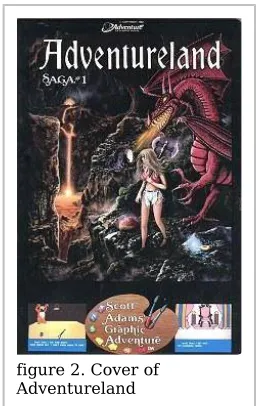
of role playing adventure games. Such games were incredibly successful for the first companies that exclusively made and sold computer games, like Adventure International, the company that in 1978 released the first version of Adventure for personal computers68, Adventureland. Unlike Colossal Cave
Adventure, Adventureland included graphics as well as text (see figure 269).
62 Castronova, E., (2007), Exodus to the Virtual World: How Online Fun is Changing Reality, Palgrave Macmillan, New York, pp. 59-60.
63 Boellstorff, T., (2008), Coming of Age in Second Life: An Anthropologist Explores the Virtually Human, Princeton University Press, Princeton, p. 22.
64 Linden Lab, Linden Lab Terms of Service, http://lindenlab.com/tos, Accessed 31/01/2014. 65 Linden Lab, Second Life Community Standards, http://secondlife.com/corporate/cs.php,
Accessed 14/06/2009.
66 From http://commons.wikimedia.org/wiki/File:ADVENT_--_Will_Crowther %27s_original_version.png
67 Jerz, D. G., (2007), "Somewhere Nearby is Colossal Cave: Examining Will Crowther's Original 'Adventure' in Code and in Kentucky", Digital Humanities Quarterly, Vol. 1, No. 2, http://www.digitalhumanities.org/dhq/vol/001/2/000009/000009.html, Accessed 31/01/2013.
68 TRS-80, Apple II series, Atari 8-bit, TI-99/4A, Commodore PET, Commodore 64, IBM-PC, Commodore VIC-20, ZX Spectrum, BBC Micro, Acorn Electron, Dragon 32/64, Exidy Sorcerer.
Role playing adventure games were among the earliest computer games and initially their worlds were described by means of text only. The user would log into the game and see only text which described the world. These games allowed users to interact with the game using simple text commands like 'look up', 'turn left' and 'get lamp'70. The game would then echo text to the screen
that described what the user was seeing. Even in this earliest of games the functionality to pick up and carry objects was provided. This adds vital interactivity to the game and is practically ubiquitous in contemporary role playing and adventure games.
[image:23.595.110.484.59.347.2]70 Scott, J., (2010), Get Lamp, http://www.getlamp.com/, Accessed 11/02/2014.
figure 1. Will Crowther's Colossal Cave Adventure
[image:23.595.233.362.496.699.2]Though both Adventureland and Colossal Cave Adventure were single player games, the latter ran on a PDP-10 mainframe71, these games were the
precursors of Multi User Dungeons (MUDs) - the first multiplayer real time virtual worlds. The first MUD was written in 1978 by an Essex University student, Roy Trubshaw72. In 1980 it became the first internet multiplayer
online role playing game when Essex University connected its internal network to ARPANet73. Once MUDs had been developed game space was
suddenly a shared space, and the rest is history. By 1992 there were more than 170 different multi user games on the net74. It is probably hard for those
who have had multi user games and the internet for their entire lives to imagine, but there was something magical about the first time one connected to a network and communicated with other actual humans via it.
Such games have a virtual space, but rather than being presented on the screen in exquisitely rendered detail, as in Second Life, the spaces are imagined using the information the game developer provides - "It's a virtual reality that exists in words"75. Though the space in such games was not
graphically represented it is nonetheless a world in the same way that, say, Tolkien's Middle Earth is a world. Its geography is described in detail and, once one becomes familiar with the world, one can wander freely in it. From this perspective text based MUDs are worlds even though we can't see them. While text based worlds were incredibly popular when they first arrived on the gaming scene they were not durable. Once graphically rendered worlds arrived text based worlds virtually disappeared. They did however spawn the genre of interactive fiction, which still endures. Role playing adventure games have an appeal that shooter type games don't. The actions of the user dictate the outcomes of the game to a much greater extent. No two players playing Adventure would have had the same experience because of the importance the player's imagination has in creating the world of the game.
A common criticism of virtual worlds is that they are somehow not real, or are less real, than the meatspace world because they are simulated. Comparisons with the meatspace world are usually the basis for discussions of what is real or not. If things are in meatspace they are real things. By this logic alone virtual worlds are real, however there remains a common perception that they are not truly in this world. Ever since the earliest computer environments things in the virtual have been simulations of, or modeled on, things in the meatspace world. For example the cave system in Adventure was modeled
71 Jerz, D. G., (2007), "Somewhere Nearby is Colossal Cave: Examining Will Crowther's Original 'Adventure' in Code and in Kentucky", Digital Humanities Quarterly, Vol. 1, No. 2, http://www.digitalhumanities.org/dhq/vol/001/2/000009/000009.html, Accessed 31/01/2013.
72 Bartle, R. A., (1990), Early MUD History, http://www.mud.co.uk/richard/mudhist.htm,
Accessed 31/01/2014.
73 Mulligan, J., Patrovsky, B., (2003), Developing Online Games: An Insider's Guide, New Riders Publishing, USA, p. 444.
74 Rheingold, H., (2000), The Virtual Community: Homesteading on the Electronic Frontier, The MIT Press, Cambridge, p. 149.
after part of the Bedquilt Cave in Kentucky76, and modeled so well that a
woman who had played the game and then went caving in Bedquilt Cave found she had no difficulty in navigating it77. This ability to simulate the real
for educational purposes is one of the great advantages of virtual worlds.
Although it is tempting to venture down the rabbit hole and ask the question of whether the real world is simulated, there is simply not space here to examine that thread adequately. Instead I shall say that simulations are real things. Our modern world is full of simulations; synthetic fibres, artificial flavours, fiat money, things that seem like other things but aren't quite them. Nonetheless these things are real. We know they are real because we can perceive them. I find myself in full agreement with Humphrey, who argues that perception is reality, that "to be conscious is essentially to have sensations: that is to have affect-laden mental representations of something happening here and now to me"78. All we know of the meatspace world we
know through our senses. Our senses report to our brain which builds a mental model of the world inside itself. We call that model reality. Perception then comprises the nature of the real and whatever we can perceive is in some way real. Repetition of perceptions strengthens the reality status of things perceived. The things we perceive are perceptual clouds, our knowing of them built up from the serial perceptions we have of them. Not each perception of a given object is exactly the same, but they share enough similarity for us to group them together in a cloud of knowing and to thus identify them as being the same thing. Unless we gain omniscience we cannot know a thing as it objectively is, we can only know our perceptions of it. Our perceptions are therefore our reality. This space that we can perceive, or imagine we perceive, in text based worlds makes them virtual worlds. Once we have perceived things we remember, and repeat, and remix those perceptions and they become our new creations.
While the aforementioned text based worlds certainly have perceivable space this definition alone is not very useful when trying to talk about the online virtual worlds we have today. It is too broad. Bartle defines the world part of virtual worlds as "A world is an environment that its inhabitants regard as being self-contained. It doesn't have to mean an entire planet: It's used in the same sense as 'the Roman world' or 'the world of high finance'"79. This
definition focuses on the space alone, and while that is enough to make it a world, what is captivating about a virtual world for me is that I can interact with the space. Early on much of Second Life was just a dressed set, a backdrop against which one could set scenarios of one's choice. Interaction was very limited indeed. While a world is still a world even if one can't interact with it, it's much more engaging if one can. Most of the early
76 Montfort, N. (2003), Twisty Little Passages: An Approach To Interactive Fiction, The MIT Press, Cambridge.
77 Adams, R., The real 'Colossal Cave', http://www.rickadams.org/adventure/b_cave.html,
Accessed 31/01/2014.
78 Humphrey, N., (1992), A History of the Mind: Evolution and the Birth of Consciousness, Simon & Schuster, New York, p. 155.
interaction in Second Life wasn't very engaging, and was with other avatars, rather than with objects, as interactive objects were difficult to construct and often clumsy.
Castronova includes others to interact with in his definition when he describes virtual world as "crafted places inside computers that are designed to accommodate large numbers of people"80. Second Life is certainly crafted, but
it is not a good exemplar of a space that accommodates large numbers of people. The maximum number of avatars one can have in a sim is 40, though in practice this number is lower, as sim performance is drastically effected as avatar numbers increase. Raph Koster, a virtual world developer, also sees the presence of others as vital and he includes the presence of avatars in his definition, "a virtual world is a spatially based depiction of a persistent virtual environment, which can be experienced by numerous participants at once, who are represented within the space by avatars81. While the presence of
avatars makes it easier to relate to others, their absence doesn't preclude the environment from being a virtual world, the world is still there. This definition, like Lortz's, excludes not only single user worlds but also worlds where the user is not represented as an avatar but can still act in the world, such as worlds where the purpose of the world is its building rather than its habitation by avatars. It also excludes the worlds of literature.
Bell focuses on the synchronicity of the humans rather than the world in his definition, "A synchronous, persistent network of people, represented as avatars, facilitated by networked computers"82. Lastowka83 likewise sees the
social aspects as vital, "Virtual wolds are persistent, interactive, simulated social spaces where users employ avatars". Although I find Lastowka's definition the most agreeable, like other definitions that exclude single user worlds, I find it somewhat problematic. I can run an instance of OpenSimulator, an open source virtual world server, on my desktop computer, not connected to the internet, and enter a virtual world where I am the only person who can enter it. Even though I am alone there, it is still a world, my world, and I can interact with it. Indeed I often do this because I am fascinated by building worlds and find building its own reward, never intending to share those spaces with others, nor even inhabiting them myself as an avatar. Having others around is nice, but it's not a conclusive defining feature of a virtual world, while space and interactivity in that space are. Whether that interaction be imaginal or visual is not important. Whether it be solitary or communal is also not important. But what about avatars? Whether or not the user is graphically represented or not is not crucial. I consider text
80 Castronova, E., (2006), Synthetic Worlds: The Business and Culture of Online Games, University Of Chicago Press, Chicago.
81 Combs, N., (2004), A virtual world by any other name?,
http://terranova.blogs.com/terra_nova/2004/06/a_virtual_world.html, Accessed 31/01/2014.
82 Bell, M. W., (2008), "Toward a Definition of 'Virtual Worlds'", Journal of Virtual Worlds Research, Vol. 1, No. 1, p. 2.
based worlds to be virtual worlds. Text based games have avatars too, although the player has to imagine them and describe them to others by means of text.
The first computer game to represent users as graphical avatars was Maze War, written in 197384
[image:27.595.66.212.109.331.2]The players were represented as eyeballs (see figure 385).
Akalabeth: World of Doom, one of the earliest examples of a role paying video game86 shows the
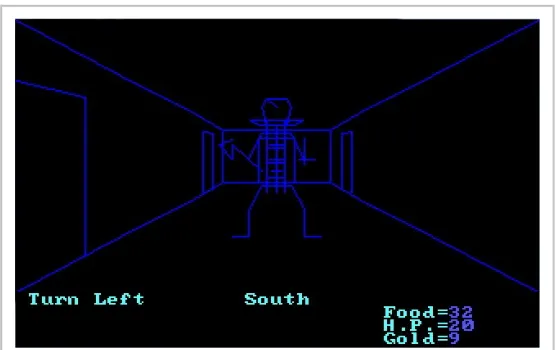
player only as a cross in the top down view of the playing field, but introduced an important innovation, the first person perspective (see figure 487)88. Another approach taken by an early graphical
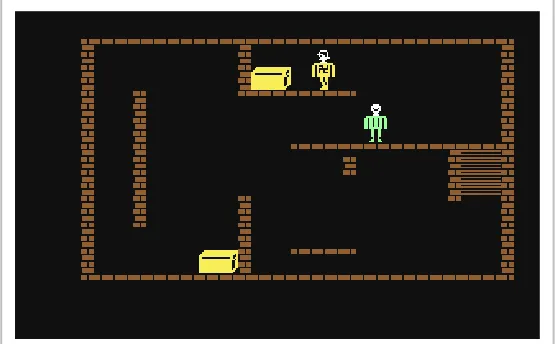
game, Castle Wolfenstein (see figure 589), is to show
the playing field and the player's avatar, from a side view. However I prefer the first person view as it seems to me to provide a greater sense of immersion in the space.
84 Damer, B. F., (1997), Avatars! Exploring and Building Virtual Worlds on the Internet, Peach Pit Press, Berkeley.
85 From http://en.wikipedia.org/wiki/File:Maze_war.jpg
86 Barton, M., (2009), Dungeons and Desktops: The History of Computer Role-playing Games, A. K. Peters Ltd, Wellesley, p. 1.
87 From http://en.wikipedia.org/wiki/File:Akalabeth.jpg
88 Scorpia, (1991), "C*R*P*G*S: Computer Role-Playing Game Survey", Computer Gaming World, No. 87, p. 108.
[image:27.595.159.437.401.576.2]89 From http://en.wikipedia.org/wiki/File:CastleWolfensteinC64.png figure 4. Akalabeth Screen Shot showing the first person perspective. In this shot the humanoid form is a skeleton the player is fighting.
While these two games have very basic avatars and functionality by today's standards, they already contain all the basic features found in contemporary worlds; avatars, three dimensional representation of space, ability to collect and use objects and text entry. These basic functions form the core of contemporary worlds, which have extended and expanded them into more complex forms. For example, avatars are obviously much more complex and sophisticated in today's games and virtual worlds than Maze War's eyeballs, with most offering a huge array of customization of player avatars. The first customisable experience one encounters in Second Life is one’s avatar. Most avatars are humanoid, but this is not because non humanoid avatars are not possible, on the contrary, one’s avatar can be anything at all. I have seen toadstools, cardboard boxes, robots, dragons, clouds, giant eyeballs and many kinds of chimera, of which furries (human-animal hybrids) are the most prevalent. Most users create humanoid avatars of the same sex as their meatspace selves, though 72% have at some time created an avatar of the opposite sex90.
I have argued that neither avatars nor the presence of others are essential, and moreover that being connected to a network is also not vital, and indeed that text based games, which don't even necessarily require a computer to create a world - for example Dungeons and Dragons, are still virtual worlds. Consequently I offer a definition of virtual worlds as persistent simulated or imaginal spaces that facilitate user interaction with that space. I feel this definition encompass all possible virtual worlds; the worlds of literature, text based games, MUDs of all kinds, graphical worlds and fully immersive three dimensional worlds like Second Life. If one wishes to stipulate, qualifiers can be added. Thus Second Life is a persistent, simulated, multi user, graphical online world where residents interact by means of avatars.
90 Bell, M. W., Castronova, E., Wagner, G. G., (2009), Surveying the Virtual World: A Large Scale Survey in Second Life Using the Virtual Data Collection Interface (VDCI),
[image:28.595.159.439.300.472.2]http://ssrn.com/abstract=1418562, Accessed 01/02/2011.
Games In The World
Though Second Life is itself not a game, there are many games played in Second Life91. Many of these games have been created in, and are specific to,
Second Life. For example the extremely popular game of Primtionary. This is a variation on Pictionary, though instead of drawing the word in question one must build it out of prims, the basic geometric shapes from which everything in the world is built. Shooting games of various types are also extremely popular. Scoring is usually effected through some kind of software meter that is not part of the software client but is a thing that the players wear which is paired with specially designed weapons. The meter keeps track of damage by recording the number of times an opponent's weapon hits the player. When a player has been hit a certain number of times the meter will declare them dead. The player then will either be immobilized for a set period of time or logged out of the game, thus incurring a penalty of the time it takes to log in again. There is capacity built into Second Life for an avatar to take damage92.
However this only records damage taken by falling or colliding with physical objects and is optional, it must be discretely turned on in each sim. Most sim owners do not turn it on as it is very easy for a falling avatar to die and thus get evicted from the sim by accident and it allows some forms of griefing (the deliberate destruction or disruption of other's builds or activities) where player's avatars can be pushed around.
By far the most popular type of game in Second Life is role playing93. Lortz94
explains that a role playing game is a game which allows a number of players to assume the roles of imaginary characters and operate with some degree of freedom in an imaginary environment. The obvious deficiency of this definition is that it overlooks games where people are role playing non imaginal characters, such as historical ones or the case of role playing one's self. Some may argue that role playing one's self is not really role playing. Goffman95
would disagree. Likewise this definition does not include non imaginal worlds or single player games.
91 Second Life Destination Guide, Games, http://secondlife.com/destinations/games,
Accessed 31/01/2014.
92 Second Life Wiki, Damage, http://wiki.secondlife.com/wiki/Damage, Accessed 31/01/2014. 93 Leigh, M., Elwell, M., Cook, S., "Recreating Ancient Egyptian Culture in Second Life",
Proceedings of 2010 IEEE International Conference on Digital Game and Intelligent Toy Enhanced Learning, pp. 114-118.
94 Lortz, S. L., (1979), "The Way of the Gamer: Dramatic Structure of RPGs", Different Worlds, Albany, Issue 2, pp. 32-35.