This is a repository copy of
Defining a 3-dimensional trishear parameter space to
understand the temporal evolution of fault propagation folds
.
White Rose Research Online URL for this paper:
http://eprints.whiterose.ac.uk/80599/
Version: Supplemental Material
Article:
Pei, Y, Paton, DA and Knipe, RJ (2014) Defining a 3-dimensional trishear parameter space
to understand the temporal evolution of fault propagation folds. Journal of Structural
Geology, 66. 284 - 297. ISSN 0191-8141
https://doi.org/10.1016/j.jsg.2014.05.018
[email protected] https://eprints.whiterose.ac.uk/
Reuse
Unless indicated otherwise, fulltext items are protected by copyright with all rights reserved. The copyright exception in section 29 of the Copyright, Designs and Patents Act 1988 allows the making of a single copy solely for the purpose of non-commercial research or private study within the limits of fair dealing. The publisher or other rights-holder may allow further reproduction and re-use of this version - refer to the White Rose Research Online record for this item. Where records identify the publisher as the copyright holder, users can verify any specific terms of use on the publisher’s website.
Takedown
If you consider content in White Rose Research Online to be in breach of UK law, please notify us by
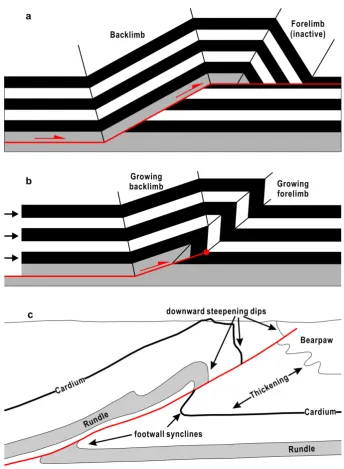
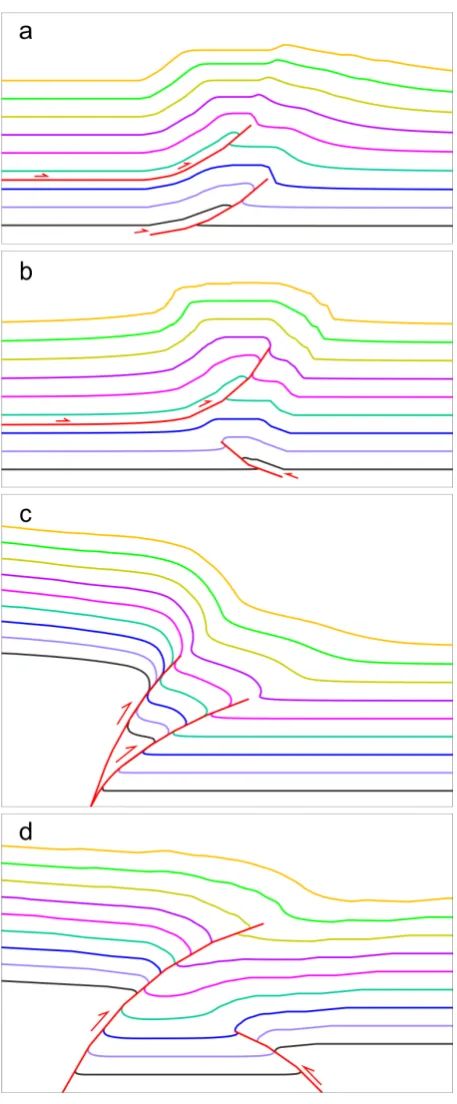
Figure 1. Fault-bend fold and fault-propagation fold based on kink bend method (a, b) 2
(Suppe, 1983; Suppe and Medwedeff, 1990) and a natural example showing variable 3
layer thickness (c) (Allmendinger, 1998). 4
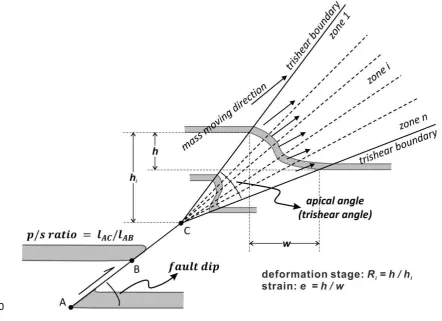
Figure 2. Conceptual model of trishear algorithm, based on Hardy and Ford (1997). 5
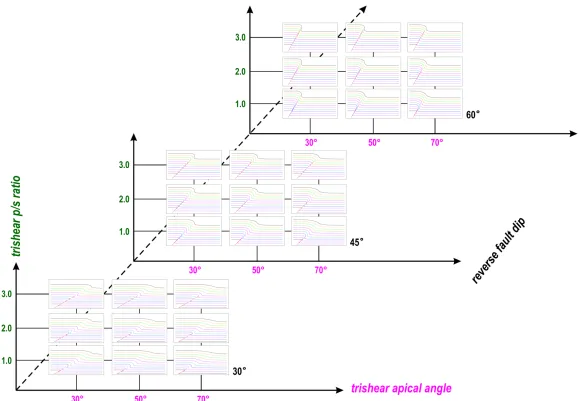
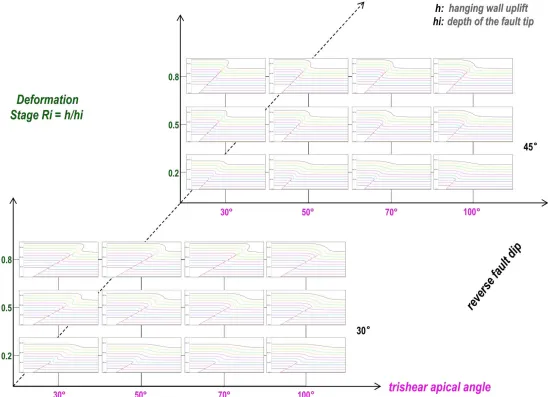
Figure 3. Three-dimensional parameter space with corresponding trishear models. 6
The three axes represent the trishear p/s ratio, the trishear apical angle and the 7
reverse fault dip, respectively. 8
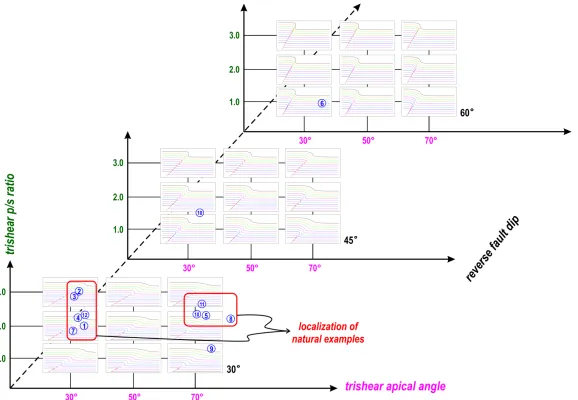
Figure 4. Clusters of natural trishear examples in the three-dimensional parameter 9
space. In the parameter space, 13 natural examples are plotted in and two clusters 10
are observed. The clusters suggest that the most applicable trishear p/s ratio is 2-3 11
and the trishear apical angle varies from 30° to 100°. The majority of these natural 12
trishear examples show shallow fault dips of 25°-45°. 13
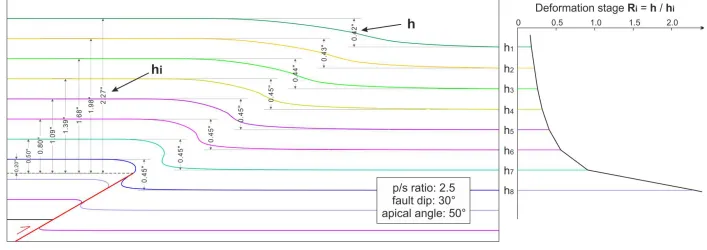
Figure 5. Diagram delineating the impact of the selection of the reference level, i.e., 14
the horizon used to calculate the deformation stage . Here a trishear model (left) 15
with the parameters p/s ratio of 2.5, fault dip of 30° and apical angle of 50° is 16
selected, in which we only calculate the of the horizons that have not been 17
propagated through by the underlying fault. The deformation stage is not unique 18
for a trishear model, but is variable for different horizons. The right diagram suggests 19
a decreasing value from h8 to h1 upward through the model. 20
Figure 6. Parameter space of trishear models with suggested parameters from the 21
clusters of natural trishear examples. 22
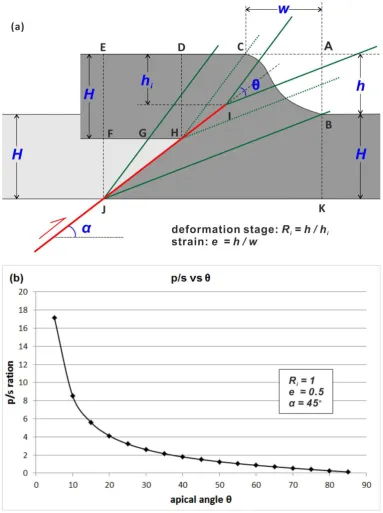
Figure 7. Quantification of strain (ratio of hanging wall uplift versus folded bed width) 23
associated with trishear algorithm. The figure (a) delineates the trigonometric 24
generated with known strain = 0.5, deformation stage = 1 and fault dip = 45° 26
in (b). 27
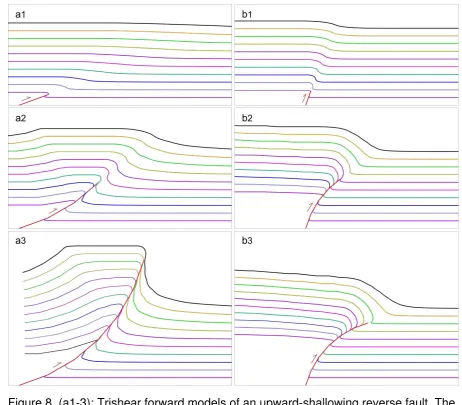
Figure 8. (a1-3): Trishear forward models of an upward-shallowing reverse fault. The 28
fault dip changes from 20° to 70° upwards with a stepwise increment of 10°. (b1-3): 29
Trishear forward models of an upward-shallowing reverse fault. The fault dip changes 30
from 70° to 20° upwards with a stepwise decrement of 10°. 31
Figure 9. Trishear forward models of reverse faults affected by pre-existing faults. (a 32
& b) upward-steepening reverse faults developed above deeper pre-existing reverse 33
faults. (c & d) upward-shallowing reverse fault developed above deeper pre-existing 34
reverse faults. Pre-existing faults with the same or opposite thrusting directions are 35
all simulated. 36
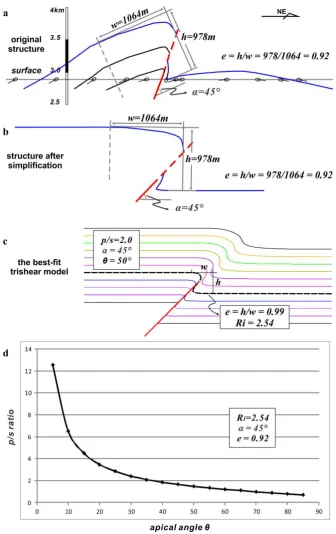
Figure 10. The workflow of applying trishear algorithm to the Lenghu5 structure, 37
Qaidam Basin, Northern Tibetan Plateau. 38
Figure 11. The forward trishear models depicts the structural evolution of the 39
Lenghu5 structure by allowing multiple curved reverse faults in trishear forward 40
modelling. 41
42
Table 1. A cluster of natural trishear examples in published studies and their 43
corresponding best-fit parameters. 44
Figure 1. Fault-bend fold and fault-propagation fold based on kink bend
meth-47
od (a, b)
(Suppe, 1983; Suppe and Medwedeff, 1990)
and a natural example
48
showing variable layer thickness (c)
(Allmendinger, 1998)
.
50
Figure 2. Conceptual model of trishear algorithm, based on
Hardy and Ford
51(1997)
.
Figure 3. Three-dimensional parameter space with corresponding trishear models. The three axes represent the trishear p/s ratio,
54
the trishear apical angle and the reverse fault dip, respectively.
56
Figure 4. Clusters of natural trishear examples in the three-dimensional parameter space. In the parameter space, 13 natural
ex-57
amples are plotted in and two clusters are observed. The clusters suggest that the most applicable trishear p/s ratio is 2-3 and the
58
trishear apical angle varies from 30° to 100°. The majority of these natural trishear examples show shallow fault dips of 25°-45°.
Figure 5. Diagram delineating the impact of the selection of the reference level, i.e., the horizon used to calculate the deformation
61
stage
. Here a trishear model (left) with the parameters p/s ratio of 2.5, fault dip of 30° and apical angle of 50° is selected, in
62
which we only calculate the
of the horizons that have not been propagated through by the underlying fault. The deformation
63
stage
is not unique for a trishear model, but is variable for different horizons. The right diagram suggests a decreasing
value
64
from h8 to h1 upward through the model.
66
Figure 6. Parameter space of trishear models with suggested parameters from the clusters of natural trishear examples.
Figure 7. Quantification of strain (ratio of hanging wall uplift versus folded bed width)
69
associated with trishear algorithm. The figure (a) delineates the trigonometric
rela-70
tionship among the variables, while the apical angle versus p/s ratio plot is generated
71
with known strain = 0.5, deformation stage
= 1 and fault dip
= 45° in (b).
73
Figure 8. (a1-3): Trishear forward models of an upward-shallowing reverse fault. The
74
fault dip changes from 20° to 70° upwards with a stepwise increment of 10°. (b1-3):
75
Trishear forward models of an upward-shallowing reverse fault. The fault dip
chang-76
es from 70° to 20° upwards with a stepwise decrement of 10°.
[image:11.595.64.527.68.473.2]Figure 9. Trishear forward models of reverse faults affected by pre-existing faults. (a
79
& b) upward-steepening reverse faults developed above deeper pre-existing reverse
80
faults. (c & d) upward-shallowing reverse fault developed above deeper pre-existing
81
reverse faults. Pre-existing faults with the same or opposite thrusting directions are
82
all simulated.
84
Figure 10. The workflow of applying trishear algorithm to the Lenghu5 structure,
85
Qaidam Basin, Northern Tibetan Plateau.
hu5 structure by allowing multiple curved reverse faults in trishear forward modelling.
[image:14.595.151.446.69.726.2]Tables
90
Table 1. A cluster of natural trishear examples in published studies and their corresponding best-fit parameters.
91
Ref
No. Structure names
Basement-involved p/s ratio apical angle fault dip
Scale, fault slip
or stratigraphy Example Sources
1 Turner Valley, Rocky Mountain No 2.0+ 37 25 Scale: 12km*30km (section width*depth); fault slip: 10km;
Hardy and Ford (1997)
2 Tejerina Fault, Spain No 3.0+ 35 30 Scale: 0.8km*1.2km; fault slip: 250m; stratigra-phy: conglomerates with thin shales;
Hardy and Ford (1997)
3 Broad Haven, Pembrokeshire No 3.0+ 35 24 Scale: 6m*10m; fault slip: 2m; Hardy and Ford (1997)
4 Hudson Valley, New York No 2.5 30-35 36 Scale: 2km*3km; fault slip: 0.3km; Allmendinger (1998)
5 Rangely anticline, W US No 2.3 76 38 Scale: 6km*12km; fault slip: 4.2km; Allmendinger (1998)
6 Reelfoot Fault, Proctor, US Yes 0.9 36 80 Scale: 0.5km*0.8km; fault slip: 52m; Champion et al. (2001)
7 Filo Morado structure, W Neuquen basin
No 1.9 35
30-40
Scale: 4km*10km; fault slip: 8.7km; stratigra-phy: thick units (evaporates & shales)
Allmendinger et al. (2004)
8 Waterpocket anticline, S Utah No 2.25 105 35 Scale: 5km*10km; fault slip:3.8km; Cardozo (2005)
9 Rip Van Winkle anticline, New York
No 1.5 90 25 Scale: 5km*8km; fault slip:43m; stratigraphy: wackstone, packstone and grainstone;
Cardozo et al. (2005)
10 Dalong fault, Gansu, China Yes 1.5 30 50 Scale: 5km*10km; fault slip:669m; stratigraphy: basement + cover (terrestrial clastic sediments);
Gold et al. (2006)
11 Chelungpu fault, Taiwan No 2.5 80 35 Scale: 5m*40m; fault slip: 6m; stratigraphy: clay, silt clay with sand;
Lin et al. (2007)
12 Hudson Valley, New York No 2.4 36 35 Scale: 2km*3km; fault slip: 0.3km; Cardozo and
Aanonsen (2009)
13 Santa Fe Springs anticline, Los Angeles basin
No 2.52 71 29 Scale: 7km*12km; fault slip:6.7km; Cardozo and