nuclear science and technology
^:-}?^fim*f*er?;l!''it'-> 'i-jfipc
The Communities R&D Programme
RADIOACTIVE WASTE MANAGEMENT AND STORAGE
(
First annual Progress Report )
&:r^iA&"i3ri&^i;"
Blow-up from microfiche original
The Communities R&D Programme
RADIOACTIVE WASTE MANAGEMENT AND STORAGE
( First annual Progress Report )
nuclear science and technology
The Communities R & D P r o g r a m m e
RADIOACTIVE WASTE MANAGEMENT AND STORAGE
(First annual P r o g r e s s Report)
Direct or ate-General
The E u r o p e a n Community's p r o g r a m m e is the first and
to this date the only joint international action dealing with those
i s s u e s , which might well become decisive for the future of nuclear
energy - the management and storage of radioactive w a s t e .
The first Annual P r o g r e s s Report d e s c r i b e s the scope and the state
of advancement of t h i s indirect action p r o g r a m m e . At p r e s e n t 24
r e s e a r c h c o n t r a c t s with r e s e a r c h institutes in almost every m e m b e r
country of the EC a r e either signed or in the final stages of negociation.
The objective of the R & D actions to be achieved by 1980 is the
d e m o n s t r a t i o n of either the technical potential or, for further advanced
p r o j e c t s , the feasibility and even the i n d u s t r i a l availability of methods
for t r e a t i n g and stoping r a d w a s t e . The following a s p e c t s a r e investigated:
- p r o c e s s i n g of solid waste from r e a c t o r s , r e p r o c e s s i n g plants and the
plutonium manufacture;
- i n t e r m e d i a t e and t e r m i n a l storage of high activity and alpha w a s t e s ;
- advanced waste management methods as the storage of gaseous waste
and the separation and t r a n s m u t a t i o n of a c t i n i d e s .
In addition to the scientific-technical R & D actions, a survey of
the legal, a d m i n i s t r a t i v e and financial p r o b l e m s encountered in r a d w a s t e
management and storage is an e s s e n t i a l part of the C o m m u n i t i e s '
FOREUORD 1
1 . TREAlQiiET OF LOti AI7D fcSDIUK LEVEL W/jSTiS
1.1 kobile plants for r e s i n imbedding of reactor waste 3
1.2 Stationary r e s i n imbedding with the CEA technique 6
2 . DSCOlTTAlJITATIOSr Alfi) COITDITIOITIITG OF IRR. FUEL ELii-ZEEPT CLADDIiTG
2.0 Introduction and description of the waste 7
2.1 Incorporation in low melting alloys 7
2.2 Incorpors;bion in concrete 12
2.3 Decontamination and conditioning in glass 16
2.4 Characterization of the radioactivity in cladding waste 21
2."} Assessment of the various types of cladding 23
3. HiT,HT.3tlAi
:I01T OF PLUTOIilUi, COITTAkliTATED WASTE
3«1 High temperature incineration 2o
3.2 Acid digestion process 37
3.3 Incineration in molten salts 4l
4. PROPERTIES OP SUBSTANCES SUITABLE FOR HIGH LEVEL VJASTE
SOLIDIFICATIOI-7
4*1 Introduction 'i-3
4«2 Scope of the programme ^3
i|-»3 Iieasuring and test equipment 47
4«4 Reference substances 4<->
i;..J Coordination of the programme 49
3. EITGI1TEERED STORAGE FOR SOLIDIFIED HIGH LEVEL iJASTE
5«1 ScoT)e of the programme 51
3.2 Stage I : Common reference data and options 31
Chap. P ase
6 . LONG TERM STORAGE AND DISPOSAL III GEOLOGICAL FORLiATIONS
6 . 1 C a t a l o g u e of s u i t a b l e g e o l o g i c a l f o r m a t i o n s 5&
6.2 S t o r a g e i n s a l t domes 37
6 . 3 S t o r a g e i n c r y s t a l l i n e f o r m a t i o n s I ° ^
6 . 4 S t o r a g e i n c r y s t a l l i n e f o r m a t i o n s I I 63
6 . 3 S t o r a g e i n cla.y f o r m a t i o n s OD
7 . STORAGE OP GASEOUS WASTE TO
8 . SEPARATION AND TRANSMUTATION OP ACTINIDE3 ■ 73
9 . DEFINITION OP LEGAL, ADkllTISTRATIVE AND FINANCIAL
3E
radioactive waste management and storage (indirect action) of the Commission of the European Communities.
The five year programme, ending 31 December 1979 was approved by the Council of Ministers on 26 June 1975.
The Council decision is based on the two following considerations - "Nuclear energy is bound in the near future to become one of the
main sources of energy alongside traditional sources, and its specific nature requires permanent monitoring of its potential effects and improved measures and research to protect the envi-ronment ;
- The development of nuclear energy inevitably involves the production of radioactive waste, and it is therefore essential to find effective means for ensuring the safety and protection of both man and his environment against the potential hazards involved in the management of such waste".
The programme is carried out by contracts on an expense sharing basis with public or private qualified agencies of the Community ; the Commission's financial participation amounts to 19,16 million units of account • A Consultative Committee of national experts
no-minated by their governments assists the Commission for the management of the programme.
The aim of the programme, as indicated in the annex of the Council decision, is the joint development and perfecting of a system of manage-ment of radioactive waste produced by the nuclear industry which, at it3 various stages, affords man and his environment the best protection possible.
The principal items of the programme are the following :
A. Work to solve certain technological problems posed by the processing, storage and disposal of radioactive waste.
* OoJ. Br. L 178/28, 9.7.1975
Processing :
- medium a c t i v i t y solid waste : coating with p l a s t i c r e s i n s ;
- High-activity solid waste : decontamination and conditioning
of i r r a d i a t e d fuel element cladding ;
- h i g h - a c t i v i t y solid waste : immobilization of calcined waste
from fission products in a metal matrix ;
- plutonium-contaminated solid waste : incineration process ;
- comparative study of the properties of various materials
suitable for the immobilization of h i g h - a c t i v i t y waste*
Storage and disposal :
- storage of s o l i d i f i e d radioactive waste in engineered
structures ;
- disposal of radioactive waste i n suitable geological
formations, including those formations currently being studied ;
- storage of gaseous wasteo
Study of an advanced management model :
- separation and recycling of long-life waste (actinides),
B, Work contributing towards the definition of a general framework (legal, administrative, financial) for the implementation of radioactive waste storage and disposal measures :
- review of problems posed by the management of radioactive waste which could not be solved under existing international
legal, administrative and financial provisions and proposals for solutions ;
- study of principles which should govern the management of radioactive waste*
The programme is closely coordinated with thfc activities related to the radioactive waste management conducted by the Common Research Center of the CEC within its pluriannual Research programme
(direct action).
This report covers the period from 1st January 1976 to 1st December 197o.
1. TREATMENT OF LOW AND MEDIUM LEVEL WASTE
1.1 Mobile Pilot Plants for Resin Imbedding of Reactor Waste
1.1.1 Objective and scope of the programme
The contract with STEAG Kernenergie GmbH aims at the development
of a technique to immobilize and condition low and medium active reactor waste (mainly from water reactors).
The intention is to imbed the waste in plastic resins. The resulting solid products shall be examined in respect to their compliance to the requirements for intermediate and terminal storage. Active operation of a pilot plant should demonstrate the industrial availability and range of application of the techniques developed under this contract.
The programme will proceed in five stages :
a) Preliminary investigation
b) Study and choice of candidate resins and conditioning methods c) Laboratory studies and technical experiments with inactive and
active waste
d) Commissioning tests and experimental operation of the pilot plant on a reactor site
e) Data processing and analysis of the results.
1.1.2 Preliminary investigation
1.1.2.1 Range of application
The various categories of reactor waste (see Fig. l) should be reviewed in order to determine, for which types of wastes the proposed technique promises to be applicable.
The common waste types should be grouped according to the urgency of treatment in respect to the amounts and volumes generated, the risk arising to the public and the lack of satisfactory techniques of immo-bilization.
1.1.2.2 Requirements concerning the product (conditioned waste)
The main criteria for acceptance of this type of solidified waste to storage facilities will be :
- leach resistance, - radiation resistance, - structural strength,
- long term physical and chemical stability, - resistance against bacteria and
- flammability.
1«1«2#3 Requirements concerning the resin
The criteria for the choice of the resins will also be examined. These will be defined to comply with the following requirements :
- safety of handling (flammability, toxicity of the resin) - safety of storage and in the process,
- ease of control of the chemical reactions and - compatibility with the incorporated waste.
1»1»3 Study of the resins and the conditioning techniques
1«1«3»1 Choice of suitable resins
The criteria established in 1.1.2.2 and 1.1.2.3 permit a first selection of candidate materials. Although information on most of the relevant properties is available, some data may have to be measured or verified by lab experiment.
The following general categories of resins have been short listed : a) polyurethanes ,
b) unsaturated polyesters, c) polystyrenes and
d) epoxy resins .
Further alternatives can be examined, if promising.
1.1.3.2 Testing of the candidate materials
The following aspects will be investigated by laboratory experiments :
- variation of the reaction rate with waste composition, - determination of leaching rate,
- influence of additives for controlling the solidification and water absorbtion,
- optimal ratio of waste/resin volumes.
1.1»3«3 Technical experiments
The best mixing technique for obtaining a homogeneous product will be determined. The unit operations to be tested are :
- pouring, - injecting,
- sedimentation and - stirring.
For this purpose pilot-scale experimental equipment will be assembled.
1»1«3«4 Prototype development
Once the suitable mixing operation has been determined, further technical experiments on existing equipment are scheduled with inactive,
simulated waste.
These tests are intended to provide the necessary information : - on the mixing stage,
- waste preparation (drying, chemical pre-treatment), - control of solidification reaction and reaction heat, - off-gas treatment (if necessary),
- transport of moist waste from the tanks to the conditioning plant, - remote control mechanisms and
- corrosion and wear of moving components.
A series of tests simulating certain accidental conditions will be run, if these conditions cannot be assessed by other means.
The operating conditions and the production sequence will be examined under the aspects of safety, reliability and economy.
Further tests for the development of the main plant components will use representative, low-active waste. These tests serve to assess :
- the operational radiation exposure to the personnel ,
leach resistance,
volume ratio waste/resin (or waste/prodt.■+,) obtainable, safety and economy of paokjng material and
radiation stability of the product.
3.I,A Operation of a prototype plant
The design and construction of the prototype plant are not covered
by this contract, as STEAG has undertaken to build the plant for commercial
exploitation and finances this investment itself.
However, the commissioning phase and a first series of operation runs of
the mobile plant on a reactor site that will provide the final experimental
evidence for the validity of the technical concept, are incorporated in the Community programme.
All operative data and the experiences gained until il December 1979 will be reported.
Samples of routine and nonrontine rims will ')«.. examined and the reliability •ad availability of the plant will be recorded.
'J'iier.dxation exposure of the personnel will be reported by the station's he^it'i physicists.
Inn licences for the opcratix of the plant on •■>. r^pc/hor Fite and for accep t.u.ce of the conditioned pre'vot for transport and terninal otora^e at the Air.o "jalt mine will be obtained by GTil/iG*
i.^ Stationary resin inbeddvi.?:with tho 0..;Afohn'.•"■o
Contractual nagocxatior towardc; particio'vti.ir m tbe operational exoe rience of a nolyestor reain inbedcling plart at '5hooz WJ1"' only be/<'in in
2.0 Introduction and description of waste
The claddings of fuels irradiated in nuclear reactor have ax'ter removal of the fuel still a high radioactivity, which identifies then as high level waste. There are two sources of this activity :
- activation products formed by neutron exposure of constituents of the cladding or deposited by reactor coolant
- fission products, transuranic elements from the fuel and
their interaction products. These may be present as undissolved fuel, as a surface layer or inside the cladding material, as a result of diffusion or implantation.
The waste arising from the reprocessing of fuels, contains, in addition to hulls, structural materials such as spacersf springs, tie
rods and end pieces.
The present expedient of under-water storage in concrete silos on the premises of the reprocessing plant is not a satisfactory long-term solution.
The research programmes investigating the various decontaminating and conditioning methods and characterizing the activity of the hull3 are described in Chapter 2.1 to 2.4.
2.1 Incorporation in low melting alloys (CEET)
The objective of this study is to develop a, method of conditioning' of cladding waste, which consists of press compaction and embedding of the hulls in a low melting alloy. The final product had to be appro-priate for long-term storage.
The reference material is the cladding waste generated by reprocessing of light-water-reactor fuels. This metal scrap, halving a density of about 1.1 Kg/dm3, is composed of Zircaloy-4 hulls (70-80 wt cp) and struc-tural materials in inconel and stainless steel. The research works, al-ready started on 1st November 1976, will be accomplished at the end of
2.1.1 Study of filling alloys
2.1.1.1 Literature review and basic selection of filling alloys
Literature data on the following characteristics of potential filling alloys will "be compiled : melting point, thermal expansion, contraction at solidification, interactions with cladding waste mate-rials, corrosion in water, cost and availability.
On the basis of these data suitable alloys will be selected for in-vestigation in the present study.
2.1.1.2 Experimental investigation of suitable alloys (inactive tests)
In case of insufficient literature data the following pheno-mena will be studied :
- Interactions with waste components (Zircaloy, stainless steel, Inconel),
- Wettability of waste components
- Corrosion of samples with and without embedded waste components in pool water and ground water.
The following analytical techniques will be used :
- microscopic examination and / or microprobe analysis - measurement of weight change for corrosion experiments - chemical analysis.
2.1.1.3 Hot cell tests with cladding samples from spent fuel elements
a) Tests and analytical techniques
- Dispersion of transuranics and fission products in filling alloys ; alpha and gamma radiography
- Long-term leach tests on cladding samples embedded in
filling alloy j gross alpha and gross beta-gamma radiometry ; alpha and gamma spectrometry
b) Gladding samples
- Origin : BR-3 fuel elements irradiated to a burn-up of 15 to 30 MWd/kg
2.1.2 Experimental investigation of press compaction
Preliminary tests will be done in order to establish that satisfactory penetration of compacted blocks can be achieved.
If the result of these tests is positive, as is expected, work will be continued as outlined in paragraphs 2.1.2 and 2.1.3, and work out-lined in paragraph 2.1.4 will not be done* If the result of the preli-minary tests is negative, work is negative, work will proceed on paragraph 2.1.4 instead of paragraphs 2.1.2 and 2.1.3, which will be dropped.
a) Results tt) be obtained
- Determination of required press force - Effects of loading height
- Effects of grids and massive structural materials on densification factor
- Measurement of heat generated during compaction
b) Operating conditions
- Inactive material without and with pretreatment (hydrogen embrittlement in order to simulate post irradiation
conditions)
- Presses of 150 t and 600 t force - Maximum diameter of die : 150 mm - Atmosphere : air
- Temperature : ambient
c) Examination
Determination of density and porosity.
2.1.3 Development of a process for filling compacted blocks
a) Results to be obtained
- Development of the appropriate procedure
- Optimizing of process parameters (filling temperature ; pressure conditions ; etc)
- Quality control of product (completeness of filling, wetting)
b) Operating conditions - Inactive material
c) Examination - Metallography
- Determination of porosity.
2.1.4 Development of a process for compaction in presence of filling alloy
(This process promises better assurance of complete filling than the .process considered in paragraph 2. .1.3)
a) Results to be obtained
- Development of the appropriate procedure
- Optimizing of process parameters (pressing temperature, etc) - Quality control of product (homageneity of filling, wetting) - Other results as in 2,1.2.a)
b) Operating conditions - Inactive material
- Engineered test unit (to be constructed) - Presses of 150 t and 600 t force
- Maximum diameter of die : 150 mm
c) Examination - Metallography
- Determination of porosity
2 .1.5 Conceptual study of a reference process
This study will provide the information needed for the comparison of the different methods. Requirements for a 300 tu/y reprocessing plant will be evaluated and the results will also be extrapolated to a 1500 tU/y plant. Cost estimates for both plant capacities will be provided.
2 .1.5.1 Definition of a reference process
2.1.5.2 Definition of optimal dimensions and of packaging of the briquettes
This will include :
- Heat transfer calculations
- Evaluation of shielding requirements - Consideration of manipulation aspects
2.1«5»3 Safety and environmental impact
The following aspects concerning the safety and environmental impact will he studied :
- Evaluation of process hazards, particularly due to pyrophorocity of Zircaloy ; definition of the required engineered safeguards.
- Estimation of secondary iiraste and effluents produced.
2.1.6 Conceptual study of a hot cell unit
This experimental unit shall be able to perform all operations of the reference process with the active waste material.
The study will include :
- Consideration of safety aspects
- Conception of the remotely operated machinery and supply of assembly drawings
- Cost estimate.
_2»2 Incorporation in concrete (G«f»Kj
The research programme of the contract is aimed at the following topics :
- Development of a special conditioning method :
Volume reduction "by rolling and subsequent embedding in concrete.
- Theoretical comparative study of the different conditioning methods.
The reference material is the same as defined in chapter 2.1. All con-ceptual studies and cost estimates will be based on an amount of 580 t. waste per year, arising from a reprocessing plant with a capacity of
1400 t U/year.
The programme will be carried out from 1st November 1976 to the end of 1979.
2.2.1 Conditioning by rolling and embedding in concrete
2.2.1.1 Characteristics of concrete
A review of candidate concrete types and the criteria of selection will be given.
Furthermore the most relevant concrete properties required for a success-ful conditioning will be described.
2.2.1.2 Development of the process
Preliminary tests with inactive materials on deformability by cold rolling will determine the required press force and also clarify the following points :
- Obtainable compression ratio (volume reduction factor) - Influence of inconel and stainless steel structural pieces. - Cracking of the material.
The active samples should "be taken from light-water reactor fuel elements with a high burn-up .(20.000 + 30.000 M W D / M T M ) . After cutting and dissolution
of fuel, the leached out hulls will be washed with nitric acid.
Some pieces of zircaloy hulls, dissolved in acid, will be submitted to ray-spectrometry for identification of the radionuclides. These results are needed to determine the leaching rate of the conditioned final pro-duct.
2.2.1.3 Testing of the process
It is planned to build an inactive pilot plant, working in inert atmosphere, for testing and optimizing the techniques of conditioning. This installation will include : a storage vault, the feeding equipment, the compaction roller, the container filling station, the concrete dosing and the container shaking equipment.
2.2.1.4 Examination of conditioned wastes for disposal
The most important characteristics for the evaluation and the choice of a conditioning technique will be measured as follows :
- Measurements of heat conduction as function of compaction and temperature will be carried out on inactive samples.
Conditioned waste samples of different densification will be irradiated. Afterwards irradiated and unirradiated samples will be submitted to the following examinations :
- Determination at room-temperature as well as at elevated temperature of the physical and mechanical properties such as : heat conduction, combustibility, crushing resistance, etc.
- Laboratory determination of free and retained gases, including tritium, evaluation of radiolysis and the gettering effect of
zircaloy.
The leaching resistance of active conditioned samples will be measured in distillated water and in salt solution (on the basis of the
2.2.1.5 Conceptual study of a reference process
The optimized parameters for a large scale application of the developed method will be established from the experimental results. The following parameters and aspects will be studied :
a) Dimension and packing of conditioned wastes. They will depend upon :
- the calculated central temperature and maximum admissible value as-sessed for a final deposit,
- required shielding, - handling aspects.
b) Safety
A safety analysis of the process as a whole will be carried out ; in particular the risk of spontaneous zircaloy combustion and the release of gases will be taken into account.
The amounts and activity of the secondary wastes produced by the process will be estimated.
c) Cost estimate
An assessment of costs will provide the data for the choice of the most economical solution.
d) Conceptual design of a large scale plant
A design study for the industrial application of the reference method including the auxiliary equipment will be produced. The study will incorporate general assembly drawings.
2.2.2 Intercomparative study of different methods
2.2.2.1 Methods
The various candidate processes for treating cladding wastes will be compared, in particular the following methods developed under the EEC waste programme :
- Densification by rolling and embedding in concrete; - Press compaction and embedding in low melting alloys; - Decontamination of molten wastes (eutectic) by glass and
2.2.2.2 Aspects of evaluation
The study has to consider all the aspects which could determine the choice of the process for the industrial application and particularly ;
- Risks of conditioning, transport and intermediate storage ; - Long term hazards of an appropriate ultimate disposal ; - Costs ;
- Secondary wastes produced
:2«3 Decontamination and conditioning in glass (CEA)
The aim of this study is to devise a method of decontamination
and conditioning for cans in a form which will permit long-term storage.
Two different processes have been considered :
- Compaction by eutectic fusion and high-temperature decontamination
by the introduction of glass into the metal bath.
Separation of slag and final conditioning of the slag and of the alloy.
-Imbedding in glass, used elsewhere for the solidification of fission
product s•
Most 6f the work envisaged, and in particular the whole of the
labora-tory study, involves the first process.
The materials for study will be those obtained from the decladding of
fuel irradiated in light water reactors, breeder reactors and possibly
reactors using fuels with the same type of cladding.
There are two main groups :
- Zircaloy alloys, particularly Zircaloy 4 (reference ASTM :
Standard B-353 grade RA2)
-
Stainless steels of similar composition to alloy AFNOR Z 2 CUD 17/l2
(reference AISI : 316 L; reference Aubert and Duval : X 18 M Z W ) ,
The quantity of stainless-steel claddings is small compared with that
of Zircaloy claddings.
The materials will be in the form of tubes varying in length from
10 to 20 mm, of outside and inside diameters in the order of 7 and 6 mm
respectively. These tubes are radioactive activates and are contaminated
by heavy radioactive elements and possibly by fission products.
It may be assumed that summary decontamination by acid leaching has
been carried out in the reprocessing plant.
The study will be based on the treatment of claddings arising from the
reprocessing of 1 500 tonnes of irradiated fuel per year which envolves
approximately 400 tonnes of hulls per year.
2 . 3 . 1 Laboratory study
£
2.3.1.1 Eutectic mixture
A series of experiments will be carried out to develop eutectic
mixtures of zirconium and stainless steel with one or more other metals
or metalloids aimed at lowering the temperature required for fusion.
The tests will be conducted in an electric furnace equipped, if necessary,
with a sealed chamber to provide a controlled atmosphere on quantities
in the order of several hundred grammes. The furnace hearth will be
made of siliceous alumina materials or of sintered alumina (Desmarquest
type). The atmosphere used will be argon.
The following filler metals will be used to begin with :
- Iron (content in the region of 16
fo)
-
Copper (content in the region of 20 $>)
- Stainless steel, types Z, CH 18-10 and
Z^
CN 18-12 (contents
of 15 1° to 20 jh)-
Nickel alloy, Inconel 601 type
- Carbon, silicon, boron.
The following results will be established :
- Lowering of fusion point by the use of a particular filler
metal or metals.
- Determination of the optimum content of these metals in the
alloy.
- Influence of the atmosphere used during fusion on the formation
of the eutectic.
- Evaluation of the speed at which the Zirconium and stainless
steel are absorbed.
2.301.2 Refractory materials
The selection of the refractory material or materials most
appropriate for the fusion of eutectic and stainless steels will be
determined by a corrosion studyo
The following materials will be studied in particular :
*
- Inker Di (calcined magnesite)
- CaF2
- Graphite
- ZAG 1681 and ZAG 1711 (AlgO + SiOg + Zr02; melted)
- Magnalux (Al?°3 + S i 02 m a i n ly ; melted)
- SiC
- Cr2°3
- Sintered magnesia.
The sample to be tested will be immersed in the liquid mixture (metal and glass) for 100 hours at a temperature 50-100° G in excess of that of the liquidus in an argon atmosphere. The tests will be carried out either with the zirconium eutectic or with stainless steel in the molten state. The container used will be made of zirconium.
Corrosion will be evaluated by visual and/or microscopic examinations, by photographs and the weighing of samples*
2.3*1*3 Decontaminating glass and characterization of the final products
Borosilicate, aluminoborate and phosphate glasses will be the subject of laboratory experiments to produce the following results :
- Influence of the composition of the glass, with particular reference to the reaction with zirconium
- Evaluation of decontamination fer uranium and fission products* - Optimum ratio of glass to metal*
The operating conditions envisaged are as follows : addition of glass after melting of the alloy, addition of products during feed and sepa-ration of slag*
The conditioned products will be characterized for the purpose of long-term storage*
^3.2 Technological study
2.3.2.1 Preliminary tests on -the design of prototype plants
Various simplified fusion rigs for discontinuous or continuous operation will "be devised and tested in order to facilitate the defini-tion of furnace characteristics required*
Initially, the melting process will "be carried out in a tilting electric induction furnace, supplied with power "by an inverter having the following characteristics :
- Nominal frequencies : 3 000 Hz and 10 000 Hz - Nominal output at mean frequency : 50 kW.
These plants will be completed once suitable techniques have been se-lected for the construction of plant for use in experiments conducted without activity.
2 .3.2.2 Ancillary devices
Regarding the first process-compaction by fusion - devices will be studied for casting, separation of slag and conditioning. For the second process - incorporation in a gLa.ss matrix - a device will be developped to achieve the necessary homogeneous dispersion.
2.3.2.3 Experimentation with prototype plants
A special furnace will be constructed for the development of a prototype plant, which will be used to carry out tests with simulated claddings. These could be in the form of stainless steel and zirconium tubes with dimensions similar to those of the claddings, zirconium plates
or, equally, rejected claddings.
Decontamination tests on this plant will be carried out with uranium-contaminated claddings. The decontamination will be evaluated by ana-lytical determination of the uranium.
2.3.2.4 Design of the plant for experiments under radioactive conditions
2*3*3 Study of a reference process
This study should supply the data making possible an initial com-parison of the proposed process with the other processes studied under the Community programme*
The reference process will be defined by the choice of procedures and parameters appropriate for industrial application, including cost esti-mates*
2*3*3*1 Dimensions and packaging of conditioned products
After evaluation of the heat to be removed and the shielding required and after consideration of the handling aspects, the optimum dimensions and the type of packaging will be determined for the condi-tioned waste*
2.3.3.2 Safety
2.4 Characterization of the radioactivity in different cladding wastes (UKAEA)
The research programme is aimed at identifying the nature, location and activity levels of the radioactive components in typical irradiated fuel element claddings. The quantitative and qualitative information provided will be of assistance in any subsequent treatment.
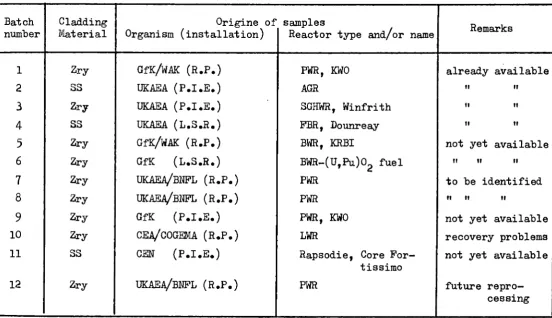
The study will cover Zircaloy mainly and stainless steel coming from the operation of nuclear reactors as : PWR, BWR, SGHWR, AGR and PBR. Priority will be given to specimens of leached hulls arising from fuel reprocessing plants. Samples obtained from the post-irradiation exami-nation (PIE), the position of which along the length of a fuel pin can be identified, will also be considered.
[image:33.595.26.579.480.798.2]Table 1 gives a survey of the sample proposed for investigation. Already available specimens shall be examinated at first and further batches shall be selected according to availability and priority of interest. The whole programme will be carried out in the period from 1st November 197$ to the end of 1979.
Table 1 ; List of candidate hulls samples for examination
Batch number
1
2
3
4
5
6
7
8
9
10 11 12 Cladding Material Zry 33 Zry 33 Zry Zry Zry Zry Zry Zry SS Zry Origine of Organism (installation) GfK/WAK (H.P.) UKAEA (P.I.E.) UKAEA (P.I.E.) UKAEA (L.S.R.) GfK/WAK (R.P.) GfK (L.S.R.)UKAEA/BNFL (R.P.)
UKAEA/BHPL (R.P.)
GfK (P.I.E.) CEA/COGEMA (R.P.) CELT (P.I.E.)
UKAEA/BUPL (R.P.)
samples
Reactor type and/or name
PWR, KWO
AGR
SGHWR, Winfrith PBR, Dounreay BWR, KRBI
B W R - ( U , P U ) 02 fuel
PWR PWR
PWR, KWO
LWR
Rapsodie, Core For-tissimo PWR Remarks already available ii it it ti ti tt
not yet available
II tt tt
to be identified
n ti it
not yet available recovery problems not yet available
future repro-cessing
2.4.1 Visual inspection
Hulls will be visually inspected to observe defects, deposits and any anomalous phenomena which could be useful for the later interpretation of the analytical results.
2«4»2 Surface distribution of actinides
The actinide concentration per unit of surface and its distribution will be determined by alpha-spectrometry.
This will be performed on samples whose gamma activity is not too high for handling.
Actinide concentration would be estimated only if actinide composition is known or can be measured.
2-4.3 Total content of actinides and of fission and activation products
Different techniques and methods will be used as described in the paragraphs 2.4.3.1 to 2.4.3.3.
2.4.3.1 Neutron activation techniques
The delayed neutrons resulting from fission after irradiation in a thermal neutron flux will be measured. The counters will be standard gas filled neutron detectors (either tritium or BF.J. The method does not differentiate between different nuclides but the approximate total content of fissile nuclides will be obtained.
2.4.3.2 Gross alpha-count and alpha-spectrometry
Samples from individual hulls from each batch will be completely dissolved.At first the gross alpha-count on all sample solution will be carried out. Afterwards alpha-spectrometry will be performed on sample solutions, selected according the previously measured alpha activity, for the quantitative determination of :
- Pu-238, Pu-239 and Pu-240 - Am-241
In order to perform the above mentioned quantitative determinations, chemical separations of americium will he made. The alpha spectrometer consists of a gridded ionisation chamber coupled to a multi-channel analyser. Samples will normally be mounted directly from aqueous solu-tion. Where appropriate the organic extractant phase will be mounted. The overall accuracy on the obtained mean values of results will be estimated. Where necessary the measured concentrations will be corrected for decay to the date of reactor shut-down. Alpha-spectra will be re-corded in analogue and digital form.
2.4.3.3 Gamma-spectrometry
Sample solutions will be submitted to the determination by means of gamma-spectrometry, of the following fission and activiation product s :
Sb-125, Cs-134, Ru-106, Cs-137, Ce/Pr-144, Mn-54, Co-60, Zr/Ub-95.
The gamma ray spectra will be measured at least on two parallel aliquots of each solution, using a (Ge-Li) detector.
Accuracy of results, decay correction and spectra recording form will be as mentioned in paragraph 2.4.3.2.
2.4*4 Depth distribution of actinides and fission products
The depth distribution of actinides and fission products will be investigated by different techniques.
2 .4.4*1 Fission track analysis
2 «4«4«2 Alpha-spectrometry on hulls
The depth distribution of actinides near the surface will be evaluated by means of alpha-spectra taken from the hulls themselves.
2 «4»4»3 Alpha and gamma measurements
Where feasible, solutions will be prepared by chemical dissolution of successive layers of at least two hulls samples per batch.
2 .5 Assessment of the various types of cladding
The Advisory Committee for Programme Management agreed that the Commission treats this subject by means
of an inquiry. This inquiry has to. provide a prospective inventory, until 1990, of cladding wastes composition and the expected amount
arising in the European Community from spent fuel from the following reactor types : PWR, BWR, SGHWR, AGR, FBR.
A draft summary report (Doc. DG I I I / E - 1 , BHa/tg of 1st December, 1976), giving a survey of the answers to the inquiry, was prepared and sent to the experts of the Member States asking for suggestions or remarks. Missing or incomplete answers were completed with own estimates.
2.5.1 Cladding wastes
The information received on the amount of waste for each of the different reactor and cladding types is summarized in fable 1.
In case of diverging data for the same reactor and cladding type, the two extreme values are given.
Reactor type
PWR PWR BWR
BWR (Th-U fuel CANDU - BLW SGHWR
AGR
PBR (Core) FBR (radial)
x) Cladding materialv
(percentage of total)
Zircaloy- 4 (70 W//o )
AISI - 304 (75 W/o)
Zircaloy - 2 (85 W/o) AISI - 304 (65 w/o)
Zircaloy - 4 (30 v/o) Zircaloy - 2 (75 w/°)
Stainless steel (80 w/°)
AISI - 316 (40 w/o)
AISI - 316 (30 w/o)
Total amount of waste in kg/ton
324 - 398
350
293 - 400
415 370 282 154
1422 - 1745
849
H.M.
2 .5.2 Waste arisings from reprocessing
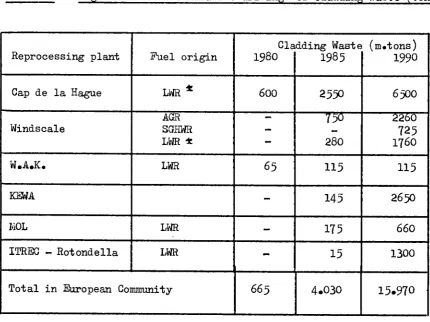
On the "basis of the known time schedules for the planned re-processing capacities in the Member States to come on stream, the cumulative expected amounts of cladding wastes were estimated. A survey of these "high" forecasts until 1990 is given in Table 2. The cumulative amount of wastes in the European Community will rise from about 4000 m» tons in 1985 to about l600 m.tons in 1990,
These values could be reduced by half in the case of the "low" esti-mates, which take into account possible delays in bringing new plants on stream or any other lowering factors of the actual reprocessing capacities.
Table 2 : "High" estimated cumulative arisings of cladding waste (tons)
Reprocessing plant
Cap de la Hague
Windscale
W.A.K.
KEWA
HOL
ITREC - Rotondella
Fuel origin LWR * AGR SGHWR LWR * LWR LWR LWR
Total in European Community
Cla 1980 600 — 65 -665 dding Waste 1985 2550
75o
280 115 145 175 15 4.030 (m.tons) 1990 6500 2266 725 1760 115 2650 660 1300 15.970 [image:38.595.77.508.347.669.2]2.5*3 Radioactivity
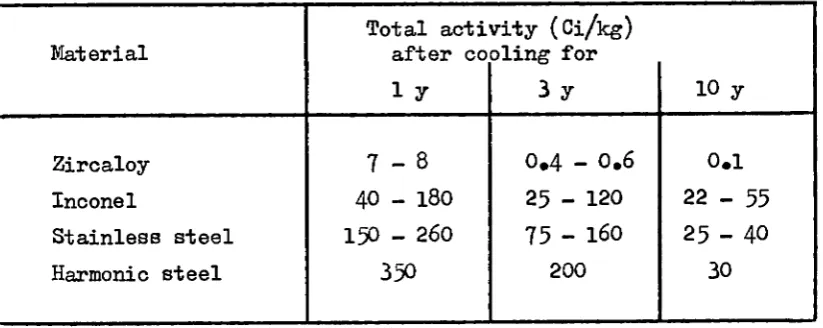
The received data on radioactive isotopes formed by neutron
activation of metal components were elaborated. Contaminating substances were not taken into consideration. The total activities of the materials, based on neutron exposure rates of 2'K)2 1 and 2.8#10 n/cm (thermal
[image:39.595.93.505.294.458.2]flux), are given in Table 3 as function of decay times after reactor shutdown.
Table 3 t Total activities of waste materials (Oi/kg)
Material
Zircaloy
Inconel
Stainless s t e e l
Harmonic s t e e l
Total a c t i v i t y (Ci/kg)
after cooling for
i y
7 - 8
40 - 180
150 - 260
350
3 y
0.4 - 0.6
25 - 120
75 - 160
200
10 y
0.1
22 - 55
25 - 40
30
For Inconel and stainless steel the considerable differences in activity, which cannot be explained by the different neutron exposures, should be cleared. Variations on the composition of alloys can only partially
give an explanation.
Stainless steel irradiated in FBR will reach, after an exposure rate of about 2*10 n/cm2 and 1 year cooling time, a total activity of
3. INCINERATION OP PLUTONIUM CONTAMINATED WASTE
3.1 High Temperature Incineration (SCK/CEN)
3 .1.1 Objectives of contract
Two strategies will be pursued in course of the programme :
a) Incineration of low Pu-contaminated waste with the aim to produce a highly leach resistant product suitable for long term storage and ultimate disposal*
b) Incineration of heavily Pu-contaminated waste with the aim to produce a readily soluble product in order to promote maximum Pu-recovery. The bulk of low contaminated waste will be processed in the existing PLK 60 furnace.
3 .1.2 General description of incinerator
CEN's objective is to develop an incineration process which decomposes the most common Pu-contaminated waste materials by complete combustion in connection with a safe gas purification system. The flow sheets Pigs. 3.1.1 and 3.1.4 show the processes of incineration and gas purification. Pig. 3.1.3 shows the incineration system schematically.
The waste material is fed from a mixing silo into the incinerator by a worm-feeder. The part so far described is already operating with in-active waste.
The off-gases pass through a post-combustion chamber to ensure their complete combustion before they are directed to a heat recuperator and further to the purification system. The off-gas train is given in Pig.3»1.4i This system has yet to be built.
3.1.2.1 Method of high temperature incineration
The most common combustible and low Pu-contaminated waste, together with most of the concentration arising from processing of liquid effluent are molten in the incineration chamber of the "FLK 60" plant (at 1300° to 1400° C) to form an inert, insoluble basalt-like slag. Semi-liquid and pasty solid materials, such as chemical sludges, are pre-dried in a rotary-drum and heated by a fraction of incinera-tion off-gases. As the properties of the slag obtained depend largely on the composition of the feed, the waste composition should be as constant as possible. To- assure an utmost constant feed the solid waste is crushed into small bits and sorted in glove boxes beforehand. Together with a certain amount of dried chemical sludges it is then stored in an
air-tight mixing silo from where it is conveyed through a worm-feeder into the incinerator. A heat recuperator, dust filter, chlorine scrubber and absolute filter will constitute the off-gas cleanup.
3.1.2.2 Method of moderate temperature incineration
The same type of incineration performed at lower temperatures (600° to 1200° C) will form ashes which could allow Pu-recovery.
Only heavily Pu-contaminated waste will be treated in this way and no liquid waste concentrates should be added. By adding molten salts, like !Ta2G03 and HaS04, the melting point of the slag is lowered and a more
3 .1.3 Range of waste
t
3*1.3.1 Low Pu-contaminated waste
In order to promote the slag-forming process and to achieve a highly leach resistant ash product incombustible waste materials of a minimum of 10 to 15 % mineral constituents are added to the com-bustible portion of the load. The contamination of the waste will be smaller than 2 g Pu per 200 1 drum.
3.1.3.1.1 Combustible waste
As combustible waste are considered :
- Miscellaneous materials containing large quantities of polyethylene, polyvinylchloride, rubber, filter, swabs, rags, etc.
- Natural materials : wood, paper, cotton,etc. - Ion exchanger : Bynthetic or natural, .
- Sorbents : active carbon in most cases
- Organic solvents : tributylphosphate, oil, etc.
3.1.3.1.2 Incombustible waste
The incombustible portion consists mainly of chemical sludges resulting from the treatment of low-level liquid effluents by copreci-pitation, application of mineral sorbents or by evaporation. Smaller quantities of crushed glass and metal items, glass wool filters, diato-maceous earth and sand from sandfilters are added.
3«1»3.1.3 Composition of waste mixture
Combustible and incombustible waste materials are collected separately. In order to obtain an optimum combustion and a convenient melting point of the slag a further subdivision of the waste material is recommended. Segregation is roughly made between :
- synthetic materials (polyethylene, PVC, ion-exchanger, etc.) - natural materials (wood, paper, cotton,etc.)
A typical composition yielding a highly leach-resistant ash product is as follows :
-30 fo paper
10 fo polyethylene 10 fo ion-exchanger
10 fo mineral sludges (mostly AL(0H)3, Ca2(P04)2, Cu2Fe(CN)6, Fe(0H)3) 10 f> metals
10 fo glass 20 fo water
3.1.3.2 Heavy Pu-contaminated waste
The optimum composition rendering dissoluble ashes for maximum Pu-recovery has yet to be fund. This is intended by the experimental operation of the pilot plant (see chapter3 .1.4.4)• The upper level of Pu-contamination will be determined by the maximum permissible Pu-con-centration at any point of the incineration process.
3 .1.4 Contents of programme
3.1.4.1 Modification of the "FLK 60" plant
The industrial plant "FLK 60" is already in inactive operation since beginning of 1975. To adapt the plant for the incineration of low Pu-contaminated waste the following modifications have to be carried out :
- Construction of an of. -tight containment
- Installation of pre-treatment.facilities for sorting, shredding, mixing and feeding of the waste material
- Installation of remote handling facilities
- Conversion of surroundings to a pressurized suit area - -Adaption of ash retrieval system for Pu-waste
- Installation of an off-gas control and purification system which will also cope with the off-gases coming from, the later attached pilot plant (see chapter 3.1./!.3).
3.1.4.2 Operation of the "FLK 60" plant
to the neutralization of acids in situ and to the removal of volatile elements in the off-gas. Various incineration conditions (oxygen supply, residence time of waste in combustion chamber etc.) will be tested. The operational studies will be supported by laboratory tests.
3.1.4»3 Construction of pilot plant
A small scale pilot plant (capacity 10 kg/h) of the same principle as the FLK 60 will be built and attached to the off-gas purification system of the FLK 60 plant. Pu-control and safeguards will be installed throughout the system.
3.1«4«4 Operation of pilot plant
The relatively small scale of the plant allows to treat higher contamination levels and gives more experimental flexibility. The main task will be to investigate the incineration of plutonium-oxychloride. Possibilities will be examined whether chlorine gases can be trapped in the ash in order to avoid secondary waste and the necessity of a titanium
scrubber.
3 »1»5 Characterisation of the process end products
3•1.5.1 Highly leach resistant ash product
Waste and ash samples as well as the off-gas composition will be analysed. The leaching rate and the density of the ash will be determined and solubility tests will be performed.
3.1«5»2 Easy dissoluble ash product
The ash products with a high Pu-concentration level originating from the pilot plant incinerator will mainly be tested for their solvent extraction rate of plutonium.
3.1.6 References
SOLID
COMB.
SOLjD_
WASTE
WASTE
CRUSHIN
SELECTED
NON COMB.
WASTE
GASEOUS
WA
CTC
— ► —
TREATMENT
FILTERS
li
CONCENTR.
TREATMENT
COMB.
LIQUIDS
DOSING
OFF
GASES
MIXIN
SILO
INCINERATION
1500°-1600°C
DOSING
DOSING
ATMOSPHERE
i
FILTRATION
FINAL
!
CONDITONING'
DISPOSA1
If IK FIK svsim
burner
1550° C
iFUSION
i
^a thin layer
of molten slag
outer
and inner cylinder.
distributor
Granulator
distributor
H
i d d
\^
I
fr
i?
. 11■ ^ j
VJ1
INCINERAJ900
TOR
STEAM
GENERAT.
7TUY
SLUDGE
T
DRYING
1
i
+
BED
FILTER
STEAM
GENERAT
300
HCL
SCRUB
BER
I
DUST
AND
SAND
FINES
TO
OVEN
▼
I
EVAPO
RATION
T
BASIC
SOLUTION
1
HEAT
w
&
j-r^m—
FIG.3.1.4
CONCEPTUAL
FLOWSHEET
3 .2 Acid digestion process (NUKEK, FRG)
3.2.1 Introduction
The objective of this contract is to develop, test and optimize a pilot plant of the wet combustion method. The plant is supposed to treat 1000 kg Pu- contaminated and combustible solid waste containing approximately 10 - 12 kg of Pu at the Eurochemic plant in Mol.
3.2.2 Principle of technique
The waste is heated in a concentrated and boiling mineral acid solution. The organic compounds are decomposed and most of them are reduced to carbon* By addition of strong oxidizing agents the carbon is transformed into COp, which leaves the combustion chamber with the off-gas. The noncombustible portion of the waste will either be con-verted into the respective salts or remain inert in the acid •
The pilot plant will use H„ SO as the mineral acid under addition of 5 vol. C/J of HNO, as the oxidizing agent. The operational temperature will be in the range of 230 °G to 250 °C. 70 >« - 80 > of the NO - and SOp- reaction gases escaping with the gaseous oxidation products are envisaged to be recycled.
Most of the plant will be built of quartz-glass components. The acid solution H0 30. + HNO, will be circulated in the digester vessel.
The digestion rate will be approximately 3 kg/h. The Pu-content will
be controlled at any vital point of the process (see flow-sheet Fig. 3.2.1). About 98 i'o of the plutonium are estimated to be recovered. The residues, converted into salts, can be treated as low active waste.
Hydrochloric, sulphuric, nitric acids and water vapours are fed to the acid recycling system. The sulphuric and nitric acids are recycled, whereas water and hydrochloric acid are treated as secondary waste. The remaining off-gases are filtered.
suction filter. The process solution will then be conducted to separa-tion columns.
The filter cake, which contains mainly metal salts, is washed in diluted nitric acid. The plutonium will be extracted as Pu NO.. The residues are envisaged to be incorporated into bitumen for intermediate storage.
3 .2.3 Range and preparation of waste
Low Pu- contaminated waste will be treated separately (compression)! A glove box serves to sort the waste into its combustible and
incom-bustible fractions. The comincom-bustible waste to be treated consists of :
- paper, cardboard
- wood, cotton, rubber gloves - plexiglass
- polyvinylchloride - polyethylene - swabs, rags, oil - cellulose filters
Mo predrying of the waste is necessary. The waste will be chopped by a shredder in order to enable the blending of a fairly constant average mixture. This mixture is then fed in defined doses (plastic bags) into the combustion chamber.
3..2.4 Contents of programme
3 .2.4.1 Elaboration of basic data-for the combustion and
Pu- recovery process
For the layout, the construction and particularly for the operation of the pilot plant, basic data have to be compiled. These studies will be mainly dealing with the digestion process, the off-gas treatment, the acid recycling and the Pu- recovery.
3, .2.4.2 Engineering of the pilot plant
Particular attention will be devoted at the design stage to the following :
- Pu- control within the system
- Retrieval of sulphuric and nitric acids and their vapours in the off-gas system
- Purification of the off-gas
- Recycling of the secondary waste (hydrochloric acid, water, filter, etc.) for re-combustion.
3.2.4•3 Construction and commissioning of the plant
Before assembling the plant, the following main subassemblies will be tested separately :
- Acid digestion - Acid retrieval
- Off-gas purification
The plant will be tested in cold and hot operation.
3.2.4.4 Operation of plant
The plant will be treating ca. 1000 kg of Pu- contaminated solid waste from Eurochemic. Experiments at various operational con-ditions (HNO,-supply, combustion temperature, duration of combustion process, etc.) will be carried out.
3.2.4.5 Evaluation of experimental results
The process will be evaluated according to the main para-meters with respect to :
- Combustion efficiency
- Efficiency of the off-gas system - Acid recovery rate
- Pu- recovery rate
- Characteristics of the residues.
3 .2.4»6 Economy of the process
o
ELECTRIC ENERGY SUPPLY (ADJUSTMENT BT RESISTANCE) PURE PLUTONIUM CONTENT-E
OXIDATION H2 S 04 TEMP.: 230250°C SEPARATION OP RESIDUES AND ANALYSIS m PLUTONIUM SEPARATION DILUTED WITH HNO3 SOLIDIFICA TION OP RESIDUES REDUCED PRESSURE MEASUREMENT (ADJUSTMENT ca.lOmmWS) ACID RETRIEVAL(H2SO
'4 HNO3)
COOLING H20SEPARAT. AND DET. OP N0X AND SO?
CONTENT • AEROSOL FILTER H2 0 SCRUBBER ALKALINE WASHING SEPARATION OP ACID
GASES ■
T
iCID WASHING
; D I L . H 2 S 04)
SEP.OF ACID GASES. _ 5XCEPT C O p *
GAS WITHDRAWAL FOR ANALYSIS VOLUMETRIC MEASUREMENT (PLOW METER ABSOLUTE FILTER VACUUM PUMP (H2OJET)
MEASUREMENT OF Pu CONTENT
3.3.1 Objective
The aim of the R & D contract with Agip Nucleare is to establish the basic data for a waste incineration technique, that permits waste incineration and Pu separation in one process step. The intention is
to destroy the combustible waste in a molten salt bath with strong oxidants with the Pu remaining dissolved in the molten salts.
By filtration all the non consumed and incombustible waste would be separated from the Pu (and other heavy metals) dissolved in the fused salt. A second step would recover the Pu from the salt.
This programme is scheduled to run. until the end of 191o.
3.3.2 Scope of the programme
The technique studied by Agip Nucleare, unlike Atomics Interna-tional's molten salt process, will use alkaline salts instead of carbo-nates for the Pu-separation. The chemical reactions following the oxi-dization of the waste as well as the dissolving and precipitating of the plutonium have to be investigated in detail before proceding to the design and construction of a pilot plant.
This programme intends to collect sufficient data, and assure adequate knowledge of the reference process to permit an evaluation of this new technique.
The first part of the programme will investigate the combustion of
the waste (without Pu) and, separately, the dissolution of the plutonium.
The second part of the programme consists mainly of the construction of a bench scale rig which can, on a small scale, perform the entire pro-cess and of the experimental operation of the rig with Pu contaminated waste•
The beginning of this part is subject to a favourable outcome of the first part•
5»~ji»'j Experiments with inactive and simultated waste
Experiments w i t h inactive and simulated waste These experiments will i n v e s t i g a t e the following i t e m s : - Choise of the most suitable salt mixture - Determination of optimized process parameters
These experiments will investigate the following items :
- Control of the concentrations of chlorides, carbonates and nitrates in the melt
0
- Measurement of the combustion rate and the volume reduction - Choice of a filter for the molten salts
- Analysis and study of the treatment of the off-gas
- Measurement of the properties and analysis of the composition of the residual waste
- Conditioning of the residual waste
- Purification and recycling of exhausted or contaminated salts - Reference data for an optimized process and
- Feasibility study of a bench scale plant.
3.3.4 ijxperinents with Plutonium
Using the most promising salt mixtures determined in the inactive tests, the tests with plutonium shall treat; the following problems :
- Dissolving the Pu in the salt melt with acid
- Determination of the solubility and stability of Pu-compounds in the salt mixture at various temperatures
- Pu recovery techniques - Minimization of Pu losses.
3.3.3 Part II : Construction and operation of a bench scale test rig
Based on the process characteristics resulting from the first part of the programme, a small test rig will be constructed, which will allow the following experimental investigations of the complete waste treatment process (with Pu) at a small scale (50-100 gr/h) :
- Peed and transport mechanisms, pressure balancing, avoidance of Pu deposits and combustion control
- Immersion of the waste into the molten salt, removal of incombustible residues from the reaction vessel, reduction or elimination of crud formation on vessel walls
- Determination of operating conditions with least incombustible residues and least risk to the off-gas filters
- Influence of the combustion products upon the Pu extraction process.
4. PROPERTIES OP1 SUBSTANCES SUITABLE FOR IMMOBILIZING HIGH LEVEL WASTE
JOINT PROGRAMME UKAEA - HMI - CEA
Testing and evaluation of the properties of various potential mate-rials for immobilizing high-activity waste in a solid form.
4.1 Introduction
This programme is a coordinated action of the United Kingdom Atomic Energy Authority "UKAEA" (Great Britain), the Hahn Neitner Institut
"HMI" (Germany) and the Commissariat a l'Energie Atomique "CEA" (France). The objective is to establish a joint basis for the evaluation of those solidification substances which will be applied in the near future. The programme will be centred on series of experiments jointly testing five different solidification substances from the three participating countries, performed under strictly identical conditions. The experi-mental investigations will include the following main items :
- Determination of the leaching rate ;
- Investigation of the temperature effects ; - Investigation of the alpha-radiation effects.
The three coordinated contracts are scheduled as follows :
UKAEA : Between ]st January 1977 and 31st December 1979-HMI : Between 1st October 1976 and 3lst December 1979.
CEA : This contract, which will have a maximum duration of six months, will be negociated in the first half of 1977*
4 .2 Scope of programme
4*2.1 Determination of leaching rate
4.2.1.1 Block leach test on active samples
CEA will measure the leach rate of five active block samples with volumes of approximately 1 litre each containing up to 20 % of
The following leach rates will be measured by radioanalysis daily and at room temperature during about 40 days :
- Total leach rate of beta- and gamma - emitters,
- Specific leach rate of beta- and gamma - emitters of the isotopes : Cs 137, Sr 90, Ce 144 and Ru 106,
- Total leach rate of alpha-emitters, if measurable.
The leaching agent is tap water (volume : 700 ml) with a resistivity of 2500,TL/cm at 20°C and a pH-value of 7,5.
4.2.1.2 Leach test on small inactive samples
A corresponding series of Soxhlet type leach rate measure-ments will be carried out by the UKASA on small inactive samples simu-lating the reference waste products.
These leach tests at standard conditions provide a base line for the leach tests measuring temperature and radiation effects. Five speci-mens of each reference substance will be tested. The main characte-ristics of this measurement technique are :
- Specimen form : coupon, 1 x 10 x 10 mm - Leaching agent : pure water
- Temperature : 100°C
- Duration of test : 2 to 20 days depending on leaching resistance of sample
- Water/solid ratio : 10/litre to 30/litre - Water exchange rate : about every 10 minutes.
The leach rate is measured by the total weight loss. A second series of tests will be carried out using the base line conditions (as above) but under reduced pressure and at differing temperatures. One specimen of each substance will be measured at :
50°C, 60°C, 70°C, 80°C and 90°C.
4.2.1.3 Supplementary leach tests on inactive samples
4»2»1»3»1 Granulate titration method
This method measures the alkali loss according to DIN 12111. The conditions of this test are :
- Specimen form : powder (particles of 2g) - Leaching agent : pure water
- Temperature : 100°C - Duration of test : 60 minutes - Water exchange rate : 100 ml/h.
4.2.1.3.2 Phase selective leaching
The objective of this test is to determine the leach resistance of crystal phases and of the remaining vitreous phase on polished surfaces of devitrified glasses under the following conditions :
- Specimen form : coupons (ca. 100 mg) - Leaching agent : optional
- Temperature : 20°C - 100°G - Duration of test : optional.
4.2.2 Investigation of temperature effects
This study investigates the changes likely to occur in the physical state of waste glasses intended to confine radioactive waste for up to 1000 years. These very slow changes from a fully vitreous to a partially crystalline structure will depend on the composition of the glass and the storage temperature. Negative effects upon the retention of the waste glasses are only anticipated in the long term and the effects of partial devitrification are not necessarily negative.
4.2.2.1 Heat treatment of samples
Glasses held at elevated temperature while cooling from the formation temperature propagate devitrification effects. Two sets of identically pretreated samples, one for UKAEA, one for HMI, will be prepared by UKAEA. Each set consists of one untreated control sample and for each of the following annealing temperatures one sample per annealing time given below.
Annealing temperatures : 500°C, 600°C, 700°C and 800°C . Annealing time : 2 hours, 1 day, 10 days and 100 days.
Leach tests will be performed according to chapters 4.2.1.2 and 4.2.1.3 on samples of each variant* The remaining samples will undergo the
following investigations.
4%2.2.2 Investigation of structural integrity
These investigations performed by HMI complement the UKAEA efforts (s.Chap .4*2.3) in the field of devitrification by analysing
the extent and the composition of the crystalline phases and by measuring the retention properties of these phases in respect to the parent glasses by phase selective leaching. This could give very valuable information
on how to improve the glasses, it could explain abnormal results and could supply further evidence and general knowledge about de-vitrification phenomena. The programme provides the following investigations :
- Investigations of softening behaviour, form stability and devitri-fication ;
- Time and temperature dependent behaviour, of (simulated) fission products in the substances after thermal treatment ;
- Detailed investigation of the structural changes produced by thermal treatment (degree of crystallization, type and size of crystals, crystal growth rates).
4.2.3 Investigation of alpha-radiation effects
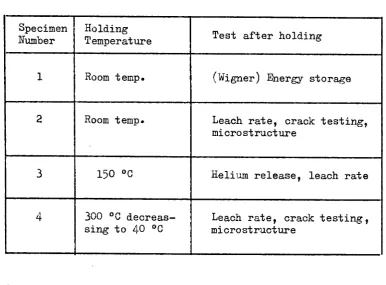
The effects of alpha-radiation are considered to cause the most significant radiation damage in waste glasses. The UKAEA will examine the effects of alpha-radiation upon four specimens doped with 238 Pu 0?
for two years. During this time they will receive an irradiation dose
-I Q
[image:65.595.91.478.237.522.2]of about 2.2 x 10 alpha-decays per ml. A set of simular specimens containing 239 Pu 0 will be made as controls. A schedule of the tests to be performed on the respective.specimens is set out in Table 1.
Table 1 : Alpha damage tests
Specimen Number
1
2
3
4
Holding Temperature
Room temp.
Room temp.
150 °C
300 °C decreas-sing to 40 °C
Test after holding
(Wigner) Energy storage
Leach rate, crack testing, microstructure
Helium release, leach rate
Leach rate, crack testing, microstructure
4*3 Equipment for measuring and testing the required properties
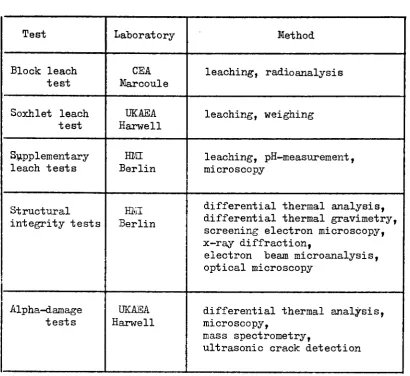
Block leach test Soxhlet leach test Supplement ary leach tests Structural integrity tests Alpha-damage tests CEA Marcoule UKAEA Harwell HMI Berlin HKI Berlin UKAEA Harwell leaching, radioanalysis leaching, weighing leaching, pH-measurement, microscopy
differential thermal analysis, differential thermal gravimetry, screening electron microscopy, x-ray diffraction,
electron beam microanalysis, optical microscopy
differential thermal analysis, microscopy,
mass spectrometry,
ultrasonic crack detection
4*4 Reference substances
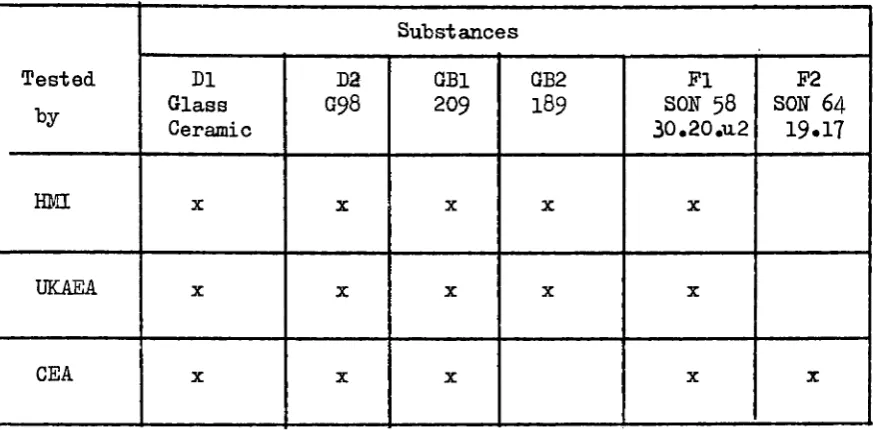
The five reference substances to be investigated are given in Table 3. The Celsiane glass ceramic B l/3 was developed at HMI and the borosilicate glass G 98 at GfK - Karlsruhe (Dl and D2 in Table 3 ) . The other four substances are also borosilicate glasses.
The second glass of the two French glasses (Fl and F2)
[image:66.595.92.503.149.525.2]