This is a repository copy of Determinants of Sanctions Effectiveness: Sensitivity Analysis Using New Data.
White Rose Research Online URL for this paper: http://eprints.whiterose.ac.uk/126200/
Version: Accepted Version
Article:
Bapat, NA, Heinrich, T, Kobayashi, Y orcid.org/0000-0003-3908-1074 et al. (1 more author) (2013) Determinants of Sanctions Effectiveness: Sensitivity Analysis Using New Data. International Interactions, 39 (1). pp. 79-98. ISSN 0305-0629
https://doi.org/10.1080/03050629.2013.751298
© Taylor & Francis Group, LLC. This is an Accepted Manuscript of an article published by Taylor & Francis in International Interactions on 14 Feb 2013, available online:
https://doi.org/10.1080/03050629.2013.751298.
[email protected] https://eprints.whiterose.ac.uk/ Reuse
Items deposited in White Rose Research Online are protected by copyright, with all rights reserved unless indicated otherwise. They may be downloaded and/or printed for private study, or other acts as permitted by national copyright laws. The publisher or other rights holders may allow further reproduction and re-use of the full text version. This is indicated by the licence information on the White Rose Research Online record for the item.
Takedown
If you consider content in White Rose Research Online to be in breach of UK law, please notify us by
Determinants of Sanctions Effectiveness:
Sensitivity Analysis Using New Data
Navin A. Bapat
Department of Political Science
University of North Carolina
at Chapel Hill
[email protected]
Tobias Heinrich
Department of Political Science
Rice University
[email protected]
Yoshiharu Kobayashi
∗Department of Political Science
Rice University
[email protected]
T. Clifton Morgan
Department of Political Science
Rice University
[email protected]
Word Count: 7150
∗contact person
Abstract
In the literature on sanctions effectiveness, scholars have identified a number of factors that may contribute to sanctions success. However, existing empirical studies provide mixed find-ings concerning the effects of these factors. Among the possible reasons for this lack of con-sistency, two stand out: selection bias created by the data set used in the previous research and model dependency of these findings. This research note addresses these two shortcomings in the literature by using the newly released Threat and Imposition of Economic Sanctions data and by employing a methodology that permits us to check systematically the robustness of the empirical results under various model specifications. Our analysis of both threats and imposed sanctions show that two factors - involvement of international institutions and severe costs on target states - are positively and robustly related to sanctions success at every stage in sanctions episodes. Our analyses also identify a number of other variables that are systematically related to sanctions success; but, the significance of these relationships depends on the specific model estimated. Finally, our results point to a number of differences at the threat and imposition stages, which suggests specific selection effects that should be explored in future work.
The conventional wisdom of twenty years ago held that economic sanctions are not effective
policy instruments. Recent research has convinced many scholars that sanctions can influence
targets’ behavior under identifiable conditions, however. Some have argued that the key variable
in sanctions success is whether the costs to the target are sufficiently high (Doxey, 1980; Hufbauer,
Schott and Elliott, 1990; Morgan and Schwebach, 1997; Drury, 1998) while others have suggested
that sanctions will work if they are “smart,” that is, if sanctions are designed so that the costs are
borne by the right people in the target state (Morgan and Schwebach, 1996; Cortright and Lopez,
2002). Drezner (1999) has argued that a key variable in determining sanctions outcomes is the
extent to which the sender and target expect to be involved in future conflicts. Others have focused
on the characteristics of states involved in sanctions episodes and have suggested, for example,
that democratic targets or states that are suffering internal turmoil are particularly susceptible to
sanctions (Bolks and Al-Sowayel, 2000; Brooks, 2002; Lektzian and Souva, 2007). Still others
have suggested that the key variable is whether they are imposed unilaterally or by a multilateral
coalition (Martin, 1993; Kaempfer and Lowenberg, 1999; Miers and Morgan, 2002; Bapat and
Morgan, 2009).
While the literature has identified many factors as possible determinants of sanctions success,
the empirical findings regarding these hypotheses have been inconclusive.1 For example, Drezner
(1999) and Allen (2005, 2008) find that sanctions against allies are more likely to succeed, but
Drury (1998) and Krustev and Morgan (2011) find no support for this claim, and Nooruddin (2002)
and Early (2011) find that sanctions against allies are less likely to succeed for U.S. sanctions.
Even when we consider the cost of sanctions, which many see as the most important predictor of
sanctions success, the empirical findings are not conclusive (Bonetti, 1998; Nooruddin, 2002; Jing,
Kaempfer and Lowenberg, 2003).
Among the possible reasons that might account for this lack of agreement in the empirical
1Some empirical findings on the determinants of sanctions success are summarized in Table 1. The table is not
meant to be comprehensive, rather it illustrates the large range of variation in the previous empirical findings.
literature of sanctions effectiveness, two stand out. First, most findings reported in any one article
result from one regression model (Kaempfer and Lowenberg, 2007). Even though many scholars
conduct tests to ensure the robustness of their findings, these attempts are often not sufficient
-they simply include a few more variables to see if the main results hold. The problem with such
robustness checks is that they leave open the possibility that the results could change with still
different variables or model specifications.
Second, recent theoretical developments have attributed the lack of agreement in the empirical
findings to a selection bias, stemming from looking only at cases of imposed sanctions. Many
recent theories suggest that threats are an important part of sanctions episodes (Eaton and Engers,
1992; Smith, 1996; Morgan and Miers, 1999; Drezner, 2003; Lacy and Niou, 2004; Krustev, 2010).
They suggest that sanctions policies might actually be more effective than the previous studies
suggest, but to observe this, we also have to consider cases in which sanctions were threatened,
but not imposed. It might be that in those cases where sanctions would induce targets to alter
their behavior, targets can anticipate this when sanctions are threatened and change their policies
before sanctions actually occur. Additionally, when evaluating the determinants of the success of
sanctions, this argument suggests that it might be problematic to look only at actually imposed
sanctions. For instance, if sanctions imposed through international institutions are more likely
to succeed because they can generate higher costs, target states facing threats from international
institutions may already take this information into account and concede at the threat stage. As
a result, the cases where imposed sanctions are observed consist mainly of instances in which
targets did not relent even though they were facing the prospects of the high costs of sanctions by
the international institutions. If we only analyze this nonrandom sample of cases, we would falsely
conclude there to be a weak, perhaps insignificant, relationship between institutional involvement
and sanctions success. The crux of this argument is that the selection bias may be preventing us
from appropriately evaluating the determinants of sanctions success.
In this research note, we address these two shortcomings in the existing empirical literature to
examine the robustness of the relationships between sanctions success and a number of variables
that may contribute to success. First, using a newly released Threat and Imposition of Economic
Sanctions (TIES) dataset (Morgan, Bapat and Krustev, 2009), we include threat cases in our
analy-ses together with caanaly-ses of imposed sanctions. This allows us to investigate which factors affect the
likelihood that the sender achieves its goals through threats and impositions of sanctions. We also
conduct separate analyses on the threat and imposition stages. Comparison of these results allows
us to see how the effects of various factors may change at different stages in sanctions episodes.
Second, we employ an approach that permits us to check systematically the robustness of our
findings (Leamer, 1985; Sala-i-Martin, 1997; Sturm, Berger and De Haan, 2005; Hegre and
Samba-nis, 2006). In particular, we use a set of eighteen factors that the literature identified as determinants
of sanctions success and run every regression possible with the combination of these variables.2
We then combine results from these regressions to establish the distribution of parameter estimates,
which informs us about the robustness of these relationships.
Empirical Strategy
Data
We take all of our sanctions data from the new TIES data set (Morgan, Bapat and Krustev, 2009).3
TIES contains data on 888 cases in which sanctions were threatened and/or imposed in the
1971-2000 period. Sanctions are defined as actions that one or more countries take to limit or end their
economic relations with a target country in an effort to persuade that country to change its policies.
By definition, a sanction must 1) involve one or more sender states and a target state, and 2) be
2For the sake of space, we do not provide a detailed summary of existing theoretical arguments on the effects of
these eighteen factors on sanctions success. However, we provide a table (see Table 1) listing these eighteen theoretical concepts found in the literature as well as expected relationships between these factors and sanctions success. Table 1 also provides representative findings from studies that were intended to test these relationships. In the last two columns, we introduce variables that our analyses use to test the effects of these eighteen theoretical concepts, and their measurements.
3The TIES data set can be obtained at
http://www.unc.edu/˜bapat/TIES.htm.
implemented by the sender in order to change the behavior of the target state. Actions taken by
states that restrict economic relations with other countries for solely domestic economic policy
reasons thereforedo notqualify as sanctions. For the purposes of this dataset, all sanctions cases
may only include one target state. If a sender state makes threats against multiple targets, a new
case is created for each individual target.4
While we are interested in which variables increase the probability that the sender achieves its
policy goal, we are also interested in which factors affect the success rate at different stages in
sanctions episodes. We therefore conduct three sets of analyses: (1) one that investigates the
suc-cess of both threats and imposed sanctions, (2) one that examines the sucsuc-cess of imposed sanctions,
and (3) one that considers the success of sanctions threats.5
The analysis of both threats and imposed sanctions includes 842 cases.6 For this analysis, a
sanction case is coded a success if the target partially or completely acquiesced, or the case ended
with negotiated settlement.7 For the analysis of successes of imposed sanctions, we consider 510
cases where sanctions were imposed.8 An imposed sanction is coded a success if the case ended
with target’ complete or partial acquiescence, or negotiated settlement. For the analysis of threat
successes, we examine 664 cases where threats were made before sanctions were imposed. We
code a threat successful if the case ended with target’s complete or partial acquiescence or
negoti-ated settlement before sanctions were imposed.9 Note that cases where sanctions are imposed are
4Sanctions may take many forms including actions such as tariffs, export controls, embargoes, import bans, travel
bans, asset freezes, aid cuts, and blockades.
5In keeping with the definition of the TIES data, we view a “sanction” as a policy tool by a sender(s). Therefore, we
do not model the selection process between threats and impositions, but look at the separate phases of the sanctioning case. This leaves the focus on whether, once the policy begins, the sanction works. Modeling the entire process is beyond the scope of this research note.
6We exclude cases in which the target is an international organization or an entity that the Correlates of War project
does not recognize as a state (e.g. Macao and Hong-Kong).
7Of the possible indicators of success suggested by Morgan, Bapat and Krustev (2009), this is the one that strikes
the best balance of the reliability and captures what most people seem to think what constitutes success. While additional research should consider the robustness of these findings with respect to the measure of success, this is beyond the scope of this research note.
8The analysis of imposed sanctions include 178 cases where threats were not made before sanctions impositions.
These cases were excluded from the analysis of threat successes. 9All three dependent variables are binary.
coded unsuccessful for the analysis of threat success.
For all sets of analyses, we use the same eighteen independent variables, which are summarized
in the “Measurement (Data Source”) column of Table 1. Note that, in this research note, we only
consider the unconditional effects of these independent variables simply because most existing
arguments are about them.
Sensitivity Analysis
A key problem in any regression is that we may find that a certain variable has a large and
sta-tistically significant association in one model, but is less relevant when other covariates are
in-cluded or dropped. This occurs because we never know the “true” data generating process
(Sala-i-Martin, 1997). Simply adding more controls does not guarantee that this bias decreases (Clarke
2005, 2009). Further, as all theoretical models are, inevitably, simplifications of reality, no model
can address all relevant variables. We are therefore left with the question: how can we assure that
the obtained coefficients are not just a function of a particular selection of covariates?
To address this question, we take a systematic approach that is similar to Leamer’s (1985)
extreme bounds analysis.10 Using the eighteen independent variables, we run Bernoulli-logistic
regressions with every combination of the these variables as predictors.11 This results in262,143
(= 218−1) models with each variable being included in131,072of them. We report the
distribu-tions of the parameter estimates andtstatistics for each independent variable.12
10Sala-i-Martin (1997), Sturm, Berger and De Haan (2005), Hegre and Sambanis (2006) use a variant of Leamer’s
(1985) extreme bounds analysis in their articles.
11All continuous variables were mean-centered and scaled by the standard deviation of the variable for ease of
interpretation (Gelman and Hill, 2006).
12To lessen the problems associated with missing data, we make use of multiple imputation (see King et al. 2001).
We generate six complete data sets using Amelia II (Honaker and King, 2010), which fills in the missing values from the imputation posterior. We run each of the262,143models on the six imputed data sets, which results in the total
of1,572,858 models with786,432parameter estimates for each variable. These parameter estimates resulting are
pooled for our inference. Due to the massive memory requirements, we randomly draw10% of the saved estimates.
We repeated this procedure several times to ensure that the graph we depict is not due to an odd draw.
Table 1:Concepts, Expected Relationships, Previous Findings, Variable Names, and Measurements
Concept Expected Relationship(s) Representative Empirical Findings∗ Variable Name Measurement (Data Source)
Cordial Rela-tionship between
Sender and
Target
Positive: Drezner (1999) Lam (1990) [+], Drezner (1999) [+], Allen (2005) [+], Krustev and Morgan (2011) [0], Early (2011) [-], Noorud-din (2002) [-]
Ally Recorded as 1 if the primary sender and the target are formally allied (Leeds et al. 2002).
Sender’s Power relative to Target
Positive: Morgan and Schwebach (1997), Krustev (2007)
McLean and Whang (2010) [+], Nooruddin (2002) [0], Drury (1998) [0], Jing, Kaempfer and Lowenberg (2003) [-]
Capability Ratio The primary sender’s CINC score di-vided by the sum of the primary sender’s and target’s CINC scores Singer, Bremer and Stuckey (1972) Positive
Induce-ments by Sender
Positive: Baldwin (1971), Cortright and Lopez (1998)
Carrots Recorded as 1 if the sender(s) offered some positive inducements (e.g. aid, trade concessions) to the target (TIES) Democratic
Sender
Positive: Hart (2000) Shagabutdinova and Berejikian (2007) [+], Lektzian and Souva (2007) [+], McLean and Whang (2010) [0]
Democratic Sender Recorded as 1 if the primary sender’s Polity score is higher or equal to 6 (Marshall and Jaggers, 2005)
Democratic Tar-get
Positive: Pape (1997), Bolks and Al-Sowayel (2000) Negative: Galtung (1967), Lektzian and Souva (2003)
Allen (2005) [+], Bolks and Al-Sowayel (2000) [+], McLean and Whang (2010) [0], Early (2011) [-]
Democratic Target Recorded as 1 if the target’s Polity score is higher or equal to 6 (Marshall and Jaggers, 2005)
Export Restric-tion
Positive: Kaempfer and Lowenberg (1992)
Lam (1990) [0], Dehejia and Wood (1992) [0], Bonetti (1998) [0]
Export Restriction Recorded as 1 if the threat or imposed sanction was intended to restrict ex-ports to the target (TIES)
Financial Sanc-tions
Positive: Dashti-Gibson, Davis and Radcliff (1997), Hufbauer, Schott, Elliott and Oegg (2007)
Allen (2008) [+], Dashti-Gibson, Davis and Radcliff (1997) [+], Huf-bauer et al. (2007) [0], Dehejia and Wood (1992) [0]
Financial Sanctions Recorded as 1 if the threat or imposed sanction included aid terminations or asset freezes (TIES)
Involvement of International Organization
Positive: Drezner (2000), Bapat and Morgan (2009)
Bapat and Morgan (2009) [+], Mari-nov (2005) [0]
IO Involvement Recorded as 1 if the threat or imposed sanction was operated through interna-tional institutions (TIES)
Number of Is-sues
Negative: Miers and Morgan (2002)
Bapat and Morgan (2009) [+] Multiple Issues Recorded as 1 if the sanction case in-volved more than one issue (TIES) Multilateral
Co-operation among Senders
Positive: McLean and Whang (2010), Negative: Drezner (2000)
McLean and Whang (2010) [+], Allen (2008) [+], Lektzian and Souva (2007) [0], Drezner (2000) [-]
Multiple Senders Recorded as 1 if the sanction case in-volved more than one sender (TIES)
∗[+]: Positive and significant relationship, [0]: Insignificant relationship, [-]: Negative and significant relationship
Concept Expected Sign(s) Representative Empirical Findings∗ Variable Name Measurement (Data Source)
Antagonistic Relationship between Sender and Target
Negative: Drezner (1999) Drezner (1999) [-], Jing, Kaempfer and Lowenberg (2003) [-], Nooruddin (2002) [-], Dehejia and Wood (1992) [0]
Rivalry Recorded 1 if the primary sender and the target are enduring rivals, identified on the basis of the Goertz and Diehl definition and data (Klein, Goertz and Diehl, 2006)
Saliency of Dis-puted Issue
Negative: Lektzian and Souva (2007), Dashti-Gibson, Davis and Radcliff (1997)
Lektzian and Souva (2007) [-], Allen (2008) [-] Lam (1990) [0], Nooruddin (2002) [0]
High Issue Saliency Recorded 1 if the sender’s goal was to contain political influence or military behavior, destabilize regimes, solve ter-ritorial disputes, improve human rights, or end weapons proliferation (TIES) Cost of
Sanc-tions to Sender
Negative: Morgan and Schwebach (1997), Drezner (1999)
Jing, Kaempfer and Lowenberg (2003) [+], Drury (1998) [0], Hufbauer et al. (2007) [0], Morgan and Schwebach (1997) [-]
Sender Costs Recorded 1 if the cost to the sender was either severe or major (TIES)
Smart/Targeted Sanction
Positive: Morgan and Schwebach (1996), Cor-tright and Lopez (2002)
Morgan and Schwebach (1996) [+], Shagabutdinova and Berejikian (2007) [+], Hufbauer et al. (2007) [0], Lam (1990) [0]
Smart Sanctions Recorded 1 if the sanction was intended to target the regime leadership, busi-ness interests, or the military (TIES)
Political/ Eco-nomic Instability of Target
Positive: Hufbauer, Schott and Elliott (1990), Lam (1990)
Lam (1990) [+], Jing, Kaempfer and Lowenberg (2003) [+], Nooruddin (2002) [0], Dehejia and Wood (1992) [0]
Target Instability Banks’ (2005) measure of political conflict, which is weighted measure of assassinations, strikes, guerilla warfare, riots, etc (Norris, 2008)
Cost of Sanction to Target
Positive: Doxey (1980), Hufbauer, Schott and Elliott (1990)
Allen (2008) [+], Lektzian and Souva (2007) [+], Jing, Kaempfer and Lowenberg (2003) [0], Bonetti (1998) [0]
Target Costs Recorded 1 if the costs to the target was either severe or major (TIES)
Target’s Trade Dependence on Sender
Positive: Miyagawa (1992), van Bergeijk (1994), Bonetti (1998)
van Bergeijk (1994) [+], Hufbauer et al. (2007) [+], Drury (1998) [0], Dashti-Gibson, Davis and Radcliff (1997) [0]
Target Trade Dependence The pre-sanction trade between the pri-mary sender and the target divided by the target’s GDP (Gleditsch, 2002)
The United
States as Sender
Drury (1998) [0], Allen (2008) [0], Hufbauer et al. (2007) [0]
United States Sender Recorded 1 if the primary sender was the United States (TIES)
∗[+]: Positive and significant relationship, [0]: Insignificant relationship, [-]: Negative and significant relationship
Empirical Results
Before we delve into a discussion of our empirical findings, let us briefly explain how to
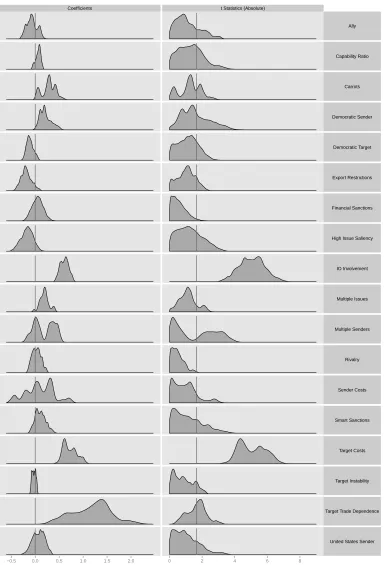
inter-pret the results from our sensitivity analysis. Figure 1 reports the results for when we analyze
both threatened and imposed sanctions.13 The left column shows the distribution of the estimated
coefficients; the right column gives the corresponding distribution of the absolute values of the t
statistics.14 For ease of interpretability, we consider variables with t statistics above an absolute
value of 1.65 to statistically significant.15 The vertical line in the right column represents a value
of 1.65.
To make sense of the results in Figure 1, let us first examine the Target Costs variable toward
the bottom of the figure. All estimated coefficients fall to the right of zero which indicates that
target costs are positively associated with sanctions success in every model specification, regardless
of which variables are included. To the right, we see that all t statistics associated with Target
Costs are beyond1.65in their absolute value. This suggests that target costs came out statistically
significant in every regression in which it was included, regardless of which other variables were
included. From these results, we can conclude that the target costs make sanctions success more
likely and do so robustly.
Second, consider the Target Trade Dependence variable. Most of its estimated coefficients fall
to the right of zero, indicating that we are certain about its positive relationship with sanctions
success. Looking to the t statistics, about a half of them fall to the left of1.65, meaning that in
about a half of the regressions we ran, this relationship lacks statistical significance. Consequently,
it is possible that some particular analysis would suggest that there is no significant relationship
13We generate figures using the ggplot2 package in R (Wickham, 2009).
14We do not report the mean (weighted) coefficients andtstatistics that Sala-i-Martin (1997) and Hegre and
Sam-banis (2006) calculated in their papers. Instead, we focus our discussions on the distributions of the results for each independent variable. As the graphs show, the means of the coefficients do not show the great amount of heterogene-ity of estimates across models. We believe that the distributions provide a better representation of the effect and its robustness for the impacts of each of the variables.
15This corresponds top < .10in a two tailed test.
Coefficients
−0.5 0.0 0.5 1.0 1.5 2.0
t Statistics (Absolute)
0 2 4 6 8
Ally
Capability Ratio
Carrots
Democratic Sender
Democratic Target
Export Restrictions
Financial Sanctions
High Issue Saliency
IO Involvement
Multiple Issues
Multiple Senders
Rivalry
Sender Costs
Smart Sanctions
Target Costs
Target Instability
Target Trade Dependence
[image:12.612.118.502.74.639.2]United States Sender
Figure 1: Analysis of All Cases. The left column shows the distribution of the estimated coeffi-cients and the right column gives the distribution of the absolute values of thetstatistics for each variable. The vertical lines in both columns correspond to zero and1.65, respectively.
between target’s trade dependence and sanctions success. Yet, our results suggest that the effect of
target’s trade dependence is positive and that the relationship is weakly robust.
Finally, consider the Sender Costs variable for which the coefficients are split about evenly on
each side of zero. This indicates that the signs of the coefficient estimates depend essentially on
which variables are included in the models. Therefore, we cannot be certain whether the
relation-ship between sender costs and sanctions success is positive or negative. Moreover, while most of
thetstatistics for the variable lie between zero and1.65, some do exceed this value. This suggests
that, under certain model specifications, it is possible to find results indicating significant effects
of sender costs; however, our sensitivity analysis suggests these are artifacts of particular models
and we conclude that sender costs appear to have no systematic effect on sanctions success,.
Success of Economic Sanctions
Having examined Target Costs, Sender Costs, and Target Trade Dependence in all sanctions cases,
let us examine the rest of the variables. Figure 1 reveals that senders are more likely to achieve
their goals (1) when they threaten and/or impose sanctions under the auspicies of international
institutions (IO Involvement) and (2) when sanctions are anticipated to impose or actually impose
severe economic costs on targets (Target Costs). In our analysis, these factors are found to be
positively associated with success of sanction policies, which is consistent with the hypotheses in
the literature, and these relationships are robust.
Figure 1 also suggests that many other variables may be systematically related to sanctions
success, but their significance depends on which other covariates are included. The relationships
between sanctions success and seven variables - Carrots, Democratic Sender, Democratic Target,
Export Restrictions, High Issue Saliency, Multiple Issues, Target Trade Dependence - are found to
be weakly robust, meaning that about half of the correspondingtstatistics are below 1.65.
How-ever, we find all or most of the coefficient estimates for these variables are in the same direction.
We believe this suggests that we can be certain that these seven variables do have a systematic
effect on sanctions success even though the statistical significance of the results depends on the
particular model specification.
Finally, our results show that the rest of the variables appear to have no systematic effect on
sanctions success. Theirtstatistics fall below 1.65 and the directions of the coefficients are lacking
a systematic pattern. This result suggests that these variables do not look to be relevant to sanctions
success. Note that it is still possible to find model specifications in which they have a statistically
significant relationship with sanctions success. Our results show that these relationships are not to
be taken as robust, however.
Analysis of Imposed Sanctions
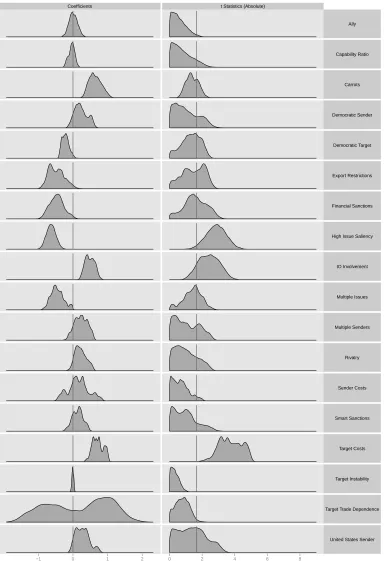
Figure 2 shows the results when we analyze only cases of imposed sanctions. In this analysis,
we are interested in which factors contribute to success of sanctions once sanctions are imposed.
Thus, we exclude cases where sanctions were not imposed (i.e. cases where threats succeeded or
senders chose not to follow through their threats). We notice from Figure 2 that, in contrast to the
results in Figure 1, there are considerably fewer systematic patterns. We find that, as was the case
in Figure 1, the effects of IO Involvement and Target Costs are robust and positive. Aside from
these two variables, there are only three variables - Financial Sanctions, Multiple Issues, Target
Trade Dependence - that appear to be systematically (and positively) related to success of imposed
sanctions. However, these variables are only weakly robust.
The findings in Figure 2 map neatly with those from previous studies, which mostly looked at
imposed sanctions. Our results are thus commensurate with the varied findings that we reported in
Table 1 in that for every relationship, there exists at least one study in which the coefficient was
shown to be insignificant. Along similar lines, Table 1 also shows that some variables were found
both positively and negatively related to success. Our results corroborate this as the relationships
between most variables and success of imposed sanctions are sensitive to changes in model
speci-fications. For example, some studies found the effects of the Ally and Sender Cost variables to be
Coefficients
0 1 2 3
t Statistics (Absolute)
0 2 4 6 8
Ally
Capability Ratio
Carrots
Democratic Sender
Democratic Target
Export Restrictions
Financial Sanctions
High Issue Saliency
IO Involvement
Multiple Issues
Multiple Senders
Rivalry
Sender Costs
Smart Sanctions
Target Costs
Target Instability
Target Trade Dependence
[image:15.612.117.502.74.638.2]United States Sender
Figure 2:Analysis of Imposed Sanctions. The left column shows the distribution of the estimated coefficients and the right column gives the distribution of the absolute values of thetstatistics for each variable. The vertical lines in both columns correspond to zero and1.65, respectively.
positive while others reported negative effects. Our findings in Figure 2 show that the possibilities
for positive and negative relations exist. Our results suggest that, if one considers only imposed
sanctions, one’s conclusions will be heavily dependent on the specific model estimated. To be
somewhat circumspect, we have to recognize that one of the models we run might be the ‘true’
specification and that might be appropriate tests of specific theoretical hypotheses. These
sensitiv-ity analyses might also suggest, however, that understanding sanctions effectiveness requires that
we consider both threats and impositions.
Analysis of Sanctions Threats
We now turn to the results in Figure 3 when we consider only threat cases. Here we are interested
in identifying which factors influence the probability that threats of sanctions are effective. Thus,
the dependent variable is the threat success, and we consider it a failure if sanctions are imposed or
if the sender capitulates before imposing sanctions. In Figure 3, we see that threats are more likely
to succeed if (1) they are issued under the auspices of international institutions (IO Involvement),
(2) severe economic costs on the targets are anticipated (Target Costs), and (3) disputed issues are
salient (High Issue Saliency). The effects of these variables are robust.
Figure 3 also suggests that six variables are systematically related to threat success, but not
robustly so. These variables include Carrots, Democratic Target, Export Restrictions, Financial
Sanctions, Multiple Issues, and United States Sender. About half of their respectivetstatistics fall
below 1.65for each of these variables, but the estimated coefficients are consistently in the same
direction. Thus, we are certain about the direction of the effects of Carrots and United States Sender
(positive) and that of the effects of Democratic Target, Export Restrictions, Financial Sanctions,
and Multiple Issues (negative).
It is worth pointing out several differences between the results from analysis of threat successes
and that of success of imposed sanctions. We first discuss one factor that seems to be systematically
related to success at the imposition stage but not at the threat stage. Our results suggest that the
Coefficients
−1 0 1 2
t Statistics (Absolute)
0 2 4 6 8
Ally
Capability Ratio
Carrots
Democratic Sender
Democratic Target
Export Restrictions
Financial Sanctions
High Issue Saliency
IO Involvement
Multiple Issues
Multiple Senders
Rivalry
Sender Costs
Smart Sanctions
Target Costs
Target Instability
Target Trade Dependence
[image:17.612.118.502.76.637.2]United States Sender
Figure 3: Analysis of Sanctions Threats.The left column shows the distribution of the estimated coefficients and the right column gives the distribution of the absolute values of thetstatistics for each variable. The vertical lines in both columns correspond to zero and1.65, respectively.
Target Trade Dependence variable is positively and fairly robustly correlated with success when we
analyze only imposed sanctions. However, when we consider success of threats, the relationship
becomes ambiguous. Thus, our results suggest an interesting puzzle: Why does a target’s trade
dependence seems to be associated with success at the imposition stage but not at the threat stage?
In contrast, some factors are found to be relevant at the threat stage, but are either not related
or related in the opposite directions at the imposition stage. Some variables, including Carrots,
Democratic Target, Export Restrictions, High Issue Saliency, and United States Sender are found
to have ambiguous relationships with success when only imposed sanctions are analyzed, but the
relationships become clearer and more robust when threat success is analyzed. Additionally, a
few variables like Financial Sanctions and Multiple Issues are found to be positively related to
success at the imposition stage, but negatively associated with success at the threat stage. The
implications of these findings for theories of sanctions may be significant. One reason that accounts
for these results may be a selection effect. For example, our finding that carrots contribute to threat
success is entirely consistent with the expectation in the literature. But, precisely because carrots
help induce targets to give in before the sanctions are imposed, cases where the sender imposed
sanctions but offered carrots before imposition of sanctions can be considered hard cases. That
is, the carrots offered before the imposition were not valuable enough to convince the target to
give in. If this argument is true, the relationship between carrots and sanctions success should be
negative for these hard cases. This mechanism may have contaminated the positive effect of carrots
on sanctions success. We believe this implies that future theoretical work must explicitly consider
possible selection mechanisms and address why these factors but not others may matter at different
stages in sanctions episodes.
Conclusion
Using the newly released TIES data set and an approach similar to the one suggested by Leamer
(1985), we report the robustness of the relationships between sanctions success and factors that are
identified to contribute to success in the literature. We find many relationships to be sensitive to
changes in variables included in the model, but others are not. We find that two factors - the target
costs and international institutions - are robust determinants of success. Our analyses also suggest
that the senders are more likely to achieve their goals when carrots are offered by the senders; when
the senders are democratic; when the targets are not democratic; when sanctions do not include
export restrictions; when issues are less salient; when multiple issues are involved; and when the
target highly depends on the trade with the sender.
We further investigated which factors determine success at different stages in sanctions episodes.
We find that the target costs and international institutions are robust determinants of both threats
and imposed sanctions and also that the issue saliency is robustly related to success of threat.
Fur-thermore, comparison of results from these separate analyses provide some interesting empirical
findings. For example, we find that financial sanctions are less likely to be effective at threat stage,
but more likely to succeed at the imposition stage. Our results also indicate that when multiple
issues are involved, threats are less likely to be successful, but imposed sanctions are more likely
to succeed.
This research note does not seek to test any particular theory of sanctions success or sort out
the different causal mechanisms behind the correlations found in our analysis. Instead, we were
motivated by the fact that even though the sanctions literature to date has suggested a number of
factors as determinants of sanctions success, there is little agreement on their empirical merits.
This research note seeks to establish which correlations are systematic and robust. However, we
believe that our results will help sanctions scholars with their theory-building. By establishing
which factors have robust effects on sanctions success, our results point to which variables need
to be included in future theories of sanctions effectiveness. Our analysis also reveals empirical
patterns that have not been theoretically well understood. In particular, these findings provide
some guidance regarding which selection processes may be at work in sanctions cases. At the very
least, it is clear that much of the ‘action’ occurs at the threat stage.
As always the case with any empirical studies, our study is also limited because certain sources
of uncertainty are not considered here. For example, we have not considered the uncertainty in
the measurements of the variables or the choice of statistical models. We also have not
consid-ered certain interactions of the factors, such as the interaction between multiple issues, institution
involvement, and multilateral sanctions that recent studies have suggested (Bapat and Morgan,
2009). These sources of uncertainty should be explored in future work.
Our results provide strong evidence for some of the relationships that received mixed
empiri-cal findings in the previous studies. Our findings on the target costs and international institutions
confirm that the literature has developed a good understanding of the factors that determine
sanc-tions success. Moreover, we find that many factors contribute to success at the threat stage before
sanctions are imposed. These findings are consistent with recent theories that suggest threats are
important part of sanction episodes. In contrast, we also find that target’s trade dependence matters
for success of imposed sanctions, but not for threat success. Our results show that certain factors
contribute to success at different stages of sanctions episode, but our theoretical understanding of
why and how these patterns emerge is still limited. Our empirical evidence calls for further
theo-retical as well as empirical investigations of the mechanisms by which these factors contribute to
the success.
References
Allen, Susan H. 2005. “The Determinants of Economic Sanctions Success and Failure.” Interna-tional Interactions31(2):117–138.
Allen, Susan H. 2008. “Political Institutions and Constrained Response to Economic Sanctions.”
Foreign Policy Analysis4(3):255–274.
Baldwin, David A. 1971. “The Power of Positive Sanctions.”World Politics24(1):19–38.
Banks, Arthur S. 2005. Cross-national Time-series Data Archive, 1815-2003. Binghampton, NY: Databanks International.
Bapat, Navin A. and T. Clifton Morgan. 2009. “Multilateral Versus Unilateral Sanctions Recon-sidered: A Test Using New Data.”International Studies Quarterly53(4):1075–1094.
Bolks, Sean M. and Dina Al-Sowayel. 2000. “How Long Do Economic Sanctions Last? Examining the Sanctioning Process Through Duration.”Political Research Quarterly53(2):241–265.
Bonetti, Shane. 1998. “Distinguishing Characteristics of Degrees of Success and Failure in Eco-nomic Sanctions Episodes.”Applied Economics30(6):805–813.
Brooks, Risa A. 2002. “Sanctions and Regime Type: What Works, and When?” Security Studies
11(4):1–50.
Clarke, Kevin A. 2005. “The Phantom Menace: Omitted Variable Bias in Econometric Research.”
Conflict Management and Peace Science22(4):341–352.
Clarke, Kevin A. 2009. “Return of the Phantom Menace: Omitted Variable Bias in Political Re-search.”Conflict Management and Peace Science26(1):46–66.
Cortright, David and George A. Lopez. 1998. Carrots, Sticks, and Cooperation: Economic Tools of Statecraft. InCases and Strategies for Preventive Action, ed. Barnett R. Rubin. New York: The Century Roundation Press pp. 113–114.
Cortright, David and George A. Lopez. 2002. Smart Sanctions: Targeting Economic Statecraft. Lanham, MD: Rowman & Littlefield.
Dashti-Gibson, Jaleh, Patricia Davis and Benjamin Radcliff. 1997. “On the Determinants of the Success of Economic Sanctions: An Empirical Analysis.”American Journal of Political Sci-ence41(2):608–618.
Dehejia, Rajeev H. and Bernard Wood. 1992. “Economic Sanctions and Econometric Policy Eval-uation. A Cautionary Note.”Journal of World Trade26(1):73–84.
Doxey, Margaret. 1980. Economic Sanctions and International Enforcement. New York, NY: Oxford University Press.
Drezner, Daniel W. 1999. The Sanctions Paradox: Economic Statecraft and International Rela-tions. Cambridge: Cambridge University Press.
Drezner, Daniel W. 2000. “Bargaining, Enforcement, and Multilateral Sanctions: When Is Coop-eration Counterproductive?”International Organization54(1):73–102.
Drezner, Daniel W. 2003. “The Hidden Hand of Economic Coercion.”International Organization
57(3):643–659.
Drury, A. Cooper. 1998. “Revisiting Economic Sanctions Reconsidered.” Journal of Peace Re-search35(4):497–509.
Early, Bryan R. 2011. “Unmasking the Black Knights: Sanctions Busters and Their Effects on the Success of Economic Sanctions.”Foreign Policy Analysis7(4):381–402.
Eaton, Jonathan and Maxim Engers. 1992. “Sanctions.”Journal of Political Economy100(5):899– 928.
Galtung, Johan. 1967. “On the Effects of International Economic Sanctions: With Examples From the Case of Rhodesia.”World Politics19(3):378–416.
Gelman, Andrew and Jennifer Hill. 2006. Data Analysis Using Regression and Multi-level/hierarchical Models. Cambridge: Cambridge University Press.
Gleditsch, Kristian S. 2002. “Expanded Trade and GDP Data.” Journal of Conflict Resolution
46(5):712–724.
Hart, Robert A. 2000. “Democracy and the Successful Use of Economic Sanctions.” Political Research Quarterly53(2):267–284.
Hegre, H˚avard and Nicholas Sambanis. 2006. “Sensitivity Analysis of Empirical Results on Civil War Onset.”Journal of Conflict Resolution50(4):508–535.
Honaker, James and Gary King. 2010. “What to Do about Missing Values in Time-series Cross-section Data.”American Journal of Political Science54(2):561–581.
Hufbauer, Gary Clyde, Jeffrey J. Schott and Kimberly Anne. Elliott. 1990. Economic Sanctions Reconsidered: History and Currenty Policy. Washington, DC: Institute for International Economics.
Hufbauer, Gary Clyde, Jeffrey J. Schott, Kimberly Anne. Elliott and Barbara Oegg. 2007. Eco-nomic Sanctions Reconsidered. Washington, DC: Peterson Institute for International Eco-nomics.
Jing, Chao, William H. Kaempfer and Anton D. Lowenberg. 2003. “Instrument Choice and the Effectiveness of International Sanctions: A Simultaneous Equations Approach.”Journal of Peace Research40(5):519–535.
Kaempfer, William H. and Anton D. Lowenberg. 1992. International Economic Sanctions: A Public Choice Perspective. Boulder, CO: Westview Press.
Kaempfer, William H. and Anton D. Lowenberg. 1999. “Unilateral versus Multilateral Interna-tional Sanctions: A Public Choice Perspective.”International Studies Quarterly43(1):37–58.
Kaempfer, William H. and Anton D. Lowenberg. 2007. “The Political Economy of Economic Sanctions.”Handbook of Defense Economics2:867–911.
King, Gary, James Honaker, Anne Joseph and Kenneth Scheve. 2001. “Analyzing Incomplete Po-litical Science Data: An Alternative Algorithm for Multiple Imputation.”American Political Science Review95(1):49–69.
Klein, James P., Gary Goertz and Paul F. Diehl. 2006. “The New Rivalry Dataset: Procedures and Patterns.”Journal of Peace Research43(3):331–348.
Krustev, Valentin L. 2007. “Bargaining and Economic Coercion: The Use and Effectiveness of Sanctions.” Ph.D diss. Rice University.
Krustev, Valentin L. 2010. “Strategic Demands, Credible Threats, and Economic Coercion Out-comes.”International Studies Quarterly54(1):147–174.
Krustev, Valentin L. and T. Clifton. Morgan. 2011. “Ending Economic Coercion: Domestic Politics and International Bargaining.”Conflict Management and Peace Science28(4):351–376.
Lacy, Dean and Emerson M.S. Niou. 2004. “A Theory of Economic Sanctions and Issue Linkage: The Roles of Preferences, Information, and Threats.”Journal of Politics66(1):25–42.
Lam, San Ling. 1990. “Economic Sanctions and the Success of Foreign Policy Goals: A Critical Evaluation.”Japan and the World Economy2(3):239–248.
Leamer, Edward E. 1985. “Sensitivity Analyses Would Help.” American Economic Review
75(3):308–313.
Leeds, Brett Ashley, Jeffrey Ritter, Sara McLaughlin Mitchell and Andrew Long. 2002. “Alliance Treaty Obligations and Provisions, 1815-1944.”International Interactions28(3):237–260.
Lektzian, David and Mark Souva. 2003. “The Economic Peace between Democracies: Economic Sanctions and Domestic Institutions.”Journal of Peace Research40(6):641–660.
Lektzian, David and Mark Souva. 2007. “An Institutional Theory of Sanctions Onset and Success.”
Journal of Conflict Resolution51(6):848–871.
Marinov, Nikolay V. 2005. “Do Economic Sanctions Destabilize Country Leaders?” American Journal of Political Science49(3):564–576.
Marshall, Monty G. and Keith Jaggers. 2005. Polity IV Project: Political Regime Characteris-tics and Transitions, 1800–2004. Arlington, VA: Center for Global Policy School of Public Policy, George Mason University.
Martin, Lisa L. 1993.Coercive Cooperation: Explaining Multilateral Economic Sanctions. Prince-ton: Princeton University Press.
McLean, Elena V. and Taehee Whang. 2010. “Friends Or Foes? Major Trading Partners and the Success of Economic Sanctions.”International Studies Quarterly54(2):427–447.
Miers, Anne C. and T. Clifton Morgan. 2002. “Multilateral Sanctions and Foreign Policy Success: Can Too Many Cooks Spoil the Broth?”International Interactions28(2):117–136.
Miyagawa, Makio. 1992. Do Economic Sanctions Work? New York, NY: St. Martin’s Press.
Morgan, T. Clifton and Anne C. Miers. 1999. “When Threats Succeed: A Formal Model of the Threat and Use of Economic Sanctions.” Presented at the Annual Meeting of the American Political Science Association, Atlanta.
Morgan, T. Clifton., Navin. Bapat and Valentin. Krustev. 2009. “The Threat and Imposition of Economic Sanctions, 1971–2000.”Conflict Management and Peace Science26(1):92.
Morgan, T. Clifton and Valerie L. Schwebach. 1996. “Economic Sanctions as an Instrument of Foreign Policy: The Role of Domestic Politics.”International Interactions21(3):247–263.
Morgan, T. Clifton and Valerie L. Schwebach. 1997. “Fools Suffer Gladly: The Use of Economic Sanctions in International Crises.”International Studies Quarterly41(1):27–50.
Nooruddin, Irfan. 2002. “Modeling Selection Bias in Studies of Sanctions Efficacy.”International Interactions28(1):59–75.
Norris, Pippa. 2008. Driving Democracy: Do Power-sharing Institutions Work? Cambridge: Cambridge University Press.
Pape, Robert A. 1997. “Why Economic Sanctions Do Not Work.”International Security22(2):90– 136.
Sala-i-Martin, Xavier X. 1997. “I Just Ran Two Million Regressions.”American Economic Review
87(2):178–183.
Shagabutdinova, Ella and Jeffrey Berejikian. 2007. “Deploying Sanctions while Protecting Human Rights: Are Humanitarian “Smart” Sanctions Effective?”Journal of Human Rights6(1):59– 74.
Singer, J. David, Stuart Bremer and John Stuckey. 1972. Capability Distribution, Uncertainty, and Major Power War, 1820-1965. InPeace, War, and Numbers, ed. Bruce Russett. Beverly Hills: Sage Publications pp. 19–48.
Smith, Alastair. 1996. “The Success and Use of Economic Sanctions.”International Interactions
21(3):229–245.
Sturm, Jan-Egbert, Helge Berger and Jakob De Haan. 2005. “Which Variables Explain Decisions on IMF Credit? An Extreme Bounds Analysis.”Economics & Politics17(2):177–213.
van Bergeijk, Peter A.G. 1994. Economic Diplomacy, Trade, and Commercial Policy: Positive and Negative Sanctions in a New World Order. Aldershot, UK: Edward Elgar.
Wickham, Hadley. 2009. ggplot2: Elegant Graphics for Data Analysis. New York, NY: Springer.