Version: Submitted Version
Article:
Baghersalimi, G. and O'Farrell, T. orcid.org/0000-0002-7870-4097 (2013) Pilot-aided
estimation and equalisation of a Radio-over-Fibre system in Wideband Code Division
Multiple Access. IET COMMUNICATIONS, 7 (10). pp. 999-1007. ISSN 1751-8628
https://doi.org/10.1049/iet-com.2012.0660
[email protected] https://eprints.whiterose.ac.uk/
Reuse
Unless indicated otherwise, fulltext items are protected by copyright with all rights reserved. The copyright exception in section 29 of the Copyright, Designs and Patents Act 1988 allows the making of a single copy solely for the purpose of non-commercial research or private study within the limits of fair dealing. The publisher or other rights-holder may allow further reproduction and re-use of this version - refer to the White Rose Research Online record for this item. Where records identify the publisher as the copyright holder, users can verify any specific terms of use on the publisher’s website.
Takedown
If you consider content in White Rose Research Online to be in breach of UK law, please notify us by
Pilot Aided Estimation and Equalisation of a
Radio over Fibre System in WCDMA
Gholamreza Baghersalimi* and Timothy OÕFarrell**
*Department of Electrical Engineering, University of Guilan, Rasht, Iran, P.O.Box:3756.
Email: [email protected]
** Department of Electronic & Electrical Engineering, University of Sheffield, Sheffield, Mappin Street, S1 3JD.
Email: [email protected]
AbstractÑ In this paper the impact of a Radio over Fibre (RoF) subsystem on the capacity performance of Wideband Code Division Multiple Access (WCDMA) is evaluated. The study investigates the use of pilot aided
channel estimation to compensate for the optical subsystem nonlinearities for different channel conditions,
estimation intervals, and coding schemes. The results show that pilot aided channel estimation is an effective
method for compensating the composite impairments of the optical subsystem and the RF channel. It is found that
there is always a suitable pilot power level which maximises the system capacity performance regardless of coding
scheme and channel condition. Also, the peak capacity is only slightly affected by a decrease in the estimation
interval.
I. INTRODUCTION
Radio-over-Fibre (RoF) is a technology by which information bearing signals using RF (radio frequency) carriers
are distributed by means of optical components and techniques. Better coverage and increased capacity,
2, 3]. However, RoF systems are vulnerable to nonlinearities in the optical subsystem that cause degradation of the
system performance. The main areas of research in RoF include microwave and millimeter-wave RoF [4, 5, 6],
RoF-based Wireless Local Area Networks (WLANs) [7,8], RoF-based cellular systems [8], subcarrier multiplexed
RoF systems [8], RoF-based Wavelength Division Multiplexing (WDM) [9] and RoF-based photonic CDMA [10].
In particular, estimation methods, modelling the radio subsystem, modelling the optical subsystem and multiple
access techniques are regarded as the most important investigation topics in this context.
Channel estimation is a subject which has received a great deal of attention by researchers in recent years. In
wireless systems, channel estimation techniques are used for the estimation of the RF channel impulse response
(CIR) in order to compensate for the amplitude distortion and phase rotation introduced by the RF channel
variations. In cellular communication, estimation is achieved by time-multiplexed pilot signals, code-multiplexed
pilot signals, or a combination of these signals. In the wireless LAN systems, on the other hand, estimation is carried
out by frequency (subcarrier) multiplexed pilot signals, time (symbol) multiplexed pilot signals, or a combination of
these signals [11]. All such equalisation techniques require extra hardware at either the transmit and/or the receive
side of the communication link.
For RoF-based wireless communications, there is a dearth of publications in the context of channel estimation and
compensation [2- 8, 12, 13, 14]. In particular, for more realistic conditions the collective effects of modulation,
channel coding, multiuser interference (MUI), large signal distortion, RF channel distortion, data rate, diversity,
estimation level and equalisation techniques have not been substantially investigated before.
It should be emphasised that both the amplitude and phase distortions of an optical channel affect the system
performance. Also, due to the hysteresis-type memory of the optical subsystem, the entire RoF link suffers more
from the phase impairments and frequency-dependent nonlinearities when compared to a nonlinear element such as
an RF High Power Amplifier (HPA) as used in cellular mobile or satellite communications.
In this paper, the impact of the optical subsystem nonlinearities on the performance of a downlink Wideband
Code Division Multiple Access (WCDMA) cellular mobile system is studied in respect of the channel estimation
(CPICH) is used to compensate for the distortion introduced by both the optical channel and the RF channel, i.e.
a combined nonlinear time-variant channel. Strictly speaking, the overall nonlinear time-variant subsystem (optical
subsystem plus RF channel) is linearly estimated and equalised using CPICH under different conditions. Also, as
this research focuses only on the optical subsystem, other sources of nonlinearity, such as the RF HPA, are not
considered.
The paper is organised as follows. Section II introduces the theoretical background for estimating and
equalising the optical subsystem. Section III presents the computer simulation model while Section IV presents the
salient results and discussion of results. Finally, Section V concludes the paper.
II. SYSTEM MODEL AND ANALYSIS
User 1
X
Complex Long PN Sequence
*: Complex Conjugate
Modulator Data
Source 1
Encoder /
Interleaver Spreader
User K
Modulator Data
Source K
Encoder /
Interleaver Spreader
Interfering Users
+
.
.
.
.. .
Pilot Spreader
+
X
X
Tx RRCFilter
Optical Subsystem
Fading Channel
+
De-modulator Data
Sink 1
Denterleaver/ Decoder
Rx RRC Filter
X
X
Long PN Sequence
Traffic Channel Despreader
Pilot Despreader Average
over Test Receiver
AWGN
*
*
Pilot Signal
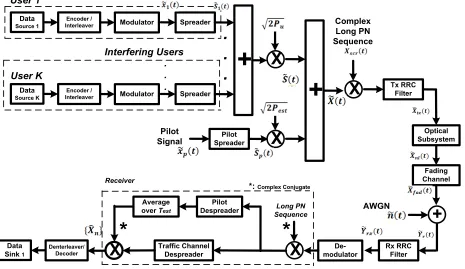
[image:4.612.77.542.366.635.2]In this section, the mathematical background of the baseband RoF WCDMA model, which is shown in Fig. 1, is
described. In general, this model comprises a transmitter, an optical link, an RF channel and a receiver. These
subsystems are described in the following subsections.
A. Transmitter
Each user in the RoF-WCDMA system independently sends its data bit stream to the channel encoder. This block
may be a rate 1/3 Convolutional Encoder (CC) or a rate 1/3 Turbo Encoder (TC). Then, an interleaver is applied for
an effective use of the channel encoders. Thereafter, the interleaved data enters the modulator where they are
converted to a symbol train using the QPSK mapping rule. Let the kth user signal over the frame period Tfr be
denoted by1
∑
= ≤ ≤ − − = s N n fr s n kk t X t n T t T
x
1
, ( ( 1) ); 0
) (
~
δ
(1)where Xk,n =bk,n+ jdk,n is the nth symbol of the kth user, bkn
, is the nth symbolÕs in phase component of
the k-th user,
d
kn, is the nth symbolÕs quadrature component of the kth user, Ts is the symbol period for all users, Ns
is the number of data symbols being transmitted for each user in the frame period Tfr =NsTs, and δ(t) is the Dirac
delta function. In the above relationship, it is assumed that all users transmit at the same data rate, or equivalently,
have the same spreading factor. Without loss of generality, in order to simplify the notation it is assumed that the
first user is the intended user, so that the intended userÕs signal over the frame period (0≤t≤Tfr), with unit
power, can be written without the index k = 1 as shown in Eq. 2.
∑
∑
= = − − + = − − = s s N n s n n N n sn t n T b jd t n T
X t
x
1 1
1() ( ( 1) ) ( ) ( ( 1) )
~ δ δ (2)
Each information bearing signal is then multiplied by the corresponding spreading sequence, as described by Eq. 3
∑
= ≤ ≤ − − = SF m s ch m kk t c t m T t T
g
1
, ( ( 1) ); 0 )
(
δ
(3)where SF is the data spreading factor which is assumed to be the same for all users,
T
ch is the chip duration andm k
c
, : m=1, 2,É, SF is the m-th element (chip) of the k-th userÕs binary spreading sequence. The spreading
sequences are chosen from the Walsh Hadamard (WH) sequences which are mutually orthogonal [15]. In addition,
if the spread signal of the k th user over a whole frame interval is denoted by Eq. 4,
fr N n s k N n SF m ch s m k k T t T n t g T m T n t c t z s s ≤ ≤ − − = − − − − =
∑
∑∑
= = = 0 ; ) ) 1 ( ( ) ) 1 ( ) 1 ( ( ) ( ~ 1 1 1 , δ (4)then the kth user spread signal of average power Pkand the total multiuser spread signal over the same frame
interval can be represented, respectively, by Eq. 5 and Eq. 6
∑
= − − = s N n s k n kk t X g t n T
S
1
, ( ( 1) )
) ( ~ (5)
∑∑
= = − − = K k N n s k n k k K s T n t g X P t S 1 1, ( ( 1) )]
[ 2 )
(
~ (6)
where K is the total number of users. Then, the CPICH is added to the transmitted signal in order to provide a
channel estimation mechanism. The spreading sequence of this signal is defined by Eq. 7
∑
= ≤ ≤ − − = p SF i p ch ip t q t i T t T
g 1 0 ); ) 1 ( ( )
(
δ
(7)where SFp is the spreading factor of the pilot signal, qi: i=1, 2, É, SFp is the i-th element of the spreading
sequence of the pilot signal and Tp is the duration of a pilot symbol. Also, the transmit pilot symbol sequence (i.e.
the non-spread pilot signal) can be represented by Eq. 8
∑
= ≤ ≤ − − = p N j fr p jp t a t j T t T
x 1 0 ); ) 1 ( ( ) (
~
δ
(8)where aj is the j-th transmit pilot symbol and Np is the number of pilot symbols per frame, henceTfr =NpTp.
∑
= ≤ ≤ − − = p N j fr p p jp t a g t j T t T
S 1 0 ); ) 1 ( ( ) ( ~ (9)
Hence, the total transmit signal over a frame is given by
∑∑
= = + − − = K k N n p est s k n k k s t S P T n t g X P t X 1 1 , ( ) ~ 2 )] ) 1 ( ( [ 2 ) ( ~ (10)where Pest is the average power of the pilot signal. In this paper, all users are assumed to transmit with equal power
Pu (i.e. Pk = Pu; k=1,2,É,K) which is the average power of a user for a certain service. By defining parameter R as
the ratio of the pilot power Pest to the total transmit power Pt as shown in Eq. 11,
t est
P P
R= (11)
then the total transmit power is given by Eq. 12
est u t KP P
P= + (12)
where the number of users K is given by Eq. 13.
⎣
SF 0 (1 R)⎦
K= ×η × − (13)
The term in ⎣ ⎦x denotes the largest integer not greater than x and η0 denotes the cell load factor. The parameter R
must be chosen in order to achieve reliable detection at the receiver without consuming excess resources and hence
capacity within the cellular system. Subsequently, the total spread signal is multiplied by the complex long PN
sequence or scrambling code. The long-PN sequence is applied on top of the channelisation codes and, on the
downlink, is used jointly to separate different cells of the cellular WCDMA system and to mitigate multipath. The
long-PN sequence does not alter the chip rate of the spread signal [15]. Following multiplication by the complex
long-PN sequence, the resultant signal is up-sampled and filtered by the transmit RRC (root raised cosine) filter as
shown in Eq. 14
)]
(
)
(
~
[
)
(
)
(
~
t
h
t
X
t
X
t
where * denotes convolution and hrrc(t) denotes the impulse response of the RRC filter, with roll-off factor equal
to 0.22 and oversampling factor equal to 4. Term
X
scr(
t
)
is the complex long-PN sequence or scramblingcode.
B. Optical Subsystem
In the analysis of communication systems, analytic models of subsystems are preferred because they normally lead
to closed form analytic solutions for the system. However, these models are only valid under certain conditions and
assumptions. In addition, some analytic techniques such as the Volterra series approach (for nonlinear systems with
memory such as the laser diode which is described by the rate equations) are very difficult to treat. Further, in some
cases the physical problems cannot be represented by mathematical models. One alternative for describing such
complex systems is behavioural modelling. In behavioural modelling, the system is treated as a black box with
transfer characteristics described by a set of equations. For an optical system, the transfer characteristics are
expressed as AM AM (amplitude-to-amplitude) and AM PM (amplitude-to-phase) characteristics (also known as
the large-signal response). The former is an amplitude transfer function while the latter is a phase transfer function.
The black box model accounts for the composite effects of all impairments in the system such as static and dynamic
nonlinearities and optical noise. The main advantage of behavioural modelling is that it can describe a complex
system without needing to have a detailed knowledge of its constituent subsystems or components.
The use of AM-AM/PM models is based on the underlying assumption that the envelope of the signal is
Fig. 2 AM AM/PM Characteristics (IBO: Input Back-off).
The models are valid when the device Òmemory timeÓ (amplitude- and frequency-dependent time delay between the
transmitted and received RF signal) is much smaller than the reciprocal of the input signal bandwidth [16]. In other
words, these characteristics can be used only when the nonlinear system is treated as a quasi-memoryless system
[17]. As a rule of thumb, the AM-AM/PM models are used when the memory of the nonlinear system is at least
twice less than the reciprocal of the envelope frequency [16, 18]. This condition is met in this study.
The optical subsystem used in this research comprises an LD (laser diode), a 2.2 km long single-mode fibre and
a PD (photodiode). The optical transmitter used is a directly modulated InGaAsP DFB (distributed feedback) LD
with an operating wavelength of 1310 nm. Also, the optical receiver consists of an overall 32 dB gain which
completely compensates for the total loss of this optical link. The radio frequency is 1.8 GHz, though the frequency
response of the link is flat over frequencies 1.7 < f <2.2 GHz. The AM-AM/PM transfer functions are shown in Fig.
2. Further, a pictorial description of OBO (output back-off) is shown in Fig. 2 and is defined (on a logarithmic scale)
as the difference between the maximum output power and the output power at the quiescent operating point.
The RRC filtered signal passes through the nonlinear (nl) optical subsystem whose output is given by Eq. 15
)] ( ) ) ( ~ ( 5 . 0 ( exp[ ) ) ) ( ~ ( 5 . 0 ( 2 ) ( ~ ~ 2 2 t j t X G R jf t X G R f R G t X tx X tx in in PM AM tx in in AM AM out out
nl = − × − + ψ
where m i RF in
P
IBO
P
G
!
=
max(
,)
is the gain of the pre-amplifier which matches the output power of the transmitRRC filter to the input power of the optical subsystem [8], IBO is the input back-off on a linear scale,
P
m is themaximum input RF power to the optical subsystem before the pre-amplifier, max(PRF,i) is the (measured)
maximum input RF power before the pre-amplifier, ~
(
t
)
txX
ψ
is the phase of the signalX
~
(
t
)
tx ,
R
in=
50
Ω
is theinput impedance of the optical subsystem,
R
out=
50
Ω
is the output impedance of the optical subsystem, andG
outis a linear gain which sets the overall gain of the optical subsystem to unity. Also,
f
AM−AM(.)
andf
AM−PM(.)
arethe AM AM and AM PM transfer function characteristics of the nonlinear (optical) subsystem, respectively.
C. RF Channel
Following the optical subsystem, the signal passes through the RF fading channel. A new set of fading taps are
generated every Tfr seconds using a unit variance complex Gaussian process. The output signal of the fading block
can be represented as Eq. 16
∑
∑
= = − = − = L l l nl t j l L l l nl lfad t a t X t R t e X t
X l 1 ) ( 1 ) ( ~ ) ( ) ( ~ ) ( ~ ) ( ~
τ
τ
ϕ (16)where L is the number of multipaths,
a
~
l is the complex gain of the lth path,τ
l is the excess delay of the l thpath, while Rl=a~l and ϕl are the magnitude and phase, respectively, of the complex gain a~l. In general, the
path amplitudes, phases and delays are time dependent. Also, the terms in a~l are normalised such that the average
received power is unity, i.e. [ ]
[
~]
11 2 = =
∑
= L i ll E a
P
E and E[⋅] denotes the expectation operator. Hence, the
received average power level is not affected by the fading channel. Eb is defined as the average bit energy of the
intended user while the signals from other users are treated as an MUI. Thus, Eq. 16 can be rewritten as Eq. 17
) ( ~ ) ( ~ ) ( ~
1 t n t
x t
where
~
x
s1(
t
)
is the scrambled and up-sampled (and possibly amplified/attenuated) version of signal ~()1t
S , and
~
n
d(
t
)
is the total distortion introduced by the multipath fading , optical subsystem , and other users.
After the fading channel is applied, the signal is perturbed by a zero-mean complex AWGN process
n
~
(
t
)
. So,the received signal can be represented by Eq. 18.
)
(
~
)
(
~
)
(
~
)
(
~
1
t
n
t
n
t
x
t
Y
d s
r
=
+
+
(18)Then, the signal-to-interference-noise ratio (SINR) is given by Eq. 19.
)]
(
~
)
(
~
[
)]
(
~
[
2 2 2 1t
n
t
n
E
t
x
E
SINR
d s+
=
(19)D. Receiver
At the receiver, the noise perturbed signal is filtered by the receive RRC filter followed by down-sampling, where
the output of this filter is given by Eq. 20.
)
(
~
)
(
)
(
~
t
h
t
Y
t
Y
r rrc
rx
=
∗
(20)In this paper, the joint optical and RF channels are estimated using a pilot symbol channel estimation technique.
That is, pilot symbols are used to train sequences for estimating the combined optical and RF channel impulse
response. To do so, a perfect knowledge of the delays of different paths is assumed.
In general, by using post correlation compensation all the paths or taps are estimated and averaged over the
estimation time Test (which is shorter than Tfr) according to a strategy to give a complex tap estimate for that
particular interval. Then all complex taps are applied to the data signal in the corresponding time intervals in the
same path. This process is repeated for all time intervals per frame and for all paths. For example, in [15] a multi
slot (each slot corresponds to 1/15 th of a frame duration) Moving Window Averaging (MWA) filter was used to
determine the final channel estimate in a particular slot. Thereafter, each final estimate per slot was used to
compensate for the channel impairment in the corresponding data slot. As another example, a 6 symbol MWA filter
was used in [19] to obtain the final channel estimate per symbol. Then, each final estimate per symbol was applied
In this paper, a channel estimate is obtained during the interval Test , and then applied to the whole frame. In
other words, after deriving the channel estimate it is immediately applied to the entire data frame. This approach
reduces the processing time and complexity of the receiver. The tap extraction process comprises three vector
multiplications (i.e. the scrambling code, pilot spreading code and transmit pilot) followed by an integration over
Test.. The shorter the estimation time the shorter the length of the three vectors, hence a more time efficient process
can be achieved. Nonetheless, averaging over longer periods gives better estimates of the channel. This concept is
investigated using capacity as the main metric for different estimation durations including frame, slot, and symbol
periods. The estimated tap in path l can be represented by Eq. 21.
∫
− − − = est T l p l scr l rxl Y t X t S t dt
a 0 * * ) ( ~ ) ( ) ( ~ ö
~
τ
τ
τ
(21)After applying the estimated tap for each path to the data signal in each frame, the resultant compensated data are
combined. In this study, the Maximum Ratio Combiner (MRC) is used. The signal in each path is multiplied by the
conjugate of the estimated tap which is proportional to the signal power in the same path. This was shown to give
the best performance compared to other combining rules [15]. Therefore, the n th received symbol for intended
user-1 in the time interval
nT
s≤
t
≤
(
n
−
1
)
T
s , as denoted by Xön , may be represented by Eq. 23.∑
∫
= −+
=
−
−
−
=
L l nT T n n n l l scr l rx l n s sd
j
b
dt
t
Z
t
X
t
Y
a
X
1 ( 1)
1 *
*
ö
ö
)
(
~
)
(
)
(
~
ö~
ö
τ
τ
τ
(22)The term ~( )
1 t
Z denotes the spreading waveform of user-1 while the terms in
b
ö
n andd
ö
nare the in phase andquadrature components, respectively, of user-1Õs n th estimated symbol. The soft outputs of the demodulator are
then passed to the deinterleaver in order to rearrange the demodulated data. The data stream is then decoded
according to the channel coding used at the transmit side. Following decoding, the data bits are collected at the data
sink and compared to those transmitted.
It should be emphasised that the value of the proposed estimation method compared with previous studies in the
literature Ðaddressed in Section I, paragraph 3- is that by using existing channel estimation and correction
the transmit and/or the receive side of the communication link. Also the comprehensive nature of the study which
models the collective effects of the modulation, coding, multiple user interference, large signal distortion, multipath
propagation as well as channel estimation and equalisation contribute to the unique value of the work undertaken.
III.SIMULATIONSETUP
In order to evaluate the effects of the optical subsystem on WCDMA, computer simulations were carried out based
on the system model presented in Fig. 1. In this arrangement the total power, which is the sum of the powers of all
spread signals including the pilot signal, is divided between the pilot signal and the users. This can be represented
mathematically by Eq. 23 where
0
<
(
R
=
P
estP
t)
<
1
R
R
P
R
RP
P
P
t t
users est
−
=
−
=
1
)
1
(
(23)where
P
users=
KP
u is the total transmit power of all the users.A key performance metric for WCDMA is the continuous-user (channel) capacity, which is defined as the
maximum number of users (or channels)that can be provided in a fixed frequency band [20]. This capacity is also a
metric of the spectrum efficiency of a wireless system for either the uplink or downlink. In a cellular CDMA system,
capacity is calculated at an operating Eb/No [20] as given by Eq. 24
)
1
(
)
(
1
0 10
ρ
α
η
+
+
×
=
−
N
E
G
C
p b (24)where
G
p is the processing gain (i.e. the ratio of the chip rate to the data rate),η
0 is the cell load factor ,α
is theactivity factor of the data signal, and
ρ
is the intercell to intracell interference ratio. As the end user of an RoFnetwork utilises the spectrum of the wireless channel, the same capacity concept can be applied for such networks.
In this research, each user corresponds to a 40 kbit/s data rate.
In this paper, a single cell system is considered with all the mobiles active all the time, hence α=1 and
ρ
=
0
.which is determined by the spreading factor SF. In addition, a proportion of the transmit power is dedicated to the
pilot signal. Since the factor R is the ratio of the pilot power to the total transmit power and as all the users have the
same transmit power, then the cell load factor is given by
η
0=
1
−
R
. Therefore, the capacity of the cellular systemis given by Eq. 25.
⎥ ⎦ ⎤ ⎢
⎣ ⎡
+
−
=
0
1 ) 1 (
N E
G R
C
b p
(25)
Finally, RF channel parameters [21], WCDMA system parameters [22], [23], and optical subsystem parameters [12]
are summarised in Tables I, II, and III, respectively.
TABLEI
RFCHANNEL PARAMETERS
Case Delay Profile [ns]
Power
Profile
[dB]
Speed
(km/h)
Flat [0] [0] 50
3-Path [0 976 20000] [0 0 0] 3
4-Path [0 260 521 781] [0 -3 -6 -9] 120
TABLEII
WCDMASYSTEM PARAMETERS
Quantity Value
Frame Length 10 ms (=400 bits)
Data Rate 40 kbps
Channel Interleaver
Depth
10 ms
Number of Frames 600
Chip Rate 3.84 Mcps
Spreading Factor Data: 64, Pilot: 256
Estimation Level Frame: 10 ms
Slot: 0.667 ms
Symbol: 0.0167 ms
Coding
(Rate =1/3)
I-Convolutional
II-Turbo
Constraint Length: KCL = 4
TC Internal Interleaver
Depth
Baseline 10 ms all channels plus 80
ms for 3-path channel
Ratio of Pilot Power to
Total Power R [%]
0.003, 0.005, 0.01, 0.03, 0.1, 1, 1.5 ,
3, 10, 20, 40, 60 , 80
Target BER 10-3
Confidence Interval 95%
TABLEIII
OPTICALSUBSYSTEM PARAMETERS
Quantity Value
Output Back off 0, 0.3, 3 dB
Max(PRF,i) [ref. value
for OBO]
3.1623 mW (≡ 5 dBm)
Wavelength 1310 +/- 10 nm
Modulation Gain 0.12 mW/mA
PD Responsivity 0.75 mA/mW
Fibre Type Single-Mode (9/125)
Fibre Length 2.2 km
Post-Amplifier Gain 32 dB
Overall Gain 0 dB
LD Type DFB
IV.RESULTSANDDISCUSSION
The continuous user capacity performance (Eq. 25) is evaluated for different cases including CC/FF (convolutional
code / flat fading), TC/FF (turbo code/flat fading), TC/FS(3 path) (turbo code/3-path frequency selective fading),
with different interleaver depths, and TC/FS(4 path) (turbo code/4-path frequency selective fading) all dimensioned
at the frame level. Also, for the TC/FS(4 path) case both slot and symbol level channel estimations are compared.
A. The Effect on Capacity of the Coding Scheme
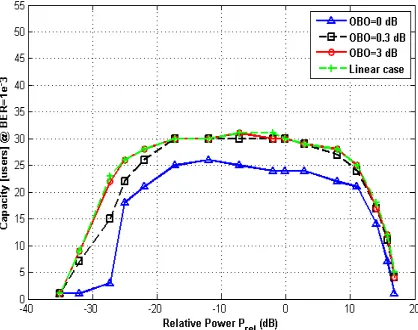
Fig. 3plots capacity versus Prel in dB for the CC/FF scenario, where
P
rel=
P
estP
u is the relative power of the pilotsignal to that of a single user (Pu). Results are shown for OBOlevels 0, 0.3, and 3 dB and a target BER of 10-3.The
specified value R1 (i.e.
0
<
R
≤
R
1); Region II Ð the capacity plateaus as R is increases from R1 to R2 (i.e.2 1
R
R
R
<
≤
); and Region III Ð the capacity decreases as R increases (i.e.R
2<
R
).This behavior may be explained more accurately as follows. In the nonlinear RoF WCDMA system, unlike the
linear system, the orthogonality of the wanted userÕs spreading code (i.e. user-1) to that of the pilot signal and also to
each spreading code of the other users is lost. When R is small, the pilot power (Pest) is low while the MUI is high
which gives a very noisy estimate of the channel impairment. For this case, the system BER, and hence capacity,
degrades rapidly. When R is large, the pilot power is high while the MUI is low. Though this case provides a good
channel estimate, the excessive interference power contributed by the pilot signal degrades the channel capacity.
For this case the system BER degrades, but less rapidly than the case when R is small. The interaction of the pilot
power and MUI clearly leads to an optimum value for R which minimises the BER and maximises the capacity.
As explained, the BER performance is improved by increasing R to a specific value. This behavior implies that
the required
E
bN
0 to achieve the target BER of 10-3
decreases as R increases (corresponding to Regions I of Fig.
3). For this case, the factors (1R)and
E
bN
0 in Eq. 25 for determining capacity decrease; the former decreaseslinearly while the latter decreases nonlinearly. In region II, the required
E
bN
0 changes slightly. For this case, thereis a balance between the factors (1R)and
E
bN
0. With a further increase in R, the BER performance degrades,consequently the required
E
N
0b for the same target BER increases. For this case (i.e. region III), the factor (1-R)
decreases linearly while
E
N
0b increases nonlinearly. The interaction of the two trends results in an optimum value
of R which maximises the capacity C. For the CC/FF case, the optimum value of R is in the range0.3% < R < 3% .
The above argument holds for all OBO levels regardless of the coding scheme. To verify this point, further
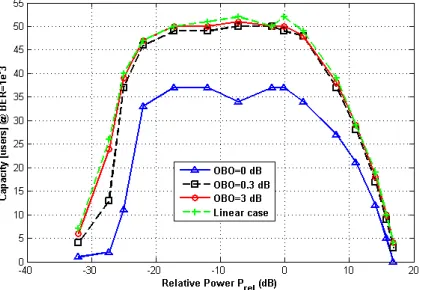
simulations were carried out using a TC as the channel code. The corresponding capacity graphs are shown in Fig. 4
where the same capacity trend is obtained as in the CC case. However, the TC achieves a slightly higher capacity
performance than the CC. This slight improvement, which is primarily due to the depth of the TC internal
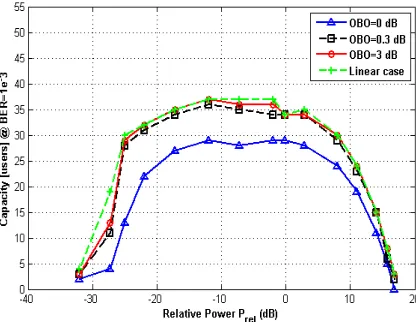
Fig. 3 Capacity vs. Prel for a CC/FF Scenario
Fig. 4 Capacity vs. Prel for a TC/FF Scenario: 10 ms Interleaver Depth
B. Frequency Selective Fading
To study the effect of fading channel type on the capacity performance, simulations were carried out for the
TC/FS(3-path) case. The results are shown in Fig. 5 for a 10 ms interleaver depth. The results indicate that the same
mechanisms described in Subsection A also determine the capacity performance in the TC/FS(3-path) scenario.
[image:17.612.200.409.367.532.2]evidenced further in Subsection D. Also, compared with the flat fading performance the results in Fig. 5 for
frequency selective fading demonstrate a proportionally greater capacity degradation at 0 dB OBO.
Fig. 5Capacity vs. Prel for TC/FS(3 Path) Case: 10 ms Interleaver Depth
C. The Effect of TC Internal Interleaver Depth
In Turbo coding interleaving is used to randomise the bit stream to achieve an effective use of the channel encoders,
which in turn leads to a capacity performance improvement. In Subsection B, the interleaver depth and TC block
size was investigated for 10 ms. In order to evaluate the effect of the TC block and interleaver depth on the system
performance, the previous experiments were repeated with an interleaver depth of 80 msec for the 3-path FS
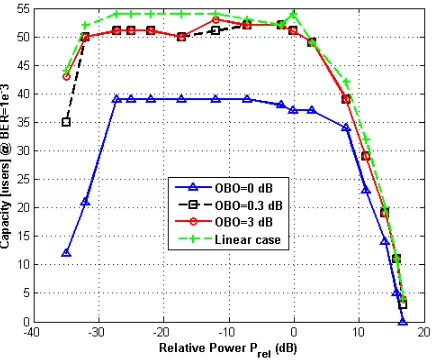
channel. The resultant capacity plots are shown in Fig. 6, in which the channel estimation is performed at the frame
level. The general trends for all graphs are similar to the primary results in Fig. 5 for a 10 ms interleaver depth. The
effectiveness of the interleaver is substantially enhanced by increasing its depth. At 0 dB OBO (the worst case
nonlinear scenario), for example, the peak capacity with 10 ms interleaver depth is 37 users and remains above 30
users for −23 < Prel< 5 dB, while with 80 ms interleaver depth the peak capacity increases to 39 users and remains
above 30 users for −30 < Prel < 9 dB). This corresponds to a peak capacity improvement of 5.4%, but more
[image:18.612.204.415.185.330.2]Fig. 6 Capacity vs. Prel for TC/FS(3 Path) Case: 80 ms Interleaver Depth
D. The Effect of Diversity
A common technique to overcome frequency selective fading is the application of diversity. Multipath diversity in
WCDMA is commonly achieved in frequency selective fading channels using a RAKE receiver to collect multiple
copies of the signal. As shown in [24], the performance of an L-branch RAKE receiver in a frequency selective
fading channel using MRC is similar to an L-th order diversity in which the BER performance is improved by
increasing the number of paths. Hence, as expected the 3-path FS fading channel yields a better capacity
performance than the FF case. However, in the FS case, unlike the FF case, the orthogonality of spreading codes to
each other (including the pilot signal) breaks down hence the cross-correlation values between the intended userÕs
spreading sequence and the sequences of other users and the pilot is no longer zero. This manifests itself as an extra
noise which in turn degrades the system performance more. Also, the power delay profile of the FS channel has a
large impact on the system performance. Further distortion is added by the optical subsystem which alsocontributes
to the breakdown of orthogonality between sequences.
To verify the above argument, simulations were carried out for the 4-path FS fading channel, i.e.
TC/FS(4-path) which exhibits an exponentially decaying power delay profile. The corresponding capacity graphs are shown
effects. Firstly, due to the larger number of paths, the interactionof different spreading codes in the presence of the
optical subsystem nonlinearity leads to more distortions in TC/FS(4-path) than TC/FS(3-path). Secondly, the
diversity of TC/FS(3-path) with 3 equal power paths is greater than the diversity of TC/FS(4-path). The RAKE
[image:20.612.200.408.231.392.2]receiver offers better performance for the equal-power multipath case. The above argument holds for all OBO.
Fig. 7 Capacity vs. Prel for TC/FS(4 Path) Scenario: 10 ms Interleaver Depth
E. The Effect of Estimation Interval
An estimate of the WCDMA channel is obtained by evaluating a portion of the frame over the interval Test≤ Tfr,
which is then applied to whole frame for data recovery. This technique reduces the processing time but the system
performance is degraded compared to estimation over a full frame period. In order to investigate the effect of the
estimation interval on the system performance, the previous experiments for the TC/FS(4-path) channel (with a TC
interleaver depth of 10 ms) were repeated for estimation intervals equal to a slot period (Test = 0.667 ms) and a
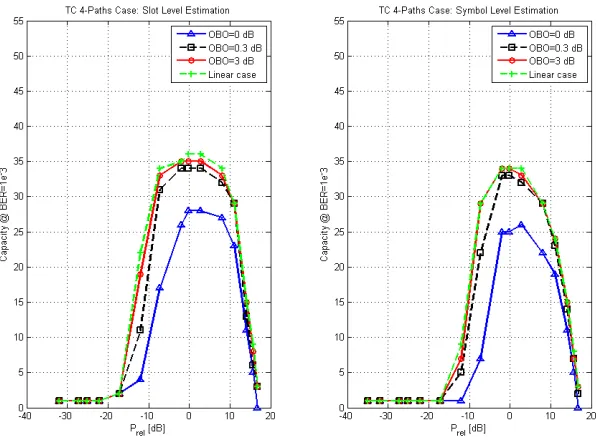
symbol period (Test = 0.0167 ms). The corresponding capacities are plotted in Fig. 8 for slot level estimation (left
pane) and symbol level estimation (right pane). For all OBO levels, the capacity exhibits the same trend as
discussed previously. By decreasing the estimation interval, the plots move toward higher pilot power levels. Also,
the system capacity is degraded by decreasing the estimation interval. At 0 dB OBO, for example, the peak capacity
estimation. While the peak capacities are slightly reduced with decreasing estimation interval, there is a significant
difference in the power required to achieve the peak capacities.
Fig. 8Capacity vs. Prel for TC/FS(4 Path) Scenario:
Slot Interval Estimation (left pane) and Symbol Interval Estimation (right pane)
In summary, the largest continuous user peak capacity is achieved in the TC/FS(3 path) channel followed by
the TC/FS(4 path), TC/FF and CC/FF channels, respectively. Compared to the 3 path FS channel, the 4-path FS
channel exhibits a more degraded performance. This is primarily due to the reduction in diversity compared with the
3 path case where all 3 paths have equal power.
Finally, in order to gain insight into the impact of the RoF subsystem and its contribution to performance
degradation, the percentage loss of peak capacity due to the optical subsystem compared with a linear system is
calculated and summarised in Table IV. Irrespective of the OBO, the TC/FS(3-path) channel incurs the largest loss
compared with a linear system followed by the TC/FS(4-path), TC/FF and CC/FF channels, respectively.
Nonetheless, while the TC/FS(3-path) channel has the largest capacity loss compared with a linear system, this
[image:21.612.158.457.182.404.2]impact on frequency selective channels with the largest diversity. This result suggests that ROF systems inhibit
diversity exploitation in wireless communication systems.
The system performance cannot be further improved by the channel estimation technique. Therefore, other
techniques such as system equalisation should be used to compensate more fully for all impairments. Nonetheless, it
should be emphasised that a 0 dB OBO represents a strong nonlinearity which is not used in practice; instead the
optimum quiescent point is determined by a parameter called the Total Degradation [25]. The performance of
MIMO based wireless ROF systems is the topic of future research by the authors.
TABLEIV
PEAK CAPACITY LOSS AT BER=10-3
Case OBO=0 OBO=0.3 OBO=3
CC/FF 12% 0% 0%
TC/FF 19% 3% 0%
TC/FS(3-Path) 43% 8% 5%
TC/FS(4-Path) 27% 3% 3%
V.CONCLUSION
In this paper, the impact of the optical subsystem nonlinearities on the system capacity performance of a RoFÐ
WCDMA system for different fading channel conditions, coding schemes, interleaver depths, and estimation
intervals was investigated. The results demonstrated that pilot aided channel estimation is an effective technique to
equalise a signal degraded by optical channel impairments as well as radio channel impairments. The achievable
optimum performance depends on the OBO and R values. However, there always exists a value of R which
maximises the capacity performance. Also, there was a negligible decrease in peak capacity when the channel
estimation interval was decreased from a frame to a slot to a symbol interval for the same OBO level.
[1] Al-Raweshidy, H., and Komaki, S.: 'Radio over fiber technologies for mobile communications networks' (
Artech House, 2002)
[2] Pinter S. Z., and Fernando, X. N,: 'Estimation and equalization of fiber-wireless uplink for multiuser CDMA 4G
networks' IEEE Trans. on Com., 2010, 58, (6), pp. 1803-1813.
[3] Wake, D., Nkansah, A., and Gomes, N. J.: 'Radio over fiber link design for next generation wireless systems'
IEEE J. of Lightwave Technology, 2010, 28, (16), pp. 2456-2464.
[4] Lim, C., Nirmalathas, A., Bakaul, M., Gamage, P., Lee, K. L., Yang, Y., Novak. D., .and Waterhouse, R.:
'Fiber-Wireless Networks and Subsystem Technologies' J. of Lightwave Technology, 2010, 28, (4), pp.
390-405.
[5] Develi, I., ÒApplication of multilayer perceptron networks to laser diode nonlinearity determination for
radio-over-fibre mobile communications,Ó Microwave and Optical Technology Letters, Vol. 42, No. 5, pp. 425-427
(2004).
[6] Yuksel, M. E., Develi, I., ÒA neuro-fuzzy computing technique for modeling laser-diode nonlinearity in a
radio-over-fibre link,Ó International Journal of RF and Microwave Computer-Aided Engineering, Vol. 15, No. 3,
329-335 (2005).
[7] Niiho, T., Nakaso, M., Masuda, K., Sasai, H., Utsumi, K., and Fuse, M.: 'Transmission performance of
multichannel wireless LAN system based on radio-over-fiber techniques' IEEE Trans. on Microwave Theory
and Techniques, 2006, 54, (2), pp. 980 Ð 989.
[8] Yuen,R., and Fernando, X.: 'Analysis of sub-carrier multiplexed radio over fiber link for the simultaneous
support of wlan and wcdma systems' Wireless Personal Communications, Special Issue on Advances on
Wireless LANs and PANs, 2005, .33, (1), pp. 1Ð20.
[9] Lin, W.-P., Peng, W.-R., and Chi, S.: 'A robust architecture for wdm radio-over-fiber access networks' Proc.
Optical Fiber Communication Conference, Feb. 2004, vol. 2, p. 3.
[10]Fernando, X., Kosek, H., He, Y., and Gu, X.: 'Optical domain demultiplexing of subcarrier multiplexed cellular
[12]Fernando, X. N., and Seasay, A. B.: 'Characteristics of directly modulated RoF Link for wireless access'
CCECE2004, 2 5 May 2004, vol. 4, pp. 2167 Ð 2170.
[13]Baghersalimi, G., OÕFarrell, T., and Postoyalko,V.: 'Pilot-aided channel estimation in WCDMA on a
radio-over-fibre channel' London Communication Symposium, 2006, pp.25-28.
[14]Zhang, J., He, S., and Yin, S.: 'A memory polynomial predistorter for compensation of nonlinearity with
memory effects in WCDMA transmitter' ICCCAS 2009, pp. 913 Ð 916.
[15]Tachikawa, K.: 'W CDMA mobile communications systems' ( John Wiley and Sons, 2002)
[16]Way, W., and Afrashteh, A.: 'Linearity characterization of connectorized laser diodes under microwave
intensity modulation by am/am and am/pm measurements' JMTT-S Int. Microwave Symposium Digest, June
1986, vol. 86, issue 1, pp. 659 Ð662
[17]Bosch, W., and Gatti, G.: 'Measurement and simulation of memory effects in pre- distortion linearizers' IEEE
Tran. on Microwave Theory and Techniques, December 1989, 37, (12), pp. 1885 Ð 1890.
[18]Lee,, C. H., 'Characterisation and compensation of direct laser modulation nonlinearity in radio-over-fibre
systems' PhD thesis, University of Leeds, 2004.
[19]Qaraqe, K. A., and Roe, S.: 'Channel estimation algorithms for third generation W CDMA communication
systems' 53rd IEEE Vehicular Technology Conference, 6 9 May 2001, vol. 4, pp. 2675 Ð 2679.
[20]Rappaport, T. S.: 'Wireless communications: principles and practice' (Prentice Hall, 2002)
[21]3GPP: ' TS 25.101: UE radio transmission and reception (FDD)', 2006.
[22]3GPP: 'TS 25.212: Multiplexing and channel coding (FDD)', 2006.
[23]3GPP: 'TS 25.213: Spreading and modulation (FDD)', 2006.
[24]Tan, C., Ong, L., Yee, M., Luo, B., and Tang, P.: 'Direct transmission of ultra wideband signals using single
mode radio over fiber system' Proc. APMC, Dec. 2005, vol 2, p .3.
[25]Fazel, K., and Kaiser, S.: 'Analysis of non-linear distortions on MC-CDMA' IEEE Int. Conf. on Com.,