This is a repository copy of
Evaluating CAVM: A New Search-Based Test Data Generation
Tool for C
.
White Rose Research Online URL for this paper:
http://eprints.whiterose.ac.uk/117808/
Version: Accepted Version
Proceedings Paper:
Kim, J., You, B., Kwon, M. et al. (2 more authors) (2017) Evaluating CAVM: A New
Search-Based Test Data Generation Tool for C. In: Menzies, T. and Petke, J., (eds.)
SSBSE 2017: Search Based Software Engineering. International Symposium on
Search-Based Software Engineering (SSBSE 2017), 9 - 11 Sep 2017, Paderborn,
Germany. Lecture Notes in Computer Science . Springer Cham , pp. 143-149.
https://doi.org/10.1007/978-3-319-66299-2_12
[email protected] https://eprints.whiterose.ac.uk/ Reuse
Unless indicated otherwise, fulltext items are protected by copyright with all rights reserved. The copyright exception in section 29 of the Copyright, Designs and Patents Act 1988 allows the making of a single copy solely for the purpose of non-commercial research or private study within the limits of fair dealing. The publisher or other rights-holder may allow further reproduction and re-use of this version - refer to the White Rose Research Online record for this item. Where records identify the publisher as the copyright holder, users can verify any specific terms of use on the publisher’s website.
Takedown
If you consider content in White Rose Research Online to be in breach of UK law, please notify us by
Evaluating CAVM: A New Search-Based
Test Data Generation Tool for
C
Junhwi Kim1
, Byeonghyeon You1
, Minhyuk Kwon2
, Phil McMinn3
, Shin Yoo1
1
Korea Advanced Institute of Science and Technology, Republic of Korea 2
Suresoft Technologies Inc., Republic of Korea 3
University of Sheffield, UK
Abstract. We present CAVM (pronounced “ka-boom”), a new search-based test data generation tool forC.CAVM is developed to augment an existing commercial tool,CodeScroll, which uses static analysis and in-put partitioning to generate test data. Unlike the current state-of-the-art search-based test data generation tool forC,Austin,CAVM handles dy-namic data structures using purely search-based techniques. We compare
CAVMagainstCodeScrollandAustinusing 49Cfunctions, ranging from small anti-pattern case studies to real world open source code and com-mercial code. The results show thatCAVMcan cover branches that neither
CodeScrollnorAustincan, while also exclusively achieving the highest branch coverage for 20 of the studied functions.
1
Introduction
We introduce and evaluateCAVM (pronounced “ka-boom”), a new search-based test data generation tool forC.CAVMis based on the Alternating Variable Method (AVM) [7]: however, unlike the existing AVM-based test data generation tool
Austin [6], CAVM generates inputs consisting of dynamic data structures using purely a search-based technique:growing the appropriate shape of the dynamic data structure, as well as filling it with data, is part of the metaheuristic search performed. It also supports generation of string inputs (i.e., char arrays) for test data generation problems involving comparisons using the strcmp library function, using code rewriting.
We compareCAVMagainst a commercial test data generaton tool,CodeScroll
(developed by Suresoft Technologies), and Austin, with respect to their rela-tive effecrela-tiveness for C code involving dynamic data structures. The empirical evaluation studies small anti-pattern case studies, known to be challenging for
CodeScroll, as well as real world open source and commercial code. The re-sults show that our new algorithms, which we implemented intoCAVM, can cover branches that neitherCodeScroll norAustincan.
2
CAVM
: A New
C
Test Data Generation Tool
Extending the basic AVM for primitive types, CAVM adopts different local search strategies for each input type. For primitive data types,CAVMuses Iterated Pattern Search (IPS) [4,7]. In case of astructtype argument,CAVMapplies AVM on each of its members: if thestructis nested,CAVMapplies its AVM-based search algorithm recursively.
CAVMconsiders pointers to primitive types as arrays;CAVMinitialises all point-ers toNULLand applies IPS to each element of the current array, growing the size of the array by one if the search does not succeed. Note that the first “move” after failing to cover the given branch withNULLis to instantiate the pointer (i.e., growing it to a single element array) using a random value.CAVMgrows dynamic data structures, such as linked lists or trees, by recursively growing nested point-ers. For pointers to struct, if the current value isNULL,CAVM checks whether it can cover the current target branch simply by instantiating the pointer. CAVM
randomly initialises primitive members of the instantiatedstruct. If the search does not succeed, CAVM subsequently tries to search for the values of the new instance (i.e., the members of the pointedstruct) recursively. For more detailed description of CAVMand its algorithm, please refer to our technical report [5].
3
Experimental Setup
3.1 Subjects
Table 1 contains the list of subject functions that we study in this paper. The anti-pattern subject is a set of branches that CodeScroll is known to be un-able to cover: these are the minimum working examples that contain only the problematic structural patterns. Line, Calendar,Triangle, andAllZeros ex-amples are ported to C from McMinn and Kapfhammer [7] and constitute the baseline examples. LinkedList is a collection of utility function implementa-tions for the singly linked list in C, taken from an on-line tutorial, whereas
BinaryTree contains seven functions from the textbook by Horowitz et al. [3]. Finally,busybox-lscontains five functions from the open source implementation of lsutility for thebusybox package, whereasdecode.ccontains 24 functions chosen from a name demangler module forC++frontend, developed by the Edison Design Group. In total, we study 482 branches in 49 functions.
3.2 Configurations
We compareCAVMtoAustinandCodeScrollbased on the branch coverage they achieve. SinceAustinandCAVM adopt stochastic approaches, we will report the average coverage over 20 runs. We only evaluate the deterministic heuristic of
CodeScroll, and therefore do not repeat its runs.
4
Taken from an on-line tutorial:http://milvus.tistory.com/17 5
BusyBox is a collection of common UNIX utilities in a single small executable:
https://busybox.net. 6
Table 1: SubjectCFunctions Studied
Subject Description Branches * Rec.* struct strcmp
AllZeros
Examples fromAVMf[7]
6 3 - -
-Calendar 46 - - -
-Line 14 - - 3
-Triangle 16 - - -
-CodeScroll Antipatterns
Set of branches thatCodeScroll cannot cover
16 3 3 3 3
LinkedList 5 utility functions for singly linked list4
26 3 3 3
-BinaryTree 7 tree-related functions from a textbook by Horowitz et al. [3]
30 3 3 3
-busybox-ls 5 functions fromlsinBusybox 1.2.05
32 3 - -
-decode.c 22 functions fromdecode.c6
296 3 - 3
-Total 49Cfunctions 482
WhileCAVMallows the user to set the search range for each input parameter of the target function,Austinlacks such control. Consequently, we do not narrow down the input range and use the default range for each primitive type, so that both tools search in the same space. For both Austin and CAVM, we set the maximum number of fitness evaluations for each target branch to 1,000, and the timeout duration for each target function to five minutes. Note that both tools collect “collateral” coverage [1] (i.e., coverage of branches that are not the target but nonetheless covered by a test case generated by a tool7
). Any collateral coverage achieved within five minutes counts in the final results. However, if a tool does not terminate within the five minute timeout, we record 0% coverage.
3.3 Environments
CAVM is written inC/C++as well as Python. The target code instrumentation is written inC/C++and depends onclangversion 3.9.0 andGNU gccversion 4.9 or higher. The AVM search is written in Python 3and depends onCFFI8
as well asPython runtime version 3.5 or higher.
For the experiment,CAVMis executed on a machine with Intel Core i7-6700K 4.0GHz and 32GB RAM running Ubuntu 14.04 LTS. Due to specific depen-dencies,Austinis executed on the same machine running Ubuntu 12.04.5 LTS.
CodeScroll only supports Microsoft Windows and consequently is executed on a machine with Intel Core i5-6600 3.9GHz and 16GB RAM running Windows 7. We allow the different hardware environments because we are only interested in achieved coverage and success rates.
4
Results
Table 2 contains the coverage results from 20 repetitive runs of Austin and
CAVM, as well as single runs ofCodeScroll. Note that the functions indecode.c
7
Here, we define collateral coverage as branches that are covered in addition to the original target by the final, generated test cases.
8
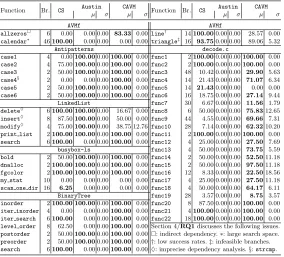
Table 2: Average branch coverage (µ) and standard deviation (σ) from single runs of CodeScroll, and 20 runs of AustinandCAVM: the highest coverage for each function is typeset in bold.Br.indicates the number of branches for each subject;CSstands forCodeScroll.
Function Br. CS Austin CAVM Function Br. CS Austin CAVM
µ σ µ σ µ σ µ σ
AVMf AVMf
allzeros 6 0.00 0.00 0.00 83.33 0.00line† 14100.000.00 0.00 28.57 0.00
calendar∗ 46100.00 0.00 0.00 0.00 0.00triangle‡ 16 93.750.00 0.00 89.06 5.32
Antipatterns decode.c
case1 4 0.00100.000.00100.00 0.00func1 2100.000.00 0.00100.00 0.00 case2 4 75.00100.000.00100.00 0.00func2 2100.000.00 0.00100.00 0.00 case3 2 50.00100.000.00100.00 0.00func3 48 10.42 0.00 0.00 29.90 5.63 case4§ 2 0.00 0.00 0.00100.00 0.00func4 14 21.43 0.00 0.00 71.07 6.34
case5 2 50.00100.000.00100.00 0.00func5 14 21.430.00 0.00 0.00 0.00 case6 2 50.00100.000.00100.00 0.00func6 16 18.75 0.00 0.00 27.14 9.44 LinkedList func7 30 6.67 0.00 0.00 11.56 1.79 delete♦ 6100.00 100.000.00 16.67 0.00func8 6 50.00 0.00 0.00 75.8312.65 insert♦ 8 87.50100.000.00 50.00 0.00func9 44 4.55 0.00 0.00 69.66 7.31 modify♦ 4 75.00100.000.00 38.75 12.76func10 28 7.14 0.00 0.00 62.3210.20 print list 2100.00 100.000.00100.00 0.00func11 2100.000.00 0.00100.00 0.00 search 6100.00 0.00 0.00100.00 0.00func12 4 25.00 0.00 0.00 27.50 7.69 busybox-ls func13 4 50.00 0.00 0.00 73.75 5.59 bold 2 50.00100.000.00100.00 0.00func14 2 50.00 0.00 0.00 52.5011.18 dnalloc 2100.00 100.000.00100.00 0.00func15 2 50.00 0.00 0.00 97.5011.18 fgcolor 2100.00 100.000.00100.00 0.00func16 12 8.33 0.00 0.00 22.5018.56 my stat 10 0.00 0.00 0.00 0.00 0.00func17 4 25.00 0.00 0.00 27.5011.18 scan one dir 16 6.25 0.00 0.00 0.00 0.00func18 4 50.00 0.00 0.00 64.17 6.11 BinaryTree func19 28 3.57 0.00 0.00 8.75 3.57 inorder 2100.00 100.000.00100.00 0.00func20 8 87.50 0.00 0.00100.00 0.00 iter inorder 4 0.00 0.00 0.00100.00 0.00func21 4100.000.00 0.00100.00 0.00 iter search 6100.00 0.00 0.00100.00 0.00func22 18100.000.00 0.00100.00 0.00 level order 8 62.50 0.00 0.00100.00 0.00 Section 4/RQ1discusses the following issues. postorder 2 50.00100.000.00100.00 0.00: indirect dependency.∗: large search space. preorder 2 50.00100.000.00100.00 0.00†: low success rates.‡: infeasible branches. search 6100.00 0.00 0.00100.00 0.00♦: imprecise dependency analysis.§:strcmp.
have been renamed in the table to save space: their full names, as well as their source code and the box plots of the coverage results will be available from the accompanying web page. ForAustinandCAVM, we report mean (µ) and standard deviation (σ): the highest coverage is typeset in bold. Out of 49 functions, there are 5 functions for whichCodeScrollalone achieves the highest branch coverage, and two functions for which Austin does the same. CAVM alone achieves the highest branch coverage for 20 functions. Notably, Austin fails to cover any branch of functions indecode.cwithin five minutes.
We manually analysed the hard-to-cover branches in the smaller benchmarks and identified the following common issues (each issue can be cross-referenced to Table 2 through the symbols):
(1) Indirect control dependency (): one of the branches in theallzeros
(2) Large search spaces (∗):aforloop incalendarconsumes a large amount of time when inputs are initialised from a large range. Since the loop iterates over the range between two integer inputs, the number of iterations can be up to the range of integers inC. This leads to frequent timeouts and, consequently, 0% coverage. When the input variable range is set to [-100, 100], CAVMconsistently achieves 100% coverage.
(3) Low success rate (†):some branches in thelinefunction are simply hard to cover under the given timeout and evaluation budget. WhileCAVMsometimes succeeds to cover all branches in line, the average coverage suffers from runs that failed to cover the hard branches.
(4) Infeasible branches (‡): the function triangle contains an infeasible branch. Consider the following code snippet from triangle:
if(a == b) { ... } else { if(a == b) { ... }}
The true branch of second predicate is logically infeasible because of the first one. Apart from this branch,CAVMandCodeScroll cover all branches intriangle. (5) Use ofstrcmp (§):case4inAntipatternscontains a call tostrcmp, which neitherCodeScrollnorAustinsupports.
(6) Imprecise control dependency analysis (♦): currently CAVM suffers from imprecise control dependency analysis; it cannot detect implicit control dependencies between branches caused by, for example, areturnin the middle of a function. Consider the following code snippet:
if(x > 42) return; if(y == 7)...
Both the true and the false branch of the secondifstatement depend on the false branch of the first one. However, this dependency is implicit, as it is not expressed as part of a nested structure.CAVM’s current control dependency anal-ysis fails to capture this. Consequently, CAVMcannot compute the fitness values correctly for these branches and cannot cover them. When we manually made the control dependency explicit (by inserting the appropriate else structure),
CAVM achieves an average of approximately 60% branch coverage for functions
delete, insert, andmodify in theLinkedList subject, with some individual runs achieving 100% coverage. Precise control dependency analysis for the full set of Cstructural constructs is a part of future work.
Finally, let us discuss the performance ofAustin.Austinrequires an explicit pointer constraint in the source code of the target function in order to instantiate any pointer. If the code does not compare a given pointer toNULL, the pointer will not be instantiated. After confirming this behaviour to be intended with the main developer of Austin, we inserted explicit NULL checks to smaller benchmarks (Antipatterns,AVMf,LinkedList, andBinaryTree), but opted not to modify the real world subjects (ls and decode.c). This results in the consistent 0% coverage for functions indecode.c, as they all require pointer parameters.
limitation regarding pointer instantiation. The accompanying webpage9
contains results about efficiency of CAVM, including the number of required fitness evalu-ations and the average wall clock execution time.
5
Conclusion
We present CAVM, an AVM-based test data generation tool that handles dy-namic data structures using a purely search-based approach. Unlike the current state-of-the-art tool, Austin, which determines the shape of the required data structure using symbolic analysis,CAVMsimply grows the data structure by suc-cessive pointer instantiations. The empirical comparison ofCAVMagainstAustin
and a commercial test data generation tool, CodeScroll, shows thatCAVMcan cover many branches that neither of the other tools can. Future work include improvement of CAVMas well as its integration to CodeScroll.
Acknowledgement. This work was supported by the ICT R&D program of MSIP/IITP [Grant No. R7117-16-0005: A connected private cloud platform for mission critical software test and verification].
References
1. Harman, M., Kim, S.G., Lakhotia, K., McMinn, P., Yoo, S.: Optimizing for the number of tests generated in search based test data generation with an application to the oracle cost problem. In: Proceedings of the 3rd International Workshop on Search-Based Software Testing (SBST 2010). pp. 182 –191 (apr 2010)
2. Harman, M., Hu, L., Hierons, R., Wegener, J., Sthamer, H., Baresel, A., Roper, M.: Testability transformation. IEEE Transactions on Software Engineering 30(1), 3–16 (Jan 2004)
3. Horowitz, E., Sahni, S., Anderson-Freed, S.: Fundamentals of Data Structures in C. W. H. Freeman & Co., New York, NY, USA (1992)
4. Kempka, J., McMinn, P., Sudholt, D.: Design and analysis of different alternating variable searches for search-based software testing. Theoretical Computer Science 605, 1–20 (2015)
5. Kim, J., You, B., Kwon, M., McMinn, P., Yoo, S.: Evaluation of CAVM, Austin, and CodeScroll for test data generation for C. Tech. Rep. CS-TR-2017-413, School of Computing, Korean Advanced Institute of Science and Technology (2017) 6. Lakhotia, K., Harman, M., Gross, H.: AUSTIN: A tool for search based software
testing for the C language and its evaluation on deployed automotive systems. In: 2nd International Symposium on Search Based Software Engineering. pp. 101–110 (Sept 2010)
7. McMinn, P., Kapfhammer, G.M.: AVMf: An open-source framework and imple-mentation of the Alternating Variable Method. In: International Symposium on Search-Based Software Engineering (SSBSE 2016). Lecture Notes in Computer Sci-ence, vol. 9962, pp. 259–266. Springer (2016), code and examples available at: http://avmframework.org
9