CO1WII SS
ION
OF
THE
EUROPEAN
COMMUNI
T
I ES
SEC(92
)
1073
f
inaI
Brusse Is,
.10June
"1992-'-'
.
LINGUA
PROGRAIIM,I}
ACTIVITY
REPORT
I.99I.
(presented
by the
Commission)L$ffiffieffiY
A. 1. 2. 3. 4. 5. 6. 7. B.
CONTENTS
SUMMARYPurpose and Structure
Administration of the Programme
Information and promotion LINGUA in operation
Unguistic diversification and the least
widely used and least taught languages
Monitoring and evduation The conditions for success
DESCRIPTION OF
THE
ACTIVTNESDECENTRALIZED
ACTIONSACTION
IA
Aims
Implementation in the Academic Year 1990-91
Forecast for the Academic Year 1991-92 Quality
of
in-service trainingParticipation
ACTION
IV
Aims
Implementation in the Academic Year 1990-91
Forecast for the Academic Year 1991-92
Participation
CE}TTRALIZED AND
SEMI-DECENTRALIZED
ACTIONSACTION IB
Aims
Implementation in the Academic Year
l99I-92
The
lst
Symposium on European C-ooperation ProgrammesPerspectives
ACTION
tr
ACTION
III
Aims
Proactive operations
in
1991Implementatlon
in
19911.
2. 3.
1.
2.
J.
ACTION
VAAims
Implementation
in
1991Perspectives
ACTION
VBAims
Implementation
in
1991Perspectives
CONCLUSIONS
ANNEXES
PAGE
28
?a 28 28
29
29 29
30
A. SUMMARY
The LINGUA Programme was adopted by the Council Decision of 28 July 1989 for a period
of five years starting on L January 1990.
The estimated budget for the irnplementation of the Programme for this first five-year period
was MECU Z)0.
PURPOSE
AND
STRUCTUREPotitical snd operational objectives
The principal objective of the Lingua Programme is to promote the quantitative and qualitative imprbrremint
of
foreign language learningwithin
the Community.An
increasein
linguistic skills isin
fact nec€ssary in order to favour mobility aswell
as economic and administrativeinteraction between all regions of the C.ommunity, and in practically all fields, and to confront
the
gowing
needsin
foreign languagesin
the economic sphere andin
social, cultural andscientific life.
Based on these recent needg the Ungua Programme has adopted a strategy of innovation. This strategy manifests itself as follows at the levels of the different operational objectives:
-
to modernise methods of in-service training of teachers;-
to modernise the content of the initial training of teachers;-
to modernise teaching curricula;-
to promote the use of innovative teaching materials;-
to infoduce innovation into youth exchanges by creating new kinds of pedagogical projects;-
to create structures and networks of multilingual communication.ADMIMSTRATION
OFTHE
PROGRAMME2.1.
The administration and promotionof
the Programme at national levels, aswell
as themanagement of the decentalized Actions are entrusted, in each Member State, to one or more
National Agencies.
The Actions of the Programme
fall
into three categories of administration:a)
decentralizedActions
(ActionsLA
andIV)
administeredby
the
Member States incooperation with the C.ommission
b)
a semi-decentralized Action (ActionII) jointly
administered by the Commission and theMember Stateq on the ERASMUS model
c)
centralized Actions (ActionsIB,
III
and the wholeof
Action
V)
administeredby
the C-ommissionl.
3.
2.2.
According to the C.ouncil Decision adopting the Programme, a LINGUA C-ommitte wascreated whose main task is to advise and assist the Commission in the implementation
of
theProgramme.
23.
For all operational matters concerning the Programme, the Commission is Assisted, on acontractual basis,
by
the BureauLINGUA
which
was setup,
in
November 199O,by
aconsortium consisting
of
the
British
Council,
The
Crntre
International
d'EtudesP6dagogiqueVAlliance Franq:ise and the Goethe Institut.
For all operational matters concerning Action
II
of the Programme, the Commission is assistedby the ERASMUS Bureau, due to the fact that Action
II
is implementedin
the same way asERASMUS.
The cost of technical assistance and of information and promotion activities represents about 9
per cent of the annu"l budget
for
1991. This percentagewill
decrease progressively to reach 5per cent
in
1994.INFORII{ATION
AND PROMOTIONInformation is disseminated through printed material, such as the Applicants' Guide, summary
Ieaflets and press releases.
The Commission produced a first version of the Applicants' Guide
in
1990 and a revised versionin
1991.The promotion of the Programme has included the organisation by the Commission of various
major activities,
in
cooperationwith
the Member States (workshops, seminars, conferences,symposiums, language exhibitions, launching conferences in practically all countries ...), or its
participation in these activities.
The information and promotion campaigns
will,
of course, be continuedn
L992.LINGUA
IN
OPERATION4.1.
1990 was predominantly a preparatory year for thefull
implementation of the Progr:unmeduring which, among other things, the guidelines for applicants were developed, the National
Agencies were set up and made operational and the Programme was promoted and made widely known
in
the different Member States; verylimited
funds were therefore providedfor
theimplementation of the Actions of the Programme over that period.
42.
In
1991, however, the Programme, as is reflected in this report, started to become fullyoperational.
Results obtained
in l99l
The achievements
of
1991 are apparent first and foremost in the hundreds of projects launchedat the levels of the Actions administered both by the Member States and by the Commission.
Thus, during the school year 1990D1 already, more than 500 teachers were able to benefit from Lingua in-service training grants (Action t) through a period of training in the country whose language they are teaching. During the school year 1991-92, the number of teachers receiving
grants
will
probably increase five-fold"As far as the development of youth exchanges (Action
I\)
is concemed, more than 4O00 young people have been able to participate in exchange projects during the school year 1990-91. 'IlrereThe European Cooperation Programm€s between teacher
training
institutions (Action IB), althoughnot
strongin
numbers(12
programmesinvolving
28
institutionsin
1991), are nonetheless destined to become an essential network whichwill
provide the infrastructure fora strategy of innovation in this sertor.
The measures destined lo promote the learning of foreign languages at university level, and to
improve the
initial
training
of teachers (ActionII)
are administeredjointly
with ERASMUS.nuring rhe academic year
f991-9e
144 studentmobility
prograrnmes and 32 staff mobilityprogrammes received support. More than 4O00 students are benefitting from these measures.
In the framework of the measures for the promotion of forcign language skills in professional
relations and economic
life
(Action
III),
financial assistance was grantedin
1991to 6l
fiansnational projects concemed mainlywith
the developmentof
teaching materials and' to alesser extent, linguistic audits and the development of curricula and certification
systems-Finally, the complementary measunes (Action
V)
have madeit
possible to grant support toeight European-level associations concemed
with
the promotionof
the teaching and use of foreign languages, and to 17ptlot
projects for the development of teaching materials for theUss wiAety used and lesser-taught languages,
with
the aim of furthering the diversification of the teaching of foreign languages.LINGUISTIC
DIVERSIFICATION AND TTIE
LEAST WIDELY
USEDAND
LEASTTAUGIIT
I"ANGUAGF^S5.1. Crntralized and Semi-decentralized Actions
It
seems clear, al the moment and at this stage of the evolution of the Programme at least, thatdiversification in general and the promotion of the least widely used and least taught languages
in particular are best implemented through the centralized Actions.
ACTION
II
has srpported 600 studentsof
the least widely used and least taught languagesduring the academic year
lggl-92,
which represents 1l.6Vo of the total numberof
'LINGUA' participants in ERASMUS.One of the main objectives of Action
II
is to contribute to the improvement of the initial training of language teachers.This obviously accounts for a strong representation of the most taught
languages-But, another important objective of the Action, which is specifically emphasized in Article 5 of the
'LINGUA
Decision', consistsin
'promoting the provisionof
opportunitiesfor
university studentsto
combine foreign language studieswith
the pursuitof
their main disciplines, as arecognized component of their degree, diploma or other qualification".
The fact that this impo(ant aspect of 'language plus another subject' is given low priority by the
Member States (a fact which is confirmed by the very few opportunities offered to students for
such possibilities in the 'standard curricula') contributes greatly to the low representation rrf the least widely used and least taught languages in Action II.
Member States strould somebow come to terms with the fact that
it
is of paramount itrrpttrtanceACTIONS
trI
AND VB have, from the beginning, contributed greatly to the diversification of foreign language learning andto
the promotionof
the
leastwidely
used and least taught languages throughout the C-ommunity.All
the official languages of the C-ommunity, plus the two added 'LINGUA languages' (Irish andlrtzeburgesch), are present as target languages in the projects funded by the Commission,
Danish represeDts 5Vo of.
all
the target languagesin
the accepted projects, Dutch 7Vo, Greek 8.5% and Portuguese 6.5Vo (27% altogether); as for lrish, it represents 2.9Vo and Irtzeburgeschl.4Vo (4.3Vo between them);
frn"lly,
Spanish and Italian account respectivelyfor
9.2%
and LL.3Vo (20.5Vo for both of them).These 8 languages represent therefore 5l.8Vo of all the target languages in the accepted projects.
ACTIONS
IB AND
VA also show great promise.Although the total number of projects accepted under these two Actions was very restricted in 1991 due to budget limitations, some of the projects that were funded have already started to
make a modest contribution to diversification and to a wider use of the lesser taught languages.
52.
Decentralized ActionsThe situation, in the case of the decentralized Actions, managed directly by the Member States
and
by
their National Agenciegis
not as straightforward, as Member States understandably consider, first and foremost, their national priorities.Diversification and the promotion
of
the leastwidely
used and least taught languages in decentralized Actions have therefore, up to now, not been very widely implemented.ACTION
IA
typically reflects the situation in the national school systems.As the
foreip
language provision is normally restricted to the usual quartet, English, French,German and Spanish, an Action
for
in-service training cannot, at the moment, count on anydramatic participation of teachers of other target languages.
Member States should, not only encourage the learning of at least two languages in schools, as
obligatory subjects, but also aim at actually including the least widely used and least taught languages within their educational systems and general curricula.
ACTION
IV
can, in many cases, create the motivation to learn one of the least widely used andleast taught languages; the setting-up of cultural and linguistic contacts with the countries where
these languages are spoken can greatly contribute to this objective.
Member States should consequently take the necessary measures to encourage and facilitate Joint
Educational Projects and exchanges under this Action.
6.
MONITORING
AND EVALUATION6.1. Monitoring
a) sending
of
questionnaires to the National Agencies concerning the actions that have beentaken,
in
each Member State, since the Programme started,in
orderto
widen the range oflanguages on offer and to promote the lesser-taught languages in their educational systems
b) production and distribution to the National Agencies of questionnaires for panicipants undr r
Actions I.A and
IV
c) requests for interim reports on the projects which started
in
1991 under ActionsIB,
III
andVB
d) regular follow-up of the most important accepted projects under Actions IB,
III,
VA and VB, on an individual basise) analysis of the activity reports received for the first year of implementation of Action
II
f) meetings of experts to analyse the situation and the progress of the Prograrlme in the different Member States
However, as most of the projects accepted
in
1991 under the centralized Actions only started inthe second
half
of
the year and as the activities generatedby
the
1991 budget under thedecenhalized Actions are
still
in progress (see 5.2., paragraph 3, above), the information which the Commission managed to gather did not provide really reliable performance indicators.62.
EvaluationFor
1992, the Commission has launcheda
callfor
tenderfor
an external evaluationof
theProgramme, of its structures and
of
its impact in the 12 Member States.a) Phase
I
of the evaluationwill
focus on:.
the efficiency of the management and coordination methods, structures and procedures which have been established for the implementationof
the Programme at Community and Member State level as well as within the participating universities..
a preliminary evaluation of the ProgrammeAn
interim reportfor
PhaseI will
be submitted to the Commission by November 1992 and a final report by 31 March 1993.b) Phase
II will
focus in depth on the overall efficiency of the Programme design and each of the Action areas.An
interim repod for PhaseII will
be submitted to the Commission by July 1993 and a final report on both phases of the study by November 1993.7.
THE
CONDITIONS FOR SUCCFSSAccording to the logic of subsidiarity, the measures provided under the Lingua Programnrc can
only bear fruit if the Member States adopt appropriate policies aimed at multiplying opfx)rlunrtics
to teach and learn foreigrr languages, encouraging the learning of less widely used and
In other words, the voluntarist strategy of the Community Proglamme can only succeed
if
there is synergy and complementaritywith
the policiesof
Member States-If
these have neglected certainof
tt"t
objectives:if,
for
example they have accordedtoo
low a
priority
to
themaintenance of diversity, the efforts of the Community in certain sectors may be in vain.
Throughout the year 1991 the Commission made efforts to sensitize its partners in the Member
States to the problem of divenification. This is a vital issue, on which the whole future of our
B.
DESCRIPTION OFTHE ACTIVITIES
DECENTRALIZED ACTIONS
(IAandIV)
The
decentralizedActions
are administeredby
the
National Agenciesin
cooperationwith
theCommission.
The general orientations are defined by the Commission with the advice of the LINGUA Committee.
The Commission organizes regular general meetings of the National Agencies in order to coordinate
these Actions. ln addition, in the Autumn of 1991, bilateral meetings between the Commission and the
Agencies were organized which provided most
of
the information upon which this part of the reportis based.
As far as the monitoring of these Actions is concerned, the Commission has produced questionnaires
which have been distributed to all teachers who receive support for in-service
taining
under Action[A
and to all young people who take part in transnational exchanges under Action IV.Seven
of
the twelve Member States have suggested storing the datalocally
and transmitting theinformation by disc or
7
ACTION
IA
l.
AIMSl.l.
The overall objective of Action[A
consistsin
raising the standardof
foreigrr languageteaching by improving the in-service training of foreigrr language teachers through an increase
of the ;pportunities offered to them to reap the benefits of appropriate preparation abroad.
Foreign language teachers are able, therefore, with the help of LINGUA gants, to improve their professionJ @oth linguistic and methodological) competence, notably through periods
of
in-sewice training or professional experience in a Member State in which the language they teach
is spoken.
12.
The priorities of the in-servicetaining
in the country of the target language are:a) improvement of the skills of communication
and
of the knowledge of the target culture, sothat teachers can develop their professional and linguistic competence (qualitative improvement);
b) improvement of the diversification of the foreigrr language
offer
including the least widelyused and
least
taught languagesof
the Community, so lhat the rangeof
languages in whichteachers are to be trained can become wider (quantitative improvement).
IMPLEMENTATION IN THE ACADEIrIIC YEAR
1990-9r2.1.
ActionId
is managed by the National Agencies designated by the Member States (mostof these Agencies also manage Action IV, but in some cases two different Agencies have been
appointed).
The
Commission makes over blockgants
for
ActionslA
andIV
and the Agencies areresponsible
for
the selectionof
applicants and the grants awarded; the maximum grant per beneficiary under Action[A
is ECU 1,5m.ln calculating the annual block grant to be allocated to each Member State, the total number of
teachers, the number of young people between the ages of 10 and 21, per capita gross domestic
product in relation to the Community average and the geographical distance between Member
States are taken into account.
22.
In
1990, tbe National Agencies had to promote the Programme and to makeit
rvidelyknown; they had therefore to set up their own internal structures, before inviting applications.
23.
In 1990, in view of the limited budget, the Commission only granted a global amount of ECU 873,758for
both Actions[A
andIV in
1990;this
allocation was meantto
supportparticipants under Actions IA and
IV
during the school year 1990-91-
up to3l
Augustl99l'
All
National Agencies succeededin
makingfruitful
useof
their allocations under Action IA; tlrcyall
managedto
passfrom the
initial
stagesof
internal organization, promotion andrrrformation to the phase
of
implementation; this gave them the opporfunity to have their first2.4.
516 teachers were concerned by the measure in the 1990-91 contract period (see table Iin the Annexes to this repo() for whom 423 reporls are available (the discrepancy between the
fwo figures is due to incomplete information sent by the relevant National Agencies; the reason
for
this is that some National Agencies are only just concluding the processof
gathering thenecessary information and of setting up reliable means
of
putting together and analyzing their statistics).Thus the
first of
the prioritiesof
the Action, namely the improvementof
the communicationskitls of language teachers, has started to be
implemented-2.5.
As
far as the secondpriority
is
concerned, namely the diversificationof
the foreigrtlanguage provision including the least widely used and least taught languages, a creditable effort was made by the Member Stateq since they sent nearly ?SVo of the overall number of teachers
eligible for a LINGUA grant to countries where lesser taught languages are spoken (included in
these are ltaly and Spain, although the situation of Italian and Spanish as foreign languages can
differ greatly from one Member State to another).
The target countries of the teachers supported were as follows:
1 teacher went
to
Belgium,I
to
Denmark, 66to
France, 48to
Germany,2 to
Greece,2
toIreland,
9
to
ltaly,
10 to the Netherlandg5 to
Portugal, 71to
Spain and 208to
the UnitedKingdom.
The dominant role of English (208 teachers s€nt to the UK), as well as, in a lesser way, that of French, German and Spanish, and the comparatively
low
representationof
the lesser taughtlanguages must certainly be seen in relation to the existing provision of foreign languages in the
European school systems. There are nevertheless some possibilities for
diversification-But although
it
might seem obvious atfirst
sight that therewiII
be very few applications inAction LA for target langUages that are not on offer in the standard curricula of schools or other
acknowledged teaching institutions, this
will
not always necessarily be so.Firstly the leapt widely used and least taught languages are in many cases, and
will
more andmore often be, offered in schools on a voluntary basis in addition to the compulsory subjects; motivated and capable teachers, specially and specifically retrained, are, and
will
be, crucial for the organization and success of such optional courses; the activity of these teachers may alsogreatly contribute to a later intoduction of the additional language into the official
curriculum-Action 1A plays there an important part by offering in-service training for their re-training and
the National Agencieg according
to
the termsof
the Decision, have triedto
give priority toapplications from such teachers.
Secondly, some of the least widely used languages are, in some countries, and
will
more and more often be, taught in special s€ctors like adult education and border areas; teachers for these languages and from these sectors should become another of the priority targets of ActionIA'
as3. FORECAST FOR
THE
ACADEIVTICYEAR
I99I-92
3.1.
For 1991, the National Agencies received a block-grant of ECU 4,500.000 for Action lA.This
grantis to
cover supportof
in-service training duringthe
school yearof
7991-92, beginningI
September 1991.If
the maximum support of ECU 1,500 is given to each applicant, this grant should enable theNational Agencies to support a minimum of 3,000 teachers.
32.
The interim statistics of the National Agencies show that, in the first months of the1991-92 contract
perid,
396 teachers were granted support for in-sewice training; since then another 1,110 applications were received (see tableII
in the Annexes to this report).Ten Agencies (out
of
thirteen) indicate expectationsfor
total participationin
1991-92; theseforecasts indicate a minimum of 2,400 expected participants for the ten Agencies concented.
The target of 3,000 participants for the academic year 1991-92 seems therefore to be realistic.
QUALITY
OFIN-SERVICE TRAINING
As a rule, during the first year of Programme, it was the applicant who had to choose the
in-service training provider in the target country.
ln many cases the National Agencies had difficulties in assessing the quality of these providers, but the critical activity reports of the participants should help to set up a non-exclusive data base
of qualified providers; the electronic mail system (EUROKOM), which the C-ommission
will
besetting up in Brussels and in the Member States in the Spring
of
1992,will
make this data base possible and mutually accessible for all the connected institutions.PARTICIPATION
AII
National Agencies express their conviction that the demandfor
in-service training abroadis far greater than the present figures indicate.
If
the estimates given by each individual Member Statefor
1992 and 1993 are added up, well over 20,000 teachers altogether strould be asking for a grant under LINGUA.With the inevitable development of language teaching in the Community in the 90's, there
will
be around 400,000 language teachers in the tvrelve Member States before 1995.Considering this figure, it seems reasonable to think that, bbfore the end of Phase I of LINGUA,
4O,m0 teachers (a
l0%
target) strould be interested in a period of in-service training abroad andshould therefore be expected to apply for a glant under Action
[A
of the Programme.But problems for the participation in this Action might arise from the administrative obstacles
that have been mentioned
by
officialsfrom
certain Member States andwhich
are due toadministrative regulations;
in
some Member States, internal regulations make the in-service training of teachers difficult,if
not imposible, particularly during term-time.School administrations seem, in many cases, to be unable to provide the staff and the funds for thc replaccment of teachers who want to participate in LINGUA activities.
4.
5.
Member States have, on several occasions, been asked
by
the Commissionto
facilitate the participationof
teachersin
in-servicc training activities abroad, so that they canfully
benefitho-
G"
possibilities offered byUNGUA;
a successfuI implementation of ActionIA
and thefull
impaitof
its added-value depend very much on the position that national administrationswill
takein
this matter.Diversification
Because the general linguistic
policy
of
most Member States doesnot
seemto
leadto
aquantitative
i*prot"."ni
of the provision made for langUage learning, linguistic diversification in the in-service training of language teachers is lagging behind'The learning of al least two foreign langUages is not obligatory in most school systems and' in
**" *."",
the foreign langUage ptouition is even being reducedin
favourof
new subjecSrelated to economic and technical development in industrialized societies'
lf
Member Statesfail
to give themselves the practical means to implement their politicalwill
tocreate a multi-cultural
;d
multi-lingual European Community through action in the relevantsectors of the national school systems, or
if
this implementation is too limited, participation inAction
lA
of
the Ungua hogrammewill
notin
futwe reflect a decisive increasein
diversi-fication and the leasi
widely
used and least taught languages (Danish, Dutch, Greek, and portuguese aswell
as the other two 'LINGUA languages', Irish and I-etzeburgesch, and,in
a lesser way, Italian and Spanish)will
be the first to suffer'It
is
understandable that the primary concernof
most Member States should beto
provideanswers to their immediate needs and to make sure
of
the immediate 'cost-efficiency' of theirlinguistic
policy;
it
is
therefore understandable that they should givepriority
to
the more immediately operational languages of the Commuity.They should however be
fully
aware of the implications of such policy on a multi-cultural andmulti-lingual
Europe.1.
ACTION
IV
AIMS
l.l.
The Action
is
dasignedto
encourage young peoplein
professional, vocational and technical education to participate in exchange prograrnmes based on pedagogical projectg calledJoint Educational Projects.
In the Decision, however,
it
is stated thatit
is up to each Member State to interpret the lermsof the Decision as to what is meant by professional and vocational training, either by narrowing
the scope or by widening it.
As shown in one of the annexes (based on information provided by the Member States) of the
'LINGUA Applicants' Guide', 11 out 12 countries adopted a wide interpretation of the Decision and included some,
if
not all, institutions providing general secondary education.Germany had originally adopted a more restricted view but has, since then, decided to widen the
scope.
12.
The aim of the educational exchanges should be the improvement of communication skillsin
foreign languages and the promotionof
the motivationof
thoset"king
partto
acquirecompetence in foreigrr languages.
This is to be achieved by the setting up of carefully prepared pedagogical projects (which can
be linguistic and/or technical and/or cultural)
fully
integratedin
the school activitiesof
theparticipants.
IMPLEMENTATION IN THE
ACADE}flC
YEAR
I99O-972.1. The Commission makes over block gpnts and the Agencies are responsible for the selection
of applicants and for the grants awarded (the aid for exchanges, however, must not excnel50Vo of total costs, including travel and programme, although, in certain duly justified cases,
it
maycover up to 75Vo of the costs).
The calculation
of
aid to be allocated to each Member State takes accountof
the number of young people between the agesof
16 and 25in
its population, the per capita gross domesticproduct
of
the Member State in relation to the Community average, the geographical distancebetween Member States and the establishment
of
a better balancein
theflow
of
exchangeswithin the Community.
22.
T1te allocationsfor
1990 were to cover supportfor
projects under ActionIV
durinlg theschool year
of
1990-91 up toI
September 1991.The definitive versions
of
the reportsof
the National Agencies on the useof
funds and onparticipation are, in some cases, still in the process of being finalized before they are sent to the
Commission.
This, as is reflected in some
of
the figures shownin
tablesIII
andIV
of
the Annexes tc, thisreport, is due to the fact that National Agencies have only just set up (or are, for some of them,
still finishing setting up) their systems for gathering the necessary information and for processing it.
)
23.
Applications, partner-finding and the role of the National AgenciesInterested schools
or
institutions hadto find
one(or
more) adequate partne(s) and often requested help from the National Agencies.On the whole, because no Joint Educational Projects were yet operational and because reciprocity of exchange is not obligatory, there was, in practically
all
Member Stateg more demand from institutions intending to send a group than from institutionswilling
to host; as a consequence,the National Agencies could not easily provide partners and the applicants usually had to find
the partner institutions themselves.
However, as a result
of
the on-going Joint Educational Projects and as a networkof
relatedinstitutions is set up after the first exchanges, one would expect that more institutions
will
beprepared to bost and the task
of
the National Agencieswill
be considerably facilitatedin
theensuing years of tbe Programme.
In addition, inquiries from interested schools
or
institutionswill
be integratedin
a data-basewhich
wilt
be mutually accessible to all the Agencies through the E-mail system (see ActionId
4)
2.4. Exchanges
Although this complex Action, which requires the
joint
developmentof
a pedagogtcal Project as a pre-requisite for the group exchange, necessitated a long preparatory period, 215 groups representing 4,018 young people, accompaniedby
317 teachers, were sent to another Member State in the academic year 1990-91.Considering the budget that was available and
with
an estimated average grant per participantof ECU 25O the target was under 2,000 young people.
The fact that over twice as many participants were involved indicates clearly tbat the demand
was greater than expected; it also shows that the actual average grant per Member State was, in
some cases, lower than the overall average; finally it confirms that, in m:rny cases, the principle
of
subsidiarity was applied and that extra funding (coming on topof
the SOVo of. the costscovered by 'non
IINGUA
sources', as requested by the Decision) was provided by Ministries, local authorities and governments or by the institutions themselves.Out
of
the 4,018 young people sent abroad under thefirst
contract, reports are available for 3,754 participants (here again, as in ActionlA,
the discrepancy between the two figures is dueto incomplete information s€nt by the relevant National Agencies; see re:rson for this in Action
lA,
paragraph 2.4.)The target countries of the exchanges supported were as follows:
74 young people went
to
Belgium, 165to
Denmarh 480to
France, 324to
Germany, 69 toGreecr, 124 to lreland, 227 to ltaly, 20 to the Netherlandg 16O to Portugal, 222 to Spain and
1,889 to the United Kingdom.
As
the useof
foreign languagesis
an integrated componentof
the exchangeq someof
the tendencies identified in ActionlA
can be observed with English, French, German and Spanishbeing much in demand; but significant differences can be sern since, in Action IV, all countries (apart from Luxemburg, for the moment) have been visited and since ltaly, Denmarlc, Portugal and Greece, in particular, have attracted a reasonable number of young people.
It
is
probably the complementary-
andnot
exclusive-
roleof
foreign languagesin
thepedagoglcal project (where languages are used as practical tools
to
achieve a non-linguistic objective and not considered as vertical academic srbjects) which makesdl
Member Statespotential partners
in
exchanges underAction
IV;
tbe main objectiveof
a Joint EducationalProject does
not
focus exclusivelyon
the
languageitself
but
relatesto
the
professional,vocational or general education of the young people, altbough the cultural and linguistic
expe-rience in the country of the meeting strould be a
fully
integrated component of the project.In the case of bost countries where lesser taught languages are spoken which have not
yet
beenlearnt by the visiting young people, participants need linguistic preparation before, and language
raining during the meeting to enable them to communicate at nsurvival leveln; this should
reslt
in creating motivation to go on learning these languages after the visit.
25.
Preparatory visitsThese visiS proved to be an appropriate instrument for implementing the Action; without this possibility offered
to
teachersor
adminisratorsof
interested and eligible establisbments tocon&act potential partners directly in the target country,
it
would have been difficult to get theAction
off
the ground in any significant way.They also contibuted greatly to
linguisic
diversification by helping interested insfitutions incountries where the least widely us€d and least taught languages are spoken to contact potential
partners and gtve them the incentive to get involved in an exchange.
Within the period covered by the allocation 1990 (school year 1990-91, up
to
1 September1991), 235 preparatory visib were supported with 430 pafticipants, almost exclusively teachers; the major part of these
visis
can be expected to lead to joint educational projects with integrated exchange meetings.FORECAST FOR
THE
ACADEIT{ICTEAR I99I-92
Under the 1991 budget the National Agencies received ECU 5,500.000
for
ActiontV;
this allocation is to cover the support of projects and meetings up to 31 August 1992.By the end of November 1991, the Agencies had received 692 applications for projectg out of which 311 were accepted involving 9,157 participants (see table V in the Annexes to this report); as the number of applications is bound to increase considerably before the end of the academic
year 1991-92" the prospects appear most favourable (see also paragraph 4.1 below).
Participants came from
all
kindsof
social backgrounds but,in
many cases, special care was taken to ensure that less-favoured young people get priority.Preparatory visits continue
to
play an important part since,at
the time when the National Agencies gave the information to the C.ommission, 215visis
had been accepted which included 517 participants.PARTICIPATION
a)
As the allocations for the academic year L99L-92 amount to over ten times those that were granted for the academic year 1990-91, participation should increase considerably.With
an
average grant per participantof
ECU
250 (see last paragraphof
4.1
below forjustification), a figure of. 22,NO young people involved
in
Joint Educational Projectsin
theacademic year 1991-92 seems to be a reasonable target for use of the 1991. budget.
But this budget
will
increase considerably in the coming years; considering the fact that all thenational structures
for
ActionlV
are nowin
place and operational and that the 'nrnning-in period' is now over, the C.ommission's estirnate is that nearly 150,000 young people strould havetaken part
in
Joint Educational Projects by the endof
PbaseI
of
the Programme and that thepotential demand is probably much higher.
This large increasc
in
the numberof
potential participantsin
the years to come implies thatappropriate mea$res be taken
by
Member Statesto
ensure that as many young people aspossible can benefit from the exchanges.
Some
of
the problems that might arise are connected with factors which can be either generalor specific to some Member States:
-
national school authorities should support participation during term-time so that projects andexchange meetings can be
fully
integrated into the curricula of the participating schools;if
tbemeetings cannot take place during term-time it
will
be impossible for the young people to work together in the school context required for the pedagogrcal project.-
as in ActionIA
the issue of the replacement of teachers accompanying the groups of youngpeople should be addressed and solutions should be found; time should also be allowed during school-periods for the active preparation of the Joint Educational Projects'
-
fu"[y,
Member States should make sure that they send to the Commission a constantlyup-dated list of potential partners in Joint Educational hojects or slrould input the information into
the system themselves, where and when
it
is possible, so that these partners can be integratedinto the database.
b)
During the academic year 1990-91, the financial contributionof
the Member States toexchanges was slbstantial and, in most cases, well over the required
507o-This commitnent to the spirit of subsidiarity should be encouraged and
will
become all the morenecessary as the Programme develops:
-
a good and efficient preparationof
the projects (through preparatory visits and extemive preliminary work carried out by both teachers and young people prior to the exchange) must be encouraged, and therefore co-financed.-
the costs represented by the hosting of groups must be taken into account.-
more fundswill
be needed, in the case of the lesser taught languages, to provide some kind of linguistic preparation in the home country and language instruction in the host country during the visit.-
finally, the work proglamme itself, including its cultural components,will
certainly occasion extra costs for the hosting partner.AII
these costs should be included in the cose per young person sent abroad and added to the costs for travel; it would therefore seem reasonable to expect the'LINGUA grant'per participantsent abroad, covering tbe costs at both ends of the project, to amount to ECU 250.
Diversification and the least widely used and least
ta"ght
languagesInstitutions coming
from
all
Member States are potential participantsin
Joint BlucationalProjects.
The role of tbe foreign language
will
obviously be different in cases where the language of thehost country is already being learnt, and to some extent spoken, by the young people, and in cases where
it
is new to them.Unguistic preparation is automatically integrated in the project in the
fint
case, as the languageis taught as a compulsory subject within the general curriculum.
In the second case, some linguistic preparation at 'survival level' of the participants is desirable
and slrould to be supplemented by instruction during the visits themselves (see also 2.4 and 4.1 above).
This particularly applies to the least widely used and least taught languages, which would then
be inftoduced in an informal way and in srnall doses into the curricula.
Measures should be taken by Member States and partner institutions in the exchanges so that
full
advantageis
takenof
this
opportunity andso
thata first
contactwith
new languagas is facilitated.One
of
the possibilities to achieve this objective would be to makeftrll
useof
the materials produced under Action VB of the Programme, when these materials are available.The costs of the linguistic preparation on the sending side and of the instruction on the hosting side should clearly been taken into account in the budgets and, as far as the least widely used and least taught languages are concerned, a LINGUA support of up to
75%
of. the total cost ofthe exchange could be envisaged to act as an additional incentive to Member States.
CENTRALIZED ACTIONS
(IB,
III
andV
)AND
S E
M
I
-
DEC
E
NT
RA
LIZFD
ACT
I
O
N(tr)
The centralized Aclions (Actions
IB, III,
9
are globally administered by the C-ommission.The semi-decentralized Action (Action
II)
isjointly
a&ninistered by the Commission and the MemberStates on the Erasmus model.
As in the decentalized Actions, the general orientations are defined by the C.ommission with the advice
of the LINGUA C-ommittee.
The monitoring of these Actions is based on the analysis
of
interim and final activity reports sent tothe C,ommission by the coordinating institutions and/or by the particiPants in the projects.
Regular meetings
with
relevant experts are also heldto
analyse the impactof
these Actions atCommunity level and to make the necessary adjustments.
t.
ACTION
IBAIMS
l.l.
European C-ooperation Programmes (ECPs) constitute a good exampleof
an innovative approach in the field of the in-sewicetaining
of foreign language teachers.12. The principal objective of an ECP is to provide original frameworks in which teachers and
trainers may improve their communicative skills, their awareness of the cultural environment of
the target language and their knowledge of different methods of teaching the language, not only in their own national context but also on a tans-national basis.
13.
This objectivewill
be reacbed through the active cooperation between in-service hainingestablishments in at least two Member States; innovation in the field of methodology in foreign
language teaching and
taining
and tbe useof
information technologies strould be important features to take into account whenjointly
designing a European Cooperation Programrne.MPLEMENTATION
IN
TIIE ACAI)EIIIIC
YEAR
I99I-92
2"1.
In
1991,ECU
300,000 were usedto
supportor
co-finance European CooperationProgramrnes.
The C-omnission received 50 applications for Programmes to be implemented in the academic
year 1991-92, involving 86 insitutions.
In spite of the limited means available, the Commission managed to select, with the help of an
advisory
boar4
andto
co-finance12
ECPs (representing 24Voof all
submitted projects)involving 4O partnen in 6 different countries
-
Fran@, Crermany, Italy, Portugal, Spain and theUnited Kingdom
-
(see Table,sVI
andVII
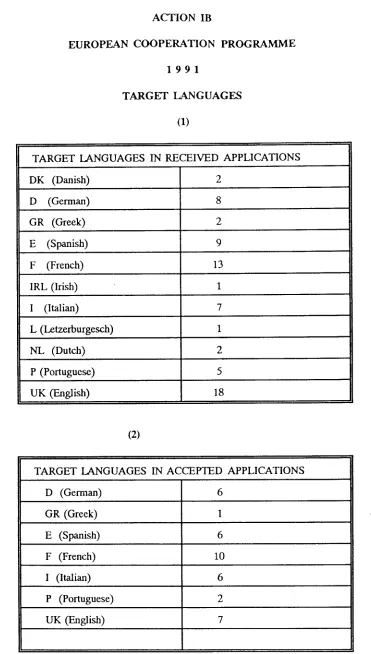
in the Annexes to this report), and covering 7 taryetlanguages (including Greek, Italian, Portriguese and Spanish) (see Table
VIII
in the Annexes tothis report).
This network was started, in 1991, on a limited basis, but the budget set aside for ECPs
n
l9y2
(MECUs
lJ,
five times as much asin
1991) reflects the determination of the Commission topromote co-operation in the field of the in-service training of language teachers and to set up a comprehensive network, thus making
it
possible, in the very near future, to offer teachers inneed of training a wide range of activities in which they can participate under Action IA.
22. The selection. policy adopted by the C-ommission took into account the priorities expressed
in the courrcil Decision, i.e. preference to Programmes which would clearly:
a. improve the in-service training of foreign language teachers
b. encourage comPetgnce in the least widely used and least widely taught languages
c. promote innovation in methods of foreign language taining
d. make use of the new information technologies
2.
3.
THE
lSt
SYMFOSIUM ON EUROPEAN COOPERATION PROGRAMMES3.1. The evaluation of the 50 applications received
in
1991 having shown that most applicants had not clearly understood the basic underlying principle.s of an ECP and in anticipation of thedifficulties that sucb a Dew concept might cause
for
future candidates when preparing their projectC the Commission decidedto
hold a
Symposiumon
ECPs,in
the Autumn,in
the
Netherlands-32.
This Syrrposium was seen by participants as a worthwhile exercise which brought betterunderstanding of.what constitules an ECP and clarified the concept; this
will
no doubt lead toconsiderable improvement in the quality of applications in the firture.
The publication of the proceedings of the Symposium is scheduled for the first half of
199;
thiswill
be followed immediately by the production of a sbort guide for the setting up of ECPs tobe used by applicants as a complement to tbe LINGUA fuplicants' Guide; this short guide
will
take
into
abcountthe
conclusionsof
the working
groupswhich took
placeduring
theSymposium.
PERSPECTTVES
4.1. Success seems to depend on a number of factors. The following points are relevant here:
a. there is a considerable variation
of
practicesin
the in-servicetaining of
foreign languageteachers actross the Community, which is bound to condition the LINGUA @urse of action.
b.
in-servicebaining
inSitutions strould acknowledgetbat
in-servicefiaining
of
foreign language teachenis
srsceptibleof
improvementard
that new training strategies strould beapplied.
c. the inter-institutional and transnational nature of an ECP concept requires effort and goodwill
on the part
of
participantsif
convincing scenarios aimed at the qualitative improvement of foreignl-gu"g"
compete.ncs within the Community in the 90s and beyond are to be developed.42.
The concept of an ECP can be difficult to apprehend by potential candidates.Experienced specialists and institutions responsible
for
the in-service fiainingof
teachers in Member States where suchtaining
exists $rould contribute to the clarification and promotionof this concept.
The C-ommission encourages these specialiss and institutions to help Member States where the
in-sewice training of teachers is either non-existent or only just starting;
it
encourages them,in
partiiular, to become active advisory partners in projects co-ordinated by less experiencedcountries or to integrate these countries in some of their own projects.
{3.
To
achieve this objective, the C-ommission stress€s the needfor
and the importance of preparatory visits.There was only a small amount of requests for these in 1991: 53 applications were received, out
of which only 6 could be funded under the 1991 budget; another 7 of them
will
be funded underthe 1992 budget. 4.
In order to promote the use of preparatory visits, the Commission has already started launching
campaigns, at C.ommunity level, aimed at language teacher training institutions so that these
visits are nadvertized" more widely, explained more clearly and generally made better use of.
4.4.
All
this implies a very pro-active and voluntarist approach on the part of all involved in thetraining of language teachers (Ministies of Education, teacher training inSitutions...) and a closer transnational co-operation between them.
The C.ommission finances up to 50% of the total costs of hrropean Cooperation Proglammes;
Member States should therefore make sure that the relevant institutions can commit, in the spirit of complementarity and subsidiarity, the necessary extra financial and human resources.
45.
The first Symposium on ECPs has laid the appropriate foundation for such co-operation,but
it will
need to be followed by similar njoint ventures" initiated by the Commission and/orthe relevant authorities and institutions involved since the in-service training of better prepared
and more competent (both linguistically and methodologically) language teachers is one of the
keys
of
the successof
theUNGUA
Programme; the setting-up and the developmentof
anetwork
of
institutions working on new ideas and new approachesin
thefield
of
in-service training should certainly be teated as one of the priorities of the Programme.4.6. A transnational approach to the in-service taining of language teachers did not really exist
before
LINGUA;
the added value that the Programmeis
providing, here asin all
its
otherActions, is therefore clearly visible.
ACTION
II
Action II of the LINGUA Programme, which promotes the teaching and learning of Community languages, oovers inter-university cooperation ana slchenge of Higher Education students and
staff. The administration of Action
II of
LINGUA
is carried outin
accordancr with the sameprocedures as thoee used
for
the
ERASMUS Programme, andjoint
arrangementsfor
themanagemenr of ERASMUS and Action
II
of
LINGUA have therefore been implemented.The total budget available in 1991 for Action
II
of LINGUA was 5 MECU compared with ECUz,?ffi,m
in
1990-91.In the assessment of tbe applications fo.r
lggt-g}
in the fietd of languages, careful attention wasgiven
to
ensuring that thefinal
selectionof
ICPs to be supported under LINGUA ActionII
"t"crly
reflected-the prioritiesof
tbe
UNGUA
Programme,notably the fiaining
of
future language tcachens a;1d the pnomotion of the least widely used Community languages.It
strould be noted that LINGUA ActionII
does not provide fundingfor
the development of common curricula or for the organisation of intensive programmes. However, these measures are considered important and they are therefore eligible for parallel funding under ERASMUS'177 applications were considered under
LINGUA Action
ll
Q3.5Voof
all
applications inlanguage.s for ERASMUS and LINGUA Action
II
combined), involving 172 student mobility programmes, 80 teaching staff mobility programmes and a total of.4,393 eligible students'A total of 149 ICPs were selected. These comprised 144 student mobility programmes (compared
with
77in
1990-91) and 32 staff programmes (comparedwith
8 in
the previous year). 448 institutions were involved in the program-et selected, and up to 4,1,80 students were eligibleto
spenda
periodof
their
recognisedstudy
in
another Member State.The
number ofpartnerships nearly doubled. Germany
(lg.g
%), the United Kingdom (L5'3%),
France (14 %) and Spain (L4 Eoi accounted for most participations. Smaller countries like Portugal (5.L Vo),the Netherlads @.8
%)
and lreland (4.6%)
were also well represented. Application rates werelowest for Greece
Q9
%)
and Denmark(2.4 Vo).Nearly
all
approved LINGUA ICPs acceptedin
1991-92 contained a strong teacher-trainingelement and ahigh proportion of all Sudents exchanged intend to become language teachers' No
less than 43 of the
i+9
approvea ICPs involved the teaching and promotion of the least spokeneligible LINGUA languag;. In 1991-92 the LINGUA (Action II)budget was so relatively small
thit
only a handfut oiloint
language/non-language srbject area ICPs could be accePted'In
line with
measures adoptedfor
ICP grantholderswithin
the ERASMUS Programme, theC.ommission undertmk to support most LINGUA accepted ICPs for a period of three academic
years
in
thefirst
instance. Re-applicationfor
funding during that period has therefore been considerablysimplified,
in line with ERASMUS procedures'In
1991, for the first time, general impressions on the actual perfonnance of LINGUA ActionIl
can be derived trom reporSof ICis
acceptedfor
1990-91, but the very small number of progranmes involved makes it impossible to draw many conclusions. However one can note thatrhe great majority
of
thefirst
79UNGUA
ICPs-
77 StudentMobility
Programmes and 8Teaching Staff
Mobility
Programmes-
have been canied out satisfactorily.One structural problem, typical in many LINGUA ICPs and highlighted in certain reports is the
considerable strain on language departments, especially those receiving incoming students. This
is because two departnents are often involved in each participating institution
-
the one sendingstudents and therefore benefitin& and the other receiving students and therefore having an
additional
work
load. Programme coordinators have srggested thatthe
programme should compensate receiving departnents (UK and IRL EnglishI
qnguage and Uterature Depar&nentsappear to be the most affected).
In
1991,-92 specid care was takento
involve in$itutions from thefive
newHnder
in
thereunited Germany.
Of
the
149 ICPs,6
were coordinatedby FNL
institutions and7
were coordinated by inSitutions from other Member States but involved a FNL institution as a partner.Student sycfoanges
with FNL
took placein
the framework of.L2
acx:npted student mobility programmes, involving a totalof
570 eligible students(=
4,316 student months). Upto
104students were eligible
to
go from theFNL to
another Member State and 75 students wereeligible to move from another Member State to the FNL.
Of
the 12 SM programmes, 5 were coordinated by an FNL institution. Of the 32 teaching staff programmes accepted for L99l-92, 3 involved an FNL institution and 1 was coordinated by an FNL institution.As far as
IINGUA
Study Visitsin
1991 are concerned, 68 applications were received fromrnembers of teaching or administrative $aff in higher education institutions and 56 of these were accepted. ln selection, care wirs taken to promote
visis
which would conFibute to the teachingof the least widely taught and least used languages as well as those related to the
initid
taining of teachers. Out of these 56 visit programmeg 9 involved a visit to an institution from the FNL. TheUK
E and B have the highest participation rate.DK
andIRL
had the lowes! each beinginvolved
in
1 Programme.The
initid
impactof
LINGUA ActionII
has been positive although certain difficulties persistwith regard to the disparity between the average level of student gants under ERASMUS and
LINGUA Action
II
dueto
differencesin
the allocation systemfor
studentgants
under therespective Programmes; this resrlts from the provisions of their respective Council Decisions.
The C,ommission has undertaken to study the problem and to seek a solution which minimises
unintended discrepancies in student grant levels but respects the C-ouncil decisions relating to
both Programmes.
One issue that
will
also needto
be addressedis
the lackof
provisionwithin
the LINGUAProgramme to support improvements in the provision of language teaching for the generality of higher education students. Inadequate language provision
is
certainlya
major barrierto
thegrowth in mobility and mutual understanding which are part
of
the aimsof UNGUA
(Action u).o I o o. o CL 6 o ! E d |l o Io a tr E ! I tr G a i5 a, t t: o
z
o E F 6 .c' \o .c*
\o.<tc-r| r-@ \o g t \c|
.i
r)\oc'\
o- {-\o
cl \o c{
s
(.1c.l
C'\
t: s ooE.
cr q d E I it (, .0 E o
z
v) ol o\ c{F
€
t-\o
{
\o \o .(t €F. ooN co @t-
€
rl' tr o a
r
I 8 € o o 6 o g o A q o ! 6 tl o o 8 G i5 x os
o r?
€
q
(> r:o\
q
o
o\ r-69
v
6 (.'! (.1€
n
vt- (\ q
€
a tr 6 q o G o. I .D E oz
l(rl c.l @@ @6 @ c- clo\ (.1 eatl \oo\ t\-C.l\o
a) Fi 6 E I a E
z
o No.t C.lC.l e'l \o c{c.l q c.r(! cI\q o (} o 0 .E' € E I o G I -o tr o
z
F 6 o o 6 o .oI
oz
(n o
{
sol \oo\ o\v o\ r c{ cl @(t \o @\o o tr 6 o
a
0 EIz
\o o rt c-cil \o c)s
c{ ol a.r c.l v t'- cr aq r-(\l \o !q{
ea Fv
J,-l J
z
!4 F F o| o\ I o\ €\z
I{
z
o
F. C);)
I
z
r1 rdo
r{
tq r4 (t)z
rdo
H
p
o\ I o\I
z
rdo
<g
5TsZ
ZY
-2
qd
r'r lrlr-r O<
-o
zo
oq)
r< rd
UO
{,'
)_r
r{
rd&
:H
r.l
<
HE
Fl cn
ACTION
trI
1. AIMS
The Action does not aim to replace activities undertaken by enterprises and other bodies in the
field of linguistic taining directed towards the economic world. Its aim is rather to contribute,
through several strategic measures,
to
the developmentof
teaching and learningof
foreignlanguages as an essential component of vocational training of workers and tainers, particularly in small and medium-sized
enterprises-The Action consists of the following measures:
a)
Diagnosisof
needs; herethe
C.ommunity aidsthe
development and disseminationof
techniques for the analysis of needs for foreign languages and for training for foreign languagesof professional or workers' organizations and of enterprises.
b) Development of teaching materials and self-learning methods.
c)
Developmentof
mobility and linguistic exchanges directed towards the representativesof
small and medium-sized enterprises and professional organizations dealing with foreign languagetaining for
the needsof
economiclife,
aswell
as towards trainersin
foreign languages,specialized in different professional and technologcat fields.
d) Introduction of certificateg in cooperation with representatives of the professions or of the sectors of the economy concerned; here the C.ommunity grants aid to establishments responsible
for
designing curricula and issuing diplomaswith
a view
to
inuoducing foreign-language qualifications for the economic world and to designing the curricula and the teaching materials involved.This Action therefore plays a
vital
rolein
the developmentof
the 'free movementof
goods,services, capital and people' in post-1992 Europe.
PROACTIVE OPERATIONS
IN
1997C-onsidering the novelty of the activities in Action
III,
two experts' meetings were held during1991, in which experts from almost all Member States participated.
At
thefint
meeting(April
1991), working groups produced documenb on language audit,certification and Action
III
strategy; in the case of language audit, a strategy for selection was suggested, which has helped to guide the Commission's selection of projects.For certification a more specialised meeting was held in September, and resulted
in
proposalsfor
specific projectsto
carry out essentialwork
for
the developmentof a
nfrarnework forcertification'
As far as language audit is concerned, the report by van Hest and Oud de Glas
('A
suweyof
the techniques used
in
the diagnosis and analysisof
foreign language needsin
trade andindustry'), which was carried out at the request of the Commission, has now been published and
is being sent to all language audit projects.
The Commission staff have participated in a number of Action
III
eventsin
various MemberStates, and have cooperated with National Agencies in developing marerials for them.
3.
IMPIJMENTATION IN
19973.1.
Applications receivedFor the
first
round(lst April),
106 projects were receivedfor
ActionIII,
andfor
the second round(lst
October) 67, a total of.L73-During 1991 with a budget under MECU 2.8,40 projects were selected from the first round, and
a further 18 from the second, making 58 in all; a further 3 are being recommended for funding
from the 1992 budget, which would give a total of 61 out of 173, just over 35Vo of. accePtance'
32.
AccePted Projects32.1.
FundingFunding
of
accepted projects has been as follows:Round
1/91
Round?91
TotalTotal
requested
3,44L,352
1,498,911
4,940,263Total
awarded
1,930,8m
812,300
2,743,LW(For details of funding, see Tables
X
andXI
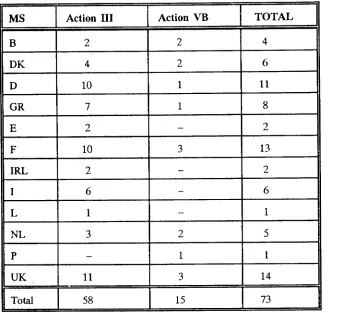
in the Annexes to this rePort).The distribution of coordinating institutions between Member States was uneven, but when one considers partner institutions, one can see a much better distribution
of
participation amongalmos
all
Member States (For details about this disnlbution, see TablesXII
andXIII
in
theAnnexes to this rePort).
322.
Taryet languagesThese are shown globally for Actions
III
andVB
in TableXIII
in the Annexes to this report'For Action
III,
although there was a considerable demand for German (17), English (2'0) and French (24), most of the 'lesser-taught languages' were well-represented,with
14 projects for Italian, 12 for Spanish, 11 for Greek, g fot Dutch, 7 for Portuguese, 6 for Danish, 4 for Irish and2
for l-etzeburgesch.This appears to be a satisfactory distribution, particularly in view of the fact that 'necessity of thd project' was a major criterion of selection'
323.
TYPes of ProjectBy far
the
greatest numberof
projectsboth
submitted and selected werefor
materials development.The next most frequent type
of
projects was language audits; curriculum development and certification came behind.However, needs analysis and certification often form part of a materials development project,