This is a repository copy of Mapping Changes in Local News.
White Rose Research Online URL for this paper:
http://eprints.whiterose.ac.uk/96293/
Version: Accepted Version
Article:
Firmstone, J (2016) Mapping Changes in Local News. Journalism Practice, 10 (7). pp.
928-938. ISSN 1751-2786
https://doi.org/10.1080/17512786.2016.1165136
© 2016, Informa UK Limited, trading as Taylor & Francis Group. This is an Accepted
Manuscript of an article published by Taylor & Francis in Journalism Practice on 06 Apr
2016, available online: http://www.tandfonline.com/10.1080/17512786.2016.1165136
[email protected] https://eprints.whiterose.ac.uk/ Reuse
Unless indicated otherwise, fulltext items are protected by copyright with all rights reserved. The copyright exception in section 29 of the Copyright, Designs and Patents Act 1988 allows the making of a single copy solely for the purpose of non-commercial research or private study within the limits of fair dealing. The publisher or other rights-holder may allow further reproduction and re-use of this version - refer to the White Rose Research Online record for this item. Where records identify the publisher as the copyright holder, users can verify any specific terms of use on the publisher’s website.
Takedown
If you consider content in White Rose Research Online to be in breach of UK law, please notify us by
1 MAPPING CHANGES IN LOCAL NEWS
Julie Firmstone
Local news media in the UK are undergoing a multitude of changes which have implications for our understanding of their value in local democracies. Despite the potential significance of these changes for those actors responsible for the provision of local news, very little
of these threats and opportunities. This article addresses this gap by presenting research which investigated the views of key stakeholders in the production of local news in a large city in the UK. The thematic analysis of fourteen interviews evaluates how normative roles attributed to journalism such as representing the public, acting as a watchdog, providing information, and running campaigns are being fulfilled by different news providers in the current news ecology.
KEYWORDS local news; local journalism; citizen journalism; civic news; hyperlocal
Dr Julie Firmstone, School of Media and Communication, University of Leeds, LS2 9JT. Contact details: [email protected]
Acknowledgements: Thanks to the anonymous reviewers and John Corner for their comments on earlier versions. Thank you also to all the people interviewed for the study.
2 Introduction
Local news media in many Western democracies including the UK are undergoing a multitude of changes which have implications for our understanding of their contribution to the fulfilment of the normative roles associated with journalism. Fragmenting and declining audiences, resource cut backs in television, radio, and most notably newspapers, increased competition, and the requirement to communicate news twenty four hours a day via a multitude of platforms, require the local news media to adapt to a news ecology that is undergoing transformation. This has led to a dominant narrative in industry commentaries and scholarship that journalism and, in particular local journalism, is in crisis (Barnett and Townend 2015; Currah 2009; Franklin 2006; NUJ )
(2015) thought provoking interrogation of the notion of crisis to describe the current situation skilfully argues what many journalism scholars already suspected - that the broad brush label of
political
today (Zelizer 2015, 888). Whilst it is widely acknowledged that the uncertainties brought about by changes in these circumstances are particularly acute in local news, we have relatively little empirical evidence of how the dynamics of local news ecologies are changing.
Without such an empirically based understanding it is difficult to move beyond the
deceptive narrative of crisis. This article presents research designed to explore and unpack changes in local news ecologies in order to evaluate how and why these changes matter. A secondary aim is to use these insights to develop priorities for future research. I argue that it is important to place our understanding of local news in a theoretical context which recognises the potential democratic role of news in society. The role of local news in the public sphere is particularly significant because it is considered vital to the functioning of local communities and the engagement of citizens in local democracies (Fenton 2011; Kleis Nielsen 2015; Mcleod, Scheufele, and Moy 1999; Shaker 2014).
In order to explore the impact of changes in current local news production, the research design operationalised four normative functions commonly attributed to news in liberal democratic theory as a measure of its democratic value. These suggest that journalists should inform and educate citizens about local issues, represent the voice of citizens, hold governing bodies and organisations to account on behalf of citizens, and proactively campaign on matters of public interest (Barnett 2009; Barnett and Townend 2015; Gans 2010; McNair 2009; Williams et al. 2015). The research evaluates the way in which local news media fulfil these four roles - informational, representative, watchdog, and campaign. Structuring the analysis of the value of local news around the concept of democratic value provides a clear evaluative framework. This allows us to consider the impact of changes relevant to wider debates about the future of journalism such as declining resources for investigative journalism, opportunities for citizen journalists, and changing audience
demands. These and other issues which evoke concerns t in
G ,
11) are explored through a main research question and two sub questions:
Main RQ: What implications do changes in the production of local news have for the democratic value of local news?
Sub questions:
1. How do local journalists and council communicators perceive the local news media to be producing news of democratic value?
2. W
3 Research design
The article presents findings from 14 interviews conducted in two stages of fieldwork in
2014 a UK L T
four ways. Firstly, few studies consider local news provision comprehensively enough to provide a picture of the combined practices of local news providers. This research takes one city as a case study and considers the local news ecology of the city as a whole. Although the local media context of Leeds cannot be taken as representative of all UK cities, its relatively large population of over 750,000 supports a mix of news providers representing most types of local journalism found in the UK. Citizens can access local news through a long established city based newspaper, a public service (BBC) television channel and radio station, one commercial television channel, several commercial
UK TV
T
ecology features many of the challenges and opportunities characteristic of that state of flux in local journalism in Western democracies which were outlined above.
Secondly, whilst journalists and news producers are often interviewed by researchers to gain an understanding of news production practices, they are rarely consulted as experts in their field. Here, journalists (News Producers) are interviewed as authoritative sources of opinion on the impact of recent changes, threats, and opportunities faced by local news media. Thirdly, the research moves away from a media-centric approach and considers the perceptions of other actors interested in communicating with citizens for different reasons than journalists. Here communications
professionals from the local authority (Council Communicators) are interviewed as actors who co-exist with and face similar challenges to local news providers in engaging with the public, and have a strong interest in the maintaining a well-functioning local public sphere. These Council
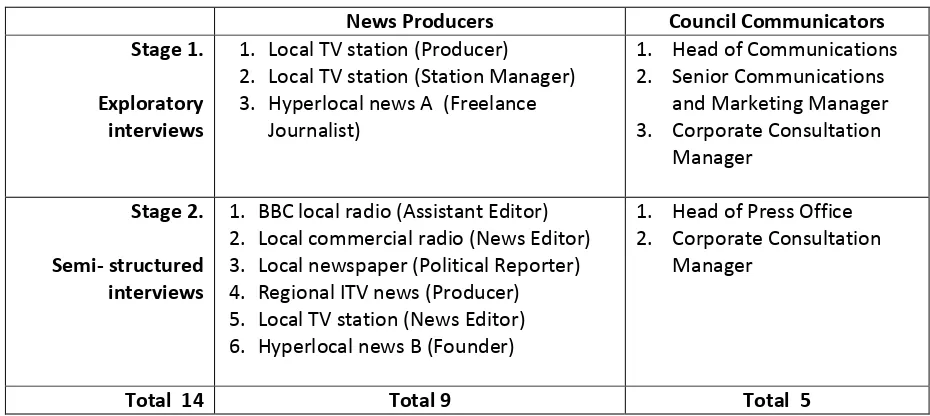
Communicators are able to draw on a different, more detached view of the local media landscape which provides a valuable alternative perspective in evaluating the current provision of local news. In the first stage of the fieldwork, three News Producers and three Council Communicators were interviewed (see Table 1). Eight interviews were conducted in stage 2: six with News producers - journalists, producers and editors from local television, radio, print, and online news outlets; and two with communications specialists from Leeds City Council Press Office and Corporate Consultation team.
A set of open ended questions guided the exploratory interviews in stage 1 aimed at
gathering initial perceptions about the role of the local news media, the challenges facing local news media now and in the future, and the role of citizen producers in local democracy. In stage 2 a semi-structured interview schedule encouraged interviewees to reflect on local news in relation to key concepts developed to evaluate the concept of the democratic value of journalism. Interviewees were asked to explain their perceptions of how local news and journalism can serve the public interest, to comment on the performance of the local news media in fulfilling four normative expectations of local news, and to discuss changes in audiences for local news.
Finally, the news ecology approach attempts to move our understanding of local news closer to the experiences of the audience who remain neglected by much journalism research (Harcup
2015) C
audiences draw local news from multiple outlets and platforms. Therefore the questions in both stages were designed to encourage interviewees to discuss the entire landscape of local news provision in the city rather than just their own organisation or one type of news. All interviews were recorded and transcribed. The discussion of findings is based on a qualitative analysis which
4 Table 1: Stakeholders interviewed
News Producers Council Communicators
Stage 1.
Exploratory interviews
1. Local TV station (Producer)
2. Local TV station (Station Manager) 3. Hyperlocal news A (Freelance
Journalist)
1. Head of Communications 2. Senior Communications
and Marketing Manager 3. Corporate Consultation
Manager
Stage 2.
Semi- structured interviews
1. BBC local radio (Assistant Editor) 2. Local commercial radio (News Editor) 3. Local newspaper (Political Reporter) 4. Regional ITV news (Producer) 5. Local TV station (News Editor) 6. Hyperlocal news B (Founder)
1. Head of Press Office 2. Corporate Consultation
Manager
Total 14 Total 9 Total 5
Findings and discussion
I
normative roles of local news are analysed first to explore the question: how do local journalists and council communicators perceive the local news media to be producing news of democratic value?
Informational role
The majority of interviewees perceived the mainstream news media fulfilling less of an informational role than it has in the past due to changes in audience demands. All recognised that digital media creates competition with a vaster quantity of sources of news than ever before. As a result news providers have moved away from producing information orientated news, with some seeing information as an add on and others only providing informational news when it can be produced in a way that is perceived to appeal to audiences. Radio news providers in particular described information orientated news as an add on rather than a driver of their news bulletins with additional information provided online for the audience to access separately. Additionally, several news providers talked about the importance of producing news that is distinctive (e.g. a bit different , provides a fresh view ) in order to engage audiences:
P to hear a list of things that are going on in Leeds today. They want to hear about what the issues of today are and what can I get angry about?, and
I (Commercial radio)
On the face of it the provision of less informational news might seem like one of the least
5 to be providing the public with good access to information, there was some concern about the extent to which news organisations were providing audiences with enough information for them to understand and engage with some of the issues that the city is dealing with. All local newspapers, not only the one in the locality, were perceived as struggling to cover complex issues, with the result
that newspape ge .
Campaigning
The move away from information provision appears to be driving a greater level of news which is campaign orientated in order to appeal to audiences, and there was a sense that major long running campaigns on specific issues are less common. Instead, radio and newspaper journalists described pursuing a different kind of campaign role producing more regular campaign orientated news as a way to create a distinctive product. The pursuit of campaign orientated news has both beneficial and detrimental implications for the democratic value of local news depending on the motivations driving the campaign. On the down side, some news organisations, particularly commercial radio, perceive news that takes a campaigning stance as a simple tool to attract audiences. As highlighted in the water cooler quote, this approach may see issues turned into
campaign
O veral news providers (BBC radio/newspaper) described a more public interest orientated approach to campaign news which builds on their established and trusted relationship with their audiences. Campaign news driven by public interest ideals is seen as providing the bonus of increasing audiences at the same time as facilitating greater audience engagement with specific civic issues which hold the potential to affect change in society. Indeed, the local newspaper described itself as a campaign newspaper and had recently launched a joint campaign with a local charity to tackle a range of issues identified by its readers as being of importance to the city. The ongoing campaign aims to re-connect with the audience, promote the role of the paper as acting in the interests of the community, and provide news content (Firmstone, 2015).
Representing
There was an overall perception that the combined efforts of the local news media in Leeds fulfil the role of representing the views of the public very well, with each catering for a different section of the population. In terms of recent changes, social media has significantly amplified journali capacity to connect with and represent the interests of their audience. It is used to gather public opinion (an alternative to vox pops), encourage audience participation, and measure the popularity of stories far more efficiently than was possible pre Web2.0. Council Communicators raised concerns about the representativeness of such interactions. They suggested that unless news
6 Watchdogs
The reduced capacity of news providers to pursue investigative journalism and fulfil the role of watchdog was universally described as the most important and concerning change affecting the democratic value of local news. All interviewees talked about the impact of falling resources on the ability of mainstream news organisations, particularly newspapers, but also television, to hold those in power to account as often as in the past. Several of the most experienced News Providers voiced concerns about whether large corruption cases unearthed by resource intensive watchdog
F
It is a challenge for anybody in the journalism industry now to actually take the time out to do the proper full background on stuff. You just wonder whether the Poulson affairi would
(ITV news)
Concerns about hard hitting investigative journalism were matched by similar concerns about the day to day scrutiny afforded by current resources. Many interviewees painted a familiar picture of what Gans (2010) calls everyday watchdogging being restricted by an increase in desk based journalists reliant on press releases and unable to invest time to attend council meetings, court hearings or get out into the community. Several interviewees described how time constraints result in press releases being directly replicated in news coverage without journalists being able to take the time to scrutinise the story or put the other side across. J regret that the capacity for watchdog journalism has decreased was nevertheless defended by the
perception among journalists that no one is doing it better than us , which leads us to the contribution of citizen producers.
The contribution of citizen journalists
One response to the perceived decline of local mainstream media has been to look at alternative ways that the news needs of local citizens may be served. The opportunities created by digital media have led to suggestions that citizen journalism can perform a replacement role to fill the gaps left by the shrinking mainstream media (Metzgar, Kurpius, and Rowley 2011; OFCOM 2012). A growing body of research has explored the potential for citizen journalists to produce news that meets the needs of local communities by analysing the content of hyperlocal news and the
motivations and business models of such sites (Williams et al. 2015). Less is known about how such new players are perceived by local mainstream news producers or other key stakeholders such as local authorities (Chen et al. 2015). Exploring one of the four ways that citizens can contribute to the
production of local news suggested by Fi C
journalism, the research asked What contributions do local journalists and council communicators perceive citizen journalism producers make to news of democratic value? Citizen journalism producers are citizens who contribute to the news ecology as individual or collectively organised producers of information and opinion, independent of mainstream media (Firmstone and Coleman 2014, 2015). At the time of the research citizen producers in Leeds were typically operating as online hyperlocal news organisations or locally based magazines/lifestyle publications produced in digital formats and/or in print.
7 related to the differing motivations, professional values and business models/resources of citizen producers in comparison to mainstream news organisations. S
based on the perception that watchdog and campaign news produced by citizen producers is motivated by interests other than the wider public interest commonly associated with mainstream journalism. Many also think the niche audiences and niche campaigns of such journalism make it unrepresentative. Even some citizen producers were sceptical of the democratic value of some citizen journalism and were concerned that such news is often produced according to an alternative set of motivations to those of professional journalists:
“ blogs are just very, very opinionated whereas I at least try and be balanced and there (Hyperlocal journalist A)
However, some new entrants aim to add something that is missing from the news ecology rather than replace the old functions of mainstream media. Defining output as news features not
news , and contributors as storytellers who do not identify as publication said:
W erwards and exclusive
stuff, so if we do feel that there is something that we can explore that somebody else is not (Hyperlocal News B)
While their additions to the local news ecology were broadly welcomed, the professional practices and values of citizen producers were of concern to Council Communicators who described difficulties in their interactions with some citizen producers. An example was given of a local blogger who did not act in accordance with the codes of professional journalism and published a story before an embargo had passed - such practices put the Council in a difficult position when it comes to engaging with citizen producers:
A
I H , if you
expect to be treated the same you need to behave in the same way behaviours that come along with that [acting in a journalistic role], a set of responsibilities,
(Head of Communications)
Coupled with concerns about the public interest motivations of citizen producers this points to a question at the very core of re-evaluations of the democratic role of journalism: what is a journalist? (Shapiro 2014).
Perceptions of the impact of changes
Towards the end of the interview each interviewee was asked for their view of the
suggestion that journalism is in crisis, and that local news is in a perilous situation. News Providers commonly perceived this as an exaggeration of the current transformations in local news provision where, in their view, any serious problems are confined to the newspaper industry.
N N
A I I
8 Similarly, Council Communicators also felt that labelling the current situation as a crisis was too strong. However, based on a far broader view of the local news ecology, they expressed a
communicate with citizens and the recent decline in the performance of the local news in engaging local citizens in local democracies.
Discussion
The empirical evidence presented in this article confirms that the narrative of local news in crisis is unhelpful in two ways. Firstly, it is not a narrative that those with a vested interest in the future of local news identify with. Secondly, the label of crisis risks oversimplifying the complexity of the implications of ongoing changes in local news revealed by t
perceptions. Yet the notion of crisis is helpful in lending a necessary sense of urgency to debates among academics and policy makers about the future of local news.
On balance, the analysis points to few changes that represent improvements in the
democratic value of news and to more features of the shifting news ecology which cause concern for the quality of news available to the public. These include an inevitable yet potentially detrimental decline in the informational role of local news; a growing gap in the ability of local news media to fulfil the watchdog role due to an increase in desk based journalism, over reliance on PR/pre-packaged news, and a lack of resources to investigate stories in depth; a perceived decline in the quantity of major news campaigns, a shift towards more frequent dramatized campaign orientated news; and, an improvement in the representative role of news brought about by social media but with the benefits largely restricted to the digitally active.
Amidst these changes, the stronger emphasis on running public interest campaigns stands out as a beneficial implication, with Voice of Leeds campaign fulfilling a potentially new role as a site of civic participation. By hosting monthly summits about key issues of public interest on neutral territory in partnership with a local charity, the newspaper has moved beyond the usual aim of campaigns to raise awareness or drum up support for an issue. Such campaigns are a direct reaction to the heightened need for local news organisations to maintain a trusted relationship with citizens to ensure their long term legitimacy and economic success (Hermans et al. 2014), and are a valued strategy to show
L N .
The findings suggest three priorities for future research. Firstly, an empirically based picture of how news content contributes to fulfilling the democratic value of news is required to establish how perceptions of changes in practices translate into changes in news content. Perceptions of local news that is increasingly dramatized, sensationalised and campaign orientated in order to retain audiences suggest a continuing emphasis on entertainment, consumer and human interest news found by Franklin a decade ago (Franklin 2006). Similarly, content analysis could show how local news content is shaped by the perceived proliferation of news unfiltered by the professional journalistic values of balance, fairness and verification, and processes of everyday watchdogging (Gans 2010).
9 watchdog and campaigning news provided by newspapers. Such news is the most difficult for non-press news providers to fulfil due to either a lack of resources and expertise (in the case of hyperlocal news) or regulatory constraints for broadcasters to remain balanced and impartial. Indeed the valuable position of newspapers as free to take sides in campaigns in a way that public service media cannot should not be forgotten in debates about the future remit of the BBC (Greenslade 2015), and local news industries generally. Shaker (2014) has highlighted the problematic consequences of the closure of local newspapers in the USA where he found a correlation between the absence of local newspapers and falls in civic engagement.
Thirdly, whilst interviewees agreed that audiences for local news are larger than ever, the challenge of making content about civic issues interesting to them persists, highlighting the need for a fuller understanding of local news audiences. In short, it is necessary to establish what needs saving and why (Currah 2009, 27) to ensure that future policies and actions to bolster the democratic value of local news can be clearly justified.
REFERENCES
Barnett, Steven. 2009. Journalism, Democracy and the Public Interest: Rethinking Media Pluralism for the Digital Age. Reuters Institute for the Study of Journalism Working Paper.
Barnett, Steven and Townend, Judith. 2014. Plurality, policy and the local: can hyperlocals fill the gap? , Journalism Practice, 9:3. 332-349.
Currah, Andrew. 2009. Navigating the Crisis in Local and Regional News: A Critical Review of Solutions, Report for the Oxford Reuters Institute for the Study of Journalism.
Chen, Nien-Tsu Nancy, Katherine Ognyanova, Chi Zhang, Cynthia Wang, Sandra J. Ball-Rokeach, and
M P C ‘ L P ‘ Journalism Studies.
Published online: 2015.
F N D D N M N N P
I Continuum 25 (1): 63 72.
Firmstone, Julie. 2015. Journalistic roles: representing the public and encouraging public
engagement in civic issues, Paper presented to the Political Studies Association, Media And Politics Group Annual Conference, Mediating Democracy , University Of Chester, 5-6/11/2015.
F J “ C T C ‘ L N M
E C E L D Journalism Practice 8(5): 596-606.
F J “ C ‘ L C “ ‘
on the Implications of Digital Media and Citizen Journalism for the Role of Local Journalism E C I Local Journalism: The Decline of Newspapers and the Rise of Digital Media, by Kleis Nielsen, Rasmus. I.B. Tauris.
Franklin, Bob.2006. Attacking The Devil? Local journalism and local newspapers in the UK in Local Journalism and Local Media: making the Local News edited by Bob Franklin, 3-5. London: Routledge.
Gans, Herbert. 2010. News and the news media in the digital age: implications for democracy, Daedalus Spring 2010, Vol. 139(2):8-17.
Greenslade, Roy. 2015. Why local papers count, The Guardian, February 5.
H T A ‘ Journalism Practice (Online version released 2015) Hermans, Liesbeth, Schaap, Gabi Bardoel, Jo. 2014. Re-Establishing the Relationship with the Public:
Regional journalism and citizens' involvement in the news, Journalism Studies, 15(5), 642-654.
10 Mcleod, Jack, Dietram A. Scheufele, and Patricia Moy. 1999. Community, Communication, and
Participation: The Role of Mass Media and Interpersonal Discussion in Local Political Participation. Political Communication 16 (3): 315 36.
McNair, Brian. 2009. Journalism and Democracy. In The Handbook of Journalism Studies, edited by Karin Wahl-Jorgensen and Thomas Hanitsch, 237-250. New York: Routledge.
M E T D D K K M ‘ D H M
P F D New Media & Society 13 (5): 772 87.
National Union of Journalists.2014. https://www.nuj.org.uk/news/nuj-calls-for-short-sharp-inquiry-into-the-future-of-local/
OFCOM. 2012. Public Service Broadcasting Annual Report 2012.
http://stakeholders.ofcom.org.uk/broadcasting/reviews-investigations/public-service-broadcasting/annrep/psb12/.
Shaker, Lee. 2014. Dead Newspapers and C Civic Engagement, Political Communication, 31(1): 131-148.
Shapiro, Ivor. 2014. Why democracies need a functional definition of journalism now more than Journalism Studies. 15(5):555-565.
Williams, Andrew, Harte, Dave and Turner, Jerome. 2015. The value of UK hyperlocal community news. Digital Journalism 3(5):680-703.
Zelizer, Barbie.2015 Terms of Choice: Uncertainty, Journalism, and Crisis, Journal of Communication, 65: 888-908.
i