~ - - - " " ___
---EUROPE!N PARLIAMENT
,tl•
-sessio11
docu11Jents
ENGLISH EDITION
25 October 1993 A3-0315/93
[J
R E P O R T
of the Committee on Budgets
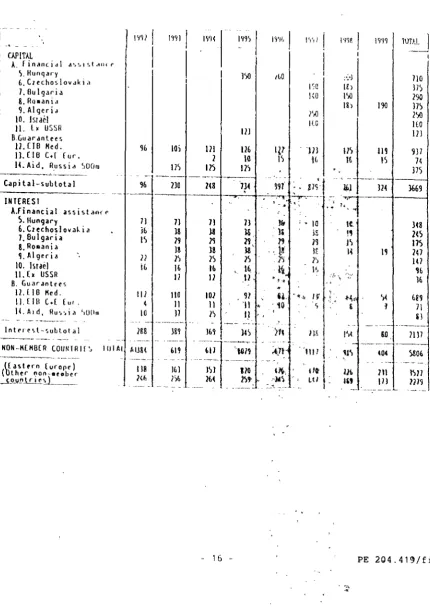
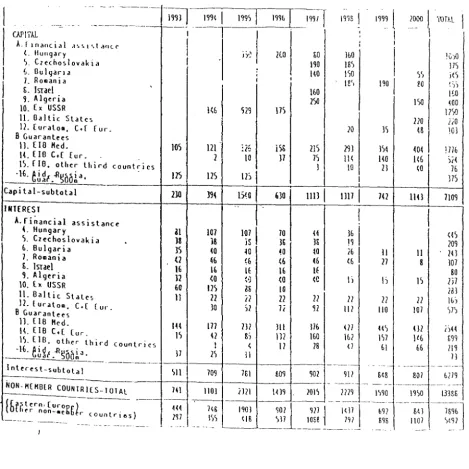
on the Commission proposal for a Council requlation
establishing a Guarantee Fund
(COM(93)0020 - C3-0119j93)
Rapporteur: Mr John TOMLINSON
DOC_EN\RR\237\237796 PB 204.419/fin.
Or. PAN
* Consultation procedure requinng a single read1ng
**I Cooperation procedure (first reading)
**II C::JOperatl~in prCJCl~Jure !second reading) requrr1ng the vCJtes of a majorrty of the current Members of Parliamen
** • Parllii!llcntary assent requing th<: vCJtes of a rr.ajority of the current Members ol Parlia:nent
CONTENTS
Procedural page • • •
P.. Amendments to the Commission proposal
Draft legislative resolution
B. Explanatory statement
Opinion of the Committee on External Economic Relations
Opinion of the Committee on Budgetary Control
Opinion of the Committee on Legal Affairs and Citizens' Rights (will be published separately)
3
4
9 10
18
By letter of 9 March 1993, the Council requested the European Parliament to deliver an opinion, pursuant to Article 235 of the EEC Treaty, on the Commission proposal for a Council regulation establishing a Guarantee Fund.
At the sitting of 12 March 1993, the President of Parliament announced that he had referred this proposal to the Committee on Budgets as the committee responsible and to the Committee on External Economic Relations and the Committee on Budgetary Control for their opinions.
At its meeting of 27 January 1993, the Committee on Budgets had appointed Mr John Tomlinson as rapporteur.
At its meeting of 30 September 1993 i t examined the validity and appropriateness of the legal basis pursuant to Rule 36(3). By letter of 25 October 1993 i t requested the opinion of the Committee on Legal Affairs and Citizens' Rights.
At its meetings of 20 September, 30 September and 25 October 1993 i t considered the Commission proposal and draft report.
At the last meeting i t adopted the draft legislative resolution unanimously.
The following took part in the vote: von der Vring, chairman; Pasty, Vice-Chairman; Tomlinson, rapporteur; Cassidy, Colom I Naval, Frimat, Goedmakers,
Isler Beguin, Kellett-Bowman (for Forte), Langes, Napoletano, Samland and Wynn. The opinions of the Committee on External Economic Affairs and the Committee on Budgetary Control are attached.
The opinion of the Committee on Legal Affairs and Citizens' Rights will be published separately.
The report was tabled on 25 October 1993.
A.
Commission proposal for a Council regulation establishing a Guarantee Fund
Commission Text(l) Amendments
(Amendment No. 1) 1st citation
Having regard to the Treaty
establishing the European Economic Community, and in particular Article
235 thereof,
Having regard to the Treaty
establishing the European Economic
Community, and in particular Article~
203 and 235 thereof,
(Amendment No. 2) 1st recital
Whereas the European Council, meeting in Edinburgh on 11 and 12 December, agreed that a Guarantee Fund should
be established to cover loan
guarantees to non-member countries;
Whereas the Inter institutional
Aqreement determines that a Guarantee Fund should be established to cover
loan guarantees to non-member
countries;
(Amendment No. 3) 7th recital
Whereas, by reference to the practice
of international financial
institutions, a ratio of 10% between the Guarantee Fund's resources and guaranteed liabilities in principal would seem adequate;
Whereas a target size for the
Guarantee Fund is to be established
by the budgetary authority in
consultation with the Court of
Auditors; whereas this target amount may not be set at less than 10% of total guaranteed liabilities but may be variable;
(Amendment No. 4) 8th recital
Whereas initial payments to the
Guarantee Fund equal to 14% of the amount of each operation would seem appropriate to attain this target amount;
Whereas the Guarantee Fund should be constituted by means of an immediate
payment from the Reserve of the
entire target amount for the total outstanding liabilities.
( 1)
commission Text Amendments
(Amendment No. 5) 9th recital
Whereas, once this amount is
attained, payments to the Guarantee Fund could then be limited to 10% of the amount of new operations; whereas if the Guarantee Fund exceeds this amount the surplus will be paid back to the budget;
Whereas payments to the Guarantee
Fund are thereafter to be a
percentage of the amount of new
operations eguivalent to the ratio of the target amount to total guaranteed liabilities; whereas if the Guarantee Fund exceeds this amount the surplus will be paid back to the budget;
(Amendment No. 6) Recital lOa (new)
Whereas i t is necessary, in order to
ensure maximum transparency of
operations relating to the Fund, that all operations be recorded in the general budget, thus permitting the Court of Auditors to exercise their controls;
(Amendment No. 7)
Article 2, before first indent, new indent
an initial pavment from the
Guarantee Reserve corresponding to
the entire target amount for the
total outstanding liabilities l
(Amendment No. 8)
Article 2, before first indent, new indent
an initial payment from the
European Investment Bank
corresponding to. a certain percentage of the loans·advanced by the EIB and
guaranteed by the Community, this
Amendments Commission Text
(Amendment No. 9) Article 2, first indent - payments from the general budget
corresponding to a set percentage of
each operation for a non-member
country, decided on and committed by the Community and guaranteed by the budget;
- payments from the general budget corresponding to a set percentage of each new operation for a non-member country, decided on and committed by the Community and guaranteed by the Community;
(Amendment No. 10) Article 3, first paragraph
The Fund shall rise to an appropriate level, known as "the target amount", determined by reference to guaranteed liabilities.
The Fund shall be of an appropriate level, known as "the target amount", determined by reference to guaranteed liabilities.
(Amendment No. 11) Article 3, second paragraph
The target amount shall be 10% of the community's outstanding liabilities in principal arising from loans and
loan guarantees granted by the
Community.
The target amount shall be
established by the budgetary
authority in consultation with the Court of Auditors as a ratio between
the Fund's resources and the
Community's total outstanding
liabilities in principal arising from loans and loan·guarantees granted by the c~mmunity.
(Amendment No. 12)
Article 3, new third paragraph
The target amount shall not be set at less than 10% of total guaranteed
liabilities, but may varv in
Commission Text Amendments
(Amendment No. 13) Article 3a (new)
In accordance with the Financial
Regulation, all operations relating to the Guarantee Fund are to be
recorded in the general budget,
either on the revenue or on the expenditure side.
(Amendment No. 14) Article 4
The payments provided for under the first indent of Article 2:
- shall be equivalent to 14% of the
value of the operation until the Fund reaches its target amount;
- shall be reduced to 10% when the
target amount is reached.
Deleted
(Amendment No. 15) Article 5, first paragraph
If, as a result of the activation of guarantees, the resources in the Fund fall below 75% of the target amount,
the rate of provisioning on new
operations shall be raised to 15% until the target amount has been reached.
If, as a result of the activation of guarantees, the resources in the Fund fall below 75% of the target amount,
the rate of provisioning on new
operations shall be raised to 20%
until the target amount has been
reached.
(Amendment No. 16) Article 5, sec0nd paragraph
If a guarantee is activated before the Fund reaches its target amount and the resources in the Fund fall below 75% of the target amount as a
result, the rate of prov~s~oning
shall be raised to 15% until the
amount drawn has been fully restored.
Commission Text Amendments
(Amendment No. 17)
Article 5, new last paragraph
If the resources in the Fund are not
sufficient to meet a guarantee or
guarantees activated, the Community
shall honour its obligations by
drawing on its cash resources as provided for in Article 12 of council
Regulation No. 1552/89 of 29 May
A
DRAFT LEGISLATIVE RESOLUTION
embodying the opinion of the European Parliament
on the commission proposal for a Council regulation establishing a Guarantee Fund
The European Parliament,
having regard to the Commission proposal to the council (COM(93)0020)1•
having been consulted by the Council pursuant to Article 235 of the EEC Treaty (C3-0119j93),
having regard to the report of the Committee on Budgets and the opinions of the Committee on External Economic Relations, the Committee on Legal Affairs and Citizens' Rights and the Committee on Budgetary Control (A3-0315j93),
1. Approves the Commission proposal subject to Parliament's amendments and in accordance with the vote thereon;
2. Calls on the Commission to amend its proposal accordingly, pursuant to Article 149(3) of the EEC Treaty;
3. Calls on the Council to notify Parliament should it intend to depart from the text approved by Parliament;
4. Calls for the conciliation procedure to be opened if the Council should intend to depart from the text approved by Parliament;
s.
Asks to be consulted again should the council intend to make substantialmodifications to the Commission proposal;
6. Instructs its President to forward this opinion to the Council and Commission.
1
OJ No. C 68, 11.3.93, p. 10
EXPLANATORY STATEMENT
Introduction; basic features of the proposal
1. The Commission's proposal for a Guarantee Fund corresponds closely to
the agreement reached by the Council at the December 1992 Edinburgh European Council, and indeed the first recital refers to this European Council. More to the point is that the present proposal conforms with the model in the draft Interinstitutional Agreement, and whereas the Commission's proposal does not refer to the Interinsti tutional Agreement with one word, it would seem appropriate to substitute some mention of this Agreement for that of the European Council in the first recital.
2. Salient features of the proposal are:
target size of the Fund 10% of the outstanding liabilities;
Fund to be built up by remitting 14\ of each new operation giving rise to a liability;
interest on resources invested, and late repayments by defaulting debtors also to accrue to the Fund;
any excess amount in Fund to be paid back, to a special heading in the statement of revenue in the budget;
Fund to be managed by the Commission.
3. The Fund is to be fed by means of a Guarantee Reserve within the General
Budget. The amount of the appropriations in the reserve for any one
year of course sets an upper limit on how much may be paid into the Fund
in that year. The reserve is to be operated along the lines of the
monetary reserve of the EAGGF: resources will not be called up from the
member states until payments are required to be made into the Fund. A
corollary of this is that any resources that have not been called up into the Fund at the year end would never go into the Fund.
4. In the Financial Perspective table of the conclusions of the Edinburgh
summit, the Council expressed its intention to write 300 Mecus into the
Reserve each year of the duration of the Financial Perspective. An
appropriation of this size would permit the Community to enter into new loan or guarantee commitments towards non-member countries totalling 300:0.14 • 2.143 Mecus per year.
5. A simple equation permits the calculation of how long it will take to
build up the fund to its target size of 10% of total outstanding loans and guarantees when the equivalent of only 14\ of new loans and
guarantees is to be paid into the Fund. The answer is that the
Community would have to advance new loans or guarantees worth 250\ of what has already been advanced before the Fund was at its target amount of 10\ of total outstandings (eg: if total outstanding& equal 1.000 Mecus at present, the Fund would be at target size only when a total of
3.500 Mecus had been advanced). This calculation of course takes no
account of interest income on Fund resources invested, which would also accrue to the Fund, but nor does it take account of the risk (or likelihood) of defaults occurring in the meantime.
Risk to the budget
6. The Commission has furnished Parliament with a number of documents throwing light onto the amount of total outstanding loans and guarantees. An annex to the 1993 general budget shows that, as of 31 December 1991, outstanding operations outside the Community and covered by the budget totalled 2. 660 Mecus. The Commission's more recent report COM(93)174 of 3 May 1993 gives a comparable figure for year-end 1992 of no less than 4.249 Mecus, an increase more than 50% in just 12 months. It should be emphasized that this figure is merely the total amount of capital still to be repaid on a variety of dates in the future: the underlying facilities - the maximum amounts of capital authorized for each operation - add up to a much greater figure, 12.117 Mecus, where the difference arises from the fact that not all facilities are fully drawn down.
7. The following table shows the total capital outstanding, in Mecus:
BENEFICIARY AUTHORIZED AMOUNT AMOUNT
CEILING OUTSTANDING OUTSTANDING
31.12.1991 31.12.1992
A. Financial Assistance
1. Hungary 1050 710 710
2. Czechoslovakia 375 185 375
3. Bulgaria 290 150 290
4. Algeria 400 247 250
s.
Israel 160 1606. Romania 375 375
7. Ex-USSR 1.250 123
B. Other
8. EIB Mediterranean 6.017 1.340 1.444
9. EIB Cent & East Euro 1.700 28 147
10. Guarantee, CIS 500 375
TOTAL 12.117 2.660 4.249
Sourcea Commissiondoc. COM(93)174
The figures in the above table even those under the heading "authorized ceiling" - do not in all cases amount to the total risk,. as they do not include interest that will accrue to the loans advanced. 8. Items 1 to 7 in the table concern loans raised by the Community itself
for on-lending to non-Community countries; items 8 to 10 represent loans advanced by financial institutions (in the case of 8 and 9, the European Investment Bank) against a Community guarantee, where the Community guarantee for EIB loans to the Mediterranean countries only covers 75\ of the credit lines.
9. Since last autumn, your rapporteur has furthermore presented to the Committee a draft opinion on a Commission proposal to provide medium-term financial assistance to the Baltic States (up to 220 Mecus over 7
years) and draft reports on Commission proposals to extend the Community guarantee to the EIB to cover losses under loans to the Baltic States
(of up to 200 Mecus over 3 years), to "certain countries outside the
Community" (of up to 250 Mecus per year for 3 years), and to Albania (of up to 50 Mecus over 3 years).
10. The annex reproduces parts of two tables that are given in the
Commission's document COM(93)174, and which attempt to illustrate on a year-by-year basis the risk to the Community budget of loans and guarantees advanced and committed. Table 1 shows the estimated amount of principal and interest due each financial year for loans actually
paid out: here, the capital to be repaid corresponds to the amount
outstanding. Table 2 shows the corresponding figures for loans actually disbursed, plus agreed loans still awaiting disbursement, plus loans
proposed by the Commission but still awaiting decision. Here the
capital to be repaid corresponds to the ceiling on loans authorized and loans proposed but awaiting decision.
11. It needs to be reiterated that these tables represent the situation as
at 31 December 1992, and as has already been shown (paragraph 9), Parliament has reported on a number of proposals since then (though, of course, some of these recent proposals may be included in table 2). It should also be pointed out that not all existing facilities have final maturities in or before 1999: as the Commission itself remarks in its document, "the loans (from the EIB and benefitting from the Community guarantee, authorized ceiling in excess of 7,500 Mecus on 31 December 1992) are generally for 15 years with 3- to 4-year periods of grace on
capital repayments". Finally, we know already now that repayments of
the 500 Mecus in loans to the CIS against the Community guarantee are in doubt since a default on a payment in March 1993, and subsequent negotiations on rescheduling of the entire debt.
12. What the tables do show is that payments are scheduled to increase
massively towards the end of the decade on loans that had already been disbursed on 31 December 1992, exceeding 1.000 Mecus in 1995 and 1997, and not surprisingly that the figures are even greater when operations
decided or merely proposed by the Commission are included: more than
2.300 Mecus in 1995, for example.
13. More recent figures (March 1993), which do not include EIB lending
against the Community guarantee, show little change in comparison to table 1 (annex) in the expected payments in 1993 and 1994 on the
Community's own loans to countries outside the Community. When EIB
lending is included, there are small increases in the later report covering 1993 and 1994.
14. This is not the place to attempt a detailed analysis of the economic
situation - and, by extension, the likelihood of full repayment of all
the loans advanced - in each of the beneficiary countries. The
Commission makes some comments in COM(93)174, but the situation is changing all the time, particularly in the states of the former Soviet Union and the former Yugoslavia, the beneficiary of authorizations totalling 760 Mecus under the Community's Mediterranean protocols, and
the situation must be said to be precarious in all the states of the
former Soviet block. But it might be appropriate to examine whether the Fund as proposed appears to be adequate to the task at hand.
Adequacy of the Fund
15. It has already bean shown that, at a provisioning rate of 14% of new loans and guarantees, the Fund will only be at its target size of 10% of total outstanding& when further loans and guarantees to a value of 250\ of what has already been lent, hava been advanced. Simple extrapolation from the table above (paragra~h 7) would suggest that total outstanding& currently amount to well over 5.000 Mecus, but even if we stick to a figure of 4.000 Mecus, this would mean that the Fund would not be at its target size before a further 10.000 Mecus had been advanced. This figure of course takes no account of future events such as repayments of present outstandings, further drawdowns under existing facilities, possible new facilities, and defaults. But the calculation gives an idea of the order of magnitude of the figures involved. It has also bean shown how the proposed appropriation for the Guarantee Reserve in the budget effectively sets an upper limit of approx 2.000 Mecus per year in new lending. By this rough calculation, then, it would be at least five years before the Fund had reached its target size.
16. In article 5 of the proposed Regulation the Commission is proposing that if, as a result of a guarantee being called, Fund resources fall below 75\ of the target amount, the rate of provisioning is to be raised from 14\ to 15\ (of new loans/guarantees) until the target amount has bean made up1 and if resources were to fall to below 50% of the target amount, the budgetary authority would have to decide on (extraordinary) measures to replenish the Fund. It seems to your rapporteur that this is a clear admission by the Commission that it is not acceptable to have Fund resources at too low a level. And yet, at present Fund resources stand at zero, and the Commission proposes constituting it by paying in only
l!!
of new engagements.17. It is appropriate to question whether the requirement for resources to meet any calls on the budget under guarantees issued by the Community really would be beat met by means of a Guarantee Fund which was to be drip-fed resources by means of a rather cumbersome procedure such as that outlined in the proposal.
18. The drawbacks of this proposal are many: foremost among them is the question of what would happen in the not unlikely scenario where the Fund was not big enough to meet a call on it. It has been the consistent position of the Budgets committee that any shortfall should be met not by lifting resources from the other headings of the budget, be they inside or outside category 4, but by raising the ceiling for category-4 appropriations and with it the overall budgetary ceiling.
Proponls
19. Given the severity of the problems being faced by the states of central and Eastern Europe, it is quite likely that it will be at the beginning of the lifetime of the Guarantee Fund that it will face its severest teat. Thus, in connection with the starting-up of the Fund, an evaluation of the overall risk of the portfolio should be made, possibly in consultation with the Court of Auditors. On the basis of this estimated risk, and with due regard to the availability of resources under the Financial Perspective, a one-off payment corresponding to a certain percentage of all outstanding liabilities should be made into
the Fund. This one-off payment would have no effect on the subsequent consolidation of the Fund by means of the step-by-step provisioning as proposed by the Commission.
20. Intuitively, it would make sense if the size, in percent, of the one-off payment were to be identical to the target &ize of the Fund, so that subsequent provisioning could take place at the same rate (i.e., if the target size is set at 10\ of total outstandings, then 10\ of total present outstanding& should be paid into the Fund immediately and provisioning then continue at 10\ of all new loans and guarantees).
21. Should the situation in spite of this arise where the Fund was not big enough to meet a call or calls on it, the Commission would be empowered to draw on its accounts with the treasuries of the member states to meet any shortfall, in accordance with article 12 of Council Regulation (EEC, EURATOM) No 1552/89 on the Communities' own resources. According to paragraph 3 of art. 12, the Commission may draw in excess of the total of the assets of these accounts in cases of default under a loan contracted pursuant to Council Regulations and Decisions where there were no other means of meeting the Community's commitments to lenders, even if such a drawdown were to mean that the limit for own resources entered in the budget were to be exceeded.
22. concerning the question of the risk to the Communities' resources, it seems to the rapporteur that this is a suitable opportunity to consider the question of whether it is at all appropriate for the Community to be granting guarantees of the full 100\ of the value of loans being advanced by the EIB or by commercial banks. Up to the present, the Community has assumed the role of banker, by trying to evaluate the risk of lending to certain debtors, and then assuming this risk by issuing guarantees against its budget to the lending banks. The return on the risk, on the other hand, has accrued not to the Community budget but to the lending banks - and in the case of the EIB, through which most of the Community's lending is channelled, this return can be interpreted as a refund to the member states, in that it is used to increase the Bank's capital - a responsibility that could otherwise have fallen to the treasuries of the member states.
23. There would appear to be two ways of countering this inconsistency. The liB could be required to assume a share of the risk of certain loans, with the guiding principle that, if the project in question was one which the EIB might consider even in the absence of the Community guarantee, then it should shoulder a share of the riek, but i f the
project
was one the BIB would not even look at, but which the CommunitywAftted to support for political reasons, then the guarantee should cover it completely. The Bank would naturally raise practical, legal and financial objections to any such proposal and could perhaps justifiably argue that any downgrading in its financial rating that were to result from a sharp deterioration in the quality of its portfolio would be to the detriment of the entire Community.
24. The alternative would be for the Bank to make a direct contribution to the Guarantee Fund in return for the comprehensive cover of the community's guarantee. The Bank would naturally be entitled to oompaaeation for the administrative work involved in identifying and
•.-mta'ng
projecte, but this payment should be commensurate with the- 14 - PE 204.419/fin.
:<
. ' ~:(,
"
~ ·~ "'
resources expended and no more. A one-off, or annual payment to the Guarantee Fund, or one that was related to the volume of loans advanced, should pose no risk of compromising the Bank's rating, as the payment would bear no direct relationship to the quality of the loans advanced.
25. In this connection, it should be noted that the EIB in each of financial years 1992 and 1992 made profits of approximately ECU 1 billion on total
I
interest receivable and similar income of ECU 6.2 bn (1991) and ECU 7.2 bn (1992). In 1992, there remained a profit of 969 Mecus even after 150 Mecus had been transferred to an internal Fund for general banking risks, and it was being proposed that these 969 Mecus be appropriated to the Bank's Additional Reserves.
26. Your rapporteur also proposes that the "emergency" provisioning rate for circumstances where the resources in the Fund had fallen below 75\ of the target amount should be raised from the proposed 15\ to 20%, reflecting the concern the budgetary authority would attach to any major depletion of the Fund's resources.
27. The question of whether 10\ of total outstanding& really is an adequate size for a fund guaranteeing loans to debtors of the quality of those with which this proposal is concerned, is one that should be addressed by the Court of Auditors, and the Commission is indeed proposing that the opinion of the Court be sought. It could be envisaged that agreement will be reached on a variable target size for the Fund, permitting account to be taken of the perceived riskiness of the portfolio of outstandings.
28. Finally, steps should be taken to ensure the maximum transparency of all operations relating to the Fund. Thus all operations, on both the revenue and expenditure sides, should be recorded in the general budget in accordance with the procedures set down in the Financial Regulation. This would also permit the Court of Auditors to exercise control over the operation of the Fund.
<
-Annex 1
TABLE 1
MAXIMUM ANNUAL RISK BORNE BY THE COMMUNITY BUDGET
(Est1mate 1n f(U m1ll1on ba~ud on all oporat1ons d1sbursed at 31 December 1992)
CAPITAL
A. financiJI .~~,.~~t""''
S.Hunqary
6.CzcchoslovJkia 7. Bulgaria
8.Ro•aniJ
~.AlgeriA
10. Israel
11. b USSR
B.Guar<~ntces
I 11. (JB Hed.
l
JJ.(IBc.r
fur.l~~~:~~~~,OOOJ
Capital-sublotal
I
INTEREST1 ASinancial assistancr 1 S.llungary
I
6.Czechoslova~ia 1. Bulgaria 8.Ro•ania~.Algeria
10. Israel
11.(~ USSR
8. Guarantees
11.l!B Hed.
ll. £111 (.[ [ut.
ICA1d. Ru~._,j., ',O!Im
lnter-esl-sublot al
J
I~~}
I
I
11 j() I~ }} io 111 ~ 101991
1
10) 1l 18 1~ 18 }~ 16 11 110 11 l1
I
INON-H(HB(R COUNIRif~ IUIAI f•U8(
m
118 }(b ILl }'>{, 19'1< 111 2
m
248~m
I
19'JI. JJ)il I1J l26 10
m
tLO }'IJ I I.G· ·m
m
Jls·-~1-... -· -+--'--.. ~ ~--~
~ fllw "!:
1l }8 1~ 18 }~ 16 11 10} 11 }') 1) lS 29, ).8 i~
' 16
ti'
11~ lt 190 m IS 710 D) 2~m
2'Jil I tOm
m
H l1S -- ' --- ---- - - lU..l lJ4 ~69
.;~T
t ~ ~ >41
[image:16.600.78.508.219.826.2]TABLE 2
MAXIMUM ANNUAL RISK BORNE BY THE COMMUNITY BUDGET
(Est1mate 1n ECU m1ll1on based on all operations - d1sbursements, dec1sions and Comm1sS1on proposals)
- -- ---- - - ---- ---~-::::~----.
19~11 199~
I
199~
I }'1% 1 1991I
(JJ'I'j'J..L
. - . - - - 1
----l
----,--A. I 1nancial ~~s••.t.1nu·
~. llungary
). Czechoslovakia
~- Bulgana
1. Romania
&. Israel
9. Algeria
10. [X USSR
11. Baltic States
12. [urato•.
c.r
fur·.8 Guarantees
IJ. EIB Hed.
14. EIB C.( fur.
J). fiB, other third countries
-16. e~~f.-R~Ob~a.
Capital-subtotal 1 I lOS 1(6
m
1 12S 1~0INT£REST -- ,.
no
m
iSS
J1
IilO
A.ri~ancial assistance
L Hungary il 107 1071 70
~.Czechoslovakia JS 18 iS l&
6. Bulgaria JS <O ~0 ~0
1. R 011 ani a (] 4(, !(, ((,
&. Israel 16 16 1~ 16
9. Algeria l1 (0 ~~ (0
&0 190 HO 160 1SO
m
7) lun 1
H Jt ~0 C6 If <C
10. l x USSR &o 11'> as 10
1\. Baltic States 11 22 12 l2 22
12.! uratom, C.( (ul'. lO )} 1i ~1
B Guarantees
19~S
I
]0
m
11< 10tml
I
)(,I ~~:~
I
I i
n
11} )) ])~ 1<0 1J I! }1n
110ll. ( IB Hed. IH 111 }J} lll I7G 07
m
it UB C.[ Eur. I) U 8'i ll1 l&o 1&2
m
\). EIB, other third countries I ( I} }8 0 61
- · 16
·
ei~f
.
.n~oo~a:
___
----·--f-l-7--1 ___2'1-+---1-1--l--~f---j---
---lnte,-est-subtotal )11 709 7Sl S09 901 91)
~---Annex 2
2000
l
WHI.LI
- I ISO ]}0 48~04!
(((, ~0 1))6 )i< 76 l7SliO 7109
<4)
]09
11 Hl
8 ]07
80
l'J 2i1
i6l
Zl I&)
107 )))
I)} ()44
}16 t99
66 119
))
807 &279
NON-H(HB[R COUNTRIES-TOTAL 741 IIOI il21 1m zol) - --- -m9
-l'l90 mo mes
[btr,tern.[urogr\ - - - - · - - -~
~~r non-ae b~r countries) 1~7
-.
-7~--;-
--J;J
---;;-l---9-1J\--l~~)-l---~~}- ---1~1_0(7)_ --~~-~--&7_-l
1',) q s ) )) 10£8
1
79! 898 '"--- ---- - - ---~
[image:17.611.79.549.229.698.2]---O P I N I ---O N
(Rule 120 of the Rules of Procedure) of the Committee on External Economic Relations
for the Committee on Budgets Craftsman: Mr Gerd LEMMER
At its meeting of 2 April 1993 the Committee on External Economic Relations appointed Mr Lemmer draftsman.
At its meetings of 2 June, 1 July and 20 September 1993 i t considered the draft opinion.
At the last meeting i t unanimously adopted the conclusions as a whole unanimously.
The following took part in the vote: De Clercq, chairman; Cane Pinto, vice-chairman; Stavrou, vice-chairman; Lemmer, draftsman; Benoit, Mihr, Peijs, Sainjon, Suarez Gonzalez and Visser (for Rossetti).
I. I.OAiftr DD Gt1ARAI'f"1"DS POR NOII-BC COtnn'RIES: A GROWIIm RISX POR THE l!:C BUDCift
1. The Committee on External Economic Relations has supported all of the Commission's proposals to the affect that loans granted by the European Investment Bank (EIB) and other medium-term financial assistance mechanisms, including support for the balance of payments (on which the committee is drawing up a report for Parliament), should be underwritten from the EC budget.
At the same time, however, while supporting and justifying financial assistance to the countries of Central and Eastern Europe, the committee has also drawn attention to the importance of constant monitoring of financial developments and examination of the real probability of repayment of th~
loans made to these countries, and to the risk entailed by creating expenditure within the BC budget which is not covered in the proper manner.
2. In this connection, the Committee on External Economic Relations has repeatedly drawn attention to the rapid increase in the budgetary guarantees which the Community has had to grant over the last few yaars1• Suffice it
to say that the financial resources supplied by the Community since 1990 -1ustifiably - to the countries of Central and Eastern Europe and the CIS states ~ have exceeded ECU 7000 million. What is the total sum of guarantees and loans to third countries underwritten by the Community? What legal mechanisms exist to ensure that such budgetary guarantees can be
fulfilled in the event of default by the beneficiary of a loan? What is the approximate maximum risk to the Community budget represented by loans to third countries?
3. The table in the annex shows a breakdown by country of figures for three basig indigators, showing the size of loans to third countries underwritten from the Community budget and the theoretical potential risk relating to their repayment.
(a) The 'maximum total of loans authorized' includes all lending operations on which a decision has already been taken and those proposed by the Commission which have not yet been adopted by the council. The overall total at the end of 1992 was ECU 14 431 million, of which 49.2\ (7104 million) was earmarked for the countries of Central and Eastern Europe and 45.6\ for the Mediterranean countries. The remaining 5.2 \ represents the 750 million ceiling recently fixed by the EIB for the funding of projects in Asian and Latin American countries.
1
Clearly, this 'total' does not represent the total risk to the EC
r
budget, since it does not include interest owed.
See ita reports on financial assistance: A3-328/91, A3-0265f92, A3-0324j92 and A3-0325/921 and ita opinions on underwriting EIB loans included in the following reports by the Committee on Budgets: 0038f9l, 0010f92 and A3-0107/93.
(b) The 'current balance on loans' on a particular date (31 December 1992) indicates the amount of capital still to be repaid in relation to the loans already disbursed.
At the end of 1992 the current balance totalled ECU 4249 million, as opposed to ECU 2660 million a year previously, which goes to show above all the the growing momentum of Community aid and EIB loans to the countries of central and Eastern Europe.
(c) The 'maximum risk' is calculated on the basis of the capital instalment to be repaid and interest due for each budgetary year. According to Commission information, the maximum risk accumulated up to the year 2000 lies between ECU 5422 million <minimum> (taking into account only loans disbursed up to 1992) and ECU 13 388 million <maximum) (taking into account all loans authorized up to 1992).
The growth in the risk shows that repayments will rise very considerably during the second half of the nineties, reaching ECU 2300 million by 1995.
4. The Community legal framework provides for mechanisms enabling budgetary guarantees to be implemented; in particular, by drawing provisionally on cash resources as provided for in Article 12 C 3 l of Council Regulation <EEC, Euratom> No. 1552/891 implementing Decision 88/376/EEC, Euratom on the system of the Communities' own resources.
1
The mechanism works as follows: since the Community guarantee takes the form of a token entry (p.m.) under the appropriate budget items, in the eyent of default by a country receiving a loan the Commission has to honour the loan guarantee by drawing on the cash resources made available to it by the treasuries of the Member States. If the size of the default exceeds the cash resources, the Commission can transfer resources from any item in the Community budget. Finally, in the hypothetical event of defaults exceeding the limit determined by the own resources available under the Community budget as a whole, the Commission could call on the treasuries of the Member States to guarantee repayments exceeding the limit set by the Community's own resources, in order to ensure the servicing of the debt of which it is guarantor.
As may be seen, not only does this mechanism operate automatically (there being no need for prior authorization from the Budgetary Authority to increase the budget items concerned), but it may also affect the speed of application and proper implementation of other commynity policies.
ror the first time in the Community's financial history, the EIB made use in 1987 of the budgetary guarantee entered as a token entry in the budget, for the sum of ECU 4 million, in connection with a loan granted to Lebanon. Over the last two years, the EIB has called for the implementation of the budgetary guarantee for a sum of ECU 8.5 million, in connection with the default on repayment of loans by the republics
OJ No. L 155, 7.6.1989, p. 5
of the former Yugoslavia (Bosnia-Herzegovina, Macedonia and Serbia). However, given the calendar gf lgan expiry dates for the next few years, fY!Fytbinq would . , . to igdicate that there may be a considerable ioqr!JBI in the tcale of potential default cases.
S. In view of this situation, the Committee on External Economic Relations felt that the measures for which provision is made in Parliament's resolution on the Delors I I package (A3-0209/92) were urgent and indispensable:
the establishment of an alarm system for the cases where the guarantees provided by the community is required to honour its loan guarantees, and,
the creation in the Community budget of a reserve for the sole purpose of covering extraordinary expenditure of this type; the minimum value of such a reserve would be 20\ of existing guarantees.
II. CXIMMEHiS OR 'i'R'E' COIIIHISSION' PROPOSAL
6. In response to the decision of the Edinburgh European Council to set up a guarantee Fund to cover loans to third countries, the Commission presented a proposal for a regulation (COM(93) 20 final), the main features of which are as follows:
the Fund will be an instrument to complement existing mechanisms, its purpose being to ensure the implementation of budgetary guarantees in respect of non-member country or a person not resident in the Community. In other words, the Fund's objective is to reinforce the provisional use of cash resources in order to avoid any disruption of the implementation of the budget in the event of non-payment1
the purpose of the Fund is to facilitate the establishment alongside the budget of financial resources to enable the Community to cope better with the risks entailed by non-payment. The Fund will rise to an appropriate level, known as the 'target tmount', which the Commission has set at 10 \ of outstanding liabilities in principal1
the Fund will be endowed by payments from the general budget (the 'guarantee reserve'), corresponding to 14 \of the amount of each new lending operation decided on and committed by the community;
The Fund will be administered by the Commission.
Under these circumstances, it is clear that the Fund will be constituted through the gradual transfer of resources from a 'guarantee reserve' under the general budget. The only indication to date of the level of endowment of the guarantee reserve is that given in the concluPions of the Bdinburgh sUIIIIita BCU 300 million annually for the period of application of the l'inancial Perspective (1993-1999). This sum is a long way from the ECU 600 million proposed by the Commission for 1~97 under the Delors I I package (COM(92) 2000 and 2001).
7. In the draftaman's view, the essential question is whether the legislative provisions established by the Commission proposal for the Guarantee l'und will suffice to cover the risks to which the Community budget is exposed at a time when the situation in Eastern Europe is changing very rapidly and in a transitional phase when the risk of default is far higher than usual.
As regards the endowment of the guarantee reserve, the draftsma.n takes the view that the 300 million earmarked may prove manifestly inadequate to cover the high quantitative and qualitative risk which must be faced over the next few years.
On the one hand, the ECU 300 million proposed for the endowment of the reserve has established a de facto maximum limit of some ECU 2100 million (3001 0.14 • 2143> annually for the new loans. On the other hand, with a level of provisioning of 14 \ on each new lending operation, the fund will not reach the 'target amount' of 10 \ of the current balance until new loans and guarantees for another ECU 10 000 million (equivalent to 250 \ of the amount already loaned) are granted. In other words, it would take at least five years for the Fund to reach ita target volume.
In view of the above figures and the risk they imply for the proper budgetary implementation of other Community policies, the Committee on External Economic Relations believes that there is a vital need for better cover for the risk to the Community budget of the non-repayment of loans granted to non-community countries and, in this connection, proposes that any revision of the legal provisions of the Guarantee Fund take the following considerations into account:
(a) the Fund's 'target amount' and the endowment of the 'guarantee reserve' should be more flexibly defined. The definition of both parameters should take into account not only the current balance of the capital sum, but also the interest due, as well as an analysis of the risk involved and its development over time;
(b) in view of the initial situation - a current balance of ECU 4249 million without provisions - and the growing risks involved, it would be advisable to examine the three options below:
to establish an special endowment for the guarantee reserve, taking into account the current balance as at 31 December 1992,
to increase the level of provisioning of the Fund in order to reach the 'target amount' as soon as possible. Thus, if the
rata of provisioning rises to 20\ of the new loans and guarantees, the target amount will be reached in under three years,
to increase the endowment of the guarantee reserve, which would make it possible to constitute the Guarantee Fund more quickly and would give the Community' a external economic policy greater room for manoeuvre;
(c) the Court of Auditors should be involved in deciding on any variable target amount.
a.
Furthermore, the Commision proposal gives no information on a number of important aspects;What level of guarantee should be granted? The draftsman takes the view that it should be consonant with the level of the risk (political or economic) threatening the country receiving the loan or guarantee;
What arrangements or procedure for covering risks will be applied if the Guarantee :rund proves inadequate, in order not to interfere with the proper implementation of Community policies? This point should be resolved in the context of the revision of the interinstitutional agreement;
What is the mechanism for monitoring changes in the risks involved and only departure from the average pattenr predicted? The proposal fails to meet Parliament's request for the establishment for a rapid alarm system (see paragraph 6), which would enable the Budgetary Authority to carry out effective monitoring.
9. In making the above observations, the draftsman was aware of the underlying dilemma to be faced when endowing the Guarantee Fund and the corresponding budgetary reserve; given the budgetary problems facing moat of the Memb!r States, the European Council and the Commission have opted for.a minimalist approach. However, the Committee on External Economic Relations takes the view that the magnitude of the risks involved and their possible impact on other Community policies require a larger quantitative commitment by the community as regards this essential instrument for the support of its cooperation policy with third countries.
rrr com::r.tJSrOJJS
10. 'l'he Committee on External Economic Relations calls on the committee responsible to include in its report the following conclusions:
1. Supports the Commission proposal for the establishment of a Guarantee Fund outside the Community budget to cover the financial risks entailed by the granting of loans to non-community countries; in this connection, considers that this proposal will help to rationalize the way in which guarantees are dealt with under the Community budget and to reduce the risk of automatic redeployment of budgetary resources earmarked for community policies in the event of activation of the guarantee.
2. Proposes, in order to ensure better cover of the political and economic risks associated with the loans already granted to the countries of Eastern Europe and the Mediterranean basin, that the Fund's 'target amount' be constituted in a flexible manner, so as to take into account not only the current balance of the capital, but also the interest due; considers, moreover, that the 'target amount' should be raised to the appropriate level as soon as possible, and, in this connection, supports the proposal that the level of provisioning of the Fund be raised to 20 \ of the amount of each new loan. The Budgetary Authority should be involved in defining the limits of the said 'target amount'.
3. Stresses that the annual endowment of the guarantee reserve should be determined on the basis of a systematic analysis of the quantitative and qualitative risk incurred. The Court of Auditors should help to carry out such analyses.
4. Points out that it would be advisable to establish a special endowment for the guarantee reserve, to provision the current balance outstanding;
s.
Considers that the level of cover of the guarantee of each loan should depend on the political or economic risk threatening the beneficiary country.!
NON-COMMUNITY COUNTRIES MAXIMUM SUMS OUTSTANDING TOTAL RECEIVING ASSISTANCE AUTHORIZED LIABILITIES ON THEORETICAL
31.12.1992 MAXIMUM RISK FOR THE PERIOD 1993-2000
A. liiAIQiftL A88ISTINCI
1. Hungary I 870 610 ) 1495
Hungary II 180 100 )
2. Czechoslovakia 375 375 584
3. Bulgaria I 290 290 ) 588
Bulgaria II 110
-
)4. Romania I 375 375 ) 762
Romania II 80
-
)5. Former USSR I 1250 123 1533
6. Baltic States 220
-
3857. Ilrael 160 160 240
8. Algeria 400 250 637
9. EURATOM - countries of
E. and
c.
Europe 1124-
678B, GUMM'J.'IBS
10. EIB countries of E.
and
c.
Europe 1750 137 142311. EIB - Mediterranean
• Old protocol• 3032 ) )
• New protocol• 1185 ) 1444 ) 4320
• Financial cooperation 1800 ) )
12. EIB (Developing countries
in Aaia and Latin America) 750
-
29513. Former USSR
(500m guarantee) 500 375 448
mDie 14 431 4 249 13 388
Ea a tern Europe 7 104 2 395 7 896
Mediterranean 6 577 1 854 5 197
Developing countries in Aaia and Latin
America 750
-
295OPINION
(Rule 120 of the Rules of Procedure)
of the Committee on Budgetary Control for the Committee on Budgets Draftsman: Mr Georgios ZAVVOS
At its meeting of 29 March 1993 the Committee on Budgetary Control appointed Mr Georgioa ZAVVOS draftsman.
At its meeting of 6 October 1993 it considered the draft opinion.
At the last meeting it unanimously adopted the conclusions as a whole.
The following took part in the vote: Blak, acting chairman; Theato, acting draftsman, Dalsass (for Langes), McMahon (for Wynn), Marck, Nielsen and Pasty.
Il!'l'BOI)OO'liOl!
The proposal for a Council decision under examination here1 gives concrete form
to the decision taken at the European Council in Edinburgh to set up a guarantee fund to cover the Community's contingent liabilities relating to loans to non-Member countries. In principle, the European Parliament can only welcome this proposal, insofar as over the last few years it has frequently requested the creation of such a guarantee fund.
The rapporteur's intention is to look at the new guarantee fund and reserve from the point of view of sound financial management. The more technical aspects of the operation of the fund and reserve fall into the field of competence of the Budgets committee and will not be addressed here.
1, TBB DID lQR A GUARAI!'l'BB PUND
For some years, the Community budget has included guarantees offered to the EIB and other financial institutions in support of Community-initiated lending to non-Member countries. These have always been written into the budget as token entries only, with the effect that, in the case of default, budgetary funds
would not immediately be available to meet the community's obligations. In
effect, cash would have to be found either through a supplementary and amending
budget or through transfers from other areas of expenditure. In either case,
the potential disruption to the implementation of the budget would be severe.
This approach to managing contingent liabilities can hardly be considered in keeping with sound or prudent financial management, and the Committee on Budgetary Control in particular has called on numerous occasions for the
constitution of a budgetary guarantee fund. There can therefore be no dispute
over the principle behind the Commission's proposal.
Furthermore, recent political trends have led to the Community assuming far greater guarantee obligations as a result of dramatically increased lending to
the countries of Central and Eastern Europe. There can be little question that
the risk attached to this new lending is qualitatively significantly greater than that previously assumed, owing to the fragile nature of the economy in
beneficiary states. Indeed there is already evidence that some countries are
having difficulties in meeting agreed repayment schedules, with the almost inevitable consequence that the Community guarantee will repeatedly be called upon over the next few years.
2 , THJ SIZI Ql 'l'HB GUARANTJB PUNP AND RBSBRVB a> rund
The target size of the new fund is set at 10\ of outstanding capital lent to
non-Member countries. The commission states that this ratio is in keeping with the provisioning practices of international financial institutions such as the
EIB or EBRD. The comparison however is not an appropriate one. The bodies
named enjoy high quality debtor portfolios, even in Central and Eastern Europe
1
COM (93) 20 final
and the developing world, largely because they receive first-rate guarantees of
precisely the sort offered by the Community budget. In the case of the
Community budget, the risk borne relates directly to the quality of the primary debtor itself, namely, in most cases, countries experiencing grave economic difficulties.
In this context, the 10\ target figure has to be viewed with some scepticism.
By the same token, the rate at which the Community intends to build its
guarantee fund (payments of 14\ of all new eligible lending) threatens to be
extremely slow, with the effect that the budget will be in a poor position to cover any guarantees called upon over the next two or three years - precisely the period where borrowers are likely to encounter the most difficult economic conditions. Moreover, in order for even the modest target provision of 10\ of outstanding capital to be reached, total lending will have to grow to about three and a half times its current level.
The rapporteur therefore believes that the Commission should re-examine its proposals for both the size of the fund and the speed of its constitution.
The rapporteur's preferred approach would be to make an initial one-off down payment from the budget into the Guarantee Fund in order to ensure that there is some bud9etary cover for any calls on the Community guarantee in the near
future. This should be set with reference to the target amount (a third seems
reasonable, and should be additional to the initial endowment of the Guarantee Reserve. On this basis, it would be possible to accept the commission's proposal to pay 14\ of all new relevant transactions into the Fund since the Fund would effectively have been given a "head start". Moreover this approach would have the advantage of not lowering the maximum possible amount of new lending during the financial year any further in a period when maximum Community intervention is most necessary (see following section).
Appropriate amendments are submitted to the Budgets committee.
b> Reserve
The Commission proposes setting aside a Guarantee Reserve of Ecu 300 million1
in the bud9et. It is this which will primarily feed the guarantee fund from which payments would be made. Given that payments from the reserve will amount to 14\ of all new relevant lending, the reserve will in effect impose an upper limit on the total amount lent to non-member countries over the financial year, of just over ICU 2 billion. In the event of an increase in the percentage paid
into the fund, the effective ceiling would of course fall. The potential
restrictions this might place on the community's lending activities should be considered.
c) Ouantification of risk to budget
At the end of June 1992 (the latest date for which detailed figures are available), the Community had capital of Ecu 3.99 billion outstanding to third countries (against an authorised ceiling of 8.74 billion). It is however fair
1
Art. 13 of parallel proposal on budgetary discipline (also COM(93)20 fin)
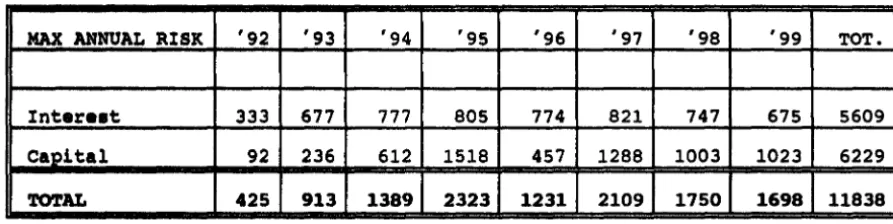
to say that the maximum risk to the budget on an annual basis is rather different, insofar as the Community guarantee would generally only be called upon to cover repayments that ware not paid as they fell due. The following table represents the commission's estimate of maximum annual risk over the rest of the decade (on the basis of loans already agreed or proposed).
Bstimated maximum annual risk on lending to non-~r countriea1
MAX ANNUAL RISK '92 '93 '94 '95 '96 '97 '98 '99 TOT.
Interest 333 677 777 805 774 821 747 675 5609
Capital 92 236 612 1518 457 1288 1003 1023 6229
TOTAL 425 913 1389 2323 1231 2109 1750 1698 11838
It can be seen from the table that the Community will have to lend a great deal of new money to build up a guarantee fund appropriate to these figures. Covering a modest 10\ of the 1993 potential liability for example would, on current proposals, require ECU 652 million of new lending in a short space of time.
dl The event of default
The Commission proposes the reconstitution of a depleted guarantee fund (between 50-75\) with an increase in the rate of contribution to the fund from the reserve to 15\. If less than SO\ of the target amount remains, "measures to restore the fund" are promised. Again, one has to entertain doubts as to whether the fund will be constituted and/or re-constituted quickly enough effectively to play its guarantee role. The rapporteur therefore proposes an amendment which will introduce the possibility of greater flexibility in the reconstitution rate, allowing it to be set at a level appropriate to the real needs of the moment.
3.
mm
OP CQMMUNITY GUAitANTBBThe Commission proposal makes no reference to the level of guarantee to be offered by the Community budget by the EIB. The rapporteur however believes that the moment is appropriate to reconsider the practice of always offering
lOO\ cover. There is clearly a certain variation in the level of risk assumed
by the Bank, and the Community guarantee should reflect this. Moreover, the Bank would be constrained to take a greater interest in the quality of its landing to non-member countries and the nature of the projects financed if it bore a proportion of the risk itself. This could only have a beneficial effect on the control of lending operations outside the Community and would spread the financial risk in a way more closely reflecting the competences of Community institutions. This proposal is consistent with the EIB'a new politically engaged role in the affairs of the Community - particularly with regard to Central and Eastern Europe, and would place the EIB on a par with other international institutions providing politically motivated credit. Equally, it should not be forgotten that the EIB will continue to enjoy the benefit of full
1 Sourcea Guarantees covered by the general budget - 30.6.92" SEC(92)2047 "
[image:29.605.93.540.164.276.2]state guarantees from beneficiary countries, guarantees moreover which, in the case of central and Eastern Europe, are being to be strengthened by the progress which has resulted from macro-economic stabilisation plans.
The rapporteur has therefore tabled an amendment which, as it were, establishes this principle in the Commission's proposal, naturally without at this stage taking a rigid position on how the system might operate. This latter point would clearly be the subject of detailed discussion at a later point.
4. PJ\RLIMilft'ARY C:OI!TROL
Leaving aside the details of the proposal, the new guarantee fund and reserve do answer many of Parliament's reservations about the lack of cover for budgetary guarantees. They do not however resolve the problem of Parliament's input into the decision making process. As at present, Parliament will presumably continue to be consulted on the granting of a budgetary guarantee only when presented with what is effectively a "fait accompli". As such, the only influence it can have over the granting of a loan is its rather draconian negative power to block the corresponding guarantee. As a matter of principle, budgetary authority (as guarantor, and as custodian of taxpayers' rights) should have the right of control over the natura of the underlying liability, namely eo-decision on the granting of loans in the first place.
This proposal is therefore a step in the right direction, but cannot be allowed to be seen to answer all Parliament's rightful demands.
5. OOICLU§IOl!S
To summarises
The Committee on Budgetary Control should welcome the establishment of the guarantee fund and reserve with the following reservations:
A target size for the Fund of 10\ comparisons with the practice institutions is probably too low. a view on this point.
of outstanding capital, if based on of other international financial The Court of Auditors should express
The rata of constitution of the fund, at 14\ of new loans starting from zero, is too slow. Given what is already outstanding, lending would have to increase by 250\ to achieve the 10\ target, and, with the constraints imposed by the size of the guarantee reserve, this could take wall over five years. An initial one-off payment into the fund would improve matters by ensuring soma cover in the riskiest period.
The rata of reconstitution of the fund in case of default is also too slow and should be adjusted upwards according to the perceived needs of the moment, especially as default by one borrower might well be a signal of further defaults on the way.
6. RBCQHMIHDATIONS
The Budgets Committee should make clear in its report that the Commission's proposal does not resolve all Parliament's difficulties with system of Community landings, particularly as regards Parliament's right of eo-decision on the loans themselves.
It should furthermore address the question of the size of the guarantee reserve in the budget, which does not strictly fall under the proposal under examination. Parliament should insist on the reserve being of a size commensurate with the demands likely to be made on it, and the amount of new lending the Community may wish to undertake.
Additionally, the Committee on Budgetary Control calls on the Committee on Budgets, as the Committee responsible, to incorporate the following amendments in its report:
(Amendment No. 1)
Article 1, first paragraph
A Guarantee Fund, hereinafter referred to as "the Fund", shall be established, the purpose of which shall be to repay the Community's creditors direct in the event of default by the beneficiary of a lending operation guaranteed by the general budget.
A Guarantee Fund, hereinafter referred to as "the Fund", shall be established, the purpose of which shall be to repay the proportion of outstanding amounts covered by the Community guarantee to the Community's creditors direct in the event of default by the beneficiary of a lending operation guaranteed by the general budget.
(Amendment No. 2)
Article 2, new first indent
DOC_EN\RR\237\237796 31
-an initial one-off payment from the European Investment Bank egual to one third of th, target amount of the Guarantee Fund, to be additional to the initial endowment of the Guarantee Reserve.
(Amendment No. 3) Article 3, second paragraph
The target amount shall be 10\ of the Community's outstanding liabilities in principal arising from loans and
loan guarantees granted by the
community.
The target amount shall be
established by the budgetary
authority after consultation with the
Court of Auditors and shall be
subject to periodic review; it shall not, in any case, amount to less than 10% of the Community's outstanding liabilities in principal arising from loans and loan guarantees granted.by the Community.
(Amendment No. 5) Article 4, second indent
shall be reduced to 10\ when the target amount is reached.
shall be reduced to a level
appropriate to stabilise and
maintain the target amount once
it is reached.
(Amendment No. 6) Article 5, second paragraph
If a guarantee is activated before the Fund reaches its target amount and the resources in the Fund fall below 75\ of the target amount as a
result, the rate of provisioning
shall be raised to 15\ until the amount drawn has been fully restored.
If a guarantee is activated before the Fund reaches its target amount and the resources in the Fund fall below 75\ of the target amount as a
result, the rate of provisioning
shall be raised to an appropriate higher rate until the amount drawn has been fully restored.
(Amendment No. 7) New Article Sa
DOC_EN\RR\237\237796
Ahe budgetary authority sh~ll
establish guidelines for the
proportion of the risk on lending to non-member mountries to be covered by the Community guarantee.