RIT Scholar Works
Theses Thesis/Dissertation Collections
10-15-2010
Tinker
Jay GrahamFollow this and additional works at:http://scholarworks.rit.edu/theses
This Thesis is brought to you for free and open access by the Thesis/Dissertation Collections at RIT Scholar Works. It has been accepted for inclusion in Theses by an authorized administrator of RIT Scholar Works. For more information, please [email protected].
Recommended Citation
Rochester Institute of Technology
A Thesis Submitted to the Faculty of
The College of Imaging Arts and Sciences
In Candidacy for the Degree of
Master of Fine Arts
TINKER
by Jay Graham
Final Approvals
Chief Advisor:
Leonard Urso
Associate Advisor:
Juan Carlos Caballero-Perez
Associate Advisor:
Alex Miokovic
Chairperson:
Don Arday
March 11, 2011
I, Jay Graham, hereby grant permission to the Wallace Memorial Library of RIT to reproduce my thesis in whole or in part. Any reproduction will not be for commercial use or profit.
Jay Graham Tinker
Abstract:
Recently I have become interested in the idea of aporia, or more specifically the state of
puzzlement that occurs when presented with a seemingly unsolvable philosophical quandary. The more I looked for a solution in one way or another, I kept finding that the problems were really entangled
together in such a way that they were unable to be teased apart. Under intense scrutiny, objects or ideas embodying traditional binary thought systems could exist as opposites simultaneously, shifting as one’s perspective changes, yet their duality was unresolved. It seemed contradictory for the object to exist as both opposites at once. The only certain thing was that I couldn’t be certain. It seemed that our knowledge had grown large enough that it illuminated the clear void which surrounds and pervades all knowledge. In other words, the more we know, the more we know we don't know. Our knowledge of our lack of knowledge serves as a destructive rather than a constructive intellectual framework, leading to an ironic mode based on expressing a negative. Any attempt to assert an idea or viewpoint in a work of art will provoke a challenge based on the lack of ultimate groundwork, and that void surrounding it. A visual culture which is based on irony, i.e. doing or showing something contrary to an actual position tends to lead to the perpetual exposing of this lack of frame or ground. The combined forces of the void and irony create a very challenging environment for creating artwork. We need to determine strategies for addressing our puzzlement with this fundamental state of being, and find a method for remaining constructive with these issues. It seems that most of the problems stem from our innate desire to tease apart objects and their constituent components, to sort and classify things so we can be sure that we know where it belongs. I have try to make work that exhibits a quality of “both”ness, where they don't clearly have a distinction one way or the other. While this quality can be ontologically troubling, a strategy to understand or explain it is to have the work move in a specific way to encourage manipulation. This manipulation can result in an understanding of the work which serves as an opening into the greater mysteries of the work.
These objects, through their awkward use of movement, certainly are becoming closer to the ideal of a form that is both geometric and organic, again relying on the very simple principle of our mind’s inability to separate movement from a host of other mental processes. In thinking about this mental state, vacillating between conclusions, I have become fascinated with the connection of physical movement and its role as an indicator, or a projection of our mental movements and energies. I want to use this
Most sculpture of a kinetic nature has a component of temporality and the suggestion of a performance.1 These works address this, as I hope the experience of seeing, hearing, feeling these machines doing their work will be more evocative than the visual alone. I believe that these objects will only be able to be fully evaluated as art when they are performing the act they were designed to do. While it may be argued that to be good, art must attempt to transcend space and time, I believe that these works will be inescapable from the ether of temporality. I also believe this will be to their strength as they will be able to speak to our own inescapable bond with this reality. By promoting the sense of temporality and interactivity, work that may seem ordered and straightforward can become rich and complex with layers adding to and subtracting from each other. Through our tendency to
anthropomorphize things which have very little human characteristics, save for movement, these objects will be identifiable with most viewers and perhaps make some people question their position on how much certainty we really have, and will reflect the necessity of examining the absurdity of the metaphysical dilemmas we face.
These recent works are an attempt to communicate my basic understanding of the phenomenology of bodily experience, the way our physical selves interact with objects, specifically art objects. It is commonly held that viewing art should stimulate one’s mind, and with these more interactive works I hope to stimulate the body as well. Hopefully the interaction with these kinetic works will allow the physical action in the pieces become an emotional reaction in the viewers. Recently after making these works I have been reading on the psychology of movement, and how throughout human culture the idea of movement, time, and transitions are all linked within languages, and, one could argue, linked within our minds.
I hesitate to describe any of my work as “interactive” art, because that term is usually used to describe something with set parameters for the viewer’s input, like a website with a mouse and cursor to change visual effects on screen. Of course, on the other extreme, any art can be described as interactive, as a viewer must be influenced by the visual experience in order to gain anything from a work at all. The ideas in these works are best summed by the idea of “Tinker”: Originally from Middle English, this was an itinerant tinsmith, who made a living fixing pots and cooking utensils. Now it usually refers to an untrained person who fixes or modifies tools or machines, but the emphasis is always on learning something by doing, and remaining sensitive to observations, using them to inform a greater understanding of ourselves and our world.
1. Prayer Wheel / Coat Rack
Faced with the realization that I was in the state of knowing what I did not know, I looked for a way to construct something which I was certain I did know, to see if it would lead to a conclusion which would resolve itself, or if it would just lead to more paradoxical problems. To ensure that I was constructing something that I was sure I did know, I decided to work with the natural numbers. (1, 2, 3 . . .) In
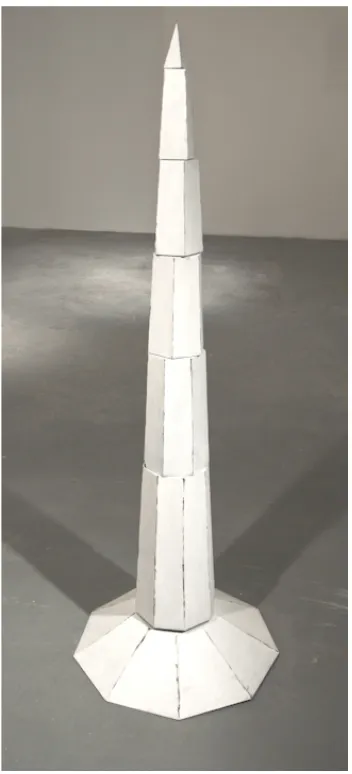
addition to being the foundation of every mathematical idea since antiquity, they are something that every small child is taught and seems familiar with. Using this as a premise, I applied it to the most readily understandable form, one which simply has volume, and the simplest form of non-architectural space, the obelisk. The obelisk serves no spatial function, architectural or otherwise, other than to assert its own existence. This form is connected to the ancient human tendency to create rockpiles or cairns, to create a mark. Many of the shapes in this body of work are phallic, but this is not their primary goal. The shape is not entirely an assertion of masculinity or virility, its existence is mainly an assertion against chaos, against unpredictable destructive forces. This tapered spire shape is important because it suggests constant, analog growth or movement along the central axis, and this axis can be understood as both representing time and space. It is not just our eyes that move along the object, but our minds as well, and this is suggesting the way objects and ideas will change and grow as they move through time. This is to say objects are not fixed in space or time, but constantly moving and interacting. Understanding that things are constantly in flux is the first step to realizing the nature of this space. So, the object has taken form, from just a few decisions which I would like to think are as non-puzzling as possible: An obelisk, with sections, each section having one more side than the previous, a little taller than me so I wouldn’t need a ladder when I was working on the top. Immediately there were problems. Obviously, the first section couldn’t be one-sided. I don’t even know what a one-sided object looks like. Similarly with two sides, even if I flattened a sheet of metal down to paper-thin it would still have that incredibly tiny cross section. All objects that exist have three dimensions, so it was necessary for the top section to be a pyramidal prism. This discovery turned out to be an important one for later work.2 With the original section “solved”, so to speak, the rest of the Prayer Wheel / Coat Rack took shape, volumes of 4, 5, 6, 7, 8 and finally 9 sides, reaching the ground.
1a. Movement
There was another problem with the numbers of sides on the volumes: when I stacked the models for the sections, the edges didn’t line up in any logical fashion. You could match either one edge or one face, but all the other planes would then be mismatched. This was a huge problem. This object was supposed to
be solving a physical quandary, not spawning new ones at every turn. With a little research and insight, a solution presented itself.
I was familiar with the idea of movement from some of my early work.3 Movement is a critical element for much of this work, and will be discussed later at length. It is a powerful way of representing both constant change, yet constant harmony. Any point in a rotation is in the process of becoming
something else, while remaining fixed in the larger cycle. It seemed an obvious choice to have each section of this obelisk freely rotating apart from the others, to allow the differences to remain in harmony with the similarities of all the parts. At this point the title becomes important. A prayer wheel is a type of object used in Buddhist practice to simulate recitation of prayers. In its most common type, spinning this prayer wheel is equivalent to intoning the mantra “Om Mani Padme Hum” which is recognizing the compassion of all things.4 The exact deity and religious meaning of this symbolic act is less important than the idea of a physical action (turning of the wheel) resonating metaphysical meaning (invoking
Avalokiteshvara, embodiment of compassion). I realized that this piece needed physical symbolic motion to represent the need for mental “work” in understanding it. Static artworks have a tendency to be
understood in terms of our bodies’ relationship with it. The idea of ‘work’, meaning, using our body to move an object’s weight, is very well understood. By making this object’s weight balanced, it becomes easy to move, and hopefully this use becomes better understood as a symbolic gesture of the need for metaphysical work in these objects.
I would like to clarify my use of the term “metaphysical” in the previous discussion. I am not a practicing Buddhist, and I do not think my art works are manifestations of the “divine”. I do think that the Buddhist ways of understanding how our personal experiences can relate to something larger than ourselves can be important. On the other hand, I did not create these objects because I thought they simply would look good, or because I was following some rigid conceptualist rule set about what an object should look like. Nor was I trying to create an object which looked like another object, or another
3 These works are machines, named after the fates of Classical Greek figures that were punished in the afterlife, and they constantly struggle against themselves with no end in sight. It is unclear if the machines are being punished or performing penance. Videos of the works are available here:
Graham, Jay. (2006) Sisyphean Machine. [Video] Retrieved October 20, 2010http://www.youtube.com/watch?v=uDyxzlkXFPI
_______ . (2006) Ixion's Machine. [Video] Retrieved October 20, 2010 http://www.youtube.com/watch?v=shKq_Tfsy4g
type of object. The reason these objects look like they do is because when I was making them, I realized some very basic and profound ways which I think about the world around me, and I am hoping that these objects will allow others to think about these ideas and hopefully realize their own truths about the world. Donald Judd said: “I Don’t think there’s anything special about squares, which I don’t use, or cubes. They certainly don’t have any intrinsic meaning or superiority. One thing, though, cubes are a lot easier to make than spheres. The main virtue of geometric shapes is that they aren’t organic, as all art otherwise is. A form that’s neither geometric nor organic would be a great discovery.”5 In making these objects, I realized my goal was not ‘neither’, but rather ‘both’: I do not want to negate these distinctions, but rather allow for them to coexist. Could they exist in our minds as members of two contradictory states?
2. Shift
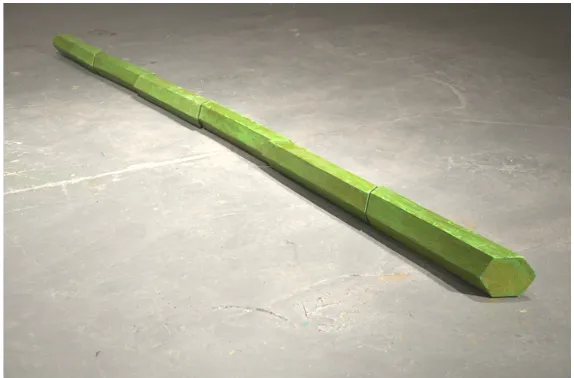
This desire led me into looking for a way to represent something that was both geometric and organic. Another way of thinking about this could be, how could something be a circle and a line at the same time? After dealing with the cross-sections of the Prayer Wheel, I seemed to find a midpoint between the (non-existent) line exiting the top of the spine, and the suggested circle created by the base. This midpoint is represented by a hexagon inscribed in a circle, midway between being a true line and a true arc. Conveniently, the length of an edge of the hexagon is equal to the radius of the circle it is inscribed in, making a close approximation of the length of the circumference to that of the hexagon. All of these things set up opposition with the previous piece. Where the movement in Prayer Wheel only altered the relations of its parts to each other, the movement in Shift drastically changes the entire shape of the piece. Suddenly all these factors come together to make Shift hard to classify. Without a stable base, it is ‘live’ in the sense of a ‘live weight’, it seems to have two ‘fixed’ geometric positions, either extended in a line or closed in a hexagon, but yet it has a multitude of organic, non-fixed positions somewhere in between these two extremes. The question becomes: how can we classify this object? Is it geometric or organic? At what point does it shift from being one to the other? Can it be one and then the other?
My explanation for how to classify such an object would simply be “both”. However, this gets very messy ontologically. It is in our nature to divide up such ideas and compartmentalize them, to assign a value to all like components, so we can make decisions about them much easier, and we can convince ourselves that we truly know what is, and what is not. Unfortunately it is not always so easy. I hoped that by creating some object which resisted most typical classifications, I could highlight the fact that rarely are such classifications cut and dried, and that most attempts are fraught with qualifications,
exceptions, and other vacillations. The state of “both” is not satisfying from an intellectual point of view,
or an emotional one, but it is probably important to realize that easy categorizations of such troubling ideas is not always possible, and there will always be some level of doubt between most dichotomous decisions. This may seem like I am trying for the ‘easy way’ out of some serious philosophical issues which Western philosophers have been struggling with for some time. By declaring that some things can exist as two opposites at once, we have thrown out all of our previous sound judgements, and up is down, yes is no, and reality cannot be classified. Obviously this is not the case, and I am not trying to suggest that determining opposites is somehow impossible. I am suggesting, however, that for any mental determination we make, there will always be some level of doubt, no matter how tiny a sliver it may be, and we must allow for that in our understanding, and second: we must realize that certain determinations
may be unknowable or undecidable. That is to say, there is not some special class of decision which cannot be determined, just that given our abilities as rational, intellectual beings, these determinations fall outside of our scope.6 One day we may be able to develop the ability to deal with such difficult ideas, but as of now, we must accept that our minds have given us the scope to conceive these problems, but not the machinations to resolve them. Usually when these issues are reasoned out, they end up causing further mental anguish, and this certainly was not my aim when creating these objects. Hopefully rather than provoking philosophical quandaries, Shift will represent the idea that some things cannot be stable, and will always be in flux.
3. Untitled (touching) (not touching)
These next two pieces came about in a search for the middle ground between Prayer Wheel and
Shift, in an attempt to further explore the objects that exist between these extremes. The ideas and
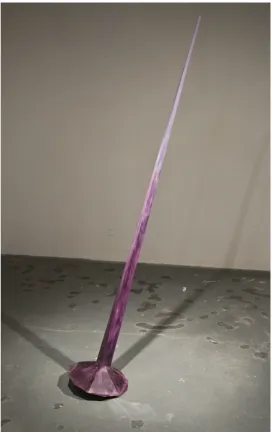
drawings for the two untitled pieces were mostly about an exploration into how the previous pieces could be combined and synthesized, and if an obelisk-type shape could generate the same flux in movement that was created in Shift. After preliminary drawings7, it was apparent that there could be two different ‘types’ of these curving obelisks: ones which the tip could touch the ground(or itself), and ones which couldn’t. Satisfied with this dichotomy in light of my previous ontological quandary, I decided to make both, prompting the inevitable questions: is it one piece? Or two? Does it matter? Ultimately these works came about because I knew which elements of the first pieces could be combined in order to keep the
geometric/organic flux in play, however beyond that I was not entirely sure how these pieces would come together. The making of the objects became an investigation of: If they would work, how they would work, and how they would interact with themselves and the other artworks. Not having these elements fully realized in the conception of the work was a risk, yet this leap of not knowing exactly how they
6 Steven Pinker, How the Mind Works, has an excellent discussion of this phenomenon in the final chapter, under the heading Inquisitive Pursuit of the Inconcievable.
would be resolved ultimately allowed them to develop an “alive”ness which some of the other, more formal, works lacked. I still am not clear as to how I feel about this, certainly they work in the context of the rest of the work, and so far I am content to leave it at that.
3a. Color
These two untitled pieces were the only ones in the group which I started without a definite vision of what color they would ultimately be, so this seems as good a point as any to talk about the role of color in these works. I had originally planned on using an industrial paint finish on these two, either a high-gloss enamel or high-gloss powder coat, for intense color and durability. After some research and tests, however, I found there to be something missing from these finishes. While they are excellent for
durability and protection from handling, they also have the tendency to ‘cover’ the surface thickly, acting as a protective, disguising barrier over the metal. These are excellent properties when finishing industrial machinery, but they had some very specific drawbacks for my purposes. I had no desire to mask the surfaces of my material. While the construction of the objects is planar, I am not interested in presenting flat, featureless facets of a volume and expecting them to do anything. The problem with color is that it has a double purpose: it is simultaneously the nature of the material, and the method which the nature of this object is projected to us. When coloring an object with an industrial finish, especially one which is flattening, this first component is often lost, as the material itself is sheathed in color. Essentially the object loses its materiality, which becomes defined by its use, or weight, or volume, or some other essence, and the visual component becomes simply decoration, something to acknowledge and dismiss because it is easily understood. Consider this writing about Yves Klein’s Work:
Colour After Klein
Chroma leads a double narrative: on one hand, it is bestowed the task of working through the objectivity of its own material to reveal a space and a sensation of transcendence. For the viewer, who responds to chroma’s affective power, this means striving to get beyond carnal boundaries of his/her body to become pure energy. On the other hand, chroma is also the medium through which the sensibility is to be internalized, within the carnal architecture of the body the viewer is to be transformed into an ambulatory spatial receptacle for the intensive universe of sensibility.8
I was looking for a way for both of these roles of color to resonate within the work, and allow for both the color as essence and as energy to be understood by the viewer. I briefly considered building oil paints upon the surface, as there is historical precedence9, but I soon realized the same issues as with an
industrial finish, simply substituting a hand-formed finish for one which was flat. Finally, I discovered a compromise: Gilder’s Paste, a beeswax-based pigment that is designed to cover extremely thin, but with a
8 Architectures of the Intensive Body, Frederic Migayrou. Yves Klein: Retrospective Frankfurt Schirn Kunsthalle, 2004. 9 See the Phoenix Museum’s Catalog Copper as Canvas: Two Centuries of Masterpiece Paintings on Copper, 1575-1775
very saturated pigment. It is made primarily for mimicking the appearance of a gilded surface, but for my purposes it is excellent at demonstrating the various anomalies of the flat surfaces, and it can also be built up to develop the surface on its own. Thus, I was able to develop a hand-worked surface which maintained the character of the material underneath.
This certainly satisfies the technical side of this discussion, but there is still the larger question which was hinted to previously but not fully addressed: why, exactly, do these objects need a color applied to them as opposed to leaving them their natural color, and where would these colors come from, i.e. what would they be? Many metalsmiths simply employ the natural patinas of the metals they work with, which are usually resilient and quite striking, and they do not have the effect of covering the metal but rather they enhance the depth of surface. Unfortunately, using patinas as finish has the effect of relying on chemical reactions to develop your colors, which are usually ‘hands-off’, meaning they require timing and strength of solutions for the differing finishes. Industrial paints and finishes, while more predictable, usually make customization difficult, and any anomaly on the surface will either be destroyed, or highlighted as a defect. Neither of these solutions was optimal for my objects as hand-made, orderly objects. For the actual colors themselves, a few choices were apparent: black and white were obvious choices, because of how well they demonstrate this duality of ideas, but an entire body of work in just black and white would be pretty visually uninteresting. For the rest of the colors, I began ‘curating’ colors I found in my daily life, saving them whenever I discovered something which struck me as particularly visually interesting or generating positive energy. It is rather hard to defend my choices of colors, as they all were independent of each other, and my methodology for finding colors I was excited by was really no different than spinning a color wheel at random. However, color is such an important part of our visual lives and yet most people pay very little attention to it, so my choices were deliberate in trying to highlight the affective power of color, along with its value as energy. I will address this further later in this work, but color’s role cannot be accurately described in any other way. For example,
consider Sol Lewitt’s Wall drawing 38110. To present the title is to describe the work, but no amount of description can compare to the non-verbal power of being presented with this work. To see the color fields is not just to absorb the color energies, by standing next to the fields your body and clothes will absorb and reflect them. It is impossible to understand them as an image, because they exist as an object, albeit a two-dimensional object. Similarly, the color fields formed on each of the planar pieces of the work function in this way, showing the depth in energy that forces a viewer to engage the object, to reflect on it and to be reflected by it.
10 “Wall Drawing 381”A square divided horizontally and vertically into four equal parts, one gray, one yellow, one red and one blue, drawn with color and India ink washes. December 1982, India ink wash and color ink wash.
4. Switch
While I was developing these previously discussed works, I became aware of a tendency in my thinking about them to believe I had finally ‘discovered’ or worked out what they were about, and what they meant, only to have my thoughts completely reversed some time later. This is precisely the aporia
that prompted this investigation in the first place. This became a troubling pattern, where I would
acknowledge my mental shortcomings to allow greater insight, only to find that this revelation really was only revealing more problems. This vacillation between conclusions became a powerful and important idea, and I immediately began thinking of ways it could be realized with the forms I had created.
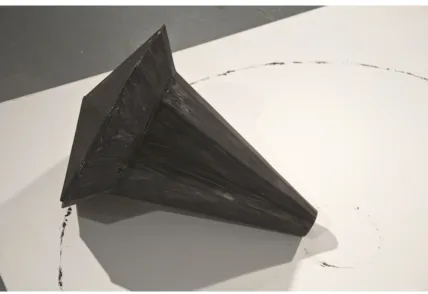
Originally I had planned two more obelisks, one which could rock about freely, but never point straight up, and a second (sadly, unbuilt) which would always remain plumb while the base would remain unbalanced and move freely. What I was looking for was the appearance of solidity and stability, but with an unsettling tendency to change orientations quickly, and even violently. Switch borrowed a discovery from part 1, that of the elongated, three-sided pyramid as a primary form, being a
3-dimensional surrogate for the line, while demonstrating movement through space as a gradual change. This form became intensely valuable, for both its simplicity and its ability to demonstrate a wide range of movements and ideas, as I will discuss further. The importance of this shape in Switch is its ability to challenge the viewer’s physical space by aggressively moving with only a small change in the base. At this point, the titles have come to reveal facets of the work. It is not coincidental that the works
themselves are comprised of facets. Switch not only refers to the object’s tendency to change quickly from one orientation to another, but is also a word for a thin stick for striking. In this case the physical presence of the spire takes the idea of the mental uncertainty discussed earlier and thrusts it into
immediacy. In putting this object’s physical movement in such a way that it comes into conflict with our own I am hoping to suggest that their reality and movement are somehow fixed and in flux together, in similar ways our realities are fixed and in flux with our movements, both physical and mental.
5. Aspect
The revelation of mental and physical movement conflated in Switch was very important for continuing this exploration into this mode of experience. However, I became worried that the movement could be too intimidating, either in apprehension in interacting with something visually unstable, or the violence of the movement itself. The next piece, then, would have to retain similar themes of physical and mental changes while being slightly less aggressive. Additionally, the previous pieces usually had some motion involved around a fixed point, resulting in the shape
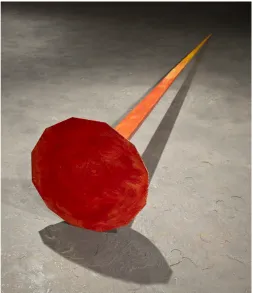
of the ‘arm’ is many times the diameter of the circle on the side, I realized the object’s profile would change drastically based on the viewer rotating around the object at an even greater arc. I found that this change worked very gradually, based on the distance one would have to sweep around the object to switch from the two extreme views: perpendicular to the length of the object, the view would be of a long, needle-like shape, and as one moves around it, the needle becomes more and more
foreshortened until the only view is of the round, flat end, seemingly floating in space. This was very important for taking a quick and violent change like we saw in Switch and making it gradual, yet the visual change is still profound. When I was thinking about making such a shape, I was very excited about the idea of such a simple form, very easy to ‘know’ it11, yet having such drastically different views from different angles. It was really almost so simple it was bordering on tautology: To change your perspective, change where you are coming from. Before this piece was built, I was sure that this simplicity was the value of the piece, and it would provide some visual pleasure even without this simplistic reduction. However, after painting the piece, I was struck by how this shape and color seemed to defy all of the logic of the space around it. If I were to say, “Imagine a red circle 20 inches in diameter resting on the floor,” most people could do it, and they would probably have a reasonable simulacrum of the shape in their minds. The reality of this bright, floating orb, however, is something which defies our ability to internalize it. This revealed another aspect of the aporia which was the genesis for all the work: as much as we can ‘know’ something, to hold in our minds, there is a profound disconnect from that knowledge to our perception, and, one would reason from there, from our perception to reality.
6. Winding
At this point in the body of work, many different ideas and directions were developing mostly simultaneously, and so I will discuss them in an order which follows thematically rather than
chronologically. The works at this point begin to branch out and investigate issues of architectural space and the intersection with bodily space, and how this relationship affects our ability to perceive these objects. Winding is based of the elongated pyramidal form used in the previous pieces with a spiral incorporated along the length of the object. Both Aspect and Switch use this form combined with a
bulbous terminus to elevate their form from the ground, but they also create a unidirectional feeling which is visually interesting but not what the work is really about. By combining two of these identical
elongated pyramidal forms and twisting one, the piece can gradually grow and shrink along the length while also dividing the space in a roughly 45 degree angle. Thematically, by including this division which
splits the architectural plane of plumb (90°) walls and floors, I was hoping to create a bridge between the vertical protruding works and the works that lie flat or near to the floor. This division will be an
important development in the next work. The spiral form is especially relevant because of its ability to represent both a fixed mathematic movement, and an organic growth from its original point. The growth is mathematic in that the size of the turn of the spiral represents a percentage of the distance from the origin of the spiral, and yet the length of the spiral is fluid, it can be pushed or pulled to change the amount of negative space in the spiral body. By creating a work which references and interacts both with the geometric and architectural framework and the organic qualities of growth and line, I am hoping to develop a sense of formal interaction with the other pieces in this body, while still retaining the
‘aliveness’ characteristic in the other pieces. Despite the fact that this piece is ‘static’, that is, it does not contain moving elements/move easily itself, the internal motion of the spiral combined with the shift in negative space as the viewer moves gives this piece a dynamism connecting it with other more kinetic works.
7. Squareamid
While most of the works in this body have in some sense dealt with the geometric/architectural space surrounding and framing the works, I had specifically avoided referencing the square or the cube in their construction. That shape tends to be self-contained and generally is good at referring to
compartmentalizing and division, and I am more interested in the ways these works can refer to many different things, most importantly the ways they can interact with our minds and our bodies. The forms in the Squaramids were developed early in the paper modeling stage for the moveable works, and originally they were just an exploration into ways a cube could be modified for rotational movement. The typical way of dividing a cube is to put a “+” into each face, resulting in 8 smaller cubes, identical to the first. It is this infinite reproducibility that makes the cube such a compelling art form, and the cube’s ability to represent the general is very powerful.12 Originally, my explorations into the cubic form were looking for a way to divide the cube to provide a rotational axis which would create a complex shape, but return the form to the cube at a fixed interval. In doing so, I realized that each corner of the cube could be separated at a 45° angle, separating each cube into 4 equal parts, or if opposite corners were removed, the
corresponding shape would nest indefinitely with each of the corners, allowing this shape to be repeated infinitely. After experimenting with these shapes, I discovered not only were they reducible, meaning the
part can represent the whole and vice-versa, but they had many different permutations and combinations in the ways they could be arranged. The power of shapes that could be created from a simple division of a cube was quite remarkable. Originally this exploration was to discover some shape from this division which could create a moveable object like some of the previous works. However, after seeing the huge number of combinations that these simple shapes created, I realized that the only solution was to create many of the objects and let the combinations be left up to the viewer. The motivation for this had several distinct components. First, In creating objects which were self-specific, meaning they referred to
themselves as parts of the whole, and allowing them to freely move and recombine with others, I was looking for a way to signal that there possibly was some internal order which could be discovered through use and manipulation. However, without a specific form or model, combinations could arise but there is no hierarchy to any of the ways they could be ordered, so any search for “meaning” in the pieces will last only as long as their current configuration. Next, with the lack of hierarchies in ordered and disordered arrangements, I was purposely suggesting that these two seemingly opposite ideas could in fact function harmoniously. Finally, By creating objects to represent parts of their own whole, I was interested in creating a type of recursion where these objects could be manipulated and understood as relating to themselves, but they could never fully represent their completed selves; i.e. there will always be another layer to add or division to make. What makes this idea powerful for me is that this level of
understanding, the physical manipulation of objects, is so fundamental for our understanding of all other concepts, but through this interaction, we find that it can never totally reveal itself. In doing so, what is really revealed is how little we can actually know, and how our investigation, for all its efforts, is revealing our state of not knowing.
8. Separate & Combine
These two pieces, Separate and Combine, are the culmination of themes and ideas found
throughout the previous works, and as such I find it easiest to talk about them simultaneously. While they have two different titles, they really are about the same thing, and so the necessity of discussing them as one singular or two related pieces becomes difficult. The two titles are representative of the idea that there are really only two things: to separate something into its various parts, and to combine parts into a formed whole. This is true both in the material world, where most art operates, and in the metaphysical world of ideas. This distinction is almost too general, even tautological, to be of any help understanding the complex and dynamic systems we navigate, and yet once this process is revealed, it is almost
our ideas. This level of recursion for such a simple idea can be staggering13, although it is very good at illustrating the void which surrounds our system of knowledge. With this understanding, it is not surprising that these works focus on the form of the circle, which has long been the symbol of the null, and the void. Originally these works developed by creating an object which would roll, and the sides of its edges would lay down, creating a drawing which would approximate a circle. This circle would be both the record of the movement, and yet also the representation of the void surrounding it. At the same time, I was interested with the idea of taking a circle, and separating it into many pieces, so the piece loses its circular nature and instead becomes all of its constituent parts. The motivations for these actions are related, and reciprocal: to combine many things into this large symbol, and to take the symbol and divide it into many pieces so that these actions are understood as similar parts of the same idea. In this case, the circle exists as a neutral site for the execution of measuring and marking, which are just physical manifestations of the separation and combination. Measuring and marking are valuable, and are probably the most fundamental kinds of artistic expression, but by using them in this way I am exposing the
inherent weaknesses of this mode. They are both used to develop the same shape, and while one method is very time-consuming, the other happens within an instant. The end result is very similar, one with an emphasis on pointing outwards, the other pointing in.
At this point I would like to explain the motivation for laying square frames directly on the floor, while typically works of this shape (rectangular) and flatness would be affixed to the wall. Indeed, these works were the only ones in this group which did not have a fully developed sense of 3-dimensionality, and were the only ones which had anything like a ‘frame’ around them, delineating what exactly was contained in their ‘art’-ness and what was separated out. There was a conscious decision in this group of works to limit the use of the flat picture-plane, and have most works be fully developed in the round. The problem that arises is culturally we have been bombarded with the idea that something inside this framework represents reality, and more importantly with the popularization of the photography, that what happens in this frame isa version of reality. For people born in the 20th century, navigating this dizzying world of screens and representation is second nature, and we are quickly becoming adept at realizing our role in absorbing this media, and we are media-savvy in exactly the sort of way that the media expects us to be.14 Starting with the Realists, we begin to see the acknowledgement that there is some trickery, or to
13 It can be tempting to ‘break free’ of this self-referential cycle of ideas by attempting to organize them on a higher level of discourse, essentially creating a ‘meta-language’ to manipulate these ideas without involving in infinite recursion. Unfortu-nately, this is not a fruitful method of inquiry, as any sufficiently complicated logic system will be vulnerable at its highest lev-el of meta-discourse. For a more in-depth discussion of this phenomenon, please see chapter IX in Gödel, Escher, Bach by Douglas Hofstadter, Basic Books Inc, New York, NY 1979.
be less negative, some implied breach of reality between ourselves and the picture plane. Once the general audience begins to realize ‘this is not a pipe’ as the Magritte painting goes, the image makers (not just in the sense of artists, but photographers, filmmakers, television producers, etc.) in turn reveal that they are not earnestly suggesting any of this actually represents reality. Images are freely offered and consumed,15 with both parties aware of their ironic usage, where the truths are revealed not to be true. This works wonderfully, the image-maker gets to show his image (or rather, what is not the image), the viewer feels sophisticated in his knowledge that this image is not actually reality, and that he is getting “behind the scenes” of the image, so to speak. This seems ok, but the problem is that once we start down this path, there is no going back. Any refusal to acknowledge this issue of the picture-plane comes off as amateurish or bumpkin-ish, and going beyond this state by using meta-irony or meta-meta-irony is to simply dissolve into infinite self-reference. Unfortunately, this ironic mode means that true meaning of an artistic point of view is lost in the endless shuffle of self-reference and avoidance of a position. For example, the British artist Damien Hirst capitalized on these cyclical ironic modes, as they initially seemed very slick, and allowed many critics and viewers to feel as though they were “in on the joke”. Unfortunately, as years have gone on, it appears that there never was a joke in the first place. Hirst’s recent show “The End Of An Era” has been met with sluggish reviews, mostly because the reviewers are seeing through the self-reference and showmanship to the lack of coherent message.16 This use of irony is seductive, but it can realistically only end in destruction.
Rather than avoid this problem altogether(not much of a solution as this problem certainly isn’t going anywhere), my choice has been to place my picture-planes flat on the ground. This is not a perfect solution, as it still addresses the rectangular planar form, and has to operate in that visual mode, but it does do two things lying flat that break some of this “window to reality” spell. As a flat object on the floor, it is clear that this apparent 2-D object has depth, or in this case, height, and as such must be accepted in our minds as having this third dimension, however sleight. The second and more important function on laying this rectangular work on the floor is that it breaks the convention of hanging a picture frame (or TV screen) at eye level and perpendicular to the viewer. This convention is chosen to allow the eye to render all four sides of the frame equally, so the image contained within is not distorted, and the frame’s corners remain square. On the floor, one is basically forced to experience this rectangular plane with some level of visual distortion, unless there is some sort of fancy balancing involved, which I think would serve the same purpose. The goal of forcing this distortion is to break the assumptions about the
15 “A man who concentrates before a work of art is absorbed by it. . . In Contrast, the distracted mass absorbs the work of art.” Walter Benjamin, Art in the Age of Mechanical Reproduction, section XV, reprinted in The Continental Aestheics Reader, Routledge, NY 2000, pg 335.
picture plane we take for granted, and change how we approach the image-object. The idea is not for some visual trickery, after all, the work is composed of some very basic mathematical concepts: circle, square, and the divisions between them. The point is for these deep concepts to be understood through our own bodily experiences of moving around them and seeing, rather than relying on cultural or visual shorthand which clouds the field of observational experience.
This body of work developed out of a metaphysical quandary, mainly my troubles with
reconciling my state of puzzlement about certain problems and their apparent lack of solutions with more concrete and self-sustaining logical systems. At first glance it seems that as long as we begin with reasonable propositions, and apply our logical rules judiciously, we should arrive at all the necessary conclusions for anything and everything, but with any observation this is quickly revealed not to be the case. Many of our well-reasoned ideas turn out to be contradictory, or absurd, or they conflict with what our eye and spirit would have us believe. With an open mind and a little mental acrobatics, it is possible to let this instability wash over all our thoughts, and suddenly all our observations and classifications become suspect. This is constantly a problem for some Western philosophers: A belief that there will be a resolution, if we could only think a little clearer, or through intense mental effort, all of these layers of ideas will fall into place, revealing the mysteries of the universe. So far I don't think anyone has gotten there. Still, the problem remains: most of these intellectual dilemmas are quite dense and tangled, and all of the information available seemed to merely illuminate how difficult and confusing they are. It is really a sort of frustrating spot to be in, but it also allows for many wonderful opportunities. When faced with this situation, I decided there was really only one course of action: using my meager skills and abilities as an artist to create something illustrating this phenomenon, and hope that somehow through clumsily groping at it, shed a little light on it. This turned out to work remarkably well, although not in the way I had planned.
observing ways in which this practice can inform new ideas or premises, or create new problems. The benefits of working this way are numerous, because it allows great flexibility in moving forward with a work or finding new connections. The exciting thing about working this way is how it is also beneficial for the observational and experiential aspects of a work. By concentrating on how one approaches a work and avoiding thoughts about the external concepts or frameworks, one can focus on how to create objects which are more stimulating or pleasing from presence alone. This method is not a one-way pathway from artist—object—viewer. Instead, it sets up a situation where the object and viewer share an experiential dialogue, allowing them both to develop complex interactions. Works which are ambiguous from a techno-functional standpoint serve to stimulate this reciprocal experience, and hopefully give us some insight into the ways we know and the ways we know what we don’t know.
Illustrations:
Figure 1 Prayer Wheel / Coat Rack
Figure 3. Untitled (touching) (not touching)
[image:22.612.118.419.384.638.2]Figure 9. Separate
[image:27.612.59.487.386.680.2]Works Cited:
Benjamin, Walter. "Art in the Age of Mechanical Reproduction." The Continental Aesthetics Reader. London: Routledge, 2000. 335. Print.
"The End of an Era." The New Yorker 1 Mar. 2010. Print.
Arthur Ganson presents a few Machines created between 1978 and 2004. DVD. Arthur Ganson, 2004.
Graham, Jay. (2006) Sisyphean Machine. [Video] Retrieved October 20, 2010
http://www.youtube.com/watch?v=uDyxzlkXFPI
---. (2006) Ixion's Machine. [Video] Retrieved October 20, 2010
http://www.youtube.com/watch?v=shKq_Tfsy4g
Hofstadter, Douglas R. "Chapter IX." Gödel, Escher, Bach: an Eternal Golden Braid. New York: Vintage, 1980. 246-72. Print.
Khyentse, Dilgo, and Patrul Rinpoche. The Heart Treasure of the Enlightened Ones: the Practice of View, Meditation, and Action: a Discourse Virtuous in the Beginning, Middle, and the End. Boston: Shambhala Publications, 1992. Print.
Komanecky, Michael K. Copper as Canvas. Phoenix: Phoenix Art Museum, 1999. Print.
Lippard, Lucy. "Homage to the Square." Art in America July 1967. Print.
LeWitt, Sol. "Paragraphs on Conceptual Art." Artforum June 1967. Print.
---. "Wall Drawing 381." LeWitt Collection, Chester, Connecticut. On View Mass MOCA, North Adams, MA until 2033
Migayrou, Frederic. “Architectures of the Intensive Body.” Yves Klein: Retrospective Frankfurt. Schirn Kunsthalle, 2004. Print.
Morris, Robert. "Notes on Sculpture: Part 1." Continuous Project Altered Daily: the Writings of Robert Morris. Cambridge, Mass.: MIT, 1993. Print.
Pinker, Steven. "Inquisitive Pursuit of the Inconcievable." How the Mind Works. New York: W.W. Norton, 1999. 554-56. Print.