
S H O R T R E P O R T
Open Access
Selection and validation of reference genes for
gene expression analysis in apomictic and sexual
Cenchrus ciliaris
Bindu Simon
1,2, Joann A Conner
1*and Peggy Ozias-Akins
1Abstract
Background:Apomixis is a naturally occurring asexual mode of seed reproduction resulting in offspring genetically identical to the maternal plant. Identifying differential gene expression patterns between apomictic and sexual plants is valuable to help deconstruct the trait. Quantitative RT-PCR (qRT-PCR) is a popular method for analyzing gene expression. Normalizing gene expression data using proper reference genes which show stable expression under investigated conditions is critical in qRT-PCR analysis. We used qRT-PCR to validate expression and stability of six potential reference genes (EF1alpha, EIF4A, UBCE, GAPDH, ACT2 and TUBA) in vegetative and reproductive tissues of B-2S and B-12-9 accessions ofC. ciliaris.
Findings:Among tissue types evaluated, EF1alpha showed the highest level of expression while TUBA showed the lowest. When all tissue types were evaluated and compared between genotypes, EIF4A was the most stable reference gene. Gene expression stability for specific ovary stages of B-2S and B-12-9 was also determined. Except for TUBA, all other tested reference genes could be used for any stage-specific ovary tissue normalization, irrespective of the mode of reproduction.
Conclusion:Our gene expression stability assay using six reference genes, in sexual and apomictic accessions ofC. ciliaris, suggests that EIF4A is the most stable gene across all tissue types analyzed. All other tested reference genes, with the exception of TUBA, could be used for gene expression comparison studies between sexual and apomictic ovaries over multiple developmental stages. This reference gene validation data inC. ciliariswill serve as an important base for future apomixis-related transcriptome data validation.
Keywords:Apomixis, Apospory, Reference genes, qRT-PCR, Buffelgrass,Cenchrus ciliaris
Background
Sexual and asexual modes of reproduction occur in flowering plants. The sexual reproduction pathway is highly regulated and results in the production of seedvia fusion of male and female gametes. Apomixis is a natural form of asexual reproduction through seeds. There are two basic forms of apomixis, sporophytic and gameto-phytic. Sporophytic apomixis (or adventitious embryony) results in embryos that develop directly from non-generative cells of the ovule. Gametophytic apomixis in-volves three steps: formation of a meiotically unreduced egg cell (apomeiosis), parthenogenetic development of this
egg cell without fertilization, and formation of functional endosperm with (pseudogamy) or without (autonomous) fertilization of the central cell of the ovule [1,2]. Apo-meiosis in gametophytic apomixis consists of two forms: apospory and diplospory. In apospory, the embryo sacs de-velop from nucellar cells, while in diplospory the gene-rative cell undergoes mitosis to form an embryo sac. In both apospory and diplospory, a chromosomally un-reduced cell gives rise to the megagametophyte, in which the unreduced egg cell parthenogenetically develops into an embryo that is genetically identical to the maternal plant [1,2]. Hence the successful introgression of apomixis into crop plants would greatly facilitate maintenance of hybrid vigor over successive generations and also re-duce costs associated with hybrid seed production [3]. Apomixis is a common mode of asexual reproduction in
* Correspondence:[email protected] 1
Department of Horticulture, The University of Georgia Tifton Campus, Tifton, GA 31793, USA
Full list of author information is available at the end of the article
numerous families but is most frequent in the eudicot fam-ilies Rosaceae and Asteraceae and in the monocot family Poaceae [4,5]. The most common hypothesis behind apo-mictic reproduction is that it is evolved from the sexual pathway, possibly by deregulation in the timing of expres-sion of sexual reproductive genes [6]. The global regulatory effects of polyploidy and hybridity have also been proposed to be the possible triggers for conversion of sexual to apo-mictic forms of reproduction [1,7]. Genetic data from sev-eral species now indicate that at least two genes, one for apomeiosis and one for parthenogenesis [2], are required for apomixis, although lack of recombination in some spe-cies manifests as monogenic inheritance of the trait.
Cenchrus ciliaris(buffelgrass, syn.Pennisetum ciliare) is found in tropical and southern Africa, the Mediterranean region, India and Pakistan. Most accessions ofC. ciliaris are tetraploid with 2n = 4 × = 36 [8]. Apospory in buf-felgrass is conferred by an apospory-specific genomic region (ASGR) that is hemizygous in nature and recalci-trant for recombination [9-14]. C. ciliaris displays the 4-nucleatePanicum-type aposporous embryo sac pheno-type [15,16]. A sexual genopheno-type discovered in C. ciliaris was crossed as the female parent to apomictic genotypes producing progeny in three phenotypic classes, obligate sexual, obligate apomictic and facultative apomicts [14,17,18]. Regions of the ASGR in C. ciliaris have been studiedviapartial sequencing of ASGR-linked BAC (Bac-terial Artificial Chromosome) clones, leading to the identi-fication of various genes with putative transcription factor or signaling-related functions [19].
Differential gene expression studies between sexual and apomictic plants enables comparison between apo-mictic and sexual pathways. In Boechera, advances in cell isolation methods, along with next generation se-quencing technology, have allowed global comparisons of gene expression patterns between sexual and apo-mictic reproductive tissues [20-22]. Quantitative real-time, reverse-transcriptase PCR (qRT-PCR) is one of the most extensively used methods to analyze and validate transcript expression profiles among different species, treatments or developmental stages due to its high sensi-tivity, specificity and broad quantification range [20,23]. However accurate normalization steps should be fol-lowed to obtain reliable quantification of gene expres-sion levelsvia qRT-PCR. The purpose of normalization is to correct any non-biological variability during the experimental procedure [24,25]. Among the various normalization approaches, the use of internal controls or reference genes has become the method of choice [26,27]. The success of using reference genes for proper normalization in qRT-PCR is highly dependent on the choice of the appropriate reference gene: its expression should be relatively constant across tissues and should not be significantly altered by the experimental conditions
[28,29]. Since reference genes often are housekeeping genes required for cellular survival, it is assumed that they are stably expressed across all tissues and/or treat-ments which often is not the case [24,30]. Different statistical software like GeNorm [31] and NormFinder [32] are available to test expression stability of reference genes. The most commonly used reference genes for various qRT-PCR analyses are actin, glyceraldehyde-3-phosphate dehydrogenase, ribosomal genes, cyclophilin, elongation factor 1 alpha, adenine phosphoribosyl trans-ferase and tubulin [33-38].
With respect to testing reference genes for apomictic gene expression analysis, two plants, Boechera and Brachiaria brizantha, have been used to validate refer-ence genes in their respective apomictic and sexual ac-cessions in different tissues and developmental stages [20,39]. In Boechera, EF1alpha (Elongation factor 1 alpha) and ACT2 (Actin 2), were among the stable genes detected [20] and inBrachiaria brizantha, UBCE (ubiquitin conjugating enzyme), EIF4A (eukaryotic initi-ation factor 4A) and EF1 alpha were the most stable genes in both apomictic and sexual plants [39]. TUBA (tubulin alpha) has been used as an internal control gene to normalize the qRT-PCR data for Pennisetum glaucuminterspecific hybrids [40].In the present paper, we selected six reference genes – EF1alpha, EIF4A, ACT2, UBCE (chosen based on their stability in BoecheraandBrachiaria brizantha), GAPDH (glyceral-dehyde-3-phosphate dehydrogenase, the most com-monly used reference gene in different systems), and TUBA (reported as unstable inBoecheraandBrachiaria brizantha [20,39] but used as an internal control for Pennisetum glaucuminterspecific hybrids [40]). All the six reference genes were tested for gene expression stability in both sexual and apomictic C. ciliaris in multiple tissues but specifically in reproductive tissues encompassing four developmental stages for ovary and three developmental stages for anthers.
Methods
Plant materials and sample collection for qRT-PCR Two genotypes ofC. ciliaris(buffelgrass syn.Pennisetum ciliare) used in this study (obligate sexual, B-2S, and ob-ligate aposporous, B-12-9) were maintained in the green-house with a temperature ranging from 24°C to 30°C. The plants were maintained by vegetative propagation as described in Rocheet al.[14].
samples based on anther developmental stages: stage I, early premeiotic; stage II, tetrad; stage III, DOP (the head contained one or two florets with anthers emer-ged, although tissue was collected from florets in which anthers had not yet emerged); and stage IV, DOP + 5 days (pollinated and seed were developing). Three different stages were collected for anthers: stage I, early premeiotic; stage II, tetrad; stage III, DOP (tissue was collected from anthers that had not yet emerged). The developmental stages I and II were determined by carbol fuchsin staining of anther squashes [41]. Staged inflorescence segments were initially stored in RNA-Later (Ambion) at −20°C and later ovary and anther samples were dissected and stored in RLT lysis buffer (Qiagen) at −80°C. At least two biological replicates were collected for all samples.
Total RNA extraction and cDNA synthesis
Total RNA was extracted using the RNeasy plant mini kit (Qiagen) and then subjected to DNAase treatment (Turbo DNA free DNase, Ambion). The DNase treated RNA was concentrated using RNeasy mini elute col-umns (Qiagen). The final total RNA samples were checked by a Nanodrop spectrofluorometer (260/280, 260/230 ratios). RNA with 260/280 in the range of 1.9-2.0 and 260/230 > 2 were checked for RNA integrity using an Agilent Bioanalyzer. Only RNA with a RIN score > 7 was used for the experiment. First strand cDNA synthesis used 5μg of total RNA with oligo-dT and superscript II enzyme (Invitrogen), according to the manufacturer’s instructions. The generated cDNAs were quantitated in triplicate using ribogreen [42], di-luted to 3 ng/μl and stored in aliquots to avoid freeze thaw cycles.
Sequencing of conserved reference gene domains from B-2S and B-12-9
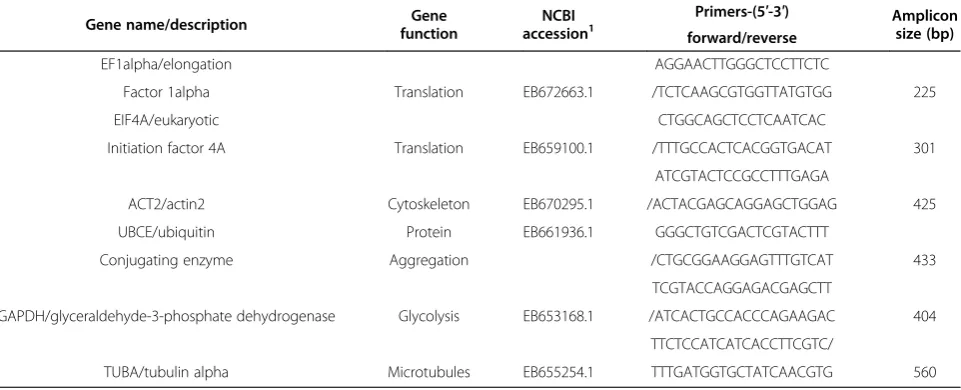
EST sequences from conserved regions of each reference gene were used to design the first set of primers (Table 1) using Primer3 (v. 0.4.0) software (http://frodo.wi.mit.edu/, [43]). Using the conserved region primers from Table 1, fragments specific to each reference gene were amplified from both B-2S and B-12-9 leaf cDNA, cloned into pCR®-Blunt II-TOPO® vector (Zero pCR®-Blunt®TOPO® PCR Cloning Kit, Invitrogen) and sequenced at the Georgia Genomics Facility (Athens, GA). At least 17 sequences per genotype from each reference gene were aligned using clustalW2 (http://www.ebi.ac.uk/Tools/msa/clustalw2/).
Primer design and real-time PCR assay
[image:3.595.58.539.531.726.2]A set of real-time primers was designed from the aligned region of each of the six reference genes (EF1alpha, EIF4A, UBCE, GAPDH, ACT2 and TUBA) using Primer3, (v. 0.4.0) software [43] and oligo analysis was performed using IDT oligoanalyzer tool (www.idtdna.com) with care taken to ensure that the reference gene real-time primer sequences were from the conserved regions of B-2S and B-12-9 and did not encompass any SNPs (single nucleo-tide polymorphisms). Real-time RT-PCR amplification re-actions were performed using SYBR Green detection chemistry and run on 384-well plates with the Light Cy-cler 4.8 (Roche Applied Science). To estimate PCR effi-ciency of each reference gene primer pair, standard curves were generated using cDNA samples derived from differ-ent organs (leaf, root, anther and ovary) for both B-2S and B-12-9 genotypes. Samples were run in a 2-fold serial dilu-tion range across 5 points with initial concentradilu-tion of template starting at 0.6 ng. The corresponding PCR effi-ciencies and the error values were determined by the Light
Table 1 Candidate reference gene description and details of the first set of primer sequences designed from the conserved regions of the specific reference genes
Gene name/description Gene function
NCBI accession1
Primers-(5′-3′) Amplicon size (bp) forward/reverse
EF1alpha/elongation AGGAACTTGGGCTCCTTCTC
225
Factor 1alpha Translation EB672663.1 /TCTCAAGCGTGGTTATGTGG
EIF4A/eukaryotic CTGGCAGCTCCTCAATCAC
Initiation factor 4A Translation EB659100.1 /TTTGCCACTCACGGTGACAT 301
ACT2/actin2 Cytoskeleton EB670295.1
ATCGTACTCCGCCTTTGAGA
425 /ACTACGAGCAGGAGCTGGAG
UBCE/ubiquitin Protein EB661936.1 GGGCTGTCGACTCGTACTTT
433
Conjugating enzyme Aggregation /CTGCGGAAGGAGTTTGTCAT
GAPDH/glyceraldehyde-3-phosphate dehydrogenase Glycolysis EB653168.1
TCGTACCAGGAGACGAGCTT
404 /ATCACTGCCACCCAGAAGAC
TUBA/tubulin alpha Microtubules EB655254.1
TTCTCCATCATCACCTTCGTC/
560 TTTGATGGTGCTATCAACGTG
1
Cycler 4.8 software. All samples to be analyzed were run in the same plate in triplicate. Reactions were prepared in a total volume of 10μl containing: 2μl of template, 1μl of
[image:4.595.59.545.100.281.2]each reference gene primer pair (optimized concentration: 300 nM), 5μl of 2x FastStart SYBR Green Master (Roche Applied Science) and 2 μl of sterile water. Each PCR Table 2 Primer sequences used for qRT-PCR analysis
Gene name Primers-(5′-3′) forward/reverse Amplicon size (bp) PCR Efficiency ± SD1
EF1alpha GTGGTTCATGATGATGACCTGGGA/ 82 1.90 ± 0.03
TGGTTATGTGGCCTCCAACTCCAA
EIF4A TGGTGATGAGCACACGGGATGAA/ 80 1.90 ± 0.05
TCACGGTGACATGGACCAGAACACTA
ACT2 CCTTCCTGATATCCACATCACA/ 103 1.85 ± 0.03
CCTGAGGTCCTCTTCCAACC
UBCE TGTCATGGCATCGAAGCGTATCCT/ 106 1.87 ± 0.03
TTGCCAATGAAACATGTCCTCGCC
GAPDH TGTCACCAGTGAAGTCCGTGGAAA/ 94 1.95 ± 0.04
AAGAAGGCTATCAAGGCTGCGTCT
TUBA CTGCAGAATTCAGGTTTGATGGTGC/ 80 2.05 ± 0.05
GATACGTGGGTATGGAACAAGGTTGG
1
SD, standard deviation; efficiency values for genes were calculated using the standard curve method of Light Cycler 4.8 software (absolute quantitationvia second derivative method). An efficiency of 2 denotes 100%. All the error values for standard curves were below 0.02.
[image:4.595.58.539.371.706.2]analysis also included reverse transcription negative con-trol (RT minus, without reverse transcriptase) to confirm the absence of genomic DNA and a no-template negative control to check for primer-dimer and contamination. Uracil-N-Glycosylase (1μl per 100μl of reaction mixture) was also included in the reaction mixture in order to avoid PCR product carryover contamination. The PCR cycling conditions were set as follows: pre-incubation at 37°C for 10 min to activate Uracil-N-Glycosylase, an initial denaturation step of 95°C for 10 min to inactivate Uracil-N-Glycosylase and activate the FastStart Taq DNA
polymerase, followed by 45 cycles of denaturation at 95°C for 10s, annealing at 60°C for 10s and extension at 72°C for 10s. The amplification process was followed by a melt-ing curve analysis, rangmelt-ing from 65°C to 90°C, increasmelt-ing temperature in steps of 0.2°C every 10s. Cp values were automatically determined using the Light Cycler 4.8 soft-ware (absolute quantitationviasecond-derivative method). For every cDNA sample, the mean expression level and standard deviation for each set replicate was calculated (cut-off value for standard deviation was kept as 0.3; only samples below this cut-off were considered). To confirm
a.
B-2S [image:5.595.58.544.88.547.2]b.
B-12-9the reproducibility of the assay and to reconfirm reference gene stability, the experiment was repeated for 2S and B-12-9 ovary samples. Two biological and three technical replicates were included.
Gene expression stability analysis
For ranking reference genes based on their stability, GenEx (version 4.1.7, MultiD Analyses) which includes both GeNorm and NormFinder software was used. The Microsoft Excel file with raw expression Cp values for each tested gene in the 18 different samples generated with the Light Cycler 4.8 software was transferred into GenEx software.
Findings
Six reference gene sequences (EF1alpha, EIF4A, UBCE, ACT2, GAPDH and TUBA) from other plant species were used in BlastN analysis against theC. ciliarispistil EST library at NCBI where C. ciliaris EST sequences with high similarity to all six selected reference genes (E-value = 0.0) were retrieved. High sequence similarity with the specific reference genes from other plant spe-cies (E-values below 7e-179) was confirmed by BlastN of the selected C. ciliaris EST sequences (Table 1) against the non-redundant database at NCBI. The amplicon length for the first set of primers used to generate B-2S and B-12-9 clones ranged between 225–560 bp whereas amplicon length with real-time RT-PCR primers ranged between 80–106 bp. Primer Tmranged between 59-60°C,
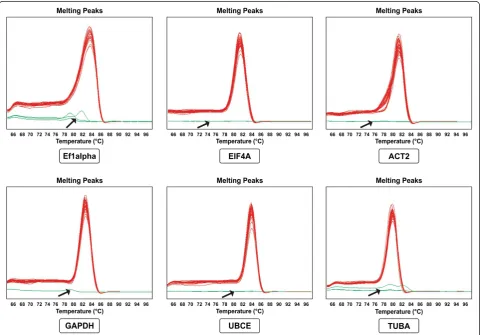
and primer lengths varied between 20–26 bp. All real-time RT-PCR primers specific for the reference genes showed acceptable amplification efficiencies (Table 2), and dissociation curves showed a single PCR product for each (Figure 1).
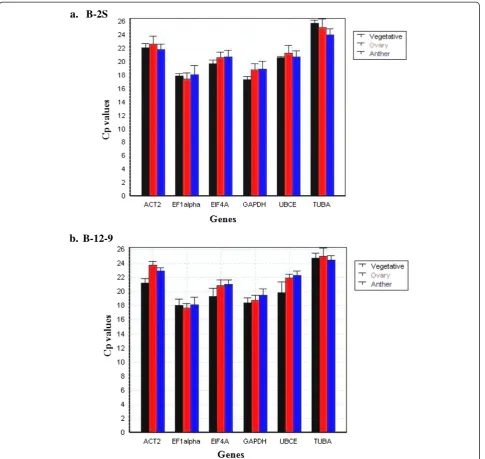
For each B-2S and B-12-9 sample, specific cDNA (leaf, root, anther and ovary) standard curves were generated to measure primer efficiency. The amplification effi-ciency for primers, calculated by the Light Cycler 4.8 software, ranged from 1.85 ± 0.03 (92.5%) to 2.05 ± 0.05 (102.5%) (Table 2) and were considered appropriate for qRT-PCR [44]. An optimized primer concentration of 300 nM for all genes produced the lowest Cp value (cal-culated using absolute quantitationviasecond-derivative method). No-RT and no-template controls either did not generate any Cp or the difference in Cp between test and control samples was more than 10 to 13 cycles apart, values considered to be negligible [45]. The six candidate reference genes displayed a relatively wide range of mean Cp values from 17.79 (EF1alpha) to 24.9 (TUBA). The Cp distribution data for B-2S and B-12-9, for all samples (vegetative, ovary-all stages and anther-all stages) are shown in Figure 2a and 2b, respectively. In both B-2S and B-12-9, EF1alpha showed the highest expression whereas TUBA showed the lowest expression level. Studying ex-pression levels of candidate reference genes will allow us to choose reference genes with similar expression patterns to that of the tested genes for future work.
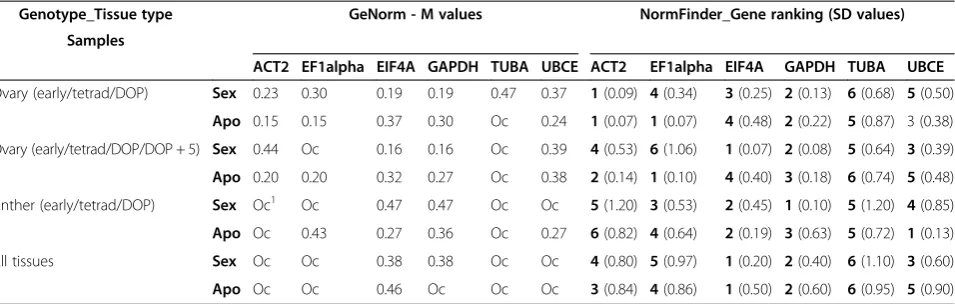
[image:6.595.61.539.100.252.2]In order to minimize bias introduced by the reference gene validation approach, two programs with different algorithms, GeNorm and NormFinder, were used for measuring gene expression stability. GeNorm software assumes that none of the tested genes being analyzed are co-regulated [46]. The stability measure provided by GeNorm (M-value) is the mean pairwise variation be-tween a gene and all other tested candidates, and hence a pair of highly co-regulated genes could be eliminated during the selection if they show high inter-sample vari-ability [28]. Genes with the lowest M-value are considered most stable. M-values below 0.5 indicate good measure of Table 3 Tissue specific reference gene stability analyses of B-2S (sex) and B-12-9 (apo) using GeNorm and NormFinder
Genotype_Tissue type GeNorm - M values NormFinder_Gene ranking (SD values) Samples
ACT2 EF1alpha EIF4A GAPDH TUBA UBCE ACT2 EF1alpha EIF4A GAPDH TUBA UBCE
Ovary (early/tetrad/DOP) Sex 0.23 0.30 0.19 0.19 0.47 0.37 1(0.09) 4(0.34) 3(0.25) 2(0.13) 6(0.68) 5(0.50)
Apo 0.15 0.15 0.37 0.30 Oc 0.24 1(0.07) 1(0.07) 4(0.48) 2(0.22) 5(0.87) 3 (0.38)
Ovary (early/tetrad/DOP/DOP + 5) Sex 0.44 Oc 0.16 0.16 Oc 0.39 4(0.53) 6(1.06) 1(0.07) 2(0.08) 5(0.64) 3(0.39)
Apo 0.20 0.20 0.32 0.27 Oc 0.38 2(0.14) 1(0.10) 4(0.40) 3(0.18) 6(0.74) 5(0.48)
Anther (early/tetrad/DOP) Sex Oc1 Oc 0.47 0.47 Oc Oc 5(1.20) 3(0.53) 2(0.45) 1(0.10) 5(1.20) 4(0.85)
Apo Oc 0.43 0.27 0.36 Oc 0.27 6(0.82) 4(0.64) 2(0.19) 3(0.63) 5(0.72) 1(0.13)
All tissues Sex Oc Oc 0.38 0.38 Oc Oc 4(0.80) 5(0.97) 1(0.20) 2(0.40) 6(1.10) 3(0.60)
Apo Oc Oc 0.46 Oc Oc Oc 3(0.84) 4(0.86) 1(0.50) 2(0.60) 6(0.95) 5(0.90)
GeNorm stability value is represented by M value (the selected cut off for M value is≤0.5). NormFinder stability value is represented by SD (standard deviation). There is no cut-off for SD, hence the ranking of genes based on the SD value is used as a measure to evaluate stability (1 stands for most stable, 6 is least stable). The ovary and anther stages are as follows: early stands for early premeiosis, tetrad, DOP for day of pollination, and DOP + 5 is 5 days after day of pollination.
1
stability [39,46]. We also tested the NormFinder software since it is less sensitive to co-regulation [28]. NormFinder relies on a ‘model-based approach’; it determines expres-sion stability of candidate reference genes by comparing the expression variation between and within groups and then combines both results in a stability value for each tested gene [47]. For NormFinder, the gene with the
lowest standard deviation (SD) will be top ranked [28,32]. NormFinder software was found to be more robust with larger sample sizes [48]. Differences in gene ranking be-tween different stability software have been reported [20].
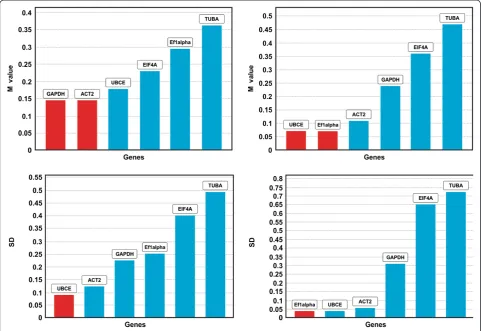
[image:7.595.57.539.90.421.2]In order to measure expression stability of genes across organs and stages, the Cp data in the Microsoft Excel file was transported into GenEx software and analysis was Figure 3The GeNorm (I) and NormFinder (II) stability values for B-2S (a) and B-12-9 (b) ovaries at early/tetrad stages.Boxes in red indicate the most stable genes or gene pairs. SD–standard deviation.
Table 4 Ovary (second independent assay) reference gene stability analyses of B-2S (sex) and B-12-9 (apo) using GeNorm and NormFinder
Genotype_Tissue type GeNorm - M values NormFinder_Gene ranking (SD values) Samples
ACT2 EF1alpha EIF4A GAPDH TUBA UBCE ACT2 EF1alpha EIF4A GAPDH TUBA UBCE
Ovary (early/tetrad/DOP) Sex 0.19 0.10 0.09 0.03 0.16 0.03 5(0.24) 1(0.01) 1(0.01) 2(0.13) 4(0.23) 3(0.15)
Apo 0.30 0.26 0.33 0.39 0.26 0.45 4(0.32) 2(0.25) 1(0.12) 3(0.30) 5(0.44) 6(0.54)
Ovary (early/tetrad/DOP/ DOP + 5)
Sex 0.24 0.16 0.09 0.06 0.29 0.06 4(0.29) 5(0.31) 1(0.05) 2(0.07) 6(0.35) 3(0.12)
Apo 0.30 0.30 0.32 0.35 Oc1 0.40 3(0.23) 2(0.16) 1(0.10) 4(0.28) 6(0.81) 5(0.56)
GeNorm stability value is represented by M value (the selected cut off for M value is≤0.5). NormFinder stability value is represented by SD (standard deviation). There is no cut-off for SD, hence the ranking of genes based on the SD value is used as a measure to evaluate stability (1 stands for most stable, 6 is least stable). The ovary stages are as follows: early stands for early premeiosis, tetrad, DOP for day of pollination, and DOP + 5 is 5 days after day of pollination.
1
[image:7.595.58.536.596.699.2]performed via GeNorm (as described by Vandesompele et al. [31]) and NormFinder (as described by Anderson et al.[32]). As analysis of gene expression in apomictic de-velopment requires the comparison between sexual and apomictic plants, which are both genetically and develop-mentally different, we analyzed B-2S and B-12-9 tissue types separately. In order to monitor if the developmental stages of ovaries and anthers influence the reference gene stability, organ and/or developmental stage specific analysis was performed. Each sample set was first subjected to GeNorm analysis and all genes with an M-value≤0.5 are reported (Table 3). The GeNorm results were further con-firmed using NormFinder. Since there is no cut-off value for standard deviation, SD (stability value of NormFinder), the criterion for genes to be considered stable was that the genes confirmed as stable by GeNorm should be among the top four ranking in NormFinder. The result of NormFinder analysis is shown in Table 3. Although results in Table 3 show EIF4A as the most stable gene across all tissues of B-2S and B-12-9, there were tissue specific changes with respect to gene stability, using both GeNorm and NormFinder (Table 3).
Given our specific interest in ovary development and comparison of gene expression between sexual and apomic-tic genotypes (in our case B-2S and B-12-9), a detailed ana-lysis of ovary samples of B-2S and B-12-9, delineating groupings of developmental stages, showed very similar re-sults between GeNorm and NormFinder (Table 3). Except for TUBA, all tested reference genes (M-value below 0.5) could be used for developmental grouping up to DOP for sexual vs. apomictic gene comparisons. The addition of the developmental stage DOP + 5, excluded EF1alpha and TUBA as good candidate reference genes. As genes involved in the apomeiosis pathway should be triggered towards early ovary developmental stages (early premeiosis and tetrad), a detailed analysis of early-stage B-2S and B-12-9 ovaries using GeNorm graph, as plotted by GenEx (Figure 3) shows that all genes had an M-value below 0.5. Both GeNorm and NormFinder results for B-2S and B-12-9 showed that the combination of EF1alpha, ACT2, UBCE and GAPDH occu-pied the most stable positions in the graph.
A second independent assay of B-2S and B-12-9 ovary samples was performed using two independent bio-logical replicates, with samples collected at the same developmental stages (Table 4). Unlike the first analysis, TUBA qualified up to the DOP stage as stable in GeNorm (M <0.5) but was still among the lowest rank-ings in NormFinder. In the second analysis, EF1alpha was considered stable at DOP + 5. Both analyses of ovaries in-cluding DOP + 5 identified TUBA to be unstable in at least one genotype (as per GeNorm). The reference genes EIF4A, GAPDH, UBCE and ACT2 were found to be stable in both first (Table 3) and second (Table 4) analyses of DOP as well as DOP + 5 ovary stages. All tested reference genes qualified
for GeNorm stability for early + tetrad ovary tissue in the second analysis (data not shown).
Conclusion
Our data present the first in-depth analysis of reference gene stability validation in C. ciliaris, a tetraploid and important model for understanding apomixis in grasses. Using both apomictic and sexual accessions ofC. ciliaris and different organs/developmental stages, we were able to understand the reference gene stability specific to each organ, stage, or mode of reproduction. Our analysis used six reference genes based on their previous use in other plant species. These genes were analyzed in 18 samples, from both apomictic and sexual plants. All- tis-sue analysis using GeNorm and NormFinder found EIF4A as the most stable gene. There was tight correl-ation between analyses with GeNorm and NormFinder, as genes detected stable by GeNorm occupied top gene rankings in NormFinder analysis.
Detailed analyses of ovary tissue in two independent assays, confirmed stability of genes in specific ovary stages that could be used in both B-2S and B-12-9, irspective of the mode of reproduction. Based on our re-sults, all tested reference genes were found to be stable (as per GeNorm, M-value below 0.5) for early to tetrad stage ovary development between the two species, while ACT2, UBCE, GAPDH and/or EIF4A would be most suitable for ovary stages up to DOP and DOP + 5. These reference gene expression and stability analyses will provide an important guideline for our future study involving apomixis-related gene expression studies via qRT-PCR inC. ciliarisor other related grasses.
Competing interests
The authors declare that they have no competing interests.
Authors’contributions
BS led the experiments and drafted the manuscript. JAC and POA conceived the experiments, participated in experimental design, and finalized the manuscript. All authors read and approved the final manuscript.
Acknowledgements
This work was supported by a cooperative research agreement with Pioneer Hi-Bred.
Author details
1Department of Horticulture, The University of Georgia Tifton Campus, Tifton,
GA 31793, USA.2Current Address: Burnett School of Biomedical Sciences, University of Central Florida, Florida 32826, USA.
Received: 24 April 2013 Accepted: 25 September 2013 Published: 2 October 2013
References
1. Grimanelli D, Leblanc O, Perotti E, Grossniklaus U:Developmental genetics of gametophytic apomixis.Trends Genet2001,17:597–604.
2. Ozias-Akins P, Van-Dijk PJ:Mendelian genetics of apomixis in plants.Annu Rev Genet2007,11:509–537.
5. Richards AJ:Agamospery.InPlant Breeding Systems.Edited by Richards AJ. Boston: George Allen & Unwin; 1986:403–509.
6. Koltunow AM, Grossniklaus U:Apomixis: A developmental perspective.
Annu Rev Plant Biol2003,54:547–574.
7. Carman JG:Asynchronous expression of duplicate genes in angiosperms may cause apomixis, bispory, tetraspory, and polyembryony.Biol J Linnean Soc1997,61:51–94.
8. Hignight KW, Bashaw EC, Hussey MA:Cytological and morphological diversity of native apomictic buffelgrass,Pennisetum ciliare (L.)Link.
Bot Gaz1991,152:214–218.
9. Akiyama Y, Conner JA, Goel S, Morishige DT, Mullet JE, DeBarry J, Yang L, Bennetzen JL, Klein PE, Ozias-Akins P:High-resolution physical mapping in
Pennisetum squamulatumreveals extensive chromosomal heteromorphism of the genomic region associated with apomixis.Plant Physiol2004,134:1733–1741. 10. Akiyama Y, Hanna WW, Ozias-Akins P:High-resolution physical mapping
reveals that the apospory-specific genomic region (ASGR) inCenchrus ciliarisis located on a heterochromatic and hemizygous region of a single chromosome.Theor Appl Genet2005,111:1042–1051.
11. Goel S, Chen Z, Conner JA, Akiyama Y, Hanna WW, Ozias-Akins P:Physical evidence that a single hemizygous chromosomal region is sufficient to confer aposporous embryo sac formation inPennisetum squamulatum
andCenchrus ciliaris.Genetics2003,163:1069–1082.
12. Goel S, Chen Z, Akiyama Y, Conner JA, Basu M, Gualtieri G, Hanna WW, Ozias-Akins P:Comparative physical mapping of the apospory-specific genomic region in two apomictic grasses:Pennisetum squamulatumand
Cenchrus ciliaris.Genetics2006,173:389–400.
13. Ozias-Akins P, Roche D, Hanna WW:Tight clustering and hemizygosity of apomixis-linked molecular markers inPennisetum squamulatum
implies genetic control of apospory by a divergent locus which may have no allelic form in sexual genotypes.Proc Natl Acad Sci U S A1998, 95:5127–5132.
14. Roche D, Cong P, Chen ZB, Hanna WW, Gustine DL, Sherwood RT, Ozias-Akins P:An apospory-specific genomic region is conserved between buffelgrass (Cenchrus ciliaris L.) andPennisetum squamulatumFresen.
Plant J1999,19:203–208.
15. Nogler GA:Gametophytic apomixis.InEmbryology of Angiosperms.Edited by Johri BM. Berlin, Heidelberg, New York, Tokyo: Springer; 1984:475–518. 16. Vielle J-P, Burson BL, Bashaw EC, Hussey MA:Early fertilization events in the sexual and aposporous egg apparatus ofPennisetum ciliare (L.)Link.
Plant J1995,8:309–316.
17. Bashaw EC:Apomixis and sexuality in buffelgrass.Crop Sci1962,2:412–415. 18. Gustine DL, Sherwood RT, Huff DR:Apospory-linked molecular markers in
buffelgrass.Crop Sci1997,37:947–951.
19. Conner JA, Goel S, Gunawan G, Cordonnier-Pratt MM, Johnson VE, Liang C, Wang H, Pratt LH, Mullet JE, Debarry J, Yang L, Bennetzen JL, Klein PE, Ozias-Akins P:Sequence analysis of bacterial artificial chromosome clones from the apospory-specific genomic region ofPennisetumandCenchrus.
Plant Physiol2008,147:1396–1411.
20. Pellino M, Sharbel TF, Mau M, Amiteye S, Corral JM:Selection of reference genes for quantitative real-time PCR expression studies of
microdissected reproductive tissues in apomictic and sexualBoechera.
BMC Res Notes2011,4:303.
21. Sharbel TF, Voigt ML, Corral JM, Thiel T, Varshney A, Kumlehn J, Vogel H, Rotter B:Molecular signatures of apomictic and sexual ovules in the
Boechera holboelliicomplex.Plant J2009,58:870–882.
22. Sharbel TF, Voigt ML, Corral JM, Galla G, Kumlehn J, Klukas C, Schreiber F, Vogel H, Rotter B:Apomictic and sexual ovules ofBoecheradisplay heterochronic global gene expression patterns.Plant Cell2010,22:655. 23. Hong SY, Seo PJ, Yang MS, Xiang F, Park CM:Exploring valid reference
genes for gene expression studies inBrachypodium distachyonby real-time PCR.BMC Plant Biol2008,8:112.
24. Pfaffl MW:Quantification strategies in real time PCR.InA-Z of quantitative PCR.Edited by Bustin SA. La Jolla, CA: International University Line; 2004:1–20. 25. Pfaffl MW, Tichopad A, Prgomet C, Neuvians TP:Determination of stable
housekeeping genes, differentially regulated target genes and sample integrity: BestKeeper–Excel-based tool using pair-wise correlations.
Biotechnol Lett2004,26:509–515.
26. Nolan T, Hands RE, Bustin SA:Quantification of mRNA using real-time RT-PCR.Nat Protoc2006,1:1559–1582.
27. VanGuilder HD, Vrana KE, Freeman WM:Twenty-five years of quantitative PCR for gene expression analysis.Biotechniques2008,44:619–626.
28. Expósito-Rodríguez M, Borges AA, Borges-Pérez A, Pérez JA:Selection of internal control genes for quantitative real-time RT-PCR studies during tomato development process.BMC Plant Biol2008,8:131.
29. Huggett J, Dheda K, Bustin SA:Normalization.InReal-Time PCR.Edited by Dorak MT. New York: BIOS Advanced Methods; 2006:83–91.
30. Thellin O, Zorzi W, Lakaye B, De-Borman B, Coumans B, Hennen G, Grisar T, Igout A, Heinen E:Housekeeping genes as internal standards: use and limits.J Biotechnol1999,75:291–295.
31. Vandesompele J, De-Preter K, Pattyn F, Poppe B, Van-Roy N, De-Paepe A, Speleman F:Accurate normalization of real-time quantitative RT-PCR data by geometric averaging of multiple internal control genes.Genome Biol2002,3:0034.1–0034.11.
32. Andersen CL, Jensen JL, Orntoft TF:Normalization of real-time quantitative reverse transcription-PCR data: a model-based variance estimation approach to identify genes suited for normalization, applied to bladder and colon cancer data sets.Cancer Res2004,64:5245–5250.
33. Czechowski T, Stitt M, Altmann T, Udvardi MK, Scheible WR:Genome-wide identification and testing of superior reference genes for transcript normalization inArabidopsis.Plant Physiol2005,139:5–17. 34. Dean JD, Goodwin PH, Hsiang T:Comparison of relative RT-PCR and
northern blot analyses to measure expression ofβ-1,3-glucanase in
Nicotiana benthamianainfected withColletotrichum destructivum.Plant Mol Biol Rep2002,20:347–356.
35. Orsel M, Krapp A, Daniel-Vedele F:Analysis of the NRT2 nitrate transporter family inArabidopsis: Structure and gene expression.Plant Physiol2002, 129:886–888.
36. Ozturk ZN, Talamé V, Deyholos M, Michalowski CB, Galbraith DW, Gozukirmizi N, Tuberosa R, Bohnert HJ:Monitoring large-scale changes in transcript abundance in drought- and salt-stressed barley.Plant Mol Biol
2002,48:551–573.
37. Stürzenbaum SR, Kille P:Control genes in quantitative molecular biological techniques: the variability of invariance.Comp Biochem Physiol B2007, 130:281–289.
38. Thomas C, Meyer D, Wolff M, Himber C, Alioua M, Steinmetz A:Molecular characterization and spatial expression of the sunflower ABP1 gene.
Plant Mol Biol2003,52:1025–1036.
39. Silveira ED, Alves-Ferreira M, Guimarães LA, Da-Silva FR, Carneiro VTC:Selection of reference genes for quantitative real-time PCR expression studies in the apomictic and sexual grassBrachiaria brizantha.BMC Plant Biol2009,9:84. 40. Sahu PP, Gupta S, Malaviya DR, Roy AK, Kaushal P, Prasad M:Transcriptome
analysis of differentially expressed genes during embryo sac
development in apomeiotic non-parthenogenetic interspecific hybrid of
Pennisetum glaucum.Mol Biotechnol2012,51:262–271.
41. Zeng Y, Conner J, Ozias-Akins P:Identification of ovule transcripts from the Apospory-Specific Genomic Region (ASGR)-carrier chromosome.
BMC Genomics2011,12:206.
42. Libus J,Štorchová H:Quantification of cDNA generated by reverse transcription of total RNA provides a simple alternative tool for quantitative RT-PCR normalization.Biotechniques2006,41:156–164. 43. Rozen S, Skaletsky HJ:Primer3 on the WWW for general users and for
biologist programmers.InBioinformatics Methods and Protocols: Methods in Molecular Biology.Edited by Krawetz S, Misener S. Totowa, NJ: Humana Press; 2000:365–386.
44. Zhao SFR:Comprehensive algorithm for quantitative real-time polymerase chain reaction.J Comp Biol2005,12:1047–1064.
45. Bustin SA, Nolan T:Pitfalls of quantitative real-time reverse-transcription polymerase chain reaction.J Biomol Tech2004,15:155–156.
46. Yan J, Yuan F, Long G, Qin L, Deng Z:Selection of reference genes for quantitative real-time RT-PCR analysis in citrus.Mol Biol Rep2012,39:1831–1838. 47. Demidenko NV, Logacheva MD, Penin AA:Selection and validation of
reference genes for quantitative real-time PCR in buckwheat (Fagopyrum esculentum) based on transcriptome sequence data.PLoS One2011,6:e19434. 48. Mehta R, Birerdinc A, Hossain N, Afendy A, Chandhoke V, Younossi Z,
Baranova A:Validation of endogenous reference genes for qRT-PCR analysis of human visceral adipose samples.BMC Mol Biol2010,11:39.
doi:10.1186/1756-0500-6-397
Cite this article as:Simonet al.:Selection and validation of reference
genes for gene expression analysis in apomictic and sexualCenchrus
![Surface modifications to increase dairy production run length : a thesis presented in partial fulfilment of the requirements for the degree of Master of Chemical Engineering at Massey University, [Manawatū], New Zealand](data:image/gif;base64,R0lGODlhAQABAIAAAP///wAAACH5BAEAAAAALAAAAAABAAEAAAICRAEAOw==)