Open Access
Technical Note
Using R in Taverna: RShell v1.2
Ingo Wassink
1, Han Rauwerda*
2, Pieter BT Neerincx
3, Paul E van der Vet*
1,
Timo M Breit*
2, Jack AM Leunissen
3and Anton Nijholt
1Address: 1Human Media Interaction Group, University of Twente, Enschede, The Netherlands, 2MicroArray Department & Integrative
Bioinformatics Unit, University of Amsterdam, Amsterdam, The Netherlands and 3Laboratory of Bioinformatics, Wageningen University,
Wageningen, The Netherlands
Email: Ingo Wassink - [email protected]; Han Rauwerda* - [email protected]; Pieter BT Neerincx - [email protected]; Paul E van der Vet* - [email protected]; Timo M Breit* - [email protected]; Jack AM Leunissen - [email protected];
Anton Nijholt - [email protected] * Corresponding authors
Abstract
Background: R is the statistical language commonly used by many life scientists in (omics) data analysis. At the same time, these complex analyses benefit from a workflow approach, such as used by the open source workflow management system Taverna. However, Taverna had limited support for R, because it supported just a few data types and only a single output. Also, there was no support for graphical output and persistent sessions. Altogether this made using R in Taverna impractical.
Findings: We have developed an R plugin for Taverna: RShell, which provides R functionality within workflows designed in Taverna. In order to fully support the R language, our RShell plugin directly uses the R interpreter. The RShell plugin consists of a Taverna processor for R scripts and an RShell Session Manager that communicates with the R server. We made the RShell processor highly configurable allowing the user to define multiple inputs and outputs. Also, various data types are supported, such as strings, numeric data and images. To limit data transport between multiple RShell processors, the RShell plugin also supports persistent sessions. Here, we will describe the architecture of RShell and the new features that are introduced in version 1.2, i.e.: i) Support for R up to and including R version 2.9; ii) Support for persistent sessions to limit data transfer; iii) Support for vector graphics output through PDF; iv)Syntax highlighting of the R code; v) Improved usability through fewer port types.
Our new RShell processor is backwards compatible with workflows that use older versions of the RShell processor. We demonstrate the value of the RShell processor by a use-case workflow that maps oligonucleotide probes designed with DNA sequence information from Vega onto the Ensembl genome assembly.
Conclusion: Our RShell plugin enables Taverna users to employ R scripts within their workflows in a highly configurable way.
Published: 16 July 2009
BMC Research Notes 2009, 2:138 doi:10.1186/1756-0500-2-138
Received: 19 February 2009 Accepted: 16 July 2009
This article is available from: http://www.biomedcentral.com/1756-0500/2/138
© 2009 Rauwerda et al; licensee BioMed Central Ltd.
Background
The open source workflow system Taverna [1] provides access to and integration of many life science web services. However, not all desired data-analysis procedures are available as web services. Therefore, support for scripting is essential and by default, Taverna provides scripting in Java. Many scientists are not familiar with Java and prefer other languages, such as R, a statistical language com-monly used by many life scientists [2]. Taverna had lim-ited support for R. We developed an R plugin for Taverna: RShell, which removes the limitations of R support in Tav-erna workflows. RShell can be incorporated in a TavTav-erna workflow as a processor for executing R scripts. Although RShell was already sketchily introduced in Li et al. [3], here we present a detailed description of the RShell func-tionality and architecture. This was also motivated by sev-eral requests from Taverna and R users. Additionally, we introduce new functionality of our current RShell version 1.2.
Implementation
RShell is based on a client-server architecture. It requires a local or remote installation of the R-interpreter with the Rserve library [4] installed. The Rserve library turns the R-interpreter into a server, which enables other applications to communicate with the R-interpreter by means of a socket connection. From here on, the R-interpreter with the Rserve library installed will be denoted as the R server. RShell uses the Java library named REngine to establish and maintain connection between Taverna and R server. To execute R scripts, the RShell processor sends the script and the input data via the RShell session manager to the R server, which delegates the script to the R-interpreter and
sends the results back to RShell (Figure 1). This new ver-sion is fully compatible up to and including R 2.9.
Configuring the RShell processor
The RShell processor is highly configurable: the user can define the script to be executed, the input ports to feed the relevant data, and the output ports to extract the created data. The user can configure the RShell processor by invo-cating the RShell processor in Taverna's "advanced model explorer". This will show a configuration dialog contain-ing four tabs for the script, the input ports, the output ports and the connection settings.
Syntax highlighting is available in the scripting tab, to help the user write correct R code. The keywords are high-lighted in blue; the inputs and outputs of the RShell are highlighted in pink.
RShell supports multiple input and output ports. Each port has a name, corresponding to the variable name it represents, as well as a type, corresponding to the type of data it holds. RShell uses the data type to determine how to exchange data with Taverna. RShell supports booleans, numeric values (both integers and floating point num-bers), strings, and, vector of numerics and strings. Inputs and outputs of these data types can directly be used as var-iables in the R script. RShell provides the text-file data type to handle large data. Ports of this type can be read and written as normal R tables. The PNG and, since version 1.2, the PDF data type are available for graphical output. PNG can be used bitmap graphics; PDF for vector graph-ics. PNG and PDF outputs are handled as graphics devices in the standard R fashion. Input ports and output ports can be defined using the input ports and output ports tab.
RShell can execute any R script as long as the required libraries are installed in the R server. By default, the RShell processor is configured to use a locally installed R server serving at address localhost, port 6311. It can be configured to use a remote installation of R instead, using the connec-tions tab. This can be useful when, the user is not able to install R, a central installation of R with a specific set of installed libraries is used, or R is installed in a grid envi-ronment. Multiple R servers can be accessed within the same workflow.
Persistent sessions
RShell supports persistent sessions to prevent unnecessary data transfer. The user can enable persistent sessions in the connection tab. When these are enabled, all input data, output data and script variables will be kept in mem-ory of the R-interpreter until the whole workflow execu-tion is finished. Multiple RShell processors in the same workflow are able to use the data provided by previously used processors, without requiring data links between
The design of RShell Figure 1
these processors, as long as they use the same R server, Although persistent sessions can be very useful, they have some limitations: i) sessions can only be used among RShell processors, ii) RShell processors involved in a sin-gle persistent session have to access the same R server (but RShells devoted to a different session can access other R servers), and iii) it takes extra effort to keep a provenance
log of data kept at the R interpreter. Taverna manages all data consumed and produced by processors. By using per-sistent sessions, Taverna is not aware of the data generated by one RShell processor and used by another RShell proc-essor. If the user wants to record data generated by an RShell processor, he/she can do that by defining an output port for that variable.
The use case workflow Figure 2
Use-case: mapping oligonucleotides to a genome
DNA-sequence
We used RShell in the design process of a zebrafish micro-array (Figure 2) [see Additional file 1 for complete work-flow]. A microarray with 15k probes of 60-mer oligonucleotides has been designed on gene sequences from Vega http://vega.sanger.ac.uk/Danio_rerio and Ensembl http://www.ensembl.org/Danio_rerio/ that are also known in the Zebrafish Information Network http:// zfin.org of the genome DNA-sequence assemblies. For zebrafish, the VEGA set is not a subset of the Ensembl set. To judge the agreement that exists between the different assembly annotations, we mapped the Vega-designed probes onto the Ensembl assembly in the following way. All probe sequences are aligned to the Ensembl assembly. Hits with an e-value below 1.5e-4 are considered to be able to contribute to the hybridization signal on the microarray [5]. Next, for each hit, a query is performed to check which genes and/or transcripts are present at the hit location in the genome. Finally, each probe with at least one hit is further classified [see Additional file 2] based on the number of hits, genes and transcripts. For this classifi-cation, an additional lower cut-off is applied (e-value below 1e-12) and the possibility of the occurrence of intron-spanning probes has been considered. Therefore, probe sequences that show two or more hits located close together on the genome and that constitute a continuous stretch of more than 57 nucleotides on the probe, are labeled intron-spanning probes. For the alignment, Bio-Moby Blat and Blast services at WUR http://www.bioin
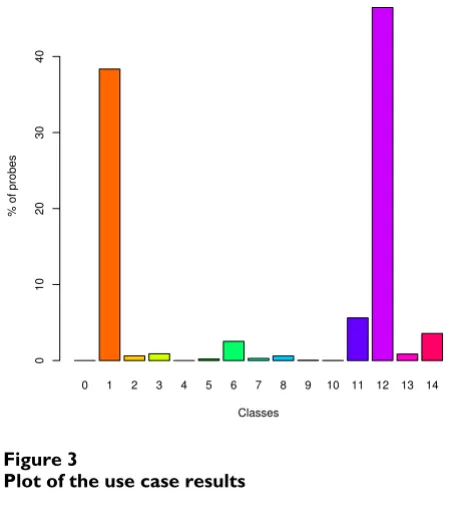
formatics.nl/ are used. Gene and transcript finding is per-formed by the Ensemble 51 Genes BioMart service http:// www.ensembl.org/biomart. The RShell processor is used to implement the classification and the visualisation in the workflow. In Figure 3 [see Additional file 2], one can see that 38.3% of the Vega designed probes have a single hit on the Ensembl assembly (class 1), whereas 3.0% are linked to multiple transcripts of a single gene (class 5–7). 5.6% of the probes are hitting multiple Ensembl genes with an e-value below 1e-12 (class 11). For these genes the Ensembl and Vega annotations clearly disagree. For 46.5% of the probes no transcript is found although they have a hit on the genome assembly below 1e-12 (class 12). These probes target Vega transcripts that are absent in the Ensembl annotation. With RShell, we have been able to implement the use-case as a workflow including the sta-tistical analysis. The complete workflow and the input data as well as a test set can be downloaded from http:// www.myexperiment.org/packs/45. The workflow was run on a 3 GHz Linux PC with 1.5 GB internal memory and took approximately six hours to complete.
Conclusion
With the introduction of our RShell plugin, scripting in R is now available for Taverna. RShell has a configurable processor that is able to execute any R script that can be executed by the available installation of the R-interpreter. The client-server architecture enables a centralised instal-lation of the R-interpreter containing all frequently used libraries used by an organisation. The support for persist-ent sessions in RShell 1.2 helps to prevpersist-ent data transfer overload.
RShell 1.0 comes with the standard installation of erna. RShell 1.2 can be downloaded as a plugin for Tav-erna and contains several improvements, such as support for vector graphics and persistent sessions
Availability and requirements
Project name: RShell v1.2
Project home page: http://ewi.utwente.nl/~biorange/
rshell/
Operating system(s): Any (Java)
Programming language: Java
Other requirements: Java 1.6, Taverna 1.3+ and R with the Rserve library installed. Taverna, R and Rserve are all open source and freely available.
Licence: GNU GPL
Competing interests
[image:4.612.53.289.112.374.2]The authors declare that they have no competing interests.
Figure 3
Plot of the use case results
0 1 2 3 4 5 6 7 8 9 10 11 12 13 14
Relative distribution of probes among the classes
Classes
% of probes
0
1
02
03
04
Publish with BioMed Central and every scientist can read your work free of charge
"BioMed Central will be the most significant development for disseminating the results of biomedical researc h in our lifetime."
Sir Paul Nurse, Cancer Research UK
Your research papers will be:
available free of charge to the entire biomedical community
peer reviewed and published immediately upon acceptance
cited in PubMed and archived on PubMed Central
yours — you keep the copyright
Submit your manuscript here:
http://www.biomedcentral.com/info/publishing_adv.asp
BioMedcentral
Authors' contributions
IW has implemented the RShell processor for Taverna. HR has designed the use case to demonstrate the RShell proc-essor. PN has implemented the Blast and Blat service used in the use-case. IW and HR have implemented the work-flow.
The authors wish it to be known that, in their opinion, IW, HR and PN should be regarded as joint first authors. All authors have read and approve the final manuscript.
Additional material
Acknowledgements
This work was part of the BioRange programme of the Netherlands Bioin-formatics Centre (NBIC), which is supported by a BSIK grant through the Netherlands Genomics Initiative (NGI).
References
1. Oinn T, Li P, Kell D, Goble C, Goderis A, Greenwood M, Hull D, Ste-vens R, Turi D, Zhao J: Workflows for e-Science Berlin, DE: Springer Verlag 2007 chap. Taverna/myGrid: Aligning a Workflow System with the Life Sciences Community:300-319.
2. Ihaka R, Gentleman R: R: A language for data analysis and graphics. Journal of Computational and Graphical Statistics 1996, 5(3):299-314.
3. Li P, Castrillo JI, Velarde G, Wassink I, Soiland-Reyes S, Owen S, Withers D, Oinn T, Pocock MR, Goble CA, Oliver SG, Kell DB: Per-forming statistical analyses on quantitative data in Taverna workflows: an example using R and maxdBrowse to identify differentially-expressed genes from microarray data. BMC Bioinformatics 2008, 9(334):1-38.
4. Urbanek S: Rserve – A Fast Way to Provide R Functionality to Applications. Proceedings of the 3rd International Workshop on Distrib-uted Statistical Computing (DSC 2003). Vienna, Austria 2003:20-22. 5. He Z, Wu L, Li X, Fields M, Zhou J: Empirical establishment of
oligonucleotide probe design criteria. Applied and Environmental Microbiology 2005, 71(7):3753-3760.
Additional file 1
Complete workflow. The expanded version of the workflow designed for the use-case.
[http://www.biomedcentral.com/content/supplementary/1756-0500-2-138-S1.pdf]
Additional file 2
Table of the use case results. Table representing the description of classes and the number of probes found in each class.
Click here for file