Open Access
Research article
Does managed care make a difference? Physicians' length of stay
decisions under managed and non-managed care
Judith D de Jong*
1, Gert P Westert
2, Cheryl M Noetscher
3and
Peter P Groenewegen
1Address: 1Nivel – Netherlands Institute for Health Services Research, PO Box 1568, 3500 BN Utrecht, The Netherlands, 2RIVM – National Institute of Public Health and the Environment, PO BOX 1, 3720 BA Bilthoven, The Netherlands and 3St. Joseph's Hospital Health Center, Syracuse, New York, USA
Email: Judith D de Jong* - [email protected]; Gert P Westert - [email protected]; Cheryl M Noetscher - [email protected]; Peter P Groenewegen - [email protected]
* Corresponding author
Abstract
Background: In this study we examined the influence of type of insurance and the influence of managed care in particular, on the length of stay decisions physicians make and on variation in medical practice.
Methods: We studied lengths of stay for comparable patients who are insured under managed or non-managed care plans. Seven Diagnosis Related Groups were chosen, two medical (COPD and CHF), one surgical (hip replacement) and four obstetrical (hysterectomy with and without complications and Cesarean section with and without complications). The 1999, 2000 and 2001 – data from hospitals in New York State were used and analyzed with multilevel analysis.
Results: Average length of stay does not differ between managed and non-managed care patients. Less variation was found for managed care patients. In both groups, the variation was smaller for DRGs that are easy to standardize than for other DRGs.
Conclusion: Type of insurance does not affect length of stay. An explanation might be that hospitals have a general policy concerning length of stay, independent of the type of insurance of the patient.
Background
There is concern that factors other than the medical needs of a patient influence decision-making by physicians [1,2]. Non-medical factors play a role in explaining med-ical practice variation [3-5]. Among the factors that influ-ence medical treatment are uncertainty of the most effective practice, response to regulations, method of patients' payment to the physicians, and type of insurance coverage [4].
In this study we examined the influence of type of insur-ance, and the influence of managed care in particular, on the decisions physicians take and on variation in medical practice. Managed care plans have evolved in the USA, where they are widely used to control costs by combining the financing and delivery of health care. Providers are at financial risk in capitated plans and the insured have less choice where treatment and health care providers are con-cerned. The potential of managed care is attractive to pol-icy makers in Europe.
Published: 09 February 2004
BMC Health Services Research 2004, 4:3
Received: 27 November 2003 Accepted: 09 February 2004
This article is available from: http://www.biomedcentral.com/1472-6963/4/3
Different types of insurance coverage are linked to differ-ent premiums and differdiffer-ent ways in which providers of care are paid. As a consequence, the type of insurance cover that patients have might influence the treatment given to patients. In traditional insurance plans, providers are paid fee-for-service. The insured can choose the physi-cians they want and consult them whenever they want, resulting in maximum freedom for both the insured and the provider. These plans were fully unmanaged in the past, but even these plans use managed care to some extent, nowadays [6].
The HMO is the best known type of managed care in the US [1]. HMO insured are obliged to choose a primary care physician, and treatment by specialists is only compen-sated after referral by the primary care physician. Physi-cians within the HMO network are often at financial risk; they are capitated or face a risk-sharing withdrawal [7-14].
It should be emphasized that the terms managed and non-managed care were developed decades ago, when Health Maintenance Organizations were well defined organizations that used specific techniques to manage hospital utilization. These definitions have become less clear, however, particularly during the last few years. Man-aged care organizations have adopted more features of tra-ditional health plans, such as the ability of patients to access specialty physicians directly, while at the same time, traditional insurance plans have made greater use of utilization controls once practiced largely by health main-tenance organizations.
Managed care insurers use various utilization manage-ment strategies to reduce health care costs, primarily by avoiding unnecessary hospital admissions. This is done by using the primary care physician as a gatekeeper, reducing length of stay and negotiating reduced payments to pro-viders for services [11,15,16]. Moreover, preauthorization for specialty care is required [12]. Restrictions on the treat-ment a physician can provide are greatest in fully man-aged delivery systems. Concurrent treatment and retrospective utilization review are common [6].
The performance of physicians is judged on length of stay, among other things. This makes length of stay a valuable outcome variable, although lengths of stay in the USA are already shorter than in Europe.
Different types of insurance provide different constraints and incentives that influence the length of stay decision. Using ordinary regression analysis, it was found that the way patients are insured [17,18] and physicians are paid [19] significantly influences length of stay. A review car-ried out by Miller and Luft [20] reported that length of stay was shorter for patients in Health Maintenance
Organizations (HMOs; a managed care organization), in fifteen out of sixteen observations from thirteen studies using data from 1980 onwards. Our study is different from these studies, as a result of our methodology and the focus on managed and non-managed care alone. HMOs (managed care) will be compared to traditional plans (non-managed care).
The question we seek to answer is the following:
Do physicians choose different lengths of stay for comparable patients who are differently insured (managed/non-managed)?
Hypotheses
HMOs try to control hospital costs, which means they have to influence a variety of decisions made by the insured and their physicians. It is most effective to prevent the insured from being admitted to the hospital, but once in hospital, length of stay should be influenced. In this study, we focus on this influence on length of stay.
Physicians decide on treatment strategies and timing of discharge, thereby determining the length of stay. On the other hand, physicians are confronted with constraints that influence their decisions. Our assumption is that var-iation between the decisions made by physicians is related to systematic differences in the constraints they face. In this study, we focus on one important set of constraints, viz. those set by the insurer of the patients.
Constraints for the HMO insured will be far more restric-tive than for the traditionally insured, implying that vari-ation between physicians treating patients with an HMO insurance will be less than the variation between physi-cians treating other patients. Physiphysi-cians treating patients with an HMO insurance face similar constraints and incentives, leading to similar length of stay decisions. Inpatient days are very expensive for insurers, who will therefore try to limit these expenses, by using incentives for physicians to discharge patients as soon as possible. Physicians sometimes receive a bonus from the HMO-insurer for example, if they reach a certain utilization tar-get and physicians will try to earn this bonus in order to increase their income.
On the basis of the differences in constraints between managed and non-managed care plans, we hypothesize that:
1) length of stay will be shorter for managed care patients
Physicians decide on treatment strategies and timing of discharge, thereby determining length of stay. Neither the hospital nor the insurer signs the discharge note, and hos-pital and insurer can only try to influence that decision. Physicians deal with different insurers within one hospi-tal, and variation within a hospital is therefore to be expected.
3) The influence of managed care, i.e. less variation in length of stay, will primarily be found at physician level
Apart from the difference between managed care and non-managed care in the substance of the constraints they apply to physicians, the restrictiveness of the constraints may vary with market conditions. Physicians can be induced to follow rules set by the insurer if the physicians are dependent on the insurer. In the case of managed care plans, physicians have a contract and this offers opportu-nities for influencing behavior.
Managed care plans set rules for hospitals and physicians to follow and the importance of following those rules will be higher when a physician has a lot of managed care patients. The physician will avoid losing these patients by following the rules as best as possible.
4) The higher the proportion of managed care patients the phy-sician has, the shorter the length of stay and the less the varia-tion in length of stay at physician level
The same applies to hospitals. When there are a lot of managed care patients, a hospital will try to influence the decision physicians make, and thus to ensure the criteria are met.
5) The higher the proportion of managed care patients the hos-pital has, the shorter the length of stay and the less the variation at hospital level
The effectiveness of an insurer in influencing physicians is conditional to the dependency of the physicians on that insurer. If a physician deals with one insurer, it will be possible for that insurer to control that physician's behav-ior. If the physician has an alternative, an insurer will have less power over medical decisions.
6) Physicians who deal with fewer insurers will have less vari-ation in length of stay for managed care patients
Again, the same applies to hospitals. Hospitals dealing with fewer insurers will be more dependent on these insurers and will therefore be more easily controlled. These hospitals will try to be more effective in controlling the physicians practicing in the hospital, in order to keep
the insurer satisfied. Stringent credentialing and utiliza-tion reviews will be carried out [22].
7) Hospitals dealing with fewer insurers will experience less variation in length of stay for managed care patients
There are interdependencies between hospitals and physi-cians. Hospitals need good physicians to attract patients, physicians need hospitals to care for their patients and to provide equipment. Whether one is able to influence the behavior of the other in cases of divergent incentives, depends on the existence of an alternative. The impor-tance of the relationship between physicians and hospi-tals will be greater when physicians practice in fewer different hospitals [21]. Physicians will be more depend-ent, and are thus more easily controlled when they prac-tice in fewer hospitals. As a consequence, physicians will show less variation in their length of stay choice when they work in fewer different hospitals.
8) Physicians practicing in fewer different hospitals will have less variation in length of stay for managed care patients
Insurers pay hospitals on a DRG basis and DRGs consist of conditions requiring similar lengths of stay in the hos-pital [22]. Rules on length of stay made by insurers will not be as restrictive for all DRGs and there will probably be a difference between those DRGs that are easy to stand-ardize and those that are not. Surgical DRGs, for example, can be more easily standardized than medical DRGs like Chronic Obstructive Pulmonary Disease (COPD).
9) The easier it is to standardize treatment for a specific DRG, the less variation in length of stay there will be for patients under managed care
Methods
Description of the data
Data were obtained from the New York Statewide Plan-ning and Research Cooperative System (SPARCS), which is a comprehensive patient data system established as a result of cooperation between the health care industry and government. SPARCS is a major management tool assist-ing hospitals, agencies, and health care organizations with decision-making regarding financial planning and moni-toring of inpatient and ambulatory surgery services and costs in New York State. It is important to recognize the fact that there are huge inter-state differences in insurance programs. Medicaid in one state, for instance, is different to Medicaid in another state.
per county. The number of physicians per 10,000 civilian population in New York State is 35.3, which is higher than the US average of 25.5 (1995 data, [23]).
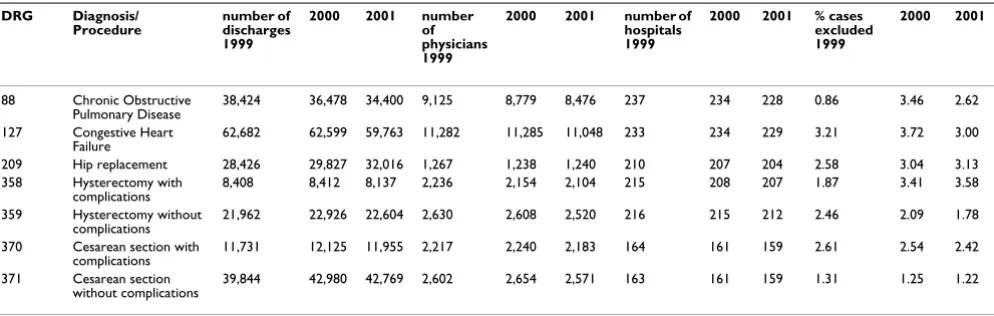
We used 1999, 2000 and 2001 SPARCS-data and seven DRGs were studied: two medical (DRGs 88 and 127: Chronic Obstructive Pulmonary Disease and Congestive Heart Failure), one surgical (DRG 209: hip replacement) and four obstetrical (DRGs 358, 359, 370 and 371: hyster-ectomy with and without complications, cesarean section with and without complications). Cases for which no physician was known were omitted (1.3 percent of all cases) and only patients above the age of twenty were included. Patients with extremely long stays (defined as the average length of stay plus 1.96 times the standard deviation) were excluded, which involved a minimum of 0.86% and a maximum of 3.72% of cases per procedure. The study populations for all three years are summarized in Table 1.
Analyses
Each DRG was analyzed separately, with three groups of patients being created within each DRG: one for managed care (HMO, Medicaid HMO and Medicare HMO), one for non-managed care (Blue Cross/Blue Shield, commercial insurance, Medicaid, Medicare) and a group containing all patients not insured or otherwise insured. Mean age for the managed care patients is 47.9 years, for the non-man-aged care patients 61.1 years, and for all other patients 49.5 years. The percentages of managed care patients for each DRG are fourteen for COPD, fourteen for CHF, twenty-one for total hip, thirty-eight for hysterectomy with complications, thirty-eight for hysterectomy without complications and thirty-seven and forty for Cesarean sec-tion with and without complicasec-tions respectively.
Multi-level analysis was used to examine the differences in length of stay between the managed and the non-man-aged care groups, thus acknowledging the fact that patients are hierarchically nested within physicians and physicians within hospitals [24]. We controlled for age, sex, race and co-morbidities. Characteristics of the physi-cian included in the analysis were the proportion of patients insured under a managed care system (range 0– 1), the number of hospitals in which the physician prac-tices (range 1–7) and the number of insurers (range 1–10) that was dealt with. Hospital characteristics that were included were the proportion of patients insured under a managed care system (range 0–0.6) and the number of insurers (range 1–12). All variables are centered. Further-more, we controlled for differences in insurance programs between counties by adding county as a level to our model. The model consists of four levels, viz. the level of the patient, the physician, the hospital and the (hospital) county. Separate models were fit for each year. Table 2 shows how the different hypotheses were tested. The vari-ance is used as a measure of variation.
Results
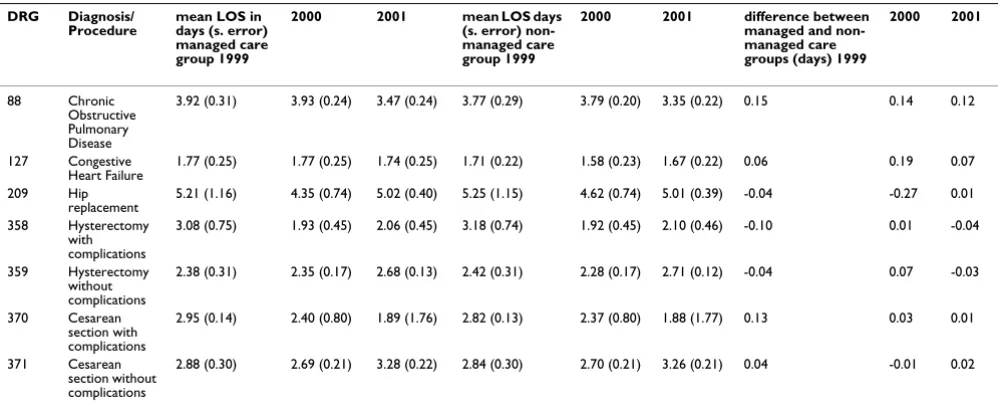
Table 3 shows the mean length of stay for the managed and the non-managed care groups for each DRG. Length of stay for the managed care group is slightly shorter in two out of seven cases. The differences are very small, however, being even less than the half-day that is the min-imum to save costs. The hypothesis (1) is not confirmed.
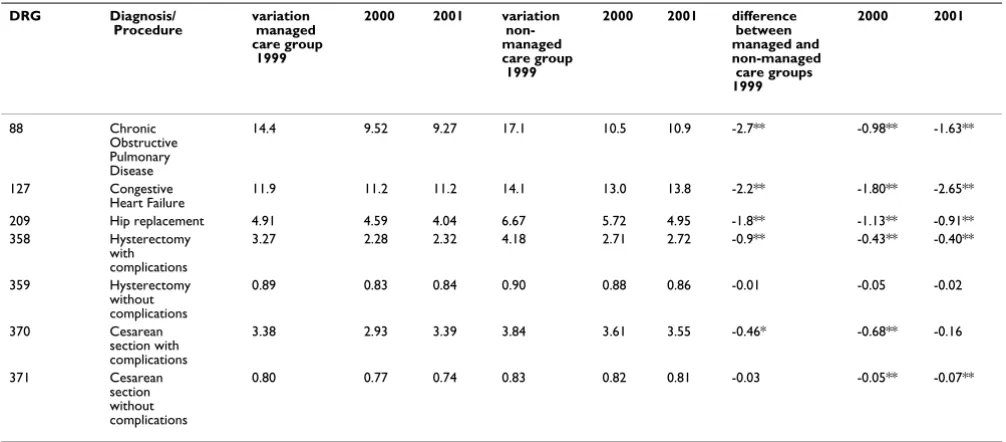
[image:4.612.58.555.100.258.2]Table 4 shows the variation in length of stay for the man-aged and non-manman-aged care groups for each DRG. The variation within the managed care group is significantly smaller for five out of seven DRGs, which is consistent with the hypothesis (2). Most of the variation between managed and non-managed care groups can be found at patient level.
Table 1: Study population: number of patients, physicians, hospitals and percentage of excluded cases per DRG 1999, 2000, 2001
DRG Diagnosis/ Procedure
number of discharges 1999
2000 2001 number of physicians 1999
2000 2001 number of hospitals 1999
2000 2001 % cases excluded 1999
2000 2001
88 Chronic Obstructive Pulmonary Disease
38,424 36,478 34,400 9,125 8,779 8,476 237 234 228 0.86 3.46 2.62
127 Congestive Heart Failure
62,682 62,599 59,763 11,282 11,285 11,048 233 234 229 3.21 3.72 3.00
209 Hip replacement 28,426 29,827 32,016 1,267 1,238 1,240 210 207 204 2.58 3.04 3.13
358 Hysterectomy with
complications 8,408 8,412 8,137 2,236 2,154 2,104 215 208 207 1.87 3.41 3.58
359 Hysterectomy without
complications 21,962 22,926 22,604 2,630 2,608 2,520 216 215 212 2.46 2.09 1.78
370 Cesarean section with
complications 11,731 12,125 11,955 2,217 2,240 2,183 164 161 159 2.61 2.54 2.42
371 Cesarean section
The difference in the variation for the managed and non-managed care groups at hospital level and at physician level is measured as a ratio (the variation of the managed care group divided by the variation of the non-managed care group). The ratio is one if the variation for both groups is the same, less than one if the variation of the managed care group is smaller, and greater than one if the variation of the managed care group is greater than the variation of the non-managed care group. If the difference
[image:5.612.47.556.100.338.2]in variation between the managed and the non-managed care groups is insignificant, the ratio is set at 1. A differ-ence in variation between the two groups is found only at physician level for DRG 88, Chronic Obstructive Pulmo-nary Disease, (1.43, p < 0.1), DRG 127, Congestive Heart Failure, (0.71, p < 0.1), DRG 209, hip replacement, (0.73, p < 0.05), and DRG 370, Cesarean section with complica-tions, (3.44, p < 0.1). These results do not provide une-quivocal evidence indicating that the variation within the
Table 2: Description of the hypothesis testing
Hypothesis Description Method of testing
1 shorter length of stay managed care mean length of stay for the managed care and the non-managed care group are compared
2 less variation length of stay managed care variation in length of stay for the managed care and the non-managed care group are compared
3 influence managed care at physician level the variation for the managed care group and the non-managed care group at physician level is compared to the variation for both groups at hospital level 4 shorter length of stay, less variation when
more managed care patients per physician
the regression coefficient for the proportion of managed care patients per physicians is examined as well as the covariance between this proportion and the variation in length of stay; both are expected to be negative
5 shorter length of stay, less variation when more managed care patients per hospital
the regression coefficient for the proportion of managed care patients per hospital is examined as well as the covariance between this proportion and the variation in length of stay; both are expected to be negative.
6 fewer insurers per physician, less variation in length of stay
the covariance between the number of insurers per physician and the variation in length of stay is examined and expected to be positive.
7 fewer insurers per hospital, less variation in length of stay
the covariance between the number of insurers per hospital and the variation in length of stay is examined and expected to be positive.
8 fewer different hospitals per physician, less variation in length of stay
the covariance between the number of hospitals per physician and the variation in length of stay is examined and expected to be positive.
9 DRGs that can be standardized show less variation
variation for all DRGs is compared, most variation is expected in medical DRGs and DRGs with complications
Table 3: Mean length of stay (LOS) for managed and non-managed care groups for each DRG
DRG Diagnosis/
Procedure mean LOS in days (s. error) managed care group 1999
2000 2001 mean LOS days (s. error) non-managed care group 1999
2000 2001 difference between managed and non-managed care groups (days) 1999
2000 2001
88 Chronic
Obstructive Pulmonary Disease
3.92 (0.31) 3.93 (0.24) 3.47 (0.24) 3.77 (0.29) 3.79 (0.20) 3.35 (0.22) 0.15 0.14 0.12
127 Congestive
Heart Failure 1.77 (0.25) 1.77 (0.25) 1.74 (0.25) 1.71 (0.22) 1.58 (0.23) 1.67 (0.22) 0.06 0.19 0.07
209 Hip
replacement 5.21 (1.16) 4.35 (0.74) 5.02 (0.40) 5.25 (1.15) 4.62 (0.74) 5.01 (0.39) -0.04 -0.27 0.01 358 Hysterectomy
with complications
3.08 (0.75) 1.93 (0.45) 2.06 (0.45) 3.18 (0.74) 1.92 (0.45) 2.10 (0.46) -0.10 0.01 -0.04
359 Hysterectomy without complications
2.38 (0.31) 2.35 (0.17) 2.68 (0.13) 2.42 (0.31) 2.28 (0.17) 2.71 (0.12) -0.04 0.07 -0.03
370 Cesarean section with complications
2.95 (0.14) 2.40 (0.80) 1.89 (1.76) 2.82 (0.13) 2.37 (0.80) 1.88 (1.77) 0.13 0.03 0.01
371 Cesarean section without complications
[image:5.612.55.554.375.580.2]managed care group is smaller than the variation within the non-managed care group at physician level, and the hypothesis is not confirmed (3). There are no differences between the variations for both groups at hospital level for all DRGs.
[image:6.612.54.557.100.321.2]Table 5 summarizes the regression coefficients and the covariances for the different variables. All four significant regression coefficients for the proportion of HMO patients per physician show that the higher the propor-tion of managed care patients that physicians have, the shorter the length of stay. The covariance shows the rela-tion between the proporrela-tion of managed care patients and
Table 4: Variation in length of stay for managed and non-managed care groups for each DRG
DRG Diagnosis/ Procedure
variation managed care group 1999
2000 2001 variation non-managed care group 1999
2000 2001 difference between managed and non-managed care groups 1999
2000 2001
88 Chronic
Obstructive Pulmonary Disease
14.4 9.52 9.27 17.1 10.5 10.9 -2.7** -0.98** -1.63**
127 Congestive
Heart Failure
11.9 11.2 11.2 14.1 13.0 13.8 -2.2** -1.80** -2.65**
209 Hip replacement 4.91 4.59 4.04 6.67 5.72 4.95 -1.8** -1.13** -0.91**
358 Hysterectomy
with complications
3.27 2.28 2.32 4.18 2.71 2.72 -0.9** -0.43** -0.40**
359 Hysterectomy
without complications
0.89 0.83 0.84 0.90 0.88 0.86 -0.01 -0.05 -0.02
370 Cesarean
section with complications
3.38 2.93 3.39 3.84 3.61 3.55 -0.46* -0.68** -0.16
371 Cesarean
section without complications
0.80 0.77 0.74 0.83 0.82 0.81 -0.03 -0.05** -0.07**
[image:6.612.56.555.391.610.2]*p < 0.05 ** p < 0.001
Table 5: Effects on length of stay; relevant regression coefficients (RC) and covariance with the managed care group (COV, whether this coefficient is positive or negative) for each variable per DRG.
DRG Diagnosis/ Procedure
HMO patients per physician
HMO patients per hospital number of insurers per physician
number of insurers per hospital
number of hospitals per physician
RC COV RC COV COV COV COV
88 Chronic Obstructive Pulmonary Disease
-0.22 pos 0.48 neg** pos neg pos*
127 Congestive Heart Failure
0.03 pos** 0.46 neg pos pos pos
209 Hip replacement -0.97** neg** -1.60** neg** pos** neg pos** 358 Hysterectomy with
complications
-0.25** neg -0.25 pos pos* pos pos*
359 Hysterectomy without complications
-0.08 neg** 0.49* neg pos** pos pos
370 Cesarean section with complications
-0.29* pos* 0.78 pos* pos pos** neg**
371 Cesarean section without complications
-0.08** neg 0.59* pos pos** pos* neg
the variation in length of stay for managed care patients. Two significant covariances have a negative sign, which means that variation between physicians is lower when the proportion of managed care patients is higher; two other significant covariances show the opposite. The hypothesis is not confirmed (4).
The significant regression coefficients for the proportion of managed care patients per hospital show that length of stay is higher when the proportion of managed care patients is higher. Our hypothesis is not confirmed. The significant covariances show opposite effects. The hypoth-esis is not confirmed (5).
As expected, variation in length of stay is higher when the number of insurers per physician is higher (hypothesis 6). We found two significant covariances for the influence of the number of insurers per hospital, indicating a higher variation when the number of insurers is higher. This is consistent with the hypothesis (7). Covariances for the number of hospitals in which a physician practices show that the variation in length of stay is higher for three DRGs and is lower for another DRG when a physician practices in more hospitals. The hypothesis (8) is not confirmed.
We compared variation for the seven DRGs to test the last hypothesis (9) on whether variation in length of stay will be less when treatment is easy to standardize. The compar-ison shows (Table 4) that variation is smallest for DRGs 359 and 371, which are the obstetrical DRGs without complications and are DRGs that can be standardized. Variation is greatest in the medical DRGs (88 and 127), which are less easy to standardize. This is true for both the managed care patients and the non-managed care patients. The hypothesis (9) is confirmed.
Conclusions and discussion
In this study, we found no difference in length of stay between managed and non-managed care patients. Fur-thermore, it appeared that there was less variation in
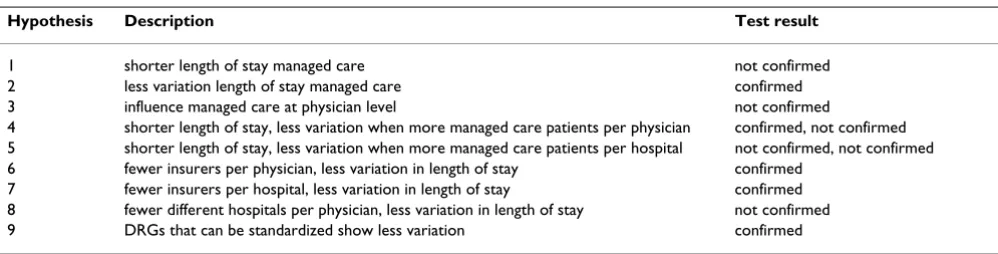
length of stay for managed care patients. All results are summarized in Table 6. Contrary to our expectations, this difference is not primarily found at physician level, nor is it found at hospital level. It is found at patient level, how-ever, which means that patients with managed care insur-ance plans differ from patients with non-managed care insurance plans. This implies the existence of some sort of selection; patients insured under a managed care system are more similar than other patients.
[image:7.612.55.554.98.225.2]Selection by managed care insurance plans has been found in some other studies, which conclude that the managed care insured are younger and healthier [20,25,26]. The mean age of the managed care patients in this study is 47.9 years, while this is 61.1 years for the non-managed care patients. Fourteen percent of the CHF-patients are insured under a managed care plan, whereas this applies to forty percent of the patients with a Cesarean section. There is less variation for procedures that are easy to standardize, such as those where no complications occur, irrespective of the type of insurance.
The question that comes to the fore is how unmanaged is non-managed care? New York State has lower managed care penetration than the US-average and approximately ten percent of patients are covered by a managed care pro-gram, which suggests two possibilities. One is that utiliza-tion controls for these plans are more aggressive and that there are greater differences in utilization between them, because managed care penetration is so low. This was obviously not the case, however. A more plausible expla-nation is that the need to compete and limit managed care penetration has caused traditional insurance plans to adopt many of the techniques used in managed care.
Yet another possibility, is that the management of care in United States hospitals is increasingly provider-driven. In this context, hospitals will apply utilization controls to all payors to reduce expenses, rather than to individual groups of patients. This point has a major application to
Table 6: Results of the hypothesis testing
Hypothesis Description Test result
1 shorter length of stay managed care not confirmed 2 less variation length of stay managed care confirmed 3 influence managed care at physician level not confirmed
4 shorter length of stay, less variation when more managed care patients per physician confirmed, not confirmed 5 shorter length of stay, less variation when more managed care patients per hospital not confirmed, not confirmed 6 fewer insurers per physician, less variation in length of stay confirmed
lengths of stay in New York State, where since 1986 all payors have reimbursed hospitals on a per discharge basis, rather than by the day. This means that hospitals have an incentive to reduce expenses for all payors, rather than simply those regarded as managed care plans.
Some hospitals employ case managers who do the dis-charge planning for all patients in the hospital, using benchmarks such as clinical pathways, criteria to deter-mine necessity of admission or length of stay parameters. A hospital may compare its length of stay to similar hos-pitals in California, which generally have a shorter length of stay for the same diagnosis. This case management does not take into account whether a patient is under a man-aged care or a non-manman-aged care program. Where an insurer is concerned, it can be highly effective to put pres-sure on a hospital and to let the hospital, in its turn, put pressure on the physicians. Length of stay or other requirements can be included in contracts between insurer and hospital, obliging the hospital to report to the insurer on the clinical care rendered by physicians or oth-ers. In order to avoid unnecessary utilization or losing a contract, it can be worth the effort for the hospital to employ case managers. Hospital norms can be communi-cated to physicians, patients and others involved in care, to ensure that hospital expectations regarding length of stay can be met. If the hospitals set their length of stay norm below that of all insurers and manage discharge effectively, there will be no difference in length of stay related to type of insurance. Since some insurers are more effective in length of stay management than hospital case management, some insurers will employ nurses in the hospital to manage for them. In these cases, insurance-related differences are possible.
In this study, there was a difference in the effect of the pro-portion of managed care patients on the physicians and on the hospitals. Where physicians are concerned, length of stay is shorter when this proportion is higher, but this effect was not found in hospitals. This means that physi-cians' length of stay choice is influenced by the insurer, while the hospital does not change its policy. The proportion of managed care patients does not have an unequivocal effect on the variation in both physicians and hospitals, indicating that there is no insurer effect.
The hypothesis that there is more variation when physi-cians practice in many hospitals is not confirmed. The option of treating patients in another hospital does not influence variation in length of stay for managed care patients, which would seem to be an effect of the insurer in combination with less variation when the number of insurers is lower.
Contrary to our study, insurance and payment were found to have a significant influence on length of stay in the studies mentioned in the introduction [17,19,20], which compared several types of insurance. Ordinary least squares regression was used to measure effects on length of stay, thus neglecting the fact that data are on different levels of aggregation. Hospital characteristics were also assigned to the patient level and when regression coeffi-cients of hospital characteristics are assigned to the patient level, the units of analysis are considered to be independ-ent observations. Patiindepend-ents are hierarchically nested within hospitals, however, and so the assumption of independ-ent observations is not correct. As a consequence, differindepend-ent levels of analysis should be taken into account by using multi-level analysis [24]. Furthermore, it is important to recognize the fact that there are considerable inter-state differences between insurance programs with the same name. Medicaid in one state is different to Medicaid in another state for instance, and these must therefore be considered as different programs, or analyses have to be made for individual states.
Bradbury et al [18] compared a specific type of HMO with traditional insurance programs by hospital, thus keeping hospital characteristics constant. Due to the fact that there had to be enough admissions of both types of insurance to a hospital for ordinary regression analysis to be possi-ble, only ten (of the initial 78) hospitals were included in the analyses, a problem that could have been overcome with multi-level analysis. Results showed that for this spe-cific type of HMO (the independent practice association or IPA), length of stay is shorter than for patients insured under a traditional program. In addition to using a different methodology that might lead to different out-comes, all studies were carried out in the eighties and early nineties. The potential impact of the evolution of tradi-tional insurance plans to include managed care tech-niques should not be discounted, and the terms traditional insurance and managed care plans may have become anachronisms in this context. This study may sug-gest the need for a more sophisticated approach to the subject, focusing on the impact of specific utilization management techniques.
Policy makers believe that managed care reduces costs without affecting the quality of health care. Nevertheless, it is open to question whether a cost reduction that pro-vides less care and involves shorter lengths of stay truly does not affect the quality of care. Evidence of cost reduc-tion is found in the short length of stay that is experienced in the United States, although it remains unclear whether this short length of stay is an effect of managed care or possibly of something else in the system. Furthermore, health care costs in the United States have continued to rise, despite the increasing number of managed care insured. This might be caused by the high costs that come with managed care systems, such as the costs of monitor-ing, or it may be due to increasing costs of medication, supplies, and various treatments. Some medications and treatments are still considered experimental, causing research and development costs to increase. Additionally, competing companies may develop similar drugs and treatments, each vying for use. The increases in United States health care costs could also be a pricing issue. In order to survive, hospitals may be raising prices and reducing expenses to order to keep up with payors [29]. It is also easy to lose sight of some (negative) effects of man-aged care that will come to the fore when elements from the health care system in the United States are transferred to European countries, since analyses of international health care policy have demonstrated that elements from one system cannot simply be transferred to a different sys-tem [30,31].
Managed care fits into the role of sickness funds in Euro-pean social health insurance systems. Dutch sickness funds have a lot in common with HMOs for example; there is a contract with providers, providers receive a budget, a primary care physician is obligatory for the insured and monitoring of providers is common [32]. Experiments with HMOs are taking place in Switzerland [33,34] and there is interest in Germany in what is called "Integrierte Versorgung", which is networks of health care providers that receive a budget from sickness funds [32]. These can also be compared to HMOs.
In this study, we did not find evidence that it is managed care that has an effect on length of stay and thus on costs related to inpatient days. There seems to be something else that is causing the short length of hospital stay in the United States, independently of the patient's insurance.
What we found is that it is not restrictions imposed by the insurer that result in patterns of variation, since there are hardly any differences in length of stay of managed care and non-managed care patients. It might be the case that hospitals respond to the way they are paid; payment per DRG means that it is always (cost) efficient to keep length of stay short. Or it may be that the knowledge that
man-aged care is on the increase is causing hospitals to react in advance by developing strategies to make sure that they will have (managed care) patients in the future [35].
Competing interests
None declared.
Authors' contributions
JdJ performed the statistical analyses, drafted the manu-script and contributed to all other aspects of the study. GW contributed to the acquisition of data and partici-pated in the design of the study, the critical revision of the manuscript and its supervision. ChN contributed to the critical revision of the manuscript. PG participated in the design of the study, the critical revision of the manuscript and its supervision. All authors have given final approval of the submitted manuscript.
References
1. Bachman KH, Freeborn DK: HMO physicians' use of referrals.
Soc Sci Med 1999, 48:547-57.
2. Donelan K, Blendon RJ, Lundberg GD, Calkins DR, Newhouse JP, Leape LL, Remler DK, Taylor H: The new medical marketplace: physicians' views.Health Aff 1997, 16(5):139-48.
3. Eisenberg JM: The state of research about physicians' practice patterns.Med Care 1985, 23(5):461-483.
4. Greenfield S, Nelson EC, Zubkoff M, Manning W, Rogers W, Kravitz RL, Keller A, Tarlov AR, Ware JE Jr: Variations in resource utili-zation among medical specialties and systems of care.
Results from the medical outcomes study. JAMA 1992,
267(12):1624-30.
5. Langley GR, MacLellan AM, Sutherland HJ, Till JE: Effect of nonmed-ical factors on family physicians' decisions about referral for consultation.CMAJ 1992, 147(5):659-66.
6. Weiner JP, De Lissovoy G: Razing a Tower of Babel: A taxon-omy for managed care and health insurance plans.J Health Polit Policy Law 1993, 18(1):75-103.
7. Scott WR, Ruef M, Mendel PJ, Caronna CA: Institutional change and healthcare organizations. From professional dominance to managed care.Chicago: The university of Chicago press; 2000. 8. Schut FT: Health Maintenance Organizations.Lochem-Gent: De
Tijdstroom; 1986.
9. HIAA: Source book of health insurance data 1999–2000. Wash-ington: Health Insurance Association of America; 1999.
10. AMA: Principles of Managed Care.American Medical Association, Council on Medical Service 1999.
11. Mechanic D: Managed care and the imperative for a new pro-fessional ethic.Health Aff 2000, 19(5):100-111.
12. Simon CJ, Dranove D, White WD: The effect of managed care on the incomes of primary care and specialty physicians.
Health Serv Res 1998, 33(3):549.
13. Kerr EA, Mittman BS, Has RD, Siu AL, Leake B, Brook RH: Managed care and capitation in California: how do physicians at finan-cial risk control their own utilization? Ann Intern Med 1995,
123:500-4.
14. Arnould R, DeBrock L: Utilization Control in HMOs.Faculty work-ing paper 90–1698University of Illinois; 1990.
15. Fairfield G, Hunter DJ, Mechanic D, Rosleff F: Managed care: Impli-cations of managed care for health systems, clinicians and patients.BMJ 1997, 314:1895-8.
16. Fairfield G, Hunter DJ, Mechanic D, Rosleff F: Managed care: Ori-gins, principles and evolution.BMJ 1997, 314:1823-6.
17. Shi L: Patient and Hospital characteristics associated with average length of stay.Health Care Manage Rev 1996, 21(2):46-61. 18. Bradbury RC, Golec JH, Stearns FE: Comparing hospital length of stay in independent practice association HMOs and tradi-tional insurance programs.Inquiry 1991, 28:87-93.
Publish with BioMed Central and every scientist can read your work free of charge "BioMed Central will be the most significant development for disseminating the results of biomedical researc h in our lifetime."
Sir Paul Nurse, Cancer Research UK
Your research papers will be:
available free of charge to the entire biomedical community
peer reviewed and published immediately upon acceptance
cited in PubMed and archived on PubMed Central
yours — you keep the copyright
Submit your manuscript here:
http://www.biomedcentral.com/info/publishing_adv.asp
BioMedcentral
20. Miller RH, Luft HS: Managed care plan performance since 1980. A literature analysis.JAMA 1994, 271(19):1512-9.
21. Shortell SM: Effective hospital-physician relationships. Ann Arbor: Health Administration Press Perspective; 1991.
22. Burns LR, Wholey DR: The effects of patient, hospital, and phy-sician characteristics on length of stay and mortality.Med Care 1991, 29(3):251-271.
23. U.S. Department of Health and Human Services, Centers for Disease Control: Health, United States, 2000.Washington, D.C.: U.S. Gov-ernment Printing Office; 1991.
24. Snijders TAB, Bosker RJ: Multilevel Analysis. An introduction to
basic and advanced multilevel modeling. London: Sage
Publications; 1999.
25. Block LE: Evolution, growth and status of managed care in the United States.Public Health Rev 1997, 25:193-244.
26. Hellinger FJ: Selection bias in HMOs and PPOs: a review of the evidence.Inquiry 1995, 32:135-142.
27. Erdmann Y, Wilson R: Managed Care: A view from Europe.Annu Rev Public Health 2001, 22:273-291.
28. Robinson R: Managed Care: US evidence and lessons for Europe.Eurohealth 1998, 4(2):33-34.
29. Anderson GF, Reinhardt UE, Hussey PS, Petrosyan V: It's prices, stupid: why the United States is so different from other countries.Health Aff 2003, 22(3):89-103.
30. Kimberley JR, De Pouvourville G: The migration of managerial innovation.San Francisco: Jossey Bass; 1993.
31. Ros CC, Groenewegen PP, Delnoij DMJ: All rights reserved, or can we just copy? Cost sharing arrangements and character-istics of health care systems.Health Policy 2000, 52:1-13. 32. Groenewegen PP, De Jong JD, Kerssens JJ: Voorkeursaanbieders:
selectief contracteren in het nieuwe verzekeringsstelsel.
Utrecht: Nivel 2002.
33. Colombo F: Towards more choice in social protection?: indi-vidual choice of insurer in basic mandatory health insurance in Switzerland.Labour market and social policy; 53 Paris: OECD 2001. 34. European Observatory on Health Care Systems: Health Care
Sys-tems in transition.Switzerland WHO 2000.
35. Zhang N, Kohn L, McGarrah R, Anderson G: The effect of man-aged care on hospital staffing and technological diffusion.
Health Policy 1999, 48:189-205.
Pre-publication history
The pre-publication history for this paper can be accessed here: