S H O R T R E P O R T
Open Access
Gene expression profiling of oxidative stress
response of
C. elegans
aging defective AMPK
mutants using massively parallel transcriptome
sequencing
Heesun Shin
1,3†, Hyojin Lee
2†, Anthony P Fejes
1, David L Baillie
3, Hyeon-Sook Koo
2, Steven JM Jones
1*Abstract
Background:A strong association between stress resistance and longevity in multicellular organisms has been established as many mutations that extend lifespan also show increased resistance to stress. AAK-2, theC. elegans homolog of an alpha subunit of AMP-activated protein kinase (AMPK) is an intracellular fuel sensor that regulates cellular energy homeostasis and functions in stress resistance and lifespan extension.
Findings:Here, we investigated global transcriptional responses ofaak-2mutants to oxidative stress and in turn identified potential downstream targets of AAK-2 involved in stress resistance inC. elegans. We employed massively parallel Illumina sequencing technology and performed comprehensive comparative transcriptome analysis. Specifically, we compared the transcriptomes ofaak-2and wild type animals under normal conditions and conditions of induced oxidative stress. This research has presented a snapshot of genome-wide transcriptional activities that take place inC. elegansin response to oxidative stress both in the presence and absence of AAK-2. Conclusions:The analysis presented in this study has enabled us to identify potential genes involved in stress resistance that may be either directly or indirectly under the control of AAK-2. Furthermore, we have extended our current knowledge of general defense responses ofC. elegansagainst oxidative stress supporting the function for AAK-2 in inhibition of biosynthetic processes, especially lipid synthesis, under oxidative stress and transcriptional regulation of genes involved in reproductive processes.
Background
A growing body of research has revealed an association between stress resistance and longevity in multicellular organisms as many mutations that extend lifespan also increase stress resistance [1-3]. Understanding the cellu-lar response to stress should therefore present signifi-cant insight into lifespan control.
The 5-AMP-activated protein kinase (AMPK), a ubi-quitously expressed, multi-substrate serine/threonine protein kinase, is an intracellular fuel sensor. AMPK is activated when phosphorylated due to the depletion of ATP relative to AMP [4] that are resulted by various
environmental or metabolic stresses caused by condi-tions such as heat shock, hypoxia, and low glucose [5], and AMPK mediates its effect by regulating the tran-scription of downstream genes by directly phosphorylat-ing transcription factors and coactivators [6-8]. The main function of AMPK as a ‘metabolic switch’ is to maintain cellular energy homeostasis by up-regulating the pathways that produce ATP while down-regulating energy-consuming anabolic processes [4,5,9].
C. elegans AAK-1 and AAK-2 are the two homologs
of the catalytic alpha subunit of mammalian AMPK. AAK-1 is identified to be required for negative regula-tion of germline proliferaregula-tion during dauer development [10]; though no significant phenotype in relation to life-span control has been reported. AAK-2 is however, known to mediate the long-term survival of dauer lar-vae.aak-2dauer stage animals do not demonstrate the * Correspondence: [email protected]
†Contributed equally
1
Genome Sciences Centre, BC Cancer Agency, Suite 100 570 West 7th Avenue, Vancouver, British Columbia, Canada V5Z 4S6
Full list of author information is available at the end of the article
normal stress-resistant and long-lived phenotype in unfavorable conditions such as starvation or crowding [10-12]. AAK-2 is required for proper fat metabolism and osmoregulation for survival of dauer larvae [11] and is also involved in germ cell cycle arrest upon dauer entry [10].
Moreover, it has been shown that over-expressing aak-2 increases lifespan by 13% relative to wild type while disruption of aak-2 reduces the lifespan by 12% compared to wild type [13]. In addition to these findings we have previously demonstrated that in vivo induction of oxidative stress in AAK-2 deficient animals by treat-ment with paraquat (1,1’-dimethyl-4, 4’-bipyridinium dichloride) results in a significantly lower survival rate than wild type [14].
Oxidative stress induces a wide range of cellular responses by producing reactive oxygen species (ROS). Low doses of ROS are known to promote cell prolifera-tion and extend lifespan and medium doses may cause senescence while high levels of oxidative stress result in cell death [15]. These outcomes are known to depend partly on intracellular stress signaling pathways that are activated in response to oxidative stress and as a conse-quence of direct damage to DNA, proteins, and lipids. These cellular injuries and signaling mechanisms directly or indirectly modulate transcription factor activ-ities resulting in changes to gene expression profiles. Some of these signaling pathways are involved in survi-val, while others are linked with cell death [16,17].
Given that AMPK regulates transcriptional responses, the loss of transcriptional regulation of some gene tar-gets of AAK-2 might contribute to the hypersensitivity to oxidative stress observed in aak-2mutants in addi-tion to indirect consequences of the absence of AAK-2 functions. Global searches for targets of theaak-2 path-way by transcriptome profiling should therefore provide new AMPK targets of which only a small number is known and insight into the regulatory functions of AAK-2 in stress resistance and lifespan control in C. elegans.
The advent of massively parallel next generation sequencing technologies has facilitated the production of high coverage sequence data enabling genome wide assays of transcriptional activities. The high-throughput sequencing, specifically Illumina sequencing technology, has been shown to be highly replicable and proven to be a superior method to study mRNA expression levels in its ability to identifying differentially expressed genes compared to existing array technologies [18]. Also, the strength of such method has been demonstrated in a recent study by Hillier et al. which used Illumina sequencing technology forC. elegansstage specific tran-scriptome analysis including stage specific differential gene expression analysis [19]. Additionally, the whole
transcriptome sequencing allows detection of low-expressed genes and novel transcripts or alternative splice variants while the usage of the array technology is limited to identifying differential gene expression of pre-viously identified genes [18]. Also, sequencing provides absolute abundance of mRNAs whereas the array tech-nology measures relative abundance and there is poten-tial for cross-hybridization.
Here, we have performed‘whole transcriptome shot-gun sequencing (WTSS)’ using Illumina sequencing technology [20], to identify C. elegansgenes that were differentially expressed betweenaak-2mutants and wild type, in the presence or absence of paraquat induced oxidative stress.
Results
We undertook a global comparative analysis of tran-scriptomes from aak-2 and wild type animals under both normal conditions and conditions of oxidative stress, in order to identify differences between gene expression profiles. Specifically, we compared transcrip-tomes from stressed wild type and stressed aak-2 mutants and aak-2 mutants under normal conditions against an unstressed wild type (N2) transcriptome. We used gene expression levels in unstressed wild type tran-scriptome as the baseline/control and compared the gene expression levels in the other three transcriptomes against this baseline to identify genes with differential expression in each sample relative to wild type, and sub-sequently, compared the groups of differentially expressed genes relative to unstressed wild type between the transcriptomes (Unstressed wild type is referred sim-ply as wild type from this point, and gene expression change measures are all relative to wild type).
In order to identify statistically significant changes in gene expression, we calculated Audic Claverie p-values [21] for each pair-wise comparison of the samples against wild type. Sequence read numbers were normal-ized for each gene, first by its length, given that the sequence reads showed a fairly even distribution, and subsequently by the total read numbers of each sample. We selected genes with p-values less than 0.01, and the minimum of ~1.5-fold difference (i.e. log2 (normalized
from one to over 100,000 reads. Approximately 85% of C. eleganstranscripts were identified by the sequence reads in each library.
We then performed Q-PCR to confirm some of gene expression level changes measured by sequencing. We chose 20 genes that showed significant up or down-regulation in stressed aak-2mutants compared to wild type but showed insignificant expression changes in stressed wild type animals relative to wild type. For this validation, we prepared new RNA samples which can serve as biological replicates as well. The Q-PCR result shows overall good agreement in gene expression pro-files and changes with the WTSS data as shown in Additional File 2 which validates our approach.
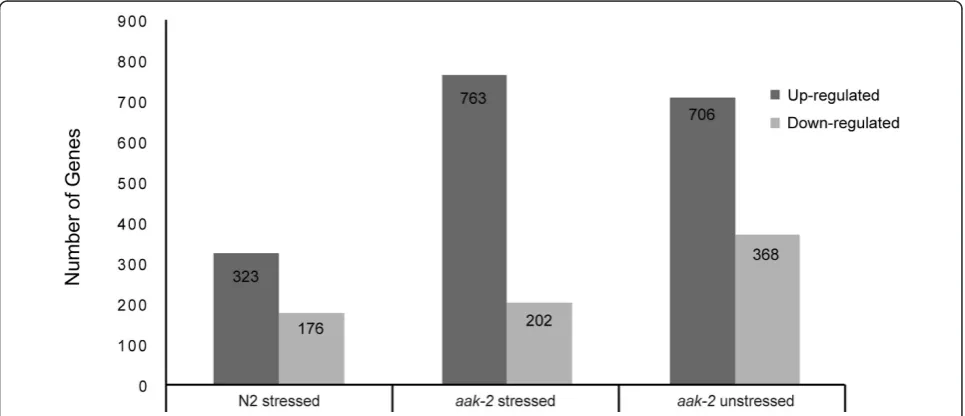
[image:3.595.57.540.486.694.2]Oxidative stress response of wild type (N2) animals We first examined the transcriptional changes in wild type animals after exposure to paraquat induced oxida-tive stress. Using the statistical method discussed above, we identified 499 genes whose expression was signifi-cantly changed. Of the 499 differentially expressed genes, 323 were up-regulated and 176 down-regulated (Figure 1). In order to identify over represented func-tions associated with the differentially expressed genes, we used GOstat [22], a tool to categorize gene ontology annotations and generate the statistics of over repre-sented terms.
Genes involved in stress response and aging are up-regulated in wild type animals under oxidative stress
As expected, stress response and aging related genes were up-regulated in stressed animals, including several heat shock protein genes (hsp-16.1, hsp-16.11, hsp-16.2,
hsp-16.41, hsp-16.48, hsp-16.49), genes involved
in oxidative phosphorylation and ATP synthesis (atp-2, H28O16.1, F58F12.1, vha-1, vha-2, vha-4, vha-8, vha-11, vha-15), and genes involved in aging (acdh-1, mca-3, ppn-1, cct-5, T27F7.3, T27F7.1, rab-1, cgh-1, F59E10.3, T02H6.11, C30C11.4,cpr-1, ifb-1, dod-6). The most highly represented group of genes up-regulated in response to oxidative stress were however genes encoding collagens, approximately 50 of which were sig-nificantly up-regulated in these animals. Several hedge-hog-like proteins (grl-16, grl-4, grl-7, wrt-4, wrt-10) were also up-regulated, as were thedaf-2anddaf-16regulated genesdao-2, dao-4, anddao-5(Additional File 3). The most significantly over represented GO terms associated with up-regulated genes in wild type in response to oxi-dative stress are shown in Additional File 4: Supplemen-tary Table S3a.
Biosynthetic and reproductive processes are down-regulated in wild type animals under oxidative stress
Genes that were significantly down-regulated in wild type animals under oxidative stress (Additional File 5) include histones (his) and ribosomal proteins (rps, rpl). Reduced histone and ribosomal protein gene transcrip-tion indicates that biosynthetic processes such as tran-scription and translation are down-regulated, as histone synthesis is dependent on ongoing DNA replication [23]. Other down-regulated genes involved in mRNA metabolic processes include gut-2, lin-40, lsm-5, lsm-6, mxl-1, nhr-37, andrab-18. Genes involved in reproduc-tion were also down-regulated as were several genes known to function in the establishment of cellular loca-lization (aps-3, ddp-1, dyrb-1, elc-1, pfd-6) and genes
encoding prosaposins (spp-3, spp-4, spp-5, spp-14, spp-17, spp-23), lipid-binding proteins required for post-embryonic development. The most significantly over represented GO terms (biological processes) associated with the down-regulated genes in wild type in response to oxidative stress are shown in Additional File 4: Sup-plementary Table S3b.
Stress responses ofaak-2mutants in comparison to stress responses of wild type animals
We examined gene expression level changes inaak-2 mutants under conditions of oxidative stress relative to wild type. From this analysis we identified 763 genes that were significantly up-regulated and 202 genes that were significantly down-regulated relative to wild type (Figure 1, Additional File 6). We then compared these differentially expressed genes to transcriptional changes from wild type animals under stress, in order to identify similarities and differences in their responses to the oxi-dative stress.
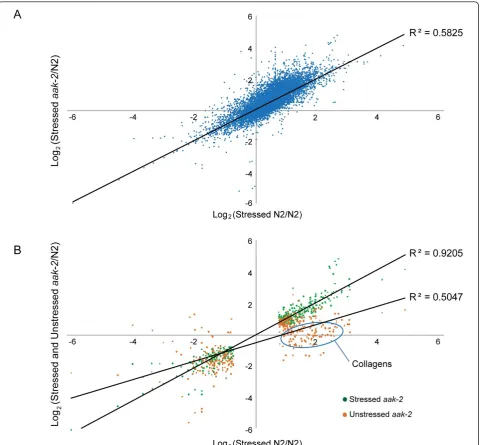
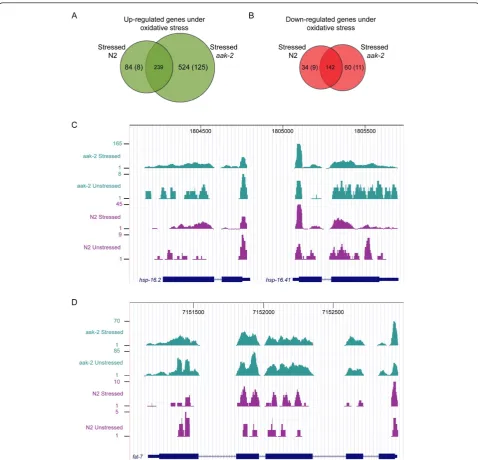
The correlation between expression level changes of all genes in response to oxidative stress in wild type and aak-2mutants is shown in Figure 2A (R2 = 0.58). Figure 2B shows genes commonly up or down-regulated in both wild type andaak-2mutants in response to oxida-tive stress relaoxida-tive to wild type (as indicated in green). This correlation is very high as indicated by the linear regression (R2 = 0.92). 239 up-regulated genes and 142 down-regulated genes were common to both wild type
and aak-2 mutants (Figure 3A, B), and mostly, the
degree of expression level changes of these genes in response to oxidative stress were directly comparable between wild type andaak-2mutants.
Commonly up or down-regulated genes in wild type and aak-2 mutants under oxidative stress - aak-2 mutants display a heightened stress response
The majority of commonly down-regulated genes in stressed wild type andaak-2 mutants are required for translation and transcription including ribosomal pro-teins and histones. Prosaposins are also highly down-regulated in both stressed wild type andaak-2 mutants (Additional File 7).
Most genes up-regulated in wild type animals in response to the oxidative stress were also up-regulated in stressed aak-2 mutants (Additional File 8). Some genes were notably more highly up-regulated in stressed aak-2mutants, including heat shock proteins (hsp-16.1, hsp-16.2, hsp-16.11, hsp-16.41, hsp-16.48, andhsp-16.49) (Figure 3C),acdh-1, a short-chain acyl-CoA dehydro-genase involved in energy generation and lifespan extension [24], and lgg-1, a microtubule-associated anchor protein involved in autophagy and membrane trafficking [25]. Additionallylys-4, lys-5, lys-6, lysozymes known to function in innate immune system [26], were
considerably more highly up-regulated in stressedaak-2 mutants. Finally, collagen genes that were significantly up-regulated in wild type animals were also up-regulated inaak-2 mutants in response to oxidative stress, show-ing slightly elevated overall expression in the stressed
aak-2 population. From this result we conclude
that stressedaak-2mutants demonstrate a more heigh-tened general stress response as transcription of genes involved in stress resistance are more highly up-regulated than in stressed wild type animals.
Differences in stress response between wild type and aak-2 mutants - AAK-2 functions in down-regulating biosynthetic processes in response to oxidative stress
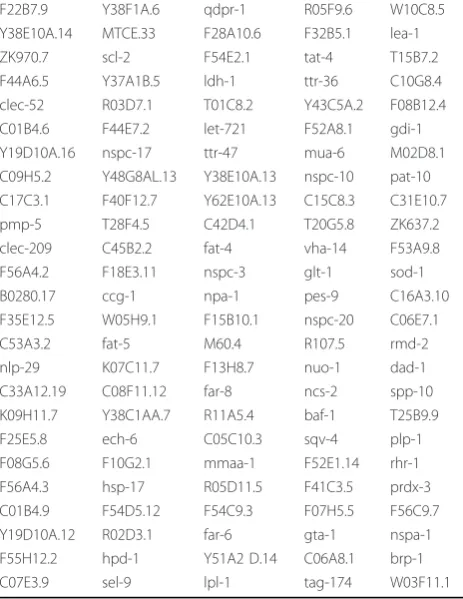
As shown in Figure 3A, there is a subset of 125 genes that are specifically up-regulated in aak-2 mutants under oxidative stress, listed in Table 1. These are the most differentially expressed genes between stressed wild type and stressedaak-2 mutants as they show sig-nificant gene expression level changes in stressed aak-2 mutants relative wild type, but they are either negligible or significantly down-regulated in wild type animals under stress relative to wild type (Additional File 9 lists fold change comparisons for these genes in stressed wild type relative to wild type and stressed aak-2 mutants relative to wild type as well as the gene descriptions). Interestingly, examination of the functionally character-ized genes in this group revealed an up-regulation of specific biosynthetic processes, particularly fatty acid synthesis (Table 2). Notable genes in this case comprise fatty acid desaturases (fat-), and several fatty acid bind-ing proteins (far-) were also up-regulated in aak-2 mutants in response to oxidative stress relative to wild type. Although not statistically significant, it is interest-ing to note that some long chain fatty acid elongases (elo-), especially elo-1, were slightly up regulated in stressedaak-2mutants relative to wild type. Addition-ally, genes involved in coenzyme and amino acid bio-synthesis and genes involved in carbohydrate metabolic process are also up-regulated. These observations may imply that AAK-2 functions in down-regulating these energy consuming biosynthetic processes when animals are under oxidative stress (Additional File 10).
genes specifically down-regulated in stressed aak-2 mutants relative to wild type (cct-8, rpl-25.2, rps-27, F15E11.1, F15E11.14, F15E11.15, F45D11.14, F45D11.15, F45D11.16, K10C2.3, and Y48G8AL.12) were also noted.
These exclusively regulated genes are the most differ-entially regulated genes between stressed wild type and stressed aak-2mutants, and therefore, these genes may
[image:5.595.59.541.88.533.2]be potential downstream targets that are potentially under either direct or indirect control of AAK-2. Many of these genes have no known functions and remain to be characterized. Further investigation of these genes may uncover novel relationships and functions foraak-2 and reveal specific targets ofaak-2that act in the biolo-gical processes that AAK-2 is known to be involved in. Figure 2Comparison of gene expression level changes against oxidative stress between wild type andaak-2mutants.(A)Correlation between gene expression level changes of all genes identified in stressed wild type and stressedaak-2mutants relative to unstressed wild type.
Figure 3Number of commonly or statistically differentially regulated genes in wild type andaak-2mutants in response to oxidative stress and examples.(A)Venn diagram showing numbers of commonly up or(B)down-regulated genes with statistically significant gene expression level changes in wild type andaak-2mutants in response to oxidative stress relative to wild type (overlapping regions) as well as numbers of genes up or down-regulated exclusively in stressed wild type or stressedaak-2mutants relative to wild type (non-overlapping regions). Numbers in brackets indicate genes that showed the most difference in gene expression relative to wild type between the two libraries, stressed wild type and stressedaak-2(i.e. genes that showed significant changes in one library (i.e. Log2ratio relative to wild type
greater or less than |0.7|, p-val < 0.01), but showed negligible changes (i.e. Log2 ratio relative to wild type greater or less than ~|0.3|) or significantly changed in the opposite direction in the other library). For instance, there is a relatively large subset of genes in brackets (125) significantly up-regulated inaak-2mutants in response to oxidative stress but either insignificantly regulated or significantly down-regulated in wild type under oxidative stress.(C)UCSC browser view ofhsp-16.2andhsp-16.41with the sequence reads aligned to the gene models. Four samples (Stressed wild type (N2), Stressedaak-2, Unstressed wild type (N2), Unstressedaak-2) are shown. It is evidenthsp-16.2andhsp-16.41are much more highly expressed in stressed wild type and stressedaak-2mutants compared to unstressed wild type and unstressedaak-2mutants, especially in stressedaak-2mutants. Note: The scales for the minimum and maximum number of reads for the four samples are different.
Differentially regulated genes in unstressedaak-2
mutants compared to wild type animals
A total of 1074 genes showed statistically significant dif-ferential gene expression in unstressed aak-2 mutants when compared to wild type. Among these genes, 706 genes were up-regulated and 368 genes were down-regulated (Figure 1).
Genes involved in stress response, ageing and the germline are up-regulated in unstressed aak-2 mutants relative to wild type
Additional File 11 lists genes that are significantly up-regulated in unstressedaak-2mutants compared to wild type animals and Additional File 12 shows most highly represented biological processes these genes are involved in as analyzed by GOstat. Genes included are those known to be involved in aging and stress responses (acdh-1, cgh-1, dao-5, daf-16, daf-18, fat-7, lin-41, mup-4, mdt-15), heat shock proteins (hsp-16.1, hsp-16.11, hsp-6, hsp25), and vacuolar proton-translocating ATPases (4, 5, vha-8, vha-11, vha-13, vha-14, vha-15, vha-16).
Another interesting group of genes that are highly up-regulated in unstressed aak-2 mutants relative to
wild type are the vitellogenin genes (vit-1 tovit-6), all of which were statistically highly significant differen-tially expressed genes observed between wild type and unstressed aak-2 mutants (Average p-val = 4.05E-42). Finally, a large group of genes involved in reproduction was up-regulated in unstressed aak-2 mutants com-pared to wild type. These genes are involved in gamete generation, oviposition, and regulation of meiosis, oogenesis, sex differentiation, embryonic cleavage, and cell division.
Biosynthetic processes and energy generation are down-regulated in unstressed aak-2 mutants relative to wild type
Many ribosomal protein coding genes and histone genes were down-regulated in unstressed aak-2 mutants, indicating a general down regulation of bio-synthetic processes. Genes involved in translational elongation (rla-2, rla-1, c37a2.7, zk512.4) and mRNA metabolic processes (snr-7, snr-6, lsm-3, lsm-8, gut-2, snr-3, lsm-6, lsm-5, snr-5, and y48g1c.9) were down-regulated. Additionally a large number of major sperm proteins (MSPs) are significantly down-regulated. Other interesting genes down-regulated include prosa-posins (spp-3, spp-4, spp-5, spp-14, spp-17, spp-23), and tin-13, tin-9.1, and ddp-1which are involved in inner mitochondrial membrane organization and bio-genesis and protein import into mitochondrial inner membrane (Additional File 13).
Genes involved in oxidative phosphorylation and generation of energy were also down-regulated in unstressedaak-2mutants relative to wild type (asg-1, atp-4,mtce.4,vha-3,cyc-2.1, tag-174, F26E4.6, Y82E9BR.3, C33A12.1, T27E9.2, F45H10.2, B0035.18, R07E4.3, F29C4.2, Y71H2AM.5, F45H10.3, R04F11.2, and D2030.4) (Additional File 14). Finally, the most highly down-regulated genes in unstressedaak-2mutants are F15E11.1, and the paralogs F15E11.12, F15E11.13, F15E11.15, and Y19D10B.7 which belong to a nematode-specific family. Transcription of these genes was almost completely sup-pressed showing a twelve to fourteen fold reduction of abundance in the unstressedaak-2mutants compared to wild type.
Comparison of unstressedaak-2mutants with stressed
aak-2mutants
[image:7.595.57.289.124.424.2]Finally, we compared significantly differentially expressed genes in unstressedaak-2 and stressedaak-2 mutants compared to wild type animals in order to identify aak-2 specific gene expression changes in the mutants before and after they were exposed to paraquat. Since most transcriptional changes in stressed aak-2 mutants were also observed in stressed wild type ani-mals, we also included gene expression changes in stressed wild type animals in the comparison.
Table 1 125 genes significantly up regulated exclusively in stressedaak-2mutants sorted by the expression level changes in stressedaak-2compared to wild type animals
F22B7.9 Y38F1A.6 qdpr-1 R05F9.6 W10C8.5
Y38E10A.14 MTCE.33 F28A10.6 F32B5.1 lea-1
ZK970.7 scl-2 F54E2.1 tat-4 T15B7.2
F44A6.5 Y37A1B.5 ldh-1 ttr-36 C10G8.4
clec-52 R03D7.1 T01C8.2 Y43C5A.2 F08B12.4
C01B4.6 F44E7.2 let-721 F52A8.1 gdi-1
Y19D10A.16 nspc-17 ttr-47 mua-6 M02D8.1
C09H5.2 Y48G8AL.13 Y38E10A.13 nspc-10 pat-10
C17C3.1 F40F12.7 Y62E10A.13 C15C8.3 C31E10.7
pmp-5 T28F4.5 C42D4.1 T20G5.8 ZK637.2
clec-209 C45B2.2 fat-4 vha-14 F53A9.8
F56A4.2 F18E3.11 nspc-3 glt-1 sod-1
B0280.17 ccg-1 npa-1 pes-9 C16A3.10
F35E12.5 W05H9.1 F15B10.1 nspc-20 C06E7.1
C53A3.2 fat-5 M60.4 R107.5 rmd-2
nlp-29 K07C11.7 F13H8.7 nuo-1 dad-1
C33A12.19 C08F11.12 far-8 ncs-2 spp-10
K09H11.7 Y38C1AA.7 R11A5.4 baf-1 T25B9.9
F25E5.8 ech-6 C05C10.3 sqv-4 plp-1
F08G5.6 F10G2.1 mmaa-1 F52E1.14 rhr-1
F56A4.3 hsp-17 R05D11.5 F41C3.5 prdx-3
C01B4.9 F54D5.12 F54C9.3 F07H5.5 F56C9.7
Y19D10A.12 R02D3.1 far-6 gta-1 nspa-1
F55H12.2 hpd-1 Y51A2 D.14 C06A8.1 brp-1
C07E3.9 sel-9 lpl-1 tag-174 W03F11.1
Additional File 9 lists Log2ratios of these genes in stressed wild type relative
Commonly differentially regulated genes in unstressed aak-2 and stressed aak-aak-2: unstressed aak-aak-2 mutants display a stress response
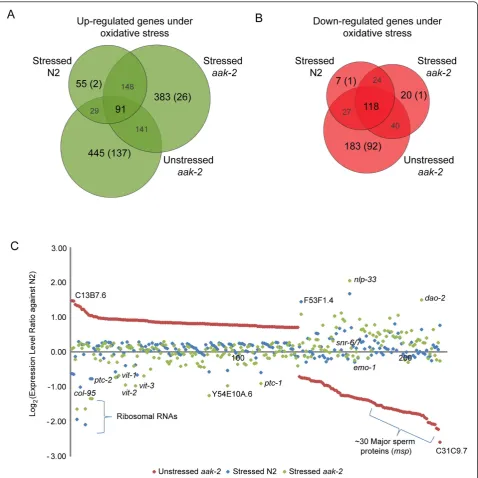
As shown in Figure 4A, there are 91 genes significantly up-regulated in unstressed aak-2 mutants relative to wild type that are in common with stressed aak-2 mutants and also with stressed wild type relative to wild type. These include genes involved in defense response, oxidative phosphorylation, and aging (Additional File 15). Also, there are 118 genes significantly down-regulated in unstressedaak-2mutants that are also sig-nificantly down-regulated in stressedaak-2 and stressed wild type animals relative to wild type (Figure 4B, Addi-tional File 16). These genes include a number of riboso-mal proteins, histones, and prosaposins. This result may indicate that unstressed aak-2mutants are responding to some background level of intrinsic oxidative stress, including metabolism and reproduction, presumably as a result of the absence of AAK-2.
Transcriptional changes specific to unstressed aak-2 mutants: unstressed aak-2 mutants show transcriptional changes in reproduction
There are however genes which show no significant change in expression, or are significantly down-regulated in unstressed aak-2 mutants relative to wild type that are commonly up-regulated in both stressedaak-2 and stressed wild type animals relative to wild type (as indi-cated in orange in Figure 2B). This group of genes
includes collagens, genes involved in aging (dod-6,
dao-2, dao-4, F59E10.3, T02H6.11, T27F7.3), defense
response (hsp-16.2, hsp-16.41), and protein localization (arf-3, dlc-1, trap-3, tag-170, C28H8.4, F59E10.3, W10D9.5) (Additional File 17), suggesting that the stress response of unstressedaak-2mutants is not as strong as that of paraquat treated animals either due to the differ-ent degree of severity of oxidative stress level or the absence of AAK-2 activities in stress resistance. Stressed aak-2mutants did however show even more heightened stress response than stressed wild type animals as dis-cussed earlier, potentially indicating the activity of alter-native stress response pathways in these animals which compensated for the lack of AAK-2 functions in a more severe stress environment.
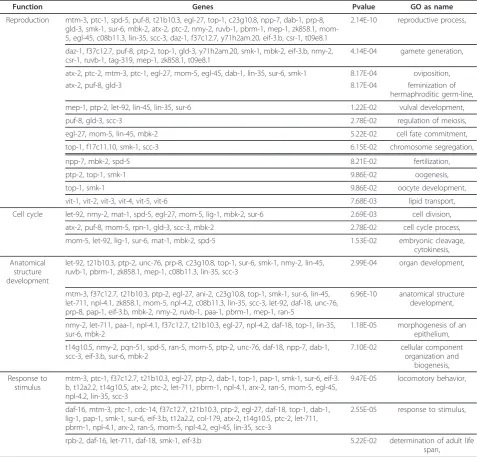
[image:8.595.60.539.107.382.2]Conversely, there are 137 genes up-regulated and 92 genes down-regulated only in unstressedaak-2mutants relative to wild type (Figure 4C). A large fraction of these genes are involved in reproductive processes such as gamete generation, sex differentiation, oocyte devel-opment, regulation of germline mitosis and meiosis, vul-val development, and fertilization as are all vitellogenin genes (vit-1tovit-6), which are known to be involved in fat transport and storage in the germline [27] (Table 3). In addition, peculiarly, genes involved in stress responses such as the forkhead transcription factor, daf-16, and a lipid phosphatase,daf-18, are more highly up-regulated in unstressed aak-2 mutants relative to wild Table 2 Most highly represented biological processes the 125 genes listed in Table 1 are involved in as resulted from GO analysis
GO Genes Pvalue GO as name
GO:0032787 fat-5; fat-4; r11a5.4; gta-1; c17c3.1; r03d7.1; fat-6 5.50E-06 monocarboxylic acid metabolic process; GO:0019752 fat-4; r11a5.4; fat-6; y62e10a.13; lpl-1; fat-5; hpd-1; gta-1; c06a8.1; r03d7.1;
c17c3.1
5.50E-06 carboxylic acid metabolic process;
GO:0006082 fat-4; r11a5.4; fat-6; y62e10a.13; lpl-1; fat-5; hpd-1; gta-1; c06a8.1; r03d7.1; c17c3.1
5.50E-06 organic acid metabolic process;
GO:0006631 fat-5; fat-4; gta-1; c17c3.1; fat-6 0.000325 fatty acid metabolic process; GO:0044255 spp-10; fat-4; c07e3.9; fat-6; fat-5; let-721; gta-1; c17c3.1 0.00139 cellular lipid metabolic process;
GO:0006555 c06a8.1; r03d7.1 0.00139 methionine metabolic process;
GO:0042759 fat-5; fat-6 0.00139 long-chain fatty acid biosynthetic process;
GO:0006633 fat-5; fat-4; fat-6 0.00211 fatty acid biosynthetic process;
GO:0006629 spp-10; fat-4; c07e3.9; fat-6; fat-5; let-721; gta-1; c17c3.1 0.0123 lipid metabolic process;
GO:0009066 c06a8.1; r03d7.1 0.0123 aspartate family amino acid metabolic
process;
GO:0006732 lpl-1; vha-14; t25b9.9; c17c3.1; r03d7.1 0.0123 coenzyme metabolic process;
GO:0000096 c06a8.1; r03d7.1 0.0152 sulfur amino acid metabolic process;
GO:0008610 fat-5; let-721; fat-4; fat-6 0.0236 lipid biosynthetic process;
GO:0006006 ldh-1; r11a5.4; t25b9.9 0.0248 glucose metabolic process;
GO:0006790 c06a8.1; r03d7.1 0.0422 sulfur metabolic process;
GO:0051186 lpl-1; vha-14; t25b9.9; c17c3.1; r03d7.1 0.0422 cofactor metabolic process;
GO:0006519 y62e10a.13; hpd-1; gta-1; c06a8.1; r03d7.1 0.0422 amino acid and derivative metabolic process;
GO:0005996 ldh-1; r11a5.4; t25b9.9 0.0474 monosaccharide metabolic process;
Figure 4Commonly differentially regulated genes in unstressedaak-2and stressedaak-2and transcriptional changes specific to unstressedaak-2mutants.(A)Venn diagram showing numbers of commonly up or(B)down-regulated genes with statistically significant gene expression level changes in stressed wild type, stressedaak-2mutants, and unstressedaak-2mutants (overlapping regions) as well as numbers of genes up or down-regulated exclusively in one library (non-overlapping regions). Notably, there is a relatively large subset of genes up (137) or down-regulated (92) significantly in unstressedaak-2mutants, but either insignificantly regulated or significantly regulated in opposite direction in stressed wild type and stressedaak-2mutants.(C)Genes significantly differentially expressed in unstressedaak-2mutants relative to wild type, but insignificantly regulated or significantly changed in the opposite direction in stressed wild type or stressedaak-2 mutants. The genes are sorted by the expression level changes (log2ratio) in unstressedaak-2mutants, and some interesting genes are labelled
type than in stressed wild type or stressed aak-2 mutants relative to wild type. DAF-16 and DAF-18 are known to regulate a wide variety of genes involved in longevity and stress responses.
A large number of major sperm protein genes (~30) were highly down-regulated in unstressed aak-2 mutants relative to wild type, but were insignificantly altered in stressed wild type and stressed aak-2mutants relative to wild type. Other interesting genes down-regulated only in unstressed aak-2 mutants include dao-2 and emo-1. DAO-2 is a secreted protein that is down-regulated indaf-2 mutant animals, and thus may
be involved in dauer formation [28]. EMO-1 is an ortholog ofS. cerevisiae Sec61p gamma subunit, which is required for translocation of secreted and membrane proteins into the endoplasmic reticulum. EMO-1 is required for oogenesis and ovulation [29].
[image:10.595.61.539.111.568.2]Finally, lysozymeslys-1 andlys-2, small nuclear ribo-nucleoproteins snr-3, snr-6, snr-7 and F45H10.2, Y71H2AM.5, T27E9.2, D2030.4, genes involved in water homeostasis/osmoregulation and generation of precursor metabolites and energy are significantly down-regulated only in unstressed aak-2mutants relative to wild type, but insignificantly changed in stressed wild type and Table 3 Genes significantly up regulated exclusively in unstressedaak-2mutants relative to wild type and the GO terms (biological process) associated with them
Function Genes Pvalue GO as name
Reproduction mtm-3, ptc-1, spd-5, puf-8, t21b10.3, egl-27, top-1, c23g10.8, npp-7, dab-1, prp-8, gld-3, smk-1, sur-6, mbk-2, atx-2, ptc-2, nmy-2, ruvb-1, pbrm-1, mep-1, zk858.1, mom-5, egl-4mom-5, c08b11.3, lin-3mom-5, scc-3, daz-1, f37c12.7, y71h2am.20, eif-3.b, csr-1, t09e8.1
2.14E-10 reproductive process,
daz-1, f37c12.7, puf-8, ptp-2, top-1, gld-3, y71h2am.20, smk-1, mbk-2, eif-3.b, nmy-2, csr-1, ruvb-1, tag-319, mep-1, zk858.1, t09e8.1
4.14E-04 gamete generation,
atx-2, ptc-2, mtm-3, ptc-1, egl-27, mom-5, egl-45, dab-1, lin-35, sur-6, smk-1 8.17E-04 oviposition,
atx-2, puf-8, gld-3 8.17E-04 feminization of
hermaphroditic germ-line,
mep-1, ptp-2, let-92, lin-45, lin-35, sur-6 1.22E-02 vulval development,
puf-8, gld-3, scc-3 2.78E-02 regulation of meiosis,
egl-27, mom-5, lin-45, mbk-2 5.22E-02 cell fate commitment,
top-1, f17c11.10, smk-1, scc-3 6.15E-02 chromosome segregation,
npp-7, mbk-2, spd-5 8.21E-02 fertilization,
ptp-2, top-1, smk-1 9.86E-02 oogenesis,
top-1, smk-1 9.86E-02 oocyte development,
vit-1, vit-2, vit-3, vit-4, vit-5, vit-6 7.68E-03 lipid transport,
Cell cycle let-92, nmy-2, mat-1, spd-5, egl-27, mom-5, lig-1, mbk-2, sur-6 2.69E-03 cell division,
atx-2, puf-8, mom-5, rpn-1, gld-3, scc-3, mbk-2 2.78E-02 cell cycle process,
mom-5, let-92, lig-1, sur-6, mat-1, mbk-2, spd-5 1.53E-02 embryonic cleavage,
cytokinesis,
Anatomical structure development
let-92, t21b10.3, ptp-2, unc-76, prp-8, c23g10.8, top-1, sur-6, smk-1, nmy-2, lin-45, ruvb-1, pbrm-1, zk858.1, mep-1, c08b11.3, lin-35, scc-3
2.99E-04 organ development,
mtm-3, f37c12.7, t21b10.3, ptp-2, egl-27, ani-2, c23g10.8, top-1, smk-1, sur-6, lin-45, let-711, npl-4.1, zk858.1, mom-5, npl-4.2, c08b11.3, lin-35, scc-3, let-92, daf-18, unc-76, prp-8, pap-1, eif-3.b, mbk-2, nmy-2, ruvb-1, paa-1, pbrm-1, mep-1, ran-5
6.96E-10 anatomical structure development,
nmy-2, let-711, paa-1, npl-4.1, f37c12.7, t21b10.3, egl-27, npl-4.2, daf-18, top-1, lin-35, sur-6, mbk-2
1.18E-05 morphogenesis of an epithelium,
t14g10.5, nmy-2, pqn-51, spd-5, ran-5, mom-5, ptp-2, unc-76, daf-18, npp-7, dab-1, scc-3, eif-3.b, sur-6, mbk-2
7.10E-02 cellular component organization and
biogenesis,
Response to stimulus
mtm-3, ptc-1, f37c12.7, t21b10.3, egl-27, ptp-2, dab-1, top-1, pap-1, smk-1, sur-6, eif-3. b, t12a2.2, t14g10.5, atx-2, ptc-2, let-711, pbrm-1, npl-4.1, arx-2, ran-5, mom-5, egl-45, npl-4.2, lin-35, scc-3
9.47E-05 locomotory behavior,
daf-16, mtm-3, ptc-1, cdc-14, f37c12.7, t21b10.3, ptp-2, egl-27, daf-18, top-1, dab-1, lig-1, pap-1, smk-1, sur-6, eif-3.b, t12a2.2, col-179, atx-2, t14g10.5, ptc-2, let-711, pbrm-1, npl-4.1, arx-2, ran-5, mom-5, npl-4.2, egl-45, lin-35, scc-3
2.55E-05 response to stimulus,
stressedaak-2mutants relative to wild type (Additional File 18).
Discussion
In this study we have used deep sequencing to construct a global picture of transcriptional changes in response to perturbation of aak-2 in the presence or absence of paraquat induced oxidative stress. While this approach provides an indirect method for assessing specific gene functions and relationships, it has given insight into glo-bal stress responses as based on previously characterized functions of AAK-2. Many of the potential targets of AAK-2 identified in this study remain to be character-ized at a developmental level. Further investigation of these genes is expected to increase our understanding of the complex biological network governing stress resis-tance and energy homeostasis inC. elegans.
Collagens may be involved in stress resistance and longevity
When we grouped significantly up-regulated genes in both wild type andaak-2mutants in response to oxida-tive stress by similar function we found significant enrichment for cuticle collagen genes. This may indicate that collagens may be involved in the necessary adaptive mechanism for survival against oxidative stress in C. elegans. Cuticle collagens are the major component of the cuticle, an exoskeleton that surrounds the body of C. elegansfunctioning as a barrier between the ani-mal and its environment. The cuticle is essential for maintenance of body morphology and integrity, and has a critical role in locomotion via attachments to body-wall muscles [30-32]. Several cuticles are synthesized throughout development ofC. elegansbeginning at the end of embryogenesis prior to hatching and then prior to molting at the end of each larval stage [33]. As all samples were derived from developmentally synchro-nized populations of adult animals, the significant up-regulation of the cuticle collagens is not likely to be due to developmental synthesis of the cuticle, but possibly due to the response to oxidative stress. We have noted that these collagens were highly up-regulated in both stressed aak-2 and in stressed wild type animals, but insignificantly changed in unstressed aak-2 mutants. Considering unstressed aak-2 mutants also demon-strated some degree of stress response, this difference might be due to the degree of oxidative stress to which the worms were exposed.
The genes encoding cuticle collagens were also found to be differentially expressed in response to bacterial species [34,35]. Increased expression of C. elegans cuti-cle collagens was a common response to multiple patho-gens (S. marcescens, E. faecalis, E. carotovora, and P. luminescens) [35]. In addition, it has been shown that
collagen genes are over expressed under oxidative stress in rat hepatic stellate cells [36,37]. In aging research, a recent study identified a large number of collagens as age regulated genes [38,39], and it has been shown that collagen gene expression decreases with age in long-livedC. elegans daf-2 mutants [39]. Overall these data suggest that cuticle collagens may be differentially regulated indirectly in response to oxidative stress or possibly involved in defense against environmental per-turbations and potentially in longevity.
Comparison to previously identified genes involved in aging
We also examined previously identified age-regulated genes [38]. Budovskayaet al. compared transcriptomes from young and old adult C. elegans using DNA microarrays and identified 1254 age-regulated genes. Of those, we found 1029 genes in our data and identi-fied 80 genes significantly up or down-regulated in stressed wild type animals. The majority of these genes were also significantly up or down-regulated in stressed aak-2 mutants. We observed the trend that most genes which were up-regulated in wild type in response to oxidative stress (average log2 ratio = ~1.3)
were also up-regulated in aak-2mutants (average log2
ratio = ~1.5), but in unstressed aak-2 mutants, these genes were only slightly up-regulated (average log2
ratio = ~0.3) which include many collagens. Interest-ingly, down-regulated genes under oxidative stress showed a similar degree of expression level changes in all three groups (average log2 ratio = ~-1.4).
Further-more, we identified 22 genes significantly up-regulated and 3 genes down-regulated in stressed aak-2mutants only (Table 4). These genes are included in the 125 and 11 genes identified to be up or down regulated, respectively, in stressed aak-2 mutants only and we speculate that these age-regulated genes may be speci-fically under the control of AAK-2.
Comparison to previously identified DAF-16 targets The forkhead transcription factor DAF-16 regulates a wide variety of genes involved in longevity and stress responses. DAF-16 is negatively regulated by the insu-lin-like growth factor receptor 2 [40,41], and DAF-16 mediates longevity Induced by dietary restriction in C. elegans[42]. Recent studies suggest that genes regu-lated by DAF-16 are involved in cellular stress response, metabolism, and energy generation. It has also been shown that AAK-2 activates DAF-16 dependent gene expression. Additionally, AAK-2 directly phosphorylates DAF-16 [42]. AAK-2 therefore is likely to contribute to DAF-16 function in stress response.
We observed a slight increase (log2 ratio = ~0.3) in
We examined previously identified DAF-16 targets [24] and found many of these genes differentially expressed in stressed wild type animals. We then compared the known DAF-16 targets [24,39,43] with genes that are significantly changed in response to oxidative stress in this study and observed increases in transcriptional levels of several previously identified positive targets of DAF-16 includingcol-157, dao-4, dao-6, dod-6,hsp-16.2, hsp-16.49, hsp-70,odc-1, andsod-2, and reduced tran-scription of genes known to be inhibited by DAF-16 includingfip-5, andmtl-2[24,43] in stressed wild type as well as stressedaak-2mutants. These DAF-16 target genes were however, not as significantly changed in unstressed aak-2mutants even though expression of daf-16itself was most highly up-regulated in unstressed aak-2mutants (log2 ratio = ~1).
This result is not conclusive as the expression level changes of the known DAF-16 targets were not highly statistically significant in our data, but we speculate that it might suggest that AAK-2 works together with DAF-16 and that in the absence of AAK-2 (as in unstressed aak-2 mutants), DAF-16 targets were not regulated as efficiently as in wild type. For example, the vitellogenin genes which have been shown to be up-regulated in the
absence of DAF-16 [24], were significantly up-regulated only in unstressedaak-2mutants.
The fact that DAF-16 downstream targets in stressed aak-2 mutants were regulated in the same way as in stressed wild type may indicate that under the severe oxidative stress, other alternative compensatory defense mechanisms were able to regulate DAF-16 downstream genes more efficiently even in the absence of AAK-2.
AAK-2 may regulate genes involved in fat synthesis, transport, and storage
It has been previously shown that mammalian AMPK is involved in down-regulating fatty acid synthesis in liver and adipose cell, and up-regulating fatty acid oxidation in muscle [5,9]. Also, in another study, Narbonne and Roy found that inC. elegans dauer, AAK-2 acts in adi-pose-like tissues to down-regulate triglyceride hydrolysis so that these lipid reserves are rationed to last the entire duration of the arrest [11].
As discussed earlier, based on our data, we speculate that AAK-2 may act to inhibit fat synthesis under oxida-tive stress by down-regulating genes involved in lipid synthesis, such asΔ9 fatty acid desaturases (fat-5tofat-7) which will require further experiments to confirm and reveal specific association with AAK-2. The regulation of fat synthesis is essential for survival of animals in unfavor-able environmental conditions [44,45].Δ9 fatty acid desa-turases are involved in lipid synthesis, specifically in production of monounsaturated fatty acids which are components of triacylglycerides (TAGs) and phospholipids [46]. TAGs are stored in lipid droplets and yolk which make up important energy stores. The increased transcrip-tion levels of the Δ9 fatty acid desaturases in aak-2 mutants signify increased fat synthesis in these mutants. This energy-consuming fat synthesis is however, down-regulated in wild type animals under conditions of oxidative stress.
Vitellogenins were one of the most highly expressed groups of genes inaak-2mutants. Vitellogenins function in fat storage and are used as protein components for intercellular transport of lipid particles, including yolk [47]. Speculatively, this might be explained as a conse-quence of the increased fat synthesis in aak-2 mutants. Additionally,ptc-1and ptc-2were also significantly up-regulated inaak-2 mutants.ptc-1 andptc-2, orthologs of Drosophila PATCHED (PTC) and human PTCH, define one of seven paralogous families of sterol sensing domain (SSD) proteins that are required for lipid trans-port [48,49].
[image:12.595.58.289.111.425.2]Taken together, our data suggests that AAK-2 may be involved in negatively regulating lipid synthesis, trans-port, and storage in response to oxidative stress in C. elegans and provides potential genes which may be involved in these processes. This result supports the Table 4 Age-regulated genes (Budovskaya et al. 2008)
which are differentially regulated in stressedaak-2only
Gene Log2(Stressedaak-2/N2) Audic & Claverie p-val
clec-52 3.12 9.77E-04
F35E12.5 2.25 5.13E-27
nlp-29 2.15 8.68E-07
F08G5.6 2.00 5.72E-07
Y19D10A.12 1.83 5.35E-08
scl-2 1.67 6.91E-03
F44E7.2 1.61 5.35E-05
T28F4.5 1.41 8.19E-07
ech-6 1.32 4.32E-11
K07C11.7 1.30 8.85E-03
ttr-47 1.18 1.98E-04
C42D4.1 1.14 1.68E-05
far-6 1.03 1.12E-03
R11A5.4 1.03 4.27E-07
T20G5.8 0.94 1.08E-03
glt-1 0.94 6.49E-03
gta-1 0.89 2.48E-04
T15B7.2 0.85 8.84E-04
F08B12.4 0.82 4.75E-03
W10C8.5 0.77 4.14E-03
spp-10 0.76 1.84E-04
F56C9.7 0.73 4.28E-03
F45D11.16 -3.24 2.04E-03
F15E11.1 -4.84 2.84E-173
characterized complex role of AAK-2 in regulation of lipid metabolism.
AAK-2 may regulate genes involved in reproduction We have previously shown AAK-2 expression in the dis-tal tip cells, spermatheca, and sheath cells [14]. Also, AAK-2 is known to be involved in germ cell cycle arrest upon dauer entry [10]. InDrosophila melanogaster, it has been shown that a deletion of the single AMPK a gene results in lethality, with severe abnormalities in cell polarity and mitosis [50].
Our data suggests that AAK-2 may have a general role in the regulation of genes involved in germline prolifera-tion and reproducprolifera-tion in C. elegans as in unstressed aak-2mutants, genes involved in reproductive processes such as gamete generation, oviposition, sex differentia-tion, regulation of meiosis, cell division, vulval develop-ment, and fertilization were up-regulated relative to wild type animals.
For instance, PTC-1 and PTC-2 are significantly up-regulated in unstressed aak-2mutants relative to wild type but significantly down-regulated in stressed wild type and are involved in lipid transport as mentioned above. Interestingly, PTC-1, the activity and expression of which is essentially confined to the germ line [49], is required for cytokinesis in the germline, but not in somatic cells, and also essential to isolate meiotic germ-line nuclei from one another so that their nuclear divi-sions are asynchronous [48,49]. PTC-1 is enriched in the plasma membrane of mitotic germ cells undergoing proliferation, or membranes of oocytes undergoing rapid expansions [51]. Similarly, PTC-2 is also necessary for normal egg osmotic integrity, locomotion, egg laying, and viability [49]. Also, the significantly up-regulated transcription of vitellogenin genes which function in lipid transport and storage in the germline indicates energy-intensive production of vitellogenin-rich oocytes in unstressedaak-2mutants.
In contrast, most major sperm protein genes were highly down-regulated in unstressedaak-2mutants rela-tive to wild type. Major sperm proteins (MSPs) are involved in both extracellular signaling and cytoskeletal functions during reproduction [52]. MSP antagonizes Eph/ephrin signaling, in part, by binding VAB-1 Eph receptor tyrosine kinase on oocytes and sheath cells to promote oocyte maturation and MAPK activation [53,54]. MSP proteins assemble into fibrous networks that drive movement of theC. eleganssperm [55]. Also, EMO-1 which is required for oogenesis and ovulation is highly down-regulated in unstressedaak-2mutants rela-tive to wild type [29].
These gene expression changes seen in unstressed aak-2mutants relative to wild type were not shown in stressed aak-2 mutants. This suggests that the
misregulation of germline specific genes shown in unstressed aak-2 mutants presumably caused by the absence of AAK-2 activities were recovered when the aak-2mutants were under more severe oxidative stress, and this may indicate presence of alternative defense mechanisms that compensated for the lost AAK-2 activities.
Additionally, the most highly down-regulated genes in aak-2mutants (stressed and unstressed) are F15E11.1 (i. e. log2 = -7, p-val = 1.2E-213) and the paralogs
F15E11.12, F15E11.13, F15E11.15, and Y19D10B.7 which belong to a nematode-specific family. F15E11.1 encodes a 17.4 kDa protein with unknown function that is seven-fold more abundant inglp-1mutant hermaphro-dites (which lack a germline) than in normal hermaph-rodites [56]. This also suggests that AAK-2 may function in the germline as it regulates transcription of F15E11.1 and the paralogs which are known to be involved in the germline.
Conclusions
We have identified potential downstream target genes of AAK-2 which may be involved in oxidative stress response, specifically with regards to lipid metabolism and reproduction from this comparative transcriptome analysis, however further experiments would be neces-sary in order to confirm or identify the functions of these candidate genes, and also to elucidate precise rela-tionships with AAK-2. A link between fat metabolism, germline stem cells, and longevity in C. elegans has recently been reported as germline stem cell arrest pro-motes systemic lipolysis, and consequently, life span is prolonged [57]. Our data suggests AAK-2 may play an important role in regulation of these interrelated biolo-gical processes. Therefore, the deregulation of lipid metabolism and reproductive processes caused by the absence of AAK-2 might account for the hyper-sensitivity to oxidative stress and potentially shortened life span of aak-2mutants.
Materials and methods Strains and Culture Conditions
Bristol N2 C. elegans strains were obtained from the
Caenorhabditis Genetics Center (Minneapolis, MN).
the same way, using PBS buffer without adding para-quat. After checking all of the worms alive, total RNA was extracted from four samples using easy-BLUE RNA Extraction Kit (iNtRON, Korea), according to the manu-facturer’s instructions.
Construction of whole transcriptome libraries fromC. elegansRNA
Four libraries were constructed from strain N2, paraquat treated N2, aak-2 (gt33) and paraquat treated aak-2 (gt33). 14-20 ug Dnase I-treated RNA was used to purify poly A + RNA fraction using the MACSTM mRNA Iso-lation Kit (Cat# 130-075-102, Miltenyi Biotec). Double-stranded cDNAs were made from poly A + RNA (200 ng) using Superscript™Double-Stranded cDNA Synthesis kit (Cat# 11917-010, Invitrogen) and random hexamer primers at 5μM.
The cDNAs were sonicated for 5 minutes using the cup horn Sonic Dismembrator 550 (Fisher Scientific). Fragmented cDNAs from all four libraries were each size-fractionated on 8% polyacrylamide gels, and the 100 to 300 base pair fractions were excised. The gel-purified cDNA products were modified for sequencing using the genomic DNA prep kit (FC-102-1002, Illu-mina) as follows: Size-selected cDNAs were subject to end-repair, 3’A overhangs generation, and phosphory-lation by T4 DNA polymerase, Klenow DNA Polymer-ase, and T4 polynucleotide kinase respectively in a single reaction, and then ligated to Illumina adapters, which contain 5’ T overhangs. The adapter-ligated pro-ducts were purified on Qiaquick spin columns
(Qia-gen), then PCR-amplified with Phusion DNA
Polymerase in 10 cycles using Illumina’s genomic DNA primer set (Illumina). PCR products were purified on Qiaquick MinElute columns (Qiagen) and the DNA quality assessed and quantified using an Agilent DNA 1000 series II assay and Nanodrop 7500 spectrophot-ometer (Nanodrop) and diluted to 10 nM. Cluster gen-eration and sequencing was performed on the Illumina cluster station and 1G analyzer (Illumina) following manufacturer’s instructions. Sequences were extracted from the resulting image files using the open source Firecrest and Bustard applications (Illumina) on a 32 CPU cluster.
Molecular mapping methods
Sequences were obtained from the Solexa (Illumina GA) sequencing machine in the seq.txt format, from lanes. The individual files were processed and converted to fasta format, while removing sequences with uncalled bases, or containing runs of more than 19 adenines. The FASTA files containing the sequences for each lane were then aligned against a collection of all annotated transcripts available from Biomart.org (WS180) using
Exonerate 1.0, (–model ungapped–bestn 1– showalign-ment 0–showvulgar 1).
Statistical analysis
In order to determine statistically significant differential gene expression from pair wise comparisons of the four libraries, i.e. wild type, stressed wild type, aak-2and stressedaak-2, we applied Audic-Claverie test of statisti-cal significance [21] using normalized read frequencies (i.e. Normalized number of reads per gene = number of reads mapped to a gene * the read length (36 bases)/the gene length/total number of reads in the library) of commonly identified genes. Additional File 19 lists num-ber of reads before and after the normalization mapped to transcripts. We then selected genes that had p-values less than 0.01 and log2 expression level ratios greater
than 0.7 (Minimum of ~1.5 difference) for every comparison.
Additional material
Additional file 1: Supplementary Table S1. Summary of the sequencing and mapping the data to the C. elegans transcriptome
Additional file 2: Supplementary Figure S1. Q-PCR validation results using a biological replicate
Additional file 3: Supplementary Table S2. Significantly up or down regulated in stressed wild type relative to unstressed wild type
Additional file 4: Supplementary Table S3. GO analysis for up or down regualted genes in stressed wild type relative to unstressed wild type
Additional file 5: Supplementary Table S4. Genes that were significantly down-regulated in wild type animals under oxidative stress
Additional file 6: Supplementary Table S5. Significantly up-regulated genes in stressed aak-2 mutants relative to wild type
Additional file 7: Supplementary Table S6. Commonly down-regulated genes in stressed wild type and stressed aak-2 mutants relative to wild type
Additional file 8: Supplementary Table S7. Commonly up-regulated genes in stressed wild type and stressed aak-2 mutants relative to wild type
Additional file 9: Supplementary Table S8. 125 genes up regulated in stressed aak-2, but insignificantly changed in stressed wild type and their fold changes of gene expression levels in stressed wild type and stressed aak-2 relative to wild type
Additional file 10: Supplementary Table S9. 125 gene up-regulated in stressed aak-2 relative to wild type but insignificantly changed in stressed wild type relative to wild type and most highly represented biological processes these genes are involved in
Additional file 11: Supplementary Table S10. Genes that are significantly up-regulated in unstressed aak-2 mutants compared to wild type animals
Additional file 12: Supplementary Table S11. Genes that are significantly up-regulated in unstressed aak-2 mutants compared to wild type animals and most highly represented biological processes these genes are involved in
Additional file 13: Supplementary Table S12. Significantly down-regulated genes in unstressed aak-2 relative to wild type
Additional file 15: Supplementary Table S14. Commonly up-regulated genes in unstressed aak-2, stressed aak-2, and stressed wild type and most highly represented biological processes these genes are involved in
Additional file 16: Supplementary Table S15. Commonly down-regulated genes in unstressed aak-2, stressed aak-2, and stressed wild type and most highly represented biological processes these genes are involved in
Additional file 17: Supplementary Table S16. Genes which show no significant change in expression, or are significantly down-regulated in unstressed aak-2 mutants that are commonly up-regulated in both stressed aak-2 and stressed wild type
Additional file 18: Supplementary Table S17. Genes significantly up or down-regulated only in unstressed aak-2 mutants relative to wild type, but insignificantly changed in stressed wild type and stressed aak-2 mutants relative to wild type
Additional file 19: Supplementary Table S18. Number of reads mapped to transcripts before and after normalization
List of abbreviations
AMPK: AMP activated protein kinase; ROS: reactive oxygen species; MSPs: major sperm proteins; TAGs: triacylglycerides
Acknowledgements
This work was funded by Natural Sciences and Engineering Research Council to HS and BK21 global internship to HL. We greatly appreciate the helpful comments and useful discussions on the manuscript from Dr. Donald L. Riddle and Dr. Martin R. Jones. cDNA library construction and Illumina sequencing was done at the Genome Sciences Centre, BC Cancer Agency.
Author details 1
Genome Sciences Centre, BC Cancer Agency, Suite 100 570 West 7th Avenue, Vancouver, British Columbia, Canada V5Z 4S6.2Department of
Biochemistry, College of Life Science & Biotechnology, Yonsei University, Seoul 120-749, Republic of Korea.3Molecular Biology and Biochemistry,
Simon Fraser University, 8888 University Drive, Burnaby, British Columbia, Canada V5A 1S6.
Authors’contributions
HS carried out the data analyses and wrote the manuscript. HL prepared the mRNA samples, contributed to analyzing the data and writing the manuscript, and performed Q-PCR validation experiments. AF designed the sequence mapping program. SJMJ, HK, and DLB conceived of the study. All authors read and approved the final manuscript.
Authors’information
SJMJ is a senior scholar of the Michael Smith Foundation for Health Research. DLB holds a Canada Research Chair in Genomics.
Competing interests
The authors declare that they have no competing interests.
Received: 23 August 2010 Accepted: 8 February 2011 Published: 8 February 2011
References
1. Munoz MJ, Riddle DL:Positive selection of Caenorhabditis elegans mutants with increased stress resistance and longevity.Genetics2003,
163:171-180.
2. Johnson TE, de Castro E, Hegi de Castro S, Cypser J, Henderson S,et al:
Relationship between increased longevity and stress resistance as assessed through gerontogene mutations in Caenorhabditis elegans.Exp Gerontol2001,36:1609-1617.
3. Murakami S, Johnson TE:The OLD-1 positive regulator of longevity and stress resistance is under DAF-16 regulation in Caenorhabditis elegans.
Curr Biol2001,11:1517-1523.
4. Hardie DG, Scott JW, Pan DA, Hudson ER:Management of cellular energy by the AMP-activated protein kinase system.FEBS Lett2003,546:113-120.
5. Hardie DG:The AMP-activated protein kinase pathway–new players upstream and downstream.J Cell Sci2004,117:5479-5487. 6. Imamura K, Ogura T, Kishimoto A, Kaminishi M, Esumi H:Cell cycle
regulation via p53 phosphorylation by a 5’-AMP activated protein kinase activator, 5-aminoimidazole-4-carboxamide-1-beta-D-ribofuranoside, in a human hepatocellular carcinoma cell line.Biochem Biophys Res Commun 2001,287:562-567.
7. Shaw RJ, Lamia KA, Vasquez D, Koo SH, Bardeesy N,et al:The kinase LKB1 mediates glucose homeostasis in liver and therapeutic effects of metformin.Science2005,310:1642-1646.
8. Solaz-Fuster MC, Gimeno-Alcaniz JV, Casado M, Sanz P:TRIP6
transcriptional co-activator is a novel substrate of AMP-activated protein kinase.Cell Signal2006,18:1702-1712.
9. Kahn BB, Alquier T, Carling D, Hardie DG:AMP-activated protein kinase: ancient energy gauge provides clues to modern understanding of metabolism.Cell Metab2005,1:15-25.
10. Narbonne P, Roy R:Inhibition of germline proliferation during C. elegans dauer development requires PTEN, LKB1 and AMPK signalling.
Development2006,133:611-619.
11. Narbonne P, Roy R:Caenorhabditis elegans dauers need LKB1/AMPK to ration lipid reserves and ensure long-term survival.Nature2009,
457:210-214.
12. Klass M, Hirsh D:Non-ageing developmental variant of Caenorhabditis elegans.Nature1976,260:523-525.
13. Apfeld J, O’Connor G, McDonagh T, DiStefano PS, Curtis R:The AMP-activated protein kinase AAK-2 links energy levels and insulin-like signals to lifespan in C. elegans.Genes Dev2004,
18:3004-3009.
14. Lee H, Cho JS, Lambacher N, Lee J, Lee SJ,et al:The Caenorhabditis elegans AMP-activated protein kinase AAK-2 is phosphorylated by LKB1 and is required for resistance to oxidative stress and for normal motility and foraging behavior.J Biol Chem2008,283:14988-14993.
15. Kim Y, Sun H:Functional genomic approach to identify novel genes involved in the regulation of oxidative stress resistance and animal lifespan.Aging Cell2007,6:489-503.
16. Allen RG, Tresini M:Oxidative stress and gene regulation.Free Radic Biol Med2000,28:463-499.
17. Curtis R, O’Connor G, DiStefano PS:Aging networks in Caenorhabditis elegans: AMP-activated protein kinase (aak-2) links multiple aging and metabolism pathways.Aging Cell2006,5:119-126.
18. Marioni JC, Mason CE, Mane SM, Stephens M, Gilad Y:RNA-seq: an assessment of technical reproducibility and comparison with gene expression arrays.Genome Res2008,18:1509-1517.
19. Hillier LW, Reinke V, Green P, Hirst M, Marra MA,et al:Massively parallel sequencing of the polyadenylated transcriptome of C. elegans.Genome Res2009,19:657-666.
20. Bennett S:Solexa Ltd.Pharmacogenomics2004,5:433-438.
21. Audic S, Claverie JM:The significance of digital gene expression profiles.
Genome Res1997,7:986-995.
22. Beissbarth T, Speed TP:GOstat: find statistically overrepresented Gene Ontologies within a group of genes.Bioinformatics2004,
20:1464-1465.
23. Baumbach LL, Stein GS, Stein JL:Regulation of human histone gene expression: transcriptional and posttranscriptional control in the coupling of histone messenger RNA stability with DNA replication.
Biochemistry1987,26:6178-6187.
24. Murphy CT, McCarroll SA, Bargmann CI, Fraser A, Kamath RS,et al:Genes that act downstream of DAF-16 to influence the lifespan of Caenorhabditis elegans.Nature2003,424:277-283.
25. Melendez A, Talloczy Z, Seaman M, Eskelinen EL, Hall DH,et al:Autophagy genes are essential for dauer development and life-span extension in C. elegans.Science2003,301:1387-1391.
26. Alper S, McBride SJ, Lackford B, Freedman JH, Schwartz DA:Specificity and complexity of the Caenorhabditis elegans innate immune response.Mol Cell Biol2007,27:5544-5553.
27. Matyash V, Geier C, Henske A, Mukherjee S, Hirsh D,et al:Distribution and transport of cholesterol in Caenorhabditis elegans.Mol Biol Cell2001,
12:1725-1736.
29. Iwasaki K, McCarter J, Francis R, Schedl T:emo-1, a Caenorhabditis elegans Sec61p gamma homologue, is required for oocyte development and ovulation.J Cell Biol1996,134:699-714.
30. Kramer JM, Johnson JJ, Edgar RS, Basch C, Roberts S:The sqt-1 gene of C. elegans encodes a collagen critical for organismal morphogenesis.Cell 1988,55:555-565.
31. Johnstone IL, Shafi Y, Barry JD:Molecular analysis of mutations in the Caenorhabditis elegans collagen gene dpy-7.EMBO J1992,11:3857-3863. 32. von Mende N, Bird DM, Albert PS, Riddle DL:dpy-13: a nematode collagen
gene that affects body shape.Cell1988,55:567-576.
33. Cox GN, Hirsh D:Stage-specific patterns of collagen gene expression during development of Caenorhabditis elegans.Mol Cell Biol1985,
5:363-372.
34. Coolon JD, Jones KL, Todd TC, Carr BC, Herman MA:Caenorhabditis elegans genomic response to soil bacteria predicts environment-specific genetic effects on life history traits.PLoS Genet2009,5:e1000503. 35. Wong D, Bazopoulou D, Pujol N, Tavernarakis N, Ewbank JJ:Genome-wide
investigation reveals pathogen-specific and shared signatures in the response of Caenorhabditis elegans to infection.Genome Biol2007,8: R194.
36. Aragno M, Mastrocola R, Alloatti G, Vercellinatto I, Bardini P,et al:Oxidative stress triggers cardiac fibrosis in the heart of diabetic rats.Endocrinology 2008,149:380-388.
37. del Carmen EM, Souza V, Bucio L, Hernandez E, Damian-Matsumura P,et al:
Cadmium induces alpha(1)collagen (I) and metallothionein II gene and alters the antioxidant system in rat hepatic stellate cells.Toxicology2002,
170:63-73.
38. Budovskaya YV, Wu K, Southworth LK, Jiang M, Tedesco P,et al:An elt-3/ elt-5/elt-6 GATA transcription circuit guides aging in C. elegans.Cell 2008,134:291-303.
39. Halaschek-Wiener J, Khattra JS, McKay S, Pouzyrev A, Stott JM,et al:
Analysis of long-lived C. elegans daf-2 mutants using serial analysis of gene expression.Genome Res2005,15:603-615.
40. Kenyon C, Chang J, Gensch E, Rudner A, Tabtiang R:A C. elegans mutant that lives twice as long as wild type.Nature1993,366:461-464. 41. Schaffitzel E, Hertweck M:Recent aging research in Caenorhabditis
elegans.Exp Gerontol2006,41:557-563.
42. Greer EL, Dowlatshahi D, Banko MR, Villen J, Hoang K,et al:An AMPK-FOXO pathway mediates longevity induced by a novel method of dietary restriction in C. elegans.Curr Biol2007,17:1646-1656. 43. McElwee J, Bubb K, Thomas JH:Transcriptional outputs of the
Caenorhabditis elegans forkhead protein DAF-16.Aging Cell2003,
2:111-121.
44. Murray P, Hayward SA, Govan GG, Gracey AY, Cossins AR:An explicit test of the phospholipid saturation hypothesis of acquired cold tolerance in Caenorhabditis elegans.Proc Natl Acad Sci USA2007,104:5489-5494. 45. Van Gilst MR, Hadjivassiliou H, Yamamoto KR:A Caenorhabditis elegans
nutrient response system partially dependent on nuclear receptor NHR-49.Proc Natl Acad Sci USA2005,102:13496-13501.
46. Watts JL:Fat synthesis and adiposity regulation in Caenorhabditis elegans.Trends Endocrinol Metab2009,20:58-65.
47. Mullaney BC, Ashrafi K:C. elegans fat storage and metabolic regulation.
Biochim Biophys Acta2009,1791:474-478.
48. Zugasti O, Rajan J, Kuwabara PE:The function and expansion of the Patched- and Hedgehog-related homologs in C. elegans.Genome Res 2005,15:1402-1410.
49. Kuwabara PE, Lee MH, Schedl T, Jefferis GS:A C. elegans patched gene, ptc-1, functions in germ-line cytokinesis.Genes Dev2000,14:1933-1944. 50. Lee JH, Koh H, Kim M, Kim Y, Lee SY,et al:Energy-dependent regulation
of cell structure by AMP-activated protein kinase.Nature2007,
447:1017-1020.
51. Burglin TR, Kuwabara PE:Homologs of the Hh signalling network in C. elegans.WormBook2006, 1-14.
52. Miller MA, Nguyen VQ, Lee MH, Kosinski M, Schedl T,et al:A sperm cytoskeletal protein that signals oocyte meiotic maturation and ovulation.Science2001,291:2144-2147.
53. McCarter J, Bartlett B, Dang T, Schedl T:On the control of oocyte meiotic maturation and ovulation in Caenorhabditis elegans.Dev Biol1999,
205:111-128.
54. Kuwabara PE:The multifaceted C. elegans major sperm protein: an ephrin signaling antagonist in oocyte maturation.Genes Dev2003,
17:155-161.
55. Miller MA, Ruest PJ, Kosinski M, Hanks SK, Greenstein D:An Eph receptor sperm-sensing control mechanism for oocyte meiotic maturation in Caenorhabditis elegans.Genes Dev2003,17:187-200.
56. Krijgsveld J, Ketting RF, Mahmoudi T, Johansen J, Artal-Sanz M,et al:
Metabolic labeling of C. elegans and D. melanogaster for quantitative proteomics.Nat Biotechnol2003,21:927-931.
57. Wang MC, O’Rourke EJ, Ruvkun G:Fat metabolism links germline stem cells and longevity in C. elegans.Science2008,322:957-960.
doi:10.1186/1756-0500-4-34
Cite this article as:Shinet al.:Gene expression profiling of oxidative stress response ofC. elegansaging defective AMPK mutants using massively parallel transcriptome sequencing.BMC Research Notes2011
4:34.
Submit your next manuscript to BioMed Central and take full advantage of:
• Convenient online submission
• Thorough peer review
• No space constraints or color figure charges
• Immediate publication on acceptance
• Inclusion in PubMed, CAS, Scopus and Google Scholar
• Research which is freely available for redistribution